
Question Time at This Weekend's Hustings in Aberdeen
Question Time at This Weekend's Hustings in Aberdeen
Just in from this year’s John P. Macintosh memorial lecture in the University of Edinburgh’s magnificent Playfair Library. After Rhodri Morgan’s typically barnstorming lecture last year on Wales as a Celtic Bermuda Triangle again kept the bar high, this year’s less ebullient but measured and erudite contribution from the BBC’s Brian Taylor did not disappoint in providing sound possibilities as options.
Never one to dodge a hot topic, Brian squared up to current affairs with “Scotland’s Referendum: who, what, when, where, why?” and proceeded to address each of the questions posed, though not, as he said, in that order. As an nationalist who survived the brutally lean years of the ‘feeble fifty’ eighties and the walking-dead Tories of the nineties when the press would rather sabotage their presses than write much positive about the cause of independence, those, like Brian who sought to pitch both sides fairly were rare and appreciated. This lecture showed why they still are.
The audience at a Macintosh Lecture is usually the East Lothian/Edinburgh Labour Party at prayer. But, starting in the nineties, local SNP activists also laid claim to a man of principle who stood up for Scotland, arguing his case for devolution fluently at a time when such radical thought was not well received, even in his own party. Since Labour lost East Lothian Council in 2007 and the Haddington House enclave of its Administration given back to the Lamp of Lothian Trust, the big private bashes there after lectures in the magnificent St Mary’s have become a thing of the past.
But that has meant a broader audience as it oscillates between Haddington and the University, where John had also been a much-respected Professor of Politics. Such was the case tonight and Brian pitched it well, first arguing some of the less controversial conclusions, such as the registered voters of Scotland must be the “who” in his title (if Britain had another plebiscite over changing its own EU relation, it would be nonsense to need an EU-wide referendum to endorse it).
Most interesting of all for me—and left to the last, perhaps because of its degree of current controversy—was the “when”. Not just citing the pledge (not, he correctly noted a manifesto pledge) to hold any referendum “in the second half of the term”, he went on to argue that this was actually sensible in that the complexities of reversing the Treaty of Union would need to be both understood and argued out in public for any informed decision to be taken at a referendum. But his understanding did not extend to why a specific date could not be determined. There were plenty of opinions voiced over the subsequent refreshments.
However unwelcome the prospect of a referendum might have been to swathes of the audience, Brian’s contribution was deservedly well received, Until a proper, wider debate is joined, informed and unbiased commentary like his speech will form an essential lubricant to getting public debate going. And, whatever the audience or the public’s opinion on the matter, coming to grips with more detailed pros and cons will be essential for whichever side of the argument you eventually come down on yourself.
I found myself in new social territory yesterday. I attended the usual Remembrance Day service in North Berwick with my Rear Admiral councillor colleague. We hustled along to the war memorial to take the salute and found the dais that had been properly placed earlier in the day had disappeared. Someone either was a little late with Trick or Treat or was five months early with April Fools.
That it reappeared by next morning didn’t help us much because, standing at the kerb did not distinguish the saluting party from the crowd, despite the Rear Adm’s sword and resplendent uniform: the ex-CSM parade marshal missed the ‘eyes left’ and the parade went by in some confusion. The wreath-laying ceremony rather redeemed it—more wreaths from more organisations than I have ever seen being laid in splendid weather in front of a big turnout of locals. But that wasn’t my new social territory.
Most pleasing to me was a big turnout of active military. As part of my cooncil travels I had attended an “Operation Firm Base” meeting at Redford Barracks where Edinburgh territorial 105 Regiment, Royal Artillery is based. As part of their effort to be more part of the community, I had invited them to join North Berwick’s Remembrance Day, which they duly did.
As well as a section of gunners and NCOs in uniform, there was a fair bit of brass, including two Lt Colonels, a Major and two Captains. Given that veteran numbers in the parade have been wearing thinner each year (and no reflection at all on the firemen, lifeboatmen, etc who regularly march) this real military presence was a splendid boost on what is, after all, a day about their forebears.
The officers turned up at the Legion for the traditional hot bowl of soup and a little socialising. I think our Legion has never seen so many pips and crowns at one time. And so, while the usual groups hogged the booths, I was left standing with the officers, strategically positioned within a few feet of the bar. And, making conversation as you do, I was gradually struck by a strange feeling.
Of the five officers, two actually live in North Berwick. I had never seen them before. Although they were from several branches (signals and engineers, as well as artillery), there was a lingua franca that they shared to deal with this novel—and not entirely comfortable—social situation. But when the talk turned to local issues and politics, even those who lived in the town appeared poorly informed about civil matters, even how mundane stuff like bin emptying and grass cutting got done.
I mean no disrespect to any of them: they made an effort to attend our ceremony and even went the extra mile to come socialise at the Legion. But I could not quite place the feeling that overcame me until I remembered: it was the same feeling I had when the mayor of Kertiminde or English language students from Spree-Neisse visited—that of entertaining perfectly nice people visiting from a foreign country.
It wasn’t just in conversation about the council; it was about Scotland, its culture, its local quirks and, most of all, its rapidly developing sense of self that seemed to leave them rather baffled. These perfectly civil, well educated, articulate men could have been in Raffles bar in Singapore just before things got rum with Johnny Jap or on the up-country mess verandah far from Nairobi in between swatting at Mau Mau incursions. One of them spoke of being glad his ‘tour’ here in Scotland was soon done and, nice though it was here, he could go ‘home’.
Maybe it was just an over-active imagination but, civil, polite and friendly as they all were, I could not shake a feeling of standing there as a colonial native, tentatively mixing with smartly turned out officers from the garrison of occupation.
This season of remembering the sacrifices of previous generations in the defence of their country is no bad time to consider the state of forces currently defending these islands. We are constantly told how Scotland benefits on the world stage from being a part of the union and from being part of this larger entity called Britain. Oh really?
At first glance, that could be true. The UK spends almost £40bn each year on defence, the third biggest outlay on the planet (see the blog Hey Big Spender from June 8th this year) and a quick glance at the official RN deployment shows three ‘home’ flotillas (Devonport, Portsmouth and Faslane) with over a dozen ships assigned to each. It’s only when you dig down to the real deployment that you realise this is pure fiction.
One of the regular taunts that Unionists deploy to question an independent Scotland’s viability is how such a small country could defend vulnerable and scattered oil and gas infrastructure that are needed to finance its future. Fair question. Let’s look at what happens now. Such are the UK’s global pretensions that, of 19 remaining destroyers and frigates, almost none are operational in home waters.
The three older Type 42 and three newer Type 45 destroyers are primarily air defence platforms—little use defending an oil rig from terrorist attack. The RN’s workhorses are its 13 frigates, scattered across the seven seas—on drug-running patrol in the Caribbean, international exercises (like Taurus 09 that took a dozen ships to the Far East for months) or squaring up to Somali pirates in the Indian Ocean.
In theory, a single warship is maintained at high-readiness in UK waters, called the Fleet Ready Escort (FRE). But this is often deployed for counter-narcotics or training operations as far away as the Mediterranean. The last ship to fill the FRE role was HMS Portland, which left FRE to join NATO exercise Joint Warrior off the coast of Scotland in early October. It has yet to be replaced.
All we Scots have protecting our home waters are nuclear submarines, useless in defending oil platforms and a flotilla of minehunters too underarmed/slow for the job. All are based at Faslane—as far away from the rigs as possible. Tip into the equation that our only long-range maritime patrol squadron, ideally based at RAF Kinloss, was scrapped and we have £400bn worth of oil reserves effectively undefended.
“Ah”, you may say, “who’s going to attack oil rigs in middle of the North Sea…and why?” Well…Somali pirates have shown there’s no limit to what small, fast lightly armed boats can capture. Determined Yemeni terrorists with an even smaller boat packed with explosives showed how to take out big warships like the USS Cole.
The UK is not a world power, nor has it been for decades. If the English hanker to re-live the glories of empire, that is their prerogative. And, as long as we’re party to their persistent over-stretch into bottomless wasps’ nests like Afghanistan, we must expect outraged locals to attempt reprisals, such as the Glasgow airport car bomb, at us too. For we Scots will be blamed equally. Our airports, our bridges and vulnerable priceless infrastructure like gas pipelines, power stations, oil rigs and refineries are as much targets as the World Trade Centre or HM Dockyard, Portsmouth.
The financially, if not morally, bankrupt UK is no longer capable of sustaining both its foreign ambitions and its own defence. Its naval defence posture of no aircraft carriers to cover their multiple foreign commitments, combined with massive but unusable nuclear strike capacity as home defence, is irresponsible, verging on the insane.
If Scotland were independent, a proportionate defence budget would be under £3bn. But even a third of that spent on naval forces would allow at least three frigates (running costs ~ £25m per annum) plus a flotilla of Finnish Hamina-class fast missile boats (£20m new), backing up a squadron of medium-range maritime reconnaissance aircraft (twin-engined CN-235 Persuaders at £15m each). With an effective force like that, you could even contract to other countries to give them a better defence posture than they could manage themselves—including England.
When Britannia waives the rules on sensible defence, maybe it’s time Scotland fended for itself before some evil organisation works out that current British defence of the North Sea is an MoD sham, largely based on smoke, mirrors and wishful thinking.
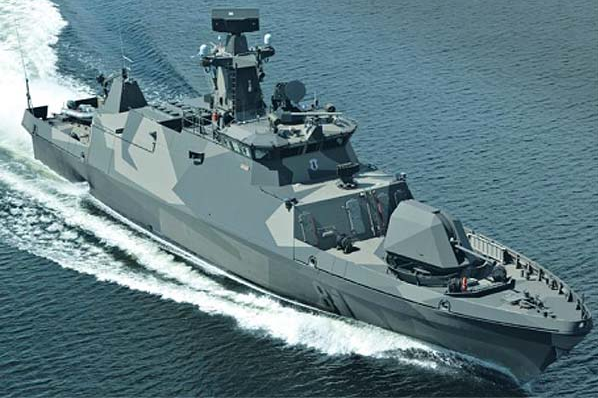
Hamina Class: 250 tons, 30kts stealth fast patrol boat. The RN has nothing like it
No matter what FIFA says, it seems entirely appropriate for all of us to remember those who served in the British armed forces and most especially those who returned home disabled or who did not return home at all. For the first two centuries of this Union, we Scots were willing and active partners in the great Kiplingesque cause of building the British Empire, which became a cornerstone not only of prosperity but of pride and of identity. The British Army and Royal Navy were instruments of its policy and, although the concept of Remembrance Day came from WWI, a grateful nation celebrated its heroes, whether at Trafalgar or Rourke’s Drift, the Nile or Inkerman.
And, whether press-ganged jolly tar or lifer redcoat, life in the empire-building forces was harsh and brutal: for them to survive, courage and fortitude against the enemy had to be augmented by courage and fortitude against a harsh military regime imposed by the cat o’ nine tails and the lash. “Ah” said Wellington, inspecting his troops on the eve of Waterloo “the Eniskillens; I hang and flog more of them than the rest of the army put together”. Often, the men suffered from the bigotry or stupidity of its commanders, whether under Cornwallis at Yorktown or Chelmsford at Isandlhwana. Seldom did they get to retire with dignity, with enough of a pension to see them through old age.
In the first half of its third century, the empire and its forces were called on for what might be considered more noble reasons than colonial ambition. The two World Wars taxed Britain in all senses of the word. Whether WWI was against German aggression or a kind of collective, self-destructive hubris by European powers is a moot point. What is a fact is that, for four years several million soldiers died under machine gun and artillery fire disputing trivial amounts of shattered land along a thin, bloody corridor running across France, Italy, the Balkans, Ukraine and Poland. It was also, in retrospect, the swan song of empire. It is little wonder that Remembrance and its symbolic poppy came out of the utter carnage of a “war to end all wars”.
But it didn’t. Easy though it is to blame Allied negotiators for fostering German resentment through the harsh Versailles Treaty, the fact was that peace had come because everyone was fought to a standstill by the horrors of mechanical war. In WW2, this then developed to such a pitch that lives were actually saved at the front, even as the civilians suffered disproportionately. But WW2 is generally regarded as a ‘good’ war: the enemy was clear, the cause of defending against aggression obvious and resulting ‘Dunkirk’ spirit under pressure was undoubtedly Britain’s ‘finest hour’. And whether sweating in a Crusader tank in the desert or in a Japanese PoW work camp in Malaya or freezing in the tail turret of a Lancaster over the Ruhr or on the ice-bound bridge of a corvette bucking its way towards Murmansk, there are countless examples deserving of remembrance for the terrible hardships they had to endure.
Since then, wars have been less clear-cut and the morals rather fuzzier. Was fighting the Mau-Mau in Kenya or Eoka in Cyprus of the communists in Malaya simply postponing the inevitable end of empire? Were the well executed but ultimately futile Suez or Korean or Falkland operations just throwbacks to an earlier glory of which our armed forces were now barely capable? And whatever your morality over Kosovo or Iraq or Afghanistan, were any feasible independent of the only real world power: the US.
But in all of these post-WWII/Cold War conflicts, the British armed forces have done what was asked of them without demur, maintaining throughout a high level of professional competence that continues to earn the respect of other countries. Whatever your political stance on such conflicts, our veterans deserve the same respect that their fathers and grandfathers bought so dearly.
As readers will have gathered from an earlier blog, I am no great fan of British colonial leadership. But for all that we on this island have achieved in the world on the back of the indefatigable Tommy, whether in trench or Tornado, who did his bit with humour and humanity, I will be at my war memorial like other millions to give thanks and remember those millions who risked everything to serve, especially those “who grow not old, as we that are left grow old.”
I woke this morning to Good Morning Scotland extolling the virtues of East Lothian Council and its house buy-back programme. My colleague Cllr. Stuart Currie was on being interviewed on why this was a good idea and was backed up by the housing minister, Keith Brown MSP and several spokespeople for the housing market. For those of you who may wonder who it’s a good deal to spend public money in some cases buying back houses, sold to their original tenants for rather less, allow me to fill in the background detail.
Like other councils, East Lothian started off around 1980 with an appreciable stock of public housing. The Tenants’ Rights, Etc. (Scotland) Act 1980 introduced the Right to Buy to tenants of local authorities with the following conditions:
This scheme worked so well that 25 years on ELC stock had dropped from 20,000 to under 8,000 and many had further changed hands on the normal housing market. Unlike some areas where the stock was poor, ELC maintained its housing to a high standard. This, combined with many improvements made by new house owners meant that the stigma of public housing that grew elsewhere didn’t really happen in East Lothian where the distinction between public and private housing has blurred.
For reasons best known to themselves, the previous Labour administration felt they should not build more houses in case they were sold off but also eschewed a range of Housing Associations (who were supposed to take up the slack) to focus on the Homes for Life Partnership in Haddington that was effectively under direct control.
Unfortunately, instead of delivering the 500 houses in three years as promised in 2002, HfLP failed to even deliver 300 houses in five years. Because EL tenants move seldom and those with a house knew what a deal they had, affordable housing to rent became like hen’s teeth and the local waiting list grew to over 4,000.
Meantime, under pressure from developers and Edinburgh city, successive local plans allowed a myriad of private housing developments, totalling over 5,000, to be built all across the county. Fewer than 5% of the total were affordable. This meant that the bulk of residents in those new houses were from outside the county. While we welcome all to discover the joys of living in East Lothian, this middle-to-upper range build skewed demographics in several towns, where a young generation was forced to live at home after leaving school and many local shop staff, artisans and hand/craft workers forced to live elsewhere.
But, since May 2007, despite a major economic downturn which has virtually frozen private house building (and a new 25% affordable requirement in East Lothian), ELC has succeeded in building over 400 affordable house with a similar number at various stages in the pipeline. It has a achieved this by having its new SNP-led Administration put this at the very top of its priorities for delivery to local residents. This has been made possible by pursuing a number of interlocking measures:
Right in the middle of Guy Fawkes season, I have just been rummaging in the further reaches of Westminster procedures and so appalled by what I keep coming up with that I increasingly believe Guy’s had a bum deal down the years. Perhaps I should regard it as a blessing that, post-Martin, the Speaker no longer wears breeches and a wig. But the extent to which obfuscating flummery still dominates our ‘mother of all parliaments’ (I mean that more in the Saddam Hussein sense) is quite astonishing.
Example 1. The decisions on bills are still recorded in Norman French. In the 21st century, we are still governed by laws that are not simple ‘passed’ but “soit baillé aux communes” and “A ceste Bille les Seigneurs sont assentus” and “La Reyne le veult.” All three are required to make it law. This thousand-year-old thing might pull in tourists for Changing of the Guard or Beefeating about the Tower…but it’s no way to run a railroad.
Example 2. You are encouraged, especially when you have a beef that your minister MP is restricted as to what they may criticise and/or question, to contact a Lord. But you are enjoined to do so in one of the eleven different correct addresses that corresponds to the rank of a Marquess or Archbishop or whatever. Not having archbishops in my country, I am at a loss to discern their relevance to modern politics there.
Example 3. Snuff is provided, at public expense, for Members and Officers of the House. It is kept at the doorkeepers’ box at the entrance to the Chamber. Yet smoking has been banned in the Chamber and in committees since 1693. As our American cousins like to say: go figure.
Example 4. Each sitting of the House begins with prayers, for which Members stand, facing the wall behind them. This practice is attributed to the difficulty Members would once have faced of kneeling to pray whilst wearing a sword(!) Members may leave cards on seats to indicate that they intend to attend prayers (and so secure seats for the remainder of the sitting). This used to be done with top hats (on the assumption that a gentleman would not leave the building without his hat) until an Irish MP cheated by bringing two hats to Parliament.
Example 5. Alfred Kinnear MP summed up (in 1900) the niceties of wearing a hat:-
“At all times remove your hat on entering the House, and put it on upon taking your seat; and remove it again on rising for whatever purpose. If the MP asks a question he will stand, and with his hat off; and he may receive the answer of the Minister seated and with his hat on. If on a division he should have to challenge the ruling of the chair, he will sit and put his hat on. If he wishes to address the Speaker on a point of order not connected with a division, he will do so standing with his hat off. When he leaves the House to participate in a division he will take his hat off, but will vote with it on.”
Got that? Pardon me while I am temporarily discommoded with nausea.
For those of you who wish to learn more, feel free to contact the nice people manning any one of the four official sources listed below. For myself, repealing the control this pile of superannuated Heath-Robinson eccentricities has over my country can’t come soon enough.
Recent discussion on “the end of PC” has actually been about the demise of the personal computer. But a recent post passed on to me jolted me into thinking that we’re a little too smug with our implementation of political correctness and need to think out of the box more. This was the post:
Let’s put all our pensioners in jail and all our criminals in nursing homes. This way the pensioners would receive:
The criminals would be left all alone, largely unsupervised and forgotten. Their lights would go off at 8pm and showers would be available only once a week. They’d take every meal of lukewarm food with the same people who kept forgetting their names. And for sleeping in their tiny room and being herded into common spaces throughout the day, they would pay £600 per week with no hope of ever getting out.

(source: The Spectator, 9th July 2011)
…as they’re cabbage-lookin’. Yet another of my gran’s pithy observations nails the whole series of naysayers who have tripped over their faces this week to do down Scotland’s future as a centre of renewable energy excellence. It is suspicious that an unholy alliance of unlikely bedfellows including Citicorp and David Cameron. As the Institution of Mechanical Engineers piece in the Hootsmon was trashing our future, one Iain Gray seemed to have had amazing foresight to have penned and submitted an op ed piece just in time to share the same issue. Funny, that.
There is another side to that argument. But, in the spirit of debate, let’s take their doubts seriously and examine whether, firstly, Scotland is sensible to invest heavily in renewables as a technology to boost its commercial future and, secondly, whether the goal of providing for 50% of our energy needs by 2020 is realistic. After all, even the bubbliest cheerleader for renewables admits that the wind doesn’t blow every day and we’re some ways off mass exploitation of some of Scotland’s renewable resources, such as wave and tidal. First off, where do we stand just now, as regards power generation?

Origin of the roughly 5,000MW capacity in Scottish Power Generation (Source: Power of Scotland Renewed: FoE/WWF/RSPB)
This picture is skewed because the late noughties were bad for our nuclear stations, both of which were shut down for periods with engineering problems. But, nonetheless, this did not strain the supply for two reasons: 1) renewables, especially wind farms were coming on-line and 2) A large amount of energy gets sold in England because Scotland runs a surplus—recently around 16TWh or 1,830 Mwatts over the year. Sources of our generating capacity up to 2004 are given below:
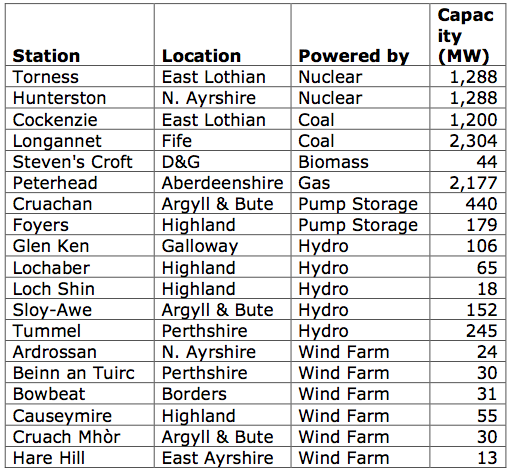
Table 1—Source of Scotland's Power Generation up to 2004 (Source: Wikipedia)
Though total theoretical capacity adds up to almost 10,000 Mw, this must be qualified. As mentioned allowance must be given for fickle winds and the limited water storage of most hydro schemes if they are run flat out. Therefore, taking only 25% of wind farm and 20% of Hydro capacity as sustainable at all time, this still gives a figure over 8,000 Mw or 60% over what Scotland has typically needed to be generated.
Looking in more detail, power demands vary on a daily cycle, with the peak coming during the working day and the trough in the wee hours. Practice has therefore been to run both nuclear stations as ‘base load’ of around 2,500 Mw, which satisfies overnight demand and even allows for pumped storage facilities like Cruachan to be recharged. This is augmented, when required, by one the three large fossil fuel stations.
In recent times, capacity has been significantly augmented by a large number of wind farms coming on-stream in the late noughties, which added a further theoretical 1,478Mwh of capacity but, effectively, a constant output more like 375MWh. These are listed in Table 2 below:

Table 2—Renewable Generating Capacity Added 2005-2009 (Source: Wikipedia)
The last couple of years have seen further acceleration in the provision of renewable wind capacity, along with an extension to the hydro sector and the first of the major offshore wind projects. These are listed in Table 3 below and represent another 1,231 MWh of capacity or the ability to sustain a constant 308 MWh of further demand.
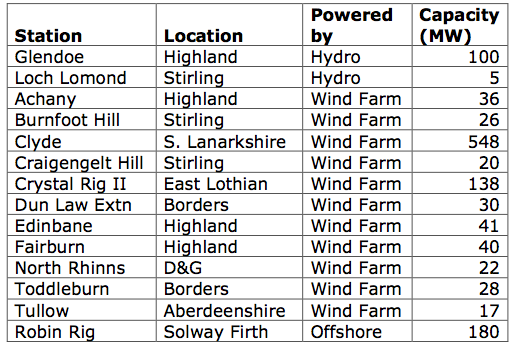
Additional Generating Capacity Added in 2010-2011 (Source: Wikipedia)
Looking out over the next couple of decades, not all of the stations will remain in operation. In fact, both Hunterston and Cockenzie are scheduled for closure by 2014. This means that some means must be found of replacing roughly 2,500Mw of capacity, roughly half of which needs to run constantly as part of the baseload. Given that an average steady 1,830 MWh is regularly supplied to England and Northern Ireland, much of the shortfall could be found there. Taken together with the 2,709 MWh added by renewables as shown above and the fact that Scotland coped with partial shutdowns of both nuclear baseline suppliers, supply should be adequate to cover the loss of both Hunterston “B” and Cockenzie. If, however, Cockenzie did get Iberdrola’s extension of life through conversion to gas firing, that would remove any uncertainty. A projection of Scotland’s future supply sources is shown below:

Future Sources of Energy in Scotland (Source: Power of Scotland Renewed: FoE/WWF/RSPB)
The diagram shows the continued rise in renewables 2008-14 that will allow both Hunterston and Cockenzie to be taken off-stream at the end of that period. The supply simply dips back to the base demand level with which Scotland has coped for the last decade. From that point on, other renewables are expected to kick in, starting with the huge 1 GWh offshore farms planned for the Moray Firth and off the Firth of Forth. This will then be followed by wave energy, based on the Pelamis project current running off Orkney and tidal systems based on those being experimented with in the Sound of Islay and the Pentland Firth. Their maturity will allow Torness to be decommissioned.
Scotland’s natural resource base for renewables is extraordinary by European, and even global standards. Our estimated potential: 36.5 GW of wind, 7.5 GW of tidal power, and up to 14 GW of wave power potential—most of Europe’s total capacity. The renewable electricity generating limit could be as large as 60 GW, some six times greater than the existing capacity from all Scottish fuel sources.
You disagree with this? Do your sums then use the Comment option below.
…are doomed to repeat it.” (Burke) It can be hard to discern key turning points in history as they happen, especially when centuries of tradition and inertia colour viewpoints. But we are coming up to the 70th anniversary of what can be seen, in retrospect, to have been the end of the British Empire. I leave the reader to interpret this as a metaphor but would welcome any comments they may have on that.
In November 1941, Britain still represented a real world power; within 90 days, the most humiliating surrender British forces ever suffered would define its eclipse. Although Malaya and Singapore were recovered from the Japanese, they would seize independence within a dozen years, despite intense anti-guerrilla campaigns fought in the 1950’s. The balance of the pink-painted empire was soon to follow.
At this remove, only senior citizens are likely to remember the pride and awe once accorded the British Empire, not only from its subjects. It was the largest and most successful global venture the world had seen and bestrode that globe by virtue of a naval dominance that was seen to reach its apogee in the Fortress of Singapore.
This consisted of a major naval base, twelve coastal batteries (guns from 6” and 15”), four airfields and supporting military bases. Built in the 1930’s, it was actually an expression of British weakness. Unable to afford battle fleets to dominate both Atlantic and Pacific, Singapore was chosen as the strategic crossroads of south-east Asia at which to base a fleet to be sent out from Britain, should need arise.
Within three years of the fortress’ completion in 1938, the need arose. Japan struck the Philippines and Malaya in co-ordination with their December 7th strike on Pearl Harbour. Since war had been looming, the British had reinforced the garrison, which was now 88,600 strong—three divisions, a dozen RAF squadrons—but no fleet. From Lt. General Percival, GOC Malaya Command, right down to the lowliest erk, the spirit of the defenders was high, verging on the cocky. Lt Col. Stewart, CO 2nd Bn. Argyll & Sutherland Highlanders asked Percival “Don’t you think our men are worthy of a better enemy than the Japanese?”
When the Japanese seized French Indochina in September 1941, all that the Admiralty could spare as the ‘fleet’ to provide teeth to the fortress was ‘Force Z’: the split-new battleship Prince of Wales and a lighter, faster battle cruiser Repulse. They arrived just as war broke out in the Pacific.
Underestimation of the enemy was rife and heavily racist. Japanese were regarded as undersize, short-sighted makers of shoddy goods. Actually, the British were the shoddy specialists. Traditionally a soft ‘cocktail command’, officers (and their wives especially) lived very well, enjoying more parties than manuevers in the tropical heat. Many of the “British” troops were Indian or Malay; even those from Britain were mostly white-kneed conscripts. There were no tanks. The bulk of RAF fighters were Brewster Buffalos declared to be “good enough for Malaya” by Air Marshal Brooke-Popham. whose cheery estimate was 70% of any invading force would be sunk at sea.
They had not yet met Lt. General Yamashita’s 70,000 China veterans in the 25th Army, who invaded the north coast of Malaya, cuffed the defending 9th Indian division aside and would cover the 700 miles to Singapore in 70 days through audacity and a myriad of successful deceptions (including stolen bicycles). But the heaviest shock came early on when Force Z, sent north to intercept and sink Yamashita’s invasion fleet, was itself intercepted by the Japanese 22nd Air Flotilla. Both huge ships were sent to the bottom in a virtuoso display of precision bombing. Aircraft—including the Luftwaffe’s much-vaunted Stuka precision bombers—had never sunk capital ships at sea before.
This blow alone sent shock waves through the garrison, fanned by rumours about how Yamashita’s men were ghosting through the jungle, trouncing every effort to block them. Morale started to waver. But the coup-de-grace came when the Japanese ranged their artillery across the Johore Strait and started pounding Singapore. Only then was it realised that few guns of the coastal batteries could be swiveled to respond, because new hoods protecting them from air attack also restricted their traverse. This greatest but fleetless of fleet bases had left its back door unlocked.
Singapore was both the greatest and hollowest symbol of Western colonial might. Its capitulation on February 15th 1942 shocked the world. When news reached that arch-exponent of empire, Churchill, he later wrote “I put the telephone down. I was thankful to be alone. In all the war I never received a more direct shock.” Carefully fabricated over centuries, the edifice of colonial invincibility was shattered. Though the Americans would hold out in the Philippines for another four months and all Western colonies were restored within five years, the great colonial game was up.
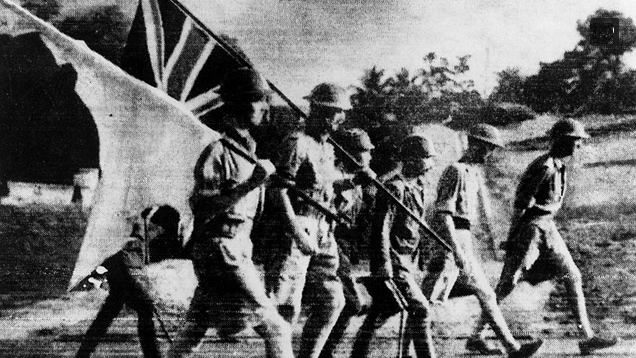
The British surrender party is escorted to Yamashita's Headquarters. Lt-General A E Percival is on the extreme right. (Keystone/Getty Images)
 davidsberry