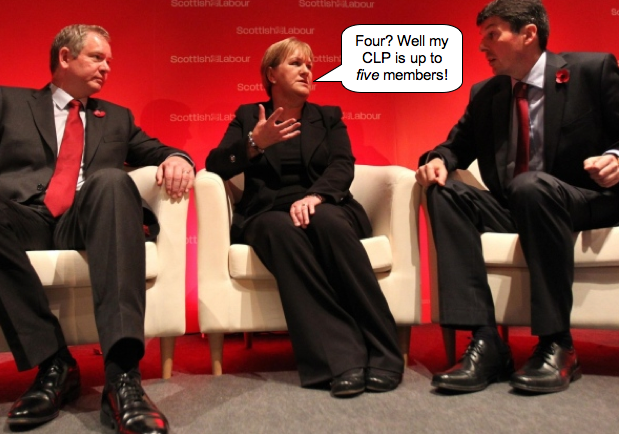
No Wonder We Feel Foreign

Right in the middle of Guy Fawkes season, I have just been rummaging in the further reaches of Westminster procedures and so appalled by what I keep coming up with that I increasingly believe Guy’s had a bum deal down the years. Perhaps I should regard it as a blessing that, post-Martin, the Speaker no longer wears breeches and a wig. But the extent to which obfuscating flummery still dominates our ‘mother of all parliaments’ (I mean that more in the Saddam Hussein sense) is quite astonishing.

Example 1. The decisions on bills are still recorded in Norman French. In the 21st century, we are still governed by laws that are not simple ‘passed’ but “soit baillé aux communes” and “A ceste Bille les Seigneurs sont assentus” and “La Reyne le veult.” All three are required to make it law. This thousand-year-old thing might pull in tourists for Changing of the Guard or Beefeating about the Tower…but it’s no way to run a railroad.

Example 2. You are encouraged, especially when you have a beef that your minister MP is restricted as to what they may criticise and/or question, to contact a Lord. But you are enjoined to do so in one of the eleven different correct addresses that corresponds to the rank of a Marquess or Archbishop or whatever. Not having archbishops in my country, I am at a loss to discern their relevance to modern politics there.

Example 3. Snuff is provided, at public expense, for Members and Officers of the House. It is kept at the doorkeepers’ box at the entrance to the Chamber. Yet smoking has been banned in the Chamber and in committees since 1693. As our American cousins like to say: go figure.

Example 4. Each sitting of the House begins with prayers, for which Members stand, facing the wall behind them.  This practice is attributed to the difficulty Members would once have faced of kneeling to pray whilst wearing a sword(!) Members may leave cards on seats to indicate that they intend to attend  prayers (and so secure seats for the remainder of the sitting). This used to be done with top hats (on the assumption that a gentleman would not leave the building without his hat) until an Irish MP cheated by bringing two hats to Parliament.

Example 5.  Alfred Kinnear MP summed up (in 1900) the niceties of wearing a hat:-

“At all times remove your hat on entering the House, and put it on upon taking your seat; and remove it again on rising for whatever purpose.  If the MP asks a question he will stand, and with his hat off; and he may receive the answer of the Minister seated and with his hat on.  If on a division he should have to challenge the ruling of the chair, he will sit and put his hat on.  If he wishes to address the Speaker on a point of order not connected with a division, he will do so standing with his hat off.  When he leaves the House to participate in a division he will take his hat off, but will vote with it on.”

Got that? Pardon me while I am temporarily discommoded with nausea.

For those of you who wish to learn more, feel free to contact the nice people manning any one of the four official sources listed below. For myself, repealing the control this pile of superannuated Heath-Robinson eccentricities has over my country can’t come soon enough.

  • House of Commons Information Office
  • House of Commons
  • London SW1A 2TT
  • Phone 020 7219 4272
  • Fax 020 7219 5839
  • hcinfo@parliament.uk
  • http://www.parliament.uk
  • House of Lords Information Office
  • House of Lords
  • London SW1A 0PW
  • Phone 020 7219 3107
  • Fax 020 7219 0620
  • hlinfo@parliament.uk
  • Parliamentary Education Service
  • House of Commons
  • London SW1A 2TT
  • Phone 020 7219 2105
  • Fax 020 7219 0818
  • education@parliament.uk
  • Parliamentary Archives
  • House of Lords
  • London SW1A 0PW
  • Phone 020 7219 3074
  • Fax 020 7219 2570
  • archives@parliament.uk
Posted in Politics | Leave a comment

Let’s Get Radical!

Recent discussion on “the end of PC” has actually been about the demise of the personal computer. But a recent post passed on to me jolted me into thinking that we’re a little too smug with our implementation of political correctness and need to think out of the box more. This was the post:

Let’s put all our pensioners in jail and all our criminals in nursing homes. This way the pensioners would receive:

  • full access to showers, hobbies and walks
  • unlimited free prescriptions, dental and medical treatment
  • on balance they’d receive more money than they paid out.
  • constant video monitoring, so they could be helped instantly if they fell, or needed any assistance.
  • their bedding washed twice a week
  • all clothing washed free and returned to them ironed .
  • a guard check on them every 20 minutes
  • their meals and snacks brought to their cell
  • family visits in a suite built for that purpose
  • access to a library, pool and weight room
  • free spiritual counselling, legal aid and education available on request
  • free clothing, shoes, slippers, PJ’s.
  • private, secure rooms for all
  • an outdoor exercise yard, with gardens
  • a PC, TV and radio with free daily phone calls
  • a board of directors to hear any complaints
  • guards who strictly adhered to a code of conduct

The criminals would be left all alone, largely unsupervised and forgotten. Their lights would go off at 8pm and showers would be available only once a week. They’d take every meal of lukewarm food with the same people who kept forgetting their names. And for sleeping in their tiny room and being herded into common spaces throughout the day, they would pay £600 per week with no hope of ever getting out.

(source: The Spectator, 9th July 2011)

Posted in Community | Leave a comment

No’ As Green…

…as they’re cabbage-lookin’. Yet another of my gran’s pithy observations nails the whole series of naysayers who have tripped over their faces this week to do down Scotland’s future as a centre of renewable energy excellence. It is suspicious that an unholy alliance of unlikely bedfellows including Citicorp and David Cameron. As the Institution of Mechanical Engineers piece in the Hootsmon was trashing our future, one Iain Gray seemed to have had amazing foresight to have penned and submitted an op ed piece just in time to share the same issue. Funny, that.

There is another side to that argument. But, in the spirit of debate, let’s take their doubts seriously and examine whether, firstly, Scotland is sensible to invest heavily in renewables as a technology to boost its commercial future and, secondly, whether the goal of providing for 50% of our energy needs by 2020 is realistic. After all, even the bubbliest cheerleader for renewables admits that the wind doesn’t blow every day and we’re some ways off mass exploitation of some of Scotland’s renewable resources, such as wave and tidal. First off, where do we stand just now, as regards power generation?

Origin of the roughly 5,000MW capacity in Scottish Power Generation (Source: Power of Scotland Renewed: FoE/WWF/RSPB)

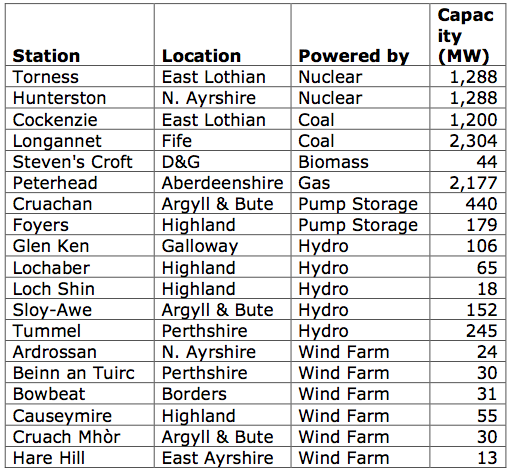
This picture is skewed because the late noughties were bad for our nuclear stations, both of which were shut down for periods with engineering problems. But, nonetheless, this did not strain the supply for two reasons: 1) renewables, especially wind farms were coming on-line and 2) A large amount of energy gets sold in England because Scotland runs a surplus—recently around 16TWh or 1,830 Mwatts over the year. Sources of our generating capacity up to 2004 are given below:

Table 1—Source of Scotland's Power Generation up to 2004 (Source: Wikipedia)

Though total theoretical capacity adds up to almost 10,000 Mw, this must be qualified. As mentioned allowance must be given for fickle winds and the limited water storage of most hydro schemes if they are run flat out. Therefore, taking only 25% of wind farm and 20% of Hydro capacity as sustainable at all time, this still gives a figure over 8,000 Mw or 60% over what Scotland has typically needed to be generated.

Looking in more detail, power demands vary on a daily cycle, with the peak coming during the working day and the trough in the wee hours. Practice has therefore been to run both nuclear stations as ‘base load’ of around 2,500 Mw, which satisfies overnight demand and even allows for pumped storage facilities like Cruachan to be recharged. This is augmented, when required, by one the three large fossil fuel stations.

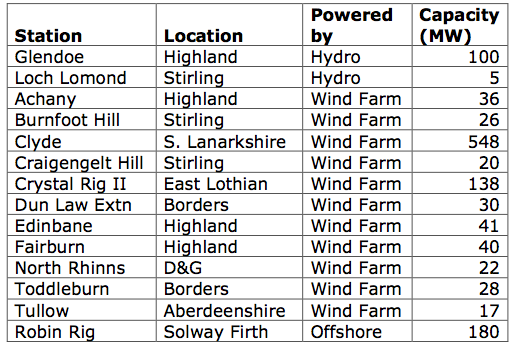
In recent times, capacity has been significantly augmented by a large number of wind farms coming on-stream in the late noughties, which added a further theoretical 1,478Mwh of capacity but, effectively, a constant output more like 375MWh. These are listed in Table 2 below:

Table 2—Renewable Generating Capacity Added 2005-2009 (Source: Wikipedia)

The last couple of years have seen further acceleration in the provision of renewable wind capacity, along with an extension to the hydro sector and the first of the major offshore wind projects. These are listed in Table 3 below and represent another 1,231 MWh of capacity or the ability to sustain a constant 308 MWh of further demand.

Additional Generating Capacity Added in 2010-2011 (Source: Wikipedia)

Looking out over the next couple of decades, not all of the stations will remain in operation. In fact, both Hunterston and Cockenzie are scheduled for closure by 2014. This means that some means must be found of replacing roughly 2,500Mw of capacity, roughly half of which needs to run constantly as part of the baseload. Given that an average steady 1,830 MWh is regularly supplied to England and Northern Ireland, much of the shortfall could be found there. Taken together with the 2,709 MWh added by renewables as shown above and the fact that Scotland coped with partial shutdowns of both nuclear baseline suppliers, supply should be adequate to cover the loss of both Hunterston “B” and Cockenzie. If, however, Cockenzie did get Iberdrola’s extension of life through conversion to gas firing, that would remove any uncertainty. A projection of Scotland’s future supply sources is shown below:

Future Sources of Energy in Scotland (Source: Power of Scotland Renewed: FoE/WWF/RSPB)

The diagram shows the continued rise in renewables 2008-14 that will allow both Hunterston and Cockenzie to be taken off-stream at the end of that period. The supply simply dips back to the base demand level with which Scotland has coped for the last decade. From that point on, other renewables are expected to kick in, starting with the huge 1 GWh offshore farms planned for the Moray Firth and off the Firth of Forth. This will then be followed by wave energy, based on the Pelamis project current running off Orkney and tidal systems based on those being experimented with in the Sound of Islay and the Pentland Firth. Their maturity will allow Torness to be decommissioned.

Scotland’s natural resource base for renewables is extraordinary by European, and even global standards. Our estimated potential: 36.5 GW of wind, 7.5 GW of tidal power, and up to 14 GW of wave power potential—most of Europe’s total capacity. The renewable electricity generating limit could be as large as 60 GW, some six times greater than the existing capacity from all Scottish fuel sources.

You disagree with this? Do your sums then use the Comment option below.

Posted in Environment | Leave a comment

Those Who Don’t Learn from History…

…are doomed to repeat it.” (Burke) It can be hard to discern key turning points in history as they happen, especially when centuries of tradition and inertia colour viewpoints. But we are coming up to the 70th anniversary of what can be seen, in retrospect, to have been the end of the British Empire. I leave the reader to interpret this as a metaphor but would welcome any comments they may have on that.

In November 1941, Britain still represented a real world power; within 90 days, the most humiliating surrender British forces ever suffered would define its eclipse. Although Malaya and Singapore were recovered from the Japanese, they would seize independence within a dozen years, despite intense anti-guerrilla campaigns fought in the 1950’s. The balance of the pink-painted empire was soon to follow.

At this remove, only senior citizens are likely to remember the pride and awe once accorded the British Empire, not only from its subjects. It was the largest and most successful global venture the world had seen and bestrode that globe by virtue of a naval dominance that was seen to reach its apogee in the Fortress of Singapore.

This consisted of a major naval base, twelve coastal batteries (guns from 6” and 15”), four airfields and supporting military bases. Built in the 1930’s, it was actually an expression of British weakness. Unable to afford battle fleets to dominate both Atlantic and Pacific, Singapore was chosen as the strategic crossroads of south-east Asia at which to base a fleet to be sent out from Britain, should need arise.

Within three years of the fortress’ completion in 1938, the need arose. Japan struck the Philippines and Malaya in co-ordination with their December 7th strike on Pearl Harbour. Since war had been looming, the British had reinforced the garrison, which was now 88,600 strong—three divisions, a dozen RAF squadrons—but no fleet. From Lt. General Percival, GOC Malaya Command, right down to the lowliest erk, the spirit of the defenders was high, verging on the cocky. Lt Col. Stewart, CO 2nd Bn. Argyll & Sutherland Highlanders asked Percival “Don’t you think our men are worthy of a better enemy than the Japanese?” 

When the Japanese seized French Indochina in September 1941, all that the Admiralty could spare as the ‘fleet’ to provide teeth to the fortress was ‘Force Z’: the split-new battleship Prince of Wales and a lighter, faster battle cruiser Repulse. They arrived just as war broke out in the Pacific.

Underestimation of the enemy was rife and heavily racist. Japanese were regarded as undersize, short-sighted makers of shoddy goods. Actually, the British were the shoddy specialists. Traditionally a soft ‘cocktail command’, officers (and their wives especially) lived very well, enjoying more parties than manuevers in the tropical heat. Many of the “British” troops were Indian or Malay; even those from Britain were mostly white-kneed conscripts. There were no tanks. The bulk of RAF fighters were Brewster Buffalos declared to be “good enough for Malaya” by Air Marshal Brooke-Popham. whose cheery estimate was 70% of any invading force would be sunk at sea.

They had not yet met Lt. General Yamashita’s 70,000 China veterans in the 25th Army, who invaded the north coast of Malaya, cuffed the defending 9th Indian division aside and would cover the 700 miles to Singapore in 70 days through audacity and a myriad of successful deceptions (including stolen bicycles). But the heaviest shock came early on when Force Z, sent north to intercept and sink Yamashita’s invasion fleet, was itself intercepted by the Japanese 22nd Air Flotilla. Both huge ships were sent to the bottom in a virtuoso display of precision bombing. Aircraft—including the Luftwaffe’s much-vaunted Stuka precision bombers—had never sunk capital ships at sea before.

This blow alone sent shock waves through the garrison, fanned by rumours about how Yamashita’s men were ghosting through the jungle, trouncing every effort to block them. Morale started to waver. But the coup-de-grace came when the Japanese ranged their artillery across the Johore Strait and started pounding Singapore. Only then was it realised that few guns of the coastal batteries could be swiveled to respond, because new hoods protecting them from air attack also restricted their traverse. This greatest but fleetless of fleet bases had left its back door unlocked.

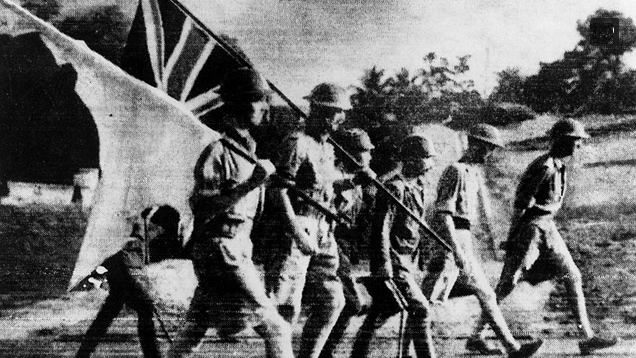
Singapore was both the greatest and hollowest symbol of Western colonial might. Its capitulation on February 15th 1942 shocked the world. When news reached that arch-exponent of empire, Churchill, he later wrote “I put the telephone down. I was thankful to be alone. In all the war I never received a more direct shock.” Carefully fabricated over centuries, the edifice of colonial invincibility was shattered. Though the Americans would hold out in the Philippines for another four months and all Western colonies were restored within five years, the great colonial game was up.

The British surrender party is escorted to Yamashita's Headquarters. Lt-General A E Percival is on the extreme right. (Keystone/Getty Images)

Posted in Politics | 2 Comments

Another BRIC in the Wall

From Scotland’s fausse freends like Moore, Murphy and Mundell an unending drone of unsubstantiated guff about all that Scotland benefits from its union wafts north of the border. Its volume and stamp of officialdom beguiles many genuinely uncommitted people to believe them. After all, Britain is one of the world’s ‘big-hitter’ economies and so us wee Scots would be better off staying under its sheltering wing. Wouldn’t we?

Well, for most of the nineties & noughties, the UK and Brazil grew at comparable rates until the 2008 crisis hit. Since then, Brazil has resumed its 4% p.a. growth while we are struggling to achieve 1%. But much of the UK’s growth in wealth has been channelled towards the really wealthy—it saw a rapid rise in income inequality between the mid-1970s and the mid-1990s. Since then, the increase in the UK has broadly levelled off for most people but those at the very top of the income distribution—fat cat bankers, FTSE100 directors, etc—have continued to accelerate away from everybody else. Not all countries have suffered this socially debilitating effect.

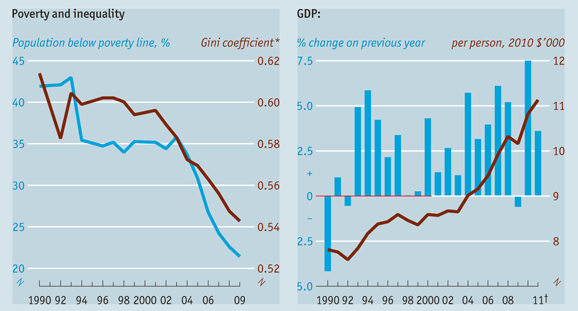
According to the Economist, over the last two decades, the poverty rate in Brazil has halved. With this, the Gini coefficient measure of income inequality has also fallen sharply, declining 1.2% a year. Brazil’s economy is forecast to grow by 3.6% this year and Brazil is set to overtake Britain from ninth place to become the sixth largest economy in the world.

But it is not just scale, GDP per person, at around $11,000 (or 19,000 reais) has been growing at an average annual rate of 1.7% since 1990; closing the gap with high-income countries like Britain (currently $35, 165). But the key issue is that income growth is faster among the poorest—those in the favelas above São Paulo or scraping a living in the newly cleared forests of the Matto Grosso.

While much attention among the BRICs is focussed on China, Brazil is actually achieving comparable per person growth rates and could reach its poverty reduction goal in the next few years. So who should Scotland be taking economic lessons from? Stagnating Britain that has flirted with double-dip recession for the last three years yet allows obscene incomes by the Fred the Shreds? Or dynamic Brazil, not only samba-ing its way away from any recession but mixing up the economic classes the way it has already mixed up its multi-racial heritage to form a more dynamic, homogeneous confident country.

Source: IMF & OECD via The Economist

Posted in Uncategorized | Leave a comment

A Peter Rabbit Version (for Unionists & Other Beginners)

As I was about to say yesterday when Nick Clegg’s transatlantic ego pushed me off course, there are a number of people in Scotland to whom the motives—let alone the aims—of the SNP are suspect. There has been (as Mr Deltoid of Clockwork Orange fame might have framed it) “some extreme nastiness, yes?” across the blogosphere implying that no debate can be had while ravenous packs of cybernats roam the net looking for a Labour Red Riding Hood to molest. What say we cool our jets, squad?

My basic premise: there will be an independence referendum in the life of this parliament and, whoever wins, the other side better feel they made their best pitch (or they will torture themselves over it for the next decade). Playground abuse is not going to achieve that so let’s move on/grow up, eh? There are five basic steps to be taken:

  1. Outline of the country that would become independent. For avoidance of doubt this would be Scotland and its seabed out to agreed boundaries. It would include all civic institutions within Scotland and would require either the creation of those missing or an understanding with another country, probably the Rest of the UK (RoUK), to provide them. Some of the most important among those are: a) Treasury; b) Armed forces; c) Welfare system; d) Tax system; e) Embassy/foreign/diplomatic service
  2. Agree all-new relationships to be forged with neighbours in particular and the world in general. This will involve a series of bilateral talks starting with, but not confined to, RoUK. Among the most important will be our long-term links to: a) RoUK; b) pound/euro; c) EU; d) NATO; e) Nordic Union
  3. Once concrete proposals and provisional agreement on the key points above are available, that form of independence needs to be debated while the formulation and timing of the referendum on that basis are planned. This, more than anything, explains why several years are required to pose the question to an informed populace. The format of the question(s) must be agreed but I argue that a multiple-choice under STV should be the format.
  4. If any result other than status quo is chosen, the Scottish Government will form multiple task groups to negotiate the details and timing of dismantling civic structures of the British state and, where appropriate, allocating them between the two countries. Mutual, peaceful examples like Norway/Sweden (1905), Eire/UK (1922) and Czech/Slovakia (1993) should be studied for lessons and suggestions.
  5. Break out the bubbly (or the 18-year-old malt). Although independence will be more of a process than an event (c.f. how Eire relied on many aspects of the British state continuing while they worked to replace them with ‘local’ civic ability) we should pick a day and celebrate it. 24th June would be good (Bannockburn), 1st May almost as good (Workers’ Day and also Act of Union which would be hereby dissolved) but something in the summer so we can (unlike St Andrew’s or Burns’ Days) get the barbie out.

Now, that’s not too difficult to grasp, is it? Good—we have 60 months; get debating!

Posted in Politics | Leave a comment

Land of Hype and Glaury

Some lost souls milling around the Royal Concert Hall on Sunday seemed desperately in need of some direction. I had therefore intended to blog supposed ‘gaps’ in the SNP case for independence so they might see the error of their ways. But I was distracted by a quote from Clegg in the Observer:

“We stand tall in Washington because we stand tall in Brussels, Paris and Berlin”

It stopped me dead. A supposedly intelligent leader of a major UK party comes out with something barely appropriate to the playground. Now, I can understand the many people who are proud of Britain and its history. Together with the Welsh and Irish, we Scots and English created a major achievement of Western civilisation in the British Empire that was the envy of most of the planet a century ago.

Because my grandad lost a leg at Ypres (6th Bn Scots Guards) and my dad drove a tank across Africa and Europe (44th RTR) and I grew up with a pink-painted map hung on the classroom wall like other kids in the fifties, I share that pride. I’m also proud my Appin Stewarts were front and centre at Culloden and that 300 local Gododdin were gloriously gubbed by Angle hordes at Catterick in 600AD. But, though I connect with all three, all are now history. Done.

Since my dad parked his Sherman for the last time, Britain has been in trouble. The last country to recover from WWII, its innovations of jet airliner and mini, Beatles and Quant were undermined by industry, politics and empire in equally antiquated amounts that led to a ’70s nadir. Since then, ‘Britain’ has grown tenuous as its various components have diverged. This is not obvious to our English cousins because they (as well as many abroad) always conflate England with Britain.

We Scots developed a chip on our shoulders about that. After Thatcher depredations, the Labour party going native at Westminster, the Beeb retrenching from received pronunciation to ‘regional accents’ and growing hostility towards immigrants Scots don’t share, justification for that chip grew. And yet, today’s Scots, with their own Parliament, rejuvenated arts scene, resiliently cheerful Tartan Army & post-industrial economy, have dumped that chip. If you want to see a capital city of which anyone would be proud, try Edinburgh in August—abuzz with life and culture but relaxed and at peace with itself.

Not so our English cousins. Let’s leave aside this summer’s urban riots, all is not well even in the leafy shires. Tory backwoodsmen bicker about Europe, sabre-rattle about action in Kosovo, Iraq or Afghanistan when justification—let alone the goal—is unclear. It is from pandering to such thinking that Clegg’s appalling pompous comment derives. It highlights that England urgently needs to find a post-Empire identity. Whether it revisits hoary old traditions, like a catholic-free throne or a non-royal as head of its church, right down to wigs on its barristers, is for the English—not Scots—to decide.

And they would do well to travel abroad more before they come to any conclusion. Not only the Germans but the Portuguese and Singaporeans have overtaken England in building a modern society. The Brazilians and Poles are about to do the same. Only the Americans seem stuck in the same time warp of nostalgia for when their word was law and their writ ran around the globe. It’s not just Clegg who needs to drop the hype and get out more.

Scots have already discovered an identity for the 21st century. Their economy will be based on energy, specialised engineering, financial services, whisky and tourism. They will be part of the European Union, friendly and open with neighbours, modeling society on the enlightened Scandinavians. Small as Scotland might be, a positive profile will be welcomed, its sports teams spreading goodwill and its military adding its full share to peacekeeping around the globe.

What it will NOT be doing is talking glaury guff like “punching above our weight” or Clegg-esque gobshite. It will have no Trident, no £7bn ‘super-carriers and no interest in interfering in other sovereign states. But it will have a peace corps to bring aid and develop a future in less fortunate lands; its borders will be open to both its neighbours and immigrants who come to contribute. In the dark days of the late 20th ©, Scotland started a journey back towards enlightenment. Long may that remain so.

Whether our cousins ‘dahn saff’ want to emulate this is up to them. But we are done taking any lessons in identity, strategy or direction from their posturing politicians.

Posted in Politics | Leave a comment

Exclusive: Pot Calls Kettle Black

Having had him as my MSP for four years, been in many of the same meetings as local council leader and crossed swords with him on several occasions as we contested East Lothian closely in May, I feel I know the public Iain Gray. I make no comment about his private side but find his public face inconsistent, verging on the confusing.

As a constituency MSP, he is shrewd enough to be guided by his staff and so shows up at most events where he would be expected and gets regular mug shots, columns and press releases into the local papers as a result. When constituents write to him, he replies, takes up cases and often manages to resolve them. Many of the causes he espouses are laudable and, even where we differ—as we do on both Cockenzie and Torness power stations having a future—at least he deploys plausible arguments. In short, he appears a decent guy trying to do a difficult job.

But when we turn to his other job as Labour Leader a Jekyll & Hyde transformation occurs that is not only less flattering but stretches credulity that his utterances actually come from his own convictions. We take it as read that he is a devolutionist, believing his party delivered that. This is, again, a plausible position, especially when shored up by solid argument. But, rather than the “(Labour) needs to talk positively about what we are for and less about what we are against” from Ken Macintosh or the “By 2016, Scottish Labour will either have re-established itself as the party of aspiration, or it will be an irrelevance” from Tom Harris, at the leadership conference in Glasgow this weekend, Iain goes off the deep end.

“You will be attacked, you will be smeared, you will be lied about, you will be threatened,” he said. “The ‘cyber Nats’ and the bedsit bloggers will call you traitor, quisling, lapdog, liar and worse. They will question your appearance, your integrity and your sexuality. They will drag your family and your faith into the lies and the vitriol. If you are a woman it will be worse.

“It is no consolation to know that any journalist or commentator who gives you a fair hearing will suffer the same. This is the poison some have brought into our politics and it is vile. It is time we started talking openly about it and it is time the SNP did something about it. They know who some of these people are. This is not how you build a better Scotland and Scotland deserves better.”

Astonishing for the leader of any party to stoop to such levels and to regard this as what he wishes to be remembered by in his farewell speech. Let’s assume there is some substance to these accusations; how would the argument be advanced by venting his own spleen in this manner? Scotland indeed deserves better and any leader of Scottish Labour should help provide it, whether in power or opposition.

Independence is not the only plausible future for Scotland but it deserves serious consideration and debate. For Harris or Davidson to dismiss it out of hand ill serves Scotland but for Gray to do it ill serves anyone. The language of ‘separation’ of ‘tearing Scotland out of the UK’ is inflammatory, as is scaremongering about border posts at Berwick and trouble visiting granny in Carlisle. He claims devolution to be the ideal settlement but has never articulated why the Irish are not clamouring to return to the fold and why the most devastated part of Ireland should be the part that remained in the UK after 1922.

As leader during the ‘attack dog’ period of Scottish Labour when their MSPs sulked for four years after 2007 and then wondered why they had their heads handed to them last May, Gray symbolises how bankrupt of ideas the whole party became. To accuse the entire SNP as he does above means he learned nothing and ought to have stepped down sooner, rather then peddling the same poison for another six months. Scotland needs a mature and thoughtful Labour party to hold the SNP to democratic account. Even as an SNP member, I am not so foolish as to think we have all the answers. But this toys-out-the-pram spite from Glasgow makes me despair of that ever happening.

There are extremists in and on the periphery of all parties. Scotland is poorly served when their bias and unreasonableness becomes the lingua franca of any major party. When leadership contender Tom Harris claims that  “Labour has not had a vision for 12 years” he deserves to be taken seriously. Instead, the best their leader can do is insult the party that just wiped the floor with his own by inspiring a majority of Scots.

Posted in Politics | Leave a comment

Choice Means Understanding Options

Growing up in North Berwick, we felt sorry for the private school kids. Shipped off in the train to Heriots or Melvilles in Edinburgh, they came home in weird uniforms long after dark when local kids were long done playing and were snug at home having their tea. Parochial as that attitude might be, it didn’t stop one classmate becoming a leading forensic accountant at the Old Bailey or another Professor of Medical Statistics at the University of Hong Kong.

No doubt private school kids were given a good education, but at what cost? We never saw or socialised with them; they were never at Scouts or rugby, never went guising or sledging on Coo’s Green. Later, on holiday from university, they behaved like strangers in their own town. Now, few maintain any contact at all while, of the ‘local’ kids, many returned to live and even more keep in touch.

All this came to the fore when the BBC picked on Marilyne MacLaren’s efforts to dissuade Edinburgh parents from exercising their right to choose their child’s school, seeing in them a cynical ploy to deprive parents of their hard-won rights, while saving Edinburgh Council the inconvenience of having to deal with unplanned transfers.

Since Cllr MacLaren has yet to make any other argument, there may be some element of truth in this. But there is much more to in than that. At the very least, we have the situation described above, where children spend hours being freighted to and fro. Not only do they miss hanging with the kids from their own area but they don’t learn social or road skills—let alone get exercised and wakened up—strapped in the back of a Chelsea Tractor instead of walking the half-mile to school with friends.

What such kids do learn is to be a gypsy, feeling at home neither in school nor where they live. Add in a couple of career moves and, as a young adult, they have trouble settling from minimal experience of what ‘settled’ means. No doubt, parents have good intentions, wanting “only the best education” for their child when sending them across the city to a school with ‘better results’.

But how can they judge? A parent with their first child entering P1 has only their own schooling of twenty or more years before as experience. They may chat to the head or even some teachers but what will they be told? That the school is any less than excellent and the staff any less than dedicated and brilliant? Unlikely. So their child will become ping-pong baggage for up to 13 years on what basis?

Even if the school chosen is unquestionably better at achieving exam results, what does that matter if the child has few friends there, feels alien social pressures there, does not meet the local understanding that many good teachers master and practice. Kickabouts in the park after school and crowding round a new Xbox game in a friend’s bedroom round the corner may not lead direct to Nobel prizes but they create support networks, round out personalities and provide a rootedness that leads to involvement like visiting local old people. Kids coming home from across town with a bagful of homework are notably absent from such activities.

Now, most kids are resilient. Given some of the backgrounds they have survived, it’s a miracle many kids grew up to be the contributing human beings they have. Commuting to a distant school is one of the lesser evils. But parental choice should be exercised as a right no more than access to the NHS. Ideally, each school, while being different and perhaps offering some specialties, should be of a comparable standard.

The concept of sink and magnet schools sits poorly with Scotland. Given our society is becoming more widely heterogeneous at the community level, there is no reason for any school not to become a good school. Allowing ambitious parents to pull their promising offspring away shows little confidence in that community—let alone the school—and in the rich variety of people inhabiting Scots towns and reflected in the social cross-section of kids at their school. That, in itself, is part of our education.

Before they make their choice, parents should think what they’re actually asking their child to forego for the sake of their own ambition, however well intentioned.

Posted in Education | Leave a comment

They Shall Not Pass

Today the Royal Society of Edinburgh (RSE) weighed into the political debate with a plea for the SNP government to re-think its generous policies towards the people of Scotland. In the firing line were a number of planks that constructed the popular policy platform that, among other things, did so well for the SNP in May, including:

  • Council tax freeze
  • Free university tuition for Scots residents
  • Low prescription charges
  • Free personal care for the elderly
  • Free eye testing
  • Free bus travel for over-60s

Such policies, according to the RSE should receive “far more independent and rigorous assessment”. In submitting its opinion to Holyrood’s Finance Committee, they have brought a more neutral voice to the political clamour that normally surrounds this. With the Spending Review imminent and another round of cuts coming from the UK Treasury next year—and the one after—perhaps this is a time to examine these options.

Pretty much all of those listed above are popular and most agree that we should do well by our elderly. But, of those listed above, the one that comes under most questioning is the free bus travel. Originally conceived to allow the elderly and infirm who most likely also did not have a car to have easier access to shopping and socialising, this will have grown into a £1bn monster by 2015. Tales abound of older people travelling all round Scotland on a regular basis, simply because it’s free. Bus companies love it because it boosts their income for no outlay or effort on their part.

But, rather than scrapping it wholesale, are there ways of retaining the original intent while reducing the degree of abuse that appears to be happening now? There certainly are, especially when you consider the degree to which it favours those who live in towns (where buses are frequent and the network dense) over those who live rural lives, sometimes without any buses at all.

  • Firstly, this was introduced from age 60 simply because women had retired at 60 and equality demanded that men could not be made to wait until 65. Simply raising the age at which it becomes valid to 65 for either would, at a stroke, save £279m or 1/4 of the policy’s cost and still allow the original intent of more elderly and infirm benefitting.
  • Secondly, it seems unreasonable that no off-peak restriction applies because those using their bus pass compound the problems of rush-hour. Banning its use between 9am and 4pm or after 6pm on work days, as most discount fares do, would not only ease congestion but save another £23m.
  • Thirdly, those still in full-time jobs could be reasonably expected to still pay their bus fares while the perk could be restricted to those already retired and generally not capable of bringing in a wage any more. Excluding full-time workers, irrespective of age would save another £42m.

Taken together, these three limitations should not disadvantage the great bulk of people for whom the original policy was conceived. And yet they would cut the actual cost of the policy by 38%, freeing up £344m for use in these tough times and perhaps retaining other policies that most people would generally agree have a higher priority.

Posted in Uncategorized | Leave a comment