One Good Reason

…why we need Scotland independent is to rid us of the flummery that takes place in the name of the people and with which the great bulk of Scots wish to have no truck. Although Scots down the ages have shown an irreverent disregard for such niceties, that venerable English institution Debrett’s helpfully prints a ranking list so that we may all know our place.

Personally, I’d rather be a hairy-arsed rebel when it comes to class and decline to acknowledge being assigned to any rank, other than by merit. I spent too long in the colonies to put up with such guff. But, for those of you who need someone to tell you your value, here is Debrett’s rank ordered (pun intended) Table of Precedent for Scotland:

  1. The Duke of Edinburgh
  2. Lord High Commissioner to the General Assembly of the Church of Scotland (during sitting of the General Assembly)
  3. Duke of Rothesay (The Prince of Wales)
  4. The Sovereign’s Younger Sons
  5. The Sovereign’s Grandsons
  6. The Sovereign’s Cousins
  7. Lord-Lieutenants of Counties
  8. Lord Provosts of Cities being ex-officio Lord-Lieutenants of those Cities
  9. Sheriffs Principal
  10. Lord Chancellor of Great Britain
  11. Moderator of the General Assembly of the Church of Scotland (during office)
  12. Keeper of the Great Seal of Scotland (the First Minister)
  13. Presiding Officer
  14. Secretary of State for Scotland
  15. Hereditary High Constable of Scotland
  16. Hereditary Master of the Household in Scotland
  17. Dukes (as in English Table)
  18. Eldest Sons of Dukes of the Blood Royal
  19. Marquesses (as in English Table)
  20. Eldest Sons of Dukes
  21. Earls (as in English Table)
  22. Younger Sons of Dukes of the Blood Royal
  23. Eldest Sons of Marquesses
  24. Younger Sons of Dukes
  25. Lord Justice-General
  26. Lord Clerk Register
  27. Lord Advocate
  28. Advocate General
  29. Lord Justice-Clerk
  30. Viscounts (as in English Table)
  31. Eldest Sons of Earls
  32. Younger Sons of Marquesses
  33. Barons of Lords of Parliament (Scotland) (as in English Table)
  34. Eldest Sons of Viscounts
  35. Younger Sons of Earls
  36. Eldest Sons of Barons or Lords of Parliament
  37. Knights of the Garter
  38. Knights of the Thistle
  39. Privy Counsellors
  40. Senators of the College of Justice (Lords of Session), including Chairman of the Scottish Land Court
  41. Younger Sons of Viscounts
  42. Younger Sons of Barons or Lords of Parliament
  43. Baronets
  44. Knights Grand Cross and Knights Grand Commanders of Orders (as in English Table)
  45. Knights Commanders of Orders (as in English Table)
  46. Solicitor-General for Scotland
  47. Lord Lyon King of Arms
  48. Sheriffs Principal (when not within own county)
  49. Knights Bachelor
  50. Sheriffs
  51. Companions of the Order of the Bath
  52. Companions of the Order of the Star of India
  53. Companions of the Order of St Michael and St George
  54. Companions of the Order of the Indian Empire
  55. Commanders of the Royal Victorian Order
  56. Commanders of the Order of the British Empire
  57. Companions of the Distinguished Service Order
  58. Lieutenants of the Royal Victorian Order
  59. Officers of the Order of the British Empire
  60. Companions of the Imperial Service Order
  61. Eldest Sons of the Younger Sons of Peers
  62. Eldest Sons of Baronets
  63. Eldest Sons of Knights (according to the precedence of their fathers)
  64. Members of the Royal Victorian Order
  65. Members of the Order of the British Empire
  66. Younger Sons of Baronets
  67. Younger Sons of Knights
  68. Esquires
  69. Gentlemen

If you struggle to cope with 70 ranks, then pity the English event co-ordinator faced with, say, a state funeral, who has no fewer than 118. There are, for example, no bishops on our list. If the Bishop of Durham heads north, must the caterer commit hari-kari with a potato-peeler for lack of guidance?

And if you—like me—balked at item 69, realising that this whole list only applies to men, then you must consider an entirely separate list that applies to women. How high-class event handlers are supposed to cope if the two should ever mix is not made clear.

  1. The Sovereign’s Daughter
  2. The Sovereign’s Granddaughters
  3. The Sovereign’s Cousin
  4. Duchess of Rothesay
  5. Wives of Sovereign’s Younger Sons
  6. Wives of Dukes of the Blood Royal
  7. Duchesses (as in English Table)
  8. Wives of Eldest Sons of Dukes of the Blood Royal
  9. Marchionesses (as in English Table)
  10. Wives of Eldest Sons of Dukes
  11. Daughters of Dukes
  12. Wives of Younger Sons of Dukes of the Blood Royal
  13. Wives of Eldest Sons of Marquesses
  14. Daughters of Marquesses
  15. Wives of Younger Sons of Dukes
  16. Countesses (as in English Table)
  17. Viscountesses (as in English Table)
  18. Wives of Eldest Sons of Earls
  19. Daughters of Earls
  20. Wives of Younger Sons of Marquesses
  21. Baronesses, or Ladies of Parliament (Scotland) (as in English Table)
  22. Wives of Eldest Sons of Viscounts
  23. Daughters of Viscounts
  24. Wives of Younger Sons of Earls
  25. Wives of Eldest Sons of Barons or Lords of Parliament
  26. Daughters of Barons or Lords of Parliament
  27. Ladies of the Order of the Garter
  28. Wives of Knights of the Garter
  29. Ladies of the Order of the Thistle
  30. Wives of Knights of the Thistle
  31. Privy Counsellors (Women)
  32. Wives of the Younger Sons of Viscounts
  33. Wives of Younger Sons of Barons
  34. Daughters of Lords of Appeal in Ordinary
  35. Wives of Sons of Lords of Appeal in Ordinary
  36. Wives of Baronets
  37. Dames Grand Cross of Orders (as in English Table)
  38. Wives of Knights Grand Cross and Knights Grand Commanders of Orders (as in English Tables)
  39. Wives of Knights Bachelor, and Wives of Senators of the College of Justice (Lords of Session) including the wife of the Chairman of the Scottish Land Court
  40. Companions of the Order of the Bath
  41. Companions of the Order of St Michael and St George
  42. Commanders of the Royal Victorian Order
  43. Commanders of the Order of the British Empire
  44. Wives of Companions of the Order of the Bath
  45. Wives of Companions of the Order of the Star of India
  46. Wives of Companions of the Order of St Michael and St George
  47. Wives of Companions of the Order of the Indian Empire
  48. Wives of Commanders of Royal Victorian Order
  49. Wives of Commanders of the Order of the British Empire
  50. Wives of Companions of the Distinguished Service Order
  51. Lieutenants of the Royal Victorian Order
  52. Officers of the Order of the British Empire
  53. Wives of Officers of the Order of the British Empire
  54. Wives of Companions of the Imperial Service Order
  55. Wives of the Eldest Sons of the Younger Sons of Peers
  56. Daughters of the Younger Sons of Peers
  57. Wives of the Eldest Sons of Baronets
  58. Daughters of Baronets
  59. Wives of the Eldest Sons of Knights of the Garter
  60. Wives of the Eldest Sons of Knights
  61. Daughters of Knights
  62. Members of the Royal Victorian Order
  63. Members of the Order of the British Empire
  64. Wives of Members of the Royal Victorian Order
  65. Wives of Members of the Order of the British Empire
  66. Wives of the Younger Sons of Baronets
  67. Wives of the Younger Sons of Knights
  68. Wives of Esquires
  69. Wives of Gentlemen
Posted in Community, Politics | Tagged | Leave a comment

SuperGran from Grantham

It is a rare occasion that George Foulkes and I agree but his brief in memoriam on Thatcher at Labour Hame is both measured and honest, which, bitter political enemies as they were, deserves acknowledgement. There will be a flurry of such oeuvres over the next week because there were few lives over 30 in Britain that were not affected by her. and, since she is regarded as the most socially divisive premier the UK has ever had, they are likely to fall into two emotional camps.

As a Scot, resident back home since just after her fall from grace, I am in the unusual position of living the prequel to her reign and being intimately involved in politics here thereafter—but never having lived in the country one day under her premiership, other than brief business and social visits.

Seeing her influence on the eighties through the prisms of the Economist and New Statesman, of the NY Times and the San Jose Mercury, of Tom Brokaw’s Channel 6 New and the McNeil/Lehrer News Hour, was emotive enough. But the letters and visits from friends kept me posted just how hot things were.

I left Britain in the seventies because I was appalled by the place. Four years in Germany taught me what modern life in Europe could be. It wasn’t about grey commuter-stuffed trains clacking their way to the serried rows of terraced clones that were (are?) Streatham Common, nor the Dunkirk-spirited “I’m backing Britain” to offset the economic slowdown of a three-day week. It was not our finest hour.

Outsiders looked on, appalled at the ‘English Disease” (they meant “British” but nobody outside the UK worries about such niceties) as more hours of work were lost in strikes than the rest of the planet put together. Despite a Labour government (Barbara Castle’s white paper “In Place of Strife” must be the most ill-conceived/inappropriate title ever from an employment minister), the country lurched from dispute to dispute, culminating in the 1978-9 Winter of Discontent.

Anyone observing Britain in 1979 would have regarded it as a failure: a country that had once been the sine qua non of Victorian global domination had made itself bankrupt in two world wars, lost an empire, lost its purpose and was now being shown up in affluence by former colonies and in social progress by countries it defeated in war. Worst of all, no party had a solution: the Tories had buckled under Heath and Labour under Callaghan seemed puppets dancing to union tunes. Britain’s nationalised industries were used as case studies in business schools of what not to do.

Had Thatcher not appeared on the scene, the option would have been even more insipid socialism under Michael Foot, a bright, sincere but charisma-free Labour leader, whose rambling manifesto for 1983 was brilliantly lampooned by Gerald Kaufman as “the longest suicide note in history“. Had that path been taken, the disintegration of the Austro-Hungarian empire might have been one of the more optimistic models to describe Britain’s future.

If not Thatcher, then some version of her was the dose of salts Britain needed. Having purged many of the wets from the Tory shadow cabinet after becoming leader, she brought urgently required qualities to the post of PM. Forget her lack of empathy or even understanding for opposing views: if you want to rescue a major country from itself and set a whole new course away from disaster, you need that rare figure: a visionary with the personality to persuade people to support them, a clear plan that addresses contemporary problems and the hard work and guts to see it through.

She didn’t get it right at first. There was hesitation, squabbles in the Cabinet, some clumsy handling of issues. But the right-wing, classic Tory aspects of her administration were clear from the start: not for her the Ted Heath U-turn. “You turn if you want to; this lady’s not for turning” wowed the Tory Conference, whose grass roots were always her power base.

But her true launch pad came when the Argentine junta occupied the Falklands. Decisive as ever, her conviction that they must be retaken came from the core of her crusading being—that Britain’s decline must be reversed and here was a clear opportunity for the empire to strike back. She knew it was a huge gamble and, had it failed, had half the Argentine Air Force bombs not been duds, she would have lost office and with it the chance to remould Britain in her visionary image.

But the victory’s surge of popularity—and more importantly, self-belief—from the British people empowered her in a way no PM had been endowed since Churchill at his height. And she used it: privatisation of BT, British Gas, British Rail, the power and steel industries, etc; selling council homes to their occupants; rewriting union laws and taking on the miners in a bitter strike. Controversial though much of this was and intolerable as it all was to those of socialist beliefs, another crushing election victory in 1987 endorsed (as far as she was concerned) all that she was doing.

The opening up of much of British industry to competition culminated in the ‘big bang’ lifting of restrictions on trading in and around the LSE so that ‘financial derivates’ and other such fiscal instruments created London as a global financial centre in direct competition with New York. All of these developments, unthinkable in the turbulent seventies, put more money into the pockets of a wide swathe of the British public who, after such austerity and depressed outlook, bought shares, houses, two cars, holidayed abroad and took to a consumerism they had previously seemed too demure to embrace.

It was the era of the ‘loud-braces’ broker in the City, brilliantly spoofed by Harry ‘Loadsamoney’ Enfield. Having swept pretty much all before her, Thatcher grew ever more imperious, purging her Cabinet of opponents, even telling the media that “we have become a grandmother“. For Scots, most of whom spent her reign as PM in apoplexy, decimating their Tory MP contingent yet still having to endure her hectoring “Sermon on the Mound”, this was a time of deep frustration and resentment. It became the turning point from their full commitment to the union.

Because subtlety was not Thatcher’s strong suit. She saw the Union in the black/white terms she saw everything else. She genuinely did not understand someone who saw England and Scotland as separable, any more than she understood the deep community spirit of the miners (“the enemy within”) or the pivotal social role post offices played in small villages. Despite retaining the deep affection of Tory rank and file in the shires, she was brought down by having made enemies of just about everyone in her government. It was no coincidence that the ‘grey’ (if capable) John Major who succeeded her would have fitted into the Heath cabinet she fought so hard to reform with Tory radicalism.

Most of the comments on her death simultaneously praise her achievements while highlighting her divisiveness. Feminists bemoan her poor role model and socialists speak her name on a stream of spit. But not since WW2 had there been such clarity of purpose and a will to follow it at a time when Britain had lost its way and was in need of that. And most indicative of all, three Labour governments that followed did little to undo her works. Indeed, she was no doubt pleased by their fixation with PFI/PPP.

People may not agree with this new way she forged—some argue that the big bang was a direct cause of the 2007 financial crisis—but several things are clear:

  • to continue as Britain did in the seventies was to endure further decline
  • nationalised industries had become intrinsically inefficient with time
  • coal and steel (or any industry) must be globally competitive to survive
  • pure capitalism may lead to great riches for some but poverty for many: Reagan’s ‘trickle-down effect’ is delusion; it needs balance
  • maximising a country’s GDP is not necessarily improving its quality of life
  • there IS such a thing as society
Posted in Politics | Tagged | Leave a comment

Gobshite Macht Frei

Despite being a strong proponent of a free press, like many other Scots today, I felt insulted by Scotland on Sunday’s presentation of a low-budget political dig masquerading as a book review of Gavin Bowd’s Fascist Scotland. What should have first tipped me off is that not many serious book reviews are written by the authors themselves—that and the more distasteful mock-up ever to have disgraced the pages of the Scottish Press.

The lower image was Photoshopped from the Cover Image on Tom Devine's Book The Scottish Nation 1700-2000

The lower image was Photoshopped from the Cover Image on Tom Devine’s Book The Scottish Nation 1700-2000

As another baby-boomer, I am particularly interested in the thirties as the cauldron out of which WW2 boiled and which framed so much of our lives post-war, from rationing and austerity, through Cold War and into material wealth. Because our excessively politically correct 21st century society pussyfoots around fascism and communism as failed 20th century evils about which we do not talk, there is merit in doing what Bowd has done, which is lift up a few stones of history and see what’s crawling beneath.

Though I didn’t live through the thirties, it was my parents’ heyday. The horrors of a war-to-end-all-wars had been banished, the Depression overcome and the fatal cracks in the Empire were not obvious to any but a few. But it was a time of great political questions, not least which political model would dominate the world. Britain was still fixated on its monarchy but even that received a body blow with Edward VIII’s abdication over the Wallace affair. The US was pioneering the relatively classless & materialist western democracy that would come to dominate seventy years later.

But the great debate of the time was which of two political extremes—fascism, as evolved in Italy and Germany, or Communism, as evolved in Russia—would come to dominate all else. Both the US and UK variants of democracy seemed weak and vulnerable before muscular movements from right and left that took hold across Europe. After Weimar collapsed and the Nazis walked into power, there were many both inside and outside that country who were pleased to see a major nation, prostrated and humiliated by Versailles, pull itself up by its jackbootstraps.

The irony of the time was that the two extremes of fascism and communism deployed such similar methods of both seizing and holding onto power. The Nazi-Soviet Pact of 1939 that allowed Hitler and Stalin to cynically dismember Poland for their own ends underscored how circular the whole political spectrum had become. It’s hardly surprising than that the ideological conflict that was about to become WW2 was manifest in political movements across the continent and a constant worry to ‘weak’ democracies.

Lindbergh in the US and Mosely in Britain had considerable following that performed an amazing snaw-aff-a-dyke act, once war was declared, much as the Whites disappeared from Russia once Lenin had grasped the reins of power. Conviction is a luxury to those whose livelihood, family and even lives were not under daily threat by regimes whose uncompromising diktats left little room for individual expression.

It’s hard today to turn convention on its head and see democracy as weak, indecisive and ineffectual, while either fascism or communism had an uncompromising purity of zeal about it, whether assembling massive tractor factories as part of a five-year plan or restoring backbone and dignity to a once-proud imperial nation. Just as the BNP makes some progress among immigrant suburbs of London, so Moseley’s British Union of Fascists made headway in heavily Jewish eastern suburbs of London.

So, before any of us gets to smug and superior about the robustness of our present democracy, the number of false political starts and their cost in stability and affluence should be borne in mind as original cost and investment. Not only were differing credos acceptable in the thirties but also served as vehicles of rebellion for many of the younger thinkers of the time.

So, coming back to Bowd’s oeuvre, the simplicity of its phrasing is deceptive. It uses contemporary sensibilities to tar the people of the thirties with loaded political overtones that they themselves would not recognise. In 1933, Hitler was seen as a saviour by most people outside German, let alone inside. The idea of a nation needing military backbone after the decimation of WWI, the destructive 1926 General Strike and 1929 Wall Street Crash was both common and lauded. Whether British or Scots in their patriotism, at the time many people saw the German rebuilding in a positive light—at least until Kristallnacht and the more blatant racism brought most to their senses.

And, as the iniquities of the more belligerent attitude adopted by Hitler in marching into first the Rhineland and then the Sudetenland made a darker future clearer, volunteers for the International Brigades to fight fascism’s Spanish curtain-opener were motivated by a socialist zeal, not least because a similar aggressive acquisitiveness was not yet so manifest itself in Stalin the way it was in Hitler. Scots, particularly those sympathetic to the socialist principles of John Maclean, were to the fore in volunteering.

Despite factually correct disclaimers like “Sir Oswald Mosley’s legion of blackshirts never made great headway in Scotland“, you will not get that impression from Mr Bowd’s article, which goes out of its way to give quotes from such prominent figures of the time as Hugh MacDiarmid distinctly Anglophobic overtones and is free with such phrases as ‘nationalist treachery’ with scant substantiation.

Indeed, such evidence as exists appears to be little-known reports of fascists infiltrating such organisations as the fledgling nationalist and socialist movements on behalf of the government of the time. But such was the political kaleidoscope of the time that few were of one rigid conviction and perhaps a majority changed political allegiance in the course of the scant twenty years between the wars.

But none of this precludes a rigorous examination of our not-s0-distant history with a critical eye. If Mr Bowd’s effort is to be faulted, it is for seeing the time too much through a modern prism where both fascist and communist have become pejorative terms in the current hegemony of Western democracy—a hegemony few but the brave would have predicted at the time when such namby-pamby concepts appeared in danger of being steamrollered by either Stalin’s muscular orthodoxy from the left or Hitler’s mechanised juggernaut from the right.

The politics of any age cannot be judged with contemporary sensibilities. Both Greece and Rome carried western civilisation to new heights on the backs of slavery, brutal conquest and even more brutal entertainments in the Colloseum. The dignity of Brize Norton was an unimaginable dream to more than a million British servicemen who died building empire across five continents, including 3/4 million who were left in France less than a century ago. It verges on cheap sensationalism to judge anyone in the thirties with smug use of 20/20 hindsight after half a century of soft living when none of the generations of young men have been sent off en masse into some foreign mincing machine. For ignoring this, Mr Bowd deserves to have his knuckles wrapped.

But, co-defendant though the author may be, by far the bulk of any opprobrium for the piece needs to be heaped on Scotland on Sunday and its editorial staff. Again, this is not for publishing something of this ilk. Much though it makes anyone’s blood boil, the Scots have weathered more venal insinuations that this. Not content to fire this dubious article at the nationalist community (why is it normal to speak of such in Ulster but not here?), SoS packages it across front page of the This Week section in a provocative and vitriolic way.

In their use of the word ‘Klan’ they have already crossed the line of decency. The only time that the Scots word ‘clan is ever spelled with a ‘k’ is in the context of the Klu Klux Klan, a discredited organisation found across America’s South and dedicated t racism and white supremacy. That they choose to use several symbols from Scottish Celtic history is no fault of the Scots—who see themselves as a mongrel race and therefore have little time for racism.

But to rub in this insult, SoS steals one of the uplifting images of the independence discussion in Scotland, the backlit image, used as a the cover of Devine’s seminal book. of several young people scrambling to erect a saltire using very similar imagery to Ernie Pyle’s classic WW2 shot of US marines struggling to erect the Stars and Stripes on a hill on the bitterly contested Pacific island of Iwo Jima.

Not content with those two crass insensitivities, they photoshop the image of the flag so that, instead of a saltire, the flag they are hoisting becomes a swastika. As a nationalist, proud of Scotland’s role in fighting nazism, proud that no-one has even been seriously hurt—let alone killed—in this battle for independence, proud of our genuine democratic achievements, I find SoS’s callously flippant use of such imagery cheap, nasty and palpably undeserved.

I need only posit the scenario of any Scottish paper running a parallel article based on the success Mosely found in England, especially the East End of London that led off with a St George Cross version of the swastika. The “off-with-their-heads” outrage among the Nomenklatura Angliski would have been deafening.

The good thing is that the dopes editing S0S seem not to realise the extent to which such ‘clever’ posturing is distasteful to the bulk of Scots and blatant attempts to smear that are patently untrue seem to wind up having the opposite effect.

Posted in Politics | 1 Comment

Dear Leader

For all my life I have observed this bizarre time warp that is North Korea who, for all that time, have gone on as if their war with the southern half of the peninsula (1950-1953) had never ended, which technically it still hasn’t. From 1876 until the end of WW2, the whole peninsula had been a Japanese ‘protectorate’ and post-1910, part of Japan itself.

The late intervention of the Soviet Union in the War in the Pacific allowed their Far East armies to roll through much of China, Manchukuo and Korea before the Western Allies could do much about it. With Mao Tse Tung’s Communist victory in 1949, parallels to a divided Germany in Europe were divided Chinas, Vietnams and Koreas in the Far East, all of which became disparate aspects of the front line in the new Cold War.

It has never been clear the extent to which Stalin encouraged its North Korean protégé to seize the rest of the country in 1950 but they came close before a nominally UN but actually mainly US force held on around Pusan then counterattacked. This swept South Korea clear of invaders but that wasn’t good enough for Macarthur, who tried to clear North Korea too. This brought in the Chinese PLA hordes, who took things back to the original start line.

It also divided a culture even more severely than East/West Germany or North/South Vietnam, both since reunited and exhibiting much healing as a result. Whereas the South has blossomed as the developed and prosperous Republic of Korea, starting with heavy engineering and culminating in global electronic brands like Acer and LG, the People’s Republic is a homage to Stalinist belligerence from the 1930s—right down to the high-peaked Red Army caps worn by the PRNK military.

Not only does North Korea’s state directed economy achieve a bare $20bn p.a. GDP from its 25m people but it spends 25% of it on defence. South Korea’s 50m people achieve a $1.1tn GDP but achieve comparable defence capabilities on its $27bn defence budget. Where North Korea dominates is not in its technology but in its sheer size as the fifth largest armed forces on the planet, after the China, Russia, the USA and India.

North Korea delights in Soviet-style parades of artillery and rockets through Pyongyang but what no-one is sure of is whether some of the rockets are anything more than some oil drums welded together. For so long, their generals have been whipping up a frenzy of paranoid militarism, based on supposed hatred from the rest of the world that decades of escalating rhetoric have left them painted into a diplomatic corner of either taking some form of military action or risking the political house of cards collapsing in humiliation.

PRNK new KN-08 missile during a military parade in April 2012

PRNK new KN-08 missile during a military parade in April 2012

The effective King of Korea, 28-year-old KIm Jong Il took over from his father who had taken over from his grandfather in the bizarre concept of a communist dynasty of “Dear Leaders” but the true power lies with the military. There is little doubt that if they could nuke American, they would. But every attempt they have made so far to build a true ICBM that could reach even Hawaii has failed. No-one questions that they have rockets capable of reaching that far; whether they are advanced enough to squeeze a heavy and complex nuclear warhead is the question.

If a shooting war starts—and the chances of this rather than a nuclear strike seem higher—it would result in a bloody land war, probably reminiscent of 1950-53 in its to-ing and fro-ing. South Korea should hold the North’s masses with American help for the same reason that ‘shock and awe’ did for the much larger Iraqi forces in the 2nd Gulf War. PRNK forces are many but generally equipped with obsolete weapons and almost no chance of gaining air superiority, on which conventional 21st century warfare pivots.

It’s hard to see how the PRNK generals would not be smart enough to see that, massive though their forces are, they would start at a tactical disadvantage, lose the war and be collectively out of a job in the smoking ruins of an even poorer country. But such are the self-reinforcing delusions of a closed society that many come to believe their own rhetoric. And, if it were all to go to Hell in a handcart, their Leader could indeed turn out to be a very Dear one for the impoverished 25m, virtually all of whom have endured starvation levels of poverty to sustain his family’s paranoia all their lives.

Estimated Ranges of PRNK Missiles (D. Cameron: please note)

Estimated Ranges of PRNK Missiles (D. Cameron: please note)

For anoraks interested in objective evaluation of PRNK military capabilities/Orbat, the following is extracted from the International Institute for Strategic Studies web site:

Pyongyang’s order of battle is equivalent to approximately 150 active duty brigades. That includes 27 infantry divisions, as well as some 15 independent armoured brigades, 14 infantry brigades, and 21 artillery brigades. North Korean forces are heavily dug-in with more than 4,000 underground facilities and bunkers near the DMZ and an estimated 20 tunnels dug under the DMZ, of which four have been found. There are also more than 20 Special Forces brigades, totaling about 88,000 troops, which could be deployed by air, sea and land to disrupt US and South Korean combat operations and attack civilian targets.
North Korea’s armoured forces are estimated to include some 3,500 main battle tanks (MBTs), 3,000 armoured personnel carriers and light tanks, and more than 10,000 heavy-calibre artillery pieces, many of which are self-propelled. The MBT force primarily comprises older T-54/55/59 models, but includes some 800 indigenously produced T-62s. Of the estimated 10,000 or so artillery pieces in the North Korean inventory, a considerable number are pre-deployed, in range of Seoul; additional artillery could be moved forward to fortified firing positions at short notice.
Of particular concern to Seoul are Pyongyang’s 240mm multiple rocket launchers (capable of simultaneously firing 16–18 rockets), its 152mm and 170mm towed and self-propelled artillery pieces, and its mobile FROG systems – all of which are capable of delivering chemical and biological agents as well as conventional high-explosives. In addition, the ground forces have about 7,500 mortars, several hundred surface-to-surface missiles, 11,000 air defence guns, 10,000 surface-to-air missiles, and numerous anti-tank guided weapons.
The North Korean air force possess some 605 combat aircraft and is organised into 33 regiments: 11 fighter/ ground attack; two bomber; seven helicopter; seven transport; and six training regiments. The air force mostly comprises older MiG aircraft (of the MiG-15/17/19/21 types), but includes small numbers of more modern MiG-23, MiG-29 and Su-25 aircraft. Like North Korea’s ground forces, a relatively large percentage of the air force is deployed near the DMZ – at military air bases only minutes flying time from Seoul.
The North Korean navy can be divided into six main groups: 43 missile craft; about 100 torpedo craft; 158 patrol craft (of which 133 are inshore vessels); about 26 diesel submarines of Soviet design; 10 amphibious ships; and 23 mine countermeasures ships. There are also some 65 miniature submarines for the insertion and extraction of Special Forces. Around 60 percent of the North Korean navy is deployed in forward bases, and North Korea has strengthened its coastal defences in forward areas by deploying more modern anti-ship cruise missiles.
It is estimated that North Korea’s heavy armoured forces, possessing enough combat hardware to equip perhaps ten US divisions, have an actual capability equivalent to about 2.5 US armoured divisions. With equipment operated by the infantry added, the North Korean ground forces possess an overall firepower which is equivalent to nearly five modern US heavy divisions. By comparison, Iraq was assessed as having six modern division equivalents and North Korean airpower, the equivalent to six US wing equivalents in size, corresponds to only two F-16 wing equivalents in estimated net capability.
Posted in Politics | Tagged | 1 Comment

Poseidon Drowning

When Yeats first mused his maxim “out of the quarrel with others we make rhetoric and out of the quarrel with ourselves we make poetry“, it was half a century before the quarrel with others could lead to a nuclear holocaust. As someone who has spent his entire 65 years under the prospect of just that, I used to hold in high regard those who argued forcibly against such a demise for humankind and against the insistence of the MoD that the UK must have such weapons to retain military credibility in the world and “a seat at the top table”, as embodied in membership of the UN’s security council.

Given British history in the first half of the 20th century, there is definitely an argument for staying alert militarily and avoiding the old soldier mistake of forever preparing for the last war so you always start the next one off-balance. Victorian Britain thought only in terms of small colonial wars, supported by global hegemony at sea. Its tiny Edwardian army was all but wiped out in Flanders by the massive German mobilisation of 1914. Its acceptance of the French fixation with Maginot defences almost led to a similar wipeout over the same ground in 1940; only both sides’ imperfect grasp of air power and much courage among sailors rescued most of the BEF from Dunkirk.

Having been caught twice in 25 years with their military trousers round their ankles, it is understandable that the MoD pushed for nuclear deterrence post WW2, especially as the Russian threat appeared palpable and imminent with the advent of the Iron Curtain. But with British global abilities questioned by communists from Cyprus to Malaya, insurgent efforts like the Kenyan Mau Mau springing up all over the globe and the absolute public humiliation of Suez underscoring a new impotence on the world stage, the writing should have been on the wall from 1956 onward. Both India and the vital Gulf oil reserves—the only economic rationale left for a global military reach—was already long out of British direct control.

Yet, not only were the V-bombers developed to thunder off into the skies in pairs with nuclear warheads as a puny Strangelove-esqe attempt to ape the USAF’s SAC ever-ready strike ability but millions were squandered on our own Blue Steel and Blue Streak ICBMs until they were scrapped and a virtue made of necessity by buying in first the US Polaris and then the Trident nuclear missiles to fit on a new submarine fleet. During the Cold War, too few people were asking questions—not about their efficacy, but about the entire rationale of their existence. The doubters were dismissed as mostly long-haired CND and hippy types, laced with intellectuals but including—to its credit—the Labour party.

The UK Nuclear ‘deterrent’ about which so much fuss has been made might still be fully capable of Armageddon all by itself but its rationale is a sickly thing. At the height of the Cold War, the US/Soviet race might also have been madness but superpowers of hundreds of millions of people deploying economies of trillions of dollars can indulge in such exercises in futility and still prosper. Britain, on the other hand, was trudging to the IMF by 1975, cap in hand. Had WW3 ever started, the US & Soviets would have reduced the entire planet to uninhabitable slag. What role the UK nukes could play in that, other than make the rubble dance higher was never made clear.

Worse than that, the chances of the UK ever deploying its nukes unilaterally is something the US has made sure cannot happen without their say-so. And, even were that not the case, at what point in the half-century of their existence could they have been deployed? Global hotspots like Hungary (1956) or Israel (1967/1973) or Vietnam (1966-73) were all American-dominated, as were Kosovo, Iraq and Afghanistan where the UK was involved. Even in the latter cases, had we wanted to use nukes against a tangible enemy, they made no tactical sense, quite apart from the moral opprobrium that would have swiftly followed any such use.

Even in purely British operations like Aden/Yemen in the sixties, nukes were useless against a guerilla force and although the Falklands was a ‘proper’ war against a ‘real’ country, nobody on either side considered for a minute that the Rio Gallagos air base was going to be nuked, let alone Buenos Aires. If nukes are a deterrent, then the question that has yet to be answered is ‘against what?’ The terrorist bombs of 7/7? Just as useless as the US arsenal, including SAC, ICBMs AND fifteen carrier groups were against 9/11.

All this makes argument for any nuclear devices by a civilised society militarily bankrupt. But, more importantly, the argument against nuclear weapons in a civilised society is so incontrovertible that it is a flat choice: nuke-armed or civilised—you can’t be both. It is the much more serious global equivalent of the argument against guns in the light of Sandy Hook or Dunblane or any of the other atrocities committed by gun owners who all claimed a need for ownership of equipment whose only practical use is to kill.

But even if the ‘self-defence against criminals’ justification for guns so often deployed in the States were not scuppered by the fact that far more family members and friends wind up being shot than any evil burglar, at least there is a limit to the damage. Were any nuclear warhead fired anywhere near either the US or Russia, they would shoot first and any questions asked later would be lost in the radioactive dust clouds that would circle the entire planet for 24,000 years (the half-life of Pu-239).

What triggered this outburst is an article in the Grauniad from two MPs who should know better and who underscore how far the Labour party has drifted from its moral roots. Angela Smith and John Woodcock argue for the retention of Trident and its replacement for what can only be described as economic grounds. Other than being PPS to Yvette Cooper and having questionable expenses, there seems no reason for Ms Smith’s contribution, other than from conviction (and jobs at Sheffield Forgemasters). Mr Woodcock, on the other hand, represents Barrow-in-Furness where the subs are built and so can be said to have an interest. Their argument?

“Those who understandably question this spending when money is tight should keep in mind that the cost of building the new submarines would give a near-unique bang for buck in boosting advanced UK manufacturing and creating highly skilled hi-tech jobs here in Britain.”

Ah, so Rolls Royce don’t create highly skilled high-tech jobs building half the world’s jet engines and Weir Pumps don’t do the same supplying the world with high-pressure systems? Smith & Woodcock (NOT Wesson!) demonstrate all the foresight of a learning-impaired dodo. Had this been 1913, they would have argued for investment in buggy-whips so that the Empire’s horse carriages would not fall behind; in 1963, they would have argued for massive investment in the North British Locomotive Company, whose steam engines were second to none. Now, in 2013, they argue the close-to-bankrupt UK “should focus on the £12bn to £17bn still to pay in the 20 years after the next election”.

And, lest we think these are two renegade thinkers—such as the old Labour party once produced in quantity, the article itself declares total orthodoxy of policy credentials:

“Labour under Ed’s leadership would never hand a gift to opponents by opting for a plan that might look fine in a Liberal Democrat election leaflet.”

It is simultaneously alarming and depressing for thinking people to live in a country whose government believes a chest-butting, my-nuclear-arsenal-can-beat-up-your-nuclear-arsenal diplomacy has any place in the 21st century. It is worse that a once-morally sentient opposition has sunk to similar sabre-rattling stupidity. But, most appalling of all, the best argument the dodos can deploy for squandering £17bn on such total uselessness (rather than, say, running ALL of Scotland’s 150 hospitals for FIVE YEARS) is it would support good jobs in their constituencies.

Call me old-fashioned but, having spent the last 20 years of my life hoping people would swallow their cynicism and trust politicians to have both a vision and the best interests of their constituents at heart, the noise you hear is humble pie merging with my cake-hole: in this case, I hope the people in Sheffield and Barrow throw these two clowns out for the short-sighted dodos that they are.

Either that, or that sound is poor Poseidon, drowning under the unwieldy weight of his new budget-busting trident,

Posted in Politics | Tagged | Leave a comment

Border Going South?

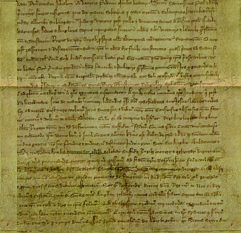
Excavation of a previously unknown vault beneath the Douglas Tower of Tantallon Castle has revealed a lead-lined casket with several well preserved medieval parchments that seem to have been part of the family papers of the Red Douglas Earls whose stronghold it was until the 17th century.

The earliest, dating from the 1380s, is a faded cloth Pennon emblazoned with what appears to be the heraldry of Henry Percy, 1st Earl of Northumberland, wrapped inside a contemporary document, apparently signed by him and James, 2nd Earl Douglas. This must have been sometime in August 1388 when both were in the vicinity of Otterburn, the former being killed there and the latter captured in the battle of that name and also explains why the Bishop of Durham, who later advanced at the head of 10,000 men to chase the Scots back over the border, signed and kept this only copy.

HotsPennon

What the document reveals is that Douglas and Percy had actually negotiated a peace of sorts, in which Douglas received deeds (apparently transferred at the time, but since lost) to “Ye baronie of Eyelandshyre et parrishes appertayning hereto” in exchange for agreement “cesse & deysiste from warlyke congresse upon lands laying sutherlie thereto, naymlie ye estaytes of the sayd Earl Percé“. How the two subsequently fell out and met their fates at Otterburn, as history records, is not known.

Parchment

Other documents found sealed in the hoard are fascinating as records from the era, such as a public notice from James II with the signature authority of Archibald, 4th Earl of Douglas prohibiting the “gowff” at “oor ferme toune o Nowrt Bayrwicke” but the Eyelandshyre (i.e. Islandshire) Grant is significant right to the present day because it was the contemporary name for Lindesfarne, the Farnes and local parishes that included Ancroft, Norham, BelfordElwickKyloe and Tweedmouth.

Berwick had already changed hands a number of times before the hostile retaking it by the English after Halidon Hill in 1333 so that, when the Treaty ransoming David II back to Scotland for 100,000 merks was signed there in 1357 there followed a long period of technical English rule but actual joint administration while the English embroiled themselves in the Wars of the Roses and the trade with Europe via Berwick blossomed.

This culminated in Berwick being officially ceded back to Scotland in 1461 by Henry VI, in exchange for help against the Yorkists. Effectively, that meant that the English/Scots border, far from heading N from Great Cheviot, then running along the Tweed would have kept heading NE and included the the present towns of Wooler and Belford as the southernmost towns where the Scottish King’s writ ran on the East coast.

Of course, there was no such clear line as a border, nor niceties like border posts and passports in medieval times; kingdoms were delineated by the loyalty of local nobles and what they regarded as their domains. But the general area would have been administered as Berwickshire under military control from the castle at Berwick. The key role of Keeper of Berwick Castle was only given to trusted Scots nobles, the most prominent among whom was Robert Lauder of the Bass, a close friend and neighbour to the Red Douglases in Tantallon just across the water.

This state of affairs must have existed until the future and tragic Richard III came north to storm Berwick’s defences in 1483. Thereafter, the situation becomes muddy. Though the Tudors ploughed considerable money into modern defences (reportedly “£128,648, the most expensive undertaking of the Elizabethan period”) and made Berwick a ‘County Corporate’ changing its name from the now illogical “South Berwick” to “Berwick-Upon-Tweed, no mention is made of Islandshire.

The 1707 Treaty of Union defined Berwick as being under English Law but neither that, nor the 1885 Act that removed Berwick as a separate entity and joined it with Northumberland for election purposes, dealt with the islands and parishes further south. Because of the religious connections dating back to the days of St Cuthbert, these had been administered as an enclave of the County Palatinate of Durham. Why there is no record of Red Douglas protest or attempt to reassert their Islandshire domain post-1483 is not clear,  although they were struggling with the King at the time who saw them as too powerful (the 8th Earl Douglas had been murdered by James II at Stirling Castle in 1452).

But if this document were to prove still valid, it sets a variety of cats among the present oil-rich pigeons roosting in the North Sea. Instead of the present equidistant boundary drawn by Tony Blair to swallow up 6,000 square miles of previously Scots ownership into English territorial waters, this would more than reverse that and mean that virtually all oil rigs and over half the more southern gas rigs are in Scottish waters. It would also isolate Berwick in an artificial English enclave, totally surrounded by Scotland, much as the supposedly Russian Kaliningrad (ex-Königsberg) is two hundred miles from the rest of Russia and in limbo as a result.

But I’m sure we Scots can be nice about it, dig up the necessary benefits 25,000 Geordies (whom we see as honorary Scots) don’t get at present in England and welcome the reincorporation of the northern quarter of now-not-quite-so-North-umberland Heim ins Reich.

Posted in Politics | Tagged | 1 Comment

Dominie Dominoes

War may not have broken out in Scottish schools quite yet but Michael Gove’s caricature of the annoying swot who used to get beat up behind the bike shed is pushing things that way South of the Border. As the Beeb puts it:

“Teachers in major unions are expected to debate no confidence votes on the Education Secretary Michael Gove and the head of England’s schools’ inspectorate, Ofsted.

“Members of the NASUWT and National Union of Teachers are holding their annual conferences this weekend. The NUT, meeting in Liverpool, is expected to hold votes on Mr Gove and Ofsted chief Sir Michael Wilshaw.

“The NASUWT will hear calls for an overhaul or abolition of inspections. It claims the government’s education policies are “destructive” and that Ofsted inspections are undermining confidence in England’s education system.”

Back in Sconnie Botland, consensus is closer: no less figures than Unison’s Dave Watson and Education Secretary Mike Russell are in agreement that English-style league tables should not be published as measures of school performance. As Mr Russell puts it:

“At its worst, the league table mentality insists that measurement can only be meaningful if it is used in judgemental comparisons, although it does not understand that such comparisons are nearly impossible given diversity of cohorts, communities and cultures.”

This position is endorsed by all of Scotland’s teaching unions. As Larry Flanagan, general secretary of the Educational Institute of Scotland (EIS), sees it:

“It’s important parents know how a school is doing, but it’s much more about the narrative, rather than just the raw data. A few years ago Castlemilk High achieved one of the best inspection reports ever and its head teacher was lauded for his efforts, yet at the time it had the worst qualification results in the Glasgow area. Had it been in a league table, it would have been bottom.”

There is much to be said, morally, for this view. After all, it’s not a child’s fault where it was born of which parents who have whatever level of social status. And no-one these days denies that social deprivation is a major statistic for any Scots child under-performing in education, which in turn prolongs that area’s deprivation.

There’s just one problem: the world doesn’t give a monkey’s toss for such niceties. No-one gets on the Scottish Commonwealth Games team because they went to Castlemilk High and therefore deserve a bye to compensate. The same applies to jobs and life, let alone careers. Moral arguments are fine if they produce results but Scottish education consistently fails too many of its kids: our youth unemployment stats are a consequence. It need not be about brainy bastards; it simply has to be about preparing pupils to fulfill as happy, prosperous and successful a life as adults as possible.

Larry Flanagan and his well meaning ilk perpetuate the exact opposite.

Because, however much they bang on about it, the welfare of union membership—whether it be in pay and conditions or in warm & fuzzy praise for doing a good job in difficult (code for socially deprived) circumstances—is not what education is about. And, as their unions have lost sight of this, so have a large section of teachers, some of whom even see stroppy opposition as a weapon in whatever party political fight they feel they—and by extension their brethren—are engaged in. If pupils need to lose a few days’ schooling in the cause, so be it. For all there are many conscientious, dedicated teachers who go that extra mile, between ill-disciplined stroppy sorts and unpruned dead wood, teaching gives poor value and worse attitude.

While the right to strike is one deserving of protection, few grant it to soldiers, police, nurses, etc. An argument that blameless children are those most hurt by teachers withholding their labour puts them at least in a grey area whether such measures are justified. Were the teachers striking over shortage of computers or derelict schools or education policies they believed in, like PE methods that tackle childhood obesity, it would be difficult to fault their motivation.

But they’re not. Every industrial action threatened has been over teachers’ pay and conditions. What’s more, it has been done with an ill-mannered belligerence, reminiscent of the strike-prone decline of old industrial Britain in the ’60s/’70s that culminated in Thatcher. Because, as then, no reference is allowed for other segments of industry suffering lost wages and benefits, nor to their own pay and conditions having been massively improved.

It’s very like negotiating with Russians: each concession made is accepted without any reciprocal obligation of quid pro quo. They have generous, cast-iron final-salary pensions? They want more. They received a pay rise in 2010 when other public sector workers (and most private sector workers) got none? Entirely deserved and should have been bigger. Devolved school budget is overspent? Must be the council’s fault for not giving us enough.

They call themselves professionals, yet behave like petulant teenagers and shame other ‘real’ professionals who consider their salary as an obligation to get a job done, not  measured as a clock-watching pay-per-hour. Since it’s the mostly secondary-based unions who are the most belligerent, perhaps teaching teenagers does infect behaviour. This is perhaps the one area where teachers do deserve support and sympathy: dealing with sullen, pubescent 14-year-olds day-in, day-out is not an easy job and not made easier when parents can behave as if they have outsourced family obligations to schools.

But let’s not lose sight of why they and the sullen 14-year-olds are there. It’s not day care for brawny minors so mum can earn a second salary. Yet, despite collusion among teachers, education authorities, HM Inspectors and the kids themselves that exam results have improved over the last decade or so, disappointed employers and appalling levels of illiteracy and innumeracy among school leavers tell a very different story. While we are fannying about soft-soaping teaching union egos, our PISA ratings are dropping and comparison with others becomes ever less flattering—especially when you consider Finland has the top EU performance, yet pays its teachers 2/3rds of Scots colleagues.

PISA places UK education in a mediocre 25th place—behind the US, Poland and Ireland and above average only in science. For Scots who have always prided themselves in the strength of their education since dominie days, it is a bitter blow and should provide a wake-up call, especially when all involved tacitly connive to accept social context as an excuse for poor school performance that deprives successive generation of a proper start. PISA is quite clear and unforgiving on this:

“The best performing school systems manage to provide high-quality education to all students. Canada, Finland, Japan, Korea and the partner economies Hong Kong-China and Shanghai-China all perform well above the OECD mean performance and students tend to perform well regardless of their own background or the school they attend. they not only have large proportions of students performing at the highest levels of reading proficiency, but also relatively few students at the lower proficiency levels.

Thus (the UK) is in the difficult position of having an education system that is defined by socio-economic factors rather than one which overcomes them.”

In other words, good schools defeat social problems. So this apologetic and ineffectual Scots roundelay, in which teaching unions claim throwing more money at them is worthwhile and once any money is thrown, play this ‘get-out-of-jail-free card’ for any school with significant social deprivation in its catchment, must stop. Otherwise this cyclical failure of  large slice of our young becomes inevitable as successive dominoes falling.

If teachers believe they are excused for failure, so do pupils—who then wander out into the world ill-prepared for an icy and very judgmental reality of the job market. Many will then follow the marble-in-a-rhone-pipe benefits-based career, with many getting their real education studying at one or other of our great traditional institutions of the University of Life: the buroo, daytime TV and Saughton.

Posted in Education | Tagged | Leave a comment

The Helo Now Standing…

…on Platform 6 3/4 is the 20:15 gravy train for Bristow. Not content with ‘outsourcing’ the UK’s impeccable air/sea rescue services to the private sector, the Condem government, with almost endearingly flatfoot timing, chooses to do so on the 50th anniversary of Baron Beeching wielding his socially callous report: The Reshaping of British Railways. on behalf of Ernest Marples, perhaps the most biased and self-serving minister even the Tories have ever come up with.

Given that most successful and popular train company in the present rail set-up is East Coast and that’s the ONLY part of the whole network NOT being run by the private sector, this should give even Lord Snooty’s chums pause about bunging anything else to their buddies in the City for them to loot and pillage three ways from Sunday. But no. The chance of another slice of key public interest being exposed to the market was another dogma to be run over at speed by their karma.

Granted, our SAR services needed a boost. Their veteran Sea King workhorses have been on station since the 1970s and there is a nominally confusing overlapping among RAF, Royal Navy and HM Coastguard stations and units tasked with operating them in this role, But the bottom line is that their operations have been the stuff of legends—repeated tales of skilled bravery in plucking lives out of hair-raising predicaments. If things ain’t broke, why fix ’em?

What is especially perverse is that the SAR services invariably operate in a seamless unit under co-ordination by HM Coastguard and its mostly part-time teams with the entirely voluntary and self-funding RNLI and the (mostly Scottish) Mountain Rescue teams, all of which are also entirely voluntary and self-funding. No other country relies on its citizens for most of their rescue services. No other country can boast such a dedicated and effective force for good. Imagine if most of our frontline police or NHS were enthusiastic and dedicated (albeit fully and professionally trained) amateurs.

Yet, not content with having scrambled the main Coastguard stations last year in a ‘rationalisation’ that now has Stornoway handling recent wintry emergencies in Kintyre and on Arran, a £1.6bn contract has now been signed with the Aberdeen-based subsidiary of the Texan Bristow Helicopters. No quibbles with this choice of contractor—they’ve been handling helicopters out to the North Sea rigs for forty years, among them the same Sikorsky S92s that HM Coastguard already operates out of Stornoway and Lerwick. And this is not about nostalgia for the Sea King. Splendid and noble though that old warhorse’s service record has been, it’s well past any sell-by date.

In 2006, the Blair government announced controversial plans to effectively privatise provision of search and rescue helicopters, though the intention was that crews might transfer to the new service. In February 2010, Soteria became the programme’s preferred bidder but a year later, the UK Government froze their bid process when Soteria admitted to unauthorised access to commercially sensitive information regarding the programme. While this contract is being renegotiated, a gap contract was tendered for the existing MCA bases and in February 2012 it was announced that Bristow Helicopters would take over the running of Stornoway and Sumburgh using Sikorsky S-92s.

Future SAR Bases (blue = 2 x AW189; red = 2 x S92)

The Eight SAR Bases of the Future (blue = 2 x AW189; red = 2 x S92; ‘Maston’ s/b ‘Manston’)

The proposed coverage shown on the map above has a couple of striking features. One is the lack of cover for the Northumbrian coast, due to a demise of RAF Boulmer and the other is that, like the earlier Coastguard cuts, Scotland’s three to England’s four and Wales two may be in rough proportion to the land mass but not to length of coastline or of sea area to cover, especially considering the UK scrapped its long-range maritime patrol ability in an earlier ‘rationalisation’.

Certainly, a heavier grouping near the Channel is justified by its huge sea traffic. But the worst maritime disasters from Torrey Canyon to Braer have taken place at the periphery. Also, although much revered for their sterling service, no-one would quibble that the Sea Kings needed to be replaced by faster, more modern helos and the AW189 and S92 are capable aircraft. But some penny-pinching advantage has been taken of their greater speed to give them greater radius of coverage and close bases like Boulmer.

A Sea King’s 3,200 hp engines can shift its 10 tonnes at up to 120 mph, which means if you allow a 5-minute scramble time it can be overhead 30 miles away within 15 minutes of the shout coming in. The smaller AW189’s 4,000 hp can cruise its 8 tonnes at 170 mph, which gets it out to almost 45 miles away in the same time whereas the larger S92 uses 5,000 hp to shift its 12 tonnes at a slightly higher cruising speed. Both can take up to 18 passengers—quite a few more than the Sea King but that will come down once all needed equipment is installed. It means that a disaster off the Farnes will take an hour to reach.

But the issue is not really about equipment or even rebasing; that’s been a given for well over a decade. It’s about the crews who will fly them. There are many skilled helo pilots who have honed their skills ferrying men to and from the rigs in tricky conditions. But the men (there are no women) who fly the SAR helos are magnificent, a breed apart. Watch any episode of Highland Rescue on the higher-numbered channels to see there magicians ease their rescuing winchman into impossible corners under impossible conditions.

Taking nothing away from the professionalism of ‘regular’ helo pilots, the breed of men who fly SAR missions for a living—and their crew whose necks depend on their skill and judgement—live on the edge for the sake of others in a way few can imagine. These are not standard day jobs; they are not even standard military jobs because seldom does anyone get put in harm’s way and in the teeth of all that the elements and landscape can throw against you on a daily basis. Handling fickle North Sea visibility is one thing; holding the helo rotors within inches of cliffs in blustery downdrafts while an injured kayaker is winched away from the incoming tide on the rocks below is entirely another.

There is talk of the RAF & RN crews transferring over to the new service and some hope that their pay might become more commensurate with their achievements. But, just as tinkering with HM Coastguard verged on folly when years of experience was ‘rationalised’ out of existence, so any losses among SAR crew will be a huge gap, not just in capability, but in the smooth working with RNLI and Mountain Rescue so that both the seas around us and the hills above will become more dangerous places and all the more deadly.

It is apparent that the UK government is pretty ignorant of conditions as they pertain in Scotland and the fundamental impact such relatively trivial ‘savings’ have on the superb rescue services that have over decades snatched thousands from the jaws of death. They are also pretty ungrateful for the first-class services of the RNLI/Mountain Rescue volunteers that would otherwise cost them a huge amount (RNLI alone: £147m each year).

No doubt whoever crews the new SAR fleet will be professional and do their best. But at £1.6bn, somebody has feathered another nice privatisiation billet for their friends that is comparable to the ludicrously expensive railway privatisation and PFI wheezes of yore. At that rate, 20 new helos pay for themselves inside three months. When it’s good times, the government is well advised not to screw the public—especially over well loved services, but in bad times like these, it is bad politics, as well as bad policy.

Posted in Commerce | Leave a comment

Indienomics for the Feart—I

Much huffing and puffing surrounded last week’s budget with this blog’s prize for bare-faced effrontery going to Alasdair Darling for his cool rendition of the ever-popular “it-wisnae-me:—a-big-boy-did-it-and-ran-away” classic. Rather than rehearse the subtleties (or lack thereof) whether Ed has more Balls than Osbo when it comes to fiscal butchness, let’s discuss the much-quoted but seldom seen ‘bottom line’.

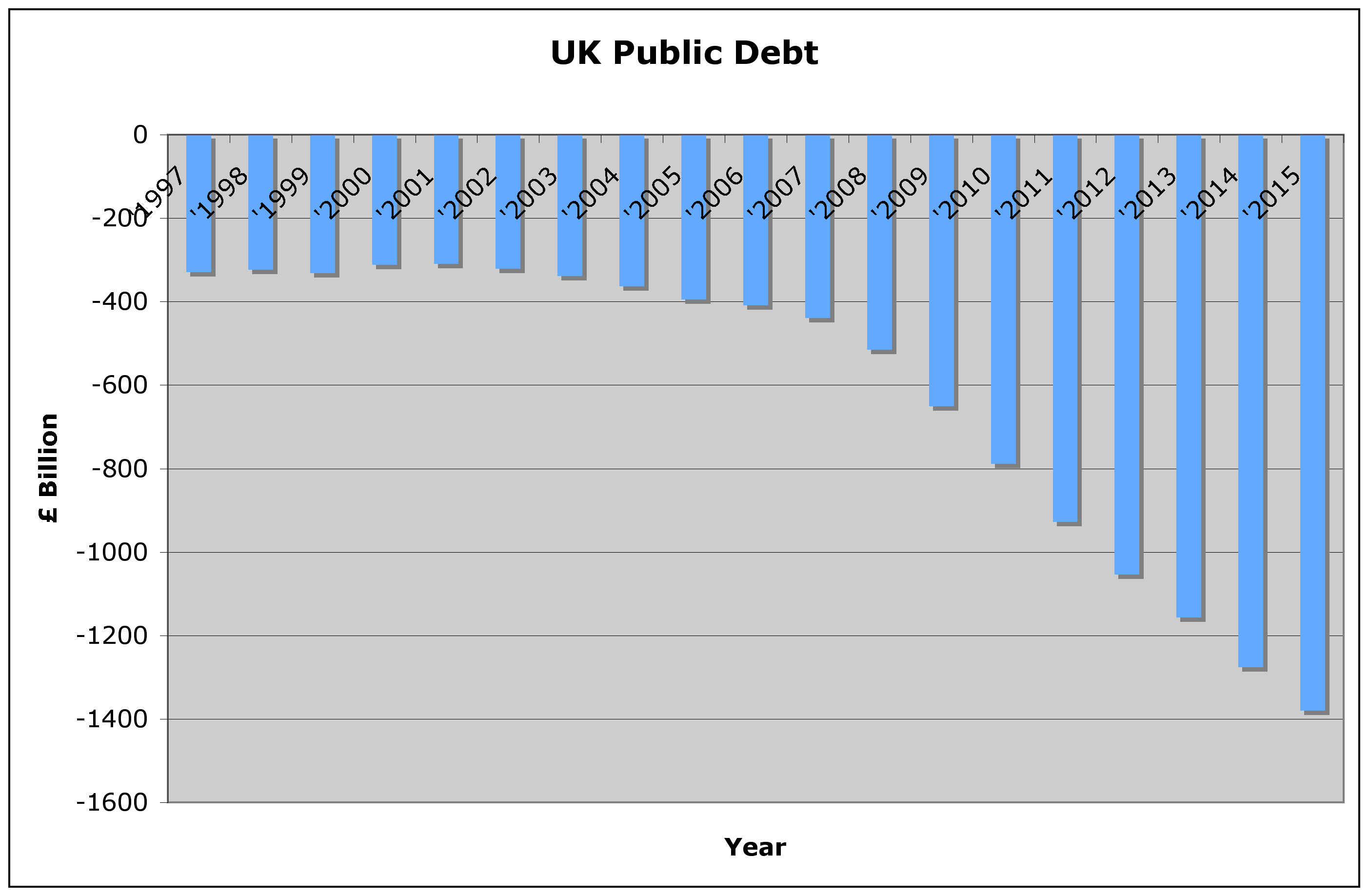
Political squabbling aside, objective observers frame this bottom line in purely fiscal terms: is UK plc broke? Loss of AAA rating suggests it might be but what do the numbers say? As companies are regarded as solvent not whether they have money but whether their credit is good enough to borrow more and hope times improve, let’s take the UK on that more elastic basis. A simple chart of public debt over a couple of decades is shown:

The years 1997 to 2005 were the first two sessions of Blair’s New Labour in which they seemed to hold the boat steady with around £350 bn in debt. But from then on—well before the banking fiasco hit—they seemed to lose the plot, such that by the time Labour had to hand the fiscal reins over to the Condem Coalition, debt had doubled to £650 bn and after three years, Osbo has demonstrated he’s powerless to stop it doubling again.

Nobody comes out of this well. Brown was still canoodling prudence when things started to drift; he and Darling were entirely too cosy with the FSA to clamp down on Canary Wharf’s junk financial wet dreams; neither Darling nor Osbo had the chutzpa to ream those bankers when their odious fiscal concoctions blew up in everyone’s face and nobody—including Balls— is copping to long-term inflationary poison a.k.a. ‘quantative easing’.

Worst of all, no-one has a solution. Both Darling and Balls are claiming they would have borrowed MORE (for feck’s sake) to pump into capital projects. Yet they insist their runaway welfare state is sacrosanct. But look at where all the money in that drunken-sailor free-fall shown above is going.

Share of UK Government Expenditure 1997-2015

Share of UK Government Expenditure 1997-2015

Most people think that Defence or Education are the big-spending departments of the UK government. That may once have been true. But while defence has fallen as a share (from 12% to 8%), look at how the great social programmes have mushroomed to take up close to 3/4 of all government spending. Top of all expenditure is public sector pensions costs that, by 2015, will have tripled in less than 20 years.

However hard-earned or desirable an index-linked public pension may be, the hard truth is that every person in the UK contributing £2,500 each year on top of similar amounts for health and welfare is a heavy burden for any economy. But when £126bn debt accumulates each year to sustain it and any prospect of that changing substantially in the future appears weak, then it is the economics of the madhouse.

The principal unionist argument appears to be that in these troubled times, Scotland should stick with big Britain to help it through. The simple truth, shown above, is that Britain is broke, living hopelessly beyond its means and desperate to keep Scotland as its oil and exports are two of the few good news stories. You want a generous welfare state? Six million Scots are few enough could build one on remaining North Sea oil, whereas sixty million British have most obviously failed to do so with the forty years so far.

Posted in Politics | Tagged | 1 Comment

An Apple a Day

Guest Blog from Christina Bonnington of Wired Magazine (Twitter @redgirlsays)

Can the iPad Rescue a Struggling American Education System?

Matthew Stoltzfus could never get his students to see chemistry like he sees chemistry until he added a digital component to his lesson plan.

Stoltzfus, a chemistry lecturer at Ohio State University, struggled for years to bring complex chemical equations to life on the blackboard, but always saw students’ eyes glaze over. Then he added animations and interactive media to his general chemistry curriculum. Suddenly, he saw students’ faces light up in understanding.

When I see a chemical reaction on a piece of paper, I don’t see coefficients and symbols, I see a bucket of molecules reacting,” Stoltzfus said. “But I don’t think our students see that big bucket of molecules. We can give students a better idea of what’s happening at a molecular level with animations and interactive elements.

And many such students are getting this multi-faceted education on tablets. Tablets are reinventing how students access and interact with educational material, and how teachers assess and monitor students’ performance at a time when many schools are understaffed and many classrooms overcrowded. Millions of grade school and university students worldwide are using iPads to visualize difficult concepts, revisit lectures on their own time and augment lessons with videos, interactive widgets and animations.

In the shift to digital, it’s not just about replacing textbooks but inventing new ways of learning,” Forrester analyst Sarah Rotman Epps said. “Some of the education apps being developed for iPad are approaching learning in an entirely new way, and that’s exciting.

Sallie Severns, founder and CEO of iOS app Answer Underground, told Wired that tablets’ simplicity, ease of use and the massive range of academically minded applications available are drawing teachers and educational technologists to the platform in droves.

Tablet-based learning is no longer the niche it was a year or two ago when we saw a handful of early adopters jump on board with iPad pilot studies in selected grades and classrooms. Schools and teachers are embracing the technology in a big way. A Pew study of 2,462 Advanced Placement and National Writing Project teachers nationwide found that 43 percent have students complete assignments using tablets in the classroom. A PBS LearningMedia study found 35 percent of K-12 teachers surveyed nationwide have a tablet or e-reader in their classroom, up from 20 percent a year ago.

The iPad is the most popular tablet option among educators. Apple sold 4.5 million of them to schools and other educational institutions nationwide last year (it sold 8 million internationally), up from 1.5 million in 2011.

Tablets have proven especially popular in elementary education, and they’ve been a “revolution” for kids younger than 8 because they’re fun and intuitive, said Sara DeWitt, Vice President at PBS KIDS Digital. The taps and swipes are easy to learn, so kids spend more time learning their lessons, not their hardware.

The iPad has given us an opportunity to make technology transparent,” she said. “The touchscreen interface is so much more natural than a mouse and keyboard, kids can jump right in.

That said, there’s more to using a tablet in the classroom than handing them out at the door. Teachers and school district administrators must decide how to best integrate them into the curriculum, considering things like the number of tablets per classroom, which grades receive them first, what content is accessed, and when.

How tablets are integrated into classrooms is key to success,” Severns said. “Planning, preparation, implementation and evaluating apps are key to using this new technology.” While adoption is broad, the ways educators are using them varies from class to class, school to district.

Apple’s iTunes U is one tool making iPad-based course integration easier by helping teachers create and curate a wholly digital curriculum. Teachers can pack iBooks textbooks (including titles from major publishers like McGraw-Hill, Pearson Education, and Houghton Mifflin Harcourt), audio and video, documents, and even iOS apps into a single package that students navigate as they progress through the course.

When it launched in 2007, iTunes U was a source for audio and video lectures students could use on their iPods, but Apple introduced a new app in January 2012 that leveraged the capabilities of the iPhone and iPad, adding in iOS apps, iBooks, and video to the mix. Downloads have topped 1 billion, and iTunes U is used by more than 1,200 colleges and universities and more than 1,200 K-12 schools and districts.

Severns said iTunes U is “paving the way for how educators teach and students learn” because it allows for unprecedented ease in distributing and accessing academic content. Simply log on and it’s there.

Still, it can be easier or more beneficial, particularly in K-12 classrooms, for teachers to just round up a collection of dedicated apps (there are more than 75,000 education related apps in the App Store) for students to use. There, tablets are often supplementary rather than being used for the bulk of coursework, so a full blown iPad-based course (like with iTunes U) isn’t necessary. Tablet time is often a reward, where students will get to play a game that isn’t just fun, it’s building on skills and concepts they’re focusing on in class. iOS has built-in controls that can let teachers lock an iPad into a single app and place restrictions on functions like browser access to ensure kids are learning, and not goofing off.

Third party apps also can take advantage of the social networking opportunity inherent to mobile devices. Students can ask questions of each other and the teacher, something Severns said is absolutely necessary to ensure everyone understand the information.

Stoltzfus, the chemistry lecturer in Ohio, said the social networking aspect allows him to poll students mid-lecture to determine how well they’re understanding the topic. He can adjust his lesson on the fly, which he said is “where tablets can really really help us in terms of progressing in pedagogy.

We are approaching the day when tablets won’t be an option, but a requirement.
Arkansas State University, for example, requires all incoming freshman to have their own iPad. But as tablet adoption proliferates amongst those students and schools with the money to buy the devices, low income students and cash-strapped schools may be left behind. That could deepen the divide between those with access to the latest learning tools and those with traditional technology and limited Internet access.

We’re seeing this kind of segregation already, but some of it is self-imposed. Many college freshmen, for example, are using iPads in class while many upperclassmen prefer their laptops or even pen and paper for coursework.

Five years from now when young students come into college, the expectation is going to be a lot different than it is now. They’ll be used to using tablets in middle and high school,” Stoltzfus said. “We have to be the ones that are pushing the limits.

Posted in Education | Tagged | Leave a comment