From Underground to On Top of the World

While East Lothian can make fair claim to the best place to live in Scotland, the ‘Hill Country’ of Gullane is the most desirable address in the county. And while there are some very fine houses on Hummel, Nisbet or Whim Roads, the sine qua non is Hill Road itself. EH31 2BE is just a dead-end. But its steeply rising curve strings mansion after mansion along  spectacular views out over a sandy tangle of bents and beach, a choppy ‘Sea of Scotland’ and a magnificent sweep of Fife along the whole horizon.

Forth Lodge; Dilston; Coldstones; take your pick—they’re all impressive in their Victorian or Edwardian architecture, tastefully separated from one another by plenty of well manicured space. And while none are identical—indeed they provide a smorgasbord of designs that could busy an architecture student for months—they do provide aesthetic coherence, speaking of an age of tasteful elegance rather lost in the tract home of today.

Oh, I almost forgot—they’ll each set you back a serious seven-figure sum before you have to start worrying about how you’re going to furnish eight bedrooms and find a maid.

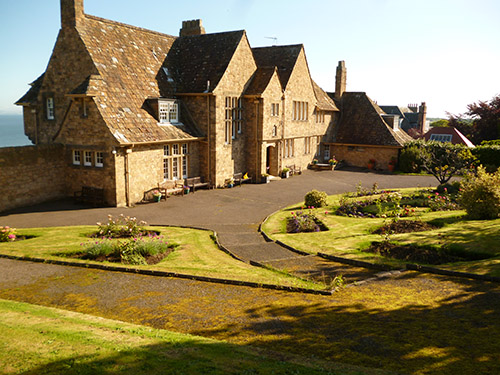
Nestled near the top on the view side is the wonderful Cotswolds-looking (actually local honey-coloured Rattlebags stone) pile in the Arts and Crafts style called Whatton Lodge. Designed in 1910 by J.B. Dunn as the earliest of three in this style (Lorimer’s Corner House and Coldstones followed in 1912), it was built for Sir Harold Jalland Styles as his main home. Succeeding Joseph Bell (Conan Doyle’s model for Sherlock Holmes) as surgeon at the Royal Hospital for Sick Children, he brought aseptic surgery to Scotland and made major contributions to the treatment of breast cancer and TB.

Whatton Lodge

Whatton Lodge

Of all the houses on this secluded street, this is perhaps the most unspoiled—no modern garages or extensions; absolutely nothing to spoil its century-old pristine style. But even better is the interior, in which dark wood panelling and extravagant flock wallpaper are still in place. The panelled doors are all original with their bulky brass door fittings. Decorative cast-iron grates are in place in the open fireplaces.  Unusual Vitruvian scroll and plaster cornices still decorate the ceilings. It is so authentic that three film crews have used it for Edwardian scenes with little beyond some furniture required to make it look authentic.

Main Stairway at Whatton Lodge

Main Stairway at Whatton Lodge

“So“, you are saying to yourself “what is all this leading up to? What captain of industry or robber banker has set himself up in this nice little earner to gaze down on the peasants from its lofty heights?” Actually, that’s the best bit of all.

Immediately after WW2, the house became vacant. Plans to nationalise Scotland’s health services faced a last minute threat from an unlikely source—workers in the newly-nationalised coal industry. The Miners’ Welfare Fund wanted a new convalescent home and had hit upon Whatton Lodge, with its salubrious beaches, golf courses and other recreation nearby, as ideal for their purpose. Also, such a move ran against Bevan’s health policy which was to bring everything into the new NHS.

Papers in Scotland’s National Archives reveal an additional snag: grand houses like this on Hill Road had feu conditions for use solely as family homes – and this was to be a convalescent home for up to 20 miners. Sir Harold’s nearest neighbour on Hill Road was his former assistant Sir John Fraser who died the year after Stiles. Fraser was the finest surgeon of his generation and had become principal of Edinburgh University in 1944.

Other neighbours asked their views on dropping the feu condition and were uniformly shocked. According to one Hill Road resident: “The precedent, to allow institutions of this kind to spring up in a locality famed throughout the world as a holiday resort primarily for golf, would to my mind be disastrous”. The chances of the nimby nobs fighting off these grubby miners from appearing in their neat back yard looked good.

But public pressure grew on Arthur Woodburn to act, although he had no powers to intervene as Secretary of State. Finally, a letter on behalf of Lady Fraser and her son Sir James broke the logjam. They said they had no objection “as they feel certain that had Sir John been alive, he would have been the last person to stand in the way of such a project”.

Dining Room at Whatton Lodge

Dining Room at Whatton Lodge

And so, since 1948, Whatton Lodge has been the Scottish Miners’ Convalescent Home, enjoyed by thousands of those stalwart men (and their wives and widows) who once made a hard living dragging what was once our main energy source from the bowels of the earth. And even though the last deep mine closed over a decade ago, there are still hundreds who come to enjoy the company of their old comrades and feel, for once in their lives, they are living like toffs.

Which they are, and long may they do so.

(To support or make enquiries about Whatton Lodge, contact Mrs E. Egan 01620 842278, whattonlodge@yahoo.com)

Posted in Community | Tagged | Leave a comment

Jock Tamson’s Kindergarten

I have a confession to make. Despite a lifetime of dedication to the cause of Scottish Independence, I like Douglas Alexander. Hell, I even like his sister and regret that she has gone from the mainstream of Scottish politics. Let me be clear that I have no idea whether I like Douglas personally (still less whether he could thole a chat with me) and he has proved to be such a loyal Labour bag-carrier that I despair of even the best in that party dragging themselves out of their partisan rut for the sake of a decent democracy. But, unlike the bulk of his Scottish colleagues, at least he has shown both initiative and courage to raise the debate about our future.

His ‘Scotland 2025’ speech, delivered at the University of Edinburgh two months ago was as close to a game-changer from Labour in the debate over Scotland’s future as I have yet seen. As Douglas put it:

“I want to suggest that the nationalists’ approach creates an opportunity for those of us who believe our Scottishness is best expressed within the United Kingdom to counter that nationalist negativity with a different, and a more hopeful, story about Scotland’s future.”

This may be like swigging hemlock and vinegar to an old nationalist like me. But the man goes on to make his case—and a positive one, damn him—for why Scotland would be better off staying part of the UK. And he does it without denigrating anybody and certainly not the Scots themselves along the traditional “too poor/wee/stupid” lines so often deployed as an argument. Good for him. If us nats can’t win in 2014 by making the better argument and countering such decent articulation, we don’t deserve to have our own country back.

I was reminded of the pivotal relevance of this sipping my usual pre-Saturday-surgery latte and scanning the Opinon pages of the Hootsmon to find they had eschewed their usual venal partisanship and featured two very different pieces—one from Gerry Hassan and the other from Alf Young—that pose similar questions and bemoan that such articulate contributions as Douglas remain very much the exception, rather than the rule. As Gerry puts it:

How many times have we been told that the independence debate is a “once-in-a-lifetime opportunity” or “a historic moment”? Funny that, because it doesn’t feel like that to many people outside the “bubble Scotland” that lives and breathes politics. There have been comedy wars, twitter spats, stupid interventions, and a politics shaped by “fans with typewriters” and worse. There hasn’t been much insight and light so far.

His article cites vicious little cyberwars that have gone on in overreaction to people like comedian Susan Calman or academic Gavin Bowd and highlights again what Douglas took pains to highlight: “Empathy is what keeps us together. It’s all really about people getting on with other people.”

And yet, trawl through media coverage of SNP commentary (there is precious little other than bumf emanating regularly from the Yes campaign so far) and it’s as if they are going out of their way to underscore Gerry’s point. Veteran eco-warrior Rob Gibson MSP trumpets a rebuff of the MoD acquiring more land around Cape Wrath; Kevin Stewart MSP bangs on in provincial narrow focus about the AWPR and the “notorious Haudagain roundabout traffic blackspot”; Eilidh Whiteford MP chirps that she has caught Harriet Harman out by revealing Labour’s plan to cut benefits to Scots; even the normally astute SNP Westminster leader Angus Robertson sees the English local elections in terms of UKIP “pulling the Tories to the right” when such 19th-century class war concepts are usually associated with stuck-in-the-past Old Labour.

Such stuff may be the talk of the Garden Lobby and have been standard fuel for street and doorstep campaigning for decades, it is hardly edifying and comes nowhere near building the empathy that Alexander makes a case for and, more importantly, that the Yes campaign needs to be building to move outside of the static 31% faithful they have had in their camp since the 2011 election. Much though they clearly love being top dogs running the Holyrood bubble, the SNP are in danger of seeing things entirely through that prism.

While the SNP have indeed demonstrated a competence, not to say an audacity, in running the country that put the small-scale timidity of the pre-2007 administrations to shame, there is something verging on hubris in present programmes that risks alienating those they would seek to convince. MacAskill has not just the judiciary but a wheen of ordinary folk up in arms about the way he has gutted the Procurator Fiscal offices and decimated the local responsiveness of Sheriff Courts. Brown has alienated Green allies by pushing ahead with road building (Forth Crossing; A9; AWPR) while cutting back on EGIP. Mackay has brought out pitchforks and burning torches across the countryside by refusing to consider private wind turbines next to settlements as any more evil than substantial wind farms hidden up on the moors.

All this has left the man in the street—the Scottish variant of the one the urbane and plausible Nigel Farage was so astute at wooing in the recent English local elections—disconnected, if not disinterested, not to say sullenly hostile to what should be Scotland’s biggest debate since 1707. In his article, Alf Young blames the SNP for “playing the long game” and allowing the discussion to start out dominated by naysayers. Professor James Mitchell, now occupying a chair in public policy at Edinburgh University, has called the debate so far “arid and acrimonious”.

Alf complains that opposing websites contain little more informative than people jumping up and down with ‘Yes’ placards in many languages or the details of a fundraising ceilidh in Banchory. Certainly, if you’re looking for information on your future pension, the apportioning of the national debt or how we stop Russian Yankee-class submarines parking themselves off the Broch in an independent Scotland, you’ll be as disappointed as if you wanted details how our English bros will look after us or HS2 is going to transform all our lives—once the Union is safe. Alf”s main thesis, with which it is hard to take exception, is:

“(The SNP) opted to play this very long game, counting on their accumulating record in running a devolved Scottish government responsibly and well as a sure foundation from which to win the trust of a majority of Scots, when it came to taking the next big step. They did not know, nor did the rest of us, that that long march would be overshadowed by lengthening years of austerity, as much of the western world struggled to extricate itself from arguably the most profound economic crisis since the 1930s.”

When you dominate the ministerial floor of offices in Holyrood, surrounded by flunkies whose career depends on keeping you happy, the natural response is to worry about your place in the pecking order and less about events outside of that bubble. The Unionists have enough Michael Forsyths and Alastair Darlings kicking about to make a fair fist of a campaign while their party parliamentarians fret about questions no-one counts and speeches no-one listens to.

But, since Mr & Mrs Punter or the Scottish equivalent of Farage’s Dog & Duck barside debate are entirely disengaged, it is hard to see how the Yes campaign can build its momentum even if juicy morsels of policy will have been grilled to perfection by this autumn when there is less than a year to go to September 2014’s vote. After the best part of a year when debate has seldom risen above a four-year-old’s “does not!”…”does too!” level of debate, the largest vote cast is likely to be by those fed up with the childishness of  it all: they will not deign to vote at all.

This could be a depressing echo of 1979 when even the dead were voting ‘No’. And, after any such ‘No victory’ we will have turned our back on change and all 60m  Britons will be stuck in the same political kindergarten.

Posted in Politics | Tagged | Leave a comment

Why Scots Should Be Fans of Farage

The results of this month’s English local elections were a shock to many and a surprise to even more. Normally barely registering on political seismographs, the discussion usually revolves around how many seats the party of UK government lost vs how many the main opposition gained. Pundits poke around the entrails, trying to divine what the relative shift means for the next UK general election. Actual issues like good vs bad councils with good or bad policies never even raise a comment.

This year was different because, 14 years after Scotland voted for a 4-party political system, England caught up. Sweeping up a quarter of the votes cast to tally a respectable 147 councillors (from 8) UKIP came of age and put some seriously feral cats among other parties/ policy pigeons, especially the Lib-Dems.

Labour, while making progress and chalking up some serious victories based on diligent local work in taking Nottingham- and Derby-shire, made disappointing progress for a 9-point poll lead. The Tories have been a-flutter with the renewed Euroskepticsm that they contract on a regular basis. But the Lib-Dems, losing most ground and all control are behaving a bit like the Poles in August 1939 just before receiving the world’s first visitation of the Blitzkrieg.

Now, gentle reader, before you put quill to parchment to accuse me of equating UKIP with NSDAP or Nigel with Adolf, allow me to explain why they are a similar force to be reckoned with and, demonstrating a mass backing of ordinary people as they do, why English parties ignore them at their peril—as they have done to date. Note that I omit Scottish parties and we shall return to examine why.

UKIP’s rise in England should come as no surprise. It has less to do with xenophobia and more with the progress of major parties towards what they regard as self-serving enlightenment. Just as no party is against motherhood or apple pie, so none that hope for national success allow policies that offend; all seek to be for education for all and human rights and compassionate welfare and universal health care and emancipation and inclusion and all other such laudable buzz words as have entered the language.

As a result of being ‘for’ everything, the average politician restricts criticism to his/her opponent or whoever backs their opponent’s party. Anyone who doesn’t risks a media roasting—Norman Tebbit is still being quoted as saying ‘on yer bike’ when what he actually said was his dad got on his bike and looked for work when he found none in the vicinity. Being interviewed, the typical politician answers any question but the one asked, takes no blame and does a passing impression of an eel caught by hand. Those of the old school still left (Prescott, Lawson et al) are out to pasture and regarded as dinosaurs.

But this left a serious vacuum at the heart of a society that sees soap operas as reflecting real life; arguments flare up; punches are thrown; vendettas fester. Nobody in the many bars of Westminster (ex-Army majors whose rent-a-quote career has ended excepted) talks or acts like they do in the Queen Vic or the Rovers. Enter bloke-ish Nigel Farage, fag in one hand and pint of bitter in the other, looking exactly like the local car dealer making his way in the world that you would pass the time with amiably setting the world to rights down the Stoat & Ferret.

The man’s a natural. Every self-made local builder or insurance broker or anyone else staying late at work putting together VAT returns for the insatiable gub’mint takes to his easy manner and forthright answers. Asked on the Andrew Marr Show if he was going to stand for Westminster, he actually answered the question and left Jeremy Vine stumbling to follow up. For the teens more moderate equivalent of the sixties’ Alf Garnet, he speaks with an authenticity that chimes with widespread frustration at endless H&S rules, political correctness, smug bureaucrats and Johnny Foreigner’s boundless cheek at telling John Bull what shape his bananas must be then coming here to have his op on the NHS.

So, this UKIP phenomenon is no flash-in-the-pan. Unlike the BNP or NF, their dislike of foreigners is measured and so English in its reasonableness and so appeals to the more admirable good nature of the average bloke. In fact, the arguments they deploy down the Stoat & Ferret are not so different from what has inspired Scots to move as far as they have towards disconnecting from an adjacent stronger neighbour whose power they see as overweening and whose sympathy for our culture and priorities misplaced or absent.

Which is one reason that UKIP does appallingly in Scotland—we already have our literate and passionate party of protest: it’s called the SNP. And, were UKIP to drop its rather futile insistence on Scotland staying part of the UK, the two parties could benefit much from co-operation, even as their respective philosophies sit badly with one another. For the second reason UKIP does appallingly in Scotland is that the overwhelming majority of Scots actually like foreigners: they add colour and bring gumption—the only people who threatened to invade Scotland in the last millennium were the English.

So UKIP xenophobia and Scottish xenophilia could actually work in harmony. While UKIP obliterates large chunks of the ephemeral Lib-Dems and pushes Tory schizophrenia into overdrive, the Scots can calmly assert both their independence and their strong interest in remaining part of the largest economic union on the planet. Along with Eire, Sweden, Denmark, Finland and other like-minded influential small members they can steer the EU away from this Brussels/Euro fixation that means ever-tighter union and towards what has been its economic glory: an affluent 300+ million trading bloc that can play ball with the US, China, the BRICs or any other economic development we may meet.

Rather than the last four years of economic stagnation, what is wrong with this scenario:

  • 2014—Scotland votes to become a normal country. It negotiates to keep EU membership and £ sterling
  • 2015—Cameron delivers a referendum on EU membership which is lost. The subsequent UK general election gives another hung parliament as 50 Labour MPs are lost with Scotland’s departure
  • 2016—Scotland takes its seat at the UN between Saudi Arabia and Senegal, joins NATO, EU, OPEC, the Nordic Union, adopts £80 bn of UK debt, contracts with England for certain services (embassies, DVLA, MCA, etc), agrees to a five-year run-down of Trident at Faslane and comes to an agreement with the Bank of England as regards permissible fiscal policy. EU abandons Euro for all members; Greece and Cyprus leave the Eurozone.
  • 2017—after two years of protracted negotiation with an ill-tempered UKIP snapping at its heels, the UK withdraws from the EU. England see sense, cancels any Trident replacement and begins to shut down Trident operations at Faslane. Scotland’s tidal and wave renewables investments begin to contribute to the 5GW of existing wind capacity. Cross-North-Sea interconnectors agreed with Norway and Holland
  • 2018—with oil above $120 a barrel and debt being paid down faster in Scotland than England, £ sterling rises in value above € (which continues to falter with the PIGS) and $ (which is burdened by over $15 trillion in US government debt now Obama is gone). This causes England’s already bad balance of payments deficit to worsen as exports suffer and more is imported. Scots oil, energy food & drink & tourism grow. The Black Watch (formerly 3Scots RRS) deployed, along with Finns and Canadians, in UN peacekeeping force to rebuild Syria after seven years of civil war. Scots prove to be most popular because they wear skirts and interact with people, sharing their Irn Bru and playing football with the kids.
  • 2019—China’s economy overtakes US; Brazil and India both overtake Germany. Strength of £ sterling and long-established Scottish trade connections with China & India combine to allow England to make major investments in consumer businesses: M&S, Next, Sainsbury & Stobard in the lead. While rediscovering overseas markets, English europhobia leaves Scotland as the  sterling zone foothold in Europe (and vice-versa) trade improves, with Scandinavia leading and providing most of population surge past 5.5m. Edinburgh & Glasgow both experience boom like 1990s Dublin.
  • 2020—Scottish trade with England and Northern Europe doubled in ten years; inherited national debt brought down to £60 bn. Renewable energy technology overtakes whisky as export earner. England has only just stopped borrowing and debt has begun to decline from £1 trillion, thanks to resurging economy on Asia/BRIC trade and £10bn saving on defence from axing Trident.
  • 2021—Scotland takes over the Presidency of the EU for the first time and convenes a World Trade summit on the back of its international success to lay the foundations of  Universal Free Trade; only North Korea and Zimbabwe decline. Faslane becomes a conventional Scottish Defence Force naval base. Edinburgh comes in second as most desirable city to live in the world, losing out to Prague only because of higher property prices. Nigel Farage, deputy PM of England, is voted Scotland’s Man of the Year.
Nigel on Home Turf

Nigel on Home Turf

Posted in Commerce, Politics | Tagged | Leave a comment

Tug for a Clapped-Out Gunboat

The ‘discussion’ on Scottish independence is theoretically well underway but the SNP’s Angus Robertson gets himself into hot water on Audioboo’s new Hear Hear and reported in today’s Hootsmon by asserting that all the Better Together campaign do is repeat scaremongering tactics that claim Scotland is too poor/stupid/wee to be a proper country.

Not a bit of it, retorts Better Together:

“The only people who peddle this line are the Nationalists. No-one from Better Together thinks that Scotland couldn’t go it alone – we think that it is better for our economy, our jobs and our future if we stay together with the rest of the UK.

“The Nationalists are only interested in dividing people. We think that we are stronger when we work together.”

Oh, aye? Let’s think about that for a bit. Yesterday Erikka Askeland and Tom Peterkin gave us both barrels in separate pieces that said:

“A study by the Institute of Chartered Accountants of Scotland (Icas) questioned the affordability of private pensions, suggesting businesses could be faced with a multi-billion-pound pension bill to finance private retirement schemes in an independent Scotland. It also highlighted the cost of paying for Scotland’s share of the United Kingdom’s £893 billion public-sector pension schemes and £82bn state pension.”

No mention that England would face the same problem as this  would work both ways, still less any prospect that the two countries might work positively to solve this problem—if it is indeed a problem. Then consider Mr Osborne, who came North earlier this week to deliver his Sermon on the Mint to us in Glasgow. The Grauniad‘s headline pretty much sums it up but more importantly, the entire speech revolved around dismissing the practicality of any future currency union out of hand:

“Would the rest of the UK family agree to take that risk? Could a situation where an independent Scotland and the rest of the UK share the pound and the Bank of Englandbe made to work? Frankly, it’s unlikely because there is real doubt about the answers to these questions”.

Let’s leave aside the Chancellor’s dubious track record on getting financials right, where is the willingness to consider options; where are the positive proposals how currency issues might be resolved among friends and equals in the event that the Yes campaign wins? His disdain is echoed by the Leader of the Better Together campaign himself, who ought to know as much about finance since he used to have Osbo’s job:

“Would the rest of the UK agree to creating Eurozone-style complexity given that they would already have the pound and the Bank of England? Would it be in their interests? We wouldn’t know the answer to this until we separated from the rest of the UK. But today the UK’s Chancellor said that he thought it was unlikely that the rest of the UK would agree to create a Sterlingzone if Scotland left the pound.

“If the rest of the UK won’t enter into a currency union, or if the terms of a currency union are unacceptable to Scotland then the likelihood is that we end up with a separate currency from the rest of the UK.”

Ach, weel, that’s us then—scunnered. Top names pooh-poohing the very concept. But Angus may have a point: if this is Better Together’s top team “thinks that Scotland could go it alone”, it’s a funny way of expressing it. And don’t you find it funny that those very proponents of how well Scotland does remaining in this Union won’t even give the time of day to any idea or request for it to assert its own priorities.

Starting with the very name “Bank of England” itself,  through CofE bishops (but no CofS ministers) sitting in the House of Lords down to the tawdry assertion of superiority by MPs such as Ian Davidson over the affairs of Scots, there is a tasteless bias here that rankles: it veers between the condescending and the insulting.

Forget the idea that a Scots king once took over the English throne—the last coronation in Scotland was for Charles II in 1651. Although the Parliament of Scotland proclaimed Charles II King of Great Britain and Ireland in Edinburgh on 6 February 1649, Cromwell’s English Parliament instead passed a statute that made any such proclamation unlawful. Such attitudes set the precedent of which country wore the trousers for the next 350 years.

The Union of the Parliaments itself was an attempt to disarm Jacobite dissent and—other than preserving Kirk and laws, that tawdry document was more concerned with filling the right pockets (on both sides of the Border) than the stature of any rump existence for the Scottish nation. English hostility to the Scots Darien venture set the tone. Both the Enlightement and the irrepressible innovation of Glasgow merchants were outwellings that benefitted both countries, Hielan laddies marched off to conquer in large numbers and it appeared that the North British were brought nicely to heel at last.

Except, no-one south of Carter Bar ever spoke of the ‘South British’. And when some district agent sat on his verandah with a pink gin after a long day, he thought of ‘England’ with its cool shires; how else could every other country on this planet talk of ‘England’ when they mean ‘Britain’? By the early 20th century, our march to cultural unity was on track so the prospect of Scotland being no different to Yorkshire was indeed plausible.

It is more than a symbolic point. Perhaps the BBC has stopped talking about ‘the regions’ in which it included Scotland. There is no question that the Scots were enthusiastic partners in empire-building—and saw great benefit from it. But, more importantly, our joint colonial cause that spilled so much blood while making so much money rather fell off a cliff in the last 50 years so that the question is less “what is Britain for” north of the border than “why am I still a part of this?”

Because that same colonial effort drove mighty industries that were even more at home in industrial Scotland than the Home Counties. This bred socialism and questioning of the forelock-tugging hierarchy at the heart of Merry Old England but was alien to the tight iconoclasm of Scottish clans and Glasgow humour. So, no more than it could with Ireland, England has failed to imprint its culture beyond its border.

To the Scots, this debate is not about what Better Together would make it—nostalgia for the the great days of Great Britain when we stood alone/together in the world against fascism and dictatorship. Only people well into retirement have any memory of that. The rest of us have learned that international trade with friends—not gunboat-enforced third world sweat shops—is what makes modern prosperity and that the Scots have little taste for those trappings of empire that seem to mean so much to our English cousins.

So, let them squabble about historical appendages like Gibraltar or Falklands or Akrotiri; a seat at the UN top table should be for monster countries and not declining has-beens struggling to stay relevant; nukes are for the delusional; global reach is now quite unaffordable to Britain together, let alone England alone.

Just as England has done for centuries, it’s time for Scots to define the priorities that suit them and pursue them. If that involves keeping the Queen, the Pound and our share of the British Army/RN/RAF—and ditching Trident and the global policeman ego that goes with it—we should negotiate that.

For now we need positive debates on how we could work together to mutual benefit and not this hand-wringing caterwauling about disasters on pound or pension if Scots had the temerity to decline to abandon the fiscal mess that UK governments have led us into. It is not helpful for them to make two-faced arguments, such as the SNP point out this week:

“Liberal Democrats remain in favour of joining the euro and Labour have never ruled it out—a fact that they seem to want the people of Scotland to forget. Meanwhile, the Tories have consistently ruled out joining the euro, meaning that there are three different positions on currency within the No campaign – something which they have described as an ‘incredible situation’ when applied to the Yes campaign.”

A little less hypocrisy and a lot more humility would allow a reasonable outcome for a currency union post-independence. The Scots would benefit from using a stable world currency and Scotland’s oil & gas would shore up both global status and its stability. And, if Edinburgh’s financial hub got back to playing the role it does best—demonstrating our famous Scots canniness to the world—they can let their Essex wide boys of Canary Wharf have their head if they want: Scots could have it own FSA with teeth that would avoid future repetition of 2007.

So, rather than the shock troops of naysaying unionists like Ms Askeland and Mr Petersen getting relentless press that gives everyone a headache and probably contributes to continued recession with their pitifully uncreative moaning, let’s get the jaikets off and see what the practicalities are of sharing the pound or the Queen or a positive joint attitude. Because if those congenital teeth-suckers succeed in bludgeoning Scots into keeping hold of nurse for fear of something worse, the remedy to dig the UK out of the Brown/Osborne fiscal shambles will be much longer and much harder than it need be.

A resurgent, independent Scotland cannot fix the present broke-but-doesn’t-know-it England by ourselves. But as we strike out in a more modest, affordable and less imperial direction, we’ll make better friends and common cause with Ireland and gain a more modern stature by joining the Nordic Union. All of this would be a pleasant surprise to other countries, especially European friends, who are used to seeing Britain as curmudgeonly, clumsy and globally still hankering for lost hegemony.

Scotland could provide a tow, could embarrass our English cousins out of their grumpy gunboat mentality, leaving their 19th century lost glories behind and, standing up with better purpose, join the 21st century.

Posted in Commerce, Community, Politics | Tagged | Leave a comment

The Groat in Yer Sporran

You know you’re getting old when you remember what happened half a century ago but can’t find your keys. OK, so it wasn’t quite half a century ago that Labour’s Harold Wilson, after weeks of increasingly feverish speculation and a day in which the Bank of England spent £200m trying to shore up the pound from its gold and dollar reserves, devalued the pound from $2.80 to $2.40. Those were the days, eh?

Claiming that Britons would see very little difference, he also said devaluation would enable Britain (stop me if you’ve heard this one before) to “break out from the straitjacket of boom and bust economics“. He went on to famously assert “From now the pound abroad is worth 14% or so less in terms of other currencies. It this does not mean that the pound here in Britain, in your pocket or purse or in your bank, has been devalued.” Aye, right. “What this does mean” Wilson went on to claim “is that we shall now be able to sell more goods abroad on a competitive basis.

The whole thing had been triggered by his Government inheriting a “huge” deficit 0f £800m from the Tories (roughly 0.08% of the monster one Osbo is wrestling today), Britain living beyond its means—importing more Japanese televisions and unable to export enough Robin Reliants—plus a series of strikes that throttled what exports there were because the dockers led most of them. The upshot was wage inflation, Chancellor “Sunny Jim” Callaghan resigning on “a point of honour” and further dislocation of the economy through strikes as his replacement struggled impose 3.5% limits on successively greedier wage rise demands from various unions.

This is not just dusty history: it is a lesson for us here today, wrestling a bigger deficit against a background of a sluggish economy and union-driven wage unrest. As Osbo came North this week to deliver his Sermon on the Mint, it is palpably clear that the basis for his chastising speech on the insanity of any future the Scots might choose outside the UK (to be characterised by plagues, locusts, etc) was based on one key assumption: that the UK brought inevitable bounty and sunlit uplands.

His predecessor of half a century ago didn’t think so and resigned. Indeed, the whole 1967 sideslip from economic grace ushered two decades of economic decline only erased in the share-sale-fueled boom of the late eighties. With three years of failed strategy, a £1tn deficit to his name and no end in sight, ‘gallus’ may be a mild word for his hubris. This blog won’t rehearse his arguments here—Ian Bell does a pretty good demolition job in today’s Herald—but posit an equally plausible alternate scenario.

Much of Osbo’s argument is predicated on a variant of the “too poor/too wee/too stupid” argument that unionists once used when independence was still to be proved viable. But consider the problem WITHOUT currency union between Scotland and England (without Scotland  there is no UK or rUK) from the perspective of an objective English Chancellor:

  • The country would be 50m in size (plus another 10% in Wales and NI)
  • At a stroke the economy and tax income is ~90% what it was
  • While some budget expenditures drop by 8.7% (e.g. welfare) and the £28bn Scottish Block Grant disappears, the £40bn defence budget would be virtually unchanged
  • £45bn annual exports to Scotland depend on some mutually beneficial arrangement
  • Imports of £41bn from Scotland means that the £4bn trade advantage is at risk
  • Without Oil & Gas revenues of £12bn the pound would cease to be a petro-currency
  • Scotland contributes positively to the UK balance of trade (see chart below)

Bottom line to all of this is: what pragmatic English Chancellor with the best interests of (worst-case scenario) only England at heart would ignore the opportunity of securing a currency union with a partner like Scotland that is a net contributor to the stability and value of that currency?

Trade Balance of Regions (sic) of the UK, March 2013


UKtradeCompared to the profligate—as well as wealthy—regions around London, Scotland lives up to its canny fiscal reputation when it comes to trade and these statistics do NOT (as is the custom dahn saff) allocate 7.6bn in oil exports to Scotland any more than they credit North Sea oil to the Scottish economy.

In his Sermon, the Chancellor again made much of the volatility of oil prices, as if other income streams weren’t equally volatile over time (c.f. Irn Broon’s 1999 raid on pension funds). He especially used it to pooh-pooh Scotland’s main alternative to currency union: having its own currency. If he got out more, he might discover another small, oil-rich, northern country called Norway. It’s well known that Tories are notoriously slow on the uptake (as it says on the tin) but it’s been around for a century now and demolishes his arguments if he were only honest enough to admit it.

But, since no-one (bar the Greens) is pitching for our own currency and no-one thinks joining the Euro at this point makes much sense, an independent Scotland would want to negotiate with England to continue in a currency (only) union together. It would make the pound in all our pockets stronger. But, unless Osbo gets his head out of the sand sharpish, he’s going to find his political bias has sold the pass and his fellow Englishmen will have to thole a worse deal with us than if he wised up to the advantage being friends with Scotland offers.

Posted in Commerce, Politics | Tagged | Leave a comment

Brechin’s Revenge on Beeching

What was disappointing about the half-century anniversary of Dr Beeching’s evil œuvre “The Reshaping of British Railways” wasn’t that comment and opinion was as divided as on the death of Margaret Thatcher and pushed it off the page (political bedfellows like the Daily Mail and Torygraph were at loggerheads) but the absence of lessons being drawn. Amidst much wringing of hands that he went too far and general agreement that the UK rail network needed investment and growth, nobody seemed to have much of a business plan laying out any how or why.

After posting this blog’s comments last week, this became doubly apparent at the 6th Scottish Rail Conference at the Carlton Hotel in Edinburgh on April 16th when all the right people from the Scottish Government (including the Transport Minister, Keith Brown), ScotRail, Network Rail, contractors, SPT, freight and long-distance operators, gathered to focus on, as Mackay-Hannah put it: “Edinburgh-Glasgow Improvement Programme projects and planning, delivery of the main build phase of the Borders Railway and challenges and opportunities… during the period from 2014 to 2019.”

Broad-based topics covered included “Building a Resilient and Sustainable Railway” and “Supply Chain and Smart Partnership”, as well as the now obligatorily upbeat “Growing Rail Use: Passengers, Freight and Added Value”. All good stuff for the insider trying to run a rail business and the anorak there to mingle with kin. But, in common with the commentary that greeted the Beeching anniversary, not much in the way of strategic thinking: no-one asked what our rail is for, whether it’s fit for real purpose and—other than tacking on of some new services in no discernible priority—how it all fits.

It’s not quite as bad as the emperor’s clothes but, with virtually everyone in Scotland from anoraks to the AA agreeing we need to grow rail services not even the Government seems to be asking hard questions like those above. We seem content to let various ginger groups and political pork barrel steer much of the investment and accept that Network Rail and long-distance services fixate on the network in England, serving the demographic-driven priorities of ten times as many English living in  twice our land area.

We have yet to get a clue.

It starts with High-Speed Rail. Anyone who is anyone in rail here is falling over themselves to get it past Manchester/Leeds and up to Scotland. Quite apart from the Treasury clutching the piggy bank close on this whether Scotland goes indy or not,  has anyone done a cost/benefit analysis on this? Apparently not. Here’s a fag-packet shot:

Let’s assume HS1 to Birmingham/Midlands (£16.3bn & by 2026) is a done deal and that the £18.2bn-and-rising HS2 to Manchester and Leeds will see the light of day this century. The UK government “has calculated that capital and operating costs of £59bn over a 67-year period would outstrip the predicted revenues of £33bn from the line, leaving £26bn to be funded by the taxpayer.” (F. Times)

Cross-border rail traffic is undoubtedly successful and growing but let’s keep things in perspective. Whether 25m English living north of Birmingham do make an economic case for HS2 or not, what chance MacHS? The problems taking any HS3 to Scotland’s Central Belt seem daunting, even if the finance isn’t. How can 5m people currently taking only 3.5m journeys each year, paying £100m between them to cross the border justify a third step? High Speed rail comes in at £130m per mile to build. Even ignoring the nightmare geography of Shap and Beattock, that means £56.3bn to connect Manchester with Glasgow. The conference discussed this project as if it were feasible; it’s fantasy.

Do the sums: get real.

Not only would MacHS be blinding white as an elephant but we haven’t been very good with the money we’ve spent so far on our spiffy new services internal to Scotland that everyone’s so proud of. Not to put any of the projects down or to imply they may not provide a self-funding component of our rail network long-term, but compare those projects already completed and committed against Portishead-Bristol costing £3.8m per mile and an entire new HST station in Leeds costing £161m

  • Stirling-Alloa cost us £6.7m/mile (predicted use: 150k; actual use in 2012: 401k)
  • Borders will cost £10m/mile (predicted use now 640k, down from 947k)
  • Airdrie-Bathgate cost £12m/mile, (not all new track; now 200k @new stations, plus 300k more @existing stations between Central & Waverley)
  • Waverley station revamp cost £58m for 3 new platforms (16.2m to 22.6m passenger growth in the 5 years that the project has run)

On top of these major (i.e. 7-figure+) projects, there have been several reopened stations, most recently Laurencekirk and Conon Bridge but, welcome though they are, none can be considered a strategic step forward in rail improvement and usage.

What we have had—and is not to be sniffed at—is a steady investment in rail in Scotland that has increased and improved both facilities and services. But, as you can see for the above list, we may have paid rather more then we should have and have swept few people from their cars and onto rail, except those who discovered they now had a station close to home or work or both.

Because some of the choices made have been questionable at best and cuckoo at worst. For thirty years, ECC has been building Edinburgh Park and the Gyle and yet the stations so named are each a half mile from the centre of their namesake and neither have fast services stopping, if only at commuter times. The ‘fast’ Waverley-Queen Street services stop at Croy, Falkirk High and Linlithgow but only the last has bus connections worthy of the name. There is much investment and service revamp on the eastern side of Glasgow but all of it is for slow commuter services, including the Helensburgh-Waverley service via the new Airdrie-Bathgate link. Because it has 21 stops between the cities, it takes longer than the infamous ‘Fauldhouse, Whorehouse & Boot Hill’ line’s 90 minutes.

Where, in short, is the beef?

Why are there NO premier services? Is it any wonder that little use is made of the business class (on those trains that have them) or that ScotRail is given major grief for being so tardy in supplying WiFi and sockets. In Germany and France, major amounts of business travel are done by rail, business even being conducted en route. Since we won’t get HS3 (see above) why has nothing been done about our internal express routes? Prime contender for such has to be the the Glasgow-Stirling-Perth-Aberdeen corridor, which is currently a 3-hour ordeal in eternally crowded and poky Class 170 3-car sets. The 145 mile journey can be made at least half an hour faster by road—not least because of the £1bn+ already spent on dualling the M80, A9 and A90.

Let’s contrast this with Cardiff-London (also, co-incidentally, run by First). They seem to make the same distance in just over 2 hours but in the comfort of a 9-car 225 train with restaurant, extensive first class and WiFi, such as we only ever see on East Coast. We should focus on this scale of service for our ‘backbone’ line.

Trains out of Glasgow currently take an hour to reach Perth, 60 miles away. It then takes them another 70 minutes to cover the 40 miles to Laurencekirk and 40 more minutes to cover the final 30 miles to Aberdeen. A speed of 35 mph is that of a bad train, not an express. Examine the 150 miles of track and there are several choke points, the three main ones being the Cowlairs tunnel, the tight curves east of Perth and (worst of all) the five miles of single track south of Montrose. The first of those needs to be fixed to improve all services in and out of Queen Street as part of EGIP, so that’s in hand.

The other two can be solved by a radical idea: reinstate the Caledonian Railway. Part of Beeching’s folly was to rip up 35 miles of the old main line from north of Perth to Brechin and think that the secondary link via Dundee, with its myriad stations, twisting track and several grades can sustain fast service. From Kinclaven, there are 35 miles of track to reinstate until it regains the existing line east of Brechin. At the standard rate of £4m per mile, an investment of  £140m (half of Borders rail costs)  could cut this section journey time to under 30 minutes and put Aberdeen within two hours. A further £10m could add a fleet of second-hand Voyager 5-car trains—although those leeches the Roscos make actual train purchase costs as obscure as they can so real price is fuzzy.

Whether it is cost-effective to reinstate stations at Coupar Angus, Forfar and Brechin is a separate analysis—as is whether 9- car 225s (like East Coast’s) or 5-car Voyagers (like Virgin’s) should be used on the route. But there are currently 40,000 people flying from Glasgow to Aberdeen, most of them business travellers paying £270 for booking a week ahead and £330 for that day. Move 25% of them onto rail by offering tickets at half that and you have a £1.5m revenue boost for the line before you even start to consider on-board catering profits.

Additionally, the A90 south of Aberdeen carries almost 2,500 vehicles per hour each way at its peak, which translates into 2m each year. Many are not cars or not Aberdeen-bound but at least half are. If 10% were shifted onto rail (and offering half-hour improvement vs a half-hour penalty for taking the train is a big incentive) you would add another £6m revenue at current average fare. Add the two together and you could fund the borrowing of over £100m of the £150m necessary to make the step change feasible. £50m shortfall from the public purse is £10 per head—a lot less than the £200 each of us paid for trams.

It is an axiom among English train operators that long-distance lines are where the profits are and they consider London-Birmingham’s 105 miles as ‘long distance’. Yet Scotland seems determined to throw money at pork-barrel projects that favour this or that MSP’s back yard. For a real future for Scotland’s rail through the knock-on effect of such a service a key service, that tenner would buy us all:

  • 2-hour journey times Glasgow-Aberdeen (1-hour Perth-Aberdeen)
  • 1-hour frequency, with stops at Stirling, Perth and Brechin as interchanges
  • Similar times from Edinburgh if EGIP allowed Edinburgh-Stirling non-stop express
  • Three new stations at towns likely to sustain them
  • New Angus Circle line Perth-Dundee-Arbroath-Montrose-Brechin (Interchange?)-Forfar-Coupar Angus-Perth. (No longer required to pretend to be fast)

Not only would the grossly underused stations at Stirling and Perth receive a massive boost (as would the cities themselves) but the services radiating out from them would offer faster access to Scotland’s other five cities. There is nothing wrong with piddling about with dualling parts of the Highland Line but its 120 miles are never going to give a faster service than air, nor its passenger density justify much. By all means let’s link Leven back onto the network because the track’s already there, as it is at Grangemouth.

But, before we go stupidly dissipating another £1bn on ill-considered transport idiocy like the Edinburgh trams or overpay for projects because we let them drift for a decade, like the Borders Rail, let’s put Scotland on the business map by running a railway that means business and not just what clapped-out 2-car dinosaur ScotRail thinks will do for that day to fulfill its franchise obligations.

A tenner a head for revolutionising our railways seems like a deal.

Posted in Transport | Tagged | 5 Comments

Gung-Ho Kim Jong

Despite all that the press do to stir up flagging sales, the world is a pretty peaceful place; those parts of it that are not tend to blight mostly themselves. Readers may dispute this, citing some conflagration or other that is always filling headlines. Twenty years ago it was Iraq, then a disintegrating Yugoslavia, then Iraq again, then Sierra Leone, then Afghanistan, then Libya, now two years of Syria.

But, ’twas ever thus. It’s just that, fifty years ago, there were far fewer countries and you never heard of their tribulations—16th century Mughal or Siamese/Burmese Wars meant little to contemporary Europe. It was only when Abyssinia got the League of Nations dander up in 1936 that international news rated much coverage in the newly widespread media. Only rarely do these more modern brush-fires justify concern for the general peace of the world.

Once such wide concern was more common. Anguish over the Cuban missile crisis, Arab-Israeli wars, Dubcek’s ‘Prague Spring’ or Angolan civil strife was genuine because all were avatars and/or test beds for the main cold war proponents and their weaponry. Each time, the road could plausibly have led to Armageddon. But, ever since the Berlin Wall was breached, such brief inside tracks to oblivion have been rare—until now.

The varied tantrums recently thrown by North Korea hark back to those troubled days. Their rhetoric echoes that of China when the US was fighting in Vietnam or the Soviets when US-backed Israelis cleaned their Egyptian protégé’s clock in the Six-Day War. The situation has all the hallmarks of a tinderbox about to ignite: repressive, a militaristic régime; an unbridled but inexperienced young dictator; grinding poverty from sustaining a bloated military that requires external enemy distraction á la Orwell’s 1984; still-glowing embers of a sixty-year-old war with the South that has never been resolved.

Both South Korea and the US appear to take North Korean threats seriously because more active, action-ready troops are deployed there than anywhere else in the world. Whereas the US and UK each have around 7 per thousand populationunder arms and China barely 1 per thousand, the KPA, including the Worker-Peasant Red Guards number some 380 per thousand—everyone of military call-up age. ROK has around 20 per.

The closest comparison that has had a recent military outing was the 1.2m strong Iraqi Army of 79 divisions that in 1991 (and again a decade later) was surgically annihilated in five days by a force a fraction of that size that knew how to exercise its overwhelming superiority in air power, intelligence, command structure and equipment. And that was on the offensive. Although nothing should be ruled out, it is hugely unlikely that South Korea would invade the North unprovoked and so any likely scenario is a re-run of 1950 when the North invaded the South.

The much larger 9m-strong KPA  deploys infantry, armour and even artillery divisions—some 153 in all. Such a force demands serious study how/if it is to be defeated, especially as Chinese intervention in the original Korean War demonstrated very effective mass infiltration and suicidal human wave attacks, able to throw the US Second division into disarray. Many generals spend their time studying how to fight the last war. Wave attacks were shattered only on the tight training, slick logistics/support and sheer jarhead determination of the First Marines around Chosun reservoir.

Given that the military is effectively the only career open to ambition in the North and that the Dear Leader is, at best, a puppet of a military junta (c.f. Burma) or, at worst, a tantrum-throwing 27-year-old who has known no constraints but those with which the West hamstrings ‘his’ country, calling the situation ‘volatile’ may be an understatement. The question is: will the KPA generals risk their livelihood to pursue their rhetoric into a shooting war? Even if they can’t build rockets to seriously threaten anyone, given their scale of isolation, commitment and paranoia, the answer has to at least be ‘possibly’

Should they have done their homework objectively and well, the answer ought to be ‘no’. Not only will they realise that Chosun and Iraq were no flukes but how fragile sheer numbers—even of armoured vehicles—are if they lack technology. The graveyard of the Republican Guard armour was in the swirling dust on the Basra road when the infra-red sights of VII Corps decimated phalanxes of blinded Iraqi T-72. But, if they do launch everything they have out of sheer delusion and bravado, what then? Pivotal in their consideration should be that their one friend China, rapidly modernising on trade with the West, have little interest in upsetting peace’s lucrative apple cart.

There is a case to be made that the US/ROK forces could be caught short, despite a justifiable belief in their own superiority. History provides rafts of examples where a palpably superior side believed it was all bluff and an entire generation of venerated generals found egg all over their faces as well as their hats. Some recent lulus include:

  • Sedan 1940. A 100-division-strong French Army trusted in élan, the Maginot Line and more tanks than the Germans. As they swung into Belgium to block the German advance predicted there, Guderian and Rommel fell on their pivot at Sedan with seven panzer divisions they had sped through the ‘impassable’ Ardennes; they were at the Channel and Dunkirk before anyone could respond coherently.
  • US East Coast 1942. Despite considerable RN advice & intelligence, a smug US Navy didn’t believe U-boats could operate in their waters and bet on aggressive hunting groups to find and sink any that dared try. The result was six months of the worst Allied shipping losses of the war (in sight of a brightly-lit coast) that came near to postponing the invasion of Europe through huge tanker losses in the Caribbean.
  • Sinai 1973. Having dismantled three Arab armies in 1967, the IDF—probably the most fearsomely effective small army in the world—convinced itself that neither the Egyptians nor the Syrians would dare attack. Egyptians jumped the canal in force and hundreds of Israeli tanks and jets were lost against SAMs and SLMs that had been cleverly held back for just such a riposte.
  • Korea 1950. Sixty years ago, a smaller, more primitive KPA swept across the 38th parallel to pen both ROK forces and their ill-prepared US allies into a perimeter around Pusan in short order. Only massive air reinforcements, combat trained troops and a gutsy amphibious landing at Inchon recovered a near-disaster.

It is devoutly to be wished that the Commander UNC/CFC/USFK, General Thurman and his staff are on the ball about the situation, as well as intimately familiar with such humbling incidents as given above—especially the last. But his photo fails to inspire confidence. ROK is faced with an irrational and increasingly isolated country of 20m fanatics who may see quick and glorious death preferable to gradual starvation: their military saviour’s haircut looks like a punk nihilist mohawk.

Not as Photogenic as his Sister Uma? General James D. Thurman

Not as Photogenic as his Sister Uma? General James D. Thurman DSM w/ 2 Oak Leaf Clusters & 21 Other Medals

Posted in Politics | Leave a comment

Face it: Thatcher Was Right

Opprobrium has been poured on Maggie Thatcher and all her works, especially in Scotland. This last part is understandable because, whatever her vision and commitment and however you view her legacy, she was neither subtle nor broad in her understanding: not only are the Scots bolshie but their culture is as far from the C-of-E-Home-Counties convention that was her mantra as it gets in these islands.

And so you can pick any number of her works that stuck right up Scottish nostrils as if the hectoring arrogance perceived were intentional and, even, the main motivating factor. The phrase ‘Sermon of the Mound’ encapsulates both perception and effect from just one such incident. The Scots were not alone in this: Scouse public service workers and Yorkshire miners were both as incensed and took action to thwart her ideals.

But the Scots have more than just cultural divisions to gripe about. Our North Sea oil money was used to fund much of what she did, rather than benefit the locals (c.f. the Norwegian Oil Fund); our simmering outrage at Polaris was replaced by our simmering outrage at Trident; we were stuck with the Poll Tax before anyone else had to thole it. Worst of all, Scots identity was entwined with horny-handed heavy industry and mass disintegration of indigenous coal, steel, aluminium, car, shipbuilding industries hit not just wage packets but our social structures, pride and self-belief.

Irrespective of who had won the 1979 election (recently broadcast on the Parliament Channel and no foregone conclusion at first), the eighties were going to be tough for Scotland. The alternative to what we actually got would have been more Callaghan or Foote from Labour with the worm of the breakaway Social Democrats burrowing at their soul because they were so unreconstructedly stupid as to think that Britain needed more government control.

Now, even had Labour’s government intervention in industry not have provided such a do-your-head-in crop of union-demarcated, overstaffed behemoths as British Leyland & Steel & Rail, etc; plus the energy ‘companies’; plus post & telecomms; plus the docks; plus most buses; plus water; plus UCS; and…and…and, then the sixties & seventies had seen a roaring increase in industrial action and outright strikes. These had pushed up some wages but that had pushed up inflation, which devalued the pound and made imports expensive. $4 per £ dropped to under $2; DM10 per £ dropped below DM4.

However well intentioned most Labour members might be to make society more egalitarian and provide support for our vulnerable, they were trying to do it on what was effectively a shrinking economy. So reluctant were people to save and invest that interest rates over 15% were offered as incentive. (This didn’t get you much farther when inflation under Labour hit 27%). In the 15 (mostly Labour) years between 1964 and 1979, GDP per head nominally increased by 760%. Take out inflation and real GDP actually increased by only 50% or about 3% per year over a period when automation and efficiency should have quadrupled that.

Indeed, real GDP didn’t regain its 1979 levels until 1983. What were Labour’s ideas to do better than that? They saw their prime goal as to “get Britain back to work”. Their 1983 Manifesto put the following front and centre:

“Mass unemployment costs the country £15 billion, £16 billion, £17 billion a year, astronomic figures never conceived possible before, and they move higher still every month. Mass unemployment is the main reason why most families in Britain, all but the very rich, are paying more in taxes today than they did four years ago.”

This sounds eerily familiar to modern ears. Labour wanted to use NS Oil revenues, substantial borrowing and “the billions saved from dole queues” to fund an Emergency Programme that included much from Labour manifestos from the previous two decades, among which were:

  • “Prepare a five-year national plan, in consultation with unions and employers. Back up these steps with a new National Investment Bank, new industrial powers, and a new Department for Economic and Industrial Planning
  • Repeal Tory legislation on industrial relations and make provision for introducing industrial democracy.
  • Begin the return to public ownership of those public industries sold off by the Tories.
  • Halt the destruction of our social services and begin to rebuild them, by providing a substantial increase in resources.
  • Increase investment in industry, especially in new technology – with public enterprise taking the lead. And we will steer new industry and jobs to the regions and the inner cities.
  • Begin a major programme to stop the waste of energy. We will stop Sizewell and abandon the Tory PWR programme; and open urgent discussions, with the unions and management in the coal industry, on a new Plan for Coal.”

There was a great deal else to demonstrate a laudable social conscience and promote state support for people (must have horrified Thatcher) but my own personal favourite that must sit badly with any Labour member with a conscience (and there are many):

  • “Cancel the Trident programme, refuse to deploy Cruise missiles and begin discussions for the removal of nuclear bases from Britain, which is to be completed within the lifetime of the Labour government.”

Other than that last, the rest of them are policies that only a socialist who had been vacationing on Ursa Minor for the last 20 years could love. It was as if the brutal decline of industry, the repeated ineffectual government intervention, the successively more extensive and damaging wildcat strikes and the bottomless demand of depressed areas for social services and benefits simply had not existed. To Labour in 1983, the answer to the social disaster visited on the country by state bureaucracy was more state bureaucracy. No wonder Gerald Kaufman called it “The Longest Suicide Note in History”.

Now, many may have their reasons for hating Thatcher but the alternative in those pivotal years post 1979 was brain-dead application of more socialist principles to a country that had almost choked on them. Major investment in modern deep coal mines had proved they still could not compete with Australian open-cast shipped in—even in the relatively strike-free and efficient Nottingham pits. Specialist car makers like Morgan and Lotus could turn a profit but the sprawling mess that was British Leyland was a Brontosuarus that had been decapitated but the tail hadn’t heard it was dead yet. Job demarcation in steel or shipbuilding was so severe that Japanese, Korean and even Norwegian yards got the orders because they built better ships faster and cheaper.

Labour was horrified that Thatcher sold council houses but millions bought them and Blair never thought of reversing the policy. Principled pacifists were horrified that she went to war over the Falklands but it boosted pride at a time when it had sunk into our boots. The Miners’ Strike brought bitterness to areas that Thatcher never understood, communities for whom the mine and the jobs in it were at the root of their being. But they were used political pawns in ideological warfare and 1997-2010 saw nothing but charity being offered as a solution to those areas damaged.

Scotland likes to think of itself as more egalitarian and with more social conscience and that is rightly seen as a source of pride. But they should not have such short memories. The magnificently self-sufficient pre-Clearance Highlanders were aggressive and brutal with others, as well as intensely loyal to their own. The affluent greatness of Glasgow was built on the slave trade and enhanced by inhuman hours worked in shipyard and factory by those living in Gorbals slums and worse. Dundee had its Jute mills; Aberdeen had its trawlermen; the carses and howes had their bondagers.

So deprivation and harsh conditions bred socialist thinking. But even Labour’s 1983 manifesto recognises that work is pivotal and that wasting human resources penalises all. Though she may not have had much of a second string to her bow, Thatcher broke the state-run-bureaucratic mould across the board by insisting the market was the best judge of most jobs. She got some of it wrong and was spectacularly immune to  human knock-on effects. But she disbursed prosperity to the late eighties and nineties that Blair was careful not to disrupt throughout the noughties. Real GDP doubled over that period.

Revile her if you will but try not to be further aggravated that she was not greatly influenced by populism. Though her methods verged on the brutal, so do some medicines when disease is well advanced. 35 years ago, Britain had a bad case of state-run sclerosis which is now largely cured (although we may have caught some loadsamoney diarrhea as a result). Her legacy is that there are no main parties advocating managing the economy in a manner greatly different from the path she forged.

Though I doubt Labour yet sees it in this light, the best way to employ people is in well paid jobs that have a future and not by keeping sunset-industry pastures alive artificially. Though I doubt Thatcher saw it in this light, the best way to do right by people through effective social programmes is to generate adequate amounts of dosh to fund them in the first place.

Posted in Commerce, Politics | Tagged | Leave a comment

Who Do You Think You Were Kidding, Dr Beeching?

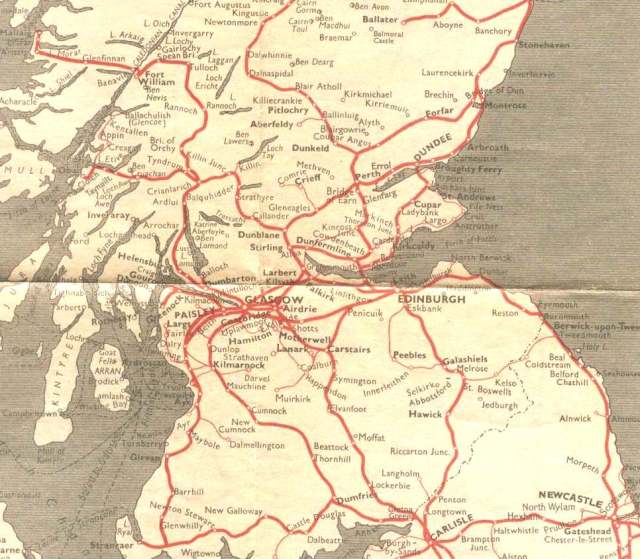
Fifty years on from the Beeching Report, it is still hard to get an objective analysis of its recommendations and the impact of those that were followed. The Beeching Report recommended taking an axe to about a third of the network—5,000 miles of track, including hundreds of branch lines, 2,363 stations and tens of thousands of jobs. At the time, this was seen as draconian and, even now, it looks very like medieval medicine which sought to drain poisonous ‘humours’ from the blood, often with the aid of leeches.

His bland bureaucrat demeanour did much to incense people at the time and the scale of his proposed cuts seems brutal until you compare what has since happened to the rest of heavy industry and its infrastructure, including steel, coal, cars, shipbuilding and other segments that were seen as permanent parts of the economy fifty years ago.

Before he was drafted in to take drastic action, Britain’s railways were decades into decline. From the profitable pioneering days of the late 1800’s, railway companies had pretty much lost the plot in Edwardian time, building branch lines for which no serious business case could be made and entrenching much of the inefficiency that would eventually (and still?) compromise profitability.

Two world wars and the imperative of supporting the war effort starved railways of investment and resulted in drastic mergers in each case. Combined with a penchant for Victorian levels of over-staffing and a business plan for the future that misunderstood major changes in transport, social attitudes and demographic change, British Rail arrived at the immediately pre-Beeching point with a plethora of problems:

  • the network was bloated to an inefficient sprawl
  • services were complex, irregular and scheduled more for the convenience of railways
  • private and public motor transport were offering serious competition
  • goods even more than passengers were shifting to the roads
  • working practices were labour-intensive and invariably inefficient
  • alternate power to steam was still in its infancy
  • the ‘integrated’  company was actually a cacophony of competing organisations
  • overall strategy was driven by political more than commercial concerns.

To be sure, business sophistication and business school graduates were both rarer in 1960 than half a century later. But Drucker had written several books, operational research and systems analysis were recognised disciplines and management-driven success stories like IBM, ITT, General Motors, etc were slickly profitable behomoths. Dealing with BR’s problems would be tricky but not beyond the wit of man.

Instead, the decade since nationalisation having been spent largely treading water and losing money through a creaking network fit for the Victorian age meant that the Tory government of the time wanted a sword of Damocles to cut a swift solution. The 1955 Modernisation Plan promised expenditure of over £1,240 million; steam locomotives would be replaced with diesel or electric, traffic levels would increase and the system was predicted to be back in profit by 1962. But losses mounted and, by 1961,  were running at £300,000 a day.

Some overdue rationalisation had been done since nationalisation in 1948; 3,000 miles (4,800 km) of line had been closed; railway staff numbers had fallen 26% from 648,000 to 474,000; the number of goods wagons fell from 1,200,000 to 848,000. Clearly, more needed to be done. But, instead of a strategic review of railways and their future role and a systematic reshaping of them to more closely achieve that, The Reshaping of British Railways took a blunt, simplistic approach that would have been a credit to a Micawber-era industrial baron.

The analysis contained in the report was fair enough—a critical examination of the profitability of each part of the network that highlighted some commercial lulus, such as:

  • Thetford to Swaffham’s ten trains carried 9 passengers each & covered 10% of costs
  • Gleneagles to Comrie (via Crieff)’s 20 trains carried 5 each & covered 25% of costs
  • Hull to York via Beverley recouped 80% of costs but duplicated a similar service.

Freight was given a similar thorough going-over, with the bulk of the hopelessly inefficient goods yards at almost every station to be closed now that road freight was not just challenging but had won the non-bulk element of the business.

But where Beeching did us all a disservice was three-fold: 1) he thought because some cuts were obviously necessary and good, more cuts must be better; 2) he saw the rise of the car and lorry but didn’t see the congestion they would cause; 3) he believed that there was a freight business below trainload size.

Almost all the fuss and opprobrium revolve around the first point. Indeed, his solution would have meant no railways anywhere in the Highlands, in Wales or even between Edinburgh and Newcastle (currently the best UK train service). Some 6,000 rural miles of the 18,000 mile network and 2,363 stations were to close. And, during the 1960’s much of this came to happen, culminating in the closure of the Waverley Line in 1969. This left the Scottish Borders with no rail and no stations and was mightily opposed at the time.

The problem was that, politically, few of the closures went quietly and the news was full of protests around the country as line after line, station after station “had their services withdrawn” (in the euphemism of the time). Much of the residual venom is a folk memory of the event and its associated anger and frustration. In modern terms, the media handling was poor and the debate often focussed on another dead parrot of a station.

Sterling examples of this Iron Horse sub-species of Norwegian Blue were in my own backyard. At thirteen, trainspotting on the ECML at East Fortune, our thrills at Gresley A4s or the new Deltics blasting though with the London express were punctuated by the Berwick stopping train squealing its five motley carriages to a halt for no-one to get on and no-one to get off. Even a thirteen-year-old could see this was no way to run a railway.

But nobody seems to have done proper homework on a systems level. In a rush to get as much closed as they could, BR calculated costs by track-mile used. As a result, in 1970 they were all set to close the North Berwick service (currently among ScotRail’s most profitable). Some sharp analysis by many of the professionals who used the line to get to work proved that the incremental costs to run it (80% of its distance, it shares the ECML) were low enough to make it profitable. It was one of the first reversals of his plans that has restored a small portion of the rail network in the last half-century.

No only that, when the ECML was electrified in 1991, the case to continue that on the 5-mile single-track spur to North Berwick was overwhelming and helps explain the solid 2-way traffic (commuters & shoppers inbound, students & tourists outbound) that make it ScotRail’s nice-little-earner.

What Beeching did NOT do was proper cost/benefit analysis that included social priorities, future opportunity and (especially) the clogging up of the road new that would throw appreciable traffic back onto rail. Take the £295m (aye—that’ll be right!) cost of reinstating less than half the Waverley line. That is equivalent to a £6.5m annual subsidy if the line had been kept open since 1969 and it was already bringing in £2.2m in revenue (2012 prices) at the time of closure. Even averaging over the 44 years, that’s £4.3m each year to have run Edinburgh-Carlisle trains all that time and still be ahead financially.

Some examples were indeed basket cases and non-viable throwbacks to Edwardian times when train moguls were building lines to compete with one another. The basket case that was Edinburgh doomed any sensible suburban rail net. Beeching was right to target some of the more egregious examples like:

  • The Fife Coast line (Leuchars to Thornton via East Neuk)
  • The Vale of Devon line (Kinross to Stirling, via Crook of Devon)
  • The Tweed Valley line (Newton St Boswells to Berwick via Kelso & Coldstream)

And yet two components for the first (Leuchars-St Andrews and Thornton-Leven) are both now under consideration for re-opening and pat of the second (Stirling-Alloa) has been reinstated. In 1963, both St Andrews and Alloa were taking in over £1/2m each (today’s prices) and Leven was taking half of that. All three were babies thrown out with the Beeching bathwater. Reinstatement of the Alloa line cost £57m. Perfoming a similar calculation to the Waverley one above, that means an average of almost £1m annual subsidy would have more than covered the costs of sustaining the Alloa link.

In 1963 it would have been difficult to be clairvoyant about how rail could be turned around as a business of the next 50 years. But several hard-nosed business cases could have been made, as shown above. It was the less hard-nosed arguments of social needs and tourism that kept the Highland lines open and are now such an asset. Most of those that did close in that sparse region should have closed, although the spectacular Dunblane-Crianlarich via Callander and Lochearnhead would have been a tourist favourite and add hugely to rail tour options on the West Highland Line.

So, should Beeching be pilloried or praised? A clear case can be made for the former. Anyone with a calculator could have done the simplistic butcher job he did. The relative density of population furth of Scotland and the drastic change in our economy from West coast grime to East coast oil meant that we were proportionally hit harder: growth areas like Fraserburgh and Peterhead were sliced off the rail net, yet their line might have been humming with both passenger and freight within a decade.

Who knows how much more effective a system could have been electrified and modernised with the same money we’re now spending in reversing the short-sighted, bean-counter attitude with which Dr Beeching approached his historic task. Glasgow-Aberdeen in under two hours; Glasgow-Edinburgh in under 30 minutes; tourists flocking to St Andrews or Melrose or the Trossachs by train, maybe by a steam train called “Dr Beeching” in his dishonour—because he never seemed to understand Scots humour any more than our rail needs.
SScotRail1961

Posted in Commerce, Transport | Tagged | 1 Comment

Milli-Management

Speak to anyone who is not among the small minority with a career in politics nor among the even smaller number of their colleagues who are genuine unpaid conviction activists and you are likely to receive a pretty jaundiced view of the state of politics in Britain. And this is one area where distinction need not be drawn between Scotland and England. Just as both suffered from business stagnation and a blizzard of strikes in the seventies, so the blending of parties into the electable middle ground has created a hybrid sleekit crataur—the Rt Hon Camilegg MP—with elastic policies such as would appal Bevan, Disraeli or Gladstone (not to mention real characters like Dennis Skinner or Nicky Fairbairn).

For ever since the charcoal suit, mauve tie and hair gel was mixed up in the witches’ cauldron that and poured out to create the world of SPADs and PPSs, a level of steely eyed professionalism using every mass psychology and advertising technique available has dominated any party with serious pretentions of power. The culture of the backroom in Holyrood differs little from that at Westminster; indeed there is a pretty free flow between the two common to all parties.

An example of their egregious spin came through the door yesterday in the shape of a colourful at-public-expense report from Jim Hume, South of Scotland Lib-Dem. It’s unfair to pick on Jim because they all do it but quick analysis of the inside content shows eight photos of Jim in action that are honest (Jim ‘meets’…’volunteers’…’discusses’…etc) and four headline items that sidestep his impotence (as an opposition member or in the wrong parliament) to actually “support”…”help”…”protect” or “stand up for” as he claims.

The latest incarnation of Milli-management (definition: attempted micro-management that’s too clumsy to get it that small) comes in the shape of the South Shields by-election, caused by the resignation of the Miliband-that-should-have-been-King (David) to take up his £1/4m job in Mammon’s very own home town. Nobody grudges him the change or the money. And, since it ranks with the safest Labour seats in the country (hasn’t ever had a Tory represent it since the reforms of 1832 and George IV was swanning about Edinburgh in corned beef tartan and pink tights) there’s no danger of political upset.

So to what end this unseemly rush to control candidate selection? On April 2nd, when the timetable for the South Shields selection was announced, Labour HQ chose a ridiculously short turnaround selection processes, presenting the local party with multiple dilemmas. To become the candidate, the application had to be in within 3 days (April 5th); any hopeful must then clear their calendar at a few hours notice to get down to London for an NEC shortlisting meeting on April 6th (a Saturday), before campaigning furiously for a selection meeting on April 10th in South Shields, the successful one then dropping everything else from your life to run for the seat.

A significant number of candidates did put themselves forward for this needlessly truncated selection process – but they could fairly be seen as those in the know and with the wherewithall to take part in such a process. There were many potential quality candidates who didn’t even throw their hats into the ring because of the way the system is set up against ‘outsiders’ —i.e. real people not part of the political machine.

Of those selected, the front-runner had been Cllr Mark Walsh whose local credentials and 17 years on South Tyneside council made him seem a shoo-in, declaring “I’ve thrown my hat in the ring and it would be an honour to represent the town I was born and raised in.” But just an hour before the voting was to start at the selection, he withdrew his candidacy for ‘personal reasons’. Because of the unseemly rush, this may well be the whole story.

But apolitical outsiders (a.k.a.’voters’) are just as likely to see this as another internal party ‘fix’ that saw fellow Cllr Emma Lewell-Buck selected for dogmatic reasons such as gender equality that, while it goes down well with  party faithful, are less well perceived by the public, including women who would rather see women succeed because they are good and not because they are handed an artificial bye. Cllr Lewell-Buck may indeed have been the best candidate—but why cast doubt with a bum’s rush?

South Shields was an opportunity to do something different, to tackle broken politics head-on. Here, Labour had  latitude to be transparent about the way they went about things, a chance to do politics openly in a way that David Miliband, to his credit, had advocated. There was no hurry; no reason why proper time and consideration could not have been allowed, no reason why local amateur volunteers, who move more sluggishly then the career-impatient professionals at head office, could not be given time for proper involvement.

Posted in Politics | Tagged | Leave a comment