Fleein’

Just back from a tour of sundry airports, it is hard not to be struck by the differences between airports in Britain and those countries who take air travel seriously, such as the USA. Scotland is particularly ill-served, having a clutch of under-developed sites scattered from Ayr to Aberdeen, none of which really fulfill the role of national airport.

Contrast American and even continental airport design with the utter chaos that is the heritage of the late-but-unlamented British Airports Authority. Compare, for example, Copenhagen with Edinburgh, both serving capitals of modest 5m countries at the periphery of Europe.

While Edinburgh (EDI) boasted of handling 4% more passengers to reach 10.2m, Copenhagen (Københavns Lufthavn CPH) grew by 6.5% to 25.6m passengers last year. Contrast the layout of its single terminal with that of EDI below

CopenhagenAirport

Map of CPH Gates (above) with EDI gates (below—Note the lack of piers).

EDImap

Not only does EDI lack the more flexible and efficient pier system to accommodate aircraft and ease access to them but many of EDI’s gates are not equipped with jetways, forcing arriving passengers either onto crowded airside buses or on a short walk. Both lead outside and expose passengers to our driech weather by way of welcome.

All this is despite a claimed £260m investment over the last decade and a similar amount promised over the next decade. Certainly there have been improvements. But almost all have been in airport operations (new control tower) and ways of parting punters from their money (multi-story car park and much expanded duty-free and shopping area). That’s what you get when you privatise your airports and don’t pay attention.

More importantly, EDI may boast New York as a transatlantic destination in its top ten (NWK) but CPH flies twice as many passengers to New York and almost as many to EDI’s main destination of London

Perhaps it is unfair to take smaller airports as examples of the best a country has to offer. What about the top two airports in the UK (Heathrow and Gatwick), as compared to the top two in the USA? In the same year as above (2014) Atlanta (ATL) grew 2% to 96m passengers and retained the top spot in the world (beating Beijing’s 86m) and Los Angeles retained its 6th world ranking by growing 6% to 70m.

Heathrow (LHR) did hold on to the 3rd spot with a 1.4% growth to 73m while Gatwick (LGW) was still way down in 36th place, despite a 7.6% growth to 36m passengers. Ten other US airports beat this, including San Francisco (up 4.8% to 47m). Interestingly, Singapore (SIN), a country not much bigger than Edinburgh, was in 16th place with 54m passengers.

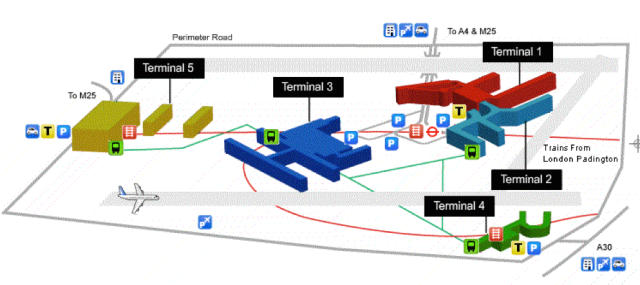
But, just as with EDI and CPH, contrasting the structure of either UK airport with practice elsewhere shows both LHR and LGW is a poor light and underscores the lack of strategic thinking and investment in either.

LAXmap

Layout of Los Angeles Airport (LAX)

LHRmap

Layout of London Heathrow Airport (LHR)

Contrast the two maps above and what strikes you? That LAX is laid out to a plan. That plan has been in place since the 1970’s when there were only six terminals. It offers easy traffic flow around all eight terminals with through traffic unimpeded in the centre and shuttle buses connecting each terminal in a matter of minutes. It is well signed which airline leaves from which terminal; even if you miss it, it’s only five minutes round the circuit again.

By contrast, LHR looks like a Lego set that has been dropped on the floor. Though it should have a huge advantage in being connected to both the Tube and to mainline rail services to Paddington, connections are partial and illogical. Getting from one terminal to another is bewildering. It often involves a crowded bus ride, twisting through the air-side bowels of the place that no passenger at LAX would ever see.

Is this a fluke? Not at all. Look at JFK or ATL and you see the same logical pattern imposed, despite the US being an even more free-market place than the UK. Contrast the second airport in UK with the second airport in California and the disparity in long-range thinking repeats itself.

SFOmap

Map of San Francisco International airport (SFO)
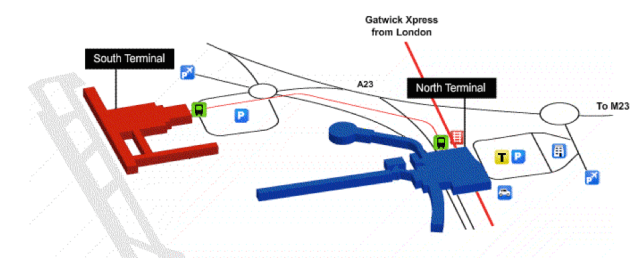
LGWmap

Map of London Gatwick airport (LGW)

Even allowing for the scale difference (47m vs 36m), SFO is laid out in a sensible and easily understood manner. Traffic flow is similar to LAX around all terminals and shuttles call at each in sequence. It even has a much used DLR-style shuttle to not just all terminals but to parking and car rental sites. There is even a BART station for connections to bothe the City and the rest of the Bay Area.

LGW does also boast a DLR-style shuttle but built such that expansion to any future third terminal is difficult, if not excluded. But LGW’s greatest sin is as illogical a set of gate numbers as you could dream up. Those sub-40 are in the South Terminal. The North Terminal has 40-56, 101-113 and 555-563. What happened to the rest is unclear. But then they really mess with your head by having 55A-55G, which happen to be at the opposite end of the airport from (and easily confused with) 555-559. The reasoning eludes me.

The recent political spat about Westminster not coming up with a decision on another runway for London rather misses the point. Why throw good money after bad with their execrably poor airport layouts? Whoever dreamed up London’s airport strategy must have been fleein’ not flying.

If the Scots had any sense, they’d build their answer to Copenhagen on a rail line near Larbert and close EDI, GLA and PIK. This could then act as our single hub, as CPH does for Scandinavia. It would steal transatlantic flights from hopelessly muddled LHR/LGW and provide Scotland with the kind of links that would mean far fewer of us would need to get lost in the present and future time-wasting tangle that is London in the first place.


Posted in Commerce | Tagged | 2 Comments

Time to Learn Mandarin

山雨欲来风满楼 (shān yǔ yù lái fēng mǎn lóu)

Coming events cast their shadows before them

Coming to the end of ten days in and around San Francisco, I am struck by how much the old place has changed. This 74th anniversary of Pearl Harbor may not be the most propitious occasion to make observations of incursions of the Orient into the Occident. But these major shifts merit comment.

I have loved San Francisco as a city since first introduced to it forty years ago. It has much in common with Edinburgh: its myriad views of hills and sea are photogenic and stunning; it acts as the cultural magnet for an extensive hinterland; it has become a major tourist destination. It also suffers from overshadowing by a larger, equally cosmopolitan rival better placed to take advantage of trade links on offer—New York in their case.

Unlike much of America, San Francisco has always looked to the Orient for its trade. Its cosmopolitan and oriental slant started early when many Chinese were brought in to help build the transcontinental railroads linking in with the rest of the country. But the City was built largely by Europeans, first brought here by the 1849 Gold Rush, boosted by the vast lumber and agricultural resources of California. And when a whole new set of industries from shipbuilding to aeronautics swept West in WW2, it formed the kernel of Silicon Valley and they have never looked back.

TransAm

Symbol of the Sixties: TransAm Skyscraper Does What it Says on the Tin

By the 1980s, the rising trade clout of Japan and Korea and the aftershocks of the Vietnam war poured new waves of oriental immigrants into the area, leavening the black and chicano elements and these have proved to be among the most successful immigrant groups America has seen, with many using family and hard work to propel first generation into professional careers through diligent ambition and education.

This was the state of play in the mid-1990s when I last lived here—a cosmopolitan City with its feet in the West and its eyes on the East. But in the last decade, a shift is discernible, linked with the inexorable growth of China as a global economic force. There has been no massive influx of people, as there was after Saigon fell or when the railroads were built. But the character of the place is changing rapidly.

Walk through San Francisco College at Balboa Park and there are almost no white faces. Ride BART or the Muni and almost all the faces are Asian or Latino. What was once a blue collar district like Noe Valley, with most working skilled manual jobs in places like Hunter’s Point shipyard, is now threaded with tasteful enterprises and a boatload of rich young whites who hop on the huge smoked-window buses to whisk them off to Google or Facebook in the 21st century’s incarnation of Silicon Valley.

SFireTruck

Classic SFFD American Ladder Unit Screams down Church St in Noe Valley

But the real change is in the Financial District downtown. The change in skyscraper construction is mirrored in those occupying them. Whereas once the faces were all white, except for serving staff in the watering holes and restaurants and Chinese faces were generally limited to nearby Chinatown, there is far more of a mix, with Chinatown now embracing what was once Irish and Beat-poet North Beach. Dim sum is now as popular as pastrami sandwiches for lunch.

PoetCityLights

The Poet Room in City Lights Bookstore: Still There, but for How Long?

The combination of affluence and racial mix is palpable, tasteful upmarket establishments spreading to the once-run-down Embarcadero waterfront (now a palm-tree boulevard of vintage trolley rides), infiltrating the once-sleazy, brothel-infested Tenderloin and spreading into SoMa (South of Market), replacing warehouses so artists can no longer afford studios.

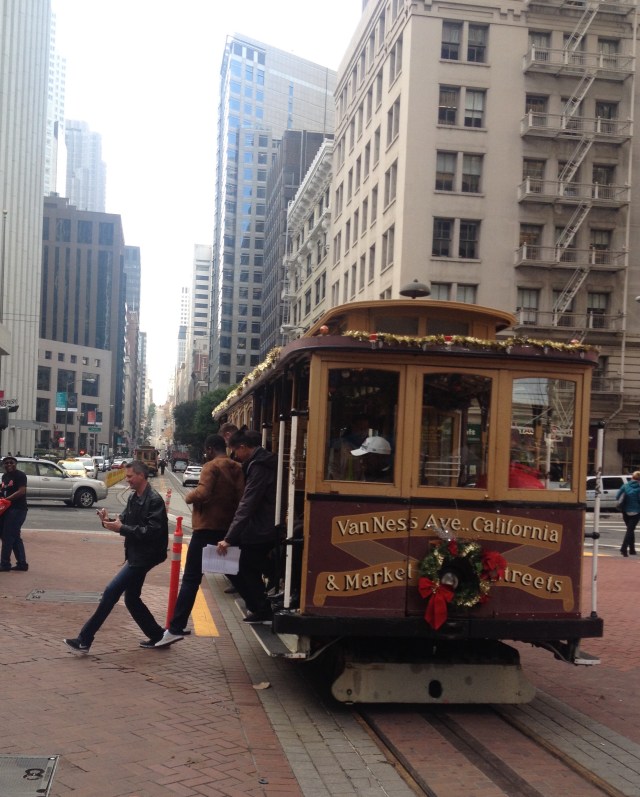
CalifCable

Heart of SF Financial District—California Cable Car Terminus on Market

But it’s the type of business in the skyscrapers that is driving all this. Always a financial centre with Bank of America headquartered here, the trend of the last few years is that here is where Chinese money made from booming trade is returning to America in the form of investments. Buying US T-bills is no longer sufficient. Entire US companies are finding their leases terminated as the Chinese enterprise that built/bought their offices wants the space for their own West coast operations within the US.

Although the US Immigration Service is still anally vigilant about people trying to sneak into the country, the State of California and the City and County of San Francisco are no slouches when it comes to seizing business opportunities. These days, San Francisco is giving Hong Kong and Singapore a run for their money as a financial hub and catalyst for trade development.

Lunch at the spectacular Cliff House out on Great Highway (overlooking the rolling Pacific as it sprays surf on the pelicans perched on Bird Rock) is a local treat. There are many ship movements to observe. At least once an hour, a massive container ship appears on the horizon and heads for the Golden Gate to discharge in Oakland’s humming port. Most of the containers are emblazoned “Han Jin“. Shipping traffic in general here makes our Firth of Forth look like a sleepy backwater.

CliffHouse

View from the Cliff House. That Dot on the Horizon Is the Future

But also listen to your fellow diners; many are Chinese but they are all speaking Mandarin, not Cantonese—the language of native San Francisco Chinese. Until recently. Most switched-on San Franciscans recognise this fundamental fact and are embracing it. But the impact of China’s development into a global economic power is still barely acknowledged in much of the West.

Even if you don’t live anywhere near San Francisco, but have ambition for your children, I would recommend they consider studying a second language: Mandarin.

Posted in Commerce | Tagged | Leave a comment

Patrician Politics

It would seem that, having led his party to multiple unpredicted victories before having the grace to fall on his sword when he failed to clear the final hurdle of the Independence Referendum, the political death of His Eckness has been greatly exaggerated. He was never likely to leave politics entirely. But, unlike Ted Heath, whose eminence grise may have haunted Thatcher but soon faded from public perception, Alex Salmond makes much too good copy to let him go gently into any such good night.

And so it was this week that, freed from the constraints of leadership (even of the third-largest MP group at Westminster) he flashed back into headlines both sides of the border with pithy commentary on the debate over adding bombing of Da’esh in Syria to that already underway in Iraq. That debate drew memorable speeches from a number of members, as well as the usual collection of toe-curlers. But the one that will sit best among Westminster’s hefty panoply of ‘history made eloquent’ came from Labour’s Shadow Foreign Secretary, Hilary Benn.

Had the speech been against the bombing, the story would end there. But, despite due deference being paid to his anti-war leader Jeremy Corbin, Hilary came down emphatically on the war side of the debate.

Having carved a political career for himself that owes little to his more famous father, it was perhaps inevitable that comparisons between the two would be drawn—especially as Tony made a typically blistering attack on the idea of bombing Saddam’s Iraq when things were leading up to Gulf War II in 1998. Describing Hilary’s speech on LBC Radio “Leading Britain’s Conversation”, Alex said;

(Hilary) “was batting a good wicket, with adoring Labour behind him and enthusiastic Tories in front. The buttons he pressed were appealing to Labour’s internationalism, the United Nations, the Spanish Civil War…but I’ll tell you this: his father, whose speech I heard in the Iraq debate all those years ago, would be birling in his grave hearing a speech supporting a Tory Prime Minister taking his country to war.”

Cue outrage among Labour chatterati that members of their Patrician elite could betray Labour principles, let alone each other. Prominent among them was the third generation—Emily Benn, Hilary’s niece and Tony’s granddaughter, demanded an apology from the former first minister, saying on Twitter: “Your comments are both deeply offensive and simply untrue. I hope you reflect and retract them.”

The Daily Record reported others leaping to Hilary’s defence. Labour’s lonely MP Ian Murray accused the SNP politicians of “dreadful behaviour”, claiming “This is too important an issue to play petty politics with“. But is this dreadful behaviour? Do the collective ladies protest too much? At what point does any politician—let alone a patrician dynasty—become such a revered shibboleth and immune from comment? This is democracy; it’s called debate.

No student of British politics can avoid Tony Benn. He gave up a peerage for a cabinet post in Wilson’s government and waxed lyrical over the ‘white heat of technology’ that was to power Britain out of its grey gas-fired black-and-white miasma that passed for post-war prosperity.”One of the few UK politicians to have become more left-wing after holding ministerial office“, he was a constant rallying point for the Left.

Benn stood against Denis Healey, the party’s incumbent deputy leader, triggering the 1981 Deputy Leadership election, disregarding an appeal from Michael Foot to either stand for the leadership or avoid inflaming party schisms. Fully supportive of Labour’s “Longest Suicide Note in History” that led to their 1983 GE nadir, he symbolically lost his seat. All this is not to denigrate Tony Benn, but to underscore that, eloquent, principled and passionate though he was, he (unlike his son) could in no way be called mainstream, even in the Labour Party.

Add in the fact that successive generations often establish their identity by reaction against what went before, and it’s mostly  whips and others tholed to blind party discipline who would finesse honest democratic differences and decry those who would discuss them. There is no evidence  Tony was ever other than proud of his son, a pride unshaken by their embracing differing threads within the Labour movement. But Salmond was simply articulating what anyone—whether in Labour or not—might have said when any media were out of earshot.

What this debate ought to have been about was Hilary’s speech itself. Memorable and well delivered as it was, it did signify a major shift from a anti-war stance that he had held and advocated as recently as two weeks earlier. It would appear the Paris bombings may have changed his mind. But there is much more than that deserving analysis.

Autonomy Scotland has done a thoughtful and provocative filleting of the speech: “Benn’s oratory was articulate and impassioned (but) the substance of what he conveyed was insubstantial. Although France is a great country and a great ally, the much trumpeted idea that we must bomb by their side is idiotic.” It then goes on to posit a sensible metaphor for the situation.

“There is more than one way to help a friend. For instance when my friend came round to my house one night agitated after having his car windows smashed in, I didn’t acquiesce to his request to join him in a bloody quest for vengeance. Instead, I sat him down, poured him a drink and talked some sense into him. He thanks me now as he appreciates not being in prison. This is the type of approach we need to adopt with our allies.”

Posted in Politics | Tagged | 1 Comment

Wha’s Like Us?

Being in a far-flung corners furth of Scotland for the last week (Glendale AZ; Sonoma CA) the marking and portent of St Andrew’s Day had slipped by me until somebody tweeted a link to Stephen Daisley’s OpEd column for STV News. In it, he rather dismisses what is perceived to be the perky patriotism of the average Scot, couching it largely in terms of the modern politics of nationalism and undermining the basis for such sentiment with emotionless pragmatism such as :

Scotland is a small country, not special or essential. If we vanished from the map tomorrow, warm eulogies would be given for our Enlightenment and inventors and the cute tartanry but the world would keep turning.

Technically, the man is right. But we are firmly in “knowing the price of everything but value of nothing” territory here; the man inhabits a reality that few Scots outside of 67 Northumberland Street N-W Lane, Edinburgh would recognise.

Were MORI to do an international poll of a statistically significant sample of the peoples of the world from Tierra del Fuego to Nova Zemlya and all points between as to the country with the highest positive profile, the USA would come out top. But, if the question were limited to small countries, Scotland would beat dull Switzerland, pricey Norway, peaceful Costa Rica. acerbic Singapore or any of the rest of them for high profile, let alone contributions to the world.

Because of an extensive, hardy, hard-working, shrewd, successful diaspora, Scotland’s profile in America and the dominions is sky-high—better even than the stratospheric level of the Irish who tended not to dissipate across the country. Once a poky little place on the edge of Europe, Scotland went out to meet the world as soldiers for Gustavus Adolphus, traders in the Low countries and admirals for the Czar. Little wonder they seized the opportunity in an empire-building partnership with England.

So much so that a century ago, half the world’s ships were being launched on the Clyde—an epic of achievement and a source of pride. From Bank of Scotland to Jardine-Matheson, Scots explored, built, pioneered, led, soldiered and founded with the best of them. Nobody suggests their achievements were unique but they stand as fine a testament to a people’s abilities as anywhere.

However, even if “Here’s tae us; whae’s like us? Damn few, an’ they’re a’ deid” is stretching things, are we as egalitarian and socially seamless as we like to think? Does Peter MacMahon have a point when he blogs to questionthis idea that Scotland is a country with social justice running through the national veins“? He cites three recent studies that imply otherwise:

  1. A survey for the Scottish government found doctors’ surgeries in the poorest areas of Scotland are getting less money per patient than those in wealthier areas.
  2. A report from Edinburgh University academics said there was no evidence the SNP’s policy of ‘free’ tuition fees has increased poorer students’ access to higher education.
  3. A report by the Social Mobility and Child Poverty Commission ‘Elitist Scotland‘ says the country’s leading professions are dominated by those from private schools and elite universities.

There is no reason to doubt any of the above. But neither do they imply  Czarist levels of inequality, nor do they preclude a cultural couthyness that goes well beyond cats looking at a king. There are devoted royalists across Scotland. But, without wishing to disparage anyone, they are in a serious minority, especially compared to widespread reverence across England, as amply voiced by Auntie Beeb.

Most Scots give elitism short shrift, seeing no reason accidents of birth accord anyone superiority in life. (It is no co-incidence that, from Carnegie in the States to MacQuarrie in Oz, Scots have flourished in the more can-do egalitarianism of the colonies.) Some of this derives from chippy resentment of English domination of Scottish life, as voiced by more ardent nationalists. But most seems to come from a genuine belief in the ‘Lad o’ Pairts’—the self-made man who pulled himself up by his bootstraps and earned any respect he was shown.

And—many though the rich subcultures in Scotland are—from Portree or Portobello, this derives from a plain-talking sensibility. Originally dinned into us by strict dominies and stern meenesters, it was carried on by grizzled grandads who’d been in the pit/yard/factory/field. They passed their lack of pretension and ready questioning of authority on to their 21st-century grandchildren. Anyone who lives here experienced this.

Nobody thinks we live in an egalitarian paradise. For example, Nicola Sturgeon wants to address the inequalities McMahon highlights, being “particularly concerned about the attainment gap between poorer and better off pupils in Scotland’s schools.” She has launched the Scottish Attainment Challenge, backed by £100 million, to try to close the gap.

Stephen Daisley may well be sincere when he fumes: “Scottish nationalism leaves me cold because there is no philosophy to it. It is about being Scottish — or more accurately Not British — and nothing else” but he entirely misses the point. Yes there are hardcore types who resent the helplessness of the 1980’s against Thatcher and see more Tory rule as alien and objectionable.

But the bulk of Scots embrace Winnie Ewing’s iconic “Stop the world—Scotland wants to get on“. They travel more, benefit from the biggest influx of immigrants since the Vikings and have found their cultural and political feet in the last two decades as much as independent Eire. Multi-faceted though it may be, a Scottish voice and cogent individuality exists—and it is far broader than individuals like our Andy Murray.

What Mr Daisley seems to have missed is that most Scots have ambition to be other than England’s poodle, to be more than a province of North Britain that speaks funny and where nasty stuff like nukes can be safely parked well away from the fount of all that is good in the Home Counties. We look at Norway or Singapore or Finland—ex-colonies all. We see they prosper. We see the global good they do. We see strong, friendly links with neighbours. We see nobody targets them because they give little reason to be targeted though they act as peacekeepers around the globe.

And, to correct Mr Daisley, we Scots are British, just as Norwegians are Scandinavian. But a geographic term and strong links based on history and mutual interests need not require political unity. And once that no longer applies, watch the chip that he perceives (probably rightly) to still sit on some Scots shoulders fall away.

Posted in Politics | Tagged | 1 Comment

America’s Higher Education Brought Low

Rarely accused of being conservative (big or small ‘c’), reading George Will is not my natural territory. Being in agreement with him is even more of a stretch. But being in the Land of the FGree just now, I found his recent syndicated column in the Washington Post exposed a litany of assaults on reason that challenges the role of higher education across the USA.

Now, it is very much the role of academia to provide fertile ground for the germination and development of ideas. By definition, some of these must appear to be dislocating when first posited. They may even be outrageous by contemporary standards. Yet, from Galileo to Einstein, many have proved to be right, despite inertial wisdom from the rest of the planet.

But George brings so much provocatively ill-informed (not to mention ill-expressed) political correctness to light that it seems he is right to challenge the non-rigorous scale of it. Freedom of speech and academic questioning is one thing. But when so many seem to slide into a dangerous half-light of dogmatic intolerance and virulent criticism of those who question, American academia may have slipped from illuminating the dark corners of knowledge to fortifying certain belief mantras into them.

Certainly, Will has overstepped the mark before, as when he questioned “the supposed campus epidemic of rape” and was pilloried by Diane Feinstein, among others: “It takes a particular kind of ignorance to argue that people who come forward to report being raped in college are afforded benefits of any kind.”

But censorship in any form deserves rigorous questioning, no matter how laudable the intent. The copyright on Mein Kampf runs out this year and the 70-year ban by the State of Bavaria on its publishing will run out. Various Jewish organisations are arguing against this. Florian Sepp, a historian at the Bavarian State Library says “This book is too dangerous for the general public.” But is it? Why not (if they existed) ban Ghengis Khan’s memoirs? Both are ancient history, providing lessons we all should learn.

And so, George Will raises the absolutely legitimate question whether political correctness may have gone so far as to undermine the objective integrity of further education. When the University of Wisconsin at Milwaukee declares the phrase “politically correct” a microaggression or Mount Holyoke College cancels its annual production of “The Vagina Monologues” because it is insufficiently inclusive regarding women without vaginas and men who “self-identify” as women, then have things gone too far?

And, before we get too cosy mocking American campus naivety, there are debates and ill-tempered exchanges in Scotland when anyone questions the new received wisdom—already expressed by University of California sensitivity auditors who condemn as “hostile” and “derogatory” such perverse thoughts as “I believe the most qualified person should get the job” and “America is the land of opportunity.

Posted in Community | Tagged | Leave a comment

La Marseillaise

As the crowds streamed out of the Stade de France after the bloodthirsty events of Friday, they began singing the French national anthem; the crowds gathered to hear Hollande’s speech from Versailles did the same. Anyone who has witnessed even a handful of French singing it will appreciate the utter passion with which it is sung.

It was born in adversity and still works as a profoundly felt, inspirational rallying cry at times like these. It comes straight from the heart of the people in a way that the British equivalent’s adulation of the monarchy can never match. The only thing the two have in common is that few bother singing any verses beyond the first.

The European Union may well have adopted Beethoven’s Ode to Joy as its own anthem. But, in the tragic shadow of the Paris attentat, La Marseillaise is being sung with unifying passion by people across Europe—and indeed the globe—with no previous connection to France whatsoever.

Allons enfants de la Patrie,
Le jour de gloire est arrivé!
Contre nous de la tyrannie,
L’étendard sanglant est levé, (bis)
Entendez-vous dans les campagnes
Mugir ces féroces soldats?
Ils viennent jusque dans vos bras
Égorger vos fils, vos compagnes!

Aux armes, citoyens,
Formez vos bataillons,
Marchons, marchons!
Qu’un sang impur
Abreuve nos sillons!

Arise, children of the Fatherland,
The day of glory has arrived!
Against us tyranny
Raises its bloody banner
Do you hear, in the countryside,
The roar of those ferocious soldiers?
They’re coming right into your arms
To cut the throats of your sons and women!

To arms, citizens,
Form your battalions,
Let’s march, let’s march!
Let the impure blood
Water our furrows!

Posted in Community | Tagged | Leave a comment

You Know You’ve Been Quangoed

Last week, we outlined the largely unaccountable role of quangos in running Scotland and the unconscoinable salaries that their senior managers pull down. This week, we give the details. If they all took a 10% cut in salary, they would all still be well above the MSP’s £59,085 wages, let alone the £20,062 average wage in Scotland. And we’d have saved enough to pay for 260 teachers, nurses or police.

Total Quango spend in Scotland is £13,334,556,588 (i.e. over £13bn) or half of all public expenditure. Some £287m of that was spent by Scottish Enterprise alone. Older readers may recall former Scottish Secretary George Robertson’s promise to make a “bonfire of the quangos”. At the time of that promise, there were 186; there are still 115 today.

Quangos are alive and well and mostly living in pricey suites like Apex House (SFC), Atlantic Quay (SE) or Waverley Gate (NHS Lothian). Of course, their senior management teams need recompense commensurate with their fancy offices and status in society; six are paid more than the Prime Minister. Scottish Water’s chief executive Douglas Millican pulls in £263,000. Scottish Enterprise’s chief executive Lena Wilson (one of the very few females) is on £203,000 and VisitScotland’s Mike Cantley makes a mere £146,000. Don’t worry if you’ve never heard of any of ‘em; that’s how the system works and you’re in the same boat as 95% of Scots.

Leaving out the NHS and the SFC (universities and colleges), if all remaining quangos were to pull in their belts across their budgets (and not just senior management salaries) with a 10% reduction, we’d save £1,893m—or 63,100 teachers, nurses or police.

Here is a list of the 115 and how much of your money they spend each year:

EXECUTIVE BODIES

  • Scottish Funding Council                                           £1.7bn
  • Scottish Enterprise                                                      £287m
  • Skills Development                                                      £196m
  • Legal Aid Board                                                            £167m
  • Police Services Authority                                             £98m
  • Highlands and Islands Enterprise                             £81m
  • Scottish Natural Heritage                                            £64m
  • VisitScotland                                                                  £50m
  • Arts Council                                                                    £47m
  • Scottish Environment Protection Agency                £46m
  • SportScotland                                                                 £41m
  • National Museums                                                        £37m
  • National Galleries                                                          £26m
  • Children’s Reporter                                                        £25m
  • National Library                                                             £20m
  • Royal Botanic Garden                                                    £14m
  • Scottish Qualifications Authority                                £13m
  • Social Services Council                                                    £9m
  • Loch Lomond and The Trossachs National Park       £7m
  • Crofters’ Commission                                                       £6m
  • Bòrd na Gàidhlig na h-Alba                                             £6m
  • Royal Commission on Ancient & Hist. Monuments   £5m
  • Cairngorms National Park                                               £5m
  • Scottish Screen                                                                   £4m
  • Deer Commission                                                              £2m
  • Risk Management                                                              £2m

ADVISORY BODIES

  • Judicial Appointments Board                                      £309m
  • Law Commission                                                       £996,000
  • Architecture + Design Scotland                              £952,000
  • Local Government Boundary Commission          £340,000
  • Advisory Committee on Distinction Awards        £134,000
  • Local Authorities Remuneration Committee         £35,000
  • Public Transport Users Committee                           £15,000

TRIBUNALS

  • Mental health                                                                    £11m
  • Parole Board                                                                       £1m
  • Private rented housing                                         £   428,000

PUBLIC CORPORATIONS

  • Scottish Water                                                               £182m
  • Highlands & Islands Airports Ltd                               £26m
  • Caledonian Maritime Assets Ltd                                    £7m
  • Scottish Futures Trust                                            £440,000

HEALTH BODIES

  • Greater Glasgow                                                             £2bn
  • Lothian                                                                              £1bn
  • Lanarkshire                                                                  £889m
  • Grampian                                                                      £798m
  • Tayside                                                                          £689m
  • Ayrshire and Arran                                                      £649m
  • Fife                                                                                   £570m
  • Highland                                                                        £564m
  • Forth Valley                                                                   £434m
  • Dumfries and Galloway                                               £270m
  • Ambulance service                                                       £197m
  • Borders                                                                           £186m
  • Western Isles                                                                 £69m
  • National Waiting Times Centre Board                      £66m
  • NHS24                                                                              £54m
  • State Hospital Board                                                     £52m
  • Shetland                                                                           £49m
  • Orkney                                                                              £44m
Posted in Community | Tagged | Leave a comment

In Remembrance

There has been a flood of commentary on social media about Remembrance Day and poppies being worn to honour it. Not all are favourable and some, indeed, highly critical. These latter appear to come from a number of positions, including: guilt/resentment at Britain’s imperial past; an opposition to warmongering; anger at UK Armed Forces being used internally as armed police (especially in Ulster); opposition to foreign interventions (such as Iraq and Afghanistan); and even a refusal to embrace this aspect of the British state by hard-line nationalists.

At the risk of opprobrium, each of those groups does have a point. Those holding any of those views do so sincerely and, as they break no law and hold their views peaceably, are entitled to them—and even to express them. But in the context of Remembrance Day and of wearing poppies to mark it, their opposition is misguided.

As America has practiced since WW2, so Britain’s foreign policy in its imperial heyday (and, some would argue even today) was to protect commerce, exploit global resources and to resist those who would threaten that. Not a particularly noble motivation but it made Britain and most of its population rich, as it has America more recently. Whether Britain should still hold the Falklands/Malvinas or Gibraltar or other residual specks around the globe or not is a thorny problem with no obvious solution. Similarly, whether there is any mandate to be the World’s Policeman’s sidekick deserves considerable debate.

But the Remembrance poppy marks none of that. Despite egregious attempts by some establishment figures—especially in the Tory Party—to conflate defence, a global UK role and a Dunkirk Spirit that validates the Union, it is no such thing. People who have served in our Armed Forces have often done so with little choice. From dispossessed Highlanders who flooded kilted regiments from Torres Vedras to Waterloo, to their sons at Bombay or Balaklava, from the Pals Battalion enthusiasts of WWI to the more sober conscripts of WW2 to the National Service teenagers in Korea, millions fought and millions died.

There is a moral argument that WWI was caused by Britain’s paranoia about being top dog as much as Imperial German aggression—just as the Japanese might argue that the US stranglehold on its raw materials justified the aggressive risk they took at Pearl Harbor. But British Tommies of 1914 had no more option to argue such a case than their equivalent GIs had in 1941.

Not to disparage those who signed up from a spirit to engage the Hun or whatever the bête noir du jour was, the vast bulk went, trained, served—and sometimes died—because they saw it as their duty. Their motivation was neither politics, nor ambition, nor greed, nor even hatred. They did it because they felt they must, so they could hold their heads high because they—and the families they left behind—had risked all to secure what all believed to be a worthwhile, if not better, life.

We all make sacrifices to preserve our community, our culture, our civilisation. But none are as great as those we ask of our armed forces. It is to honour those millions and their selfless service which has allowed all of us to enjoy the comparatively comfy lives we do. My grandad lost a leg in Flanders; my dad drove a tank through the unbearable heat of Libya; the worst I have ever had to endure was scout camp.

That is why I wear a poppy every year for them—and for all their comrades—with humility and gratitude. Others may do what their conscience dictates but Remembrance should not be about politics.

Posted in Community | Tagged | Leave a comment

Angels or Vampires?

According to SCVO there are over 45,000 Third-Sector organisations (i.e. charities) in Scotland, employing a total of 138,000 people with a turnover totalling just under £5bn each year—getting on for 10% of our GDP. Many of them do sterling work and are bulwarks against the worst effects of modern society, market-driven economies and the increasing complexity of 21st century life.

Third Sector in Scotland (Source: SCVO)

Third Sector in Scotland (Source: SCVO)

In general, Scots are generous in their support for what is now a massive sector. But, just as the NHS—laudable though the great majority of its front-line staff are—suffers from pencil-neck jobsworths and third-rate administrators, not everyone in the third sector is a selfless hero(ine) working for the good of all, as opposed to themselves. High streets across Scotland are filled with charity shops, staffed by volunteers who receive nothing for their time. But running these large operations are salaried ‘professionals’ who are just the tip of the third-sector salary iceberg.

Across Scotland’s 100 biggest charities, 57 members of staff enjoyed wages of more than £60,000 in 2014 (in 2012, the number had been just 45), an average increase of 26% in the last three years when wage inflation had crawled up at 2.2%. Examples from the top of the heap include:

  • SSPCA‘s Stuart Early whose wage jumped from £160,000 to £185,000 (he who closed a £20,000-per annum Shetland shelter because the charity “couldn’t afford it“)
  • Laura Lee of Maggie’s Centre who’s on £120,000
  • Bosses at Quarriers, Capability Scotland, Scottish Autism and SAMH all around the £100,000 mark.

Even the SCVO itself is a charity with two members of staff on more than £60,000. There are more than 23,700 charities in Scotland but OSCR will stop short of revealing the pay packets of top staff. Charities Aid Foundation, which has carried out a study said “Many people remain concerned the money they donate may not be used to best effect“. Given they found poorer families were proportionately the most generous, with those earning less than £9,500 a year most likely to give away around 4% of their earnings, such coyness seems a travesty.

Not included in the above is the quangocracy that has spread across Scotland, with similar well paid jobs that are equally obscure where the public is concerned. A Quango (Quasi-non-governmental-organisations) is “an organisation that has responsibility for developing, managing and delivering public policy objectives at ‘arm’s length’ from government. Such bodies assist in the delivery of public services in Scotland including culture, healthcare, the environment and justice.” They have a long history of operation in the UK and have become an established part of public sector delivery. At least charities have a public profile through shops, adverts, street collection, volunteering, etc. Quangos are much more a mystery. Yet Reform Scotland has established:

  • 43 quango officials are paid more than the First Minister (£144,607)
  • 132—enough to fill the Scottish Parliament–are paid more than a Cabinet Secretary (£103,495)
  • Over 200 are paid more than a Government Minister (£86,405)
  • Nearly 700 are paid more than an MSP (£59,085)

That totals to over £78m or £25 each year for every man, woman and child in Scotland. And Scotland is a small place. Where once ‘The Establishment” (i.e. senior advocates, Heriots/Fettes FPs, the Honourable Company of Edinburgh Archers, etc) controlled many senior job placements, since devolution there a new kind of mafia grew up in the revived political firmament who also know one another and regularly show up in plum jobs.

The growth in quango numbers and budgets has meant significant expenditure streams are largely invisible to the public who pays for them. As Reform Scotland says:

“The current lack of openness and accountability is not conducive to good governance. Power exercised by government derives from consent of the people and should be exercised in their interests. It is difficult for people to judge whether that is the case when the current way blurs accountability.”

Research on quango spend on PR, overseas travel, external consultants and hospitality/entertainment comes to an annual total of £113m. This breaks down as:

  • £66.8 million per year on public relations
  • £3.7 million annually on overseas travel
  • £2.5 million on hospitality and entertainment
  • £40.2 million on external consultants

Buried within the above (and surely deserving of deeper investigation) are:

  • £300,000 on overseas travel by the Scottish Qualifications Authority (SQA)
  • £6.7 million by Scottish Water a year on consultants
  • £209,000 annually by Creative Scotland on public relations (somewhat explicable if not excusable by its squirmingly bad public profile)
  • £2.8 million for external consultants by Scottish National Heritage
  • £1.5 million on PR by Skills Development Scotland AND
  • £1 million on consultants by Skills Development Scotland
  • £1 million per year by Health Boards on hospitality and entertaining

This last item alone should set alarm bells ringing. When people are dying forgotten in our most modern hospital, when other budgets are pared to sustain the NHS’s, when Health Boards’ competence to oversee their multi-£m empires is under serious question, what are they doing squandering your money on ‘hospitality’? £1m buys a lot of custard creams.

There are, for example 24 board members of Lothian NHS Trust, headquartered in the prime office space of Waverley Gate (the old GPO building) at outrageous cost to the public purse and none of which assists a single patient. As an example of its ‘transparency’ its Annual Report and Financial Information doesn’t even mention ‘remuneration’ or anything as sordid as ‘pay’.

Both main parties seem content to sustain this irresponsibility. While the Scottish Parliament engages in an unedifying rammy over what to do with a putative £113m that may come their way from 50% of a devolved Air Passenger Duty, they might dig into the £200m listed above and many more such dark corners.

Our Labour opposition might think of waking up and combing through all the slumbering numpties they appointed 1999-2007 for efficacy and the SNP government do the same for their profligate appointments since. Because, from a country that once grew rich from building things for the whole world, we now specialise in featherbedding mediocre administrators into ever-more-expensive cushy numbers across our burgeoning charities and quangos. Because our riches are no longer self-generated, this is unsustainable.

Independence or no, unless we wake up, winnow our bloated quangocracy and knuckle under to steer people into jobs that emulate Switzerland (high-end services) Singapore (major trading entrepot) or Germany (precision manufacturing) our Byzantine third sector moguls will join those shoals of globetrotting/factfinding (but never doing anything) board members on the burroo with the rest of us.

Posted in Commerce | Tagged | Leave a comment

Millionaires Only

Anyone who has visited this blog more than cursorily will have twigged that I love where I live. North Berwick is not the perfect place. But having been round the world and lived abroad for a quarter-century in six different countries, I have yet to find one that is closer to perfect. And a huge part of its charm is its context—the bucolic and unspoiled county of East Lothian, together with easy access to Scotland’s vibrant capital. It has sea and sailing, golf and green space, beaches galore and an unspoiled historic heart around a High Street full of interest. What’s not to like?

Naturally, I am not alone in appreciating it. As well as the many locals, for years an influx of retirees and professionals working in Edinburgh have almost doubled the population of the county in the last half-century. That trend shows no sign of abating. Add the social profile of those new residents to a wide selection of Victorian/Edwardian quality homes and developers ever-eager to build and sell new statement homes, it comes as no surprise that a ranking of Scottish areas selling the most £1m+ homes puts East Lothian in second place, right after Edinburgh.

Which is, in many ways, good news. People buying them means engagement as well as investment in our communities is high; the council rakes in a higher council tax per skull than most of Scotland; local businesses are kept alive. But the down side is that such houses are either isolated upmarket ghettos like Archerfield or Craigielaw or middle-class tract homes all of the same design, such as Windygoul in Tranent or Lochend in Dunbar.

There is little at the affordable end. Prior to 2008, almost none were built, beyond a scattering from Homes for Life and ELHA (local housing associations). From its inception until then, ELC built a nice round number of new council houses = zero. In the same time, their stock of houses to rent dropped from almost 20,000 to under 9,000. No wonder the waiting list went through the roof to 4,000, homelessness soared and those leaving school could find little to rent in their own town that wasn’t at scalper rates (and quite often for former council houses that somehow found their way into private landlord hands).

Meantime, developers built 13,500 new private homes in the county—none affordable because ELC’s Local Plan had gagged including such a requirement. In theory, the 2008 Local Plan changed that. It demanded any development of four or more had to make 25% of the units affordable for rent. The parallel legislation that removed Right-to-Buy’s 60% top discount was intended to keep new council homes built affordable into the future.

That meant councils who had built little were no longer constrained to using sales to pay off debt, and would not lose houses they built almost immediately. East Lothian’s Labour administrations had put all their eggs in the Homes for Life basket but, instead of building 500 homes in three years, they managed 300 homes in five. So, if 25% was a reasonable proportion for affordable homes to keep communities balanced, 1995-2007 saw a piddly 3% built. The disparity across Scotland is shown in Chart 1.

Historical Housing Starts in Scotland by Tenure (source: Scottish Parliament)

Chart 1: Historical Housing Starts in Scotland by Tenure (source: Scottish Parliament)

In 2007, ELC’s new SNP/LibDem administration were fast off the blocks to address this. Despite a poor land bank available for build, in every town across the county, new council houses appeared—and quickly. In 2008-9, ELC built 29% and in 2009-10 27% of all new council houses in Scotland. Others caught up and the ratio dropped to 14% in 2011-12. But that still meant 107 new starts made both that year and the one prior.

Complementing this was a changed allocation policy. Labour had always given the vulnerable and homeless priority. This seems socially laudable but is short-sighted and poor community-building. Putting lots of vulnerable people in the one place means no social network and low ability of neighbours to start one. The policy was changed to increase allocations for those with a local connection and, more importantly, offer new homes to existing tenants with good records as a reward to them.

This still left the same number of houses available to vulnerable/homeless people. But it distributed them through existing communities where a social network already existed and there was a much better chance of support from neighbours and development into no longer being vulnerable but full members of the community. In that period, one in three new houses in East Lothian were council-owned for rent that (despite a premium) remained the second-lowest in Scotland. This started to redress the balance towards the goal of 25%.

Unfortunately, despite the major progress made 2007-12, a new Labour/Conservative administration has not seen fit to pursue this. Since they took office, new starts have declined each year as a proportion of what other councils are doing across Scotland to now stand at a risible 1.5%. The actual number of starts in both periods is shown below.

Housing Starts by East Lothian Council by Year (source: Scottish Parliament)

Chart 2:  East Lothian Council Housing Starts by Year (source: Scottish Parliament)

Is anyone else taking up the slack? No. Housing Association build is at a standstill and private developers (e.g. Cala’s Gilsland development in North Berwick) has been trying to weasel out of the 25% affordable (they sit poorly beside 5-bedroom statement homes available for £500,000).

When questioned why there is such a fall-off when private development (see Chart 1) is resurgent, the answer comes that ELC cannot afford to borrow. This seems smug and/or negligent, if not incompetent, for a number of reasons:

  1. Borrowing at current rates and rents is actually a competitive investment, given steady house price rises in East Lothian guarantees that, even on houses sold under Right-to-Buy, the council recovers its original investment and more.
  2. The previous administration showed great ingenuity in sourcing funding for new build, including grants from the Scottish Government, joint work with private developers and use of dormant property that officials had not suggested as appropriate.
  3. The local housing stock, already skewed to middle-class-upwards prices is beyond the reach of average wage earners who form the bulk of locally employed people, let alone the reach of those on minimum wage
  4. The resumption of growth in the waiting list implies growing social cost, as well as real cost in homeless accommodation and housing benefits to private landlords.
  5. ELC’s borrowing limit has not been reached and there are no penalties for exceeding it
  6. They banked £7m of public money into reserves last year, £1m of which they lifted from a profitable Housing Account

It is amusing, but deeply depressing, to watch ELC’s 3-member Tory group tail wag the 10-member Labour dog on this. But both are complicit in encouraging developers to build ever-more, ever-less-affordable houses across the county—and little else. The result may delight existing and would-be millionaires, but it forces more and more local people into the ‘vulnerable’ category, about whom they profess to care so much.

Cynical as I am about Labour’s motives, even I can’t believe they are doing it in their increasingly desperate quest for votes. But what other rational explanation is there?

Posted in Community | Tagged | 1 Comment