A Tale of Two Cities

I make no pretence at being an urbane city dweller but I know my way around much of the Western world and have seen many samples of the rest. Having grown up when there was still something of a British Empire, there is a residual assumption on my part that the UK, inventor and builder of planes, boats and trains with the best of ’em, still offers world-class transport. I didn’t need to go as far as Mumbai or Beijing to puncture that delusion.

An early vacation this year took me to Spain to meet up with a couple of friends and to the two principal cities of that country. We must remember Spain a hundred years ago was a shadow of the medieval superpower that once had encircled the world with golden galleons long before Britain painted a fifth of the globe a nice patriotic pink.

After losing Cuba and the Phillipines in the Spanish-American war, it was racked by political upheaval, culminating in three years of civil war and four decades of fascist rule. When Franco died in 1975, Spain looked like some third world dictatorship. Even with the great strides it made in the last four decades, during the recession it was still lumped in with other fiscal basket cases in the EU, lately under the derisory term of ‘PIGS’.

You land at BCN—Barcelona’s airport—and instantly forget the cheesy, cramped hodge-podge facilities of Edinburgh or the convoluted illogical spaghetti of connections among Heathrow terminals. As often happens on budget flights, we were delayed—in my case by two hours so the car hire desk was closed. No matter, the city centre bus was easy to find and the neat little hotel tucked behind Plaza Catalunya 200m from its terminus.

Spend time in Barcelona and you come to savour its diversity, all of which is easily accessible by Metro which costs under €10 for a ten-journey ticket. The quaint medieval lanes of the Barri Gotic is only a stroll from the broad Ramblas and ringed by wide boulevards where the bustle of the city flows by. The wide airy spaces of Montjuic overlook the  the processional avenue sweeping down from MNAC to the Plaza España and the surrounding busy commercial district around Sants. Shopa and cafes jostle along the tree-lined streets.
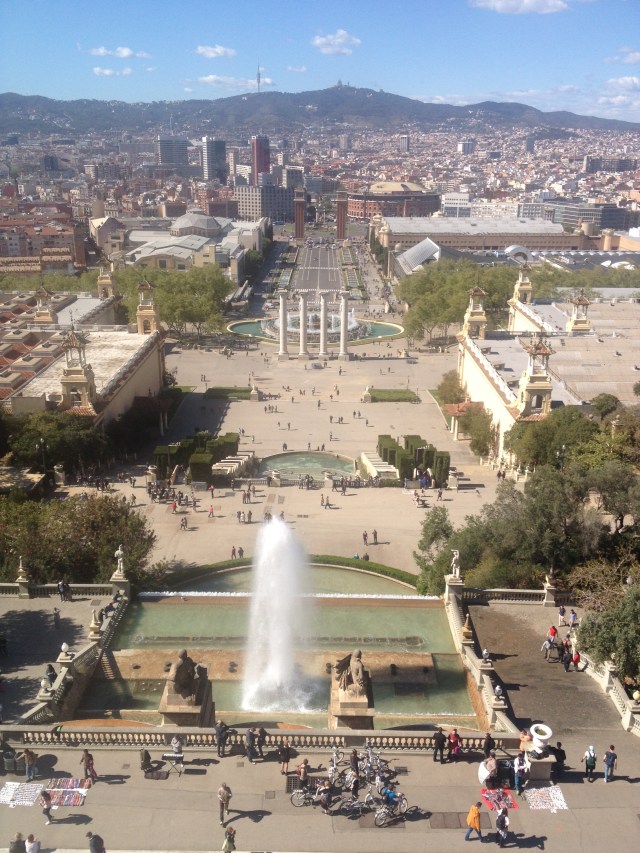
View over Plaza España from National Art Museum of Catalonia (MNAC) on Montjuic

View over Plaza España from National Art Museum of Catalonia (MNAC) on Montjuic

If there is a slum or a no-go district anywhere near the centre, I didn’t come across it. What you DO come across are a huge variety of districts, each with their own character. Head up the Ramblas away from the Port Vel through a pricey shopping district and cross the broad and busy Avenida Diagonal and get swept along the life flow that is the Gran de Gracia; here everything gets cosier and you find yourself lost in a maze of narrow one-way streets—some serenely quiet, others full of children playing and lively shops. It’s more fun to walk but it’s on three stops to Fontana on the Metro’s L3.

This is the Gracia district, still with the character of a town, although it was absorbed into the city in the 19th ©. Here are unexpected squares with fountains and cafe tables spilling round the edges where the locals hang out. There are superb fruterias with strawberries the size of hand grenades and xarxuterias with wafer-thin jamòn de serrano and even more serenely delicious jamòn iberico.

Plaza del Sol in Barcelona's Gracia district and 200m from the Apartment

Plaza del Sol in Barcelona’s Gracia district and 200m from the Apartment

Best of all are the local restaurants that don’t bother with Spanish—let alone English—on the menu where you dive into dishes like Pa Amb Tomaquet (bread rubbed with fresh tomatoes and drizzled with oil and salt), Escudella (stew made with meat, beans, potatoes and cabbage that can arrive as three courses) and Crema Catalana (their take on créme brulée that has also spawned delicious filo pastry custard tarts quite the equal of the divine Portuguese pastel de nata).

I had made the mistake of visiting Barcelona three times without ever entering Gaudi’s masterpiece of Sagrada Familia, having been put off by the queues and satisfying myself with the impressiveness of the exterior and crowds admiring it. This trip, I corrected that mistake and was shamed it took me so long. As an admirer of medieval cathedrals with gothic masterpieces in Norwich, Canterbury, Winchester, Notre Dame and even the floating mastery that is Chartres under my belt, I was still unprepared.

To say it is gothic on LSD trivialises it. The incompleteness outside is not reflected inside; it is a poem in three dimensions, suffused with subtle light. Whereas in other cathedrals gothic columns reach up to the roof in ranked arches, this is subtlety itself; each column branches with organic unpredictability of trees and the varied stained glass windows intersperse polychromatic highlights with shade so that the fantastic space within appears almost a living thing.

Interior of central apse of Sagrada Familia

Interior of central apse of Sagrada Familia

So, after the best part of a week in Spain’s second city, I climbed aboard an AVE (RENFE’s high-speed train) at Sants station, looking forward to its capital. As with the airport, the station embarrasses British standards for a main terminal. The whole thing has wide roads around it, bus and taxi areas, is served by three Metro lines and its modern passenger floor space (with shops, restaurants and facilities as well as ticket offices) is double the area of Waverley—tracks, platforms and all. Of equal area below this are fourteen through tracks to which access is controlled much as at airports but with much less fuss and walking.

The journey to Madrid is painless—the same distance as London-Edinburgh in half the time as a non-stop. Madrid’s Atocha main station is even bigger than Sants; it would make some airports look cramped. But, again, taxi, Metro and bus were easy to find and I was at my apartment not far from the Plaza Mayor within 30 minutes of arriving.

Perhaps it was because the weather broke and it was a week of spring weather much as you would expect in Scotland at this time of year (chilly, rain showers, a little windy) when I had left balmy 20 deg sunshine behind but Madrid gave the impression that it was chilly and dank even when the weather was good.
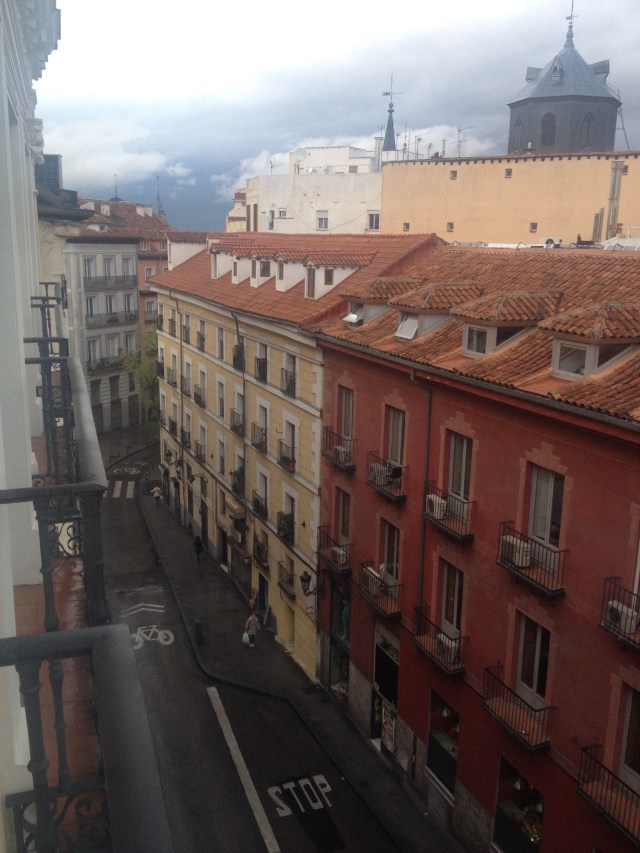
View from my Apartment in Calle AStocha, Madrid

View from my Apartment in Calle Atocha, Madrid

Madrid suffers from the problem of having been a major city in medieval times and so the centre is cramped by modern standards. Whereas Edinburgh (and Barcelona) solved this problem by building a brand new centre away from  the old one and Paris simply used Napoleonic authority to sweep the old away and build in a more grandiose style, Madrid still has the narrow streets and tall buildings of another era and feels provincial as a result.

There are modern and lively parts to it—the Puerto del Sol is surrounded by fashionable shopping and yet has no cafes and restaurants sprawling along its edge making it more human and enjoyable, as would be the case in Barcelona. And when you penetrate to the supposed heart of the city, the Plaza Mayor, it has a faintly abandoned feel to it as the shops leading up to it are tackier than those in Edinburgh’s already touristy Lawnmarket.
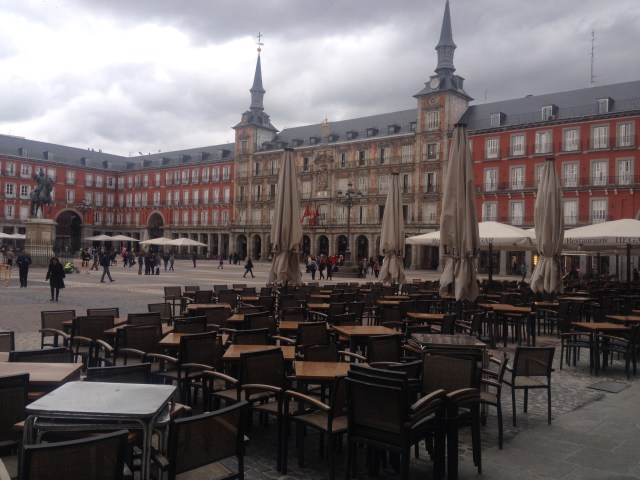
Plaza Mayor—the Heart of Madrid.

Plaza Mayor—the Heart of Madrid.

Certainly the weather didn’t make this supposedly main square seem cosy. But, even on a summer’s day, the sheer architectural relentlessness of the surrounding buildings is not conducive to the kind of informal, bustling cafe life I found in Barcelona. The most engaging and lively corner that I found in the city centre was the San Miguel market, which made a good fist of bringing together interesting food and drink stalls with boutiques and cafes to provide a real city-life experience to rival Boston’s Faneuil Hall or Philadelphia’s Reading Market.
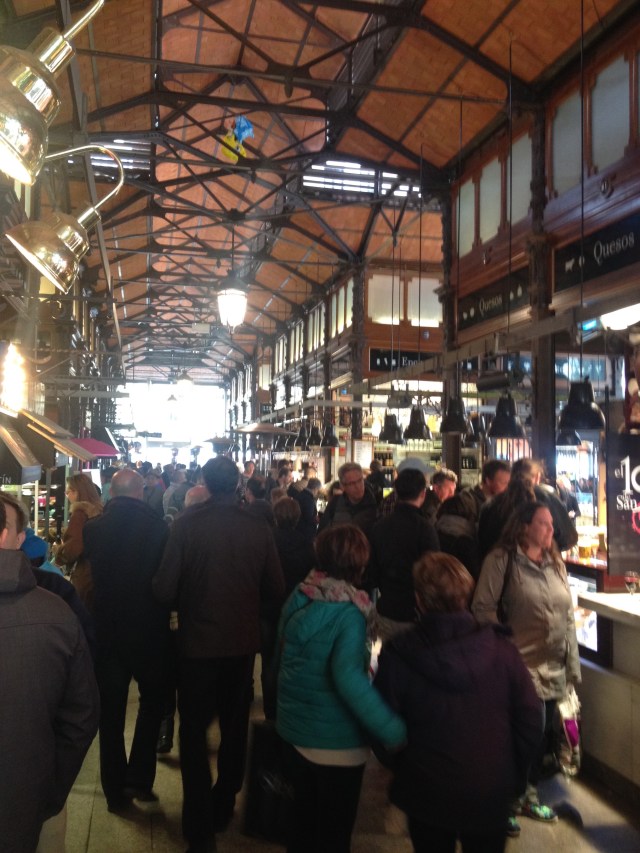
Madrid's San Miguel Market, not far from Plaza Mayor.

Madrid’s San Miguel Market, not far from Plaza Mayor.

Moving out from the city core, it seemed to lose what character it had. The Prado is very accessible but, other than as an imposing building, came as a disappointment. They had chosen to glue an ultra-modern extension on the rear to accommodate shop, cafe and entrance…which rather demolished any feeling of antiquity or veneration for it. And, while the collection is vast and the Spanish school well represented, there are only so many Don this-an-that in lobstershell armour you can take before the eyes glaze.

Despite the wide selection of august paintings, I was most taken by a painter new to me. Joaquin Sorolla, a contemporary with the Impressionists, made astute use of their irreverent approach to light and colour. His monumental works on display carried social and historical themes that, for me, expressed more than all the formal Velasquez portraits.

Moving further out from the city centre brought little more than intensity, such as is common in a hundred faceless cities, viz: much traffic and phalanxes of pedestrians but little by way of soul or colour. Typical was Nuevos Ministerios, a transport nexus to the north, where many government departments are housed. Eight lanes N/S intersect with six lanes and a flyover E/W above a combined RENFE and Metro station beneath. There was scant joy and certainly none of the laid-back squares of the Gracia: everybody was much too busy wanting to be somewhere else.

And that included me.
Posted in Community, Transport | Tagged | Leave a comment

Trans-Arctic Convoys

Once upon a time, the British took the Phoenecian and Viking idea of building a maritime empire to its logical global conclusion. We spent the last two centuries congratulating ourselves on how clever we were to do so. Leave aside that a former colony has long put us in the shade as the heavyweight of global enterprise; leave aside that the masses of goods imported into the UK (we’re not so good at exporting any more) arrive in non-British ship bottoms,  registered under flags of convenience from Panama to Liberia, not the Red Duster; we still remain a maritime nation.

Which means that we still should pay attention to what goes on on those high seas we rely on. We should keep our wits about us to counter threats and exploit opportunities. But, unfortunately, media and government thinking both seem increasingly landlocked and focused on landlubber issues like Palmyra, Ukraine or Brussels.

Non-terrorist threats not requiring immediate action get short shrift. One such ho-hum is global warming and its effect on global ice sheets. This has drifted in the background of people’s awareness for years. Deniers do their best to keep it there. But since 3,250 sq km of the Larsen B ice shelf in Antarctica—a chunk of floating ice the size of Lothian— went walkabout in 2002, some people have sat up. Recent research doubles the prevailing estimate of rise in sea level by 2100AD from 1m to 2m .

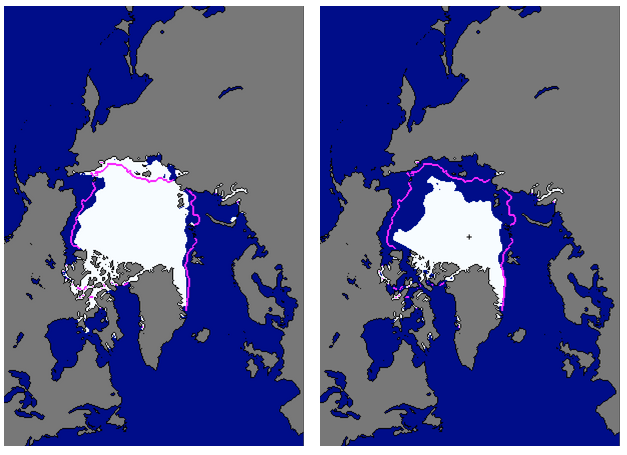
This is reinforced by mappings of the extent of Arctic ice at the end of each summer. The deterioration seems a cruel joke on intrepid explorers like Cabot, Frobisher and Davis who searched for the Northwest passage in vain; it now exists, albeit seasonally. Compare the two maps below for 1979 and 2011. The coloured line shows  average extent for the period.

ArcticIce

In recent seasons, ships have traversed round both sides of the remaining ice pack. And the way things are going, its extent will shrink further, possibly disappearing. Even though it would refreeze each winter, icebreakers could traverse it part of the time because it would be thin while forming.

This happening would not imply global inundation. The huge Greenland and West Antarctic ice sheets sit on land and their melting would indeed be catastrophic. If that happens, we need gills: Glasgow’s underwater and the Highlands become two islands. But Arctic ice already floats on water and displaces almost the same volume when melted. We might in fact find some good out of such an event. Look at the maps again and, this time, from a truly global perspective.

European trade with the Far East, especially China, has mushroomed in recent decades. Unless we find a better source of cheap electronics, appliances and manufactured goods, will grow more. At present, virtually all of this arrives in massive container ships. Where these were once so-called ‘Panamax’ size—cargo of around 80,000 tons (carrying 4,000 20ft containers) that could fit through the Panama canal—trade is moving to ‘Post-Panamax’ (6,000 containers) and ‘Post-Panamax Plus’ (10,000 containers). While the latter is more efficient for the $14m it costs to run (vs $9m for a Panamax), over half that cost is fuel.

The reason it costs so much is the distance. Glasgow may be just over 5,000 air miles from Shanghai but even ships using the Suez canal cover 10,800 miles and take over a month to get there. Larger ships must cover the Cape route’s 14,100 miles and that takes six weeks because ‘Slow Steaming’ at around 18 knots is the standard way to save expensive fuel. If that distance could be halved, then fuel worth $8m could be saved each voyage and twice as many voyages made. So let us really look at those maps again.

Even if the Arctic were not entirely clear of ice, 6,000 miles Glasgow to Shanghai becomes a possibility for perhaps half the year. What Europe really would need is a trans-shipment port. Huge vessels have great trouble accessing the shallow ports of Hamburg, Rotterdam, Felixstowe, Le Havre, etc. But they could be loaded up from and discharge to small ‘feeder’ cargo ships in some large, deep water anchorage on the edge of Europe for distribution..

I give you the 324 sq km (same size as the lost Larsen B) of water that is Scotland’s Scapa Flow and a peaceful reincarnation of the Arctic Convoys of WW2.

Arctic

This map shows the sea ice at the beginning of this month—the greatest extent likely in the foreseeable future. Even assuming all of it does not melt, there will be open water and the advantage of this route as sea lanes is obvious. Once the home of the Royal Navy’s Grand Fleet of battleships, Scapa Flow, already a major oil terminal, could become what Patterson once dreamed of in his ill-fated Darien scheme of 1698—a major global entrepôt that would transform the economy of Scotland and place it at the heart of world trade.

Posted in Commerce, Environment | Tagged | 1 Comment

Nae Twae Kitchens

My grandad was a crusty old fart, given to rolling in from the pub the worse for wear and frightening the bejasus out of me when he took off his wooden leg to relax. His real one is still somewhere outside Ypres. That loss made his fisherman trade very difficult to ply so he was constantly broke. Which goes a long way to explain his crustiness. But, though he could be stern, he passed on some pithy phrases that stay with me. The one above was trotted out when my gran tried to sneak me a jeely piece with both butter AND jam; to him, sheer extravagance. Milk AND sugar on porage brought down similar condemnation. Though resisted at the time, such lessons in consuming within your means stay with you.

I was reminded of my modest and frugal grandparents when this week a rather damp squib of a starting gun was fired in the BBC Leaders’ Debate, almost simultaneous to Kevin Hague’s œvre The Price of Independence— An Objective Analysis. The former seemed scarcely able to address pragmatic political reality, while the latter contains an overdose.

Having ploughed through a serious amount of its 40 pages, the œvre contains what it says on the tin. Although claiming no party affiliation, Mr Hague bats steadily for the unionist team and has form as a vituperative critic of Yessers who dare question his numbers (including your humble scribe). Yet, to be fair, it is hard to poke holes in the extensive numbers he has gathered in this paper, based as they are on GERS and other government documents. He has set rigorous terms for any fiscal debate on Scottish independence.

To fellow believers in independence who rail against his relentless dismissal of any fiscal sanity behind that concept, I would qualify his conclusions as a beancounter. While his numbers stand scrutiny he seems oblivious that almost none of the 100+ countries who have gained independence over the last couple of hundred years did it by convincing their fellow citizens to believe in a spreadsheet. Business may well have been behind many a revolution but “we like the bottom line” has never been the mob’s cry as they storm the palace and line the bastards up against the wall.

In short, Mr Hague is one of those intelligent but unfortunate people who appear to know the price of everything but the value of nothing.

But, before we get too dewy-eyed and emotional, it must be acknowledged that running an independent country requires a pragmatic grasp of finances. So…convincing 2m+ Scots doubters who were unswayed by the dream but—more importantly—unconvinced by the numbers will take more than exuberant rallies by the faithful and dour dismissal of Westminster and all its works.

Between now and any successful second referendum in which significant numbers of those 2m+ doubters do join the believers, they must be swayed by plausible fiscal projections demonstrating how this country could prosper by itself. And, as Mr Hague’s paper points out, the rosy numbers  for both oil revenues and structural deficit cited as arguments by the Scottish Government a year before the referendum had not only lost their glow by September 2014 but have deteriorated even more since. See his pp 7-8.

The details of this, including looking over more than a decade and comparisons with other European countries do pose questions to be answered if significant amount of the doubters are to change their minds. Some will undoubtedly be immune to argument, being tholed to the Union as surely as some are to Independence. But the substance of the ‘NO’ campaign was using fear of fiscal damage as a club. And, for a significant slice of doubters with (understandable) concerns for jobs, business, commodity prices, property markets, etc, a convincing projection of a satisfactory fiscal future would indeed make the difference.

Which means, however much the SNP’s Scottish Government has fudged the matter over the last two years, a narrative that meets Mr Hague’s statistics and conclusions head-on is needed. Fudge has worked up to now and will probably carry the SNP back into power in May. But they will have to address this soon or lose credibility. The passing of significant devolved powers means blaming nasty Tories and raspberrying Westminster won’t do. Wur teenage Parly has to wean itself off pocket money and get itsel’ a joab.

Problem is that wur Parly has spent 17 years on mostly gesture politics. The McCrone settlement with teachers; the smoking ban; free tuition; free personal care; concession travel; nursery provision; minimum wage—all laudable initiatives. But they are populist; they were affordable ONLY because parliamentary budgets doubled before becoming constricted in the last couple of years.

That Mr Hague’s numbers show we Scots are running a structural deficit worse than the UK’s is not some unionist plot to undermine the SNP. It is reality. And waving saltires at rallies will not make it go away. Partly because of decades of Old Labour, together we Scots have grown cosy with a profligate society, as compared to our means. And, much though the SNP may have spruced up the competence of government since 2007, they have bottled hard fiscal choices to remain as populist as Labour ever was.

Just as many a Labour-run council cut its roads or cleansing or environment budgets so that libraries, community centres, all-weather pitches, etc could get built in true pork-barrel style, so the Scottish Government has ‘protected’ a high-profile NHS full of competent front-line staff let down by appallingly inefficient administrators of its £11bn. Or it has stood by while Scottish Enterprise shows very little enterprise with the £600m it swallows every year.

Meantime, some major fiscal beasts are devouring the landscape and creating Scotland’s structural deficit. It is true transport per head will be higher here than in densely-settled England. But concession travel costs have more than doubled with abuse: some people criss-cross the country on vacation while others would happily pay. Free personal care is a noble aspiration. But since its introduction, nobody has had the chutzpah to question whether we can afford it—at least until our finances look less of a basket case. There is a shopping list of a dozen such policies that need serious debate about their viability.

But perhaps the worst of all has been the extent to which our public institutions, quangocracies and charities have become stuffed with executives pulling down bloated salaries that often exceed those in the private sector—already bad enough when bonuses are included. Once upon a time, charity executives were there from noblesse oblige and not for compensation. Last year, this blog highlighted some of the outrageous charity salaries and expenses that now divert well intentioned giving by the public from the intended benefactors.

Similarly, once upon a time, council Heads of Service and Directors were modest bureaucrats grateful for rock-solid job security that compensated for their meagre salaries. Once upon a time there were far fewer public bodies whose heads were paid far less. There are now 52 Executive, Advisory and Tribunal Public Bodies, as well as Public Corporations like CalMac and Scottish Water. Chief Execs of such are routinely pulling down more than £100,000, plus some sweet benefits. Details of these were given last you in You Know You’ve Been Quangoed.

The journalist Iain MacWhirter recently came across this interesting chart published by the Parliament research organisation SPICe that sheds some light on the scale of the issue:

SPICeTax

Now, just why over 2,000 Health and Social Work executives should be pulling down more than £150,000 per annum here when the UK has proportionally far fewer and our (supposedly large and reputedly overpaid) financial sector should be so much less is a mystery both Iain and I would wish to see answered. Such sweet deals are symptomatic of the malaise and no-one has the cure but the government.

If Scotland is to make a go of it, the serious questions posed by Mr Hague’s analysis must be answered. That may be by judicious liposuction of the ‘flab’ highlighted above. Or by some equally trenchant wealth-creation policy so we can afford the profligacy identified —which, at present, we clearly can’t. The most effective answer would be both. We’re not quite as bad as my grandad—spending a night down the pub to obliterate the unpalatable truth that he can’t afford to spend a night down the pub—though we’re getting close.

In his blunt phrase, we cannae hae twae kitchens; we can’t go on overpaying people in non-wealth-creating jobs and piling more costly populist policies onto the public purse and think we’re running a viable country. Check out the EU Country Deficit Comparison on page 10 of the paper to see where we stand relative to our neighbours, as well as the UK.

More relevant, the history shown in the next chart on page 11 demonstrates that, while everyone suffered post-2008, the fiscal hard choices made in Greece and Ireland have allowed them to overtake us on their way back to viability. Meantime Scotland treads water in a fiscal funk that makes independence impractical as long as the SNP insists on spreading gesture jam on its fiscal piece.

Posted in Politics | Tagged | Leave a comment

A Terrible Beauty

For some years, I have made a point of wearing green on March 17th. That’s not because I have any Irish blood but because of a swathe of positive influences that Ireland and the Irish have made on my life. Starting with a colleen displaced to darkest Hampshire, I reckon I hitch-hiked a distance equivalent to global circumnavigation to see her over a three-year period. More recently, a riotous week a decade ago was ostensibly researching campaigns using STV voting, but actually savouring the fleshpots of Temple Bar and learning what criac really means.

Scots are fond of citing the far-reaching influence of their diaspora but—truth be told— the Irish probably have us licked as measured by global reach by a smallish country. Combined with the fact that they are stylised as sweet-talking hard drinkers while Scots are stylised as dour-faced hard drinkers, we could do worse that learn from our cousins.

St Paddy’s Day drifted by with very little fanfare in Scotland and any fraternal feeling evaporated in their decisive 35-25 6-Nations win over us in Dublin two days later. So there is little appetite to disinter a history forever wrapped with Easter 100 years ago. We like to call Culloden the “last battle on British soil”, but it wasn’t. Foolhardy bravery by barely 1,000 rebelsis was a pivotal historic event that is still debated in Eire, seminal as it was to that country, as it brought ‘physical force republicanism’ to the fore in Irish politics.

That the anniversary will be ignored in London and by the British establishment is perhaps understandable; it was not the Empire’s finest hour. The brutal lessons our Celtic cousins learned on their rocky road to independence should stand as indelible reminders of the cost to all involved of armed insurrection and decades of bitterness that follows.

The parallels between Scotland and Ireland cannot be taken far. Whereas the Scots (parcel of rogues notwithstanding) voluntarily joined to England and was a full partner in sending gunboats to the pink-painted fifth of the globe the Empire once covered, the Irish came by a different path. Since before Edward I subdued the Welsh in the late 13th century, England had colonial designs on Ireland. They had colonial designs on Scotland and France too but the latter both managed to fight them off.

But in the half millennium between then and the Irish being officially given partner status in 1801, there were a series of land grabs, skirmishes, pitched battles, resentment and religious standoffs that make John Knox look like a soft-spoken moderate. Present republican leaders descend from a romantic heritage stretching back to the High Kings and the legends around who we Scots would call Fingal. Hard-headed, hard-spoken unionists of the Ian Paisley mould descend from carpetbagging Scots who were shipped over by James VI to try to balance recalcitrant Catholics with dour Scots Protestants.

To this ancient powder keg, the otherwise triumphant government of the world’s most successful empire that had overcome warlike Zulu and wily Pathan, added gasoline. It seems they didn’t ‘get’ how they could be thwarted by a couple of million recalcitrant bog-dwellers. Since the destruction of the clan system and associated Clearances worked had so well in bringing a Tacitan peace to the Highlands—so much so that George IV could prance about in a kilt and Victoria visit the Cairngorms less than a century post-Culloden—well, the same medicine as pacified Jock jolly well ought to work on Paddy, what?

For the (largely English) colonists sent over to exploit the Pale and beyond treated the Irish pretty much the same as they did Bantu or Brahmin—local resources to be exploited in pursuit of profit. They practiced feudal overlordship long after bonded peasants had been freed into something more enlightened in England. Little wonder Irish resentment blossomed. Incidents were common as sullenness ran as undercurrents to daily life.

Catholics—80% of the population—lived in conditions of poverty and insecurity, despite emancipation in 1829. At the top of the social pyramid was the “ascendancy class”—English and Anglo-Irish families who owned most of the land, exercising unchecked power over their tenants. This land question became the root cause of disaffection, so the British Government established a Royal Commission in 1843 to review laws regarding the occupation of land. In predictable fashion, they formed it entirely of landlords. But even such a lopsided group could not:

forbear expressing our strong sense of the patient endurance which the labouring classes have exhibited under sufferings greater, we believe, than the people of any other country in Europe have to sustain.

Such was not always the case. Many Irish—like their Scots cousins—saw the opportunity that the burgeoning empire offered and created an early diaspora as they took up various callings from Saskatchewan to Singapore.

What undercut this co-operative, if not directly harmonious, element was an Gorta Mór—the Potato Famine. By the 1840s, Ireland was heavily dependent on potatoes for food. An outbreak of blight between 1845 and 1852 ravaged the crop. That in itself was bad enough. But the reaction of the British state was callous. Despite Prime Minister Peel making a start by importing American maize, he was replaced by a Whig administration that took a laissez-faire attitude: the market could rectify the famine situation. The result was 1m people died and another 1m emigrated in a desperate effort to survive.

From then on, Ireland was a rumbling volcano, the only question being when it would erupt, rather than whether. In post-famine Ireland, anti-English hostility was woven into the philosophy and foundation of the Irish nationalist movement. Parnell’s nationalists dominated the hundred Irish MPs returned to Westminster. Up to the turn of the 20th century, the Celtic Revival movement associated the search for a cultural and national identity with an increasing anti-colonial—and by extension anti-English—sentiment.

A feeling of anti-English sentiment intensified within Irish nationalism during the Boer War leading to real Anglophobia. To assuage this, bills were proposed in Parliament for Irish Home Rule but these were shelved at the outbreak of war in 1914. Though many Irish fought in that conflict (three divisions were formed—the 10th, 16th and 38th), the level of frustration and resentment after centuries of despair provide a background for a rising. Though organised across Ireland, effectively it happened only in Dublin. That it came to this was because the man in charge, Irish Secretary Birrell (hitherto seen as an enlightened chief secretary for Ireland) seems to have grown complacent.

A hundred years ago on April 24th, in a hopeless optimism that the British were so preoccupied in France they would let Ireland go its way, Pearse and Connolly led a few hundred in occupying several buildings. But they signally failed to take ports, railway stations or Dublin Castle, the seat of British rule, so reinforcement could be organised.

Despite being caught on the hop, the British response was devastating, including artillery being used on the streets. The 1,200 troops in the city were swiftly reinforced to 16,000 and all points seized by the rebels quelled in 5 days. 132 soldiers and 254 civilians were killed, along with 64 rebels. The 16 ringleaders were arrested, courts martial convened and all were executed within two weeks.

Which pretty much sealed the deal on Irish independence. Many former unionists were outraged at the peremptory and brutal treatment of their countrymen. Unrest flared up after conclusion of WWI. Churchill’s Irish Constabulary Reserve (better known as the Black and Tans and recruited largely from unsympathetic demobbed soldiers) employed a brutality that only made things worse.

So the British government threw in the towel and declared the Irish Free State in 1922. But not before they welshed on a deal struck with de Valera, unilaterally keeping the six counties of Ulster as part of Britain as a sop to the Protestant majority there, largely descended from those dour Scots shipped there three hundred years before. And we all know how well that turned out.

There are, as hinted above, lessons here for Scotland: for a start that armed resistance—even when apparently justified by heinous acts—costs both sides dear and leaves scars that heal only slowly, if ever. But the larger lesson is that even small, poor countries can make a go of it, increasing prosperity for their citizens. Fifty years ago, Eire was a backwater that sent its brightest elsewhere to find careers. Even with tough times, they rode out the 2008 crash. At no time did you hear no Irish voices raised asking to return to the Union fold. Better Together made no kind of sense to the Irish.

One of the more enlightened Tories Michael Portillo has now made a timely documentary about the Easter Rising called The Enemy Files. It is being broadcast on Monday. March 21st on both RTÉ One and BBC NI. But, perhaps significantly, it will not appear on any channel in either Scotland or England. So it remains a lesson our two countries still need to learn.

Now and in time to be,
Wherever green is worn,
Are changed, changed utterly:
A terrible beauty is born.

Easter 1916, W.B.Yeats

Posted in Politics | Tagged | Leave a comment

Building Something Worth Keeping

Edinburgh has a lot going for it as a city, not least its World Heritage architecture, its strong cultural reputation, its status as a capital city and its stunning setting beside the Firth and peppered with hills. Property professionals prize location above all factors when valuing a property, helping to explain Edinburgh’s pricey reputation—and not just on Anne Street. And these prices are post the 2008 fiscal meltdown (damaging the key financial services sector from RBOS on down) and with oil currently a basket case.

So imagine how much more insanely unaffordable housing might be if both financial services and oil were both to come roaring back. Is there, therefore, an upside to this down trend? Well, there is at least a model that might be used as an example what NOT to do. San Francisco shares many characteristics with Edinburgh. Its hills and views are even more spectacular; its culture and arts are more varied; its architecture is more modern but equally unique and valued; the Golden Gate must be the most stunning harbour entrance on the planet, through which passes much of the massive US trade with Asia.

But, unlike Edinburgh, San Francisco is in boom times. Its resulting travails may have some lessons for a Scottish Government so keen to build houses just now that now side with developers to steamroller local plans and over-rule local planning decisions.

A recent New York Times article (NY is no fan of SF, with city rivalries there are as fierce as between Edinburgh & Glasgow) highlighted the housing pressures SF faces from the boom in internet companies like Google, Facebook, AirBnB, etc. These companies are based outside the city in Silicon Valley on the SF Peninsula. But unlike their predecessors of Intel, AMD, Sun, Oracle, Cisco, etc, their relatively young employees have chosen to live in the culturally vivid and exciting City, as opposed to the staid suburbs of the Peninsula.

Their stratospheric salaries and lack of conventional burdens (e.g. kids) means they have serious disposable income and so have driven the housing market haywire. This is despite rent control ordinances passed thirty years ago. As the NY Times reports:

“Two years ago, radicals began delaying and harassing Google and other tech companies’ shuttles as they threaded San Francisco’s narrow streets. Now — after the city officially gave the shuttles free rein to use public bus stops; after the tech elite were accused of trying to buy a crucial local election; after the home-rental company Airbnb spent a fortune to defeat a proposition that would have restricted its business — the discontent is mainstream.”

We saw something like this with oil in Aberdeen in the eighties or the euro-boom in Dublin in the noughties. But this dwarfs either. People who do not make their living from technology are being squeezed out as San Francisco booms, adding 10,000 people a year to a record 852,000 in 2014. A one-bedroom apartment goes for a median $3,500 a month (£2,433), which means SF has passed NY to boast the highest rents in the US.

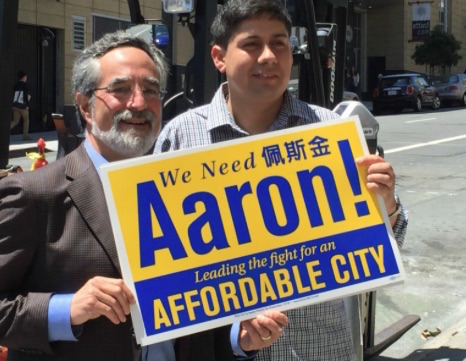
This is being fought by activists like Aaron Peskin who got himself elected to the Board of Supervisors (= City Council) by arguing:

“Let’s take a stand to make San Francisco more affordable and livable.These billion-dollar companies should help ameliorate the impact they’re having, They can afford to do a lot more. So far, it’s only window-dressing. They can volunteer to be decent.”

Peskin

But what might seem like a straightforward David-and-Goliath spar between evil property barons and landless peasants is a good deal more complex, as has been related to me by some long-time resident friends there who keep their fingers on the pulse.

They believe that those rent-controlled voters who had their rents frozen 30 years ago are actually exacerbating the problem as they hang on to their advantage. As a result, those few properties available rocket in price to make them largely unaffordable. As one said:

“The success-driven but otherwise quasi-autistic programmers which one used to see only in Silicon Valley now fill the cafés, but they’re not talking.  All of them are on computers, and typically with earbuds for the music from their iPhones.  This business about rents and the homeless is largely political rhetoric that grows from the fact that SF is a rent-controlled city with 80% of the voters being renters.

“I don’t think Peskin really believes a lot of the nonsense that he advocates.  That’s just how the game is played here by politicians.  That said, he’s better than his adversary, who was a total sell-out to the mayor, in turn a total sell-out to developers and Chinese power brokers.”

So, while the short-term solution for housing shortages in Edinburgh is under much less pressure and before concern for the vulnerable seizes on private rent control as a popular policy in any boom-to-come, it would help us evade SF’s current fate by:

  • Rethinking the present any-houses-anywhere-at-all-costs stampede
  • Getting much cleverer at linking jobs with housing to curb commuting
  • A proper share of affordable public housing (the only type that stays affordable)
  • Avoid letting good intentions build social wastelands, e.g. tower blocks; Easterhouse

Because, despite the gleeful chorus of unionists who appear to be celebrating the current economic hit Scotland has taken from the oil slump, I believe we have better days to come. And when they do, I don’t want clodhopping government fire-brigade policies capable of repeating our mistakes like Dumbiedykes and Saughtons and Wester Hailes and Piltons —and pleading homeless/substandard/deprivation as justification.

The spectacular and historic tenements of the High Street were once home to rich and poor alike. The servants once lived on the upper floors of all the genteel Georgian mansions of the New Town. The vast majority of residential San Francisco may be diverse but it is very livable. Time we started thinking of what this generation leaves for posterity that they will cherish similarly—and won’t want to knock down as unfortunate eyesores.

Posted in Community, Politics | Tagged | Leave a comment

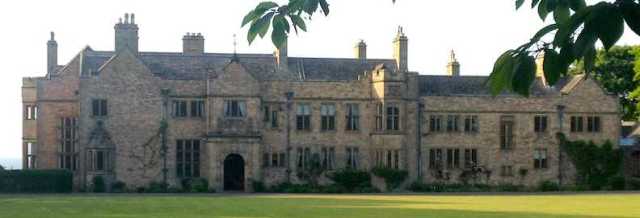
Carlekemp: Architectural Gem

You can drive down Abbotsford Road in North Berwick and not even know it’s there. Carlekemp, a long, elegant pile of mellow Rattlebags stone, hides in its expansive four acres of grass and trees behind a high wall that retains the grandeur intended when it was first built. The name derives from the Celtic for the “crooked knoll” on which it stands, predating both the house and the 178-yard par 3 Hole 4 of the golf course it overlooks.

In the Victorian industrial boom, James Craig had amassed a fortune from his paper mills along the Esk around Penicuik. In the fashion of the time, a prosperous, high-profile family such as his needed a summer residence in a fashionable resort. In 1898, he commissioned Edinburgh architect John Kinross, RSA to provide him with a suitable 2-storey Cotswold Elizabethan style manor house on land between the recently completed Abbotsford Road and North Berwick’s West Links.

CarlekempLong

Kinross crafted an iconic Elizabethan Cotswold beauty but lost out to Lorimer to construct the almost-as-impressive mansions in similar style and stone for Craig’s brother Robert (Bunkershill in 1904) and with Peddie for Westerdunes (1910). Although its exterior and setting remain unspoilt the real gem of Carlekemp is the interior of the western third of the building—sometimes called Flat 1. This is actually the historic main portion of the original house. Superbly panelled in oriental teak and mahogany by Scott Morton and Company, Edinburgh, the galleried hall boasts Jacobean details and oriel over doorway, as well as strapwork and ornate plasterwork throughout.

Even a glance inside provides a flavour of how well those Edwardian magnates lived—especially considering this was merely their summer residence. Credit both to their taste for having built it but also to those who have preserved its graceful dignity down the years. In 1971, it was given Grade A Listed Building status. But, as elsewhere, large houses became progressively more difficult to keep and in 1945, Carlekemp was converted into a Priory Prep School under the supervision of the Friars from Fort Augustus Abbey. Father Oswald Eaves and his staff dressed in traditional brown habits taught well known pupils including the Duke of Hamilton, Earl of Haddington, George Hope of Luffness and Ludovic Broun-Lindsay (present Provost of East Lothian). The Priory School itself received unfavourable press last year about abuse of its pupils but its Prep School had closed in 1977 when the building was converted into apartments.

Three years ago, we visited and published a blog with a dozen photographs showing the magnificent interior of the building. These were removed nine months later at the request of residents as they felt the details shown compromised their security.

Posted in Community, Environment, Uncategorized | Tagged , | Leave a comment

Chocolate Steam Train

Ever since 2007 when the affable, ineffectual John Home Robertson (as unlikely a Labour MSP as you’ll ever meet) drifted into retirement, East Lothian has been represented at the Scottish Parliament by Iain Gray. Now Iain—like John—is not a bad lad. Trained as a teacher, he worked abroad and later in a charity. He is not your standard numpty. Unlike the unlamented, autocratic Anne Picking who was his MP colleague for a time, he doesn’t abuse punters with egotistical expenses. There’s not much legacy from his four years as Labour Leader in Scotland but ‘ineffectual’ seems a common trait in that job.

Though I am not standing again, I need to declare an interest in this: I stood against him in 2011 and ran him close. The worst I can say about him then is he was an opponent who pulled out all the stops he could to win. Nowt wrong with that, although he was clearly bricking it during the recount at the Corn Exchange. But I hold no deep animosity toward him, other than a frustration that he treads water in this magic corner of the country that deserves better—East Lothian.

Abelio’s ScotRail runs the North Berwick line that is the transport backbone of the county and the prime means whereby thousands of professionals who leave here shuttle into Edinburgh to earn a decent wage. So, when I heard Iain was stirring up a campaign against the inept way it is being run, my first thought was: “good on him; about time he showed some leadership; that’s a  local issue crying out for it”.

Except, as I dug deeper, my enthusiasm waned. The line has been in need of serious management intervention ever since the Class 380 4-car units were introduced in June four years ago. The trains themselves are now excellent and solve many earlier problems. But that, along with the booming ridership, has exposed shortcomings in management, not rolling stock. As he uses the train more than I do, why has it taken him four years to recognise that, for all that time passengers have had to put up with:

  1. Unreliable service. This is more than ECML trains with higher priority delaying our local service. ScotRail habitually abandons the 17:43 ex-Haymarket or turns trains at Drem to make up time, leaving dozens of passengers stranded.
  2. Overcrowded trains. Starting at Prestonpans inward in the mornings and that far outward at night has always been standing room only but now it’s so bad that people at Musselburgh can’t even squeeze on the train.
  3. Revenue loss. Partly due to overcrowding but mostly to inadequate staffing, hundreds of people from/to the last couple of stations never have their ticket checked and so freeloading has become endemic, much to the annoyance of passengers from further East who pay their fares.
  4. Antiquated ticketing. Not only no automatic barriers at Waverley but no sign of  reusable swipe cards like Oyster which has boosted ridership and cut delays in London for the last 13 years. As a tease, readers have been installed at stations two years before tickets that use them.
  5. Chaotic planning. It took almost ten years to get the Class 380 trains appropriate for the line and platforms were extended to cope. Now they are being extended again—but only to accommodate 5-car trains. There are no 5-car Class 380 sets.
  6. Poor maintenance. Ticket machines are regularly out of service, the Kiosk leaks like a sieve since it was built and it took over a month to fix the sliding door.

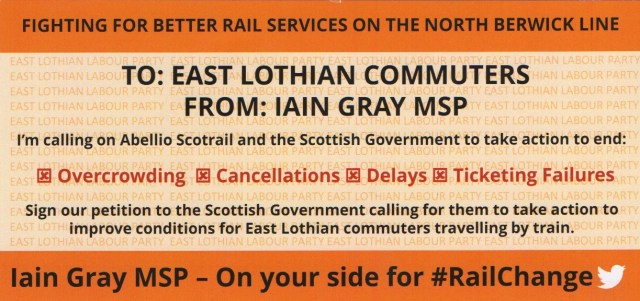
So, Iain has much to get his teeth into; since he rides the line, he ought to know all this. Yet, what does he make by way of suggestions to line up with RAGES, ELC, George Kerevan MP, Colin Beattie (MSP for Wallyford & Musselburgh, the worst affected stops) for a coherent campaign of lobbying? Well, nothing beyond a petition to ‘improve conditions’.

GrayRail

Iain has been out at stations handing these to commuters. He was at North Berwick on Feb 22nd and deserves credit for being there on a cold mornings. His reception was frostier than the weather. Even if everyone were to sign this petition, how does that advance a solution towards which others have been working for the last five years?

Unlike five years ago, ScotRail now runs trains to/from Dunbar and is in receipt of a follow-up paper outlining how a half-hourly service between Drem and Waverley can be run using one more train than they do now (4 instead of 3 sets in service). With an alternating hourly services to/from North Berwick AND Dunbar congestion would ease. Such a service is needed anyway to serve East Linton station when it is re-opened.

This solution seems clear, easy to implement and solves most problems listed above. If, for some reason, it doesn’t appeal to Iain, he should propose something equally effective. After four years to think up something, is one whiny petition the best he can do? What point is there trying to get up steam in a such chocolate engine?

My cynical side says this sudden interest in commuter welfare has more to do with a May election looming at which he’s threatened with his jotters. Like Home Robertson before him, the people of East Lothian have little benefit to show for his decade in post. His achievements? Unswerving loyalty to Labour and an affable presence kept afloat by SPAD-spawned press releases. But does he really believe people want their money spent on leaflets for symbolic campaigns like the above—more focused on keeping him off the burroo than improving the lot of his parishioners?

Posted in Community, Politics, Transport | Tagged | Leave a comment

Why Did It Take So Long?

Today’s Herald reports that Nicola is to use a visit to a school in Midlothian to announce major changes to how Council Tax is levied. The paper reports that the SNP had originally wanted to replace it with a progressive Income Tax, but didn’t have the powers to do so and abandoned the idea in 2009—two years after floating it.

Since then, Osbo’s Osterity has bit deep into council’s funding, their hands tied by having control over less than 20% of their income and even that option denied them by the continuation of the Council Tax Freeze for a decade. But, worst of all has been the Scottish Government’s disinterest in creating a better solution until stung into action by being outflanked by Kezia’s “Penny for Education” wheeze to exploit newly devolved tax powers.

It’s a shame it has taken seven years for the SNP to take its supposed local partners in government seriously enough to take action. What gars me greet is that they have taken this long to come back to a property-based tax when some relatively simple options were always available and that even this column was arguing that four years ago in the run-up to the last local elections in 2012. What follows is a reprint of what was published then.

The LabourHame web site has some good ideas worth stealing. John Ruddy has cooked up a more progressive system with the dual virtues of raising tax receipts without touching council tax rates that have been frozen over five years. Taking my own East Lothian Council as an example, some 55% of its 35,500 taxable properties are rated as Council Tax Bands A-C. Another 24% are in the ‘yardstick’ Band D, while 19% are in bands E-H. These last properties can reasonably be considered the more affluent, while bands A-C are typically occupied by those with modest incomes. Yardstick Band D properties pay 9/9ths of the tax rate set, with lower bands paying proportionately less and those above more. The current situation in East Lothian is shown in Table 1.

Table 1—Council Tax Bands in East Lothian with Approximate Revenues

This raises around £39m in Council Tax. John’s ploy to increase this is to split each upper band (E-H) in two so as to give bands E-L but to continue the proportionate ratcheting up of the ratio (3rd column) so that band L would be paying 36/9ths or 4 times as much as Band D. This does accrue appreciably more tax, with all of the increase coming from above Band D. But this hits the middle class (houses in the £58,000 to £212,000 valuation range) hard, compared to now. But it still doesn’t nail the many houses valued well over £212k.

A better compromise would be to adapt John’s scheme so that we have the additional bands and increments he suggests, but that we assign houses into upper bands with less steep gradations than his proposals and then add a proper ‘Mansion Tax’ on houses valued over £1/2m. This would give a scheme more like that in Table 2.

In the case of Table 2, no-one in Bands A-F pay any more. Those in old Band G would find themselves paying between £0 and £800 more each year, depending on which new band they fell into. Those in the old ‘over £212k’ Band H would pay at least £745 more. The middle-upper reaches of house prices would therefore be more fairly segmented; those approaching £1/2m in value would see their tax exactly double from £2,235 to £4,470. There would be no theoretical upper limit for properties valued over £500,000.

As a final element of this, second homes would be treated differently. Until recently, they actually received a tax break by paying at only a 50% rate. But most second homes are actually holiday homes, run as businesses and/or property speculation schemes. That, in itself, is not reprehensible but the cumulative effect on our remote and picturesque communities is a glut of empty houses and an abandoned feel off-season, with locals—especially young locals—being driven away by being priced out of the market.

Anyone with a second home cannot be poor. If they were rated at 200%, this would effectively be a tax on holiday homes that leave payment by locals unaffected. The definition of local would be registered voters resident, which would have the added bonus of catching the rich who maintain a home in Scotland yet claim reduced council tax as non-residents. Estimating the number of local second homes (mostly above band D) at 1,000 in East Lothian, such a scheme should add another £3m; urban councils would see less benefit.

Bottom line of this scheme is that it would boost Council Tax income in the East Lothian example 23% from £39m to £48m without any increment for people living in modest houses valued up to £100,000. The Mansion Tax sting would be concentrated on less than 10% of all houses but those are best placed to stomach such increments. Given increases in East Lothian house prices for decades now (average 5% per annum) property value accretion alone pays for any council tax five times over in the long term.

Would there be people unfairly hit (e.g. widows with little income still in a large family home)? Yes, it might and some thought needs given to such cases. And, lest you think that this would fall unfairly on certain parts of East Lothian, even the Fa’side ward has 16% of its houses in current Bands F-H.

Such a simple conversion of the council tax system would adjust its unfair burden from the less well to the better off and boost council income by the same as a 13% rise in council tax.

Posted in Uncategorized | Leave a comment

Council Crunch

Any regular reader will be know I have been a inveterate supporter of Scottish independence since I first became aware of politics as a teenager. For most of that time (38 years to be exact), I was a member of the SNP. Despite a parting of our ways three years ago, I still regard them as the main vehicle whereby the Scottish people will achieve that independence and do not foresee that changing.

But that does not make me see them as infallible, nor above criticism. Indeed, it was due to some serious disagreement on policies—handling of local government and justice briefs to be exact—that a minor spat triggered my resignation. While internal dissent is healthy, having a senior party member (I was Convener of ANC and an elected member of the National Executive) criticise ministers in public is clearly unacceptable.

But, with the exception of those two policy areas, this blog has been sparing in taking the present Scottish Government to task. Not only were they so much better than what had preceded them but our media wolf-pack that scents blood in the least peccadillo and holds politicians to standards that few humans can sustain is a distraction from recording real progress. Hence the selective criticism by this blog.

But the times they are a’changin’. Not only are a number of key areas of government displaying flaws that are more than just random chuntering from a dispirited opposition but a blinkered refusal to address valid criticism has become the norm. And now, a series of fiscal decisions have been taken that appear to have much more to do with symbolism and re-election than any long-term vision of securing happiness and prosperity for the Scottish people.

From some questionable moves in the Justice brief, things have started to look equally questionable in the two major areas of Health and Education which, between them, account for around 60% of the entire Scottish budget. In both cases, the ministers involved have (understandably) dismissed the weak criticisms made by Labour. But Robison & Watt have yet to take on board serious shortcomings appearing in health:

  • No attempt to curb execrable efficiency performance of NHS Trust administrations
  • Rampant abuse of ambulance and A&E calls which block real emergencies
  • Fixation on waiting times (to detriment of good management) and using them as political football
  • Ballooning over-prescription and hoarding of drugs at home from free provision

These are paralleled by equally urgent issues arising in education that are also being rather swept under the carpet by Constance & Allan and not being addressed:

  • Actual abilities of school-leavers declining while exam results ‘improve’
  • Fixation with university degrees when FE and vocational learning numbers drop
  • Fixation on policy—GIRFEC/CfE/inclusion—to the detriment of real outcomes
  • Massive over-centralisation so local circumstances ignored: Glasgow is not Orkney

In themselves, these are grave enough. But almost every area of government is now showing autocratic, out-of-touch traits not present when the SNP were first in power. And, rather than necessarily displaying ministerial hubris, it smacks of mandarins playing ministers like marionettes (c.f. Yes, Minister), as was the case with Kenny Macaskill at Justice before ‘going native’ caused his removal. These include:

  • Fergus Ewing being too long under the thrall of Scottish Enterprise & VisitScotland
  • Aileen McLeod weak on land access by bending consistently to the landowner lobby
  • Derek Mackay taking iffy advice from Transport Scotland on strategic projects
  • Margaret Burgess—far less effective at building affordable homes than Alex Neil

This should not be taken as personal criticism of anyone named. It’s always hard to push things through bureaucracy and their Labour predecessors (honourable exception being Malcolm ‘Jessie’ Chisholm) set such low standards they all look good by comparison. If the team moves forward as a whole, you can afford to have a few passengers.

But the last month has seen a watershed. The SNP Government moved from being an bolshie bunch who pushed the envelope with their ideals to become seasoned politicians keen on keeping their job & not rocking any boat. The litmus for that was John Swinney.

Even their opponents rightly credit both Alex Salmond and Nicola Sturgeon with being  effective leaders and formidable politicians. Their ‘front-of-house’ image sealed SNP’s rise to power; recent teflon performance in polls confirms that. But the sober voice backing them up, putting gravitas into statements and plausibility into budgets was John’s. But, after nine years of running budget numbers like a pro, he has fumbled the ball.

Read the previous blog for an analysis and interpretation of his December 16th Statement. His was the SNP analysis of the budget for an independent Scotland. That held water until the Referendum. Since then, projections of oil tax have plummeted from £7.1bn to £0.1bn. Pertinent (if barbed) questions on this from the likes of Kevin Hughes have gone unanswered except by the more distasteful troll end of nationalist supporters. Because he has provided no counter, John’s deservedly high reputation has taken a knock as a result.

Now, unlike plodding unionist rentaquotes like Alex Rowley whom the SNP runs rings round in Parliament on a daily basis, critics like Hughes have done their homework and deserve answers. Otherwise, thinking people out here in the real world (i.e. far from the puppet show of FMQs) will make up their minds on factual argument and not on the blind inertia that sustained Labour long past its sell-by date.

What the SNP has done—through John as its budget front man—is to take that leaf out of Labour’s book, always a dangerous tactic. Refusing to acknowledge (let alone address) the growing litany of criticism detailed above, the Government sustains an aura of rectitude of the Emperor’s Clothes variety. Compounding this are populist policies, barely justifiable in good times but fiscally irresponsible if non-means-tested in bad, such as:

  • Free prescription charges, eye tests and bridge tolls
  • Concession free bus travel outside of local area
  • Winter fuel allowance (not SG but falls under the same heading of unsustainable)

But the voice from the emperor-watching crowd—even if it does not happen before the May elections—is the confrontation with councils over their budget. Far from being the “Parity of Esteem” lauded by both sides back in 2008, the Scottish Government is foisting a 2% cut in council budgets against more than symbolic opposition. Sweetening it with a one-off £250m for health integration with social work is fooling nobody.

The real crux is the erosion of any council room for fiscal manoeuvre. The council tax system is antiquated; it is frozen; the eight years since 2008 have been wasted in terms of overhauling it. Councils must raise most of their own money and be left to make their own fiscal decisions. Given that Scotland is just about to have significant fiscal powers devolved, given a SNP landslide looming in May, it’s hard to see why John’s SNP colleagues could not find the cojones to bite this urgent bullet and avoid hypocrisy.

The net result will be several councils defying the government and raising council tax anyway. These are most likely to be four weighty councils who have already broken away from CoSLA out of frustration to form their own body: Glasgow, Renfrewshire, Aberdeen City and South Lanarkshire. This may seem like dilution but is more likely to lead to more variety of opinion and a headline-grabbing rammy in the run-up to May’s election.

But unlike the SNP’s short-term posturing, this is likely to lead to an ongoing dispute, a fragmentation between the SNP parliamentary group and their long-suffering (and far more numerous) council colleagues who have a much closer relation to the party rank-and-file. Combined with the flood of new members who owe little to the present long-serving party nomenklatura, expect the famously monolithic SNP party discipline to fragment once MSPs are back in power and SNP councillors are looking down the barrel of 2017 council elections, having been left holding the fiscal baby. Explaining to their voters swingeing cuts in schools and social work will not make them happy bunnies.

Posted in Community, Education, Politics | Tagged | Leave a comment

The Budget as Window Dressing

John Swinney may be Scotland’s best politician. He displays neither the presence nor the delivery of charismatic leadership but he is, for many, the embodiment of “a safe pair of hands”. He comes across as an old style bank manager, the one you rather balked at seeing because you knew he had the power and the authority to discover/solve whatever peccadilloes were lurking in your account.

And that steady hand on the tiller was apparent again when he made his budget statement to parliament on December 16th. But, though pitched as his “Scottish alternative to austerity”, it seemed nothing of the sort. He pitched a timid clutch of ‘steady-as-she-goes’ policies masquerading as something principled and radical. Given the present popularity of the SNP, the imminence of Holyrood elections and the weakness of any real opposition, taking an “if it ain’t broke, don’t fix it” approach had its merits.

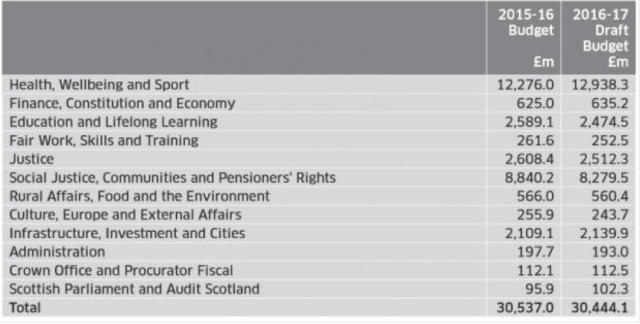
SGbedget2016

By the Numbers: Scottish Government Budget 2016/17

And so that was the pitch we got: no rise in income tax “because it would hit the poor harder“; same for council tax; the only rises to hit big business and second home owners. But, from the £400m increase overall, £500m more to NHS, £55m to police and parity to further education, to transport. Every part of the statement was positive, as if he had conjoured money and  stretched it further than you would think possible.

He made even some losers sound good—a £350m cut to councils being sweetened by £250m in NHS money to go towards better local social care that would ease pressure on NHS places. All in all, the whole was well received by his supporters for its coherent anti-Tory/Westminster theme. As John put it:

Scotland can accept these Tory cuts or we can rise to the challenge and choose a Scottish alternative to austerity. We choose to rise to the challenge. We choose the Scottish alternative.

The opposition did not share such enthusiasm. Jackie Baillie served up her ritual moanfest:

(This budget) doesn’t deliver fairer taxes, a long term plan for Scotland or an anti-austerity alternative. Local services like our schools, roads and care of the elderly will face massive cuts.

We’re in boy-crying-wolf territory here. Jackie never has a good word to say, even as she fails to offer credible alternatives. But now that she may actually have a point, it will be dismissed as her usual dog-in-a-manger act. Murdo Fraser made a better fist of it, pointing out that John had the option of reversing the cuts about which he complained through the new tax powers, but had refused.

Murdo’s point is hard to deny because John changed almost nothing in terms of income while robbing parts of his allocation to appear generous to others. Councils were hardest hit, losing £350m. Culture drops from £170.2m to £154.1m for 2016/17, with performing companies taking a huge hit of £27.6m (down to to £22.9m in 16/17) and spending on cultural collections dropping from £85.9m to £78.6m.

A 3.5% drop in Justice, a 4.4% drop in Education overall, a 6.3% drop in Social Justice (despite another boost to public pensions) are all serious reductions. None of these were mentioned in the speech, perhaps because these were more easily hidden from public view.

For eight years, this blog has praised John’s obvious competence. But, given the dire state of their opposition, was there any need for a softly-softly budget like this? Yet the ca’-canny cabal at the heart of the SNP has misjudged history and fallen into the same trap that felled Labour: that being in power trumps taking risks once you have it.

Had John displayed the cojones that he undoubtedly once had, he had a unique chance to take up cudgels on several (if not all of) these fronts:

  1. Used the income tax powers and ring-fenced it to defray any cuts in culture, justice or social programmes
  2. Released council tax freeze as local government has no room to maneuver and any change next year will be too late to retrieve fiscal balance before the 2017 local elections. Revision of CT has been urgent for years but nothing tangible has been done to fix it.
  3. Taken the economic quangos to task. The Scottish economy needs to boom for any ambitious spending programme to be plausible. But neither Scottish Enterprise nor Visit Scotland nor Skills Development Scotland have been effective, given what they cost.
  4. Sacrificed some shibboleths—free prescriptions, concession travel,  eye tests, personal care, etc are all very nice. But none are means tested and their soaring burden means they are abused
  5. Got tough with system abusers in general. Half of ambulance call-outs are alcohol related. Call-outs for ambulance, A&E, fire, police, coastguard, RNLI, mountain rescue, etc deemed spurious and/or culpable could carry automatic fines to cover costs (c.f. emergency cord on trains)
  6. Stop throwing money at things. Labour’s fault was that it always talked about how much more it was spending but never what had been achieved for that money. John started well with his ‘Parity of Esteem’ with councils and Strategic Outcome Agreements. The former has degenerated to a one-sided joke and the latter to box-ticking exercises that measure nothing.
  7. Face down the special interests. Scottish charities boast some high executive salaries; many quangos and council SMTs join them in a cosy oligarchy. The same names pop up repeatedly—fine IF they achieve something. But from Arts to Zoos people on six-figure salaries get scant more scrutiny than an annual report.
  8. Face down unions who claim to represent professionals but who fixate on money and resist quality of service evaluation. This is not just the usual suspects like EIS and BMA/GPC but also low profile ones like the Society of Local Authority Chief Executives (SOLACE) and the Association of Directors of Education in Scotland (ADES)

I know John’s Cabinet colleagues ordained circling the fiscal wagons to keep their jobs past May. But were any jobs under threat? This was a unique chance in dire fiscal circumstances for them to show real mettle and genuinely “rise to the challenge with a Scottish perspective“.

Had they done so, the gulf between their achievements and Labour would have been written into history. As it is, they fluffed it. And if they don’t move soon, the gloss will tarnish, risks proliferate and inertia will lock them into the same sad trajectory toward oblivion as Labour is now on.

Posted in Politics | Tagged | Leave a comment