A few thoughts on Labour’s Devolution Commission

(I have my own disappointments at what Johann Lamont announced as Labour’s offering to Scotland, should we choose ‘No’ in September and Labour wins the 2015. Indeed, the ‘Devo Plus’ option was one that I argued should be on the ballot because that interim stage was probably the most popular option among the apolitical majority of Scots. Given that, the attached blog from a professional dissects the paper’s shortcomings far more elegantly and clinically than I could.

Quoted verbatim from http://www.legalknowledgescotland.com/?p=1558):

I am surprised that Labour has backtracked on almost all of the tax proposals it made in its interim report.  I did not expect Lamont to be so thoroughly routed by her opponents in her own party on the need to extend the powers of the Scottish Parliament in any meaningful way.  The final report can be found here and my blog on the interim report can be found here.

The final report does not even go as far as the final recommendations made by the Calman Commission.  Calman recommend 6 new tax powers for the Scottish Parliament.  The Scotland Act 2012, often referred to as “Calman minus” only implements 3 of them.

This is from the final report: “We concluded that, for a variety of good reasons, VAT, national insurance contributions, corporation tax, alcohol, tobacco and fuel duties, climate change levy, insurance premium tax, vehicle excise duty, inheritance tax, capital gains tax and tax on oil receipts should remain reserved.” It is not clear from the final report if the Aggregates Levy will be devolved.  What is meant by the Crown Estate recommendation is anyone’s guess.

With regard to the only tax power left standing when the music stopped; income tax.  The interim report said: “In our view, a strong case exists for devolving income tax in full, and we are minded to do so“.  How Labour got from that point to the income tax proposal announced yesterday is again anybody’s guess.  I will come back to that point.

This announcement must also have exasperated those still arguing for “devo plus” and “devomax”.  These proposals are often misunderstood, often intentionally.  ”Devo Plus” would devolve almost all tax and welfare powers.  ”Devo max” goes even further. Remember there are over 25 taxes, charges and duties when comparing the Labour proposal to “devo plus” or “devo max”. The Labour proposal such as it is, when taken together with the recent announcements by the Liberal Democrats and the Conservatives may well prove to be the final straw for those arguing for the devolving of substantial powers for the Scottish Parliament. That I suspect can only be good news for the “YES” campaign.

Johann Lamont was unable to even answer basic questions on the income tax proposal when she was interviewed on Newsnight Scotland.  A link to this interview can be found here.  To be fair, I am not sure if anyone could easily explain the income tax proposal.  If I was the cynical type I might suggest that this looks like a policy that is intentionally created to make sure it never sees the light of day.  I was also interested to hear that she is opposed to tax competition if it involves Scotland.

This is from my chapter in the Hassan/Mitchell publication “After Independence” and titled: “The continuing battle for Scottish tax powers”.   Nothing it seems has changed.

“So how have the opponents of substantial tax powers for the Scottish Parliament been able to ensure that substantial tax powers are not devolved to the Scottish Parliament?  A template can be seen from Calman, what might be called the ”Calman doctrine”. Make a huge fuss about having someone look at the issue, take your time, offer as little as possible, exaggerate any problems, minimise or ignore any advantages and ensure HMRC and HM Treasury remain in control.”

Posted in Politics | Tagged | Leave a comment

On Yer Bike

With crocuses pretty much done and daffodils coming on like a billion smiles, Spring is here, which means Walk to School Week can’t be far away. Although these pages have seen little on this topic, it is one on which I could bore for Scotland. This is for three very good reasons:

  1. The education, health, security and welfare of its children is a major measure of any civilisation; most serious accidents involving children happen on busy roads.
  2. Various studies have shown that children who walk to school regularly and through whatever our Scottish weather may throw at them not only stay healthier but arrive at school alert, awake and ready to learn.
  3. The unsupervised “chumming” of one another to/from school is a key factor learning social skills, making friends and learning about/from each other.

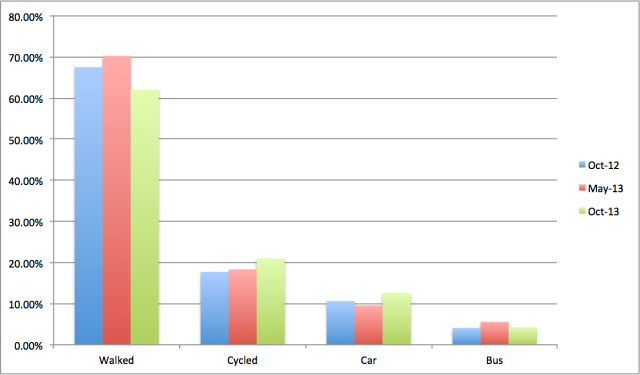
Parents don’t set out to endanger their own or any other kids but especially around the larger primaries, bringing kids by car is a beguiling option if you’re busy/late, driving that way in any case and—most perversely—concerned about their safety, especially in bad weather. Generally, East Lothian parents have a pretty good track record on Walk-to-School year round. But the statistics from recent Walk-to-School weeks have shown a negative trend:

WTSW Statistics for Major Primaries (Source: ELC)

WTSW Statistics for Major Primaries (Source: ELC)

The trend is clearly more cycling (which is good) and car (which is not) use at the expense of walking. And while one in ten pupils arriving by car doesn’t sound bad, consider a 600-pupil school like Law that shares a campus with a 900-pupil high school and a popular gym/swimming pool, the last of which gets used as an unofficial drop-off area. Those 60 vehicles for Law mostly arrive in a ten-minute window when teachers’ cars, buses and gym customers add up to give a vehicle every couple of seconds while 400 pedestrians and 120 bikes are pouring past them.

All this is bad enough if the bulk of cars arriving were Minis, Kias, etc but North Berwick favours the Chelsea Tractor to an extent that seems almost inconsiderate because few primary pupils are tall enough to be seen behind them and so can pop out unexpectedly. Although almost all parents at Law are careful and considerate, both the crossing guard and the community police officer have hair-raising tales of drop-offs at blind corners, from moving vehicles or even on the traffic circle inside the campus—off-limits at school time because of the bewildering density of foot traffic.

Of course, not everyone lives within a reasonable distance to walk. But even those from the country can take the advice of the Junior Road Safety Officer volunteers in Law (and many other primaries) who have laid out maps of alternate drop-off point nearby (e.g. Gilbert Avenue) that avoid bringing a vehicle into school traffic but involve no more than a 200m walk. There have also been walking buses in the past approaching along Lochbridge Road and Trainer’s Brae that parents have joined at points away from the school. If they are not now running, the upcoming Walk to School Week in May would be a good time to revive them; contact myself or the school.

That said, the bulk of drop-off car traffic at Law (as well as Dunbar, Windygoul, etc)  is from within the town from well intentioned parents who may not appreciate either the desirability of alternatives nor the extent to which danger levels rise for other pupils just as they try to protect their own. Once the Grange Road development gets underway, the school roll will rise significantly and the problem will only get worse—unless a concerted effort is made to encourage and choose the healthier alternatives.

Posted in Community, Education, Environment, Transport | Tagged | 1 Comment

One Hundred Years of Desuetude

With apologies to Señor Gabriel Garcia Marques for abusing his title, the next thousand words seek to examine the assertions coming from Philip Hammond, his MoD minions and his boss David Cameron that Scotland would be far safer and able to defend itself in this wild and woolly 21st century by remaining a partner in the UK.

We shall leave for another time whether the current UK pose as a global power wielding a nuclear-tipped seat on the UN Security Council is either sensible or affordable and focus on the last century’s track record of defence ability in general and military posture in particular that led to the present overstretch and inability to project anything anywhere without US or NATO support (which comes to the same thing). UK contributions in Afghanistan were marginal; those in Libya were weak; Syria non-existent and Crimea not even credible.

One hundred years ago when Victoria died, Britain did indeed rule the waves—and underscored that fact by launching the revolutionary HMS Dreadnought in 1904. Problem was that it made not only competing fleets obsolete but the Royal Navy’s as well and locked it and the bulk of its funds into building the 28 comparable battleships with which it entered WW1. The result was a neglect of other forms of naval war, such as submarines and countermeasures to them. This led to the loss off Holland of all 3 (obsolete) ships of the 7th Cruiser Squadron—and 1,457 officers and men—to a single U-boat on September 22nd 1914 and brutal merchant losses for years before the Admiralty was forced to adopt a convoy system.

Tragic as that was, the flaws in British capital ship design came home to haunt them. Not only were German ships better designed but they were tougher with superior armament and—decisively—both ranging optics and skill in using them. After indecisive skirmishes in the North Sea, the ‘showdown’ at Jutland became no such thing. Three British battlecruisers simply blew up—not just because they had been designed for speed at the expense of adequate armour but because flash protection to stop fire in a turret reaching the magazine below had not been fitted. The Germans suffered no such weaknesses.

The carnage of four years in the trenches were not a result of MoD shortcomings but the sideshow bloodbath that was Gallipoli was. This amphibious assault with no amphibious assault equipment provided was an Opera Bouffe for which ANZAC, rather than British, troops suffered casualty rates as high as 25%. Nothing of substance was achieved. Luckily, an even dafter plan to land British troops on the Pomeranian coast and march on Berlin came to nothing.

That the “War to End All Wars” should result in huge defence cuts post-1919 is understandable but seldom were those funds provided put to good use. HMS Rodney & Nelson were built to a daft design that were structurally unsound and often inoperative. The folding of the Naval Air Service into the RAF meant that Britain entered WW2 with risible naval air strength built around the obsolete Swordfish biplane and a maritime reconnaissance arm on short-ranged Ansons. And, while Hobart was writing prophetically of the key future role of the tank only to be ignored, Guderian was busy forming the first ten panzer divisions.

At the outbreak of WW2 at least the RAF were being provided with modern Spitfires and Hurricanes but its ‘striking’ power were underarmed Battles and Blenheims in the tactical role and lumbering Hampdens and Whitleys in the strategic, all of which were swept from the skies in the debacle that led to Dunkirk. Magnificent as that operation was, it stands as a monument to British muddling through to atone for Whitehall inertia and incompetence.Even Fighter Command’s magnificent achievements in the Battle of Britain came close to jeopardy by a dearth of pilots because it was being treated as an exclusive club for Oxbridge buddies.

The whole sorry story of weak/slow/clumsy British tanks commanded by impulsive ex-cavalry officers throughout the war is a book in itself and responsible for half of Rommel’s reputation. Blindness to the lessons of Jutland led to HMS Hood blowing up in action (3 of her 1,325 crew survived) and to the convoy lessons of WW1 led to countless mercantile losses and two aircraft carriers sent out to chase submarines (?!). It took most of the war to catch up building the escorts needed to secure the Atlantic trade routes.

And none of this is to mention the charades being played about British might in the Far East. That Hong Kong might fall was obvious but racist deprecation of the Japanese led to Singapore being a shibboleth of Empire might. After Pearl Harbor, it fell within weeks to an inferior force and the loss of two battleships, an aircraft carrier, six cruisers and an entire army—the largest single defeat the British have ever suffered. It wasn’t just because they had omitted building and defences on the inland side of Singapore—but that didn’t help.

In all of this, there is no insult intended to the brave men who served noble causes, nor to the campaigns conducted with a verve and aplomb that compensated for shortcomings in leadership and authority: the Abyssinian campaign of 1941; commando raids on Fortress Europe; innovation in special forces like the LRDG or the Chindits are only some deserving mention. But look at design sensations and you find it wasn’t the MoD who launched the amazing plywood Mosquito (it was deHavilland) or the fast MTB for light forces and air-sea rescue (it was Vosper). Perhaps the General staff’s most successful and useful project was the 25-pounder artillery piece which provided the ‘punch’ in ground warfare in all theatres throughout WW2 and beyond.

Thankfully, the last half-century has seen less warfare and so less need to ‘muddle through’ to make up for shortcomings in the MoD and General Staff planning and leadership. There was the massive (if casualty-light) humiliation of the Suez debacle. There were the millions wasted on the Blue Streak/Blue Steel missiles. There was the aluminium superstructure of the Type 42 destroyers that burned in combat and lost HMS Sheffield in the Falklands; the lack of decent tactical AA in the Falklands; the absence of enough heavy-lift coppers that left 2 Para taking Goose Green with cold steel and most of 5 Brigade yomping across East Falkland under a ton of kit each.

The last 20 years has seen the MoD directing UK forces in the Middle East with a variety of shortcomings, whether it was Tornados’ vulnerability to any old iron thrown up in its path as it follows the nap-of-the-earth low-flying training standard or vulnerability of standard-issue Landies to roadside bombs. For over a decade now, UK forces have suffered almost all of their casualties from irregulars in unconventional warfare in which Challenger tanks, Warrior APCs, artillery and air bases are targets rather than assets. The advantage of being part of a large country that can better afford such things escapes most objective observers. The Irish Defence Force in Mali or the Norwegian Army in Palestine both do bang-up jobs of peacekeeping with nothing heavier than jeeps and machine guns.

And what good our Trident nuclear subs are doing slithering around the Atlantic two decades after a Soviet threat evaporated and as expensive, irrelevant junk in the present Crimea crisis passes all logical understanding. But then, where the MoD and Whitehall have been concerned they have ‘form’: ’twas ever thus.

Posted in Politics | Tagged | Leave a comment

This Septic Isle

Last week’s Scottish Tory Conference virtually frothed with discussion about what they were going to do for Scotland—once their deluded countrypersons had seen the light and consigned Independence to the bin for toxic waste, come September. Ruth made a competent speech, outshining Cameron who was nonetheless in sincere mode and completely leaving a very plodding Hammond in the dust. Those people watching not already hardened Tory might have been impressed, even swayed.

My favourite was an interview from retiring MEP Struan Stevenson (not a phrase I have used often in his case) advocating complete tax devolution and leaving nothing but defence and foreign affairs to Westminster. Given that his colleagues are busy trashing the prospect of using the £UK in both countries, I don’t see how this radical “devo-max” avoids all the pitfalls Osbo et al are listing against sharing currency but perhaps he’ll blog and enlighten us. I’d certainly consider reblogging it because if he’s cracked the problems for such a radical move, then he’s also undermined the unionist arguments too.

If there’s something that underscores the bankruptcy of Tory political philosophy, it’s the selectivity with which they approach the very concept of  ‘union’. While I’m sure they would dispute this, their various simultaneous positions can only be seen as coherent if seen through the prism of the Home Counties in general (the very phrase speaks volumes) and London in particular.

Let’s start with their name. “The Conservative and Unionist Party” does not refer to union with Scotland but with Ireland. This goes some way to explain their dalliance with Ulster Unionists for much of the 20th century and their dogged insistence on retaining Ulster in the UK, despite civil mayhem for decades. And, perhaps, their ongoing support for an open border with Eire, despite Tory Pavlovian paranoia on immigration and security.

But it does not explain their silence on Eire—from 1801 an integral part of the union sending MPs to Westminster, since 1922 fully independent and for all that time behaving as a much more constructive partner than their recalcitrant neighbours to the North. And after the burst of prosperity there in the 1980’s into the noughties—when Dublin built a tram system 3 times the size but half the price of Edinburgh’s—they have been suffering heart-stopping austerity to recover from a speculative property bubble. Yet they have not come, cap-in-hand, begging to be let back into this (according to Tories) robust, stable fly-wheel that is the UK. What is weirder yet: Tories have made not a peep to persuade them and so recover the lost chunk of empire so dear to them 100 years ago that they named their part in its honour.

But there is more to the British Isles than UK and Eire. Both Man and the Channel Islands enjoy a relationship eerily close to that which Scotland aspires: their borders are open; they raise their own taxes; they use the £UK freely; they are not IN the UK and send no MPs. Yet our Tories are not only supportive of this state of affairs but positively encourage it as friends who are ‘something in the city’ make millions banking ‘offshore’ in Jersey. How can such tax havens be exempt from unionist cant while Scotland is not?

We’ll leave for another (longer?) blog in which we discuss the tortured policy stances that rend the Tories over Europe, except to say that their whole argument that Scotland would prosper better folded in Nurse UK’s ample skirt pleats is reversed totally when it comes to being at the core of the 500m-and-counting market that is the EU. Illogical, captain.

Even in the simple issue of devolution Tories have been all over the place. From centuries of opposing all devolution, Heath sprung the possibility for Scotland (as an antidote to Tory decline and the coming of oil) at a conference in Perth in 1970. That led to the Kilbrandon Report and (indirectly) to the 1979 ‘40% threshold’ referendum swiz. By that time, Douglas Home and Thatcher were promising a vague ‘something better’ if Scots would only vote ‘no’. They voted ‘no’ and were rewarded with Thatcherism and the febrile 1980’s.

It might be simpler (and certainly more honest and true to their roots) if the Tories simply decried all attempt to take any power away from Westminster; their protestations at being the party of small government seem borne out by Tories having been responsible for most reductions in the Civil Service—from 3/4m in 1977 to 1/2m now. But while the odd Sir Humphrey has got his jotters, decisions continue to be centralised as control freaks like May and Gove wade into their brief with autocratic gusto. And whether on trunk roads, houses or HS2, local opinion and/or government is swept aside whenever ‘the national interest’ is cited.

This bodes ill for the English provinces. At least the other three nations have some forum in which to mount counterattacks on over-centralisation. But pity the NorthEast or Cornwall—both provinces that the Tories largely regard as inhabited by recalcitrant ne’er-do-wells who never vote Tory and are therefore lost causes. The Geordies got a sniff of an assembly back in 2004 when Two-Jags was peddling his wheeze. An Ipsos poll at the time found that three out of four people surveyed in the North East of England believed they got a worse deal from the Government than those living in London.

But Tories were dead against. And when you saw the sickly creature to be spawned—all councillors, business and the voluntary sector but none directly elected—you have some sympathy with their view. And as the first one went down in the flames of a three-to-one vote against, Labour and Lib-Dem supporters ran for cover and the idea has not been heard from since.

Which is a shame for places like Kernow (a.k.a. Cornwall), where the rudiments of an Assembly, if not a full-blooded independence movement are coming together. The complete and long-term isolation of the county from the storm-wrecked rail line at Dawlish has recently highlighted their tenuous links with the rest of England—not to mention their historical privileges.

Since the Charter of Pardon in 1508, Cornwall has enjoyed rights to its own parliament and veto over acts, statutes and laws passed by the Westminster government. These powers were granted in perpetuity and cannot lawfully be rescinded. They were confirmed as valid in British law in 1977 by the then Lord Chancellor, Lord Elwyn-Jones. Mebyon Kernow was formed in 1951 and describes itself as a Centre-Left party. It now regularly fields candidates in elections to Westminster and currently has four elected councillors onto Cornwall Council.

The Tories take a jaundiced and dismissive a view of all this, much as they did towards eqwuivalent Scottish aspirations—until they had their heads handed to them by the Scottish electorate. It seems the Tories have limited scope for loyalty. Their culture is so embedded in things English that they cannot entertain any other hub in their universe; theirs was the mission in the decades of empire-building to “make the world England”; they were behind the early 19th century fashion for Scots to become “North British” that spawned a hotel and railway company of that name. Curiously, there was never any move to name anything “South British” and in this can again be seen a certain consistency of attitude.

Perhaps the reason there  has never been an English National Party is that the job has been filled for a long time by a quite indefatigably single-minded Tory Party who have long proved inexorable.

Posted in Politics | Tagged | Leave a comment

Redefining Security and Intelligence in an independent Scotland

The debate on defence has gone all quiet, perhaps because anyone comparing the costs to Scots of expensive ego-toys (like nukes, global bases, aircraft carriers, etc,) to the threadbare defence we actually get sees the fiscal ineptitude behind the MoD’s present posture.
But the unionist case about security and counter-terrorism is made just as seldom—and is equally in need of debunking, as here.

Admin's avatarA Thousand Flowers

A Guest Post by Cosmopolitan Scum
sadfacesub

Military and intelligence stories have been all over the news recently. Be it indiscriminate eavesdropping programs, WMD infrastructure, or our impending doom at the hands of terrorists if we vote “yes”, there is a common denominator in the statements of the high heid yins: these are issue for the big boys, the role set out for the rest of us is to cower in fear and not to hurt our wee brains trying to understand. In the independence debate, we are warned that an independent Scotland is going to be overrun by terrorists, disastrously cyber-attacked, or run out of money trying to prevent these disasters from happening. The catalyst of the recent wave of scare stories is a report by a bunch of military and intelligence insiders,  the crowd treated in the mainstream media as holding an exclusive grasp of the serious issue…

View original post 5,149 more words

Posted in Uncategorized | Leave a comment

Is This an Economic Argument or the Full Half-Hour?

Now that the indy debate has devolved from professionals to real people it has become muddier. All sorts of voices are chiming in with their two cents’ worth—as it should be. But over the last month as the babble has intensified, Clarity has been the first casualty. Folk—rightly—have a broad range of opinion; falling into the lock-step of a single voice is not human nature.

Unfortunately, truth has not been far behind in getting wheeled into A&E. While the vast bulk of these new voices are undoubtedly sincere, there are more than a few on the payroll vote stirring it and some amazingly gallus slants put on various news items by a media that will be pilloried at sopme point in the future for falling down on their prime duty: objectivity.

But, as hardened observers of the Fifth Estate will long have practiced, a strong filter of their own research, familiarity with the pundit in question and a healthy dash of skepticism does much to focus the truth, much as a projector lens throws a clear image on a screen—if properly set up.

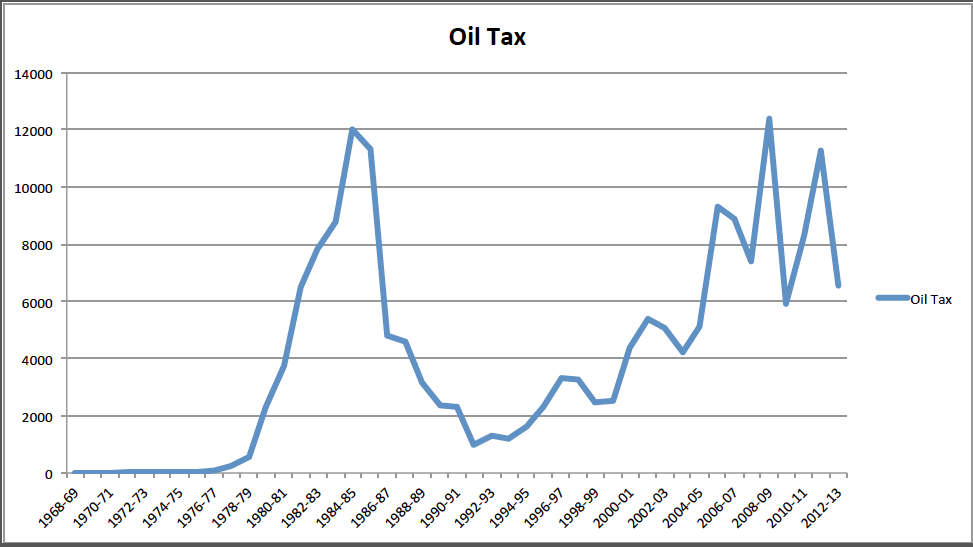
This week, the turd in question arriving at the fan blades were the GERS figures for last year. Although they didn’t make front page in the Cornish Guardian, from the Rhinns Reader to the Yell Yeller, it became the talk of the steamie that oil tax revenues for HM Treasury fell from £10bn to £5.6bn from the previous year and that ~Scotland’s fiscal public deficit shifted thereby from being better than the UK average of 7.3% to a rather worse 8.3%.

Let’s leave to one side whether any treasury mandarin cooked these books. Tax revenue does fluctuate and such numbers are plausible and would have to be dealt with by an independent Scottish Treasury. But is it, as Labour Finance Spokesman Iain Gray almost had a heart attack running between channels to tell us, proof that Scotland should stay in the UK? Are oil revenues in ten, as opposed to eleven digits, bad news?

Iain, for one, needs to have a word with himself. Serious financial trends are never predicted from one set of figures—certainly not without reading the small print. Some £2bn of the drop this year were due to a larger figure being invested in the North and Celtic Seas and the justifiable tax incentives for our future kicking in. Then there is the fact that last year was a rather good year and bucked the general trend of gentle decline in the figures. In fact, looking back a decade or two, it’s easy to see why even sober, neutral commentators caution against over-dependency on such a volatile revenue source.
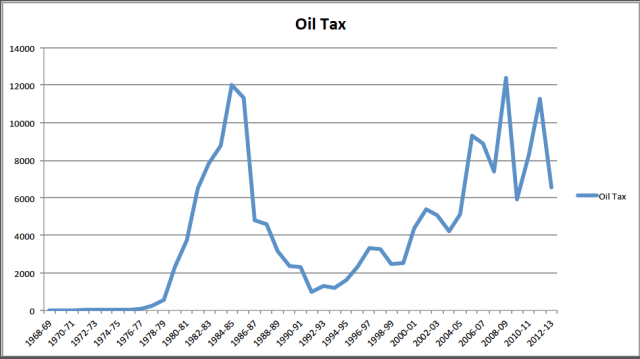
Total Treasury Revenues from Oil & Gas by Year in £m. (Source: HM Treasury)

Total Treasury Revenues from Oil & Gas by Year in £m. (Source: HM Treasury)

So, not only are fluctuations pretty much the norm but the UK Treasury has suffered considerably lower annual incomes 1990-95 without their fiscal world coming to an end. Ah, retort the unionist apologist rentaquotes like Iain; that’s because the UK economy is so much bigger and provides exactly the ‘flywheel’ effect we need. He rather ignores that Norway, rather than squandering £165bn so far as the UK has done, built up a quarter trillion ‘oil fund’ to act as their flywheel—and to gain a quarter of their income from interest from it as a side effect. Some ‘side effect’.

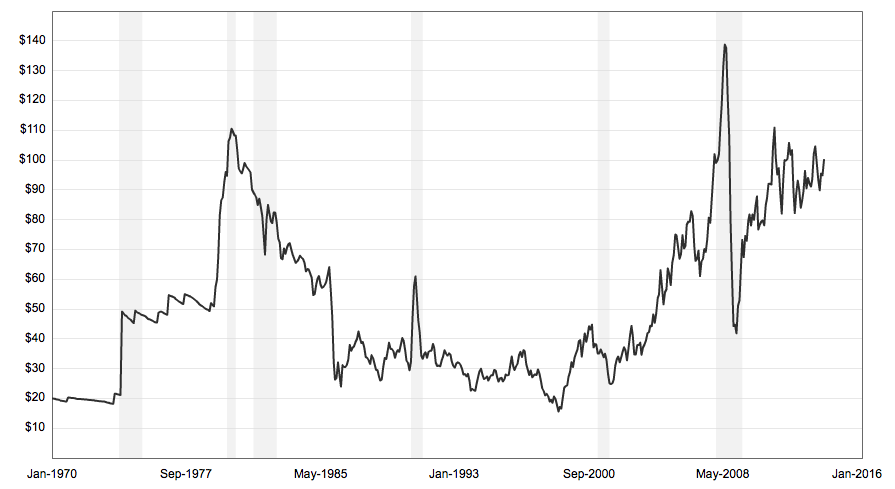
The other point that Iain gamely makes is that it now costs twice as much to extract each barrel than it once did. Quite true and—as we drill deeper and further out—likely to get worse. What Iain’s highly selective grasp of figures fails to mention is that firms are falling over themselves to spend that extra money because the higher price of oil makes it very much worth their while—indeed many overheads become proportionately less of a burden.
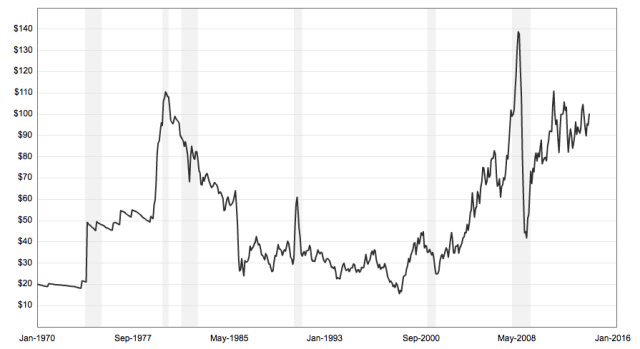
Historic Global Crude Oil Prices by Year in $US/barrel (Source: Macrotrends)

Historic Global Crude Oil Prices by Year in $US/barrel (Source: Macrotrends)

This shows price history back to the two dramatic leaps in the 1970’s. The average price over these 45 years has been $40. The current price of $100 (with an obvious steady upward trend if the 2008 ‘blip’ is removed) means that, despite a doubling in cost, there is now a 50% extra profit margin available to companies, as compared to historic average—and that seems likely to increase. Fold into the equation the fact that half the oil remains to be extracted (at these or higher prices) and it may be time for Iain to upgrade his crystal ball and/or trade in his slide rule if he is to be current.

It’s probably unfair to pick on the unfortunate Mr Gray who is strapped into the job of mouthpiece for a party that embodies the scene from Life of Brian in which a streetful of people all chant “Yes, we must all learn to think for ourselves“. Much more relevant are comments from business leaders who have less of a posturing and more of a pragmatic role they are following—as often as not with the interests of their business to the fore.

This week at their annual conference Stephen Leckie, chair of the Scottish Tourism Alliance, said there was huge uncertainty for what independence would mean for his £11bn industry that employs over 200,000 people. In particular:

“The discussions and debates and arguments that are going on at the moment are, I think, not representing Scotland and the parliament well. All it is is everyone just arguing with each other.”

He has a fair point. The problem with providing figures he (and many others) say are missing from the White Paper is  no party has ever provided detailed financials prior to any election. With the UK digging heels in over whether the £UK could be shared, so many imponderables are created that even making a stab at Scotland’s would be a fool’s errand.

On the other hand, world-leading maker of portable power supplies Aggreko’s CEO Rupert Soames waded into the debate claiming that his business was being damaged by uncertainty from debate over independence. Sounds plausible—until you realise that this is Winston (Empire-is-my-Life) Churchill’s grandson and brother of Tory Minister Nicholas Soames. Having lobbed his grenade, he promptly resigned to run Serco “The Company that Runs Britain” since accused of so fraudulently over-charging on contracts to tag criminals such that the UK government has banned them getting any new work. Meanwhile, Aggreko share price dropped by 9%. Nice.

Probably most significant are the rumblings from Scotland’s £17bn/150,000-worker finance sector that they may have to consider their staff and HQ deployments in the even of independence. Scottish Widows, RBS, Standard Life and BoS wing have all been quoted in this context. These seem to be both genuine and sensible for such firms. Nobody—least of all the Scots—want to see any of them go. But, before unionists expect us all to head screaming for the hills at the prospect, we should bear in mind what is meant by ‘go’.

Both Standard Life and BoS are already part of the Lloyd’s group, which has the bulk of its staff and business outside of Scotland. Important though their operations are here, it is hard to see either being disrupted by major moves of staff south—especially when office space in Canary Wharf (at £55/sq.ft.) is more than three times that of the Gyle (£16/sq.ft.). Standard Life, being listed on the London stock exchange, is less of a Scottish company than it used to be. As for the Royal Bank of Scotland, it is these days largely a Scottish company in name only.

Standard Life has previous form in these matters. As long ago as 1992 it warned that devolution – never mind independence – might cause it to relocate south of the border. Well, devolution happened and Standard Life is still here. As for RBS, Mark Carney told the Treasury select committee that an independent Scotland would have to guarantee deposits held in England by Scottish-domiciled banks under EU law and so could lead to RBS HQ moving to England. But three facts modulate the impact of any such move:

  1. Just where the company displays its brass plate involves a hundred or so staff at most; BoS HQ remains a spectacular but nonetheless small building on the Mound
  2. The bulk of operations and therefore staff and therefore economic advantage would remain wherever they are now.
  3. Removing the HQ of such global giants removes the main argument against currency union as the bank of last resort connection would move with the HQ, unburdening the new Scottish Treasury.

Nobody sensible objects to all companies making contingency plans—which explains 90% of the fluff spun by the press over the last month. What has received rather less coverage and speculation is the possible good news story from independence if:

  • Oil tax revenues average over £8bn—as they have for the last decade?
  • Scotland puts its £2bn annual saving from defence (alone) into its own oil fund?
  • Oil continues to rise at ~$5 each year, boosting tax revenue to £12bn by 2025?
  • Whisky exports continue to grow past the £4bn p.a. already achieved?
  • Renewables employment exceeds last year’s 5% growth (to 11,365 people)?
  • Tourist expenditures grows better than the 15% achieved in recent years?

Funny, but unionists and their media never seem to think of bringing up such possibilities.

Posted in Commerce, Politics | Tagged | Leave a comment

Better Together? Aye, Right

Now that the independence debate has broken out of the ghetto of late-night-current-affairs  programmes and heated up and with the UK Cabinet and Shadow Cabinet weighing in—along with CEO’s of major Scottish companies—it’s a good time to look at the case being presented why Scotland would benefit from the rather unusual position of being run by another country, rather than joining the 200+ countries of the world who define their own destiny.

There is a whole page on the Better Together website labelled “The Positive Case”. We will assume it is not just a front for HM Treasury, keen to suck another £165,000,000,000 out of us to avoid more taxes. The “Case” is repeated here in full below (whether it is indeed positive we leave the reader to judge)—but adding a commentary of balancing statements. Better Together is hereby enjoined to disprove these disprovals.

“We love Scotland. We are ambitious for Scotland’s people and Scotland’s possibilities. Our case is not that Scotland could not survive as a separate country – it is that there’s a better choice for our future.

“A strong Scottish Parliament within the United Kingdom gives us the best of both worlds: real decision making power here in Scotland, as well as a key role in a strong and secure UK. Now and in the future Scotland is stronger as part of the United Kingdom and the United Kingdom is stronger with Scotland as a partner.”

Billy Connolly called Holyrood “A pretendy parliament”. That is being a little harsh as it does control half of public disbursement in Scotland—but NONE of the revenue income. This is a weak setup if you want either efficiency or responsible accountability.

“In the UK the BBC and the Bank of England were founded by Scotsmen. The NHS was founded by a Welshman. The State Pension system was founded by an Englishman. Partners in these islands. Working together, better together.

“We are proud that we fought together to defeat fascism, and worked together to build a welfare state. But the case we make is about what’s best for Scotland’s future.

The same Scotsman who founded the Bank of England also led us into the Darien Disaster but no-one disputes the glorious history we have shared over hundreds of years. Canada, Australia and New Zealand fought fascism just as hard as we did but were independent. Where we do agree is that this is all “about what’s best for Scotland’s future“.

Prosperity

“Times are really tough at home and really turbulent internationally. In the future Scotland’s prosperity will be strengthened by keeping the British connection. We need more growth, more jobs, and more prosperity in Scotland. We don’t need uncertainty, instability, and barriers for our businesses.

Someone should tell that to UKIP and the Eurosceptic wing of the Tories, whose “Little-Englander” myopia that alienates European friends could be got shot of with independence.

“In these tough and turbulent times, the size, strength and stability of the UK economy is a huge advantage for Scotland’s businesses. Scotland’s largest market is the rest of the UK. The UK is the world’s oldest and most successful single market and the UK has the oldest and most successful currency – the pound.

“Scottish businesses are increasingly having to win orders against smart, efficient and productive firms in foreign markets. These competitive challenges will only get tougher in the years ahead. The UK is better placed than a separate Scotland or England to help our businesses find and win new orders across the world.

That business is tough is a surprise to no-one. £24.3bn in Scotland’s exports go to rUK while £32.4bn are imported. Of the £23.1bn exported outside UK, only £10.5bn go to Europe so far. Scotland balance of £47.4bn exports vs imports of £53.7bn give a trade balance of -£6.3bn. Growing exports and lowering trade imbalance is a desirable goal.

The equivalent figure for the UK is -£119bn (-£77bn with EU & -£42bn with RoW). Scotland’s per head imbalance is 2/3rds of England’s (£1,200 vs £1,889) and therefore more sustainable. Having direct influence on EU trade talks would offer a market of 500m people with 10 times the opportunity from staying in the UK. If being with ‘big Britain’ makes sense then being with bigger EU with our own voice makes ten times more sense.

Security

“In an uncertain world Scotland’s security will be strengthened as part of the United Kingdom. The British Armed Forces that protect us are the best in the world. In Scotland we are proud of the Forces and proud of the vital contribution that Scotland makes to them. As part of the UK we have real clout in the UN Security Council, NATO, the EU, and we have Embassies around the world.

Such ‘clout’ is delusional and displays a strange understanding of ‘protection’. The UK’s residual colonial tendencies have interfered in too many other countries from Senegal to Iraq to Afghanistan. Claiming a too-horrendous-to-be-used nuclear arsenal as a force for peace flies in the face of peaceful intent. The only part of Ireland to have been a blood bath since 1922 is the part the UK hung on to. In fact, Irish, Danish and Norwegian soldiers have won praise and friends around the globe by being peacekeepers—a force for good on request. None of those countries have suffered terrorist attacks.

More to the point, Scottish armed forces would resurrect Scottish regiments, giving them more appropriate support forces under a £2bn defence budget than the present depleted off-balance travesty (nearest ocean-going ship in Portsmouth), for which the MoD charges us twice as much: £4bn.

Interdependence

“As Scots we believe there’s nowhere better, but we understand there’s something bigger. By contributing to and benefiting from the multi-national, multi-ethnic and multi-cultural United Kingdom of the years ahead, Scotland’s society and culture will be enriched.

If the UK government were not slapping on immigration restraints to placate UKIP and their own small-minded backwoodsmen, Scotland might receive more of the infusion of new people it needs from England, Poland, etc that has boosted its economy. We are not full up; England sees the Channel as a moat. Scots are already a model of multiculturalism but London is ignoring our experience and fixating on pulling up drawbridges.

“Hundreds of thousands of Scots and English have made their homes in each other’s nation. Half of us have English neighbours.  Hundreds of thousands of Scots were born in England. This interdependence – the coming together of family, friends, ideas, institutions and identities – is a strength not a weakness, and is an ideal worth celebrating. The truth is we’re better together.”

We lose none of that with independence. We already share an open border with independent Eire—and have done for 92 years. There are 2 million Brits living happily all over Europe but outside of Britain. And if Better Together truly “are ambitious for Scotland’s people and Scotland’s possibilities” they might consider rewriting the whole piece looking to a future towards which we are all headed and not mired in nostalgia for our shared past.

We all prosper from friendly relations with neighbours; it is desperate stuff to scaremonger about barriers at Berwick when there are none at Dundalk or, for that matter, none at Baarle-Hertog.

Belgian/Dutch border at Baarle-Hertog bisects a café.

Belgian/Dutch border at Baarle-Hertog bisects a café.

“Our case is that Scotland is stronger now and will be stronger in the future – economically, politically, and socially – as a partner in the United Kingdom.”

Scots do want to be England’s partner and close friend. But, for that to work in the way Better Together claims, London needs to get out of the habit of light-fingering our resources and running Scotland as if it were just another one of its provinces.

Posted in Politics | Tagged | Leave a comment

Kissinger on Ukraine

Published in the Washington Post on March 5th 2014, the attached article was written by Henry A. Kissinger under the title How the Ukraine crisis ends. He was US Secretary of State from 1973 to 1977 and, as such, received heavy criticism as ‘Doktor Death’ by dissidents opposed to US involvement in the Vietnam War, despite bitter lessons the French learned, culminating in Dien Bien Phu. That included myself. But his grasp of geopolitics’ subtler needs here is more astute than the gesture politics in which the UK and EU are indulging on this matter.

WPopinionsPublic discussion on Ukraine is all about confrontation. But do we know where we are going? In my life, I have seen four wars begun with great enthusiasm and public support, all of which we did not know how to end and from three of which we withdrew unilaterally. The test of policy is how it ends, not how it begins.

Far too often the Ukrainian issue is posed as a showdown: whether Ukraine joins the East or the West. But if Ukraine is to survive and thrive, it must not be either side’s outpost against the other — it should function as a bridge between them.

Russia must accept that to try to force Ukraine into a satellite status, and thereby move Russia’s borders again, would doom Moscow to repeat its history of self-fulfilling cycles of reciprocal pressures with Europe and the United States.

The West must understand that, to Russia, Ukraine can never be just a foreign country. Russian history began in what was called Kievan-Rus. The Russian religion spread from there. Ukraine has been part of Russia for centuries, and their histories were intertwined before then. Some of the most important battles for Russian freedom, starting with the Battle of Poltava in 1709 , were fought on Ukrainian soil. The Black Sea Fleet — Russia’s means of projecting power in the Mediterranean — is based by long-term lease in Sevastopol, in Crimea. Even such famed dissidents as Aleksandr Solzhenitsyn and Joseph Brodsky insisted that Ukraine was an integral part of Russian history and, indeed, of Russia.

The European Union must recognize that its bureaucratic dilatoriness and subordination of the strategic element to domestic politics in negotiating Ukraine’s relationship to Europe contributed to turning a negotiation into a crisis. Foreign policy is the art of establishing priorities.

The Ukrainians are the decisive element. They live in a country with a complex history and a polyglot composition. The Western part was incorporated into the Soviet Union in 1939, when Stalin and Hitler divided up the spoils. Crimea, 60 percent of whose population is Russian, became part of Ukraine only in 1954 , when Nikita Khrushchev, a Ukrainian by birth, awarded it as part of the 300th-year celebration of a Russian agreement with the Cossacks. The west is largely Catholic; the east largely Russian Orthodox. The west speaks Ukrainian; the east speaks mostly Russian. Any attempt by one wing of Ukraine to dominate the other — as has been the pattern — would lead eventually to civil war or breakup. To treat Ukraine as part of an East-West confrontation would scuttle for decades any prospect to bring Russia and the West — especially Russia and Europe — into a cooperative international system.

Ukraine has been independent for only 23 years; it had previously been under some kind of foreign rule since the 14th century. Not surprisingly, its leaders have not learned the art of compromise, even less of historical perspective. The politics of post-independence Ukraine clearly demonstrate that the root of the problem lies in efforts by Ukrainian politicians to impose their will on recalcitrant parts of the country, first by one faction, then by the other. That is the essence of the conflict between Viktor Yanu­kovych and his principal political rival, Yulia Tymo­shenko. They represent the two wings of Ukraine and have not been willing to share power. A wise U.S. policy toward Ukraine would seek a way for the two parts of the country to cooperate with each other. We should seek reconciliation, not the domination of a faction.

Russia and the West, and least of all the various factions in Ukraine, have not acted on this principle. Each has made the situation worse. Russia would not be able to impose a military solution without isolating itself at a time when many of its borders are already precarious. For the West, the demonization of Vladimir Putin is not a policy; it is an alibi for the absence of one.

Putin should come to realize that, whatever his grievances, a policy of military impositions would produce another Cold War. For its part, the United States needs to avoid treating Russia as an aberrant to be patiently taught rules of conduct established by Washington. Putin is a serious strategist — on the premises of Russian history. Understanding U.S. values and psychology are not his strong suits. Nor has understanding Russian history and psychology been a strong point of U.S. policymakers.

Leaders of all sides should return to examining outcomes, not compete in posturing. Here is my notion of an outcome compatible with the values and security interests of all sides:

  1. Ukraine should have the right to choose freely its economic and political associations, including with Europe.
  2. Ukraine should not join NATO, a position I took seven years ago, when it last came up.
  3. Ukraine should be free to create any government compatible with the expressed will of its people. Wise Ukrainian leaders would then opt for a policy of reconciliation between the various parts of their country. Internationally, they should pursue a posture comparable to that of Finland. That nation leaves no doubt about its fierce independence and cooperates with the West in most fields but carefully avoids institutional hostility toward Russia.
  4. It is incompatible with the rules of the existing world order for Russia to annex Crimea. But it should be possible to put Crimea’s relationship to Ukraine on a less fraught basis. To that end, Russia would recognize Ukraine’s sovereignty over Crimea. Ukraine should reinforce Crimea’s autonomy in elections held in the presence of international observers. The process would include removing any ambiguities about the status of the Black Sea Fleet at Sevastopol.

These are principles, not prescriptions. People familiar with the region will know that not all of them will be palatable to all parties. The test is not absolute satisfaction but balanced dissatisfaction. If some solution based on these or comparable elements is not achieved, the drift toward confrontation will accelerate. The time for that will come soon enough.

Posted in Politics | Tagged | 1 Comment

Mebbies Aye; Mebbies Naw

Knox Academy is the high school serving East Lothian’s county town of Haddington and named after its pulpit-thundering son John Knox, would-be nemesis of Mary Queen of Scots and her “monstrous regiment of women”. Well to the fore again today he might have swelled with pride rather than brimstone when three ELC councillors joined a fund-raising debate organised by Knox seniors to benefit the local Bridges Project.

Organised by Yve and others* (most from the Monstrous Regiment), with light-touch support from Head Teacher Ms Ingham, the lunch hour was spent in a debate that ‘professional’ politicians engaged in similar but less edifying activity in Westminster, Holyrood and sundry TV studios could well have learned from—not least in the use of factual support, articulation and lack of acrimony. The panel was set up in the library in from of 120 seniors between two teams to debate the question: “Should Scotland be an independent country?” chaired by Ludovic Broun-Lindsay, Provost of East Lothian. The ‘No’ team consisted of Amy, Lev and Cllr John McMillan who, like the Provost, represents Haddington. The ‘Yes’ team was Finn, Euan and should have included the third councillor for Haddington, Tom Trotter. As Tom was unavailable, your humble scribe was pulled in to make up the numbers.

Finn opened the batting for  Yes with a straightforward series of arguments how there was a general need for change and the only way for that to happen in Scotland was through a break with Westminster and run our own affairs. In fact, he asserted that the present UK government was dysfunctional and unable to meet Scots aspirations. A better society was attainable by using neighbours like Denmark and Iceland as examples. It was time, he argued, to bring power into our own hands.

Amy’s riposte for No was powerful, claiming independence would lead to weakness and isolation, threatening the Barnett handouts and the fact that HM Treasury supported Scotland to the tune of £8,300 per head, whereas only £7,100 was spent in England. We would be too reliant on a single volatile commodity—oil—and even short-term surplus would be spent and not saved. And taking the 2008 financial crisis as an example of tough times, she maintained an independent Scotland would not be able to weather such a storm, especially as the clear steer from the Chancellor was that we could not use the stability of the pound sterling.

Coming back for Yes, Euan challenged Barrosa’s claim that EU membership would be “difficult if not impossible” by citing other EU officials saying the opposite, including Spanish nationals. And, far from depleting, the oil reserves were being added to such that some £200bn remained to be exploited. Moreover, properly managed, oil could start to build a fund like Norway’s (now £300bn) and other industries such as textiles, whisky, salmon and renewable energy were major earners and growing. He also pointed out that the UK could not prevent Scots from using the pound as there were plenty of examples of sovereign states using someone else’s currency while being independent—including the Isle of Man and the Channel Islands.

Lev weighed in for ‘No’ by stating flatly that independence would obliterate Scotland’s voice in the world it has through the ‘weight’ of the Union. No more would we have a seat on the UN Security Council, have any control within the EU or NATO and—most serious of all—give up both the “iron protection” of 225 nuclear warheads and that of the special relationship with the United States. Independence would be a weak, disjointed strategy that would steer us onto the rocks.

The two councillors then made their own contributions, none of the speakers being allowed past the 3-minute limit set by the Provost, who then threw the debate open to the floor and a series of questions mostly directed at the ‘No’ team but both sides handled it well, especially given that nobody had ‘prepped’ them for what those questions were likely to be.

As my own views as part of the ‘Yes’ team are pretty clear, I would not wish to critique the other side too much, other than to say their arguments were just a catalogue of losses they believe we would suffer with independence. But, other than that, I thought both Amy and Lev marshaled their arguments and articulated them well and, if I am honest, made a better, slicker case than Finn and Euan managed. But when the Provost called for a show of hands in the vote, there were roughly 50 each for ‘Yes’ and ‘No’, with a dozen or so undecided— a classic Scots “mebbies aye; mebbies naw” result.

So, in declaring such a draw, he was being both fair and accurate. That rather delights me because, if these young voters are at all representative how this douce backyard of former Labour leader Iain Gray will vote, then the Better Together campaign is in deep trouble in what should be its heartland.

*Thanks for helping make this all possible go to: Emma Scott, Bethan McGregor, Nicole Alexander, Danielle Forsyth, Caitlin Brock, Gemma Sandie, Kirsty Steven, Holly Taylor, Connor Tinch, Lyndsey Herkes, Kieran Haldane and Calumn Wilson.

KnoxBadge

Posted in Community, Politics | Leave a comment

Carlekemp

Apologies

This blog and its embedded photographs were removed at the request of residents as details on the interior of the building might have compromised resident security.

December 2nd 2014

Posted in Community, Environment | Tagged | Leave a comment