Never Too Old to Learn

I stopped celebrating birthdays decades ago and have just passed an age milestone that America named both a Route and a sixties rock ‘n’ roll song after. Yet each day still brings something new and long may it remain so. Easily the most substantial chunk of learning  experienced recently happened last Friday.

Those who have followed me for any time will know that I have a mouth on me and that mouth has got me into trouble more than once. I like to think that I use both experience and judgement on a regular basis and, on the good old Scots Honi Soit Qui Mal Y Pense principle, don’t pillory folk without justification or proof they have ‘form’. Apologies have been forthcoming only three times in the busy four years this blog and a parallel Twitter account have been running. This constitutes the fourth.

Back in February of this year, I clashed on Twitter with Steve McCabe, Labour Leader of Inverclyde Council. The topic was prosperity and economic development in general. I had used Inverclyde as an example of decay, with major losses over decades having resulted in loss of population and economic difficulties. Although positioned vis-a-vis Glasgow in roughly the same relationship as my own East Lothian is to Edinburgh, I had posited political leadership as a major factor in their decline vs our prosperity, quite apart from the relative differences between us driven by the two cities’ differing fortunes.

Steve was having none of this. An escalating series of tweets resulted in Steve deflecting the growing acrimony by throwing down the gauntlet and challenging me to come see for myself. Having experienced Labour leadership under Norman Murray in my own ELC and Jim McCabe’s in South Lanarkshire via CoSLA, I had a picture that was a mix of inertia, Buggin’s Turn, reactive cabinet spokespeople and a surly hostility to anyone outside their group. I suspected a bluff, or possibly even a wheeze to waste an unbeliever’s time.

In my first attempt to visit, I tried to seal arrangements over Twitter because ELC had seen fit to cut off all remote access for councillors in the name of UK-driven database security. That was a mistake and resulted in the first attempted visit being cancelled at short notice, which did little to allay my suspicions. However, Steve was quite civil about it and doggedly rescheduled for May 2nd, this time ensuring respective PAs were on top of it.

Getting to Greenock from North Berwick is quite a coast-to-coast adventure; three trains and a hike through central Glasgow, totaling three hours each way. Was I being had? I expected a brief meeting for form’s sake and then an hour or two with colleagues or officials being shown how Inverclyde works as a council. Although all structured differently, all councils provide roughly the same services.

I was more interested in what role it played in economic regeneration, especially its £60m per annum ALEO called Riverside which had taken stick for failing to either get the private investment or provide more than a few percent of the jobs promised. A Reform Scotland report was especially critical and the Parliaments Local Govt committee has been rummaging in this area, looking for bodies. My own experience of Inverclyde was limited: some passing visits en route to Cowal and Bute and several days door-knocking in the by-election caused by the death of David Cairns in 2011.

Met off the train by Steve himself, the balance of the afternoon was entirely not what I had anticipated. No flunkies, no tour of council buildings (although we did pass his salt barn), this was a personal tour by Steve himself, keen to correct any impression I had that the area was an economic basket case from which people were fleeing. And, given that all I knew was that Inverclyde had lost all but one of its shipyards and 10% of its population in a decade, that was a fair accusation to make of me.

Port Glasgow town centre does look worse for wear—a wobbly retail mix heavy on betting shops, carpet stores and charities, reminiscent of Tranent. But the town centre buildings of Port Glasgow were better than Tranent—solid Victorian red sandstone tenements found all over Glasgow and solid enough to merit refurbishment at some future date.

That was a theme that repeated itself throughout the trip: a Victorian heritage of such civic pride that whether it was the swimming pool in Port Glasgow or the ex-Tate & Lyle dockside Sugar Sheds in Greenock or the Marine Centre, Gourock, it was clear that substantial investments a century ago were worth further investment now as there was both heritage and architecture that had a place in the future.

Sugar Sheds and James Watt Dock, Greenock

Sugar Sheds and James Watt Dock, Greenock

One reason you soon became confident of that is the peculiar geography of the place. Unlike post-industrial Blantyre or Airdrie where some new alternative to heavy industry is not obvious, here you are dealing with a strip of land less than 10km long and barely 1/2km wide. And what is beyond that is both unspoiled and spectacular. Housing estates do run up the steep hills that lead to Loch Thorn and rolling, pretty countryside. But the glory of the place is the Clyde.

Still a river until it turns south at Tail o’ the Bank, the 2km wide sweep of calm water is gloriously visible wherever you are. And, unlike views from North Berwick across the Forth—fine as they are—they don’t have the detail of Helensburgh or Kilcreggan going about their business across the water, nor the height of hills reaching up to Ben Lomond on the horizon, with Dunoon and the green Cowal Hills beckoning you further on.

View over Gourock and the Tail O' The Bank to Cowal.

View over Gourock and the Tail O’ The Bank to Cowal. Memorial is to the French Navy (close ties since WW2)

As property barons have always maintained, there are three vital elements to prospering with property: location, location and location. Seeing how many visitors come to our coast and the praise they give it, it’s easy to see the potential in Inverclyde. While some heavy engineering remains (Ferguson’s, the last shipyard in Port Glasgow still builds ferries) and the James Watt dock in Greenock has been converted to a marina, there are miles of unused waterfront now obvious contenders for redevelopment, all within a few hundred metres of 4-each-hour modern electric trains to the centre of Glasgow and the A8 to Glasgow airport.

Steve and his colleagues seem to have clocked all this potential but have started at the pragmatic end, bringing the likes of a Mega-Tesco and B&Q to boost retail and retain shoppers in the area. These have not been sited subtly, being highly visible off the A8 but not close enough to town centres to boost surviving High Street retail. But Inverclyde have also moved with the commercial times, hiding a large Amazon distribution warehouse in woods above the Western Ferries terminal and evolving the IBM presence at Inverkip into a commercial park.

And, rather than bulldoze a rich architectural heritage, many solid stone-built edifices live on in new roles. Particularly impressive is the Custom House area of Greenock which leads on the container port and cruise line terminal. Tastefully landscaped and cobbled, it includes a Premier Inn, The Waterfront Complex and Cinema and the Western College campus. This leads onto a fine wide promenade west (to Battery Park and Gourock) that outshines Portobello and has massive recreational potential. Here, with green banks to develop and, calm, wave-less water, the potential for watersports—kayaking, skiff rowing, paddle-boarding, as well as sailing of all shapes—seems huge.
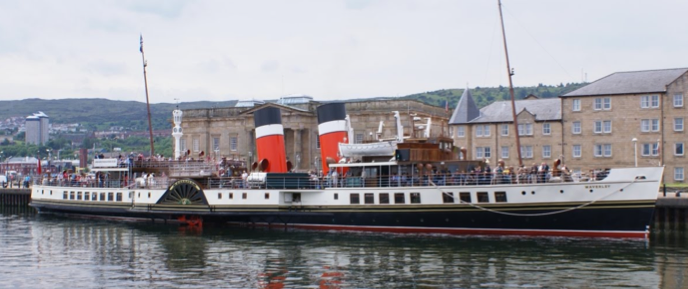
SS Waverley at Custom House Quay, Greenock

SS Waverley Docked at Custom House Quay, Greenock

Even end-of-the-line Gourock where the ferries leave for Dunoon (Cowal) has retained a functional High Street with a wide selection of douce villas offering stunning views. They lend the place such class they could be key in attracting people back into the area. Past the urban section, Inverkip offers a marina and Wemyss Bay ferries to Rothesay (Bute). Their green, unspoiled environment stretches all the way up and over the hills to Kilmacolm in a wide hinterland back to Port Glasgow. This latter was ideal cycling country: gentle hills, varying rural views, roads with little traffic.

Steve was quiet-spoken—not at all brash or boastful. But, as a local whose dad spent his working days slapping red lead paint over the bottom of ships in the local yards, he spoke with assurance and passion. As with anyone so rooted in the place, he clearly knows and loves his patch. But what Steve also brings to the party is a vision, determination and the backing of a strong local Labour party who—in contrast to my own experience—seem to have moved on from wishing good old days to return and are looking to a future through ideas and with gumption to back them up.

Having gone to Inverclyde as a unbeliever, as no fan of this post-industrial backwater, one afternoon with Steve turned me firmly around. Now I wonder if, despite all our advantages, East Lothian might not come second to Inverclyde in seizing a rich quality of life for the future of its citizens, if Steve McCabe has his way.

All power to him: property prices there went up 24% last year.
Posted in Education, Politics | Tagged | 1 Comment

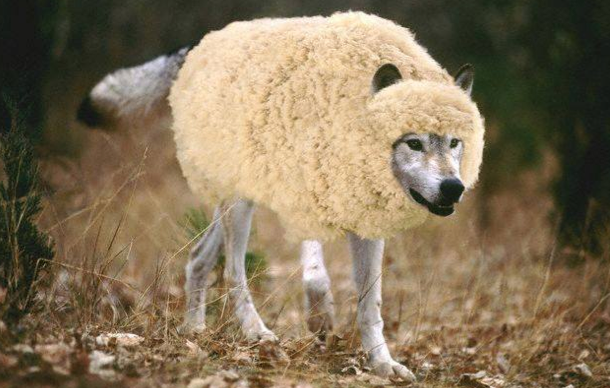
Волк в ове́чьей шку́ре

WolfSheep

After a couple of decades dimly perceived media limelight, the Russian wolf has suddenly loomed large in the headlines in a way that it has not since the bad old days of the Cold War. After the fall of both the Soviet Union and the Berlin Wall, a collective amnesia among western countries—especially in America and its UK deputy sheriff where global politics is habitually defined in terms of white and black hats—that the wolf wearing a new capitalist waistcoat and riding a spiffy new non-Lada-made bicycle was fit to invite to tea.

This impression was reinforced by western media having unprecedented access across the country, newly rich Russian oligarchs buying up half Chelsea and Baltic cruise ships calling at renamed St Petersburg to witness the cultural magnificence of the Hermitage. Despite the fact that not one in a thousand Brits understand the Cyrillic alphabet, let alone speak Russian, the inclusion of Russia in the G8 signaled the bear was tame and all was well.

Granted, to those of us grown up under the shadow of WW3, it is a relief not to care where the next fallout shelter is and how many loved ones you might reach if given the five-minutes-to-Armageddon warning. That philosophy was simplistic and bleak. What we have now is simplistic and dangerous. Back then, the rarity of insight ‘over the hill’ was underscored by Sting’s “If the Russians Love their Children too” being one of the few messages of hope in a desolate flurry of Fleming/Le Carre eyeball-to-eyeball cultural icons.

And, just as it was simplistic then to malign the Russians as the Cold War baddies, so was it even more so to imagine that 200m people were suddenly going to embrace western identity wholesale. The present series of Mexican standoffs along the Ukraine/Russia border is entirely understandable to those who have made a study of the history, culture and mentality of a people who have much to offer the world besides nuclear annihilation.

Russia, like most countries, was born in turmoil. But most western countries didn’t have brutal raiders like Vikings, Mongols and Turks invading them from all sides over centuries. And just as a long-overdue unification of Germany led to it feeling its oats and to a couple of world wars before it calmed down, so the great unification and expansion of Russia under Peter the Great led to wars and iconic victories at Poltava and Borodino that shaped the Russian mind that the Western neighbours were enemies and invaders, not friends. Pilsudski’s Poles in 1921 and Hitler’s Germans in 1941 did little to dissuade them.

So, despite international achievement from Tcaikhovsky through the Bolshoi to Faberge, Russian paranoia on this account found its deepest expression in Stalin, who used WW2 to build the biggest buffer zone Russia ever achieved on the back of the greatest victory ever achieved unflinching from 28 million sacrifices (27% of the population, compared to UK’s 0.94%).

What the Russian people went through 1941-45 was unimaginable to our cosy Western lifestyle. The Wehrmacht surrounded Leningrad and, through two bitter Baltic winters, tried to starve out the 3m inhabitants. Over 1m died—of cold, disease, malnutrition more than bombs or shells. But the trams ran; the factories turned out munitions; the workers ate bread that was mainly sawdust.

Inured by a hard 19th © lifestyle that makes our Highlanders’ sparse pre-Culloden life seem luxurious by comparison, by WW2 they had built a modern country in the teeth of Western opposition. They pride in the Bratsk power station or the Dniepr dam and the fact that they out-designed, out-produced and out-fought the much-vaunted Wehrmacht while the Allies were taking three years to chase an Italo-German sideshow out of North Africa.

No matter what country you come from in Western Europe, you are ill-equipped to project yourself into the Russian psyche. It is 40 times the size of Spain; Moscow is regularly above 25degC in summer and below -10degC in winter; the train from Moscow takes 6 days to reach Vladivostok; Russia’s forests cover 7.7m sq km—14 times the size of Spain. Russians are more dour and inexpressive than the Scots but, like the Scots, once they warm to you are embarrassingly generous and make solid friendships. They love music and dancing but are especially passionate about poetry, most being able to recite Pushkin or Soviet-era writers like Yevtushenko.

Even today, they are stoic, phlegmatic in surviving on little, proud rather than ambitious yet curious as children about the world. Survival of individuals has always been a crap shoot. Mother Russia has survived every invasion even if whole swathes of the people didn’t. As a result, their whole history revolves around a strong leader holding their vast country together—even if it’s by means that squeamish Westerners would disown.

Among family and friends they are very human, but geared to accept strictures that life and or the government imposes. They expect strict and clear principles on what is or is not acceptable—in many ways the emotional reverse of the American ‘land of the free’ ideal. This alone goes far to explain why they so often misunderstand one another. It also helps explain the rise of the Russian oligarch since Glasnost—those who apply bald capitalism can exploit their own people’s relative passivity quite easily.

Since the fall of Communism in Russia, there has been too swift a readiness to see Russia as an extension of the West. It has released its satellites, pulled its troops back home, joined in economic summits, joined in world trade and exported billionaires as well as raw materials and wheat. But it is no more relaxed about sovereignty and prestige than France is about the inviolability of the French language. Losing its military buffer states against a repeat of 1941 was traumatic enough. It wore sheep’s clothing as a pragmatic way to feed its people and trade its way back into the world.

But when the Ukraine starts talking with the West, alarm bells ring in Russia; traditional loyalties seem turned on their head. Why Krushchev decided to award the Crimea to Ukraine is a mystery. Russia had fought the Turks over it for over a century—that’s where our Crimean War came from. And, now that Russia is come down in the world from superpower status, that their principal arm protecting their southern borders—the Black Sea Fleet—was suddenly based in a foreign country was too much to swallow long-term.

Though the Ukrainians may protest (partly because the West naively encouraged them to) over ‘loss’ of Crimea, the Ukraine was never a state before now and therefore has scant right ‘historic’ to provinces. This is not to condone Russian actions but they are a very practical lot; if they want something and think they have the power to grab it, they will, or expect to be considered weak.

The most sensible suggestion about the whole crisis came from Kissinger, who argued that, rather than being tugged hither and yon by both the EU/US and its Russian opponent to join one side or the other, Ukraine could make the best contribution as a bridge. (see earlier blog Kissinger on Ukraine), something the Russians might tolerate. Membership of NATO or EU is not.

The Donets industrial basin in Eastern Ukraine is less clear-cut but, populated as it is largely by ethnic Russians and included in the country thanks to some questionable boundary-drawing by Stalin’s Kremlin, there is a genuine problem about Russian minorities who, in that particular case, aren’t a minority. Given that Putin’s standing within Russia (a matter far more important to him than international niceties) it is not rocket science to predict that a relatively easy victory snatching Crimea makes it tempting to try for Donets too.

Because what can the West do? The Russians have overwhelming military superiority in the area. Even America at its most gung-ho would not stick its hand into this wasps nest because the Russians could obliterate anything they could deploy that far from home right on Russia’s doorstep. This is why the US let Russia have its way in Chechnya, Georgia and other tinder-box flare-ups along its southern border. The best the West can bring is a non-player here.

So, when Alex Salmond, while qualifying any admiration, declares that Putin’s actions have been a good thing insofar as it has restored Russian pride, he is demonstrating a firm grasp of realpolitik that seems to have eluded most English party leaders. Instead of making the best of a bad job like Alex, the UK government and its opposition have struck a pose both unrealistic and pathetic. They seem to think  they command a deployable force that the Russians won’t fall over laughing at. Just because the Russians have recently donned sheep’s clothing internationally to avoid frightening trade delegations away, doesn’t mean they don’t still have sharp teeth and remain brutal as ever about using them.

In Putin, Russia has a leader they like, not least because he understands them. Resisting their ambitions has long been a part of the global ‘Great Game’ that imperial Britain once played on the North-West Frontier. But, while Russia may not be what it once was, Britain is a weak shadow of its 19th © self and should stop sabre-rattling before someone gets hurt.

Posted in Politics | Tagged | Leave a comment

A Sprinkle of Stardust

For over three years and 630 blogs, I have been happy in this far vineyard, toiling to bring such readers as I have gathered insight into life in my beloved East Lothian and pragmatic perspective on independence for my country to help ensure that does come to pass. But in all that time, grateful as I have been for the interest of my readers/followers, I have never felt the flutter of flattery—until today.

Many of said followers lead informed and questing lives; I know this by the amount of shrewd and informed feedback—if not actual shots across my bow—that I receive, for which I am most grateful. Never having had the truth presented to me on a plate, I am appreciative of other perspectives, learn from them and, hopefully, blog the better for it.

But this weekend, an unusually exotic creature flew in among my followers; colourful, beautiful and graceful as an ikran from Avatar. For this blog is now being followed by Elena Levon, aka ‘Lena’ who is, if my regular readers will forgive the sheer ingratitude of such a bald statement, a real breath of fresh air.

Absinthe Makes the Heart Grow Fonder—Lena at La Coupole, Paris

Absinthe Makes the Heart Grow Fonder—Lena at La Coupole, Paris

Let me admit right away that any interest from such a hot momma has a viagresque effect on a man who has had a concession card longer than he cares to admit, so that my world suddenly appeared brighter and newly stimulating. But Lena brought much more than a stimulating portfolio. She brought obvious intelligence, creativity and bold ambition which she is parlaying into celebrity status with a deft, natural skill that leaves lifetime plodders like me somewhere between awestruck and gobsmacked.

For she has parlayed a Russian academic background, dark good looks and a strong jawline that would serve leading males well onto an international-circuit lifestyle before she was thirty. Now with her own entry in the IMDB database and a portfolio including snaps of hardy partying with a suite of ‘names’, it would seem easy for her to relax into the role of arm candy for selected sugar daddies in the good ol’ “poo-poop-ee-doop” tradition.

But here’s where she impresses me most. Not only has she used her considerable range of talents to carve out a ‘celebrity’ status for herself with precious little external assistance but she also puts it all on the line by challenging herself in various adventures on random continents and seizes emerging opportunities from social media to live a rather public life over the internet via a multifaceted blog site that puts her creativity on-line to be mocked and/or praised as the readers see fit.

That takes either boundless ego or guts and my money is on the latter. Why? Because there have been other ‘celebrities’ who search for some kind of grounding in the world by sharing their poems/art/music/etc so that they have more bearings to go by than the sycophancy of fans and agents. But Lena displays real substance. Whereas someone else in her place might be a natural clothes horse—and she seems to have select, if racy, taste herself—there is substance and a real person here:

“Social status has never been a goal or a priority of mine. I can’t tell the difference between jimmy choos and prada. To me it’s just a shiny wrapper with no substance or real value. Our world today has more important issues to deal with, than a decision making of what brand of shoes to buy this afternoon or what color the highlights should be.”

Once you get used to centre-line fixations of her blog, there is material worth mining in there—musings of a woman of the world who has a nice turn of phrase expressing them.:

“I was and I will always, find myself walking on fire and I’ll be convincing my heart that it’s only cool water. I believe that if your passion is greater than your fear, you can have anything you want!”

To be 19 and on a bench at LAX in 2003 with no idea what came next, to experience and achieve all she has in the intervening decade and to articulate it in 21st © style so that others can critique, ignore or learn from it takes a kind of courage and clarity that few of us have. And to be clear about a childless and unmarried future so early in life shows a gutsy pragmatism that isn’t always a celebrity strong suit. But there is room for a really human side too: she actively supports ten charities, including the Nelson Mandela Foundation.

So, cheerfully confessing to (and relishing) being somewhat bewitched, I still haven’t fallen into ‘if I were half my age’ speculation because I am from another era and definitely not into living out my thoughts through social media—although I have allowed myself to speculate that she would be a dynamite salsa partner. But I do remember being on that bench at LAX myself in 1977, aged 29 and making a fair—but not as good a—fist of  opportunity as Lena even in twice the time she’s had.

I think this lady is both fun and a force of nature; so I am flattered that she should find interest enough in my musings to bother following them. But it’s a sprinkle of unexpected stardust that I hope to savour.

Posted in Community | Tagged | Leave a comment

Making the Law an Ass

This blog has been critical of recent ‘developments’ in Scotland’s justice system in general and the role played in such changes by the Justice Minister, Kenny Macaskill MSP. And this criticism is not personal, having nothing to do with wur Kenny finding no time to hang out with veteran activists in the SNP Club since his elevation.

Much more important is the degree to which he—using the unexpected SNP majority in Holyrood—has taken a meat cleaver to the finely balanced combination of body of law, legal profession, enforcement and justiciary that had been Scotland’s distinctly independent glory for the last 300 years (see earlier blogs Must Justice Be Blind from last May and Kenny Cannae Ca’ Canny from the year before). To put it mildly: he has form.

Not content with one major reform he has blundered about like a bull in a china shop fixing a succession of things that senior observers of such matters still don’t consider were broke. These include:

  • folding eight forces into one and removing the democratic scrutiny of police boards
  • giving the resulting Police Scotland monolith carte blanche to ‘reorganise’ (aka slash) services (e.g. traffic wardens) without consultation with ‘partners’
  • restructuring the Procurators Fiscal offices, much to the consternation of judges
  • closing a significant number of Sheriff Courts after a sham ‘consultation’
  • deleting Corroboration as a major pillar of fairness in Scots Law

A blog is too short to rehearse all of the arguments why wur Kenny might have much of this wrong. But this week saw a particularly ugly and indigestible chicken come home to roost when the Chief Inspector Brown presented the full East Lothian Council with a first Police Report for the third of the new Police Scotland “J” Division that it covers.

Some six months ago, his predecessor’s only appearance was marked by her getting it tight for having dropped wardens, re-tasked community officers and re-allocated council-funded officers, all with no consultation with the civic authorities thereby affected. Why she then moved on with less than a year in the job has not been made clear.

Ch.Insp. Brown’s 26 pages of report starts off well enough, with reassuring introductory comments that include:

“I remain strongly committed to the principle that community-based policing, which responds to local need and demand, is crucial to delivering services that keep people safe and maintain public confidence.” —Chief Constable Sir Stephen House QPM

Few would quibble with that. Indeed, those involved at the sharp end of policing have found that genuine community bobbies who know their beat (and therefore the kids, secrets and malcontents therein), combined with civic wardens, tenants & residents, community councils, ASBO teams and various civic pillars have been doing a bang-up job dealing with minor disturbances so well that few ever reach crime statistics. And those have been falling steadily for several years as a result.

Reading the report, you would never know it. Described as a ‘strategic document’, this makes it flawed right out of the gate because what is needed is an operational report. The five priorities given as the backbone of the report are pure motherhood and apple pie. In itself this is not risible but the fact that they are so generic as to apply equally to Whitecraigs, Giffnock as Whitecraig, East Lothian makes the reader wonder what understanding there is for real local issues among police middle management.

But, worse that that, one of the objectives given is: “Increasing the proportion of positive stop and searches“. Such actions are common currency in city estates where weapons and drugs are commonplace. But to introduce such abrasive behaviour into docile East Lothian is akin to having police walk the beat in Warrior armoured personnel carriers. Such crass application of inappropriate tactics is more likely to scare citizens than reassure them. Worse, it will give the impression that police are losing the fight against crime when the opposite has been true.

And when senior officers start talking about ‘flexibility’ and ‘cross-training on local issues’ you know that the bean-counters are in charge and that officers are regarded as so many interchangeable pegs to fill a variety of policing holes. This ‘efficiency’ was tried in the nineties and ‘community officers’ cycled through the post so fast most of them never even found the local toilets, let alone our petty criminals.

They also fixate on serious crime and think the minor stuff is seen as just that by the public. As a ‘goodwill’ gesture, two officers were assigned to North Berwick High Street on Easter Saturday to compensate for the absence of traffic wardens. While they were busy timing which cars were overstatying the 90 minute limit, Marine Parade (seafront) jammed up with double-parked cars (incident #215) and the Dirleton Avenue entry into town backed up a mile while a lorry offloaded (incident #428). Both incidents were reported on ‘101’ by 12:30. #215 never received a response and two (other) officers attended #428 at 15:25 to report no lorry.

Such examples are legend and serve to dissuade the public from reporting anything to the police who then delude themselves into thinking they’re well on top of things. Neither incident above, nor any like them will ever find their way into this Police Report because, unlike any competent report in business, it includes neither goals, nor measures, nor even scrutiny as to whether anything—let alone competent policing—was achieved. Another problem in the nineties was that crimes went unreported because of the paperwork involved and the need to occupy two officers to apprehend suspects and take them to police stations. Look for that practice to re-appear as statistics are cooked to polish up ‘solve rates’ and thus careers.

None of the above should be taken as criticism of beat officers. Having chaired a Community Action Police Partnership for the last four years, I am full of admiration, gratitude and respect for the hard work done by officers attending there and the pro-active communication of their local inspectors who have invariably provided the best support available for those officers in the front line. Middle management is another matter—interfering with officer availability locally, rigidly enforcing shift patterns so they can’t attend to local duties when it suits, being more in thrall of internal objectives and career paths whether they bear relevance to citizens’ real policing needs or not.

The thing made most clear by the wholly unsatisfactory report is that, from House down to division level, the police—always fond of their own jargon and generally dismissive of civic insight, let alone control of how they operate—have gone native. This report is not just a bureaucrat’s charter but an insult to anyone genuinely trying to exercise their democratic right to scrutinise those who apply the law.

However, that probably applies to the 32 clone reports with which councils are being fobbed off across Scotland. What makes matters worse is that the report reeks of policing that may be appropriate to Glasgow but certainly not to Gifford; the subtlety of policing that once made it so effective in East Lothian is at risk of being thrown out the window of pseudo-managers who clearly don’t know their patch and don’t seem minded to learn.

Worst of all, having handed Mr House this one-size-fits-all cleaver, Macaskill seems not to care how that will reverse crime figure improvement, especially as his abolition of Haddington Sheriff Court means local miscreants will get trucked up to Edinburgh where they can learn their criminal trade properly from graduates of Saughton and Bar-L with whom they will soon be rubbing shoulders.

Posted in Community | Tagged | 1 Comment

Nothing to Bash

After a mild spring, North Berwick has so far been blessed by two days of sky-splitting sunshine over the weekend and the place is going like a fair—boat trips out round the islands well loaded and not a pavement cafe seat nor parking place to be had. Which makes us glad we took the chance we had when this weather arrived mid-week to run the final ‘mallow-bashing’ trip of the winter.

The plague of sea tree mallow, know locally as ‘Bass Mallow’ because it grew on Bass Rock—probably planted there by a travelled lighthouse-keeper who saw the advantages of large soft leaves should the loo-roll supply be cut off—is by a beast of a plant:

“Lavatera arborea tolerates sea water to varying degrees, at up to 100% sea water in its natural habitat, excreting salt through glands on its leaves.This salt tolerance can be a competitive advantage over inland plant species in coastal areas. Its level of salinity tolerance is thought to be improved by soil with higher phosphate content, making guano enrichment particularly beneficial.”

In other words, on seabird-rich islands. The 150,000 gannets now on Bass Rock have pretty much blitzed vegetation off there and so keep it under control. But on other islands like Fidra and Craigleith with no gannets and only small auks like puffins in residence, the reverse is true; the puffins’ burrow-cleaning operations actually providing a welcoming seed bed of soft soil at each entrance. At one point, the puffins on Craigleith were being confronted with 2m-high mallow ‘forests’ they couldn’t land in and 3-4cm-thick stems outside their burrows that acted like jail bars.

Thankfully six winters of a volunteer army of ‘mallow-bashers’ organised by John Hunt under the auspices of the Scottish Seabird Centre have hacked down generations of new plants as the zillions of seeds in the soil have germinated each year like some night-of-the-living-dead zombie movie.

Mallow-Bashing Squad on Craigleith (John Hunt in the Centre)

Mallow-Bashing Squad on Craigleith, April 15th (John Hunt in the Centre)

Only after we had combed the island from end to end did we realise that, with the exception of a few mature plants low down on the cliffs too dangerous the access, that there was no work to do. Hard work from earlier squads had dealt with the larger plants and our allies the rabbits seem to have decimated this season’s mallow seedlings. The giveaway was the shortness of the grass (see pic above). But the absence of mallow cover and the fine Spring weather has allowed the native grass and other plants like worts and nettles to reassert their cover so that seedlings will have an even tougher time next year.

So, there was nothing for it but to settle back to enjoy our packed lunches, the magnificent views and catch up on a little early sunbathing. Having served on a number of squads it is hard to describe with what relish you find yourself presented with such hedonism when you had braced yourself for the prospect of a day’s hard labour.

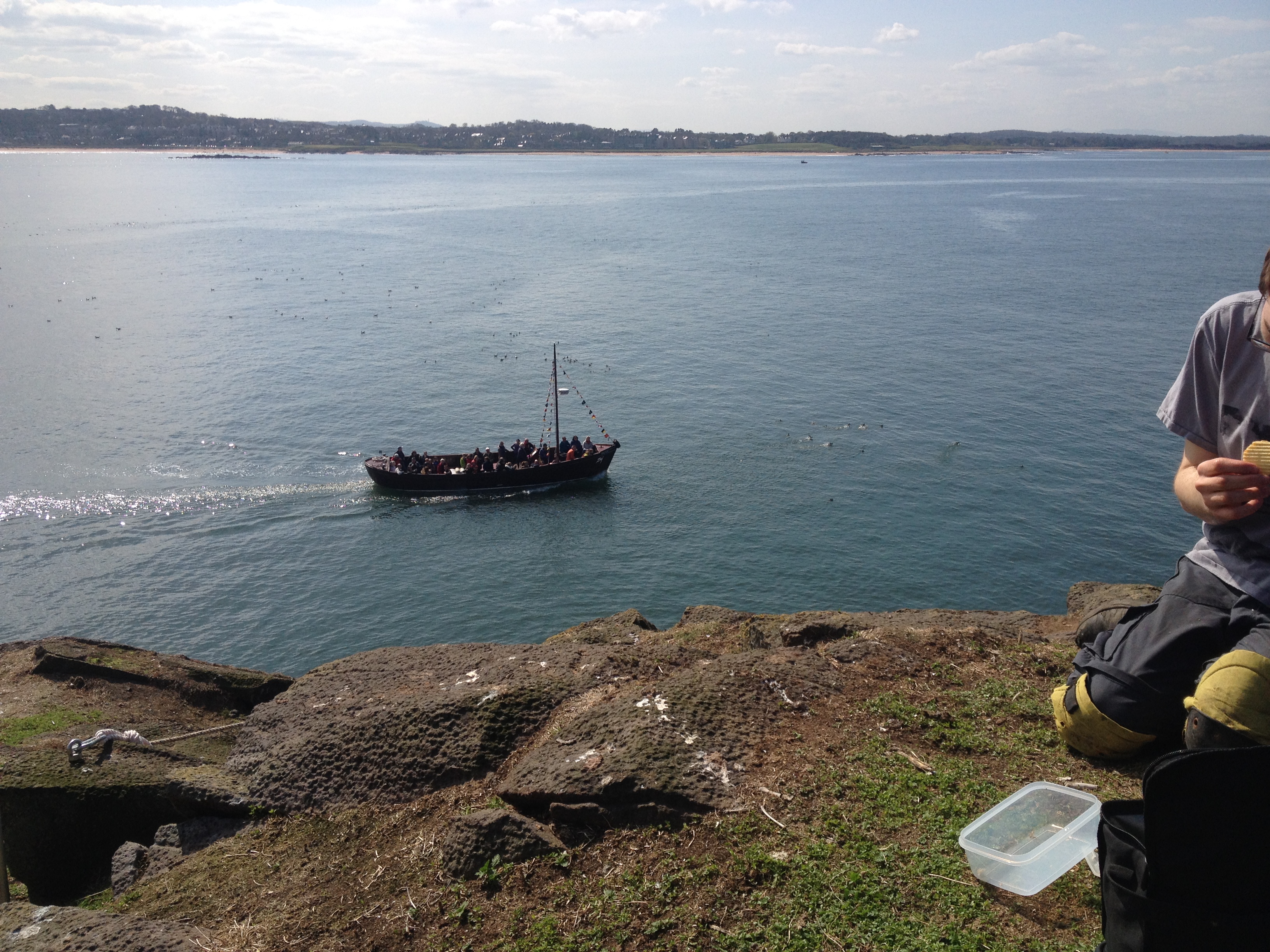
A Well Loaded Sula II Passes with North Berwick in the Background

A Well Loaded Sula II Passes, with North Berwick in the Background

Gratifying though it was to realise what had been achieved by the hard work of hundreds, the sun-blessed feeling of stolen apples was yet more enjoyable still.

Posted in Environment | Tagged | Leave a comment

Provocation? Not Gonna Work

The indy debate is heating up. In the course of my three-plus years of blogging and tweeting so far, I’d like to think my point of view contributed as objectively as my conviction would allow. Nonetheless, I have been classified as a cybernat—invariably  pejoratively. There is only one occasion—about a year ago—when I overstepped acceptable convention with a tweet for which I not only apologised but resigned from the party of which I had been a member for thirty-seven years to avoid its name being compromised.

My other 8,117 tweets, plus 634 blogs, I stand by. Indeed, I challenge any reader to find bigotry, insult and/or lack of respect in them. Nonetheless, I have been blacklisted as a ‘cybernat’, with the subtext that I am thereby blinkered, hostile or even racist—I have have even been blocked on Twitter by such ‘professionals’ as David Torrance as a result.

Rather than refute this directly, I came across the following from Alan Bisset on the ever-worthwhile Bella Caledonia blog. Finding it better articulates than I could the unfairness of and defiance at such mislabelling by those cited, whose virulent hostility to Scottish Independence I have also witnessed, it speaks in my stead. For the record, half my family is English and England is, as I have voiced to many, my favourite foreign country.

‘Ethnic’ Cleanse

April 16th 2014 by Alan Bisset

According to the Herald journalist David Torrance he is an ‘ethnic nationalist’. To the composer James Macmillan he is a ‘Blood Scot nationalist’ and ‘motivated by hate’. To the Labour blogger Ian Smart he is ‘anti-English’ and ‘a nasty piece of work’. To The Telegraph’s Iain Martin he is full of ‘hateful pish’. Who is this monstrosity walking among us, conducting his rage-fuelled pogroms against the English? Why it’s me! – with my English grandmother, English god-daughter, English cousins and half-English girlfriend. Did I mention I lived in England for three years?

‘Yeah, but some of my best friends are black.’

Okay then. Let us examine the evidence for these serious charges. What exactly has the ‘ethnic nationalist’ Bissett said to warrant such a ferocious reaction?

Could it be this?

If no Scot is ever appointed to a chief position in the Scottish arts again, so be it.  This might still be preferable to divisive talk of ethnicity and enmity erupting where there was none. (‘Who Carries the Carriers’ , National Collective)

Or this?

The intellectual and scientific achievements of the English are vast. (‘Is it cos wur Scots?’ National Collective)

Or this?

Scottish independence is not about ridding ourselves of the English, not least because there are so many English people integrated here anyway, with jobs, friends and families, and because Scotland and England will always be right next door to each other.  People from both nations will still be free to live in, work in and visit each other’s countries anytime they like. (‘Is it cos wur Scots?’ National Collective)

Curiously, none of these gentleman were able to identify a single quotation to back up their accusations. Quite the methodology.

We could, of course, examine their motives. It should surprise no-one that all of them are Unionists, and that both Smart and Macmillan have form for making inflammatory, baseless comments intended to provoke exactly the kind of reaction about which they can say, ‘Look at how angry they are!’ Smart has refused to apologise for his infamous tweet – “Better 100 years of Tory rule than the turn on the Poles and Pakis after indy fails to deliver” – incredulous on so many levels.

Macmillan is also a stranger to understatement, happy to describe Rangers and Hearts football fans  as ‘eager talkers of fascist filth’ and claim that the abortion of female foetuses in India and China is western feminism’s gift to the Third World. Macmillan also once called the National Collective, a group of artists in favour of independence, ‘Mussolini’s cheerleaders’. This is the same National Collective who organised a Wish Tree, on which people could write their hopes and dreams for an independent Scotland. Mussolini was fey like that.

Iain Martin, meanwhile, has worked for every right-wing British newspaper you can name and claims on his website that, ‘fearing a Nationalist victory and a potential show-trial I fled my homeland’. Clearly he’s good at getting things into perspective.

Smart, Martin and Macmillan are engaging in simple smear tactics, and I am their latest target. Smart admitted as much when he tweeted sinisterly last weekend that I was ‘now fair game’ and that (blowing his Viking horn) ‘I’ll be the least of Bissett’s worries over the next short period’.

The real disappointment is Torrance. He’s a high-calibre journalist, often reasonable, intelligent, able to see the angles, not one who normally goes in for slurs. What he has done by dropping the word ‘ethnic’ into the debate, without justification, is irresponsible.

It is interesting to note that Macmillan added his tuppence-worth in the Comments below Torrance’s Herald piece, as though Torrance, by using the term ‘ethnic’, had emboldened him to go one further and accuse me, bizarrely, of ‘blood Scot nationalism’. Torrance’s article is the thin end of a dangerous wedge.

So what prompted these attacks?

The impetus was my play The Pure, the Dead and the Brilliant, opening at the Assembly Rooms as part of the forthcoming Edinburgh Fringe, an excerpt of which was performed as part of a Yes cultural showcase in front of the SNP conference (and Martin’s ‘stunned hacks’). The scene took the form of a debate in the Faerie Kingdom – think Book II of Milton’s Paradise Lost – about how Scottish independence may be averted, which morphed into a parody of the No campaign.

The only time that England was mentioned was in the following rant from one of the anti-independence Faeries:

Think about your relatives in England. They’d be foreigners – Yes, FOREIGNERS, cos we all know FOREIGNERS ARE A BAD THING – who would be unable to love you ever again and who you’d certainly never see because there would a ONE HUNDRED FOOT WALL OF ICE ON THE BORDER LIKE IN GAME OF THRONES all to fulfil Alex Salmond’s dream of being Scotland’s first ever dictator, cos it’s all about him, you know that right? There’s only one person in Scotland who actually wants independence and he’s JUST A BIGOT WHO HATES THE ENGLISH! I mean, that’s what this is all about, isn’t it? Don’t give me that guff about redistributing wealth and getting rid of Trident and improving democracy, you just want to round the English up into Gulags and force them to eat porridge and read the poetry of William McGonigall every single day, don’t you? No? WELL THAT’S NOT WHAT WE’RE GOING TO TELL THEM!

Neatly, Torrance, Martin, Smart and Macmillan, in their rush to brand me anti-English, demonstrate the accuracy of the satire.

Each speech from the Faeries was pro-Union in content, often using the No campaign’s own words and themes against them. Is Torrance really asserting that to hold a mirror up to the strategies of Better Together somehow constitutes ‘ethnic nationalism’?

I’m not sure I qualify as a nationalist at all, let alone an ‘ethnic’ one. I am a socialist. If I believed the best future for the Scottish working-class lay in the Union I would vote No. If we were still living in the post-War settlement of the Welfare State and full employment – led by a Labour party that truly represented the people, not middle-class swing-constituencies and the USA – I would vote No. That compassionate Westminster, however, existed all-too briefly and is irretrievable without the shock to the body politic which Scottish independence will provide.

A living, breathing, functioning democracy in Scotland, and an economy which works not for the ruling-class but the people – the kind advocated by Yes groups the Common Weal, Radical Independence, the Greens and the Scottish Socialist Party – will be an example for the rest of the UK to follow.

In short, I am partly in favour of Scottish independence because it will be good for the Scots and the English. Scottish ‘nationalism’, if we can even call the independence movement that, is bound up only with the struggle for self-determination, as opposed to the imperialism and elitism of its British counterpart. After independence we should be wary of anyone still calling themselves a ‘Scottish nationalist’. What we are all working towards is the normalisation of Scotland.

It’s often the rhetoric of the Unionist left that a worker in Ipswich and a worker in Inverness have more in common with each other than with their respective overlords. This is, of course, true (though I fail to see how Scotland remaining in the UK actually helps a worker in Ipswich). These days I feel more in common with the Englishman Billy Bragg or the Welshman Rhys Ifans – who understand and support the motives of Yes – than I do with Scots like Smart, Macmillan or Martin, whose dogged loyalty to an increasingly brutal British state I find alienating. One of the reasons I feel so comfortable in the Yes campaign is because of its inclusive, pro-immigration stance. If English people were to move to an independent Scotland to escape the right-wing consensus down South I would consider that quite a victory.

Torrance accuses me of having a ‘black and white view of history’ and being from ‘the “Scotland was colonised” wing of the Yes campaign’. As such, I kindly invite him to a reading of my work-in-progress for the Tron’s Mayfesto season next month – Jock: Scotland on Trial – which explores Scotland’s culpability in slavery and the colonisation of other countries.

In the meantime, David, please drop this talk of ‘ethnic nationalism’. Any reasonable observer would struggle to find it in the broad, pluralist Yes campaign, so it shouldn’t be invented where it doesn’t exist.

Posted in Politics | Leave a comment

By Their Fruits Shall Ye Know Them

This blog has been consistently critical of the UK Ministry of Defence and all who sail in her, right up to the Cabinet Minister for Defence, currently Philip Hammond. Apologists for the Union as diverse as Murdo Fraser, Alan Cruickshank and Stephen Curran have taken issue with this stance. Many others, from Brian Wilson to Lord Robertson of Port Ellen to Malcolm Rifkind have never deigned to comment but I’m sure would be equally stout in the defence of defence (if you know what I mean).

So, it behooves this blog to make more than accusations and back up criticism with plausible substance. Much of the very Unionist arguments revolve around the power that the UK deploys in the world and the glorious victories of the 20th century made possible by that strength and resolute joint efforts of the countries of the United Kingdom to achieve them. While there is much to praise in such achievements, the details do not allow close examination if you have no wish to expose a cataclysmic series of cock-ups that should have sold us down the suwanee but didn’t, mostly because we got lucky.

There are so many to choose from, with WW2 particularly blessed by incompetence from tank design to Singapore to convoy escorts to mechanised tactics to anti-tank guns to naval air, and so on. But because it is a century ago, let us examine the War Office/Admiralty approach to submarines on the eve of the outbreak of the Great War.

Throughout the 19th century, the Royal Navy dominated the seas with what is now called a ‘blue water navy’, meaning units could deploy almost anywhere around the globe, using a chain of strategically placed bases and coaling stations. Prompted by an innovative admiral called John (Jackie) Fisher, HMS Dreadnought, a 20,000-ton leviathan with 10 12-inch guns and capable of 24 mph was launched in 1906. By being faster than any enemy with three times the firepower, it instantly made every other battleship obsolete. Including all those in the Royal Navy.

That launched an early form of Cold War among naval powers to out-build each other with such ships. That race was in full cry when in 1911, Winston Churchill replaced Fisher as First Lord of the Admiralty. At the time, that job was the most pivotal in the Empire as the RN and its ability to project power was what held it all together. He presided over a naval budget for that year of over £44m, which was to pay for five new battleships, four cruisers (to scout for them) and twenty destroyers (to chase off torpedo boats who might sink them with that devilish new-fangled contraption).

So preoccupied was Churchill and the Admiralty professionals with outbuilding Germany especially that each year’s naval estimates included similar expansions up to August 1914. At that point, the Grand Fleet fielded 24 battleships (and 5 more building) to Germany’s 16 and everyone from Churchill down congratulated one other they had won the race. What they didn‘t know was that British armour design was inferior, that their poor isolation of gun turret from magazine below would cost them three battlecruisers at Jutland two years later and that German optics and gunnery training was far superior, especially at range and in poor visibility.

But, what His Majesty’s Admiralty also didn’t know (but swiftly realised after the outbreak of war) was what else the Imperial German Navy had been up to, besides building better equipped and protected battlewagons. They had been furiously developing submarines, the diesel engines to drive them and the torpedoes to fire from them. During Churchill’s tenure, the number of British submarines had actually gone down and only a dozen or so were ‘ocean-going’, able to operate other than close to the British coast.

While Fisher had been an advocate of the submarine, Churchill and almost all other admirals saw them as weak, slow and good only for defence, using phrases like “the weapon of a weaker nation” or “underhand, unfair and damned un-English”—this, despite the fact that the German budget for submarines was known and known to be growing. Against the British offensive dozen, Germany deployed 46. And when it was forecast in June 1914 that these would sink unarmed British merchantmen without warning, Churchill went on record as saying he did not believe that “this would be done by a civilised power“.

Barely a month after war was declared, on September 22nd three British cruisers HMS Aboukir, Hogue and Cressy were patrolling off the Dutch coast, enforcing a blockade on German trade. In broad daylight, the submerged U-9 sank all three with a loss of 1,459 men from their crews of over 2,200. The week before, another U-boat had penetrated the Firth of Forth past all its defences to within a couple of miles from Rosyth naval base and added insult to injury by sinking the cruiser guardship HMS Pathfinder near Bass Rock on the way out. The Admiralty had barely got over those shocks when the same U-9, replenished back in Kiel, came back out on October 15th. She promptly sank HMS Hawke, which had been sent to replace the lost cruisers, for the loss of another 500 lives.

In the ensuing panic, all Allied shipping in the Channel was stopped and troop transport to France suspended. The entire Grand Fleet held at Scapa Flow to block German breakout to pillage our maritime trade retreated to Loch Ewe and then to Lough Swilly in Ireland, from where they would have been hard put to stop any German move.

It was the beginning of a harrowing phase in British history when its ability to continue the war was called into question as more and more shipping was lost to submarine warfare for which no answer had been prepared. The subsequent carnage among shipping around Britain that followed had been foreseen by the retired Fisher but ignored by anyone with influence. It took two years—until July 1916—for the Admiralty to finally introduce a proper planned convoy system, after which losses started dropping.

But during that time, hundreds of millions (billions in today’s terms) spent on British battleships was neutralised by shrewd planning by the Germans taking advantage of  plodding thinking from those in charge of Britain’s defence. When the Admiralty finally did decide that submarines were “fair” and a weapon of the future, they got it so wrong it resulted in the Battle of May Island, when over 100 RN sailors died and the nearest German was asleep in Wilhelmshaven. But that’s a different MoD horror story.

Meanwhile, one hundred years on, with Nimrods, Harriers and half the army scrapped, while any naval air arm is in limbo and the RAF pared to find money to sustain nukes, the evidence that a great deal has been learned about defence is hard to find. We’re better together? With these chumps? Don’t make me laugh: how much worse could the Scots possibly do for themselves in the light of chronic, repeated ineptitude from Whitehall’s War Office/Admiralty/MoD?

Posted in Politics | Tagged | Leave a comment

‘Britain’ Is a Geographic Term

Pace the great Austrian statesman Metternich who used a similar phrase in his famous put-down of Italy’s ambitions to become a united state, it seems long past time to broaden the discussion that so far has fixated on Scottish independence and ask the broader question: what is Britain for? Retired colonels staring out over their acre of Tunbridge Wells now grip their pink gins tighter and start composing a letter to the Times to defend all that is holy about this sceptred isle, this plot, this realm, this…England.

Ay, there’s the rub. Scratch a unionist argument for Britain and you soon find the talk turn to England. Indeed, ’twas ever thus—but the reason nobody bothered is that most people benefited from the global con trick that was the British Empire and so forged a career with little real thought to the culture from which it benefited, Currently the UK consists of three real countries, a sham country and some islands. We’ll leave those islands out this for now and presume Scotland chooses independence. How will what remains proceed?

Any future for the term rUK meaning ‘rest of the UK’ must to be ditched at the start. The ‘United’ part derives from the 1707 Treaty. With Scotland gone, any union is—de facto as well as de jure—null and void, so there will be nothing to be the ‘rest’ of. Which brings us to the sham country. Northern Ireland is a product of English political necessity, born out of trying to rescue pride from the centuries-long car crash that was England’s first colony.

That the bulk of the Irish (including many in Ulster) felt seriously gypped in 1922 when the mighty Raj flinched at total humiliation and used extremist Protestant ‘loyalists’ as an cover for an international frontier where none existed before to make Northern Ireland a ‘country’. The ‘unionist’ part of the Tory party’s real name (Conservative and Unionist Party) actually refers to Ireland and not Scotland. S0 we’re not going to get much logic or sense out of them while they’re in power—nor have we for 90 years. But does it matter?

Time was Ulster always returned a dozen Ulster Unionists to Westminster and common causes wedded them to the Tories. But nature has a way of dealing with political Luddites; it is estimated that, after the next general election, Catholics will form the majority in Ulster. So, with the growing ferrets-in-a-sack postures adopted by Protestant politicos, the prospect of a majority Ulster vote to finally rejoin Ireland (and the real world) can only be a decade away. If ‘United Kingdom’ has not been decently buried before, that will surely do it and plant a Cenotaph to the 3,600 who died while the country was artificially split.

Which brings us to Welsh Wales. Conquered so early, it can hardly be considered a colony. It has been treated as an integral part of England so long the astonishment is it didn’t disappear into English culture as totally as Mercia or Wessex. But not only did the Welsh keep their language but their creativity with it, especially in song. After a hesitant start with their Assembly, their tail is now up, seeking Parliamentary powers and status for it and the parallel decline here of unionist parties as in Scotland points the way, albeit more slowly, towards independence.

Though they will have another 20-30 years to adjust to it during the above, it is likely that England will still not have grown up and stopped hiding behind the delusion of a political entity (let alone a robust political entity) called ‘Britain’. But, as they are not stupid, confronted with fact, they will adapt and adjust, finding it surprising when they present themselves as a medium-scale affluent and influential Western country of 53m people which everyone else has regarded them as since WW2.

Freed of having to constantly combat Anglo-centric entrenched London bias, Dublin, Edinburgh and Cardiff will form a more equitable (and profitable) civic union, if England’s smart (which I believe) and joins,. A bloc of such common causes—much like Scandinavia—will advance an enlightened business-oriented global outlook, backed by 68m people with global reach. Freed of their periphery, the English can go back to what they’re good at:  disarming charm with the financial morals of a barracuda. The other three countries can get on with being the different places they always were, but adding colour from the superficial (blarney/music/kilts) to the substantial (energy/tourism/research).

Each would engage with the world/EU/each other as much/little as they wanted but if the experience elsewhere is anything to go by, pragmatic arrangements among the four would soon appear—and even new bonds with, say, Scandinavians or Low Countries that have much in common in terms of fishing or environment or social policy.

And, instead of 90 MEPs (78 for UK; 12 for Eire) we could do better, deploying at least 15 for Ireland, similar for Scotland, perhaps 10 for Wales and still send 69 from England alone. That gives us ‘clout’ of 19 more MEPs. Not only would this put UKIP’s gas at the peep but by doing that, we’d gather more EU friends and get more done there on behalf of all the people of Britain. Separately, all four of us would actually stand taller.

Which would slip its backward-looking, xenophobic overtones of ‘Great’ and morph into a harmless geographic collective term for the power-artist formerly known as Britain.

Posted in Community, Politics | Leave a comment

Everyone Out of Step but John Bull

Perhaps it was always there, submerged in the jingoism that ran through British society in Edwardian times like a resort name through a stick of its rock. And when faced with the second half of WW1 (played 1939-45) in which we all but went under, it’s sensible to sink any difference in a fight for our lives together. That ‘Dunkirk Spirit’ togetherness still lingers in England but is increasingly hard to find here—especially urban Scotland.

This difference derives from a common bewildered disorientation of the Thatcher years in most Scots that boiled into expression in Poll Tax Riots that removed at least one chip from our shoulders. For the first time since the Enlightenment, many Scots developed ambitions for culture through many vehicles: the Eigg and Gigha buyouts; Lanark, Rebus, Black Watch, Kelman, etc; a Scottish Parliament articulating people (nowhere more poignantly powerful than in Margo’s lucid, redoubtable and now sadly stilled voice).

This week, behind a podium labelled “Securing Britain’s Future” Dave Cameron took another stab at unionist reasoning before the faithful of the Conservative Forum in London. The to-be-expected SNP response of jumping all over his shortcomings missed an opportunity to put his gas at the peep by reflecting on the nub of the speech, which went:

“Two hundred years ago we were leading the industrial revolution and shaping the world’s economic ideas. One hundred years ago young men from the Highlands to the Valleys went to war together, and many fell, together. Seventy years ago—the D Day landings, the Highlanders running onto the beaches of Northern France to the skirl of the bagpipes. Sixty years ago—building the health service that says no matter where you’re from or how much you’ve got, we will look after you. This is what I love about our UK. The decency. The family. The solidarity.”

It’s sad that most—if not all—Scots would share pride in all that history…until you get to those last two words. Because from Cameron to his supposedly Scottish advisors and the great payroll of Labour MPs who stuff committees to take turns echoing that mantra, live in that golden past. As anyone with half a brain who visits their local pub/cafe/club in Scotland, the Scots  no longer do.

Granted, anyone now out of school brings 20th century baggage to their thinking. But we’re talking 19th century thinking here. Substitute Inkerman for Northern France and Victorian railways for the NHS and this is Disraeli in full cry. He could afford to pontificate; there were decades of painting maps pink to come and any slide towards mid-range mediocrity was not yet obvious. Cameron can’t.

He and his apologists representing Unst to Ongar can’t get their heads around three facts absolutely fundamental to placing the present debate on a common footing:

  1. John Bull’s basic swashbuckling ‘might-is-right’ philosophy and economics that once made Britain Great are gone; it’s long been time for Britain to find a new, more modest, consensual role in the world.
  2. Because all main English institutions survived our 1707 union basically unaltered the larger/stronger English had no need to distinguish ‘British’ from ‘English’ and, three centuries later, are almost incapable of doing so.
  3. Because there was swash to be buckled and fortunes to seek, the Scots overlooked such niceties and joined in. When we were reduced to conquering Rockall in 1955, the whole rationale looked threadbare. A few decades of indecision led to Scotland finding itself around the turn of this century. Nobody in England noticed.

So this independence debate suffers Cool Hand Luke‘s famous “failure to communicate” as long as unionists accepting little of the above and start by presuming that Scots are happy as a junior partner in a rather lost ex-major power continuing a century-long slide.

Such myopia is not unique in once-great nations. Spend time in Madrid (or, better yet,   reactionary Spanish provinces like Badajoz or Salamanca) then visit Catalunya. There, the universality of Catalan language makes differences obvious, despite years of its repression. Witness the exuberance of youth buzzing around the Fontana district or the richness of yachts in the Port Vell. It all echoes a modern culture advancing and at ease with itself.

Contrast all that with over-serious chupatintas of Madrid and you see why a huge Catalan flag soars high above Montjuic. In the heart of the castel (NOT castello)—long a political prison—an extensive exhibit on life under Franco’s repression is only in Catalan. Across the city Spanish flags are rare, only hanging from military buildings; but every apartment block sports Catalan flags from multiple balconies.

View over Barcelona with the Catalan Flag Flying on the Santa Amalia Bastion

View over Barcelona with the Catalan Flag Flying on the Santa Amalia Bastion

Scotland is neither so blatant nor so comfortable with its own culture. Yet. But Cameron and his apologists would do well to examine it against a Catalan background. Despite long isolation from old friends in Scandinavia by UK fixation with global ambition and ‘foreign’ hostility, the Scots social psyche still show commonality in a way the English never have. Scandics value community, believe in society and choose mutual support over unbridled self-improvement. They are also more curious than hostile towards foreigners, generally welcoming them if they embrace their values. All of them aspire to a world role but as partners with others, based on trade and mutual prosperity, of moving by consensus.

This is not to denigrate the many cultural, familial and historic links that Scots share with their English cousins, nor to imply that they remain piratical demons looting the world three ways from Sunday (different Elizabeth). In fact, Scots want to keep many of the links we share but would like the option to choose how they develop. As an example, Scots have  musical links with our other cousins the Irish and a thriving folk scene is growing between the two.

As an even better example, Scotland could be working with Norway on oil and energy; they have exploited theirs carefully, tucking away billions for their future. England simply raided all it could short-term to squander it on weaponry and social programmes it could not otherwise afford. Restoring Scots fiscal prudence after Canary Wharf wide boys raped it and left it for dead would restore shrewd retail banking to the Scots panoply of global skills. Working with Scandinavian banks who avoided either hubris or catastrophe would be more fruitful than expecting an out-of-control City to reform.

See Scots ambitions in the light of Norway or Denmark, of Ireland or Catalunya and it is obvious that British bravado about global role, its fur-coat-and-nae-knickers defence strategy and repeated aggravation of its friends sets John Bull apart as the real odd man out. It’s the Scots who are normal. It’s the Scots who would benefit themselves, the English and the world by assuming its place as a normal country.

Unionists who claim Scots and their social democratic aspirations are weird or different have a skewed grasp of global reality. The social attitudes of Scots, and the policies of the Scottish Parliament, are pretty much standard for a European country. Scotland isn’t the exception, it’s the rule. It’s Britain that is the statistical outlier and, much as we love our English cousins, this union with them continues to plumb some miserable stats*.If we examine “Better Together” as a claim, so far we share:

  • fourth most unequal developed country on earth,
  • pay that has in recent years fallen faster than in all but three EU countries,
  • our people working the third longest hours in Europe
  • for the second lowest wages in the OECD
  • Europe’s third highest housing costs
  • highest train fares and the second worst levels of fuel poverty
  • the least happy children in the developed world
  • they suffer highest infant mortality rate in Western Europe
  • among the worst child poverty in the industrialised world
  • child care costs much higher than most European countries
  • elderly are the fourth poorest pensioners in the EU.
  • eighth biggest gender pay gap in Europe
  • wealth gap twice as wide as any other EU country

Scotland’s aspirations are normal. It’s John Bull who can’t seem to march in step with his comrades. Time he stopped trying to frog-march his best friend along to a tune that few but he can hear—and considers living normally himself.

*statistics extracted from Our Kingdom article by Alan Ramsay March 21st 2014

Posted in Community, Politics | Tagged | Leave a comment

And Answer Came There None

Not wishing to flatter myself, I would hope, after almost 8,000 tweets and over 630 blogs, that I am known in the smallish hothouse of political social media in Scotland and, despite some lively querying and debate, that I play the ball and not the man when advocating my unswerving belief that Scotland evolving into a full member of the family of nations is the most beneficial future for its 5.25m inhabitants AND their 58m friends ‘dahn saff’.

Where I have waxed venomous has largely been at the smug assumption (coming largely from the unionist fraternity) that the UK is the best thing since sliced bread and a beacon of enlightenment in a world full of terrorists, dope-smoking commies insatiable euromonsters and loud-mouthed ex-colonials who can’t spell ‘honour’ or drive on the proper side of the road.

So I compressed my critique of the history of Greater England (which is what the UK has always been) into seven 140-character tweets and challenged UK apologists to deconstruct their argument. I am still waiting for an acknowledgment, let alone a response. So, I repeat them here, along with the same challenge: debunk my analysis and make the positive case for the UK such that reasonably neutral people (i.e. not Labour MPs with a season ticket on the Westminster gravy train) would see the Union in a similar positive light as that in which I see independence.

  1. The UK state has been overcentralised since Henry VIII threw his considerable weight around and thought he could legislate on people’s souls
  2. The UK state got greedy when Elizabeth saw what riches Spain stole from colonies, regretting any Armada galleon lost before it was plundered
  3. The UK state put finance before governance to fund empire; a shoddy sale of baronetcies enriched the treasury but not the basis of nobility
  4. The UK state eschewed full democracy—taming royal power into fiction allowed a loyalty that let élites get on w/getting richer in private.
  5. The UK state’s globespanning achievement was driven by merchant greed and paid for with blood by some redcoats & many more who opposed them.
  6. The UK state’s Finest Hour was geopolitical reality visited on a bankrupt empire doomed by overreach—rescued only by superpower entanglement
  7. The UK state in the 21st © is a power base nostalgically trying to recall why it became one, a playground bully grown doddery and forgetful.

The above may be short, verging on glib, an disrespectful of the global might that was once the British Empire. But where is it essentially wrong as pocket analysis? Answers need not restrict themselves to 980 characters.

Posted in Politics | Tagged | Leave a comment