Lord of the Gnomes

King Charles Street should be famous, but isn’t—perhaps by being named for the only British head of state to lose their head to democracy just up the road in front of Banqueting Hall. This narrow street is permanently sunless and gloomy, with little traffic running E-W between massive buildings—the Foreign & Commonwelth Office to the North and a monolith known as GOGGS (Government Offices Great George Street) to the South. It should be famous because that’s where HM Treasury lives.

You might think that Number 10 in the far better known Downing Street just to the North or the Cabinet Office, a little further up Whitehall yet, would represent the seat of real power for this United Kingdom. The media certainly thinks so. But major decisions in matters of state—whether to raise taxes, go to war or enhance welfare—are always rooted in what the gnomic mandarins of GOGGS permit.
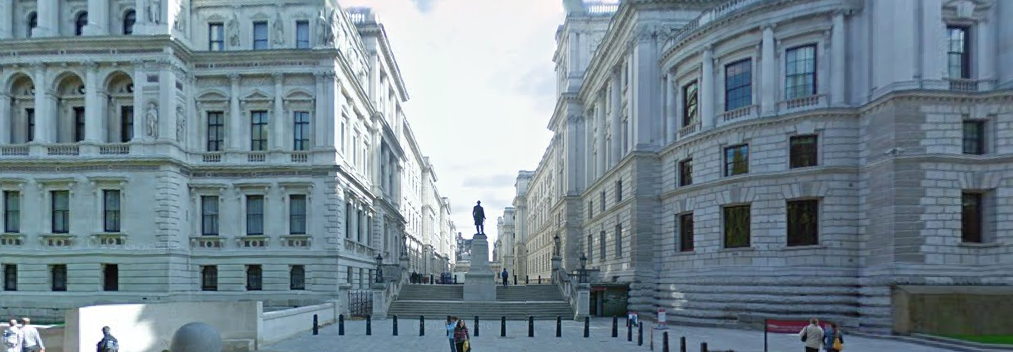
The Heart of Imperial Britain: Clive of India dominates St Charles St with the Churchill War Rooms entrance on the right

The Heart of Imperial Britain: Clive of India dominates St Charles St with the Churchill War Rooms entrance on the right

Filling the splendid Edwardian edifice to the right (built 1908-17) is a formidable collection of fiscal minds who actually run this country. As of September 2013, Sir Nicholas Macpherson KCB, Permanent Secretary to HM Treasury since 2005 (and currently the longest-serving PS in all Whitehall), disposed of the following top staff.

HMTsnrmgmtOstensibly reporting to The Chancellor, George Osborne MP, through Nick (as he is known) this high-powered lot—plus 66 Deputy Director minions—cost us all a cool £3.682m in salaries. As they are all sworn to work for the good of the country, irrespective of party in power (Nick has seen off two chancellors already) this should seem like a snip if it makes the other 63m rich. Except, for some time now a major question has been going unanswered: which country?

On 13 February HM Treasury published a letter from Nick to the Chancellor, advising him against entering into a currency union with an independent Scotland. The publication of personal advice from a Permanent Secretary to a Minister is highly unusual and calls into question just who they are working for.

In the 1970’s HM Treasury was in the thick of a strategy to downplay the importance of North Sea oil so that short-term gain could be made at the expense of SNP attempts to portray it as a vital strategic resource. In the 1980’s HMT was instrumental in selling off UK oil assets and settling for a steady stream of oil tax revenues, rather than be an active participant or to divert earnings into an oil fund, both of which Norway chose to pursue. In the 1990’s, they were up to their starched evening collars in the UK’s disastrous flirtation with the ERM and their scheming abetted Irn Broon’s notorious “pension stealth tax” that reduced the value of retirement funds by at least £100 billion.

So when we roll up to the present day and find Osborne dismissing any currency union and Cameron pitching that the UK is far better placed to develop North Sea oil further—both on the backs of HM Treasury advice, it is time to ask for whose benefit those 90 fiscal super-gnomes are beavering away and look this fiscal gift horse in the mouth. It would be unfair to accuse them of serving the payroll vote like Scots Labour MP always do—habitually rubbishing independence because it threatens both their ego and their job. But it must be hard to see 10% of their domain and most of the oil disappear from their clutches and not be tempted to do what you can to prevent it.

That said, the HMT cohort listed above are products of the formidable British Civil Service; they’re not daft. So let’ds see just how well they have done in general down the years before anyone dismisses the clear recommendations they are giving to keep Scotland in the Union as just self-serving gobshite. First, we’ll examine the outline of the UK economy in the 30 years since Thatcher came to power and oil became a factor in the economy. Then, we’ll compare that performance with a couple of neighbouring countries with and without oil of their own.

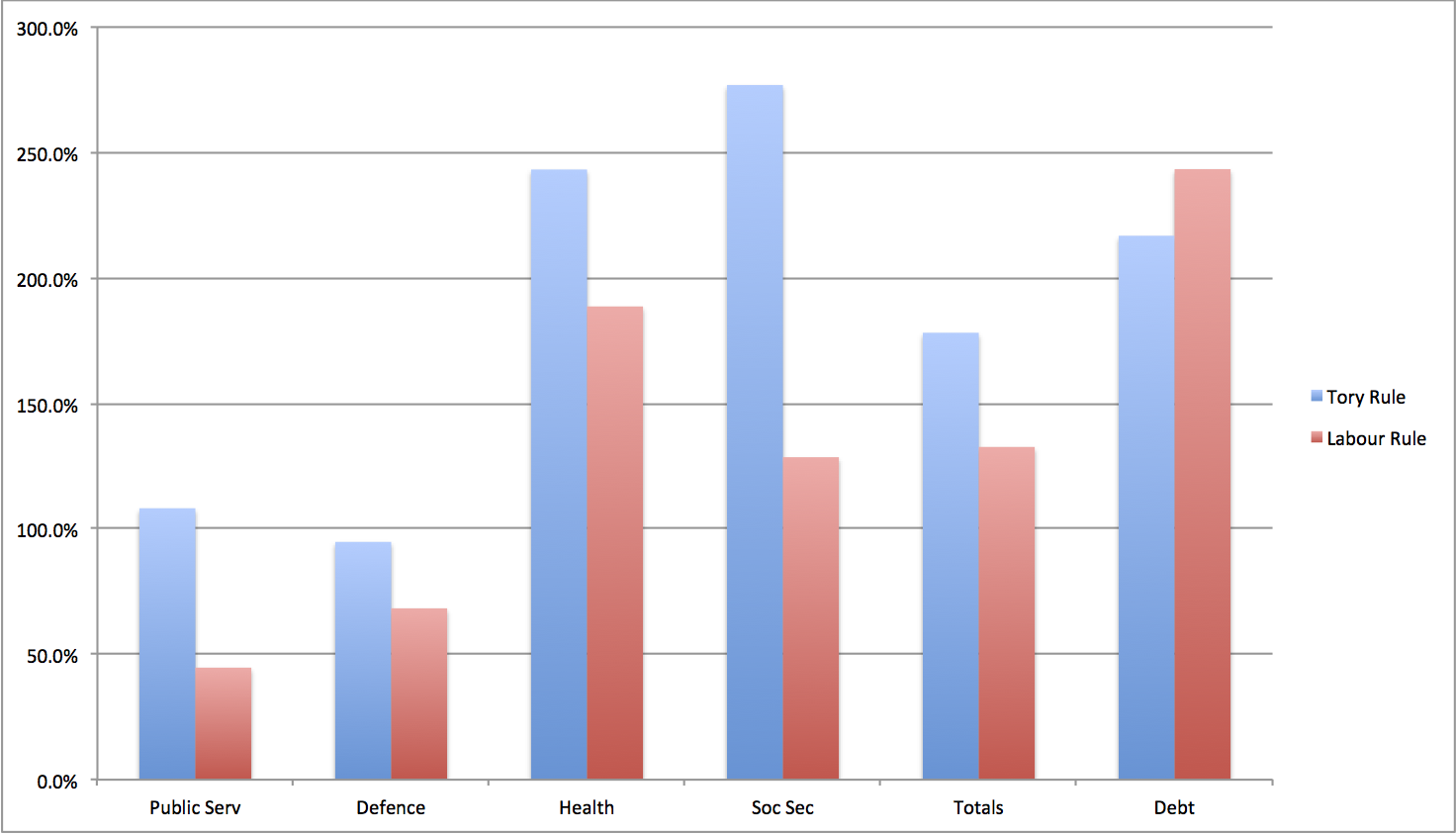
Those 30 years were split between 18 years of Tory rule, dominated by Thatcher, followed by 13 years of Labour rule dominated by Blair. Key elements of government spending from each period are compared in the graph below.
Change in UK Government Expenditure & Debt 1980-2010

Graph 1—Change in UK Government Expenditure & Debt 1980-2010 (Source HM Treasury)

This chart is something of an eye-opener because it shows that ‘small government’ Tories actually increased spending more in every department on their watch, as compared to supposedly ‘tax and spend’ Labour—even  into debt in an attempt to sustain it. Supposedly HM Treasury was providing both governments with their shrewdest advice how best to exploit Britain’s resources (including oil) and standing in the world to maximise the benefits for its citizens. If we compare with nearby small countries, we should be able to see the formidable exercise of shrewdness backed by clout exemplified.

Graph 2—Comparison of Three Small Neighbours to UK 1980-2010

Graph 2—Comparison of Three Small Neighbours to UK, 1980-2010 (Source OECD)

So comparing how expenditure in neighbours increased over the 30-year period under discussion, it can be seen that the UK increased its health spending greater than the others but in every other case (except vs Irish defence spending) lagged behind, even though debt accrued during the period outstripped all three countries. This looks like poor performance, with smaller countries—even those like Ireland, often derided as in an ‘arc of insolvency’ still outstrip the UK is providing for their citizens without mortgaging their future through debt.

However, it could be that small countries suffer, as strange bedfellows like Lamont and Cameron both maintain, from dis-economies of scale, so let’s revisit this from the point of view of spend per capita.
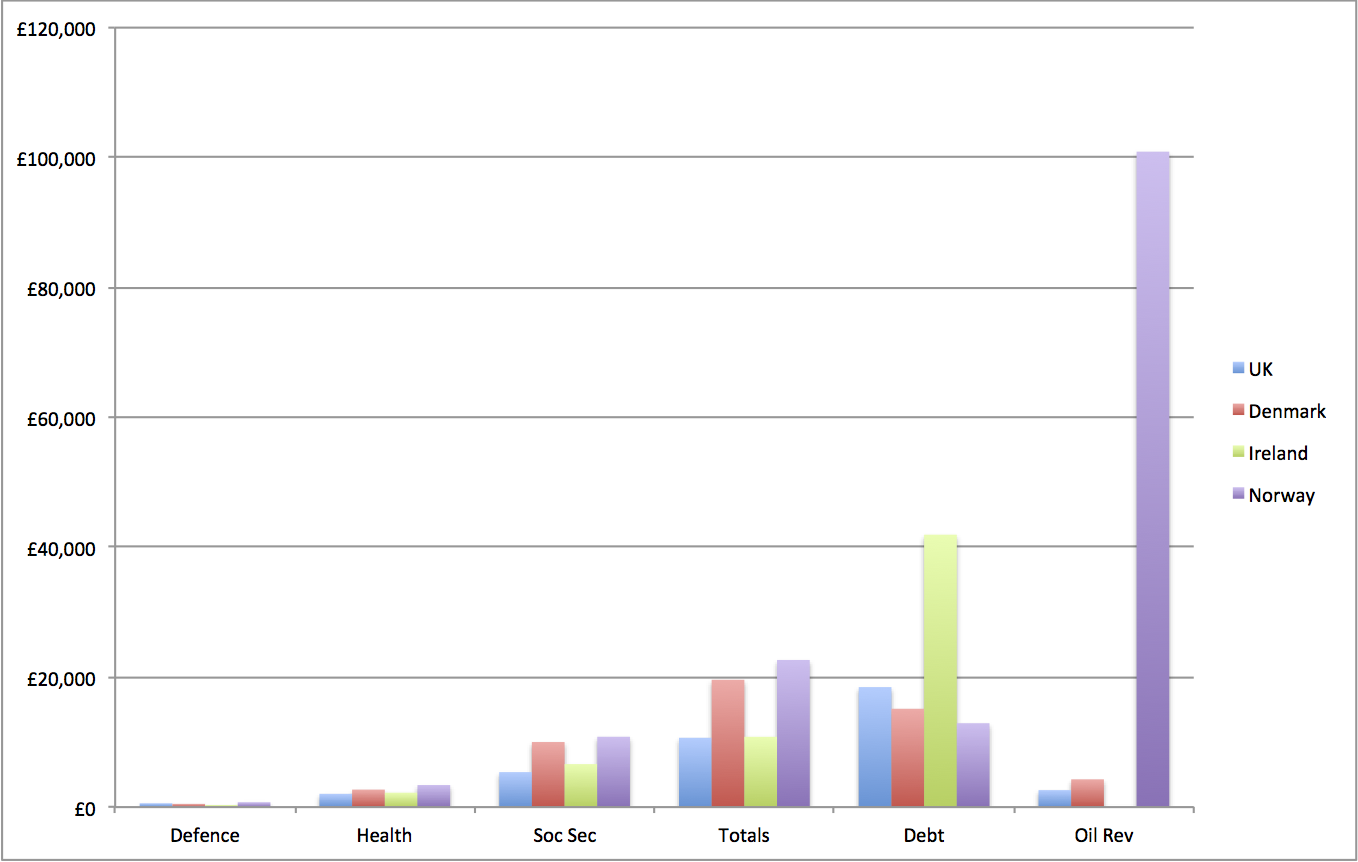
Chart 3—Government Spend and Total Oil Receipts per Capita 2010

Chart 3—Government Spend and Total Oil Receipts per Capita 2010

The salient points from Chart 3 can be summed up as:

  • Norway, Denmark & UK spend comparable sums on defence; Ireland spends barely 25% as much
  • Health spend per head each year is comparable, ranging from UK ‘s £2,042 to Norway’s £3,401.
  • Despite its huge outlays on Social programmes, UK still only spends half the amount Norway or Denmark do to provide theirs
  • Total spending on its citizens in Norway or Denmark is twice that in UK or Ireland
  • Ireland may have eye-watering debt but it has no oil; UK debt is highest of the others.
  • Despite having the largest share, UK taxpayers have benefited least from North Sea oil

Put bluntly, not only does the relative size of the UK seem to have provided its citizens with no advantage over countries one tenth its size but two of the three cases cited beat it on every count and supposed ‘basket case’ Ireland does just as well. There seem to be three plausible explanations for this:

  1. Despite their size, resources and ‘clout’, large countries operate at a disadvantage.
  2. HM Treasury is fiscally incompetent
  3. HM Treasury does not work to benefit all citizens but a subset of them

The sheer economic beefcake that is the USA soon disproves 1. The reputation of the UK Civil service in general and the fiscal wheezes dreamed up by the gnomes of the Treasury to lightfinger ever more money out of unsuspecting punters rather gives the lie to 2.

The most stunning statistic in all the charts and figures is that, while even the Danes have each benefited by twice as much oil revenue as the UK, the Norwegians have fifty-fold; in Norwegian Krone (NKK), they are each millionaires. If you want some detail why that should be, try Dude, Where’s My Oil Money? in the Guardian on January 14th. To quote in part:

“For a few years, the UK enjoyed a once-in-a-lifetime windfall – only, unlike the Norwegians, we’ve got almost nothing to show for it.

“All this was kick-started by Margaret Thatcher, the woman who David Cameron claims saved the country. The party she led still touts itself as the bunch you can trust with the nation’s money. But that isn’t the evidence from the North Sea. That debacle shows the Conservatives as being as profligate as sailors on shore leave.”

Don’t like the Grauniad’s take on the affair—how about the New Statesman?

“…nothing better illustrates her failure to invest in Britain’s long term future than her mishandling of the giant windfall she was gifted on entering Number 10 from booming North Sea oil revenues.

“Tony Blair said in 1987 that North Sea oil was “utterly essential to Mrs Thatcher’s electoral success”. But history should also record that Thatcher missed a trick in not diverting some of the proceeds of oil revenue into an oil fund, like Norway and others did.”

To be un-Britishly blunt: HM Treasury was complicit with Thatcher in making the worst economic decision ever made in the UK. For all their Oxbridge/Civil Service training, the gnomes of King Charles Street blithely frittered away £165bn on “current spending, including covering the costs of large-scale industrial restructuring and funding expensive tax cuts to woo middle England.” Given all that, Chief Gnome Sir Nicholas Macpherson wading in to prop up the Union, though deeply unprofessional and blatantly self-serving, is hardly surprising.

But what is surprising is that Scots are not livid with righteous anger they are not yet sitting on a nice £90,000 nest egg in their own rich, progressive country and are still being lectured by economic pygmies how to squander the other half of their own North Sea oil riches left. Our 90 top fiscal gnomes on their £3.682m in salaries seem dedicated to shafting Scotland in the process. They have form.

The real mystery of the whole sorry story is why we let them.

Posted in Commerce, Community, Politics | Tagged | Leave a comment

Buddy, Can You Spare a Dome?

You have to hand it to Tony Blair. Not only did he shrewdly sidestep the coming fiscal storm in 2007 but then dropped from public scrutiny straight on to the six-figure speaker circuit and hasn’t looked back since.  Sweet. What has helped is his deeply pragmatic view of politics. Though he does not have his public enemies to seek, they are fewer and less vitriolic, compared to the only other 20th century politico hate figure—Margaret Thatcher.

That Thatcher-bashing remains a favoured sport can be explained by her steely vision and inability to compromise,. Whereas Blair, in many ways, went further—reinventing Labour as friend to patrician and proletariat alike, once you bury your principles, it’s much harder for media and/or enemies to pin you to a given point. Thatcher’s mistake was to settle for recruiting the middle class to her standard, leaving most workers thirled to Labour. Blair, on the other hand saw he could take their loyalty for granted while he wooed both the middle class and arriviste rich created by Maggie’s City ‘Big Bang’ and housing bubble.

Even though the hapless Irn Broon reaped Blair’s whirlwind head-on, even he got away with his rape of prudence as chancellor—raiding pension funds; letting the FSA doze at the wheel; inventing social benefits without worrying about long-term financing; pushing PFI (onto councils especially) to keep borrowing off the books and pork-barrel flowing.

In office, Blair was happy to bask in the glow of popular developments, London infrastructure and socially progressive schemes funded by government spending doubling from £250bn to £500bn on his watch. Brown sang descant, milking money left, right and centre. Because everyone’s house prices/salaries were rising, nobody questioned bonanzas. Blair may have stolen much Tory policy thunder but business beamed; ‘Ethical Foreign Policy’ was simply a cover for selling anything to anyone, provided all kept quiet and didn’t rile the Americans.

In those days almost everyone felt they were getting richer and Blair deserves acknowledgement for creating such feelings. He appeared to do this by speaking to voters over the heads of parliament and party with a presidential omniscience that lasted over a decade. It was still intact when he body-swerved out of the limelight. Once the lugubrious Brown was in charge, the Bambi shine went all dull. Yet, despite borrowing to sustain it all when the infinite-money-illusion collapsed, Brown slid off to Kircaldy-les-deux-Églises un-pilloried, if not unsullied.

Blair was not just gifted, his timing was flawless. Brown may claim to have produced over a decade of affluence and growth but mostly he just indulged himself on the proceeds and milked the image of a dour, bankerly Scot as the right man for the economy. People only dimly perceived the extent to which the (then-new) army of spin doctors manipulated  news. Alastair Campbell, Charlie Whelan, John McTernan had a field day selling devolution, peace in Ulster, national minimum wage, saving the NHS and local council education, bringing unemployment down, introducing tax credits, etc, etc.

While some of his team like Mandelson and Irving lost touch, Blair never fell into the trap of hubris, never made McMillan’s mistake of telling people they’ve “never had it so good”. He even managed to deflect criticism by putting Mandelson in charge of the ill-fated Dome as a kind of lightning-conductor, deflecting criticism away from his boss by getting guacamole on his face. Just as well; the NAO slammed the project as a £1bn disaster.

This may have been the highest profile of many profligacies in which Blair indulged. But the one that did  most damage—especially in Scotland—was to revamp the Tory dosh-for the-boys PPP scheme and relaunch it as PFI. Worse value than normal public procedure of borrowing off the PWLB at rates below anything a private company could, it did not show  as government debt. Public bodies like councils doing the borrowing were bluntly told it was “the only game in town” and to find extra money required by themselves.

So detached was this wheeze from socialist principles and damaging to the public sector that its biggest union came out against it and in 2007 published “At What Cost” a report on the aggregate costs of PFI/PPP projects in Scotland. As these contracts last 30 years and take precedence over any other fiscal priorities, such contracts are now playing havoc with  councils’ ability to deal with any fiscal belt-tightening in a balanced manner. In the Executive Summary, Unison points out:

  • Total PFI contracts active in Scotland total £20bn, mostly in councils and NHS
  • Scottish PFI/PPP contracts could be costing around £2.1bn more than conventional funding. That’s twice the spend on the Dome with nowt to show for it.
  • Analysis of official figures from 35 schemes found that estimated public sector
    comparators (PSCs) were 6.4% cheaper than the contractors’ bids.
  • An incredible £3.5 billion ‘insurance’ policy is effectively paid to the private sector to cover risks of things going wrong with the contracts, despite risk being effectively retained by the public sector.
  • None of the above figures take account of higher financing costs in the private sector; Audit Scotland says this could be as much as 10% of total costs in early PFI schools.

It is notoriously difficult to get detailed financial figures for many PFI/PPP schemes due to claims of ‘commercial confidentiality’. Despite approving funding for these schemes, the Labour Scottish Executive of the day claimed it did not actually hold many of the key documents. Details of many of those it did hold are redacted due to commercial confidentiality; other public bodies withhold financial information on similar grounds.

In order to prove that PFI/PPP supposedly provides good value for money a notional risk adjustment is added to the PSC. This usually takes the estimate higher than the PFI/PPP contract. This like an ‘insurance’ policy against problems such as time and cost overruns.
Yet any Minister worth their salary would be able to negotiate a far cheaper policy than
the total estimated £3.5 bn in risk adjustments.

“Unison Scotland estimates the total sum wasted on PFI in Scotland at £5.8 billion, taking into account the whole range of factors listed above.”

So, while many of the New Labour persuasion still think fondly of Blair as the man who won three elections on the trot for the first time in their party’s history and as many of his detractors vilify him for finessing UK into the Iraq War with scant moral justification, his true legacy in Scotland is that he robbed at least two generations of adequate public capital investment just to buy himself glory in those three election wins. I doubt he loses sleep over thinking about what that £5.8bn would buy for Scotland. The answer?:

  • 29 hospitals the size of ERI
  • 244 inner-city high schools of 1,300 pupils (including full S6)
  • 3 new Forth Crossings
  • 2 Denver International Airports (newest in US & 5th-busiest airport in the world)
  • Build Phase I and II of EGIP and upgrade Aberdeen line to express standard—then have the same amount again to revolutionise Scotland railways
  • Dual A9 Perth-Inverness & A1 Dunbar-Berwick, upgrade A96 Inverness-Aberdeen
  • Pay independent Scotland’s share of UK’s £1.5tn debt for first ten years

Or if you prefer to think the way Blair, Mandelson et al thought: 6 Millennium Domes.

Posted in Commerce, Politics | Leave a comment

Learning from History

It was eerie. I had a Friday evening free, fired up a casserole and channel surfed for something better than another yuppie house makeover to watch. And there it was—forty years almost to the day the cusp of change in the British two-party state. Anorak as I am for being able to watch BBC Parliament for more than five minutes without throwing something (including up), here was politics (and broadcasting) in aspic—a whole era of accents, suits and attitudes that looked outdated and seemed as remote as Peel or Disraeli or even Arthur’s Camelot.

Though nobody knew it at the time, the February 1974 UK General Election was the last of a long line of binary tussles between Tweedledum and Tweedledee (not to be confused with Christine Grahame’s Borders constituency) that had driven British politics since the post WW1 self immolation of the Liberal Party. Graphics were hilarious by today’s standards, links were clumsy, with Alastair Burnett and Robin Day desperately picking up pieces and patching in gaps as they anchored a period piece of reporting with ugly cracks and stuffing leaking out the back like an old sofa.

To appreciate its full glory, you had to re-imagine life in the seventies—interrupted by repetitive strikes, living standards wobbling as once-muscular industries were debilitated by the devilish cleverness of Johnny Foreigner. Cities were echoing to glam rock and random explosions as provos and proddies had eternal goes at one another and most of the British Army then deployed to Ulster—to the despair of most of the rest of us. It was not anyone’s finest hour.

So it was weird, if understandable, that half the commentary was about or came from Ulster and the results in its dozen seats. Paisley’s unionists disparaged Fitt’s unionists and both had a go at the struggling SDLP when their real problem came from Sinn Fein. Ian Paisley’s resounding victory was celebrating not with a victory speech but with a psalm. The main story of the election was expected to be the resounding endorsement of Ted Heath’s Tory government who, after suffering years of fractious behaviour from various unions, had called their bluff with an election on the basis of “who rules?”

“Well, not you”, came the people’s response. Yet they also could not raise enthusiasm for the alternative: Harold-Wilson-led Labour who struggled to overturn many Tory-held seats and barely scraped past them with 305 seats to 299. As with every election in modern times until then, the pendulum between the two was all that counted and they totalled 95% of all seats even that time. So, much of the long night and well into the following afternoon was taken up by speculation of coalitions and repeated strutting by Ulster Unionists anticipating the power of being kingmakers.

But there were two spectres at their collective feast. One was the Liberals who, although having a hugely successful election, garnering 6m votes. By spread evenly across Britain as a solid 25% share, they could not translate those votes into seats, winding up with barely a dozen—it was taking over 800,000 votes to elect a Liberal MP. This was discussed across the BBC studio with much wringing of hands and anticipation of voting reform. Aye, right. Bottom line was the Liberals were too weak to be power brokers and the two big party’s stiff indifference still lasts to today.

The other was ignored until well into the following day when the catch-all group of MP’s lumped together as ‘others’ grew too big to be ignored. In this were Selwyn Lloyd the Speaker (whose contest drew much sucking of teeth because both Labour & Liberals had had the temerity to break convention and oppose him) an Independent Labour win at Blyth as a poke in the eye to machine Labour who deselected him for exposing cronyism in the CLP and the usual (at the time) Irish unionist suspects.

This still left an unexpected squad of nationalists—two from Plaid and seven from the SNP—who had gone through rural Tories like a dose of salts, presaging their eventual 1997 wipe-out by 23 years. The import of this was lost on the entire BBC studio crew, who yammered on about LAB/CON swings: none seemed able to escape such binary politics and could only treat Northern Ireland as if it were a separate planet.

So, we had a toothsomely young Esther Rantzen interviewing vowel-mangling Tory toff St John Stevens for holding off his Liberal challenger in Chelmsford, various Tory nabobs dissing the Liberals’ complaint for fairer representation and some frightening union dinosaurs of the era like Jack Jones and Frank Cousins clearly chuffed to see themselves as power brokers now that Heath had thrown down the electoral gauntlet at them.

But there was no outside broadcast interview North of Newcastle, Worse was the level of ignorance displayed, labeling George Reid as ‘David’ and Gordon Wilson as ‘Grahame’. As a piece of metropolitan reporting it is a history lesson both in how simplistically British politics was treated (with the massive, almost kow-towing exception of Ulster) and in how the SNP could build up a significant head of political steam simply by highlighting the complete lack of understanding/sensitivity where Scots were concerned.

Even when the SNP ‘football team’ of 11 was sent to Westminster in the second election in October (that still failed to form a real majority but did unseat Ted Heath and launched Thatcher), Wilson and then Callaghan’s fixation was the cat fight into which British industrial relations had fallen—and that they felt elected to resolve. The naescent surge for independence on the back of North Sea oil was cleverly run into the sand by a scheming Willie Ross as Scottish Secretary and the connivance of the Westminster establishment, culminating in the odious ‘40% rule’ that lost the 1979 Referendum, despite a clear majority.

Watching the whole election unfold explained why so many other things were anguished over but the SNP’s surge was not. As my granny would say: “Aye, they ken noo!”

Posted in Politics | Tagged | Leave a comment

The Devil Is in the Doodle

I have been a fan of the Scottish Parliament since before we failed to get ourselves one in 1979. And, however sanctimoniously two-faced some parties my have been in opposing it and then using it to rescue themselves from well earned oblivion, that all political stripes of Scottish life are in there and arguing their corner speaks for democracy and to Scotland being mature enough to handle such diversity.

That said diversity does not currently stretch to the socialists can be blamed on their fractious nature (so ably lampooned in Life of Brian) or offer much hope to the BNP/UKIP right explained by the less xenophobic nature of the Scots. And the definition of ‘Scots’ can be as loose as you like. In the decade since 1999, 800,000 English came to settle in Scotland. Yet UKIP polled a miserable 0.7% in the 2010 election here vs the 25% they polled in England last month. Maybe it’s our water.

With good nationalist friends, I stood on the steps of the (as it still was) Bank of Scotland HQ steps that summer’s day in 1999, clutching my saltire and lump rising in my throat at the history being made before me. Winnie spoke powerfully of the Parliament being ‘reconvened’ after three centuries in oblivion and Sheena Wellington nailed the mood with a rendition of “A Man’s A Man, For A’ That” that didn’t leave a dry eye in the house.

I won’t rehearse the many unrealistic expectations of this reconvened ‘Pairlimunt’ because that which dissolved in 1707 was no model of representation, biased as it was towards a nobility of questionable nobility (they were still flogging Nova Scotia baronetcies to arrivistes if they could pony up the money) and still more questionable morals. The bulk of those there were more concerned with recovering what they had lost in the ‘gaun wursels’ colonial disaster at Darien the decade before than representing the Scottish people in any broad sense.

But nobody seems to have bothered wondering just what sort of Parliament we do have and—especially as it may wind up running the other 2/3rds of the Scots economy not under its control—it would seem a good time for a little stock-taking. The difficulty seems to be that everyone has already filed into their partisan trenches and got busy lobbing mud at Holyrood or Westminster, depending on which jersey you’re already wearing.

There is no doubt that there has been legislation that meets the elusive simultaneous goals of popular, effective and successful. Land reform; free personal care; smoking ban; rewriting teachers’ contracts come under those heads albeit—as with so much—not with everyone. That said, looking to the areas most affected (1/3rd of budget goes on the NHS and another 1/3rd on local government) precious little hard-headed analysis is done.

Both main parties are to blame for this. Labour managed to fluff the massive opportunity offered by a doubling of budget 1999-2007 to provide anything memorable. The 2001 McCrone agreement with teachers doubled their pay/pension per chalk-face hour, yet has yet to achieve improvement in pupil education. Even larger percentage increases in the social work budgets were swallowed up by ever-wider casting of the social care net so that free provisions—free bus passes; free prescriptions; free personal care—as well as new services—kinship care; compliance with DDA; equalities issues; etc. The system swallowed it all to the point that carers still complain they are under-compensated. They have a point.

But let’s be hard-nosed about some real luxuries. Why should travel concessions apply during rush hours? Or allow travel from Stranraer to Thurso for nothing? Why is there no means test of the annual heating allowance? Those are some simple ones. But if we truly are in a fiscal bind and local authorities are cutting services people value why don’t most charge for parking or special uplifts or park/ranger services? Why does property banding stop at an average-home price? Why do people get discounts on 2nd/3rd/etc homes when they usually rent them out for profit? Even if you’re an NHS fan, why should prescriptions be free and why should those who abuse its laudable impartiality (e.g. using ambulances as taxis) not get charged for their unreasonableness?

Billy Connolly derided Holyrood as a ‘pretendy parliament’. Most of us don’t share that view but, as long as they have no direct responsibility for raising their finances, there is a case to answer how they would do in the ‘real’ world. Full fiscal autonomy would sweep away much gesture politics and get whoever runs the show focused on balancing the books. It might launch civil debate over fundamental changes now being visited on the police/justice systems to prioritise cost-savings there so NHS monies are maintained (even as overheated wards open windows and thousands of meals are binned daily).

It should not take a fiscal crisis to make any government behave responsibly as it discharges its duties of health, welfare and prosperity for all of its citizens. They should be lean, mean and fit for purpose at all times: Olympic athletes do not start training three weeks before the games. But watching FMQs over the last couple of years should make even Labour politicos wonder if the present opposition is in any state to oppose, let alone run a country. The lack of lead in their pencil has let the present government run rings around them and so allow backbenchers the luxury of posing as much as pushing.

If only to release all 129 of ’em from self-importance (despite their doodling) in the chamber, the argument for independence is overwhelming. Not only is it a big, cold world out there but when the going gets tough, the tough get going. In its its formative decade and a half, the Scottish Parliament achieved much. But to overcome radical challenges from this century—and for as long as Westminster fixates on problems of a colonial past—the Scottish Parliament needs to streamline the jalopy—make it faster, leaner, meaner. And when independence does come, know how to drive clever and not make an arse of it.

Posted in Commerce, Community, Environment | Tagged | Leave a comment

C’mon get aff

Appalled as I was at Barrosa’s smug declarations on Sunday’s Andrew Marr Show (complete with sleekit protestations that he “did not wish to interfere”) it seems that I should have been even more appalled at his self-serving position and Marr’s docile acceptance of it.

weegingerdug's avatarWee Ginger Dug

Speaking on the Andrew Marr Show on Sunday, European Commission President José Manuel Barroso repeated the Glesga clippie objection to Scottish membership of the EU – c’mon get aff the bus and get tae the end o the queue.

Funny how it’s only the negative stuff that gets blanket coverage on the telly news isn’t it? Here we go again, a new day and a new scare story, or more precisely an old scare story reheated.  This one has been reheated so often that it’s little more than a toxic mass of bacteria which is unfit for human consumption, but that doesn’t stop the BBC presenting it as a tasty little delicacy.  They think if they coat lies in lard and deep fry them, Scottish people will consume them eagerly.

Barroso is a member of the European Popular Party  He belongs to the same centre-right cabal as the Spanish Partido…

View original post 738 more words

Posted in Politics | Leave a comment

Come Back, Canute: All Is Forgiven

A factor that is constantly overlooked in any debate comparing Scotland with England is the fact that, although the coastline of Scotland dwarfs that of England by a factor of three, it is nonetheless much more stable and not as vulnerable to global warming and to sea level rise that—surprisingly—conspire in Scotland’s favour. But—more importantly—they make the impact of the present flooding pale by comparison with what might come.

It is not just that Scotland has relatively few low-lying coastal areas and considerably more high moorland and mountain terrain. Measurements taken over decades reveal that, while Scotland and Northern England are still rising faster than sea levels, Southern England is sinking at a rate that effectively doubles the rate of sea rise. Many don’t see that as a problem, given sea levels rise by a millimeter or two a year. But that is changing.

There is a general consensus that global sea level rose by 20cm in the 20th century, But there is much speculation that it will be more this century, with many predicting around 40-50cm. Adding in the effect of sinking land would make that figure more like 55-65cm. The equivalent figure for Scotland is half—25-35cm. That alone would test sea defences on the relatively low-lying English coast but have minimal effect on the 10,000km of rocky, mostly mountainous coast in Scotland.

But then consider some less likely but nonetheless real scenarios. The science tells us that warming seas accelerate the process: glaciers don’t regenerate; ice sheets (which reflect much sunlight) melt to expose darker sea (which absorbs it); The Arctic ice sheet has halved in area, opening up the Northwest Passage past Canada in the last two summers. Current estimates are that melting polar ice sheets contributed 11cm to sea levels in just two decades and this is accelerating fastest of all. This is where it gets scary.

The melting of small glaciers and polar ice caps on the margins of Greenland and the Antarctic Peninsula melt, would increase sea level around 0.5 m. But collapse of the grounded interior reservoir of the West Antarctic Ice Sheet (WAIS) would raise sea levelsby 5–6 m. Melting of the Greenland ice sheet would produce 7.2 m and of the whole Antarctic ice sheet a whopping and catastrophic 61.1 m of sea-level rise.

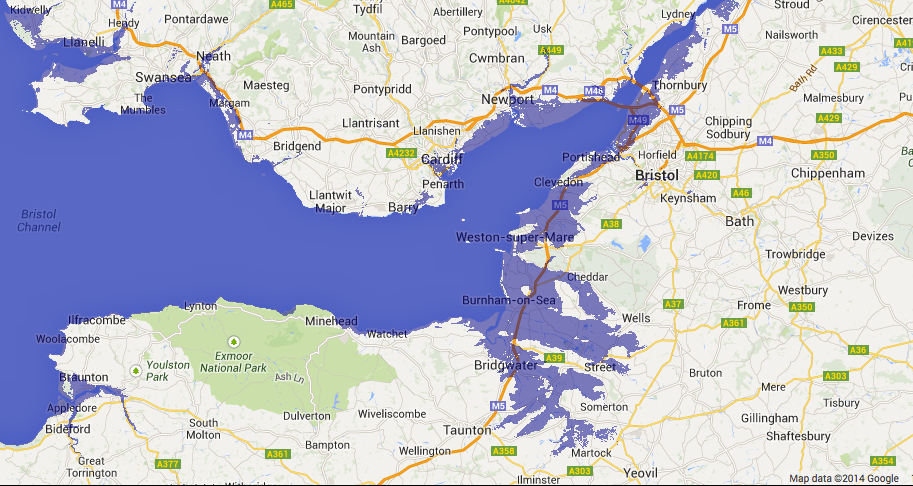
Anyone not living in Tibet or Bolivia ought to be concerned about this. Given recent fracturing of the smaller Weddell ice sheet, loss of the WAIS alone is a distinct possibility for this century and would drown several countries, including the Seychelles, Singapore and most of Holland. In this case, we are talking about an 8m (25ft) total rise in sea level in Southern England. Given the recent demonstration of the vulnerability of the Somerset levels, if the above occurs that part of England becomes shallow sea, much like the Wash.

Effect of 8m Rise in sea Level on Bristol Channel (purple indicates flooded land)

Effect of 8m Rise in sea Level on Bristol Channel (purple indicates flooded land)

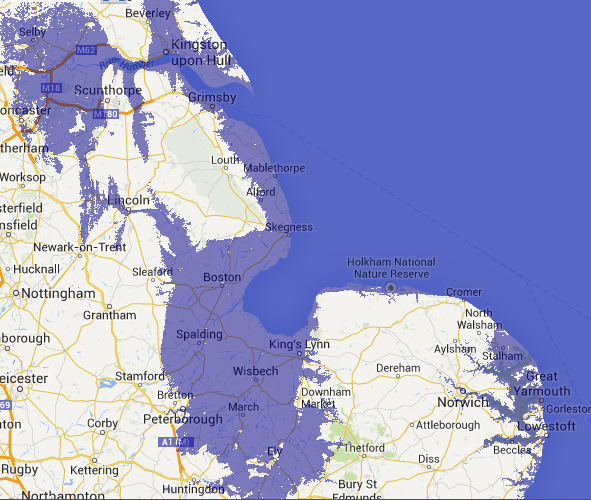
Bad though that is for the folks of Somerset, it is relatively benign compared with the equivalent 8m scenario in Eastern England. That area has not suffered the nearly as much recently as the brunt of recent storms hit elesewhere. But it was hard-hit by the Fen Flood of 1947 and the Great Flood of 1953 which devastated swathes of Essex. This area would actually be hardest hit of all by a steady sea level rise, as shown below.

Effect

Effect of 8m Rise in Sea Levels on Eastern England (purple indicates flooded land

Here the scale is ten times worse, with over a hundred square miles of fertile farmland, hundreds of towns, plus Cambridgeshire and much of Lincolnshire lost to the sea. Though civil engineers could get clever and build big enough to protect the Somerset levels from inundation, such is the sheer scale of vulnerability here that no coherent defence against flooding is feasible.

Though an 8m rise there would not tally up in terms of area like Eastern England, by far the worst flooding in terms of impact would be the Thames estuary. Greater London contributes £280bn to Britain’s economy—roughly one quarter in terms of gross value added and this would be substantially crippled by an 8m rise in sea levels—a situation in which the Thames Barrier would be so overwhelmed as to become little more than a navigation hazard.

Effect of 8m Rise in sea Level on Thames (purple indicates flooded land)

Effect of 8m Rise in sea Level on Thames (purple indicates flooded land)

The entire estuary and docks area, both financial districts, Southwark, Westminster and hundreds of metres either side upriver to Richmond would be flooded and/or tidal. Half the mainline train terminii would be gone, the Tube flooded and the only public transport working would be the Thames catamarans. Massive flooding along the South coast, with coastal towns from Portsmouth to Worthing all gone, Thanet an island again and Uckfield able to build a marina, would be serious but trivial in impact by comparison with London.

Were all this come to pass within the next century, even a large, leading economy such as England’s would be unable  either to absorb its impact, or finance the scale of engineering required to mitigate—let alone combat—biblical disaster on this scale. And though other countries may not be hit as badly in proportion, the global economy would be crippled.

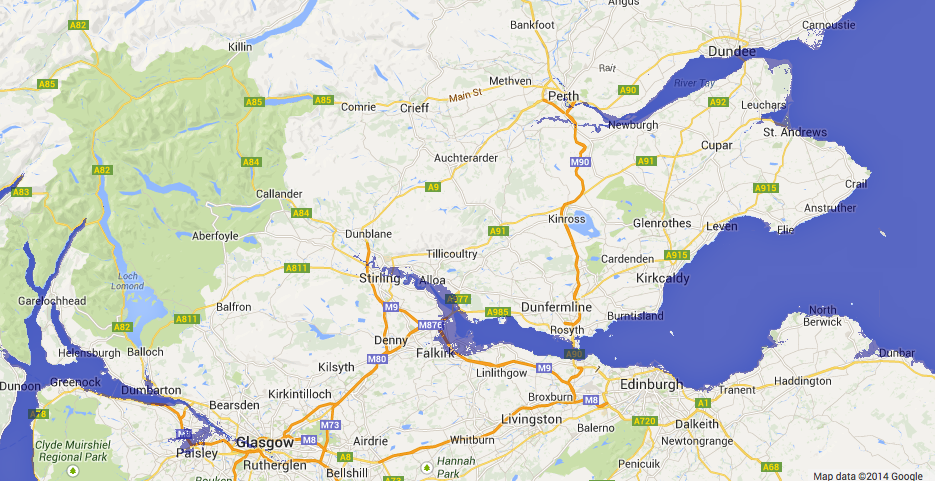
England would need to look to its friends and, since swathes of Europe and the States would also suffer badly, one of the few countries least affected, probably disposed to help and close enough to do so would be Scotland—whether independent or not. Because of its rugged geography and rising landform, the equivalent maps for Scotland, while chilling, do not display anything like the catastrophe shown above for England.

Effect of 8m Rise in sea Level in Central Scotland (purple indicates flooded land)

Effect of 8m Rise in sea Level in Central Scotland (purple indicates flooded land)

Though there will be major problems in Paisley and Falkirk/Grangemouth, some coastal farmland flooded and more robust bridging problems to be faced at Stirling and Perth, given flood defences for the Clyde, some 90% of the country’s economy could, with some adaptation, function normally. Indeed oil platforms are built to withstand waves larger than 8m, the associated storms that we’re seeing now would provide additional renewable power and that will come in handy with all England’s base-load nuclear power stations at Hinkley Point, Sizewell, Dungeness and Heysham knocked out by coastal flooding.

With plenty of space, Scotland would be able to house a significant number of the 8-10 million who would be rendered homeless by the sea. Many would enjoy a new quality of life close to the heart of things, revitalising areas of the Borders, Ayrshire, Fife and the Mearns. Others could find work further north in the booming offshore energy market around Cromarty, the Celtic Sea oil support industries growing up in Wester Ross or around the new Coronish gold mines around Tyndrum. All wild speculation? Perhaps: but a couple of thousand years ago you could walk from Holderness to Hamburg.

So, when (rather than if) Canute does come Cnock-cnock-cnocking on England’s door, there will be—then as formerly—no holding back the waters. But the Scots won’t let them down, provided that—before being struck by tragedy on such a titanic scale—our English cousins  bear such a scenario in mind and remember who their real friends are.

Posted in Environment | Tagged | Leave a comment

A Hard Pounding

Apologies to regular readers for the thinness of posts since the New Year. In part, after three years of steadily posting twice or more a week, it was to recharge the batteries in the pen/keyboard/quill. But equally, there was a seasonal outbreak of both good will—in the shape of positive noises from unionists—and glad tidings—in the shape of polls creeping upward for independence after months of rolling along with little change—so the outrage factor that normally drives new blogs was weakened.

For example, I was encouraged by a different poll last weekend (done by YouGov for Oxford University’s Migration Observatory) that demonstrated Scots culture did not mirror English, despite the much we have in common. Scots were shown to have a much more (if not totally) enlightened view on immigration, which pretty much settled a Twitter debate in which I was involved with Hugo Rifkind and others who feel strongly that Britain is culturally homogenous and therefore indivisible.

Positives had been coming from all the right people and merged into an outbreak of reasonableness after endless collective furrowing of brows that has been dubbed “Project Fear”. Alistair Darling himself, the chair of the No campaign, said that a sterling area between an independent Scotland and the rest of the UK was ‘desirable’ and ‘logical’. In an emotional personal plea during his “Sermon from Olympus”, David Cameron launched a charm offensive aimed at the large Scots diaspora in England to phone up their friends and relatives back home and persuade them not to go.

Those who should know were maintaining an even-handed approach on the tricky subject of sharing the pound, with Mark Carney making a major speech on which he stayed pretty much on the ‘mebbies aye; mebbies naw‘ fence and his predecessor Mervyn King saying: “(The Scots) problem is what the Treasury say now and what they say the day after a Yes vote in the referendum are two entirely different things”.

Clearly some bigwig in the Metropolitan Mafia decided all this was dangerous talk. Now the ‘Big Three’ UK parties are set to deliver a warning to the voters of Scotland that they will not be able to keep the pound if they opt for independence. Chancellor George Osborne is expected to rule out an independent Scotland joining a formal currency union with the UK when he publishes the latest Treasury analysis of the issue in Edinburgh.

It is expected to be followed by statements from shadow chancellor Ed Balls for Labour and Treasury Chief Secretary Danny Alexander for the Liberal Democrats, all making clear that their parties also would not allow Scots to retain the pound. Compared to the earlier sweetness and light, this is clearly a serious mood swing and—to those grateful for the quite affable tone the debate had achieved—rather throws us back into the debate’s dark ages.

While no-one should be expected to hold back in making the case for/against independence as they see it, consider the damage that in ill-tempered debate will have, irrespective of the outcome. Much of the unionist case rests on how much we have in common—from history through culture to interests. Sensible independistas all agree; but then make the case that the relationship would get even better without the ex cathedra arrogance of Westminster we still have to thole as part of the UK.

And here’s the rub: it’s the UK’s pound. The United Kingdom started in 1603 between equals under a common monarch. It was reinforced in 1707 with a grubby little Act that merged not just the parliaments but the finance system and, most relevant to our discussion, the currency. It became the British pound and, though de jure its name stayed unchanged as the Bank of England, de facto this became the British Central Bank, shared between the two, just as Westminster replaced the English parliament.

It is our pound as much as theirs.

If they want to play hardball, that is unfortunate—not just for the unnecessary ill-will it will cause among friends but also because the once great British state will wind up as a much-reduced English state with egg all over its face. Because without Scotland, the 1707 Treaty must be annulled and then there will BE no United Kingdom to be the remainder of. We are not talking about a sliver detaching from the main: this is a partnership and if it ends, it splits down the middle.

Now nobody is arguing it’s a 50-50 deal. The Scots are reasonable; they acknowledge that we now constitute roughly 8.6% of the population (back in the day it was much bigger) and are entitled, on balance, to that proportion of assets. We also acknowledge a responsibility for the fiscal mess Westminster helped get us all into and (so far) accept shouldering our proportion of the £1.5tn-and-growing debt as reasonable. And, if Yes win in September negotiations of the details of this will be long and intense—the billions in government property in London is little use to Scots except for an embassy; the presence of nuclear weapons at Faslane will be a bargaining chip; how the BBC, Network Rail, Met Office, DVLA, etc, etc function must be agreed.

But for the Metropoliticos to pick a fight on currency seems daft. Not only is it not theirs to withhold but the planet is strewn with examples of countries using other countries’ currencies with few problems (and indeed some advantages). The $US is the best example:

  • legal tender in Panama, Ecuador, El Salvador, East Timor
  • in common use in Zimbabwe, Peru, Uruguay, Cambodia, Afghanistan, Canada, Mexico
  • local currency in Bahamas, Bermuda, Barbados, Belize, Lebanon, Hong Kong, Macau all pegged to $US and so fluctuate with it on the currency markets

That’s a population bigger than Britain using someone else’s currency, NONE of whom have a currency agreement with the USA to do so. The US economy is a huge enough economic flywheel in itself for these others to have no appreciable effect on currency value. So, simply using the pound with no agreement is clearly an option, if less desirable.

And it is less desirable for two reasons. One is the fear that UK parties appear to have that the Euro sends a hard lesson about currency union. That may be but the huge difference is that the heart of the Euro economy—Germany—is swamped in size by the rest of the Eurozone, where as England would be 90% of any Sterling zone and, therefore, much more in charge.

The second is basic economics: Scotland is an oil economy; without it, England will see a fall in the value of sterling and, since imports massively outweigh exports there (not so much the case in Scotland) this could even lead to inflation, higher interest as BofE controls kick in and mortgages going to hell in a handcart.

And that’s not even considering what if Scotland gets equally stroppy with England and, for example, wants its nukes out of the Clyde within a year. Are the UK parties sure this is a road towards unhelpful belligerence they want to go down? Because, in international circles stuffy, stuck-up, anti-EU, UKIP-voting England has an image problem against which a high-profile, plucky, friendly, tartan-and-whisky exporting Scotland is golden.

Is it in England’s interest, Messrs Cameron, Darling, Carmichael et al, for you to pick a fight with us at all?

Posted in Commerce, Politics | Tagged | Leave a comment

Scotland Is Not Just Geography

It was Henry de Bohun who changed history catching, as he did, Robert de Brus out in front of his army at Bannockburn on a light palfrey. Despite de Brus’s glancing blow with his battle axe, de Bohun’s helmet held and the heavily armoured knight brought de Brus down, whethupon his schiltron retreated at the first English charge. Instead of their original plan to flank the Scots with cavalry alone, this allowed Gloucester & Hereford to follow up the centre with archers, which decimated Keith and Moray’s schiltrons in succession. Stirling Castle was relieved and, with that, went the last hope of independence.

Treated little different from the recently conquered Welsh, most of Lowland Scotland grew peaceable under great castles built across the Lowlands. Those at Perth, Dundee, Inverdee, The Broch and Inverness held sway over the fertile lands of Angus, Buchan and Moray, since, as at Harlech or Conwy they could be supplied and reinforced from the sea. But those at Dunstaffnage, Inverlochy and Dornie on the treacherous West coast proved not worth the effort for the barren hills of their hinterland.

And so the Albanach were hemmed back in their historic heartland—trackless wastes from Badenoch to the Hebrides while what came to be called the Scots were the english-speaking majority ruled from London, much as the Welsh.

In these new circumstances, Angus Óg MacDomhnaill, who had fought with de Brus, reneged on his father’s subserviance to Alexander III and declared Lords of the Isles to be kings in their own right and reasserted a title stretching back before Somerled to a time before Vikings came. This gaelic-speaking Alba remained a stump of a kingdom, confined the mountainous West. The North Isles and the fertile Caithness and Dornoch lowlands remained to the Earl of Orkney until traded into English control by Gustavus Adolphus.

The English, content with peace and the profitable parts of Scotland, could return their attention to their extensive Angevin empire across Western France, threatened from 1337 on by the Hundred Years War. Though thereby left in peace, the remainder of Alba (the English retained the name ‘Scotland’ for their conquests) remained culturally isolated, having neither ports nor larger ships nor many goods to trade with emerging riches in Europe in the shape of Hanseatic ports and the Low Countries.

With their backs secure and the riches parts of Britain providing the funds, the English were able not only to survive against the more numerous French but at the pivotal siege of Orleans in 1429, were able to break the French, despite all Joan of Arc had achieved and so remained a Continental power controlling effectively the western half of France. So while Constantinople and Granada both fell later that century, making both Spain and Turkey major European powers, the weak Henry VI was able to survive without civil war and prosper.

As a result, England was able to wrest the rich Catholic Netherlands from the Duke of Burgundy, whom the weakened French crown was unable to support. This, together with joint maritime interests shared with the Netherlands resulted in both a Protestant religion in both countries and the three-century-long tussle with the Spanish and Portuguese for overseas trade routes and the colonies to secure them. The Anglo-Dutch total defeat of the Armada off Beachy Head (there being no friendly port on either side of the Channel for their damaged ships to retreat to) secured North America for both powers, even as Spain and Portugal secured South America. But because of English preoccupation with Continental affairs from Gascony to Brabant, they never invested in global trading.

Meanwhile, the Lords of the Isles survived ruling over a backward rump Alba for centuries, meting out justice from their capital at Finlaggan, exercising power through a system of clan chiefs and a small standing navy of birlinns. Aside from fending off the occasional cattle raid, the English largely left them in peace, as they also left the handful of High Kings who ruled segments of Ireland at different times. Both Alba and Ireland lacked the riches of the valleys of the Loire, Meuse or Garonne to repay much attention. But, cut off by England, Alba had been active sending sons of leaders to France for cultivation and these wordly men saw opportunities and developed ocean-going ship types to trade with all the blossoming new colonies.

Having developed coastal ships beyond birlinns to ocean-going types, Alban caravels became the traveling traders of the world, first using ad hoc colonies on Central American islands as bases and then, when they developed into the piratical federation of Caribbea, preying on colonies all along the Atlantic coast, they developed longer-ranged routes with the East via South Africa. A long-term association with Portugal grew up with trade ports from both often established close by, such as Malacca/Penang, Zanzibar/Dar es Salaam Bombay/Goa and Macao/Hong Kong.

The trade profits and maritime skills revolutionised Alba. With plentiful harbours available at home as entrepôts, with a population used to hardship, the Albanach made indomitable sailors and shrewd traders. And whereas the Spanish and Portuguese saw natives as either slaves or competition, the Albanach made peace, learned local survival skills and intermarried so that the network of entrepots they established around the globe all had fruitful hinterlands and willing partners in the natives. So successful did they become that thousands of Irish were recruited to fill shortfalls and all over Islay—not just around Finlaggan became a melting pot of languages from all over the globe.

From a backward collection of islands and isolated glens, Alba passed England in riches per head by the mid-18th century to dominate world trade, becoming the first real internationalists and, effectively, the Phoenicians of the 21st century.


Posted in Education, Politics | Tagged | Leave a comment

My friends wonder why any intelligent Scot would vote Yes

Delighted to see a level of debate that rises above the doom-and-gloom gutter into which Better Together and its Westminster apologists keep trying to drag the debate on the most important decision of our lives.

Posted in Uncategorized | Leave a comment

Derek Bateman: Open Letter to MEPs on EU

I had intended giving readers of this blog a rest from ear-bashing over this season of good will. That has been scuppered (again) by articulate, pertinent points made by Derek Bateman in his incisive questioning of the loyalties of some of our MEPs, as they seem far keener on toeing the party line than reflecting the interests of their electorate—let alone the truth.

____________________________________________________

Open Letter to David Martin MEP and Catherine Stihler MEP (both Lab)

Dear David and Catherine:

Season’s greetings to you both and to your families. I do miss my trips to Europe paid for by the taxpayer. They may come round again for me when I’m appointed Scotland’s Ambassador to the EU in a couple of year’s time. (I have been told I’m ahead of both Alyn and Ian in the queue so it may be worth keeping in with me).

I see you have both been busy over the holiday period in keeping with your reputation as among the hardest working MEPs. In particular, your ringing public endorsement of Jose Manuel Barroso’s assertions about the position of our nation after a Yes vote have been striking and in tone at least leave you open to the charge of relishing the idea of your country being excluded from membership in its own right, an oddly masochistic reaction I put down to confusing two different things – your desire to remain part of the British state by winning the referendum on the one hand and your constituents’ national interests on the other. As we are about to vote this year on our independence and, since continued EU membership is very much the desired outcome for many of us, can you address a few questions for clarity. In this, I’m following the well-worn precedent of European Unionists in demanding answers of the Scottish government before we vote, not to mention the greater precedent of access to truthful information for all citizens in advance of a democratic vote. Here are my questions.

Can you point to the section in the treaties which can be applied to Scotland voting for independence and then subsequently, against its wishes, being expelled? If you are seeking legal clarity on Scotland’s position, will you formally ask the British government to request it from the Commission who have promised to clarify officially but only to the Member State (UK)?

Do you agree with the Foreign and Commonwealth Office that a “precise scenario” for clarification only applies after the referendum vote? (Letter to me from FCO 13/12/13. The ‘precise scenario’ referred to by the Commission can only be presented following negotiations on the terms of Scottish independence from the UK, which can themselves only follow a ‘yes’ vote in next year’s referendum as there is currently no democratic mandate for undertaking such negotiations.

Will you vote for Scotland’s membership of the EU irrespective of how it eventually comes about?

I appreciate it is in your political interest to have your constituents frightened into believing they will become stateless people – the Palestinians of Europe – stripped of their existing rights against their wishes after exercising their democratic right of freedom of expression but surely we are entering uncharted territory now in which the destiny of the Scots is at stake, not just another five years in or out of office. Therefore the ritual dance of claim and counter claim from our politicians – on all sides – should stop.

So, again, where in the treaties governing the European Union does it allow for existing EU citizens to have their country removed from membership, their citizenship revoked, their right to free movement withheld, their financial contribution retained, their subsidies stopped (retrospectively?), their visiting students repatriated before qualifying, their border re-introduced and closed to the single market, hundreds of EU-funded developments halted, and you as MEPs ejected from your elected position?

It seems that Barroso and Van Rompuy – and yourselves – are relying on Article 49 of the TEU which relates to new member states. Scotland won’t be a new state until the negotiations are completed and she will then be endorsed by London so are you saying Brussels will have no involvement of any kind in 18 months minimum of talks between London and Edinburgh and will immediately turn its back on the deal although it’s ratified by the rUK as a Member State?

Even if we adopt that viewpoint, although Article 49 manifestly envisages third countries applying to accede rather than existing ones splitting, my question is: How does Scotland get there? By what process based on which section of the treaties does Scotland cease to be a member? Who decides? Who votes? Is it your argument that the Commission members simply assert that Scotland is outside from a given date and do you as democrats – and as Scots – accept that without challenge? If so, what happened to your commitment to the rule of law and rights of the citizen and all those demands over the years for the institutions to be made more democratic and subject to the parliament? Or do we end up in the Court of Justice possibly under an Action for Annulment, thus:

If any EU country, the Council, the Commission or (under certain conditions) Parliament believes that a particular EU law is illegal, it may ask the Court to annul it. ‘Actions for annulment’ can also be used by private individuals who want the Court to cancel a particular law because it directly and adversely affects them as individuals. If the Court finds the law in question was not correctly adopted or is not correctly based on the Treaties, it may declare the law null and void.

I assure you, I will be the first individual raising such an action, should it ever be needed.

And, if it comes to this apparently unlawful exclusion, will you support it, even if the Scots, whom you both represent, have expressed their desire for independence and will you declare that your obligation is then to fall in behind the people who elect you and take up the fight for Scotland’s right to retain membership?

I would have thought that was self-evident but, David, I remember your enthusiasm for Scotland’s exclusion is quite boundless and you wanted to enshrine it in decisions of the parliament by producing an official report…. “Martin planned to write a report arguing that any new state would be automatically outside the European Union and would be forced to reapply for membership…” 

Why are you so keen to ensure your own country is made a pariah? The trouble I have with this is that it doesn’t sound like a patriotic Scot bringing to bear his vast experience by using the treaties and historic precedent to warn of the implications of a vote. Rather it has all the marks of a zealot hungry to find any means, lawful or otherwise, of creating difficulty for his own people…not to mention the democratic rights of our fellow European citizens in Catalonia. When did your fealty to the British state overtake your socialist instincts for peoples’ rights, subsidiarity and internationalism?

How is it that you can champion over many years the rights of Palestinians to their own homeland run by themselves even when it brings you into direct opposition with the Israelis, yet you campaign from other side when your own people aspire to the ultimate expression of nationhood – independence? In principle, I don’t think the two are so very different and at the very least, Scots and Palestinians are entitled to hear the truth about their position from those who represent them rather than find those same representatives are in effect running a campaign against them. (How else do explain your position of insisting – and working to demonstrate – that Scotland will be outside the EU? And why have the Labour MEPs done nothing to seek an alternative view, a more creative approach which is already being preached by voices in other member states and briefed by the EU’s own lawyers?)

I notice too that in working to get the institutions to oppose Scotland’s membership, it is your custom to refer to the nation of Scotland as a “region of the EU”. I suppose that is the reality of our place in the UK but I know of no Scot, Unionist or Nationalist, who talks on an international stage of his or her country as a region. Does this provide us with a clear insight into your own personal view of the Scottish nation as less than other countries and unworthy of statehood?

I fear the politicking in this debate is obscuring the reality which is the inclusive impulse of the EU since inception, a principle I know you subscribe to which makes your insistence that the Scots must be denied an odd one.

The risks for those of you promulgating this stance is two-fold. One, the anger at the embarrassment this obstructionism to Scotland – and Catalonia – is causing to the reputation of the EU as a democratic alliance spills over and other countries openly challenge the institutional orthodoxy or, even more likely, an insider leaks the outline legal viewpoint which contradicts it. Second, the Yes campaign wins and the truth is revealed in real time as negotiations begin. In neither case do the Barroso adherents win, or deserve, anything but the contempt of the international community and, more pertinently, the scorn of the Scots. Not much of a legacy, is it?

Happy New Year

Derek

Posted in Politics | Tagged | Leave a comment