Poll Position

Today finally came and, with it, a climax of energy that has been building across Scotland over the last two years. I can’t claim to have much of a clue of what’s going on elsewhere (I’ve heard that a phalanx of women marched into a Glasgow polling station singing ‘Flower of Scotland’) but I have been round all six polling stations in my North Berwick Coastal ward and am mightily impressed with what I found.

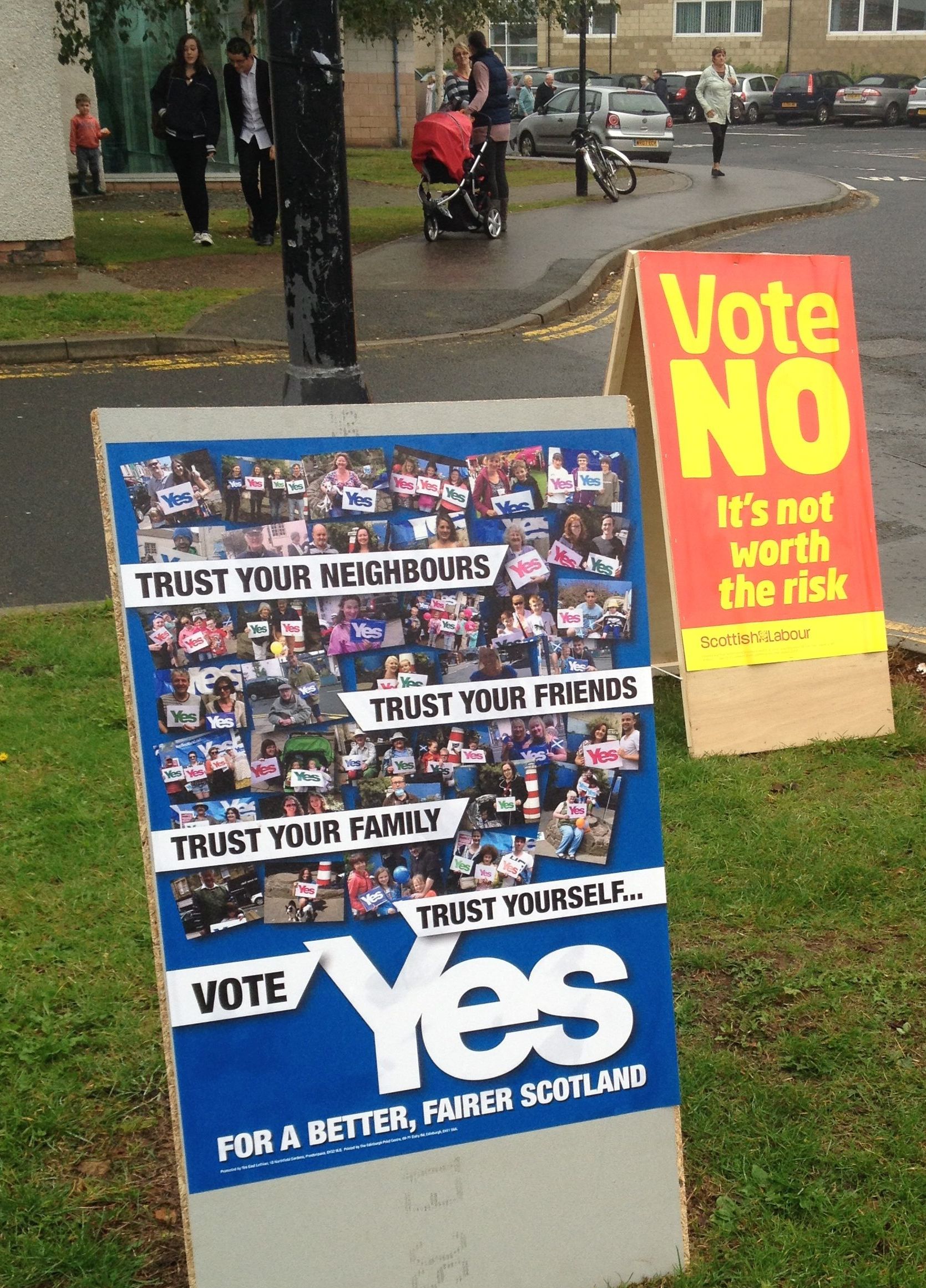
First of all, the customary boards were there in greater numbers and, in the absence of candidates and parties to promote, are actually carrying messages. These two at North Berwick seemed to sum up the differences between the campaigns.

YES and NO Campaign Boards, North Berwick Polling Station

YES and NO Campaign Boards, North Berwick Polling Station

I have stood at polling stations for every election in this area since 1994 and have never seen what I saw today. Turnout is immense; normally sleepy Gullane had a queue out the door, across the car park and part-way up the street when it opened at 7am. The 20% of all voters have sent 95% of their ballots in and still they were pouring through the doors.

But much more than at party elections, people were bringing their kids, stopping to chat, making the whole event more carnival-like. This feeling was heightened at North Berwick in the early evening when three rather fine young pipers showed up and started entertaining both the poll gate checkers and the flood of people going in to vote. Only the wee dug seemed perplexed by the noise.

Three Pipers play. NO on the left of the door YES on the right

Three Pipers play. NO on the left of the door YES on the right

At Whikeirk, a resolute YES supporter staked out the place where no party has ever thought it worthwhile to do so before (barely 300 voters) but there she was with her camper chair, brolly and flask of coffee. At Aberlady, the same Presiding Officer of two decades of elections there was saying he’d seen many people he knew who had never been to vote before—some had to be guided in as it’s the most difficult polling station to find.

In Gullane, the douce ladies with the blue NO rosettes seemed particularly discomfited by having non-local NO ‘colleagues’ in red NO rosettes so close for so long. In fact that was a theme common around them all—NO presence far higher than any single party manages at a normal election. But, more than that, a high level of anxiety, if not actual stress among NO workers that seemed entirely absent from the YES side. Some worked it out of themselves with intense conversations, largely with YES workers who, in turn, seemed relaxed…but were having trouble coming to terms with no longer being the underdog.

Two hours to go on a two year campaign and the word from East Lothian is that everyone deserves credit for engaging with the public and galvanising them to participate on a scale that may be unprecedented. Since it is such an important vote, it’s a real victory for democracy. Incidents of egging, shoving and heckling did occur—but what other country has come this close to independence with no deaths and no injuries stemming from it?

And, if the turnout does exceed 80%—as it well might—that will make any relatively close result (e.g. 52% to 48%) still be conclusive so we can all wake up on Friday as friends and get on with the next phase of Scotland’s future. But, down our way, despite emotions running high, this election went off splendidly—so splendidly that the local polis had a chance to take their eye off roit control and get themselves a decent selfie.

SOme of Lothian's Finest Allow Themselves to Get into the Indyref Mood.

Some of Lothian’s Finest Allow Themselves to Be Distracted into the Indyref Mood.

Posted in Community, Politics | Tagged | Leave a comment

Chiels That Winna Ding

This last week of the referendum debate has grown ever more heated. Despite 99% of those engaged in campaigning keeping the heid, there have been some idiots on either side. Even some intending no malice have had their exhuberence seen as intimidation by  opponents. But, given what’s at stake and the sheer scale of activity, we should perhaps be grateful that the worst violations of good grace have been limited to robust heckling and at least one egging.

There has never in history been an independence movement like this—come so close to succeeding without serious personal injury, let alone any loss of life. Whichever side wins, once emotions cool both sides will look back on this with pride, irrespective of outcome.

But part of the problem has been debates too light on facts. Both sides have been guilty of this—the Yes campaign declining to answer gaps in the White Paper and the No campaign projecting doomsday scenarios for which it failed to provide much evidence.

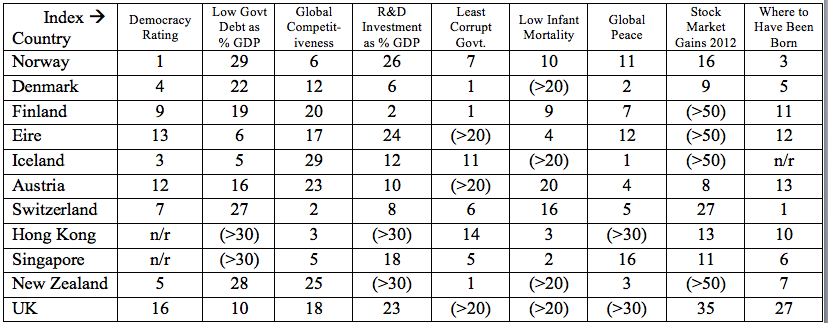
So, before the polls open and the hour grows too late, allow me to distill a series of hard facts, as gleaned by the respected Economist Intelligence Unit, comparing countries on a number of key parameters of success for its citizens. Most are extracted from their World in Numbers 2012 booklet. Together, these rankings summarise which countries are successful in bringing a rich, safe, comfortable and fulfilling life to its citizens.

Brought together in the table below are ten countries roughly comparable to what Scotland might become as an independent nation and the UK as a whole. While there is no clear winner, these cold numbers make it abundantly clear how much more successful these Scotland-sized nations are in every category. Any conclusion drawn on Scotland’s future must include consideration of these facts that are, in Burns phrase, chiels that winna ding.

Comparison of UK vs Scotland-Sized Countries (Source: Economist

Comparison of UK vs Scotland-Sized Countries (Source: The Economist)

While it may be difficult to see which country does come out on top, it is most certainly not the UK. But the whole point of independence is for a country to choose its own destiny and not live by someone else’s priorities. Socially-conscious Scandinavia to bustling Singapore is all possible but we’re bonkers together.

Posted in Politics | Tagged | Leave a comment

Wee Blue Book: Currency/Pensions

In this third installment from the Wee Blue Book, the two main targets of Project Fear are debunked. Clearly the use of a stable currency is vital to any country’s prosperity but it is equally clear that Westminster has created this straw man for their own purpose. As the security of pensions is a vital issue to people as they age, sowing uncertainty about their future is a similar bid for the normally reliable pensioner vote.

Currency

The No campaign’s most repeated scare story is that an independent Scotland wouldn’t be able to keep the UK pound. This is a categorical lie. Sterling is what’s known as a “fully-tradeable” international currency, which means that any country can use it if it wants to, without requiring the UK government’s permission.

So even if the threats made by George Osborne (and backed by Ed Balls and Danny Alexander) that Westminster would refuse a formal currency union were to turn out to be true, nothing could stop Scotland from continuing to use the pound.

Many economic experts actually believe that using Sterling “unofficially” would be a BETTER plan for Scotland. In February this year Sam Bowman, research director of the world-renowned Adam Smith Institute, said:

“An independent Scotland would not need England’s permission to continue using the pound sterling, and in fact would be better off using the pound without such permission. An independent Scotland that used the pound as its base currency without the English government’s permission would probably have a more stable financial system and economy than England itself.”

Professor Lawrence White of the Institute of Economic Affairs agreed, noting that while informal use would leave Scotland without a national central bank, such an arrangement can actually be a positive:

“The possibility of banking panic justifies having a central bank only if it can be shown that panics are more frequent and severe in countries without central banking than in countries with central banking.”

The evidence actually points the other way.

An official lender of last resort can unintentionally worsen the problem of banking panics if it makes explicit or implicit bailout guarantees that encourage banks to take undue risks”

In any event, most experts agree that the Unionist parties’ position is a bluff. In March 2014 Janan Ganesh of the Financial Times (and formerly of The Economist), who also wrote a biography of George Osborne in 2012, told the BBC’s Sunday Politics that:

“If the Scots vote for independence, of course a deal will be done on the currency, because it’s not in London’s interests to have a rancorous relationship with Edinburgh.”

He was commenting after an unnamed UK government minister told the Guardian:

“Of course there would be a currency union”

A few days later the University of Glasgow’s professor of economics Anton Muscatelli – a former consultant to the World Bank and the European Commission, a current adviser to the House of Commons Treasury Select Committee on monetary policy, and former chair of an independent expert group for the Calman Commission on devolution – also said the UK government was bluffing, in a piece for the Financial Times explaining why refusing a currency union would be a reckless and irresponsible move:

“A successful currency union would actually be in the interest of both sides – and especially the rest of the UK. The most damaging prospect to the rest of the UK from rejecting a sterling currency union is what it will do to its own trade and business activity. Whatever the political tactics involved, it would be tantamount to economic vandalism.”

No matter what happens after a Yes vote, whether the UK government agrees to a currency union or not (although the overwhelming likelihood is that it will), Scotland WILL keep the pound. Because of the nature of Sterling, this is one of the few aspects of the debate which can be absolutely, unequivocally guaranteed.

Pensions

Pensions are a matter of great concern to many Scots, and as a result the No campaign spends a considerable amount of its time trying to frighten people into believing independence represents a threat to their pension. Yet as with currency, pensions are one of the few aspects of the independence debate about which it IS possible to state the position with certainty.

For example, Labour MP Ian Davidson, chair of the Scottish Affairs Select Committee, made these comments in the House Of Commons in May 2014:

“The state pension of any individual in Scotland, in the event of separation, would not be adversely affected […] they would continue to get the level of state pension, the same as everyone else in the UK… people themselves can be assured that their pensions are secure.”

Mr Davidson was reflecting a statement to the committee by UK government pensions minister Steve Webb, which was reported in the Scotsman the same day:

“State pensions would still be paid after independence, a UK minister has told MPs, despite concerns raised by the Better Together campaign.”

Giving evidence to the Scottish Affairs Select Committee, Lib Dem pensions minister Steve Webb said that anybody who had paid UK national insurance would be entitled to their state pension whatever the outcome of the referendum.

The intervention contradicts concerns raised by former Labour Chancellor Alistair Darling, the leader of the Better Together campaign.”

And in any event the facts had been well established long before then, with the Department for Work and Pensions having made a similar statement in January 2013:

“If Scotland does become independent this will have no effect on your State Pension, you will continue to receive it just as you do at present. Anyone who is in receipt or entitled to claim State Pension can still receive this when they live abroad. If this is a European country or a country where Britain has a reciprocal agreement they will continue to receive annual increases as if they stayed in Britain.”

Public sector pensions will be equally safe. In May this year Neil Walsh, the Irish-born pensions officer for the Prospect trade union (which is neutral on independence), conducted a conference call for union members to explain the ramifications of a Yes vote to the union’s members, and others in a similar position.

“If you [are] a member of a public service pension scheme that’s already delivered by a Scottish administration – and that includes the NHS, teachers’ pension scheme, fire authority, local government pensions – then literally I can’t imagine what would be very different under independence because you’re already having your occupational pension delivered by a Scottish administrator.

“The responsibility for each and every one of those schemes, NHS, teachers, police, fire and local government, would be taken over by an independent Scotland and continue to be delivered in precisely the same way that you’ve always been used to.”

On the subject of UK-wide public sector pensions, such as those applying to the armed forces and civil service, Walsh noted that negotiation would be required between governments, but that nobody should worry and members wouldn’t notice any change:

“The Scottish Government says the most appropriate way to divide up responsibility is for them on independence to take responsibility for the state and public service pension of anybody who lives in an independent Scotland at that time, the UK Government says that that might not be the most appropriate way.”

But I don’t think anybody says no-one will become responsible for your public sector pension after independence. It would be a matter for negotiation behind the scenes, and actually you as a member should just continue on paying your contributions seamlessly if you are an active member or receiving your benefits seamlessly if you’re a pensioner member.”

Private workplace pensions are the only area of uncertainty. EU rules impose funding requirements on pensions operating across national borders, which would apply to any UK-wide scheme.

However, there are numerous options available to circumvent this problem, the simplest of which is for the firms operating the scheme to set up a Scottish office and handle the Scottish and rUK sides separately. The decision as to which solution to adopt will be one for each company to make individually. Unfortunately it’s simply not possible to answer generically or in advance.

(In previous cases affected by these rules, such as between the UK and Ireland, the governments concerned have been able to make transitional arrangements while matters were sorted out. Unfortunately, the Westminster government refuses to discuss such arrangements before the referendum.)

But perhaps more to the point, staying in the UK doesn’t guarantee anything about pensions.

  • Gordon Brown’s infamous “pension raid” shortly after he became Chancellor in 1997 has so far cost UK pensioners £118 billion, or about £12,000 each, and will continue to cost them money every year until the day they die.
  • the UK plans to increase the state pension age to 70 for both men and women. Some people, particularly women, have already seen the age they expected to start receiving their pension increase by five years under changes by both Labour and Tory governments.
  • in June 2013, a report from the National Pensioners’ Convention revealed just how badly-served the UK’s pensioners have been by Westminster:“According to the latest figures from the Office for National Statistics, British pensioners are among Europe’s poorest, with more than two million older people at risk of poverty.

    The UK was ranked fourth from bottom out of 27 European countries, with more than one in five (21.4 %) of older British people classed as being at risk of poverty in 2010; significantly higher than the EU average of 15.9%.

    The main reason for this situation stems from the UK’s inadequate state pension system. According to the latest EU comparisons, the adequacy of the UK state pension in relation to the country’s average wage ranks it at the bottom in a list of 25 European countries.

    For the average earner, the UK replacement rate of 17% is far below the EU average of 57%.”

The idea that a No vote provides either security or certainty over pensions is simply a myth. Nobody can say what the next government England elects will do.

Posted in Politics | Tagged | Leave a comment

Wee Blue Book: Economy

This second installment from the Wee Blue Book addresses an area over which considerable debate has raged. The economy underpins every aspect of Scotland’s future. In the interests of objectivity on so crucial a matter, this section has received a fiercely partisan—but nonetheless considered and articulate—critique from Kevin Hague’s Chokkablog.


The choices that any independent Scottish Government makes, and whether those choices will be easier or harder than those faced by a devolved Scottish Government, will be dictated by how much money is available. For that reason, the UK government and the No campaign desperately want you to believe that Scotland would be poorer as an independent country, and that it would therefore have to raise taxes and/or cut public spending to protect services.

But that simply isn’t true. In fact, it’s not even close – the Financial Times stated unequivocally in February 2014:

“An independent Scotland could expect to start with healthier state finances than the rest of the UK.” Scotland subsidises the UK by billions of pounds every year, and has done for many decades. On the rare occasions when it’s forced by Parliamentary rules to tell the truth, the UK government admits that fact plainly.

On 27 March 1997, the Herald newspaper reported:

“Mr William Waldegrave, Chief Secretary to the Treasury, has been forced to concede figures in Commons questioning in recent months, which show that if Scotland’s share of North Sea revenues had been allocated since 1979, then the net flow in favour of the Treasury from north of the Border ran to £27bn.”

The Herald went on in the same article to note that Mr Waldegrave (the 1997 ministerial equivalent of Danny Alexander) later admitted to the House that the real figure was even higher, at £31 billion over the 18-year period.

The extent of Scotland’s wealth after the discovery of North Sea oil in the 1970s was so great that successive Labour and Conservative governments hid it from the Scottish people for three decades. When a 1975 analysis for the UK government by economist Professor Gavin McCrone was finally made public in 2005 after a Freedom Of Information request, The Independent newspaper reported:

“An independent Scotland’s budget surpluses as a result of the oil boom, wrote Professor McCrone, would be so large as to be ‘embarrassing’.
Scotland’s currency ‘would become the hardest in Europe, with the exception perhaps of the Norwegian Kronor.’ From being poorer than their southern neighbours, Scots would quite possibly become richer. Scotland would be in a position to lend heavily to England and ‘this situation could last for a very long time into the future.”
In short, the oil would put the British boot, after centuries of resentment, firmly on the foot standing north of the border.
Within days of its receipt at Westminster in 1974, Professor McCrone’s document was judged as incendiary and classified as secret. It would be sat upon for the next thirty years.”

The pro-Union economist Professor Brian Ashcroft (husband of former Scottish Labour leader Wendy Alexander) calculated in July 2013 that had Scotland been independent since 1981, it would by now have an accumulated basic budget surplus of at least £68 billion. The real figure, including interest and other benefits, would likely be an “oil fund” of well over £100 billion.

But instead of that huge surplus, Scotland is part of a UK with a massive £1.4 trillion debt – our population share of the debt is approximately £118 billion.

In short, membership of the UK for the last 32 years has left Scotland anywhere from £180 billion to £250 billion worse off than it would have been as an independent country. Thanks to Westminster we’re massively in debt, where we should have had money in the bank.

There’s no point crying over spilt milk – that’s all in the past. (Although the vast subsidy Scots have paid to the UK could still play a big part in reducing how much of the UK’s debt Scotland takes on in independence negotiations – see Chapter 5) But the fundamental economic facts making Scotland stronger than the UK are the same now as they’ve been for the last 40 years, as the Financial Times observed.

Unionists don’t care about that. In February 2014 the Labour MP for Lanark and Hamilton East, Jim Hood, stood up in the House Of Commons and said:

“If the Scottish people are going to be better off economically etc, I would still be against breaking away from the Union.” (and video)

But Scottish Labour MPs can afford not to care. They’ve got safe jobs for life (Jim Hood has a 13,000 majority and has been in place for 27 years) and they get to decide their own salaries. If you’re living in Scotland and you DON’T have an MP’s lavish expense account and gold-plated pension to fall back on, you probably do care whether you and your family would be better off or not.

Scotland can’t afford to keep paying tens of billions of pounds over and above its fair share. The simple fact is that by any reasonable calculation, and even BEFORE the effect of different policies (such as scrapping Trident) is taken into account, Scotland will have more money as an independent country than it does as part of the UK.

Questions

Q: “But isn’t UK government spending higher per person in Scotland?”

A: Yes, it is. But Scotland pays for every penny of that spending and more besides. As the Financial Times article from February points out:

“Although Scotland enjoys public spending well above the UK average – a source of resentment among some in England, Wales and Northern Ireland – the cost to the Treasury is more than outweighed by oil and gas revenues from Scottish waters.”

On average, UK spending is around £1,200 higher per person in Scotland than in the UK as a whole. But on average Scotland sends £1,700 more per person to the UK in taxes. We only get back around 70% of the extra money we send to London. The other 30% is kept by Westminster and spent in England, Wales and Northern Ireland.

Q: “But doesn’t Scotland get more money spent on it than it generates in tax?”

A: Sort of. In 2011-12, for example, Scotland generated roughly £57bn in tax and had £64.5bn spent on it. But that extra spending isn’t a generous gift from the UK – it’s borrowing, taken out by the UK government in Scotland’s name. It’s not money from the rest of the UK, it’s money from international banks – it becomes part of the massive debt referred to above, and Scotland has to pay it back.

(And we have to pay it even if we didn’t need or want the things it was spent on – like nuclear weapons, the London Olympics and the HS2 railway from London to Birmingham, all of which Scotland pays billions of pounds towards because Westminster claims they’re for the benefit of the whole country.)

The gap between what a government gets from tax receipts and what it spends is called a deficit, and almost every country on Earth (except Norway and Switzerland) has one. It’s a normal state of affairs – it’s just how modern governments work, though the No campaign likes to make out that Scotland would be the only country in the world with a deficit.

Scotland’s deficit is in fact considerably smaller than the UK’s – in 2011/12 the UK’s deficit was £126bn, making Scotland’s population share of it £10.6bn. Yet Scotland’s own deficit that year, according to Alistair Darling, was only £7.6bn.

In other words, in just one year Scotland had to take on an extra £3bn of the rest of the UK’s debt, as well as all of its own.
For perspective, £3bn is roughly three times the cost of free university tuition (£590m), free prescriptions (£60m), free bus passes for pensioners (£180m) and free personal care for the elderly (£200m) combined.

Most of Scotland’s deficit (roughly £5bn a year, or two-thirds of it) is in fact made up of UK debt repayments. We only have to pay that because we’re in the UK and the UK keeps loading extra debt onto Scotland, even though Scotland already pays far more than its share.

The facts are clear – the longer we stay in the UK, the worse Scotland’s deficit and debt will get.

Q: “But what if there was another banking crisis? Scotland couldn’t afford to bail out the banks.”

A: That’s simply not how bank bailouts work. There have been numerous bailouts of banks across Europe and the USA in the last few years, and they’ve all operated under the same principle – governments fund the bailout proportionate to the business the bank does IN THAT COUNTRY.

So if a bank is based in Scotland but does 90% of its business elsewhere, the Scottish Government would only be liable (if it chose to bail out the bank at all) for 10% of the bailout. That’s why, for example, the US Federal Reserve contributed an eye-watering £640 billion to save Barclays in 2008, despite Barclays being a UK bank registered in London.

Q: “But won’t independence create barriers to trade with the rest of the UK, which will damage the economy?”

A: No. Scotland and the rUK will both remain inside the European Economic Area (EEA), a free-trade zone which incorporates both EU and non-EU states.

Q: “But aren’t those figures about a wealthy Scotland mostly from the boom years of North Sea oil? Isn’t the oil running out and getting harder to extract and less profitable now?”

A: For most of the 1990s the price of oil was around $20 a barrel, but it’s been consistently over $100 for the last two years. The price of increasingly-rare commodities on which the world depends tends to go up, not down. But don’t listen to us – how about the Investors Chronicle (part of the Financial Times group), which in July 2014 told its readers to buy shares in oil company EnQuest, saying:

“We think that Westminster has been deliberately downplaying the potential of the UK Continental Shelf (UKCS) ahead of September’s referendum on Scottish independence.”

Unionist politicians are desperate to talk down Scotland’s oil wealth, for obvious reasons. As we’ll find out later in this book, they’ve been doing that for most of the last 40 years. If you want an honest, impartial assessment, ask the people whose living depends on making money out of it. Because unlike the government, they can’t afford to lie to you.

Posted in Commerce, Politics | Tagged | Leave a comment

Wee Blue Book: Principles and Politics

In the run-up to the referendum, the media din and dubious behaviour of politicians and even seasoned journalists who should know better have made it harder for those still to make up their minds where to garner relevant data. As a committed Yes supporter I do not pretend to achieve total objectivity. But the Wee Blue Book, published by Wings Over Scotland comes as close as I have seen to a rational analysis. Look for installments of the booklet here in the run-up to Thursday. The first section is Principles and Politics.

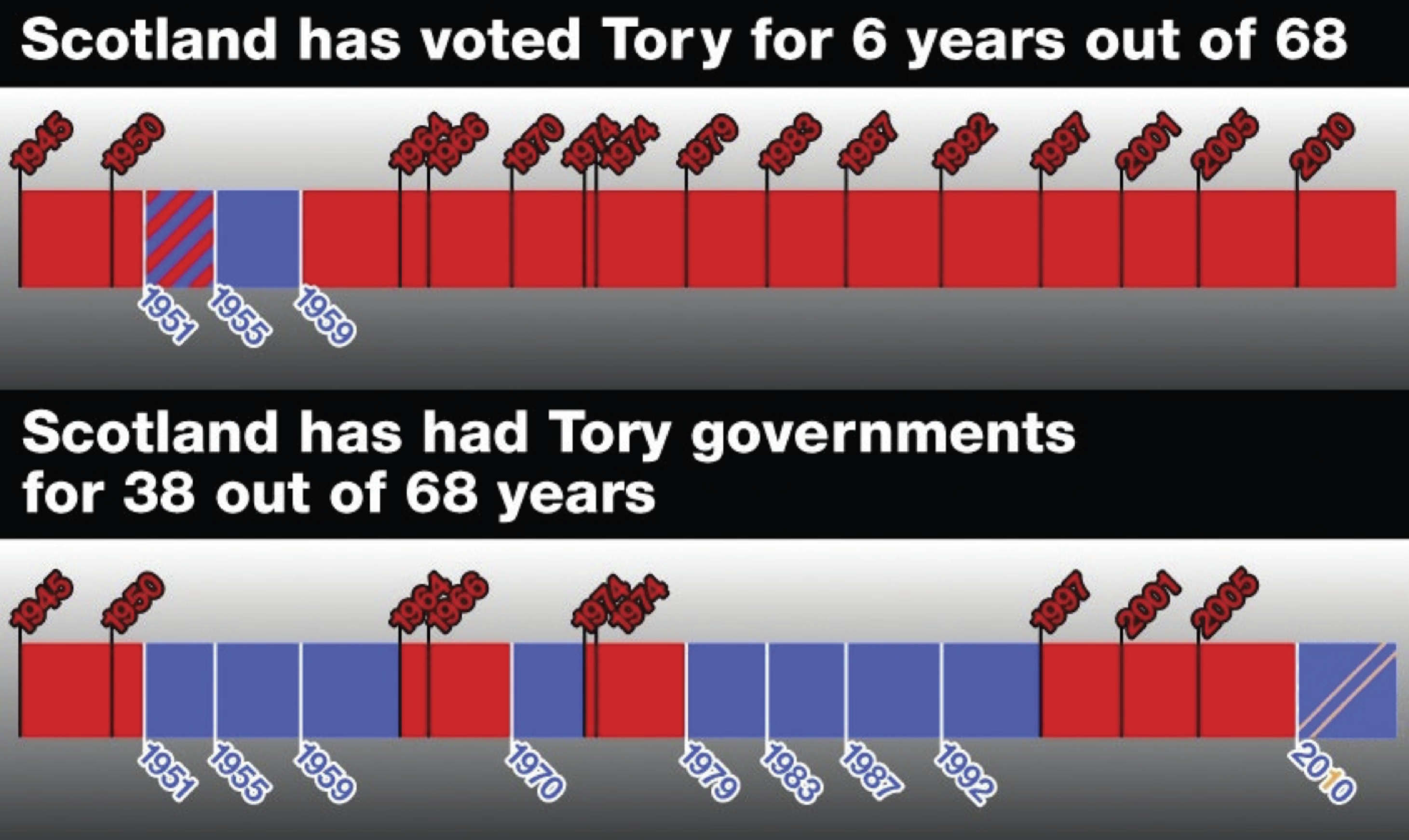
ScotsToryThis is perhaps the simplest aspect of the debate to deal with. Scotland rarely – less than half the time, in fact – gets the governments it votes for. Scots have voted for Labour at every Westminster election since 1955, but by the time of the 2015 election will have had Conservative governments they didn’t want for 38 of the last 68 years.

Whether you support Labour, the Conservatives, the SNP, the Liberal Democrats or anyone else, that’s not democracy. With all due respect to Wales and Northern Ireland, 85% of the population of the UK lives in England, and that means that in practice England always decides what government everyone else gets.

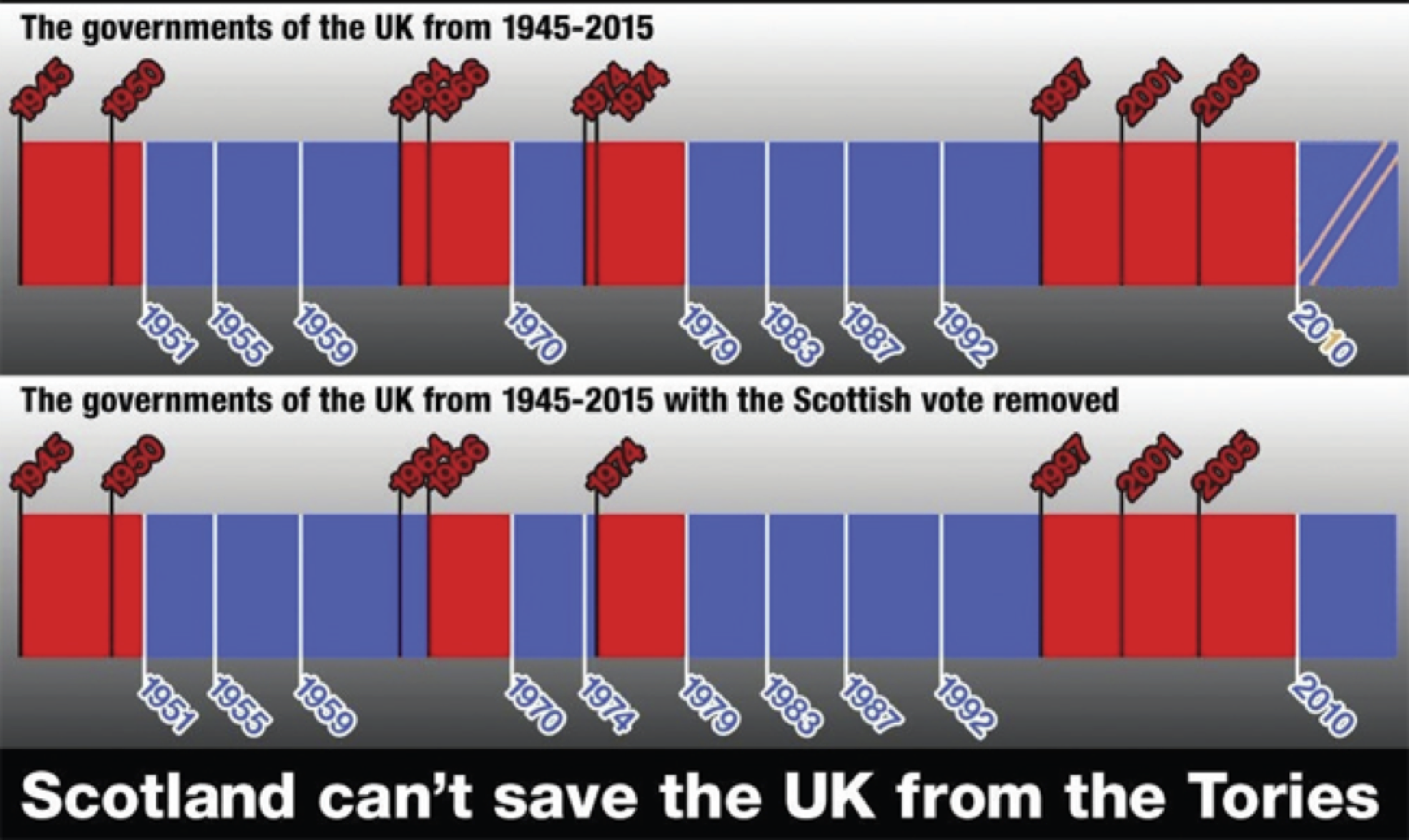
Most of the time (roughly six years in every 10, for the entire modern political era dating back to WW2) that’s been a government Scotland has rejected. We believe Scotland is a country, and therefore should get the governments it votes for every time – not just when it happens to coincide with what a much larger neighbouring country wants.

UKGovtsThat doesn’t mean it should be ruled by the SNP. If you don’t like the SNP or Alex Salmond, you don’t have to vote for them in an independent Scotland – Labour and the Lib Dems were in charge for the first eight years of the Scottish Parliament and could be again. But so could brand-new parties that don’t even exist yet – it’s only a few years since nobody thought the SNP would ever win an election.

Independence isn’t about policies or parties. Those are questions which will be decided at elections, not the referendum. All you have to decide on the 18th of September is who should choose the future governments of Scotland: the people of Scotland, or the people of England?

Q: “But won’t we be abandoning the people of the rest of the UK to permanent Conservative rule?”

A: No. Scottish votes almost never make any difference to the outcome of UK elections, and when they do it’s a very small and short-lived one. Scottish independence will NOT condemn the rest of the UK to permanent Conservative governments – almost every Labour government since WW2 would still have had a comfortable majority without any Scottish votes.

(For example, in 1997 Labour would still have had a huge majority of 139 seats if all Scottish votes had been removed. Even in 2005 it would have had a comfortable majority of 43 seats without Scottish votes, rather than the 66-seat majority it actually got.)

Q: “But lots of people didn’t vote for the current government. People in Liverpool or Manchester didn’t vote for the Tories either, but they still got them as a government.”

A: The unit of measurement for democracy in governmental elections is nations, not cities. No government ever gets 100% of the vote, and indeed it’s decades since any UK government even managed 50%. Some individuals or regions will always get a government they didn’t vote for. But the referendum hinges on whether you think Scotland is a country or just a region of one. It can’t be both.


Posted in Politics | Tagged | Leave a comment

Dateline: September 18th, 2019

Looking back over five hectic years since the referendum, it’s surprising how little our lives have changed. Post gets collected from the same red boxes, the Beeb is where it always was on the dial and pensions get paid like clockwork. It’s at the macro/global level that most has changed. Interest rates did rise at first from uncertainty but Scots paying their £128bn share of the UK debt faster. This, together with capable financial stewardship and sharing the pound as a petrocurrency has us back on Aaa (same as the USA and Denmark).

Relations with England improved as soon as an unrepentant Cameron marginally won the 2015 election. England voted to leave the EU just after the Scots concluded negotiations to stay and cross-border business boomed. Threatening to chase their trawlers out of home waters was what persuaded the Spanish to withdraw their threatened veto. Scotland lobbied for 2017’s CFP review and an agreement with Iceland, which has eliminated discards, reviving both pelagic and demersal fisheries.

Despite committing to the Euro and Schengen, the Scots negotiated the logical opt-out from the latter to be consistent with England and Eire. Trains, cars and lorries still roll unimpeded through Berwick as they have always done. Closer links with Scandonavia have developed new ferry and air links (in part due to the removal of air passenger duty) and even membership of the Nordic Council. And, free of English immigration strictures, Scottish tourism and food and drink industries have both surged on the backs of new workers settling here.

While it took 15 years for Scotland to grow by 250,000, that has been repeated in five, giving a population of 5.5m This has added some £12bn to the economy and boosted government revenue by £2bn because the great majority of immigrants were of working age. Despite oil prices falling initially due to extensive fracking production in the States, the 2017 Whittier earthquake halted further development and prices have recovered to top $100 again.

The greatest problems emerged partitioning the British state. Leaving England heavy military hardware (aircraft carriers, heavy tanks, nuclear weapons, etc.) was easier but disentangling UK-loyal personnel had to rely on individual choice. Sharing HMRC, DVLA and embassies on a temporary basis needs a long-term solution as does HMNB Clyde once England decides if it can afford Trident.

Since deployed to post Assad/ISIS Syria, the Black Watch has used unorthodox ‘soft-cap’ engagement, combining kickabouts with no-nonsense policing. Scotland’s new membership of OPEC has given ‘back channels’ to the Arab world but Jocks from Lochee connect with Aleppo’s poor faster than Brits carrying baggage of Empire ever could.

Perhaps the greatest compliment to us so far has been the English Parliament introducing legislation based on our 2015 One Society Act (hammered out with Labour to support a minority SNP government) that is already done reversing the growth of inequalities suffered in the final years of Union.

(Printed as my Op Ed column this week in East Lothian Courier)

Posted in Politics | Tagged | Leave a comment

An Open Letter From Jim Sillars To Scotland’s Pensioners

One of the tackier aspects of the Independence campaign has been the need for letters like Jim’s to counter some shameless disinformation being shovelled by the NOs.

michaelgreenwell's avatar

AN OPEN LETTER FROM JIM SILLARS TO SCOTLAND’S PENSIONERS

imageI am 76 years of age. My State Pension is safe with independence, and so is yours. Who says so?

The UK Department for Work and Pensions in a statement made in January 2013:

“If Scotland does become independent this will have no effect on your State Pension, you will continue to receive it just as you do at present”

The Department explained that as we have paid our National Insurance Contributions, we have a legal entitlement to the State Pension.

The No campaign knew about that statement, yet through insinuation have made you think your pension was not safe; a despicable tactic to sow fear among the elderly when there are no grounds for fear.

There is, of course, more to the referendum than our pensions – there are our children and grandchildren. I want mine and yours to have…

View original post 300 more words

Posted in Uncategorized | Leave a comment

Dismal Scientist

Yesterday a good friend in California (one of the whip-smart feminists to whom I referred recently) forwarded two Op Ed pieces from the prestigious New York Times. Apparently it is not only the London press corps who have woken up to the magnitude of events unfolding here in Sconnie Botland. In one Why Scotland Should Stick With Britain guest writer Gordon Brown explains why the four ‘countries’ of the UK are just dandy the way they are; “Scottish patriotism did not demand expression in a separate state”, as he puts it. Though worth rebuttal, it did not cry out for deconstruction because it was, to be fair, a pretty articulate take on his long-held unionist views.

No, what screamed out for counterargument was a piece from the prestigious Nobel prizewinning Princeton Prof. Paul Krugman; Scots, What the Heck?  To assist readers, it is reproduced below in full (or at least until the NYT lawyer SWAT team come through my skylight), followed by an e-mail I fired back at my friend (with cc to Kaufman before my sense of outrage subsided). It is one thing to opine on another’s future. However, the weightier your qualifications to do so, the more imperative it is that you do it right.


“Next week Scotland will hold a referendum on whether to leave the United Kingdom. And polling suggests that support for independence has surged over the past few months, largely because pro-independence campaigners have managed to reduce the “fear factor” — that is, concern about the economic risks of going it alone. At this point the outcome looks like a tossup.

“Well, I have a message for the Scots: Be afraid, be very afraid. The risks of going it alone are huge. You may think that Scotland can become another Canada, but it’s all too likely that it would end up becoming Spain without the sunshine.

“Comparing Scotland with Canada seems, at first, pretty reasonable. After all, Canada, like Scotland, is a relatively small economy that does most of its trade with a much larger neighbor. Also like Scotland, it is politically to the left of that giant neighbor. And what the Canadian example shows is that this can work. Canada is prosperous, economically stable and has successfully pursued policies well to the left of those south of the border: single-payer health insurance, more generous aid to the poor, higher overall taxation.

“Does Canada pay any price for independence? Probably. Labor productivity is only about three-quarters as high as it is in the United States, and some of the gap may reflect the small size of the Canadian market (yes, we have a free-trade agreement, but a lot of evidence shows that borders discourage trade all the same). Still, you can argue that Canada is doing O.K.

“But Canada has its own currency, which means that its government can’t run out of money, that it can bail out its own banks if necessary, and more. An independent Scotland wouldn’t. And that makes a huge difference.

“Could Scotland have its own currency? Maybe, although Scotland’s economy is even more tightly integrated with that of the rest of Britain than Canada’s is with the United States, so that trying to maintain a separate currency would be hard. It’s a moot point, however: The Scottish independence movement has been very clear that it intends to keep the pound as the national currency. And the combination of political independence with a shared currency is a recipe for disaster. Which is where the cautionary tale of Spain comes in.

“If Spain and the other countries that gave up their own currencies to adopt the euro were part of a true federal system, with shared institutions of government, the recent economic history of Spain would have looked a lot like that of Florida. Both economies experienced a huge housing boom between 2000 and 2007. Both saw that boom turn into a spectacular bust. Both suffered a sharp downturn as a result of that bust. In both places the slump meant a plunge in tax receipts and a surge in spending on unemployment benefits and other forms of aid.

“Then, however, the paths diverged. In Florida’s case, most of the fiscal burden of the slump fell not on the local government but on Washington, which continued to pay for the state’s Social Security and Medicare benefits, as well as for much of the increased aid to the unemployed. There were large losses on housing loans, and many Florida banks failed, but many of the losses fell on federal lending agencies, while bank depositors were protected by federal insurance. You get the picture. In effect, Florida received large-scale aid in its time of distress.

“Spain, by contrast, bore all the costs of the housing bust on its own. The result was a fiscal crisis, made much worse by fears of a banking crisis that the Spanish government would be unable to manage, because it might literally run out of cash. Spanish borrowing costs soared, and the government was forced into brutal austerity measures. The result was a horrific depression — including youth unemployment above 50 percent — from which Spain has barely begun to recover.

“In short, everything that has happened in Europe since 2009 or so has demonstrated that sharing a currency without sharing a government is very dangerous. In economics jargon, fiscal and banking integration are essential elements of an optimum currency area. And an independent Scotland using Britain’s pound would be in even worse shape than euro countries, which at least have some say in how the European Central Bank is run.

“I find it mind-boggling that Scotland would consider going down this path after all that has happened in the last few years. If Scottish voters really believe that it’s safe to become a country without a currency, they have been badly misled.”


S:

this is typical of the kind of Op Ed pieces that pour from mighty organs like the NYT—written by intelligent, educated people who actually don’t know what they are talking about. None of this is about you but bear with me while I fulminate.

It is fair comment to take the jaundiced view of a critical friend in such weighty matters and, yes, look at places like Canada, Florida and Spain as possible models to predict what might happen to Scotland; it is poor journalism not to back up assertions with economic realities, including numbers,—and he is qualified and trained to do so.

The Canada/US model works as an example only from the view of relative sizes: 318.7m ‘Murcans to 35.4m Canucks is about 9:1 while the UK (less Scots) 58.8m vs the Scots 5.3m runs out at 10:1. NAFTA means you share $735bn in trade each year. That’s 62% of all Canadian exports, with the next two (China and Japan) dwarfed at 5.2% and 3.6% respectively. In other words, economically, you’re joined at the hip.

Scotland exports £58.3bn to rUK and £35.6 to elsewhere in the world. That’s a healthier division and we’re not even a proper country—yet. £6.9bn of the latter is engineering product (mostly oil & gas), £4.1bn is chemicals and £3.9bn is whisky, all of which have global penetration. 14.4% go to the USA, 11.1% to Netherlands, 8.1% to France and 5.7% to Germany. Growth markets like China we have barely started on. Name one Canadian product beyond maple syrup. If the US sneezes, Canada gets pneumonia; we Scots look far more diversified so his comparison collapses as you dig into it.

Where we agree is his bit about Florida is valid—but only for a ‘state’ (as you call them) that is not a proper country; the Feds had no choice, like in the S&L debacle I lived through in the 1980’s. Don’t start me on bank bailouts or this will get really tedious.

Then he compares us to Spain? That’s like comparing Massachusetts to Bolivia. Three decades ago, Spain was a third-world fascist dictatorship. EU investment (and turning a blind eye to its piratical fishing fleet practices) has dragged it into the Western World. Its banking system is just one step away from the mafia-driven Italian variant. Thanks to their banking hubris (comparable to the UK’s when Gordon Brown hobbled the UK equivalent of SEC/FINRA and everyone played ‘emperor’s clothes’) their economy went to hell in a handcart in 2008 and they have since had 27% unemployment (Scotland’s is right around yours at 6.4%). No wonder the Catalans want out themselves. Name one Spanish product beyond sherry/wine.

The man is a professor of Economics and International Affairs at Princeton, for heaven’s sake; he was even given a Nobel prize. He should KNOW better—but he writes like the closest he’s ever got to Scotland is watching Scotty fondle dilithium crystals on TV. When we Scots are within an ace of achieving a sensible independence of a country that boasts a longer history than yours (and in whose cause we pride ourselves no-one has yet died), I really don’t appreciate such people running off at the mouth about issues so vital to others about which they apparently haven’t even had the damn courtesy to do their homework.

If you’re ever in NY, tell him. 🙂

D

“For, as long as but a hundred of us remain alive, never will we submit to English rule. In truth, it is not for glory, nor for riches, nor for honours that we fight, but for freedom alone, which no honest man gives up but with his life.”
—Declaration of Arbroath, 1320

Posted in Commerce, Politics | Tagged | Leave a comment

Shirreff Parks his Tanks on our Lawn

The world of global diplomacy—and with it, the context of our independence debate—has become increasingly surreal. Despite being unable to breathe without running into WWI commemorations, the lessons the Great War taught seem no longer relevant to our complex modern life.; this is myopic.

Just because hundreds of miles and even more days of trench warfare stalemate will not recur does not mean that present-day politicians are any more gifted with global brink-personship than Sir Edward Grey and his well meaning Liberal colleagues who were dragged into war by a web of treaties explicitly set up to avoid the catastrophe that did in fact overtake the 20th century.

The equivalent web today is called NATO. This even longer-standing military alliance  united Western democracies with enough resolve to see off Reagan’s “Evil Empire”. But just because the Soviet Union has gone should be no invitation to exploit Russia’s discomfort by sweeping fragments of Russia’s former empire under their nuclear umbrella. In the colourful geopolitics-speak used around Brussels’ Boulevard Leopold III (NATO HQ), such in-your-face tactics is known as “parking our tanks on their lawn”.

Admission of the ex-Warsaw Pact countries of Eastern Europe to NATO was a mild example of this; adding the three Baltic States (a part of the Soviet Union for 60 years and under 15 minutes by Eurofighter from St Petersburg) verged on the provocative. To then consider Ukraine’s membership (their re-application went in last week) is a challenge that ordinary Russians—even without Putin doing his strongman act—would resent and resist.

Ukraine was Russian heartland before Scotland was part of Britain, ever since Peter the Great chased Sweden’s Charles XII out after Poltava in 1709. Imagine how London would react if a newly independent Scotland were to bind itself in a military alliance with Russia. Having been brutally invaded and half-conquered several times before the Nazis, the Russian folk memory is touchy about belligerent forces on their Western border.

A more sensible alternative to poking the Russian bear would be to agree Ukraine’s full neutrality and allow it to be a trading and diplomatic bridge between NATOland and Russia that could benefit all three parties. NATO may have as many ships, tanks planes and men as the Russians, but it is military insanity to project enough of them 1,000km East of their present bases and fight a still-formidable Russian machine on its home turf that is nuclear-tipped and a lot less stable than when Joe Steel ruled it.

Which brings us to Scotland and its putative effect on/membership of NATO. For if Ukraine is a domino too far to the East, then things are looking decidedly dodgy in the West. With many global commitments recent US strategy has been for the European end of NATO to take more care of itself. Whatever Westminster governments may pretend, Trident’s keys are still firmly in Pentagon pockets and so can be discounted for ‘local’ use.

Which brings us to the UK’s conventional weapons and a sad tail of decline. Being £1.5tn in hock, the MoD is cutting British Army from 104,000 troops to just 82,000. To get the scale by which we can no longer play with the big boys, the US Marine Corps alone is three times bigger, with more aircraft than the RAF, including the 72 Harriers we sold them.

Far from being capable of projecting military power into Ukraine, even as a part of NATO, UK forces have proved incapable of intervention in Syria, despite a ‘sovereign base‘ 100km away outside Limassol. Such missions as were flown in Libya were expensive pinpricks by one aircraft at a time and it was just three years ago when an entire Russian carrier group entered the Moray Firth undetected because we had scrapped all our maritime patrol Nimrods. The frigate scrambled from Portsmouth (HMS York) was the only RN ‘blue water’ unit in home waters at the time.

This last weekend Scotland on Sunday carried a letter from General Sir Richard Shirreff, recently stepped down as NATO’s Deputy Supreme Commander Europe. In it, he described the Scottish Government’s plans for defence as “amateurish, dangerous, unrealistic and lacking clear strategic purpose”. He also warned that the claim that an independent Scotland could join a nuclear defence alliance (i.e. NATO) while removing nuclear weapons from the Clyde could hinder membership.

Now, I don’t want to quibble with his obvious qualifications to have an opinion on the matter (although his claim to be from Co’path in East Lothian shows his grip on geography to be weak) but the above analysis of a NATO posture for which he must bear some responsibility means that we really do need to revisit what NATO is for. It is certainly not so that the West can go empire building on the ruins of the Soviet Union.

What NATO does need is a competent team on its North flank, in the event of any hostile intent amplifying the Kuznetsov incident into a war scenario by the Russian Northern Fleet. As explained, the UK is no longer capable of keeping up its end: the Standing NATO Response Force Maritime Group 1 has seldom contained any RN units and, as a result, Norway, Denmark and Canada have shouldered additional burdens to cover that.

So, when Gen Shirreff opines: “nothing I have seen or heard persuades me Scotland’s safety or security would be enhanced one iota if it became a separate country“, he does himself no service, despite his undoubted authority. Just to cover points raised above, a Scottish Defence Force would deploy the following key elements (currently missing from  UK deployment) that would tie in with our Norwegian/Canadian/Danish allies:

  • Two FFs deployed in Scottish or adjacent waters
  • A flight of four LRMP aircraft, based in Moray (CN-235s?)
  • A squadron of fast patrol boats (Hamina-class?) based to protect maritime oil rigs
  • A special forces battalion trained (among other things) in oil rig protection & assault

The absence of any need for global deployment, nuclear weapons and battle tanks will render Scottish forces more fit for purpose in maritime defence. Despite what Gen. Shirreff says, a regional defence with maritime emphasis is a clear and sensible strategy for which SDF proposals are highly suitable—in sharp contrast to the mission overstretch from which UK forces have suffered since commitment to Afghanistan and which subsequent severe cuts will carry into the foreseeable future. In this context, replacing Trident at all and populating the two aircraft carriers with flawed/overpriced F-35s simply compound that overstretch.

Rather then believe Gen Shirreff to be that naive, it makes more sense to see his outburst (whether orchestrated or not) as part of the relentless parade of naysayers that have been the backbone of the NO campaign. He does not state why NATO would not want a member with balanced forces like Denmark, rather than the UK’s current incomplete circus, any more than Barrosa explained why the EU would not want a solvent petrocurrency that already complied with all EU laws.

It echoes the ‘chicken little’ scaremongering we’ve had from Irn Broon, Osbo and Darling—that an independent Scotland could never have kept HBOS and RBS afloat by itself. What they conveniently ignore is that subsidiaries Halifax and NatWest are massive English institutions for which any English government would have intervened to keep them (and  rUK) solvent, no matter where they were headquartered. On this and on using the £UK, it’s not those seeking independence who seek to drive such wedges between nations. Since Winnie coined the phrase in 1967 we’re still saying: “Stop the World, Scotland wants to get on!”

So, if any reader in Co’path should run into Gen Shirreff rediscovering his Berwickshire roots now he has more time on his hands, ask him politely to get his tanks off our lawn.

Posted in Politics | Tagged | Leave a comment

This Is No Small Country

One of delights in returning home to Scotland twenty years ago was to discover a renaissance in its arts flourishing across the board. Having left in 1971 when the Cringe seemed the most fashionable garb among those with artistic ambition, perhaps the most refreshing among many positive aspects of my return, the Scottish Poetry Library (still hidden then down Tweeddale Court) spoke volumes for the new attitude—global in outlook; rooted in the local culture.

Among the more memorable creatives I met while rummaging amidst my cultural roots  there was an inventive voice from the North Isles who greatly impressed me. Whether writing in Shetland or Scots dialect or in ordinary English, Christine de Luca impressed me with her ability to forge simple, direct words into poetry that cleaved through Gordian knots of mumbling thought. To find her now acknowledged as a full-fledged makkar and new “Poet Laureate for Edinburgh” is no surprise…but a sheer delight nonetheless.

As with her other work, her first poem in her new role (published in today’s Hootsmon) is deceptively simple. But—like Scotland—it reaches far beyond our borders and even the watershed decision in two weeks towards a measured, balanced perspective to follow of which her country-men and -women will be justifiably proud.

The Morning After:

Scotland, 19th September 2014

Let none wake despondent: one way or another we have talked plainly, tested ourselves, weighed up the sum of our knowing, ta’en tent o scholars, checked the balance sheet of risk and fearlessness, of wisdom and of folly.

Was it about the powers we gain or how we use them? We aim for more equality; and for tomorrow to be more peaceful than today; for fairness, opportunity, the common weal; a hand stretched out in ready hospitality.

It’s those unseen things that bind us, not flag or battle-weary turf or tartan. There are dragons to slay whatever happens: poverty, false pride, snobbery, sectarian schisms still hovering. But there’s nothing broken that’s not repairable.

We’re a citizenry of bonnie fighters, a gathered folk; a culture that imparts, inspires, demands a rare devotion, no back-tracking; that each should work and play our several parts to bring about the best in Scotland, an open heart.

© Christine de Luca, 2014

Posted in Community | Leave a comment