John Maclean’s Body Is A-Spinning in his Grave

These blogs have at times been scathing when referring to the Scottish Labour Party and for that no apology is offered. And yet, those who read them objectively will have realised that the positions taken were as much from sorrow as from anger. Historically they were once a real force for good. Starting with union intransigence post WW2 as heavy industries declined, their political wing—Labour—stood unquestioningly on their side.

Whether defending job demarkation in shipyards, firemen on trains that had no fires, craft differential pay or details of dockers’ pay when containers were the future, the stories are many and varied but all have a common outcome: failure. Despite flashes of initiative and dedication such as Jimmy Reid and UCS, the 1950s to 1990s are a catalogue of declining industries, diminished incomes and the extinction of heavy engineering as a Scots staple.

Labour played a dismal, reactionary role in all that. Given low wages elsewhere and booming global trade, some decline was inevitable. But Labour’s dogged efforts to shore up workers’ share of profits was understandable, even commendable. Had they succeeded, they might have been heroes in the way they had fought for and won decent pay, adequate benefits and tolerable conditions duing the first half of the 20th century.

Seeing Labour as their only champions, people across what became Scotland’s Rust Belt—West Central Scotland with outposts in West Fife, Clacks and Dundee—voted for them in such numbers that earlier representation by Liberals and Tories was wiped out. And, given they became the sole local power brokers, from City Chambers in George Square to Cowdenbeath Town Hall, Labour ran the local show; Miners’ Clubs as social centres; council house allocation; public service jobs (c.f. Monklands in the 1990s) went to those submitting the right-colour forms.

Despite the relative ineffectualness of the ‘feeble fifty’ Scots Labour MPs in the 1980s against Thatcherism, mine closure, poll tax, loss of last moderinsed industries (Linwood, Ravenscraig), Labour heartlands strengthened in solidarity and resistance. What else could they do? But somewhere in there, the ‘buggins turn’ system (loyal Labour members became councillors, board members, even MPs with little beyond loyalty to deserve it) became self-referencing and developed a pavlovian hostility to any who questioned it.

Throughout all this, Labour never wavered from its public message of ‘Labour values’—support for the poor and the vulnerable; rights for the disabled; protection for children; free health and education for all. Problem was that the advent of UK New Labour under Blair—while still protesting such values—went well outside their normal support base and pretty much sold their soul to the middle class and private sector devil. Until 2008, that appeared to work like a dream; more money was found/filched/borrowed; benefits went through the roof; ‘old’ Labour (i.e. Scotland) was content sharing in the results.

The fact that not one new—let alone wildly popular—policy has emerged from Scottish Labour since our Scottish Parliament was established 15 years ago seems to bother few.

Because these results mentioned held good up to and including the 2010 General Election. Brown may have lost but in Scotland, in spite of the 2007 shock of an SNP-run Holyrood, voters stayed in the Labour fold in droves to return 41 Labour MPs and only 6 SNP—five of which were from non-Labour areas. Adding in the fact that Labour was part of the recent ‘winning’ NO campaign in the referendum, many in the party are breathing sighs of relief and settling into the usual motions for next May, expecting business as usual.

But that is dangerous thinking. Unless some form of serious cross-party UK compromise on major devolution to Scotland via the Smith Commission happens, large chunks of the NO vote (who did so on the promise of something substantial short of independence) will join with the thousands of Labour voters who retched at being in the same campaign as the Tories and use the new widespread political awareness to reflect deeply where their vote might go. Assuming it will go to/stay with Labour is delusional.

Whether Labour needs Scotland or not to find a majority, they must do well in England in the first place. That has been called into question by several recent polls, the most recent of which is from Lord Ashcroft, looking at 11 marginal English constituencies with majorities of between 1,328 or 3.1 per cent (Brighton Kemptown) and 2,420 or 4.8 per cent (Gloucester). Their analysis is:

The overall swing from Conservative to Labour in this group of seats was 5 per cent, but as in previous rounds there was some variation between constituencies: from 2 per cent in Pudsey (a tie) and Gloucester (Tory hold) to 6.5 per cent in Hastings & Rye and 8 per cent in Brentford & Isleworth.

Though nine of these seats would change hands on the basis of these snapshots, Labour will not feel comfortable in many of them. Though Labour led by ten points in Enfield North and 13 points in Brentford, they were ahead by less than five points in Brighton Kemptown, Hove, Halesowen & Rowley Regis and Nuneaton.

Swings to Labour appear to be related to the UKIP presence, which varied significantly from one seat to the next. Nigel Farage’s party scored just 7 per cent in Brentford & Isleworth (where Labour’s share was up eleven points since 2010), but 24 per cent in Halesowen (where Labour were down by two points, though still just ahead).

As these figures imply, there was more direct switching from the Conservatives to Labour in Brentford than in seats where UKIP had jumped to a solid third place. This lends some support to the theory expounded in the recent Fabian Society paper Revolt On The Left, which suggests UKIP could hamper Labour in Tory-held target seats by diverting voters who might otherwise switch straight from blue to red – though the evidence so far is that this effect is not yet strong enough in these seats to counteract the erosion of the Tory vote.

So, areas of UKIP strength have every chance of derailing the Labour hope of a straight switch from Tory to them. Indeed, as many of those will be protest votes, the absence of fresh ideas, which UKIP seem to offer (even if half-baked) will erode Labour votes.

Which puts even more burden on Scotland to deliver their 41 MPs. Or more, if possible. But the strongest YES votes came from just those areas that represent(ed?) Labour heartlands. And now an analysis published this week in the Herald shows the biggest surge in the tripling of SNP membership also comes from those very same ‘heartland’ areas. Throw into the equation the fact that the latest YouGov poll for GE2015 in Scotland puts Labour at 28% and SNP at 45% (vs 42% and 20% in GE2010) and alarm bells should be ringing 24/7 throughout John Smith House.

Were such a swing of 20% to happen and the SNP finally to grab serious share in a Westminster vote too, it would be a disaster verging on a wipe-out for Labour. Even the most sanguine SNP psephologist does not expect that. However, were we to take no more than half the polled swing, dependent on the flood of new SNP members in key Labour seats, it still makes ugly reading for the SLP.

Labour could expect to lose the following seats to the SNP:

  • Airdrie & Shotts
  • Dundee West (the last non-SNP holdout in ‘YES City’)
  • Cumbernauld, Kilsyth and Kirkintilloch East
  • East Kilbride, Strathaven and Lesmahagow
  • Falkirk (where ex-Major Joyce has blotted both his & Labour’s copybook)
  • Glasgow East (Margaret Curran—held by John Mason prior to that)
  • Glasgow North
  • Lanark and Hamilton East
  • North Ayrshire and Arran
  • Ochil and South Perthshire

Many more would become marginal, the closest (within 2,000) including Glasgow Central, Livingston, Kilmarnock & Loudon and Linlithgow & East Falkirk. The Lib-Dems are likely to do just as badly proportionately, holding on to Orkney & Shetland, Northeast Fife and Ross, Skye & Lochaber but losing:


  • Argyll and Bute to SNP
  • Berwickshire, Roxburgh and Selkirk to Conservative
  • Caithness, Sutherland and Easter Ross to SNP
  • East Dunbartonshire to Labour
  • Edinburgh West (probably to Labour but a close 4-way call)
  • Gordon to SNP
  • Inverness, Nairn, Badenoch and Strathspey to SNP (Danny Alexander’s seat)
  • West Aberdeenshire and Kincardine to Conservative

Such a result would see:

  • Labour reduced by eight to 33 MPs
  • SNP much stronger going from six to 20
  • Lib-Dems quartered to just three
  • Tories enjoying a modest revival with three.

Such a result would not necessarily disable Labour ambitions to form a Westminster government but their performance would be unrecognisable to the party’s founding fathers as Blair was. Whether that further fragments the former heartlands remains to be seen. But losing anything like the ten seats listed above will create huge cracks in a once-monolithic edifice. The good news is it will make Labour actually work for once.

Meantime, that record 20 SNP MPs may outnumber any other smaller party—almost certainly Greens, Plaid and even UKIP—and may even contend with the LibDems as the third force, should England give them the trouncing they seem about to get in Scotland.

And if Alex were to use his newly free time to be re-elected as an MP (say, for Gordon?) to lead that formidable group, look out for fireworks and anything but Westminster business as turgid usual, espcially when contrasted with the comfy quiescence typical of most Scottish Labour MPs.
 

Posted in Politics | Tagged | Leave a comment

Support Catalan Petition

The Scottish independence referendum has shown that the best and fairest way to make crucial political decisions is an open public debate followed by a democratic vote.

In accordance with the Statute of Autonomy of Catalonia and the Catalan Popular Consultation Act, the Catalan Parliament has decided to hold a non-binding vote to consult Catalan citizens on whether Catalonia should become an independent state. Under the mandate of Parliament and in compliance with these laws, the President of the Generalitat (the Catalan head of government) has called for the vote on November 9.

Despite the lawful and legitimate decisions by the Catalan institutions and the wide support among the Catalan population (between 75-80% according to various polls), the Spanish government is adamantly opposed to this vote on that or any future date, and it is determined to stop it at all costs.


Spain is repressing the efforts of a significant part of Catalonia’s population to have a referendum much as Scotland just held whether it should remain a province of Spain or become an independent country. An on-line petition is seeking support for this and can be found at:

http://votecatalonia.org/

What impressed me about the short form you fill in is that their country pull-down menu included Scotland. The English text of the petition you would be signing is as follows:

We firmly support the right of the citizens of Catalonia to be consulted about the political status of their country in a free and fair vote. Whether Catalonia remains a part of the Spanish state or becomes an independent and sovereign state is a decision that need only be taken by the Catalan population.

We therefore entreat all interested parties to facilitate the holding of a vote, where all adult Catalan citizens, without distinction of gender, age, creed or origin should be allowed to express freely their preference on whether Catalonia should or should not become an independent state.

We believe that the option chosen by the majority of Catalans should be accepted by all parties and the international community, as a democratic expression of the will of the Catalan people.

Thus, we petition to support the holding of this vote and to make all necessary efforts to ensure that its result is respected in accordance with the most fundamental principles of democracy.

Posted in Uncategorized | Leave a comment

CA 94027

Another American TV import about spoiled teenagers wrapping their new red Ferraris round palm trees because they were jilted by a blonde in training for The Real Housewives of Orange County? No. It doesn’t even refer to the sunkissed boulevards of the Southland. But it is in California.

What CA 94027 refers to is the ZIP code (US for ‘Postcode’) for Atherton, a name hardly known outside the Bay Area in Northern California. Technically one of the many sprawling suburbs of San Francisco, Atherton lies about halfway down the peninsula, nestled between Menlo Park and Palo Alto to the south and Woodside and Redwood City to the north. It is also the most expensive place to lice in the US for the second year round.

The most expensive home currently on the market there is a 12,840-square-foot (1,204 sq. m.) Mediterranean mansion with a $21.988 million (£13.7m) price tag. The least expensive home for sale is a 1,370-square-foot (152 sq. m.), two-bedroom, two-bath bungalow—what locals call a starter home–with an asking price of $1.499 million (£936k).

Despite what you may believe, Atherton beats out anywhere in Miami, Los Angeles, Washington, Boston, Philadelphia or their suburbs. New York is closest on its heels: Long Island’s Sagaponack 11962 takes the No. 2 slot, followed by three consecutive New York City ZIPS: Lower Manhattan’s 10013 (No. 3), the Upper East Side’s 10065 (No. 4) and 10075 (No. 5).

Atherton pips ’em all because of its proximity to Silicon Valley and  its technobillionaires. Apple, Facebook, Oracle, Google and Cisco are all a 20-minute drive away and San Francisco no more than double that. The nearby Santa Cruz mountains offer tree-lined vistas over the Bay and the Pacific and hiking trails among the towering redwoods. And Atherton’s relatively relaxed building regulations means Atherton Avenue is full of huge construction, 12,000-square-foot ‘statement’ homes.

This is partly a result of strict city regulations forbidding plots smaller than an acre in size. The land costs at least as much as elsewhere in the Bay Area and so only the rich can afford to build big and bold homes to take advantage of all that space. The net result is wierd: no downtown of shops, etc, nor even pavements—just wide streets with tree-lined fenced estates that have automatic electric gates guarding the entrance to each sweeping drive to a house that can’t be seen from the street. If you visit hoping to rub shoulders with Ty Cobb or Lindsey Buckingham or Farzad Nazem, forget it. You won’t even recognise their car flashing by.

Originally known as Fair Oaks, in 1923, the nearby city-to-be of Menlo Park wished to incorporate its lands to include this area. During a meeting of the representatives of the two communities, Fair Oaks property owners realised keeping their community as a strictly residential area required separate incorporation. Both groups rushed to Sacramento but the Fair Oaks committee arrived first. As there was already a Fair Oaks near Sacramento, they decided to honour Faxon Dean Atherton (one of the first property owners in the area. Atherton was incorporated an area of 5.049 sq. miles (13.076 sq. km.) on September 12, 1928.

The government was established with Edward E. Eyre as the first mayor. In 1928, the residents voted to build a Town Hall, which stands today. The author Gertrude Atherton (Faxon D. Atherton’s daughter-in-law) wrote in “The Californians“, “Atherton has been cut up into country places for what might be termed the ‘old families of San Francisco’, the eight or ten families who owned the haughty precinct were as exclusive, as conservative, as any group of ancient country families in Europe.” The local explosion of Silicon Valley and the shed-loads of dosh made therein has done nothing to change that.

So, even today, traffic consists partly of very expensive, mostly foreign cars (plus the odd Humvee) and an assortment of trade vehicles as gardeners show up to mow the lawn, pool maintenance sweeps the inevitable pool and Beltramo’s delivers that week’s champers etc to keep the wet bar and the one in the ‘romper room’ stocked. And yet, the road is lined not just with mansions but the usual US urban blight of power lines draped the length of the road on poles.

Which is a hint of a second reason for Atherton’s popularity among the seriously rich—low city taxes. Inhabited exclusively by the rich, what need is there for common social provision, let alone any public provision for aesthetics? That goes as far as eschewing museums, libraries and even schools (although 4-year private Menlo College is allowed in). Children are freighted out to private schools or go to local schools run by other cities. And so, other than contracting with nearby fully functional cities for waste disposal, police and fire, the overhead for living here (San Mateo property taxes aside) is surprisingly light.

In Atherton, the American shibboleth of market forces finds its ultimate expression. Far more exclusive than upmarket districts of cities, more so than even the gated communities where mostly retirees cower behind security guards at the gate and trim-mowed parklets where dog fouling is a major felony, Atherton has achieved distinction as the equivalent of the cuckoo in the nest or the cancer tumour in the body, living happily on the hard work of life around it, contributing as little as it can in return.

It is a monument to flawed ambition of those who know the price of everything but the value of nothing.  As a recipe for a dysfunctional community, it could hardly be bettered. Its divorce rate is high; among adolescents age 15-19, suicide is the third most common cause of death (after car accidents and homicide). No wonder divorce lawyers and therapist offices populate the office complexes of nearby Redwood City and Menlo Park. Atherton embodies the saying “Money doesn’t buy you friends—but it does get you a decent class of enemy.

Posted in Uncategorized | Tagged | Leave a comment

A Richt Gaggle o’ Soothmoothers

Orcadians can be subtle—but usually not when referring to people from ‘Scotland’ (as they call the land to their south; they have a Mainland of their own). The title of this blog came verbatim from farmer from Orphir debarking from the M.V. Hamnavoe to be met by his wife at Stromness pier in reply to her query how busy the voyage was. Scots can also be a bit like that when it comes to Sassanachs. But, thankfully, we have realised it’s a half millennium since Flodden and tourism offers major opportunities in the 21st century.

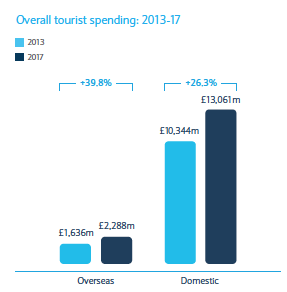
This summer, Barclays bank published a rather upbeat analysis of tourism potential in Scotland, done for them by retail research agency Conlumino.  Increase in UK domestic tourism of 27% was expected to be surpassed by foreign tourism increasing by 33% to give a total market of over £135 billion by 2017. The general upward trend of tourism in the UK was even better in certain parts, especially London and Scotland.

The top four countries supplying the UK with international tourists—USA (10.8%), France (6.6%), Germany (6.2%) and Australia (5.0%) will be joined by China (3.9%) within four years; no other country will have a share greater than 3%. The proportion of retail spend by international visitors is expected to remain steady at twice that of domestic tourists. But their actual spend on accommodation, dining and leisure are each expected to increase by around 33%.

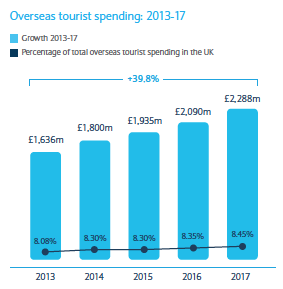
Those international visitors are expected to increase the proportion of their spend in London from 62.9% to 64.0% by 2017, a stunning £15.1bn total. The only other UK ‘region’ to increase its share of the cake is Scotland—from £1.6bn to £2.4bn and taking 8.5% to be bigger than any other English region, N. Ireland or Wales. Total tourist spend in Scotland is expected to top £15bn by 2017. Opportunities, indeed.

Credit for such increases are generally given to Scotland’s strong image and reputation, as well as coherent marketing, especially by VisitScotland. Whatever the reason, across Scotland, socks need to be pulled up if such an influx of new visitors is to go home with smiles, memories and an inclination to recommend the experience to their friends. (Source of all charts below is the Barclay’s paper cited above)

Projection for Overseas Tourism Spend in Scotland

Projection for Overseas Tourism Spend in Scotland

Projection for Domestic Spend in Scotland

Projection for Domestic Spend in Scotland

Projection for Total Growth in Tourism in Scotland

Projection for Total Growth in Tourism in Scotland

All three charts contain good news for tourism-related businesses—and even simple infrastructure staples like ScotRail benefit. North Berwick station now sees over 500,000 passengers each year. Ten years ago, the figure was 360,000. Over one half of the growth came in leisure travel and a higher proportion (perhaps one in four) were overseas tourists who arrive by air and don’t trust themselves on our narrow roads in a right-hand-drive car. That means not just more ScotRail income but a filling of empty trains heading out of Edinburgh in the morning and returning in the evening—a contraflow to commuters.

Overseas spending on fashion retail is expected to rise by 42%. This means the Jenners-style outlets should do well, providing a wide range of Scottish-sourced goods in an historic ambiance. Although larger, domestic retail is only expected to rise by 30%. But, since many of those are English, the same advantage accrues to distinctly Scottish outlets. Locals in Kirkwall tend to sniff at the Orkney Soap, Jane Glue and Jolly’s outlets in the main street but these places do a booming trade with cruise liners that call regularly.

Overseas tourist spend on accommodation and eating out is set for a 40% growth, so hotels who understand their market will profit hugely. A good example is the seriously off-the-beaten-track Moor of Rannoch Hotel that recently won the Cesar Newcomer of the Year award, thanks to its blissfully isolated location with board games and books replacing radio, TV and wi-fi. Those satisfied employing untrained teenage serving staff who snottily tell guests that the kitchen is now closed for lunch at 2:04pm are likely to get short shrift.

But the biggest growth expected in all sectors are leisure attractions, projected to grow by over 46%. Given that top places like Edinburgh Castle are already overcrowded in the height of the season, this implies that creative new activities like the Foxlake wakeboard park or Glenkinchie distillery in East Lothian ought to benefit by overspill that is the zoo of Edinburgh in the summer. But even in far Orkney, the Orkney Brewery and Highland Park distillery already attract record numbers by having friendly sales areas and restaurants as well as tours and tastings.

Having recorded a bumper summer on the back of the 2014 Commonwealth Games, Glasgow is finally elbowing its way into a position to capitalise on these opportunities. Long famous for being dressier and more fashionable than their Edinburgh counterparts  its Style Mile is drawing in tourists as well as locals. Added to the Kelvingrove and the Science Centre (as well as the SECC) and a pivotal jumping-off point for Scotland’s magnificent West Coast, there are now as many overseas visitors each year as there are population (600,000). The £300m refurb of the Buchanan Galleries and the £390m redevelopment around George Square ought to set the city on track to meet the 2017 opportunities.

Barclays paper provides a case study of the Corinthia Hotel in London. The 5-star 300-room hotel has carved itself a niche in a very crowded Central London market. It owes its success to a deep understanding of needs of its customer base and how to capitalise on the hotel’s surroundings to fulfill them. It concludes with a series of a half-dozen considerations with associated bullet points how tourism businesses can pro-actively grow their market share.

Posted in Uncategorized | Leave a comment

Ken Yaur Neuk

Friday’s FT carries an amusing tirade from John Lewis’ boss Andy Street in the Retail & Consumer section that denigrates France as “sclerotic, hopeless and downbeat”. It seems, en route from Paris to make this speech, “He was delayed by a rather poor experience coming back through Gare du Nord”—a place he described as “the squalor pit of Europe”.

Having spent time there, I grant his point, although most main termini (and indeed many airports) could contest the title. More relevant, though, is his dismissal of one of the three main pillars of the EU as “finished“. Leave aside the material such outbursts may provide UKIP and the troglodyte wing of Tory backwoodsmen, this sent me back to the archives where this blog parried such xenophobic mutterings on other occasions such as this.

There are many variants on the ‘Frogs Begin at Calais’ theme but if there is one thing that does continue to unite this Kingdom it is an endemic, perhaps genetic, inability to couch anything in terms of other cultures, even cultures no more than a coastal artillery shot distant. There is little to choose among all four nations in this regard—all are equally inept at languages and (more importantly) the cultural differences they conceal. We get annoyed by Japanese saying “hai“, thinking it means “yes” when what is meant is a far more subtle “I understand you and respond as if agreeing, so as to save you face“.

Since languages simply reflect the cultures that developed them, we need to appreciate subtlety to a depth a dictionary cannot begin to fathom. The German equivalent of “hai” is “jein“. Technically it doesn’t exist but translates more as “Your point seems a good one but incomplete/in error”. The culture of precision vs the culture of face. The British ‘happens’ is neutral, without overtone; the Portuguese equivalent “acontece” is laden with acute understanding for woe or misfortune—much closer to the American “shit happens”.

Andy Street is almost certainly one of our more traveled and cosmopolitan Brits. If he’s alienated by our Eurocousins, what of the 90+% whose Spanish experience is poolside waiters in Lanzarote and Italian is Spag Bol down Streatham High Street? Most schools offer French to under half their pupils; a fraction of those could survive in France—even with a decent A-level in the subject.

In Scotland, 191,850 pupils sat Highers last year: French was down from 4,688 to 4,236—a miserable 2.2%. German (spoken by 1/3rd of the EU) was 0.5%, with no other language significant. The rest of the UK is no better. The argument that “the world speaks English” is a fallacy, especially in business where negotiations are personal and cultural subtleties often form winning strategies. German precision is not enforced; it is a cultural necessity. Anyone aspiring to trade with them need to ‘get into their heads’, much as style is a part of Italian psyche and any product for the Italian market needs passion as an ingredient.

So, even if we spoke the language beyond ‘A’-level, we’re still miles from thinking as they do. Andy’s nemesis the French do have their idiosyncracies; they are proud, volatile, voluble, communautaire and generally socialist. The French believe implicitly in the superiority of their culture, at whose peak lie language, cuisine, couture, art, wine and architecture. They are dismissive of British culture, although do appear as wedded to their cars. This is in contrast to the Dutch, who do use cars and build motorways but give comparable space and priority in their crowded country to bicycles and pedestrians.

Another contrast for the Dutch is that nobody bothers learning their language—despite 28 million people speaking it in half-a-dozen countries, as well as remnants in South Africa and Indonesia. This appears to bother them not one whit; in fact it appears that anyone you meet in the country speaks English and this may help explain why they effortlessly run major global operations, including Shell beer, electronics, financial services and long-distance tugs.

Whereas the British and French have both, for their own reasons, accepted the need for an EU with their own versions of bad grace, the Dutch (and most others, including Germany) have embraced the concept of opportunity. With ongoing delusions of global grandeur, the Entente Cordial of 100 years ago share a hankering for their glory days and ambition to ‘punch above their weight’. But, whereas France—after a couple of sharp lessons from the Wehrmacht—have accepted a humbler, less global role, the UK has not; some 50 years on it still hasn’t learned lessons from the Suez débâcle and is still first to rattle its sabre (that is, once Uncle Sam has sanctioned it by furrowing his brow).

The pathologically incorrigible ego of the French is, unfortunately, what most Brits know of Europe and much of our unsatisfying experience in the EU can be diagnosed as a form of macho chest-butting between those two ex-empires. But while British cuisine has moved on from the disaster area it once was and squadrons of pieds-á-terre Anglais colonise the Dordogne, real mutual understanding remains in short supply.

How much worse then with the rest of the Continent? There may never be much meeting of minds with the Mediterranean profligates (although Portugal is an old, old friend with much in common and would repay any subtlety and discrimination in British attitudes.

The tragedy of all this is that the greatest misunderstanding—deriving from almost total ignorance and willful isolation—is with the Middle European and Scandinavian blocs with whom the British ought to find the most in common. Plenty of Brits have had a stag or hen in Amsterdam but find me any who have visited the Rembrandt Museum in Antwerp. The glories of Vienna and Prague are only now being discovered, thanks to Easyjet—and the fact that the locals speak English.

But the bulk of the area is unknown and opinions formed on the basis that they lost the war and have been in penance ever since. This is absurd. Germany dwarfs all others in the EU in both size and economy. But a Rhine boat trip from Bingen to Bonn floated on a couple of glasses of Piesporter is like elastoplast to cure a brain haemorrhage. That we Brits can’t manage alstublieft in Amsterdam is poor but understandable. That we don’t understand Wirtschaftswunder on any level shows our cultural credentials as threadbare.

A century ago, Britain was a manufacturing colossus. WWI tested the best the British could do against the best the Germans could do and we were found wanting. At Jutland, three RN battlecruisers blew up, whereas a German equivalent (Derfflinger) took huge punishment yet made it back to port. A century later, we are still puzzling why the ghost of British Leyland haunts our exports and why German engineering is legendary and leads their exports.

It is senseless to withdraw from the EU like some petulant child who can’t get his way. Our cultural, linguistic and Victorian-era attitudes that drive that are a ball and chain that will hobble ambition for any economic virility until we realise we need the world more than they need us. We speak English; that gives us an ‘in’ to all of prosperous Scandinavia and the Low Countries, not to mention Germany. But we must train engineers the way they do: in schools and technical colleges that have as much status as our much-favoured doctors and lawyers. Fastidious accuracy is not a joke but a credo that builds products and markets. Investment in infrastructure like transport systems follows boundary-crossing plans that work and are not just an opportunity for large contractors to get their snouts in.

Britain may not be as sick as the cardiac arrest that was the 1970’s. But its low-wage, services-driven, unequal society is no way to compete in a 21st century world, still less to address and defeat a £1.5tn debt hole dug from a decade of living beyond our means.

Posted in Uncategorized | Tagged | Leave a comment

Ma Faither’s Howff (Revisited)

With the council budget planning season now upon us and the pips starting to squeak badly as Osbo’s Os-terity bites ever deeper into their allocation, it’s time to rethink the ~20% that comes from Council Tax. Labour has revived the idea of a ‘mansion tax’ but that needs to be applied fairly as part of a rebanding, such as was proposed in this blog from exactly two years ago.

davidsberry's avatardavidsberry

This morning on BBC Scotland’s GMS, there was an unedifying interview with James Kelly MSP, Labour’s whip at Holyrood. In five minutes, James managed to display every bad trait for which his party has become notorious: evasiveness, posturing concern for the vulnerable, lack of ideas and a dogged debate style like he was reading off a script consisting of six words at most.

But, to be fair to him, one point he stuck to but which became lost in his partisan posture was that Holyrood will suffer cuts at least until 2016 and we need a debate how we are going to face them. His party’s contribution, trailed by Johan Lamont earlier in the week, is we need to revisit a range of free services currently provided, mostly to the elderly because “why should people with six-figure incomes receive them?”

A curious point as it was Labour who set them…

View original post 986 more words

Posted in Uncategorized | Leave a comment

Go Back to Your Constituencies…

…and Prepare for a Gubbing.

The first day of Labour’s conference in Manchester was a standard affair and made even more standard by a rather plodding “don’t-frighten-the-horses” speech from an Ed Balls who normally likes to position himself as a bit of a radical. Although he said some un-Labour-like things like squeezing Child Benefit, that’s not how commentators saw it. BBC economics editor Robert Peston asked:

“Can Ed Balls be austere enough? The shadow chancellor has a difficult trick to pull off: to be seen to be austere and fiscally righteous but not as austere as George Osborne, because then there would be little reason to vote Labour”.

Today, Ed Milliband is to lay out his 10-point plan for a better Britain but the tone has already been set: Labour continues on its Blairite path of wooing the better-off South East England where it is chronically weak and trusting the unions and the poor will keep buying their hollow socialist rhetoric because they have nowhere else to go. But—given an Eton-mafia-run Tory government in a dire economic situation where £128bn more than an already-disastrous plan has been borrowed—shouldn’t Labour be doing rather better in the polls than a wobbly 5% lead?

The most excitement came from Unite’s Len McClusky. The head of Labour’s biggest union donor today called on Ed Miliband to stop wooing middle class voters and increase the minimum wage to £8 an hour immediately. He dismissed Labour’s pledge to increase the minimum wage by £1.50 over the next five years and attacked Ed Balls’s plan to make real terms cuts to child benefit.

“The Scottish referendum had exposed the anger of working class voters ignored by the main political parties. It’s time for Labour to stop tailoring policies to ‘a few marginal voters in southern England’ and to focus on ‘working people’. We’ve been calling for a £1.50 increase in the minimum wage with immediate effect, not over a five-year period.”

When the most radical and thought-provoking ideas come from the unions and not the leadership—as happened in the disastrous Labour governments of the 1970s—then you know the party is in trouble. That it is complacent about its great tracts of English Midland & Northern urban heartlands is bad enough; their imploding Lib-Dem opponents there do give them plausible hope that inertia may not be too damaging.

But the most deckchair-rearrangement moment came when those stalwarts of the Scottish Referendum ‘victory’ were invited up to crowd the stage to receive applause and acclaim from assembled delegates. Looking along the faces you did recognise Darling, Murphy and Alexander—all of whom undoubtedly contributed to the result and deserve recognition for effective (if not indelible) contributions. But those are all Westminster; lost among the crowd, although properly placed centre stage were Lamont, Boyack and a sprinkle of faces from Scottish Labour. Like their contributions up to September 18th, not one of them stood out.

There were fulsome congratulations for “the team that saved the union” and, indeed if anyone on the union side chapped significant numbers of doors or manned ubiquitous street stalls, it was Labour. Airdie’s MP Pamela Nash paid tribute to “the role of the solidarity of the Labour Party in securing the UK’s future last week“. In the corridor outside was a 3m tall map of the UK showing target constituencies. This included Argyll and Bute. To be fair, there was no triumphalism but any onlooker could be forgiven in thinking all was well.

Whether Labour manage to out-poll UKIP in target constituencies south of the border or the traditional back-and-forth sees them inherit enough Tory votes to unseat Cameron remains to be seen. However, this UKIP novelty isn’t really that novel (think of the Alliance in the 1980s) and so Labour psephologists and tacticians ought to be able to cope. No-one can deny they’re in with a shout ‘dahn saff’.

But what is different and appears little understood by either Scottish Labour or their unionist masters on the bridge of the Titanic yesterday was what has been going on in Scotland both before and after the referendum. Where the NO camp managed to get fellow unionists working together it was usually with some distaste on both sides—a revelation for Labour that Tories still existed in numbers as a bolshy lot of genteel individuals; a revelation for Tories just how tribal and Stalinist any operation run by Labour was.

But the net result was not any meeting of minds likely to affect the rapidly looming May 2015 General Election. Labour seems not to have noticed that NO won by cosy middle class and cosy elderly combining to vote against any change that cosiness much. This is not Labour heartland. However, the massive 45% YES came largely from the less well off and the young (71%) who normally do comprise Labour heartland. Actually, as many as 40% of Labour voters broke ranks and voted YES.

Now that the ranks of the Labour Clubs—not to mention activists who are not on the payroll vote as MP/MSP assistants/researchers—have dwindled, Labour finds it increasingly hard to talk to people. This is because of an increasing awareness of policy betrayal, of talking socialist and acting Tory makes more and more ‘supporters’ hostile. Vox pops outside the conference found uniform hostility to Milliband as leader. Typical is a letter in today’s Scotsman from an ex-Labour member who finds Milliband indistinguishable from Cameron in presentation and policy.

But their real problem lies north of the border where a viable political alternativr has been running the show for the last seven years and undermining the patronage that used to be a pillar of ensuring local support for Labour. And if the machine is falling apart, its leadership has been execrable.

Iain Gray piloted it to a disaster on a scale previously unimaginable in 2011. Half the Glasgow constituencies and many in the Lanarkshire and Fife heartlands fell to the SNP. SInce then, Johann Lamont has bettered (worsered?) that dismal record by losing every single one of the eight Glasgow constituencies (plus N. Lanarkshire and Dundee) to YES. It is arguable that the voters will come back but the simplistic rhteoric at Manchester about having beaten ‘narrow nationalism’ entirely misses the point.

The letter in the Scotsman represents thousands of other Scots who no longer support Labour because they no longer recognise the party, especially in its leadership and especially because that leadership is so obviously ‘B’ team when compared to the John Smiths and Donnie Dewars that preceded it. But they are not nationalists (and probably resent the imprecation) and, though they may not be 40% of Labour, they’re not in single digits either.

Compounding Labour’s problems are the 16,000 new SNP and 3,000 new Green party members who have signed up in the last week. While some will be ex-Labour and the vast bulk are from (ex-?) Labour heartlands, most come from the disenfranchised who see the YES campaign and the parties behind it as the only ones holding out a positive beacon of hope—very like the one Labour used to hold out—for the future; that life could be better and that a politics other than nihilistic buggins’ turn adherents is the only realistic way to achieve that. In Dewar’s day, 90% of such people would have voted Labour. Not now.

So the febrile forty-one Scottish Labour MPs basking in their unionist glow in Manchester should enjoy the acclaim while they can. Not only are no new constituencies likely to fall to Labour but from Greenock to Glenrothes there large holes will be torn in a once-red map and a number of the loyal-but-invisible MPs Labour is so adept at producing will find themselves suddenly staring at their jotters.

Posted in Politics | Tagged | Leave a comment

The Best Means of Defence…

…is to go on the attack. Positive Yes advocates all scunnered by result? Unionists looking like they may waver of last-minute promises? Ordinary folk appalled by right-wing hoodlums making a battlefield out of peaceful George Square? Don’t get mad; get even.

Scots hold Geordies in high regard—not least as they suffer the same neglect and cultural misunderstanding as the Scots? The feeling is mostly reciprocated— there are strong currents of dissent; rejection of the the milky-weak devolution warmed up by John Prescott a decade ago is not a fair measure of their dissatisfaction. This attitude can be found as far south as Yorkshire, although it does not penetrate far on the west side of the Pennines—Carlisle seems to feel as loyal and English as Tunbridge Wells.

But cosy up to the eastern border and you find citizens in the former District of Berwick (now subsumed into a distant, much-resented monolith of Northumberland County Council) to be less than happy about their fate. They have a hinterland that is 75% Scots but don’t get their free prescriptions, tuition fees, bus passes, personal care, etc.

General Map of Berwick and its Context

General Map of Berwick and its Context

So, after two years in which English high panjandrums from Cameron down rolled north to preach against the blasphemy of kilted heathens who don’t see warm beer and Pimms while watching the cricket as the pinnacle of civilisation, it’s time for payback. It’s time for something to rattle their “plucky union jack overcomes odds yet again” triumph, set their teeth on edge and rekindle the alarm and despondency (especially among Tories) that plagued them in the run-up to Thursday? Let’s do something radical.

Let’s invite Berwick back into Scotland.

It’s not like there’s no precedent. After Edward II lost at Bannockburn what his Longshanks dad had won, not only did Scots retrieve Berwick but something close to peace reigned into the 1400s while our English cousins staged the English Civil War, Part I (also known as the War of the Roses). Four cities in Scotland flourished, including Berwick and Roxburgh, mostly from trade with the Continent that was much easier to conduct by sea in those days. Far from being on the edge of the world, Scotland was a major supplier of raw materials to the Hanseatic League and the Low Countries. Berwick was focal in all that.

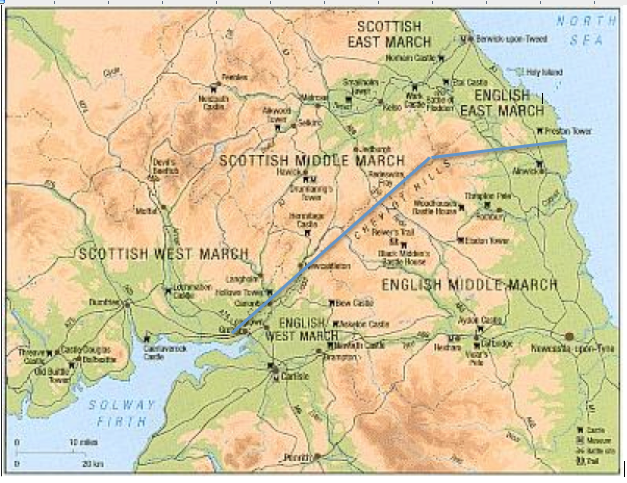
But its name was South Berwick—to distinguish it from its smaller ferry port namesake up on the Forth. Back then, the Border was an elastic concept, running from the end of the Cheviots to roughly Holy Island; Alnwick and Rothbury were definitely English; Norham and Spittal were not; in between was anyone’s guess. Repeated wars switched Berwick itself between the two countries 13 times, becoming English when Elizabeth I built its still-extant magnificent town fortifications to replace the castle (eventually demolished to make way for the station in 1850). It’s long overdue to switch back.

Berwick is closer to the Scottish capital of Edinburgh, than to the North East’s regional centre of Newcastle upon Tyne. That Berwick is Scottish is  reinforced by the fact that most commercial banks in the town are Scottish and Berwick Rangers plays in the Scottish league. Dialect also leads to the belief that Berwick is Scottish as, to most Englishmen, the local `Tweedside’ accent spoken sounds Scottish

Local residents today regard themselves as independent `Tweedsiders’ or `Berwickers’, rather than English or Scottish. In fact until the Reform Act of 1885 Berwick did have a considerable degree of independence with the status of a `Free Burgh’ meaning that it had to be mentioned separately in Acts of Parliament. But the abolition of Berwick District recommended by the Boundary Commission in 2004 and executed in 2009 have left them feeling run by outsiders with scant sympathy for their unique position.

Assuming the local population like the idea, what would a redrawn boundary mean? The whole of the old Berwick District would have the border run from The Cheviot roughly East, passing 5-6 miles North of Alnwick to hit the sea between Seahouses and Dunstanburgh Castle (it would not include the RAF ASR base at Boulmer). An alternative is that the border instead of heading East should follow the line of the Cheviot border slanting NE past Wooler and Belford to reach the sea near Budle Bay.

In either case, some 25,000 people would become Scottish citizens, enjoying advantages  the other 5.25m already do. It would lend itself to solving a longstanding problem of civic incoherence in Scottish Borders. Spinning Berwickshire out of Scottish Borders to join with Berwick and its formerly English hinterland could form a 33rd Scottish local authority, one that had a major town at its focus, excellent rail connections N & S and a far better chance of encouraging coherent development and growth of the lower Tweed valley.

Quite apart from the sheer logic of having a town and its hinterland be in the same country, it would eliminate cross-border nonsense, such as English involvement in Tweed water quality because they control 10 miles of its bank or futile arguments about which roads authority repairs the Coldstream/Cornhill bridge. All this is conceivable without independence and would still be a shot in the arm to Scots at this emotional time.

Oh—and bringing the old English East March north of the border would also move the maritime border between Scotland & England in the North Sea south by about 50 miles—giving the Scots 95% instead of 90% of the oil. Don’t tell the English but if we bribe the Berwickers with some of that increment this could all be self-financing.

Ssshhh!

A New Border? The English East March Turns Scottish

A New Border? The English East March Turns Scottish

Posted in Community, Politics | 7 Comments

That Motion In Full

Without much apparent consultation with colleagues in his own party, let alone across all three unionist ones, Gordon Brown announced a timetable of UK parliamentary measures to address the inadequacies of the present devolution settlement to Scotland. According to papers today, as the first step of that, the following motion is to be laid before the UK Parliament next week:

“That this House welcomes the result of the Scottish independence referendum and the decision of the people of Scotland to remain part of the United Kingdom; recognises that people across Scotland voted‎ for a Union based on the pooling and sharing of resources and for the‎ continuation of devolution inside the United Kingdom; notes the statement by the Prime Minister, Deputy Prime Minister and Leader of the Opposition regarding the guarantee of and timetable for further devolution to Scotland; calls on the Government to lay before Parliament a Command Paper including the proposals of all three UK political parties by 30th October and to consult widely with the Scottish people, civic Scotland and the Scottish Parliament on these proposals; further calls on the Government to publish heads of agreement by the end of November and draft clauses for the new Scotland Bill by the end of January 2015.”

Given that a clear option to achieve just that was excluded from the referendum question on David Cameron’s insistence, the undignified scramble of the last week and the above motion taken at face value could be seen to have reversed that stance. As a result, Scotland may still gain something substantial for the 45% of its people who voted YES, even if it is not the sovereignty they hoped for.

Not wishing to rain on anyone’s parade and dampen such prospects, the whole thing seems cobbled together in a panic. There is evidence of UKIP-paranoid Tory backwoodsmen gathering pitchforks and torches against any more ‘concessions’ to Scotland and—of pivotal importance—any agreement has to survive ritual abuse of party machines girding their loins for a General Election now less than 8 months away.

The cynical negativity and nastiness that typified senior politicians speaking out against independence may have simply been a campaign tactic and they do indeed wish Scotland well and bury their collective hatchets to permit her to prosper by their alternate method.

But, as gran said: “Ah hae ma doots”

Posted in Politics | Tagged | Leave a comment

Grey Light of Dawn

It’s 8am and the last result from Highland comes in with a 47% Yes/53% in Danny Alexander’s back yard, making a grand final total of 1,617,989 Yes votes against 2,001,926 No votes. Despite the consistent polls during the run-up pointing to a knife-edge result, that 45%-to-55% difference is decisive and the Yes campaign in the shape of Nicola Sturgeon conceded defeat before the last half-dozen results were in.

Yes supporters like myself have been reported variously as disappointed, gutted, stunned, etc and I’m sure that is true. But the ad hoc Yes party outside Dynamic Earth kept spirits until the dawn and dispersed without any incidents—as seems to have happened across the country. As could be expected, the No party in Glasgow was ebullient.

In the grey light of dawn (the haar is in here in East Lothian and the roofs are wet without it actually raining) the result seems to have surprised both sides. While I’m sure there is much ongoing anguish and even resentment from crestfallen Yes supporters, many of us are actually proud and relieved that Scotland came out and voted in such numbers to give an unheard-of 85% turnout.

The last time Scotland voted so completely was the 1945 General Election that came in the dying days of WW2 and swept wartime leader Winston Churchill out of office and the reforming Labour administration of Clement Attlee in. Ordinarily, elections in Scotland these days are lucky to achieve a 60% turnout—with some socially derived city constituencies even falling below 50%.

What campaigners and poll-gate-checkers of both persuasions shared throughout yesterday was a reward for all their work by turnout that was an exemplary display of democracy in action. The mood at the polling stations sometimes verged on the carnival, with groups showing up singing here and bagpipes skirling there. Despite some minor blips earlier in the summer, the intense campaign of the last few weeks was fought very hard but very fairly. Some 20% of the votes were postal and represented a return rate around 95% of those sent out returning—again an unheard-of figure.

With such a definitive result on the back of effectively total participation, there is little by way of doubt for Yes supporters like me to grumble about—“if only the ‘X’ vote had turned out” is a non-starter of an excuse. Which should make it rather easier to wake up today, unpin the Yes and No lapel badges from the jackets and all be friends and Scots together—although resentment at the bias of almost all major media is remains unfinished business if democracy is to be truly fair and open.

Because the story doesn’t end here any more than if there had been a ‘Yes’ landslide, debate about what these vague ‘additional powers’ promised by all three unionist parties in the dying days must be addressed, especially as any unity will do a ‘snaw-aff-a-dyke’ job as the 2015 UK General Election looms. And, given the humphing and grumbling from many parts of England that they were excluded from yesterday’s vote, the democratic deficit of the non-existent English Parliament and a re-thinking of this UK Heath-Robinson constitution is immediately front and centre.

Proper analysis of why the vote was so decisive may need to wait until data from across the country can be better correlated but, having been a counting agent in East Lothian and watched votes tumble out of our 96 ballot boxes (as I have done for the last two decades) some factors seem fairly clear.

  • A surprising uniformity across Scotland with the main differences between city, suburban and rural areas rather than geographic location
  • That said, faith in the Union seemed strongest along our southern border: Scottish Borders (33%/67%) and Dumfries & Galloway  (34%/66%)
  • “Tory” areas (known down our way known as ‘The Stone Houses”) overwhelmingly voted No. This came as no shock but the anguish displayed by residents there over the prospect of independence and loss of British identity was surprisingly intense.
  • SNP areas did more poorly than expected—Aberdeenshire, Moray, Clacks, Perth, West Lothian, East Ayrshire all have strong SNP presence but none lay much outside the general trend and none managed a Yes majority. The exception was Dundee which had been predicted to be “Yes City”
  • If the Lib-Dems had an influence in all this, I failed to see it (there were no Lib-Dem activists present at any polling station I visited—and they once had 6 councillors here)
  • Most interesting were the Labour ‘strongholds’ where there seems to have been considerable erosion of party loyalty and a significant number of the 35% predicted to vote Yes doing so. This meant Glasgow, the Lanarkshires and Fife came in far closer to the knife edge the pollsters had been predicting overall and it remains to be seen how much damage Labour’s No stance has done to their support
  • Affluent suburban areas generally seem to have voted No by 2 to 1. This can be seen in the three ‘Easts’ (Renfrewshire, Dumbartonshire and my own Lothian) are within a whisker of each other around 38% Yes to 62% No.
  • The Islands—as always and as in 1979—have minds of their own (Orkney 33/67; Shetland 36/64; Argyll 42/58 but Western Isles a more balanced 47/53)

Overall in a contest this huge, there will be no glib single explanation of the result. But for my money what we saw was a variant of the surprise result in 1992 when Kinnock’s Labour were widely predicted to win and yet Major’s Tories scraped in with a majority and ruled another five years. The explanation given was that it had become embarrassing to admit to being a Tory so the polls deeply underestimated their real strength

In this campaign, I believe pollsters asking Scots how they would vote were getting many answers from people who did not wish to be thought unpatriotic by voting No so they responded as Undecided or even Yes. But on the day, they were fully in the mood of their fellow independence skeptics and cast their ballots firmly for NO.

Posted in Community, Politics | Tagged | 2 Comments