Why YES is the Answer V: The Sisterhood

Having spent two decades in California where feminism is alive, well and a major political force, let me disclaim right from the outset any delusion that I am qualified to speak for women. Several bright, articulate female friends taught me well. But, as an active and longstanding participant in this debate on Independence, I nonetheless feel entitled to express my views—in this case on the pivotal role I believe women are about to play in these last few weeks of the debate.

To date—as with most political issues of national import—men have dominated the debate. Do I betray my gender when I assert they have made something of a pig’s ear of it from both sides? Fifty years ago, women scarcely registered on Britain’s political radar; pioneers like Barbara Castle and Margaret Thatcher achieved what they did largely by playing to the unwritten male rules of the time: aggressive postures; military vocabulary; unsociable hours; old-boy back-room networking.

We have come a long way since women made the tea but analysis of the speeches given or questions posed by Johann Lamont or Ruth Davidson are hardly distinguishable from Milliband or Cameron after 15 years of a Parliament that was supposed to introduce a politics different from that of tradition-encrusted Westminster. And before conclusions are jumped to, this is no wistful plea for touchy-feely or any other supposedly ‘feminine’ approach. Any readers puzzled by this are referred to the writings of Texas-based Molly Ivins who regularly takes on the good ol’ boys of the Texas legislature with wit, humanity and pragmatism in a potent formula women can achieve.

So far, there has been a dearth of such pungent bullshit-antidote here. Nicola Sturgeon comes closest but is too wrapped in party message to realise the bias-transcending lucidity of a woman who knows her stuff and is not going to let ego, career or chest-butting ambition (foibles endemic among males) deflect or dilute her message. And—despite being on the record as a convinced YES—I confess the debate (and thereby the decision) would be much enhanced by such articulate right jabs from the heart from either side.

Churchill was a great orator but let his unbridled love for the British Empire confuse his politics; Blair was a virtuoso in media manipulation but his acolytes have brought politics into disrepute by breeding widespread cynicism in the voting public. Thatcher betrayed her “where there is discord may we bring harmony” speech from the word ‘go’ by using power in a typically unbridled male manner: “Might is Right” is a watchword few intelligent women ever use or even acknowledge as valid.

Gro Harlem Brundtland was three-time Prime Minister of Norway. Not only was she partly the architect of Norway’s current prosperity but also of its peaceable and popular profile in the world, despite membership of NATO and UN deployments to hot-spots like Lebanon and Sudan. More than that, the UN’s Brundtland Commission developed the  concept of sustainable development in the course of extensive public hearings  distinguished by their inclusiveness. The commission, which published its report, Our Common Future, in April 1987, provided the momentum for the 1992 Earth Summit.

In the current independence debate, poll after poll has shown men largely have their minds made up one way or another; women now provide a significant proportion of the ‘don’t knows’. Much of the debate has centered around the absence of key ‘facts’—will we get to use the pound? —how will we defend ourselves? —how could we comply with EU and/or NATO requirements? These are always presented in typically male confrontational fashion—an “answer now or you’re a ten-stone weakling” kind of approach.

Despite women supposedly having a reputation for deciding things by ‘intuition’, the vast bulk who aren’t in politics are neither happy with such playground behaviour nor swayed by glib conclusions thereby implied. The stand-up comedian image of women as flighty, indecisive, vain and uninformed went out with the Carry On films. As they have flooded the workplace, captained RN ships and dealt with household budgets that now may include mortgage rates, investments, their pragmatism, empathy and ability to interpret and anticipate life’s vagarities have developed steadily: flouncy ’50s Doris Day has found the unruffled competence of the IMF’s Christine Lagarde.

These modern Scotswomen are being fed a diet of doctored disinformation by both sides. No serious businesswoman would run negotiations the way Better Together implies Scots will suffer penalties if they leave ‘home’. Women do feel that huge emotional tug as their own children leave home—but swallow their own needs and salve the hurt with pride as their children achieve on their own. No woman balancing a family budget would accept the bland but unsubstantiated assurances Yes disseminates about pensions, social support, debt repayment and future oil revenues. Budgets survive unknowns through rational anticipation and shrewd evaluation of probabilities. Ask any woman.

Modern Scotswomen need honesty and transparency; neither side is making much of a fist of giving them that. More than men worried over pension pots or border tariffs, women are used to assimilating factors across dissimilar axes and weaving best estimates into acceptable conclusions. More than men focused on today’s results, women feel the longer run of life into the future, using imagination and—yes—intuition to derive best estimates for the future that are between fact and fiction but more probable than improbable.

Mothers especially know in their hearts that this is not about them. Like the Highlanders who took white-sailed ship for America, this is about their grandchildren’s grandchildren and whether, in the centenary celebrations of 2116, they would be welcomed as brave visionaries who seized the way to a better life. Or are they like the Clydeside’s shipbuilding unions of the 1950’s, circling wagons to defend a life they know for fear of something new?

It is not that women are feart—the way many men seem feart at losing their pension or their power. It is because big decisions for themselves or their family need to be picked over, talked over, mulled over by heart and head and women are right not to be rushed into any conclusion. Being judged by your grandchildren’s grandchildren is no matter to be taken lightly.

Posted in Politics | Tagged | 2 Comments

Our Maritime Neighbours

Apart from fishermen, yachties and the odd boat trip, few of us spend much time beyond our shoreline, let alone wonder what’s beneath. The superb food and drink we are becoming famous for includes excellent shellfish and a seasonal abundance of mackerel and cod yet to be exploited. But only since the Scottish Seabird Centre arrived have we developed understanding for sea mammal friends living out there—seals on the islands and visits from cetaceans: porpoises, dolphins and whales.

Once, our Forth waters were thick with industrial effluents that poured into the Carron. Sea mammals are choosy about their environment and left. But after a decade of exemplary water quality, the seal population is growing again. As they live and feed around the islands and seldom close inshore, they were hard to track and census but marine biologists, BBC documentary teams and our own SSC cameras are giving us a much clearer picture.

Visits by whales are also growing. If not in deeper water, sightings indicate animals in distress—as in the deceased smallish (14m) sperm whale washed up at Portobello early this month. A pod of 14 such whales was snapped from a microlight off Fidra last April. But most sightings are of smaller species: minke (smallest) humpback or fin (largest) whales. In 2003 a 12m humpback spent a month cruising around the Forth before disappearing. A pod of black-and-white mottled killer whales (actually large dolphins as they have teeth) appear occasionally, hunting local seals.

But our most common visitors are bottlenose dolphins identified as from the large Moray Firth pod. They are intelligent creatures who use sound to converse with each other and to echo-locate their prey. Pods act as a pack, herding fish together, some blowing curtains of bubbles as barriers while others strike. But they are often playful, bow-riding large ships, breaching right out of the water, playing games with clumps of seaweed and even bullying their porpoise cousins by flipping them into the air.

In 2013, at least eight were sighted together as close as 300m off Platcock Rocks; some hardy sailors sighted 3-4 there again on New Year’s Day. This season there has been another pod seen several times not far off the Leithies. Look for the triangular pointed fin sticking up from a curved back up to 4m long, usually accompanied by a few friends and all moving in unison. For more information, try http://www.dolphincareuk.org or http://www.seabird.org/wildlife/marine-wildlife/12/27

Retired Local Deputy Head Extends his Practical Education

Retired Local Deputy Head Extends his Practical Education

Posted in Environment | Tagged | 1 Comment

Naysayers Anonymous

Since the inception of this Independence Referendum campaign there have been cringe-worthy contributions from either side. But the good will shown by Salmond and Cameron at Aberdeen dissipated almost immediately on the NO side. Against a YES campaign that laid out far more detail than any government ever has prior to a general election, NO supporters have delivered only a dreary barrage of simplistic questions repeated in the teeth of answers given.

But worst of all—and most damaging to encouraging those entitled to vote to engage in this crucial debate—has been a catalogue of unsubstantiated and largely untrue assertions that may qualify as the most stultifying misleading campaign posture Scotland has ever had to suffer. To quote, only in part, a representative cross-section:

  • “Yes vote is a threat to freedom”
  • “Independent Scotland’s economy would crash if it tried to use sterling”
  • “Go-it-alone Scotland ‘defenceless’: Nation will be left without weapons”
  • “Mortgages up £1600 if Yes”
  • “Scottish yes vote could lead to currency limbo, say MPs”
  • “Postal costs in Scotland could rise after independence, say MPs”
  • “Scotland and the UK will separate geographically, as well as politically”
  • “Yes could be catalyst for sterling crisis”
  • “Yes will send shares crashing”
  • “Labour claim 1m may lose jobs after independence”
  • “Darling: Independence could cost Scotland £8bn”
  • “700,000 to Leave if Union is Broken”
  • “Yes vote would lead to economic crisis worse than the crash”
  • “UK split to set back cure for cancer”
  • “Gordon Brown raises organ-transplant fears ahead of referendum”
  • “Alex Salmond Is A ‘Prototype Dictator’ And ‘Master Of The Borg’”
  • “Juncker Ends Salmond’s European Dream”
  • “Scotland’s tourism industry is threatened by independence”
  • “Split ‘may cost Scots £400m for welfare IT’
  • “Yes vote pension cost warning“
  • “Vulnerable people could lose benefits in an independent Scotland“
  • “Bank bailout doubt if Scots vote to quit UK“
  • “Independent Scotland Could Suffer Iceland-Style Financial Collapse“
  • “Consumers would snub separate Scotland’s brands“
  • “Scottish independence ‘would harm world’s poorest’”
  • “Go-alone Scotland faces ‘threats from space’”
  • “Scottish Independence ‘Will Lead to Soaring Energy Bills’”
  • “Scotland faces £143bn debt after independence”
  • “Fears for fishing in breakaway Scotland”
  • “Thousands of defence jobs will be at risk if Scotland votes Yes”
  • “Scottish independence will cause civil war in Africa”
  • “Scottish independence ‘would be cataclysmic for the world”

None of the above come from hot-headed local leaflets: all were carried by public media—who don’t emerge from all this smelling too sweet themselves.

This blog had always been clear, consistent and, I hope, rational in its support for independence. In holding to that, it has not responded to the wilder fringes of unionist abuse in kind. Nonetheless, it is difficult to maintain objectivity in the face of such unprincipled and unsubstantiated scaremongering. No wonder it is dubbed “Project Fear”: no matter how senior their spokespersons, double standards prevail: e.g. a mindless repetition of “What IS the currency Plan B” while denying any need to detail the “Devo Max” to which all unionist parties are supposedly agreed.

Much flaky tat comes from the Westminster nomenklatura—those with much to lose if their UK gravy train were derailed—which is a disservice to those uncommitted genuinely trying to get valid questions answered. Even blogs like this accept that reasoned arguments for the union exist. But this deluge of theatrical exaggeration, verging on abuse insults the intelligence of all voters, not just YES supporters. Which means, in turn, the positive arguments for the union—whose existence no enlightened YES supporter has ever denied—are being drowned out.

So an undecided quarter of all voters, bombarded by lurid non-information, are tuning out this crucial debate on the most important decision they will ever make because of nauseating cacophony assaulting them at every turn. If both sides don’t tone it down and avoid dissuading our many switherers from voting at all, then Sep 18th will drift into a tie, conclude nothing and the whole circus will roll on indefinitely.

Posted in Politics | Leave a comment

Why Yes is the Answer IV: to Pension Questions

Many of those still undecided how they will vote next month have an answer provided to them by their hearts but have yet to sway their heads on pragmatic concerns how life will turn out either way, based on credible figures. Prime among those concerns—especially for those over fifty—are pensions.

The UK does not have a particularly good record on providing pensions. Thatcher broke the link that raised state pensions with inflation then punted private pensions that were missold by the billion. This approach was continued under Blair and indeed worsened when Irn Broon raided private pensions and compounded during the 2008 fiscal crisis when many private pension pots lost half their value.

This left UK taxpayers with a third-world-standard state pension of around £5,500 in 2013. Although this is to be raised to £7,500 by 2016, this is offset by a rise in pension age to 67. In contrast, Finland provides £14,100 per annum. Norway provides some 75% of average earnings from the state pension alone—around £10,650, with occupational pensions topping this up further.

Private expenditure on old-age benefits is the highest in Australia, Denmark, Iceland, the Netherlands and Switzerland, where it exceeds 3.5% of GDP. How is it Alastair’s ‘Arc of Insolvency’ member Iceland can still afford better pensions than the ‘rich’ UK? The UK trails rather badly so if you’re looking for a pension to secure your comfortable retirement, you’d better have a private one or receive it from outside the UK. Even with the UK promising a standard pension for all and effectively increasing to by 2016, it still compares poorly, as shown in Table 1 from Which:

Table 1—Comparisons of Pensions in some Western Countries

Table 1—Comparison of State Pensions

Even taking private pensions into account, UK lags in terms of share of GDP dedicated to pensions. All four Scandinavian countries, along with Germany, France and Italy exceed the OECD average of just under 10%; UK lags below 9%, behind even the USA.

So there really is not a lot to lose regarding state pensions for Scots, were they to become independent. That said, many people are concerned so here’s a checklist of ten major misgivings—and the corresponding answers:

  1. Will I still get my state pension? Yes. The Scottish Government have guaranteed to continue to pay every state pension after independence including all the rights you have built up to enhanced pensions such as through Serps
  2. Will my state pension be as much as it is now? Yes, in fact it will be better. The Scottish Government have guaranteed a “triple lock” on state pensions after independence – something Westminster have only put in place until next year’s General Election. This triple lock means the state pension after a Yes vote will rise in line with prices and earnings, or by 2.5 per cent, whichever is highest.
  3. What about this new single tier pension being offered by Westminster? Will we get that after independence? Yes. The Scottish Government will pay a single tier pension of £160 a week from 2016 – that’s £1.10 a week higher than currently being promised by Westminster.
  4. But I am on Savings Credit, will I still get that? Yes, the Scottish Government will pay savings credit at £18 a week, benefiting 9000 low income pensioners. Westminster plans to abolish Savings Credit after April 2016. So voting No will hurt the poorest.
  5. Will the state pension age be the same? It could be lower. The UK government will raise it to 66 by 2020 and then move it to 67 later. The Scottish Government think that is unfair because Scots do not live as long, so would get less pension if we stay with Westminster. After independence, a Scottish Government will ask pensions experts to look at keeping the retirement age below 67.
  6. But how can an independent Scotland afford better pensions? Pensions are more affordable in Scotland because we pay more tax per head than in the rest of the UK. Expenditure on pensions and benefits known as “social protection” have been lower in Scotland in each of the past five years. For example, social protection in 2012/13 was 15.5 per cent of Scotland’s national wealth, compared to 16 per cent for UK.
  7. I have an occupational pension, what happens to that? Occupational and personal pension rights will stay the same after independence – you have accrued these benefits and are legally entitled to them.
  8. What happens to my NHS/civil service/council pension? The Scottish Government will meet all public sector pension obligations and all schemes will be fully protected. The Scottish Public Pensions Agency are already administering a lot of public sector pensions here and will take on new responsibilities after independence and that may create new jobs – a bonus.
  9. Where can I get more information? There’s lots more about pensions in Scotland’s Future, the White Paper on what independence will look like. Call 08453 072014 to get your own copy or read it online at scotreferendum.com
  10. But isn’t it safer to stay as we are? A No vote will not mean things stay as they are. It means retiring at 67 – or even older, a loss of Savings Credit for the poorest pensioners and a smaller single-tier pension. Remember, the UK Government’s track record with pensions is poor. It’s a good argument to transfer responsibility for pensions to a parliament with a better track record of looking after them.
Posted in Community, Politics | Leave a comment

Girl Talk

Last night’s TV included 2003’s Mona Lisa Smile, a film I had not seen. As a period piece of cloying post-war American consumerist culture, the location, set design and wardrobe depts get full marks but the screenplay—written by two men—seemed both predictable and superficial. Most reviewers see it comparing poorly as a female version of the late (and greatly lamented) Robin Williams vehicle from 1989—Dead Poets Society. That did make a better fist of awakening young minds locked too early on an upmarket career path.

But, all that said, it did make a decent fist of examining the roots of modern woman and the still-ongoing conflict with traditional roles that brings her. The business world has been wrestling with this since at least the film’s setting in the early 1950s (c.f. Mad Men where the jobs are segregated but the power certainly isn’t) and is still found wanting, despite equalities acts and a genuine commitment to avoid wasting talent. But from California to Canary Wharf, the ground-breakers/high-earners remain driven by testosterone and sports metaphors.

Fortunately, the fact that aroma of stale cigar smoke predominates still in boardrooms does not hinder too many women; the real battle is on the career ladder leading there. Once women amass the requisite heft to their CV, they find climbing the final boardroom peak easier—dinosaurs like Fred Goodwin notwithstanding. Once there, they usually find allies in undermining a macho culture that butts chests over how long it’s been since you took a vacation and habitually uses vocabulary based on warfare to describe business.

Where business deserves brownie points is that it, in general, it recognises it still has a major problem in making proper use of talents in the female half of the population. Earlier efforts failed for lack of flexibility:  California positive discrimination legislation from the 1970’s fast-tracked many latinas faster than their abilities could develop so that no-one benefited when many cratered.

Unfortunately, politics has not followed so pragmatic an approach. On the surface, there has been enthusiasm in UK parties and abroad for gender balance. The Scottish Parliament was set up as a ‘family friendly’ operation and even the gentlemen’s club that is Westminster has made concessions. But from St James to St Andrews, bias against women remains rife and the role of the presentable, support wife as career adjunct—basic to the story in Mona Lisa Smile—remains sacrosanct.

Take ‘enlightened’ Labour in Edinburgh as an example. It describes selections as fair and transparent, considering both all-women shortlists and a twinning procedure as progressive measures. In Edinburgh Western, two (minority ethnic) males, one other male and one white female all sought selection for the twinned constituencies of Edinburgh Western and Edinburgh Pentlands. She automatically received sole nomination while three male PPCs had to compete for the remaining constituency.

Similarly, even though identified as a ‘key seat’, Edinburgh Western eschewed an all women short list to select Cllr Cameron Day. In this, he was supported by major local figures like Traminatrix Cllr Lesley Hinds who chaired the selection, even though insiders complained the selection timetable was rushed through, objections ignored and she advocates all-woman shortlists. Soon after, the MSP for Edinburgh Northern and Leith (twinned with Western) announced retirement and an all-woman short list was promptly declared. When nominations closed, there was only one candidate: Cllr Lesley Hinds.

It would be easy to claim ‘stitch-up’ were other parties not equally guilty of besmirching equality with grubby ambition. But the net result parallels the over-promoted California latinas, as evidenced by the sweetie-swapping Karens who graced the early days of wur Pairlimunt but who could barely read a scripted speech, let alone contribute to debate. Did they show that ‘real people’ could be elected. Or did they turn off professional women who saw them—and their televised tribal yah-boo-sucks debates—as unedifying, a kind of Sex and the City without the glamour.

As well as the whole political process itself, poll after poll shows Scottish women are also considerably less keen on independence than men. Despite wur Eck reaching out to women voters since the campaign kicked off two years ago, fewer women seem engaged in what will be the biggest decision they are likely to make this century. Or it may be they just want more evidence: that doesn’t necessarily make you more disengaged or cautious, it just makes you more analytical. Jo Armstrong, Professor of Public Policy at the University of Glasgow says:

“If the hypothesis is that women analyse things differently, it’s unlikely that they would want to see policies promoted only for them. It’s about having policies where they can understand the implications for them and their families, which is perhaps not being communicated well in the political messaging.

“I suspect that the issues that interest women are exactly the same as the ones that interest men. I can’t believe that women think that childcare is more important than the economy, jobs, or more important than better services in general.

“The idea that you’ll be able to make women change their minds with women-only issues is misguided. It suggests that the political parties still have a poor idea of what equality is really all about.”

Traditionally women are more conservative than men in how they vote. Perhaps that’s because men were in the factories or the office, negotiating careers but finding common ground on which to do it and so forming networks whether in trade unions or golf clubs. But women are more about pragmatism. Old-fashioned as it sounds, in many cases women are the ones running the household budget and so they actually see what’s happening to the price of food, clothes, etc—the ‘sharp end’ of the economy.

Women want reassurance that independence is going to be better. They are the ones who ask: “What if something happens to my husband’s wage? What if something happens to childcare? “What if something happens to university fees?” They are far more engaged than the arm-candy-for-life girls of Mona Lisa Smile. Trevor Salmon, Emeritus Professor of Politics and International Relations at the University of Aberdeen says:

“The trouble with making pledges about what will happen after the referendum is that there’s such a distrust of politicians nowadays. The only promises that either side can make to attract more women are ones where they can make them real.”

The old Scottish tradition of women not being heard is influencing what women are prepared to say or on how they are going to vote; women are more naturally cautious because of this culture of exclusion. No wonder we have low participation level by women in politics. Where are the female role models, women in leadership roles or on senior management teams? All this saps women’s confidence levels.

And this was my major gripe with Mona Lisa Smile—the Miss Watson (Julia Roberts) character went through obvious iconoclastic motions towards Wellesley and its broom-up-the-bum conventionalism but never resolved her own human frailties into life lessons; development; progress. That’s one characteristic where women typically surpass men.

I’m with Karly Kehoe, Senior Lecturer in History at Glasgow Caledonian University on this one when she says:

“There’s no easy fix here, but the first step is to recognise that we have a problem. We need to start for example by normalising equality in society. This can start with children by reinforcing understandings of equality through childhood and young adulthood. If you show a child how their mum and dad are equal in both home and employment, that child is going to grow up with a balanced picture of what society is and should be.”

But with one month to go before the referendum, we no longer have the luxury of time that needs.

Posted in Commerce, Politics | Tagged | Leave a comment

It Cannae Be Canny—Can It?

Last week’s FM Questions did not much advance the sum of human knowledge as JoLa insisted on asking the same question (“What is “plan B” if currency union is not an option?”) four times in an obviously scripted attempt to finally score a point off His Eckness as Alastair Darling managed to do in their televised debate. His reply was equally consistent (if a touch more humorous than the expression-free zone of the Labour leader): there were a number of options laid out on Page 110 of Chapter 3 of the White Paper but only one was both desirable and right: “It’s Scotland’s pound and we’re keeping it”.

This question loop was clearly part of a cross-party drumbeat caterwauling at the prospect of independence because JoLa followed up with a press release early this week asserting that Scottish families would see their mortgages rise by £1,600 a year in the case of independence. How she could be so certain of numbers when she and her party can’t even outline what actions they would take to ‘improve’ the devolution settlement, should Scots not vote for independence, was not made clear.

What is even less clear is what fiscal planet nay-sayers like JoLa are living on when, virtually on the same day that £1,600-worth of doom & gloom was being peddled, the Daily Excess (no friend to those who don’t think that SE England is the source of all wealth and the font of all goodness) splashed with a very interesting piece that Scottish house prices had risen by £800 a month for the last year.

This rise was most pronounced in the capital where average single home price is up 4.2% in a month to reach £239,369 while oil-booming Aberdeen is not far behind at £228,802. And contrary to what Bitter Together would appear to assert, the rest of the UK is not sharing in this. Gordon Fowlis, regional managing director of Your Move, commented:

“While the majority of regions in England and Wales are witnessing price falls, the Scottish market is moving the other way.”

Even more inexplicable if you believe in impending independence fiscal disaster is seaside towns offering superb quality of life and accessible from those markets are doing even better. My own North Berwick comes in at £327,518 average, St Andrews at £261,446; Stonehaven at £211,413 and Inverbervie at £202,144.

None of this compares, of course, to London, where, as the Independent burbles:

“At £1.5m, a home in London remains a highly lucrative investment, as those who bought a property in ‘prime London’ this time last year would have made a profit of £166,216.”

For more realistic comparisons, let’s look to that lair of global capitalism, the USA. Not only have Americans been avidly practising career moves linked to property speculation decades before Londoners woke up to this nice little earner but the bitter recession of 2008 is now behind them and property prices rising across the States.

To what? Well, the top four markets there are all in California which is still being driven by waves of technology that gave us Silicon Valley, the PC, the internet and the iPhone. The four most expensive housing markets are San Jose, $899,500 (£535,416); San Francisco, $769,600 (£458,095); Anaheim-Santa Ana, $691,900 (£411,845) and San Diego, $504,200 (£300,119).

That my seaside town of 7,000 can compete in house price with top US markets and that our capital has a 13% edge over Washington DC’s $356,500 (£212,200) is no guarantee that such affluence is any less transient than other property bubbles that have come and gone.

But, if we were standing on the brink of fiscal disaster, why would canny investors lose their heads to buy up properties in the path of Hurricane Independence if they thought it threatened their wealth? What do they know that JoLa and her eye-of-newt forecasting cauldron don’t?

Posted in Commerce, Politics | Leave a comment

Douglas Alexander: Politician, Thinker, Great Briton

While I don’t entirely share Jamie’s degree of criticism, I admit Douglas’ SoS piece seriously undermined my previous level of regard for him as a unionist who avoided falling into closed-minded, hate-filled clichés typical of Brian Wilson, Ian Davidson et al.

Posted in Uncategorized | Leave a comment

The Poond in Yer Pocket

The British Pound (£UK) has a long history as a currency. Prior to the 1707 Union of the Parliaments it was known as the English pound as the ‘Pund Scots’ was of rather less value—not least because of the country losing a quarter of its wealth in the Darien disaster. The exchange rate dropped from an initial parity under David I (12th ©) to 4:1 under the unpopular and ineffective James III (15th ©) and down to 12:1 when reformed under James I & VI (17th ©). It was at this rate it was phased out in the 18th ©.

Since then, the British pound has led a chequered life. Britain’s two centuries of industrial and colonial growth up to WWI saw its value and usage grow to dominate a global trade in which the Scots shared and benefited as much as anyone; around 1910 the highest per capita GDP was in Scotland.

The crippling debt accrued and the damaged trade that followed that global catastrophe was largely kept from the British public during the inter-war years but economic body blows to world trade like the 1929 Wall Street crash and the subsequent Depression cost Britain as the world’s leading trading nation dear.

Further outlays for another World War put such severe pressure on the £UK that Britain entered into an agreement with the USA known as the Bretton Woods system of fixed exchange rates, pegging the £UK at the $4 rate held through WW2 and $35 being the fixed value of an ounce of gold held as security in Fort Knox. (This led to slang of the time: 5s (a then-rare ‘crown’ = 25p) was called ‘a dollar’ and the much more common 2/6d (half a crown) as ‘half a dollar’.

Despite deep devaluations to $2.80 in 1949 and $2.40 in 1967, the global recovery of the 1950’s and ’60’s when people (in MacMillan’s phrase) “never had it so good” let this arrangement bring stability as it was effectively a formal currency union and tied UK fortunes to the now-much-stronger USA. Every chancellor of the time from Labour’s Stafford Cripps to Tories’ Anthony Barber saw this as a good thing, eschewing all control over exchange rate policy and taking credit for economic growth.

On August 15, 1971, President Nixon announced his New Economic Policy “to create a new prosperity without war.” Known colloquially as the “Nixon shock,” the initiative marked the beginning of the end for Bretton Woods; so many dollars were in global circulation that the even the US was having trouble holding enough gold to cover them all and there were speculative runs on the dollar.

After several failed attempts to realign currencies, in March 1973, the G–10 approved an arrangement wherein six members of the European Community tied their currencies together and jointly floated against the U.S. dollar, a decision that effectively signaled the abandonment of the Bretton Woods fixed exchange rate system in favor of the current system of floating exchange rates. The UK made a separate attempt to link the £UK to the $ but with similar ability to float and absorb vagaries of the market.

In the Louvre Accord of 1986, Thatcher agreed to switch the standard from the $ to the Deutschemark, followed up four years later by Major entering the Exchange Rate Mechanism or ERM. Membership lasted two years before currency speculators, led by George Soros realised that a killing could be made if major currency speculators ganged up by selling a particularly weak currency so that it was forced out of the system and effectively devalued.

This happened on ‘Black Wednesday’ in 1992 when all the Bank of England’s efforts to shore up the £UK failed and cost the British taxpayer over £3bn, a third of which would up in Soros’ piggybank. Despite this, attempts were made to keep the £UK linked to both other currencies and the value of gold but this was finally abandoned and the currency allowed to float freely on world markets under Gordon Brown in 1999.

Not such a bad idea in itself, Brown went further and sold off much of Britain’s carefully hoarded gold reserves as now superfluous—an evaluation that is highly questionable in view of later events. But, worse than that, he announced the sale and eventually sold about 395 tons of gold over 17 auctions from July 1999 to March 2002, at an average price of about US$275 per ounce, raising approximately US$3.5 bn

Had he held on and used it in 2008’s recession, prices were passing $1,000 (and are now nearer $1,500), it could have fetched an additional £10bn—or £400 off everyone’s tax bill. ‘Prudence’ did you say?

And if that’s not bottom line enough for any blog, consider that the above story of currency exchange rates demonstrates the UK has, in the last half-century, tried just about every option available. And George Osborne, latest author of and heir to the UK’s sorry fiscal decline in all that time, dictates unilaterally that Scotland, were it to become independent, cannot choose among those options?

Is this attitude by a partner in any union worth the name one that offers any value to us?

Posted in Commerce, Politics | Tagged | Leave a comment

Anorak of the Year

Health warning: this blog is one only anoraks are likely to love.

Ten years ago, Lothian Buses made great play of receiving the ‘Bus Company of the Year’ award for 2002 and emblazoned the fact on their buses. In the intervening time, having lost much goodwill from punctuality torpedoed by tram works, insult has been added to their injury by having the whole tram operation hung round their necks.

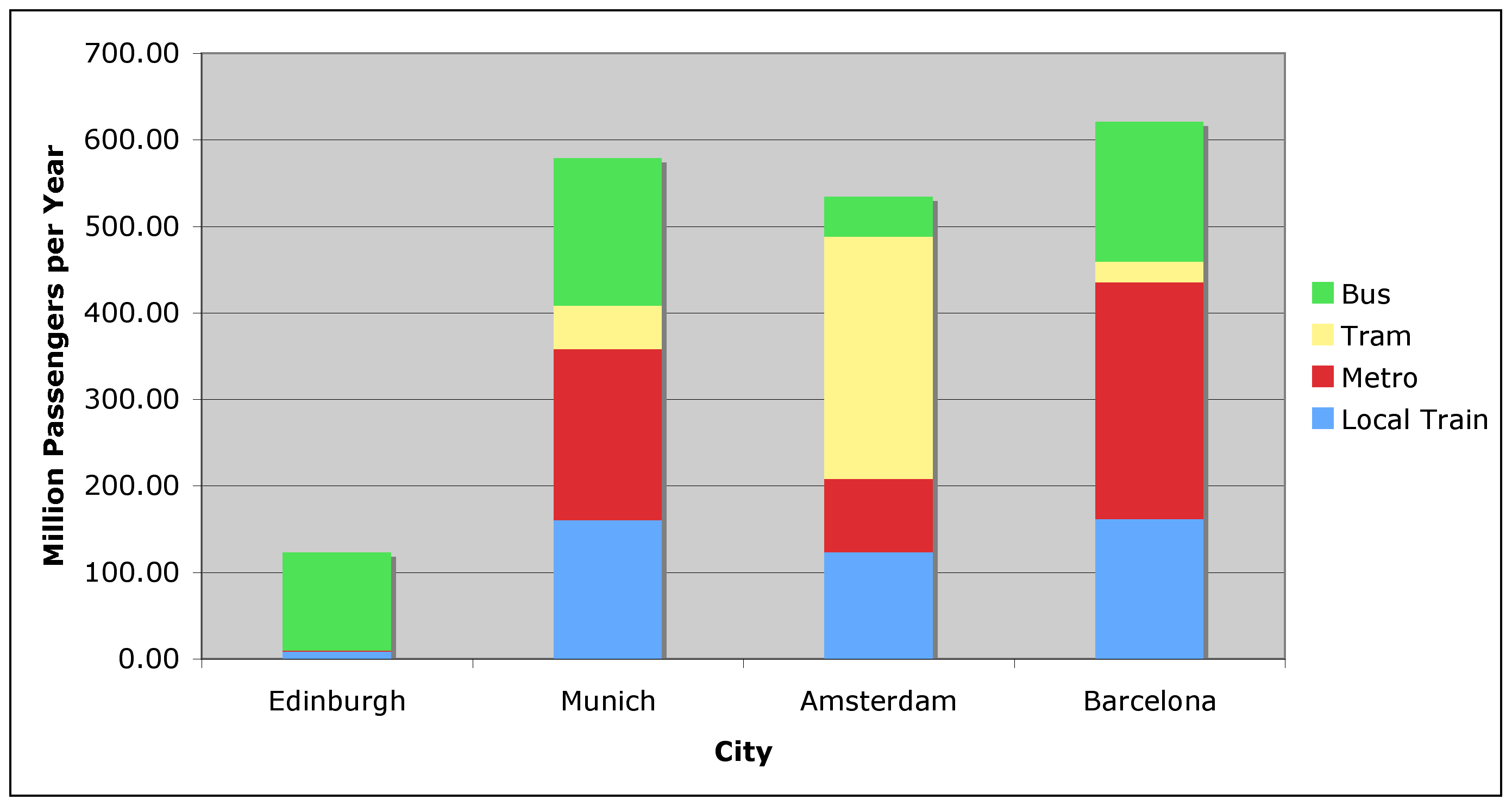
In fairness, they do run a tight ship with a fleet of clean, new, buses that run a relatively punctual schedule around Edinburgh and its near environs and therefore receive few complaints from the locals who use it regularly. But anyone with enough buses, drivers,  mechanics and an IQ in double-digits could make buses pay in Edinburgh, a major city with horrendous traffic problems and no other public transport to speak of: it is the biggest city in Europe with the transport strategy of a village—check the comparisons.

Embra-rassing: Public Transport Stats for Comparable European Cities

Embra-rassing: Public Transport Stats for Comparable European Cities

Most important, the other transport nets cited are integrated: one ticket gets you from A to B, no matter what means you use. Check out Lothian’s website. It has a tab for “Integrated Transport” but all it consists of is a 3-minute cartoon aimed at 5-year-olds that skips the fact that trams take longer than the Airport link and cost lots more (although the website’s ‘fares’ page tells you none of this).

All through the site, the assumption is that you are a resident. Want multiple tickets? Well the CityTicket for 20 journeys costs £30—exactly the same as you’d pay for 30 single journeys and you have to find a Travelshop to achieve this stunning 0% bargain discount. Or the Day Ticket: “Perfect if you are making 3 or more journeys in a day.” chirps the website. But how many times is that likely?

But what of the 3.7 million visitors Edinburgh, the No.2 tourist destination in the UK, receives each year? Well, they’re stuffed, whether they arrive by train or get turfed out of the Airport link at Waverley Bridge. Good luck finding the TIC dragging their cases or working out which of the 18 Waverley bus stops they need and then finding it or even the two nearby-but-well-hidden Travelshops. Try asking about trains in a Travelshop or buses at the train counter if you want an earful of pithy anglo-saxon in a broad Scots accent.

In short, Lothian is on another planet. The reason is: it’s run by bus anoraks largely for bus anoraks—the present CEO Ian Craig replaced Neil Renilson—both with bus CVs the length of your arm. No-one would mind his total pay package of £269,388 last year (up from £264,196 in 2012) if he was delivering a 21st century integrated system.

They do get 96% customer satisfaction and services they provide are clean and modern.  Recent PR oozed over 10 new Volvo 7900H diesel-electric hybrids, gushing over their green credentials and soon to be running on Route 30 Clovenstone/Musselburgh. But nobody polls the millions (including almost all of the 3.7m visitors) who don’t use Lothian as to why.

Leaving aside the total lack of integration with ScotRail (or tourist buses or FirstBus or anyone else), the most glaring flaw is their network structure that is pure 19th century. Compare Lothian’s route map with the 1950’s Edinburgh Corporation Transport trams map and see how little progress has been made. Then compare it with, say, Munich’s transport map. Note how the radial routes on which Lothian fixates are all provided there by fast S-Bahn or U-Bahn lines in Munich; any gaps are provided with higher-capacity trams. Buses are only used to feed this fast, high capacity backbone. And—this is why Edinburgh is now saddled with a white elephant—no tram line duplicates heavy rail.

Consider this when you are stuck in a chain of No 26’s crawling their way through Roseburn or a shoal of No.3’s stuck in South Clerk St behind a delivery van.

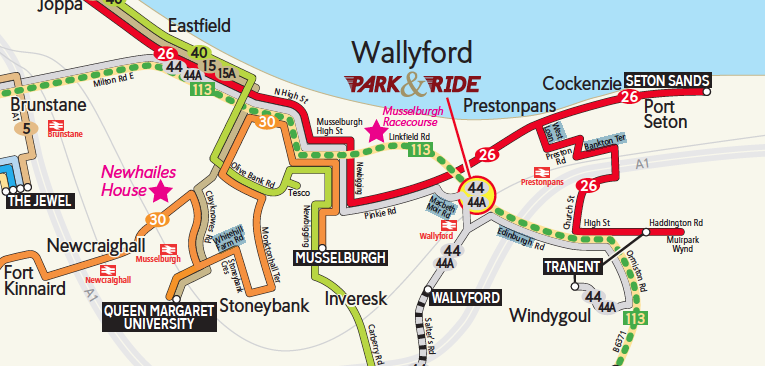
It’s just as well that efficient buses are to be used on the No.30 route. It might qualify as the least efficient route of all, especially at its eastern end where it takes 1/2hour to cover 1.4 miles crossing Musselburgh between Newhailes House and Musselburgh Grammar. That’s 2.8 mph in old money.

Lothian Route Map in Musselburgh: Route 30 in Orange

Lothian Route Map in Musselburgh: Route 30 in Orange

Despite serving QMU, this bus takes 1 1/2 hours end-to-end, a voyage no sane passenger undertakes. After Fort Kinnard, it duplicates other routes, so you might think demand would exist for a faster service that didn’t duplicate the train to Waverley (10 mins vs Route 30’s 40 minutes). It could profitably be rerouted through the swathe of South Edinburgh that has no QMU/Musselburgh service, even if it does need to wind up at Clovenstone. (Wild guess that’s for another anorak reason: the depot’s nearby)

But that would be a non-radial service, which Lothian abhors. Every good anorak knows that is no way to parade your spiffy buses before an adoring public—even if it does cause self-induced traffic jams blighting Musselburgh High Street, Shandwick Place, St John’s Road, Great Junction Street, Elm Row, Tollcross…and two dozen more bottlenecks.

Therefore, this blog’s clear winner for Anorak of the Year, in acknowledgement for setting  goals furthest from public need (through endemic bus fetishism, executive-over-passenger priorities and showboating for their 91%-share ECC political masters) is Lothian Buses.

In modern cities with real transport systems, buses don’t cause traffic jams; they fix ’em.

Posted in Transport | Leave a comment

Делать хорошую мину при плохой игре*

“It is the servant who takes the money” —Lawrence of Arabia

As a young man, I was proud to be British. But the more I became familiar with its Establishment and could compare it with other cultures, the more that pride has been (to put it mildly) eroded. The last tenuous memories of such pride are of Lord Carrington resigning as foreign secretary some 32 years ago.

Watch any British film from the 1950’s and you are struck by a time warp of modesty, selflessness and dogged resilience that verges on the fetish. Contrast the self-deprecation with the rugged individual heroics of US films of the same era and you have a rough model of cultural differences that still existed.

But roll forward to the 1980’s, the era of ‘Big Bang’, brazenly loud braces and the Masters of the Universe emerging amidst the new cityscape of Canary Wharf. Those cultural differences (e.g. Carrington vs Rumsfeld) might still exist out in the shires but they were already gone from the Square Mile of the financial district and, courtesy of Blair and New Labour, soon to be expunged from the political village of Westminster just up-river.

Such purging was not all bad. The long boom from early nineties to late noughties made most people much richer, creating a quality of life unknown 50 years before. Even the avalanche of outsiders into the City blew fresh air through stuffy management in Morgan Grenfell, Hambros and Warburg; the huge NatWest was gobbled up by newly aggressive (if much smaller) RBS and creative investment banking invented PPP, PFI, privatisations, 100% mortgages and derivatives of ever-increasing complexity to mine what seemed like an inexhaustible and profitable supply of ‘financial instruments’.

The fact that ‘canny’ Scottish bankers like RBS and HBOS were to the fore in all this only served to soothe any disquiet felt by the fuddy-duddies who still hankered after the much more staid days of  ‘my word is my bond’.

The comeuppance of 2008 was a shock to everyone. Twenty years of salary and bonus inflation had addicted an army of bankers, accountants, traders and fund managers to  seven-figure salaries and the mortgages they paid. Despite constriction everywhere else in the economy—and particularly in Joe Public’s salary—denizens of the Square Mile (which now includes Canary Wharf and the Qatari-owned Shard) successfully defended their bonus culture, convincing the UK Government that it was essential in any recovery.

Spending over £100bn each year that they did not have, the UK Government bought that story, betting on a recovery in lucrative financial services to drive borrowing down before the whole country (and AAA rating) sank under a £1,500,000,000,000 mountain of debt. As the result, the City’s bluff was not called and this residual distinction of British (vs American) culture—that there was a moral as well as a profit obligation—disappeared.

Foreign money has poured into the City for centuries. And, like the Swiss, there have not always been searching questions asked as to its origin. But weak UK sabre-rattling in response to the disappearance of Crimea back into Russia and appearance of Russian tanks in Eastern Ukraine demonstrates that the UK establishment understands that, in the 21st century, what matters are banks, not tanks and global competition to house the dosh concentrated in 58 Russian billionaires and their poorer brethren (there ARE no sisters) is fierce because of its very lucrativeness.

Thus has London become the centre for Russian corruption, deftly directing their loot into Britain’s continuing empire of tax havens—Gibraltar, Jersey, Cayman Islands, British Virgin Islands (BVI)—on which the sun never sets but where the taxman’s baleful glare seldom shines. To give some concept of scale, the entire UK received £53.2bn in foreign inward investment last year. That’s a respectable £1,000 per head. But the BVI saw almost £54bn in inward investment—roughly £1.5m per head—in the same period. “We are all in this together”? I think not. As the blurb for the place (pop: 28,000) itself says:

  • “The British Virgin Islands represent the world’s principal centre for International Business Companies (IBCs) of which there are in excess of 500,000 currently registered
  • The BVI is among the top four domiciles for offshore mutual funds in terms of the number of offshore funds incorporated (over 2,500) and domiciled
  • There is no tax on offshore income and capital, no tax on mutual funds, no inheritance tax, no capital gains tax, no VAT/sales tax, no currency controls, and no double taxation agreements in BVI.
  • BVI are home to leading international accountancy and attorney firms, and its Know Your Client legislation has been approved by the US Treasury”

In other words, an offshore tax scam on a colossal scale in which both the City and HM Government are complicit. Yet the average UK citizen neither has access to nor benefits from dog-eat-dog global finance in whose waters some very shady sharks swim—not all of them with thick Russian accents.

But this is not all. For tbose who can afford it and despite this pious guff about slowing immigration, British residency is up for sale. “Investor visas” can be purchased, starting at £1 million; Russian clients now provide 60% of the work for lawyers in London’s Commercial Court; 50 Russia-based companies swell the trade at London’s Stock Exchange; planning regulations become malleable for Shard-like aspirations of London’s hedge-funding class.

London’s bright young things have become consultants, art dealers, private bankers and hedge-fund-runners. In effect, they have become the oligarchs’ valets. Such is the trade that Rootin’-Tootin’ Putin knew he could play serious sabre-rattler to bolster his ratings with the krest’yanin, as well as the nomenklatura, by talking tough, grabbing Crimea by coup de main and stirring things endlessly with Ukraine’s Russian minority.

Because when you pay them, you own them. Putin calmly assumed that Britain’s senior management, shuttling through the revolving door that now exists between cabinet posts and high-flown corporate boards, won’t/can’t give up their fees and commissions from the oligarchs’ billions. He has been proved right

In the austerity years following 2008’s financial crash, such a source of wealth could not be resisted. Tony Blair has come to embody a latter-day Raleigh’s pirate ways; he advises Kazakh’s Nursultan Nazarbayev on his image in the West, tutoring his patron on evasion of awkward questions about crackdowns and mine shootings that are everyday life there.

As Scots stand within six weeks of being able to choose an alternate future, they should consider that ‘No’ means remaining party to the UK’s latest growth industry that taints its history as much as earlier greed-driven wheezes like the slave trade or opium wars: laundering oligarchs’ dirty billions and laundering their squalid reputations.

* “To put a brave face on a sorry business” (Russian proverb)

Posted in Commerce | Tagged | Leave a comment