Changin Scotland

It’s the end of a packed weekend in and around the ever-quirky Ceilidh Place in Ullapool. Therehave been over a dozen previous Changin Scotland get-togethers but this was my first—and, unfortunately, reputed to be the last. There were so many newbies like me that they had to shift the main venue to the nearby Village Hall to accommodate the 80-100 at each session.

Starting Friday evening and running to Sunday lunchtime a series of a nine discources of over an hour each with 2-4 ‘names’ on-stage covered an eclectic range of topics from feminism through the Smith Commission to possibilities in the Arctic. Not all gave speeches and not all who did seemed comfortable doing so. But there was a clear sense (rare, if not unheard-of in political discourse) that all were sincere and none were here purely as a career move.

In the opening session Politics; Cultures; Imaginations, Kathleen Jamie, one of Scotland’s finest poets who deftly exudes a couthy and an international outlook simultaneously and Guardian journalist Madeleine Bunting exchanged views on how Scotland was perceived and how it perceived itself under the astute chairing of BBC Business Correspondent Douglas Fraser.

Intense audience participation over whether Scotland was comfortable in its skin (it was) was relieved by Douglas’ chocolate Labrador—impatient at the back of the room—broke free to join him onstage and spent the rest of the session flat on his back contentedly having his belly rubbed. It was that kind of gathering—intense yet disarmingly informal.

My own response to sessions was mixed: I found the Gender Power Radicals and Leadership xession to be both hectoring and old hat. A lecture about how young men were trapped in male aggression seemed the same antique one-sided feminism that was espoused by Andrea Dworkin 25 years ago and not in tune with the more complex interactions behind modern thinking.

Probably my favourite session was with Lateral North’s obviously nervous Tom Smith, somewhat calmed by able chairing from Andy Wightman. But despite himself, Tom’s articulation and enthusiasm shone through talking about seeing Scotland from a radical geographic perspective—as the threshold of Europe for trade with Asia via the Barents Sea and Orkney becoming an entrepôt, capable of handling 300.000-ton ‘cape size’ container ships too large to access Rotterdam or Hamburg directly.

The liveliest, most audience-interactive session was chaired by Gerry Hassan What Do We Do about Scotland, England and the UK? The main contributor was Adam Tomkins, a Professor of Public Law at Glasgow since 2003 and advisor to the Conservatives on the Smith Commission. Not only did he give insights into why it reported as it did (e.g. why 15% of Welfare was included and Pensions weren’t) but he made a strong case—through reference to other countries—why this was about as powerful a settlement as could be hoped for.

This led to what was, for me, the least enjoyable passage where the audience turned clearly hostile and accused him of a “party political broadcast” as his views clashed with the bulk of those there. I found this unfortunate; I had hoped for a more open and flexible debate, hearing many views but this reminded me of when Labour’s Pat Watters addressed the SNP Councillor Conference and the atmosphere was very much one of Daniel in the lion’s den.

And there lie the limitations of the gathering. While genuinely attempting open and varied debate, Changin Scotland seems to attract almost entirely independence supporters in the older age groups. I was reminded of SNP conferences of the 1990s when numbers were small and many grey hairs present had seen the false dawn of the 1970s and suffered the depredations of the 1980s wilderness.
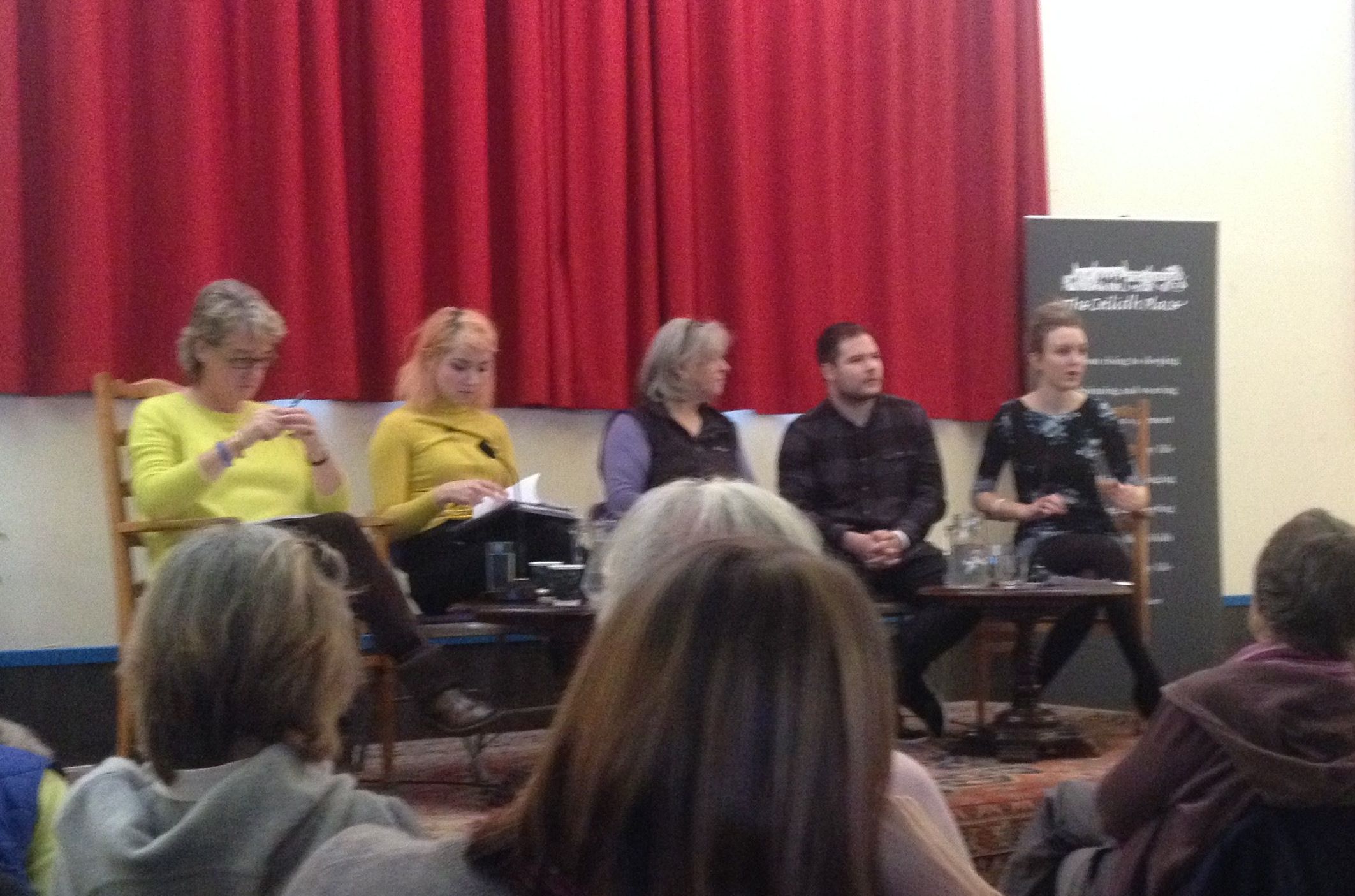
Susan Stewart: Cat Boyd; Kathy Galloway (chair); Ross Colquhoun; Miriam Brett in final session of Changin Scotland

Susan Stewart: Cat Boyd; Kathy Galloway (chair); Ross Colquhoun; Miriam Brett at Changin Scotland

Although the bulk of attendees would probably have been glad for that, in no way did this resemble the razzmatazz of Nicola’s rally in the Hydro last week. It had more content but significantly less buzz and enthusiasm. It also contrasted poorly with last month’s SNP conference in Perth—shot through as that was with young people and wide-eyed enthusiasm of new members; neither element was present here.

But perhaps I expected too much. Under Jean Urquhart’s kindly and embracing stewardship. the Ceilidh Place has always been a quirky corner of unexpected homey comfort—one that old hands rather than firebrands are likely to appreciate. The fact that attending requires both travel and accommodation expense also mitigates against the younger audience readily available in Glasgow or Edinburgh should not permit too much criticism or sombre analysis.

The bottom line is that, for three days and £60, I got to rub shoulders with a panoply of names I have read and admired and was able to discuss my country and its future in a variety of cosy environments scattered around a picturesque Highland village. As memorable weekends go, this one will be hard to beat.

Posted in Politics | Leave a comment

Politics in a New Dimension

For as long anyone could remember, politics in Scotland was an extension of Westminster and British politics; same parties, same policies, same debates. ‘Putting a kilt’ on a story simply meant having a Scottish slant on a miners’ strike or industry investment. Some may have believed things changed in the seventies but Thatcher soon dispelled any such notion.

Then came the 1997 Tory comeuppance that was especially brutal for them in Scotland. Donnie Dewar’s provision of a Scottish Executive shifted the ground under any latent Tory aspiration to preserve a politically seamless union but the party has struggled to recover from the perception of an English-dominated pseudo-colonial attitude. They have yet to adjust to that first seminal shift in Scottish social attitudes.

From a northern poor relative in constant need of fiscal infusion for its ailing industries, the riches of the North Sea took two decades to infuse the Scottish psyche with a cultural renaissance that stretched from cinema (Trainspotting) through theatre (Black Watch), music (Franz Ferdinand), architecture (parliament) industry (renewables) media (BBC Alba) and a varied slew of creative writing from Kelman to MacCall Smith.

That could be considered the first phase. No longer was the ‘cringe’ a topic worth discussing; we had rediscovered our cultural identity—and it was secure enough to embrace the full-tilt self-mocking of Rab C. Nesbitt, Still Game or Billy Connolly. But, although the day the parliament was (in Winnie’s historic words) “reconvened” was full of colour and hope, it struggled for a while to find either its feet or its voice.

That came when the SNP grabbed power by a whisker in 2007 and swept away the many moribund council administrations to whom ‘aye been’ was justification for inertia. The minority administration was bold in its attempt to break fresh ground and were unabashed to do it in a populist manner. Many ‘freebies’, including free personal care, prescriptions, concessionary travel and eye checks were either preserved or implemented and council tax frozen acrtoss the country.

Although habitually criticised by all opposition parties, the SNP stuck to their guns and spent a solid four years proving competent in administration and adept at working with even the Tories to get their budget passed. That proof of competence paid off hadsomely in 2011 when they were swept back into power with an orverall majority and a stunned Labour party found itself with half its experienced team out on their ear while relative unknowns from list places were elected.

It cost Labour leader Iain Gray his job but his replacement Johann Lamont failed to ignite any stirring from what appeared to be a moribund party. It was clear they had lost track of Scots and wandering the political wilderness but this only became highlighted to the aoplitical majority when the SNP and oits allies made all the running in the leadup to the Referendum and that any Better Together initiative that rose above dire threats and warnings came from the Conservatives.

What didn’t help was a spillover from the English parties who are famously reluctant to sit in the same room as one another. Better Together campaigns were run jointly but only so far as what few street activists there were delivered pretty much the same literature. It was obvious to most that they made uneasy bedfellows, with Labout clearly the least comfortable.

A major party of the Better Together campaign was a serious distaste among its supporters—especially those with a Tory bent—tht they were having to deal with this issue at all. Many gave the impression of citizens confronted by a predicted tsunami or earthquake: deep concern lixed with varying levels of terror at their helplessness. Whereas the ‘Yes’ side seemed ebullient and keen to chat with anyone and everyone, there was no such sense from the ‘No’ side beyond a hope this would all just go away.

Decisive though the referendum was and clearly though the ‘Yes’ camp has said they accept the result, the tone of debate in the two months since has taken of in a direction few had forecast. Instead of the ‘losers’ dispersing dejectedly and the ‘winners’ being bouyed into carrying their idead further, the roles appear to have been almost diametrically reversed.

Despite some organised nastiness from ‘No’ extremists in George Square the day after, the debate has not faded but continued in more or less the same good humour that had characterised the run-up. Organisations like Radical Independence, Women for Independence and similar ad-hoc groups—as well as the parties involved—have seen a huge rise in interest and membership and the debate has taken on an even more elevated tone which the former Better Together colleagues seem to have gone back to their old interests on the assumption that the issue was settled and they could just walk away.

But, more than that and without the ‘No’ camp even seeming to recognise it, political debate has changed into something Scotland (and probably the UK and most of Europe) has never really seen before—a kind of evangelical, show-biz approach that would not be out of place in America. Somebody in the SNP—and it’s hard to believe that it’s self-effecing Peter Murrell, their long-standing Chief Executive—has realised the powerful alchemy that showbiz can bring to a campaign on a roll.

The SNP has always been good at staging enlivening conferences. Not only were debates held in public but showcasing good speeches and punctuating with PPBs or inspirational music interludes meant each SNP gathering had a ‘buzz’ that other parties never could replicate. That has been taken several stages further.

To attend Radical Scotland or Women for Independence meetings was to be struck by the amount of ‘fresh blood’ and dearth of ambitious politicos on had. Not only were postures heartfelt but most avoided the standard cliches expected from a conference rostrum as if the gathered faithful were the only ones who mattered.

This was brought to its apogee so far in the Roadshow that filled the new Glasgow Hydro with thousands of people, many of whom were members of no party. It was a night such as Scotland has only ever seen at T in the Park or similar mega-concerts—lots of music, amusement and atmosphere all stoked by a competent compere. While the politics were present, this was more entertainment and positive experience than anything else.

In fact, it may be that the former ‘No’ cumpadres are too deep in relief that they won to register how totally the political grounf is shifting under them. Because, unlike party conferences of old, dominated by a nomenklatura or old hands and officials, this was a born-again rally of mostly young people who had found interest in current affairs and were basking in the opportunity to participate, even as an audience member.

But what an audience. Political parties have been rightly criticised for being worlds unto themselves. What post-referendum Scotland seems to have done is galvanise huge formerly cynical and disengaged segments of the population into participating in a movement. It may not be subtle, there may not be the usual attention to policy details. But it is real, huge and seems to have been capitalised on by the ‘Yes’ camp to the exclusion of the ‘No’.

All three main unionist parties can be accused of sloping off after the deed was done on Sept 18th and regarding the job as done. But with the Tories still speaking largely to their own 15-20% with no traction on the rest and the Lib-Dems hurtling towards sub-5% oblivion, it falls to the Labour party to take up cudgels against the phenomenon. And if they can’t beat ‘em, join ‘em.

Because Labour has relied on inertial loyalty at least one election too often. Once they come out of this debilitating hiatus of a leadership contest, they will have five months to understand how Scotland is now a civic hotbed that long-serving CLP officials are ill-equipped to understand, let alone harness. Not only have they held no rallies like the Hydro but no-one is trying to develop either their version or even their antidote.

And the 55% who voted ‘No’ will approach the May 2015 General Election faced with a choice between parties who have engaged the spirit and soul of Scotland—especially its young people—and those that think plodding inertia and absence of apple-cart-upsetting ideas is their road back to political health.

To deal with this politics in a new dimension, they need to ask themselves how many elastoplasts they think they need to cure a brain hemorrhage.

Posted in Politics | Leave a comment

Silicon Valley’s Culture of Amorality

Unashamedly lifted verbatim from his Nov 23 article in LinkedIn by Tom Foremski, former Financial Times journalist, publisher of Silicon Valley Watcher, and adviser on corporate affairs. For those few readers who may not know, Silicon Valley is shorthand for the fifty miles of world-leading high-tech companies between San Francisco and San Jose in northern California.

Ten years ago in mid 2004 I left the Financial Times and started publishing Silicon Valley Watcher. Silicon Valley was starting to wake from a long downturn from the dotcom deflation and Google’s August IPO was a good sign after several years of bad news.

The culture of Silicon Valley was different then. The software engineering community was more radical than today, and far more socially conscious. The open source software movement was very strong among engineers and there was overall an anti-commercial attitude and a respect for protecting an open commons.

It shared much in spirit with the radical English groups from the mid-seventeeth century such as The Diggers, and also with the The Diggers of the 1960s in San Francisco, who ran free stores and served free food from their kitchens.

The business bible of 2004 was The Cluetrain Manifesto and it came directly from that culture. Here’s an excerpt:

…People of Earth

The sky is open to the stars. Clouds roll over us night and day. Oceans rise and fall. Whatever you may have heard, this is our world, our place to be. Whatever you’ve been told, our flags fly free. Our heart goes on forever. People of Earth, remember.

Google took on Wall Street

Google was very much a part of this radical culture. Its IPO was shocking at the time because it tried to stop the Wall Street bankers and their insiders from profiting from the one-day flips on opening day. Its “Dutch” auction was designed to give small investors the same access to shares as anyone else.

Its passion towards social responsibility was front and center, its “Letter from the Founders” was the first thing you saw in its IPO filing.

A mystery black box…

I was working at the Financial Times when the much anticipated IPO documents were filed with the SEC. Until then, Google was a black box — no one knew how much money it was making. We raced back from lunch to comb through the hundreds of pages of financial statements.

The numbers were fascinating and told an amazing story of how immensely profitable “search” had become. But it was the “Letter from the Founders” that stood out. It was extraordinary, I had never seen anything like it in any IPO filings.

Here was Larry Page and Sergey Brin telling future shareholders that making money was not the prime goal, that building a business that improved the world was their motivation. The founders explained how a dual-share structure, that gave them ten-times the voting rights, was essential to its mission.

Here’s an extract:

Don’t be evil. We believe strongly that in the long term, we will be better served-as shareholders and in all other ways-by a company that does good things for the world even if we forgo some short term gains….

We aspire to make Google an institution that makes the world a better place. . . We are in the process of establishing the Google Foundation. We intend to contribute significant resources to the foundation, including employee time and approximately 1% of Google’s equity and profits in some form.

We hope someday this institution may eclipse Google itself in terms of overall world impact by ambitiously applying innovation and significant resources to the largest of the world’s problems.

Corporate social responsibility

Google became an important thought leader in the burgeoning social corporate responsibility movement, which was kick-started earlier by Salesforce.com founder Marc Benioff.

Corporate Social Responsibility was important because it was important to the software engineering community. It was essential in recruiting the best engineers. A company bus and a company lunch didn’t cut it with that generation of coders.

Today’s Silicon Valley culture is dominated by a peculiar amorality, a narcissism that claims Ayn Rand for its aspirations, even though few have read her books or even their dust jackets.

It’s as if everyone has forgotten, “What the right thing to do is.” And Google has worked hard to play down its “Don’t be evil” rule.

Water is a disruptor

The culture of Silicon Valley today sits somewhere on the autistic spectrum and exhibits the elemental qualities of water. Water will always find its way, it will find the unseen cracks, and find ways through obstacles and even tear them down, as a tiny leak can bring down a mighty dam.

Water is an amazing disruptor in nature — materializing from thin air, it can torrent and push aside mountains, or it can patiently work at opening up tiny cracks in solid stone, freezing and expanding, thawing and flowing.

Water doesn’t need ethics or morality it is a force of nature. It will always find its right level. It’s an appropriate metaphor for Silicon Valley’s culture of amorality. For example, the “Double Irish Dutch sandwich” tax accounting scheme used by (Bermuda based) Google, Apple, and others, to reduce corporate taxes in Europe and the US.

These loopholes in tax laws require extraordinary measures by large teams of accountants and lawyers to exploit, but like water finding its way through obstacles, if the holes are there water will flow through. Or as Eric Schmidt, Google’s Chairman told angry British politicians last year: plug the holes if you want more tax revenues.

This culture of amorality extends to lobbying in Washington where Silicon Valley companies don’t see a problem in giving money to re-elect politicians working against measures to control climate change, or restrict marriage to heterosexual couples.

No win-win…

And the amorality of winning at all costs even when you are winning.

Look at the secret conspiracy by Silicon Valley’s most successful and richest companies, Apple, Google, Intel, Intuit, Adobe, against their own workers, to hold down their salaries and restrict their career moves; Zynga’s admission of nasty revenue scams; Uber’s uber-sleazy growth strategy; Twitter’s demands for tax relief simply for locating its HQ in San Francisco’s poorest neighborhood — an economic burden for the city.

Silicon Valley companies have discovered the simple fact you can have your cake and eat it because there’s always more cake. You can be shitty and behave despicably and never have to eat humble pie because there will always be more cake.

And like water, this culture of amorality doesn’t set out to be evil, but it also doesn’t set out to do good — it sets out to see what it can get away with, what holes it can find to win and keep winning.

Ten years ago Silicon Valley aspired to be more than this

Posted in Commerce | Tagged | Leave a comment

Ten reasons why reducing automobile dependency makes sense

Usually right up there with the Americans as addicted to cars and laying out their cities to accommodate them more than people, the Australians seem to be considering a change of heart. With less space and more problems, why are Scots not ahead of them in integrated transport thinking?

vanndemon's avatarreviewanew

Like many places throughout the world, Australian cities’ transport systems are dominated by the private car. The car has offered unprecedented flexibility and reach in our personal mobility and dominated the form and lifestyles in cities since the mid 20th century. They can be convenient and versatile and fast, and now account for about 90 per cent of the total urban passenger movements (up from around 40 per cent in the late 1940s). In Australia there are about 17m cars. Worldwide, we are up there in terms of cars per capita at around 7 cars for every 10 people.

But over the last two decades or so, we have heard increasing calls for reducing automobile dependency. Like here, and here!

I’m on board with this – it seems to me that a more balanced transport system is the key to the future livability, economic success and social inclusiveness…

View original post 1,133 more words

Posted in Transport | Tagged | Leave a comment

Long Way to the Finnish Line

To most Scots, of the key areas of policy already devolved to Scotland, Education ranks right behind Health and the NHS in terms of priority. Based on an early tradition of universal education, Scots have had a pretty good conceit of the superiority of a Scots education. But, since school leaving age was raised to 16 and universal comprehensive education was introduced forty years ago, that conceit has worn thin.

While—in common with England—the measures of academic performance for the last 15 years indicate steady improvement in exam results, most employers, colleges and universities (and in private, many teachers) see the measure as inflated and flawed. Despite what education professionals claim and undoubted abilities of better pupils, there is uniform condemnation of school leavers ill-prepared for work and, in many cases, innumerate if not actually illiterate.

Rather than argue the toss with no context, let’s look elsewhere for comparisons. In the early 1970s, Finland had an under-performing education system and a poor economy. The Finns knew that to achieve their goal of a knowledge-based society, the education system needed revamping. Finland’s agricultural economy had fallen into a steady decline by relying heavily on one product of which there is an abundance in their great forests: trees.

But only one out of every ten adults had completed more than nine years of a basic education. Holding a degree from a university was a rarity. Most children left public schools after six years while the rest attended private, folk, or academic grammar schools. The privileged few and the lucky ones received quality education. This is one reason why Finns now value equality over excellence of individuals. The not only emphasise but actually practice “equal opportunity to all”.

By 2006 the Programme for International Student Assessment (PISA) conducted a survey of 15-year-olds’ academic skills from 57 nations. Finland placed first in science by a whopping 5% margin, second in math (edged out by one point by Chinese Taipei), and third in reading (topped by South Korea). That they have been overtaken in recent years by Singapore, several districts of China and other Asian countries does not negate their remaining at the peak of Western educational attainment where they are being pursued by a variety of countries. But not Scotland or England, which languish around 25th place.

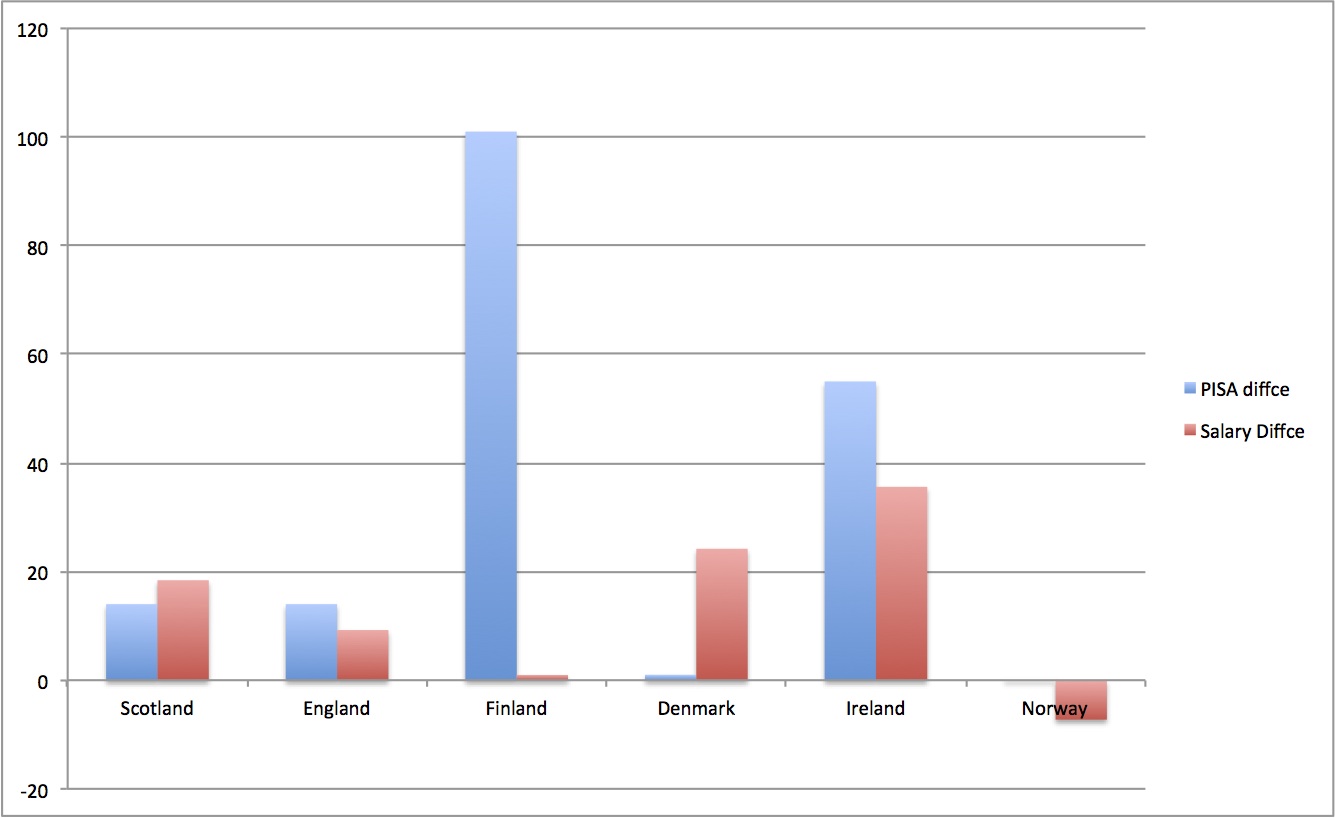
To listen to EIS and other teaching unions, money in the shape of teachers’ salaries and conditions are the answer. But statistics do not bear this out. Taking the difference in points between PISA scores in maths, science and reading OECD average and comparing this with the difference in percent between that country’s teacher salary and the OECD average gives a chart as shown below.


Comparison of PISA Scores & Teacher Salaries

Comparison of PISA Scores & Teacher Salaries

There is clearly little correlation between results and what teachers get paid and it appears that Danish children get a worse deal than Scottish for the money lavished on their education. The Irish cost more but seem to get better results. But the one that stands out (again) is Finland. Whatever their success in educating young Finns, it clearly doesn’t derive from their teachers’ high salaries.

At first glance, the Finnish educational system looks as if it were designed for slackers. Schools often have lounges with fireplaces but no period bells. Finnish students don’t wear uniforms, nor do they often wear shoes. (Since Finns go barefoot inside the home, and schools aspire to offer students a nurturing, homey environment, the no-shoe rule has some pedagogical logic.) And, although academic standards are high, there’s none of the grind associated with high-performance private schooling here in Scotland. Never burdened with more than half an hour of homework per night, Finnish kids attend school fewer days than 85% of other OECD nations.

Finnish teachers enjoy an equally laid-back arrangement. They work an average of 570 hours a year, much less than the Scottish average of 950 hours. They also dress casually and are usually addressed by their first name.But that does mean they do not receive huge respect.

When Finland began the first stages of remaking its education system, teaching made it to the top of the list. The first reforms relocated all teacher education from teacher colleges to universities, which enabled a higher level of professionalism and academic sophistication. In order to control quality and maintain standards, only eleven colleges and five vocational schools offer teacher education programmes. Of equal significance, further reforms have since required teachers to hold a master’s degree.

In Finland, teachers boast the highest vocational status (followed by doctors.) A full 25% of Finnish youngsters select teaching as their career goal, but only a fraction succeed. Under 13% of applicants gain acceptance into the masters’ degree in education program. Applicants usually come from the top quartile in their class and are accessed based on their upper secondary school record, extra-curricular activities, and their score on the Matriculation Exam. If the applicants make it past the first screening round, they are observed in a simulated teaching environment, and if they make it through this, they are then interviewed. Applicants who show a clear aptitude for teaching, in addition to strong academic performance in their interviews, are accepted.

Because of the fewer hours worked, Finnish teachers do earn hourly rates comparable to their Scottish colleagues. But the big difference is Finnish teachers enjoy immense independence. Allowed to design their own lesson plans and choose their own textbooks (following national guidelines), they regard their work as creative and self-expressive.

It all starts early. Finnish toddlers have access to free nurseries supervised by certified college graduates. Nurseries offer no academics but plenty of focus on social skills, emotional awareness, and learning to play—they don’t approach reading until age seven— learning other concepts first, primarily self-reliance. P1s are expected to walk unescorted through the woods to school and lace up their own ice skates.

Schools aren’t ranked against each other, and teachers aren’t threatened with formal reviews. At many schools, teachers set no exams until P5, and they aren’t forced to organise curriculum around standardised testing. Gifted students aren’t side-tracked into special programmes but struggling students receive free extra tutoring in the mainstream. Many teachers also stay with a single class for many years, moving with them through the school. School choice doesn’t exist; everyone goes to the same neighbourhood school.

After S2, students follow either an academic (53%) or vocational (47%) curriculum, which results in 96% of pupils leaving school with suitable qualifications. The Finnish curriculum is far less ‘academic’ than you would expect of such a high achieving nation. Pupils sit no mandatory exams until the age of 17-19. Teacher-based assessments are used by schools to monitor progress and these are not graded, scored or compared; but instead are descriptive and utilised as feedback and assessment for learning.

Finland’s academic success took smart planning, a willingness to take risks to achieve measurable and ambitious goals, patience, and fortitude —things our education system needs. With Finland’s retention rate for teachers is 97 percent (in Scotland, it’s 73%) there is a clear case for status, respect and autonomy, rather than financial reward, being the best motivators for exceptional teaching than creates a world-class education.


Posted in Education | Tagged | 1 Comment

Raining on Nicola’s Parade

There is no question that the SNP Conference just finished in Perth was upbeat, professional, impressive and—because of the slew of new members present—one of the most open and exciting. Salmond didn’t disappoint in the choice of demeanour for his swansong: dignified but laced with humour and a touch of humility. After a decade of growing stature and success as Leader, he chose a shrewd time to go and various unionist attempts to portray him as ending in failure say more about the authors’ failure to grasp the zeitgeist than any real failure of Salmond’s.

Undoubtedly a hard act to follow, Nicola Sturgeon’s decade apprenticeship in his shadow stood her in good stead. She came out of the gate with a rousing, competent speech that was more subdued, more grounded, more content-rich than Salmond would have given and so set the tone that the guard had changed.

Nicola’s speech went down a storm with the faithful, as it usually does.  She has managed to appear more the hands-on activist that backbone SNP volunteers and office bearers take to their hearts. She went over very well with the feminist and Women for Independence factions (See Burdz Eye View for an enthusiastic but nonetheless measured take from this perspective.) Lesley Riddoch said “Incredible list of specific pledges in powerful well crafted speech by Nicola Sturgeon in first leaders speech”.

But it reached well beyond those likely to be sympathetic. More objective reporters were also well impressed: Ian MacWhirter said “Sturgeon lacks Salmond’s wit and rhetorical sweep. But forceful delivery and gave conference what they wanted.” while David Torrance enthused “Impressive first leadership speech (was) well crafted, bold social justice agenda, ecumenical tone and slick delivery.” Perhaps the wittiest observation came from Libby Brooks “I know as an upstanding feminist I’m not supposed to report on Nicola’s clothes, but she sure is stealing Labour’s right now”.

Which is a shrewd insight into what the speech appeared to be aimed at: Labour voters not yet part of the 70,000 new SNP members but whose loyalty has been undermined by the dearth of clear policy directions from anyone in Scottish Labour. The pledges Lesley Riddoch refers to will tug at the loyalties of Labour members and voters alike, such as:

  • Increase free child care to eligible 2/3/4-year-olds to 32 hours per week
  • Ensure that the Living Wage is adopted by everyone, including the Parliament
  • Increase NHS funding in real terms every year in this and the next Parliament

Such firm commitments wil go down a storm across urban Scotland—especially in those once-Labour strongholds that voted Yes. That includes Glagow, Dundee and South Lanarkshire. As political positioning to cut the legs off remaining Labour support across the Central Belt and boost the chances of the SNP decimating Labour MPs, this could scarcely be bettered.

Although most of the 41 current Labour seats could not be called marginal, the hill that the SNP vote would have to climb becomes credible once polling numbers reach unheard of heights like the 45% SNP vs 25% Labour that recent polls have indicated.

But such tactical advantage comes at a price. While the above pledges may please the faithful and seduce wavering Labourites, none are self-funding; their provision requires fiscal creativity. That does not necessarily mean high taxes; John Swinney has proved to be a skilled and steady hand on the budget tiller—but even he can’t work miracles.

So, whether it is a revamp of council tax or income tax, a mansion tax, or an equivalent of the innovative Land & Buildings Transfer Tax, it will hit the better off. Given the unbalanced society Cameron and Osborne seem hell-bent on creating, this may be no bad principle and look relatively popular in Scotland. Why? Because, unlike in England, after almost two decades in the wilderness, Scottish Tories appear incapable of fighting their way back from irrelevance.

And, despite all that has been written above, is a shame. That is for two reasons.

  1. The SNP is an amazingly coherent organisation, given it is such a broad church. To date, Salmond has worked miracles through leadership and strength of character to keep such broad opinions focussed on the prize. The net result has been a business-friendly, socially conscious balance. But, add the above list to free tuition, bus passes, eye tests, prescriptions, etc and something has to give.
  2. That coherence will not permit wide internal dissent without a factionalism that has blighted other parties but not—so far—the SNP. The natural balance of debate should be provided by someone like the Tories. But, since Bella and her shrewd influence left, not only do they continue ineffectually in the wilderness but they have had no ideas that carried into public debate to modify SNP policy.

So, the SNP are on a roll, surging behind a popular new leader and likely to mow down their main opponents in six months time, with nothing effective balancing their outmaneuvering of Labour on the left.

But if these clever tactics work, will Nicola be able to rein in the populist tendency or nervous members sitting on slim majorities that has scuppered Labour in the past? Irn Broon handed Blair squillions that bloated the social budget beyond affordability by pushing fiscal prudence out the window. That created the present mess that is proving hard to tackle even by un-squeamish right-wing Tories.

It may be negative thinking to posit a similar, if less severe scenario for Scotland. But unless John does work some fiscal miracle, unless Nicola is very frugal with all the extra demands her pledges make on finances (that still mostly come from a hostile Treasury), unless the SNP can—in the absence of effective opponents—train themselves in financial rectitude when their track record to date portrays the opposite, Scots will have their own austerity straitjacket strapped on them during the 2016-20 parliament.

And that will form a shoogly launch pad from which to seize opportunities from more devolution—never mind independence—that Cameron’s stumbling, Europhobic second administration is likely to then offer the SNP.

Posted in Politics | Tagged | Leave a comment

Remembrance

Today being the actual anniversary when 96 years ago the guns fell silent on the Western Front it seems appropriate to not just remember those who lost their lives serving in the British Armed Forces but why they were called tio make that ultimate sacrifice.

And, though the First World War caused unimaginable slaughter across all the countries engaged and signalled the end of European hegemony irreparably fracturing the dominant, highly stylised but overly smug Edwardian culture.

Though the Allies eventually won the war, in righteous triumph after so much sacrifice, they chose to ignore sage advice to treat gently with the defeated Central Powers. Their harsh terms sowed vigorous seeds of what would become the Second World War, a war that many have cynically regarded as the ‘second half’ of WWI.

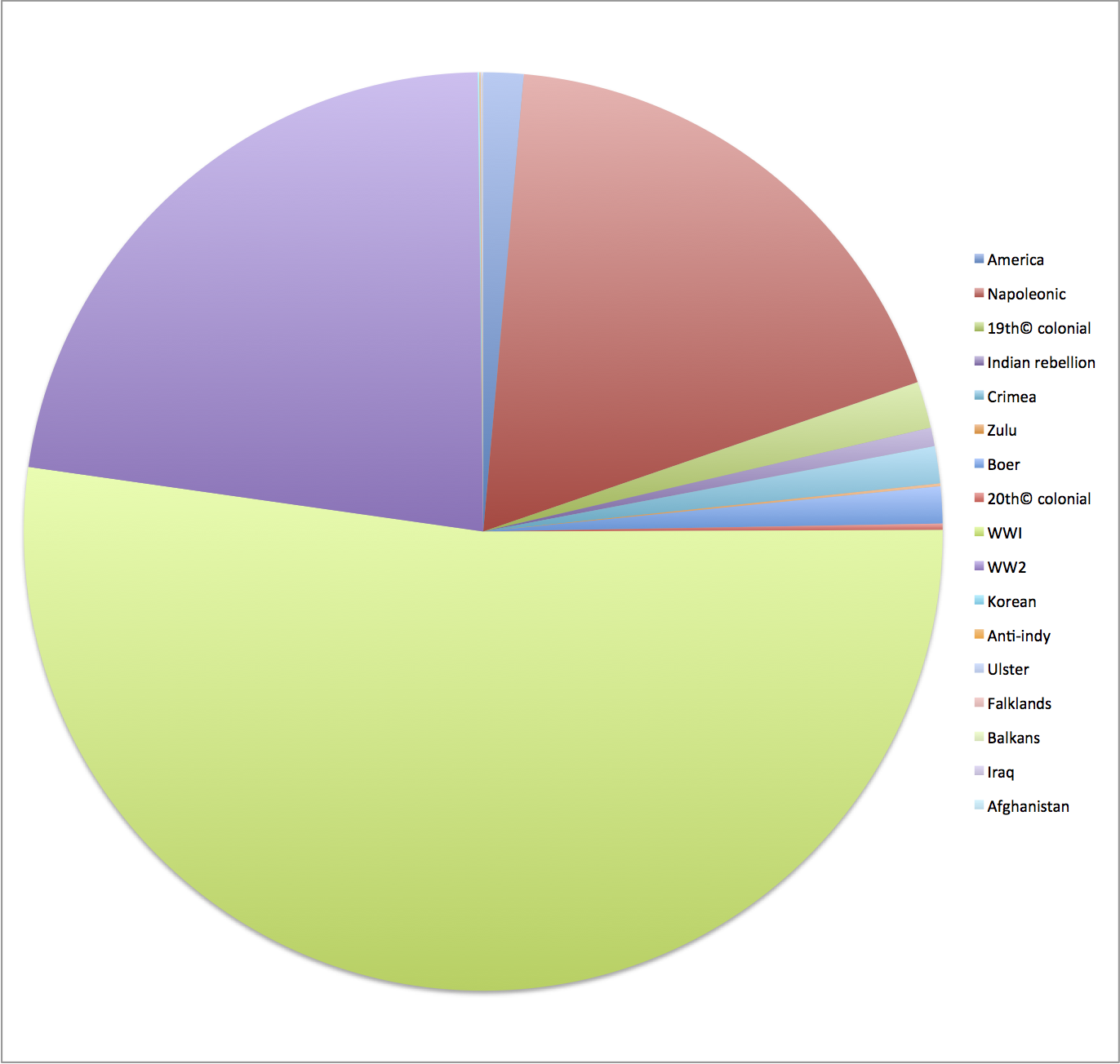
Together, those two wars account for 1,287,000 British casualties or almost exactly 75% of the 1,678,000 total from military actions since the American War of Independence. A chart showing the casualties of individual wars underscores this.

British Military Casualties Since 1775

British Military Casualties Since 1775

The chart also shows that by far the most bloody conflict outside the two World Wars were the 331,000 soldiers and sailors who died in the Napoleonic conflicts. Given the war lasted over a decade and a half—even though there were pauses—the impact of industrial developments meant that individual conflicts were fought at deadlier range; better training for professional forces meant armies and ships engqged more closely and more resolutely.

Prior to the American Revolution, records, weapons and training were all haphazard affairs. After a hiatus of amateurism lasting 1,000 years after the Romans left, Cromwell put the Army on a professional footing, leading to the mass standing armies of the late 18th centurry.

Conceived for self-defence, they were also simply too good as tools of what Von Clausewitz called ‘diplomacy by other means’ not to be used for aggrandisement with the ill-defined, fluid borders of Central Europe. Britian’s naescent Navy asserted itself against Dutch maritime power for control of the seas. Prior to Napolean, Gustavus Adolphus of Sweden and Frederick of Prussia carved unlikely empires by drilling armies of professionals to march, volley and melee better than their opponent.

Well before then, the motivation for war had become highly commercial. England’s early hostility to Spain derived from their colonial ambitions and the money to be made bringing tobacco, potatoes, tomatoes and other lucrative goods home, It was only when France’s ambition clashed with Britain’s in North America, the Caribbean and India that they were revived as an object of venom.

Though much was made by Pitt at the time of the need for coalitions to deal with the ‘upstart Boney’ and his republican threats to the remaining monarchies, the real motivation was to ensure freedom of the seas. This, more than any moral imperative, was necessary so that Britain could dominate global trade upon which is was fast becoming rich. Nelson’s victories at the Nile, Copenhagen and Trafalgar were greeted with great relief at Westminster but even more so in The City.

Naval victories against a France were not, however, enough. It dominated the entire Continent and therefore most destinations of Britain’s trade—hence the heavy involvement in a Peninsular campaign, support for far-flung allies like Portugal and Russia and judicious local bribes like the £1m going to Brunswick to prop up a wavering United Netherlands.

Casualties over the couple of decades to 1815 were proportionately heavy as anywhere, dwarfing those suffered in earlier wars. Given that Bonaparte was exiled for good and peace reigned across Europe for a century, high principles were cited as justification for the unheard-of numbers of dead. But the dominance of British trade and industry through the following decades was no co-incidence.

The ensuing colonial wars that sputtered across the world in the 19th century and cost a cool 100,000 lives were fought against locals resisting becoming another pink part of the map. Some (such as Elohinstone’s disastrous Afghan campaign) could be seen in Kiplingesque “White Man’s Burden” terms. But those to secure Assam’s tea; to secure Egypt as a vassal so that tea trade would flow uninterrupted; to secure Kimberley’s diamonds and Jo’burg’s gold to finance the whole shebang had no such altruistic explanation, even as smokescreen.

And the problem with global reach is it provokes such a global myriad of enemies. Whether from the Opium wars, the Sudan campaign, the Indian mutiny or repressing the Boers, fallen redcoats were an integral component of the ‘lifeblood of empire’.

Indeed, the entire culture that has grown up to be seen as quintessentially English—the tough regimen of Eton and Harrow through to Oxbridge and Sandhurst was to train a constant flow of administrators and subalterns who formed the backbone of empire right up to its collapse in Britain’s post-WW2 overreach.

While taking nothing away from the cooly professional performance of the British Armed Forces that continues to this day, the country itself no longer has the fiscal or moral backbone to justify recent deployments. From the Falklands through Iraq to the present Afghan wind-down, everything has been done on a shoestring for questionable reasons that many in the country dispute.

Residual taste for conquest and its justification resides in the MoD, plus a cadre of politicians and retired colonels these days. The ‘Troubles’ in Ulster cost more lives than all the various independence movements in Malaya, Kenya, Cyprus, etc. Those, in turn, cost more than all the ‘small’ wars engaged in since Korea 60 years ago.

The British no longer have the stomach for this—even the 760 service lives lost in foreign operations spread over the last 35 years (since withdrawal from Aden and ‘East of Suez’). Even averaging that out to a loss every three weeks on such deployments now seems unacceptable to the public.

Contrast that with the glory days of empire when Britain lost someone every half an hour; commercial ambition (a.k.a. “the good of the country”) deemed such loss to be acceptable. For that if no other reason, we should remember them along with the tragic, deserving fallen of WWI and 2 and since.

Those earlier stalwarts also died ‘doing their duty’ but for causes much less ennobling, much more grubby than saving the world from the horrors of Nazism.

Posted in Commerce, Education | Tagged | Leave a comment

The Wrong Plane We Can’t Afford

An event that passed with very little comment this summer was the naming of the first of the Royal Navy’s two 65,000-ton aircraft carriers—HMS Queen Elizabeth—at it launching ceremony in Rosyth. It is the second warship so named in RN service. Its illustrious predecessor was the name ship of a class of five fast battleships completed during WWI. That 15-inch-gun ‘battlewagon’ gave sterling service in WW2 before being broken up at the Inverkeithing yard in the late 1940s not a mile from where the new ship now lies.

Massive and impressive though the new ship and its engineering may be, the normal delay for fitting out so any ship can be commissioned is, in this case, further delayed by problems with the sole reason for a ship such as this—aircraft.

Artist Impression of HMS Queen Elizabeth at Sea

Artist Impression of HMS Queen Elizabeth at Sea

Originally planned by the previous Labour government to fly the new American Lockheed Martin ‘Joint Strike Fighter’ (JSF) in its ‘jump-jet/STOL’ configuration (the F-35B), the MoD’s Strategic Defence Review of the carriers belatedly realised that the navalised version (the F-35C) would be the more cost-effective choice of aircraft.

Although not able to take off and land in the confined space of the F-35B, the F-35C was designed from the start as the carrier variant: it has a larger internal weapon bay to carry a bigger punch and would be cheaper in the long run, reducing “through-life costs by around 25%”. The F-35C has larger wings and more robust landing gear than the other variants, making it suitable for catapult launches and fly-in arrestments aboard full-scale aircraft carriers. Its wingtips also fold to allow for more room on the carrier’s deck while deployed.

The F-35C also has the greatest internal fuel capacity of the three F-35 variants, carrying nearly 20,000 pounds of internal fuel for longer range and better persistence than any other fighter in a combat configuration. As a result, US Navy orders are for F-35Cs for their dozen operational carriers; F-35B orders are all (other than the RN batch) from the US Marine Corps to replace their AV8 Harriers and designed to operate from austere (i.e. small) bases and air-capable ships near front-line combat zones.

But using the carrier variant requires catapults and arrester wires to launch and land aircraft from the deck. Despite meaning that this would then enable both carriers to launch and land American, French and other allies’ naval aviation, the redesign and rebuild of the carriers necessary at that late stage would have added another £2bn to the existing £6bn program costs and delayed completion of even the first carrier to 2027.

So the decision was taken to continue with the F-35B. This means tactical air operation aboard the carrier will be very similar to the now-scrapped Illustrious class small carriers that used to fly Harriers. This also explains the prominent ‘ski-jump’ launching ramp repeated on the bows of both new carriers.

F-35B Lightning II

F-35B Lightning II

But the the delay to equipping the carriers is as much due to delays in the more complicated F-35B (its Rolls-Royce patented shaft-driven LiftFan engine is showing teething troubles) as it is to the MoD being strapped for cash and delaying expenditure. Whatever the cause, it did not appear at the Farnborough Air Show (again) this year and the first of 48 aircraft at £70m a pop will not deploy on the carrier until 2020—three years after planned commission.

Undoubtedly a powerful unit once equipped, trained and deployed, Britain’s declining ability to project power globally begs the question why such a ship is necessary. There is also the small matter of vulnerability. As a Soviet submarine commander once quipped during a NATO visit: “You know what we call carriers? Targets!“.

Professor Michael Clarke, the director general of the Royal United Service Institute, says of the new carrier:

“It will be a strike carrier that will project power around the world. However, it will require most of the Royal Navy to support it and protect it, so it means we will in a sense design the navy around one carrier battle-group. That is pretty powerful, but it means putting a lot of eggs in one basket.”

Posted in Politics | Tagged | Leave a comment

A Prefect to Sort Out the Primary Playground

So the other shoe in the shape of Jim Murphy has dropped. Along with Neil Findlay and Sarah Boyack, the lineup looks a lot more credible than the dithering silence at the start of the week but this game is over before the kick-off whistle blows. Given her 15-year service and various posts held, Sarah is clearly the stronger of the two MSP contenders but this ‘contest’ is likely to be a demonstration of Westminster realpolitik played out against the primitive simplicity of miners’ welfare committee conventions that have served Scottish Labour so well for so long. Murphy’s campaign will make any MSP’s efforts look like 1939 Poland, sliced down by Blitzkrieg in short order.

Compared to Murphy and despite many positives, both Sarah and Neil are babes in the woods. They have spent their political life either in ineffectual government or as dazed opposition in Holyrood where a competent (but not brilliant) Salmond-led SNP have run rings around them so thoroughly that both Labour ex-First ministers are berating their and their colleagues performance. Having only been elected three years ago, Findlay could claim to dissociate himself from Labour’s Holyrood performance but doing so simply underscores his lack of readiness to be elected leader.

It is significant that none of the contenders hail from Labour heartlands and that both MSPs were elected on the Lothians list. And while Murphy hails from Glasgow it is by a tortuous road that includes South Africa and a Tory ‘safe’ seat. Dig deeper and you find a man so enamoured of politics that it distracted him so badly that in nine years he never completed his degree. His serial matriculation however did allow him to rise through and then run the NUS so fiercely that he was condemned by a House of Commons Early Day Motion introduced by Ken Livingstone and signed by 17 other Labour MPs for “intolerant and dictatorial behaviour

For Murphy is that queer fish on the Labour benches—a self-made intellectual well honed in political arts who owes his place to neither union nor entrenched CLP mafia, driven by crusading personal ambition and not too distracted by awkward baggage like idealism. It is a political study in itself to see how—against all odds and largely dismissed as unwinnable by Scottish Labour at the time—he overturned Allan Stewart’s 11,688 (biggest in Scotland) majority in 1992 with a 14% swing in the legendary 1997 wipeout of Tory MPs.

This (and subsequent bolstering of his majority) was achieved through hard work applying his Blarite principles to appeal to ambitions of  douce middle class denizens of Neilston and Newton Mearns. To call him a ‘Red Tory’ would be unjust. But to think that he spent any time on the minimum wage or decrying Trident would insult his acumen. Since then, his ability to be what his audience wants to vote for has been astonishingly good. His ability to lambast the SNP within weeks of sounding the most emollient peacemaker was good; his consensual performance at 2013’s Festival of Politics was virtuoso.

Competent politicians can sound sincere; good politicians have a range of tones from intimately personal to braggadocio rostrum-thumping; Murphy is one of the few who can combine both.

And, though the professional posture can slip—as when he lost the rag at Pete Wishart in the voting lobby during the bedroom tax vote in April this year—the poise is seldom less than perfect. This was reinforced during his rather effective ‘Irn Bru Crate’ pre-referendum tour this summer when a Yes supporter caught him with an egg in Kirkcaldy. Not only did he neither cower nor run but he used it and a gullible press to highlight how irresponsible, how brutal, how uncaring about human dignity the Yes campaign had become. Of all the politicians in Scotland, few are as instinctive, as flexible, as unflappable as Murphy.

So, whether there are any more MSP contenders does not matter one whit; even a Westminster colleague shows an interest, that won’t matter—Murphy is used to running his own campaign against odds and adjusting to what is required. He will have calculated  his profile and growing reputation (in the media as much as the party) and judged it sufficient, especially against any MSP who has focussed almost entirely on party insiders to get where they are.

While the next month may quack like a contest, with Murphy portraying sincerity and reasonableness in any debates, much else will be going on below Joe Public’s radar. Given Jim’s ability to adjust to circumstances, no prediction can be wholly accurate but expect his Damascene conversion to Old Labour values (especially on the CLP stump), furious lobbying of the relatively few kingmakers in party, union and city hall and a fair few twisting of arms and calling in of favours (particularly among MPS) to leave as little to chance and the traditional buggins turn as feasible.

When he wins the leadership, expect a brisker, more plausible campaign across the Central Belt (he will leave those outside Labour core vote areas to fend for themselves) and a turnaround of support from the present dismal 26%, thereby stemming the present likeihood of circa 20 seats being lost to more like 10. Scottish Labour and its loyal core will be thereby relieved and hurry to secure Jim a seat in Holyrood for 2016. Suddenly Scottish Labour will be crisper, more its formidable old self and—to the faithful—all will seem well.

But, it will be the swansong of Old Labour here, rooted in our ex-industrial communities and woven into the social fabric by its social clubs. Having survived the ditching of Clause 4, 13 years of Blairism and the loss of half their council hegemony, its nemesis will be the smart leader, chosen in its hour of need, able to calculate the political price of everything to the last decimal point, but who, as London’s man in Scotland, knows the value of nothing.

Posted in Politics | Tagged | Leave a comment

Sauce for the Gander

Since the referendum, the NO campaign have exuded “well, that’s settled”, based on their 10%-margin win. But actually, they have been keeping their heads down because debate around any agreed devolution settlement—such as the Smith Commission is expected to come up with—has suddenly become messy. Squaring the disjointed policy circle that  Westminster parties have slapped together will be hard to merge within six weeks.

In the meantime, what would cement the SNP and other YES-supporting parties credibility is to pre-empt Curran’s ‘radical’ bid for resuscitation of Scottish Labour. Whether they can rediscover ‘core Labour values’ here while Milliband outflanks Tories and UKIP on immigration and Europe remains to be seen. But how to pre-empt? Simples. If more devolution is coming to Scotland, let’s devolve much more to local level.

Now that independence is parked, the SNP in general—(meaning John Swinney and Derek Mackay in particular) have an opportunity to reach out from the hothouse of Holyrood and engage civic Scotland. Lifting the dead hand of Labour from Scotland’s city halls is long overdue and full of potential. But, while all parties use their 1,200+ councillors as campaigning footsoldiers and locally trusted spokespeople, they have never given them scope to bring democracy closer to people in a way a tenth that number of MSPs bever could. It is well worth trying and should be done in phases:

Town Hall Devo: Phase I—Do Now

  1. Council budgets are mostly not raised in the local area—other than council tax, frozen now for 7 years, and some fees. John Swinney needs to take his foot off the councils’ collective neck and let them freely set council tax rates again
  2. Council tax banding itself is a joke: houses worth £200k pay as much as £2m or £20m mansions. It is regressive, hitting the less well off more. By doubling the bands and setting a ‘mansion tax’ flat percentage above £500k (see Ma Faither’s Howff Revisited) this could raise 25% (as opposed to under 20%) of council spending.
  3. Business rates may be collected locally but all go to Holyrood for ‘redistribution’. If half the £1.6bn raised were retained by councils, another 5% of their income would be raised locally and they would have far more incentive to grow local businesses.

Town Hall Devo: Phase II—Do Soon

  1. Planning—especially strategic planning—is a mess and demeaned by unseemly tussles between mandarins and developers. Local councils get told what to do and the shoddy city- and town-scapes we have been building are the result. City regions (no more than a half dozen) must be defined and given the power to plan infrastructure, transport, power and economic strategy as well as housing allocation. This will involve bulleting the largely ineffectual and remote Scottish Enterprise, HIE, NHS Trusts and regional transport authorities.
  2. Formation through 1. of incipient City Region Authorities who should gear up to handle all major public services delivered in their area, starting with NHS, business development and transport, followed  by water, police and fire services.
  3. Empowerment of CRAs to control train, bus, air, harbour and ferry services within their region, including route planning, single-ticketing, timetable co-ordination and ensuring freedom from monopolies commission interference
  4. Comprehensive attempt to revive community decision-making at ward level through community councils, area partnerships, community wellbeing that make binding decisions on council departments.
  5. Statutory requirement on public bodies to maximise the social, environmental and economic benefits of procurement and to make public all land held on their books for possible use for affordable housing.

Town Hall Devo: Phase III—Do Next

  1. Local Government Re-organisation on the basis of the half-dozen city regions become the principal elected body controlling most local government functions in their area and raising at least half of the revenue spent via council tax and local income tax. As well as the functions listed in II/1 above, education, social work, building maintenance and cultural services are controlled by a democratic body of no more than 50 councillors elected by proportional representation and sitting in the regional city.
  2. In parallel with this, those communities which opt to do so revive the burgh—a democratic body of 4-6 councillors and similar number of employees managing a clearly defined community, such as a school catchment area. Burghs would have responsibility for local planning, housing, basic local services (e.g. cleansing) contracted out, retail business, parks, recreation and tourism. Burghs would be allocated a fraction of council and business taxes levied in their area and have the right to vary the amount levied within that fraction. Consideration should be given to ensuring burgh councils are non-party-political, highly visible and fully accountable.
  3. Villages, rural areas and smaller towns not minded to re-form burghs would be administered by a department of the city region. Cities themselves would be special cases where considerably more functions might come under a body intermediates between burghs and city regions.

Whether the above will restore local democracy depends on how it is done. If it is done grudgingly and the Scottish Ministers handle the matter as they currently do with their one-size-fits-all planning cudgels, then it will be illusory devolution; local communities will feel duped into believing they are trusted with real responsibility.

But if local authorities really were given parity of esteem talked about in 2007 and empowered with real control and flexibility about how national policy was implemented, then the differences between Inverary and Inverure or between Hawick and Halkirk could be a driver of new ideas, a source of home-grown innovation that engages citizens with politics they connect to and understand. Otherwise the Holyrood bureaucrat will be seen as no more sensitive than the Westminster mandarin and an MSP as much a suit with a mouth as any London-fixated MP.

Posted in Commerce, Community, Politics | Tagged , , | Leave a comment