Standard & Poor Says: Standards Are Poor

As a amateur observer of things economic, it’s hard to feel bad when you’re proved right but I derive no pleasure in having predicted the present fiscal tumble in which stock markets have lost 10% in value and the mighty US of A sees its debt rating drop from top rank AAA to (beginnings-of-a-slippery-slope?) AA+. That this size-nineteen-clodhopper of another shoe dropped surprised few in the business but it is totally unprecedented. It is a maxim in US fiscal circles that the government does not default. Standard & Poor has broken ranks to say “they might”

This shoe dropping will raise pain on everybody’s corns because it pushes up interest rates (mortgages, credit cards, etc) even as the value of investments and pensions erodes. The Republican US Majority Leader might have taken off his Dick Turpin mask at the last minute but those in the know seem unconvinced that enough political resolve to cut spending and limit the US debt exists. That, in turn, takes the wind out of the economy’s sails so that the present weak recovery becomes threatened.

All this would be bad enough were it not for the simultaneous fiscal war going on around the Euro in which poor generalship is leading the Eurozone towards defeat. We banged on about this last month but, with the PIGS (Portugal, Italy, Greece & Spain) all looking ropier in their ability to repay the debt they’ve each taken on, the sheer size of the total makes any bale-out like last month’s extension of Greek debt impossibly large.

Britain—and, by extension, Scotland—may not be directly involved in ether. But such is the global scale of both problems that either deteriorating from here would mean recession; both together would amount to another depression. To give you some idea of the scale of all this, MPs of all parties have been handwringing about the £160bn of debt we landed ourselves (talk of our grandchildren paying it off is no exaggeration: the National Debt from WWI took until the nineties to pay off).

Once, in the heady days of the Clinton administration, talk was of a US budget surplus. But, check out how puny Britain’s debt is in comparison with what Bush doctrines and tax cuts for the rich have done to the US:

Posted in Commerce, Politics | Tagged | Leave a comment

Are We Nuts Overpaying Monkeys?

There has been considerable agitation by public service unions on both sides of the border that workers are being hit severely by Westminster’s austerity programme, whether by pay freeze/cut or benefit loss (especially pension) or even loss of their job entirely. In Scotland, tightened budgets have mostly led to natural job losses as people move on or retire. But that won’t last. And, given that worse is to come, the real question is how best to cope rather than shutting eyes tight in the face of reality.

But one area where tightening remains a foreign concept is in executive pay. The senior management teams (SMT) of councils (Heads of Service, Directors and Chief Executives) have had it pretty good. In 1976, the first pass of local government reorganisation had district councils led by Chief Executives earning 2-3 multiples of the median wage of £4,420 (even trained professionals earned under £8,000). Twenty years later, the present structure of single-tier councils saw SMT pay scales appropriate to regions retained when the median wage had risen over £15,000 and SMTs were led by CEOs with salaries 4-5 times that. (Actual and historical details are fiercely protected by SOLACE).

Recently, median level earnings in the public sector (£28,808 per per annum) has pulled ahead of the private sector (£24,596 per annum), following steady annual increases that the private sector has not seen since pre-2008. But, in the decade and a half since the present 32 councils were set up, it is SMT members who have done extraordinarily well. In steady boosts—such as Glasgow’s 9.2% jump in 2002—every council Chief Executive is now on at least £100,000, with Edinburgh’s new CEO landing £158,000 and Glasgow’s pushing £200k. Current strictures that apply to council staff, the private sector (or, indeed, the real world) don’t seem to apply here. And when you chip in that a council SMT consists of upwards of 15 senior staff on over £75k each, costing each council £1.5m or more, questions need to be asked.

Back in 2002, Sir Neil Macintosh’s review of senior salaries claimed  ”This review is necessary if councils are to continue to attract and retain the best calibre of chief officers by offering competitive salaries in comparison with other authorities and public sector bodies.” Since public sector bodies like SPT are paying £150k to their CEO, this seems like a rather self-serving, circular argument. And none can be claimed as performance-related. The local government bill to the Scottish public a decade ago was half what it is now. Can anyone highlight a council service that’s twice as good as it was ten years ago?

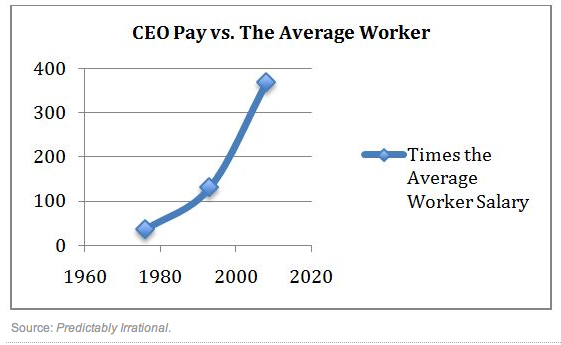
This fraught situation has its parallel in the private sector. Once, CEO’s there were paid a modest multiple of the workers’ wage, much as in the public sector. But look what happened once business growth and ambition combined into a heady mix:

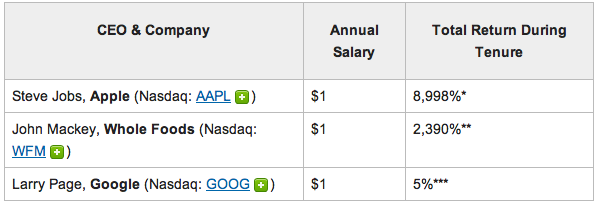
These are astronomical figures, made worse by the fact that, since 1993 salaries were supposed to be geared to efficiency and/or sales growth. So, are our public servants modest by comparison? Do the public actually get a good deal? The answer has to be a firm ‘no’. Not only are councils famously top-heavy as operations but they have proved themselves unable to rationally streamline their operations, let alone exploit business opportunities and build customer loyalty through excellent service. What we need in our public sector apparently exists in the private, namely chief officers prepared to put their money where their mouth is and take performance-related rewards and only token base pay:

So, step up the first council CEO prepared to work for a £1 salary, plus some fraction of the efficiency savings and/or people motivation that they create personally. Their current annual haul is, surely, justified by that, isn’t it? …Hello?…

…Is anyone there?…


Posted in Commerce, Politics | Tagged | 1 Comment

The Lion in Us All

After the eternal navel-gazing of Hackgate, I was delighted to find a real discussion kicked off by Pete Wishart’s article on Britishness in Newsnet Scotland. His open queries came immediately under sustained attack from people whose position seems more like Irish nationalists a century ago than modern Scots. However, over the weekend Newsnet Scotland saw fit to publish a further article on the matter by Paul Kavanaugh that broadens discussion to cultural groups around Europe and how they do not carry the same baggage that “British” still seems to. And, simply because such a range of opinions exists, isn’t it time we Scots sorted ourselves out on this?

I am with Pete and Paul. Despite great respect for Wallace, England is not foreign to me, any more than Ireland or Wales or, for that matter, Orkney, despite each having a culture distinct from my own lowland Scots. I’m delighted to surprise Welsh friends with tales of their ‘Old North’. After the Welsh Gododdin succumbed, this area was English until Malcolm II knocked heads at Carham in 1058, whereupon our Southern cousins soon got too distracted by French-speaking Vikings to ever get it back. Add in a half millennium of our close ties with Flanders, the Hanseatic ports and much of Scandinavia and you start to put our culture on a much broader basis than a London-dominated state that painted a fifth of the world map pink. Yet the word to describe it is ‘British’.

We Scots never really embraced English jingoism. But then, post-Carham, we were never threatened by ‘real’ foreigners, the way the English were by the Armada or Napoleon. And, once the bad taste of Darien was washed away, first, by post-1707 prosperity, then the agricultural and industrial revolutions in which all four ‘British’ nations joined with enthusiasm, the idea of anything other than ‘British’ to describe the team that went on to build the world’s most successful empire would be ludicrous.

If colonial ventures are not to your taste, the manner in which the British stood their ground in two world wars—even when the sacrifice was huge and the post-Dunkirk future hopeless—gives us shared heritage and pride it would be churlish to ignore. Had we nothing else, that we never gave in and faced down Fascism should give us common pride and bonds lasting generations.

I am proud to be an internationalist, with longstanding German, Belgian, American and even Macaoese friends. But, fond of them as I am, none are brothers or sisters in the way those who inhabit these islands are. In Galway and Cork I feel more at home than in the middle of a Gaelic conversation in Stornoway; Cardigan Bay delights me as much as views of Fidra or the Bass; the sleepy lanes of rural Norfolk are even cosier than the back roads of Lothian that I love. Our common culture, as mundane as a good cup of tea or Monty Python humour or the great pop culture Pete refers to, seems obvious to me. If there are barriers to appreciating Yeats or Dylan Thomas, I fail to see them. If I like Vaughan Williams over MacMillan, does that make me English? Or if Capercaillie opens my country’s culture to me while Irish folk leaves me cold, does that make me a xenophobe?

The richness that all of us bring to these islands is surely a matter of celebration and pride. Sweden once dominated Scandinavia as Spain once occupied all of Portugal. but Greig and Sibelius, Munch and Nokia, not to mention Telemark skiing and saunas are just some of the contributions their neighbours have made to not just Scandinavian culture but to the world. With its centuries of broad links with the wider world and its history of amicable, active ties with Celtic brethren, Scotland, which has contributed so much to ‘British’ culture to date, has a pivotal role to play in its future—once we sort out this ‘last colony’ anachronism among some of our more benighted English cousins.

Posted in Community, Politics | 1 Comment

Crime and Punishment

Posted in Uncategorized | Leave a comment

Welcome to Scotland: Now Go Home

I have taken some flak down the years for having been a regular reader of the Economist. But far from being another tub-thumping, jingoistic right-wing rag à la Torygraph, it has always provided me with a more balanced international perspective than governments manage. This week, it raises some serious questions regarding tourism and how effective countries are, both at making a success of it and at fleecing the maximum amounts from those who do visit—not necessarily the same thing.

According to VisitBritain “the UK ranks 5th out of 50 in the world in terms of a ‘Tourism’ brand.  Our strongest ‘Tourism’ dimensions relate to being ‘rich in historic buildings and monuments’ and for our ‘vibrant city life and urban attractions’, in each case ranked 4th in the world.” Certainly all parts of the UK have advanced considerably from the greasy cafe/dingy pub image of half a century ago, but are we matching peoples’ ever-higher expectations, especially those of visitors from abroad?

This evening I attended a team talk at our local Seabird Centre after three trips as a guide on their Bass Rock trips today. In two hours, nobody mentioned foreign visitors or their languages. In my three trips, I had had over 75% foreigners: Poles; Germans; Dutch; Israeli; Malaysian. Nobody mentioned customer relations, let alone language, training. It may be unfair to criticise a successful visitor attraction for this because very few other visitor-oriented establishments from First ScotRail to the council’s putting green staff seem to understand that they are in the front line of visitor experience.

Britain—and especially Scotland—may have scenery, history and monuments to die for but we still seem content to let them sell themselves. Leave aside that parking wardens ticket clueless visitors with glee, we actually miss a huge trick in persuading those visitors who do come to part with their hard-earned dosh. People having a good time normally do this with gusto but consider these spend statistics from the Economist:

Receipts per Tourist in US$ by Country

Even allowing that many of those countries are distant and therefore receive longer visits per visitor, this hardly applies to Sweden or Switzerland. The figure for Britain in $935 per head from 29.6m overseas visitors in 2010. Scotland did marginally better with $1,017 per head from our 2.3m visitors. But look at those stats. It means that Scotland attracted proportionally fewer foreign visitors than England did. AND we did much worse than Slovakia at persuading them that this was THE place to spend their money.

It’s all about service, about understanding, anticipating and—especially—fulfilling visitor needs. Most of our better restaurants ‘get’ it. But too many third-rate places staffed by gormless, obviously untrained teenagers will greet hungry customers with “we stopped serving lunch at Two” when it’s 2:10pm. Edinburgh is Britain’s ‘second-top tourist destination’. Yet, stand in Waverley’s teeming concourse and show me where you get information on local buses, let alone buy a joint city transport ticket that is standard elsewhere. And good luck finding & dragging your suitcases up to Tourist Information.

Despite it being Scotland’s No 1 business, we are simply not yet professional enough  to succeed in 21st century tourism. And that requires more than getting past assuming everyone should speak English. It’s about the decorum of dealing with Muslim women; that Germans like their tea weaker and coffee stronger than we do; that Americans like being spoken to by locals for no good reason; that the surname comes first in Chinese names. So, go out there and adopt a tourist; do your bit; don’t gripe if they block the pavement or don’t understand queues.

These people have had the good taste to visit and appreciate why we all like living here.

Posted in Commerce, Education | Tagged | 1 Comment

Nomenklatura O’ the Clachan

“Nomenklatura” referred to the Communist party’s authority to make appointments to key positions throughout the governmental system.  —Wikipedia

You have to hand it to Burdzeyeview. While often disagreeing with the line she takes, it is always cogently argued and this time I think she’s put her finger on what keeps us Scots, to paraphrase Omar Sharif in Lawrence of Arabia, “A little people, a silly people, greedy, barbarous and cruel”. This week she shines a spotlight on a dingy corner “The Public Sector Carousel”, highlighting Scottish Government economic adviser Andrew Gouldie’s smooth transition to a professorship in Government & Public Policy at Strathclyde.

Let me say—as she does—that this has nothing to do with envy, still less with objecting to careers and the ambition that drives them. But names shift around top posts in Scotland in such a way as to give nepotism a good name by comparison. Time was—fifty years ago—that this was also true. But, under Supermac, Scotland was a loosely controlled, very small political village dominated by Edinburgh private school old boys who still practiced noblesse oblige; where power was available, they generally wielded it impartially.

Then came the politicisation of Scottish local politics, given a huge boost by the creation of regions in 1976. Over the next two decades, resistance to Tory domination in London flowed from Strathclyde and its ilk, so that the growing number of public posts became a measure of political control, depending of who filled them. Because of local dominance, Labour won that fight. This was underscored post 1997 when first Westminster, then Holyrood fell under Labour control. As a result, our quangocracy, be it SPT, police boards, HIE, CoSLA, SEPA, NHS Trusts, MacBraynes, Scottish Water, SNH, Historic Scotland, etc.—even the Ombudsman and the Accounts Commission—grew a political presence, however passive, in much of the machinery of state. The ‘hands-off’ principle of noblesse oblige looked increasingly threadbare.

By the time the political pendulum swung against Labour, as it did over 2007, 2010 and 2011, their presence throughout the clachan-scale Scottish establishment was substantial. This is not to say it was egregiously unfair—if you hold most of the elected posts (MPs, MSPs, councillors) why wouldn’t you dominate the appointments? But, after the political tide turned against Labour, they stayed blessed: the Tory party was a shell of its former self, Lib-Dems were decimated to 5 MSPs and 7% of the vote and the SNP, frankly, has yet to care about, let alone understand, the scale and importance of nomenklatura.

So, under the noses of new political regimes, this carousel revolves largely undisturbed. Senior appointments can be widely advertised—and often are. But, by the time SOLACE or whatever advisory body is involved, the gulf between Scottish and other practice laid on the table, inevitable personal connections within the clachan acknowledged, it takes little selective myopia on the part of the selection panel to come to the ‘right’ choice. Over 90% of Council Chief Executives were appointed from within Scottish local government. Can the English/Welsh/Irish really be that unlucky/incompetent?

To pick on Andrew Gouldie’s appointment is unfair. The entire Senior Management Team of Scottish Enterprise was selected from internal appointments: yet no nomenklatura can explain what good the £600m in public money SE hose around each year does for the economy, let alone the punters. Our quangocracy is like any other self-interested body: they lay low, avoid attention but keep close to whoever holds the purse strings in the hope that the gravy train will rumble steadily on through boom and bust.

So far, it has.

Posted in Politics | 1 Comment

We Are ALL Norwegians

My little blog is no place to rehearse the details of this weekend’s tragedy in and around Oslo that killed 93 innocent people, mostly teenagers, and wounded another 100. Even after Anders Breivik goes on trial for what he did, I am sure many of us will remain uncomprehending as to his motivation. I still recall my chill revulsion on seeing Bogdanovitch’s Moving Targets in the ’70’s but never thought I would experience anything like it, especially so far from Texas.

But what I do need to remark on is the unflappable bravery of the Norwegian people from Prime Minister to police chief to passers-by who came on camera. Each asserted—in flawless English—that this would change nothing, that the principles of openness, of toleration, of international participation would not change. The Norwegians may not have had all the apparatus and preparation to deal with such premeditated evil but they did recover fast,  organising a moving memorial service for the victims within 24 hours.

And that service itself was a statement of undaunted openness: Prime Minister Jens Stoltenberg, King Harald V, his family and sundry dignitaries walked through their people who then gathered densely around them in shared grief. More than just moving, this was demonstration that, small country though it is, Norway will not be stampeded into paranoia and police over-reaction. King, commoner and—I have no doubt—more than a few republicans bowed their heads together, as if vowing their society and their values were not so fragile, that they could withstand outrageous abuse and maintain the dignified, inclusive trajectory of civilisation in which Norway has led the world for the last century.

It was their 9/11 and, choked with tears as they were, they met it magnificently. Today I wish to stand with them in support, to call myself a Norwegian. I hope you feel as I do.

King Harald and Queen Sonya are greeted at Oslo Cathederal. (Photo Wolfgang Rattay, Reuters)

Posted in Uncategorized | Leave a comment

Real News vs. Scandal Fixation

I am normally a fan of Newsnicht. Gordon Brewer, Isabel Fraser, Glenn Campbell et al hold incisive discussions relevant to Scotland without resorting to the Paxman sneer. But last night, the four MPs asked to comment on the latest twists of Hackgate stood in weak comparison to the preceding Newnight piece on the Eurocrisis. My own MP, Fiona O’Donnell was on her worst apparatchik/rentaquote setting, looking off-screen as if reading a teleprompter from John Smith House how Milliband was knocking ‘em dead with his Coulson witch hunt down at the Palace of Westminster.

Personally, I think Milliband would have been far better letting Tom Watson continue taking his verbal chainsaw to Cameron’s defences but that is to miss the point of asking why Newsnicht should be obsessed as any red-top by this juicy scandal when its London sibling had raised its eyes from such mire and even had Ed Balls saying sensible things about Greek default.

For, immersed as it is in collective outrage at indiscriminate phone hacking and pies being thrown—both physically and figuratively—at the once dreaded Darth Vader of world press, all our media—English or Scots; print or TV—spent this last week of parliament ignoring two major stories that may combine, like storms into a tornado supercell, in as little as two weeks from now. But good luck finding reportage outside anorak organs like the Economist or the WSJ. The Tweetosphere was thick with Kuenssberg or Reid chopping the same hackgate story into a hail of soundbites.

The most urgent story is of Merkel and the European Central Bank putting more elastoplasts on the brain haemorrhage called Greek National Debt. On the heels of their ‘stress test’ for banks comes a wheeze to levy €30bn eurozone bank levy, likely to weaken said banks. If the last rescue package for Greece has failed (see “Let Them Eat Baklava”) what likelihood is there that another €115bn will make the spendthrift Greeks mend their evil ways? If it all unravels, we’re talking about defaults on a major scale and a huge spanner jammed into financial machinery. Britain may stand outside the Euro but half our exports are to the Eurozone: we’re in it up to our necks.

This would be apocalyptic in itself. But on the other side of the pond, we have the Standoff at the Capitol Corral as Tea Party (=low-tax) Republicans eyeball Obama’s ‘free-spending’ Democrats. The US hoped to export its way out of the crisis. But they are net importers from BRIC (i.e. growing) countries and the previous paragraph explains what little hope Europe offers. With a budget stalemate continuing and time growing short, House Republicans are pushing their plan to cut spending, rule out tax increases and amend the Constitution to forbid government spending more than it takes in. Such a plan will fail: in the Democratic-controlled Senate or under a veto by the President. If a budget is not agreed by August 2nd, then the US government moves into the unknown. Soldiers may not get paid and a drop from AAA bond ratings—not to mention recession and/or market collapse—could well follow.

However unaware we are in Scotland, these storms are gathering. Either of them would hit us badly. Both together would trigger a recession making 2008-10 look like the good times. Because many middle-class people had their normal short-term expedient of putting expenditure on credit cards blocked by reluctance to issue new cards and draconian limits on cards already out, their maneuver room is small. And, if recession returns, the inevitable rise in interest rates will catch another tranche of those pegged in mortgage payment ability or who took out variable-rate loans to cover expenditure. These third and fourth horseman of our fiscal apocalypse would ride out to join their foreign kindred.

Famine and pestilence may not sweep the land as a result. But, unless some of our more able minds stop fixating on tabloid trivia and deal with the repercussions of and antidotes to such a doomsday scenario, the opprobrium heaped on News Corp will be as nothing compared to what those at the helm will receive if this destructive fiscal supercell does form. Take your earphones out, the better to hear the sound of gigantic hooves approaching.

Posted in Commerce, Politics | Tagged | Leave a comment

Hall of Shame

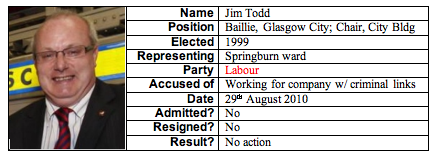
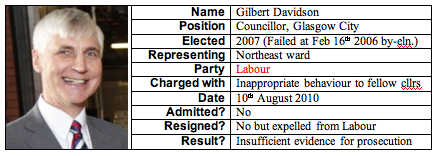
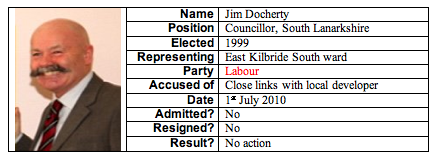
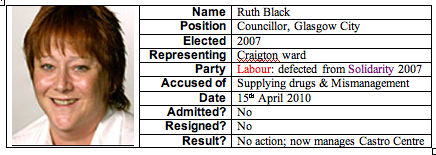
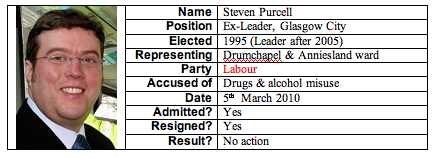
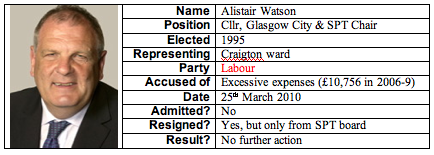
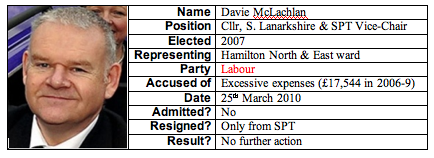
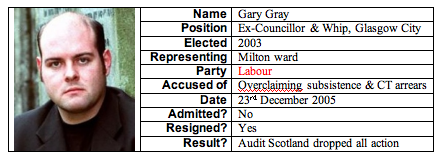
Research for my previous post (Oxter Award) exposed some pretty dubious council fauna in dark corners, especially in and around wur Dear Green Place. The broad range of accusations makes some form of ranking necessary and so I have awarded ‘black marks’. NOTE: those exonerated by either the courts or Audit Scotland (an astonishing 15 each in Glasgow and South Lanarkshire by the latter) are zero-rated.

  1. ☁ Apparent lack of judgement or momentary lapse deserving admonition only
  2. ☁☁ Abusive behaviour or systemic incompetence but little moral turpitude
  3. ☁☁☁ Dishonesty for minor personal gain or non-moral conviction (e.g DUI)
  4. ☁☁☁☁ Substantial or systemic abuse of position or dishonesty conviction
  5. ☁☁☁☁☁ Wholesale corruption or court conviction involving jury trial

Within our present system, 1-3 black marks do not result in automatic disqualification from holding office as a councillor; 4 or 5 do. As these ‘grades’ are all my own invention, I deducted a black mark for those with the grace to admit their error publicly and resign altogether. Few did. I do subscribe to the principle that there is no moral latitude when it comes to representing the public. Nonetheless, just as punishment should fit the crime, the scale of moral turpitude does have a place in considering the seriousness of any lapse of judgement leading to betrayal of public trust. Those inducted and their classes are:

The pretty mixed bag in this category were all explicable as human error or political harassment and not considered worth detailing, especially as they came from all corners of the country, representing the spectrum of political parties.
☁☁
☁☁☁
☁☁☁☁
More reading: Paisley Daily Express Oct 20th 2010

p.s. Not to be confused, despite appearances, with Dinsdale Pirana.

☁☁☁☁☁
It was with some relief that I could find none to place in this category, not least because I’d rather not fund the ensuing legal action if I did. Nonetheless, such wholesale abuse of public trust has occurred elsewhere and vigilance against it—not least by all of us taking the more ‘minor’ categories seriously—is our principal defence against erosion of public trust, without which councillors have no legitimacy.
Taken over all, 2010 especially tarnished the probity of Scottish councillors. Whether behaviour of the baker’s dozen inductees above were material in May’s landslide election result, I leave the reader to decide. Jack did:
“We had many successes in government, but on too many occasions, I have been embarrassed by our conduct. The greed of individuals, party centralisation and inconsistent policy on the hoof have been damaging, and at times indefensible. And we failed to adapt to the new political landscape of Britain.”
     —Jack McConnell, former First Minister, The Scotsman, 8th September 2010
Posted in Community, Politics | Tagged | Leave a comment

This Month’s Oxter Award

Such has the scale of disconnect between the public and their elected representatives become that it is time to acknowledge those in service of the public who have clearly lost sight of that basic fact with an award. This month’s thoroughly deserving case, leading what may become a catalogue of ignominy, was brought to us courtesy of the Daily Mail.

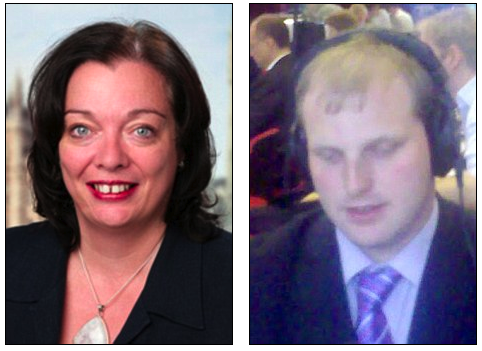
Our very first Oxter Award winner (l); Blind victim sworn at for being unable to see her (r)

TalkSPORT political editor Sean Dilley was walking with his golden retriever guide dog
in a corridor towards Portcullis House in Westminster. A clearly stressed Lyn Brown, MP for West Ham and Labour Whip bulldozed into the back of him before overtaking and shouting back at him: “For ****’s sake, move out of my ******* way.”

The journalist asked her to be more careful as he did not want to crash into his guide dog, Chip. “You are such a rude ******* man, you just walked right in front of me.” she retorted. Mr Dilley replied, not unreasonably: “I’m blind, you stupid woman.” When he asked  Miss Brown’s name, as he could not see who had bumped into him, Miss Brown replied: ‘I’m not giving it to  you: **** off!”

Miss Brown was unavailable for comment. Certainly, we’re speechless.

Read more: http://www.dailymail.co.uk/news/article-2015202/MP-letter-blast-blind-man-Out-way-Labour-whip-shouts-reporter.html#ixzz1SUsskinW

Posted in Politics | Tagged | 1 Comment