Dead Fish Swim with the Stream

Captain Jimmy Buchan pilots Amity II, Star of BBC's Trawlermen out of harbour

Ever since I overcame my mother’s Blitz-begotten mistrust of the Germans, I have been a Europhile. But sometimes, they really don’t make it easy. Their latest unpalatable tranche of Eurotrash was served up this week by Maria Damanaki in her role as EU Fisheries Commissioner. Her thesis is that the EU Common Fisheries Policy is flawed and urgently needs revision. With 50% of catches being regularly returned dead to the sea as discards to comply with EU quotas and stocks at 10% of post-war levels, that’s a no-brainer.

But, in an apparent rush to swap frying pan for fire, her new proposals, while ending the insanity of 100,000 tonnes of discards each year, also propose that quotas can be traded. Eilidh Whiteford, MP for the core of Scotland’s fleet said: “the Commission is advocating an expansion in the international trading of fishing quotas. Selling quota to Europe’s highest bidders will erode Scotland’s historic rights which in turn could spell doom for our fragile fishing.”

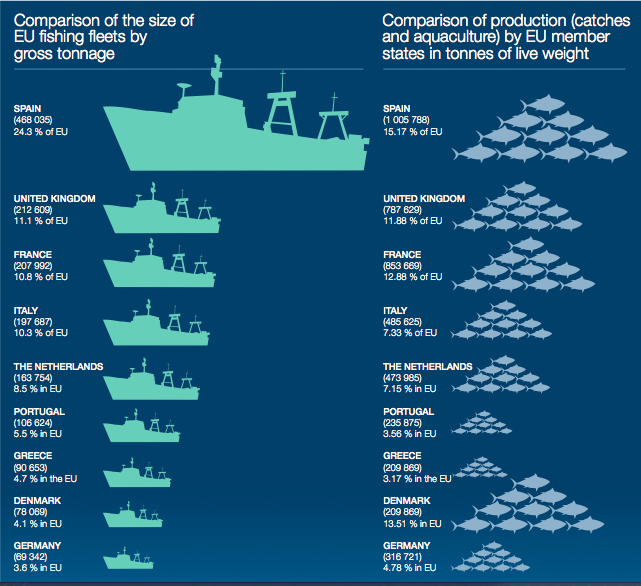
Right on, sister. The limited quota sales of the last thirty years have halved the Scottish deep sea fleet from 800 to 400 (out of our total of 2,800 boats, most of the rest being inshore). Spain, on the other hand now operates 17,000 boats, 8,700 from Galicia and 1,300 out of Basque ports. Many are ocean-going 165-ton boats which work Scottish waters with such gusto.

Scottish Territorial Waters: All EU countries may fish, plus Iceland/Faroes/Norway

Greenpeace fingered them in a damning piece of research last year entitled “The Destructive Practices of  Spain’s Fishing Armada”. That armada has been boosted over the last two decades by buying-up of Scottish fishing quotas while their government subsidised ship building (€1m each for 27 boats between 2000 and 2005 at a time when EU policy was to reduce fleets). Over that same time, Spain received 46% of all EU fishing subsidies—€1.6bn—while Scotland’s fleet got under 2% (€65m), much of it for de-commissioning boats! In the same period (Spanish fishermen were given access to the North Sea only after 2003), cod, haddock and whiting stocks went through the floor, even as Scots chafed under CFP draconian actions “to maintain stocks”.

Several captains have been prosecuted for flouting CFP quotas, with HM Customs and Fisheries Protection nabbing UK miscreants. But no Spanish boat has suffered such ignominy. They eke several loads from one trip by landing in different Scottish ports like Lerwick or Kinlochbervie, loading the catch onto waiting freezer artics that then get the goods to Spain faster than they could be sailed there. Then out to fish again.

On the EU Council, Spain wields 8 points of clout: Scotland clamours for some share of the indifferent UK’s 10 points. Landlocked Austria, Hungary and Luxembourg each have a say. Countries with coast but no fleet (Latvia, Estonia, Finland, Belgium, Bulgaria, Rumania) also have a say. Scotland has none. Little wonder, then, that our fishermen, from  Amity II Skipper Jimmy Buchan, through every fisherman’s federation up to Fisheries Minister Richard Lochhead are aghast at what Ms Demanaki’s proposes.

Just as Scottish fishing was stitched up post-1979 when national control was extended to 200 miles and the UK traded fishing rights away, so a cosy côterie of Mediterranean and non-fishing countries will happily swap Spain their fishing interest for support for Greek debt or a wine lake good only for shriveling head lice. We’ll be dead fish, swept away by this stream if we don’t swim hard against it.

In the last century, the Scots have been repeatedly foolish over fish. In the twenties, we fished out the huge North Sea herring stocks. In the seventies, we did the same to the West Coast herring shoals. Since then, we have gone from landing a million tons of pelagic (cod, haddock, whiting, etc) to barely 150,000 tons each year, now worth £55m. If we let this happen a third time, especially if we allow another country to reap the benefit while thumbing their noses at the rules by which we hamstrung ourselves, then we’ll need a robust sense of humour to see the irony in such tragedy.
Posted in Commerce, Environment | Tagged | Leave a comment

Puffin Farewell Party

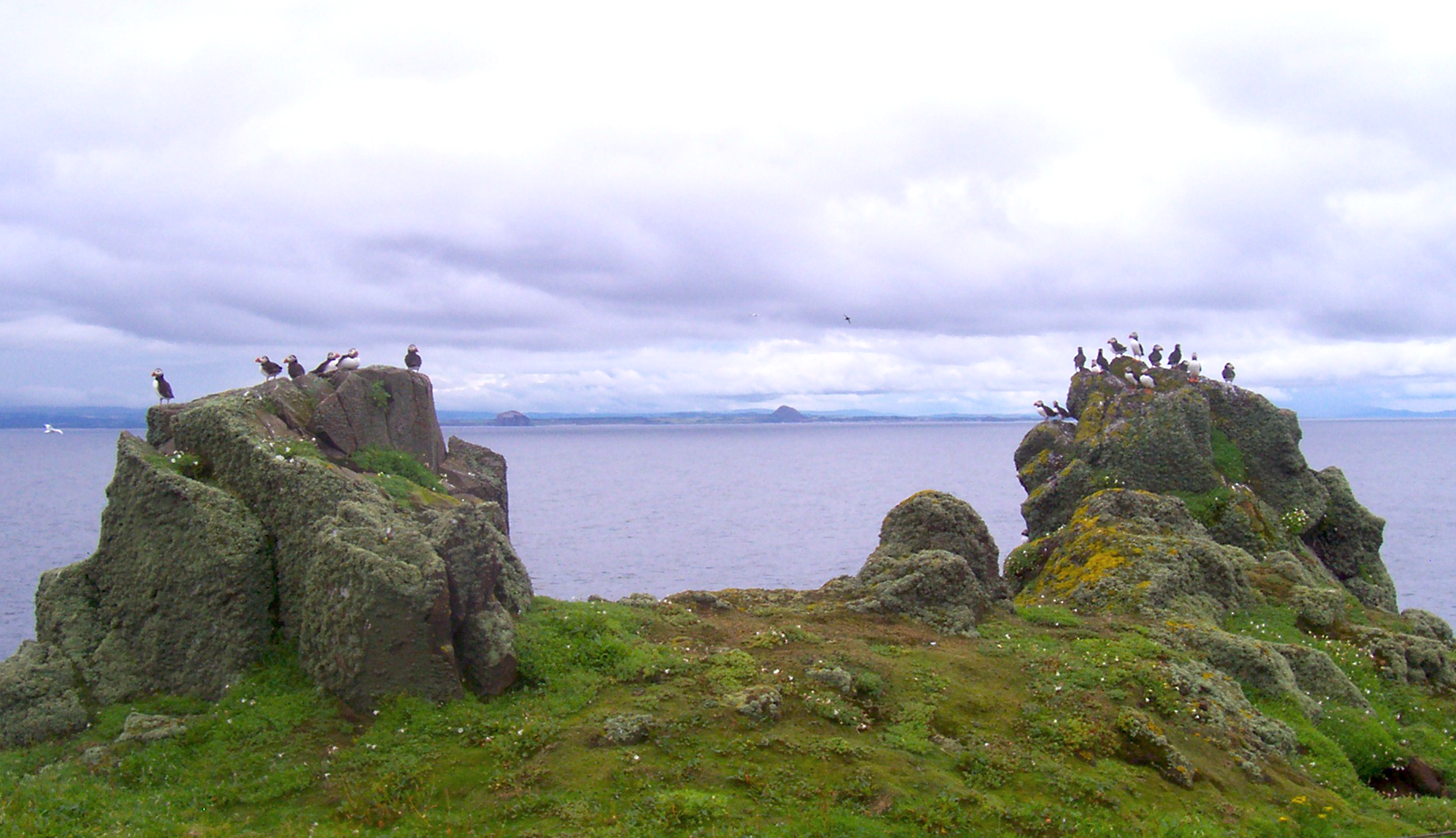
Puffins Socialise on the May, framing Bass Rock & Berwick Law

I had originally intended to simply post the photo above to show how serene and restful the May was yesterday with many of their 45,000 inhabitants out socialising, as they do. With their ‘pufflings’ now grown and departing daily, this scene will soon be rare as the adults head out to sea for the winter.

But Scotland on Sunday today carries an article on ‘puffin therapy’ where visitors to Dervaig on Mull can be landed on one of the Treshnish Isles to commune with the 3,000 puffins there. As Dr Nick Baylis, a consultant psychologist and wellbeing expert, says: “As animals ourselves, we have a born need to be in the wild and if we don’t spend time in nature, it can make us ill. Communing with birds like puffins, is as important as sunshine or sleep or vitamin C. Puffin therapy is a great way to get that fix.”

Speaking from experience, I can thoroughly recommend a couple of hours among them—but you don’t need to trek over to Mull. Fifteen times as many of these utterly charming and comical locals live on the May, plus three times more on Craigleith, both served from North Berwick. But the short season is ending, so you’d better get on your bike/boat.

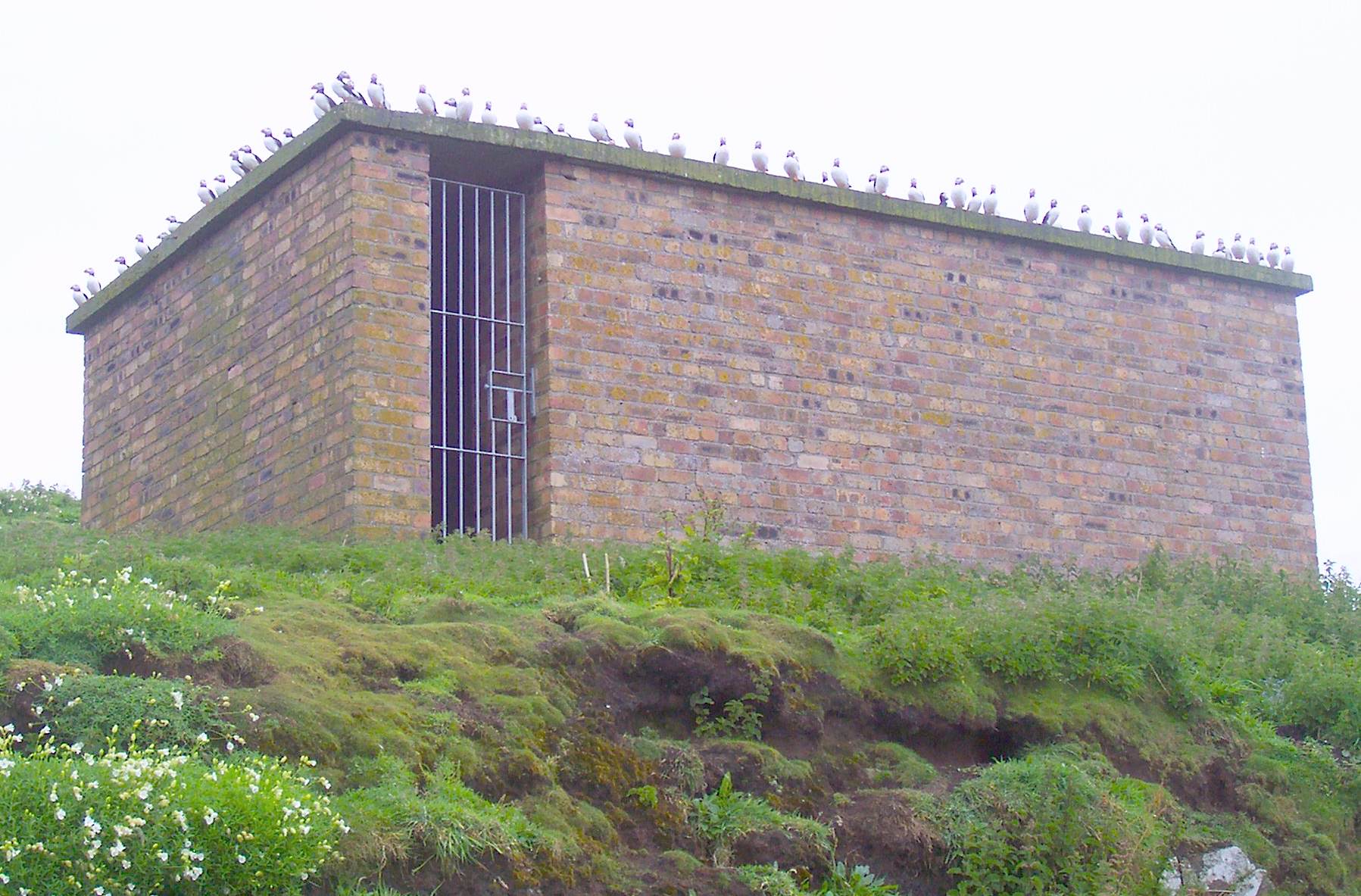
Puffin Productions present a scene from the film "Zulu"—WWII Radar Station above Holyman's Road, Isle of May

Posted in Education, Environment | Tagged , | Leave a comment

Furth of Forth

The other sea-boot dropped today as UK Transport Minister Philip Hammond re-thought draconian plans to cut 18 coastguard stations to 3. The revision restores both Stornoway and Lerwick to the roster, along with Aberdeen and has caused much relief and no small celebration in the isles. But, whatever advantages technology undoubtedly offers through radar, depth sounders, GPS, etc, there is no substitute for professional local knowledge. Given that the total coastline of the Northern and Western Isles exceeds that of England & Wales where there are to be 7 stations retained (out of 13), this seems only sensible.

On the down side, we lost Tynemouth, Oban and Pentland in 2001 and now both Clyde (at Greenock) and Forth (at Fife Ness) stations are to be “phased out by 2015” i.e. closed. This is a real loss—and not just for local jobs. There are over a dozen lifeboat stations in Forth’s patch alone; together they handled 40% of all rescue callouts in 2010. The Forth is Scotland’s busiest waterway with tankers, cruise ships, ferries and RN ships and sundry bulk coal and container ships. The number of inshore fishing boats landing shellfish is growing each season. Then there are seasonal boat trips and a burgeoning number of recreational sailors, divers, surfers, jet-skis and general plouterers-about.

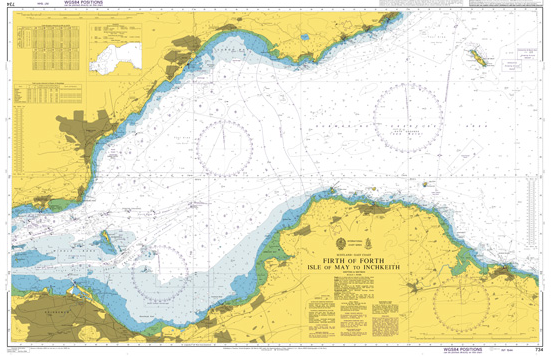
Admiralty Chart—Firth of Forth, Inchkeith to May Island. The blue (shallow) bits contain many submerged rocks

Everyone accepts that new technology has made marine traffic safer. But we’ve had light-houses, powered ships, foghorns and professional mariners for 200 years already. In that time, we have accumulated over 200 wrecks around the Forth alone. That we haven’t had many recently might be because HMC Fife Ness has been doing a bang-up job.

Our most recent wreck was the work of professionals who should have known better. HM Fishery Protection Vessel Switha miscalculated the shoals south of Inchkeith  in January 1980 and rammed Little Herwit Rock so hard the wreck was visible for the next quarter century. But when Fife Ness closes, the Forth will be handled from Aberdeen (the next station south is at Bridlington). Whether they’ve ever heard of Little Herwit Rock is a moot point. Local names are unknown 100 miles away and most inshore fishermen don’t know a Northing from a fishhead. How long will a loon o’ Aiberdeen need to get a map grid reference from a crackly radio that “a boat’s in trouble in-bye the Lattie Doocot”?

As I explained in an earlier post, our sea rescue service is a hybrid, with all-volunteer RNLI in the front line. With HM Coastguard as rescue co-ordinater to RAF Boulmer (Northumberland) and/or HMS Gannet (Ayrshire) for Sea King ASR lift and transport, it has worked seamlessly. It is the local knowledge of the HMC officers that knows to call out a RIB to effect rescue in shallow waters or hold off a helicopter from a yacht now hard against vertical SW cliffs of the May. The joint work among all four organisations relies on HMC’s hard-won local insight as much as their professional training.

Expecting Aberdeen to understand the complex rip tides that run through the Sound of Vatersay was always unreasonable. But is it any more reasonable to expect them to know one almost as bad that runs past the South Dog of Fidra, then over Brigs so shallow and jagged they’ll take the bottom out of anything but a RIB? In 2015, most people will not miss Fife Coastguard. But in the summer of 2016—guaranteed—someone in peril on the Forth will regret a local knowledgeable presence was ‘rationalised’ out of existence.

Posted in Community | Tagged | 1 Comment

The Press—Trusted;Investigative;Profitable: Pick Two

A boatload of pious claptrap has been written and broadcast over the last few weeks as the rest of the media has been circling the wounded News Corp like sharks homing in on an enfeebled killer whale. I am no fan of Murdoch, his protegée, or any of their collective works but the number of people now clambered aboard this particular bandwagon makes me wonder how it can roll along so happily. It reminds me of playground games among seven-year-olds where everyone’s a cowboy and nobody wants to be the hapless indians.

Elbowing even the rest of the media aside is the UK Parliament where Miliband has finally found a statesman voice to outmaneuver Cameron. All parties are falling over one another to agree on something for the first time in living memory. Everyone knows phone hacking is wrong—whether illegal or not—and especially distasteful when it comes to people who, courtesy of the fickle finger of fate, are in the public eye and therefore of media interest.

But why were we so quick to condemn the News of the World when, by pushing investigative journalism into realms where others feared to tread, they had built a publication bought by millions. Despicable as their tactics might have become, was all they did so different from the paparazzi who intrude on ‘celebrities’ lives, or a flock of hacks flashing cameras into prison van windows as they arrive at court? Pick the average magazine out of the cacophony of colours on any news stand and it doesn’t have to be Hello or OK to boast of exclusives or secrets or intrusions into somebody’s life. Vile though it may have been, by the sleazy standards that we lay down our money for, NoW was the trendsetter, the top of the heap, even secretly admired.

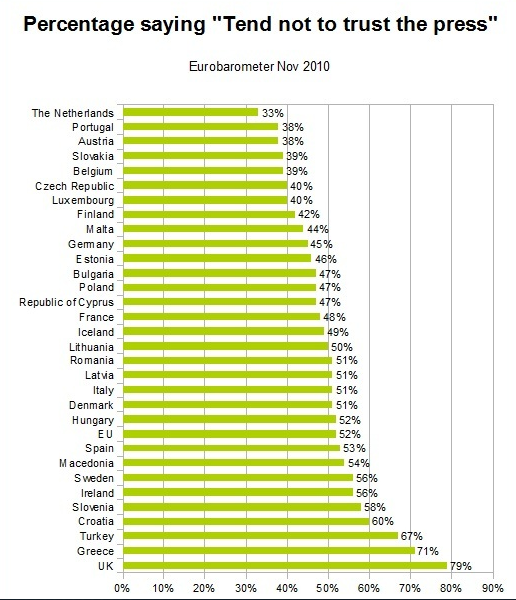
Fifty years ago, in the button-down fifties, sex didn’t exist. At least, as far as the media was concerned, it deserved no mention and the trial over Lady Chatterley’s Lover was the scandal of the age. A dozen years before that, the heavily censored press printed just about whatever patriotic guff the government wanted (“carrots are good for eyesight” or “snoek and whalemeat are nutritious”) and yet we trusted the press then. Now, in an age where information is at overload, we have developed cynicism to a refined level. We are not alone with our red-tops: Bild Zeitung provides a very similar service in Germany. But our prurient, selective amnesia between morals and a good scandal make us stand out in our lack of trust in the very media we rely on for unbiased commentary.

This is not an exclusively European phenomenon: 60% of Americans do not trust their press but, because they have such a fragmented, provincial set of titles, that varies greatly around the country. Indians display a similar skepticism, although that may be hangover from the days when the British Raj ran the show. But the British still top the charts.

So are our press subcreatures of the moral universe and the NoW et al hacking scandal indicative of their morals? No. There are principled journalists out there who will get the story the old-fashioned way: through persistence, research, shoe leather and a little luck. But every editor from tin-pot county press to the Grauniad pushes them to look for the ‘angle’. Long gone are the deferential pieces from Victorian times when the press was both trusted and profitable. Setting speculative hares running is no longer frowned on. “Getting the dirt” is what it’s all about. “It is easier to get forgiveness than it is to get permission” has become our press watchword.

And, since we buy the results by the bushel, who can we blame but ourselves?

Posted in Commerce | Tagged | Leave a comment

Minnesota Ice Tea Party

"When fascism comes to America, it will be wrapped in a flag and carrying a cross” ~ Sinclair Lewis, 1836

While Scotland does not follow American politics closely, most will recall Sarah Palin as the ‘running mate’ of John McCain, Republican candidate defeated by Barack Obama in 2008. They may not recall the Alaska governor’s right-wing agenda and therefore won’t feel alarmed that she has been overtaken on the right by Minnesota Representative Michele Bachman, darling of the Republican right-wing shock troops referred to as the Tea Party movement, named for the infamous incident in Boston harbour (harbor?) that triggered the 1776 war of independence.

No sooner had Michele Bachmann hijacked the Republican presidential contenders’ debate on June 14th to declare she is indeed a candidate for the White House than her newly minted campaign website said she is on her way to “reclaim America”. Americans may also know less about the first Republican congresswoman from Minnesota than they do of that other Tea Party darling Sarah Palin. But we and they are about to learn. Fast.

During a 2008 interview she criticised Barack Obama for his association with Jeremiah Wright and Bill Ayers, saying “…usually we associate with people who have similar ideas to us, and it seems that it calls into question what Barack Obama’s true beliefs, values and thoughts are…I am very concerned that he may have anti-American views.”  Don’t be deceived that this sounds like laughable Soviet revisionism-speak; in the States, that’s as good as calling the President a traitor who consorts with terrorists. In the recent jockeying, front-runner Mitt Romney’s ability to speak French was framed by Bachmann as unpatriotic: “All we have to know is the president deferred leadership in Libya to France. That’s all we need to know.” Republicans do not like “cheese-eating surrender monkeys.” (originally Groundskeeper Willie in a 1995 Simpsons episode). This woman can’t be stupid: she has a BA and a law degree. Yet she believes global warming is a hoax because “carbon dioxide occurs naturally and therefore can’t be harmful to us”.

If she were some also-ran, she could be dismissed as the usual extremist Republican
who throws their hat into the presidential short-list ring. But this week’s news is that Bachmann now has a lead over former front-runner, governor Mitt Romney, that may be significantly wider than the 4% margin reflected in last weekend’s Iowa poll. Among voters described as the “most attentive,” Bachmann leads by a much-wider 14-point margin, 32% to 18%. Attentive voters are more likely to turn out to vote. The rest of the field, including Newt “You-Can’t-Trust-Anyone-with-Power” Gingrich, are in the single-digit dust. Palin has not declared and now is too late to. That means the odds are on a female Republican candidate more right-wing than Reagan or either Bush in 2012.

Why should we sweat it? Barack roared into power in 2008 and should ace 2012 after all his innovation like the health initiative, right? Well, yes, after the stasis and errors of Dubya, he was a breath of fresh air. But if the recession was blamed on Bush allowing Wall Street excesses, the economic bite, the 9.5% jobless rate and accelerated decline in American manufacturing (not to mention a whopping trade imbalance with the Chinese) means that Joe Sixpack is pointing at the White House as responsible.

Minnesota is normally Democrat and not radical country. It is known for dairy products and down-home small town America of the Coen Brothers’ Fargo or Garrison Keillor’s Prairie Home Companion (“where all the children are above average”). Bachmann claims to be the new broom from there to clean out the Augean stables. She has the cash backing and is gaining the momentum. America may be a big country but its politics are that simple.

Posted in Politics | Tagged | Leave a comment

Christie Eleison VI

What with Harry Potter’s latest wheeze or Kate wowing the Canadians or News of the Screws screwing itself, it’s been an packed week in the normally slack ‘silly season’. Long gone from anyone’s radar is the Christie report, about which we’ve been banging on.

This is a shame. Not always known for their decisiveness, CoSLA has come out so strongly in support of Christie that they didn’t even want to wait for official government adoption of the report before starting to implement it. In their words:

The Commission’s report concludes that nothing less than an urgent and sustained programme of reform embracing a new collaborative culture will allow Scotland to deal with a fiscal landscape where budgets will not return to 2010 levels for 16 years. In terms of a route map, this is a journey that local government is both willing and able to travel. We are pleased to see the link between circumstance and demand for services at last being recognised.  For this reason we are also pleased that the report recommends more spend on prevention and that there is a real focus towards integration, decentralisation and localism. We also welcome the fact that he is not proposing reform in the abstract, he is very clear that all reform must meet his criteria and we look forward to working with the Government to ensure that this is the case.”

Oh, really?

Little of Christie is new. It belongs to theories of local government predating the 1976 reorganisation that set up District Councils to be more locally responsive in matters like planning, culture or landscaping; dependent on local involvement to work properly. Sadly, what we got was Strathclyde—and what we have now is more like Strathclyde than any of the districts, let alone the now-defunct pre-1976 burghs.

It’s a shame there is little in CoSLA’s response to quibble with, especially as such harmony between them and a major government report is not the general rule. But what both seem to be blithely overlooking is whether an “integrated, decentralised and localised” system is achievable with the tools available. Most Scottish councils—especially those run by Labour pre-2007—are official-driven. That means all but the most general strategic policy decisions are taken by officers. Many pretend otherwise, but council meetings are boring, rubber-stamp affairs: actual debate as to what gets done how happens in non-public senior management team and departmental meetings. Almost all those attending those have been in local government all their careers.

We are supposed to believe that such people, used to cosy control for decades, are going to fling open their doors for amateur oiks to wage fragmented untidy causes all over their nice, tidy closed-shop budget decisions? I think not. Officials have spent the last thirty-five years bedding into the fabric of ‘big’ councils, where their writ now runs. Lip-service is paid to ‘control’ by councillors. But strategy, while cited, is barely understood, goal-setting and evaluation are unknown and council ‘spokespersons’ only vaguely aware of operational details, let alone where any bodies are buried.

People like Bill Jamieson can tub-thump about how the looming pensions squeeze in the public sector must be addressed properly. And they may be right: as a fiscal time-bomb, it could bankrupt the best-laid budget schemes o’ mice and men. But, even if such alligators were eliminated, we are still in a swamp. To expect the present management of councils to embrace and address Christie would not just be expecting turkeys to vote for Christmas; it would be expecting the medieval city states of Italy—cultured, stable and admired as they were—to undertake a space programme.

Posted in Politics | Tagged | Leave a comment

Crueller Even Than the Sea

I had been convinced that my second guide trip this season to the Isle of May would be cancelled today. The Met Office inshore forecast for Forth was Southeasterly force 5 or 6 wind, moderate to rough sea state, poor visibility and rain, with SEPA and EL Council backing that up with a flood warning because of so much rain. We were to land at Kirkhaven with broken sea running out of the Northeast at the bottom of a Spring tide.

But the day dawned and few of the predictions turned out as dire as forecast. The worst was heading into a broken sea on the passage across which meant plenty spray, slow progress and a lot of work for skipper Callum. But, once there, the rain held off and the biggest flocks of puffins I have ever seen stood about in amicable battalions like mini-penguins or clattered overhead in dense clouds. They seem to like it best when overcast and dull and were not the least deterred from fishing by the broken water nearby.

But my vivid memory of this trip will be of learning two more of the wrecks that pepper the outer Forth, their story being particularly tragic. It was May 7th 1945. The BBC had announced peace with Germany had finally been signed, to take effect at midnight, with two days of celebrations to follow. Among those cheering (and perhaps starting the celebrations early) were the crews manning the Fixed Defence Stations on the May and at Canty Bay who monitored the submarine detector loops laid across the mouth of the Forth.  Singularly displeased with this news were the sailors on the five ships of convoy EH51 that had just left Methil for Belfast, escorted by three trawlers.

They would have even been more displeased to know that U-2336 under Kapitanleutnant Klusemeier had slipped undetected inside the Forth. This was one of the revolutionary Type XXIII ‘Walther’ boats, capable of unheard-of submerged durations and speeds. Had they been introduced earlier, they could have starved Britain out of the war. Because they operated submerged, Klusemeier had not heard the OKM order of May 4th to desist from further attacks, nor that day’s one calling a midnight ceasefire.

At 11pm, the light was almost gone as the convoy steered 70deg in calm seas to clear the South Horn of the May. The Canadian (but British-crewed) Avondale Park (2,878 tons) was leading the starboard column when a torpedo hit her engine room, destroying the starboard lifeboat. As she settled by the stern, some of her crew got away on a raft on the poop deck. The next ship in the column, the Norwegian collier Sneland I (1,791 tons) had to swerve to port to avoid the sinking ship. As she drew level, she too was struck by a torpedo abaft her No.2 hold and sank within two minutes.

The escorting trawlers, though small, did have asdic and depth charges and attacked a submerged contact without effect. They picked up a number of survivors, finding them in the dark by the small light carried on new lifebelts. A total of 55 survivors were landed  back at Methil when the convoy turned back. But neither Chief Engineer George Anderson, nor Donkeyman William Harvey, who had gone into the flooding engine room  of Avondale Park, survived, nor did seven crew from the Sneland I, who had too little time to escape, including her Captain, Johannes Legland.

U-2336 returned to Kiel unharmed on May 14th and surrendered to the British. Being a coastal submarine, it had carried only two torpedoes—and could hardly have caused more carnage on its one and only voyage. But, cruellest of all, the nine deaths it caused were pointless, with peace less than an hour away. Both wrecks, the last casualties of the six-year-long sea war, stand as their monument 8 metres high in 45 metres of water little more than a mile off the South Horn of the May.

Posted in Community, Transport | Tagged | 1 Comment

We’re Number (Fifty-) One!

We are always being told how, being a part of Britain, Scotland derives major benefits from “being at the top table” or “punching far above our weight”. Let’s assume such logic isn’t mince. Well, why mess about with the has-beens and also-rans like Britain? Let’s go straight to superpower without waiting our turn to pass ‘GO’ or collect 200 squid.

As today is their Independence Day, let’s apply to the US for Scotland to be their 51st state. Just think about the advantages: Obama’s far cooler than Cameron; the US GDP ($14 trillion) is seven times bigger than the UK’s; we wouldn’t wait years to see their soaps; petrol would be under 50p a litre and you wouldn’t need a passport to shop New York or surf Malibu. And if you’re keen on really punching above your weight, how about being backed by a dozen carrier strike forces and three divisions of marines to tear the heads off anyone who looks sideways at Scotland?

Just think: a refrigerator the size of a car, a car the size of a house and a house the size of several Inner Hebrides stuck together. And they would love us: all our golf, whisky and tartan-laced history. 20,000,000 Americans (and 75% of their presidents) claim Scottish ancestry; how hard could it be to persuade a majority to let us meld with the colonies instead of being stuck with the colonisers? After all, where to you think McDonalds came from in the first place? Now’s the day and now’s the hour…altogether now:

Oh, say, can you see, by the dawn’s early light…

Posted in Uncategorized | Leave a comment

Christie Eleison V

From blog hits, it’s clear that dissection of the Christie Report makes less than riveting reading for our readers. But we make no apology for this instalment—nor for one more to come (anorak it may be, but it matters, guys). In the first four parts we’ve examined: the state we’re in (I); the recommendations (II); medicine for the NHS juggernaut (III); and public sector workers’ increasingly bolshy stance (IV). What we are considering today is, given ‘parity of esteem’ between government and councils, if “physician, heal thyself“ is a plausible, or even sensible, directive to councils.

Councils have a poor record of self-analysis and none on constructive reorganisation. They fought both 1976 and the 1996 UK-government-driven re-organisations tooth and nail. Since then, the net number of senior managers, which ballooned under the expanding budgets up to 2008, has failed to drop in the more stringent times since. And, while setting up Arm’s Length Executive Organisations (ALEOs) has shown some new thinking in places as diverse as Glasgow and East Lothian, the bulk of council business is still integral and by departments congruous with the council area.

After the 2007 change in most council administrations (and given a boost by the subsequent financial debacle) many councils formed local task forces to explore shared services (ELBF around Edinburgh and Clyde Valley Partnership around Glasgow). There were also efforts at national co-operation like Scotland Excel to combine purchasing and joint efforts for Stirling/Clacks and East/Midlothian to share back office and central control of Education and Children’s Services. All this was supported by CoSLA, the Improvement Service and the Scottish Government.

So, four years on, where are the victories, the better services, the streamlined delivery, let alone the savings? So far, bupkiss; zilch; nada. Stirling and Clacks have tied the knot and East/Midlothian may do so this year but any impact will be seen next year. Scotland Excel has a staff over 100 and is indeed driving down the cost of paper clips but councils still insist on buying big Tonka Toy trucks with their own special fixtures so worrying about the pennies while the pounds flood out the door makes SE’s £3.7m cost look like spend to spend more than to save.

But most telling has been the total failure of shared services—where one council provides all the service to another for a charge (ideally less than the original service cost). While Scottish Borders does get many roads contracts from elsewhere, nothing like a real shared service exists. Why 32 payroll departments or housing advice or welfare rights or a myriad back-office functions need be repeated in every city hall across Scotland is unclear. But ask a director and they will say “my department’s very efficient and we would not get that service from somewhere else”. Ask, if it’s that good then, why it cannot be sold as a service to another council and you get “they require a different specification and it would cost us money to run two systems”.

Despite three years of dire warnings from government and their administrations about budget cuts, it is not the staff—bolshy or no—who are the problem. It is the Heads of Service (on £80k+), backed up by their Directors (on £100k+) who, having enjoyed cushy 5% increments to budgets for a decade simply seem incapable of appropriate action. Across Scotland, we pay council senior management teams £100m; we are not getting our money’s worth. Drastic as wholesale government intervention may be, heads will need to roll pour encourager les autres. Public service management, never having seen calamitous times, badly needs a crash course in dealing with them.

Posted in Politics | Tagged , | 2 Comments

No’ Awa’ Tae Bide Awa’?

As part of her visit to open wur pairliament, this weekend, Queen Elizabeth presented new colours to six of the seven battalions of the Royal Regiment of Scotland (RRS: the 4th  Bn is absent, serving in Helmand). Those with little empathy for the military may not appreciate the symbolism and seriousness attached to poles with flags hanging off. But when you are asking young men to lay their lives on the line, military discipline is all the more effective if honed by ideals, self-belief and a little shared symbolism.

The former regiments each had their own pair of colours—a Queen’s colour, which held battle honours from two world wars and a Regimental colour, carrying battle honours from a myriad of campaigns from the 17th century to Iraq. Anyone visiting les Invalides in Paris will be struck by the serried rows of ragged regimental colours with similar battle honours, all gathered together in peace at last. Originally carried ahead into battle, colours would be defended to the death: losing them was disgrace.

But, being a single regiment now, all the honours accumulated by all the infantry regiments of what could be regarded as the Scottish Army had to be squeezed onto two flags—an impossible task. The Queen’s colour carries 32 honours (arbitrarily chosen as common to two or more of the battalions). The Regimental colour carries the maximum 46 of the 339 honours to which they were entitled. What horse trading decided which remains unknown. But the real tragedy is that five active ‘regiments’ that became component battalions were themselves the result of many amalgamations. Names of famous regiments, not to mention deeds, lie buried under re-organisation.

Those with little military interest may skip this paragraph but others interested in the scale of amalgamation, read on. The Argylls (5th Bn RRS) came from merging the 91st and 93rd Highlanders: the 71st (Fraser) and 74th (McLeod) Highlanders amalgamated to form the Highland Light Infantry which combined with 21st (Royal Scots Fusiliers) to form the Royal Highland Fusiliers (2nd Bn RRS); the 75th and 92nd became the Gordons and, together with 72nd and 78th, who formed the Seaforths, merged with the Queen’s Own Cameron Highlanders to form the Highlanders (4th Bn RRS); the Black Watch (in Gaelic Am Freiceadan Dubh, 3rd Bn RRS), started as guard companies along the Highland line and reformed from the 42nd and 73rd; these four remaining Highland regiments amalgamated with the merged lowland Royal Scots and Royal Scottish Borderers (1st Bn RRS) to form the Royal Regiment in 2006. The 51st Highland (7th Bn RRS) and 52nd Lowland (6th Bn RRS) are Territorial (i.e. reserve) battalions. Others were already history; the Cameronians started as Covenanters with muskets, became the 26th Foot, absorbed the 90th Perthshire Light Infantry to disband in 1967; eight yeomanry regiments were disbanded post-WW2.

A number of other Scottish units, such as the Scots Guards, do still exist. But the core of any pretence at a ‘Scottish Army’ is the infantry. Even though we no longer aspire to empire, the scale of reduction is massive and the extent to which dogged courage, occasional brilliance and fearsome reputations have drifted from common knowledge is deplorable. Even allowing for huge declines in Highland populations, Scottish infantry has suffered disproportionate disbandment. Over three hundred years, the British Army earned an enviable reputation for professional soldiering, among which the ‘Ladies from Hell’ figured prominently and enthusiastically. Whether the same fierce pride and tough resolution that built their reputation can be maintained as a single regiment in a declining UK defence force is a question still with no answer.

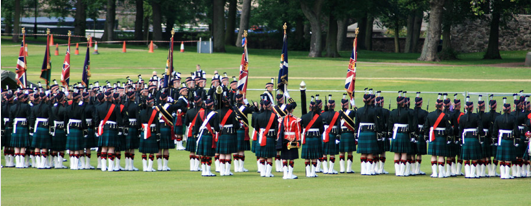
Royal Regiment of Scotland on Parade for Presentation of Colours in Holyrood Park

Posted in Uncategorized | Tagged | Leave a comment