Daft Question

Even the Guardian has recently highlighted the debate here in Scotland whether we should be teaching Scottish culture in schools. For me, this is the ultimate daft question. My reasons are not political, nor simply because it is hard to find a comparable country where the national culture is not part of the school curriculum. My reason (those still suffering from the Scottish cringe should stop reading now) is that we’re good, and not just historically good. But, as a nation, do we know that?

The Enlightenment put Scotland on the cultural map. And, whether in contemporary drama, art, literature, music, etc., Scotland can still hold its own. Indeed, since Kelman, the crime novelists, a clutch of poets, McMillan, etc. came on the scene in the nineties, any growing political awareness has been outmatched by a cultural one.

But, even all of that does not explain why I am such a passionate advocate of teaching Scottish culture; my reason is because of all that I missed out on in my life because my sixties schooling offered none. Now, I had a fine education in North Berwick and Edinburgh but my first inkling that it lacked, big-style, came when I signed up for a Philosophy class at the Hume Tower (I read Physics but there was this girl, see…) and was confronted by Hume himself. I had never heard of him.

Then I fell over Prebble’s Glencoe in Thin’s bookshop and was asked to leave or buy it. I still have that tattered copy forty years later. Stumbling across roofless Cracaig village on Mull was accompanied by reading his Clearances as I set about discovering my own country. I discovered Sibelius but could not explain why I liked him so until I came across MacDiarmid’s lines in Goodbye Twilight that, from our Highlands and Islands:

“what a symphony should come, more ghastly and appalling  than Sibelius’ gaunt, el-greco-emaciated, ecstatic Fourth!”

Celebrating my own culture spurred me to explore others’: the lyrical humanity of Under Milk Wood; Stoppard’s penetrating plays; the profundity of Rilke’s Duino Elegies; the disturbing images of Bosch. It also led me back to epiphany on the depth of my own culture—that Vettriano and Bellany were preceded by the Colourists, that Gray’s epic Lanark had roots in A Scots Quair, that Morgan’s insightful humour reached back as far as The Bruce.

I’m as dismayed as most Scots that we were sent home from New Zealand with not one try on our scorecard and that our Euro 2012 future now hangs by a thread with a dirty great Spanish machete swinging towards it. But why (with the exception of mould-breaking Andy Murray) do we invest so much wild enthusiasm in sports, only to be dashed again and again to wallow in “aw, we wiz shite” self-flagellation that seems to have become universal since 1979?

Though I have little time for the kailyard tat of the Royal Mile or the “90-minute patriots” that Sillars derided in 1993, why do we, as a country, fixate on sports when our culture is (at least at present) so much more world-class? All our high schools have sports pitches; every town has junior soccer. But how many high schools teach Scottish culture beyond Tam o’ Shanter? How many evening art classes preach Peploe’s passionate or Vettriano’s precise styles?

Forget politics and the sterile rammy about ‘seperatism’. I’ll take Burns’ best over his contemporary Wordsworth’s because he was more insightful, while remaining memorable to this day. Carol Ann Duffy is an entirely fitting successor to the towering Ted Hughes as poet laureate. But where is any of this in our education system? If Scots were to devote half the passion to their culture that they devote to their sports, then their self-esteem would be such that it would probably overflow into the sports arena as well. But the difference would be a quiet confidence, rather than the brittle hope that runs through much of our presence on the international stage.

Scots culture is alive, well and pure dead brilliant; time we all learned it.
 

Posted in Community, Education | Leave a comment

Getting Above the Law

Unluckily, the day scheduled by the local Friends of the Law & Glen (FLAG) for me to give an informal history walk up Berwick Law was so resolutely driech that the summit, though only at 200m, was firmly in the clouds. Undaunted, we set off and followed the usual ascent, curving round the back above the disused quarry and stopped there to discuss the iron age Gododdin settlement found but never fully excavated there.

Available history of the Law itself is thin but I had thought that its isolation makes it a unique vantage point to discuss the history of East Lothian, the Forth islands and the south Fife shore all laid out around you. What was fascinating to me was that, as each stop we made, someone had a piece of information to add to the jigsaw: a stone circle new to me; the link between the small water trap below the west shoulder and the WWI observation post near the summit; that local volcanoes were active 200m years before those on Mull and Skye.

Going no farther than the halfway point of the bench on the west shoulder, getting wetter by the minute and occasionally losing sight of Fife or even the town as clouds swept by, it was still enlightening to look at the landscape through the eyes of the past. This blog speculated earlier that this area might once have been an island and, as such, well placed to develop as a key crossroads for eastern Britain. That idea, its ample size and its key location all become clearer from the Law.

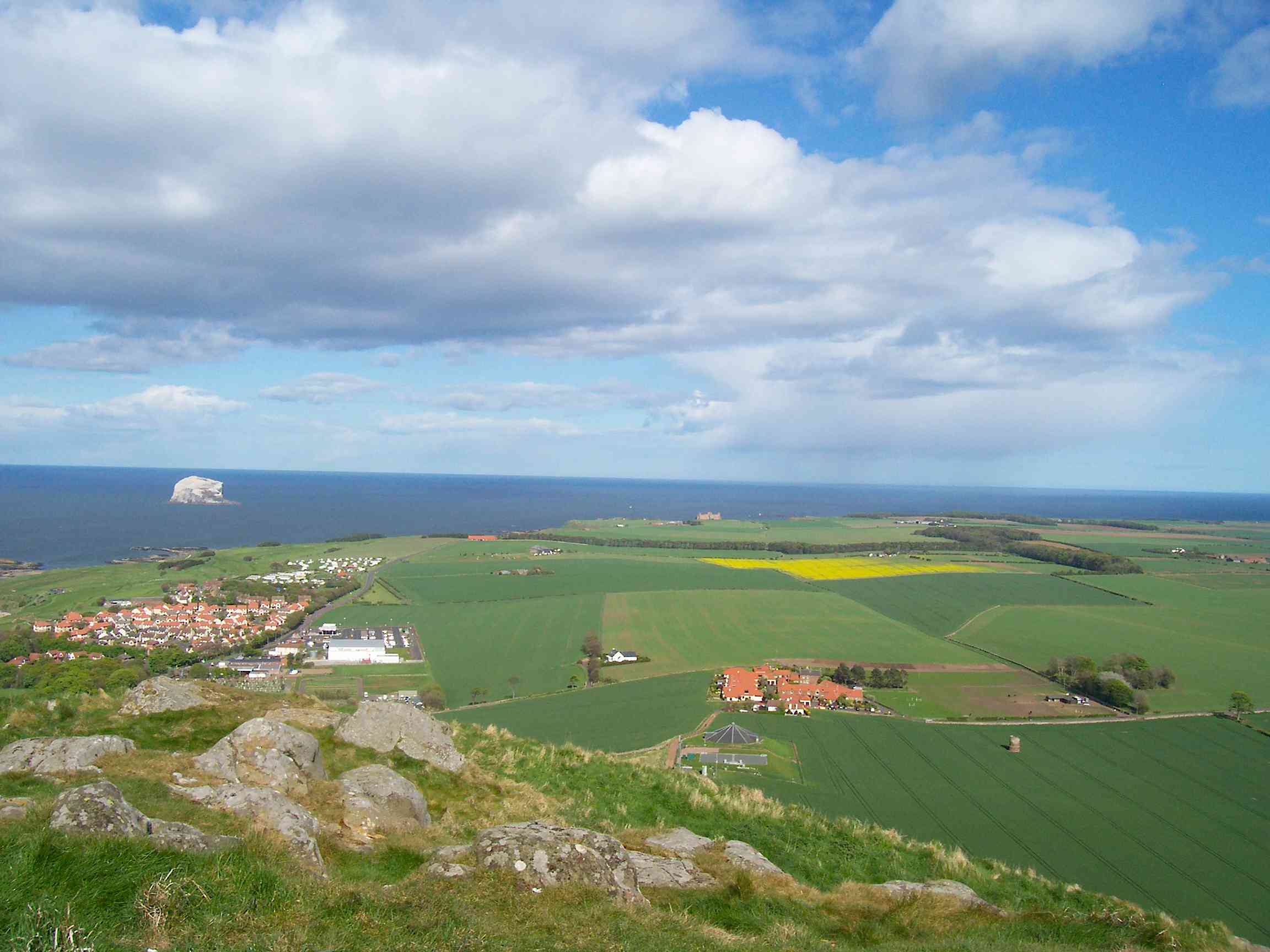
You can see both Gododdin capitals at Traprain and Castle Rock. You can witness how much shorter it is from Earlsferry to Yellowcraig and how a hillfort hidden in Eilbotle (OE = “old settlement”) Wood make plausible an early pilgrim ferry leaving from there. It’s obvious (pre-Forth Bridge) why a railway to Anstruther, a ferry to NB and a line on southwards looked like a winner in the 1840’s. I’m just relieved the final link of an embankment round the West Bay to NB harbour was never built; it would have ruined the prettiest town beach in Scotland.

The vantage point makes it clear why, for a thousand years, the invasion route led through here and therefore more battles fought than in any other county. You can’t quite see Ormiston where Cockburn revolutionised agriculture and gave us the open field patterns we see as natural today but you can see the great sweep of the Lothian and Fife coalfield that powered half of Scotland’s major contribution to the industrial revolution.

Even in the little town of North Berwick right at our feet, you can see the early harbour, the tight confines of the medieval town, the grandiose Victorian mansions stretching to the west, balanced by a later ‘cooncil scheme’ to the east and then more recent clumps of commuter homes tacked on around the edges. Coming up here above the normal perspective puts a distance between you and the everyday but, in compensation, gives an overview of not just the place but its history.

For putting things into perspective—even on a driech day—it’s hard to whack.

View eastward of Bass Rock & Tantallon Castle on a sunnier day

Posted in Community, Environment | Leave a comment

That’s All, Foulkes

A quirky characteristic of Labour in Scotland is that, while they field formidable and subtle politicians, such abilities traditionally, with rare exception, head South. Once there, such contributions as they do seek to make back here in Scotland are drowned out by a combination of sheer distance, local media gone native and the balance of their party still here, now in their fifth year of hissy-fit strop at not being in charge.

The result is stultifying: the more creative pro-actively disagree with all comers; the more pedestrian simply wait for the SNP to act, then complain about it. Edifying, it is not. What turns off those few Scots who do follow the Holyrood hothouse are their MSP’s predictable, one-dimensional postures: Michael McMahon finds SNP duplicity lurking in everything but (including?) the cafeteria menu; Jackie Baillie finds faults with the NHS, none of which she noticed pre-2007; Johann Lamont sticks to women’s issues to finagle the First Minister into agreeing; Iain Gray spends all his time jabbing at SNP policies in unconscious parody of Monty Python’s argument clinic.

The uncoordinated opportunism leads to some pretty bizarre contradictions so it’s as well the Scottish media still gives Labour an easy ride for old times’ sake. How can Labour credibly call for a VAT cut when they declined to vote against Osborne’s increase in the first place? Labour-run councils refused to join all other parties in CoSLA’s acceptance of Swinney’s financial settlement, yet offered no alternative. Their leadership contest is so irrelevant even Milliband forgot who’s running in it.

So opposition in Scotland falls to the exiles, especially the MPs. Ian Davidson gets called to speak most but he is so much a product of the Glasgow nomenklatura that his obvious venom and frustration get in the way of him saying anything memorable. Jim Murphy, after a period of studied reasonableness while he was Scottish Secretary of State, has reverted to type and the ‘big beasts’ Brown and Darling have gone to ground.

Which leaves—although this surely cannot be from any deliberate decision by Labour—Lord George Foulkes of Cumnock. It’s hard to believe that Labour chose him to lead their charge but, given what’s on offer elsewhere, it’s more likely that he chose himself. Anyone who has followed his career as MP, MSP, Hearts Director and now peer will not find this surprising. So venal is his hatred of the SNP and all it stands for that he swings and misses more often than he connects; this would be funny, were the matter not so serious.

The fact that he lives in a glass house himself has not prevented him from throwing stones at the SNP Government and the Head of the British Army on the topic of expenses claimed. (In 2008, Foulkes was criticised for his expenses claims, which included around £45,000 over a period of two years for overnight subsistence to stay in a flat he had inherited. Between April 2007 and March 2008, Foulkes claimed £54,527 in expenses from the House of Lords). It is likely his difficulties have been caused more by arrogance than dishonesty but public perception conflates the two.

His latest apoplexy is that a senior mandarin was supposedly caught promoting the SNP policy, viz “advising the SNP government on the tactics and policy in relation to the break-up of the United Kingdom. Surely it is the responsibility of Sir Gus O’Donnell (UK’s most senior civil servant) to say to Sir Peter Housden that he should be advising the SNP only on devolved areas and not on matters that are reserved to this parliament, particularly those that are politically sensitive.” In this, he received much supportive harrumphing from Lord Forsyth of Drumlean and his ilk.

That’s the same Forsyth who, as Major’s Secretary of State for Scotland did everything in his power to scupper the Convention for a Scottish Assembly and any semblance of the Scottish Parliament. And it was Foulkes’ party (although he was not himself elected an MP until 1979) under Wilson and Callaghan that instructed mandarins to repress the importance of North Sea oil and subvert all income to the UK so that any “It’s Our Oil” campaign would get short shrift. There is no doubt that George saw all those actions as legitimate.

So why should he be so distressed at Scottish mandarins going about our government’s business? All that the Scottish Government has done is ask its civil servants to implement their manifesto. There is nothing else—other than in George’s mind—that limits what they may or may not do. Nonetheless, he nagged all three oppositon leaders to write to complain. In fact, The head of the UK’s civil service, Sir Gus O’Donnell, wrote back to Scottish opposition party leaders saying “recent comments made by the Permanent Secretary, Sir Peter Housden, did not break the Civil Service code.” In a joint letter to the three MSPs, O’Donnell dismissed the accusation, saying that “the job of civil servants is to support the elected government of the day.”

Like his pedestrian Scottish colleagues, Lord Foulkes exhibits stress reactions when faced with new political initiatives, whether here in or furth of Scotland. The result is Foulkes’ attacks are barely distinguishable from local ill-conceived, amateurishly inept efforts. His compulsion to rubbish anything the SNP does comes across as a kind of political Tourette Syndrome, especially to the great uncommitted majority. It is ironic that he thereby does far more damage to Westminster than his phonetic namesake could ever have managed with all the gunpowder in the world.

Posted in Politics | Leave a comment

Stay Hungry; Stay Foolish

The motto was one by which Steve Jobs lived all his life. He may have been fortunate to grow up in Silicon Valley but he and his buddy Steve Wozniak (‘Woz’) were not only creative enough to be part of the California counter-culture of the mid-1970s but smart enough to be aware of the opportunities unfolding around them as technology went into overdrive.

It was Woz who was the ‘Phone Phreak’; he developed hand-held devices to control sound frequencies used by AT&T and Pac Bell to run the entire local phone system. They made international phone calls for fun. But it was Jobs who saw the potential in Woz’s prototype Apple I at the Homebrew Computer Club. He started in business as unconventionally as he continued, financing the first 50 by persuading Cramer Electronics to sell them all the components on 30-day terms and working 24/7 to deliver in time. Not one share was sold to raise capital. That happened when they went public in 1980 on the back of the much more successful Apple II—the most successful Initial Public Offering since Ford Motors.

The whole area was abuzz at the time: Intel in Santa Clara, AMD in Sunnyvale, HP in Palo Alto and many other spin-offs originated from Xerox Corp’s Palo Alto Research Centre (PARC), perhaps the most innovative and influential technology centre in the world. It invented what made Apple: the intuitive interface in the form of a high-resolution display screen and ‘mouse’, as well as a keyboard. When Jobs saw this, he formed an entirely new team to develop a commercialised version.

And so, the Macintosh was born: a compact, luggable single unit when the IBM PC that was leading the market was a drawer-sized clunker. Its launch by TV ad during the 1984 Superbowl interval is still stunningly innovative—highly effective in reaching non-techies and unheard-of for a technical company. Jobs insisted that Macs talked to each other and through this AppleTalk, a whole group could use a silent, amazingly flexible laser printer while the DOS world buzzed with character-only dot-matrix.

Because no-one was ever fired for buying ‘Big Blue’ and PC’s were unknown territory, IBM dominated the business market. When various clone manufacturers dropped the prices and Microsoft finally worked out how to mimic Apple’s graphic-based intuitive interface with Windows 3.0 in 1990, Apple’s market share became squeezed into the creative sector. Graphic designers and architects loved Macs but most computers were used by accountants and secretaries who needed a spreadsheet, a word processor and little else. Although Apple produced successively better computers, they were derivative. Jobs became frustrated and was squeezed out.

He went on to found NeXt, which reiterated his fixation with style and presentation but could not be made competitive enough, nor penetrate a market dominated by standards and the inertia associated with them. His stint at Pixar created opportunities in film animation that are still being explored today. But it was when NeXt sold its innovative, UNIX-based operating system to Apple in 1996 that the marriage made in heaven was consummated.

Because the now-widely experienced Jobs not only came with the package but, within a year was Apple CEO. Almost immediately, he had a deal to have Microsoft’s industry-standard Office released on the new OS. Innovative, attractive computers like the single-unit iMac and the slim, lightweight MacBook grew the market and a struggling Apple was back in the game. Under Jobs’ direction, there followed a flurry of prescient products, backed by a visionary commitment to what the web could do to promote and support products and starting with the iPod. Complaints flowed that Jobs’ insistence on following a vision was insufferable. But nothing succeeds like success.

But 2007’s introduction of the iPhone, followed closely by the iPad, presented coherent, attractive technical wizardry that appealed to the non-techie. This, as much as anything, has been a the root of Apple’s spectacular growth since 2005. Obviously, thousands of dedicated professionals have made this happen. But the vision of what was required and the drive to achieve it came from the brain of one man: Steve Jobs.

For over 35 years he kept faith with his beliefs, had the courage to follow them, the audacity to be visionary, the articulation to persuade others to follow him and the wit to see when opportunity to pursue realisation was at hand. Not a bad epitaph for a techie. Would that more politicians deserved something similar.

Posted in Commerce | Tagged | Leave a comment

A Faraway Conference, of Which We Know Little

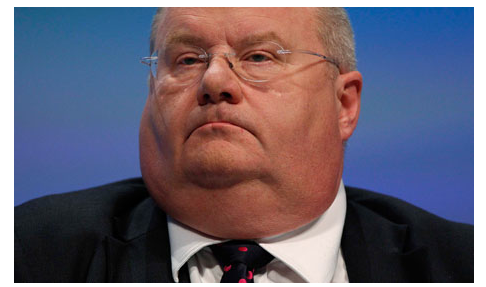
Eric Pickles: upset about being considered a fire hazard by officials at the Conservative party's annual conference in Manchester. Photograph: Phil Noble/Reuters

Manchester or the Moon, the debate seems to be just how relevant the Tory Conference can be for Scotland. With ex-Tory Brian Monteith fulminating eloquent as ever about their lost opportunities in the Hootsmon and Iconoclast-in-Chief Murdo Fraser not showing up for lone-Tory-MP Mundell’s speech, the state of the party in Scotland was hardly on everyone’s lips there. But the state of this conference is going even less remarked in Scotland. Why should it?

Major speeches by Osborne, Fox, Hague et al will leave Scots disinterested at best. Far from those dark days when Thatcher ruled all, debate in Scotland revolves around John Swinney’s much more relevant finance settlement. That Cameron said “I want Scotland to stay in the union but accept the decision is one for its people alone” is hardly news.

But over 300 faithful (“more than vote Tory in Scotland”, according to the Grauniad) did pack a conference fringe to hear the four candidates vying for Rab-McNeil-favourite-den-mother Annabel Goldie’s poisoned chalice of a job. Of the 8,500 McMembers left who can choose a new Embalmer-in-Chief, half are over 80, with Jack Carlaw as the grannies’ favourite over Murdoch Fraser, Ruth Davidson and Margaret Mitchell.

Had he stayed conventional, Fraser would have walked it. But being a Tory with some strategic vision (not yet an oxymoron but getting damn close), Murdo questioned just how many elastoplasts it takes to treat a brain haemorrhage and, to his credit, opted for the necessary radical surgery over simply taking his shift at the helm of a political Marie Celeste. For the other three, it is the sheer Britishness of the brand they wish to defend that matters, which illustrates just how deep you have to stick your head in the sand to stay loyal to conventional Toryism in Scotland these days.

For, this is what is scuppering a once-great party—their doughty insistence that all that has passed between our two nations as a mighty empire and beacon of democratic civilisation to the world for 300 years must ipse facto be the template for the next 300. When Tories are not ladling on this paternalism with a spoon, they are lecturing us in the kind of cut glass tones that only a grocer’s-daughter-come-to-her-inheritance would dare articulate. Britishness has never been a clearly distinguished trait because it was just convenient camouflage for ‘making the world England’. It is a form of cultural colonialism that Tories seem to practice whether home in England or elsewhere. A clearly distinct form of Scottish Toryism has never yet manifested itself—but exactly that is what’s needed.

We Scots are no longer the plucky Jocks going over the top at Mons; no longer the phlegmatic chief engineer reassuring the bridge that she’ll make it back to Blighty; no longer the kailyard music hall singer missing granny’s hielan hame and steppin’ wi’ his crummock tae the road. And, now that the song of the Clyde is no longer the sound of us building their empire, perhaps the Tories will hear this whisper of renewables, the now stilled voice of 7:84, Local Hero & Trainspotting, the conversations inhabiting other-than-stone houses that are the voices of 21st century Scotland.

You can’t really hear those voices in the hubbub from Manchester. Murdo has; but, among the faithful, has anyone else?


Posted in Politics | Tagged | Leave a comment

Sectarianism: the Common Enemy

As a long-time member of the SNP, I cheerfully confess that it’s seldom that I’m uplifted by the thoughts of any member of the Labour party. But, as regular readers of this blog will recall, Tom Harris MP, contender for the Scottish Labour leadership, has managed that before and in his recent piece on sectarianism, has done so again.

Tom contends that the present legislation on sectarianism is poorly conceived and will make bad law, either overfilling prisons with disproportionate sentences or making lawyers shed-loads of money. I believe he has a point. But, rather than then going off the deep end about how inept/separatist/untrustworthy/minging/etc the SNP are (as most of his colleagues would do) he shows insight into the situation and suggests that his party should creatively assist the SNP in “crawling out of the hole they’ve dug”.

Now this might be reasonable—or even obvious—behaviour in the real world—but not in the more rarified point-scoring world that remaining senior Scottish Labour figures appear to inhabit. Though it will doubtless be making a stick for our own backs to hope that Tom wins their leadership (and ends our easy ride of the last four years) any aspirational government like the SNP needs competent opposition to keep it sharp.

But, further than even Tom suggests, a common approach from Labour and the SNP might offer the best way of dealing with the blight of sectarianism. He is a little too ready to blame the SNP for this legislation and its clumsiness. A former holder of the post to which he aspires said: “If I have regrets, and I do have a regret that comes from hindsight, it is that I didn’t put more of the things that I really cared about as First Minister into legislation. I wish I had passed a bill on government action on sectarianism”—Jack McConnell May 2009.

But the problem to date has been dealt with clumsily, as if it were a nation-wide problem. Tom simplifies too much: “What school did you go to?” is not a loaded question across three-quarters of this country. And, while Scotland has had its share of religious wars, most of that is well in the past: in recent times, Na h-Eileanan Siar have been far more divided over the Frees vs Wee Frees than over Catholic vs Protestants. Growing up in Lothian as I did, Catholic kids were just the ones who showed up late some days and no more was thought of it.

Sectarianism is largely a West of Scotland phenomenon, based, as much as anything, on the import of workers into the booming industries of the Clyde from Ulster in the 19th century who brought their beliefs—and prejudices—with them. As in many of the world’s conflict spots, it was rooted in identity in some struggle perceived to be life-and-death. Football has provided a socially acceptable cloak for its passion and enmity but the focus on the ‘Old Firm’ largely misses the point—and more particularly, the root—of the problem: it is largely social.

There are two beacons for the SNP (as well Tom and his colleagues in Labour) to look to if they want to get this blight addressed (and Scottish ministers off the legislative hook on this one). The first is Eire. A country once torn by civil strife that was mainly sectarian based, it has grown beyond its centuries of religious enmity to become not just a force for peace in still-fragmented Ulster but an example of how the unifying identity of being Irish has helped build common ground, consensus and joint purpose.

The second is our Asian community. Based, as it is, in the heart of sectarianism’s heartland, there are few in the West who do not work with, use the services of or buy from our Asian friends. It is a vibrant community, catalysed after WWII when India was split by its own sectarianism. They are, with few exceptions, dedicated to their own culture and religion but also to be active and engaged within their communities. Their children attend local schools; their leaders are elected to represent constituents who are brown, white and all shades between. The late Bashir Ahmed was the epitome of their affable good sense and ability to both succeed and contribute.

If Irish and Asians can show us, why can’t we Scots show ourselves?

I’m with Tom: the present legislation is flawed. But, rather than re-work it, let’s look to our close neighbours and—as with the social consensus achieved on once-rife drunk driving—see if there isn’t a better way: make any need for such a thing seem obsolete.

Posted in Community | Tagged | Leave a comment

What Is It About Tories…

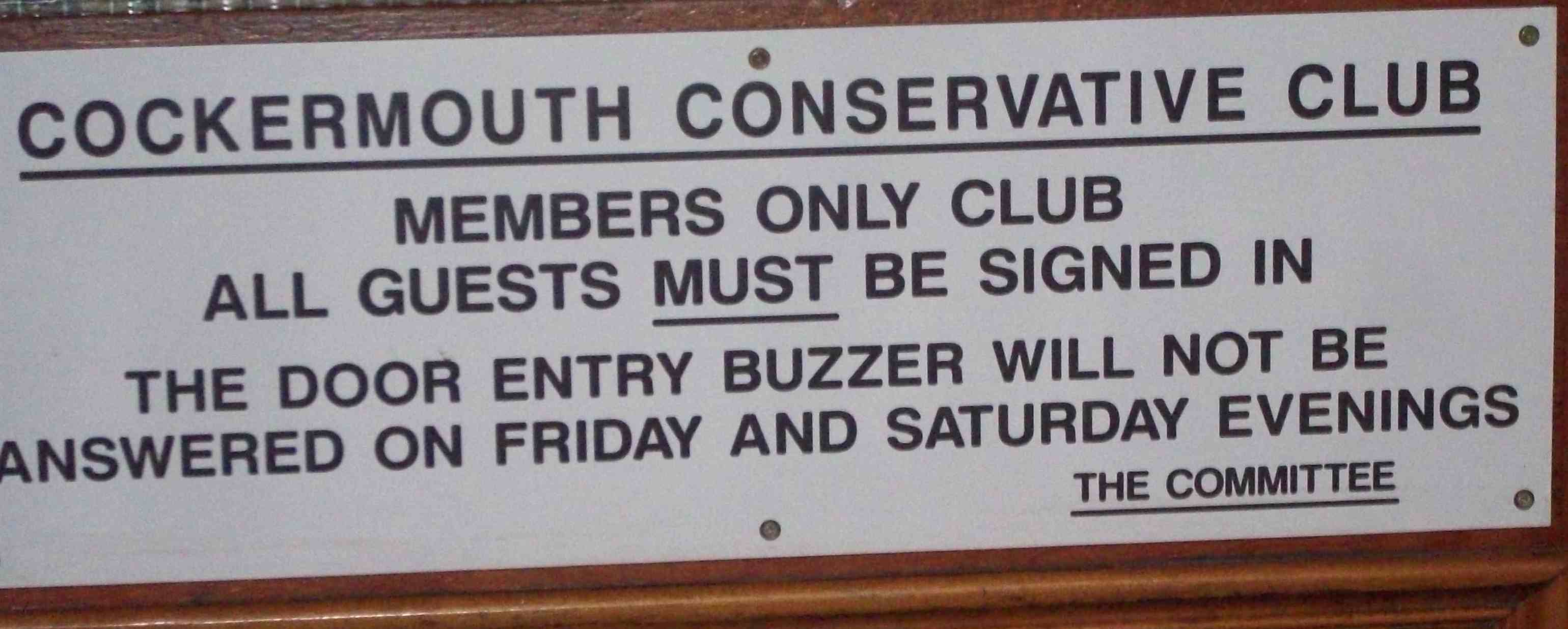
…that, even in Englandshire, malcontents won’t let those few members left have a quiet commiserative drink together of a Saturday night?

Snapped on Main Street, near the Bridge over the Cocker

We note that, despite David Mundell’s best efforts to scupper him, Murdo is still casting about for a new name for the Scottish(?) Tories. “Scottish Reform Party” and even “The Caledonians” have been mentioned.

We think the “Rather Insipid Party” has an accurate ring, especially as an acronym.

Posted in Politics | Tagged | Leave a comment

Looking Through a Glass Union

At first I was quite heartened to hear that a new website had been launched to put the case for the Union. According to the site: “Currently there is no coherent Scottish voice championing a preservation of the United Kingdom. There seems to be no organised campaign in Scotland against the SNP campaign for separatism.” Though I’d quibble with their phrasing, there’s no gainsaying their point. However, examining their arguments does not move us on very far, especially their main assertion that: The Union serves all four parts of the United Kingdom well and enables us to achieve much more together than would be the case if we were separate nations.

Their points below are given under four heads in italics and our responses follow:

History

  • The Union has been one of the greatest political success stories of modern European history. It has helped to provide us with a degree of political stability in the United Kingdom that is virtually unparalleled anywhere else in Europe over the past 300 years.
  • No quibbles with that. But who says that’s the right choice for the next 300?
  • Thanks to the Union the English language is possibly the greatest export that Britain has ever produced.
  • No quibbles either. But will independent Scots be banned from using English?
  • In the 18th century, the Union helped create the sense of possibility that inspired the Scottish Enlightenment. In the 19th century, the Union brought unparalleled prosperity to both our countries in what was Europe’s first common market between Scotland and England. In the 20th century, we confronted side by side totalitarian regimes that were the scourge of mainland Europe.
  • No quibbles again. But, starting with the Darien disaster, through the Clearances, right up to North Sea Oil and EU Fisheries, England has proved a selfish partner, failing to distinguish between itself and Britain; the worst exponents were Thatcher/Blair which is why we’re having this debate.

Economy

  • The Union allows Scotland to be part of a larger, more powerful economy and within the Union, Scotland enjoys the four freedoms – movement of goods, services, people and capital.
  • Same applies (far more powerfully) to the EU, in which Scots need a direct say.
  • By remaining part of the Union, Britain has the fourth largest economy in the world. Edinburgh’s role as a major financial centre is built on the expertise of its workforce and underpinned by its position in the UK.
  • EU is the 2nd economy in the world. And is Singapore restricted as a financial centre by being a country the size of Edinburgh? No—this is the 21st century.
  • Being in the Union allows us to pool resources and risk. The fact that Scotland receives more from the UK Treasury than she contributes does allow the disproportionate remoteness of some regions and the disproportionate economic disadvantages of others to be catered for.
  • Hoary old chestnut, this one! North Sea Oil, Crown Estates, Whisky duty & other invisibles Westminster chooses not attribute to Scotland means it actually makes a net contribution (7.8% of UK GDP from a population of 7.6%)
  • Most of the Scottish budget comes from a block grant from the UK Parliament, paid for out of taxes collected from across the UK.
  • Yes: so do English schools, transport, social work, libraries, etc. Your point?
  • Being part of the Union and the current funding setup means that public services are less exposed to sudden fluctuations in revenue with a tax base as wide as the UK’s
  • Iffy point. You mean, like Irn Broon’s raid on Scottish pension funds or Darling’s 20% VAT boost? Give us a chance to steer an economy relevant to Scotland and not to London and we’ll take that ‘disadvantage’.
  • Social security payments are available and are paid on the same basis to people across the country, according to their needs. This principle of fairness should not be undermined.
  • Pardon us but, after Thatcher, we Scots take no lessons from England on what is or is not ‘fair’.
  • Being part of the UK allows the costs of say bank rescue plans to be more easily absorbed and spread out across a far larger tax base and therefore makes the costs less acute on the individual.
  • That would be a good point, other than, had the 2008 crisis hit an independent Scotland: a) we would have had an FSA like Norway’s (i.e. one not asleep on the job); b) instead of squandering oil revenues on supercarriers and nuclear subs, we would have started to amass an oil fund like Norway’s to help cushion the blow; c) we would not have been alone—NatWest and Halifax are English banks—England would have had to share the bailout or watch its banks go bust; d) are we sure glueing HBOS to Lloyds was a good idea?

Political

  • Being part of the UK, Scotland is able to wield meaningful influence for good around the world. Scotland is in the privileged position of being amongst the five permanent members of the Security Council, is in the G8 group of the most prosperous nations, is one of the three big nations at the centre of the EU and leads the Commonwealth. Scotland’s interests are therefore represented in the most influential and important international organisations in the world by virtue of the Union.
  • This is utter crap: England’s interests are represented—when it comes to any conflict (e.g. selling fishing rights to the Spanish or redrawing North Sea oil boundaries) Scotland’s interests go down the Suwanee.
  • It goes without saying that Scotland is physically safer with the pooled resources of the UK military and counter-terrorist services at our disposal.
  • No: it goes with saying that we are in more danger staying part of a third-rate power with delusions of grandeur: the Glasgow airport car bomb would not have happened had Scotland not been dragged into the Iraq War
  • Over the centuries, Scots have made an outstanding contribution to the UK’s military successes. Scotland punches above its weight in Britain’s Armed Forces and Britain punches above its weight in the world because of the expertise and bravery of those Armed Forces.
  • If “punches above its weight” means Scotland has had more sons killed or put in harm’s way than England (and continues to with 42 Cdo & 4th Bn RRS in Afghanistan), then yes. But current UK military policy is both delusional and dangerous—underfunded, underequipped and overstretched. It’s time Scotland had modest Norway-scale forces, playing a normal peacekeeping role. Who’s going to invade Berwick or Barra: the Russians? The Faroese?

Social Benefits

  • The Union allows individual Scots to continue to play a major part in the social fabric of the UK.
  • And the Irish don’t/can’t?
  • Many of us will have family in other parts of the UK.
  • …and Canada and Australia and South Africa and Eire and the States and Spain and France and… There will be no border posts at Berwick (as there are at Dover but not in the Schengen countries)
  • Sports stars like the Scottish Olympic Gold Medallist cyclist Chris Hoy trained in England and competed at international level for Britain.
  • Oh, puh-lease; he still could. That’s a reason to deny 5m people freedom??
  • A common bond we have is the Royal Family.
  • Which would remain as long as a majority of Scots felt that way: c.f. Canada
  • Within the Union there are aspects of Scotland’s national life which are different from the rest of the UK. The distinctive Scottish legal system and the Scottish education system are good examples.
  • Agreed: we just want the other aspects that would make us a normal country.
Posted in Politics | Tagged | Leave a comment

Borderline Rail Needs Re-thinking

It should surprise no-one that the other shoe has finally dropped: all private bidders to build the Borders Rail have now dropped out and a second hot potato passed back to government agencies to complete. Transport Minister Keith Brown MSP, pressured by the opposition to assure them that it would be built by 2014 and for the £295m quoted, said “Yes”. Borders politicians of all stripes gushed enthusiasm at this reasurance.

But this gives the Minister a chance to re-cast the whole project because the Lab-Dems cheese-pared the whole thing into a questionable shadow of its original self, divorced from Network Rail and the rest of Scotland’s rail system. Consider the details:

  • single track for most of its length = limited capacity & speed
  • cannot carry freight or standard ‘heavy’ trains
  • stops at Tweedbank = does not serve most of the Borders
  • still stymied for level access across the A720 Edinburgh bypass
  • not integrated with any Edinburgh City Region transport plans
  • business case beyond Gorebridge cast into doubt

In fact, such a glorified tram hardly merits being classed as a railway—having more in common with the Aviemore funicular, which is no great business precedent to follow. If we have to put £295m into this, why not put it on a basis that could lead to further development? While the business case demonstrates benefits to Galashiels, thinking bigger about Midlothian and the Central Borders could make this project far more beneficial to those areas, as well as fitting into Edinburgh City Region transport.

Ever since 1969’s closure prompted the stillborn Border Union Railway, there have been enthusiasts to revive the Waverley route, some the entire way to Carlisle. But the now-electrified Carstairs route makes Waverley’s gradients & curves uncompetitive. It was regarded as the most uncomfortable main line ride around, with even expresses scheduled over 2 hours end-to-end. Total reinstatement may one day be possible as a enthusiast-based ‘nostalgia’ line, (c.f. the highly scenic Settle-Carlisle line). But, commercially, it’s a non-starter.

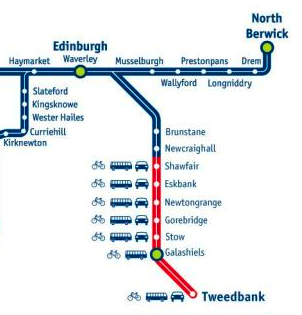
Borders Rail—the Existing Plans

What is essential is to put the Borders firmly back on Scotland’s railway map and leave the door open for further expansion. But there are still major obstructions, including:

  • regrading the A720 to reinstate flat track bed between Shawfair and Eskbank
  • rebuttal of the ‘damaged’ business case from FOI releases in 2007
  • review of passenger projections given the hiatus in house building in the area

As of now, the last two are for Network Rail to address, but the first is the dealbreaker. Whether done in conjunction with Transport Scotland’s long-overdue rebuild of the Sheriffhall roundabout (along the lines of the Newbridge) or not, the grade crossing must take the road over (or under) the rail: a ‘tram-type’ flyover, such as TIE built at Saughton and Edinburgh Park, would limit the line to light rail and stifle expansion.

If such a ‘proper’ grade crossing is not already part of costs, temporary termination of the line at Gorebridge as a “Phase I” would compensate. This would still serve higher density traffic and prove itself commercially if ScotRail extends its Newcraighall service to cover this first stretch. “Phase II” could then extend the line to Tweedbank, as originally planned, with a further “Phase III” extension to Melrose and SBC HQ at St Boswells. If this last were provided with Park & Ride, major housing development here would relieve development pressure on Edinburgh and, as a Central Borders ‘hub’ be a better terminus. Extensions to Kelso and/or Hawick might then be considered.

But, first, a neglected option of the existing Gilmerton freight line could be added to this ‘network’ to serve western Midlothian. Although only single-track, it both exists and crosses the A720 and could serve stations at Loanhead, Roslin and Glencorse. This would again be part of the ScotRail network franchise and further relieve the road traffic to/from Midlothian.

Rather than well meaning anoraks dreaming of a re-opened Waverley line (while being sold another tram), Midlothian and the Central Borders deserve a ‘real’ railway to link them into the booming Edinburgh economy of the next century.

Posted in Transport | Tagged | Leave a comment

The Road to the Isles

Back from Ullapool to find Danny Alexander MP in a strop at this week’s Transport Conference in Aviemore over Transport Minister Keith Brown MSP’s supposed SNP focus on Central Belt projects and neglect of the A9 that takes wur Danny home after a long, hard day at the Treasury.

Now, far be it from me to see ulterior political motives in this, but wasn’t it the Lib-Dems who pushed the Edinburgh Trams project ever onwards in the teeth of fierce SNP opposition from the start? And was it not Lib-Dem squeals that echoed their former Labour Executive colleagues over SNP scrapping of GARL and EARL, both Central Belt projects of scant interest in the Highlands?

Having just yesterday traversed the A9 from Dingwall to Perth myself, the benefits of some £20m in recent investments, including new dualling south of Newtonmore, are obvious. Compared to the stuttering investment ten years ago when even the lethal A827 crossover at Ballinluig was yet to be addressed by the then-(to be fair, Labour) Transport Minister, the A9’s in much better nick and getting its share of investment.

Road to the Glenelg Ferry, Lochalsh

In fact, the general state of roads in the Highlands is looking up. Having traversed Skye, the little-travelled A863 to Dunvegan was in good nick and the A860 onwards to Portree now a broad two-lane. Even single-track sections on either side of the Glenelg Ferry have—despite being in competition with the now-toll-free Skye bridge—a good surface and adequate passing places. Best of all, the A835 Dingwall-Ullapool artery, upon which the Western Isles depends for its main ferry link, is as fast and good a road as you could expect to weave through the stunning scenery that is Wester Ross; it gets you to Inverness with no white knuckles in barely an hour.

Perhaps the busy life he now leads doesn’t allow wur Danny the time to travel about and see the improvements being made across his country; it’s a far cry to Lochawe, let alone Loch Broom when affairs of state keep him in Lunnainn. And, if he does feel that I have made no strong case and persist in moaning unjustifiably, then he only need instruct his officials to prepare a law that allows the Scottish Parliament to issue bonds and borrow capital—just like all the other real Parliaments, including the one Danny works for, are able to.

Or is he feart to go down that road?

The Road to the Isles Gets Watery—The Stornoway Ferry Docked at Ullapool

Posted in Transport | Tagged | Leave a comment