A Faraway Conference, of Which We Know Little

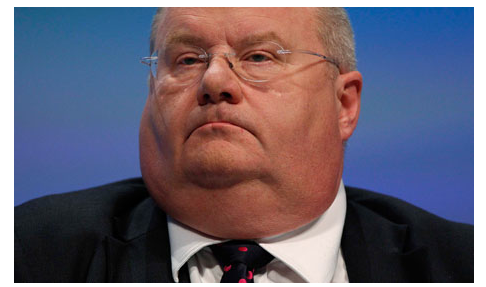
Eric Pickles: upset about being considered a fire hazard by officials at the Conservative party's annual conference in Manchester. Photograph: Phil Noble/Reuters

Manchester or the Moon, the debate seems to be just how relevant the Tory Conference can be for Scotland. With ex-Tory Brian Monteith fulminating eloquent as ever about their lost opportunities in the Hootsmon and Iconoclast-in-Chief Murdo Fraser not showing up for lone-Tory-MP Mundell’s speech, the state of the party in Scotland was hardly on everyone’s lips there. But the state of this conference is going even less remarked in Scotland. Why should it?

Major speeches by Osborne, Fox, Hague et al will leave Scots disinterested at best. Far from those dark days when Thatcher ruled all, debate in Scotland revolves around John Swinney’s much more relevant finance settlement. That Cameron said “I want Scotland to stay in the union but accept the decision is one for its people alone” is hardly news.

But over 300 faithful (“more than vote Tory in Scotland”, according to the Grauniad) did pack a conference fringe to hear the four candidates vying for Rab-McNeil-favourite-den-mother Annabel Goldie’s poisoned chalice of a job. Of the 8,500 McMembers left who can choose a new Embalmer-in-Chief, half are over 80, with Jack Carlaw as the grannies’ favourite over Murdoch Fraser, Ruth Davidson and Margaret Mitchell.

Had he stayed conventional, Fraser would have walked it. But being a Tory with some strategic vision (not yet an oxymoron but getting damn close), Murdo questioned just how many elastoplasts it takes to treat a brain haemorrhage and, to his credit, opted for the necessary radical surgery over simply taking his shift at the helm of a political Marie Celeste. For the other three, it is the sheer Britishness of the brand they wish to defend that matters, which illustrates just how deep you have to stick your head in the sand to stay loyal to conventional Toryism in Scotland these days.

For, this is what is scuppering a once-great party—their doughty insistence that all that has passed between our two nations as a mighty empire and beacon of democratic civilisation to the world for 300 years must ipse facto be the template for the next 300. When Tories are not ladling on this paternalism with a spoon, they are lecturing us in the kind of cut glass tones that only a grocer’s-daughter-come-to-her-inheritance would dare articulate. Britishness has never been a clearly distinguished trait because it was just convenient camouflage for ‘making the world England’. It is a form of cultural colonialism that Tories seem to practice whether home in England or elsewhere. A clearly distinct form of Scottish Toryism has never yet manifested itself—but exactly that is what’s needed.

We Scots are no longer the plucky Jocks going over the top at Mons; no longer the phlegmatic chief engineer reassuring the bridge that she’ll make it back to Blighty; no longer the kailyard music hall singer missing granny’s hielan hame and steppin’ wi’ his crummock tae the road. And, now that the song of the Clyde is no longer the sound of us building their empire, perhaps the Tories will hear this whisper of renewables, the now stilled voice of 7:84, Local Hero & Trainspotting, the conversations inhabiting other-than-stone houses that are the voices of 21st century Scotland.

You can’t really hear those voices in the hubbub from Manchester. Murdo has; but, among the faithful, has anyone else?
 

Posted in Politics | Tagged | Leave a comment

Sectarianism: the Common Enemy

As a long-time member of the SNP, I cheerfully confess that it’s seldom that I’m uplifted by the thoughts of any member of the Labour party. But, as regular readers of this blog will recall, Tom Harris MP, contender for the Scottish Labour leadership, has managed that before and in his recent piece on sectarianism, has done so again.

Tom contends that the present legislation on sectarianism is poorly conceived and will make bad law, either overfilling prisons with disproportionate sentences or making lawyers shed-loads of money. I believe he has a point. But, rather than then going off the deep end about how inept/separatist/untrustworthy/minging/etc the SNP are (as most of his colleagues would do) he shows insight into the situation and suggests that his party should creatively assist the SNP in “crawling out of the hole they’ve dug”.

Now this might be reasonable—or even obvious—behaviour in the real world—but not in the more rarified point-scoring world that remaining senior Scottish Labour figures appear to inhabit. Though it will doubtless be making a stick for our own backs to hope that Tom wins their leadership (and ends our easy ride of the last four years) any aspirational government like the SNP needs competent opposition to keep it sharp.

But, further than even Tom suggests, a common approach from Labour and the SNP might offer the best way of dealing with the blight of sectarianism. He is a little too ready to blame the SNP for this legislation and its clumsiness. A former holder of the post to which he aspires said: “If I have regrets, and I do have a regret that comes from hindsight, it is that I didn’t put more of the things that I really cared about as First Minister into legislation. I wish I had passed a bill on government action on sectarianism”—Jack McConnell May 2009.

But the problem to date has been dealt with clumsily, as if it were a nation-wide problem. Tom simplifies too much: “What school did you go to?” is not a loaded question across three-quarters of this country. And, while Scotland has had its share of religious wars, most of that is well in the past: in recent times, Na h-Eileanan Siar have been far more divided over the Frees vs Wee Frees than over Catholic vs Protestants. Growing up in Lothian as I did, Catholic kids were just the ones who showed up late some days and no more was thought of it.

Sectarianism is largely a West of Scotland phenomenon, based, as much as anything, on the import of workers into the booming industries of the Clyde from Ulster in the 19th century who brought their beliefs—and prejudices—with them. As in many of the world’s conflict spots, it was rooted in identity in some struggle perceived to be life-and-death. Football has provided a socially acceptable cloak for its passion and enmity but the focus on the ‘Old Firm’ largely misses the point—and more particularly, the root—of the problem: it is largely social.

There are two beacons for the SNP (as well Tom and his colleagues in Labour) to look to if they want to get this blight addressed (and Scottish ministers off the legislative hook on this one). The first is Eire. A country once torn by civil strife that was mainly sectarian based, it has grown beyond its centuries of religious enmity to become not just a force for peace in still-fragmented Ulster but an example of how the unifying identity of being Irish has helped build common ground, consensus and joint purpose.

The second is our Asian community. Based, as it is, in the heart of sectarianism’s heartland, there are few in the West who do not work with, use the services of or buy from our Asian friends. It is a vibrant community, catalysed after WWII when India was split by its own sectarianism. They are, with few exceptions, dedicated to their own culture and religion but also to be active and engaged within their communities. Their children attend local schools; their leaders are elected to represent constituents who are brown, white and all shades between. The late Bashir Ahmed was the epitome of their affable good sense and ability to both succeed and contribute.

If Irish and Asians can show us, why can’t we Scots show ourselves?

I’m with Tom: the present legislation is flawed. But, rather than re-work it, let’s look to our close neighbours and—as with the social consensus achieved on once-rife drunk driving—see if there isn’t a better way: make any need for such a thing seem obsolete.

Posted in Community | Tagged | Leave a comment

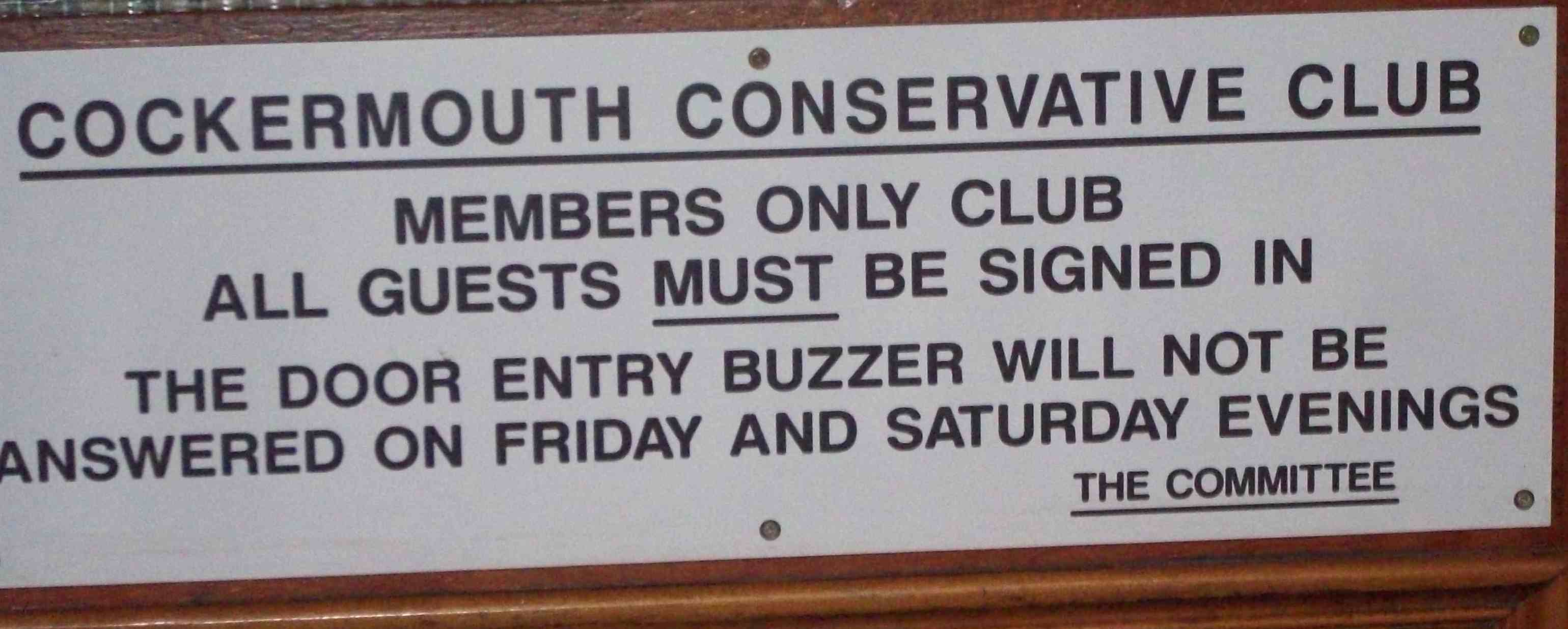
What Is It About Tories…

…that, even in Englandshire, malcontents won’t let those few members left have a quiet commiserative drink together of a Saturday night?

Snapped on Main Street, near the Bridge over the Cocker

We note that, despite David Mundell’s best efforts to scupper him, Murdo is still casting about for a new name for the Scottish(?) Tories. “Scottish Reform Party” and even “The Caledonians” have been mentioned.

We think the “Rather Insipid Party” has an accurate ring, especially as an acronym.

Posted in Politics | Tagged | Leave a comment

Looking Through a Glass Union

At first I was quite heartened to hear that a new website had been launched to put the case for the Union. According to the site: “Currently there is no coherent Scottish voice championing a preservation of the United Kingdom. There seems to be no organised campaign in Scotland against the SNP campaign for separatism.” Though I’d quibble with their phrasing, there’s no gainsaying their point. However, examining their arguments does not move us on very far, especially their main assertion that: The Union serves all four parts of the United Kingdom well and enables us to achieve much more together than would be the case if we were separate nations.

Their points below are given under four heads in italics and our responses follow:

History

  • The Union has been one of the greatest political success stories of modern European history. It has helped to provide us with a degree of political stability in the United Kingdom that is virtually unparalleled anywhere else in Europe over the past 300 years.
  • No quibbles with that. But who says that’s the right choice for the next 300?
  • Thanks to the Union the English language is possibly the greatest export that Britain has ever produced.
  • No quibbles either. But will independent Scots be banned from using English?
  • In the 18th century, the Union helped create the sense of possibility that inspired the Scottish Enlightenment. In the 19th century, the Union brought unparalleled prosperity to both our countries in what was Europe’s first common market between Scotland and England. In the 20th century, we confronted side by side totalitarian regimes that were the scourge of mainland Europe.
  • No quibbles again. But, starting with the Darien disaster, through the Clearances, right up to North Sea Oil and EU Fisheries, England has proved a selfish partner, failing to distinguish between itself and Britain; the worst exponents were Thatcher/Blair which is why we’re having this debate.

Economy

  • The Union allows Scotland to be part of a larger, more powerful economy and within the Union, Scotland enjoys the four freedoms – movement of goods, services, people and capital.
  • Same applies (far more powerfully) to the EU, in which Scots need a direct say.
  • By remaining part of the Union, Britain has the fourth largest economy in the world. Edinburgh’s role as a major financial centre is built on the expertise of its workforce and underpinned by its position in the UK.
  • EU is the 2nd economy in the world. And is Singapore restricted as a financial centre by being a country the size of Edinburgh? No—this is the 21st century.
  • Being in the Union allows us to pool resources and risk. The fact that Scotland receives more from the UK Treasury than she contributes does allow the disproportionate remoteness of some regions and the disproportionate economic disadvantages of others to be catered for.
  • Hoary old chestnut, this one! North Sea Oil, Crown Estates, Whisky duty & other invisibles Westminster chooses not attribute to Scotland means it actually makes a net contribution (7.8% of UK GDP from a population of 7.6%)
  • Most of the Scottish budget comes from a block grant from the UK Parliament, paid for out of taxes collected from across the UK.
  • Yes: so do English schools, transport, social work, libraries, etc. Your point?
  • Being part of the Union and the current funding setup means that public services are less exposed to sudden fluctuations in revenue with a tax base as wide as the UK’s
  • Iffy point. You mean, like Irn Broon’s raid on Scottish pension funds or Darling’s 20% VAT boost? Give us a chance to steer an economy relevant to Scotland and not to London and we’ll take that ‘disadvantage’.
  • Social security payments are available and are paid on the same basis to people across the country, according to their needs. This principle of fairness should not be undermined.
  • Pardon us but, after Thatcher, we Scots take no lessons from England on what is or is not ‘fair’.
  • Being part of the UK allows the costs of say bank rescue plans to be more easily absorbed and spread out across a far larger tax base and therefore makes the costs less acute on the individual.
  • That would be a good point, other than, had the 2008 crisis hit an independent Scotland: a) we would have had an FSA like Norway’s (i.e. one not asleep on the job); b) instead of squandering oil revenues on supercarriers and nuclear subs, we would have started to amass an oil fund like Norway’s to help cushion the blow; c) we would not have been alone—NatWest and Halifax are English banks—England would have had to share the bailout or watch its banks go bust; d) are we sure glueing HBOS to Lloyds was a good idea?

Political

  • Being part of the UK, Scotland is able to wield meaningful influence for good around the world. Scotland is in the privileged position of being amongst the five permanent members of the Security Council, is in the G8 group of the most prosperous nations, is one of the three big nations at the centre of the EU and leads the Commonwealth. Scotland’s interests are therefore represented in the most influential and important international organisations in the world by virtue of the Union.
  • This is utter crap: England’s interests are represented—when it comes to any conflict (e.g. selling fishing rights to the Spanish or redrawing North Sea oil boundaries) Scotland’s interests go down the Suwanee.
  • It goes without saying that Scotland is physically safer with the pooled resources of the UK military and counter-terrorist services at our disposal.
  • No: it goes with saying that we are in more danger staying part of a third-rate power with delusions of grandeur: the Glasgow airport car bomb would not have happened had Scotland not been dragged into the Iraq War
  • Over the centuries, Scots have made an outstanding contribution to the UK’s military successes. Scotland punches above its weight in Britain’s Armed Forces and Britain punches above its weight in the world because of the expertise and bravery of those Armed Forces.
  • If “punches above its weight” means Scotland has had more sons killed or put in harm’s way than England (and continues to with 42 Cdo & 4th Bn RRS in Afghanistan), then yes. But current UK military policy is both delusional and dangerous—underfunded, underequipped and overstretched. It’s time Scotland had modest Norway-scale forces, playing a normal peacekeeping role. Who’s going to invade Berwick or Barra: the Russians? The Faroese?

Social Benefits

  • The Union allows individual Scots to continue to play a major part in the social fabric of the UK.
  • And the Irish don’t/can’t?
  • Many of us will have family in other parts of the UK.
  • …and Canada and Australia and South Africa and Eire and the States and Spain and France and… There will be no border posts at Berwick (as there are at Dover but not in the Schengen countries)
  • Sports stars like the Scottish Olympic Gold Medallist cyclist Chris Hoy trained in England and competed at international level for Britain.
  • Oh, puh-lease; he still could. That’s a reason to deny 5m people freedom??
  • A common bond we have is the Royal Family.
  • Which would remain as long as a majority of Scots felt that way: c.f. Canada
  • Within the Union there are aspects of Scotland’s national life which are different from the rest of the UK. The distinctive Scottish legal system and the Scottish education system are good examples.
  • Agreed: we just want the other aspects that would make us a normal country.
Posted in Politics | Tagged | Leave a comment

Borderline Rail Needs Re-thinking

It should surprise no-one that the other shoe has finally dropped: all private bidders to build the Borders Rail have now dropped out and a second hot potato passed back to government agencies to complete. Transport Minister Keith Brown MSP, pressured by the opposition to assure them that it would be built by 2014 and for the £295m quoted, said “Yes”. Borders politicians of all stripes gushed enthusiasm at this reasurance.

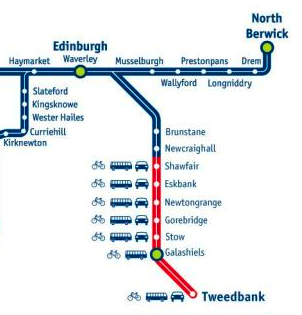
But this gives the Minister a chance to re-cast the whole project because the Lab-Dems cheese-pared the whole thing into a questionable shadow of its original self, divorced from Network Rail and the rest of Scotland’s rail system. Consider the details:

  • single track for most of its length = limited capacity & speed
  • cannot carry freight or standard ‘heavy’ trains
  • stops at Tweedbank = does not serve most of the Borders
  • still stymied for level access across the A720 Edinburgh bypass
  • not integrated with any Edinburgh City Region transport plans
  • business case beyond Gorebridge cast into doubt

In fact, such a glorified tram hardly merits being classed as a railway—having more in common with the Aviemore funicular, which is no great business precedent to follow. If we have to put £295m into this, why not put it on a basis that could lead to further development? While the business case demonstrates benefits to Galashiels, thinking bigger about Midlothian and the Central Borders could make this project far more beneficial to those areas, as well as fitting into Edinburgh City Region transport.

Ever since 1969’s closure prompted the stillborn Border Union Railway, there have been enthusiasts to revive the Waverley route, some the entire way to Carlisle. But the now-electrified Carstairs route makes Waverley’s gradients & curves uncompetitive. It was regarded as the most uncomfortable main line ride around, with even expresses scheduled over 2 hours end-to-end. Total reinstatement may one day be possible as a enthusiast-based ‘nostalgia’ line, (c.f. the highly scenic Settle-Carlisle line). But, commercially, it’s a non-starter.

Borders Rail—the Existing Plans

What is essential is to put the Borders firmly back on Scotland’s railway map and leave the door open for further expansion. But there are still major obstructions, including:

  • regrading the A720 to reinstate flat track bed between Shawfair and Eskbank
  • rebuttal of the ‘damaged’ business case from FOI releases in 2007
  • review of passenger projections given the hiatus in house building in the area

As of now, the last two are for Network Rail to address, but the first is the dealbreaker. Whether done in conjunction with Transport Scotland’s long-overdue rebuild of the Sheriffhall roundabout (along the lines of the Newbridge) or not, the grade crossing must take the road over (or under) the rail: a ‘tram-type’ flyover, such as TIE built at Saughton and Edinburgh Park, would limit the line to light rail and stifle expansion.

If such a ‘proper’ grade crossing is not already part of costs, temporary termination of the line at Gorebridge as a “Phase I” would compensate. This would still serve higher density traffic and prove itself commercially if ScotRail extends its Newcraighall service to cover this first stretch. “Phase II” could then extend the line to Tweedbank, as originally planned, with a further “Phase III” extension to Melrose and SBC HQ at St Boswells. If this last were provided with Park & Ride, major housing development here would relieve development pressure on Edinburgh and, as a Central Borders ‘hub’ be a better terminus. Extensions to Kelso and/or Hawick might then be considered.

But, first, a neglected option of the existing Gilmerton freight line could be added to this ‘network’ to serve western Midlothian. Although only single-track, it both exists and crosses the A720 and could serve stations at Loanhead, Roslin and Glencorse. This would again be part of the ScotRail network franchise and further relieve the road traffic to/from Midlothian.

Rather than well meaning anoraks dreaming of a re-opened Waverley line (while being sold another tram), Midlothian and the Central Borders deserve a ‘real’ railway to link them into the booming Edinburgh economy of the next century.

Posted in Transport | Tagged | Leave a comment

The Road to the Isles

Back from Ullapool to find Danny Alexander MP in a strop at this week’s Transport Conference in Aviemore over Transport Minister Keith Brown MSP’s supposed SNP focus on Central Belt projects and neglect of the A9 that takes wur Danny home after a long, hard day at the Treasury.

Now, far be it from me to see ulterior political motives in this, but wasn’t it the Lib-Dems who pushed the Edinburgh Trams project ever onwards in the teeth of fierce SNP opposition from the start? And was it not Lib-Dem squeals that echoed their former Labour Executive colleagues over SNP scrapping of GARL and EARL, both Central Belt projects of scant interest in the Highlands?

Having just yesterday traversed the A9 from Dingwall to Perth myself, the benefits of some £20m in recent investments, including new dualling south of Newtonmore, are obvious. Compared to the stuttering investment ten years ago when even the lethal A827 crossover at Ballinluig was yet to be addressed by the then-(to be fair, Labour) Transport Minister, the A9’s in much better nick and getting its share of investment.

Road to the Glenelg Ferry, Lochalsh

In fact, the general state of roads in the Highlands is looking up. Having traversed Skye, the little-travelled A863 to Dunvegan was in good nick and the A860 onwards to Portree now a broad two-lane. Even single-track sections on either side of the Glenelg Ferry have—despite being in competition with the now-toll-free Skye bridge—a good surface and adequate passing places. Best of all, the A835 Dingwall-Ullapool artery, upon which the Western Isles depends for its main ferry link, is as fast and good a road as you could expect to weave through the stunning scenery that is Wester Ross; it gets you to Inverness with no white knuckles in barely an hour.

Perhaps the busy life he now leads doesn’t allow wur Danny the time to travel about and see the improvements being made across his country; it’s a far cry to Lochawe, let alone Loch Broom when affairs of state keep him in Lunnainn. And, if he does feel that I have made no strong case and persist in moaning unjustifiably, then he only need instruct his officials to prepare a law that allows the Scottish Parliament to issue bonds and borrow capital—just like all the other real Parliaments, including the one Danny works for, are able to.

Or is he feart to go down that road?

The Road to the Isles Gets Watery—The Stornoway Ferry Docked at Ullapool

Posted in Transport | Tagged | Leave a comment

Another Load of Old Balls

Given that oratory was never his strength, Shadow Chancellor Ed Balls’s speech to the Labour Conference faithful in Liverpool was a competent affair that achieved what most senior opposition spokespeople aspire to but seldom achieve—landing a couple of blows on the government.

Coming from a protégé of the now untraceable Irn Broon and seen from a Liverpool or even a Lambeth perspective, it balanced fairly frank nostra culpas about some policy gaffes with claims that ‘it wisnae us’ that ran the UK fiscal bandwagon off the rails in 2008. But, as Sheila Lawlor points out “Labour’s bequest to the country and the coalition was a bare cupboard, stuffed with IOUs piling up.”

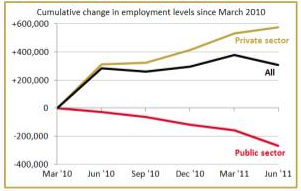
In fact, some of Ed’s claims look pretty hollow when held up to detailed scrutiny—much in the style of his old boss. As one example, he claims that the public sector has suffered devastating job losses but fails to mention that the private sector has, in fact, created two jobs for every one lost in the public sector.

Labour Market Statistics (Source: ONS, September 2011)

In defence of Labour’s fiscal prudence, he claims they did well, given that they inherited the worst public debt ever in 1997 and proceeded to improve it—if not a blatant lie then a gross misrepresentation of the truth.

UK Net Debt (£bn) During Irn Broon's Reign as Chancellor

Now, given his stint at the Treasury as Irn Broon’s right-hand man, it’s hard for Ed to dodge responsibility for, let alone claim ignorance of, such gross misrepresentations. But, given that he himself admits involvement in the infamous ‘light touch’ regulation of the financial markets in general and the FSA in particular, Ed shows especially rare cheek in stating that it was not too many nurses/police/firemen that caused Lehman to collapse, and thence the global crisis.

Well no, Ed, it wasn’t…it was buddying up to the likes of Fred the Shred and their unregulated cowboys of the City and New York, packaging up worthless mortgages as ‘financial instruments’ that brought US and UK banks to their knees. Had anyone paid proper attention to how the Germans or Swedes or Norwegians kept greed on a short leash, our banks might not have cratered (as theirs did not) and our budget might not now be £200bn+ in the hole as a result of your (not Osborne’s) gross negligence.

And, while we’re discussing gross negligence, perhaps you could shed light on the Chancellor’s insistence—in the teeth of Treasury advice—that some 400 tons of gold bullion was sold between 1999 and 2002. This turned out to be the bottom of the market. Like your raid on the pension funds, it was inept and showed no judgement as regards timing. The £4.5bn you netted was squandered in political giveaways. But just think what effect a £24bn injection—what that amount of gold is now worth today—could have had in greasing our creaking economy.

The question for us in Scotland is: what does Ed’s 5-stage plan offer? More capital spend (source unclear) & less tax income, combining to simultaneously worsen both deficit and borrowing. That makes even less fiscal sense than Osborne’s brutal Plan ‘A’. But Lanarkshire has something Liverpool lacks: Scotland’s own option: Swinney’s more subtle Plan MacB that finds extra capital and works with business and local government to stimulate the economy.

Looking at Ed’s track record at the Treasury and picking through his 3,834-word conference speech, as above, the real answer is not hard to find: this is the usual ambitious unionist with eyes fixed on Westminster, peddling us Scots another load of old balls.

Posted in Politics | Tagged | Leave a comment

The Right Madness on Skye

When I lived in Palo Alto, California, I fell in with a creative writing group called Waverley Writers who were pushing the envelope with ‘performance’ poetry long before ‘slam’ poetry became popular. To them, poems belonged both on the street and in your face and not kept as genteel trinkets, twittering on shelves like a caged bird.

They introduced me to their new world of writers, from Walt Whitman to Bob Haas but one that stayed with me was a one-time US Air Force fly-boy-become-offbeat professor at the University of Montana at Missoula called Richard Hugo. He wrote many fine gritty poems on everyday American life but he spoke most deeply to me with a slim volume born of his sabbatical in Scotland: The Right Madness on Skye.

Today, I am on Skye for the first time since being introduced to Hugo. And in the streaming rain, across the rolling heather-purplish moors, beneath Cullins combing tumbling clouds with their towering heads, I am looking for some trace of him where I might pay homage. For what he taught me, travelled as I was when I first read him, was that, in any inhabited place is always a deep rootedness, a consciousness of where you are and—almost more importantly—what and who went before you.

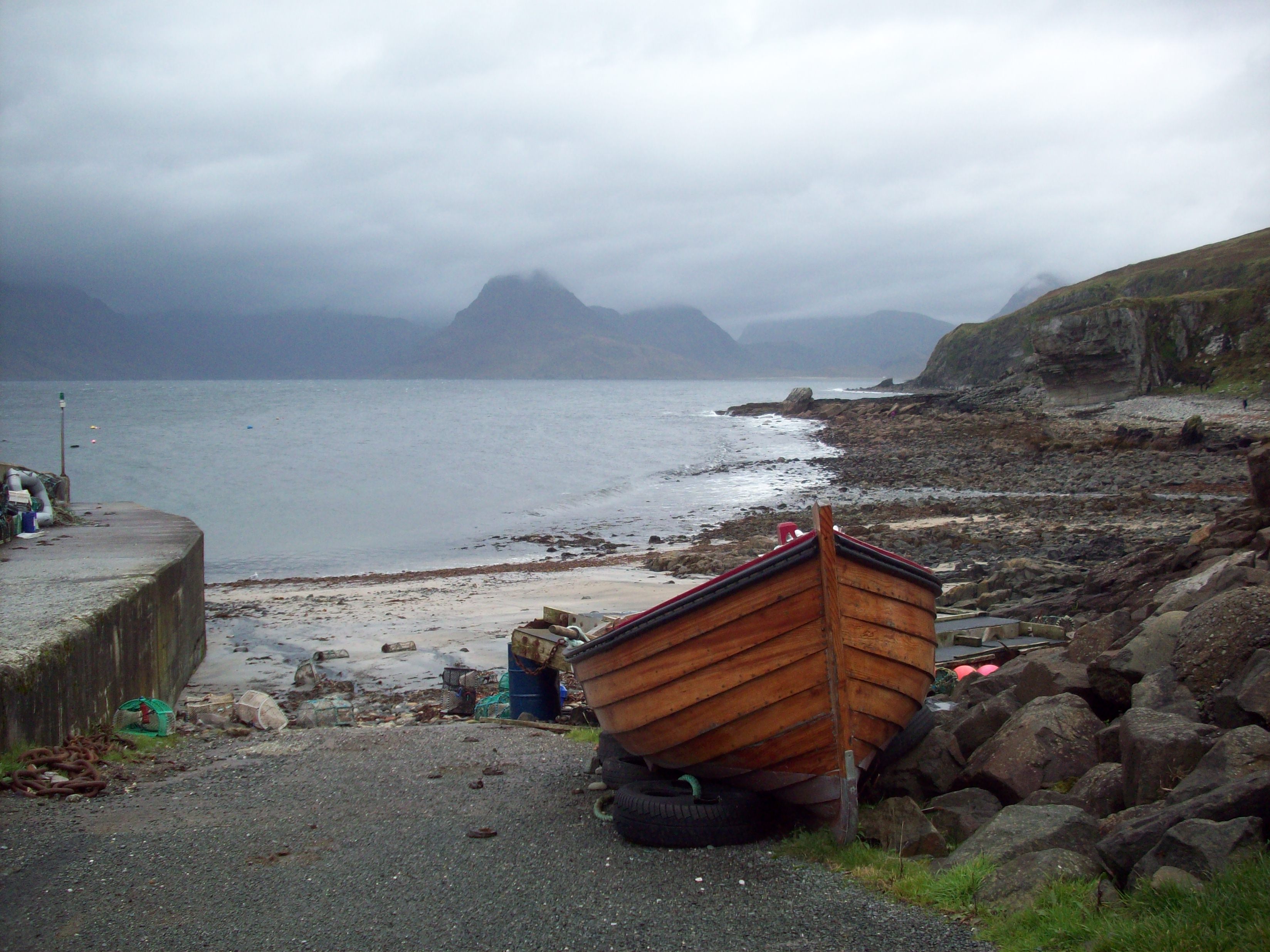
The Cuillins and Loch Coriusk from Elgol Pier

Richard’s poems muse about inhabitants long disappeared; a knight in a churchyard at Kilmuir that he imagines acted above himself and with whom he falls out; two skulls marked by a huge boulder where he can’t work out why anything meriting a boulder would not merit a more formal burial. He ties his human observations into the landscape, moving in and out of the past with a fluency any historian would envy.

Whether it’s because I am driving too fast or not spending enough time at each stop, I grow in frustration, realising that I am very much the tourist, skimming the surface of this profound and convoluted island. From the lack of boats at Elgol to the dismal selection of hotels in Dunvegan well past their sell-by date, there is very little by which I can connect with the people, let alone the place. Although he spent less than one year here, Richard did, gleaning a fulfilment from the hopes of ordinary people, seeing their tough existence with the same phlegmatic resolution they did.

If we could turn our lives that way, the way

the mill stones turned, slow and even,

the milled grain falling dreamy all day, we’d find

some recent peace, a composure we never quite trust

in family portraits.

            —Mill at Romesdal

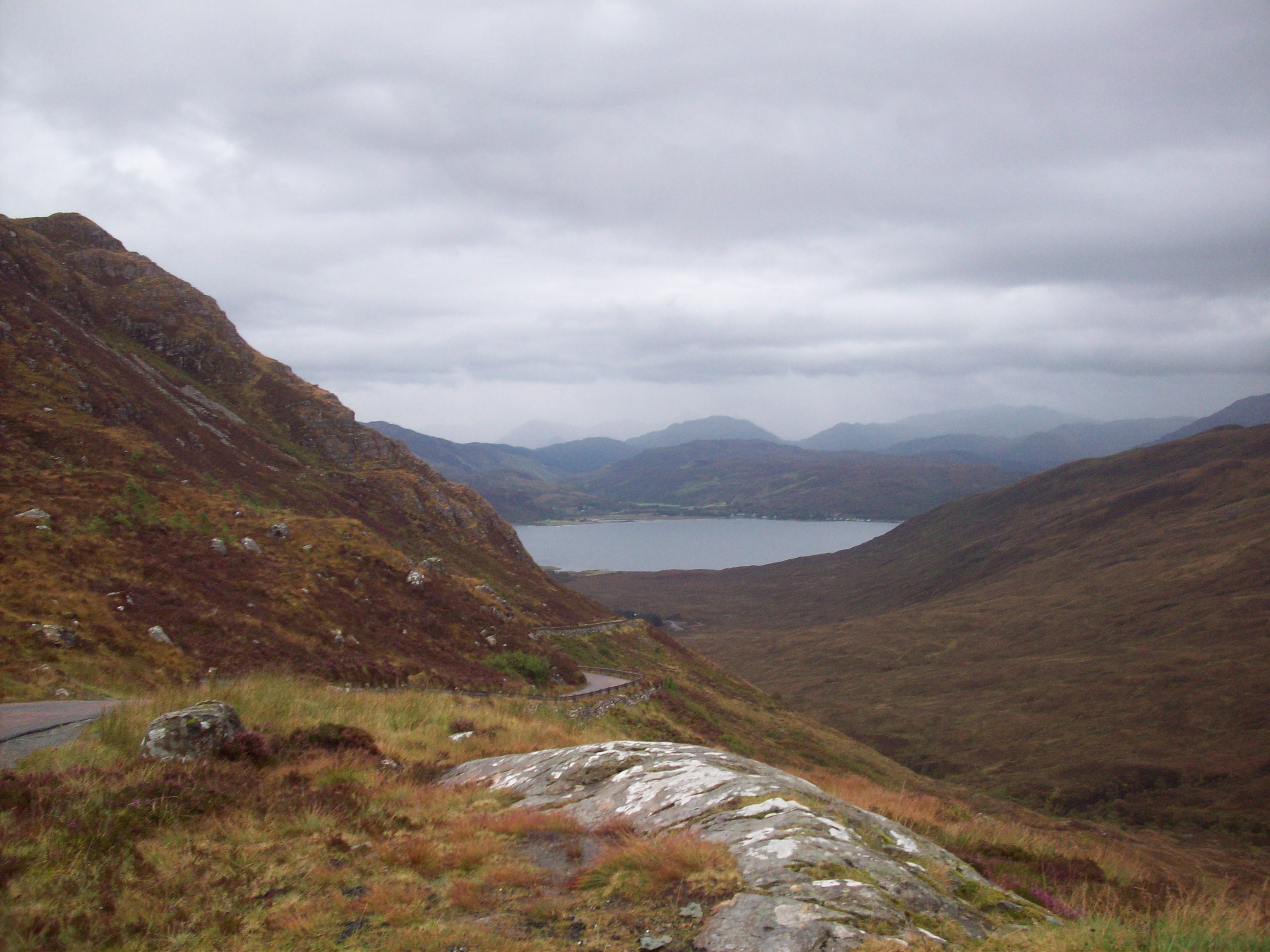
Single-track Road Leading down to Kylerhea and the Glenelg Ferry

I can’t even find a proper black house, let alone a deserted clachan, eyeless from the Clearances, much less living traces of the Gaelic that streams across the landscape in place names like repeated waterfalls ribboning the steep mountainsides. Even though he died a quarter century ago, Richard goes on teaching me about how to see what is around me here. There are fine poets who have written well about Skye, some who have the Gaelic, some, like Richard who have not. But perhaps it takes an insightful incomer like Richard to teach a cultural Sassenach like me about my own country.

Posted in Community, Education | Tagged | 2 Comments

Oh, for a Muse of Fire!

The opening words of the Chorus in Henry V sprang to mind as, in the second row in St Mary’s tonight I was transfixed by the BBC Scottish Symphony’s performance of Menotti’s Violin Concerto in A minor as part of the Lammermuir Festival. The accoustic setting of St Mary’s gave the music richness and depth and being in the second row felt like performing in the orchestra itself.

Not being an opera buff, I was unfamiliar with Menotti but this scintillatingly virtuoso concerto just caught fire under the energetic but absolutely focussed performance of Jennifer Koh, who has studied it and recorded it with the composer. Of its 1952 premiere, the New York Telegram wrote “It is a fresh and vigorous piece of music, overflowing with energy and melody and whatever else it takes to complete a three-movement concerto without becoming apologetic.”

But it was Koh’s playing that made it incandescent; her body language was vibrant with passion, sometimes rocking to sweetly tease out Menotti’s poetic writing, sometimes, with her short, dark hair alive and electric, infusing the piece’s dramatic statements with a fearsome vigour.  Whether whispering or pounding her bow, she maintained a sublime tone from her 1727 Stradivarius that she handled as if a part of her.

Jennifer Koh

Partly composed near Gifford in East Lothian, the concerto is a piece steeped in Romantic tradition and thoroughly removed from the avant-garde learnings of the past century. I am delighted that the Lammermuir Festival appears again to have been a roaring success but, framed as Menotti was tonight by definitive performances of Ravels’ William Tell and Dvorak’s 9th in the acoustic heaven of St Mary’s, this world-class event must surely have been its high point.

Ms Koh has been championing Menotti for years; this one performance demonstrated why.

Posted in Education | Tagged | Leave a comment

Jist Wee Yappy Dugs

It took a lot to throw my grandma off course. Married to a fisherman who lost his leg at Ypres as one of the ‘Old Contemptible’ she had to make do with a man constantly on the edge of rage at his disability. She had a way of dismissing people who made a fuss of nothing. “Jist wee yappy dugs” she would say and get on with making girdle scones or a kaolin poultice by which she swore as a cure for all ailments.

Today, I was reminded of Kate. I watched John Swinney make his half-hour budget statement and thought him competent. But when Baker, Goldie, Rennie and—later on—Gray came to make their responses, I kept seeing Kate turn her back on them as she saw to her scones or poultice. It was pitiful stuff, especially as John had not strayed into radicalism and bamboozled them with the unexpected like privatising Scottish Water to raise capital or nationalising the Crown Estates.

What IS it about unionist politicians in Scotland just now that they can articulate not one idea but are so Pavlovian in their responses that I’m thinking of applying to write scripts for them, they’re so predictable. Baker: “The Scottish Government is passing the buck onto councils.” So, it would be fair if they were protected like the NHS and the money to do that pulled off trees? Goldie: “This can hardly help business recovery, especially as there is a dearth of capital to invest in jobs.” And the UK Coalition cutting capital by 40% is OK then, is it, Annabelle? Talk about cognitive dissonance.

Best of the bunch at demonstrating why Scotland has good government at last was Iain Gray on BBC’s Newsdrive: “We should not be cutting funds to further education at a time when young people  need help”. Fair enough, but where else would you cut to give more money to further education, Iain? Three times he was asked; three times he weasled back onto further education and blaming Swinney and avoided any answer that might be considered an alternative.

Surprisingly, the most credible response came from the least probable Holyrood source—the leader of the rump Lib-Dem, Willie Rennie: “They could have used the £250 million savings from the Forth Bridge for job-creating transport infrastructure but they have diverted it elsewhere. They could have looked again at the council tax freeze which gives most benefit to the richest people in the biggest houses but they didn’t.” He still didn’t say where he would cut instead but at least he put forward alternatives and stood behind proposals that could have triggered a debate.

But, as for the Labourvative leaders of this unionist ‘savaging by a dead sheep’, Kate would’ve seen them all off as: “jist wee yappy dugs.”

Posted in Commerce | Tagged | Leave a comment