The Empire Strikes Out

Hard of the heels of our discussions on both advisability of the UK attempting to build new aircraft carriers for a global role it can’t afford (see Macho White Heffalumps from March 26th) and the hubris of empire over islands at the far end of the world that we British thought we could hold easily (see Those Who Don’t Learn from History in November 2011), we find ourselves at the 30th anniversary of the short, sharp Falklands War (Guerra de las Malvinas to those on the other side). From media coverage, the lessons hard learned then do not yet appear to have been learned.

In 1982, despite the Empire being just a memory to people over 40, Britian still aspired to a global rôle. So when, on April 2nd, Lieutenant Commander Guillermo Sanchez-Sabarots’ Amphibious Commandos Group, landed and rolled up Major Norman’s handful of Royal Marines, it was all over in a day. This should not have come as a total surprise to the MoD. Two weeks earlier, a non-military Argentinian occupation of the abandoned whaling station on South Georgia had resulted in them dispatching two nuclear submarines (HMS Splendid & HMS Spartan) along with RFA Fort Austin to support the only RN ship in the area, the survey ship HMS Endurance.

Carrington’s resignation and Thatcher’s doughty dispatch of a task force to re-take the islands is well documented. The resolute, brave and professional exploits of all three services will, deservedly, receive much media coverage over the next two months, up to June 14th, the 30th anniversary of the Argentine surrender in Port Stanley. Epic though those exploits were, it was, as Wellington phrased it at Waterloo; “a damn close-run thing”. Not only could it have been a disaster but any modern equivalent would almost certainly be. This is because a series of major pieces of luck all fell our way:

  1. The ‘Argies’ didn’t expect a response. Even the US thought the UK crazy to try to take islands 7,000 miles from home and over 2,000 from their nearest base on Ascension. As a result, the garrison of partly conscripts weren’t expected to have to fight.
  2. Casper Weinburger was an anglophile. In deference to his latino population and diplomacy in Latin America, President Reagan resolutely declared the US to be neutral but his Secretary of Defense persuaded him to supply badly needed satellite intelligence and sidewinder missiles, without which the British would have lost.
  3. The Argentinians had few Exocets. French-built and carried by a Dassault Super-Etendard strike fighters, these were weapons for which the Task Force had no real answer (Phalanx gatling guns came later). Launched from below the horizon, two of these destroyed HMS Sheffield and the Atlantic Conveyor (with 6 Chinook heavy-lift helicopters). The lucky part is that the second target was meant to be HMS Invincible, the loss of which would have ended the operation.
  4. Although operating outside the British-declared exclusion zone around the Falklands, the WWII-vintage cruiser Belgrano was sunk by a single torpedo from HMS Conqueror, triggering a dispute as to the legitimacy of the action. However, this did remove any surface threat to the Task Force and allowed it to concentrate on the occupying land forces and incoming air attacks.
  5. Despite their phenomenal bravery flying at extreme range with ‘iron’ bombs, Argentinian Air Force pilots destroyed few of the sitting-duck-target ships in San Carlos Water after the landing. They hit plenty but at least three out of four bombs did not explode because they were released so low, the fuses had no time to arm.
  6. Operation ‘Black Buck‘ was a success. Due for scrapping that year, the RAF still had a number of Vulcan delta-wing bombers on strength. By scraping together a dozen air tankers and refueling single Vulcans, one reached the Falklands from Ascension to strew 21 1,000lb bombs across the runway at Port Stanley, rendering the airfield unusable to all but light aircraft. This denied the Argentinians air superiority.
  7. Goose Green was held mainly by conscripts. After the landing, 2 Para was sent to clear this flank of the advance on Port Stanley. Across bare ground, with little artillery and no armour support, this was an almost suicidal mission,. But, carried out with such bravery and determination, it psyched out the defenders who surrendered, but not before Col. H. Jones lost his life leading the attack. News of this undermined the remaining Argentine defenders’ morale.

Had any one of the seven items not happened, the outcome would have been in serious doubt; had several of them happened, the operation certainly would have been a disaster and the Falklands probably have become the Malvinas and part of Argentina. But the present exploration for oil in the waters around keeps the question of sovereignty alive.
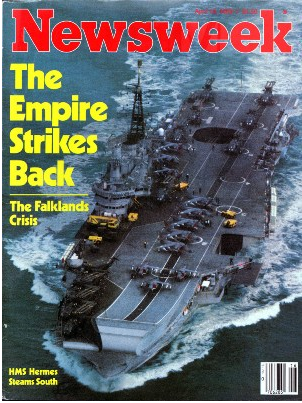
Nowadays, with no aircraft carriers, no long-range bombers, no STOL Harriers, fewer ships, fewer aircraft and ‘operational stretch’ of forces being fully committed (overcommitted?) in Afghanistan and elsewhere, a similar occupation—in the Falklands or even anywhere else up to and including North Sea oil rigs and Channel Islands—could not be repulsed, let alone ejected, by the UK’s present forces, even if an equivalent seven lucky breaks to the above could be guaranteed.

For a country with the third highest defence budget in the world (£40bn), we have an execrable deal. It’s one about which serious questions need to be asked—as well as what the UK thinks it is doing in the 21st century, not just in Afghanistan, but in the fourteen ‘pink bits’ on which the sun still never sets, any of which have the ability to entangle us in a Falklands-type war. The difference being that, now, there’d be little chance of winning.

Posted in Politics | Leave a comment

You’re Georgeous!

Seldom have I seen so many politicos in a tizz, so many journos wrong-footed or so many people who should know better vacillating between doing the headless chicken and venting their spleen over the thumping victory “Gorgeous” George Galloway achieved in Bradford West. Unlike his rabbit-out-of-a-hat job at Bethnal Green in 2005 where he squeezed past a bemused (and rather undeservedly) dejected-looking Oona King by 500 votes, this was the real deal; here, he cleaned the floor with his opposition.

His opposition—quite apart from the usual 3-digit fringe parties—was actually the three major UK parties. George likened them to three buttocks on the same arse and certainly had skelped them all by the time the night was over. Their usual henchpersons were out explaining away why they had neither seen it coming nor had convincing explanations for what happened. What happened is as close to a landslide as elections ever get, viz:

  1. George Galloway (Respect) 18,341 (55.89%, +52.83%)
  2. Imran Hussain (Lab) 8,201 (24.99%, -20.36%)
  3. Jackie Whiteley (Con) 2,746 (8.37%, -22.78%)
  4. Jeanette Sunderland (Lib-Dem) 1,505 (4.59%, -7.08%)
  5. Sonja McNally (UKIP) 1,085 (3.31%, +1.31%)
  6. Dawud Islam (Green) 481 (1.47%, -0.85%)
  7. Neil Craig (D Nats) 344 (1.05%)
  8. Howling Laud Hope (Monster Raving Loony) 111 (0.34%)

While a cuffing for parties of Government and the low vote for minority/unheard-of parties were both on the cards, this was a Labour seat with a 5,000+ majority in the Labour heartlands of the ex-industrial North of England caused by nothing more sinister than the retirement of a sitting MP for reasons of ill-health. With the Coalition having their worst week so far and Labour’s new leader of six months itching to make his mark, this result ought to have been a foregone conclusion.

As close as the day before, Labour thought it was, reporting that Galloway was making a strong challenge but that Imran Hussein, a Muslim from the area, would be the winner. Indeed, it is almost unprecedented for the opposition party of the day to lose a by-election—as rare as three times in the last 40 years, including this one. And it wasn’t just Labour: the ConDem parties and just about everyone else but George and his troops had written this off as a Labour romp.

Since the result was announced, party spin machines have been in a lather of damage limitation with Harriet Harman most to the fore, declaring “we need to learn the lessons” on five occasions in 24 hours and “we need to deepen connection with voters” on three. If this smacks of Johann Lamont’s recent sackcloth and ashes script, it’s probably no coincidence; Labour—especially New Labour—is not geared to doing ‘humble and repentant’; it’s not in their DNA. Labour leadership is now suffering criticism that they were too focussed on maligning the Tories nationally even while campaigning in Bradford West—and there is much truth in this.

Two Eds are Better than One When the Pasty Tax Bites at Greggs

But Labour was still out there working the streets; they had a plausible candidate and a long history of steady support. What went wrong?

First of all, Bradford West is an unusual constituency. It is unusual in the same way that Bethnal Green is: the two have the largest percentages of Muslim voters in Britain. This played to George’s Respect Party’s strengths, which are anti-war and pro-Muslim. Many people may have forgotten the Iraq war, even if they have not forgotten Afghanistan. But, as Diane Abbott MP has pointed out, those who have not lie outside the political classes and provided an unrecognised undertow of opinion.

Secondly, there is George himself. It’s hard to name a British politician as flamboyant, as self-believing, as shamelessly self-promoting or—among politicos at least—less popular. No-one who is anyone likes him and many claim his 2010 squirmingly unpalatable Big Brother appearance contributed much to his win. This is simplistic. George is actually not only politically astute but clearly understood the people of Bradford West far better than any other candidate/party.

More than simply campaigning on an anti-war footing, he threw out conventional campaigning and addressed an unprecedentedly sectarian letter appealling to Muslims to search their hearts for they know ‘instinctively’ who is a Muslim and who is not. It is bracketed with the customary Muslim greeting as no previous party election literature.

A Catholic himself, he flatters them divine discernment—what they know ‘instinctively’ is what Allah knows perfectly. He declares: “God KNOWS who is a Muslim and he KNOWS who is not” and he goes on to list his Islamic virtues: “I, George Galloway, do not drink alcohol and never have… I, George Galloway have fought for Muslims at home and abroad, all of my life… I, George Galloway, tell the truth…I, George Galloway, hold Pakistan’s highest civil awards…I, George Galloway, came to the side of the people of Palestine in their agony…’. He also says he will give his remaining days in service of all the people of Bradford West “if God wills it”.

It is as brazen and clever an appeal as anyone could come up with—and that is the third vital element in this. More than anything, it underscores just how vital speaking directly to local voters is. That involves not just bombarding them with literature and messages but working out what kind of community you are dealing with, what their concerns are and speaking to them in a language that resonates. That used to be the case for all parties. But in this day of central offices, large staffs and bright young things fresh from university, that seems to have been lost. With a weak local presence and scant hope of winning, such a mistake being made by the Tories or Lib-Dems is understandable. But that Labour should make it on a home patch is reprehensible.

The bottom line is that this massive victory was no fluke. It was caused by one—certainly flamboyant—candidate knowing how to speak to people while the ‘professionals’ gagged it, big-style. Wounded by his 2010 loss of Bethnal Green, written off after his risible showing on the Glasgow MSP list last year, Georgeous Gorge is back with a vengeance, stunning his old party and ca’ing the legs out from under Milliband’s leadership, just when he thought (rightly) he had the Tories on the run.

As even those marginally interested will know, watching the House of Commons is hardly comparable to watching the Bourne trilogy for entertaining action. Love him or hate him, now that GG’s back, that will change.

Posted in Politics | Leave a comment

Not Just Pasty-Faced: Unionist Economics Are Peely-Wally Too

This blog having trodden light on politics for a week, its time to wheech the shoes off and climb back into the vat to tread the grapes of math. Those readers squeamish about numeracy may wish to skip this one altogether.

When the latest UK GDP figures were released by the Office of National Statistics (on Wednesday March 28th), they did not make for encouraging reading. The ONS said that the UK  economy contracted by a quarterly rate of 0.3% between October and December, up from the previous estimate of a 0.2% decline. This disappointed market analysts, who had expected no changes.

But it also fuels the debate over Scotland’s viability as a separate economy. Leaving aside nostalgia, the UK government’s main forward-looking argument for the union seems to be the we are “stronger together”. The more we see such figures, the less tenable this statement appears. Newsnet Scotland published a cutting piece on what it called the “failure of UK government’s economic plan”. In it, SNP spokesman Stewart Hosie MP commented:

“The UK Government remains wedded to their austerity cuts and now want them to last longer and cut deeper than originally planned.”

But what are the relevant numbers? The current and former chairs of the David Hume Institute (not known cheerleaders of the independence movement) also published some figures that can be considered objective, even if—as they themselves admit—they are rather provisional. Peat & Sutton started by considering national debt to national output as a measure how well a country can withstand its debt burden.

Although some nations are over 120%, an acceptable figure of debt/GDP appears to be around 60%, with Gordon Brown having once set 40% as a goal in the days before Prudence was rudely handled round the back of the bike shed. The Office for Budget Responsibility calculates that the UK’s debt/GDP ratio will peak in 2014/15 at 76.3%, with the current Public Sector Net Debt (PSND) of almost £1tn, putting UK at 63%.

Taking Scotland as 8.4% of the UK population, that puts our share of PSND around £83bn. UK figures ignore offshore oil & gas but, by including them, we arrive at a GDP for Scotland of about £159bn. This would imply our debt/GDP is 52.2%—considerably better than the UK’s.

However, Peat & Sutton further argue that PSND is a fairly narrow measure of liability and that we must consider Whole Government Accounts (WGA) which takes into consideration debt burdens such as pensions (UK about to grow this by adding in Royal Mail pensions), PFI/PPP (which Irn Broon resolutely kept off the books). WGA is calculated as £2tn, which reduces to £1.2tn when assets are offset. The equivalents for Scotland are £152bn and £85bn—slightly better as we have slightly more assets per head.

Also coming into the equation are the £65bn in liabilities by which banks were bailed out in 2008/09. In theory, all this could be recouped if bank share prices recover. But, until they do and assuming they won’t pre-independence, we would need to assume our share of both the debt and the shares owned—meaning there could be a nice windfall post independence. Taking the debt in full adds £5.6bn—but could give us far more back if (when?) RBS/Lloyds share prices climb.

It is a fact (from GERS figures published this month) that Scotland’s own fiscal position has deteriorated with the current recession. From a net £554m surplus in 2007-08 (+0.4% of GDP), the balance has dropped to -£6.4bn (-4.4%) in 2010-11. These figures include North Sea revenues that would accrue geographically to Scotland, based in internationally recognised equidistant borders. (they would change a bit if Berwick were ever to return to Scotland but that is a whole different discussion). So, the ‘positive’ case seems not to look as positive as it did.

But, the picture for the UK as a whole is even less rosy. From a -£5bn (-0.4%) deficit in 2007-08, it has plunged drastically to -£98.4bn (-6.6%) in 2010-11. In other words, the UK is 50% worse off than Scotland would be if it stood on its own. As with the debt, there may be debates to be had about the exactness of the figures. But the incontrovertible fact is that Scotland would pay more by staying in the Union—by these figures to the tune of £2bn (or about 6% of current Scottish Government revenue) each year.

The above cases for independence based on debt or GERS are too simplistic to be conclusive. A large number of other factors need to be taken into account before any final figures could be calculated. These include major components such as:

  • Who would pay to decommission Chapelcross/Dounreay/Torness/Hunterston?
  • What would England pay to lease the Clyde Naval Base & for how long?
  • What English services would Scotland wish to keep using (e.g. embassies)?
  • Would defence savings (£1.8bn cost instead of current £3.4bn) be feasible?
  • Compensation for major infrastructure investments (e.g. Olympics)?

Without full-scale examination based on negotiated settlements, it will not be possible to be fully accurate. When Eire became independent in 1922, they simply walked away from Britain with anything inside their borders and no compensation was made either way (although two naval bases were retained). So simple a solution is unlikely.

But the key issue is this: the present UK government fiscal policy has produced no recovery (the economy is flatlining) and our continued presence in the UK is accruing us debt at a rate 50% faster than if we were independent. While it is right that we need an extended period for information gathering and discussion—especially in light of the large number of ‘don’t knows’ in the population—a major decision on dissolving the British Union must be on the table.

Because the case for Scotland grows stronger daily, not least because the revenues from Scottish exports (not just oil: whisky recently reached a £4.4bn export record; we just reached 33% renewables generation while England’s next nuclear power stations have been ditched by E-on) will allow us to pay down any debt faster than the UK ever could. With Brent Crude over $110 a barrel and £1tn in known reserves remaining, a surplus going into an oil fund, such as Norway has, is no pipedream.

Read the articles—and any others that seem knowledgeable and attempt objectivity. The two years of discussion will slip by quickly. And the decision, when it comes, must be made looking forward to make the best of Scotland’s—and possibly even England’s—future. And those who believe in the Union need to abandon their peevish naysaying and marshal their economic arguments if they hope to win. Their pale arguments, vacillating between scare stories and nostalgia are helping us win the case for independence—by a mile.

Posted in Commerce, Politics | Leave a comment

Campbeltown Lock, I Wish You Were History

While this blog tries to be broad in its subjects, once in a while it drifts into indulgence. The pacifists among readers need read no further because this blog will be dedicated to a little-known piece of classic British derring-do, during which more Victoria Crosses (the highest award for valour) were won than in any other action of World War II. Today, the 28th of March, is the 70th anniversary of Operation Chariot, referred to by many as ‘The St Nazaire Raid‘ and to military historians who know about such things, as simply ‘The Greatest Raid Ever’.

Winter of 1941-1942 was a black time for Britain. Staving off invasion in the Battle of Britain had been followed by smashing German victories in Russia and the entry of the USA after Pearl Harbor. This brought no positives as the Far East fell to the Japanese and USN inexperience contributed to what Vizeadmiral Karl Dönitz called ‘The Happy Time’. Wolf packs were sinking ships faster then we could build them, Britain was sliding close to starvation and even Churchill later admitted “nothing so frightened me as the U-boat menace”.

As well a U-boats, convoys had to deal with surface raiders. The German fleet was small but modern and powerful. The biggest of all were sisters Bismarck and Tirpitz (50,000 tons, eight 15-inch guns, capable of 30 knots). Although Bismarck had been sunk the previous May, it took the entire Home Fleet, two weeks and luck to hunt it down and it dispatched HMS Hood, the largest warship in the world after a 10-minute gun battle before finally succumbing.

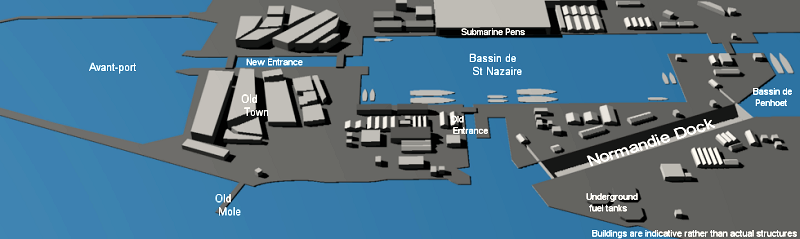
If Tirpitz, based in Norwegian fiords could break out into the Atlantic, no convoy would be safe. And, since she could outfight anything she couldn’t outrun, the Admiralty was reduced to hoping for the same luck they’d had the previous May. The good news was that only one place on the occupied Atlantic coast had a facility capable of servicing and repairing a ship as mighty: the Normandie dock in St Nazaire at the mouth of the Loire.

The audacity of the plan Combined Operations cooked up to reach the lock gates 8km up the river over myriad sandbanks is the stuff of legend. 265 men of No 2 Commando under Lt. Col. Newman were to embark on motor launches (fast but flimsy craft of around 50 tons of 20th and 28th ML Flotillas) and raid the place. Centrepiece of it all was a surplus ex-USN four-stacker destroyer HMS Campbeltown under Lt. Commander Halden-Beattie. Shorn of a couple of funnels and rigged to have the silhouette of a German torpedo boat, her bow was packed with 5 tons explosives. The plan was to go upriver on the highest tide of the year and ram the lock gates.

On the German side, the area was defended by the 333rd Infantry Division. Although it had few troops in the town, the port had the 28 heavy guns of the 280th Naval Artillery, plus over 40 AA guns of the 20th Naval Flak. When Dönitz, inspecting the day before the 6th and 7th U-Boote Flotillen based there queried the base commander about a possible raid, Korvettenkapitän Herbert Sohler replied: “an attack on this base would be hazardous and highly improbable“.

Accompanied by two escorting destroyers and with a submarine position off the estuary to guide them in, the rag-tag fleet left Falmouth on the afternoon of March 26th and had a brush with U-593 and two French fishing boats before gathering off the Loire late on the 27th. Campbeltown hoisted the German naval ensign and the 3 MLs formed into three lines on either side and astern. A diversionary raid by five RAF squadrons bombed nothing of consequence and served only to alert the garrison that something was up.

They had only just entered the estuary around 01:20 when German searchlights homed in and demanded recognition signals. A German-speaking signaler stalled them. This got them to within a mile of the target before shore batteries opened up, the White Ensign replaced the German one and, as they say in the movies “all hell broke loose”. Engaging concrete bunker-emplaced guns with 20mm Oerlikons and no protection was heroic but close to futile. All but two of the dozen MLs were sunk or damaged and only fragments of the assault parties landed. Campbeltown, increasing speed to 19 knots, rammed the lock gates, driving her bow 30ft beyond it with the force of impact.

The Commandos aboard scrambled off to demolish pump houses and dock equipment and 30 of the crew, including Halden-Beattie were taken off the stern by ML-177. Only ML-160, -307 and -443 made it back to Falmouth. Newman had landed and organised a defence perimeter while demolition charges were being laid. But so many of the small boats were lost that the planned evacuation by sea was impossible. Apart from 169 dead or missing, 215 commandos and sailors were then captured in the fierce fighting that raged on until dawn. Only five men made it to Spain to return home.

Dawn brought the scene of shambles into the light—smoking, rubble-strewn demolition sites, bodies everywhere, abandoned MLs drifting on fire and the spectacular sight of the Campbeltown reared up over the dock gates.

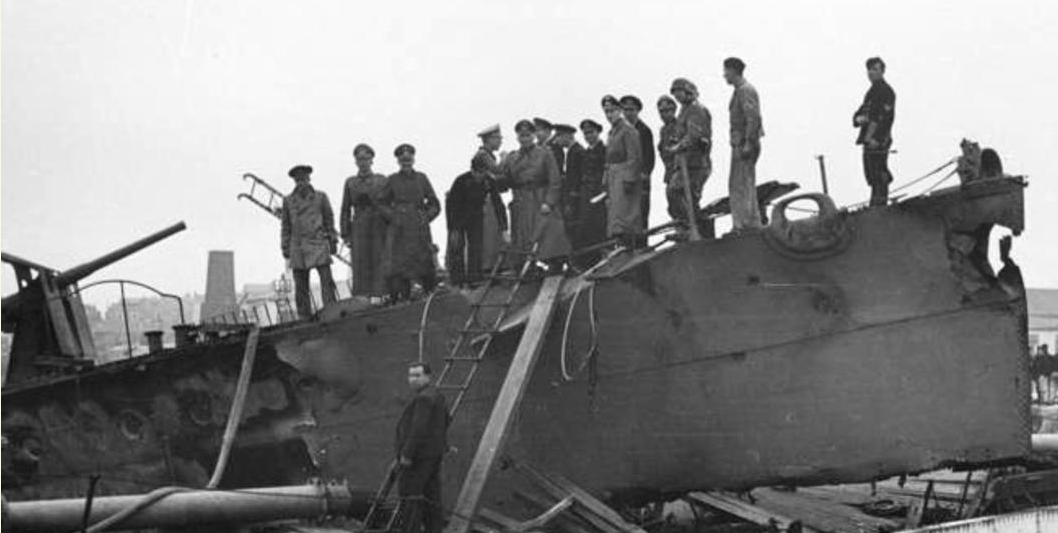
Clean-up was underway just before noon and a party of 40 senior German officers were inspecting the ship when her delayed action charges went off. The massive explosion killed them all, along with almost 300 others in the vicinity. And, as planned, it wrecked the dock gates, sweeping Campbeltown into the empty dock and sinking two tankers that were already there under repair.

The dock itself was not again operational until after the war and the Tirpitz spent the war hiding in Norwegian fiords until capsized by a massive 22,000lb ‘Tallboy’ bomb delivered by an RAF Lancaster of the 617 ‘Dam Buster’ squadron. Five Victoria Crosses (two of them posthumous) and eighty-four other decorations were awarded, including four Croix de Guerre by the French. Hitler was so furious he dismissed the Chief of Staff to the Commander-in-Chief West. A memorial to the those involved in the ‘greatest’ raid was erected in Falmouth. It is a shame such selfless heroism gets so little coverage nowadays.

Germans Inspect the Wreck of HMS Campbeltown shortly before She Blows up

As a postscript, Campeltown’s ship’s bell was rescued that night and eventually presented to the people of Campbeltown, Pennnsylvania. When a new RN ship of that name was commissioned in 1987, the townspeople loaned the bell back in service. When she was decommissioned, the bell was returned to the people of the town on June 21st last year.

Posted in Uncategorized | Leave a comment

Macho White Heffalumps

Ever since The Defence Minister Philip Hammond started backpedalling last week, there has been more than a whiff of panic in the air over the two monster aircraft carriers so beloved by the Lords at the Admirality (as CPO Pertwee once dubbed them on the Navy Lark). Apart from that comment showing my age, it also makes me old enough to remember the last time the UK deployed ‘real’ carriers in the 1950’s—and to question why we need any new ones at all.

Back then, there was some military rationale for carriers. WW2 taught the lesson that air supremacy is vital to any operation and the most flexible way to apply it, especially to a far-flung maritime empire such as Britain still had then. With all the pre-war fleet carriers, plus various classes of light and escort carriers all decommissioned before the Korean War, the remaining two Audacious (Fleet) four Centaur (Fleet) and four Colossus (despite the name, Light) class carriers did sterling service both there and the later Suez debacle.

But planes grew ever faster and heavier and no UK carrier (except HMS Hermes) was provided with a proper angled flight deck that allowed simultaneous aircraft take-off and recovery operations, nor were they big enough for the size of air group that became the norm. Global experts and the only ‘blue-water’ navy with real credibility was the USN, who developed 98,000-ton monsters capable of carrying and deploying 70+ aircraft on board. By 1960 all light carriers were scrapped (Bulwark converting to a helicopter carrier) and soon, with Britain’s withdrawal ‘East of Suez’ the Fleet Air Arm and remaining fleet carriers were scrapped (Eagle in 1972; Ark Royal in 1979; Hermes in 1984).

Three smaller carriers (20,000 ton Invincible class, originally ‘through-deck cruisers’ vs the 28,000-ton Centaurs) saved Britain’s bacon in the Falklands conflict by allowing air cover by Harrier ‘jump-jets’ as no other heavy fixed-wing aircraft could operate from such small ships. But, valuable as they were, even the original fleet carriers were no match for the USN. With a current total of fifteen operational carrier ‘battle groups’ the USN rules the waves in a manner the Royal Navy never did in its heyday. The idea that the UK can again stand tall with the Americans by building these large carriers is delusional.

HMS Ark Royal (left, with 'painted-on' angled deck) berthed with USS Nimitz (right, with the real deal)

As the picture underscores, the UK has never been able to play in the carrier big league. Quite apart from the carrier itself at the core of things, EACH US carrier battle group consists of:

  • 2,000 highly trained personnel on each carrier
  • Air wing: 12 x F14s; 36 F/A18s; 4 x E2Cs (AWACS); 5 EA6s (ECM); 8 x S-3s (Tankers)
  • At least one CG Aegis cruiser (10,000 ton, $1bn cost command & control unit)
  • Two DDG (9,000 ton, Guided missile destroyers for anti-air/missile work)
  • Two FFG (4,000 ton Guided missile frigates for anti-submarine work)
  • One of more oilers and supply ships

So, don’t just count the ballooning cost of £5.5bn for two ships—the RN would wind up spending 4 TIMES that amount if it ever wanted to deploy them in anger. Call it £20bn. That’s HALF the entire UK defense budget. The real issue is the UK doesn’t really have the £5.5bn, let alone any multiple.

And what, exactly are they to be used for? Afghanistan is landlocked—even the American’s can’t use naval air there. Have we any more colonies we are likely to go to war over, a la Falklands? Are the Chinese, busily building business links all across the planet, suddenly going to invade Oz (for whatever Lebensraum is in Mandarin) and we will rush to their aid?

It now appears that the UK’s original plan to delay equipping the carriers with JSF fighter aircraft until the VTOL version (can take off/land like Harriers) has run into further cost escalation. The necessary catapults to launch and arrestor gear to land aircraft add (according to Babcock) another £800m per ship, bringing the total bill to £7bn for just the ships.

Mr Hammond is to make a statement in the Commons tomorrow (March 27th). His and his government’s back may not collectively be quite back against the wall on this matter. So these white carrier heffalumps (they’re too ridiculous to be called ‘elephants’), born of Labour macho hubris but embraced by equally macho Tory hubris, may not face the axe. Yet. There will be some mumbling compromise that appears to pare their ludicrous costs.

But the more the UK gets irradiated by poisonous Osbornium—borrowing at a furious rate, not cutting public spending, stealing the odd tax where he can—at its fiscal heart, the more certain it is that these monsters will never launch, let alone carry aircraft in anger. It took the Admirality 15 years to build HMS Hermes: with these two, it looks like Their Lardships are going for the record.

Posted in Uncategorized | 1 Comment

In Darkest Englandshire

We Scots poke fun at our neighbours quite a bit. And, truth be known, they do deserve it sometimes. One such occasion was the polTroon fest underway this weekend, during which various ‘heavyweight’ spokespersons (applies in particular to Lord Strathclyde but I’ll try not to make this too personal) have been freighted up to the woolly North to shore up the Union before Babe Ruth gives it all away.

Others have better dissected the largely ill-informed speeches made in Troon. Suffice to say that the premise on which they all depended (‘better off together’) made them all seem to look back to the days of Empire, the enlightenment of dark corners and the ol’ Dunkirk spirit. I wish to disparage none of those, as Scotland was very much a partner in all. But we also shared mining, heavy engineering and shipbuilding. As none are any basis for a prosperous future now, why ipse facto is the Union? That question remained unanswered at Troon.

Co-incidentally (and not, in any way, to avoid the Cameron, May, et al cavalcade heading north) I have headed south this weekend. Spending time in England is always revealing and helps my perspective. This time I was in the non-Home Counties South, traveling from Somerset, through Wiltshire and on through Oxford to Leicester.

The first thing that strikes you is the diversity—the almost bucolic feeling of villages around the Somerset levels, with their narrow streets and crowding-in tall hedgerows giving it a cosiness that is uncommon elsewhere. Then a sheer bustle of places like Trowbridge or Devizes contrasts with the timeless serenity of the Avebury megaliths only a few miles away. Down there, with the sky-splitting early Spring sun bringing them on, the daffodils are fading, buds bursting and the grass glowing green with growth. All rather beautiful, especially approaching some dreaming pile of warm Cotswold stone like Norton Philip.

Also, the level of civilisation is palpable—lunching in the Summertown part of Oxford on a sun-drenched verandah just off the Banbury Road compares with anything on the Rive Gauche or Rodeo Drive. Even stopping off at the Dog and Gun in Chipping Warden, that effortless calm of rural England pervades the soul amidst oak beams, horse brasses and comfortable chairs. Great stuff, which I don’t always get to enjoy on a visit.

But you are also struck by the hectic of most towns and roads; there’s traffic everywhere road signs are appalling and everyone’s in a hurry. Some places like Tamworth are almost choked by cars piling in and out of hypermarkets, sprawling malls and DIY centres, even as pedestrianised streets of the old town centre are thronged too. More than anything, I am struck both by the sheer density of people—whether housing everywhere, town centres choked or roads nose-to-tail. Even far from London—which you expect to be crowded—there is an urban and/or higher-paced feel all over.

This intensifies when you enter quite secondary cities like Swindon or Leicester. Though football crowds make moving about impossible, even on a Sunday roads are thronged with cars and sirens punctuate the air more often than I recall even in Glasgow or Edinburgh. But most striking in virtually ever such city are the rows upon rows of Victorian brick-built terraces where the corner shops are long gone and cultural mixtures abound. Wandering such streets feels like another country, largely because such sprawling suburbs are less common to me but partly because the degree of cultural mixing is limited only to some parts of Scottish cities.

While cultural diversity is relatively unknown in Tamworth or Swindon, in cities of the Midlands and North like Leicester or Oldham, it is the norm. Having little experience of it, I have few insights to give. But such areas do have a very different feel and I start to get some sense why the English seem to be so much keener on border controls than the relatively open-minded Scots. If we had the scale of population mixing, we might share their attitudes. But we don’t.

But, when Theresa ‘Shoes’ May comes North to rouse the polTroons and dares to lecture the Scots how border controls would need to be introduced in the event of Scottish Independence and our signing up to Schengen, despite recent insights, I am still ashamed of such jingoistic paranoia about immigration. From my own experience, immigrants have drive and ambition and are generally not burdens on but benefactors to the state. How immigrants are supposed to reach England via Scotland when we have no direct ferries to the Continent any more on which they might stow away remains a mystery.

And, with the Scots natural curiousity about the world that made us equal partners with the English out of all proportion to our population, it’s time we started to reassert that willingness to engage with others and distance ourselves from an inward-looking, defensive attitude that now dominates English dealings with their neighbours, especially under the congenitally hostile-to-furriners Tory governments, as typified by La May. It wins few friends and impresses no-one.

So, pleased though I am to rediscover the culture of darkest Englandshire and that it, despite overcrowding issues, remains vibrant, until they get themselves a more tolerant, outward-looking government that the rather petty minds we have now, the sooner we Scots should celebrate our distinct culture of inclusiveness by asserting our right to it. And if southern paranoia insists border posts, they can put them up on their side

Posted in Politics | 1 Comment

A-Bashing We Will Go

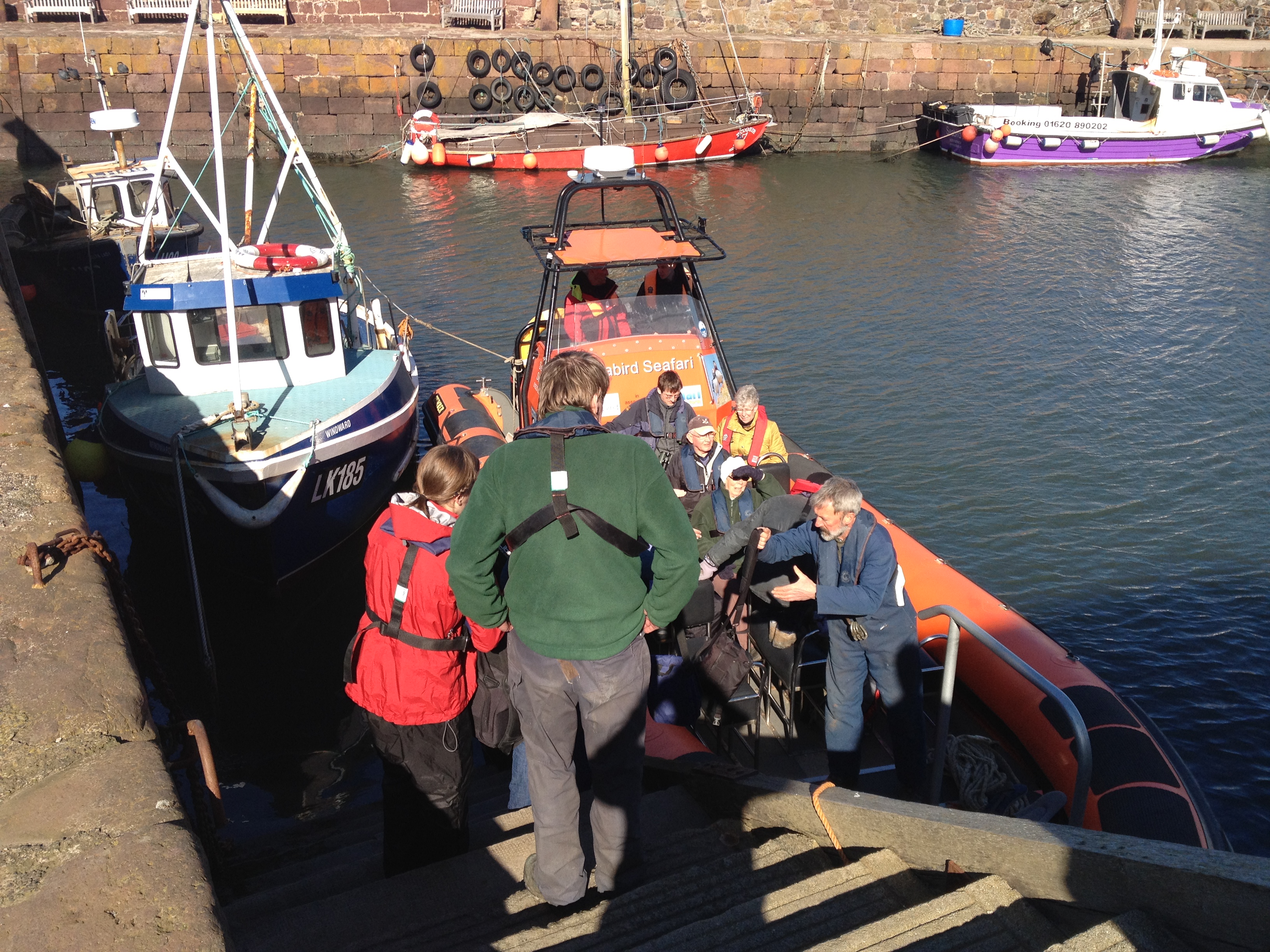
Down at North Berwick Harbour this morning, I was delighted to find yet another full crew of volunteers preparing to board one the the Seabird Centre RIBs and head out to Craigleith, one kilometer off shore and blighted until recently with ‘Bass Mallow’.

Loading the RIB at the Fish Stairs. The Two Colins at the helm and John Hunt (Operation Puffin's Organiser) nearest camera

Craigleith was originally the town’s rabbit warren. When they were wiped out by myxomatosis in the fifties, puffins that had shared the island by living in abandoned burrows became spoiled for choice and numbers burgeoned from a few thousand to over 20,000 by the noughties. But then, observers noted a steep decline in numbers and traced it to an invasive plant that was blocking the burrows.

Known locally as “Bass Mallow” because it grew around the lighthouse on Bass Rock, it is tree mallow, a monster relative of the geranium originally from the Mediterranean. The theory why it’s here is that an ex-sailor lighthouse keeper planted some on the Bass because of its large soft leaves for the occasions when storms isolated the keepers and fresh supplies of toilet paper could not get through. Kept in check on the Bass by the trampling of 150,000 gannets, seeds were carried to nearby islands where they easily established themselves in the soft soil around each burrow entrance.

Under the auspices of the Scottish Seabird Centre, over 140 work parties have made regular trips out to Craigleith and neighbouring Fidra island to cut down the tree mallow, with the project being run and supported entirely by more than 700 volunteers, know colloquially as the ‘mallow bashers’. Thanks to their tremendous support, excellent progress has been made. Monitoring is shows puffins are returning to the islands to re-use old burrows where mallow has been removed. The ‘season’ is when the puffins are at sea, which is August until around now, so today was one of the last parties to land.

How successful it has been can be measured but the larger numbers of puffins recorded last year and the fact that all of the mature mallow (grows up to 3m tall— a daunting size for a 15cm bird) has been cut down and the parties are now dealing with the myriad seedlings still springing up. Response from volunteers to work these trips has been magnificent, with John Hunt stellar as the organiser and usually the leader of each 12-strong squad. On a day like today—dazzlingly spring-like—the 5 hours spent on the island will have been an otherworldly and inspirational experience for all involved.

If you’re keen on some mallow-bashing yourself, there’s a page on the SSC website where you can sign up. You need reasonable mobility, some warm and waterproof clothes (Forth weather is not always as idyllic as today) a packed lunch and a sense of adventure. You won’t get any ‘thank-you’ from the puffins but a boat trip out to see them in a couple of months—as they bob around in sociable rafts or gather in kaffeklatch groups on the grassy slopes or whir overhead like clockwork toys with sand eels in their colourful beaks—should be reward enough for the much good you’ve done.

Kaffeklatsch of Puffins: You Decide if they Look Grateful

Posted in Environment | 1 Comment

The Man Who Would Be King

Tony Blair has a lot to answer for. Taking nothing away from the vision with which he shook the Labour Party out of its post-Foot slumber and made it electable, there are unsavourary aspects of his legacy with which many are still having to cope. The least savoury of those is the bottomless pit known as Afghanistan.

Meaning no disrespect to the bravery and dedication of all British forces who have served or are serving in that far-flung, foreign and mountainous region, the question that is still asked all too seldom is: What the Hell do we think we’re doing there? Long before Camp Bastion was even a glimmer in Blair’s eye, that place had been a graveyard for foreign intervention. The mighty Soviet Army found that out when they piled in there thirty years ago, only to slink out of Kabul a decade later much, much the wiser.

What is especially galling is the the British—of all the global forces on this planet—ought to have known better than to stick their fingers back into that particular fire. For, long before the Russians, ‘way back when the Great White Queen (Victoria, not Elizabeth) had barely ascended the throne, the Afghans taught the Raj a lesson that the MoD at least seems to have forgotten.

Once India was conquered and settling into its role as “The Jewel in the Crown”, the ‘wider still and wider’ edict of empire drove the then-Governor-General of India Lord Auckland to take down the troublesome Amir of Kabul by force. The occupation was relatively easy at first (sound familiar) and left 10,000 British troops split into two main garrisons at Kabul and Kandahar. So easy was it that the Kabul cantonment was built with so little consideration for defence that the commissariat stores were placed some 400m away outside its perimeter.

To command this most far-flung, split-new conquest, Auckland sent the 60-year-old, gout-ridden, flatulent and incontinent Lord Elphinstone, who arrived to be told by the outgoing General Cotton that “You will have nothing to do here: all is peace”. No sooner had he left the country then communication with India was severed by Afghans in the hills, a relieving force chased into Kandahar and “Elphy Bey” found himself besieged in Kabul.

Almost immediately, his health broke down. But since he could not abide his abrasive second-in-command Brigadier Shelton he would not relinquish command to him. Nor would he make up his mind what action to take as the Afghans looted the stores and gave the clumsy, overdressed British infantry reacting to their raids a series of sharp lessons in both skirmishing and accurate musket fire. When the British formed squares to repel Afghan light cavalry, the accompanying sharpshooters found the obligingly large, bright red, mass targets impossible to miss, even at a distance.

With supplies gone, casualties mounting and the appallingly poor standard of British musketry (some officers took to throwing stones at the Afghans, so poor were their men at picking them off, the 44th Regiment of Foot being especially bad), Elphinstone waited until mid-winter before deciding on evacuation. “Everything is reverting to the old state of things” he said his last dispatch.

With snow a foot thick all the 100+km to Jalalabad and the safety of the Khyber Pass beyond, the 16,000 headed East, harassed all the way by tribesmen and even children who picked off exhausted soldiers and stragglers. Although of smaller scale, because of the totality of the result it rivaled Napoleon’s humiliating retreat from Moscow just 30 years before in the annals of military disasters.

The only European to reach Jalalabad and safety was Surgeon-Major William Brydon. Once the news reached Auckland, a punitive expedition was launched and the great bazaar at Kabul was burnt, which the bulk of Afghans cooly observed from the safety of surrounding hills. For the next 150 years, the perils of trying to occupy, pacify or even interfere with the internal affairs of Afghanistan were passed around the Army and the Foreign Office as career-ending gospel if they were to be ignored.

Unfortunately, those who feel the hand of destiny upon them rarely pay much heed to dusty lessons from a distant past. Any Man who would be King makes his own fate and, like Peachy Carnaghan and Daniel Dravitt of Kipling’s tale before him, drive on through the perils beyond the Khyber to make their mark on the world. Peachy and Daniel both paid dear for such temerity—as, more recently, have 400 British servicemen.

Meanwhile, the Man Who Would Be (and was) King now gets six-figure speaking fees and sleeps sound at night, untroubled by any nightmares of Elphinstone’s terrible legacy in its current incarnation.

Posted in Politics | 1 Comment

We Want to Get BACK On

Today’s issue of the Hootsmon has an interesting article from a Devo-Plus advocate Malcolm Fraser who argues Scotland does not need independence to take on more responsibility for its own future. Plausible though many of his arguments are, it is when we get to Scotland’s historic role in the world that we part company. “The union has been good for us as a nation, in helping us out of a Celtic miasma and on to an international stage” he argues. Bollocks! I retort.

The Western world of today had its origins in the 15th-to-17th century expansion of European trade. The English, having fallen out with everyone, glared across the Channel through its finger-hold of Calais and built a ‘blue-water’ maritime future elsewhere on piracy and colonisation. But, in ever-egalitarian Scotland, not just the royal court and clergy, but the enterprise and labour of ordinary Scots got us into trading. For the most part those people have left little trace in the historical records but their legacy lies all around us.

Scotland lay at the edge of a developing European economy; life on the edge made many Scots enthusiastic traders and travellers in search of the opportunities for a better life. Scots merchant communities were established across Northern Europe—in Bordeaux and Dieppe in France, Bergen in Norway, Mälmo in Sweden, Elsinore and Copenhagen in Denmark, the Hanseatic Ports of Hamburg, Luebeck and Danzig and as far afield as Russia. Where ever they went the Scots stuck together and established their own trading networks, as well as their own Kirks, often with altars dedicated to St Ninian.

The main focus was a ‘staple port’ in Flanders, with permanent Scots merchant houses established in Bruges then, as that silted up, in Veere (where the town museum is the ‘Schottise Huis’). From there Scots flowed across the continent to trade goods, find  jobs or take up the opportunities of warfare and university education. The Scots exported their wool, hides, coal or timber and imported a myriad of both luxury and manufactured goods (sometimes the same thing).

The major beneficiaries in Scotland were Leith, Aberdeen and Berwick, with smaller ports in Fife’s East Neuk and the Lothian coast joining in. My own home town of North Berwick had 11 trade ships registered there in the 15th century. Lost between all the squabbles over independence in the 1200s/1300s and over religion in the 1500s/1600s, the 1400s were actually a time of growth and prosperity in Scotland. While England was engrossed in its Wars of the Roses, Scotland became relatively affluent on its trade.

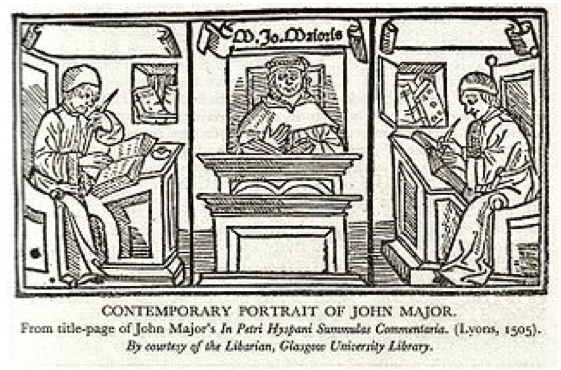
It also became cosmopolitan, with Highland chieftains sending their sons to Paris for their education, those of lowland lairds to university at places like Utrecht and Liege. From Gelghornie, a small farm outside North Berwick, John Major left to be educated in Paris in 1592, becoming renowned scholar in theology and philosophy at the University. Peter the Great’s principal advisor, General Patrick Gordon of Auchleucheries hailed from Aberdeen; in fact, 15 admirals of the Imperial Navy were Scots.

In the 17th century, up to 40,000 Scots were settled in Poland mainly as merchants, peddlers and craftsmen. Scots immigrant names can still to be found in Polish phone books and Danzig (now Gdansk) has many Scottish street names. Even village names remember the Scots  who built them: Dzkocja, Skotna Góra, Szotniki or Szoty. When Gustavus Adolphus launched the Thirty Years War at Breitenfeld, an entire Brigade of Scots were the solid centre on which he pivoted his line.

But, after the Darien Disaster of 1698 drained a quarter of the country’s capital and the Treaty of Union in 1707 opened new doors, impoverished Scots turned to opportunities in the new British Empire and the once-strong links with neighbours across the North Sea faded to the point that we were seen as reluctant Europeans in the mould of our new English partners. The Napoleonic and two World Wars did not help. But all that is now as much history as the Thirty Years War; time for another re-think.

To paraphrase the redoubtable Winnie Ewing: “Stop the World: Scotland wants to get BACK on”.

Posted in Commerce | Leave a comment

England’s Green & Pleasant Land

A recent book by Prof Higgs of Essex University is entitled Identifying the English but it will be of little help in the independence debate as it is all about identity theft since 1500. But one of the major components absent from the debate is exactly that: who are the English? Most unionists seem to assume that there is an identity called ‘the UK’ and that, should we Scots go our own way, this would become ‘the rest of the UK’ or ‘rUK’ for short.

This is flawed thinking. The current treaty binding the UK (of 1801, modified in 1922 when Eire went its own way) is based entirely on the grubby 1707 document that is more concerned with protecting merchants and banning Catholics then anything as noble as nation-building. But, nonetheless, the present state of Britain rests on its equal partnership between England and Scotland. Should Scotland end that partnership, there is no such state of Britain or UK, any more than Canada or Jamaica are part of the UK.

And here’s where out English friends get confused. After 300 years of using ‘British’ and ‘English’ as interchangeable adjectives (who can blame them: most foreign countries make the same mistake), they are now forced to work out what distinguishes their own identity. Our Irish cousins have been dealing with this for the last 90 years. Given the harrowing circumstances that led to Eire, their acceptance of being ‘British’ has been reluctant, to say the least. But they—and in good time Scots—will learn to embrace the cultural, linguistic and geographic truths about all that we share on these islands.

But what about the English? Who are they, as distinct from just being the most numerous of the British peoples? Some years back, John Major—quite sincerely and without irony—tried to punt ‘British’ values that sounded very English to Celtic ears: cricket games on village greens and warm beer in the local pub. That makes sense coming from someone in Huntingdon—or the Cotswolds, or anywhere in the snugger Home Counties. But what about Cleveland or Clitheroe; what about Cornwall or Cromer?

As with any agglomeration of 50-odd million people, there is a huge diversity. London alone speaks a myriad of languages; Pimlico and Brixton are three tube stops apart but barely on the same planet. How relevant are thatched cottage idylls to most English, when cities are multi-ethnic and Salford or Bradford residents may never have seen a thatched cottage?

A pure North/South divide is too simplistic but the Wash-to-Bristol line does delineate a huge northern segment that is still struggling to find its common purpose in a post-industrial world. This has close parallels with our own Glasgow/Clyde valley. Whereas city centres like Leeds and Manchester have largely recovered, great swathes of suburbs and smaller towns have little economic vitality and therefore societal ties are looser and opportunities thinner on the ground.

This is not to write off the entire area—visit the Lakes, the Dales, the Peak District, the North York Moors, swathes of Northumberland and you’ll be charmed by England’s many hidden gems. But the cities and towns—where the majority live—are generally struggling to find either identity or affluence. For every Cockermouth or Grassington or Whitby, there’s a Salford or a Rotherham.

For them—as much as for us Scots—it is futile and stupid to talk in terms of what the empire achieved or of the Dunkirk spirit that saw off the Nazis. Proud though we all ought to be of such things, you can’t see the future if you’re looking backwards. I can see a Scotland using wealth from its bountiful oil and renewables to give new purpose to our greatest city, to turn a dependency culture into generations who invent what will make Scotland famous into the 22nd century. What is the English equivalent?

Whatever it is, I hope they don’t see it in terms of any more Falklands or Afghanistans; those days are done. By why can’t they use their copious muslim citizens as a force for good? What European country has so many people better qualified to form bonds with the Middle East and South Asia? Where are the tidal projects in their 14m-rise-and-fall Bristol Channel? Why are they letting us nail the renewables market?

‘Britain’ may be something we can all be proud of but, because of its imperial and imperious overtones, is it not time for a brand name change? Just as the Scots are seen as  full of quirky and endearing character across the world, maybe it’s time for the English to mimic us and go for a spruced-up image. James Bond and Harrod’s; Rolls Royce and Beatles; Cotswolds to Chelsea; Man U. to Wimbledon; cut glass accents in Pall Mall clubs; West End farce or village brass band; punting on the Cam or strolling Blackpool pier; BBC costume drama or Fawlty Towers—they’re all quintessentially English. Don’t tell me there’s not enough material to work with!

And then, it will be so much easier for all of us on these islands to be British.

Posted in Uncategorized | 2 Comments