Recycled Rubbish

Sad case that I am, while on-line yesterday entering canvass results, the TV that shares my desk was tuned—like a junkie who can’t get enough—to Scottish Questions on BBC Parliament. This one was from April 18th, but I had to keep checking the date on the strapline because I kept getting a strong feeling of déja vu, that I had seen all this before.

And then it struck me: I had. Not literally, but here was a cast of characters rehearsing their roles with all the plot predictability of Tom and Jerry. Don’t get me wrong: I’m a big Tom & Jerry fan (even tho’ I sometimes feel I’m in one of their plots at the Council). But in one of their cartoons, it’s never in doubt who’s going to win. Last Wednesday, SQT ran with the same predictability, as if it were on rails.

The Mother of All Parliaments, the inner sanctum of our democracy spent the best part of an hour doing a fair impersonation of a bunch of macho rednecks discussing “women’s problems”. For once, it made little odds from which side of the House the questions were coming. Laced with ritual snipes across the chamber about which side was purloining the larger sum from granny’s purse was an almost orchestrated sense of agreement that came straight out of the straight man/funny mad music hall tradition.

At the centre of it all was the Moore and Mundell double-act. While the one can’t help himself in looking over-serious, the other struggles to be taken seriously at all. Yet they were in fine form, knowing—as in all the SQT sessions for months now—that well over 90% of members present were entirely on their side and willing participants in a theatre of gesture politics that ill-suited so historic a chamber. On the topic of funding, they started off sounding reasonable:

  • Mr David Evennett (Bexleyheath and Crayford) (Con): Does my hon. Friend agree that it is vital to maintain the Union in the interests of both England and Scotland, but that the funding formula should be fair to both countries?
  • David Mundell: I agree absolutely with my hon. Friend’s sentiments, but as he and many other Members are aware, this Government inherited the worst deficit in peacetime history from the Labour Government, and stabilising our nation’s finances must be the focus of their efforts.
  • Gordon Banks (Ochil and South Perthshire) (Lab): Does the Minister agree that the Scotland Bill will increase the amount of revenue gathered in Scotland to about a third of its spend, and will thus decrease dependency on a block grant?
  • David Mundell: I agree that the Scotland Bill represents a radical, historic and significant change to Scotland’s financing. More than a third of spending by the Scottish Parliament will result from funding from taxes that it determines and raises. That is a major step forward in terms of devolution and accountability, and should be welcomed by all Members.

Punting the Scotland Bill then moves up a gear with a fair degree of relish being displayed on each side. At least they retain enough dignity not to indulge in a ‘nudge-nudge, wink-wink’ but you can tell it’s a struggle:

  • Mrs Anne McGuire (Stirling) (Lab): The new Scotland Bill will pass significant powers to the Scottish Parliament, including those relating to tax. Among the representations that he has received, has there been a request from the First Minister to work jointly with him to highlight and promote those new powers, to show that we can maximise devolution while maintaining the integrity and strength of the partnership of the United Kingdom?
  • Michael Moore: The right hon. Lady will not be surprised to hear that I have not received a representation on that particular subject. I agree with her that the Scotland Bill is a significant piece of legislation; it represents the most significant transfer of financial powers from London to Edinburgh since 1707.

We then segue neatly into indirect condemnation of what the Scottish Government has been clear in organising with the mandate it received mast May:

  • Amber Rudd (Hastings and Rye) (Con): What assessment his Department has made of the responses to its consultation on the proposed referendum on independence for Scotland.
  • Michael Moore: The Government published their response on 4 April. The responses to the consultation gave strong endorsement to a referendum involving a single, clear question on independence, overseen by the Electoral Commission, using the same franchise as that used to elect the Members of the Scottish Parliament, and held sooner rather than later.
  • Alun Cairns (Vale of Glamorgan) (Con): Does my right hon. Friend agree with the consensus of established by the responses, which is that people do not want to wait 1,000 days to exercise their votes in a referendum?
  • Michael Moore: This is a fundamentally important decision, the most important that we as Scots will make in our lifetimes, and the longer it is delayed, the greater the uncertainty will be. The sooner we can get on with resolving the process and the question, the better.
  • Amber Rudd: Do the responses of the consultation reflect my view that there should be a simple “yes or no” question in any referendum if we are to secure a decisive outcome for Scotland?
  • Michael Moore: My hon. Friend is entirely right. We must not muddle the issue of independence with a separate debate on the future of devolution. Today we mark another important milestone in the development of the Scotland Bill. What we want after its enactment—assuming that we receive their lordships’ support—is a clear decision on the future of our country, and for it to stay in the United Kingdom.

A clearer example of a stitched-up artificial debate is hard to imagine. Had the arcane rules of the House permitted it, a pantomime to-and-fro-ing between 600 unionists (Oh, no it isn’t!) and 6 SNP MPs (Oh, yes it is!) would have been appropriate. And, lest it seem that the opposition were not complicit in this great game, the above was followed by:

  • Pamela Nash (Airdrie and Shotts) (Lab): Some 70% of respondents to the UK consultation felt that 2014 was too long to wait to decide Scotland’s constitutional future. Businesses and financial institutions in my constituency have made it clear that this state of limbo is damaging the economy in Scotland. Has the Secretary of State received similar representations from businesses elsewhere in Scotland?
  • Michael Moore: The hon. Lady is entirely right to draw this issue to the attention of the House and to highlight that across Scotland and the UK, businesses, like individuals, want answers. We need to resolve this hugely important issue sooner rather than later, so we do not lose out on investment in jobs and we understand our future within the UK.

The debate finally moved into business as usual, whereby government stags were chased by baying opposition hounds. Michael Connarty, Lindsay Roy, Sandra Osborne and Greg McClymont all went baying after Mundell on the matter of 367,000 pensioners being affected by changes in age-related personal allowances. Nonetheless, the bulk of the SMQ session was an exchange that repetitively echoed so many other SMQ sessions this year.

It’s not that Moore isn’t capable of more complex and enlightening debate, nor that Mundell is quite as green as he is habitually cabbage-looking. But it does appear that, when it comes to presenting the unionist case in as sympathetic an environment as Westminster’s hallowed halls, any old recycled rubbish will do to scupper the Scots.
Posted in Politics | Tagged | Leave a comment

I’m All Right, Jock

Peter Sellers fans—and readers already carrying a bus pass—may recall his merciless portrayal of “bruvvah” Fred Kite and his heroic antics at preventing upper-class twit Ian Carmichael from inadvertently causing efficiency among the work force of a munitions factory in Boulting’s under-rated but brilliant 1959 “I’m All Right Jack”. This all flashed before my eyes when The Big Picture arrived on my doormat today. Unstapled and amateurish, I was about to recycle another tree-wasting circular when I realised that it was the EIS manifesto. How fortunate that I did: only Peter Sellers himself could have made it more entertaining.

The Educational Institute of Scotland likes to think that it speaks for all teachers but it couches everything as if its interests were indistinguishable from those of children and the future welfare of this country. That, in fact, it speaks for a fairly large number of primary school teachers and not much else is not made clear. Nonetheless, it does so in a way of which Fred Kite would be immensely proud.

Before proceeding farther, let me say that I have much sympathy for teachers and the way in which their profession was rather marginalised as part of the Tory colonial (mis-?)rule of Scotland in the eighties and nineties. By the millennium, teachers’ pay had fallen well behind other professionals with whom it had once been comparable and many teachers felt, rightly, that their extracurricular work (like after-school clubs, sports & theatre outings, etc.) was neither properly compensated nor acknowledged.

In May 2000, the report of the McCrone Inquiry into professional conditions of service for teachers was published. Authored by Prof Gavin McCrone this took a broad view of how to recover a sense of professional dedication among teachers that many felt had been lost. As education had been devolved to the new Scottish Parliament, this milestone document was seized upon by the then-Labour/Lib-Dem administration as a balm to soothe understandable unrest among teachers. Unfortunately, few in that administration seem either to have read or to have understood its wider scope. An agreement A Teaching Profession for the 21st Century was hatched by an Implementation Group that reads like a Scottish Labour Who’s Who (Jack McConnell, Sam Galbraith, Norman Murray, etc)

What had been a broad discussion on the profession of teaching was rather narrowed, with new pay and conditions featuring heavily in both political grandstanding by the politicians and teachers, most especially their unions with EIS foremost among them. While a number of innovations such as Chartered Teachers and more flexibility in work remained from the original report, details like that were lost in the general backslapping about what a good deal this was. Teachers’ pay would rise by over 30% within two years; their unions trumpeted a victory; the politicians rushed to congratulate themselves.

In those halcyon days when the Scottish budget jumped in dizzy increments from £16bn in 1999 to £32bn in 2009, no-one noticed that the new teaching emperor had no clothes for chillier times. As a result, extra teachers were hired to cover the new lesson preparation times, pupil support was extended so teachers could teach and council education budgets doubled in a decade (East Lothian’s £50m in 2000 was £104m by 2010). But once the current budget strictures hit, big cracks showed in the edifice.

Because nobody had actually required any outcomes for all this doubling largesse, any closing of stable doors now is futile. Anyone analysing the Agreement of which the Implementation Group were so proud in 2001 will be struck by how proud Fred Kite would have been of it. It is full of gradings and pay scales and the language of union jobsworths but says bugger all about how well our kids are to be taught and how we are ever going to know whether they are or not. It is a shop steward’s wet dream.

So, fast forward to today and examine the EIS website. Is it full of admonitions to its members of how best to inspire their charges? Does it outline how well its motivated professional members achieve that inspiration? Not a bit of it. Fred Kite haunts every line. Their response to the recent McCormac Report: “Advancing Professionalism in Teaching – Report of the Review of Teacher Employment”?

  1. “a list of duties for teachers and associated professionals, as set out in Part 2 of the SNCT Handbook, should be retained;
  2. Appendix 2.6 of the Handbook should be retained;
  3. a contractual working week of 35 hours should be retained;
  4. a weekly class contact maximum of 22.5 hours should be retained;
  5. the existing clearly defined time allocated to personal time and time allocated to the collective work of schools should be retained;
  6. mechanisms to ensure that school based decisions on the use of time remaining are subject to agreement should be retained.”

blah…blah…blah. Not all unions have as soul-destroying a mindset as the EIS—but surely one is too many, especially when it is involved in teaching our children. But decades of Ronnie Smith as its belligerent General Secretary has made it legendary in the yes-what-we-have-is-OK-but-more-is-always-better approach. Although Ronnie retired this year, and Alan Munro publishes their manifesto, his voice echoes spectral-like throughout:

  • “why must children pay?” as if the fiscal wealth of teachers were any measure of children’s learning
  • “education must be defended against any budget cuts” as if the elderly, the vulnerable or the homeless are, by definition, less important than teachers
  • “teacher numbers may start to decline and pupil numbers to rise” as if this were fact (not in East Lothian) and as if teachers were exempt from any effects of the downturn
  • “establish national staffing standards” as if schools on Canna and in Craigmiller can be standardised so that union negotiators have an easier time of it
  • “protecting teacher professional development” yet Chartered Teachers, trumpeted in the 2001 Agreement, have been discarded by teachers as a career path
  • “improving levels of support staff working” when most schools have a half-dozen each of administrative and support staff; both far exceed numbers of even 10 years ago
  • “class sizes must be reduced to 20” as if school buildings could magically be rebuilt with, say, 15 classrooms for 20, instead of 10 for 30—& no hint where this s/b priority

It may be axiomatic that unions exist to serve the interests of their members. But, in discussions with teachers over the first year of Westminster cuts that came in 2010/11, the EIS had one year to run on a 2.5% annual pay increase. All other council employees—including councillors—had their pay frozen. When EIS were asked to forego their rise, else it might mean reducing teacher numbers to make the budget stretch, they declined. It seems that even their members’ jobs come second to keeping up pay levels.

What is perhaps most revealing is that, in all the acres of small print and among pictures of thirteen children, ‘teachers’ are mentioned almost 200 times but ‘teaching’ only 20. ‘Pupil’ gets only 56 mentions and ‘children’ a measly 11—half as often as ‘government’. The 41 mentions of ‘development’ all apply to teachers: none to pupils. For the biggest union involved with teaching our children, such a manifesto comes across as an unedifying, egregious piece of self -serving claptrap. If I were one of the many professional teachers that I know, I would reconsider my membership in such a selfish, narrow-minded outfit.

But, at least the recycling will benefit.

Posted in Education | Leave a comment

The Innumerati

This week, it appears that Ed Milliband has finally succeeded in doing what he has clearly been desperate to do for months—seize the political agenda. He did this by proposing something daring and radical and which must therefore run against all his training as a pure product of the UK political hothouse: that political parties have their funding capped at £5,000 per donor.

Initially, I was deeply skeptical, assuming this would not apply to trade unions (whence most Labour funding comes). But having been swiftly rapped over the knuckles by several Labour MPs for such cynicism, it appears that it does apply to them too. At first glance, a limit to anyone’s ability to buy political influence is desirable. Yet, every political system from Babylon to the Kremlin has suffered from this problem. While cutting back on political money may seem ipse facto a positive move, what about the old saying that when you pay nuts, you get monkeys?

Do we really want 3rd-rate people in charge of £1,000,000,000,000+ of our money?

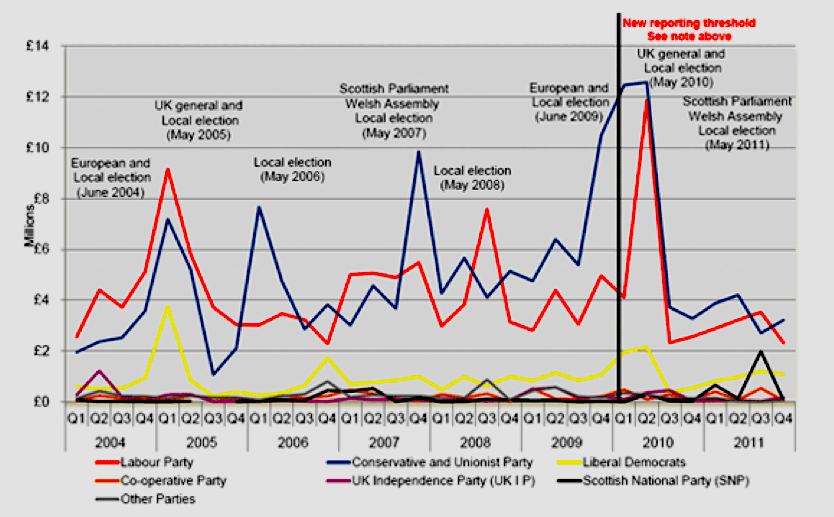
Current party funding is something of a minefield and other countries offer much in the way of moral lessons from which we could learn. Quarterly donations to the two main UK parties have zigged between £2m and £12m each quarter for the last decade, as shown in chart 1 below. Note that the first (and only) time the SNP registers is in Q3 of last year.

Chart 1: Quarterly donations (in £millions) to UK Parties (source: Electoral Commission)

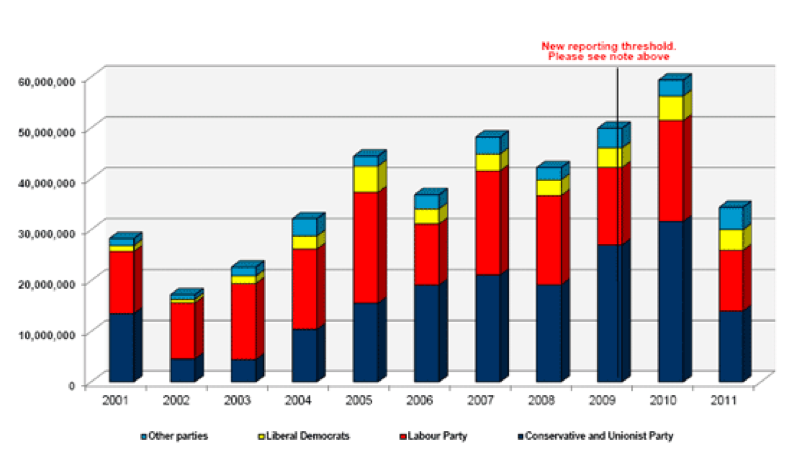
The scale of disparity between the main UK parties and those either trying to break through to UK level (e.g. Lib-Dems of UKIP) or those with limited geographic aims (e.g. Plaid or SNP) is particularly pronounced when this is looked at on an annualised basis, as shown in Chart 2.

Chart 2: Annual Donations to UK Parties (source: Electoral Commission)

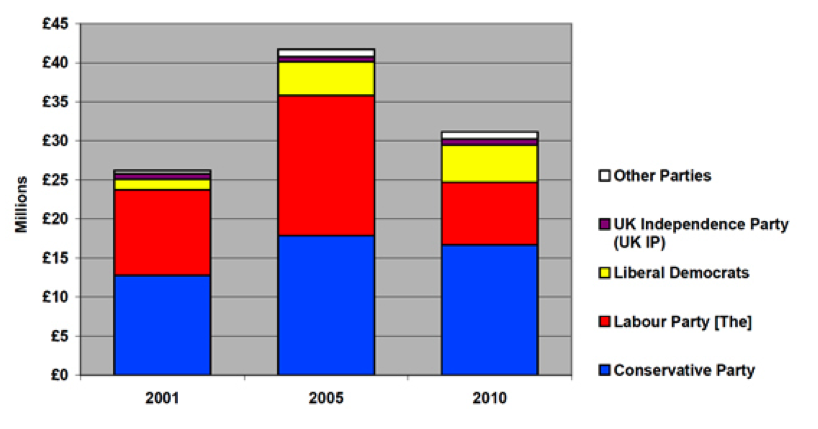
What this effectively means is that two parties can outspend all other parties put together by several factors, which results in the kind of expenditure on general elections looking as shown in Chart 3.

Chart 3: Expenditure (in £millions) by UK Party on General Election Campaigns (source: Electoral Commission)

Note the disparity between the white sliver which represents mostly SNP and Plaid and roughly £1m between them, versus the £25m spent by Tories + Labour in 2010 (down from the £35m in 2005, largely because Labour was going broke). Even allowing for the under 10% of UK population that Scotland represents, they outspent the SNP by a factor of five AND had ‘national’ BBC coverage going for them.

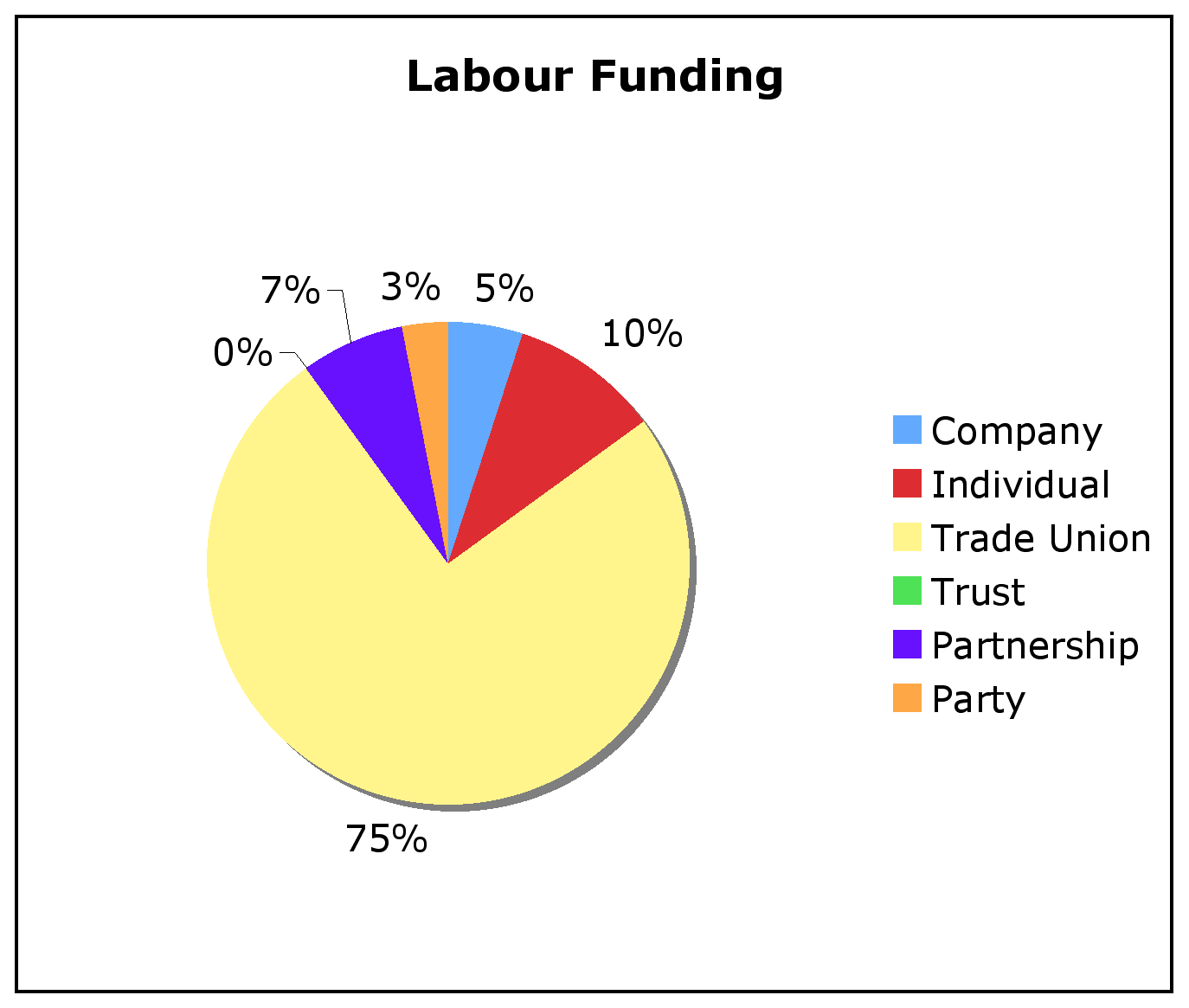
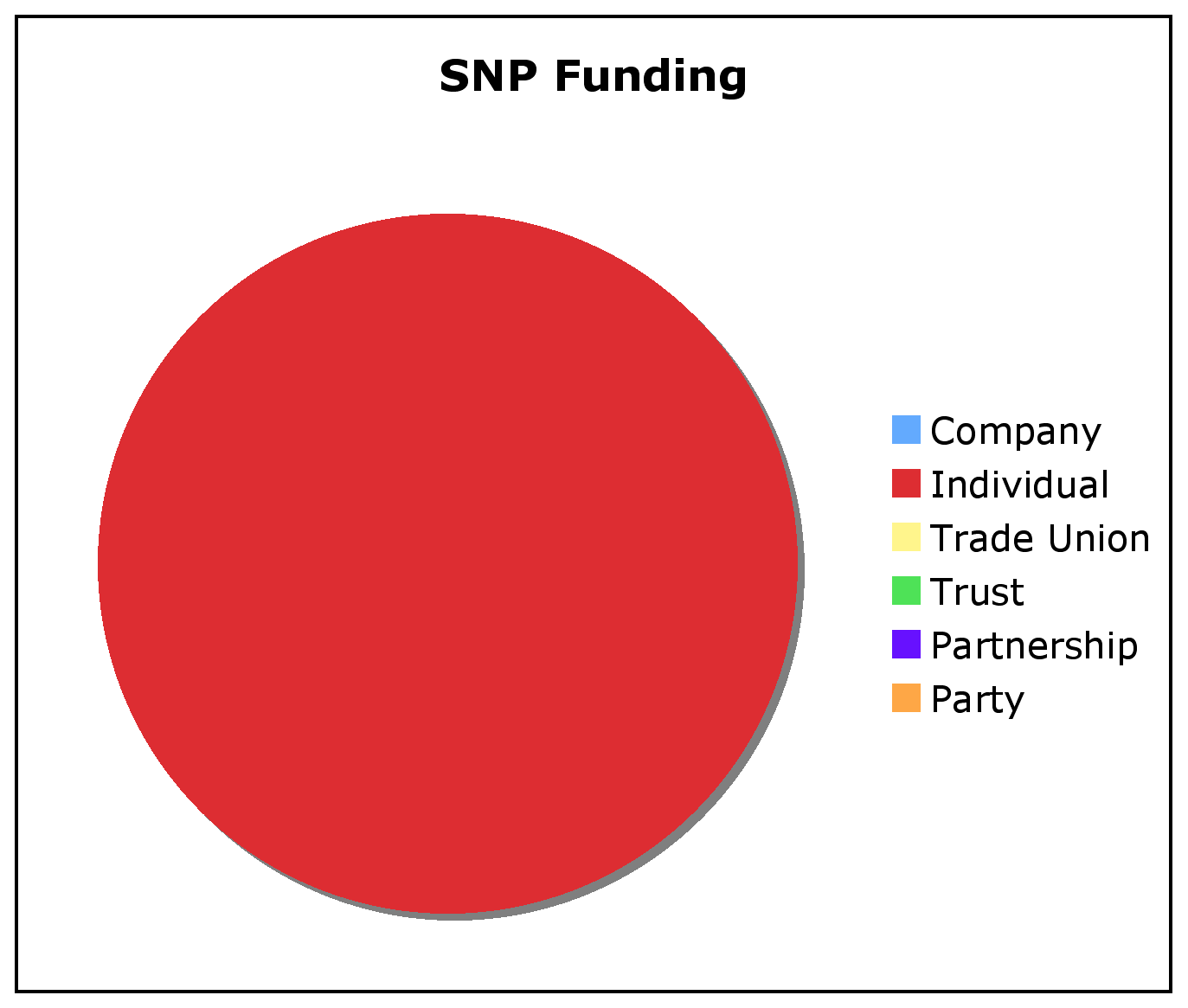
But more interesting is to bore down deeper into the sources of funding, as the Hootsmon, to its credit, did yesterday. They looked at the four main parties in Scotland—and quite a contrast their funding sources made too. These are shown in Charts 4a to 4d.

Figure 4a Distribution of Labour Funding Sources (source The Scotsman April 16th)

Figure 4b Distribution of Tory Funding Sources (source The Scotsman April 16th)

Figure 4c Distribution of SNP Funding Sources (source The Scotsman April 16th)

Figure 4d Distribution of Lib-Dem Funding Sources (source The Scotsman April 16th)

The differences among the above four charts are quite striking. As long as the SNP was broke and receiving very little funding, the big UK parties seemed quite happy to hoover up funds from whatever source suited them. In the last quarter of 2011, the Tory Party received:

  • £600,000 from the National Conservative Draws Society
  • £150,500 from Mark J.C. Bamford
  • £136,180 from Lycamobile UK Ltd
  • £125,452 from Peter (I-can-get-you-dinner-with-the-PM-for £125k) Cruddas

Meantime, the Labour party was doing very nicely in the same period with its biggest donations being:

  • £649,092 from the GMB union
  • £427,774 from the Unison union
  • £304,588 from the Union of Shop, Distributive & Allied Workers
  • £194,210 from the Communications Workers union

And, lest we think the Lib-Dems were missed from all this ‘civic giving’, they received £329,352 from the Methuen Liberal Trust Fund and a cool £153,267 from the Ministry of Sound (NOT, we should add, a Whitehall department. Yet).

The SNP has come under considerable criticism from its opponents that it received money from Shir Shean and that Brian Souter’s recent £500k in matching funds and ~£1m each from the estate of the great makkar Edwin Morgan and lottery-winner members who shared their windfall with the party. With the exception of Soutar, it is clear that no self-serving influence could be attached to the ‘generosity’. But with hefty union and business donations sustaining both Labour and Tory and Cruddas recent ‘access-for-sale’ exposure coming on top of expense scandals, cash-for-honours and egotistical nonsense like Derry Irvine’s wallpaper, that distinction is palpably naive.

How Ed and his boys would survive had they only received 4 x £5k = £20k instead of the over £1.5m the unions slipped them is unclear. Noble though the principle of his initiative may seem, with his party deep in debt and elections getting no cheaper, Miliband needs to explain how he can square that particular circle without dipping into public funds. With the mood the people are in just now, advocating more public money for politicians would be political suicide.

Is Ed that daft?

Posted in Commerce, Politics | 2 Comments

Operation SOS Puffin

Even in as delightful a place to live as East Lothian, people get into the usual habits of life. As we zip from home to work to shop and then off to evening class or golf course or pub, we are not always aware of changes happening along our regular commute paths, let alone in the wider environment.

One such example happened over the last decade on the islands of the Forth near North Berwick. These provide a scenic backdrop to our picture postcard beaches and, until the Scottish Seabird Centre started frequent trips and studies of the wildlife on them, most locals were pretty ignorant of how well of badly things were doing. From the gradual spread of white all over the crown of Bass Rock, it was pretty clear that the gannets were doing well and, when Prof Brian Nelson spent his year-long soujourn on the rock studying them, he confirmed that was the case.

From a few thousand nesting on the cliffs when they became protected a century ago, their population has boomed to over 150,000 now. However, the other seabirds, being smaller and less obvious, were something of a mystery. What was know was that the highly photogenic puffins liked Craigleith because the myriad of rabbit burrows from the days when it was the town warren provided them with ready-made nests. By the turn of the millennium, their numbers had reached around 40,000—not as many as on the larger Isle of May but still impressive numbers.

But then numbers started to decline. At first, no-one but a few keen birdwatchers noticed. But then the regular boat trips by Sula and observers using the remote cameras in the SSC remarked that the rafts of puffins on the water and the ranks of them socialising along the skyline of the island seemed to be fewer each season. A cursory examination of the island six years ago identified the problem almost immediately.

Although looking equally green as the grass that normally covered it, Craigleith had become infested with tree mallow, a plant not native to the area. Originally from the Mediterranean and related to the geranium, tree mallow grows large soft, circular leaves. The theory is that lighthouse keepers grew some as reserve toilet paper for the times weather delayed their supply boat. Once the keepers were taken off in 1996, it grew wild and some of its seeds were carried to Craigleith.

There it found a cosy home. Puffins are good housekeepers and clean out their burrows each season. This means the mouths of the burrows always have plenty of soft soil—which makes an ideal seed bed. Initially small, the mallow plant stem becomes woody after the first season. By the second season, it can be 2m high and produce thousands of seeds. Not only are the burrows blocked by ‘cell bars’ of mallow at their entrance but small puffins can’t land or take off in the middle of a mallow jungle. Even people disappeared in the denser stretches.

Your humble scribe mallow-bashing on Craigleith. The tall plants are mallow

Supported by the SSC who provided boats to take the volunteers out, naturalist John Hunt has been organising regular ‘mallow bashing’ trips, together with wildlife expert Maggie Sheddan for the last five years. Initially focussing on the worst areas with the tallest plants, followed by seasonal strimming of the seedlings springing back up from the millions of seeds dropped, Craigleith is almost back to normal and most of Fidra has been cleared too, Because the puffins nest between April and July, work has to be done in the other eight months to avoid disturbing them.

That means we have now come to the end of another successful season—this winter being particularly light on storms and so a lot of work could be done. Even if you can never manage to visit and/or volunteer, watch the video trailer to get a sense of what a magic and unusual place these islands are and how worthwhile the efforts of hundreds of volunteers have been in restoring such a precious wildlife resource that is so close and accessible it provides a splendid learning opportunity for our visitors and locals alike.

This blog reported on the project last year and also published an update last month. But now a French-Canadian team has filmed the raw material for a documentary that gives a sense of what the volunteers have been doing all these years. Have a look at the trailer here which gives a glimpse of what it is like to visit the other-wordliness of being among the wildlife on islands that are within swimming distance from the shore but seem so rare, exotic and far from civilisation once you’re there.

Although there will be no more trips this season, volunteers will be needed, starting in August and there may be some places on a puffin count of the islands to be done before then. The bottom line is that numbers are recovering and the rafts of puffins bobbing off Craigleith on Easter Sunday morning bode well for that continuing. Gordan Buchanan did a brilliant short film for BBC2 Wild about puffins on Lunga which you can watch here.

If you need more information about SoS Puffin:

  • Scottish Seabird Centre: 01620 890202 http://www.seabird.org/sospuffin.asp
  • John Hunt (SoS Puffin co-ordinator) johnf_hunt@yahoo.co.uk
  • Maggie Sheddan (Seafari Guide at SSC) m.sheddan@virgin.net
  • Maude Rivard-Haustrate (Documentary maker) maude.rivard@gmail.com
Posted in Environment | 2 Comments

Economic with the Argument

Some of my more volatile colleagues have come close to seizure with this weekend’s issue of The Economist, whose cover carries a waspish map of ‘Skintland’ and whose densely packed articles include a record three that discuss Scotland. Having been a long-time reader of the paper, I was not among those going ballistic—having used The Economist as a lodestar of news down the years, I regard it as an old friend.

Starting in Munich in the 1970s, I could no longer access any UK—let alone Scottish—media. Eloquent though it is on German issues, the Süddeutsche Zeitung covered neither exciting election in 1974 and drove me, faut de mieux, to try what I had always dismissed as a stuffy, humourless specialist weekly, although I had never read it. I was genuinely stunned to find how wrong I had been. I found it witty, insightful, numerate, well written, global in outlook and, best of all for me, disinterested in sport, celebrity or gossip.

With its weekly schedule, I found it just the tool to stay abreast of news that mattered so that, when I moved to California, it continued to provide my weekly dose of penetrating analysis—in sharp contrast to the lightweight and parochial West Coast press in the shape of the San Francisco ChronicleSacramento Bee, San Jose Mercury or the Oakland Tribune.

So, for the last 40 years, I have been a fan, almost an addict needing my weekly fix of concise, informed opinion—so much so that, with my return to Scotland coinciding with that sad decline of the once-noble Scotsman into Mail-in-a-Kilt, The Economist continued as my current affairs source-of-choice. When news of this week’s issue (and the outrage it was causing) reached me before the print edition did, I was simply curious.

Nonetheless, seeing the cover that triggered the stramash and reading the related lead article did give some sense of outrage; my first instinct was to draw an equivalent map of various English shortcomings. Then, I thought better of it. Are we Scots still so touchy that a well executed lampoon and demolition job need trigger apoplectic fits? Is the fact that The Economist is now trying to deconstruct Scottish Independence not a definitive sign that debate has arrived, that a hitherto fore oblivious nomenklatura is waking up? Independence has arrived at the gates of the establishment.

It is hard, as a paid-up independista, not to see some of the article’s language as, at least, provocative. For example:

“The Catalans, among other disaffected European groups, see Scottish independence as a harbinger of their own bid for nationhood. Other diverse nation-states watch, and worry.”

The language—implying unrest and coded revolution—is not the most measured phrasing I have seen on those pages. But it reflects how many unionists see it. The trouble is, it is also how Franco saw it and who, in his four decades of odious fascism, tried to repress both Catalan identity and their language. They have reason to be stroppy in a way Scots can’t quite justify.

For the repression that Scots may feel is more the result of a combination of genuine lack of appreciation for our differences in Britain, hand-in-glove with a congenital assumption on the part of most English that their culture represents the sine qua non of civilisation. The subsequent conflation of England with Britain and all that is good in either then becomes Pavlovian and, from there, axiomatic support for the unionist argument. What we Scots don’t quite ‘get’ is that all is often done more with affection than malice. This may be the first time that usually impeccable editorial standards of The Economist have run foul of this.

To find support for Scots viability you need delve no further than other pages of the very same issue. As well as the It’ll Cost You headline article, there are 1,300 words that are more measured (and typical of the paper) entitled The Scottish Play. In this comes the paragraph:

“Scotland’s accounts of revenue and expenditure, based on Treasury data, show that it is not a ward of the state, grossly subsidised from Westminster. In fact it performs better than all regions outside the south-east of England, and has done particularly well in the past decade. In 2010-11 Scotland’s GDP was £145 billion ($225 billion) including a geographical share of North Sea oil and gas, around 10% of Britain’s, with 8.4% of the population.”

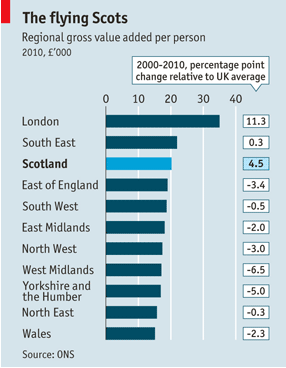
Few nationalists would quibble with this positive slant—and yet it has received little covereage. This article includes a chart (see below) that highlights Scotland as the third best-performing ‘region’ (yes…I know…) in Britain, after London and the SouthEast.

Gross Value Added by UK 'Region' (source: Economist)

Note that, not only does Scotland rate above anywhere outside the Southeast of England but that it beats all but London in terms of growth. And when some of the more negative caveats in both articles are examined closely, they smack more of an attempt to find counter-arguments than the balanced analysis I would normally expect.

As an example, statements made that Scotland would depend on oil for 18% of its GDP and that an oil price of $60 per barrel would seriously reduce production are both factually correct. But would either invalidate Scotland’s economy when Venezuela and Nigeria, let alone the Gulf states are far more dependent on oil and Brent crude, while dipping below $100 only once in the last year, is trading at over $120—twice the ‘worst case’ above?

And, curiously enough, there is a third article in this issue, entitled “Chocs Away”. In it is featured a small company in Grandtully whose hand-made chocolates business is going through the roof and exemplifies the opportunity to exploit Scotland’s reputation for high quality foodstuffs. Their marketing manager Ms Collier reckons that the ease with which her chocolates have found foreign buyers:

“…owes much to the reputation for quality that Scottish food and drink have gained thanks to malt whisky distillers. Small artisan producers like us are following in their footsteps”

The article further cites how salmon exports boomed on the back of Chile losing business and how said malt whisky distillers never faltered in the recession and broke through £4bn in exports this year.

It’s the same in The Economist as elsewhere. The British (= English) establishment, based in London and steeped in colonial history and a reticence that Johnny Foreigner has anything to teach them, is ill-disposed that any other (let alone an equally viable/successful) culture could exist within these islands. They—and their mouthpieces among which The Economist must count itself—can be expected to articulate a broadly unionist line more often than not.

It’s our rôle as Scots not to be so touchy or easily provoked when our cousins lose either their objectivity or their famous sang-froid as they appear to have here. Be gracious: they’re not used to contemplating serious competition from another ‘region’ in what they continue to see as their own back yard.

Posted in Commerce, Politics | 2 Comments

The First Shall Be Last

Last week, the Edinburgh Evening News broke the story that FirstBus (Scotland East) was going to withdraw roughly half the service it currently runs in East and Mid-lothian. Having worked with First through EL Council and seen the thick end of £1/2m disappear into its coffers for local supported bus services, not to mention compensation payments for carrying the elderly and running home-to-school transport, might you hope for a “heads-up” warning from one partner to another? Not a bit of it.

A letter to the council, dated April 2nd announcing the fait accompli, was not presaged by either negotiation or information and actually arrived the day after the EE News scoop. It made no mention of the four years still to run on the deal struck between ELC and First for supported bus services. Although unsaid, this was a unilateral reneging on a contract.  First’s MD Paul Thomas explained the situation thus:

“Despite the implementation of a number of marketing and pricing initiatives, this decision has been reached because a number of years’ poor trading performance, economic climate, fuel costs and cuts in external funding…it is no longer possible to fund these services from other parts of the business.”

Oh, really? Twenty years as a customer of their services taught me there are few more organisations single-mindedly dedicated to short-term profit than First’s Edinburgh operation. They charge eye-watering prices where they have no competition; they are especially fly at screwing extra money out of supported services. And they do this with a fleet of cast-off, antiquated gas-guzzling buses that make mockery of public transport as any green alternative to chelsea tractors.

In all, they provide an unenviable example of how bus deregulation does real damage to public transport and public attitude towards it. The profit motive is all very well but for First Group’s latest 6-month report to boast profits of £3.2 bn (= 10% of the Scottish Government’s entire budget), it’s a bit rich to plead poverty. Now that they’ve failed to squeeze enough out of this one sector by losing a bus war with Lothian, despite elbowing most smaller operators off their patch, they throw in the towel with scant 60 days notice.

But, easy though it is to catalogue First’s copious shortcomings, it is actually a chance to light a candle rather than curse their darkness. It will be a scramble to re-provide their existing services by June. But meetings with other bus companies, the Scottish Government, SESTRANS and Midlothian (who are also affected) are underway and sounding positive.

But this is also an opportunity to re-think how ELC provides transport across the county. This can be broken into four:

  1. Commuter traffic, mainly radial into central Edinburgh
  2. Local traffic, providing access to town centres from suburbs and villages
  3. School traffic, feeding pupils from across a catchment area, plus outings
  4. Social support traffic, such as Day Centres/Lunch Clubs and outings

Category 1 includes train services into town from Dunbar and North Berwick; buses here are best run as express services. Category 2 should (but does not) provide ‘feeder’ services to stations and avoid running buses that duplicate rail services. By making a few, reasonable assumptions, it should be possible to prototype a far better and easier to use system in East Lothian that could be a model for the rest of Scotland. The assumptions are:

  • Lothian provides the ‘local’ services to/from Tranent/Port Seton & Edinburgh
  • Some agreement on use of their Ridacard elsewhere in EL needs to be reached.
  • All buses accept an ‘Oyster-type’ swipe card to ease transfer and speed boarding
  • Buses in the (non-Lothian) Eastern area are mutually timed to meet at Interchanges

Given, this, a more frequent and streamlined service could integrate with both Lothian and ScotRail services so that people would find real encouragement to use public transport—as across Europe. The difference? To look like Europe, it should be integrated, fast and competitive in price. Why? Because as ridership rises, public subsidies fall, service improves and everyone’s happy. A post-First network might consist of:

    1. X24 N. Berwick to City Centre (via Gullane, Longniddry, A1/ASDA)
    2. X45/253 Dunbar to City Centre (via E. Linton, Haddington, A1/ASDA)
    3. E20 (ex-120) E. Linton to Gifford (via Tantallon, N. Berwick, Dirleton, Drem, MoF, Flag Heritage Centre, Athelstaneford, Haddington)
    4. E23 (ex-123/44C) Haddington to QMU (via Pencaitland, Ormiston, Tranent, Wallyford, Musselburgh; return via A1/A68, Whitecraig, Wallyford)
    5. E28 (ex-128) Haddington to QMU (via Ballencreiff, Longniddry, Port Seton, Prestonpans, Wallyford, Whitecraig, A68/A1; return via Musselburgh, Wallyford)
    6. E44 (ex-44D Haddington to ERI (via Gladsmuir, Macmerry, Tranent, Wallyford, A1/A720/A7)
    7. E10 (ex-110) Elphinstone to Port Seton (via Tranent, ScotRail & Alder Road)

Timing services C through F above to have Interchanges with each other and with B at Haddington and ScotRail at Wallyford, you could get to/from central Edinburgh, ERI and QMU far faster than now to/from any village or town in the county. Evening, weekend and seasonal tourist services would be modifications of this basic service.

Services A and B may remain commercial, as will western local services run by Lothian (15, 26, 30, 44). To add services C through G as hourly would only take nine buses; ELC already support six (110; 120; 121; 123; 128; 141/142). If these were scheduled to run as:

  • First trip circa 7am as commuter trip
  • Second trip circa 8am as school trip
  • Core trips (9am – 3pm) as standard trips
  • Tenth trip circa 4pm as school trip
  • 11th trip circa 5am as commuter trip
  • Final trip circa 6pm as standard trip

…then they would save at least three other buses currently used exclusively for school trips and the net cost for a far better service should be no more than it is now.

As for fares, currently, First’s prices outside the area served by Lothian average three times what they charge in Edinburgh and attract much negative comment and reluctance by the public to use the services. It would remain cheaper to buy day tickets than a normal return—or invest in a Ridacard.

Assuming that all services outside of Lothian’s area were run by an ‘arm’s length’ East Lothian Transport company with Oyster-style swipe payment of at least £1 per journey, it should be possible to increase ridership to the point that financial subsidy of bus services could actually be decreased. Even charging £2 per trip is appreciably cheaper than now.

Suggested East Lothian Transport Network (maroon colour = Lothian)

Red dots on the map indicate main Interchanges. Buses would arrive/depart from Haddington grouped around 10 minutes past each hour and from Wallyford around 50 minutes past each hour. While most journeys would involve a transfer, this would be compensated for by easy swipe-card boarding, minimum wait time and hourly service on all routes. Full co-ordination of interchange and ticketing with rail would take extensive negotiation and require a longer time scale.

Whether First wishes to be a part of this is unknown. Certainly other bus companies have expressed an interest in expanding/improving services and both the Scottish Government and SESTRANS have expressed support for such a scheme. Final details will only be know once ongoing negotiations have been completed. But First’s failure could actually be the best thing that’s happened to public transport in East Lothian (and maybe even Scotland).

Posted in Commerce, Community | Leave a comment

NATO no Tenet on OTAN

I’m a follower of Burdzeyeview because said Burd has a deft habit of spearing keys issues of the day with insightful comment—thereby roping in a fair number of informed people to comment on them and generally advance the issue, even where it is not resolved. Despite it being Easter, this week was no exception. While I was merrily bouncing round the Bass showing visitors our spectacular wildlife, the Burd asked why Professor Malcolm Chalmers piece in SoS had flushed so little comment out of the usually vocal ‘cybernats’.

The question is a fair one: I’m game. For years, SNP party policy has been against any NATO membership for Scotland. The basis has always been a fundamental refusal to accept nuclear weapons on Scottish soil. I can well believe (as the article claims) that a majority of SNP members would consider NATO membership of some sort as a necessary component of a Scottish defence posture—not least because I am one of them. But I am no happier with Trident than anyone else in the SNP.

What the good professor seems to overlook is that, of the 28 existing members of the NATO alliance, only three are nuclear (USA, Britain, France). The rest have kaleidescopic involvement in the alliance that is tailored to their capacities and political realities: nobody expects landlocked Hungary to field much of a navy nor tiny Luxembourg to field much of anything. Yet they are members. The habitually stroppy French won’t even agree on its name and insist on “Organisation de Traité d’Atlantique du Nord” (=OTAN).

Despite an independent Scotland not offering serious global military clout, along with Iceland, it is superbly positioned to watch NATO’s northern flank. It offers facilities for commando training in the Angus glens, infantry and low-level flying ranges in D&G, plus the most accessible and ideal joint-services exercise area around Cape Wrath. To think that NATO top brass in Brussels would not prefer to have Scotland as a member—even IF it joined with some caveats—is to underestimate their pragmatism.

The caveat of not stationing nuclear weapons on our soil may not be seen as ideal. But it is neither unique, nor is it a dealbreaker. Especially as any Scottish armed forces would be ex-UK armed forces and already fully trained in NATO practice.

The second key point Professor Chalmers appears to make is that Scotland could not afford a decent defence posture—citing £2bn as our budget and £100m as the cost of a single strike fighter. Both are indeed reasonable figures and it would indeed cost us a year’s budget to equip a squadron with state-of-the-art fighters. But any independent Scotland will have paid for 9% of the present UK forces and would be entitled to that share upon independence.

That share may not sound like much, but a balanced defence force for Scotland would not include the most expensive equipment currently deployed by the UK, most especially the 4-strong Trident fleet, either of the aircraft carriers now building, any of the 400 Challenger MBTs (cost £4m each) or overseas deployment & bases & support required for them.

As a result, a couple of frigates, some light craft, a hundred or so IFVs and light recon vehicles, a share of REME gear, two squadrons of helicopters (recon & attack) and the same of fighters (plus some Hawk and Tutor trainers) would do us nicely and not break the 9% bank. Some heavy lift like Hercules would be necessary until we replace long-range maritime recon aircraft that the MoD scrapped.

Two months ago, an article here described what a Scottish Army might look like. Its exact nature would be up to those better qualified than I and the agreement of those involved that they wished to serve in it. But the key point is that—like ALL smaller NATO nations—we would not be going to war by ourselves and—unlike the UK—would have no ambition to throw our weight around in any repetition of Falklands/Iraq/Afghanistan.

Where Prof Chalmers is probably correct is that Scotland may not wish to deploy any of the Astute class nuclear-powered (but NOT nuclear-armed) attack submarines, nor any of the Type 26 frigates due in service after 2020. That is because 2-3 older frigates from the existing RN fleet would suffice for ocean patrolling; attack subs are intended to take on a major blue-water navy. Scotland would be crazy to do that by itself and, with only a small surface fleet, would have no need to defend major targets like aircraft carriers from such a threat.

It is clear to most in the SNP that, if Scotland were to scale its forces to the country’s needs, the £2bn defence budget would be adequate to provide adequate forces. It would also be barely HALF of what we currently spend to support the £40bn UK defence budget. But Prof. Chalmers final assumption—that none of the ships the RN would continue to need would be built in Scotland—seems flawed.

Scotland would have no interest in anything but good, close relations with its southern neighbour. That would be exhibited in a willingness to extend the life of Faslane while the RN found a new home for their nukes (including the five hulks mouldering at Rosyth) and also continue building carriers and frigates for their more global military ambitions at competitive pricing the MoD would find hard to refuse.

The SNP defence spokesman Angus Robertson has recently said the party is “looking at the policy options” on the Nato treaty. Since NATO has diplomatically accommodated its smaller, non-nuclear members to date, it seems time for us to consider such options.

Posted in Politics | 3 Comments

It Was 20 Years Ago Today

No, not the Beatles track (that one was actually 45 years ago now) but, in displaying my anorak tendencies in spades, I fess up  to having just spent a housework day half-watching BBC Parliament’s 12-hour-long  marathon rebroadcast of the 1992 General Election. Despite it being history, its relevance as a reference point to politics today was striking.

The initial problem was to get past the ‘time warp’ aspect of big hair and big glasses, women’s blouses and colourful floral ties that date it so much. That and John Snow’s semi-mechanical ‘swingometer’ still in early stages of development. People you thought were always part of the establishment popped up as new boys—like David (‘two brains’) Willets, Mandy (complete with dodgy ‘tache) and Eric Pickles, who already looks like he couldn’t possibly get much fatter. Emma Nicholson, re-elected in Devon gushed about Major and convincing him to get more women elected (just 3 years before she defected to the Lib-Dems, citing Westminster Tory ‘old boy’ networks). Though it seems piffling now, much was made of an increase to 59 women MPs, 20 of them Tories. Out of 650!

The raft of familiar faces shown were startling in their youthfulness, including Ashdown and Kennedy, Redwood and Portillo, Gordon Brown & Brian Wilson. All were quizzed by compere David Dimbleby at the helm, but with a deference that today would seem Victorian in its politeness.

Fresh-faced Iain MacWhirter, anchoring in Scotland spoke of “everyone eating large amounts of humble pie” after Tories—against all expectations—held their 9 Scottish seats and added two. He interviewed an equally youthful Galloway who (alone) predicted Kinnock would stand down and argued Labour must extend a hand of friendship to SNP to use the Constitutional Convention as Tories were laughing at the disunity among their opponents over any constitutional change.

Canon Kenyon Wright claimed “the will of the Scottish people contined to be massively thwarted” while David Steel, interviewed in his Ettrickbridge fastness, felt Jim Sillars, having persuaded the SNP to stay away from the Constitutional Convention, might have less influence now his “Free by ’93” had proved such a damp squib and himself had lost the hard-won Govan seat. Sillars’ interview showed him more moderate and measured than either his reputation or his more recent utterances.

Alex did a statesmanlike job in his acceptance speech. 20 years younger, he delivered with the same impressive balance he exhibits today a claim that the people of Scotland would not long stand being ruled by those for whom they did not vote. But most convincing of all in Scotland was a nebbish but poised Donald Dewar who, while dismissing civic disobedience as a tactic flatly stated that the Tories had no mandate to rule in Scotland and that they would come to regret it if they ignored that fact.

Long ago as it was, the sheer surprise to all (including Tories, though the senior ones denied it) that Labour didn’t win and that Major was back in with a working majority of 21. But, seen from today’s perspective, he did less well and Kinnock did much better than the story of the day. Both polls and papers had been predicting a Labour win and the anti-Thatcher, anti-poll tax sentiments were still running high.

But this was also the era of the ‘loony left’ and Labour were still on the long journey back from 1983’s electoral oblivion when they punted what Gerald Kaufman waspishly observed to be “The Longest Suicide Note in History” as their manifesto. Kinnock, although he had brought them back from the brink, had indulged in some odious triumphalism in Sheffield (“Well, all right!” repeated from the podium to rapturous applause— to no discernable purpose). Within 24 hours of the result Kinnock stood down.

As this was the era when Middle Britain emerged from the class war, many started to expect more from politicians than left/right doggerel and cant. Blair and Brown were MPs but it would take the interregnum of the decent John Smith to lay foundations for what became the immensely electable New Labour who cottoned on to such things and effectively stole the Tories traditional clothes.

So while Labour did make serious progress—actually their 2nd-best improvement up to then, they won only 44 of the 94 seats required to form a government and which all agreed they were on-track to achieve. Polls and newspapers had much to answer for. In the event, not only did the Tories scrape home in many target seats but they sustained their 43% share of vote and, watching the Lib-Dems slide from 23% to 18% and slip back by 2 seats, could argue they won even bigger against them than against Labour.

Paddy Ashdown made a brave face of it but was miles off in predictions, seeing his own policies as realities and claiming “There is now a real question whether Labour can ever challenge for government”. Dennis “The Beast of Bolsover” Skinner would have no truck with this and was quite clear that, with no concession to Lib-Dems or their PR but with a strong dash of old-time class warfare, “Labour could win the next election hands down”.

The Lib-Dems would actually make good use of time but not at Westminster. Sally Magnusson down at the Yeovil Liberal Club found them somewhere between miffed and defiant. But through the nineties and noughties, they made a strong play in the North and West of England from grass roots, electing hundreds of councillors to city halls from Liverpool to Doncaster. This platform became one from which they could make their strongest showing to date in 2010.

But if the English and Welsh were baffled how Major pulled this out of his hat, there was a right scunner among the Scots. Although 49 Labour MPs were elected (along with 11 Tories and 9 Lib-Dems) no-one had a sense of progress, nor of being protected from either Thatcherism or nukes on the Clyde. The ‘standing-still’ of the SNP at 3 seats concealed a huge rise in their vote, doubling to over 690,000 and putting them in striking distance of the three further seats In five years, losing them began a long dark Tory night.

In 1992 Scotland still registered as just a region of Britain—albeit a quirky one. Dimbleby referred to Berwick as “the northernmost constituency in Britain” and proceeded to show a picture of Alnwick Castle. What was equally amusing was the obvious spin and blind party loyalty indulged in by everyone when discussing results: spin was not a Blairite invention—he & Mandy simply perfected it.

But it is only with 20/20 hindsight that the events of the last few years—let alone the Scottish Parliament itself—could have been predicted from the events of that night in 1992. Nobody (with honourable exceptions from Dewar and Galloway) seemed to have a clue what even the next five years might bring. Altogether, it was a lesson in how little even the best informed and those paid to anticipate can predict our future.

Posted in Politics | Leave a comment

“I Can See How One Might Be Stirred Up”

How unfortunate that such empathetic insight as displayed by the Rev Beeb in Forster’s “A Room with a View” is not echoed by the mighty Auntie Beeb when it comes to allowing democratic voice to its Scottish license-payers. As outlined in the excellent “A Sair Fecht” blog (and shamefully stolen for this one), censorship of debate has been exercised here which is not the case anywhere else within the Britain that unionists never tire of telling us is so good for us Scots.

But consider the following:

BBC Scotland: Political Editor – Brian Taylor: Comments NOT allowed.
BBC Scotland: Business Editor – Douglas Fraser: Comments NOT allowed.
BBC Wales: Political Editor – Betsan Powys: Comments allowed.
BBC Wales: Parliamentary Correspondent – David Cornock: Comments allowed.
BBC Northern Ireland: Political Editor – Mark Devenport: Comments allowed.

In England:
BBC North East & Cumbria: Political Editor – Richard Moss: Comments allowed.
BBC Yorkshire & Lincolnshire: Political Editor – Tim Iredale: Comments allowed.
BBC Midlands: Political Editor – Patrick Burns: Comments allowed.
BBC East Midlands: Political Editor – John Hess: Comments allowed.
BBC West of England: Political Editor – Paul Barltrop: Comments allowed.
BBC East of England: Political Editor – Deborah McGurran: Comments allowed.
BBC South East: Political Editor – Louise Stewart: Comments allowed.
BBC South of England: Political Editor – Peter Henley: Comments allowed.

And the reasons given? Daniel Maxwell, BBC Scotland’s news online editor, when given the task of defending the indefensible, said.

“We believe that by determining which particular issues might best be explored by the inclusion of public comment online, we will allow a more flexible and adaptable approach to be taken to how we cover the main issues in Scotland.”

Aye, right: I’m with the Rev—not Auntie—Beeb.

Posted in Politics | Leave a comment

Why Far Away is Close to Home

Oakland, California is 8 time zones or 5,000 miles from Scotland and, as it seldom registers on our screens unless the Raiders make it to the Superbowl, is seen to have little relevance. Oakland does not have the profile of San Francisco across the Bay, a ‘city’ of some 300,000, it is actually an integral part of the SF Bay conurbation, which has a population larger than all of Scotland. So why is this week’s shooting of seven at Oikos University any more relevant in America’s 5th most dangerous city (110 murders in 2011)? It is also a dizzy mix of black, Chinese, Chicano, Nicaraguan, Korean and Vietnamese, as well as the (marginal) white majority.

While details are still being uncovered, the New York Times reported that L.Goh, a 43-year-old Korean former student lined up a class of which he had been a member months before and started shooting, causing five deaths and wounding five more, two of whom have since died in hospital. He gave himself up in a nearby Safeway. This kind of thing is becoming less rare, especially in the US, and still strikes most Scots as incomprehensible. Perhaps we should pay more attention as it does have relevance.

Looking at the context, there are many parameters that are unfamiliar to Scots. Oakland, though the size of Aberdeen, boasts 13 institutions calling themselves ‘universities’. Some—University of California and California State University we would recognise as such. Others—like Laney of Merritt Colleges—are ‘junior’ colleges, where students can do the first two years of undergraduate work cheaply, then transfer into a ‘full’ university like UC or CSU.

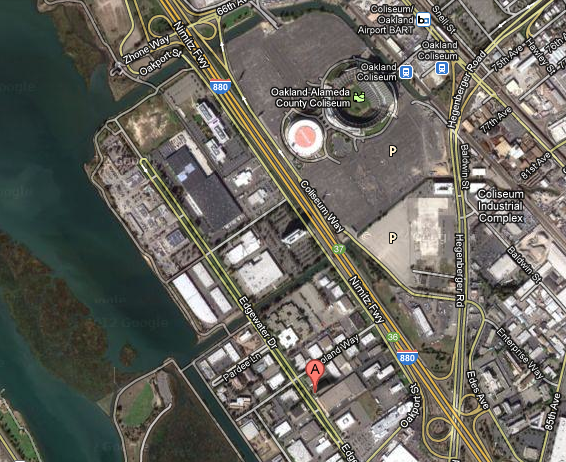
But in a large grey area are a number of private universities recognised by the US Dept of Education as able to confer degrees in certain subjects. As with all other third-level educational institutes in the US, these are fee-paying and profit-oriented. The top-notch universities like Ivy League, Purdue and Stanford are richly endowed, have a formidable academic reputation and cherry-pick the best students to sustain that reputation. The less well known like Oikos cannot and live far more hand-to-mouth, competing with a half-dozen similar ‘universities’ just within Oakland itself. For cost reasons, it is located in an industrial area across the Nimitz Feeway (Interstate 880) from the Oakland Coliseum (where the Raiders play) in a standard industrial building. Forget tree-shaded lawns around dreaming spires; there is no campus recognisable as such—this is business.

And, while it may not charge the $20,000+ that Stanford would across the Bay, you ‘must’ carry at least 12 units per Semester (cost = $4,400 per year), plus:

  • Application Fee: $300.00 (Non-refundable)
  • Admission Fee: $100.00 (Non-refundable)
  • Registration fee: $100.00 / Semester
  • Student Fee: $100.00 / Semester
  • Graduation: $600.00

—which adds up to a hefty $5,200 minimum each year, plus all books, materials, equipment and living expenses, plus $600 at the end if you want a nice certificate to say what you did. And, because the US constitution bans religion from state education, these private universities are also the refuge for those who see religion as part of any proper education. Oikos is one such. In its Vision Statement, Youngkyo Choi, Chairman, Board of Directors declares:

“The vision of Oikos University is to educate emerging Christian leaders to transform and bless the world at every level – from the church and local community levels to the realm of world entire.”

There is no concrete evidence connecting this with Sun Yung Moon‘s Unification Church that became notorious in the seventies for brainwashing disciples. But Koreans do seem partial to a particularly muscular version of Christianity and Oikos offers a BA in Biblical Studies, as well as Nursing, Music and Asian Medicine ‘Schools’. Curiously enough, while the fees and course outlines are available on their website, the faculty members are not. Degrees from any school requires a minimum of 15 (out of 120) units must be ‘Bible and Theology requirements‘.

Whatever did motivate a student to attempt a massacre on his former classmates may eventually become clearer but any vision of an immature student in an Oxford-like environment should be suppressed and replaced by something as close to an industrial apprenticeship suffering severe financial (if not religious and psychological pressures) in a factory environment with the express and single-minded goal of attaining a certificate that will enable higher earnings. The idea of a broad education and convivial collegiate socialising that is the norm in Scottish universities is entirely alien in this case.

The lessons for us? Reasonable though the demands are from business to receive graduates who are literate, numerate and able to contribute from the off, we are in danger of sliding towards the Oikos ‘factory’ model if that is taken too far. In addition, the idea that religion has a role to play in education clearly had relevance in the Middle Ages when virtually every seat of learning had religious overtones. But, in the 21st century, such segregation—especially in the crime-rich pressure-cooker of a multi-ethnic, multi-faith community like Oakland— appears to have explosive overtones, especially when combined with such a soulless ‘factory’ approach to education.

We compromise the broad, secular, other-worldly nature of our universities at our peril.

Googlemaps Satellite View of Oikos (A) with SF Bay on left & Oakland Coliseum at Top

Posted in Commerce, Education | Leave a comment