Ehhhh: What’s Up, Doc?

Yesterday saw the first UK-wide doctors’ strike in decades. It was over proposed changes to their pensions and, although the government tried to play it down and a fair number of doctors showed up for work anyway, there were still thousands of appointments broken and hundreds of non-urgent operations cancelled. Anyone having waited for either to come round knows that can be a matter of month, if not years.

The doctors had thought they had a deal but the UK Department of Work & Pensions has made no exception for doctors in its brutal re-evaluation of what the country can afford to pay its public servants. Generally speaking, the public has been supportive, such is the high esteem in which doctors (and nurses) are generally held. A discussion on FaceBook received this (edited) response:

“They contribute more to the pension pot and, in the main, work long hours and have a job with great responsibility. I dont think it is too much of a reward at retirement. In comparison to bankers and what Westminster government wastes on Trident, etc. it is a mere drop in the ocean.

“All the while, Westminster’s squandering of money could be used to increase wages for the lower paid. Because doctors got generous pay rises under Blair does not make them responsible for Blair pushing others into doomed private pensions. Otherwise you could lose them to other countries.”

All fair comment. But a little rummaging comes up with a pay structure that has changed appreciably over the last few years. This is shown in the following table of NHS salaries:
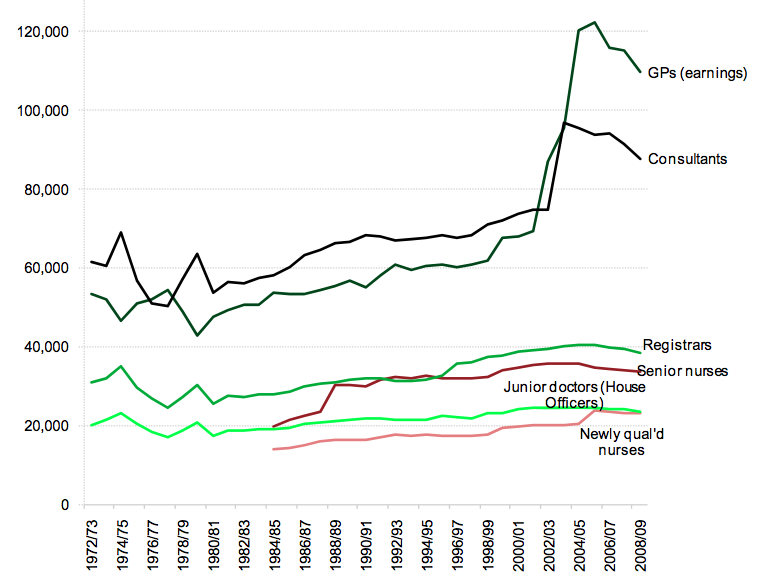
Salary Averages in £ sterling of NHS Medical Posts 1972 -2009 (Source: Pay in the NHS)

As well as showing the doctors’ huge boost around 2003, it shows the relative pittance for doctors under training and the modest salaries of even senior nurses. Compounding public envy of the scale of that boost has been a simultaneous decrease in GP willingness to work anti-social hours, resulting in fewer out-of-hours surgeries, home visits, etc. But is thee evidence that we are losing doctors abroad because the pay is so much better there? The chart below makes comparisons of salaries elsewhere:
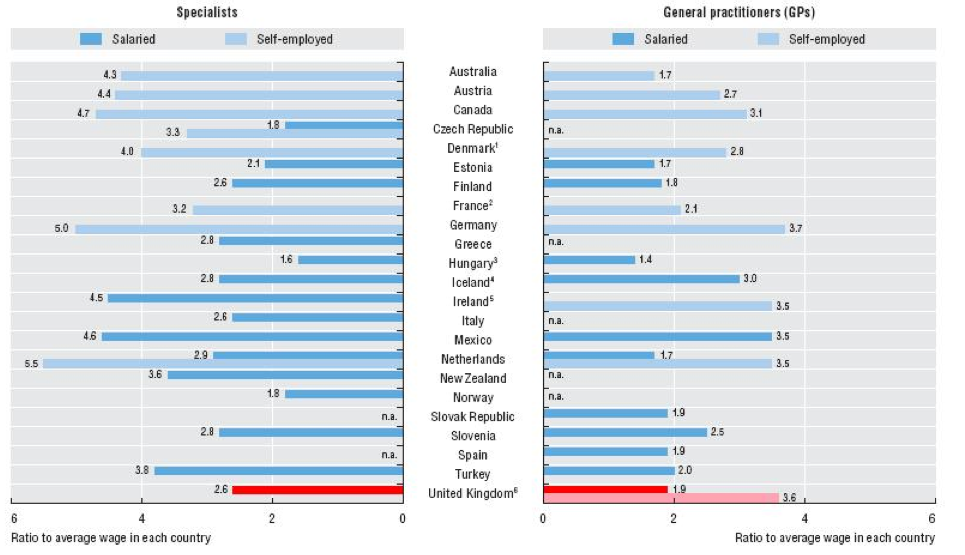
International Comparison of Doctors’ Salaries with Average Wage (Source: fullfact.org)

The results show things as at least comparable, with the self-employed (i.e. private practice) GPs doinf particularly well by comparison. Those interested in details of UK GP salaries can find them in the NHS publication GP Earnings and Expenses those for hospital doctors are given in Hospital Doctor Pay Scales. Bottom line is that most GPs will earn over £50k before tax, most hospital doctors double that and specialists or Trust CEOs serious six-figure sums.

But the dispute was about retirement arrangements. Instead of a lump sum of £162,000 and an annual pension of £68,000 upon retirement, the DWP wants doctors to contribute more, retire later and receive less. While unfair, this is no more than thousands of council workers, teachers, firemen and other public servants are being asked to do. All have complained, some have taken strike action.

Many of them (including doctors’ supporters) will agree with the assertion above, that “Westminster’s squandering of money” could provide the necessary finance. Trouble is, one man’s squander is another man’s defence system and, given the failure to date of either copious borrowing or quantitative easing to halt our fiscal slide, Osbo has no real room to maneuver—even if he wanted to.

So, solid though the doctors’ case may be that they had a deal, so did everyone else. And, since they pull down at least twice average earnings and would not get any better pay elsewhere, why they should not take some of the pain too seems a reasonable question.

Posted in Commerce, Community | Leave a comment

Lost in Translation

Recently, SNP Westminster leader Angus Robertson, a fluent German speaker, was interviewed in Wiener Zeitung (The Vienna Newspaper). In it, he urges caution in allowing himself to be described as a ‘nationalist’ because of continuing strong right-wing overtones in that word from Nazi history in the German-speaking world, even 2/3rds of a century later. The SNP have always been proud of its peacefully different ‘civic’ nationalism.

The response from Patricia Ferguson and Ruth Davidson (aided by a partial Herald newspaper), mocking the SNP for denying they were nationalists, seems to stem from either rank ignorance of history or deliberate cynical opportunism. In either case, it so appalled the editor of the paper in question he felt obliged to pen an explanation:

“May I clarify remarks attributed to Westminster SNP leader Angus Robertson, in an interview published in the Austrian quality newspaper Wiener Zeitung (“Robertson defends interview”, The Herald, June 19).

In an edited German language interview with Mr Robertson the newspaper reported that the SNP was not “nationalist” in the sense that German speakers would commonly understand it. The distinction seems an obvious one for anybody who speaks German, knows the history of Germany and Austria or reads the interview.

In the unabridged interview Mr Robertson said: “We are cosmopolitan citizens of the world. I prefer not to translate that ‘I am a Nationalist’ into German because in German it sounds far-right, which I am not.”

“I hope this puts the record straight.

  • Dr Walter Hämmerle,
  • Deputy Editor,
  • Wiener Zeitung,
  • Wiedner Gürtel 10, 1040 Vienna, Austria
Posted in Politics | Leave a comment

Looking a Sea Horse in the Mouth

Yesterday, Marine Scotland published a controversial report on fish stocks in the Firth of Clyde as the Clyde Ecosystem Review. Whereas two years ago, a similar report had predicted that the estuary was “about to become a marine desert” this report is far more optimistic and talks about “a functioning ecosystem” and “more white fish biomass than in the 1940s“.

Scottish Fisheries Secretary Richard Lochhead said:

“The Firth of Clyde has been a rich and productive fishing ground for Scottish fishermen for hundreds of years, however intensive fishing in the twentieth century has made an impact. Therefore it’s very encouraging that this new report reveals a remarkably resilient ecosystem, which has shown recent signs recovery and continues to support fish populations.

“What this report indicates is that with careful, collective management it may be possible to improve biodiversity and nurture the Firth back to a more diverse fishery, able to support mature fish stocks that can be sustainably harvested.”

All of which is good stuff. By surveying the fish actually in the sea, including the minnows and not just taking statistics from those that are caught, it is believed that this survey is much more accurate. A large number of young whiting is thought to be because their predators are being caught. The more informed and/or cynical among you out there reading this might be caught with a sotto voce “aye, right” on your lips right now.

Because whitefish increase or no, landings are not what they once were and a whole variety of fishing methods (quite apart from the insanity of CFP-induced discards) are literally tearing the place up. Most at fault are the prawners and scallop dredgers. To catch prawns, you need fine mesh nets and just about everything else gets hoovered up as by-catch. The scallop boats drag what is effectively a marine bulldozer along the bottom. Not only does this bring up a different sort of by-catch as well as prawns but it’s like harvesting apples using low-level bombers: it gets the job done but leaves a wasteland.

The Community of Arran Seabed Trust now has several years of a total take ban on a couple of square kilometers in Lamlash Bay and are pleased with the biodiversity gained but this is literally a drop in the ocean of the whole Clyde ecosystem. While water quality improvement and regulated fish and shellfish farming have certainly helped boost the productivity of Scotland’s inshore waters, increased seal and seabird populations, though welcomed, are often at odds with producers, much as sheep farmers oppose reintroduction of eagles or wolves because of what they may eat.

Although there has been no equivalent study, the situation in the Forth appears similar to the Clyde. The exception here is the lack of fish farming—although if someone were to reintroduce the local oysters, once so plentiful they were the staple of Auld Reekie’s poor, there is a fortune to be made (they’re smaller but sweeter than the pacific variety in current use). But we have the same scallop and prawn boats, as well as a scattering of one -man inshore crab and lobster smacks all round the Forth’s many small harbours.

Every time I go out on it, the Forth seems healthy too. Not only have cetaceans been spotted around its mouth (always a sign of good water quality) but the gannets of the Bass continue to thrive. Gannets aren’t too fussy about which fish they take, as long as they swim within 5m or so of the surface. These big birds can take fish a half kilo or more in weight. Last time we counted, 150,000 of them were living on the Bass. Even if they took just one fish per week each, that’s ten tonnes of fish a DAY going down gannet gullets alone.

Nesting Gannets above the Lighthouse on Bass Rock

On the other hand, Bass gannets have been detected fishing as far away as Norway so it may be they are being forced to extend their range. For short-ranged seabirds like puffins and guillemots who ‘fly’ deep underwater to catch their prey and don’t have that option, the story is not so good. Puffins locally had been losing numbers while the Danes were sucking up thousands of tonnes of their staple sand eels off the Wee Bankie for use as fertiliser. Then they were hit by invasive Bass Mallow blanketing Craigleith and Fidra so they couldn’t even land, let alone get to their burrows. Numbers do seem to be rising again.

But, while the puffins may be recovering, guillemots (in French “little penguins” because that’s what they look like) seem to be in decline. The massed colonies on Craigleith’s east cliff and the steep side of The Lamb have thinned. Just what that means is unclear but such birds feed on just those small fish most likely to get wheechled up in a prawn net and not seem big enough to bother throwing back. It is a similar story with the dainty kittiwakes who take smaller surface fish.

We should learn lessons from elsewhere. Once people could pick the delicious California abalone along any rocky seashore. And, although that great state has 1,500km of seashore (15% of Scotland’s) the abalone is now fished out and endangered. Wildlife tourism is one of our growth industries. And while one of the glories of the Forth is its wildlife and its accessibility from the Capital, we should not be smug. I would not take Marine Scotland’s report as more than a reprieve that we have not messed up our inshore marine environment quite as badly as we thought. Business as usual is no sensible option.

Posted in Commerce, Environment | Leave a comment

Who You Calling ‘Foreign’?

I often wonder at the genuineness of unionist ‘confusion’ at what Scotland being a normal country would involve. Every other day another academic is dragged out from some ivory tower to furrow his distinguished brow over whether the sun could still rise over Britain if it contained two countries or a businessman frets that ‘separation’ would damage bulk-buying of stamps and could hurt profits.

Let’s leave aside that 100+ countries have become independent since 1945, half of them smaller than Scotland and that not one is clamouring to lose its independence. More specifically, Eire, despite a worse depression than the UK has suffered and a property market that has lost 50% of value did not come begging to reverse the 1922 treaty that set up the Irish Free State. Why?

Congenital naysayers like Jim Murphy had their fun coining the phrase ‘Arc of Insolvency’ when places like Eire and Iceland, both riding the credit wave of the mid-noughties for all they were worth, were hammered worse than the UK when the recession hit. Icelandic banks tumbled, along with Irish property magnates and the austerity imposed dug deeper there than here. So, that’s the lesson then—poor wee places like that can’t make it? Tosh!

Having hugely overstretched itself in the banking sector (the three government-owned banks that failed once owned assets 10 times Iceland’s GDP) the Financial Times says Iceland is “emerging from the shadow of 2008“. Meantime, in contrast to both Britain and the EU’s shrinking economy of 0.1% and 0.3% respectively, the Irish managed 0.9% growth last year and is on-track for the same in 2012. Not only are they not insolvent but both made a better fist of dealing with the crisis and with much less fuss and long-term damage than the £200bn ‘quantitative easing’ fest at the heart of Osbonomics.

So, smirk Mr Murphy but your boss of the time, Mr ‘Prudence’ Brown pillaged pension funds, invested squat in the future, spent beyond our means on social programmes, threw the FSA to the wolves of Canary Wharf and muffed the Northern Rock warning signal before running into the HBOS/RBS fiscal brick wall that made Iceland look like a playground lunch money heist. Allow me, for the first time, to quote yesterday’s blog because it is relevant here:

“The most recent expenditure and revenue figures for 2010/11 show that Scotland accounted for 9.3 per cent of UK public spending, but 9.6 per cent of UK tax revenue, and that our 9.6 per cent of UK tax was generated with just 8.4 per cent of the population.”

In other words, Scotland’s starting to look more like our recovering neighbours than the floundering economy that we are currently yoked to. The arc of prosperity is returning and we are prevented from being a part of it. Ah, but we’ve only touched on two of the countries that made up the original arc: what about our three Scandinavian northern neighbours? The contrast with the UK becomes embarrassing:

  1. No Scandinavian bank came close to failing (they had strict regulation: FSA take note)
  2. No Scandinavian country fell into recession
  3. Sweden and Denmark rank 3rd and 4th on the scale world economic competitiveness
  4. Norway’s oil fund (now passing £200bn) is the world’s biggest single financial reserve

All this has been done with the most generous welfare state on the planet and with standards of living and qualities of life that are surpassed only in dot-on-the-map financial havens like Liechtenstein, Monaco and the Caymans. It’s not that the Arc of Prosperity is back: it actually never went away. It just suits unionists to bubble on about the Euro crisis and Greek instability because it makes the British fiscal failure look good by comparison.

But, even if Scotland’s doing better than its southern cousins and looks like it might fit in the arc, how could we afford to dismantle the UK state, shoulder all the burdens that are currently carried by it and not drown in debt? Let’s assume, for the sake of argument, that we want a world presence comparable to Eire. How would that work?

There are around 500,000 civil servants in Britain. Assuming we’d need 8.6% of them to run our 8.6% of the UK population, that’s a chunk of change—probably around £1.2bn. But we’re already paying for them with the 9.6% of tax revenue we send south (see above). Two issues to resolve is whether equivalent economies of scale are possible at our reduced size and just how the Department of Work & Pensions or the MoD or whatever could be sensibly partitioned. Given that avoiding that being disruptive would take time, there is no reason why Scotland could not contract with England to run parts of its civil service in the interim while the trickier ones (e.g. HM Revenue) are sorted out.

Let’s face it, Canada, Australia and New Zealand all made peaceable and almost unnoticed transitions to full independence. Australia, independent in 1900, kept the pound until post-WW2 with no ill effects to anyone. Much gnashing of teeth has met the idea of Scots keeping the pound because “we’d have no control over the currency“. Given the fact that Sterling interest rates are controlled by the Bank of England and set mainly in the interests of the London area, you have to ask what difference this would make. Having the same currency as our main trading partner simply makes sense.

Our place in the world, if modeled on Ireland, would involve about 170 embassies and consulates but, since we already own a 8.6% stake in the 200+ UK ones, its should be relatively straighforward to negotiate for a presence in those where we wished to be and invest in new premises where it made sense to do so. Embassies would only be part of the negotiations to apportion assets. Clearly the English would be getting the bulk of the deal and might therefore wind up buying us out of areas of Whitehall, Salisbury Plain, Chatham, Portsmouth, GHQ, etc.

Whether we’d want to make a stink about far more than 91.4% of motorway being in England would depend how hard-nosed they were about 90% of North Sea oil coming to us and how much they were prepared to pay to keep Faslane, as well as the Cape Wrath and Benbecula ranges. The point is that it’s in both our interests to make it as painless as possible. Trains will cross the border carrying grannies to see their grandchildren, just as before; the BBC will broadcast Eastenders as well as River City; there need be no more antagonism than we witness before a Calcutta Cup match.

Let’s face it, the transition of three-quarters of your day-to-day services like education or NHS to Scottish Parliament control in 1999 went largely unnoticed at the chalk-face, The distant bureaucracy of benefits, taxes, pensions, defence, foreign service, etc will be noticed even less. All of it need not happen overnight and there are over 100 recent examples to study how it can best be done.

From then on in the great and civilised land that is Englandshire, the Jocks will join the Paddys as visiting cousins rather than foreigners (whether the Taffys wish to make such a move will be up to them). You will notice that there IS no shorthand word for the English: given their dominance in Britain—and the continued cultural oblivion that has always gone with that—we on the Celtic fringe will simply have to shrug, smile and accept that even full political autonomy will be no proof against the ongoing family tyranny exerted by your big brother even after you leave home.

Posted in Commerce, Community, Politics | Leave a comment

Stranger Scotland; Untied Kingdom: It SSUKs

I am encouraged by rumours of an imminent ‘No’ campaign launch. It is high time that those who claim the present Union is the best of all possible worlds for the Scottish people extended their campaign beyond procedural quibbles and throwing mud at those, like myself, who argue for independence.

Given the putative lineup of SSUK leaders, we’ll have our work cut out. Alasdair Darling, Charles Kennedy and Annabelle Goldie are no lightweights and, while independistas have differed with them on many points, they construct cogent arguments from their interpretation of the facts and fairly represent the thinking person’s (i.e. not the Daily Mail) wing of unionism.

And it’s not before time. This blog has been running a series of items on advantages to be had from Scottish Independence. To date counter-arguments on the advantages of Union have been thin on the ground and largely devoted to unsubstantiated scaremongering (“can’t keep the pound”…”can’t stay in Europe”…”shunned if not in NATO”…”oil running out”… etc, etc).

Typical of the ham-fisted staging of the Union argument to date has been the utterly hilarious Luff & Harvey Show before Westminster’s indelicately titled “Separation Committee” chaired by Iain Davidson MP, a man whose mind has been compared to a black hole. Nick Harvey MP (Minister of State for the Armed Forces) and henchperson Peter Luff (Parliamentary Secretary of State for Defence) appeared before the committee this week. Ably aided by Lindsay Roy and David Mowat (and noticeably less ably by Jim McGovern and Pamela Nash), Iain performed what could only be described as a stylised but intimate tango with the MoD reps. It was like the Glasgow Warriors’ pack discussing ‘women’s problems’ after a night on the batter.

Seldom can Sir Humphrey have been as comfortable in front of a parliamentary committee as here. Knowing they were among friends, Luff and Harvey waxed lyrical on how inseparable British forces were, how lacking in detail the MoD was regarding Scottish Government intentions, how impossible it would be to build as much as a portable sentry hut in Scotland, were this debilitating plague of independence befall Scotland. Imagine a football match while one team was still in its bus on the way to the game and you get the picture.

To date, whether it’s Brian Wilson sounding off again in the Hootsmon or the latest naysayer comment in SoS, the drum-roll of dismissive pooh-poohing of what Scotland can achieve can be seen as no more than the logical continuation of assertions in the ’90s that there was no debate to be had about Scottish independence, that “we couldnae dae it wursels”. Looking back those twenty years, it is impressive how far this debate has come, despite surly Unionist foot-dragging at conceding each step.

Leave aside the entire argument about process—we have a Scottish Government both capable and clear about the major question to be asked about our future; that question will be posed in two years’ time, once we’ve had a chance to discuss it; a free choice of all people registered to vote here will decide and, unlike most other countries, we got here democratically, without anyone getting hurt—let alone killed—in the process. That alone is something of which we can be proud.

But let’s examine this new ‘stronger together’ slogan. Leave aside our joint history; do the Scots feel that a permanent UK right-wing government is what they want? Are we prepared to send our soldiers on dubious wars while the UK deludes itself it’s still a world power “punching above its weight”? Are we happy having another budget-busting generation of cold-war-era, global-macho nukes we’ll never use based on our soil? Do Scots feel the same jingoistic hostility towards Europe as most English seem to? Are Scots as mercenary predatory as London City traders whose 1988 ‘Big Bang’ deregulation fueled the greed that created the present recession (for which punters are paying)?

I was struck while watching the BBC’s obsequious Trooping the Colour ceremony not just how spectacular but how foreign it looked. Apart from tunic buttons, all the Guards look identical. While, from a military awe perspective, this makes sense, that particular visual homogenisation looks so English; when the Queen opened the Scottish Parliament in 1999, the Household Cavalry looked magnificent but totally out of place in Edinburgh. When the BBC4 re-broadcast Tumbledown for the 30th anniversary of the Falklands conflict, it was as part of their “Very British Institution” series. But apart from Colin Firth’s excellent performance as a wounded Scots Guards officer and a couple of token Jock accents, this was as English a production as Radio 4 at its plummy best.

A recent debate about whether Scots can be British misses the point entirely. The Scots ARE British—whether they like it or not. But most are pretty clear about the differences. But that is exactly where our English cousins get muddled because, for 300 years, they have used the terms interchangeably. Most English—especially those in the Home Counties—would have seen either BBC programme as magnificently British; most Scots would see them as quintessentially English. TheEnglish get hurt, insulted or even angry that the Scots would want to leave the Union because they are English and after three centuries of its glory, to them, the Union is simply England writ large. Unless they belong to the 5% who have spent appreciable time in Scotland, they just can’t get their heads around what we’re on about.

What we’re on about is our ability to do better than be the adjunct of a fading world power with delusions of grandeur. The most recent expenditure and revenue figures for 2010/11 show that Scotland accounted for 9.3 per cent of UK public spending, but 9.6 per cent of UK tax revenue, and that our 9.6 per cent of UK tax was generated with just 8.4 per cent of the population—the equivalent of £1,300 extra for every man, woman and child in Scotland.

Though we will shoulder our share of the UK debt, the resources available to Scotland (90% of UK’s oil, similar amount of renewables, strong export market in whisky and engineering, major tourist destination, world reputation already) mean we are well placed to prosper and to pay that debt down much faster. It will be England, burdened by acres of social problems in its cities, unaffordable ‘prestige’ expenditures like Trident, by bases in Gibraltar and Cyprus to support its carrier-less and therefore delusional ‘global reach’ that in two decades will still be struggling to repay the present debt while Scotland has moved on to start accumulating its Norwegian-style oil fund.

Scotland now has its vision—not to hark back to some Victorian heyday, glorious as yet another BBC costume drama and relevant as your great grandad’s campaign medals—to look to a 21st century future for our children: to build a stronger, sustainable, prosperous economy; to create a fairer, more equal society; to shape a Scotland of which we can all be proud and from which our presently benighted English cousins might learn.

Posted in Community, Politics | Leave a comment

Can’t Get There from Here

Readers of a gentle disposition in no mood for a rant—much less an anorak rant—are advised to point their browsers elsewhere. Yesterday I spent the day trying to pull together a coherent picture of public transport in the North Berwick area with the idea of publishing a short, lucid timetable for use by our many tourists. I failed. Miserably.

The logical among you will ask “how hard can it be?” Indeed, in such a rural idyll with one train and four buses in the entire North Neuk of East Lothian, it should be a doddle. But there’s a history. Roll back to the eighties when the government of the time believed in market competition in all things and deregulated buses. There did indeed follow a free-for-all in most cities that left a couple of companies glaring at each other and trying to get by on minimal £1 fares they dare not raise.

But out here in the rolling mangelwurzel fields of Bucolitopia, commercial routes became an endangered species, the rest sustained only by council money paid to bus companies to run evening/Sunday/any services. The ploughman’s wife on Norglaur Farm needed to get her shopping in town, so these minimal rural runs were supported for social reasons. Trouble is, Norglaur and its ilk is now tenanted out and its steading become £450,000 homes whose Chelsea Tractors see far more use than the slow and infrequent rural bus.

For the last 20 years, rural passengers have suffered badly from deregulation. Commercial routes charge exhorbitant fares because there is no competition and supported routes (if two buses a day can be called a route) run so infrequently people avoid using them. Best of all, rapacious operators like First would undercut local bids for routes and then balloon their price for the next bid because they knew the smaller operator could not risk bidding and failing. Supported bus costs rocketed while service was cut back.

Seven years ago, I campaigned for a summer free shuttle bus—nothing major, but an hourly service that met the train, whipped round the main local attractions, then back to the station. Given that parking in NB is a summer nightmare, especially on weekends, it is a sensible way of squeezing more visitors in. The Seabird Centre arranged a joint ticket with First ScotRail but First Bus refused to honour it on the shuttle so a Swedish family would struggle to find 80p each in ‘foreign’ money to ride the mile to the SSC. First also used a clunky full-size bus without special decoration when a 15-seater plastered with Summer Shuttle logos could have advertised its own services.

The annoying points weren’t just that companies took a blinkered view, it was that the council were unable to see this as more than a school bus contract. They put neither posters nor timetables at the stops, printed no leaflets, did nothing to link with the train and, probably worst of all, never allocated the contract until it was too late to advertise it in all the literature being printed for that tourist season. This went on for five years.

For two of those years, it actually did work. The difference was a semi-retired bundle of energy from Wallyford called Tom Armstrong who saw the potential. He had racks made for the bus, put posters in its windows, boned up on local geography and history and was off along the platform meeting each train to invite arriving tourists to use his services. It was a revelation while Tom was there but his retirement put an end to all that. He was replaced by another glum driver from Musselburgh whose response to any tourist question was an incomprehensible grunt.

This year saw the great First Bus Scramble when First suddenly announced they were pulling out of half the routes they ran in East Lothian. Locally they kept the X24 service to Edinburgh and—annoyingly (because anyone could do it better than them)—the 111 Summer Shuttle. The 121 Haddington went to Prentice and Eve’s kept the 120 Dunbar service.

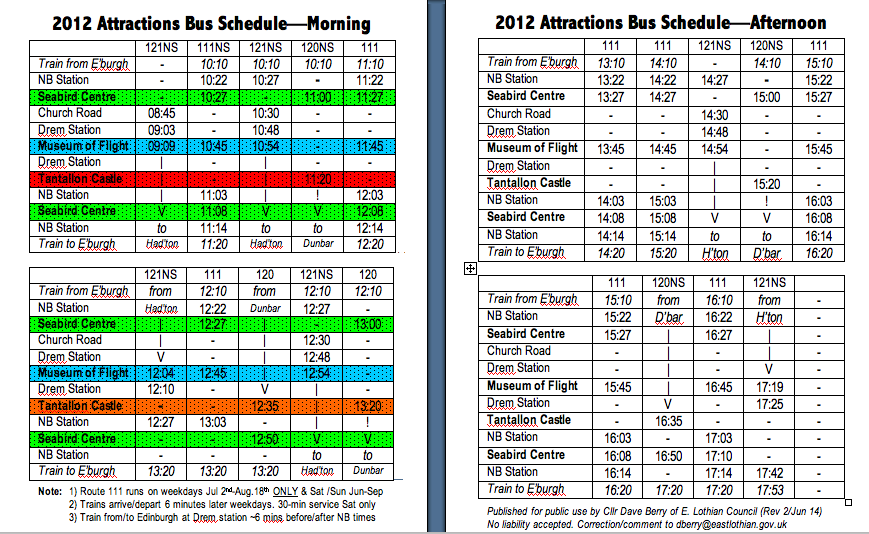
This leaves a real pig’s breakfast: none of the four routes are co-ordinated either with each other, nor with the train, except for shuttle and train. No ticket issued on one bus is valid on another and the concept of a single travel ticket valid on all—bog standard on the Continent for the last half-century—is still a mystery here. Visitors must go away thinking Scotland is a nice but difficult to visit because its public transport is appalling.

So, yesterday was the day I tried to boil this mess down into something palatable. I tried to think like a tourist as to what could make a visit as easy as possible and came up with the formulation below. Whether anyone who gets to the Museum of Flight could also visit Tantallon Castle in one day, let alone see all four attractions, is questionable. This timetable is still deeply flawed and I welcome suggestions for improvement.

But perhaps you can’t get there from here as long as each bus and train operates as if it were on its own isolated planet and information totally ignores any passenger who may never have been there in their puff before. It may be yet another argument why Chelsea Tractors and petrol still make sense at £1.35 per litre.

Posted in Commerce, Transport | Tagged | 2 Comments

In Deep Guano

After years of biting my tongue, I have put myself on our major local charity’s ‘shit list’. This week, East Lothian Council’s new Cabinet approved a paper several years in the making, setting up an arm’s-length North Berwick Harbour Trust to manage most of the non-private facilities within the harbour area. This concept has been some time in the making, building, as it does, on the success achieved in Dunbar, created by the Dunbar Harbour Trust Transfer Order of 2004.

Matters in North Berwick had been more complicated by the number of maintenance issues concerning the harbour itself and the presence of the popular and successful Scottish Seabird Centre within the proposed harbour area. Nonetheless, work undertaken by local volunteers in a provisional Harbour Trust Association had not only brought a degree of focus and management that ELC had been unable to achieve itself but most of the ‘snagging issue’ had been resolved by an immense amount of co-operative work between the HTA and ELC’s Communities department.

Ownership of the area is complex, with a couple of dozen private dwellings being excluded from the proposed Trust control and the local laird having extensive holdings around the old kirk that were leased to and being managed by the SSC. The SSC itself has a 99-year lease with both the Laird and the Council.

Until a year ago, the intention of all involved had been for all ELC assets to transfer to the Trust, including those lands over which the SSC holds its 99-year lease. For the last year, the SSC has waged a resolute campaign to prevent those lands being transferred to the Trust. Their explanation that they would rather have ELC than the Trust as a landlord has gone down very badly with the HTA volunteers and this week’s decision to ignore their protests has caused bad feeling among those who are to form the Trust.

Having been a supporter of the SSC from as far back as local twitcher Bill Gardner’s original idea in the mid-nineties (and, as member No 16, an early activist), I expressed major reservations about the decision to accommodate the SSC and what its repercussions might be. The SSC has certainly helped put North Berwick firmly back on the map as a major Scottish tourist destination.

But, that said, the competitive manner it which it is being managed is causing increasing alarm. From charging local groups like NB Cinema Club full whack for use of SSC facilities, through extending their retail space to compete directly with local businesses and forever increased emphasis on income, as opposed to the original primary thrust of education, it has become increasingly autocratic and insensitive to a community that supported its inception so strongly.

While there was bound to be some competition, the manner in which the SSC took funding to run a ferry to Fife and to purchase a RIB, which then ran in competition with local Bass boat trips after a handful of ferry trips, then growing the fleet to four boats by buying out a local operator, has caused much ill-feeling among other harbour users.

At the same time, the provision of a car park, undertaken originally by ELC, was extended three years ago to cope with demand. But the SSC has raised local ire by issuing penalties local residents who dared use it and now have brought in an external organisation to police parking charges. As any such civil penalty cannot legally do more than recover costs, this cannot represent other than a loss-making operation for the SSC.

Poor relations with other local parties came to a head with the forming of a Harbour Trust. For the last year, the SSC has refused to countenance the ownership of the land on which it sits passing to any Trust. The aggressive manner in which this was argued was never, in my view, given any valid basis. At the same time, they declined to share with the all-volunteer Trust Association plans that they have for expanding into a marine centre. This meant long-term arrangements, such as whether space for a Spiegeltent on the Esplanade as part of future Fringe by the Sea events could continue, came into question.

So, this week was the parting of our ways. I sounded off loudly in the Cabinet debate and my name is now guano among the SSC’s illustrious board members. But I just can’t rationalise how can you make a forward-looking partnership of a Trust successful if a major player therein expresses no trust in its supposed partners. With their lease secure for 99 years, what adverse change could be forced on them? What on earth was their motivation—other than gratifying their own paranoia?

Having failed in my efforts to relevant persuade ELC officials all the way to the Chief Executive and Council Leader of the foolishness of launching any Trust where a major partner exhibits megalomanic selfishness, I had to protest that ELC would better serve the community at large by holding off on the Trust until the SSC learns what the word ‘trust’ actually means.

Your Humble Scribe (sans Guano) in Crusty Mariner Gear as SSC Volunteer Guide in 2010

Posted in Commerce, Community | Tagged | Leave a comment

CoSLA Gets Grumpy

The Convention of Scottish Local Authorities is, even by its own admission, something of an anorak organisation. Tucked away in the monolithic glass-and-concrete office blocks trapped between the endless tram works on Haymarket Terrace and the endless trains streaming through Haymarket station, its couple of dozen staff spend their time trying to speak for the 32 councils that cover Scotland.

Once almost entirely a Labour fiefdom, that all changed in 2007 when all but three councils swung out of Labour’s overall control and the SNP became a comparable force in CoSLA by sending, for the first time, a comparable number of delegates. We’ll leave CoSLA’s organisation and effectiveness in its role to another blog.

The key issue is that, pre-2007, despite Labour dominating both it and the Scottish Executive (as the Scottish Government was then styled) they went at each other in best stairheid rammy tradition. SInce 2007, the Concordat, the lifting of restrictions like funding ring-fencing, new and enlightened leadership from President Pat Watters and realpolitik breaking out among the more balanced delegate coherts, all led to five years of constructive dialogue and real progress in government/council relations.

The first shift came in 2011 when the SNP suddenly dominated the Scottish Parliament with 69 MSPs—the first majority enjoyed there—and the mood music changed, Cabinet Secretary John Swinney, whose brief includes local government, did not change but the SNP’s tail had gone up and more ambitious, if not abrasive, statements started to emerge. At the same time, the Local Government brief was handed to Aileen Campbell—young, bright but split new into the job of MSP, let alone in wrestling with council neanderthals from darkest Lanarkshire.

That lasted a short time before Derek Mackay, also part of the young & bright MSP intake but with four years of leading Renfrewshire Council and the SNP delegation to CoSLA, a more experienced hand. Trouble was, Derek was so highly thought of, he was also given the SNP Business Convener gig, formerly handled by party heavyweight fixers Bruce Crawford MSP and Angus Robertson MP.

But, nonetheless, the CoSLA—SG relationship continued to work in a far more constructive manner than it had pre-2007. Key issues like pay negotiation or council tax freeze were tabled, discussed and agreed; various policy initiatives affecting councils like alcohol minimum pricing or police/fire reform were aired and, if not concluded, were seen as useful exchanges of position.

But roll forward to last month, when the council elections saw a significant number of council administrations alter on the backs of the results, and we may yet see the most significant outcome of those elections be the CoSLA delegate allocations made by the new administrations.

Delegate numbers are proportionate to the size of council (generally 3 to 6) and CoSLA policy (unenforceable) is that they should reflect the political composition of the council. So, whereas my own East Lothian had once sent 3 Labour delegates pre-2007, we sent one each Labour, SNP and Lib-Dem for the 2007-12 sessions. Both Lanarkshires had kept their pre-2007 thinking and had each sent 6 Labour delegates.

This meant, despite winning more council seats than Labour, SNP delegates to CoSLA were outnumbered. What kept CoSLA balanced, however, were healthy delegations of (in order of size) Independent. Lib-Dem and Tory councillors. CoSLA roughly reflected the average council where SNP & Labour held the biggest groups but neither dominated alone. But the demise of the Lib-Dems has changed much in council control and the net makeup of CoSLA will not become clear until its first full meeting on June 29th.

In North Lanarkshire, Council leader Jim McCabe, a long-time CoSLA delegate and believer in the justification for Labour dominance, told the Wishaw Press: “The job we have here is to make sure the council is best represented on any forum.” As a result, all six of its delegates are again Labour.

In Falkirk, the politically awkward set-up of Labour/Tory administration will take three of the four positions and their is every indication that major councils like Aberdeen and Stirling with the same type of administration will follow suit. The latter is likely to be especially one-sided as Leader Corrie McChord has ambitions to replace Pat Watters as President and will want to secure as many delegates as he can to beat the SNP’s Rob Murray, a veteran CoSLA vice-president and Leader of the newly revived SNP in Angus.

Since Labour controls only four councils outright, with four minorities, while the SNP controls two with three minorities, it might seem a close run thing. But, on top of four LAB/CON councils, others are making unionist noises about keeping the SNP down in local government to help balance their uppitiness in the Parliament. Of the other coalitions, six exclude the SNP entirely, while another six have some form of SNP presence in the Administration.

Given the co-ordinated aggression with which the SNP was systematically excluded from power where that was feasible, the chances of delegates being assigned on the same principles seem low. The 11 where the SNP have a say are likely to follow the practice from 2007 of allocating delegates proportionally. But if the 18 others (3 are wholly independent-run) follow Jim McCabe’s partisan lead, the years of partnership between CoSLA and the government is about to be replaced by partisanship.

As the relevant minister, Derek Mackay has already registered his concern that a more hostile, not to say obstructive, era may be about to dawn. Holyrood quoted him saying:

“I have to express some concern at early indications that some local authorities are appointing delegate entitlement entirely for the administration. That doesn’t seem to respect the COSLA guidance on proportionality and fairness in representing the political composition of the local authority.”

With their eight official spokespersons and working groups, backed up by CoSLA staff, the opportunity for guerilla actions and PR bouts with the Scottish Government is huge. Issues such as pensions, pay freeze, budget limits, shared services, ballooning services for the elderly, etc are all hot topics already and allies in unions or segments of the public to make them hot-spots would not be hard to find.

But the whole edifice of Concordat, Single Outcome Agreements, council tax freeze and joint working across public agencies, so carefully constructed over the last five years, could be in jeopardy. Perhaps leaders like McCabe are not prepared for the equivalent of local government civil war because their own budgets could get even worse than they are. But with the independence debate representing as serious a decision as any generation has confronted, why wouldn’t a dedicated unionist use every weapon to hand to derail it?

Posted in Politics | Tagged | Leave a comment

A Gorgon for Me; A Gorgon for Me

Ed Milliband’s speech on “Defending the Union” given at the South Bank’s Royal Festival Hall on June 7th was, in many ways, long overdue. Despite Tory protestations at being the prime defenders of the United Kingdom (although the ‘Unionist’ part of their title is actually a century-old reference to Ireland), their political decline in Scotland clearly makes Labour the leading party in any real defence of the status quo.

The speech was competent, well delivered and, most importantly, long overdue. Almost certainly, unionists of all political stripes would have felt relief, if not encouragement, that the UK’s main opposition leader had nailed his Union flag firmly to the mast. Indeed, in it was much that thoughtful supporters of independence could warm to: the idea that being English/Scottish and British was no contradiction; that peoples of this island shared much common culture, pride and history; that how we work together here will determine all our future prosperity and happiness.

It was widely reported, as it should have been, as a major statement on the subject. The Hootsmon chose, in its usual corrosive style, to lead on Ed’s argument that England ought to have a say in any independence deliberation for Scotland and that his own party has been guilty of burying English identity for fear of retreating into a “narrow nationalism: for too long people have believed that to express English identity is to undermine the Union.” Fair enough, but then he claimed that this year’s jubilee and Olympics had heightened awareness of “multiple identities”.

And this seems to be where Ed (and many of his well intentioned colleagues) get themselves into difficulties, conflating geography with identity, past history with future ambitions and culture with politics. People are complex—their cultures are bewilderingly so. Yeats—no stranger to the complex path to independence—said “Out of the argument with ourselves, we make poetry; out of the argument with others, we make politics”. And, just as friendship or even marriage is a series of adjustments to the ideal, our imperfect political arrangements constantly balance ideals with pragmatism. A man who knew something about putting a Union together was Bismarck, whose “Politics is the art of the possible” has been a much-used quote since.

No-one argues that Britain has not been a success as a country. For most of three centuries it was the world’s leading power. In contributions to science, technology, trade, culture, industry, arts, society, freedom, etc, etc it need bow to no-one. Its four peoples bonded together to catalyse many other greater and lesser countries, all of whom (with the glaring exception of Zimbabwe) are beacons of progress across the globe. Our joint history, especially when couched in resonant Churchillian prose, makes a rattling good read.

But, equally, no-one now thinks of Eire as anything but a normal country AND, at the same time, a full partner in the English-speaking world, in the EU and even in the British Isles. Relations with the UK are superb; if there are any wrinkles they are found in that part of Ireland that Imperial Britain could not thole losing in 1922. Just as the Irish once wrestled with their own identity and own political existence, so the Scots and the Welsh are making excellent progress in this and—thankfully—in a more peaceable way.

All of which leads to the discussion of England and its own identity and political existence. Here, Ed’s speech was much less surefooted. Without examining the case, he dismissed the need for an English parliament or even a discussion of what it means to be English, as opposed to British. This seems a major mistake. Labour Uncut has written a pretty shrewd analysis of the speech, in which it compares Ed to Perseus who, while talking cogently about the problem, evades entering the Gorgon’s cave to slay the Medusa of Englishness.

The analysis focusses on Milliband’s conflation of culture with politics:

“English cultural expression is “not about an English Parliament or an English Assembly.” So wave the flag of St.George like Bobby Moore was still captain of England but don’t get all political about it? We’ll have none of that.”

England does need a thorough awakening from the complacency with which it patched its own institutions 300 years ago to make the UK, rather than seeing any need for new ones. The jubilee rather highlighted this where not just Auntie Beeb kept using the word British when it meant English because it is all too easy not to bother with the distinction. In 1707, Scotland received representation in the English parliament with a handful of MPs and 16 peers. The Church of England continued unaltered with the British monarch as its head. The Bank of England continued as the reserve bank of the British state. Nelson’s famous message at Trafalgar started “England expects…”

It is not that the Scots should be touchy about all this—indeed, I think we have tholed three centuries of English jingoism with a fair bit of good humour. But the time has come to look England straight in the eye and ask what it wants to be when it grows up. That Scotland was already heading its own way was obvious in the 1987 General Election which Robin Day regarded as a non-event because the Thatcher majority shifted marginally from 140 to 100. And yet, Scotland voted massively against the Tories, who lost 11 of their seats there to have 10 in 71.

Ed sees no need for an English Parliament because the 1990’s Labour initiative for regional assemblies got short shrift. That was because England is a pretty monolithic state—and always has been. Compared to Germany its regional politics are barely discernable beyond a habitual North/South divide based largely on industrial cities and rural idylls. Labour is now banking on that lack of concern locking in the status quo. But the constitution is lop-sided and unstable. It will actually take a force of will for it not to topple. It may not be in 2014 but it is by no means unimaginable that a strong argument for a political expression of Englishness will succeed beyond then.

The Scots have done this. Our Medusa Gorgon is toast. In the last decade and as compared to the turbulent 1980’s, confusion about what it is to be Scots and how their political ambitions are to be realised has abated. What will happen in 2014 may still be an open question but most are up for asking it—even as they disagree on the answer—just because it will clear the decks and move a country the great majority identify with further down the road to its future; the fishermen of Fraserburgh and the Pakistani-Scots of Polloksheilds all accept this.

But it’s a road England has yet to set off down. Feeling cosy after the jubilee warmth may not be the time to bring this up but, if not Ed, someone has to not just pose the question of Englishness but to boldly enter the cave where it lives and drag its severed head out into the light of day for all to see what exactly this was all about.

Image

Posted in Politics | Tagged , | 1 Comment

EIS empty vessels making a lot of noise

EIS empty vessels making a lot of noise.

Posted in Education | Leave a comment