It’s Democracy, Stupid

It’s a curious world we live in. Yesterday, unionists presented a panel of “election experts” to frame a single referendum question for consideration by the Electoral Commission. The launch of the panel came as Scotland Office Minister David “Nae Scottish Mates” Mundell said backing a second question would be an “upfront admission of defeat” for Mr Salmond.

Let’s leave aside that two of the three unionist parties’ policies (Labour & Lib-Dem) support strengthening devolution—and they’ve previously held these views for an honourable length of time. Obviously, the “Better Together” movement must be Tory-dominated. In their unionist extremism, they have opposed any power being devolved anywhere at any point in history; they at least get credit for consistency. Yet their panel of three to formulate is distinguished and qualified, even if some do have unionist ‘form’.

But whatever conclusion on formulation they come to, why have opposition parties swung lemming-like behind the single-question position? Could it be a tactical ploy, a confusing red herring? A choreographed wailing-and-gnashing-of-teeth portrayal of an independent Scotland frames a stark choice between the familiar warmth of Ma Britannia’s hearth and the unknown maelstrom of financial turmoil outside. Their formulation of a question may not be as blunt—but look for it in the subtext.

It is unusual for all three opposition parties to be obtuse at once, even for political short-term advantage. It’s not difficult to determine what sort of referendum the Scottish people prefer; it’s an almost eerie three-way split among three clear choices. This was underscored again this week by a TNS BMRB poll conducted for The Herald that posed both a two- and a three-option referendum and compared results.

In the two-option version, they were asked one question—basically a ‘yes’ or ‘no’ to independence. Their formulation was, with results shown in Table 1 below:

  • I AGREE that the Scottish Government should negotiate a settlement with the Government of the United Kingdom so that Scotland becomes an independent state.
  • I DO NOT AGREE that the Scottish Government should negotiate a settlement with the Government of the United Kingdom so that Scotland becomes an independent state

Table 1—Two-Option Referendum Results. Source: TNS BMRB

Though the demographic variants are interesting, all groups roughly corresponded to the overall conclusion of 5 people disagreeing for every 3 people agreeing. Even died-in-the-wool independistas would have to admit this portends no rousing victory for their cause. But, note that the ‘undecideds’ sit around 20%—one in five don’t like either option.

However, TNS BMRB went on to survey the results if three options were available (adding what is generally referred to as “Devo-Plus”/”Devo-Max” to the two above), as outlined below, with results in Table 2:

  • Keep the current arrangement of a Scottish Parliament with its existing powers.
  • Transfer more powers from Westminster to the Scottish Parliament, including tax and welfare but excluding defence and foreign affairs
  • Full independence for Scotland

Table 2—Three-Option Referendum Results. Source: TNS BMRB

In this case, the number of ‘don’t knows’ halved, with nine in ten ready to choose an option. The largest proportion of respondents (37%) chose the one option unavailable in the single-question/yes-no/two option survey in Table 1 (more powers without full independence). The proportion supporting the status quo dropped by 3 in 5 to 20%, while those for full independence maintained second place at 27%—barely down from Table 1. Again the demographic variances are interesting but not decisive.

Unionists can bleat all they like about ‘straight choices’ and play their brinkmanship game. But when given several options, eight in ten of the Scottish people are dissatisfied with what they have, with four of them wanting all but external affairs transferred and a solid three of them resolute for full independence. That latter number will grow, the more those four-in-ten voters ‘in the middle’ feel democratically ignored and dissatisfied.

It is entirely up to the unionist ‘no’ campaign to pursue their arguments any way they see fit. But choosing to dismiss 37% of the voters when that option has been publicly part of their long-held policies and beliefs strikes me as carrying tactical political ‘advantage’ to the point of self-immolation. It seems unprincipled, undemocratic and, frankly, stupid.

Roll on 2014.
Posted in Politics | Tagged | 2 Comments

Like Wolves at Lambing

With the blog a week ago titled The Whole Wunch of ‘Em, I hoped to have cleared the air about the scale of malaise gripping the country’s morals and proposed some ideas from others how things could be actively improved. But, having picked up what various other commentators are saying, it seems this is more than a hiccup of our financial systems; it is a crisis of faith among the general public as to what society is for in the first place.

The right-leaning-but-thoughtfully-articulate Economist has a piece on the LIBOR scandal in which alarm bells are ringing: “What may still seem to many to be a parochial affair involving Barclays, a 300-year-old British bank, rigging an obscure number, is beginning to assume global significance.Joyce MacMillan—who seldom agrees with anything the Economist has to say—blames “a global elite who seem to have convinced themselves, long since, that whatever rules are in force simply do not apply to them.”

In fact, Joyce is on a crusade of ideals, shared by many, that UK society has fallen in thrall of what she describes as “Junk Thatcherism”—that everything and everyone has a price, and that all human interactions can finally be reduced to the model of some kind of market transaction, or “investment”.

An alternative perspective came in the Reith Lecture at the Royal Society of Edinburgh, Professor Niall Ferguson points the finger at “welfare as the culprit, corroding our moral fibre, and bankrupting our institutions.” Yet even American stalwart supporters of their beefy brand of capitalism like the Washington Post are crying foul and accusing major banks of cowardly, if not criminal, behaviour: “It takes little effort or intelligence to make a profit when you’re setting a rate and betting on that rate at the same time.

Whatever your perspective, the whole thing is appalling. But what makes it worse is the crass inequality with which the financial crisis is striking people. Channel 4’s Dispatches will have Jon Snow leading one of their typically mordant reports on July 23rd on the effects of mis-selling on ordinary people that puts a human face on this tragedy. Without revisiting what I blogged about a week ago, it seems this whole thing goes deeper than any other event since the miners’ strike.

No matter who does or doesn’t get prosecuted over LIBOR, people’s faith in bankers—once up there with doctors and ministers—has fallen into the mud. After the amateurish Commons interview of Barclay’s Bob Diamond and the yah-boo-sucks tone of the spat between Balls and Osborne coming on top of exposure of grubby attitudes to expenses at Westminster, the politicians at the helm are seen as little better.

Fundamental questions are being asked, rightly, about what drives the UK. But they are not being asked by leaders in politics, banking or most other business endeavours, where it appears to be business as usual. The sixties and seventies were a car crash for British socialism that cleared the way for Thatcher’s capitalism. Whatever your misgivings about it, that brought growing prosperity to most for the next three decades.

But, like the USA (and unlike most of Europe) Britain never set much by way of limits to problems for which capitalism might be the solution. Most of our problems stem from those limits of capitalism. The railways are cod capitalism that remain state dependent and not efficient. The same applies to most of transport system, those bits of the NHS hived off—and the banks. This last is not because Lloyds and RBS are now state owned but because they were in the “too big to fail” box and not really subject to the market.

People often portray markets as being all about self-interest. But self-interest is as essential part of the human character and it has been argued that markets harness and control self-interest to the benefit of all. So long as customers can shop around, businesses must continually reduce prices and improve quality. It is this dual tension, where self-interest is held in check by the free choices of others, that drove our prosperity.

What torpedoes this virtuous cycle is monopoly control, which is why the state-owned model works poorly. And this is our tragedy, as played out by our banks. They were deregulated and so swallowed up competition until they achieved artificial competition like our rail companies. Nobody said much when the government took over GNER and kept the trains running as East Coast. But what kind of ‘market’ is that?

A market where you don’t need literal corruption for it to infect the banking system. You just need banks big enough so that the jobsworths keeping an eye on them have nightmares about what happens if banks fail. At that point the jobsworths will dedicate themselves to keeping the megabanks afloat at all costs, even it requires methods that aren’t on the up and up.

It’s a heady mixture: untrammeled cowboy operations by so-called ‘investment’ arms of banks, sustained by high street monopolies that drain bank fees, savings and what should be business investment money and cascade it all into the hands of people who get huge bonuses to take risks on derivatives with other people’s money, all underwritten by the state. No wonder they got in trouble; the wonder is it took so long.

But how to unmake the omelette and all these broken eggs? With government and senior bankers behaving as if business as usual were an option, this ludicrously broken system is being preserved. And the once-solid trust of the punter to work hard, pay taxes and retirement rewards will surely come is paper-thin. Tom Meirs offers positive suggestions in today’s Hootsmon but it would take years (and independence?) for them to take effect.

Meantime, why should anyone believe “we’re in this together” when Diamond walks away laughing from his Commons “grilling” en route to plopping a cool £17m severance into his piggy bank? …when the Government front bench is stuffed with millionaires who largely made all that dosh from the system described above? …when the opposition bench were not only tholed but embraced Tory policies (PFI; bus deregulation; arms sales; MoD outsourcing; foreign wars; Trident, etc, etc) throughout their 13-year tenure.

The line from the film Rob Roy about the elite running his country seems apposite: “They are like wolves at lambing” he growled. Once people get angry en masse about not just the recession and how badly it has hit them but that the ones who did it to them are still prospering, still running the show, how long will British sang froid and patience hold? The carnage of riots last summer was visited on a swathe of towns by a few thousand disenfranchised youths.

What happens when Middle England joins in?

Posted in Commerce | Tagged | 2 Comments

Butcher’s Choice

Many column inches have been expended in pursuit of ‘nasty nats’—those Scots impatient to live in a normal, independent Scotland but whose impatience provokes them into rash statements and personal attacks on those who stand in their way. I have found few of the nasty kind. Most are quiet, dedicated and, if passionate or articulate, neither hostile in expression nor personal in attack.

Most of us are also on record as fans of the English, admirers of their culture and champions of what our two countries achieved together. But, sometimes, a blithe England-as-centre-of-the-universe insouciance exasperates even its fans to the point of anger. This happened again just this morning when I sprayed coffee all across an article in SoS that a statue of the Duke of Cumberland was again to be placed on the empty plinth in Cavendish Square in London.

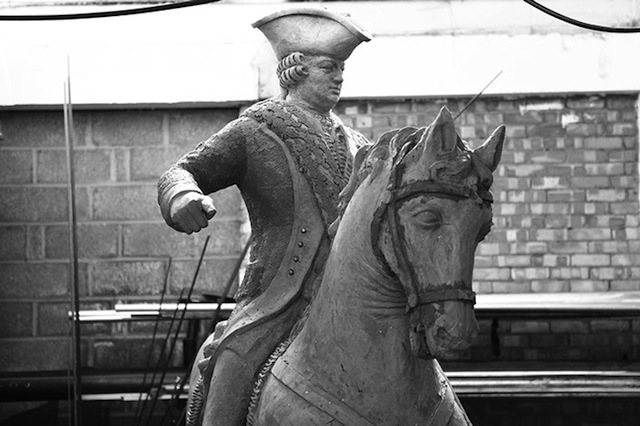
Westminster Council (second only to the CofE as “The Tory Party at Prayer”) has commissioned Korean artist Meekyoung Shin to sculpt another life-size likeness of William, the Marquess of Berkhamstead in the County of Hertford, Earl of Kennington in the County of Surrey, Viscount of Trematon in the County of Cornwall, and Baron of the Isle of Alderney—better known as the Duke of Cumberland, second surviving son of George II—to replace one removed in 1868 in deference to Scottish sensibilities.

Replacing it now may not be a unionist ploy to piss off the Scots—but it’s hard to imagine a more tasteless one that would tread on our sensibilities in any more clodhopping fashion.

Displaying physical courage at an early age, William became his parents’ favourite and rose quickly in the Army to command the Foot Guards and then England’s eternal tussle with the French. He was victorious, if wounded, at Dettingen (1743) but fluffed his chance at Fontenoy (1745). By this time, Charlie’s wild Highlanders were on the march towards Derby and, in the ensuing panic, he was recalled from Flanders as a popular general who would deal with this worst of these recurring Jacobite rebellions.

Credited with pulling together and training a badly rattled British army to face the apparently unstoppable energy of a Highlander charge, William chose his ground well at Culloden Moor. His men scythed down the clans where they stood with grapeshot from artillery, flanked them with musket fire as they charged in frustration and defended with a new, simple close quarter tactic—bayoneting the enemy to their right beneath his targe.

Thus far, history shows him a capable, if unremarkable, general who got done the key job of clearing the threat of invasion from the rear. But, such was the fear the Highlanders had induced that he went much further, ordering his men to advance after the wild charge had been broken to bayonet enemy wounded found on the field. For his 52 casualties, he left 1,200 Jacobite dead on and beyond the moor, taking only 550 prisoners (mostly French, the only ones he recognised as legitimate combatants).

With the tacit support of the King, government and much of Lowland Scotland (Glasgow even awarded him an honorary degree), he then set about systematically dismantling the gaelic-speaking Highlanders’ way of life. Although ‘government’ clans like the Campbells were spared, Jacobite clans (almost all Catholics) had suspected rebels murdered complicit settlements burned and rapacious soldiers billeted on them. But, most ruinous of all, the herds of cattle by which clans measured their wealth were driven off and auctioned to part-pay for the campaign (and end up in some officers’ purses).

It was systematic destruction of a way of life, a genocide before that word had been coined. Quite apart from the hundreds killed or died of starvation, proud clan chiefs were ruined along with their clansmen. And many, defying Highland custom of holding land in trust for the whole clan, became English-style landlords, turning clan lands into businesses, replacing subsistence farming with sheep, thereby throwing thousands into homelessness and starting the Clearances. Though only there a year, Cumberland’s harsh influence still echoes through empty glens or lies mute under rickles of stones that were once homes.

Ironically, to survive many clansmen joined the very army destroying their heritage. The famous Highland regiments were formed from them. Each earned praise from officers up to Wellington for resolute toughness, courage in adversity and a fearsome effect upon Britain’s enemies around the globe. It was only when the Clearances had long done their baneful work that the British Army found any regret—that it could no longer raise fierce Highland battalions for the Crimean War as it had done for the Napoleonic.

Cumberland returned to Flanders where his undistinguished generalship lost the Battle of Lauffeld and ended the war for a while. The relieved British establishment had meanwhile lauded him as ‘Sweet William’ after the common ragwort dianthus barbatus. But his epithet among Scots is they call this plant ‘Stinking Billy’.

As his post-Culloden predations became better known, his political ambitions were frustrated. Even a return to military action in the Seven Years War did him little good. While Britain was generally victorious, Cumberland lost Hanover to the French. On his return, George II’s dry comment was: “Here is my son who has ruined me and disgraced himself”. He failed even to secure the regency over his nephew, George III, when his elder brother died.

Cumberland spent his last days advising his nephew. It is not known if he was complicit in forming George III’s intransigence that lost Britain its American colonies. He died in 1765 and an equestrian statue in lead was cast in 1770 for a plinth, originally intended for a statue of Queen Anne. That it stayed almost 100 years before being removed speaks volumes for English chauvinism and insensitivity. That another is being erected does little to dispel the feeling that either has moderated in the meantime.

The only good news is that it is being sculpted in aromatic soap so that Stinking Billy can slip away from us, albeit more slowly this second time.

Hanoverian Hygiene—Soap on a Dope

Posted in Community | Tagged | Leave a comment

Time to Play Chemin de Fer

Today the Torygraph reports that MPs have announced that over-optimistic forecasts for passenger demand have left taxpayers “saddled with £4.8 billion of debt” over the 68-mile HS1 London-Folkestone Channel Tunnel rail link.

Total taxpayer support over the period to 2070 is likely to be £10.2 billion. Apparently, international passenger numbers on HS1 are only a third of the original 1995 forecast and two-thirds of the ‘corrected’ Department for Transport forecast in 1998.

Oh aye, bluidy typical!” comes the standard Scots gripe. “Thae English tak’ wur siller tae pay fur mair whigmaleeries doon in Lunnon”. The original plan for Regional Eurostar services to destinations north of London was abandoned after connecting services from places like Edinburgh saw little traffic.

But the problem with those services is that they took much longer then bog-standard GNER trains at the time. Now significantly improved journey times are available with HS1. It is physically linked into both the East and West Coast Main Lines (ECML & WCML) through Stratford International and the North London Line to Willesden, Watford and points north.

Recently increased maximum speeds on the WCML should make Regional Eurostar services to/from the Midlands and Scotland commercially viable. However, Simon Montague, Eurostar’s Director of Communications has said” “International services to the regions are only likely once High Speed 2 is built.”

By Eurostar’s own estimates, following the December 2009 opening of the Benelux HSL Zuid, a London–Amsterdam journey is estimated to take 4¼ hrs. In 2010, international rail travel was liberalised by new European Union directives, designed to break up monopolies in order to encourage competition for services between countries.

Germany’s Deutsche Bahn, now intends to run services between London and Germany and the Netherlands. The sale of HS1 by the UK Government (having effectively nationalised the original ‘London & Continental Railway’ in June 2009) is also likely to stimulate competition on the line.

But all these new ideas refer to London-to-Continent traffic. The ‘regions’ remain ignored—partly due to English xenophobia about foreigners (all Chunnel trains run as if they ran only on UK soil) but mostly due to London-centric thinking that is the bane of the rest of us. In a 21st century of international trade, Schengen agreements and foreign travel by everyone and their granny, isn’t it time that the massive public investment of £21bn that is the Chunnel and HS1 were utilised by the 80% of the UK that isn’t London to recoup their £16bn subsidy of the capital?

The Labour government of 2010 didn’t think much of the potential for a link from the Midlands to HS1, let alone from further North. They claimed:

“Running direct services to Paris or Brussels would bring Birmingham within three hours and attract a significant market share, but the market would not be big enough to fill a 400 metre train a day in 2033.” (HS1/HS2 Connection by C. Stokes)

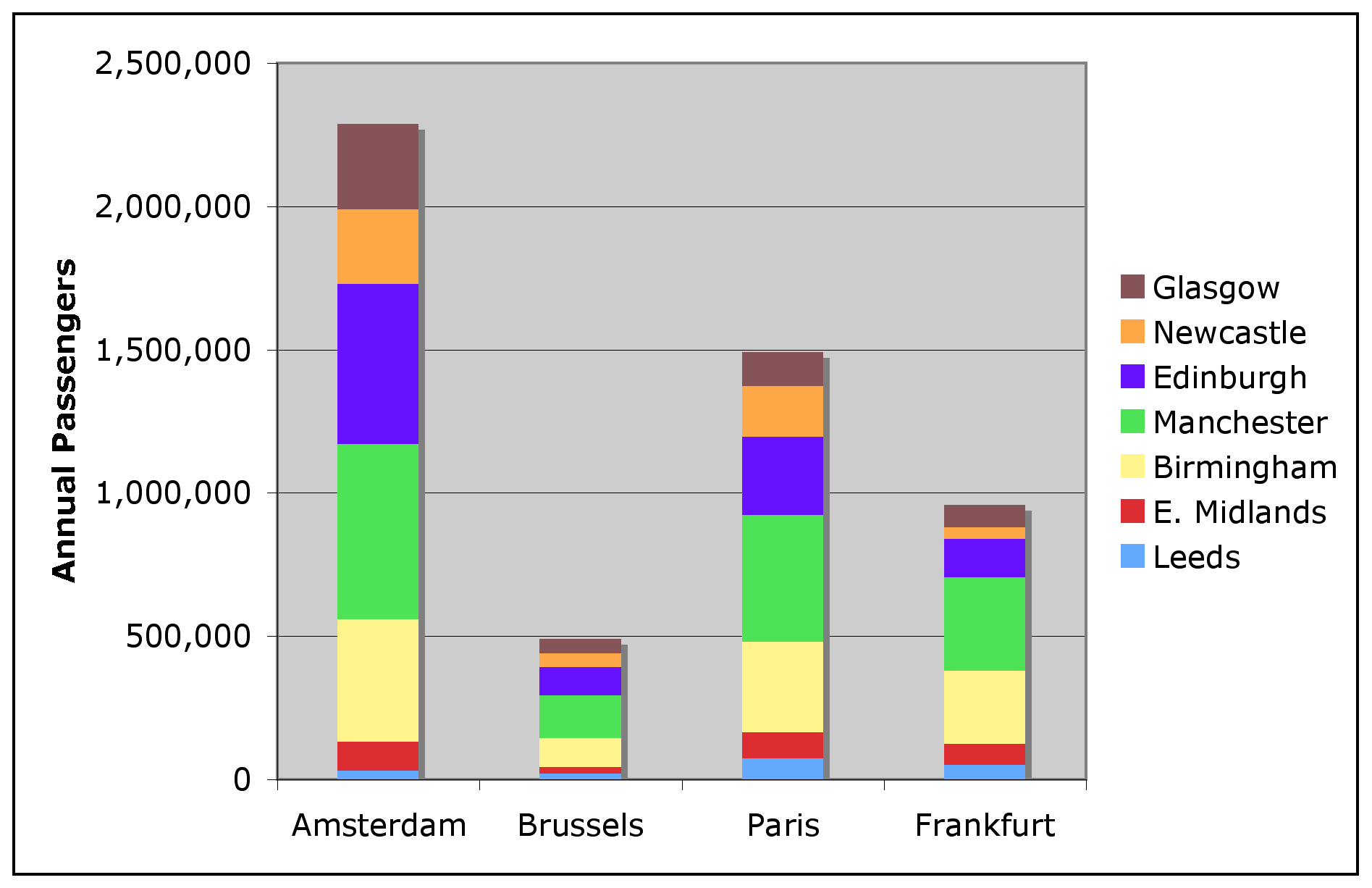
Oh, really? There is no real need to wait for any HS2 for this ‘other 80%’ to start exploiting fast rail to Europe. Booming Continental air traffic from everywhere North of London is a clear sign of the demand. An overview is shown in Chart 1.

Annual Air Passengers North Britain to Near Continent

Some 5 1/4 m people fly between the areas in question. Even assuming only 50% of those as the potential market, 20 trains a day, each carrying 360 passengers could not transport them all. This represents a considerable untapped market that neither Eurostar or the UK Government seem keen to exploit, quite apart from the ‘green’ element of not piling even more people into fuel-inefficient short-haul jets.

Both HS1 and the Chunnel are underused. To date, only the Eurostar’s monopoly makes use of its 100 mph (160 kph) capability and even they stop running between 10pm and 6am. That’s 33% of capacity underused. Rather than just running more trains, there are three distinct businesses untapped, each of which appears viable in the circumstances:

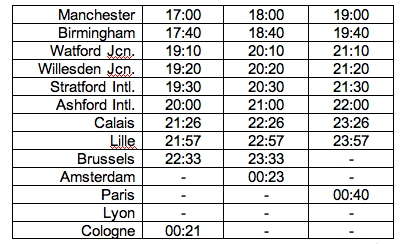
  1. Evening services between the Midlands and the Near Continent (targeted at businessmen who want to return home in comfort that same day)
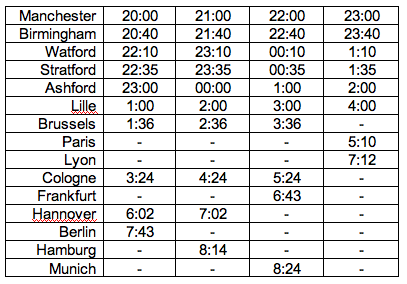
  2. Sleepers between the Midlands and the Central Continent  (targeted at those who wish to save travel time in comfort getting to/from Berlin/Munich/Geneva)
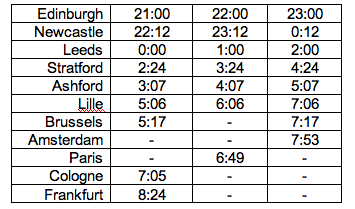
  3. Sleepers between Scotland/The North and the Near Continent (targeted at those who wish to save travel time in comfort getting to/from Amsterdam/Paris/Frankfurt)

If such services ran at Eurostar/ICE/InterCity225 speeds, all of the above could be encompassed through using the currently unused 33% capacity of HS1/Chunnel. Draft timetables are shown below.

Table 1—Draft Chunnel Timetable for Midland/Near Continent Evening Services

Table 2—Draft Chunnel Timetable for Midland/Central Continent Sleeper Services

Table 3—Draft Chunnel Timetable for Scotland & North/Near Continent Sleeper Services

Now that Network Rail has adjusted much of the British network to accommodate European dimension trains, the main problem would be differences in power standards for overhead lines in some countries. The concept of a fast service that could shift over 2m passengers onto rail each year is surely a driving incentive for future travel.

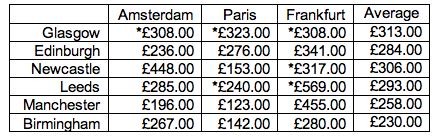
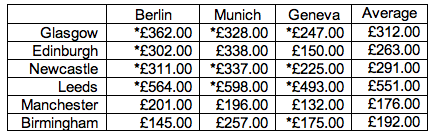
As to the business side, that seems conclusive. Compare the air fares available between the destinations cited above and, despite low-cost airlines flying to some, examples of the cheapest return fare bookable at 10 days’ notice (below) show very adequate margins:

Table 4—Current Cheapest Air Fares to Near Continent (*no direct flights)

Table 5—Current Cheapest Air Fares to Central Continent (*no direct flights)

In a third of the cases, no direct flights are available, which puts fast rail at a speed advantage too. For the rest, standard return fares of around £200 from the Midlands and £250 from Scotland/North would make them competitive with the air alternative, while the option for luxurious facilities that would justify a true 1st Class service at less than the £750 typically charged by major air carriers.

Assuming an eight carriage sleeper train (two of which are 1st class) gives a potential revenue of some £40,000 in revenue per train. Extrapolating a year’s revenue for the ten trains described above at average 50% loading gives a rough turnover of £45m each year, even allowing one night per week (Saturday) with no trains for track maintenance.

Given Eurostar’s revenues of around £675m, an enhancement of 7% in payments for use of HS1/Chunnel would change its finances and point the way for a far easier integration of UK business outside of London with its Continental partners. And all that would be based on switching only 25% of those using airlines to travel from the Midlands/Scotland.

Once a UK government realises the short-sightedness of zero VAT and duty on aviation fuel, the gamble on air traffic as sole mainstay of UK Continental interactions outside of London will become even more obvious. Once ‘regional’ service is proved with the above, the folly of assuming everyone changes in London will be exposed and interchange points like Willesden and Stratford (as connected as St Pancras but much less crowded) will become popular with Londoners too.

Posted in Commerce, Transport | Tagged | Leave a comment

Danny Dare: Bigot of the Future

The launch of the “Better Together” campaign last week (no, not this one, nor even this one, but this one) generated reasonable and measured statements from heavyweights like ex-Chancellor Alistair Darling and positive signs that unionists are finally getting their act together to articulate proper reasons why the UK should continue to exist.

Despite already being enthusiastic about the benefits of Independence themselves, nationalists of the Scottish persuasion are neither narrow in their outlook nor blind to cogent arguments deployed against them by such campaigns. There are many debates to be had and questions to answer. Few of us think that the great apolitical majority will embrace a different future, no matter how enticing, unless those advocating change deploy credible reassurances and plausible reasons for taking such a step.

At the same time, any arguments why staying in the Union would be beneficial also need to be made with depth and cogency. Glorious joint histories, shared civic cultures and even geographic closeness are all important. But they are not, by themselves, decisive: why would 50-odd members of the Commonwealth abandon empire; why would Slovakia and Czech Republic, Sweden and Norway, Malaysia and Singapore not have each stayed together as one country if “better together” were a universal truth?

Many unionist protagonists are starting to build their case and should be commended for that, especially as years of frankly bratty behaviour, of pouring scorn on the concept or simply declaring this to be “the strongest union the world has ever seen” has clearly not worked. On June 25th, constructive joint statements from Darling, Rennie, Lamont and Davidson demonstrated considerable cross-party strength and encouraging signs that thrawn naysaying would no longer form the major part of a unionist campaign. “We make a positive case for staying together. A positive case that celebrates not just what makes us distinctive but also celebrates what we share” Darling claimed.

Fair enough—’bout bloody time.

Except that one of the team seems yet to have ‘got’ this religion. As Chief Secretary to the Treasury, Danny Alexander plays a pivotal role in running the Union, as well as representing a large slice of Scotland’s photogenic scenery. But he does not diplay this new enlightenment. Since the campaign launch, he has been singing the same wrist-slitting dirge as before. Yet, any of his pronouncements must be seen in a context that throws his judgement—both political and financial—into some question. He has:

  • told a London City audience that the oil tax increase the UK government imposed on the North Sea, and which threatened developments and jobs in the North Sea was “my idea, which I proposed a few months ago.” Entirely unhelpful to the British economy, let alone the Scottish.
  • argued that the UK Government’s £10 billion tax raid on the offshore industry “would be good for people in the north and north-east.” Again entirely unhelpful to the British economy, let alone the Scottish.
  • claimed “mortgage rates will be linked to government bond issues in an independent Scotland“. This claim was debunked by Dan Macdonald, Chairman of the Scottish Property Federation 2007/8
  • said “cutting the top rate of tax would be cloud cuckoo land”. Now, he supports a budget that is doing precisely that.
  • claimed “regional public sector pay was a distant and unlikely prospect.” He had previously written to the Welsh First Minister saying he was “keen” to see it introduced.
  • been author of the current budget’s ‘omnishambles’—successive U-turns on 3p rise in fuel duty, tax relief on charitable donations, and VAT on pasties and caravans.
  • entered the 2010 election pledging not to increase tuition fees, to oppose an increase in VAT and on a platform that would not back Tory austerity cuts. Upon entering government with the Tories he has reneged on each of these.

This is no track record to write home about. So his baleful pronouncements on the fiscal evils of independence must be seen as not just running counter to his unionist colleagues attempts to make a positive case for the Union, but also deriving from a kind of innumeracy that sits badly with his day job. Some examples:

  • July 5th 2012: “Scotland will have a large budget deficit, be overly reliant on oil revenues and would see financial services flee south of the Border.” That deficit would be 2/3rds the size of the UK’s per head and, while most oil economies are dependent on oil prices, Scotland has a more diversified economy than most (whisky, tourism, engineering, renewables, financial services). The latter go where most profits are to be made and Edinburgh competes nicely with Manhattan or Canary Wharf on costs, quality of life and skilled people.
  • June 23rd 2012“low interest rates for family mortgages will be hit in an independent Scotland because of higher borrowing costs”. He doesn’t seem to know the difference between mortgage availability in the private sector and government bond issues. Banks base their mortgages on the interest rate set independently by the Bank of England, which would be exactly the same for Scotland as for England in the proposed sterling zone.
  • December 29th 2011: “plans for an independence referendum are a ‘self-inflicted wound’ on the Scottish economy“. Meanwhile, in the real world: North Tyneside Council’s Tory mayor warned Scotland was at a competitive advantage over the north in England in attracting inward investment; Aker Solutions announced another 500 jobs to its current 2,700 strong operation in Aberdeen; £4.5 billion investment announcement by BP West of Shetland – an extension of the existing Clair oil field, including investment by oil firms Shell, ConocoPhillips and Chevron; Hewlett-Packard will provide more than 700 jobs by setting up an IT services hub at Erskine.
  • September 2nd 2011: “Scotland would have struggled to deal with the fallout from the financial crisis if it had not been part of UK.” As we are now discovering, the FSA missed many key issues creating the fiscal crisis, including loose LIBOR control and following Brown’s ‘soft touch’ regulation. Had Scotland been independent, a tighter regulation would have kept RBS & HBOS sensible enough to avoid fiscal meltdown— as banks in Denmark, Norway and other countries did.

In short, our Danny peddles mince—and not just mince but bigoted mince at that. Scots needs a proper debate about their future. He isn’t providing one. Whatever drives him, it would be in his own future interests, as much as anyone’s, if he toned it down some and embraced Better Together or (the equally unionist but nonetheless articulate) Scotland Institute for ideas how to make the running. Properly.

Because, unless he sees the light, we will.

Posted in Commerce, Community, Politics | Leave a comment

The Right of the People

Two hundred and forty-six years ago today, fifty-six representatives of thirteen colonies who had been gathered in Philadelphia for a month to decide their future signed a document drafted by Thomas Jefferson that was then printed up and distributed to what thereby became the state legislatures. The Declaration of Independence—like the one made at Arbroath in 1320 and owing much to its ringing nobility—founded the most powerful country history has yet seen on principles to which most enightened people would seek to aspire.

Since Scotland has no Independence Day, as yet, why not celebrate such a magnificent one until we do? To readers keen to draft a Scottish Declaration of Independence and return the compliment from Arbroath; the text follows. To Unionists who wish to avoid repeating the follies of Lord North and his monarch; consider its dignity, force of argument and, ultimately, effectiveness.

When in the Course of human events it becomes necessary for one people to dissolve the political bands which have connected them with another and to assume among the powers of the earth, the separate and equal station to which the Laws of Nature and of Nature’s God entitle them, a decent respect to the opinions of mankind requires that they should declare the causes which impel them to the separation.

“We hold these truths to be self-evident, that all men are created equal, that they are endowed by their Creator with certain unalienable Rights, that among these are Life, Liberty and the pursuit of Happiness. — That to secure these rights, Governments are instituted among Men, deriving their just powers from the consent of the governed, — That whenever any Form of Government becomes destructive of these ends, it is the Right of the People to alter or to abolish it, and to institute new Government, laying its foundation on such principles and organizing its powers in such form, as to them shall seem most likely to effect their Safety and Happiness. Prudence, indeed, will dictate that Governments long established should not be changed for light and transient causes; and accordingly all experience hath shewn that mankind are more disposed to suffer, while evils are sufferable than to right themselves by abolishing the forms to which they are accustomed. But when a long train of abuses and usurpations, pursuing invariably the same Object evinces a design to reduce them under absolute Despotism, it is their right, it is their duty, to throw off such Government, and to provide new Guards for their future security. — Such has been the patient sufferance of these Colonies; and such is now the necessity which constrains them to alter their former Systems of Government. The history of the present King of Great Britain is a history of repeated injuries and usurpations, all having in direct object the establishment of an absolute Tyranny over these States. To prove this, let Facts be submitted to a candid world.”

(There follow 25 separate detailed accusations against King George III and his government.)

“In every stage of these Oppressions We have Petitioned for Redress in the most humble terms: Our repeated Petitions have been answered only by repeated injury. A Prince, whose character is thus marked by every act which may define a Tyrant, is unfit to be the ruler of a free people.

“Nor have We been wanting in attentions to our British brethren. We have warned them from time to time of attempts by their legislature to extend an unwarrantable jurisdiction over us. We have reminded them of the circumstances of our emigration and settlement here. We have appealed to their native justice and magnanimity, and we have conjured them by the ties of our common kindred to disavow these usurpations, which would inevitably interrupt our connections and correspondence. They too have been deaf to the voice of justice and of consanguinity. We must, therefore, acquiesce in the necessity, which denounces our Separation, and hold them, as we hold the rest of mankind, Enemies in War, in Peace Friends.

“We, therefore, the Representatives of the united States of America, in General Congress, Assembled, appealing to the Supreme Judge of the world for the rectitude of our intentions, do, in the Name, and by Authority of the good People of these Colonies, solemnly publish and declare, That these united Colonies are, and of Right ought to be Free and Independent States, that they are Absolved from all Allegiance to the British Crown, and that all political connection between them and the State of Great Britain, is and ought to be totally dissolved; and that as Free and Independent States, they have full Power to levy War, conclude Peace, contract Alliances, establish Commerce, and to do all other Acts and Things which Independent States may of right do. — And for the support of this Declaration, with a firm reliance on the protection of Divine Providence, we mutually pledge to each other our Lives, our Fortunes, and our sacred Honor.”

(There follow the 56 signatures, organised by the 13 new states that they represent. Among them are two future Presidents, not counting New Hampshire’s Josiah Bartlett, the name taken for the President in the West Wing. Over one third of the 56 were Scots, including the president of New Jersey College, John Witherspoon from Gifford, East Lothian)

“Liberty cannot be preserved without a general knowledge among the people, who have a right…and a desire to know; but besides this, they have a right, an indisputable, unalienable, indefeasible, divine right to that most dreaded and envied kind of knowledge, I mean of the characters and conduct of their rulers”

John Adams (1725-1826), Signator for Massachusetts

Posted in Politics | Tagged | Leave a comment

The Whole Wunch of ‘Em

It is rare to find civic figures taking more flak than the government—especially a Tory government, as seen from Scotland—but, this week, the bankers managed it. And it wasn’t just the one in the limelight, Barclays. It was the whole wunch of ’em. Labour is quite right to insist  (today’s Hootsmon) that a parliamentary inquiry is inadequate to deal with the scale of what’s been going on: only a Levenson-style examination under all stones—no matter how sacrosanct or odious—can clear the air.

In truth, they have been living dangerously ever since the house of cards loosely described as junk mortgages collapsed in 2007, blowing great holes in what were deemed as assets, triggering a reflex slamming-on of brakes in liquidity. Such a major spanner thrown into the global banking works tripped Northern Rock, Lehman Bros, Landisbanki and other overexposed international operations into insolvency, brought the two major ‘Scottish’ banks RBS & HBOS within hours of the same and cast huge doubt over the wisdom of recent inflated deals—such as RBS’s takeover of the Dutch ABN-AMRO.

Many sensible commentators, such as the Hootsmon’s redoubtable Bill Jamieson, had been saying the emperor had no clothes for some time. Ever since 1988’s ‘big bang’ of deregulation in the City, normally staid commercial high street banks had been in thrall to their investment arms that created and invested in “financial derivatives”. In the long stock market run prior to 2007, banks as well as developers, investors and outright speculators had not been content with simply investing in shares or bricks and mortar.

Starting with stock options, various ‘instruments’ were then marketed as ‘products’, each more speculative than the other. Any associated element of risk, as with most things in life, carried with it a premium. But that meant that Icelandic bonds or say, packaged junk mortgages, paid better interest. The trick was to keep the whole merry-go-round of faith going, even though this broke almost every principle of staid commercial banking being used as the stuffy ‘front’ for the bunch of financial cowboys running the investment arms.

And because those investment arms made the money, their managers were the ones promoted to run the whole operation, hence why Bob Diamond now runs Barclays, Fred the Shred got the top job at RBS. Such people were pilloried in the aftermath of 2007 as they retained their bloated bonuses even as their shares (supposedly ‘safe’ investments) lost 90% of their value.

Worse than that, small businesses, equally hammered by the sudden business chill found their bankers preferred to sit on the public cash they had been given to stay liquid and snub opportunities to make loans they once would have peddled tirelessly. Banks moved from being a pillar of local business to the pariah, especially when few heads rolled over the debacle they helped create and money appeared to still flow freely only in top salaries and bonuses (although explanations what exactly the latter were for became hazy).

This week’s ‘Libor’ scandal comes on top of all this. It appears that the same ‘masters of the universe’ in financial centres like Canary Wharf were also manipulating the rates at which banks loan money to one another, mostly overnight. Such arcane matters have no direct effect and hold little interest to those outside the business itself. But the manipulation meant that key investment bankers could make that bit more for their firm and, by extension, for their own bonuses. Barclay’s is the first to be caught with its hands in the till but they won’t be the last.

The shocking part though is two-fold: first, this was discovered by the banks themselves as far back as the 2007 debacle and is only now being revealed; second that the same FSA  asleep at the wheel then but who should have prevented speculation in worthless ‘instruments’ (but was ordered to move with ‘a light touch’ by Chancellor Irn Broon) was informed fairly promptly and still has not brought any of its own investigations to a conclusion. Talk about toothless, of not complicit!

Bob Diamond may have settled a £260m deal to get regulators off Barclay’s back and thrown his Chairman Marcus Agius to the wolves but nobody thinks Barclay’s is alone in guilt for such actions. Coming on top of Diamond now falling on his own sword today, after pulling down a cool £100m since the debacle, ordinary punters have had enough. They’ve suffered serious financial squeeze; major banks like RBS pared IT staff and moving operations to India for ‘efficiency’ to find collapsing ‘legacy’ computer systems unable to reliably make customer transactions; their pitchforks and burning torches are now well and truly out for banks.

It all makes for sordid and distasteful stuff, especially since the greed, avarice and self-centred behaviour repeatedly evidenced sits poorly with any ‘all in this together’ spirit that Cameron’s Coalition has tried (and failed) to foster. They are not quite getting the spirit of it themselves: last night Tories down Labour’s amendment to stop 14,000 millionaires getting a £40,000 tax cut by 315 votes to 233. And with impeccable timing the Department of Health appoints a Warclays banker to run the National Health Service.

So, what’s to be done? How do we clean Augean Stables on this massive scale, especially restoring the faith in dour-but-competent banks that the present set of spivs have so cheerfully gambled away for their own ends? Campaigner Andy Wightman has some constructive things to say in his recent blog. He quotes a recent speech from Swinney:

“If we are to learn the lessons of the boom years, the banking collapse of 2008 and scandals like this one at Barclays must become an opportunity to build a better banking system.”

Well, duh! And just what would that look like, John? Well, as Andy rightly argues, monetary reform is a prerequisite. And if Scotland is to use Sterling after independence, that means, quite apart from anything else, reform of the Bank of England. Biggest problem with this is that big bankers, their buddies in the English Establishment and its subset the Bank of England itself have a slew of long sharp talons dug into Lord Snooty and his chums on the Tory front bench, so don’t hold your breath.

Positive Money has written a useful article on how power has shifted from parliament to the banking sector and given some thought how to shift it back. To help this along, they have even drafted a Bill for reforming the Bank of England. Whatever Scotland does in the next few years, it should take the ideas in both to heart if it is to establish a reputation for its own financial culture that echoes the probity for which we were once famous.

Visible on the same page as the article on the on-line Hootsmon site, the results of the reader survey on whether Jimmy Carr was morally wrong for getting creative with his taxes was much closer than you would expect from a public with its moral dander up: 56% thought him wrong while 44% disagreed—a mere +12% moral edge. Perhaps we get the bankers we deserve?

Posted in Commerce, Politics | Tagged | 1 Comment

Europe or Euyo-Euyo?

If there is one element of British life that the Yes campaign has working for it tirelessly, it must be the xenophobia of a wide section of the English public. Even assuming they can persuade Scots to embrace the concept that we might be “better together”, then a deep-seated virulence against the rest of our neighbours defeats their own rationale.

On the back of Cameron’s speech raising the possibility of another UK referendum on Europe, today’s Daily Express returns to its virulent anti-EU stance with a leader that struggles to revive the bulldog defiance of Napoleon and Hitler, viz:

“What is the point of Britain trudging on with this euro-albatross round its neck, dragging the dead weight of a failing currency and a ruthless Brussels-based regime that seeks to destroy our sovereignty, override our laws and drain money from British taxpayers like a vampire gorging on blood?”

Not analytical journalism’s finest hour, but at least UKIP now has plenty material for their next rant. Meantime, over at the equally xenophobic Daily Mail, former minister Liam Fox has invented a radical path to restart his career by advocating Britain’s withdrawal from the EU altogether. He wants a referendum now and bluntly warns Cameron:

“not to wait for EU leaders to recognise the failure of the ill-conceived euro before we set out what we want for the British people.”

Why should this ‘most successful union in history’ that Scotland is blessed to be part of—one proud of its imperial legacy, its globe-spanning trade, its powerful alliances, its seat on the UN Security Council—behave in this way? Such a petty and short-sighted attitude must call current unionist arguments over Scotland into serious question.

For. which of “better together”‘s more plausible arguments do not apply as much to the UK relations with the EU as to Scotland’s relations with England? Europe accounts for 57% of our trade and over 80% of our foreign holidays. Exports to the newer members is growing at 10% and helping to address a scary £180 bn import level that overwhelms our £139 bn in exports to the EU—a balance of trade deficit of almost 30%. In other words, they’re our best trading partner but they’re much better at selling to us than we to them.

The Little-Englanders, much exercised about the dire state of the Euro and the ongoing saga of which of its weaker members might default, imply that this should not be our concern. Well, first of all, the fiscal emergency that created the saga was as much a product of Canary Wharf and the dubious banking practices like Libor manipulation there that only now are being dragged into the light of day. Secondly, the UK financial nomenklatura are still struggling to find some exit from this ongoing recession while, thirdly, the stronger Euro members have not only restored growth but are again showing the struggling Brits a clean pair of heels in business.

That Europe has its flaws, no-one disputes. Any organisation of 300m+ people crossing many languages and cultures is cumbersome in a way that the USA with its unifying language and federal organs is not. But to clamber onto a xenophobic bandwagon—as the Tabloids and Fox seem keen to do—smacks of a politics of fear, of blaming foreigners for our own troubles and of being seen as a weak partner, short-sighted and selfish.

Were Scotland to become a normal country, they should not assume that Europe will be generous and selfless in its negotiations with us for membership. But nor should we take the habitual English-dominated approach to date of reluctant participation, of hand-bagging ultimata, of habitual low-level discord.

Scotland offers Europe a robust trading partner and tourist destination. With our vast and varied energy resources, our strategic location on its northern wing and a positive, recognised international profile that comparably-sized countries can only envy, we could use such bargaining chips for a place at the top table among our neighbours that our Channel-invasion-fixated cousins will at last be able to understand that a great future for all can be had from a union that looks to the future and not to the past.


Posted in Commerce, Politics | Tagged , , | 1 Comment

The Giftie Gie Us

Listening to the last act of ORF’s live broadcast of Donizetti’s Lucia di Lammermoor on top of today’s EFF premiere of Brave and Cummings in Macbeth earlier in the week, I am struck by the contrasting views that various “furriners” appear to have of Scotland. Seen through such a prism—as opposed to a flurry of petty tweeting about who’s more Scots than whom—the place Scotland holds in the world looks pretty secure.

What does it matter that Lucia flits among the standard amorous travails of Italian opera and that neither Lammermoor nor Ravenswood Castle exists, let alone the feckless Enrico? Brenda Rae’s soaring aria as Lucia has the Wiener Staatsoper audience applauding out of their seats at the romantic aura woven about what we locals know to be  as bleak a haar-whipped treeless waste of heather and bracken as you could wish for.

For decades, we Scots have been touchy about Macbeth, claiming he wasn’t as bad a lad as made out. Possibly not, but Shakespeare gave us a more mordant, rounded picture of the human frailties of those who rule than private secretaries (or the BBC) will ever dare reveal. What really happened 1040-1057AD we’ll never know—but civilised and pretty, it wasn’t. But if Macbeth’s sole legacy is one of the finest scripts to grace the English language, what more would anyone want to be remembered by?

And so to the latest portrayal of medieval Scots, this time by Californians. Some had expected a Brigadoonish worst but they needn’t have worried. Not only has Pixar done this one with their usual panache, visual style and attention to detail but McToyStory it is not: they went to the trouble of researching the culture and hiring authentic voices. With Kelly MacDonald and The Big Yin, backed up by a host of weel-kent voices, it avoids the cod-Scots weak spots of Braveheart and Rob Roy to make you think we might have made it ourselves—if only we’d had the time/equipment/money/skill/gumption.

But no matter. Just as Donizetti’s Lucia can make something heart-renderingly beautiful out of the glaur of Spartleton Edge so Macbeth can mix feminism with power politics to make a heady brew that carries a kick even today:

“Yet do I fear thy nature; It is too full o’ the milk of human kindness. To catch the nearest way: thou wouldst be great; Art not without ambition; but without the illness should attend it.”

But what is delightful about Brave is that it isn’t Braveheart. That was a film of its time, when Scotland was still politically asleep and barnstorming patriotic fire was finally lit under those who had seen too many feeble fifties and rusting Ravenscraigs. What we have is humorous entertainment that grandads can take kids to see or vice versa. But, better than that, non-Scots (yes, I mean our English cousins) won’t be offended by either the towering ruthlessness Patrick McGooghan brought to Edward I or the foppish guile with which Tim Roth infused his Archibald Cunningham.

I expect the main difficulty non-Scots will have will be with the accents—everything, including a broad Doric, is uncompromisingly to the fore. But I hope everyone can get beyond that because, despite being animation, this comes across as a real film about real Scots—with all our flaws, quirks and idiosyncrasies. You will swear you know half of these people, even though they’re a cartoon. If there’s a cringe or hidden apology in there, I missed it—it strikes me very much as a major milestone in our cultural coming-of-age.

The only complaint I have is that we should have had the gumption and foresight to make the film ourselves.  But, much more than the other renditions of Scotland described above, this may be the best way to date tae see oorsels as ithers see us.

Posted in Community | Leave a comment

Not Our Finest Hour

Before there were such clinically business-like names as “nuclear strike capability” and “mutually assured destruction”, there was the Strategic Bomber Offensive which, unlike our present military madness, was actually prosecuted to as full an extent as we could.

Based on the theories of Douhet, the thirties and forties saw a build-up of air forces capable of striking at other countries. The RAF was to the fore, developing Bomber Command for that specific purpose. This differed from the parallel Nazi development of the Luftwaffe in that their bombers were designed for close co-operation with the rest of the Wehrmacht in an integrated all-arms operation dubbed “blitzkrieg”.

Today, in London’s Green Park, a monument will be unveiled to the 55,573 airmen of Bomber Command who died in the course of the war—the highest proportion of any arm of any service, higher than similarly dangerous efforts that saw huge hardship and sacrifice. The airmen fully deserve this belated recognition for repeated bravery in the cruel circumstances in which most died—on their umpteenth mission in an unheated Lancaster or Halifax in the dark at 20,000 feet over a burning German city amidst exploding 88mm or 105mm flak shells.

But to ask what they were doing there is not to doubt courage, sacrifice or recognition of it.

When war broke out in 1939, people all over Britain rolled into makeshift shelters clutching gas masks, believing Douhet’s predictions of air war would be fulfilled; they were wrong. There were pinprick raids on naval targets at Scapa Flow and choke points like the Forth Bridge but the Luftwaffe was too busy helping sweep the Polish, then Norwegian, Dutch, French and Belgian armies aside to venture over the North Sea.

Bomber Command confined itself to military targets and leaflet-dropping, hoping that their older 2-engined mainstay bombers making it to the Ruhr to drop leaflets would be deterrent enough. Early RAF efforts to attack Kriegsmarine ships in their North Sea home ports damaged nothing and half the planes dispatched were lost: it was a shock to Douhet disciples how wrong he was—the bomber didn’t always get through.

Up to 1940’s Battle of Britain, both sides avoided civilian targets. But in September, a German geschwader’s flawed navigation dropped bombs on London by mistake. An incensed Churchill dispatched a couple of RAF squadrons  to bomb Berlin in ineffectual retaliation. Although targeted at Templehof Airport, accuracy was so abysmal it was seen as indescriminate. So, in the military vacuum following the Germans shelving invasion, bombing cities was the only either side could strike at one other.

So, for a year, the ‘Blitz’ rained down on London (especially the East End) and industrial cities like Coventry and Glasgow. Because of the demonstrated weaknesses of bombers to fighter attack in daytime, this took place at night, which removed any hope of accuracy. Even though military targets were invariably given, raids were lucky to find the right city in a blacked-out landscape. Do17s and He111s, with barely a ton in each plane, targeted industry, with raids of more than 100 considered large. Nonetheless, 100 tons of high explosives were hell to endure for anyone living even near the ‘target’.

Bomber Command was tasked with retaliatory raids, even after the Luftwaffe was pulled away to support the invasion of the Soviet Union in June 1941. When a study found that not even half the bombs dropped fell within five miles of ‘target’, the effort to develop newer and heavier bombers and dispatch them at the foe did not slacken a bit.

In February 1942, RAF Bomber Command explicitly began to focus its attacks on the enemy civilian population, when it shifted from target bombing to night-time area bombing of cities, designed to break enemy morale. Arthur ‘Bomber’ Harris, the new head of Bomber Command, saw German civilian deaths (or the ‘dehousing’ of their workforce) as entirely necessary.

He embraced the theories of a Prof Lindemann, who posited attacking major industrial centres to deliberately destroy as many homes and houses as possible. Working class homes were to be targeted because they had a higher density and fire storms were more likely. This would displace the German workforce and reduce their ability to work.

The new RAF 4-engined Lancaster and Halifax bombers coming on-stream could each deliver 7 tons of bombs to any city in the Ruhr. The RAF’s first 1,000-bomber raid (on Cologne at the end of May 1942) devastated large parts of the city with 5,000 tons of bombs—fifty times what a ‘big’ German raid had once delivered.

As other fronts were opened in Italy and D-Day landed Allied armies in France, the ‘bomber offensive’ continued, with the RAF’s night raids now partnered in daylight by the US Eighth Air Force (who did adhere to precision bombing). Harris received top-level backing for his ‘bomber offensive’ even to the point of starving Coastal Command of long-range aircraft.

One of the most gruesomely ‘effective’ raids were against Hamburg in July 1943. The unusually warm, clear weather meant the bombing was highly concentrated around the intended targets. This created a vortex and whirling updraft of super-heated air which built into a 1,500-foot-high tornado of fire. Over a week of raids, 9,000 tons of bombs killed 42,600 civilians, wounded 37,000 more and wrecked 250,000 homes, practically destroying the entire city. Yet the war continued for two more years. (For comparison, fewer than 1,000 died in Coventry or on Clydeside.)

Harris’ argument that, even if they were not destroying military targets, his massive raids were splintering German infrastructure and sapping their will to resist was not borne out. Not only had German efforts 1940-41 not weakened British will to resist, German sources maintain their response was no different.

“In the burning and devastated cities, we daily experienced the direct impact of war. It spurred us to do our utmost . . . the bombing and the hardships that resulted from them (did not) weaken the morale of the populace.” —Albert Speer

Perhaps the most callous and unnecessary RAF raid was made on Dresden in February 1945. The Germans were beaten on both fronts and this “Florence on the Elbe“, a cultural landmark of little or no military significance, was full of refugees fleeing a vengeful Soviet Army. In four raids, 1,300 bombers dropped 4,000 tons of bombs that devastated 40 sq. miles of the city in a firestorm; the 25,000 casualties were never properly counted.

There is no question that the thousands of airmen who climbed into lumbering aircraft night after night, knowing their chance of survival over furiously hostile territory was under 50%, deserve recognition for bravery few of us could muster. But the reasons behind orders they followed so resolutely, the justification for a million tons of bombs killing 305,000 civilians, wounding 780,000 more and rendering 7.5m (the equivalent population to London’s) homeless, lie open to questioning even today.

  • Is there any such thing as ‘civilised warfare’?
  • If so, did Britain comply with its precepts 1939-45, as it claims to have done?
  • If ‘yes’, how can Bomber Command’s indiscriminate strategy be justified?
Posted in Community | Tagged | Leave a comment