Why Our Friends Aren’t Idiots

There has been much huffing an puffing in the press recently about the supposed ‘split’ in the SNP over NATO and some of my colleagues have taken advantage of the traditional summer silly season to pour a little gasoline of that conflagration as the opportunities to make an individual mark amidst an MSP phalanx as large and as disciplined as the SNPs are not frequent.

I call the motivation of none of my colleagues into question and some—like Dave Thomson—with a longstanding commitment to the CND would have been morally inconsistent had they not raised a debate about joining NATO. I don’t seek to change their principles, nor do I seek to muzzle their understandable desire for debate.

But what I do is to ask the less committed, the more open-minded people both within and without the SNP to consider the position of our non-nuclear neighbours and friends who are very much supportive of and active in NATO—and all of whom thole the idea that there are members with nuclear capability.

1. NORWAY Perhaps the most like the Scots from NATO’s perspective, between us we would hold the northern flank of NATO’s defence of Europe. Both of us (along with Iceland and Greenland) provide unsinkable aircraft carriers that would seriously hamper any hostile naval action from this direction. Norway already deploys the LRMP aircraft, fast patrol boats and SBS capability (all badly neglected by the present UK MoD) as well as modern interceptors. Because of relatively short ranges, aircraft carriers are actually superfluous and function more as attack sub targets (i.e. liabilities).

Norway’s posture is boosted by a significant portion of their GDP (already over 50% bigger per capita than the UK’s) going to defence. Their policy of “Smart Defence” was outlined this April in a speech from Mr. Roger Ingebrigtsen, State Secretary, Norwegian Ministry of Defence. In it, he asserts:

“Smart Defence is about striking a balance between legitimate and important national concerns – and the benefits we could obtain from a new culture of cooperation in the alliance and with important partners.”

In other words, it involves not just signing up to NATO as a joint defence but it involves trusting your neighbouring partners to supply key components of a joint defence posture. Even though that would render it more difficult to stand alone, it makes for a better, cheaper and more integrated joint capability.

Interestingly, he found no need to even mention nuclear weapons—none are deployed in Norway and NATO’s entire posture in the country is both non-nuclear and welcomed.

2. DENMARK Similar to Norway, Denmark outspends the UK per capita in defence but still keeps defence low as a proportion of GDP. The Danish Defence Agreement, signed by all political parties in 2009, defines its defense arrangements as:

“Denmark’s membership of NATO is a cornerstone of Danish security and defence policy. In a strategic perspective Denmark’s sovereignty is secured through NATO’s Article 5 commitment to collective defence of Alliance territory. At the same time, NATO provides a framework for the participation of the Danish Armed Forces in international missions.”

They accept that the Danish Armed Forces must continue to be able to fight conventional conflicts, but there will be an increasing need to be able to participate in other types of conflicts, such as counter-insurgency operations, peacemaking operations and reconstruction efforts. The fact of NATO members possessing nuclear weapons does not rate a mention as there is no arrangement for them to be deployed on Danish soil.

3. NETHERLANDS Not quite as comparable as the other two geographically or demographically, the Netherlands has a rather unique attitude towards international law and military obligations. The origins of the country’s long-standing global trade in the 17th century explains their strong support for international law, which follows from a combination of a law-abiding people in a small trading country with insufficient individual military capacity.

A paper from the CfESat the University of Twente reinforces this in some depth and explains how they forsook a long-held policy of strict neutrality and joined NATO in 1949 with similar provisos against deployment of nuclear weapons. During the Cold War, the Netherlands nonetheless proved to be an active and loyal member of the Alliance, which—in their eyes—allowed for a much larger role in international affairs than its size would justify.

In 1999, the Netherlands did debate similar issues to those underlying the SNP proposal.  Those on NATO’s nuclear strategy, on the need for a NATO no-first-use declaration, and on the need for an explicit UN mandate for NATO actions did not succeed in getting majority support.

TAKEN TOGETHER the position of Scotland’s three closest neighbours who are NATO members appear very similar and pragmatic about realities with which any small European country would need to come to terms.

It would be ideal if no nuclear weapons existed, failing which an international treaty were to abolish them and that abolition be enforceable, all the way down to rebels, splinter groups and dissidents. Given the world the way it is, steering our way out of a Cold War without Armageddon was perhaps the best we could realistically hope for.

But, join it or no, NATO and the US/UK/French nuclear arsenals around which it was originally built remain facts. An independent Scotland could be far more a force for good than its present role in shoring up England’s residual delusions of global empire and influence. But not if it sulks in the corner because no-one will accept their strict principles.

Without independence, we are a voiceless people people with a nuclear arsenal foisted on us by someone else, making mockery of our principles. If we refuse to join NATO, our influence on the world will be that of Nicaragua or Eritrea or Kirghizstan—all viable countries of around 5m with some regional influence but little on the global stage.

As an EU member, Scotland would have commercial access to a market of 300m and a correspondingly amplified voice in world trade and its regulation. As a member of NATO, it would have a similar military voice while still being able to limit its involvement to non-nuclear and UN-sanctioned involvements. More importantly, it would have a say in driving debate within NATO to make a non-first-strike declaration or one on a requirement for a UN mandate before any action.

The choice is stark, clear and easy because our neighbour friends—models to whom we would aspire—point the way: Do you want to stop the world so Scotland can get on? Or do you want to become Jocky-Nae-Freends, sulking in a corner by ourselves?

Posted in Politics | Tagged | Leave a comment

The Last Resort

“Patriotism: the last resort of a scoundrel.” Dr Samuel Johnston

The Edinburgh Festival is now launched full-scale and among the myriad of performances  is a play from  Tricycle Theatre at the always avant-garde Traverse called “Letter of Last Resort“. As with many socially articulate and relevant pieces, it is more than a little discomfiting, revolving as it does around a new Prime Minister being confronted with the need to write the same letter all prime ministers since the fifties have been asked to write—the instructions to follow in the event that London is vapourised, and the current government with it.

Now, much as I am a fan of the absurdities of nuclear warfare so pithily dissected by Kubrick and his splendid cast in Dr Strangelove, I do recognise that, if you insist on having a nuclear deterrent, there must be two mechanisms in place that are absolutely cast-iron in their effectiveness: 1) a method of launching a nuclear strike, even in the case of being attacked with no warning and 2) a method of preventing that happening through fluke, mistake or some form of evil intent.

Having lived my six-and-a-bit decades entirely under the threat of nuclear war and come this far without my molecules being vapourised, it appears that those countries with the ability, as the US Military so colourfully puts it, “to make the rubble dance” have at least got the latter bit right. But what of the first—not the actual mechanisms, but the moral dilemma outlined in the play: if your country has been vapourised, what exactly is the point of you retaliating? The game’s already over.

Throughout the Cold War, this was a dilemma we lived with because the Soviet Union had, since Stalin’s acquisitiveness before, during and after WWII, been such an obvious threat. Not content with the huge land army that had crushed Nazi Germany, they had developed a ‘blue water’ navy and rocket forces just as capable as the US of killing all life on the planet several times over. While this East-West eyeball-to-eyeball Mexican stand-off may not have been the most stable of arrangements, coming after the mayhem of WWII that was directly attributable to appeasement, it had a certain logic.

More importantly (and much to my surprise at the time) it actually worked. Ronnie Ray-gun’s military “see-you-and-raise-you spend” bankrupted the Soviets, broke up their Union and dissolved an Iron Curtain that had kept neighbours, families and countrymen apart for half a century. But what now? During the Cold War, the enemy was obvious and the target co-ordinates of British missiles were all Soviet.

Unpleasant though their duty may be, most people accept that the military has a purpose and, whether because of history or the need for feeling protected, most people are fairly patriotic about their soldiers and the things they are asked to do. Conventional forces do operate on a human scale and their exploits can make riveting novels or history.

For myself, I have been interested in many aspects of the military and studied them through simulations (aka wargames) for some time. Such simulations teach much about options open and decisions taken; refighting this battle or that campaign you can see how history might have been different—whether it be the French less hidebound in May 1940 or Marlborough less audacious at Blenheim.

But, while friends and I did attempt to simulate WW3 in the shape of Soviet ground and air forces thrusting through the ‘Fulda Gap’, one of our number ridiculed the concept. “This won’t happen” he claimed. “It will go nuke and the only way to simulate that properly is to pour lighter fluid all over the map and set fire to it”. Though intended as a joke, as a metaphor it had a dreadful truth to it.

We will now never know if a Soviet invasion of Western Europe would have triggered Armageddon. But at least there was startling clarity about who the enemy was and the scenarios available were strictly limited. The whole posture of British armed forces were as heavily armoured ground forces, supporting tactical air forces and a navy split between a nuclear-tipped sub fleet and the rest geared to hunting down the Soviet equivalent.

As a result, British military actions over the last half-century have been the equivalent of opening tin cans with a screwdriver—we don’t have the right tools for the job. Challenger tanks and ASW ships were little use in the Falklands, Sierra Leone, Kosovo or Afghanistan. Brave men have achieved much but that should not conceal the fact that our forces were seldom adequately prepared and equipped for what came next.

This applies to British nuclear forces more than to any other arm. Consider the sheer idiocy inherent in our entire strategy of deterrence: no country dare attack us for fear of our retaliation. Once, the Soviets could have obliterated us with one hand tied behind their back but any strike from us was always dependent on US permission. Lopsided though that was, there was a certain logic to it.

What we have now is insane. Our deterrent could plausibly be used against whom? When New York was hit on 9/11 and London was hit on 7.7, using nuclear weapons were not even considered, not least because there were no plausible targets. What if either scale of carnage were repeated—say Canary Wharf laid low by two planes and the Taliban claim responsibility, are we going to nuke Aghanistan? Hardly. What if nasty people sneaked a nuke onto a Iranian-flagged tanker and blew it up while anchored at Hound Point? You’d lose Edinburgh, West Lothian, West Fife, Dunfermline and, depending on wind direction, irradiate the Central Belt. But is there any chance the UK would retaliate by nuking Teheran or even one of their oil ports? No.

Having a nuclear strike ability, if it ever made sense, makes no sense now. Though it may always have been a moral obscenity the disappearance of any plausible target means it is now also a logical obscenity. Add in the double-dip recession we now suffer, severe cuts affecting not just conventional forces but every family and the prospect of spending £38bn in Trident replacement (more than the entire budget of the Scottish Government) adds fiscal obscenity into the mix.

Even if our nuclear strike ability of one sub carrying 16 missiles were not constrained by the US, what possible targets could they have? Could they stop last year’s riots? Did the US’s overwhelming nuclear might prevent 9/11? Have they been any use at all in Afghanistan? If Norwegians captured all our oil or the French decided to occupy Kent, is there any chance we would nuke ’em?

It escapes most normal people how, if we are committed to never being the first to use nuclear weapons, their risk and cost can be justified. And in the extremely implausible case of Britain being fried in a nuclear attack (by whom?), can there be any moral justification of rendering even more of this fragile planet a nuclear wasteland purely as vengeance? The play puts this dilemma on a very personal scale. And that is where each of us must think what this playground bluster (from Tories and Labour alike) about Britain “punching above its weight” is costing us all in morals as well as money.

If the last resort is oblivion, then it’s no resort at all.

Posted in Community, Politics | Tagged | Leave a comment

Here Comes Summer

It’s been a long wait for summer to hit here in Sconnie Botland but the timing could not have been sweeter. This week is our biggest of the summer here in North Berwick. After a so-so day that allowed our barnstorming Highland Games another major success of forty-odd bands from around the globe that gave 10,000 people a ‘grand day out’, we were hoping for some sun as Fringe by the Sea took over for the balance of this week.

It took off with a bang—the Manfreds blew the roof off the even-larger spiegeltent we put up this year and had the 600+ people crammed inside singing along, with Paul Jones having his usual positive impact with the ladies in the audience. For those who missed this superb one-nighter, they’re on tour this year and back in Scotland in November.

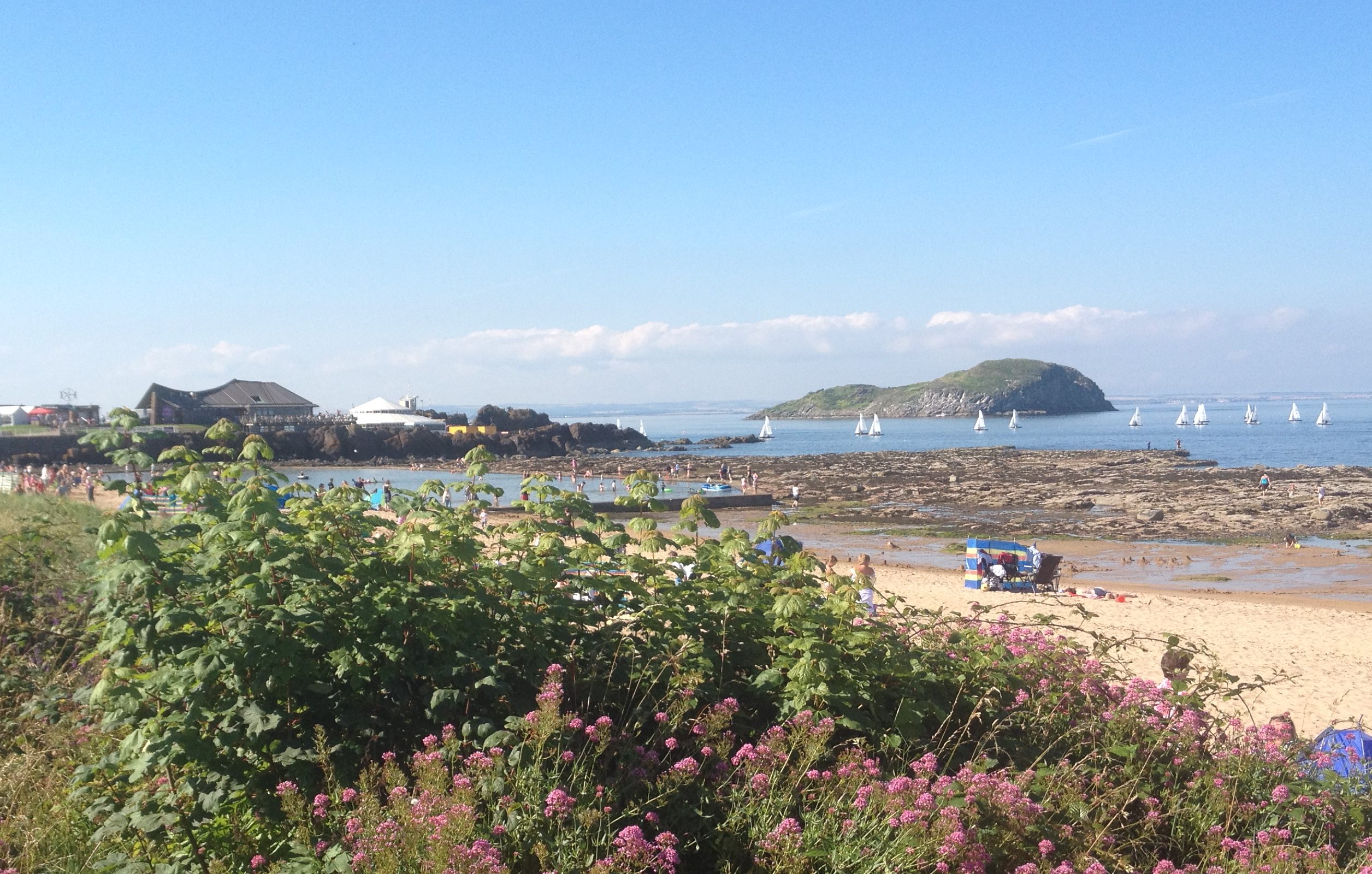
West Beach and Craigleith, August 9th 2012

Today was one of those idyllic days when the sea seems so azure and inviting that it’s not just the kids that are tempted into the water. Trains were pouring hundreds of people into the town (lucky for them—parking spaces were like hen’s teeth), the High Street and harbour were mob scenes and emergency supplies of ice cream had to be blue-lighted down from Luca’s in Musselburgh.

Offshore was the great spectacle of the Laser 2000 UK Nationals being avoid by sundry trip boats taking sunburned visitors out around the islands. Altogether, it was the sort of day that you remember from your childhood—and the many kids running about today will have it etched in their memories that will probably bring them back in a couple of decades to pass it on to theirs.

East Beach with Seabird Centre & Spiegeltent beyond Paddling Pool, plus Lasers racing near Craigleith

While everyone had been complaining that this summer had been the pits, a couple of days of this magic and all is forgiven!

East Beach and Bass Rock, North Berwick, Augus 9th 2012

Posted in Environment | Leave a comment

England’s Not Foreign to Me

Peter Jones is not a man with whom I would normally choose to cross verbal swords. Freelance journalist more recently for the Hootsmon but previously regular contributor to weighty pieces in the Times and Economist, he knows his stuff but—more than that—he’s a professional. How he balances his professional objectivity with his private life, from which there must be at least social pressure, I don’t know. The point is (and I say this as someone who has read him for decades): he does.

So when his Op Ed piece entitled Questioning what the English have done for us pops up in yesterday’s Hootsmon, I recharge my java and dive in. And I am not disappointed—en vacances in his gite, Peter discovers that the French of Gascony came to like the English, despite their having been chucked bodily out of the place some 5 1/2 centuries ago (I paraphrase: Peter’s prose is far more resonant). More to the point, the present flood of ex-pats are being uniformly welcomed and not resented. He observes:

“This seems to me to be what Europe ought to be all about. Different nationalities, equally proud of their varying histories, conscious of clashing histories but not resentful of them, mixing together.”

I’m with him to this point. But then he spends the last 10% of the piece pouring cold water all over the concept that the Scots would be capable of welcoming either one-time would-be conquerors or current-day squatters. Here, he has lost me, perhaps because he makes no attempt to expand his basis for doubts. If you read this, Peter, walk with me through the following couple of paragraphs and point me to the parts you find inaccurate.

We Scots didn’t invent racial melting pots but we surely embraced the concept as well as any. When Kenneth MacAlpin hammered our kingdom together in the 9th century, it was out of Brythons and Picts, Norsemen and Anglians, as well as his own Scots—five mutually unintelligible languages that give us the pigs breakfast of place-names with which Ordnance Survey still strews the map of our country.

When Edward I came raging north in 1296 to steal our richest port of South Berwick, he cleared out the inhabitants first but found himself confronted with Flemish, Hanseatic, Danish, Mecklenburger and all other sorts of residents and a major international incident. Once we had established conclusively whoever was running the country, it wasn’t the English, the Scots were to be found all over the Low Countries and the Baltic, trading their little hodden grey socks off.

Seventy ports in Scotland were in the international trade business. The Staple (guild of merchants under a Conservator) was set up in Bruges in 1347 and transferred to Veere around 1510 (where the local museum is still in the Schotish Huis). More Scots fought in the armies of Gustavus Adolphus than any other nationality but the Swedes themselves. There are Scottish villages and descendants of Scots all around the Baltic; half the admirals in the early Imperial Russian Navy were Scots.

After the hugely ambitious Darien project was scuppered by jealous English merchants, we picked ourselves up and dominated the new tobacco trade, drove the Hudson’s Bay company all across the Americas’ higher latitudes and came to specialise in the ships with which we built an empire with our southern cousins. And in those colonies, whereas the Irish or Italians or whoever would hunker in immigrant ghettoes, the Scots were already out mixing with locals, exploiting opportunities.

It wasn’t all Carnegies coming home to build libraries and halls here or full-blood Shoshone indians from Saskatchewan showing up in Stromness looking for their ancestors or MacQuarries putting Australia together with their bare hands. We welcomed the Italians when they came a century ago, the Poles who settled after WWII, the flood of Pakistanis who have made curry our other national dish; they are all Scots now.

As our heavy industries declined we lost many of our best and brightest until it looked like Scotland would become a backwater, dependent on English handouts. Then came oil and gas and Aberdeen was on the same map as Dallas and Bahrain, becoming a melting pot of American, Norwegian and Doric accents. A financial services boom and cultural renaissance followed. Soon whole families were moving North as the combination of competitive houses with quality of life outbid spending your days on the 7:50 from Wokingham.

And, of all those English who have moved north only have few, if any, suffered even a cold shoulder, never mind hostility. Now that Scots have recovered a sense of themselves, now that they have cultural, media and political outlets that are not filtered through the alien prism of London, now that we’re back to our outgoing ways from year-outs in Thailand to commuting to New York, why on earth would we be hostile to people with enough sense to realise what we have—and do something about it by moving here themsleves?

Scotland, unlike England, is not full up.

Peter seems so open to what the French are telling him about their attitudes, why does he say nothing about his life here in Scotland? I lived here until 1971 when things were getting dire. The improvement to 1993 when I came back was startling—but nothing as compared to what’s happened in the two decades since.

It’s not just that you can get guava or papayas in the supermarket or catch a Kabuki play at the local rep. Whether commuting into Edinburgh or B&Bing on Mull, our English incomers are now at home—and as vocal against the incomprehension emanating from their former friends down south as they are signed up to what renewable energy, quality engineering, whisky exports and booming tourism can achieve for a nation of just 5m happily ensconced in one of the most beautiful corners of the globe.

Wallace’s argument against Edward’s accusations 700 years ago was both noble and correct: “How can I be a traitor when England is foreign to me?” But do we live in such brutal times that arrogant assertion is the only way we deal with each other? When you are fighting attempted conquest, broad-mindedness and tolerance are often the first traits out the window. That was then.

Though Scots who stayed at home undoubtedly became less international in the centuries we’ve been a partner in the United Kingdom, the splendid voyage we shared with our English cousins and the recent shrinking of distances around the world and the corresponding exposure of so many Scots to other cultures (as well as the hugely dominant English-speaking diaspora we helped build) is making us more international than we perhaps ever were.

Rubbing shoulders at our local Highland Games with a polyglot crowd of 10,000 that included as many ‘incomers’ living in the area as long-term locals is neither unique nor unusual. Our clubs and committees and societies are stuffed with English, Welsh, Irish, plus the odd American or European. I don’t know the fractious, apparently benighted place Peter Jones calls home but he should get out more. We like the English too; they brought much to this world and are not done yet.

We just don’t think they should be running our country.

Wake up and smell the java, Peter: it’s our New Scots as much as our Old who are brewing it for you.

Posted in Commerce, Community, Politics | Tagged | Leave a comment

Some Candle!—Still Burning

She only acted according to the script we gave her
” —Ernesto Cardenal

Exactly fifty years ago, when Marilyn Monroe died aged 36 of a sleeping pill overdose in 1962, I was—like Elton John at the time—just a kid. From age seven, I would wander the hundred yards from my gran’s house (no TV and radio powered by a car battery as there was no electricity) along to the local cinema. It showed three films each week and I’d splash out 6d admission on those that looked adventurous.

That 6d got me a seat in the front row where, craning my neck, the picture filled my entire vision, compensating for my short-sightedness nicely. It taught me to immerse myself within the film, to forsake the grey sleet, coal smoke and dun-coloured macs of fifties Britain and, for an hour or two, live in the glorious world of the film.

Tiring of wooden Cecil B. de Mille epics or Brief-Encounter-ish British fare, I would sometimes take a leap of faith and be rewarded with a Hound of the Baskervilles edge-of-seat job as often as a slushier Kiss Me Kate. Part of Perth-based Caledonian Cinemas, films shown at North Berwick’s Playhouse were always months after their first run. But, since I had no way of knowing this, that made little difference to me.

Marilyn Monroe’s earlier work was long passed before I was a regular. I do vaguely remember Some Like It Hot, but that was because my budding twelve-year-old manliness was discomfited by men dressing up like women and almost nothing to do with her. Her jiggle from the steam jet was a joy that I would discover only later.

So it was that The Misfits came to the Playhouse in the spring of 1962—the same year that I first traveled far (to exotic St Andrews), that I first embraced scout camp as a winner with a sun tan, that a new NI card got me my first summer job…and I first kissed a girl. The characters and life-style in that film seemed exotic, rather than gritty. At the time, I had no appreciation of either Miller’s script or Huston’s directing—I was passive, wanting film to entertain me, not thinking about how and why, much less appreciating the craft behind it all.

It was my first awakening. Schooled in the simplistic boy-meets-girl-marries-gets-mortgage-retires-into-sunset consensus of the fifties, the film’s emotional messiness was far more discomfiting than Some like It Hot. And, though repelled by differently flawed characters portrayed by Gable, Clift and Wallach, despite myself I saw, for the first time, just how people negotiate their own path towards happiness as best as circumstance will allow. Later on Sillitoe’s Loneliness of a Long-Distance Runner would move me much further down my road to self-realisation. But The Misfits set me out on it.

It was only later that I appreciated Monroe’s real contribution. At the time, I thought her far too beautiful to ever find herself in such circumstances. Like most tumescent teenagers, I saw her characters almost entirely through the prism of what the media made of her: the jiggle-action, poo-poopee-doo, platinum-blonde arm candy. When I first heard ‘Candle in the Wind’ on a friend’s state-of-art stereo in Lausanne in the mid-seventies, I still subscribed to that vulnerability and loved the sexy references to it, such as Kelly le Brock’s skirt-wafting grating homage in Woman in Red.

But, thanks to technology, a miracle for us fifties filmgoers has now happened: for a few quid and fewer hours of your time, any film is yours to dissect. And it can be freeze-framed, rewound, slo-mo’ed—you name it. Looking back over Monroe’s films, you can see the fertile female-as-icon soil from which the legend grew.

Starting from the pouting WW2 pinups of  Grable, Haworth and Gardner, things grew more complex, developing several sub-genres from the hard-ass Crawford/Stanwyk school, through the more readily voluptuous Jane Russell (“hard to describe her without moving your hands” in Bob Hope’s phrase) to the class of ditzy blonde deriving from Betty Boop. With little thought, the media machine swept Marilyn into this last category.

It may be hard for women in the 21st century to recall when emancipation was limited to the vote and equality was regarded as an aberration against scripture. Watch an episode of Mad Men to get a sense of how different things were then: men were the boss; women turned passive aggression into an art form as they had few alternatives to get their way.

Seen in that context, it’s amazing what Monroe achieved. After an unsuccessful early marriage and difficulties with trusting men from having been abandoned by her own father, she took control of her life using what tools she had. Famously unpunctual, she got her own back through milking the rights of stardom and playing to the gallery. No doubt impressed by second husband Miller, she nonetheless declined to be simply the blonde ego-boost he (and his society) had written as a role for her.

Her classic pose is the tossed back head and narrowed eyes. But watch the cool intelligence in those eyes when they are open (if you boys can pull your gaze away from the rest of her). If she’s ditzy, then so is Carol Vorderman doing a maths quiz. See how she plays the torn neediness, the necessary compromise, the inner gustiness of Roslyn in The Misfits and you realise that this was no candle in the wind.

She tried to be her own woman, making the best she could of what breaks life gave her. The tragedy is that proper companionship—something she perhaps needed most of all but was least likely to get with that public image—does not seem ever to have been among them. The memory that remains is of that image she played to and not of the woman she always knew was in there.

Posted in Community, Education | Tagged | Leave a comment

What Next for (Scottish) Labour?

A book is published this year, entitled What Next for Labour. The blurb for it states “Now is the time for a real debate about the future of the Labour party and its decisive role in British politics. Labour needs to restore trust and build confidence between politicians and the people, and reconnect with voters. The way to achieve this is to provide an objective critique of Labour’s record and discuss what the future is for the Labour Party, which will lay the path for a new type of politics.

The book is not unique. Last year John Denham published Labour’s New Thinking, in which he could claim: “Since becoming Labour leader Ed Miliband has successfully opened several new national political debates, from the ‘squeezed middle’ to ‘responsible capitalism’ and concern about diminishing opportunities for the rising generation.”

Brave words all. And, although the second half of the former is largely about internal organisation and action, its first half also attempts to break fresh ground in policy, an area in which Labour has been sadly passive for some time. But what of Scotland? What of the ‘Labour Heartland’ that once guaranteed five in seven MPs sent to Westminster sporting a red rosette?

Superficially, the signs are good. Soon after becoming Labour leader in Scotland (but before May’s council elections) Johann Lamont was asserting “We knew when we lost the Scottish Parliament elections in 2011 that people wanted us to change. That’s why in the past year, we’ve seen real change in our party that’s helped us get closer to people and communities across the country.”

In parallel with that, the Scottish Fabians were relaunched in February as an integral part of the Fabian Society (which operates as a Labour think-tank). At their inaugural conference on May 12th, attended by over 100 people, Ms Lamont gave the keynote speech, declaring “I welcome the contribution of the Scottish Fabians to our political discourse. The wider the debate, the wider the engagement, the more chance we have of arriving on solutions we so dearly need to our politics.”

So, no hint of London’s policy tanks being parked on SLab’s crabgrass-infested manifesto lawn then? Certainly there has been no blowback. That was reinforced by Shadow Scottish Minister Margaret Curran MP hosting the first Scottish Fabian ideas workshop in Edinburgh’s City Art Gallery on July 18th, posing fundamental questions like:

  • How do we bring Government closer to people across the country?
  • How do we engage the people of Scotland in the debate on our future?
  • What can we learn from other countries about decentralisation and empowerment?

Laudable objectives that auger well, especially as the select few who showed included activists like Duncan Hothersall & Steven Johnson, policy wonks like Kenneth Fleming, EUSA President Matt McPherson and non-numpty MSPs like Sarah Boyack and Kezia Dugdale. But what did this actually produce? Apparently recycled flat assertions from Ms Curran, such as:

“Devolution and separation are two very different paths with two very different destinations” or;

“We must not let the referendum overshadow the real issues facing the people of Scotland”

Oh, aye—heard this lot before. But perhaps Ms Curran had yet to enter into the spirit of new thinking abroad in Scottish Labour? What cue did the new leadership give to this and other such groundbreaking events? Ms Lamont’s address to the Scottish Fabians in the aftermath of May’s elections included:

“The commentators predicted another Labour meltdown…Instead, we achieved fantastic results all over the country. Overall majorities in Glasgow, North Lanarkshire, West Dunbartonshire and Renfrewshire. Labour control across the country, here in Edinburgh, in Aberdeen, Fife, Stirling, West and East Lothian, Dumfries and Galloway, and many others. And gains in places we didn’t expect, in the Western Isles, in Aberdeenshire and in Moray.”

Not only has the humble pie diet been set aside, but we are drifting back into reeking of triumphalism, such as lulled Ms Lamont and her boss-at-the-time Lord McConnell of Glenscorrodale into comfortable delusion after the 2005 UK General Election made them look pretty secure in their day jobs. Successive voting landslides in 2007 and 2011 taught ’em different.

Is Scottish Labour really that thrawn? Can they really believe that a straw or two in the wind is all it takes to restore doughty intransigence and justify shelving pious statements about ‘need to reform’? Because today’s Hootsmon ought to give Mmes Curran and Lamont pause for thought before they hunker back down in ideological fortifications.

The Bad News—percentage of people who think Labour is:

  • Trustworthy = 8%
  • Forward-looking = 9%
  • Have plenty of ideas = 8%
  • Competent = 10%

The Worse News—percentage of people who think Labour is:

  • Untrustworthy = 25%
  • Boring = 26%
  • Incompetent = 29%
  • Out of touch = 35%

The Worst News of All—the poll was conducted by YouGov on behalf of the Fabian Society, so this is far more likely to be the unvarnished truth than had it been come from one of Labour’s opponents. Most revealing are the top two reasons given why many respondents voted Labour at UK level but SNP at Scottish level:

  • SNP has performed well in government in Scotland = 43%
  • SNP has better policies for Scotland than Labour = 40%

This last especially ought to give SLab—and Ms Lamont in particular—food for thought. Her speeches have been peppered with ritual Labour boilerplate (“by having faith in our traditional values”…”common values we share of fairness, equality and social justice”…”we debate about how we can improve people’s lives, not where to build borders”…”yahdah-yahdah-yahdah“) but not once—in the half-year hiatus of the leadership contest or the half-year hiatus since—has anything that ordinary mortals could confuse with a groundbreaking new idea passed her lips.

It is, of course, not all her fault. There are 37 MSPs, 40 MPs, 394 councillors all their staffs and many thousand members, not counting unions. What are they doing to help? It’s not that hard. If they spent less time trying to diss their enemies and more puzzling what Labour if FOR (besides looking after their own), they might come up with some. From a genuine desire for Labour to quit whining and become a proper opposition so that they have some chance of ever seeing power again, allow me to set the ball rolling:

  1. For eight years Labour sat on their hands and completed squat in transport systems. The SNP took over railways from the UK, opened Airdrie/Bathgate and Alloa lines, opened Lawrencekirk station, finished the M74 and rescued Edinburgh’s tram mess. What if SLab went further than re-regulating buses and introduced real city transport authorities that integrated all modes so that they worked seamlessly, as in Europe?
  2. RBS is being targeted by the Treasury for a complete takeover so the Government can finally pry open their over-tight fists in business lending. But that’s only one bank. What if SLab argued for the Bank of England to charge all banks for cash deposits so that it became worth every bank’s while to lend their cash and not just sit on it?
  3. If they are as keen on job provision, (especially for youngsters, as they keep saying they are), where are their ideas for providing real jobs and not just recycling bodies off the buroo so that it LOOKS like they have gainful employment. What if SLab realised that the biggest undeveloped business opportunity in Scotland is inshore fishing? What if they dynamited Crown Estates and Scottish Enterprise out of their criminal torpor so Scotland becomes a world-famous tourist destination for seafood (and not just an exporter to Spain/France/Italy where our seafood is consumed at ten times wholesale prices paid to our fishermen)?

That’s a start. With 500 elected representatives, at least as many salaried staff, ten times that in members and the supportive presence of English colleagues and the whole Fabian Society, surely SLab can come up with something else worthy of the name “new policy”. Or is “Out of touch, incompetent and boring” to become their recurring headline?

Posted in Politics | Tagged | Leave a comment

Why SNP Will Not Say ‘No’ to NATO

The Scottish press are rather relishing the rammy that they expect to break out within the ranks of the SNP in the run-up to their main annual conference in Perth in October.

On some levels, they are right to do so: by the standards of any other major party, there will be a rammy. There will be letters in the press; there will be furious debates at branches; there will be apoplectic press releases; longtime friends will slam down fists on bars; furious e-mails will fly. To the SNP leadership, it will not be a pretty sight.

And, by the standards of most party conference, Perth Concert Hall will ring with far more rowdy passion than Labour, Tory, Lib-Dem or even the SNP itself have let loose in public  for years. For they have become stage-managed events, designed much more for free publicity and fund-raising than to bring the faithful under one roof for the unseemly verbal bar brawl of debate.

Some would argue that in the dozen years of the Scottish Parliament—but most agree in the five years since the first SNP Government—the party has matured, has come of age. Not only have their many MSPs had to mind their p’s and q’s in a way that radicals with no hope of power never need bother with but the army of councillors, assistants, researchers, etc—mostly culled from the long-serving ranks of party members—have stepped up to those many jobs and displayed professionalism and restraint.

But this should not lead anyone to fall into the “thae politicians are a’ the same” trap. The  Tory party backbone was built on tea dances at Conservative clubs in the fifties: it had its last boost under “I’m all right Jack” Thatcherites in the eighties. Labour was at its laudable best in the forties under Atlee and last dug in to defend its socialist principles in the fractious seventies. The Lib-Dem/Alliance bubble was more recent but based mostly on dislike for what the other two parties had on offer.

Seen over such a long perspective, every party has compromised on what was once seen as a fundamental policy that lay near its heart. But, just as the Tories came to embrace the NHS, so Labour embraced Trident; both would be called ‘U-turns” but both have become fundamental to the posture of each party. The most recent major shift was Blair’s shrewdly engineered dumping of Clause 4 in the mid-nineties.

The lack of much shift since in the UK parties has been due to tighter party management, combined with a new speed and breadth of reporting. If a candidate kicks a dog attacking him on an isolated farm in Galloway, it’s tweeted within the hour, gone virally global by nightfall and all over national front-pages with psychological/psephological analyses and an in-depth commentary on brutality from the RSPCA by next morning. The candidate’s career thereby comes at an untimely end. So everyone stays stiff and polite.

Not so the SNP. While the party has demonstrated considerable ability to run things well and a degree of tight-lipped discipline that has surprised even old hands like me, we have not yet had a ‘Clause 4 moment’ where a stark choice between continuing idealism in the wilderness or electability and prospect of subsequent power was presented to the faithful. Could the NATO question be that moment for the SNP?

Certainly some members see it as such. The SNP has a long, honourable—and among the four main parties unique—record on opposing nuclear weapons. Starting with Billy Wolfe’s leadership in the fifties. it attracted many CND adherents and adopted a posture hostile to nuclear in any form, including power. This led to a degree of idealism by the nineties where party policy was to shut down both Torness and Hunterston immediately on coming to power. As they had no alternative, this would have resulted in great swathes of Scotland without power.

Having had a half-century in the political wilderness, it is understandable that parties like the SNP allowed themselves radical ideals: the trickier part of implementing them—let alone explaining and justifying them to a majority of the public—need not be faced. This was ground onto which the principled and informed Foote led the UK Labour party under the banner of “The Longest Suicide Note in History” in 1983.

After a brief dawn in the seventies, the SNP experienced dark days equivalent to Labour’s in the eighties, right up to its climb since the late nineties. Those members from that era provide both the core of party activists and the source of most present elected members. They still harbour their ideals—as do I. For many of them, nuclear is still not acceptable in any form . NATO is a nuclear alliance. Therefore NATO is unacceptable.

However, at the Inverness conference in 1997, I seconded the East Lothian CA motion that we should continue to use nuclear power stations “to the end of their useful life”, thus eliminating the risk of immediate blackouts if the SNP came to power and did what they said on the tin. It passed. Add to this the fact that Scotland IS a member of NATO right now and DOES have “the obscenity of nuclear weapons” on its soil already (and has had for decades), idealists are already compromising on principles, just by living here.

More importantly, we are a decade and a half on from then and, even more importantly, a party of four times as many members. Those new members, while mostly not pro-nuclear, are also less scarred by the idealistic battles of the seventies and eighties, less weighed by the baggage of Cold War history and more concerned with national security in the 21st century then any throwback to evil empires and World War Three.

Modern defence involves alliances, especially for small countries, as Scotland will become. The stronger rule of international law and local alliances have been instrumental in turning the gunboat-wielding empire-building swashbuckling approach to other regimes (in which the UK led the way right up until the last century) into a fraternity of over 200 countries that—by and large—behave themselves.

We can’t change our geography. Like it or not, we are a country at the Northwest periphery of Europe with a maritime frontier that is a bit of a headache and plenty of resources that it would be worthwhile plundering (or at least disabling) if we were still back in the gunboat era. Despite little by way of land threat, Scotland would have more sea acreage than England to secure and have more in those acres in need of defence.

One option would be a standalone approach where we built many long-range-maritime-reconnaissance aircraft (like the UK scrapped), several frigates, many air-sea-rescue helicopters, many fast assault boats, developed our own Special Boat Squadron, built up a supporting air force of strike aircraft like the Typhoon or F-35, etc, etc and cocked a snook at everyone else.

Or…we could recognise that even the ‘No’ campaign had a point in arguing a ‘better together’ case and joined some umbrella organisation that found strength in numbers. There is only one that qualifies: NATO. And, though three members do deploy nuclear weapons, none are on soil of members who do not wish them. And, of the 25 non-nuclear members, several—Eire, Norway and Denmark—are exactly those with whom we have much in common and would wish to be working alongside anyway.

An independent Scotland has much to offer NATO. And, by joining, the removal of Trident from the Clyde is much more likely if we are in the club, arguing the case with friends and neighbours of the same mindset, than if we were struggling to negotiate with England, who, having nowhere convenient to base their Trident ego-trip, would drag their feet to have their deterrent stay as far from London as it already is.

It is this latter thinking, embraced by the great majority of newer party members, that will prevail in Perth. The ‘old guard’ will have their say—as they should—and may still genuinely feel that having the current occupants of Faslane indefinitely is the lesser evil to being a non-nuclear member of an organisation dedicated to not using its nuclear weapons.

If the SNP were to retreat to its idealism of the eighties as our Trade Union Group and a couple of MSPs argue, how representative would it be of current thinking among the Scottish people? And if, as I suspect, it is not representative, then what chance a ‘Yes’ result in the 2014 referendum, idealism or no? After all what is the SNP for?

Either way, it’s worth a rammy at Perth over something as important as this, not least to show that, unlike your typical stage-managed conference, democracy is alive and well in Scotland’s main party.

Posted in Politics | Tagged | 4 Comments

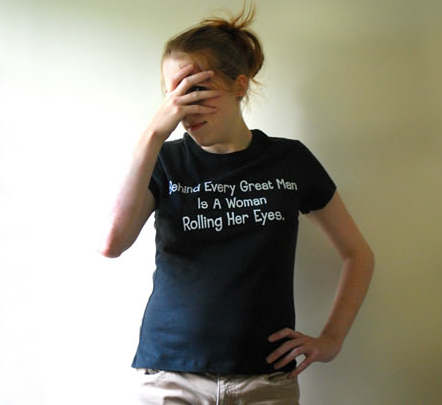
Made Fae Gurdurs? Shairly No’!

…or, for outraged feminist readers who believe men really ought to have evolved beyond this sort of thing by now:

…and for those really hard-core feminist readers who didn’t get a giggle out of that either, the truth is out there somewhere:

Posted in Uncategorized | Tagged | Leave a comment

Labour for Independence

The title of this blog is not nearly as bizarre as the present leadership of Scotland would have you (and many of its membership) believe. But while official party policy appears stuck in a miasma of denial that anything beyond the present devolved arrangements will lead to rickets and the loss of your first-born child, the word on the street is rather different.

I must confess sympathy with many loyal members of the Labour party who, in a decade since Donald Dewar worked himself to death, have tholed leadership by time-serving placeholders—none in the mould of John Maclean, Willie Ross, John P. Macintosh, Tam Dalyell or Big Donnie himself—all bonny fechters who said their piece and stood their ground. (Gratuitous plug: Tam will be at North Berwick’s Fringe By The Sea on Aug 7th).

What strikes me as strange is Labour’s total lack of enthusiasm in coming to grips with what everyone agrees is the biggest question Scotland has faced in centuries: When a referendum on Independence is posed in 2014, how do I vote? We’ll discount Tories and Lib-Dems. Not only have they been doggedly stuck on their opposition but they can’t even gather 1 in 5 Scottish votes between them (or 1 in 10 if you count those who didn’t vote).

So a Labour-led ‘No’ campaign faces an SNP-led ‘Yes’ campaign for the soul of the third or more of people who show no party affiliation or are genuinely undecided? Not really: it’s more subtle than that.

First of all, the silence from Labour’s ‘leadership’ has been deafening since the ‘No’ campaign launch by an even-less-inspiring-than-usual Mr Dour himself, Alastair Darling over a month ago. Johann Lamont (remember her) has been nowhere near the parapet, let alone above it on this one: her last Twitter presence is three months ago and the last real public event was Glasgow Says ‘No’ three weeks ago. Heather is not being set alight.

Meantime, a curious but nonetheless symbolic website has recently appeared called Labour for Independence, with the tagline “working together for a free and prosperous Scotland“. Now, I do not wish to make trouble for the Labour members behind this by doing any extrapolation about what this means for party politics. But that someone was going to break ranks was only a matter of time, given the beliefs in a significant number of Labour supporters with whom I have spoken.

Campaigning across East Lothian in 2010/11 as candidate for the Scottish Parliament, the biggest response I received was people voting SNP who would vote ‘Yes’ in a referendum. Second biggest was people voting Labour, who would vote ‘No’—neither too unexpected. But the THIRD biggest were Labour voters who would vote ‘Yes’; they beat Tory, Lib-Dem, Green, UKIP and even those SNP voters who would vote ‘No’. We were talking one in three of Labour voters here, and it didn’t matter if we were in Labour ex-heartlands like “The Bot’om ‘Pans” or douce commuter estates of Pencaitland.

Now, it’s not as if Ms Lamont has not admitted the scale of problem she faces: “We looked tired and complacent and we got the kind of beating we deserved. But now we need to start building the kind of Scottish Labour Party which Scotland deserves.” Stern stuff, verging on the courageous. But her party of devolution has not led the debate since and, in ruling out changes in corporation tax she has not only discounted a major source of tax income but has also put into question whether Labour will indeed fight for Scotland if it disadvantages their colleagues in the rest of the UK.

So far, it has all been thin gruel to fuel any tooth-and-claw campaigning. No wonder Labour members who are also patriotic Scots are rather champing at the bit and feeling frustration that a party policy clamp-down gives them very little room to go out and discuss pivotal issues with the great undecided.

Which currency we use; who should be our best friends; what military is desirable or even feasible; how do we deal with our share of debt; how could we prosper better—all these questions and more deserve an airing. Each has been posited in earlier blogs here but this needs to happen in pubs and over dinner tables across the country so that 2014 can be an informed decision and not just driven by fear or nostalgia.

Because the future for Labour (as well as the rest of us) could be so much better in an independent Scotland. They have a powerful and demanding role as the other large party in Scotland. They need not lose the future Darlings and Cookes, Dalyells and Browns to a culture at Westminster that has little time for us—and thereby regain the class and capability of politician that all of us—not just Labour—need here, working for Scotland.

It was Labour arrogance, verging on stupidity that let it think that ‘B’ team placeholders should be shunted into the Scottish Parliament in 1999. They even managed to shunt out ‘A’ team players like Wendy Alexander because she didn’t fit the role. Ms Lamont has admitted that they need to up their game. Letting their considerable phalanx of members who see independence in a positive light have their say would demonstrate such maturity.

But, can they?

Posted in Politics | Tagged | 4 Comments

Out of Our Shell

This week has seen a resolution to the ‘prawn wars’ brewing off the West Coast as larger boats from the East Coast, having meagre pickings in home waters, muscled in on their brethren. Another example of the idiocies perpetrated by the Common Fisheries Policy, (the sooner we get Scotland’s own negotiating team at the table the better), this will ban the bigger interlopers from August 1st.

At the same time, the Herald announces a seven-figure takeover of the Loch Fyne Oyster Bar in Argyll with Roy Brett, Scotland’s top seafood chef as its culinary director. Other than being on the West Coast, why are these related? Actually, it has little to do with geography. A third related story is the booming business of two new eateries at North Berwick harbour: the Lobster Shack and the Rocketeer. Both are open-air and informal but, despite the worst summer on record, both are going like a fair. Why?

Because, for the first time, the many visitors who come to North Berwick’s quaint town and pristine beaches can get their hands on some of the superb seafood that passes through here, en route to wholesalers in Eyemouth who ship most of it to Spain for the enjoyment of British tourists. Fishermen are happy because they get twice the price; everyone seems to gain.

These prawn wars, Loch Fyne and NB harbourside restaurants all serve to illustrate that we Scots have our heads in the sand when it comes to one of this country’s glories—seafood. Why on earth we export most of it at wholesale prices is a mystery when its superb quality makes it an obvious attraction for tourism. Whether Maine or the Maldives, other countries ‘get it’; why don’t we?

At present, there is no coherent plan to exploit our world leadership in pelagic fish, shellfish and farmed salmon; each business is left to bumble along as best they can. Dont even mention Scottish Enterprise because a more myopic set of jobsworth timeservers would be hard to find when it comes to any enterprise at all. Nonetheless, every time the seafood business makes progress in the right direction, the public follow.

The other main clueless provider of unnecessary log-jams is Crown Estates who sit in their London offices and charge anyone for attaching anything to ‘their’ seabed. They don’t actually do much else, just charge for anchorages, harbour improvements, fish farms, pretty much anything to do with improving our seafood industries.

But this latter is improving—from full to partial pain in the arse. Under considerable pressure to get off said nethers, they plan to pass control of oysters and mussels (which attach themselves to ‘their’ seabed) up here into Scottish control. This means that the prospect of making a business out of reseeding and/or farming these becomes realistic.

Even without such improvements, examples exist elsewhere about how much a boost to tourism top quality fish restaurants supplied by top quality produce can be. We needn’t look abroad either: Rick Stein has made Padstow, Cornwall a mecca for fish-lovers. Down there, because of constricted harbours, fishing boats are small and trips are daytime only. That means the fish landed were in the water that day. If you’ve ever tasted fresh-landed mackerel, you’ll know it’s like another fish—full of chicken-like texture, as well as flavour.

There are no Rick-Stein-like restaurants in Scotland. Yet. But if the Loch Fyne Oyster Bar taps the business passing it on the A83 tourist highway, that should just be the beginning. North Berwick needs a quality version of the informal pair it now has; Dunbar, Eyemouth, Anstruther, Arbroath, Stonehaven, Fraserburgh, Portsoy, etc, etc should all have similar business. It provides jobs, economic growth and puts places on the map.

We have tourists traipsing all over Scotland to appreciate our scenery, history, golf, distilleries and so on. Why do we not come out of our shell and overjoy them with some of the finest seafood to be had in the world, instead of making them fly to Spain to enjoy it?

Posted in Commerce | Tagged | 1 Comment