More Important Than Knowledge

Albert Einstein was no dummy. He believed imagination to be more important than knowledge. And that mantra that would serve Scots well as they gather information to help them decide their future in about two years. None of us should see knowledge as unimportant. But when it comes to momentous events, what we know and what we are comfortable with are seldom the best—and never the only—guides to the future.

From your first dive in a swimming pool to your first job to your life companion, the right choice comes from a gathering of all of yourself, an in-depth analysis that mixes courage with conviction, ambition with emotion and a connection with the inner peace we all have when we know we’re doing what is right. None of that is either easy or instant and, however much we may seek advice and counsel, must come from deep within.

Much of life programmes us to follow known patterns. Whether a commute or a communion,  familiarity reassures and calms, encourages confidence in known outcomes and allows is to enjoy time in surroundings that comfort us. Britain, rightly, is proud of many long traditions and—whether it is as maritime nations or having a global outlook—the Scots and the English share many of them equally. Honorable unionists (yes, there are many) apparently believe that our history to this point must determine our future. They recite the glory of Britain, as if that familiar story were enough.

“The Union has provided over 300 years of stability, and has become a political and economic powerhouse with a seat at the top table internationally.”

“So, if the vote should take place in 2014 then, yes, let us all recognise the 700th anniversary of Bannockburn when our ancestors proudly fought against the English.
 But let the celebrations be for the 70th anniversary of the D Day landings, when our parents and grandparents fought and spilt their lifeblood not against the English, but side by side with the English.”

Both quotes are from Jackson Carlaw’s 350-word argument on why we Scots should be “better together” with the English. I find little in it with which to quibble—beyond his Pavlovian slurs on the SNP. But nowhere does he illustrate any future vision and why it will indeed conform to that. This is wholly representative of the Unionist debate to date.

Passionate or even principled as such unionists may be, it is retrograde thinking, a kind of anti-advancement some people suffer, like P7 kids in trepidation about what the High School might bring or stay-at-home youth who decline to move out because who would feed them and do their laundry?

Such personal dilemmas can be resolved by appeals to practicality (you’ll earn more money) or to emotion (we all need to grow up). But what when it applies to a country? Surely similar thinking applies. Moving out from your family is a natural thing and, however fraught with unknowns, is also full of opportunities, of new experiences, of growth and development available no other way. The feelings and affections remain.

The people I know supporting independence have more ambition than to be satisfied by reminiscences. They see Scotland full of potential, but strapped to another country that lives more in its past. England is still trying to hold onto glories of Empire, to the prestige of “being at the top table” as a nuclear power on the UN Security Council, a country that “punches above its weight” that can still exert gunboat diplomacy in others’ affairs, like in Iraq or Afghanistan. But for what? And why must we be part of it?

Scotland is an energy dynamo of a country, waiting to be unleashed. It could expand its present leading-edge presence in oil, renewables and engineering. It could export growing amounts of whisky, fish and even fresh water. It could welcome ever more tourists to appreciate its world-class wildlife, culture and history. Any people that for centuries has dispatched sons and daughters around the globe to bring innovation, hard work and success wherever they landed deserves the reputation we have, small though we are.

And we Scots didn’t earn that by being followers. From the Hudson Bay to Jardine Mathieson, Scots have shown how to think different, how to synergise, how to look past others’ mundane pursuit of the known and visualise another future. Watt saw past Newcomen and triggered the Industrial Revolution; Adam Smith blazed out of the Enlightenment and saw what that revolution could bring through far-seeing use of capital and markets; John Maclean fought and won the battle to give workers a fair share and a fair voice in the midst of capitalist exploitation and human misery.

And who says we Scots are yet done?

We belong back where we’re at our best—not as an appendage to someone else’s memories, glorious and proud though they may be—but at the cutting edge of civilisation and development. We need another Declaration of Arbroath to fire imaginations so far that it rings as powerfully down the centuries; we need the self-belief that kept clansmen fierce and proud of the life they wrung from unforgiving country; we need the inventive competence that made the Scots engineer a byword in coaxing magic from machinery.

We need to look to the visionaries of today, to the people whose unshakeable belief in what was possible confounded the suits, exasperated the beancounters and shattered the comfort zones of pedestrian conformity. Embrace Robin Williams’ inspiring teacher in Dead Poets Society. Absorb the business lateral thinking of Richard Branson. Live the inspirational motto of Apple Computer, once its founder returned in 1997 to revive its lost soul: Think Different.

For, as a country, we have never been conventional. We have always been a little wild, on the periphery, out there. Britain became great because we gave the English something that they, bless ’em, lack: fire and soul. It’s now time to rediscover them for ourselves. While it’s too long to be our motto, Scots should consider how Apple launched its rediscovery of what had made that company great—and took it, via iTunes, iPod, iPad, IPhone, etc from a doing-OK $2.4bn plateau to a 63,000-person global revolution valued at half the entire British economy ($0.5 trillion).

“Here’s to the crazy ones: the misfits; the rebels; the troublemakers; the round pegs in square holes; the ones who see things differently. They’re not fond of rules. And they have no respect for the status quo. You can quote them, disagree with them, glorify or vilify them. About the only thing you can’t do is ignore them. Because they change things. They push the human race forward. And while some may see them as the crazy ones, we see genius. Because the people who are crazy enough to think they can change the world are the ones who do.”
Posted in Politics | Tagged | 2 Comments

Eff Ofgem

The legacy of Thatcher is a long one. Despite folk tradition (especially in Scotland), all that she did was not evil. But her successors’ efforts to create a real market in industries like railways and energy have proved illusiory.  See Rosco Used in Train Robbery for a blog on the former. But a spate of profit reports have highlighted severe shortcomings in supposed ‘markets’ in the latter.

Between 1996 and 1999, domestic energy consumers gradually got the freedom to choose their supplier, and finally in May 1998, the domestic gas market was fully opened to competition, closely followed by the domestic electricity market in May 1999. Before there was competition on domestic markets, Ofgem (Office of Gas & Electricity Markets) set price controls, which remained in place until removed between 2000 and 2002. By then, Ofgem had decided that competition was developing well the Competition Act would protect consumers from supplier price fixing and the like.

The same Act provided Ofgem with powers to tackle any abuse. Since consumer surveys indicated they knew how to switch, and were doing so away from the former monopoly supplies, big suppliers were seeing falls in their market shares. Ofgem is expected to look after the comsumers’ interests and herd in any excesses by suppliers.

Shame it doesn’t work that way.

First of all, GEMA/Ofgem are based across the road from the House of Lords and crawling with nomenklatura whose mission in life appears to centre around brown-nosing their way to a knighthood or looking after the civil service noenklature who populate its offices.

Lord John Francis Mogg was appointed for a second five year term as the non-executive Chairman of Ofgem in October 2008. Lord John became a Life Peer on 18th April 2008. On 28th May 2008, he was created Baron Mogg of Queens Park in The County Of Sussex.  In his three-days-a-week job as chairman, he receives £214,999 a year salary. For his long years in the Civil Service, in 2003, was appointed a Knight Commander of the Order of St Michael and St George (KCMG). He is serving a second term as Chairman of the European Regulators Group for Electricity and Gas (ERGEG), is President of the Council of European Energy Regulators (CEER) and chairs the Board of Governors at the University of Brighton. Busy man, eh?

Chief Executive of Ofgem since 2003 is Alistair Buchanan a Director for state-owned Scottish Water and member of the Business Energy Forum and the UK Energy Research Partnership (UKERP). A ‘bean counter’ to trade, he spent his career as “an award-winning analyst and as Head of Research, in London and New York.” He claims to be particularly proud of such contributions as “creation of the “RIIO” model for regulatory price controls and “Project Discovery” which provided a root and branch review of GB’s medium term security of supply outlook.”

Sounds good. But these two have been running the place for the last decade; are the two of them any good? Well, February 2008, they did nail National Grid with a £41.8m fine, with Sir John thundering “National Grid has abused its dominance in the domestic gas metering market, restricting competition and harming consumers. The abuse has prevented suppliers from contracting with other companies for cheaper deals.” So, er, that fine would cover their salaries for 80 years. But what about the punters?

That pillar of the establishment, the Torygraph, is none too impressed with goings-on:

“Buchanan trousers a salary of £265,000 a year so you can see why he needs to hammer the old expense account – to the tune of £28,000 last year. That included a £50 round of drinks at a meeting to discuss fuel poverty (sic), as well as £5,700 for overnight stays in London if he had to work late or start early. So in which distant part of the country is the Buchanan residence? John O’Groats? Penzance? No, it’s Egham in Surrey.”

This week, the Institute for Public Policy Research think tank yesterday demanded far tougher rules to ensure the big six energy firms make savings and pass them to customers. While families struggle to keep their heads above water, officials have awarded themselves £1.12million of taxpayers’ cash. In 2010, Ofgem paid out £602,969 to 266 staff members—an average bonus of £2,267, while in 2011, some £515,047 was shared between 346 officials—an average of £1,489 each.

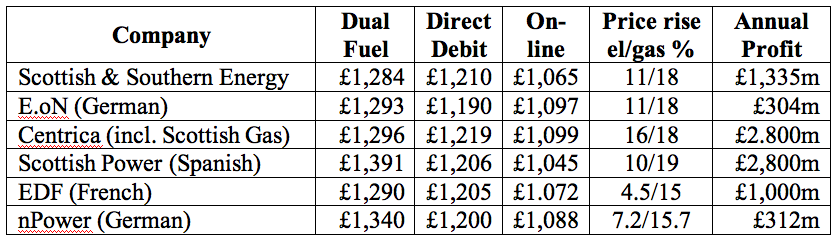
Ofgem is meant to keep a check on gas and electricity prices, but the average dual fuel bill is now a staggering £1,310 a year. In May, the same IPPR came out with a stinging report, with associate director Will Straw asserting: “We need more competition among energy companies. Poorer and older households are most at risk of being overcharged. Ofgem must act faster.

The report says five million people are already being overcharged to help fund low-cost deals for new customers. It calls for tougher rules to ensure the big six energy firms make efficiency savings and pass them to customers which could cut £70 off average bills. The system is so complicated that some families pay £330 a year more than neighbours to buy the same amount of energy from the same company. The report says consumers could save £1,900m a year by 2020 if the market is overhauled.

Comparisons Across the ‘Big Six’

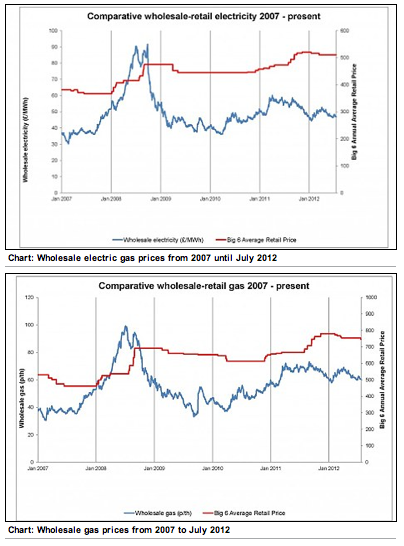
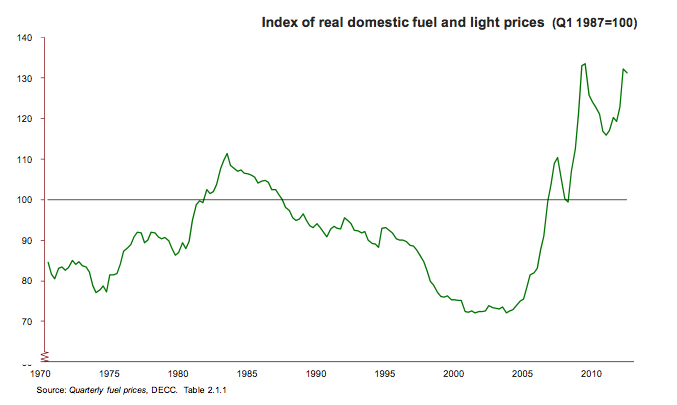
The ‘Big Six’ energy companies are fleecing loyal customers trying to expand their market share—but not at the expense of profits. Up until the mid-nineties, energy prices actually dropped in real terms. But once both the 2007 oil price rise and subsequent recession hit, energy prices have been rising steeply, as shown in the chart below.

Customers have seen costs more than double in the last eight years, with the average gas and electricity bill going up from £522 in January 2004 to its current level of £1,258.
The Money Advice Trust (MAT) received 27,000 calls in 2011 from people unable to cope with fuel debts, compared with just 1,212 in 2004. In January this year, the helpline received a call for help with gas and electricity debts every five minutes.

The percentage of family budget spent on heating for the poorest decile has jumped from 8% in 2006 to 12% last year, driving over 100,000 Scottish families into fuel poverty. Across the UK Some 7.8 million people could not afford their energy bills in 2009. This is due to rise to 8.5 million by 2016. But the wholesale prices for energy have, in fact, come down as well as gone up in recent years. None of the Big SIx have reflected that in their price structure, as can be seen from the two charts below.

Wholesale Price vs Retail Price ‘Lag’ from the Big Six (source: This Is Money)

“The ‘Big Six’ made £168 per second in profits from British customers last year.” (The Independent)

Ofgem is asleep at the wheel. What more evidence that Aladair and Sir John are thoroughly undeserving of the public purse sustaining their ‘fat cat’ salaries and bloated staffs at Ofgem do we need?

Posted in Commerce | Tagged | Leave a comment

Buildin’ a Brig Tae the Bass

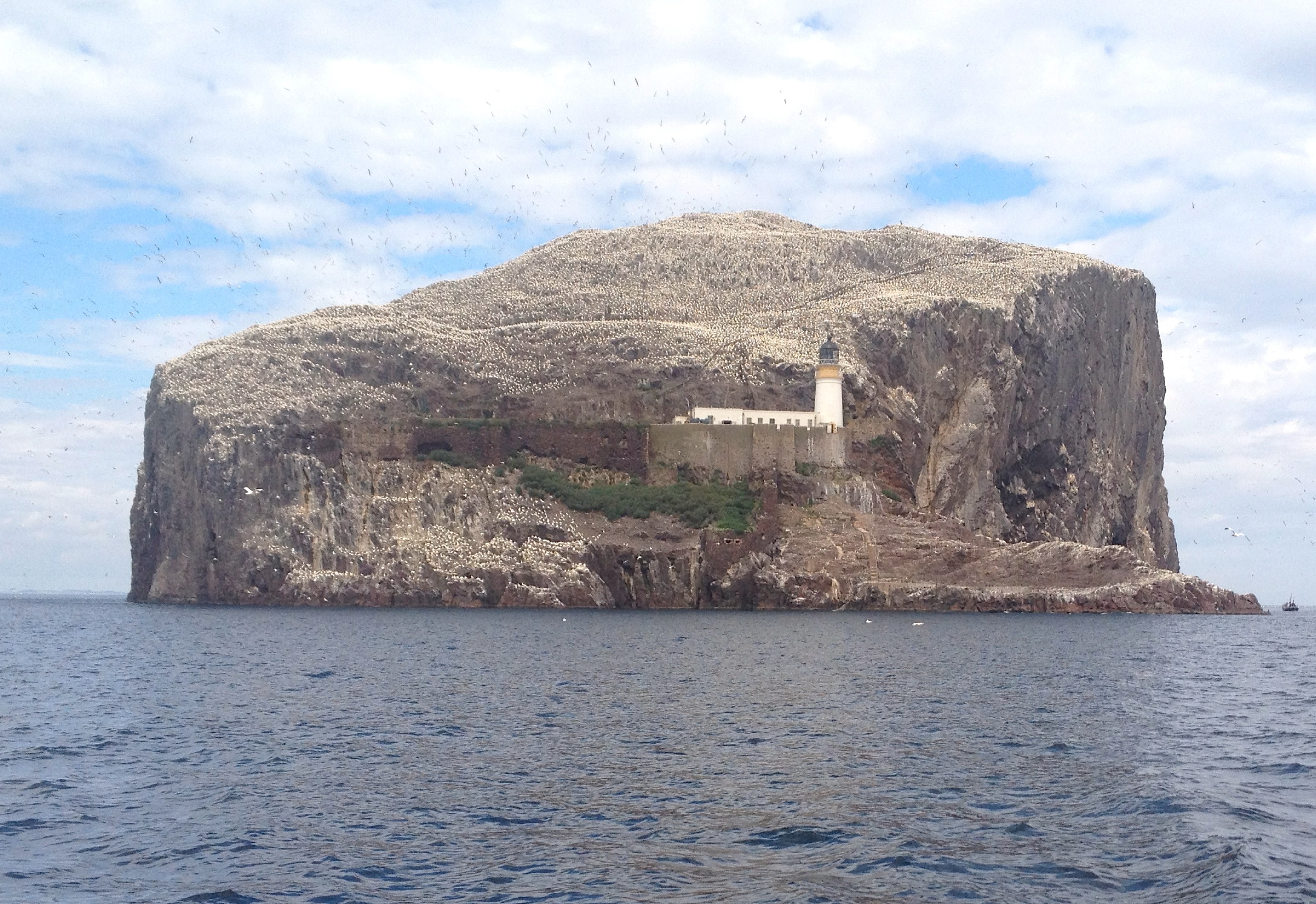
It’s a truism that natives of any given place seldom appreciate what they have all about them: sunshine in LA is a given, as is the waterborne romance of Venice or the cultural kaleidoscope of London. As a kid growing up in North Berwick, I thought little of Bass Rock, even though I went round or landed there many times. It was like Berwick Law or the wide Forth itself; just part of the scenery.

Bass Rock from the South, Showing Lighthouse amidst Castle Lauder and East Cliff on Right

Now, after two decades back home, my appreciation is growing sharper, even though I now regularly crew trip boats going out to visit it. It is a constant amazement to me—as well as visitors—that something this spectacular is not hidden away and inaccessible as other large gannetries like Shetland or St Kilda are: this one is 40 mins by train from Scotland’s capital, Edinburgh.

Impressive as it is from shore, every time you approach it by sea, it reveals something new. The gannets wheel over it like a cloud, their patterns and directions always changing with the wind. The gugas grow by leaps and bounds, the fluff balls now almost as big as their 3kg parents and yet still another kilo to put on before they leave. The ‘mini-penguin’ guillemots have already left the East Cave but Kittiwakes still chorus their own name from the West Cave cliffs where yesterday no fewer than seven seals gamboled about the boat.

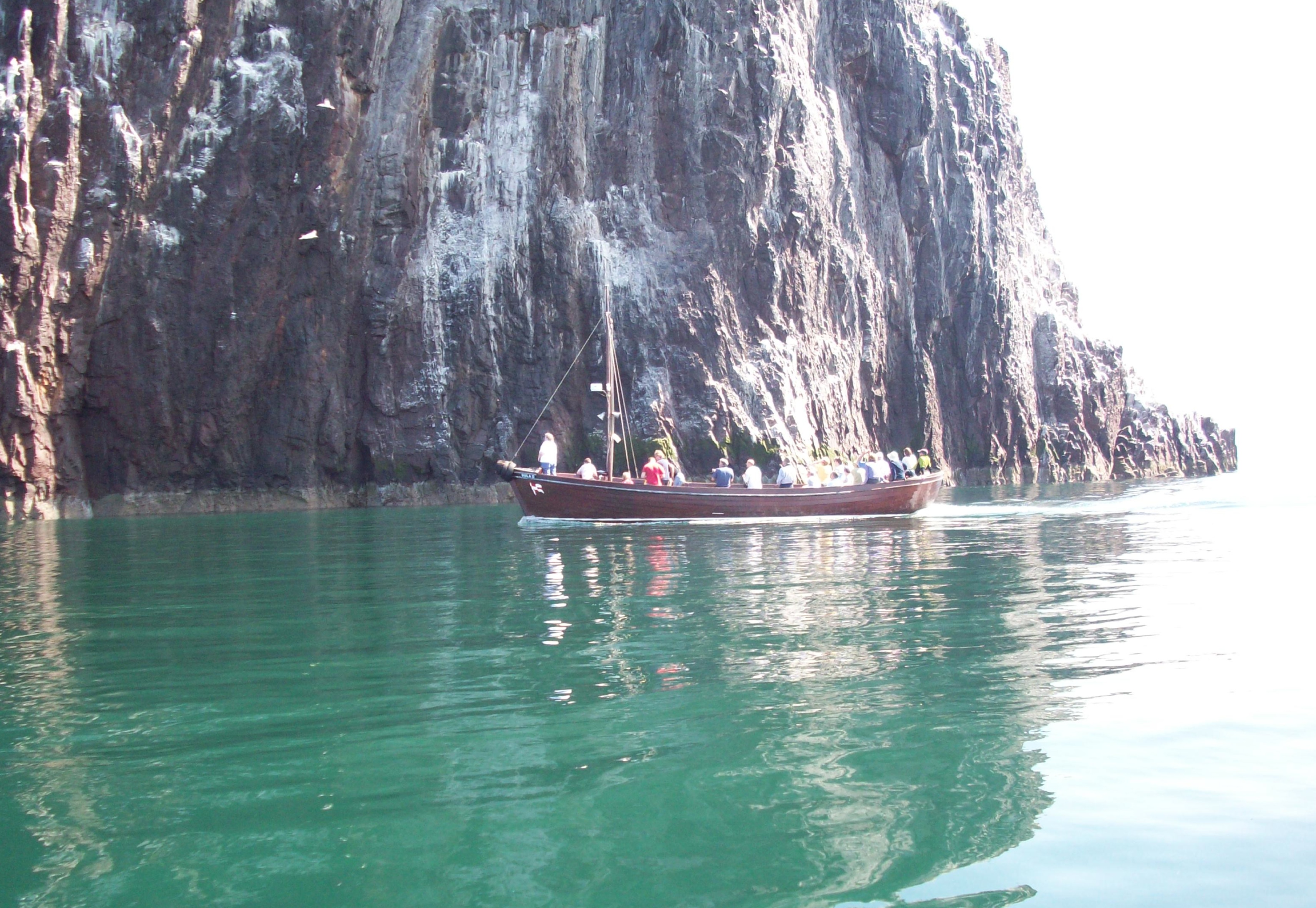
This close up, the Bass itself is nothing short of spectacular, even after the gannets depart for Africa in October. Sheer, unbroken 100m cliffs defend three sides and hint at the other 40m below the water. Scuba divers rate this among Britain’s best cliff dives. Boats can approach to within touching distance and, at one point, underneath the overhang.

Sula II Approaches the 120m-High East Cliff

Although the Scottish Seabird Centre, established 12 years ago, also now runs trips out to the Bass, a traditional boat called Sula II had the run to itself for decades and the Marr family (Chris, Pat & father Fred) became famous for shipping people and researchers out there before before they passed it on last season. It still makes a stately adventure out of seeing this unique island close up.

First recorded as a retreat for St Baldred, the 7th century monk who brought Christianity to the Welsh-speaking Goddodin on the back of Northumbria’s conquest of the area, it passed to the Bishops of St Andrews when Malcolm brought Lothian under the Scottish crown in the 11th century and then to the Lauder family who grew to such prominence that they were entrusted with being Keepers of both Berwick and Edinburgh castles.

Their keep here was one they retired to in summer or when things got a little hot on the mainland. Since there is only one place low enough to land and the castle dominates it, this was regarded as among Scotland’s safest castles—more impregnable even than Tantallon, just a mile away on the shore opposite. In their time, a flock of sheep produced Bass mutton—much prized for its rich taste from the well fertilised grass—and fat solan geese, as the gannets were once known—although their taste (“between chicken and kippers”) was one that needed to be acquired.

Sula II in the East Cave—the Right-Hand Shaft Continues through to the West Cave

Although it never fell, the castle passed out of Lauder hands to pay for gambling debts being bought by James V, whose ancestors had always coveted it. In the 1680’s its dungeon was used as a cruel prison for Covenanter ministers, caught preaching in the fields in defiance of James II/VII. John Blackadder (buried in North Berwick kirkyard) was the most famous who died here. Finally used as a prison for Jacobite officers captured at Cromdale in 1690, they broke out, forced the garrison onto a supply boat they had been unloading and held out for three years before gaining passage to France.

Sold for a pittance to the local laird in 1701, it was used for years as a hunting estate by gentlemen staying at nearby Canty Bay who would bag themselves a brace or two of solan geese, which were shipped as far as London. All this time, gannets had survived first the predations of the castle garrison, then such visitors and, finally, from lighthousekeepers, by nesting on inaccessible ledges on the cliffs, leaving the top clear for agriculture.

Increasingly secure under a whole series of Wild Bird Protection Acts starting in 1890, gannets ran out of cliff ledges fifty years ago and have since colonised virtually the whole 1-mile-circumference rock, with the exception of the castle and landing areas, plus low-lying spots like the Midden which is liable to being swept by waves during storms. Their numbers are now passing 150,000 but such is their loyalty to the Bass that no-one knows what will happen when there is no nesting space left.

In medieval Scotland, a synonym for the impossible was to “ding doon Tantaloon (knock down Tantallon castle) or build a brig tae the Bass (a bridge out to Bass Rock)”. The first was accomplished in 1650 when Monk’s artillery ruined the castle. But, though it still lies a daunting mile offshore, the increasing number of boats and visitors allows us to build a figurative bridge to this remarkable place so that all can enjoy its spectacle.

Posted in Environment | Leave a comment

North of East Coast Eden

On June 26th, the UK Department for Transport published its Consultation on the East Coast Rail Franchise, to which all assiduous anoraks will have replied by the closing date of September 18th. The summary of results are to be published, along with the Invitation to Tender it’s supposed to inform, in January 2013.

Even those who use the Edinburgh-King’s Cross trains on a regular basis may react with “who cares?”. After privatisation in 1994, Sea Containers ran it for a decade under its GNER subsidiary before National Express made an over-generous bit to take it over but was forced to hand it back into public hands after two years, since when “East Coast” has been a bit of a black sheep—a private company run by the public under a Tory government.

And, since it’s a Tory government, they want shot of it back into the private sector. At the launch, Rail Minister Theresa Villiers said:

“There are exciting changes on the horizon for the East Coast Main Line. It is set to receive a brand new fleet of InterCity Express trains. The next franchise will be up to 12 years in length, giving the operator greater opportunities to invest in improvements that will benefit passengers.

“The consultation outlines what we expect the next operator to deliver, including better service quality, improvements to stations, the roll out of smart-ticketing technology and good levels of punctuality. Bidders will need to share with us their plans to improve the passenger experience.

“The East Coast Main Line is a key part of our nation’s transport infrastructure, providing heavily used and economically significant services between north and south. Before we let this franchise, we want to hear from the people who use East Coast and listen to their ideas on better services.”

This service is actually the premier franchise in the Tories’ fractured rail system. Heavy investment in electrification and 225 trains in the 1980s made this line very profitable. GNER paid £1.3bn and innovated on livery, services and quality. But the 10% growth projected to fund the £1.4bn that National Express subsequently bid did not materialise and service quality suffered. By November 2009, re-negotiation talks had ground to a halt and John Prescott could soon happily boast of “enjoying a nationalised bacon roll with his nationalised cup of tea” when he used the service next.

But such a state of affairs is anathema to the present government so they are moving to complete the transfer back into a private franchise by Christmas 2013. The consultation can be seen as a sop or a serious attempt. But what is clear is that the DfT has a pretty sturdy pair of blinkers on when they look at options. The route map were discussing is:

East Coast Route Map with Connecting Services

As a business, it has proved robust and justifies BR’s early investment. But now that £2bn has been spent improving the West Coast line (WCML) and more is to be spent on the Midlands to Sheffield, the ECML is in for a period of competition. East Coast have already shown themselves to be too narrow in their thinking.

Whereas their main innovation in 15 years was to run (unprofitable) trains through Edinburgh to Glasgow, both Virgin and Cross-Country introduced Edinburgh-York-Leeds-(Midlands/Birmingham/West Country) services with smaller trains that proved both popular and profitable. Nonetheless, East Coast has grown to carry record numbers of passsengers.

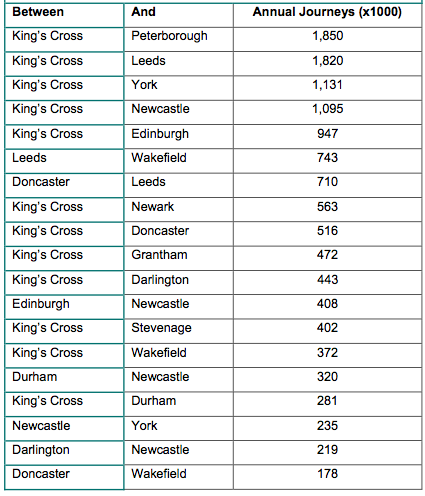
Main East Coast Passenger Journeys, 2011

This shows by far the bulk of journeys to be in England. No service North of Edinburgh registers and Edinburgh makes it on the list only through its traffic to London and Newcastle. Oddball situations like Dunbar do not register at all.

So, when the DfT consultation showed up in Edinburgh on July 17th, it was understandable (if rather inexcusable) that the top section of their map beyond Edinburgh was missing entirely and they were unprepared to discuss much about services in the missing areas, other than they would be continued.

It was not a large audience (perhaps two dozen) but it consisted mainly of local lobbyists with a fixation on their own little patch, leavened by Sarah Boyack and Mark Lazarowicz who chipped in some astute observations as regular users of the service to date. So, in terms of service improvements for the 1m+ passengers from Edinburgh, little was said. But there was, for example, little mention of:

  • distinct ‘real’ express services stopping at Newcastle, York and nowhere else
  • providing room for a spacious experience—in contrast with airplanes
  • connecting directly beyond London to Chunnel and/or South Coast
  • broadening the catering selection, especially on longer journeys
  • providing adequate luggage storage, perhaps in a luggage car
  • better co-ordination with Network Rail to provide same-platform interchanges

While those who showed from DfT and East Coast were well intentioned and genuinely appeared to want to stimulate a consultation, it was obvious that they would have felt more comfortably at home at their next two gigs in Newcastle and Leeds. They were unprepared for discussion about:

  • Provision of express services within Scotland as ScotRail does such a poor job of it
  • Co-ordinating with ScotRail/Virgin/X-Country of regular service to Dunbar/Berwick
  • Provision of more comfortable sleeper seats (c.f. airlines) to Inverness/Aberdeen
  • Rethinking services beyond Edinburgh in light of the EGIP electrification project

These latter seem particularly relevant as the new ICE trains will not only be fast but capable of switching power between electric and diesel as the line allows. Clearly, setting the franchise at 12 years means we will have a long time to live with it if Scotland does not get its premier rail service with the rest of the world right. Given, on the basis of this meeting, that the present senior staff ill understand Scottish requirements, it behooves anyone out there with proposals for improvement to get them in well before September 18th.

And spell them out in plain English, preferably in one-syllable words, so there can be no doubt.

Posted in Transport | Tagged | Leave a comment

Disease in Common

Those keen on Scotland becoming a normal country often cite other countries as examples for such a situation. Many serve well in this role—including affluent Norway who “separated” peacefully from Sweden just over a century ago and has been a shining example of neighbourly democratic success ever since.

But one equally cited because it is almost the same size and latitude is Denmark. Problem is that few Scots know much about Denmark, with even fewer ever having been there. However, some distance was made up recently by the Beeb screening two hugely popular and excellent Danish TV series: Borgen and The Bridge. Not only did they engage and thrill but they gave us insight into Danish life and a rare chance to hear their language.

Danish belongs to a Scandinavian common family of teutonic languages that are mutually intelligible, similar to the latin-based Iberian group (Spanish, Portuguese and Catalan)—they are distinct languages but with a great deal in common. It’s a bit like Scots and English. Just as the English will gripe about the unintelligibility of a broad Scots accent, so the Swedes have a phrase that claims “Danish is not a language: it’s a throat disease“.

This week’s Economist, amongst its usual eclectic mix, has dug up an amusing video trying to help visitors to Copenhagen even manage to pronounce street names with any hope of locals knowing what they mean. As the author of the article says:

“Two non-Danes living in Copenhagen bang together some electronics to create talking street signs, telling confused foreigners how to pronounce things like Kvæsthusgade and Rådhusstræde. If you don’t know Danish, your best guess will probably not even be close.

“Strøget is the most famous street in Copenhagen—the pedestrian shopping street right through the heart of town. It may also be the hardest to say in the city. It combines:

  • a strongly uvular r—not that hard if you know French or German, but still not easy for non-natives
  • the ø—which is not so different from German ö, but still difficult for those who don’t know it
  • a g that is not pronounced at all, and worst:
  • the definite article -et (“the”), which in Danish always comes at the end of words.

“The combination, “Strøget” as Danes say it in running conversation, is one long, slightly strangled-sounding syllable.”

Scots may laugh at this difficulty. But before we do, think whether we appreciate the confusion we cause to our English visitors—let alone foreign ones—when we talk about “Mulgai” “The Broch” “Hoik” or my own local home of the saltire, “Ailshenfur”. And this is without even starting on any of our islands.

So, the problem seems to be that we and the Danes have similar troubles communicating even with our nearest neighbours. Is it a wonder that, example or no, we have so little contact between each other?

Posted in Education | Tagged | Leave a comment

Don’t Get MoD, Get Even

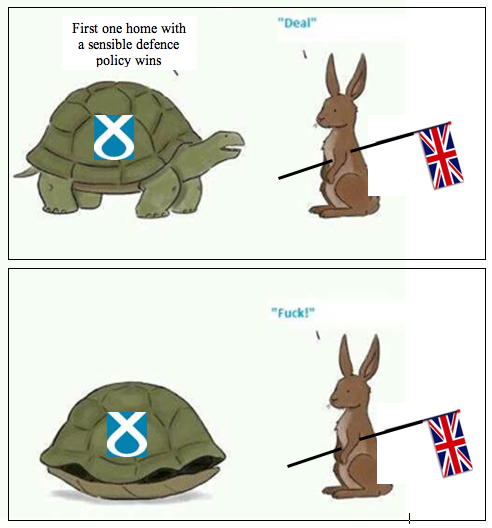
Fibre-optic broadband is humming with the opening salvos of debate on the announcement from the SNP’s highheidyins that they have placed Scotland’s defence strategy—including NATO membership—as a keynote topic for discussion at the party’s upcoming Autumn Conference.

Defence Spokesperson Angus Robertson MP has set the tone. It is a posture that I, for one, have long argued as a way to win friends both in- and out-side the country and to secure an independent Scotland’s rightful and responsible place among its neighbours—but without the obscenity of nuclear weapons.

However, there is a long a honourable tradition among veteran SNP members (especially core activists) to distance themselves from all things nuclear, including any nuclear equipped alliance, which includes NATO. Their perspective is perhaps better expressed over at Burdzeyeview, a source I respect so much I was considering simply reblogging it.

It’s shaping up to be a real debate—like other democratic parties used to have. I hope others are relishing the prospect as I am.

Posted in Politics | Tagged | 1 Comment

Go Get ‘Em, Gramps

The following letter was sent by an 86-year-old to their bank manager, who, displaying far more chutpah and humanity than most modern bank managers display, had it published in the New York Times:

“Dear Sir:

I am writing to thank you for bouncing my check with which I endeavored to pay my plumber last month. By my calculations, three nanoseconds must have elapsed between his presenting the check and the arrival in my account of the funds needed to honor it.

I refer, of course, to the automatic monthly deposit of my entire pension, an arrangement which, I admit, has been in place for only eight years. You are to be commended for seizing that brief window of opportunity, and also for debiting my account $30 by way of penalty for the inconvenience caused. My thankfulness springs from the manner in which this incident has caused me to rethink my errant financial ways.

I noticed that whereas I personally answer your telephone calls and letters, when I try to contact you, I am confronted by the impersonal, overcharging, pre-recorded, faceless entity which your bank has become. From now on, I, like you, choose only to deal with a flesh-and-blood person.

My mortgage and loan repayments will therefore and hereafter no longer be automatic, but will arrive at your bank, by check, addressed personally and confidentially to an employee at your bank whom you must nominate.

Be aware that it is an offense under the Postal Act for any other person to open such an envelope. Please find attached an Application Contact which I require your chosen employee to complete. I am sorry it runs to eight pages, but in order that I know as much about him or her as your bank knows about me, there is no alternative.

Please note that all copies of his or her medical history must be
countersigned by a Notary Public, and the mandatory details of his/her financial situation (income, debts, assets and liabilities) must be accompanied by documented proof.

In due course, at MY convenience, I will issue your employee with a PIN number which he/she must quote in dealings with me. I regret that it cannot be shorter than 28 digits but, again, I have modeled it on the number of button presses required of me to access my account balance on your phone bank service. As they say, imitation is the sincerest form of flattery.

Let me level the playing field even further. When you call me, press buttons as follows.

IMMEDIATELY AFTER DIALING, PRESS THE STAR (*) BUTTON FOR ENGLISH

  • #1. To make an appointment to see me
  • #2. To query a missing payment.
  • #3. To transfer the call to my living room in case I am there.
  • # 4. To transfer the call to my bedroom in c ase I am sleeping.
  • # 5. To transfer the call to my toilet in case I am attending to nature.
  • # 6. To transfer the call to my mobile phone if I am not at home
  • #7. To leave a message on my computer, a password to access my computer is required. Password will be communicated to
  • you at a later date to that Authorized Contact mentioned earlier.
  • # 8. To return to the main menu and to listen to options 1 through 7.
  • # 9. To make a general complaint or inquiry. The contact will then be put on hold, pending the attention of my automated answering service.
  • # 10 . This is a second reminder to press* for English. While this may, on occasion, involve a lengthy wait, uplifting music will play for the duration of the call.

Regrettably, but again following your example, I must also levy an establishment fee to cover the setting up of this new arrangement.

May I wish you a happy, if ever so slightly less prosperous, New Year?

Your Humble Client”

Posted in Commerce | Tagged | Leave a comment

Dishonesty as a Cash Cow

For more than the last decade, a selection of informed voices have warned about PFI/PPP. But they have done so from the wilderness because every stripe of government bar the SNP at Scottish or UK level has regarded ‘Public/Private Partnerships’—whether rebranded as  ‘Private Finance Initiatives’ or not—much the same way as gluttons regard their lunch.

None of the 85 PFI projects in Scotland have been pretty sights. None have gleaned awards or even positive comment, other than in local council or NHS patsy sheets and internal bumfodder. Because almost all were done behind closed doors due to ‘commercial confidentiality’; because punters did not have their pockets felt directly, because your average politician falls over themselves to get another swimming pool or health centre for their patch—whether needed or not—the juggernaut, once started, was effectively unstoppable. It was credit-card-junkydom, shopaholism on a national scale.

It’s hard to blame the huge shoal of businesses that swam towards the smell of major money to capitalise on the many PPP opportunities created by the Thatcher and then Major governments—or even the pod of business sharks who swam in with them. And, fair’s fair, the Tories have always had a penchant for privatisation by hook or by crook whether or not—like the railways—it winds up being an expensive pig’s breakfast for which the public are still over-paying a quarter century later.

And you can almost forgive politicians (whether at the Treasury or the Town Hall) for pushing this wheeze. The former got to provide capital ‘off the books’ so that Irn Broon could claim the UK met debt criteria; the latter got to announce shiny new pork-barrel babies, knowing that poor shmoes running that council decades later would pay for it. Who cared that, in the long run, it cost £3 or £5 or £8 for every £1 of investment. None of the beneficiaries would need to pay for it. Sweet.

For Old Guard Labour, the fact that their party embraced it with such enthusiasm came as a bit of a shock. But Labour members are nothing if not loyal. If rebranding PPP into PFI and peddling the same snake oil to the masses under a different label was going to keep them in power in both Westminster and Holyrood, well…Sweet again. This was, after all Blair’s Third Way; some shibboleths were going to get hurt.

Because the Lib-Dems were complicit under Dewar/McLeish/McConnell in pushing a total of some £5.7bn in PFI in Scotland and, since 2010, have been similarly complicit in Westminster, we have the unedifying prospect of 95+% of our MPs being held shtum about the worst financial deal ever foisted on the public for political expediency.

Wasting public money is usually a headline-grabber, with the MoD leading the field in this particular parade of shame (remember the £4bn write-off of Nimrod replacement aircraft?). But PFI takes the biscuit in both scale and in silence. When’s the last time you saw it mentioned on TV/in the press/by anyone?

Yet, every man, woman & child in Scotland will wind up paying £4,400 each. For nothing.

Let’s discuss the scale of this in Scotland alone. There are 85 live or completed PFI projects across the country. The sum of their capital investment in public infrastructure is £5,692.8 million. By the time all projects are complete, the public purse will have paid £30,755.5 million in so-called ‘unitary charges’ to the private consortia who run the various PFIs. In some cases, the public won’t even own the buildings they paid for.

Now, every investment comes at a cost. The normal public process would be for councils or NHS Trusts to go to the Public Works Loans Board (PWLB) to borrow the money and be charged interest on it. Current rates for a 20-year load are around 2.75%. If all projects had been financed this way, the total interest would be around £2,372 million. Call me innumerate but that looks like more than a £22,000 million over-charge—or a sucker rate of 400%. Not so sweet: even pay day loan companies are a better deal.

And the real horror is that we’re stuck with this bum deal. Several attempts have been made to ‘buy out’ the PFI by offering a lump sum payoff, financed through the PWLB. None have gone any further the falling-down laughing-before-dragging-another-sack-of-dosh-to-the-bank phase. Why would they?

But who’s being dishonest here? It’s not the consortia who are running the PFIs, however greedily and/or ineptly. It wasn’t their fault that McConnell’s executive pitted naive bureaucrats against their slick negotiators, who reamed the public big-style. You make the best deal you can: it’s business—always has been run like that. And it’s not the fault of officials losing an ever-larger slice of their budget, armour-plated against any savings in the unitary charge, who were given much choice in the first place. They got telt.

But those Labour, Tory and Lib-Dem politicians who seized this blinkered opportunity for short-term advantage and—like Brown, Major, McConnell, Kerr, Howe and Lawson—mostly buggered off before the ricketiness of this fiscal house of cards became apparent are the real cuplrits. Some are even directors in companies now raking it in. None are apologetic for mis-selling this fiscal lemon.

But even among those few whose conscience is now uneasy, nobody who’s anyone wants to talk about it at a UK level and, as a result, UK media are largely silent. It is similar to the media approach to disasters: a plane crash in which 100 people die is front-page news for days; the fact that just as many die on Britain’s roads every fortnight gets no coverage. Bias by a thousand omissions.

Only the SNP Scottish Government speaks out and used what limited fiscal wiggle room it had to form the Scottish Futures Trust to provide more sensible financing. Yet even this is caught up in the general unionist tirade of misery about independence and dismissed as posturing. Stewart Hosie MP poses insightful questions in the Treasury Select Committee but he’d be as well going up Soho for a good time for all the coverage.

There are another thirty years to go before the last PFI signed (Dumfries & Galloway Council’s £109m schools project) will be paid off in 2041. Everyone hopes this recession won’t last until then. But it’s lasted four years so far, with no sign of reprieve. How long can councils/NHS Trusts/SEPA/etc afford to keep giving fat lump sums to overpay for public projects as Westminster, the source of this wheeze-gone-wrong keeps paring their income and the equally-squeezed punter simply can’t be charged more to make up the shortfall?

Posted in Commerce, Politics | Tagged | 1 Comment

Worthwhile Yet Untaxing Read

James Aitken’s measured thoughts in his Legal Knowledge Scotland blog are always worth a read but Friday’s is particular value in information provided vs time spent to absorb it. Regular readers of this blog will have noted my trouble getting what I need to say out in less than 1,000 words; James, on the other hand, is a model of succinctness.

Posted in Uncategorized | Tagged | Leave a comment

South Suburban Salvation

Edinburgh’s train services suck. As a result, its public transport sucks.

Even if the trams are completed—including the abandoned original loop to Leith, Granton and Craigleith—it will still have a third-world transport system. In the absence of any underground at all, the ‘fast’ rail services that normally provide the backbone of any transport net are practically non-existent. Waverley may handle 20m passengers a year but only 5% of them are within Edinburgh. The only ‘suburban’ stations it has are South Gyle (0.5m) and Edinburgh Park (o.4m). After those two you’re in the dross, with Slateford seeing a risible 21,000 people (to AND from) per year.

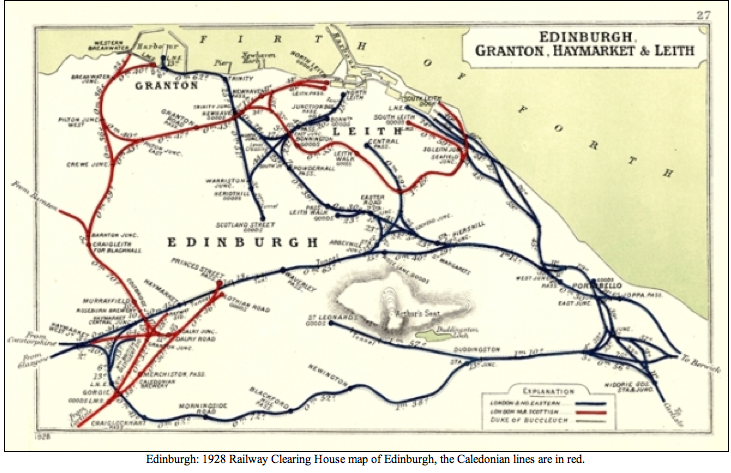
Given the pigs’ breakfast of unco-ordinated 19th century rail developments that gifted the city with hopelessly inefficient rail spaghetti, it’s perhaps not surprising rail did not do well here against 20th century competition. A 1928 map says it all at a glance

So the bulk of intra-Edinburgh trips are carried on Lothian Buses—109m last year. They are a well run bus company but their speeds are glacial. Edinburgh City used to run them and in the 1960’s encouraged British Rail to close its suburban stations because ECT buses were faster and better. At the time, it took 12 minutes by train from Morningside or Corstorphine into Waverley. The numbers 16 and 26 buses now take 24 minutes for the same journeys. As the Americans say: go figure.

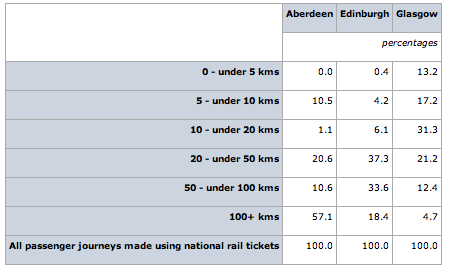
But what is more concerning is the number of unnecessary road journeys being made around Edinburgh because there’s no easy way to get to Waverley with luggage without dropping serious dosh on parking. The result is an interesting transport statistic on the three main city-centre stations in Scotland, shown in Table 1.

Table 1—Passenger Distance Travelled to Scottish Main Train Stations

Note how few Edinburgh people bother with rail—most (a huge 89.3%) of Waverley’s passengers) originate well outside the city. Glasgow, with its comprehensive and fast electric rail network gets 61.7% of its main line travel from within the city; Edinburgh achieves one sixth of that, despite a whopping £48m invested in Waverley over the last decade.

Given that £500m-and-counting and we still have no tram working, public transport is a touchy topic in the capital. But why are we blinded to all else, leaving the sluggish Lothian bus as the only game in town? Is there no ‘low-hanging fruit’ that could address the problem without breaking the bank and digging up more streets? Well, yes. And, co-incidentally, it would provide fast public transport to the very area of the city that trams will ignore, even when they do run.

Allow me to introduce Edinburgh’s South Suburban Railway (ESSR). It already exists. Many residents will know it and some older ones may even have ridden on it before Mr Beeching’s blade came down exactly 50 years ago. Built in 1880 it is still in use, carrying some 60 freight trains a day so that they don’t need to pass through Waverley and the congested tunnels through to Haymarket.

Transform Scotland has been campaigning to re-open the line for years and a consultant report provided several options for restoring what used to be a circular service by making this part of a “Crossrail 2” scheme, up to electrifying the line to fit in with the EGIP service plan already on the stocks. The key thing is that NONE of the options requires the kind of silly amounts of public money that have been thrown at railways for marginal improvement.

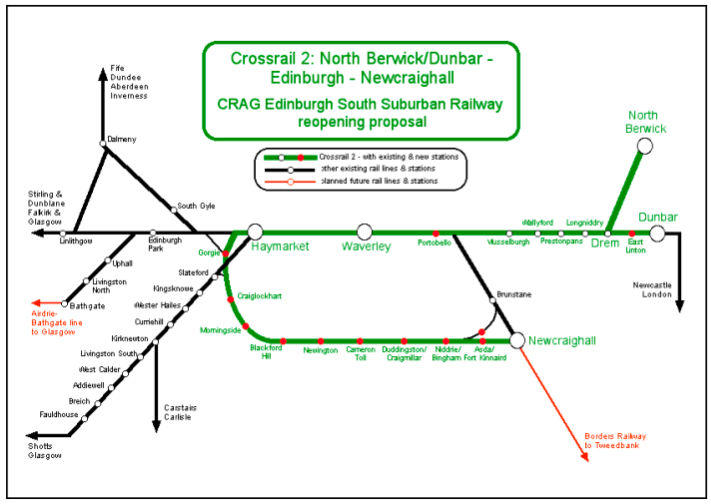
In terms of the ‘best bang’ for our buck, the Crossrail 2 is the most useful. The options were considered by the City of Edinburgh Council in 2004, and the council indicated a preference for a North Berwick-Niddrie service (Crossrail 2 option). Not only does it link up seven former and three new stations in the South of Edinburgh but it could integrate with the existing East Lothian services and complement Crossrail 1 by sharing a common terminus at Newcraighall, ready for this to be extended as Borders Rail. The proposal is shown below.

Figure 2—Edinburgh South Suburban Railway (ESSR) As a Crossrail 2 Project

New stations would serve shopping destinations at Cameron Toll and Fort Kinnaird. Morningside would be under ten minutes from Waverley by train, instead of 25 minutes by bus and, more importantly, a slew of professionals living along the line would find it a very easy way to Waverley and on to a long distance train, drastically cutting car travel.

Campaigners submitted an online petition to the Scottish Parliament, who noted that the re-opening would not require parliamentary consent as the line itself is still operational, and minimal infrastructural work was required (other than stations) so re-opening costs would be unusually low.

The new Airdrie line (3 stations) cost £300m; the one to Alloa (one station) cost £57m; the Borders Railway (6 stations) is to cost £235m. Hell, even a facelift for Waverley has cost us all £48m. Reopening the ESSR line with ten stations is estimated at a paltry £15m, with electrification at £18m. Forget the trams—compared to any other railway project in Scotland, this is a deal like no other.

Running half-hourly trains from Newcraighall (timed with existing half-hourly trains leaving there via Brunstane) gives a 15-minute service to Waverley. Half of them would follow the ESSR via Newington, Morningside and Gorgie to pass through Haymarket and Waverley roughly 30 minutes later and then provide an improved half-hourly service to Drem, where alternate services to North Berwick and Dunbar each hour would complete the service: Duddingston to Dunbar direct in under an hour; Newington to North Berwick the same; or vice versa.

It is calculated that 7,725 passengers per day would use the ESSR stations—or around 2.8m passengers a year. That compares with ridership on the popular North Berwick line already or 15% of Waverley’s total. And not all of those would be a loss to Lothian buses. Many would be new customers, attracted by the line’s speed and convenience and adding to the users of Lothian buses on the Southside to reach reopened stations. With a Benefit-Cost Ratio of 1.42, it would be a profitable asset and addition to ScotRail’s allure as a mode of transport around Edinburgh the way it already is in Glasgow.

We are already part-way there. In February 2007, the private consortium E-Rail announced that £8.5m had been pledged by land owners along the route, in recognition of the forecast that properties and land close to the stations on the line are expected to increase in value by around 10% if the line re-opens. It is understood the finance would come from The University of Edinburgh, and the Cameron Toll and Fort Kinnaird shopping centres.

So, what are we waiting for?

Posted in Transport | Tagged | 4 Comments