Interesting to consider how different we are (and probably always have been) which was understandably downplayed in the centuries of joint empire-building and standing firm against sundry baddies across the Channel.

burdzeyeview's avatarA Burdz Eye View

There has been much seizing upon by the Better Together campaign of the Mail on Sunday’s poll results, published yesterday.

Not only do the survey findings suggest that support for independence is slipping, but also that opinion on the issue of the referendum question or questions is hardening.  Only 27% support independence, with 13% undecided and 60% now opposed.  At the same time, the poll suggests a slight majority now favours a single question referendum (53%) with 41% wanting a devo plus or max option on the ballot paper.

But a different poll conducted by Com Res for the Independent on Sunday, albeit with a much smaller sample size for Scotland*, shows a slightly different position.  That poll conducted over roughly the same time period shows 31% in favour of independence with 20% undecided and 49% against.  Whichever poll you prefer, they both do confirm the trend of…

View original post 793 more words

Posted in Uncategorized | Leave a comment

Senior Service Needs a Junior Partner

The Royal Navy has prided itself—and not without reason—in having a proud and distinguished tradition, longer even than the British Army. To that end, it continues to have and develop state-of-the-art equipment that will allow it to do its job and sustain that tradition.

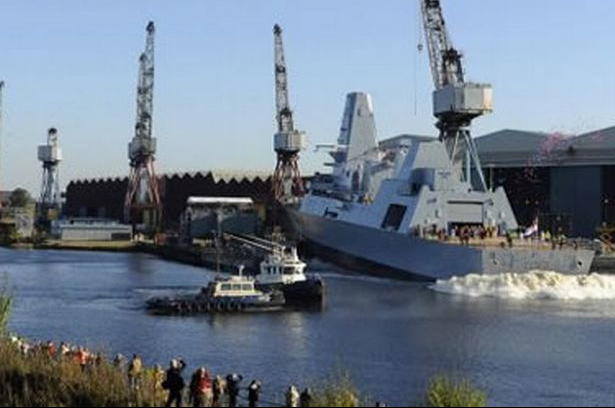
The most recent step along that road has been the £127m programme initiated in 2010 by the MoD with BAE Systems to develop the Type 26 frigate Global Combat Ship (GCS), previously known as the Future Surface Combatant. These ships are to be completed from 2021 onward, replacing Type 22 (‘Broadsword’ Class) and Type23 (‘Duke’ Class) frigates, currently in RN service.

Far from their humble WWII origins as cheap, sluggish 1,300 ton convoy escorts, frigates have become the backbone of ‘blue-water’ navies capable of deployment far from friendly bases. To do this, they have developed into 5,400-ton weapons platforms that can touch 30 knots and cruise over 10,000 miles. The Type 26 will use stealth technology and can be configured for several roles, such as Anti-submarine warfare (ASW), each ship costing from £250m to £350m, depending on equipment configuration.

Unionist politicians, led by Shadow Defence Secretary Jim Murphy, have flapped their lips about how imperiled the BAE’s Type 26 programme will be if Scotland threatens to become independent. Conveniently glossing over the fact that four RN support vessels are now being built in Korea and every nuclear system deployed (as well as the F-35s slated for the two aircraft carriers) is of US origin, the bold Jim sees only thousands of lost jobs:

“It’s crystal clear that if we leave Britain then we leave the Royal Navy.  If we lose the Navy we lose the work in the yards.  That would cost thousands of skilled jobs and many more in small companies in the supply chain.” —Jim Murphy, 14th February 2012

But, more practically than that, the decision about where such ships would be built lies as much with BAE as with the MoD. And, anyway, what do they have as alternatives? The BBC’s Scottish Business & Economy editor, Douglas Fraser, has written a sensible piece on this topic, pointing out that the only capable site outside Scotland is BAE Systems other shipyard in Portsmouth.

Whatever differences Scotland and England may feel they have now or in the future, it will be in the interests of both to be close friends—closer even that Eire currently is to the UK because neither would benefit from loss of the currently close levels of co-operation. Unlike Portsmouth, BAE’s Yarrow and Fairfield yards on the Clyde and at Rosyth have been building modern warships for decades.

In any case, a study by Howard Wheedon, senior strategist with City firm BGC Partners, told the Daily Record newspaper that the Clyde yards would continue to operate after Scottish independence:

“If BAE decide to close a shipyard because of uncertainty about future work levels, I think it would be Portsmouth.  It would be natural because Portsmouth is smaller than the Clydeside operations. It’s true that if Portsmouth closed and Scotland went independent, all the yards would be in Scotland.  But that’s not BAE’s concern.  That’s the UK Government’s concern.”

In fact, shipbuilding—especially of warships—has grown on the Clyde, with the workforce doubling to almost 4,000 over the last decade and key companies like engine manufacturers Rolls-Royce and SELEX Galileo, one of Europe’s leading avionics companies based in Edinburgh benefitting from the growth.

It is true that, in an independent Scotland, the MoD would be under no obligation to feed contracts out in a steady stream to allow optimal use of the skilled workforce. But, on the other hand, Turkey, Australia, India, Malaysia, New Zealand and Brazil have all expressed interest in the design and are potential customers. Portsmouth learning all the skills and expanding the capacity to handle all RN and/or export markets makes no economic sense—such overhead can’t be justified in this era of tight budgets.

Perhaps the most ironic element of all this is that Scotland would be unlikely to build any spiffy new frigates for the Scottish Defence Force. Not only do we not need global deployment (their 10,000-mile range is overkill) but the very RN ships that Type 26s are to replace actually fill the role we require far more economically, especially if refurbished with transom flap, Intersleek anti-fouling paint and Type 2087 sonar.

Better yet: the Scottish ‘share’ of the 19 Type 22/23 frigates active with the RN would be two, roughly the naval defence element we would need, especially if operated with the RN. The advantage to Scotland from that would be that both ships would be based and deployed in our waters—unlike at present where the nearest active RN frigate is actually at Gibraltar and poorly placed to intervene in any terrorist attack on, say, North Sea oil.

To sensible minds (that includes those in the MoD and Admiralty), building the Type 26 in Scotland is the best/cheapest solution for England: for the price of two ships they’d pay off anyway, they get England’s Northern flank protected by a stronger force, reliable and friendly as if it were the RN itself (because most personnel would BE ex-RN). They would also get much cheaper unit costs if we were to build Type 26’s for allies as well as RN. Only the Clyde has such capacity. Meantime, Scotland gets the core of its Navy for free.

The best deals are those where both parties win. That should be the independence debate theme—not singing Jim Murphy’s dolorous dirge that matches his long face.

Posted in Commerce | Tagged | Leave a comment

Glorious and Free

Before unionist readers have conniption fits about this being another diatribe about Scottish independence, allow me to point out that the title is the English translation of the Province of Manitoba’s motto: GLORIOSUS ET LIBER. And why should I be citing such obscure mottos? Because yesterday was the 70th anniversary of a little-remembered (outside Canada) piece of British military mishap/incompetence in which large numbers of brave men lost their lives—arguably unnecessarily.

Recently, we Scots are being forever told that we are part of “the most successful union the world has known”, with the subtext of having come through two world wars together. While demonstrably true, let’s not kid ourselves that we were the only country to answer the call when the British interpretation of ‘civilisation’ was threatened.

Despite already being nominally independent as ‘Dominions’, Canada, South Africa, Australia and New Zealand were quick to side with Britain on both world wars and to send their young men to fight alongside. This blog has already covered the pointless sacrifice of young Australian lives on the altar of British military incompetence at Gallipoli in Lions Led by Donkeys.

Although Canadians lost 67,000 killed and 173,000 wounded, out of an expeditionary force of 620,000 in WWI (a tragic 39% casualty rate), this was attributable to the general stupidity of Hague and his generals from which all troops suffered there, not just Canadians. In WW2, Canada was equally quick to offer support supplying a huge naval effort in the Battle of the Atlantic and thousands of flying personnel in Bomber Command.

But the 1st Canadian Division arrived in the UK too late, luckily, to be sent to France prior to Germany’s crushing defeat of France and the Dunkirk débacle (let no one call it a triumph—we were lucky; our men and the little ships were brave; the Germans, for once, were stupid). Which left the Canadians as the only competent and equipped military unit of any size to defend Britain in the dark days when the Sealion invasion seemed a real possibility.

Once Hitler’s deranged strategy threw the Wehrmacht’s 180-odd divisions at the USSR in June 1941, Churchill (under heavy pressure from his new ally Stalin) was urging his military to open a second front. Sanity prevailed and a compromise invasion of North Africa was agreed for late 1942. But, since invasion of France would be a prerequisite of any defeat of Germany, some kind of major raid to test theories and equipment would be necessary. This was scheduled for the port of Dieppe in August 1942.

As the most coherent units available (such British units as could be spared had been sent to the Middle East and Singapore) Canadians—mostly their 2nd Division—made up the bulk of the troops involved. The plan was conceived by South-eastern Command’s Montgomery, a competent enough general if given enough force but not an innovator. It involved an amphibious landing under and direct assault on the cliffs on either side of Dieppe harbour.

Support for the operation was weakened from the plan: a massed bomber raid was reduced to avoid French casualties, destroyers replaced battleships for providing support bombardment (52lb shells instead of 2,000lb shells) and a parachute landing to capture major shore batteries dominating the beaches was replaced by commandos landing on the same beaches.

The Plan for Dieppe: Note the Number of Canadian Regiments with Scottish Associations

Dieppe was defended by the German 302nd Infantry. Mobilised only two years before and by no means a ‘crack’ unit, this was still a fully-equipped regular division of 14,000 men under a competent Major-General von Bogen, strengthened by flak and coastal artillery units and well dug in behind barbed wire obstacles all along the beaches. While obstacles were not as comprehensive as two years later at Normandy, the defences had been alerted by French spies and good intelligence.

Photo-recon Spitfires only had to cross the Channel to report back on all this but the plan went ahead anyway. 237 ships deposited the assault force on the morning of August 19th. Only No 4 Commando had any success, destroying the shore battery at Varengeville. Those at Pourville, Puys and Berneval, along with field artillery, dug-in machine-guns and mortars on the heights, shredded the Canadians on the shingle beaches below, including 27 of the new Churchill tanks, none of which made it past the sea wall. By 11am, the whole operation was abandoned and survivors taken off as best they could under heavy fire.

Casualties from the raid included 3,367 Canadians killed, wounded or taken prisoner, plus 275 British commandos. The Royal Navy lost one destroyer and 33 landing craft, suffering 550 dead and wounded. The RAF lost 106 aircraft to the Luftwaffe’s 48. German casualties? 591. The German Fifteenth Army (responsible for the sector) conducted an investigation into lessons to be learned from the operation, as well as from two dozen samples of Britain’s latest tank with which they were presented. They thought little of either British planning or their latest tank. It triggered the building of the Atlantic Wall and eventually having no less a figure than Rommel put in charge of it.

Much has been said since about the fact that the Dieppe raid was a necessary precursor to the great amphibious operations that were to follow, in terms of the lessons learned and experience gained. However, it needed no debacle like Dieppe to learn those lessons. Unsupported frontal assaults on a competent, dug-in enemy are never part of sane tactics. General Sir Leslie Hollis (deputy head of the Military Wing of the War Cabinet with direct access to Churchill) judged the operation a complete failure, and the many lives sacrificed in attempting it were lost with no tangible result.

But the whole sordid episode bids fair as another glaring example of ineptitude that tarnishes any glory deriving from the British Army’s exploits through history as part of this union—and raises considerable questions about a relative indifference from their staff officers to casualties, proportional to the distance from the Home Counties that soldiers involved in any given operation originated. It’s a wonder Canadians are as fond of the British as they are. But they’ve had their own country since 1867—glorious & free.

“So proud of the way the (Queen’s Own) Camerons (Highlanders of Canada) went to their deaths. So sad that they seemed to have been wasted. So angry that I was even a part of something so unrewarding, without even knowing what I was doing or where I had been.” —Dieppe survivor Albert Kirby

Posted in Politics | Tagged | Leave a comment

School’s Gone Back: Time for Summer

It has become a cruel tradition in recent years that the weather down our way waits until the schools go back before it rolls out its most summery offerings. This year seems no exception —but at least it had the grace to schedule it on a Saturday so that youngsters were able to join in.

Yesterday started out with two-edged promise: A dark belt of rain to the South of the Firth of Forth and a wide swathe of sunshine to the North. At first, it wasn’t clear which would prevail over our part of the border between.

West Beach at Morning Low Tide—Dark Clouds to the Southwest (The Lamb is just Above the End of the Pier)

But after a nominal drenching, things picked up. Out in a lugger for a short sail to check on Uri Geller’s Lamb, we sneaked up on rafts of guillemots, mostly paired up as parent teaching chick to dive on what must have been a rich shoal of sand eels. There were even some razorbills and less-colourful puffins (now their beaks have lost their display plates).

As we were quietly under slow sail we could get within feet of them. All of these auks have disappeared from their nesting sites, making islands like the Lamb and nearby Craigleith seem bare, so it was good to find so many of them still local because of plentiful food for them. Not long ago we were losing pufflings because all their parents could find were pipefish and the youngsters were choking on their bony bodies.

Almost-grown Puffling—not yet Quite as Cute as its Parents

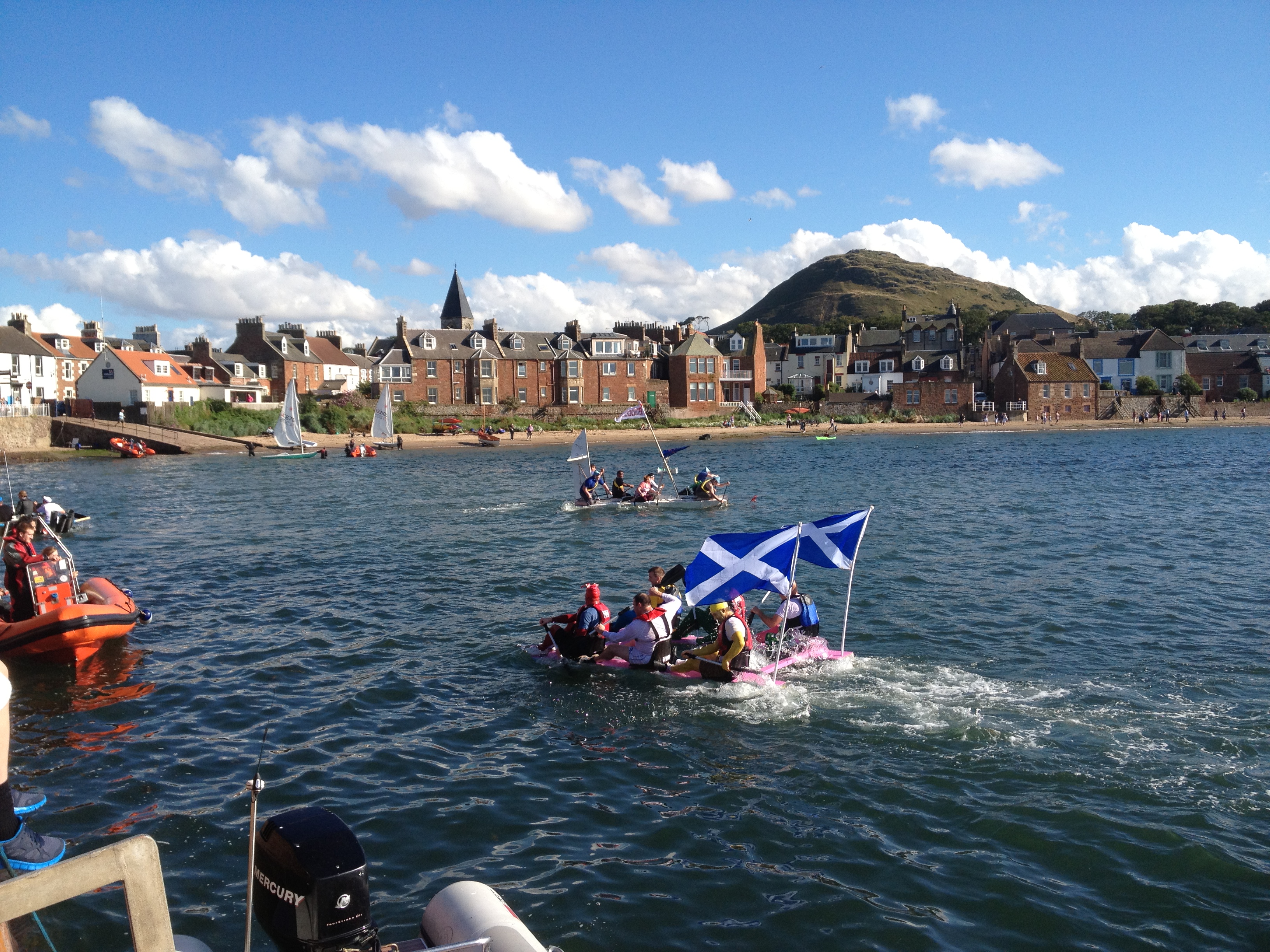
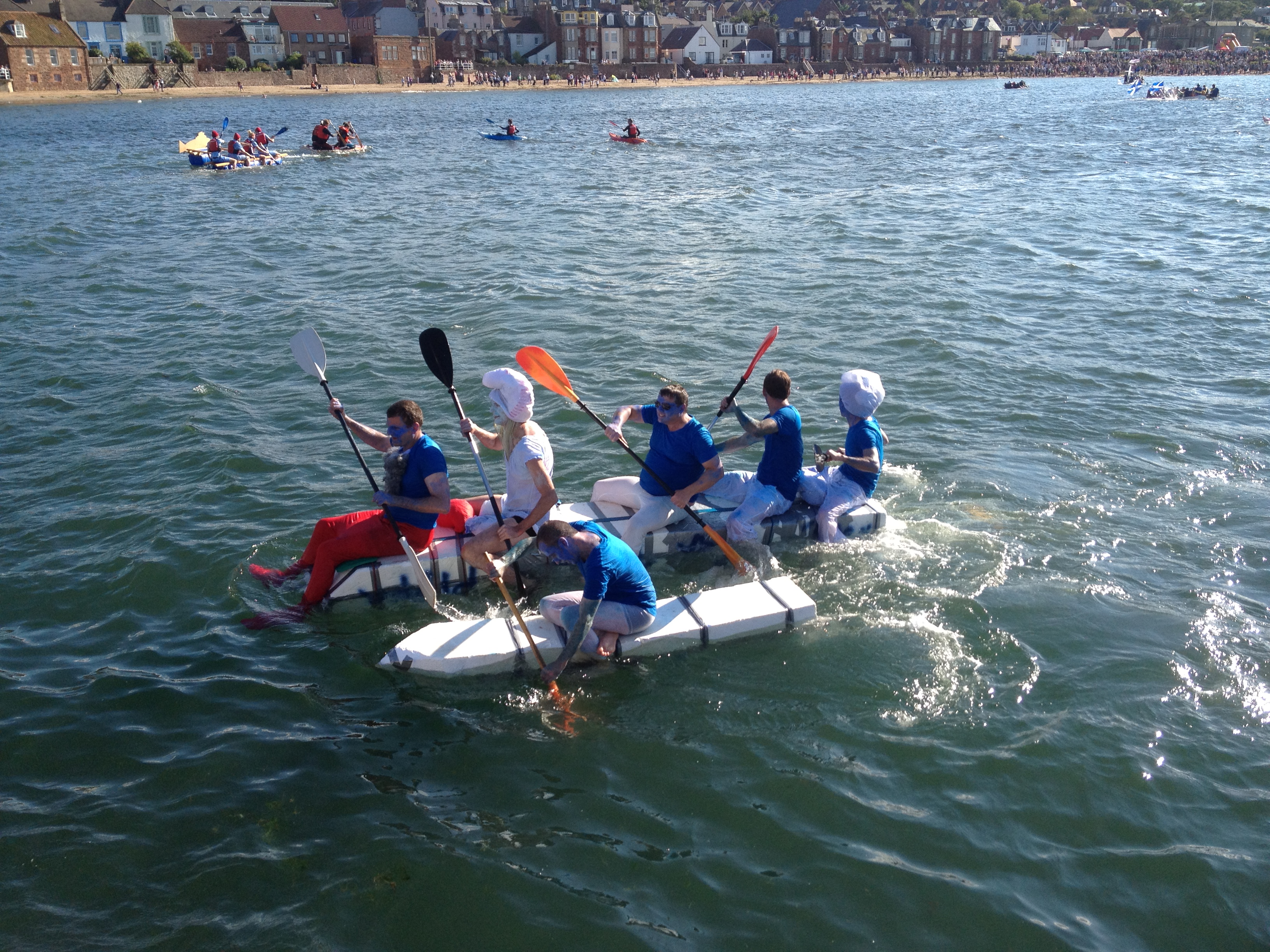
Back to harbour in time for the Raft Race highlight of the day, the weather had turned from threatening all the way to brilliant. It became the warmest, sunniest afternoon so far, with just enough cloud to make the views interesting. With a grandstand view from the South Pier (which contestants had to touch as the second marker in a three-leg course), I still couldn’t work out which film/TV themes each raft represented.

First and Second (with the Saltires) Places at the Turn

Though the finishing times varied wildly—some taking three times the winner’s 8 minutes back to the beach—even the stragglers didn’t give up, paddling furiously against a stiff headwind on the final leg back to the beach Elcho Slip start line.

Lying in Fifth Place—Unsure What They Represent but it’s not Top Gear

The Batmoboat Won no Award for Speed but, Judging from Female Spectators, Came 1st in the Beefcake Stakes

Crowds at Elcho Slip Watch our ILB Shepherd Last Place Along. (How the Yachtie Got involved, No-one Knows)

No idea yet how much the event raised for the RNLI and NB’s Music Therapy Project but I hope it was a lot: hundreds went home happy with the sunburn they’ve been hoping to get all summer. Many thanks to Peter Hammond and the RNLI for providing a brilliant focal point for a memorably splendid day.

Posted in Community | Tagged | Leave a comment

Romney Marsh

Mitt Romney has less than three months to convince American voters that he is the man to lead them (and the rest of the planet) out of the biggest fiscal hole it has fallen into since the Depression. While we don’t have people throwing themselves out of tall buildings, the degree of damage to wealth (UK GDP down by 23% since the halcyon days of 2007) is major. It will not be fixable by voodoo economics.

Yet that appears to be what Romney’s new running mate and the next LBJ—if Mitt succeeds and we have another Dallas 1961—intends. Given the continued love of personal artillery (and a history of using it to settle arguments) across the pond, then the donations that the NRA give to the Republican party make that scenario anything but far-fetched.

Paul Ryan is the most articulate and intellectually imposing Republican of the moment—no great accolade. But that doesn’t alter the fact that this earnest congressman from Wisconsin is preaching the same empty conservative sermon as his boss. His campaign rhetoric about shrinking Big Government and giving tax cuts to “job creators” (aka: the top 2% earners) will do nothing to reverse US economic decline or avoid fiscal collapse. It has been calculated that Romney would pay 0.82% tax rate if the proposals were enacted.

Mr. Ryan professes to be a defense hawk. But following that Republican doctrine since Ronald Ray-gun now saddle a bankrupt nation with a roughly $775 billion “defense” budget when the US has no advanced industrial state enemies and has already been fired (appropriately) as the world’s policeman for doing a Clancy Wiggum. That huge amount is half of Britain’s entire GDP.

Adjusted for inflation, today’s US defence (defense?) budget is double Eisenhower’s in 1961 (about $400 billion in today’s dollars)—a level Ike deemed sufficient to contain the Soviet nuclear threat in a post-Sputnik era. The Romney-Ryan school of attacking “Big Government” (always a winner among right-wingers there) is to increase an already outlandish warfare-state budget for sabre-rattling at an irrelevant Iran.

Far more urgent than environmental marginalia that Mitt Romney targets is that the giant Wall Street banks remain dangerous quasi-wards of the state—inexorably prone to speculative abuse of taxpayer-insured deposits and the Fed’s cheap money. Forget about “too big to fail”: these banks are too big to exist. They are too big to manage internally or to regulate externally: they need to be broken up.

Ryan’s greatest hypocrisy is his phony “plan” to solve the entitlements mess by deferring changes to social insurance by at least a decade. Instead of a sweeping, income-based eligibility test, which would reduce or eliminate social insurance benefits for millions of affluent retirees, the supposedly courageous Ryan plan would cut nothing from the $1.3 trillion-per-year cost of US Social Security and Medicare over the next decade.

Instead, it shreds a measly means-tested safety net for the vulnerable of America: $100 billion per year for food stamps and cash assistance for needy families and a $300 billion budget for Medicaid, the health insurance program for the poor and disabled. Shifting Medicaid costs to the states is make-believe if current federal financing to them is cut at the same time.

In his days representing Wisconsin, Ryan would give out copies of Ayn Rand’s book “Atlas Shrugged” as Christmas presents. He described the novelist of heroic capitalism as “the reason I got into public service.” But Mr. Ryan’s youthful, feverish embrace of Rand and his clumsy attempts to distance himself from her now is more than the flip-flopping of an ambitious politician: it is a window into the ideological fissures at the heart of modern conservatism.

Though Mr. Ryan’s advocacy of steep cuts in government spending might have pleased Ayn Rand, she would surely have opposed his social conservatism and hawkish foreign policy. She would have denounced him—as she denounced Ronald Reagan,—for trying “to take us back to the Middle Ages, via the unconstitutional union of religion and politics.

And when Ryan’s embrace of Rand drew fire from US Catholic leaders, he reversed course with a speed to make Mitt Romney proud. “Don’t give me Ayn Rand,” he said earlier this year. “Give me Thomas Aquinas.” Mr. Ryan’s is a telling index how far American conservatism has moved from its founding principles. The creators of the movement embraced the free market, but shied from Rand’s promotion of capitalism as a moral system. They emphasized the practical benefits of capitalism, not its ethics.

Mr. Ryan’s selection as Mr. Romney’s running mate is the kind of stinging rebuke of the welfare state that Rand hoped to see during her lifetime. But Mr. Ryan is also what she called “a conservative in the worst sense of the word.” Like his new boss, Mr. Ryan has no serious plan to create jobs. America has some of the highest worker costs in the world; workers and business pay $1 trillion each year in their equivalent of PAYE/NI. Many argue for a national sales tax (a consumption tax, like our dreaded but efficient VAT) but neither candidate will have the gumption to create one.

Of the $1 trillion in so-called tax expenditures that the plan would attack, most would come from slashing popular tax breaks for employer-provided health insurance, mortgage interest, 401(k) accounts (savings via payroll deductions), state and local taxes and charitable giving. The plan seems devoid of credible arithmetic or hard policy choices. There is no element to face up to Wall Street, the Fed, the military-industrial complex, social insurance or even the present US fiscal calamity—not even a clear route to that American axiom of reviving capitalist prosperity.

They are like old-time fire-and-brimstone preachers doing a Canute—wading out into an unknown marsh and calling to their followers that faith alone will keep all their heads above water.

Posted in Politics, Uncategorized | Tagged | Leave a comment

Firstest with the Leastest

I like Americans. They are generally direct people who can’t abide havering around and generally “tell it like it is”, albeit sometimes gracelessly. Their Confederate General Forrest went down in history ascribing victory to whoever entered battle the “Fustest with the Mostest”.

This week’s announcement by English Transport Minister Theresa Villers MP that First Group had won over Virgin to run the contract for West Coast Trains over the next 14 years shows that Cameron’s government is either not au fait with this American sentiment or that they seriously misinterpret it. Either way, it’s bad news if you plan to travel through Carlisle by train anytime before 2026.

After a long and ponderous period of bids being constructed, submitted and considered, the choice has gone to the one offering the most money. Such a simple criterion could have seen the matter sorted in an afternoon, without the lengthy sham that we have had. The Department for Transport (DfT) handed the contract to FirstGroup after Virgin’s rival made an offer to run the line for £423m a year or £5.5bn in total. Sir Richard Branson had bid £750m less.

At first (no pun) glance, this may appear reason enough. But, since this is one of the key rail services linking Scotland with the rest of the UK, we Scots need to know this is the best we could get. Leaving aside the whole debate about why we are running our railways in such an insanely inefficient fashion, let’s just focus on whether it’s the right choice.

Virgin West Coast had (rightly) come in for some serious stick during the dozen years  they ran this franchise (see below). Unlike East Coast’s 9-car trains, VWC would often run 5-car sets and get swamped by un-booked passengers. This was not helped by running through the rail spaghetti that is South Lancashire/West Midlands, falling foul of delays to other services in a ‘knock-on’ effect.

On the other hand, they had completely revamped the rolling stock, providing modern carriages, even groundbreaking Pendolino tilting trains and an electronic seat reservation system that others are lax in not copying. They also survived the horrendous upgrade of the WCML (think ‘trams in Edinburgh’) with passengers intact and broadly satisfied. Much was from innovative management thinking growth and improvement as much as short-term profit.

Contrast that with FirstGroup.

Although they are not immediately comparable, the transport companies that make up FirstGroup bid fair to be among the shoddiest in the business. It is not that they can’t turn a profit; it’s that they seem to know about little else.

Consider their bus companies. The ones based in Aberdeen and Edinburgh each chose to run a fare war with their local rival over most of a decade. Until they won one and lost the other, passengers were dazed by timetable changes and floods of buses timed to run in front of one another. First regularly uses cheap buses from anywhere (the ones in East Lothian are currently liveried in Welsh), pays the meanest wages, gazumps councils into paying over the odds for supported services and could not care a fig about ‘service’. They’ve mastered the ‘cheap’ but have some ways to go on the ‘cheerful’.

Maybe their train companies are better? Well, ScotRail has had eight years under First. In that time Airdrie/Bathgate or Alloa or Lawrencekirk or Waverley station were all driven by the Scottish Government or SPT or Network Rail. In all else—ticketing, promotion, new services, new rolling stock, new anything—they have been passive.

Opportunities abound. Glasgow/Edinburgh-Aberdeen services are toy trains—too small to avoid oil workers and their bevvy, they stop at every lamp post. Rickety, antiquated two-car diesels carry tourists through our spectacular Highland scenery. Whether to Oban, Mallaig, Kyle or Thurso, it’s all on cheesy kit we should be ashamed of. And what of the jewel in their crown: Edinburgh-Glasgow? Same speed as Victorian times, the quarter-hour frequency often fails and you get someone’s elbow in your ear all the way because they’ve skimped with another 3-car unit.

FirstGroup run four other rail franchises already (Great Western, Transpennine, Capital Connect and Hull Trains), with only the first of these providing any experience of running real express trains over long distances. A New Statesman article comparing FGW with Virgin services provides interesting statistical detail:

Virgin Trains: The average Virgin train was 8 years old in 2011. The majority of its trains are electric Alstom Pendolinos, built between 2001 and 2004, with a second set delivered between 2009 and 2012. They can run up to 140mph, but only travel at 125mph on the West Coast Main Line. They had 266 complaints per 100,000 passenger journeys in 2011, 53% responded to within 20 working days. 1% of contacts were praise. In passenger surveys, 87% of respondents were satisfied or better with the company’s performance. In every category given, more than half of passengers were satisfied or better, with the least popular aspects being how Virgin deals with delays, the toilets on their trains, and the amount of space for luggage on the trains. 88% of people were satisfied with the speed of the journey.

First Great Western: The average FGW train was 29 years old in 2011. On its high-speed route, it runs 54 “Intercity 125” trains, built between 1975 and 1982. Although the fastest diesel trains in the world, the line is stymied by the lack of electrification. They had 86 complaints per 100,000 passenger journeys in 2011, 100% responded to within 20 working days. 5% of contacts were praise. In passenger surveys, 83% of respondents were satisfied or better with the company’s performance. The least popular aspects of FGW were how well it deals with delays, value for money of its tickets, and the toilets on its trains; none of them satisfied more than 40% of passengers. The most popular was the speed of the journeys, satisfying over 80%.

The problem with these comparisons is that FGW is largely the king of the track in those sections that matter (Paddington-Bristol-Cardiff & Bristol-Exeter-Plymouth)—as East Coast is on the ECML. Virgin West Coast had no such priority through the Midlands maze.

And it is this East Coast history that bodes ill for FirstGroup overbidding and Ms Villers et al blinded by pound signs in their eyes in choosing them. Looking over comments online, the vast majority think the Department for Transport’s decision was completely wrong. This view is backed up by a survey by the Telegraph. With over 17,000 votes, over 92% of respondents believe FirstGroup will not deliver on its promises and the price they have paid is not deliverable.

The Torygraph published a good article on the lessons the Government should have learnt from both East Coast Main Line stumbles. A rather more pungent and recent article goes on to explain why the decision is “nuts” and how FirstGroup are looking to “exploit” the West Coast mainline. Richard Branson has warned: “The three times that Virgin has been outbid, the winning operator has come nowhere close to delivering their promised plans and revenue, and has let the public and country down dramatically.”

If only First would live up to its name as a class. But the runes are not good.

Posted in Transport | Tagged | 1 Comment

Indy-Contrarian Broon Misgivings (ICBM) Strike

From whatever hardened silo complex outside Auchtertool in which they had been nursing his wrath to keep it warm, the Hootsmon launched their secret weapon of Irn Broon full-frontal-page yesterday. For a man who can make the word ‘dour’ look like carnival in Rio by comparison, it was not the highlight of anyone’s day, but at least the man is consistent.

Presenting the annual Donald Dewar lecture at the Edinburgh International Book Festival, Mr Brown performed the now-familiar unionist rain-dance that Scotland would all but slide beneath the waves, were it not for the solid rock of the Union to keep it afloat. I looked hard for anything new being said but it really did consist of a stark choice between business-as-usual under Westminster’s wing or fiscal oblivion.

Now, whatever you may think of Gordon’s politics or even his tenure at No 10, the man’s not daft, nor can he be without ability to thole Blair as a boss and hoodwink an entire nation (two, actually) into thinking his girlfriend Prudence had put the hex on boom and bust. If I sound bitterly cynical, it’s because I believe he—more than any—was asleep at the financial switch and so allowed UK banks to grow as greedy as the late (un?)lamented Lehman Brothers, bust through hubris despite their $639bn in assets (roughly the size of the whole UK economy).

Yet so major a figure would not come out of retirement to flap his lip just for the exercise or nostalgia for the limelight. Do his assertions that keeping the pound would be ‘a colonial arrangement’ and would continued union offer a far safer path into increasingly uncertain futures?

Let’s look at background figures, published in the spring by Eurostat (I thank Andrew Wilson and his ever-astute (excepting where Motherwell FC is concerned) observations on events for drawing my attention to their detailed tables). They provide statistics how this recession has affected Gross Domestic Product per capita, broken down not just by country but by relatively small economic region across Europe. We hear today how Portugal’s economy has shrunk 1.5% in the last 3 months, even as Germany alone pulls off a small growth. We are all (as Cam might put it) in the mess together, no?

Well, no.

However much Irn Broon may regurgitate the bettertogether mantra of fiscal apocalypse at the gates, the implication that the UK is a financial life-raft for impoverished Scotland, whose continued survival involves clenching both eyes and nurse’s hand, should hold water when examined under the objective microscope of detailed Euro-based stats, no?

Er…again, no.

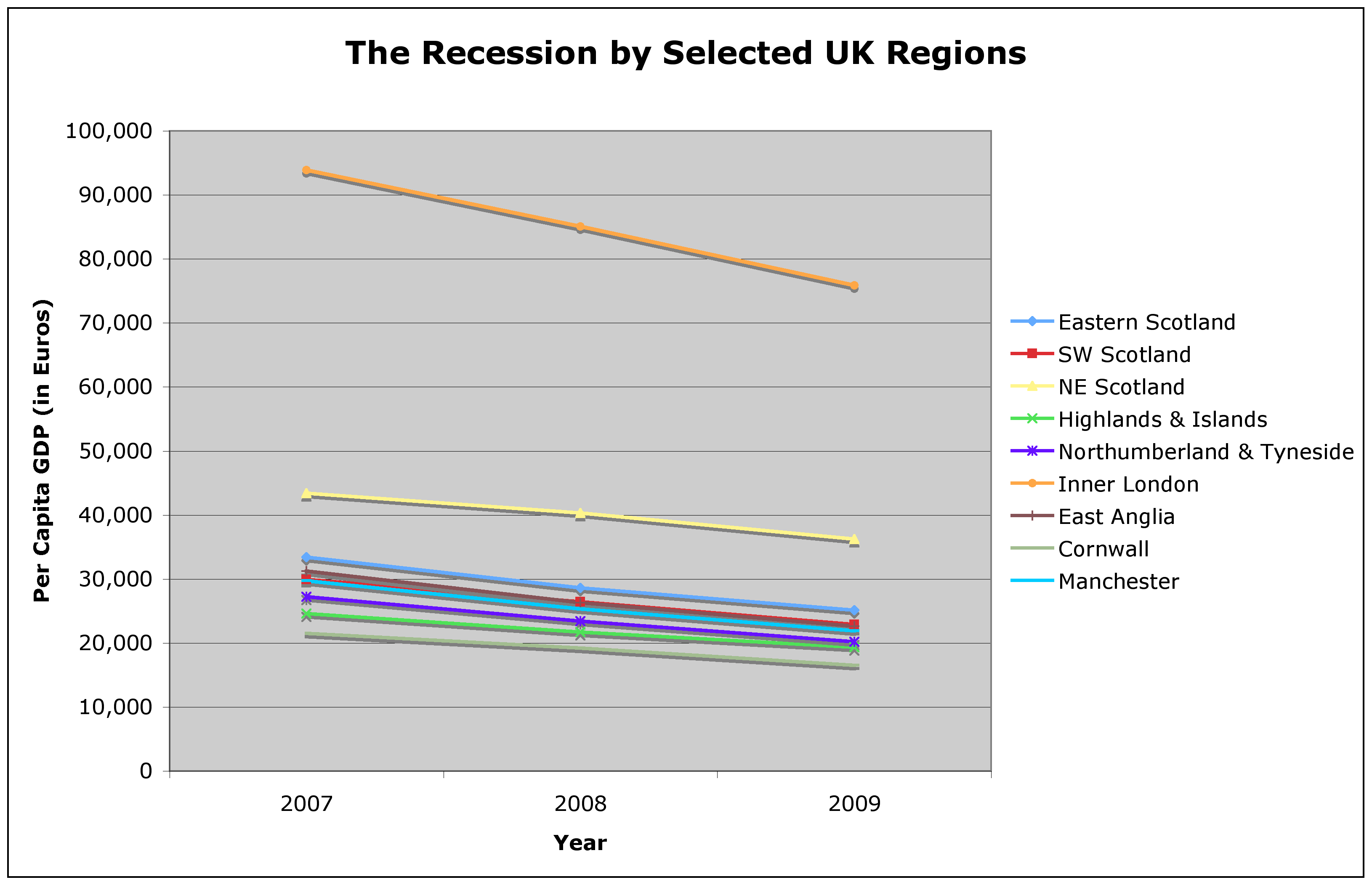
Let’s examine the story within the UK. How hard has the recession hit us and how evenly has its impact been spread? Looking at selected regions across Britain (with Scotland’s four regions compared to representative ones in England) gives a fairly consistent tale of how the recession affected GDP per capita in each area.

Chart 1—Recession by Selected UK Regions (source Eurostat)

Note how all regions show a consistent pattern, no matter which part of the UK, with Inner London keeping its clear lead in GDP through financial services and NE Scotland through the barely-affected Oil and Gas sector . Looking at the before-and-after change shows how serious this has been but that we are all roughly in the same boat.

Chart 2—Change in GDP in Selected UK Regions (source: Eurostat)

This shows that, although both Inner London and Aberdeen can be said to have weathered the storm best, everyone is pretty much in the 15-25% loss boat. In such dire times why would you think of casting yourself adrift in such stormy seas?

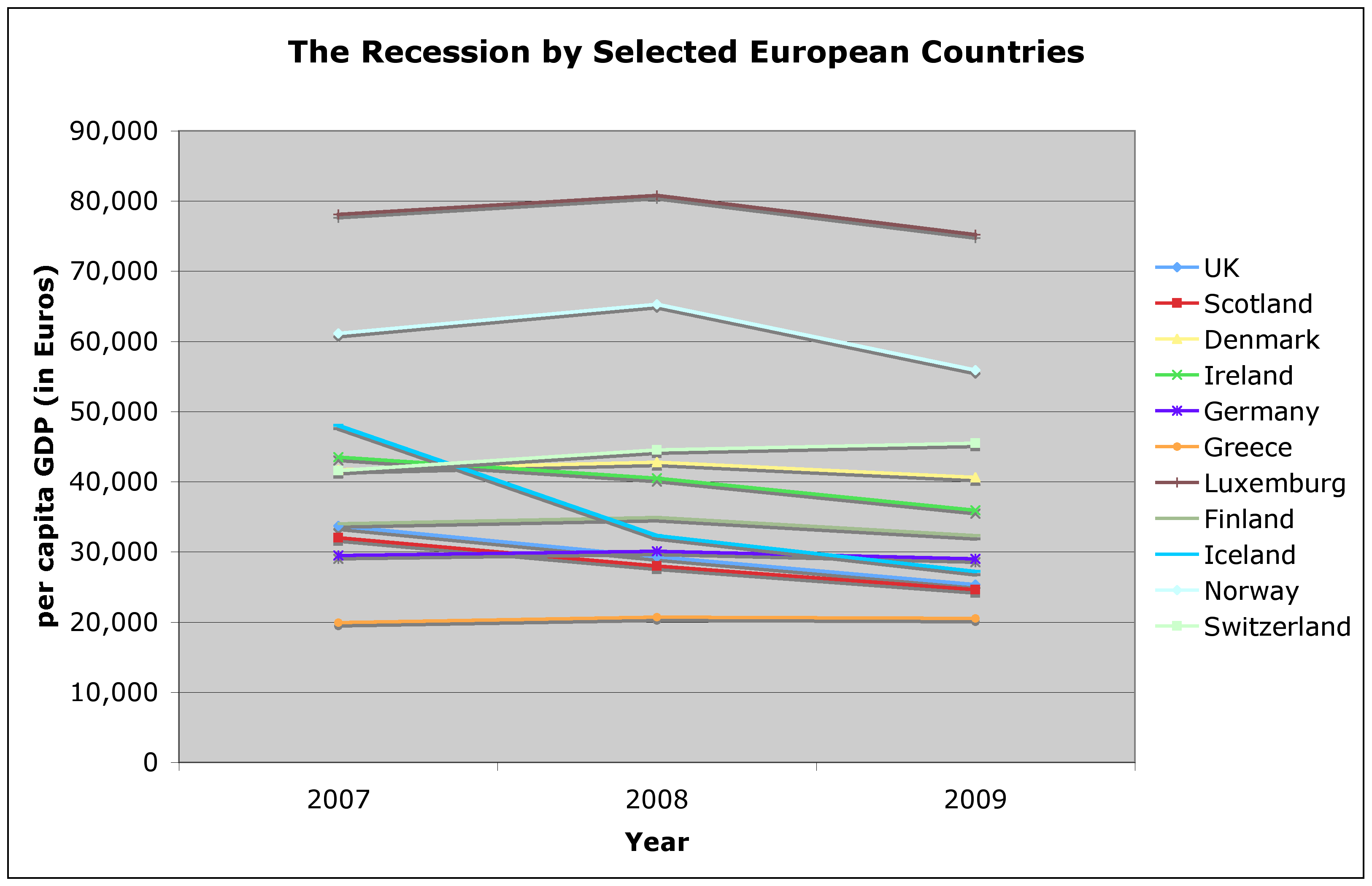
Well, because there is another story going on—one that both media and UK government seem reluctant to relate. While they are always prompt with dire news from the Continent, brought to us with much wailing and gnashing of teeth about how our biggest markets are there, so how can we possibly escape this recession, the news is rather at odds with that glum picture. Not only have the PIGS yet to grunt—let alone croak—but the figures are not what you would extrapolate from the UK stats. Chart 3 is the Euro-equivalent of Chart 1 above.

Chart 3—per Capita GDP for Selected European Countries (source: Eurostat)

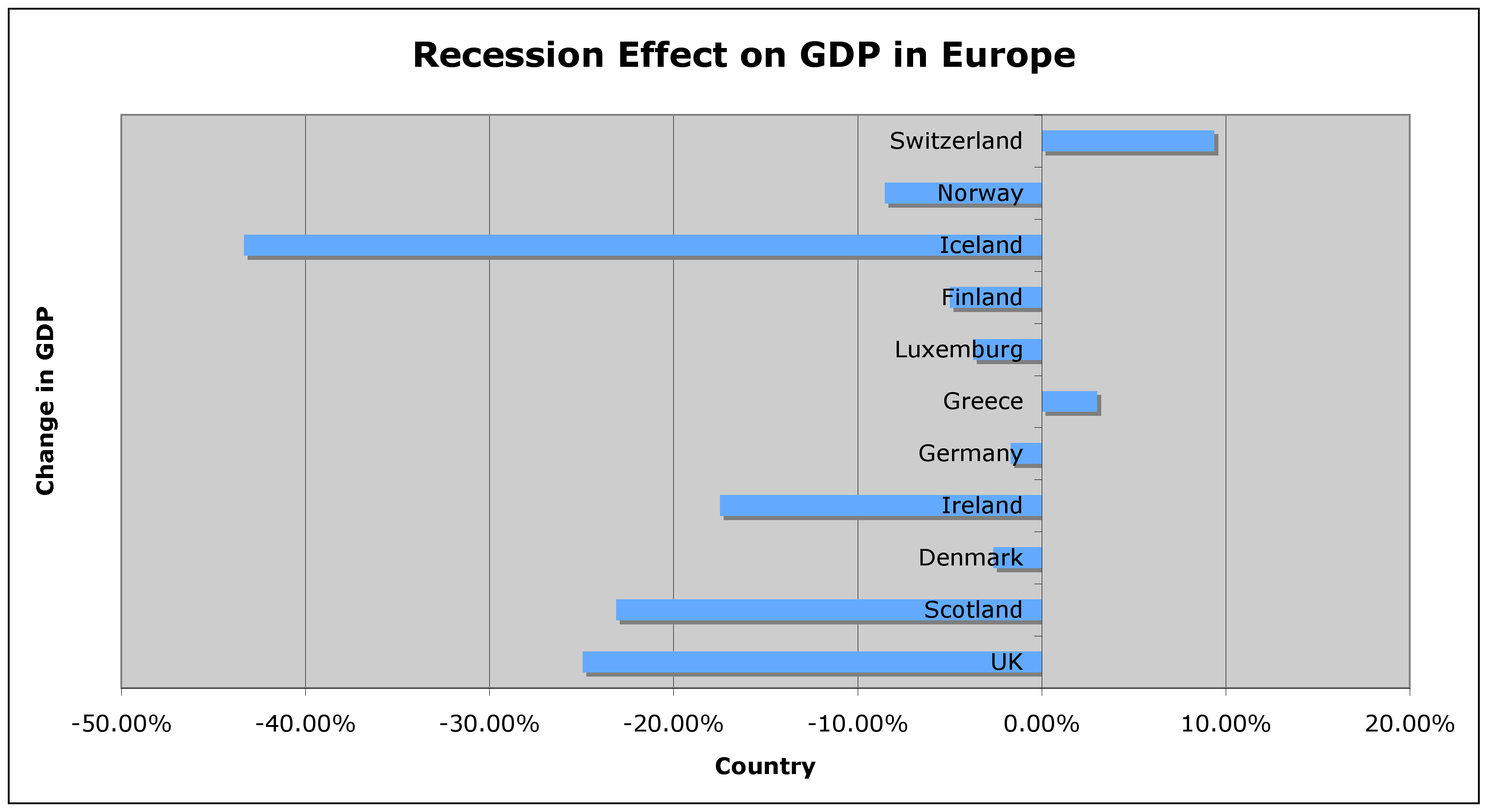
Doesn’t that look pretty much the same? Well, no, it doesn’t. Note both the UK (light blue) and Scotland (red) are slashing down to the right much steeper than most others except Iceland and Ireland. In fact, Switzerland and Greece appear to be rising. Looking at the European equivalent in Chart 2 in Chart 4 below highlights this.

Chart 4—Change in GDP in Selected European Countries (source: Eurostat)

This looks nothing like Chart 2. In other words, a slew of European countries are riding out this recession with far less damage than the UK. In fact, the only countries sharing the dire 15-25% falls uniform across the UK are Iceland, whose banks were one of the few worse examples of hubris and overstretch than those of the US and UK, and Ireland, which is suffering the bursting of a property bubble that made London house price rises in the eighties look modest.

Elsewhere in Europe, the equivalent to the UK’s major stumble is nowhere to be found. The worst is Norway, whose GDP ‘dropped’ 8.5%—from 1.9 times ours to 2.3 times ours. Oh to have such ‘problems’. With statistics like that, is it any wonder that our European neighbours regard Britain as the sick man of Europe and get thoroughly fed up with Tory party backwoodsmen bleating on about sovereignty and hankering after halcyon days when Johnny Foreigner could be brought to heel with a well deployed gunboat?

These figures make any objective observer ask why a country in Scotland’s position would want to remain tied to a country run by such inept fiscal controllers—as Brown proved to be—and not establish itself as one of a body of progressive countries nearby that are clearly making a better fist of weathering the current fiscal storm than the UK is.

Despite its front-page coverage, what Gordon Brown was peddling yesterday was hokum. It was unsubstantiated scaremongering that simple research such as above disproves with the click of a mouse. None of the assertions made in the Hootsmon were substantiated—we just had to take Gordon’s word for it. Instead of the nuclear strike on arguments for independence that this ICBM deployment had intended, it was, to mangle a phrase from Westminster itself, like being savaged by a damp squib.

Posted in Politics | Tagged | Leave a comment

Queen Elizabeth—Another ‘K’atastrophe?

Regular readers will know of my interest in history in general and of naval history in particular. Last week, as part of North Berwick’s Fringe by the Sea, I gave a couple of talks on the former to be delighted and surprised by one attendee who, knowing I had a further talk on The Battle of May Island, generously gifted me a 1963 hardback first edition that filled a gap in my library. Reading it rekindled my deep suspicions about the two Queen Elizabeth-class aircraft carriers now building for the RN for some £7bn.

The book is Don Everitt’s The ‘K’ Boats and is the shocking, if eclectic, history of a class of disastrous submarines built by the RN during WWI. I had read it decades ago as a paperback, using much of its later material in my talk. But re-reading it refreshed me on the earlier section when the boats were being conceived, designed and trialled.

I impute no incompetence at any of the half-dozen major and hundreds of minor contractors involved in the aircraft carriers—any more than the similar number involved in the 21 K-boats built. But you do wonder at what they are/were asked to do. No amount of clever design, ingenious engineering or stout seamanship can compensate for a daft idea from what CPO Pertwee once referred to as ” The Admirality”. I can’t prove parallels between the K’s and QEII’s to be true at this stage. But consider the following:

In 1913, Britain was, in theory, at the peak of its global power. But it was financially strapped and building a fleet of dreadnoughts had severely strained the naval budget, not least because they required scouting cruisers, defensive destroyers, major docking facilities around the world, along with coaling stations, etc, etc. Worst of all was a paranoia that some new-fangled weapon like the submarine would render the lot vulnerable.

Problem was that subs of the day were new and had weak power plants. Submerged they could only make a few knots; on the surface they couldn’t do much better than half the fleet’s 24 knots. Never one to accept a situation he disliked, as First Sea Lord, Churchill bullied his Admirals into rectifying it. Fisher declined, citing inadequate technology. When Fisher left, having fallen out with him over the Dardenelles, Winston had his way.

Designed to make 24 knots, the ‘K’ class of submarine seemed an answer and were then rushed into production. Bigger than a destroyer at 2,600 tons, they were over 120m long, heavily armed (for a sub) with 10 torpedo tubes and three deck guns. Production was pushed with urgency, so no prototype was built. It was only on trials that shortcomings in the concept became apparent. That, in itself, is understandable. But the degree to which they were systmatically covered up, ignored and generally swept under various carpets was criminal. Because many men died; none of them at the hands of the enemy.

The basic problem, as Commodore Submarines Sydney Hall observed, “it is a bold advance of 300 percent in design” since they used steam. “So what?” you ask; “all ships of the day used steam.” Yes—but not underwater. Think about it. Dealing with the matter of funnels, ventilation, heat, condensation, boiler blowback and a host of things made them the most complex machine built to date and over a dozen holes in the hull of varying shape/size.

Read the book for a catalogue of trials failures and accidents, including several uncontrolled dives to the bottom, one of which had the future George VI on board. Their shape, length and weight made them almost impossible to trim; they were so long the bow could hit the bottom while the stern was in the air, propellers thrashing because of pressure differences. And, limited by sealing so many holes to 50m maximum depth, they were vulnerable in the many places the sea is deeper than that.

Several were lost with crews of 100 on board without trace. Yet the Admiralty glossed over the major shortcomings (they had invested over £6m—at the time the cost of an entire dreadnought squadron) and persisted with tinkerings with the design. The final straw was not until January 1918 when a night exercise in the Forth cost two sunk and four damaged with the loss of 100+ crewmen and the nearest Germans asleep in bed on Heligoland.

Wind forward a century to the concept that the UK needs real carriers. The original RN carrier fleet was scrap by the 1980’s and the STOL Harrier-equipped ‘through-deck cruisers’ the only means of projecting UK air power until they were binned in a strategic review two years ago. But the carriers are now to be equipped with the STOL F-35, which doesn’t need a 65,000-ton monster. Nor can F-35s mix it easily with land-based fighters like F-22 Raptors.

The original strategic review called for aircraft carriers for three main reasons (I quote):

  • Ability to operate offensive aircraft abroad when foreign basing may be denied.
  • All required space and infrastructure; where foreign bases are available they are not always available early in a conflict and infrastructure is often lacking.
  • A coercive and deterrent effect when deployed to a trouble spot.

Note how none of this refers to defending the UK. We have pared down most of the defence force of Britain—including ANY long-range maritime capability—to pay for this. So the rationale for carriers is so we can go elsewhere and hit somebody. Given the the USN has 18 comparable carriers and support groups, what likelihood is there we would be going to war without them? And, if we’re talking Afghanistan or the like, carriers cannot get close enough to make any meaningful addition to deploying force there.

So why the hell do we need any, other than for UK high heid yins to whine their way to the top table so they can chest-butt the bad boys?

And, as one US submarine Admiral said about ‘his boys’ in attack submarines: “You know what we call aircraft carriers? Targets.” The US deploy at least one Aegis cruiser, two DDGs and two FFGs, plus support oilers, etc, every time they let one of their carriers out to play away from home waters. That means pretty much the whole RN surface fleet committed to avoiding our carriers decorating the bottom of whatever ocean they’re engaged in gunboat diplomacy at the time.

The RN has form in deploying poorly conceived equipment when it comes to aircraft carriers. Losing Courageous while ‘chasing submarines’ in 1939, losing Glorious while transporting land aircraft in 1940, losing Illustrious to superior land-based bombers in 1941, losing Hermes to the better-equipped IJN in 1942—all can be attributed to the Admiralty appreciating the need for air power at sea but settling for poor tactics and worse equipment trying execute it.

The K-boat strategic concept of fleet submarine was flawed: as Jutland and WWII proved, the whole concept of ‘fleets’ was faulty. The idea that the UK needs what illusory 21st century clout a fleet aircraft carrier with inferior aircraft can offer reeks of similar delusions. And, given that no serving RN Admiral (let alone anyone at the MoD) can claim flag service in a proper fleet carrier, on what basis can our £7bn be anything other than wasted?

Posted in Politics | Tagged | Leave a comment

A Proud City Goes Begging

I have always been a booster for Edinburgh as a city: a walkable, architecturally inspired romp across hill and dale that encourages exploration of its compact city centre and trademark panoramas. Its soul sisters Lisbon and San Francisco come close but don’t, for me, quite make it. And, although lively and varied throughout the year, moves up several gears during August when the Festival puts it front-and-centre of the world stage.

Its city fathers or yore (there were no women) have generally discharged their duty of care well: they dodged a serious bullet when they shelved the 1960’s plot to drive a motorway up the Pleasance as the start of an inner-city ring road. Some things have been less far-sighted, as when they ripped out their trams in 1956, lost the plot on what to build on Princes Street then sanctioned debilitating eyesores like the Midlothian CC building or the St James Centre.

Through all that and the half-century since, Edinburgh City Council has had an office-full of time-served civil engineers whose job it is to plan the roads within the city and how to improve them. In that half-century, unlike any other major city in the UK, they have planned and built precious few roads at all. In fact, if you discount trunk roads, the Gyle and Sir Harry Lauder, they have provided diddly-squat.

So what HAVE they been doing all these decades to earn their serious five-figure crusts? At first it was hard: driving new roads through historic cities is difficult. Then twenty years ago, along came a young councillor with an anorak gleam in his eye by name of Begg. His 1995 manifesto for the new unitary council aimed “to help create a civilised, safe, inclusive and sustainable city. The strategy seeks to improve alternatives to the car, reduce the need for car travel, restrain traffic and improve safety”.

At that time, he was in the middle of executing a brainstorm. If he couldn’t build more roads, why, he’d just pretend there were more by overlapping them. With an expenditure on paint that shamed the Forth Bridge ECC covered most major arteries within the city with delineated lanes for buses and expanded bike lanes both on- and off-road. In itself, no bad idea to speed urban bus travel and encourage alternatives to the car, this was, unfortunately, the ONLY measure deployed.

The result was heightened hostility towards car drivers that was amplified by privatising the traffic wardens—the legendary ‘blue meanies’ whose ticket-issuing had far more to do with revenue than speeding traffic flow. On top of that came the proposal for Congestion Charging across the city, with higher rates for a city centre core zone. The funding would have built ‘better transport facilities’ but it was a pig in a poke because none would be put in place first. Worst of all was the absence of ANY transport structure (underground, trains, etc) that almost any city could offer as alternative to buses on narrow streets.

Given that city traffic keeps growing (despite all that paint) and bus journey times still lengthen (despite all the paint) and there were no alternatives to car/bus but bike/walk, when the citizens were polled, they gave it a huge thumbs-down. Such a setback did not faze the irrepressible David Begg. He would go ahead with a plan to provide Edinburgh with a modern tram system that would serve Leith and the northern suburbs, as well as the airport (the airport could easily have been served by re-opening Turnhouse station but that would not have been to the further glory of his status as transport visionary).

So in 2002, with the active collusion of then-Transport Minister Iain Gray, TIE was set up as a cosy cartel and given the contract to deliver two tram lines by 2008 for under £330m. This is no place for that ugly story (try here) but this set off a decade of street disruptions that would have caused riots, had their extent been known at the time. The office-full of roads engineers were switched from playing Picasso with paint to scheduling how to tear up most major arteries in the city multiple times.

Few sensible people advocate letting cars run riot in cities and most agree that areas where pedestrians have priority are far safer and more liveable. Edinburgh’s cycling fraternity have an honourable reputation in persuading Begg & his anorak buddies to listen to them. Where cycle paths were easy, such as across the Meadows or old rail tracks, they have generally been done. But on main roads like Clerk Street or rat runs like Grange Road or the Pleasance, bikes are unwelcome interlopers.

And in the tram wreck that was TIE and the ludicrous overspends/overruns they left in their wake, such niceties as people-friendly environments have gone completely out the window. Funnily enough, the now-Professor Begg jumped ship before all this went down and now:

“Appointed to the Board of First Group as a Non-Executive Director in August 2005. He is Chief Executive of Transport Times and a Non-Executive Director of BAA Limited. He is also Chairman of the Business Infrastructure Commission and a Director of Portobello Partnership. He is a visiting professor at Plymouth University and an adviser to Greater Manchester Passenger Transport Executive. Until 2005 he was Chairman of the Commission for Integrated Transport and a Non-Executive Director of the Strategic Rail Authority”

Gotta hand it to the man—one of the coolest body-swerves out of trouble you have ever seen. Even assuming the tram fiasco ever gets running and paying back some of the £1bn it will cost the public purse, the damage done to the entire economic health of Scotland’s capital city is immense. And, what is worse than that is that the Beggite acolytes still in their transport engineer jobs at Chesser House are still behaving as if this scheme had few on-costs and they can play with the streets as they did in their Picasso ‘blue’ period.

This month, Edinburgh is close to gridlock. Shandwick Place has been closed for over a year; Haymarket is a bomb site; York Place is closed, messing up Leith Walk; St David St is a bomb site (right outside the Waverley tourist focus); Princes Street is clogged and, in their wisdom, the engineers have blocked George St for the Festival. Not only does it look a mess, but the only transport option available are losing customers trying to find ever-changing stop locations when not stuck in jams. It took 40 mins from Holyrood to Queensferry St on a 36—and this is typical.

I have no idea how many shops have gone to the wall. I have no idea how many visitors are heading home, shaking their head how stupid the Scots are to waste so much money ruining a perfectly good city. I have no idea—short of jobs-for-the-boys—how Begg walked away from this without a public lynching. But, than, no-one from TIE has even had their knuckles rapped, let alone had their six-figure salaries pinded.

The modern legacy at City Hall is the usual c.y.a. agency-produced guff that doesn’t even get to the point until halfway through whichever glossy publication it is we’re discussing. And when arch-Labour-loyal Cllr Lesley “don’t-confuse-me-with-a-sunny-day” Hinds pops up  to reassure us all that the project is back on track, the coverup and rank-closing must be well advanced.

Meanwhile, you don’t know whether to laugh or throw yourself into one of the many holes that still scar a once-beautiful city centre.

Posted in Transport | Tagged | 1 Comment

How Come Big Countries Have Such Small Minds?

I belong to a huge minority—the minority that shunned the Olympic opening ceremony because none of us were really sports fans in the first place and had not yet recovered from the previous two months unrelenting blanket coverage of football and tennis. Even that had not prepared me for the BBC monomiacal fixation where one or other of BBC1/2, BBC3, BBC24 and BBCWestminster provided unending coverage of the Olympics.

I was appalled. For this kind of entertainment fascism I pay a license fee? Then, because there was almost nothing else, I started watching. The first that intrigued me was absence of jingoism compared to Oplympics past: yes, TeamGB got coverage…but commentary acknowledged the myriad of other superb performances on display.

And that was the second thing—outstanding performances by athletes you’re never heard of from countries you’ve barely heard of. This tweaked my instinctive Scots contrarian streak to support the underdog…and yet be nonplussed that some of the underdogs were actually winning…and that Ethiopian distance or Jamaican sprint runners are nobody’s underdogs.

And so I came to my third realisation—that, if the athlete had physically made it to London they were each going to have a fair shake of the stick. Each event seemed to go off without a hitch: the facilities were there and worked; organisation seemed first-class; a myriad of events went off where they should when they should.

But most of all, the part when I normally allow my sport-indifference to switch off—the post-event interview—was icing on the cake. My allergy comes from footballers talking endless fatuous rubbish to barely-literate interviewers. This was so different. Whether matter-of-factness from Bradley Wiggins or obvious humanity from Kristin Armstrong in the world beating cycling team, the infectiously radiant enthusiam of Nicola Adams in the boxing ring or the unflappable sticking with stratospheric points scores in the dive pool by Tom Daley, it was the most powerfully positive display of human spirit I’ve witnessed.

So I (and I suspect many like me) became a convert, realising my lack of personal interest could have allowed me to miss this experience that might not (I reluctantly confess) have happened, had the Beeb not thrown the kitchen sink at coverage.

(Chomp…chomp…chomp—the sound of humble pie going down á la mode)

All of which made me the angrier when I read Eddie Barns in today’s SoS. Yes, I know their consistent position defending the Union. But, for once, they might try to rise above forever making sow’s ears out of silk purses. Eddie manages to fabricate an article out of the ‘news’ that TeamGB would still include Scotland in Rio 2016, whatever the outcome of a referendum here in 2014.

Well, duh!

But, much more that that, Eddie writes as if this matters, as if the First Minister, who has clearly stated his desire to see Scotland have its own Olympic team, is even now whipping cybernats up into a frenzy at such outrage. If this is the best that Eddie and his Editors can do to further the independence debate, the sooner they have him reporting shinty from Fort William the better.

The achievements of Team GB were superb. I have not heard anyone trying to make capital from the fact that had the Scots within that been a team on their own, they would lie 11th (below Australia but above Japan) and rUK would drop to 4th behind Russia. They WERE a team—along with their English, Welsh, etc cousins. And, had they not trained, worked, lived and bonded with their team-mates (quite apart from the superb training facilities the UK could afford) their theoretical performance would have been just that.

Because the Olympics are a good example of what could happen after 2014. A vote for independence is about running our own affairs and having our own voice on key issues like who we ally/trade/bond with…and who we don’t. A Scotland standing isolated was never sensible, nor part of the agenda. Once we have independence, weighty but secondary questions like the monarchy, currency, alliances and, yes, Olympic arrangements can be discussed, negotiated and settled in the fullness of time.

For years now, Nationalists have taken the broader view, the one that asks what is good for the Scottish people in the long run. No-one seems to want a UK football team but the British Lions tour regularly. The choice on Olympic membership will not be made by “Craig Reedie, a vice-president of the International 
Olympic Committee and former chairman of the British Olympic Association” or some other self-important flunky—as Eddie Barns and his ilk would have you believe.

So, stop the world so that Scotland can get on; we have bigger fish to fry in the meantime. But if we did want our own Olympic team, we might insist on shinty being included as a sport. The only downside is that we might have to thole Eddie Barns reporting on it.

Posted in Community, Politics | Tagged | Leave a comment