Leader of the Free World? Baggie Not

American politics is something that rarely interests Europeans, not least because of its simplistic tenets and absolute belief in itself. But as long as its 300m people constitute the biggest consumer market and source of innovation on the planet, who runs it matters.

On November 6th, they will (among a myriad of other posts) elect a new President—the incumbent Democrat Barack Obama or the Republican contender Mitt Romney. Given the rather right-wing slant of most American politics, it is hard to find objective commentary but Rolling Stone magazine, by being left-wing in a right-wing world, quite often hits the bulls-eye in balancing things. While not being objective, they are astute and insightful in a way that Time, Newsweek and their ‘quality’ papers seldom manage.

On September 12th they published a piece by Matt Taibbi Greed and Debt: The True Story of Mitt Romney and Bain Capital. If you are a subscriber, read it. If not, I attempt to distill the gist of his 8,000 insightful words into those below.

How the GOP presidential candidate and his private equity firm staged an epic wealth grab, destroyed jobs – and stuck others with the bill

The great criticism of Mitt Romney, from both sides of the aisle, has always been that he doesn’t stand for anything. He’s a flip-flopper, they say, a lightweight, a cardboard opportunist who’ll say anything to get elected. The critics couldn’t be more wrong. Mitt Romney is no tissue-paper man. He’s closer to being a revolutionary, a backward-world version of Che or Trotsky. His legendary flip-flops aren’t the lies of a bumbling opportunist – they’re the confident prevarications of a man untroubled by misleading the nonbeliever in pursuit of a single, all-consuming goal. Romney has vision, and is trying for something big.

The incredible untold story of the 2012 election so far is that Romney’s run has been a shimmering pearl of perfect political hypocrisy, which he’s somehow managed to keep hidden, even with thousands of cameras following his every move.

Like John McCain four years before, Romney desperately needed a vice-presidential pick that would change the game. But where McCain bet on a combustive mix of clueless novelty and suburban sexual tension named Sarah Palin, Romney bet on an idea. He said as much when he unveiled his choice of Ryan, the author of a hair-raising budget-cutting plan best known for its willingness to slash the sacred cows of Medicare and Medicaid.

Last May, in a much-touted speech in Iowa, Romney used language that was literally inflammatory to describe America’s federal borrowing. “A prairie fire of debt is sweeping across Iowa and our nation,” he declared. “Every day we fail to act, that fire gets closer to the homes and children we love.”

And this is where we get to the hypocrisy at the heart of Mitt Romney. Everyone knows that he is fantastically rich, having scored great success, the legend goes, as a “turnaround specialist,” a shrewd financial operator who revived moribund companies as a high-priced consultant for a storied Wall Street private equity firm. But what most voters don’t know is the way Mitt Romney actually made his fortune: by borrowing vast sums of money that other people were forced to pay back.

By making debt the centerpiece of his campaign, Romney was making a calculated bluff of historic dimensions. The result has been a brilliant comedy: A man makes a $250 million fortune by loading up companies with debt and then extracting million-dollar fees from those same companies, in exchange for the generous service of telling them who needs to be fired in order to finance the debt payments he saddled them with in the first place.

That same man then runs for president riding an image of children roasting on flames of debt, choosing as his running mate perhaps the only politician in America more pompous and self-righteous on the evils of borrowed money than the candidate himself. Four years ago, the Mitt Romneys of the world nearly destroyed the global economy with their greed, shortsightedness and wildly irresponsible use of debt in pursuit of personal profit. Mitt Romney, it turns out, is the perfect frontman for Wall Street’s greed revolution.

Instead of building new companies from the ground up, massive bank loans are used to acquire existing firms, liquidating every asset in sight and leaving the target companies holding the note. Mitt Romney – a man whose own father built cars, nurtured communities and was one of the old-school industrial anachronisms pushed aside – has emerged now to sell this make-nothing, take-everything, screw-everyone ethos to the world.

Like John F. Kennedy and George W. Bush, Mitt Romney’s career has been both a tribute to and a repudiation of a famous father. George Romney in the 1950s became CEO of American Motors Corp., made a modest fortune betting on energy efficiency in an age of gas guzzlers and ended up governor of Michigan. Mitt made an odd career choice after his top-notch education: Already married and a father of two, he left Harvard and eschewed both politics and the law to enter the at-the-time unsexy world of financial consulting.

Romney started off at the Boston Consulting Group, where he showed an aptitude for crunching numbers and glad-handing clients. Then, in 1977, he joined a young entrepreneur named Bill Bain at a firm called Bain & Company, where he worked for six years before being handed the reins of a new firm-within-a-firm called Bain Capital. Romney made a fateful strategic decision: he moved away from creating companies through venture capital schemes, and toward a business model that involved borrowing huge sums of money to take over existing firms, then extracting value from them by force. This form of financial piracy became known as a ‘leveraged buyout’, and it achieved iconic status, thanks to Gordon Gekko in Wall Street.

Romney and Bain avoided the hostile approach, preferring to secure the cooperation of their takeover targets by buying off company management with lucrative bonuses. With management is on board, the rest was just numbers. Say the target company is worth $500 million, Bain might put down $20 million of its own cash, then borrow $350 million from an investment bank to take over a controlling stake. The catch? When Bain borrows all of that money from the bank, it’s the target company that ends up owning all the debt.

Once in such debt, one of two things can happen. The company can fire workers and slash benefits to pay its new obligations (debt + Bain fees + management bonuses), leaving it ripe to be resold by Bain at a huge profit. Or it can go bankrupt, leaving behind one or more shuttered factory towns. Either way, Bain wins. Within the cult of Wall Street that forged Mitt Romney, making money justifies any behavior, no matter how venal. Romney’s face when asked to apologise said it all: Hey, I’m trying to win an election. We’re all grown-ups here.

In the old days, making money required sharing the wealth: with assembly-line workers, with middle management, with schools and communities, with investors. Even the Gilded Age robber barons, despite their unapologetic efforts to keep workers from getting any rights at all, built America in spite of themselves, erecting railroads and oil wells and telegraph wires. Under Romney’s business model, leveraging other people’s debt means you carve out big profits for yourself but leave everyone else holding the bag.

Romney is a perfect representative of one side of the ominous cultural divide that will define the next generation, not just in America but all over the world. That divide will be between people who consider themselves citizens of actual countries, to which they have patriotic allegiance, and people to whom nations are meaningless, living in a stateless global archipelago of privilege – a collection of private schools, tax havens and gated communities and minimal connection to the rest.

Obama ran on “change” in 2008, but Mitt Romney represents a far more real and seismic shift in the American landscape. Romney is the frontman and apostle of an economic revolution, in which transactions are manufactured instead of products, wealth is generated without accompanying prosperity, and Cayman Islands partnerships are lovingly erected and nurtured while communities fall apart.

—Matt Taibbi, Rolling Stone, September 12th 2012
Posted in Commerce, Politics | Tagged | Leave a comment

If It’s About Money, You’re in the Wrong Job

For six years as community councillor and thirteen as a local authority councillor, most of which I served on a SEPA board, I have earned a grand total of around £149,000. Put another way, that works out at £3.50 per hour—or about half the minimum wage. Now I expect neither plaudits nor OBEs for that; I chose to do this and no-one is forcing me to continue. I do this because I have a sweet spot for my home town and I believe no-one else can as good a job of representing the people who live there and their needs.

This weekend, a sleeping dog was snoring happily away when it was awakened by a Hootsmon reporter drawing my attention to a recent advert in the London Gazette that said:

“The Queen has directed that the appointment of John Lindsay to be an officer of the Civil Division of the Most Excellent Order of the British Empire, dated 31 December 2005, shall be cancelled and annulled and that his name shall be erased from the register of the said Order.”

It was a conclusion to a matter and—in my opinion—the only fitting one, given that he had already been criticised by the Standards Commission, stripped of his membership of CiPFA (the Chartered Institute of Public Finance and Accountancy and fined £7,000 to boot. It is the final dishonourable step in what should have been an honourable career.

Everyone who comes to public service does so for their own reasons and I am not about to lecture anyone on what they should be. But one thing I am certain: those reasons should not be about money. If it’s about money in public service, then you’re in the wrong job. After a career in local authority finance, by 2007, John Lindsay had been Chief Executive of East Lothian Council for a decade and was heading for retirement and an annual pension of around £50,000. Despite being a tidy sum, this was nonetheless fairly earned by rules that no-one has questioned either before or since.

For reasons that still escape me (other than greed), he could not settle for that. First of all, he dreamed up a financial wheeze whereby what had been a separate car allowance for senior officials was to be considered as salary and, since final salary pensions were standard, would have a positive effect on any senior staff’s retirement pension package. No-one pointed out it was specifically forbidden to treat car allowances in this way.

My history with John was one of cagey hostility. When first elected in 1999, the office he assigned me was a room next to the Sheriff Court cells and five minutes walk from any administrative support. When I took complaints of ritual bullying by the Administration in the Chamber to him, he listened in stony silence, claimed he could do nothing about it and we went our separate ways.

Though I made a point of meeting with him annually, it was with diminishing hope that I would be treated as other than a nuisance, an aberration of the council’s 25-year history of a Labour Administration, heavily dependent on its Chief Executive for policy and budget initiatives whose execution was barely disturbed by a pliant Conservative opposition.

Then came the ELC Special Meeting to set the 2007-8 budget on February 8th. As was usual, papers were made available only 1 hour prior to the meeting. First among them was a tabled paper of which I had been given no notice that re-organised senior management such that the Chief Executive post would be made redundant and the putative savings therefrom wrapped into a lump sum of £149,000 to be gifted to John upon his retirement.

The paper was nodded through with Conservative support; the Labour budget passed. Once it was all over, I walked out of the room knowing something was wrong. I shared my misgivings with several officials who basically shrugged. I then went to Council Solicitor Keith MacConnachie as Monitoring Officer (the Council’s internal conscience) who maintained the legitimacy of the paper and that making the Chief Executive’s job redundant did not, as I claimed, break the law—quite apart from flying in the face of logic.

Failing to find any support for my position within the Council and convinced that this was much more than an Administration again riding roughshod over a weak opposition, I felt I had no choice but write to the Ethical Standards in Public Life, which I did. No sooner had I done so than The Provost Pat O’Brien, Leader Norman Murray and Leader of the Opposition Gilbert Meikle all reported me to the same authority, claiming I had harassed the manager of the committee clerks service.

Before much else could happen, the May 2007 elections produced an earthquake in Scottish local government. Instead of 17 Labour to one each SNP and Lib-Dem councillors, 7 Labour faced 7 SNP and 6 Lib-Dems, the latter quickly agreeing a coalition that was to administer East Lothian for the next five years.

Upon hearing of the coalition, John reversed his decision to retire in September of that year but was promptly put on “gardening leave” and escorted out of the building. The next 18 months saw a great deal of legal wrangling as to whether he was or was not entitled to keep either his job or his £149,000 ‘bonus’, during which time the Accounts Commission reported that not just ELC’s behaviour around this retirement but indeed much of its management practice at senior level before then did not match its standards.

In all that time, I served as Leader but, because much of this was sub judice I was unable to brief my own Cabinet colleagues, let alone the bulk of staff who were understandably unnerved by this wrangle going on at senior level. Before John’s case itself collapsed after two years, CiPFA’s own investigation found John’s behaviour seriously wanting and so below the standards expected he was expelled as a member and fined £7,000. All three Ethical Standards in Public Life cases against me were dismissed with no case to answer.

It is unfortunate that it took the Crown a further three years to strip John of his OBE but the logic seems inevitable to me. How fellow councillors can consider this “a step too far” puzzles me. John was already stretching rules before he made this foolish bid for money to which he was not entitled. I found him to be a poor Chief Executive, relying on fiscal threats to keep departments in line, over-cosy with the Administration and poor at people motivation.

That as senior and experienced a councillor as present Leader Willie Innes can say “Everyone makes mistakes…but on balance I would have thought it a bit unfair for the honour to have been stripped” makes me question moral compasses of some  colleagues.

This was no mistake from John; it was coldly, deliberately, selfishly planned.

This was a strong-willed individual browbeating his staff on more than one occasion into self-serving policy interpretations that were demonstrably wrong and then swearing black was white in his own defence, rejecting respected organisation after respected organisation as they condemned his schemes in the strongest possible terms.

With the OBE matter now out of the way, this whole issue can be put to bed and John can sit in his big house down in Archerfield and enjoy an already well funded retirement. I’m glad the whole distasteful mess is now over and console myself that, if I had never done a single other thing for residents of East Lothian (and I like to think I’ve done many) then by torpedoing John’s dash for the door with £149,000 of public cash, just by itself has covered my entire public income over my two decades of public service to date.

But I hope any future contribution I make in the public interest will be less distasteful and more uplifting for all. Can’t guarantee it will face its face, though.


Posted in Politics | Tagged | Leave a comment

The Sillars Season

Jim Sillars has been a weel kent face in Scottish politics since before he won the Govan by-election for the SNP in 1988 and repeated the wet-fish-in-the-puss-for-Labour act his irrepressible wife Margo MacDonald had achieved 15 years prior. As a former deputy leader, you would credit Jim with some insight into the party but you might as well compare computers from 1993 with those of today if you wanted a similar example of being out of touch.

In his latest outburst, he excoriates a “totalitarian SNP” in yesterday’s Hootsmon and does not mince his words:

“If I did not know better, I would easily believe the leaders had been schooled in the old communist party, where the top, the elite, made the decisions and the rest fell into step automatically, with not a word of dissent. Totalitarian would be a fair description of Scotland’s majority party.”

Perhaps he sees himself as Trotsky to Josef Dughailovitch Salmond and is eternally on the qui vive for the looming ice pick. Now today, Brian Wilson has piled in joyously, also in the Hootsmon, with his usual opportunism when a chance to put the boot into the SNP is on offer. Brian writes well and deserves credit for his consistency. But, as with many who made a career ‘down south’ where the ‘real’ government is, has an agenda that would choke a horse when it comes to his beloved Union and the threat he (rightly) believes the SNP poses. But, as with Jim, I have great difficulty believing he writes from knowledge and not from personal bias, such as:

“All political parties aspire to internal discipline but few achieve anything like the parrot-like uniformity which characterises the Nationalists at Holyrood and beyond. As Sillars suggests, there are no internal pressure groups to influence policy; no individuals left who will stand up for an unapproved cause; no right to ask an unvetted question; no evidence of independent thought. They exist to follow orders.”

This should be funny. But, as we’re talking about the party who runs Scotland, the lie to this little self-serving falsehood needs to be exposed. The fact that Jim once moved from Labour to form the ILP and then join with the SNP is, in my eyes, no disqualification for a decent opinion. Alex Neil was his colleague through those transitions but has remained a leading figure in the SNP, shedding much of the hectoring pseudo-radicalism that still characterises Jim’s later pronouncements.

As an SNP party member since the seventies, activist & local official for the last two decades, ex-Convener of their 400+ councillor association and member of their National Executive, I feel I have some basis on which to accuse both Jim and Brian—political veterans though they may be—of talking through their collective hat.

Let’s leave aside that, over the last two years, this blog has been as questioning of SNP orthodoxy as any, how is it, with my frequent appearances on-stage at conference, often in support of our own ego-iconoclast Gerry Fisher, no large gentlemen called Shuggie have been round to knee-cap me? Why would I still attend and be taken seriously at monthly NEC meetings? I’ve been made welcome at party gatherings from Strichen to Tarbet and from Kirkwall to Jedburgh.

If Jim and Brian are right, I fail to understand why a loose cannon like me could keep getting selected to represent the party in elected office for 13 years, still less lead my council for three of those, during which I opposed Keith Brown’s priorities on Transport, took issue with Richard Lochhead’s approach to shellfish development and openly lambasted Scottish Enterprise and VisitScotland’s shortcomings in dealing with rural business and local tourism. Though I check my bed nightly, no horse’s head has appeared.

Even “Stalin” himself stills smiles at me (although, thankfully, he has yet to kiss me on both cheeks), despite the fact that his “politburo” would prefer Cockenzie power station to be converted from coal to gas firing and I had my entire group out campaigning to have the eyesore demolished because East Lothian needs another power station like a hole in the head. Yes, I have ‘enemies’ within the party but we treat each other with respect because we believe in something in common more than we believe in personal ambition. Is it bad that such internal differences don’t surface to be reported in the media?

The sad thing for me is that both Jim and Brian appear to have had trouble moving away from a mentality that seemed to pervade Scottish Labour through their black days of the eighties. They hated Thatcher and all her works but were helpless to stop her policies being stuffed down their throats. They circled the wagons and came to believe only they held the truth; only they could be the people’s champions; only their rule was right.

If you start to believe in such a bunker mentality, the rest of the world appears foreign. You wind up condemning anything that did not originate with your tribe. You assume no-one else can have morals or aspire to ideas. And, since such neanderthal thinking seldom is rewarded by an enlightened public, frustration creeps in with each electoral defeat, along with backstabbing and infighting (c.f. Glasgow City early this year).

And, if you live in that poisonous atmosphere long enough, you start to ascribe its less salubrious elements to your opponents out of sheer bitterness. You see others who debate with little rancour as spineless; you see a whole mass of people spurred on by success in a common cause they believe in as automatons; you see leaders who have the confidence of their membership as autocrats because they are not being constantly torn down in public.

I believe that Jim does not recognise the party he left declaiming as “ninety-minute patriots” two decades ago. That’s because the long dark tunnel of the eighties & nineties ended in 1997 and the SNP moved into its present upbeat, outward-looking and calmly resilient mood.

Brian, for all his abilities and experience, has always displayed a pathological hostility to the SNP. What he feels is no doubt genuine (were I in his place, I would be consumed by frustration at events) but he needs to get out of the eighties and watch our upcoming NATO debate.

Both should look not just at what the SNP is doing but how it is doing it—with the passion, belief and common purpose that once made the Labour party greater and nobler than the tittle-tattle of their present writings.

Posted in Politics | Tagged , | Leave a comment

Costly Lessons

Just back from a week wandering Appin, Morvern and Mull, I make no apology for having silenced this blog for a whole week. We all need a break but watching sea eagles bringing sudden death to the fish of Loch Sunart or Askival and Ainshval play hide-and-seek in curtains of rain cloaking Rum from Ardnamurchan lighthouse or the Kilchoan ferry slide at dusk in between the dozing boats beneath the Western Isles Hotel was therapeutic beyond my wildest expectations.

Meanwhile, back at reality, I open my first paper in yonks and splutter my coffee over a piece in the Hootsmon by the usually astute Douglas Alexander, claiming that SNP policies are causing a waiting list of over 10,000 Scottish students by restricting funding to tertiary colleges while sustaining it to universities. That seems a serious issue and one worth some investigation—so I did.

Reading the article , it is apparent that virtually all of the ‘lost’ students are from Numptygrad Central—8,000 from Glasgow colleges and a further 2,000 from colleges in Lanarkshire. Now, while the reduction in funding is real and can’t have helped, why would it be that virtually all the students with this problem have spent their entire education to date under the dominance of the Labour party and their three Lanarkshire redoubts?

It’s not that those Education Authorities get any less money per pupil than anyone else. Apart from the tendency to run half-empty schools—which should make for smaller class sizes, even if it doesn’t help efficiency—they also don’t have the transport headaches of most other councils and they should benefit from sharing specialists over more pupils, quite apart from the generally good performance achieved by their many Catholic (not to mention Gaelic) schools.

But I have no explanation why Glasgow and Lanarkshire vocational students should be any harder to place in tertiary education than anywhere else. And, as it’s clearly not the kids themselves, I can only conclude that it’s the education they’ve been receiving and that the fault lies with a combination of teachers, educationalists and parents in that area.

If it were a matter of being shortchanged on funding, I would not be so rash as to make the above statement. But, although Glasgow’s £1/2bn education budget was slashed by some £33.5m. But for its 65,000 (and declining) pupil numbers, that means £7,146 per pupil, which compares favourably with my own East Lothian’s £7,669, especially when you realise ELC is constantly building schools for new pupils, whereas Glasgow needn’t as its rolls have shrunk by over 10,000 in barely a decade.

So, what’s going on?

Controversial though it is to say—especially when there are many selfless teachers out there who sincerely believe in the importance of education and go that extra mile—we are not getting value for educational money. Douglas Alexander can try to blame his SNP nemesis but that is no more helpful than my blaming local politicians, as I did above. We need to revisit McCrone because, apart from boosting teachers’ salaries and restoring some much overdue respect and dignity, it has done diddly-squat to improve education.

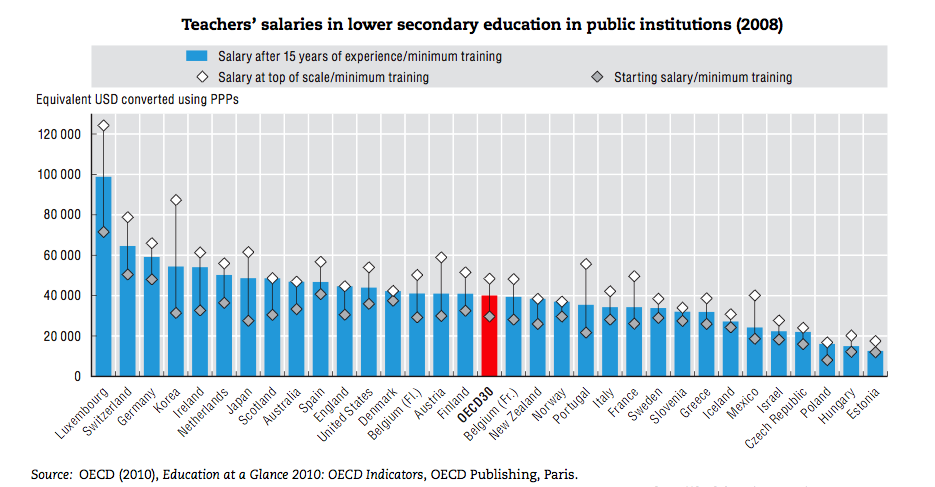
Before an official EIS-sponsored lynch mob shows up at my door, consider this: Scotland pays its teachers better (in purchasing power parity terms) than most countries whose pupils are well ahead on tests and who are generally agreed to now have superior education systems to ours. Scottish teachers on an average $48,611 salary beat their English colleagues by 8.9%, Finnish by 18.7%, Norwegian by 31.3% and Swedish by a whopping 43.5%. This is illustrated on Chart 1 below.

Chart 1

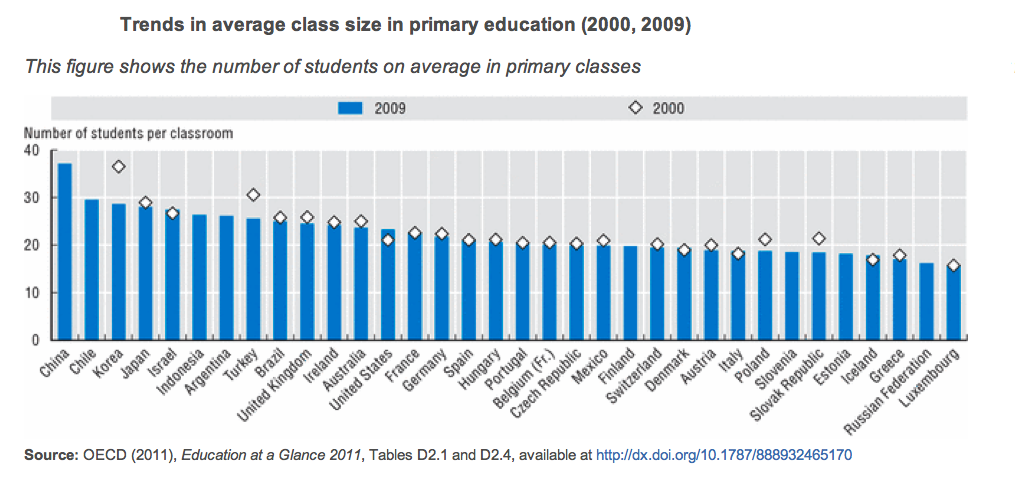
It would be fruitless to get into a rammy over whether Scottish teachers were worth 31% than Norwegian teachers. But consider this, if class sizes are such a big deal, our average class size of 26 could be 18 at a stroke if teachers here were paid the same as Norwegians and the money was used to hire 31% more teachers instead. That would take us from 10th most crowded classrooms to the bottom of the table, as shown in Chart 2.

Chart 2

Trouble is, I’ve never heard the EIS or any other union arguing this, despite the obvious benefit to both children and education. More often, we hear the opposite from teaching unions—as today at the TUC in Brighton, the two main teaching unions (NUT and NASUWT) were both shaping for a fight with English ministers. They voted to start an indefinite work to-rule protest in two weeks’ time, even though 73% of their members did not actually vote.

Some teachers—especially those newly qualified and uncertain of their tenure do have valid beefs with their employers. But those whose salary and conditions boomed under McCrone and want a general strike because their chunky annual salary boost has been frozen need to get out more, read the financial pages during their 12 weeks of holiday and consider that, as professionals, how the welfare of young people under their charge and their vital education would be damaged by indefinite strike action.

And, if a class size of 26 is deleterious to good learning, how much worse must a class size of none be?

But—bottom line—are we getting value for our money? In Scotland’s 32 councils almost half their £11bn budget is spent on educating the 675,000 pupils (down from 758,000 a decade ago) in the schools they run.

Last year, the highly respected PISA (Programme for International Student Assessment) indicated Scotland had slumped to 28th place in maths, 25th in reading and 15th in science. Compared to a decade before, the year the tests in the three subjects on 15-year-olds, we were eighth in maths, seventh in reading and fourth in science. England and Northern Ireland have done much the same but Wales has performed even worse.

You decide for yourself whether Scottish teachers would be justified in taking industrial action. A decade ago, I fully accepted they were. But in the intervening decade for a ‘profession’ to receive double the investment, including hundreds of new schools, to perform by sliding out of the top ten into third world territory and then threaten industrial action that would damage kids’ futures in the midst of a major recession just beggars belief that they don’t see now as time for a little humility and self-evaluation.

Time someone examined the teachers to weed out failures who don’t deserve over-the-odds payment they already receive—never mind more costly rises, especially when based on time served and not on pupils inspired, sparks ignited or new careers launched. Teaching is a calling that deserves decent remuneration. But if teaching unions can talk of little but member pay rises, they are worse than greedy bankers: at least the people that bankers screw over are adult and capable of retaliation.

Posted in Education | Tagged | 1 Comment

Union ‘Dividend’: No’ Like the Co’

Posted in Commerce, Politics | Tagged | Leave a comment

Independent School; Private Politics

Earlier this week there was a flurry of press around a Lloyds/TSB research detailing how fees for private schools had risen by a whopping 63% over the last decade. While I respect the motivation of parents who choose to shell out £10k or more each year as part of their effort to give their offspring the best chance in life, it is not a force for social good. Would the demise of the hale jingbang be such a bad thing?

Scotland has a long and honourable tradition of universal education, dating back to Knox and his disciples, who, as part of simplifying worship by removing intermediaries, saw the ability of each worshiper to read their own bible as freeing them from a priest’s impenetrable mumbo-jumbo during mass. The parish school and its dominie sent many a Scot out into the world to make their mark, creating the diaspora, an enviable reputation and the highest GDP in the world by 1910.

But we’ve since rather lost our way. Scotland has not topped any global league, either in education or in GDP, for some time. There are many reasons for this but high among them is our propensity for sending some children to private schools. It is not that the schools are bad in themselves—recent exam results published by SCIS are superb and those who attend the schools and those who paid are both generally well satisfied.

Although it comparing apples with oranges, the following two table list what are regarded as the top schools in the private and state sectors.

“League Table” of Private Schools by Advanced Highers

“League Table” of State Schools by Exam Results

But boosters of private schools open-minded enough to have read this far should consider the socially divisive impact of all this. To live in a free country, some degree of choice is necessary but so is some compulsion. We do not choose which laws to follow any more than which side of the road to drive on. While choosing a school for your child clearly has merits, siphoning off certain children amplifies inequality and, where money is involved, leads to the kind of self-perpetuating elitism that characterises ‘old money’ in the US to a disturbing, if not disruptive degree. Education in the USA is grossly unequal.

Those remaining in schools from which pupils with engaged parents have been wheeched away have that much less example of good ethos and ambition for themselves that is characteristic of the best schools—and especially fee-paying private ones. For pupils whose parents are poor, it becomes doubly hard to achieve whatever potential they may have. And while many schools in deprived areas combat—and often overcome—this with a tough ingenuity that is a credit to staff pupils and parents, why should they have to?

We need not have to follow the great leveling gulag of the comprehensive, as conceived by Labour in the sixties. Educationally, we are still recovering from the concept that every class must proceed at the speed of the slowest pupil. But the state schools of Scotland, boosted by much capital investment and the reinvigourating effect of the McCrone Settlement have never been in better shape. nor better funded.

I grew up in a small, affluent town, and, as someone whose dad bashed metal for a living, went to its state school, although a number of contemporaries hopped on the train for a private education. My school was one of those listed above and so I went on to enjoy an education limited only by my failings and not by opportunity. Others were not so lucky but both of us relished grinding some private school victim into the mud at rugby.

Now, although socialists believe in equality of education, you don’t have to be a socialist to see its advantages. In this competitive, global age, we no longer need an elite few, plus a mass of workers. The 21st century is skills-based and, whether its distilling whisky, engineering Class 26 frigates, relating Stirling’s colourful history or developing cool apps for the iPhone, we need all our oars in the educational water to avoid becoming a post-industrial backwater.

For secondary pupils, Edinburgh has the highest level of privately educated pupils in the UK, accounting for 24%. In Aberdeen it is 16%, in Glasgow 12%. This goes some way to explain why only Boroughmuir just squeezes into the last place on the state league table. In our capital city, where 1 in 4 pupils are creamed off to go to private schools, the state schools struggle to provide comparable education results. While league tables are not everything, the exam results on which they are based do determine who enters which university. Increasingly, well paying jobs are demanding that applicants have degrees.

Now, if Edinburgh were a social basket case, a vast wasteland of sink estates where society was failing and the vulnerable abandoned by the uncaring rich, that might be some explanation—however deplorable or inexcusable—for poor league results. But, since Edinburgh’s 26,000 primary and 20,000 secondary pupils are funded by some £300m, that spend of £6,500 per head is generous (especially given they need only teach 3 in 4 children) and actually approaches the £9,800 for private schools reported recently in the Hootsmon. Clearly the issue is not one of money.

What the issue appears to be is that—in Edinburgh especially—pupils with either ambition or potential (and some with neither), who have parents with both ambition and money, are sent to private school as a matter of course. Despite teachers’ best efforts, this skews the culture of state schools to disadvantage pupils there and inculcates the kind of elitist old-school-tie clique fumbling the job of governing Britain so badly just now.

While I am prepared to accept that Eton/Harrow/Windsor/Winchester, then on to read the Greats at Oxbridge is so quintessentially English that to meddle with it is a heresy to rank with ploughing up the cricket field, changing the guard in cammies and kevlar or chilling the bitter down at the Dog and Duck, I see no such dispensation in egalitarian Scotland. From Arbroath, down through the socially mixed tenements of the Old Town, through the broad reach of the dominie’s teaching from Whithorn to Wick, this has been the homeland of the Lad o’ Pairts, a humble citizen given a chance and who seized it.

Were there no compelling reason to curtail private education in Scotland, it would still rankle many, as it does not sit well within our culture. But the compelling reason is that, whatever private schools can achieve, they are depriving the majority of a social balance in their education and perpetuating a class system originating in English sensibility and which causes a mixture of impatience and derision among most Scots.

However desirable, abolishing private schools could be seen as undemocratic. However, removing their dubious charity status would seem a reasonable, if not desirable step. Most would close as a result. Those who insisted on setting themselves apart from us mortals could still do so—but would pay through the nose far more than the 63% increase bemoaned by the Hootsmon. But all children from a given catchment would then not just be educated together but socialise far easier because they would know each other and not use different uniforms to build social divisions.

Those journeying in to work in cities would no longer have to thole tribes of 13-year-olds with their feet on the seats and those 13-year-olds would suddenly have an extra couple of hours in the day to swot under the cosh of their ambitious parents—or simply get to know the other kids in their neighbourhood for once. Best of all, some £300m of middle class money would be released as discretionary spending each year—enough to drag Scotland out of recession all by itself.

Posted in Education | Tagged | Leave a comment

Going South North by Northwest

Time was centuries ago that brave explorers in fragile wooden ships probed the bewildering series of ice-bound passages separating the islands of Northern Canada. Unlike the later Antarctic explorers, these were not quests for knowledge but hard-nosed attempts to find a sea passage through to the Pacific. They never succeeded—until now.

Satellite Image of Arctic Ice, August 2012 (at Record Low of 4.1m sq.km.)

You may have noticed we’ve had a poor summer; this is not a local phenomenon. Arctic sea ice follows an annual cycle of melting through the warm summer months and refreezing in the winter. It has shown a dramatic overall decline over the past 30 years and this year ships could have made the longer Northeast Passage around Siberia as well as the elusive Northwest one that many died failing to find. Clive Tesar of WWF’s global Arctic programme says:

“Record-breaking ice minimums are becoming the new normal. We’re breaking records on a regular basis as the sea ice continues its decline.”

According to many scientists, the sea ice plays a critical role in regulating climate, acting as a giant mirror that reflects much of the sun’s energy, helping to cool the Earth. The formation of the sea ice produces dense saltwater, which sinks, helping drive the deep ocean currents. Without the ice, many scientists fear this balance could be upset, potentially causing major climatic changes and our whole world will go south.

Before you next jump in your Chelsea Tractor, think about this.

Posted in Environment | Tagged | Leave a comment

A Trip to Avalon

Hanging about the local harbour has its charms, especially on a sunny day, such as Sunday was. Sometimes you get to crew one of the fishing boats hauling creels and snag a nice lobster for your troubles. Sometimes it’s more recreational—last weekend my mate Cam wanted to shake down and rig his new lugger and we spent a very pleasant couple of hours ploutering about off the Lattie Doocot working out how best to set her three sails.

But this time one of the rare un-cancelled trips out to the Isle of May still had a couple of empty places, so I pulled a favours to take up one of them. The bad forecast slipped to the next day and, despite lumpy seas making something of a juddering passage out, the day improved hugely as it went on.

The Isle of May from the North East

Much though I love the four islands closer to the East Lothian shore, to me The May is Queen of the Forth. Not only is it larger and flatter than the rest but you get to land and wander and, even with nesting seabirds almost all gone, it remains a magical place. With waves surging only on the lower NE shore, the rest of the island is a haven of peace now—the only birds now obvious are some oystercatchers, shags down by Kirkhaven and a flock of pigeons.

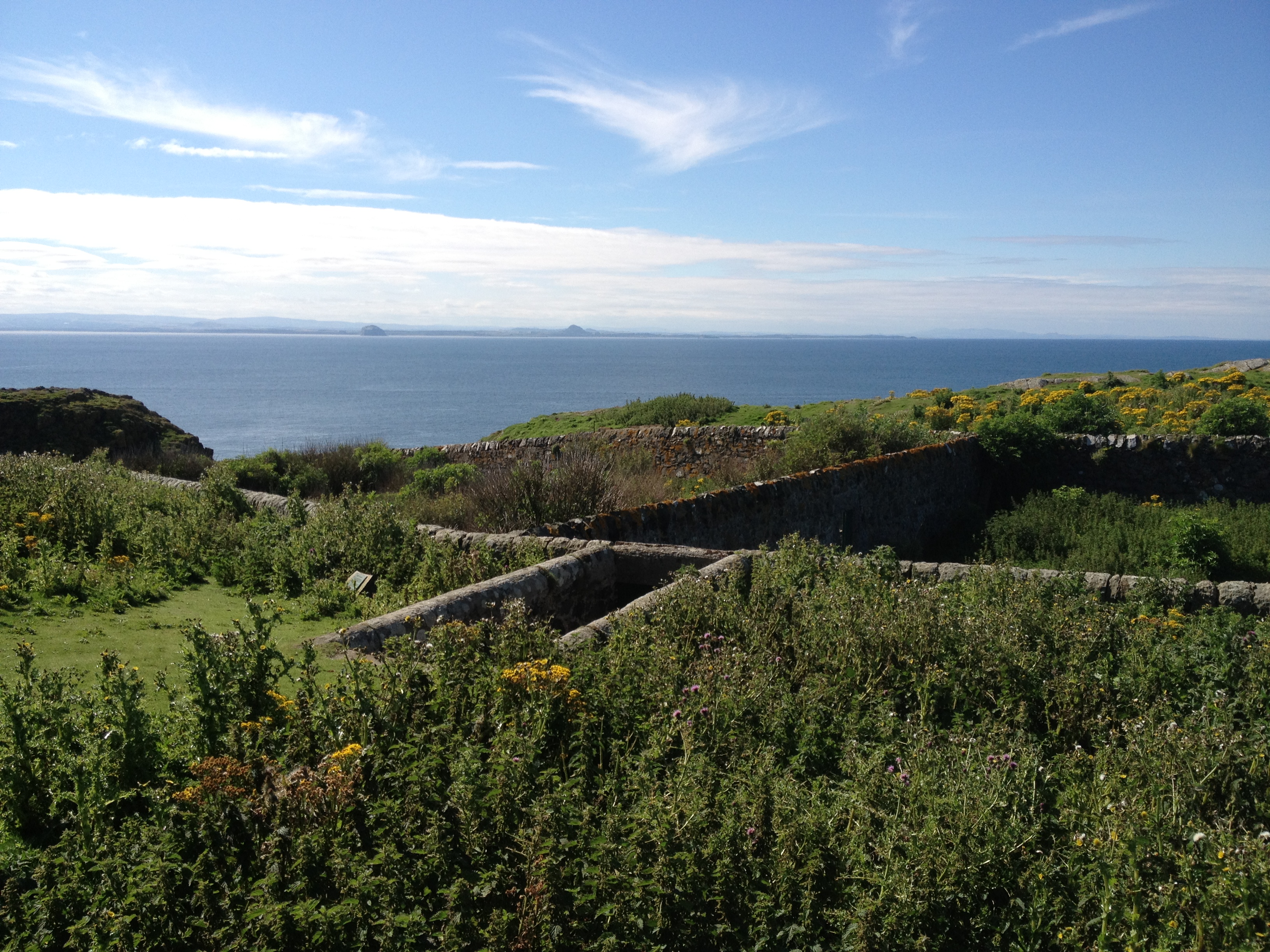
View SW over walled gardens (once used for vegetables by lighthousekeepers) towards Bass Rock & Berwick Law

After a brutal spring and early summer that left much of the island’s vegetation brown and withered until recently, the place looks green and lush, with the rabbits hopping about in acres of space, now that the crush of 10,000+ puffins are off out to sea. The peace along Holyman’s Road and the SW cliffs at Three Tarn Overlook was particularly noticeable.

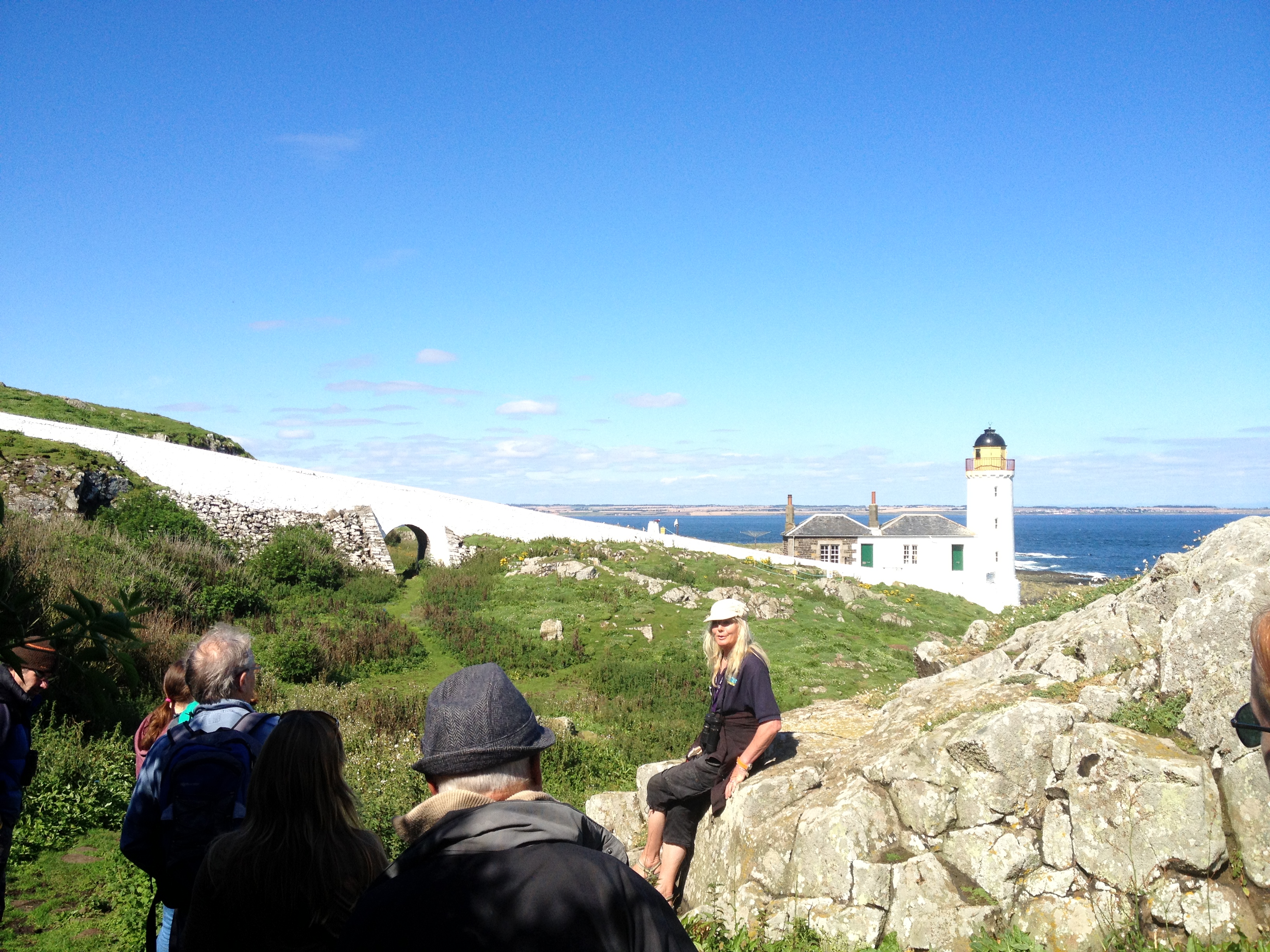
Approaching the Low Light on Holyman’s Road

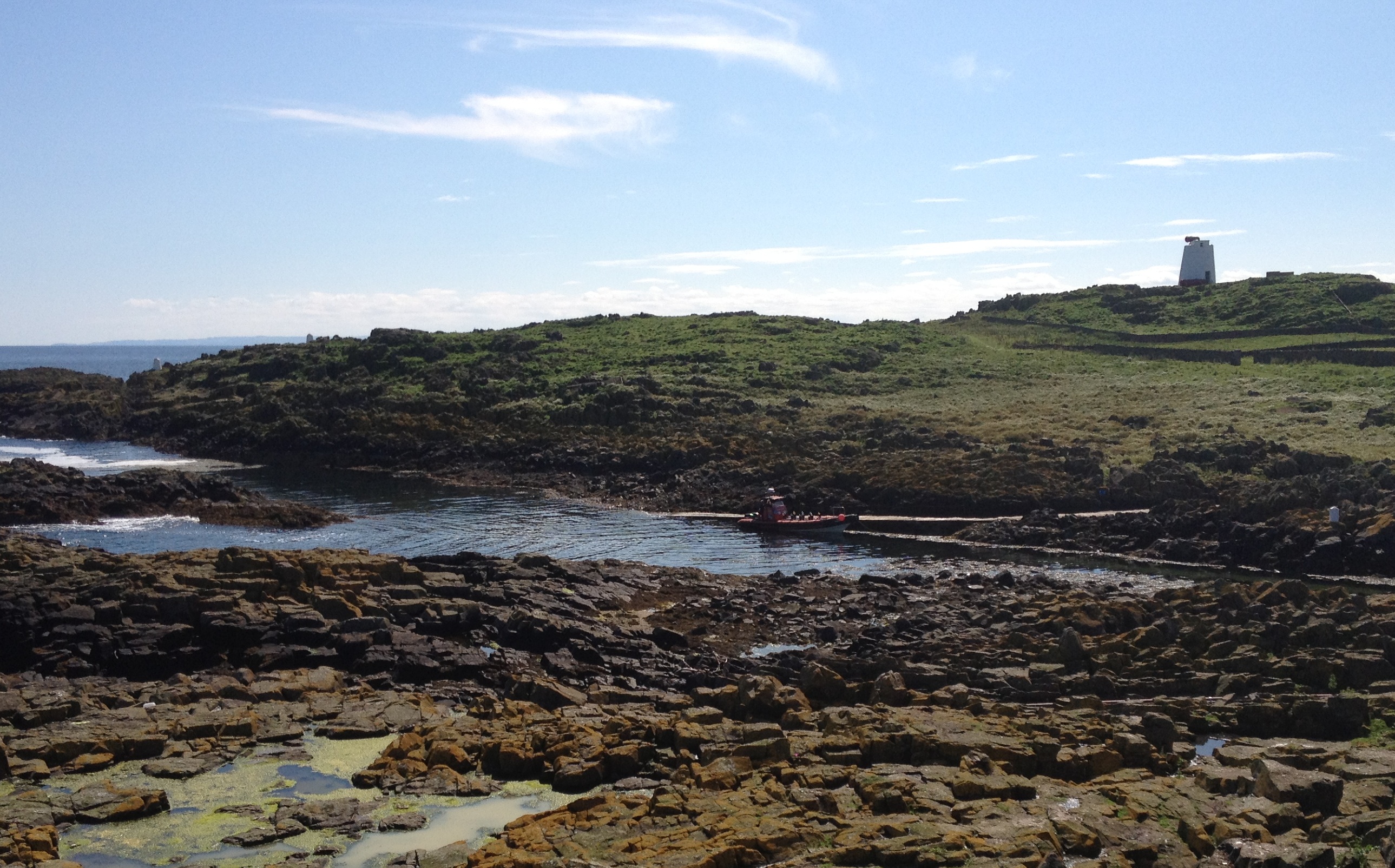
The island’s owners (Scottish Natural Heritage) are understandably touchy about people straying off paths, especially during the breeding season. But there are still so many paths taking you to odd corners to explore, such as the flat rocks next to the landing stage at Kirkhaven.

Kirkhaven with the SSC RIB tied up at the Landing and the South Foghorn in the Background

Because of its size (over a mile long) and undulating landscape, the May seems like a much bigger island. Even discounting Rona at the north end because it is inhabited year-round by a hundred or more grey seals that should not be disturbed, it is still hard to get to know the island, even in several two-hour landings. Especially in the brilliant weather that we had, it’s hard to accept that it’s already time to kit up and head home.

Gathered again & kitted out at the Visitor Centre ready for the return

Full of history, including a ruined monastery and many WW1&2 buildings, the isle even has associations with King Arthur from the time when Arthur’s Seat was named. That this was the fabled isle of Avalon is not too hard to believe.

The Crowning Glory—the magnificent, castle-like Main Light, built by the Stevensons in 1816 (original 1637 light on the left)


Posted in Environment | Tagged , | 1 Comment

Wake Up and Smell MR BO

Much though it may appear an incomprehensible circus of brassy showmanship taking place far away from our lives, the outcome of this year’s US Presidential elections matters. Since post WW2, when the US became a superpower, their political postures—from the Cuba missile crisis to post-9/11 pursuit of the Taleban in Afghanistan—have defined the world in which the UK/Scotland operates, like it or not.

Because of its dominance of the the world economy, the outcome of their election will have a major impact on our economy, as well as their own. Aberdeen can flourish all it likes; if Houston doesn’t, any growth will be limited. VisitScotland can trumpet next year’s Open at Muirfield but if the Americans don’t come over in force, its impact on our revival will be trivial. Which will triumph on November 6th—Obama’s pragmatic inclusiveness or Romney’s tax-cutting de’il tak the hindmost?

American politics can appear naive and simplistic on policy (only two parties and those sharing a child-like jingoism) but they are geographically complex. A convenient shorthand of “blue coasts—red centre” gives you a layout of the (relatively speaking) left-leaning Democrats winning states like California and New York and (definitely) right-leaning Republicans dominating places like Texas and Tenessee.

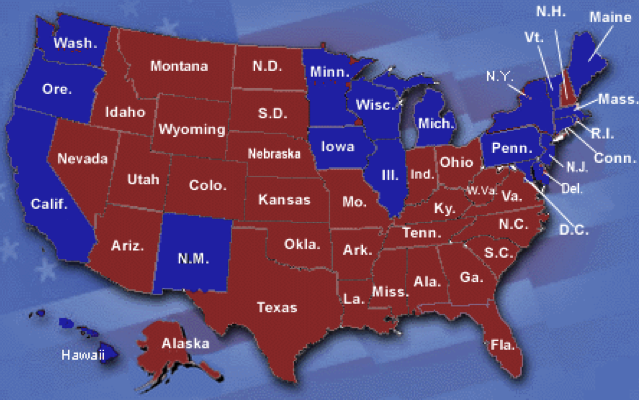
For Presidential purposes, each state elects a number of delegates (to the Electoral College) proportional to its population and most give all to the winner in that state. The candidate with majority (over roughly 245 delegates) wins. After a cliff-hanger in 2004 when Bush unexpectedly won Ohio and the contest, in 2008 Barack Obama sailed home, leaving the Republican McCain/Palin ticket in the dust. This is shown in Figure 1 below:

Figure 1—Map of 2008 US Presidential Result (Red = Rep; Blue = Dem)

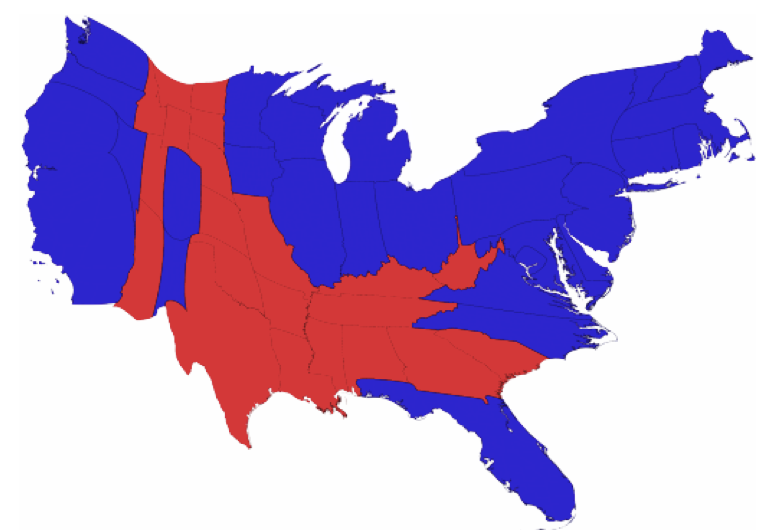
At first glance on this map, it would appear that the Republicans won from the sheer size of their red area. But much of the US population is concentrated on the coasts and so a more accurate, demographically based map is one such as shown in Figure 2.

Figure 2—Demographic Map of the 2008 Presidential Result

In either case, several unusual occurrences stand out. Florida, famous for being an unending cliffhanger in 2000 and run by Bush’s brother, chose Obama and in New England only New Hampshire (state motto: a rather uncompromising “Live Free or Die”) voted for McCain. After four years of buffeting by recession, almost everyone expects 2012 to be a much tighter race, with polls confirming Obama is only a few points ahead.

The on-line retailer Amazon has come up with a creative new measure of what is in the voters’ minds by compiling political books they are buying into a heat map (Figure 3).

Figure 3—Political Book Purchase Heat Map (Source: amazon.com)

At first glance this appears alarming for Obama, with Republican readership 16 points ahead of Democrat. But, simplistic as it is, American politics cannot be so glibly divided into two camps, any more than its literature can. There is also the argument that many Democrats are boning up on Republican thinking as the right has made far more policy twists in recent years. The New York Times has a handy 2-minute lesson on this.

As the Republicans gather for their conference in Tampa, Florida next week under the inauspicious shadow of Hurricane Isaac, they are reasonably united in policy: no gay marriage; no abortion; lower taxes; undoing ‘Obamacare’ medical coverage; less government. But, Mitt Romney gaffes aside, by picking Paul Ryan as his ‘running mate’ (i.e. Vice-Presidential candidate) has painted himself into a pretty extremist corner. It may be no more extreme than Reagan chose in the eighties. But that ballooned the country’s debt, laying the spending-beyond-means foundations of the present fiscal mess.

The Democrats convene the following weekend in Charlotte, North Carolina and will have some unwanted distractions: a rally on same-sex marriage is in town at the same time. Despite their reputation as pace-setters in innovation of material things like cars and computers, Americans are notoriously conservative politically. There is also continued links between big donors and their influence on party policy on a scale we would find embarrassing (the Boston Globe recently covered the issue of “Late-Night Charlotte” and who’s schmoozing whom).

At this point (10 weeks out), there is still little coverage here—not least because there tends to be a series of unseemly squabbles as both sides lob expensive ‘attack ads’ at each other on major TV channels. These are invariably unedifying and usually about some obscure item of US politics/constitution/personal history about which we know/care little. That Obama made a mark in his four years is beyond doubt, unifying a fragmented country by motivating whole blocks of previously disenfranchised citizens to vote. But you can also argue that he has been divisive, as National Public Radio (NPR) has found.

But we really should care. Whoever is inaugurated into the White House in January will lead the world out of recession. While Republicans claim to be the party of business, their track record of cutting taxes with no real cut in expenditure means their strategy is bankrupt. Add to that Romney’s Bush-esque lack of awareness of the world outside and foot-in-mouth ability to hack off friends and you may find yourself with the bulk of Europeans—rooting for Obama.

It now looks like I may be in-country for the fortnight run-up to the poll (Philadelphia and San Francisco), so expect Uncle Sam to dominate this blog from around October 24th until the brouh-ha-ha dies down in the early hours of November 7th. It’s important enough to make a stink about it.

Posted in Commerce, Politics | Tagged | Leave a comment

There’s Nothing Surer…

…the rich get richer and the poor get poorer” was a line from a twenties song popular through most of the last century—probably as much for its social commentary as for its musical appeal. It should be coming back into fashion again, given the current statistics on exactly who is benefitting from the quantative easing (QE) being sprayed about just now. Today’s Independent contends that it is almost exclusively the rich.

Now, Osbo and Mervyn are not the first to dream up the financial strategy of stuffing money into the pockets of the already-rich in order for there to be a ‘trickle-down’ effect that benefits the less wealthy as the rich spread their good fortune around. Ronald Reagan excused a massive series of tax breaks to wealthy Americans in the early eighties as a means to get a sluggish economy whirring.

The economy did revive but only because he also spent trillions he didn’t have on the military. That bankrupted the ‘evil empire’ Soviet Union—but also saddled the US with a public debt that stands at $15 trillion (or $50,000 for every American still breathing after hearing that shock news).

Many of us more mature citizens grew up in the last century being taught not to spend what we didn’t have. The national equivalent of that was for the country’s Treasury to simply print money without the economy to support it. Such an approach had done for the Weimar economy in the 1920’s (and paved the way for Hitler); the same strategy has once-prosperous Zimbabwe on its economic knees under Mugabe.

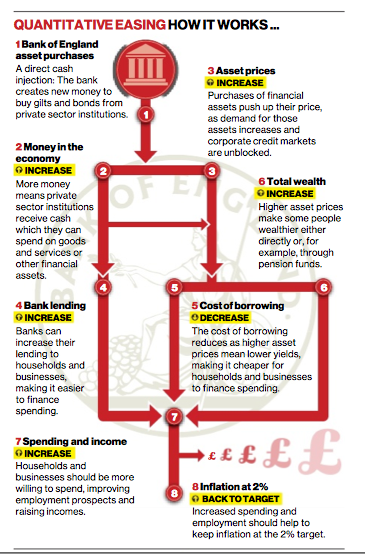
Undeterred by either such prospect, the UK Treasury and Bank of England have boldly seized upon QE as a major tool to revive the economy. In theory, it works like this:

Source: The Independent, August 24th 2012

Simple though this may appear, there are serious flaws in this argument:

  1. Step 4 has a uniform effect only if the banks lend across the affluence spectrum. Over the last four years of pause in growth and outright recession, a more rapacious and self-serving pile of bastards than the banks have been hard to find. Money has been provided to them but, after having their collective fingers burned by over-speculative commercial brethren, the retail end have made outrageous demands for small loans and sit on the money with the fierceness of terns protecting their breeding colony.
  2. Benefits only accrue if the value of the currency holds up. The only things holding Sterling up above the deep fiscal hole we are digging is the even-more-profligate approach by the US and the fiscal irresponsibility of the PIGS (Portugal-Italy-Greece-Spain) so that all three of Sterling Dollar and Euro are suspect in global eyes. If Greece defaults and the Euro stabilises, we’re in trouble as our main trading partners do so in Euros, which will become expensive.
  3. We can only afford the massive public debt that all this is causing (£600m more in July when it should have dropped £2-3bn) because interest rates are low AND we still enjoy an AAA credit rating on world markets. Should either—or, heaven forfend, both—go south, we will be in deep puckey. Public sector net debt was £1,032.4 billion  at the end of July 2012 (equivalent to 65.7% of GDP). Currently around 2%, if bond yield rates rose to just 3% (Spain’s are over 6%), we would pay an extra £10bn in interest—or one third of the entire Scottish Government budget.

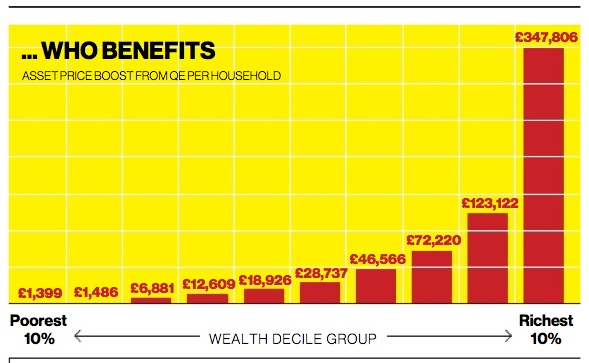
Scary though this all is, much could be forgiven if it were working. But not only is there little sign that the UK economy is reviving but the whole mechanism is skewed to reward those who started out with money in the first place. It would probably be crediting Osbo and pals with too much Machiavellian foresight to claim that the programme was set up to benefit the millionaires in the Cabinet and sod the non-Tory-voting plebs who have to work in the rain for a living. But consider the following chart:

Source: The Independent, August 24th 2012

A more egregious poster for the Communist Party is hard to imagine. While it is a fact of life that money begets money and that bankers fall over themselves to lend money only to those who don’t need it, for any democratic government that purports to represent the people as a whole (and not some nepotistic subset) to have created this almost beggars belief. That they blithely continue it is morally bankrupt.

We haven’t heard much about “we are all in this together” from Cameron recently. I wonder why.

Posted in Commerce, Community | Tagged | Leave a comment