Come All Ye Jolly Mallowbashers

Poor though this summer has been, the restart of our local mallow bashing season has seen a couple of fine weekend days to get the season off to a good start, For those of you puzzled what I’m on about, I refer you to John Hunt’s SOS Puffin Report and an earlier blog.

A week ago, the plan had been to land on Craigleith with a squad to clear this year’s growth of tree mallow (Lavatera arborea) that still infests the island because of its prolific seeds still dormant in the soil. See Scottish Natural Heritage’s 2005 Report for details but basically this non-native plant was throttling the local puffin population. Despite it being a brilliant day, a Westering breeze and sea chop exposed the ad hoc landing and we diverted to Fidra, whose small harbour is sheltered from the West.

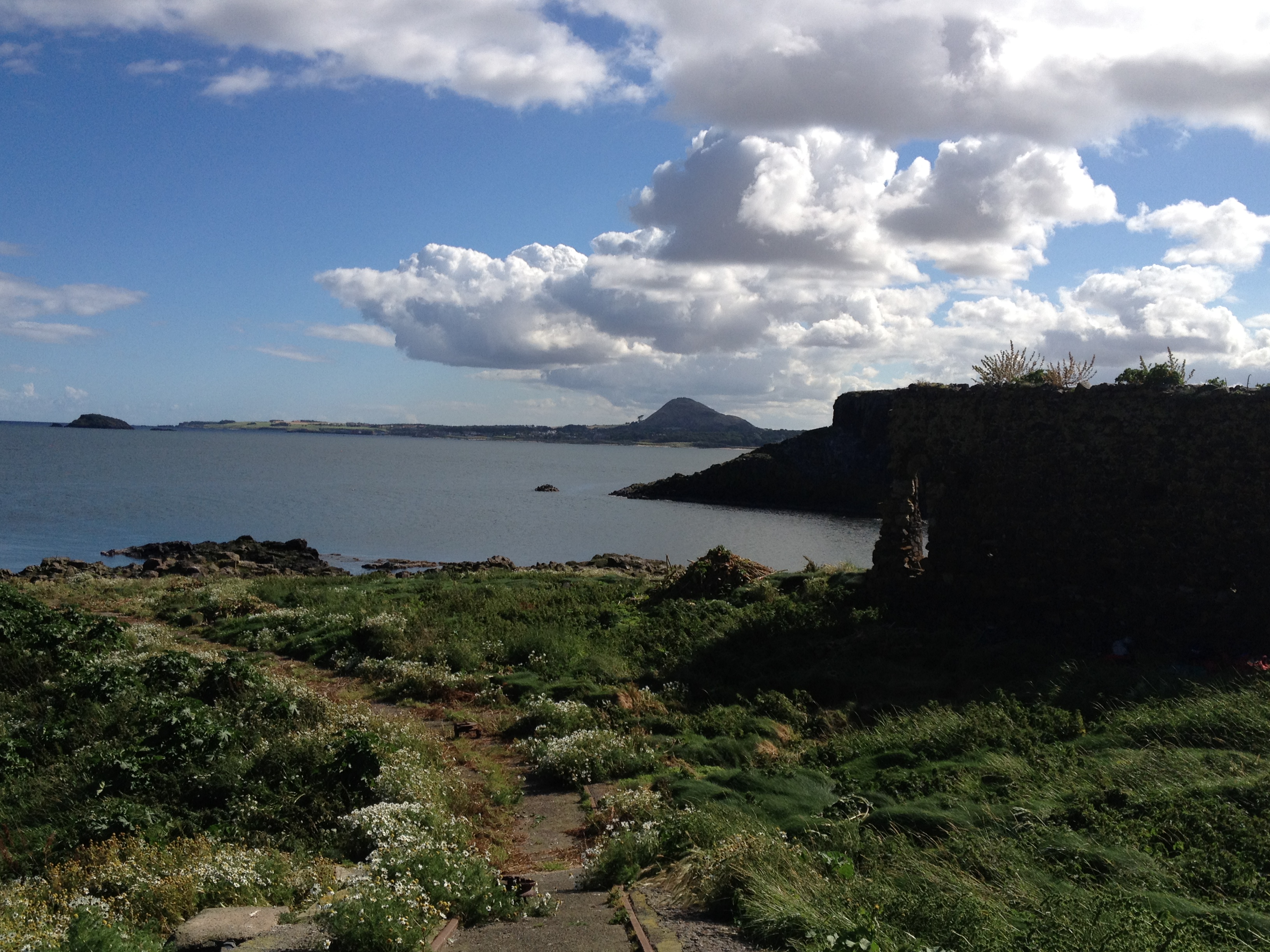
View from railway path past Castle Tarbet towards Berwick Law and the town with Uri Geller’s Lamb on Left

As days go, we couldn’t have asked for a better one in September. As the breeding season was over, the gulls usually nesting around the ruins of St Nicholas chapel were gone and all Fidra eerily silent. There are only a few hundred puffins nest on Fidra, as opposed to the 7-8,000 on Craigleith and we were not working the area around the lighthouse where their burrows are. Nonetheless, we need to clear as much of the mallow as possible as its seeds carry easily from island to island, being eaten by non-seabirds then defecated.

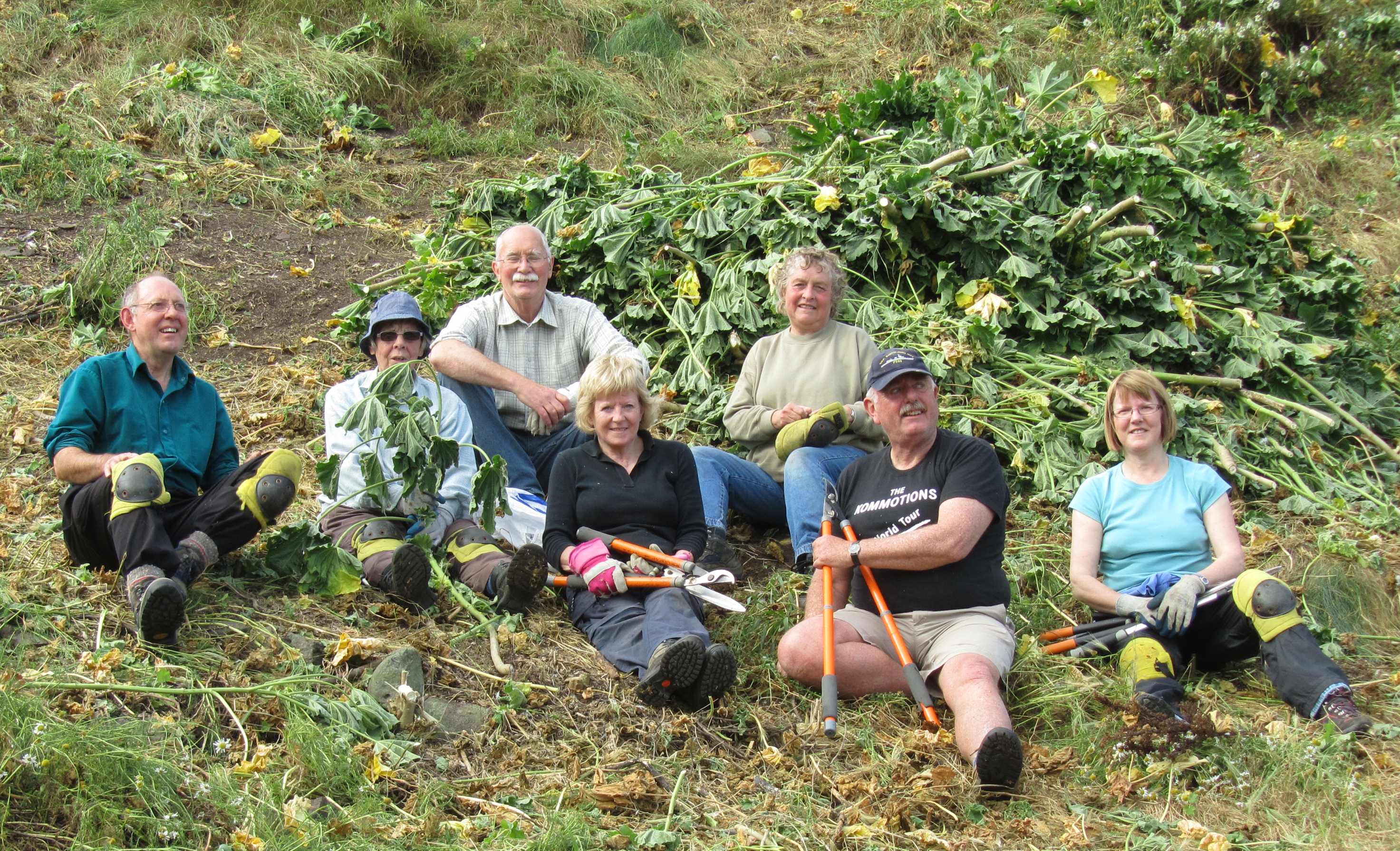
A break for the Mallowbashers—recently cut mallow behind them

In the full day you spend on the islands you don’t get much time for socialising: you see a lot of hard work from all the volunteers and there’s never a shirker amongst ’em. John is a gentle taskmaster, so lunch is leisurely and gives you a chance to chat or explore.

We use different techniques to eliminate the plant: strimmers will deal with seedlings early in the year, simple hand weeding on larger plants but for those really established (the larger stems can be thick as your arm—it’s not called ‘tree mallow’ for nothing) you need loppers or even a saw, cutting it close to the ground or the root will regenerate.

Your humble narrator doing his bit

Fidra is full of history, although you have trouble finding it while you’re there. The local Congal tribe, who appear to have been a remnant of the once-powerful Goddodin, lost badly here to a band of Vikings under Arnulf the Dane in the 9th © and may explain the Norse name (“feather island”). By the 10th © it was an Anglian outpost on Northumbria which passed to Scotland after Malcolm won at Carham in 1057.

It then seems to have been a retreat for the first settlements under control of the Earls of Fife and the original pilgrim ferry may have gone from here before boats became too big to haul up on the beach and they moved to the nearest haven, thereby founding North Berwick. A stave fort similar to Traprain existed on Castle Tarbet and even a wooden bridge to shore over the shallow Brigs of Fidra. The single ruined wall on the island dates from around that time and was a chapel dedicated to St Nicholas. This was gifted to Dryburgh in 1165 but terminated by Alexander de Vaux in 1240 when that Norman family had built their castle 2km away at Dirleton.

The lighthouse is a latecomer, another Stevenson effort built in 1878 and uniquely having a cable-drawn wagon railway to haul supplies and paraffin up from the landing, thereby saving the three keepers considerable work. When keepers were withdrawn in the 1980s and Bass Rock was downgraded, Fidra became the main light on the south side of the now-busy Forth, flashing its powerful 24-mile range beam four times each ten seconds.

Looking North through the ‘White Lady’ beneath the Lighthouse (plants visible are mallow)

Work though it may be, just having the privilege to wander these islands is a magical experience that makes it worth the effort and brings you back tired and pleased and filled with images. If you’d like to participate, the squads go (weather permitting) most weekends and sometimes mid-week. Contact John, if indefatigable leader of hundreds of trips on johnf_hunt@yahoo.co.uk.

And to see why we’re bothering, sneak a look at Tammie Norrie, clown of the sea and tell me if you don’t want to help out a fellow creature who—despite being among the world’s toughest and resilient seafarers—may be the living embodiment of the word ‘cute’.

Posted in Community, Environment | Tagged | Leave a comment

No More Branch Office

One of the good thing about unionists  is that they’re committed. And when the more thoughtful ones—of which I cheerfully admit there are many—pester you with questions, they are often questions deserving of not just an answer but a fair bit of pondering and self-examination in order to supply that answer.

One such epiphany happened this week on Twitter, when a particularly terrier-like series of questions revolved around the presumption that Scotland would do better on its own just ipse facto, quite apart from any other factor. That wasn’t quite what I had asserted. I had been claiming that Scotland was, on balance, prospering even now:

“Taken as a unit, all of it is: Tower Hamlets is a basket case but next-door Canary Wharf & the like make London boom.”

But this wasn’t good enough for my correspondent:

“The parts not engaged in successful industry are not doing so well. Edinburgh & Aberdeen prosper. I’m more of a Michael Porter / John Kay kind of guy. The focus should be on industries & regions rather than national borders.”

This is a thought-provoking point. Do we, in our political fixation with where laws and cultures run, get fixated on boundaries that make little sense in a global economy where raw materials, factories and customers are scattered across the globe. The Nation State is dead: long live the Multinational?

Back in the Seventies, I read The Sovereign State of ITT, a non-fiction portrait of how Harold Geneen created a continent-spanning monster out of the non-American segment of AT&T. Back then, it appeared only a matter of time before GM, IBM, Macdonald’s, Disney and other darlings of Wall Street took over the Third, as well as First, World. Now I don’t believe my correspondent was necessarily a fan of such philosophy but he did dismiss the relevance, if not the importance, of sovereign states.

But I would contest that. While there are certainly enough cases of states running their own affairs running them into a wall, this is not the norm. Certainly Africa offers a rich suite of examples how not to run a country and other parts of the world are no better. Mighty and elusive though multinationals may appear, there are sharp limits to what they can achieve without the active co-operation of the countries in whom they do business. Entire sectors get nationalised, tax regimes are adjusted and it’s not at all clear that multinationals do have the whip hand.

But let’s look at how well sovereign states do as units to better the lot of their inhabitants. You might think that most countries in a demographic grouping, such as Europe would do pretty much the same, with the ‘big’ countries dominating, the odd specialist like Switzerland alone being able to break the mould of ‘big is better’. You’d be wrong.

Taking a long view to iron out the vagaries of war, recession, oil shocks, etc, let’s look at European countries from a GDP purchasing power parity perspective (PPP—an accepted way of comparing economic apples with apples). The chart below is pretty self-explanatory.

Source: Contours of the World Economy, 1–2030 AD and Index Mundi http://www.indexmundi.com/g/

This provides an interesting picture. Major European countries have done well for their citizens, providing GDP growth of 1000% and more over the century. The UK is actually the worst at 879%, this can be explained by the UK being the world’s largest economy at the time and therefore other countries’ later growth would be likely to exceed it.

Most interesting of all are the countries that barely existed 100 years ago. Norway had just recently asserted its independence from Sweden in 1905; since then it has come on a whopping 4,409%. Finland would break from being a province of Imperial Russia during the mayhem of their revolution in 1917, after which it has managed 3,030% growth.

But the star performer is Ireland. After being a surly and fractious component of the United Kingdom for 121 years, it was granted independence in 1922 by an ill-tempered still-imperial/imperious Britain that sought to retain Ulster and thereby kept the most surly and fractious component.

Ireland did not prosper in its early years. Having little industry and few obvious natural resources, it suffered endemic migration of its best and brightest for over a generation until they joined the EU and played a shrewd hand of being an English-speaking manufacturing and distribution hub within the EU boundaries that played to those same multinationals we discussed above.

The rest, as they say, is history. Since the 1980’s when Ireland wrong-footed a slew of British development agencies at this game, in the 30 years since they have caught up with and surpassed anything other countries have achieved in a century with an out-of-the-park score of 10,100%.

While none of the three top countries and necessarily templates for what Scotland could achieve post-2014, it is up to the unionists to explain how staying a part of Britain slices  to 1/10th the growth in wealth that the people of Ireland experienced by leaving—not staying—in this Union.

Posted in Commerce, Politics | Tagged | 4 Comments

Ten of the Best

Now that Nicola Sturgeon has been assigned to the Yes campaign, expect to see some fireworks from that quarter. I have watched Nicola mature from a passionate YSI member that I first saw in action at the SNP Conference in Dunoon in 1993 and watched her develop through what some saw as a ‘nippy sweetie’ phase that saw her chosen as Deputy Leader and since which she has matured into a formidable politician with a depth and personable side that does not necessarily come with that accolade.

But taking prisoners is not what Nicola is about; expect some strong arguments and searching questions to soon be discomfiting the unionists’ shaky alliance of strange bedfellows and the pace along the road to 2014 to move up a gear. To do my humble bit, I spent part of this morning on Twitter, posing ten “daft laddie” questions that I believe any unionist worth their salt should be able to answer if the case for remaining as part of the United Kingdom makes as much ‘no-brainer’ sense for Scotland as they claim.

I therefore challenge anyone who has taken the principled stance that Scotland will benefit more from remaining in a union with England than it would resuming its former role as an independent country, to answer the following ten questions honestly. In particular I challenge organisations keen to tout the UK’s advantages to Scotland, such as British Unity or Better Together to answer as many of the ‘reasons’ they give seem to be historic and about ‘preserving’ things. No disrespect to 300 years of glorious joint history, but answers should look forward to Scotland’s future.

Daftladdie Question 1: If UK is world’s 7th richest country, how come it’s >£1tn in debt, with a more unequal society than a decade ago?

Daftladdie Question 2: If Scotland’s manufacture and exports and GDP are all more per head than the UK’s, and with 80% of oil & renewables in Scotland, why wouldn’t it be better off alone than in the current UK?

Daftladdie Question 3: If UK £40bn defence spend allows Scotland to ‘punch above its weight’, how come we now have defenceless oil rigs?

Daftladdie Question 4: If the UK is so ‘great’, how come most EU members dislike its stroppy attitude, the US treats it as a poodle, and yet Scotland has friends around the globe?

Daftladdie Question 5: If an independent Scotland would not be allowed to stay in the EU and this Union is equal partnership, there can be no ‘rest of’ (rUK)—so how could England stay either if Scotland left?

Daftladdie Question 6: If the UK is such a beacon for the future, how come females provide only 144 MPs (28%) and yet 44 MSPs (34%) in Scotland?

Daftladdie Question 7: If the UK is such a sweet deal for all, why is supposedly basket-case Eire not clamouring to enjoy the benefits of being back in the fold?

Daftladdie Question 8:  If England is such a rich, vibrant place we should stay thirled to, why are more English moving here than Scots moving there?

Daftladdie Question 9: If the MoD thinks a Scottish Defence Force is daft why are Norwegian/Danish/etc units in such demand as UN peacekeepers?

Daftladdie Question 10: If big is better, why has the world grown to over 200 countries, the most prosperous & stable of which are all small?

Answers on the back of a signed copy of the Declaration of Arbroath please (need not be an original & the Declaration of Independence will be accepted but at only 1/1.56 value) before October 24th 2014. Those postmarked “Saorsa Alba” will be disqualified for being premature (this contest is not open to members of the Scottish Government, nor to anyone currently employed by that organisation).

For so long as a hundred of us remain on-line, we shall not submit to the domination of the unionists…

Posted in Politics | Tagged | 2 Comments

How to Run a Railroad

We apologise to readers here in search of soaring rhetoric on broadminded topics; today you have come to the wrong place. This blog is not just about things local to East Lothian but written wearing the tasteless anorak of a train spotter.

The recent stramash about Virgin vs First on the WCML franchise is actually about First’s penchant for capturing markets, then milking the hell out of them—as with First Edinburgh’s buses. This is equally apparent than in their tenure of ScotRail, in which they expand only when someone else tells them and pays for it (e.g. Airdrie/Bathgate, Alloa). Otherwise, they’ve shown no vision to invest in growing rail services for the long haul.

The recent Scottish Parliament rammy over whether the £1bn EGIP (see our earlier blog) was phased or gutted was notable in that ScotRail—who should have been raising merry hell that its premier line was still not electrified—said nary a public peep on the matter. Other than simply cashing in on passenger numbers that are rising anyway, they show little interest in growing their future. They should.

Let’s take an example of a 40-year-story of a rail service (once pronounced dead and now among the most profitable) as how business can be made in the least likely circumstances and almost despite the company that benefits from it. The North Berwick-Edinburgh service dates from 1850, seeing such dizzy luxuries as the Lothian Coast Express in its Edwardian heyday. By the 1960’s new diesel multiple units, frequent services through Edinburgh to Corstorphine and closing half the intermediate stations didn’t halt decline in passengers. In 1968, the dreaded closure order came down from British Rail.

As with dozens of casualties of the Beeching axe, that should have been it. But EL County Council, supported by N. Berwick and Prestonpans Town Councils (an unholy alliance if there ever was one) commissioned a study that showed only £36k would be saved, rubbishing BR’s financial analysis that they would save £66k—almost twice that. John P. Macintosh MP marched this study into Barbara Castle’s office, with the result that she was persuaded to give a reprieve and a £13k subsidy. Locals 1; BR 0.

The downside was a skeletal service; two commuter trains each way on weekdays and three shopping trains each way on Saturdays. But the punters used them—so much so that they were overcrowded and a lobby of BR to double the commuter trains from 3-car to 6-car units succeeded. Locals 2; BR 0. Then Macintosh got behind a lobby by schoolkids for an earlier train to return from Edinburgh and a new 4:30pm brought the score to Locals 3; BR 0.

Not all was success. A very reasonable campaign to do away with platform staff and have train staff collect tickets (as they do now) was turned down because BR thought “not all fares could be collected on such a short journey.” Efforts to have extra excursion trains were stymied by all track and signaling, bar a single “6-mile siding” having been removed made such working impossible. Hmmm Locals 3; BR 2.

The local North Berwick Negotiating Committee continued to badger BR for various improvements: peak through running to Haymarket restarted in 1979 (4:2) and a daily midday train was introduced in 1984 (5:2). This resulted in BR admitting that the line was on the verge of profitability and that, after 15 years of doubt, its future had become so secure that they were using it as an experiment in local accountability. This was just as well as the old station buildings at NB were succumbing to decades of neglect and were demolished to leave a single short platform. Final score: Locals 5; BR 3.

However, this greatly improved available parking and a growth in residents meant more commuters than ever were piling on the trains and the introduction of the first pay-trains in Scotland made the line even more viable. By this time, traffic congestion in Edinburgh drove ever more people onto the trains. Sunday trains were introduced, then evening trains on a seasonal and then year-round basis. By 1988, introduction of the class 150 “Sprinters” restored a full 7-day service, hourly between 7am and midnight.

Real growth came after 1991 when, similar to the provision of electric overhead catenaries on the Lanark line spur off the WCML, the NB branch was electrified along with the Berwick-to-Edinburgh ECML after some strenuous lobbying by locals and Lothian Regional Council (who met half the £1.3m cost), as well as supplying new stations at Musselburgh and Wallyford. The ‘new’ trains were refurbished class 305 ‘slam-door’ 4-car trains from Essex. But they were fast, quiet and, despite initial teething troubles, grew the service by offering larger capacity and easy entry/exit.

After the class 305’s soldiered on well past their sell-by date, a recent upgrade has finally given the line modern class 180 new trains fit for the frequent and popular service it now provides. Not only does the 6-day (Su – Fr) hourly service run 22 trains between 6am and midnight but a Saturday 30-minute frequency is now well used, as are extra late trains run during the Festival and Fringe by the Sea.

Whereas the original 70’s service focussed on the commuter and didn’t break 50,000 fares annually, shoppers and casual business, as well a a heavy counter-flow of students to the new QMU and visitors to the seaside and MoF at East Fortune took it past 1,000,000 by 2005. As a rail revival story, it could hardly be bettered, showing business growth around 10% each year at all stations.

Since 2000, ScotRail has enjoyed a 157% growth in their revenue on the line.

The obvious next step would be to reopen East Linton station and go through an equivalent exercise to grow a Dunbar-Edinburgh local service. But although ScotRail have been persuaded to run four trains a day to Dunbar (compared to the previous none) and the logic of running  30-min service out to Drem and then alternating between Dunbar and North Berwick as destinations seems irrefutable, there is, as yet, no sign they’ve learned lesson one from the story laid out above.

Shame there isn’t a Dunbar Negotiating Committee. Maybe there should be.

Posted in Transport | Tagged | Leave a comment

Table of spending limits and changes—extracted from Scottish Govt. Draft Budget, Sep.20th 2012

Posted on by davidsberry | Leave a comment

‘Cos!

I was reminded of an endearing trait of a former partner who was plenty intelligent/educated and would hold her own in any discussion but who, when pressed to discuss and not in the mood would simultaneously declare the discussion over and that she had won with the simple expletive: ‘Cos!

I soon came to appreciate the fine distinction between “because” and “cos”, which was the former anticipated rational statements of explanation to follow which expressed the argument in more detail and, hopefully, was persuasive in winning it. ‘Cos! implied no such thing and functioned in our discussions much as DefCon 5 and ICBM launch function in international brinkmanship.

I was reminded of this in a small tweetfest with Duncan Hothersall, one of the more compulsive Twitterati who is also a staunch unionist and Labour activist in Edinburgh. Needless to say, we don’t see eye to eye much but he is sincere and non-malicious, even as his passion does lead him astray occasionally. We were discussing Canavan’s aspiration for Scotland to escape Tory policies through independence.

Duncan objected to this: “I’ve long admired Dennis Canavan; it’s really disappointing to see him using the “vote indy to get rid of Tories” line.” When I responded “Why? Scottish Tories are a spent force in most Scottish constituencies. #indy is the answer to avoiding their crass policies” he explained “Because (note we are not yet in ‘Cos! territory) an honest #indyref debate needs to be about the constitution, not a way of fixing elections.

At that point I realised our problem lay in our differing reading of ‘country’. If I understood him right, he sees both Scotland and UK as “countries”—”And of course Scotland is a country. And a part of a bigger country. And these two things are both fine.” he tweeted. And this may be the root of some confusion in this independence debate. To Duncan, the idea of dissolving the union is a political sleight of hand that fragments what, to him and others like him is an entity, a country called UK or Britain.

That’s a hard one for me to accept. Having been born in England with an English dad and had my education with large pink-painted maps of empire on classroom walls throughout, I still see Scotland as my country and England as part of my heritage  and feel much pride in what they achieved together with no small help from the Welsh but ‘Britain’ has faded to a geographic concept that, for me, ranks with ‘Europe’ as a geographic term that carries little patriotism or emotive identification.

Some people (perhaps Duncan?) argue that the political union and shared history of three centuries has become the dominant factor in identifying ‘country’. But I would cite Norway, Finland, Lithuania, Portugal or Poland as examples of countries that disappeared from maps—but never disappeared from the self-identity of the people who made up that country.

Sometimes countries exist in people’s minds before they exist in reality. The Austrian politician Metternich’s dismissive assessment of Italy as “only a geographic expression” was disproved within a century by Garibaldi. Despite centuries of city-state politics, its unifying culture, language and history made it a country before its citizens realised it. Bismarck and Germany are a similar parallel story.

A similar situation applied to England’s 13 colonies in America. Under the unifying pressure of the Seven Years’ War and the haughty attitude adopted towards them by the British government, the stirring sentiments of their Declaration of Independence codified what the bulk of people there already knew: that they had become a country. Because of the cultural distinctiveness derived from environment and common experience, they had already been thinking that way for some years beforehand.

So, back to Duncan and his elastic understanding of what constitutes a country. There is no doubt that many people in Scotland continue to think of ‘Britain’ as their country, even if they are now in a minority (barely 12%, while ‘all’ or ‘more’ Scottish tally to 64%—according to British Social Attitudes Survey 2011). Given a decade of growth due largely to English immigrants, those are surprising figures.

Where most confusion arises is in England. While the union and the Scots presence in it has registered, most consider it a variant of Edward’s cuffing of Wales into line four centuries previously. For a nominal ‘union of equals’ it has been breathtakingly one-sided with some space being found in the English parliament for fifty or so Scots and their presence in the Lords no greater than that of CofE Bishops.

More importantly, traditions of the English state, such as centralisation, sovereignty of parliament, deference to the monarch, even in business affairs like Crown Estates control of seabed and presumption of seniority of English courts have simply been presumed to extend to Scotland, even where they are in direct conflict with Scottish culture and tradition.

It was difficult enough to redress this in the early days when a post-Darien Scotland came almost bankrupt to the negotiating table. But the population imbalance of roughly six to one has worsened to twelve to one. The booklet In Bed with an Elephant captures the Scottish dilemma of making her voice heard but is unknown among the great majority of English who see no anomaly in using the terms “British” and “English” interchangeably.

Given the relative remoteness and unimportance of Scotland to the bulk of England’s citizens, it would perhaps seem artificial if it were any other way; how often do Scots consider or refer to—let alone understand—Shetlanders? But with so many poorly informed English politicians (Cameron; IDS; Farage; Mayor Boris) wading into the independence debate and so many Scottish politicians (both Alexanders, Davidson, Curran; Rifkind; Brown; Darling; Kennedy, etc) basing their career in England, it is little wonder discussion stalls on terms of reference rooted in English and/or Westminster practice, to the annoyance of those who think the union’s other partner has a say.

What we need at this point is a latter-day Canon Kenyon Wright to articulate that say in a manner that is obviously not tholed to any political master. What the Yes campaign has now is the modern equivalent of Paolo Vestri in 1997—the pivotal desk jockey organising the campaign. But what it needs is the Garibaldi, the Bismarck, the Bolivar, even the Wallace who will articulate—beyond anything regulation-issue politicians in Westminster or Holyrood can achieve—the aspirations of a people to be in charge of their own country once again.

That person must then articulate a new 21st century incarnation of “for as long as one hundred of us remain alive…” that will lift our hearts, inspire our future and give us Scots back the sense of purpose we lost when this British Empire partnership with our good friends to the South ran into a wall.

Simply stamping our feet and grunting “‘Cos!” isn’t going to be enough.


Posted in Community, Politics | Leave a comment

Trooble at t’Toon Hoose

Cheery as this blog tries to be, those seeking their ritual giggle (some at the style, some at the content), should stop reading now and switch to Oor Wullie. Get yer tin hat on—we’re in Sturm und Drang mode today. What triggered it was nothing more offensive than a KPMG beancounter presenting his fiscal audit of ELC to their Audit & Governance scrutiny committee. Although not a member of said committee, anorak that I am I sat in.

The report was competent and thorough but took a rather jaundiced view of ELC finances. We had rehearsed this argument at last week’s cabinet but to hear an outsider figuratively suck his teeth because all reserves were earmarked and capital spend for the last year had exceeded the previous by some 15% made me realise just how uncharted are the fiscal waters into which councils (and indeed the entire Scottish Government) are now sailing.

I’ll spare those readers not already chuckling at Fat Bob and Soapy Soutar the detail but ELC had tightened its fiscal belt as soon as the 2008 crunch hit, piled up some £28m in reserves and planned to spend them down to cover the 3-5 year downturn forecast when the UK budget was put on emergency life support. A chart went the rounds that showed a 5 -year series of year-on-year drops in public funding, followed by a further ten, during which it recovered to its original level.

The idea was that a ‘bridge’ could be built across the bottom of that sharp down/slow up chart by filling in the shortfall with reserves for a limited few years. That assumed there would be an ‘up’ starting soon, if not now. Unfortunately, every indicator from double-dip recession to unending Eurocrisis now points to more down before we see any up. This is bad news for anyone. But for councils, it heralds a disaster.

First of all, a 4% year-on-year drop in the Scottish budget was put off for a year but came into effect last year and will be repeated this year. Initially a third drop next year was going to be the extent of it—a 12% real drop in Scottish Government spending (good chart here), after which things would recover slowly to normal. That in itself was going to be drastic, equalling a loss of £3.840m in monies spent by the Scottish Government. Those monies are spent roughly 1/3rd each on:

  1. NHS, including hospitals, GPs, ambulances, dentists, pharmacy, etc (£10,435m)
  2. Local Government (schools, social work, roads, parks, sports, museums, cleansing, recycling, libraries, environment, planning, trading standards, housing)…to name just a few, totalling £10,300m
  3. Everything else, which includes tertiary education (£2,296m), finance & growth (£3,394m), justice (£1,963) rural affairs (£545m), with quangos like SEPA, Scottish Enterprise, Creative Scotland, VisitScotland, Scottish Water funded through the relevant department.

Given that our population is ageing and the elderly make the biggest demand on the NHS, the current government’s promise to protect the NHS budget is the least it can do. Which means than, instead of 12%, 18% in savings must come out of the budget for the other two areas. Let’s presume local government and the rest share that equally (optimistic, given that there will be hell to pay if either university or arts funding drops by 18%).

There is an additional factor that needs to be considered. When council budgets rose by 3-5% each year, as they did throughout the noughties, the effect of salary ‘creep’ could be ignored. This ‘creep’ is a natural increase as people gain seniority and promotion. Even if a complete pay freeze is in effect, employee salary ‘creep’ will add 1 – 1.5% to any budget and must be taken into account.

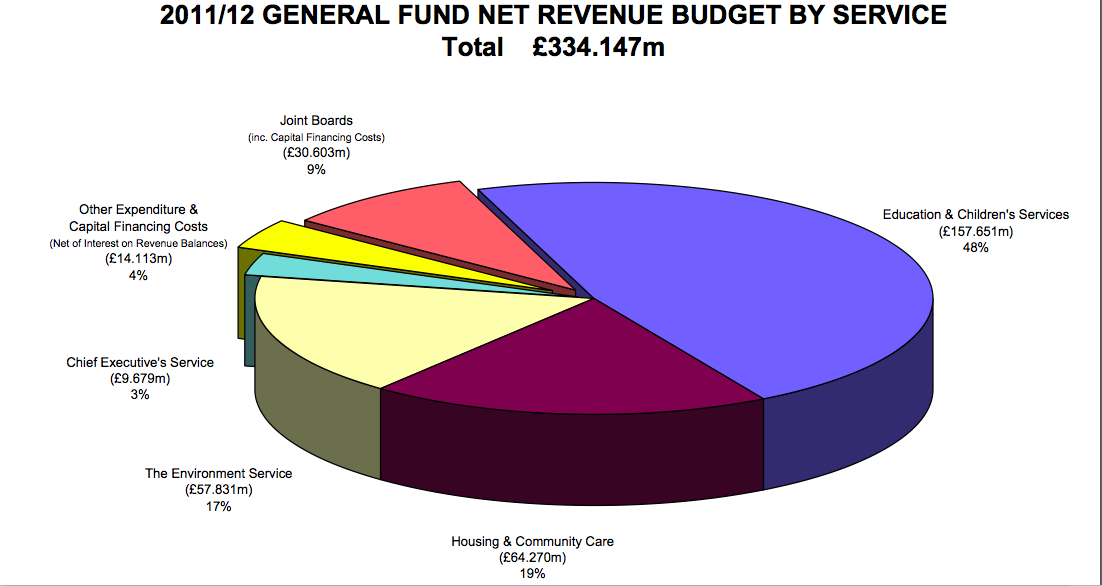
So, let’s examine council spending more closely. Easily the most visible of public services to most people, there are few people insensitive to council services, whether it is bin collection, street sweeping or their local football pitch. A typical mid-size council (Perth & Kinross) annual revenue budget allocation is shown in the pie chart below:
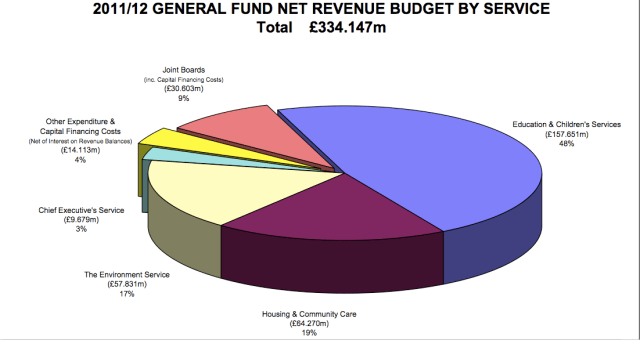
By far the largest chunk goes on Education and Children (48%), with the next largest on Housing and Community Care (19%). The former is almost all expended on schools and the bulk of the latter is spent on Adult Social Care. This is because all these budget are net. This means that they are the additional money needed to pay for services that do not pay for themselves. Unusually (because it charges rents), Housing is one of the few council departments that either breaks even or even contributes some money to the general budget.

As far as the general public is concerned, both Education and Adult Social Care fall into the same taboo category for cuts as the NHS does. If the same ‘ring-fencing’ to protect their budgets were applied as we just did with the NHS above, instead of 12% becoming 18% cuts for the whole council, protecting Education and ASC would mean a 54% cut on everything left. Add in salary creep and you’re looking at least at 57% savings

This is clearly impossible without wholesale closure & sale of libraries, museums, community centres, sports centres, parks, etc and slashing planning, cleansing, environmental protection, roads and even transport of pupils and ASC clients to unacceptably low levels. The room for maneuver is worse than we thought.

Back in 2008, East Lothian Council instigated a 2% per annum efficiency saving requirement from each department over the next three years. This was achieved, largely by natural wastage of staff (down by over 200 out of 4,500 FTEs), plus major items like an overhaul of how ASC was provided, through charging for special uplifts, right down to skipping winter planting of flower beds or summer hanging baskets (unless the town fund-raised to supply them).

The point is that, after three years of effort, most of anything that could be described as ‘fat’ has already been cut from the operation. Where councils (including ELC) have made very little progress is in ‘shared services’ where they operate joint departments with other councils. Nobody argues there needs to be 32 directors of education or 32 separate roads departments, each with their own yellow “Tonka-toy” fleets of gravel lorries and tar machines.

But, despite the fact that all 32 councils could get their payroll from one place and despite councils like ELC budgeting £5m of reserves for a ‘change fund’ to finance such transitions, almost nothing has happened. After three years, an ‘ELBEF’ consortium of the six Edinburgh, Lothian, Fife and Borders councils has produced exactly nothing.

The reason is that senior management in virtually all councils have been permitted to run their various departments as they saw fit. And after a decade of annual increments to both their budgets and their salaries, they presided over somewhat bloated organisations that nobody had examined in detail—let alone taken a chain saw to—in living memory.

Complicit in all this is Audit Scotland, who churn out forest-fuls of high-production-value reports that nibble at the edges. It’s an echo of the emperor’s clothes where it’s in no-one’s interest to blow the gaffe and, as no-one steps much out of line, few examples of how to innovate.

In February of 2013, there will be a variety of bun fights down at the local Town House; the new administrations will blame the old administrations, suck their teeth and balk at anything too radical, using reserves to cover shortfalls and selling property to cover that where necessary.

But during 2013, meetings at CoSLA (the council’s own common organisation) will get much more ill-tempered, as will their relationship with the Scottish Government. John Swinney will continue to be diplomatic, reasonable and generous where he can. But as his hands are also tied, there will be a joint throwing of toys out the council pram as the much-heralded ‘Concordat’ of 2007 gets torn up, along with the related commitment to a council tax freeze.

Even then, because education and ASC will need to take some share of the cuts to come, much ill-tempered trading of blame will pepper the run-up to the February 2014 budget setting—because, despite raising council tax as much as 10% and making what cost savings and natural staff wastages are still there to be made, that’s when the cumulative shrinking will really start to bite and wholesale jotters will be collected across those services deemed not to be ‘essential’.

As well as real cuts in jobs and salaries in Education and ASC and unpopular moves like fortnightly bin collection or doubled fees, look for community facilities that councils supply from pitches to libraries suffering not just limited hours but wholesale closure and sale, with staff losses in what were once ‘safe’ public service jobs of 10% or more.

It’s that serious.


Posted in Community | Tagged | Leave a comment

Qually Folly

Michael Gove has set the cat amongst the educational pigeons in England. By scrapping GCSEs and replacing them with a Baccalureat more common in Europe. Known in France colloquially as le bac, it is an academic qualification which French and international students take at the end of the lycée (secondary education). It was introduced by Napoleon I in 1808. It is the main diploma required to pursue university studies.

Apart from political knee-jerk reactions from the usual suspects, more thoughtful commentators have queried how a single exam in each subject can properly evaluate a pupil’s knowledge and how this will not result in a ‘two-tier’ education dividing academic from vocational pupils.

After 13 years of the Scottish Parliament, the spend on school education has doubled with no measurable improvement in exam results, positive destinations or social problems among young people. The McCrone settlement of 2002 greatly improved teacher salaries and status, while councils have devolved management to schools as well as creating nursery places for all 3- and 4-year-olds.

Nonetheless, negative comments in recent reports and comparisons with Scandinavian models lead to the conclusion that our above-average spend per pupil may not be effective. And, while all reports note the relevance of social backgrounds to academic performance, none draw any conclusion beyond providing ‘more resources for the vulnerable’.

Is it therefore time to re-think Scotland’s school system?

What is striking about education debates both here and furth of Scotland is how dominated they are by the vested interests of governments and teaching unions. The two major groups for whom the system largely exists—employers and the pupils themselves who will become employees—are at best abstracted or, at worst, ignored.

A recent blog on this site (Costly Lessons) took independent schools to task but one thing they excel at is understanding and achieving success in the education system and, to a lesser extent, what pupils need to learn for success in later life. That second point applies mostly to those who would ‘read the Greats’ or wind up in the Honourable Company of Edinburgh Archers but they are more pragmatic than their ivory tower looks suggest.

Education cannot be viewed separate from social context, nor without reference to human behaviour, as regards reward, ambition and peer/family pressure. The strict rote learning of the mid-20th century gave way to pupil-centred and, more recently, inclusive learning. At the same time, social norms of conformity and obligation have given way to ambition and entitlement. Taken together with a fixation on academic progression, the result has given more disruption in classrooms with less responsibility being embraced by parents, especially (but not exclusively) those with social difficulties.

Education authorities and teaching unions agree that key learning stages like literacy are best achieved prior to P3 and social interaction skills prior even to that. Anathema though they seem to be here, Scandinavian outdoor nurseries boast an enviable record of teaching infants self-confidence, as well as both practical social skills. Why can’t we at least investigate that as a tool of early learning?

And where Gove is treading heavily at the other, the fear of social discrimination is blocking the recognition of vocational skills as just as important a part of learning for life as academic pursuits. This month, Corby Technical School opened. with a specialisation in engineering and science. Roquette, a major local employer, says it “welcomes the opportunity for young people to develop real skills for their careers alongside relevant traditional academic qualifications that will provide students with increased value to their future employers.”

Leaving aside fixing poor school infrastructure (important but more a question of money than education philosophy), the top priority parameters to address include:

  1. Reducing classroom disruption
  2. Empowering teachers in status, as well as in disciplinary options
  3. Empowering communities to determine strategic direction of local schools
  4. A much different approach to nursery and infant ‘education’
  5. Definition and enforcement of parental responsibilities
  6. ‘Level-playing field’ options for pupil career (vocational, creative, business)

For such to be feasible, let alone effective, a close involvement of multiple agencies will be required, not least police, social work, youth organisations, wardens but especially parents’ groups. But key to any of that, whatever the structure, it must be pro-active, as opposed to intervention once a child is ‘failing’ academically or socially.

Clearly not all homes are capable of the same nurture and support but neither are a child’s chances of success enhanced where parents abdicate their involvement as role models for which no professional can provide an adequate substitute. However well intentioned or professional state involvement might be, families—like communities—stand or fall on their own actions. Our own history from clan clachans to the Gorbals teaches that poverty makes that harder but does not make it impossible.

The folly of the old P7 Qualifying Examination that once sorted pupils into ‘streams’, each with a differing syllabus was not the principle of teaching pupils what they needed to know for their likely post-school destination but the social presumption that any stream was ‘better’. This is where private schools are a liability, focussing on academia and making it evident they regard money (for their fees) as a measure of worth.

In any other part of human endeavour, training for the job would be self-evident. Deep-sea Divers and Supply-Boat Captains share little in their job training, let alone with solicitors and surgeons. Yet all of them wind up on comparable salaries, often living as neighbours.

For society to be classless, education itself must NOT be classless but differentiated and geared to the child, which involves challenges in wood shop, developing new iPhone apps, access to sports facilities (c.f. wur Andy) andinteractive, real-world languages, as well as Latin and Calculus. And that, Mr Gove does NOT involve pushing them all through the same mincer—any more, Mr EIS, than it does trying to level the playing field and ‘make every child a winner’ because neither is helpful training for life.

Posted in Education | Tagged | Leave a comment

Looking Through a Glass Union (Again)

A year ago, this blog welcomed the One Dynamic Nation website to the debate on Scotland’s future, especially its relationship with England. Obviously a reasonably professional effort, in the intervening time, it has been fleshed out with a number of pages and maintained a reasonable, if simplistic, graphics “feel”. Nonetheless, I have been disappointed with the content and apparent lack of new things to say.

Take, for example, one of the five ‘Campaign’ pages entitled “Benefits of the Union” which starts off with:

“The Union serves all four parts of the United Kingdom well and enables us to achieve much more together than would be the case if we were separate nations.”

The presumption underlying this is that bigger is better—and could use a couple of examples if they believe this to be true, especially as Switzerland and Denmark—not to mention Luxembourg or Liechtenstein enjoy GDPs per capita that Britain can only envy.

They then go on to cite three points on history, none of which relate to the 20th century, let alone the 21st, and then cite a number of economic points they obviously consider to be major advantages but they start off badly:

  • The Union allows Scotland to be part of a larger, more powerful economy and within the Union, Scotland enjoys the four freedoms – movement of goods, services, people and capital.

…err, if that were the case we should all integrate with Europe tomorrow because those same four freedoms underpin the EU. Yet the UK is the EU’s most eurosceptic member.

  • By remaining part of the Union, Britain has the fourth largest economy in the world. Edinburgh’s role as a major financial centre is built on the expertise of its workforce and underpinned by its position in the UK.

…err, so explain how tiny Hong Kong or Singapore (never mind the glorified reef that is the Cayman Islands) can possibly hold on to their leading roles in global fianance.

Rather than deconstruct the rest of their rather weak and poorly thought-through points, I challenge whoever is behind the site to up their game. What they have now is a series of platitudes for the faithful to (as they say on their site) “Keep Calm—and tell us why you love the United Kingdom.” Given the latest survey of independence from the British Social Attitudes, they are missing the fact that decisive debate is over those who are not thirled to either view who will wind up being decisive.

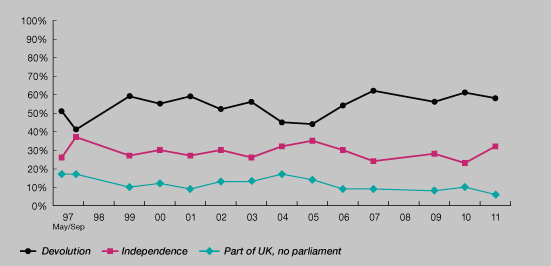
In a sample size of 1,197 voters, support for more powers being repatriated to Scotland from Westminster now stands around three-quarters. The detail figures from BSA are:


This shows, as clearly as anyone could wish, the extent to which the debate centres not around those who have entirely resisted the trend towards Scotland handing its own affairs (now down from a 20% peak to an irrelevant 5%) but on the half of all people who are pleased with what devolution has brought so far. The real question that web sites like ODN must answer is how are they to persuade that block in the middle that what they now have is adequate, that this positive process is at an end.

They must look across the world at the Norways and Singapores and they must make a strong case why they should have remained part of Sweden or Malaysia, how they would have been more prosperous, more highly respected and able to ‘punch above their weight’ had they stayed where they felt they no longer belonged. The onus of proof is not on fans of independence to prove how it would benefit Scotland, but on those who hold onto a historic but now antiquated union that denies the Scottish people the right to develop their own future, as many others have.

Posted in Politics | Tagged | 2 Comments

Scottish Enterprise: The Problem, not the Solution

Whatever kind of recession we’re in, pretty much everyone now agrees that we’re in one. What everyone does not agree on in how to get out of it. In fact, there is a significant proportion of the population—quite often those struggling with their finances—who question whether unbridled growth is desirable, sensible or even achievable in the long term. But, leaving aside the latter view, how best can we restore a modicum of growth—and thereby remove much of the ill-temper from present economic debate?

Though a global economy is pretty much a given and healthy US/Europe demands for Asian goods has become a lynch-pin of global growth, that does not mean opportunity does not exist for smaller economies to boom while the more sluggish giants who depend on global stimulus to prosper wallow from the inertia of size. For too long, Scotland has thought of itself as a branch of the UK economy: its finest hour to date was as arsenal, foundry and shipbuilder to the British Empire a century ago.

That proud Empire economy that once bestrode the world is now history. Even the last vestige of military manufacturing in the shape of BAE is contemplating merger into Europe. Whether you believe in Osbo’s austerity enema that is actually debt gluttony or not, this UK economy supertanker won’t turn around any time soon. The smart money is on fractional growth, if any, and a 12-15% real cut in public spending over 3-4 years.

Now, a definition of stupidity (or is it madness?) is to repeat the same action time after time, yet to expect a different outcome. What growth there has been in the Scottish economy owes little to Scottish Enterprise—the organ of state whose job it is to generate it. Their thinking was born in the statist 1970’s when the Linwoods, Ravenscraigs and other echoes of our manufacturing past were all the rage. It continued through the 80s and 90s when Mitsubishi and Chungwha and Hitachi all gave a modern veneer to Silicon Glen. It also provided good jobs so nobody was much concerned with quibbling.

But it was an illusion. Since Linwood, Ravenscraig, UCS, and most of Silicon Glen is now dust along with much of the investment provided, it’s time to ask what the hell SE thinks it is doing for our future and why most of its senior management don’t deserve their jotters. As part of the £1/4bn annual cost of SE are a Chief Exec at £204,000 and senior staff at over £1m among them, including pensions as sweet as any FTSE member. SE may hold £5m in 100% ownership of startup shares, plus £75m in others but they sit on £100m+ in cold, hard cash. They also heavily influence the distribution of over £1bn annually of EU and Scottish Government money.

In California, where much of today’s technology is still being developed, even if it’s being manufactured in Seoul or Shanghai, the venture capital denizens of Sand Hill Road must laugh themselves sick that such a colossus could exhibit either the foresight or the flexibility to punt on the future accurately, let alone the cojones to do it with their own money. It’s like releasing your pet dog Rover in Yellowstone and expecting him to compete with the wolves there to bring down caribou.

One of Scotland’s advantages is that it’s small. That means the politicians, bankers, businessmen—and the quangocrats—generally know one another and network well. But that also means that such a club is generally defensive about any major changes because there for the grace of fate goes any one of them. As a result, major moneys such as the European ESF and ERDF funds pass largely through SE, with the rest parcelled out to known recipients through a picked committee put there to rubberstamp what the Victoria Quay mandarins present tell them.

The point is that virtually none of public investment in Scotland is done with an eye on the far future. Go ask the Wood Group or Clyde Blowers or Barrs or Cairn Energy or even Brian Souter what they think of Scottish Enterprise and, once they’ve stopped laughing and picked themselves up off the floor they’ll put a flea in your ear how they grew their respective companies themselves and no thanks to the timeservers in the ivory towers of Apex House or Waterloo Street.

It took SE well into the nineties to twig that chip manufacture was a third-world operation that belonged offshore. It took them until the noughties to see that CRT picture tubes were old hat and that LED screens were the future. They are still fishing about for the next Motorola that will build a nice £1bn plant with 5,000 employees in Armadale because it seems that’s all they know. They have washed their hands of really small companies, palming them off on ‘one-stop shops’ with local councils who generally are not geared to real business advice or funding.

So what is the solution? The dog-eat-dog rapaciousness of the American business climate does not sit well with Scottish culture but nor do the environmentally indifferent sweat shops of East and South Asia. Appropriately enough, we may have something to learn from our UK partner in England. A couple of years ago they took out their equivalent of SE (the regional development agencies) out and shot them. The replacement was a network of much smaller local enterprise partnerships (LEPs), announced as part of the June 2010 UK budget and of which there are currently 39 in operation.

LEPs are voluntary partnerships between local authorities and businesses and, since they form organically, they seem to focus far better on the requirements of a particular area. While some thought needs to be given how they would be formed in the rest of Scotland, it seems that the area SE of Edinburgh, covering Mid- and East Lothian, plus Scottish Borders shares much in common, being a combination of commuter and rural but with none of the industrial concentration of West Lothian or the city focus of Edinburgh.

Such a SESLEP (South-east Scotland LEP) would, by its population, be entitled to around 10% of SE’s budget or approximately £25m. They should also get the equivalent of the EU and Scottish Government capital investments, allowing issues like Borders Rail or A1 dualling to be dealt and not dithered with. This would go a long way towards developing business to suit the area and thereby reduce the huge amount of travel into Edinburgh by professionals and salaried workers.

So what should such a SESLEC focus on to achieve such noble, not to mention useful, aims? For a start, the amount of skilled people and desirable quality of life would give them a flying start to develop:

  • “Joined-up” tourism offering transport and entry to multiple attractions
  • Linear recreation, such as long distance footpaths, an East Lothian Coast offering a smorgasbord of accessible recreation options and a bike hire network
  • Town centre offices attracting architects, web/graphic design and other small professionals to work where they live—and spend their money there
  • Quality food distribution network making local produce and seafood available to restaurants, specialty (e.g. farm) shops and other local outlets
  • Quality restaurants specialising in the local produce and seafood
  • Support infrastructure for building and maintaining Scottish & Southern offshore wind farm
  • Town centre specialty retail that becomes a tourist destination in themselves
  • Crafts and artwork network that would see equivalents of Wigton as book town spring up for art gallery tours

Although not all of the above may be viable, the point is that many opportunities here are lying unexploited—despite the growth in foreign and local tourism—because the enterprise ‘network’ we have is not geared to local small businesses. Such business offers the appropriate method of regenerating and making prosperous the 400,000 people who live in the quadrant SE of Edinburgh—and about which Scottish Enterprise is demonstrably clueless.

Posted in Commerce, Community | Tagged | 3 Comments