In the Thick of It

Appreciative as I am of regular readers calling in on this blog and gracing it with their comments, I give notice that the pretty steady regularity of more than a blog every other day for the last two years might become erratic over the next few weeks.

As most will have been aware, the quadrennial circus that the Americans call an election is well underway and now accelerating into its final fortnight. For my sins, I have volunteered to spend these next two weeks taking stock of that election from both a political and an mechanical perspective. Starting on Thursday, I will be visiting party campaign and county election directors in the “Home of the Liberty Bell” city Philadelphia and in New Jersey counties across the Delaware River.

Philadelphia is the only place in the US that uses entirely digital balloting so I’m keen to find how they prevent, detect and combat fraud in such a system with no ‘paper trail’. Pennsylvania and New Jersey are two normally ‘blue’ (Democrat-voting) states that Romney needs to target if he is to win.

Then, in the final week, it’s three time zones further on to San Francisco to research the political moods and campaign methods there and the other half-dozen counties that comprise the Bay Area. They tend to vote pretty solidly Democrat but large areas of Contra Costa and Santa Clara counties have huge tracts of recent developments that are largely Republican in sympathy. Just when I’ll be Wifi’d up with enough time to blog isn’t clear. So, if there are a few day’s blog-free silence, put it down to a tight schedule or the difficulty in finding a cafe/hotel with decent Wifi.

Given that the general opinion of the three presidential debates is that they went one to each with last night’s tied and the polls have both main candidates running neck-and-neck, this looks like being an interesting couple of weeks to be in the thick of it. However, this time it should be easier for me to enjoy as I will be there as an observer and not involved up to my eyeballs, as I would normally be here in Scotland.

All together now: “My country, ’tis of Thee, Sweet Land of Liberty, Of thee I sing…”

Posted in Politics | Tagged | Leave a comment

Who Are They Kidding?

The publication last week of the RUSI Study of defence in an independent Scotland  should have been seen—even by unionists—as a reference point for a decent debate. Instead, former UK Defence Secretary has joined with Jim Murphy, Philip Hammond and the usual MoD suspects in ridiculing the prospect of Scotland having a credible defence posture outside of the UK ‘umbrella’.

Have they looked how porous that umbrella has become of late? Time was 100 years ago that the UK defence policy revolved around the Royal Navy and a ‘two-power standard. That meant that the RN had to be equipped not just to be the biggest but to able to take on the two next-biggest in a naval war and win. Changed days.

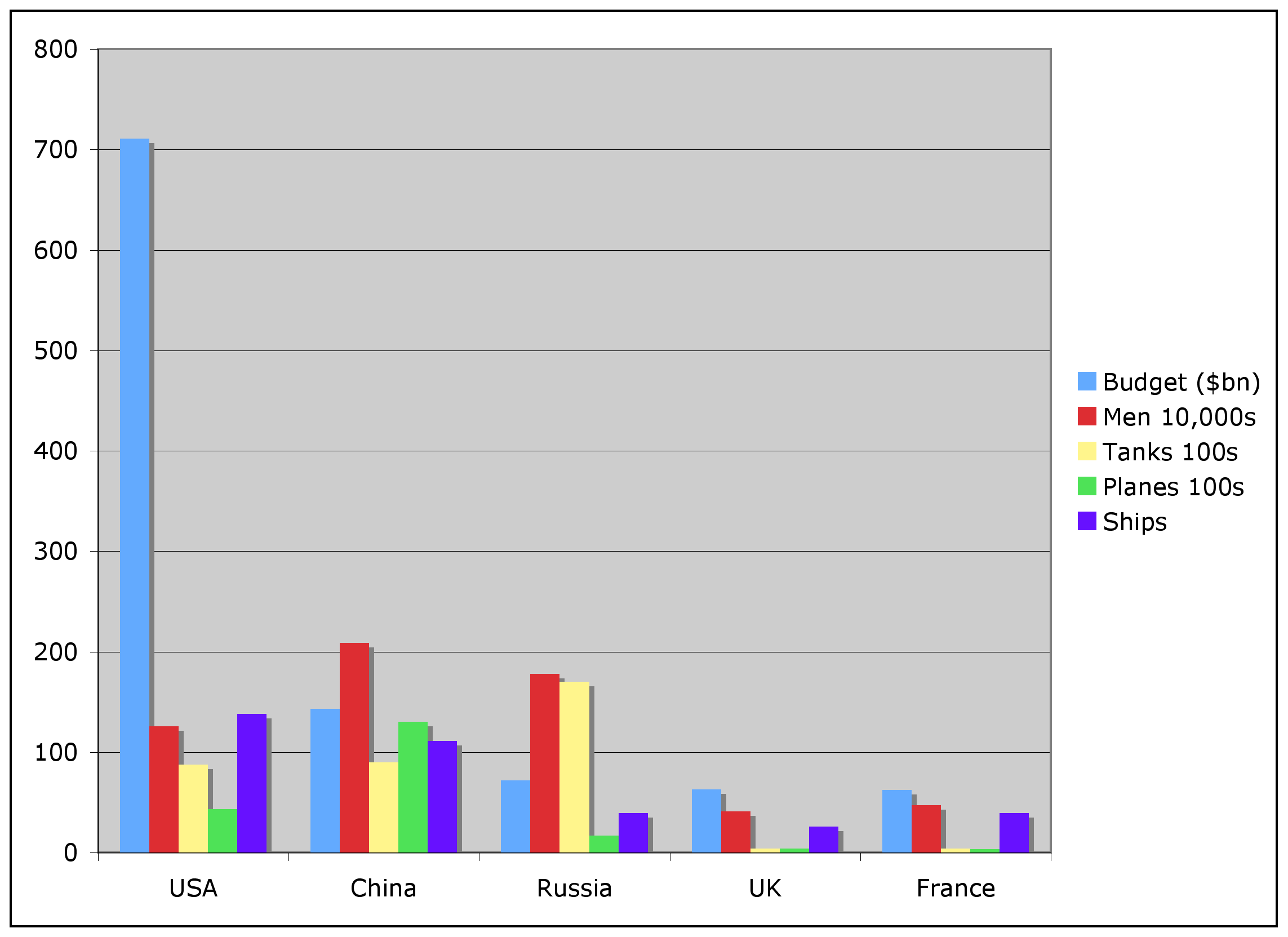
With the scrapping of aircraft carriers, long-range maritime reconnaissance aircraft, Harrier jump jets and shrinking of army battalions and RAF squadron numbers, the UK is in danger of becoming a third-rate power with a fig leaf of the minimal level of nuclear capability to argue itself the “place at the top table” that Fox, Murphy et al always tout as so important. But, consider this chart:

Comparison of Defence Posture and Budgets

By any measure of conventional military strength, the UK cannot be seen as a first-rate power and would be totally incapable of making more than a gesture against the de facto Big Three, the UK even trails France, which is the current European defence leader. This is dangerous territory to occupy: big enough and replete with colonial history to be known across the world stage & be selected as a target without being powerful enough alone to take on anyone so minded and motivated to create trouble.

The Glasgow airport attack; the 7/7 bus/tube bombs would not have happened had the UK not gone into Iraq. Far from defending any part of Britain from such attacks, the UK’s current posture verges on an invitation to attack an oil rig or some other such undefended corner. Present force overstretch is such a habitual occurrence that it’s a puzzle why Al Quaeda or other such organisations kept hostile by our puny variant of gunboat diplomacy in their back yard have, so far, not taken a crack.

The Scottish Defence Force of the RUSI study is not only considerably cheaper at £2.8bn than the £3.8bn share currently paid by Scotland for the defence of the UK but would also permit far more effective deployment of appropriate forces like frigates, fast patrol boats, long-range maritime recon and special forces in defence of our vital oil fields.

Posted in Politics | Tagged | Leave a comment

Perth Conference—Day 3

The problem with the best conference schedule is that it never allows for all the late-running fringe, subsequent social chats, rolling up ad hoc groups who then go to dinner and then winding up righting the wrongs of the world in the Salutation. All this means that, even with a tardy 10:30 am start to business, not all present themselves fresh-faced and ready for debate by that time.

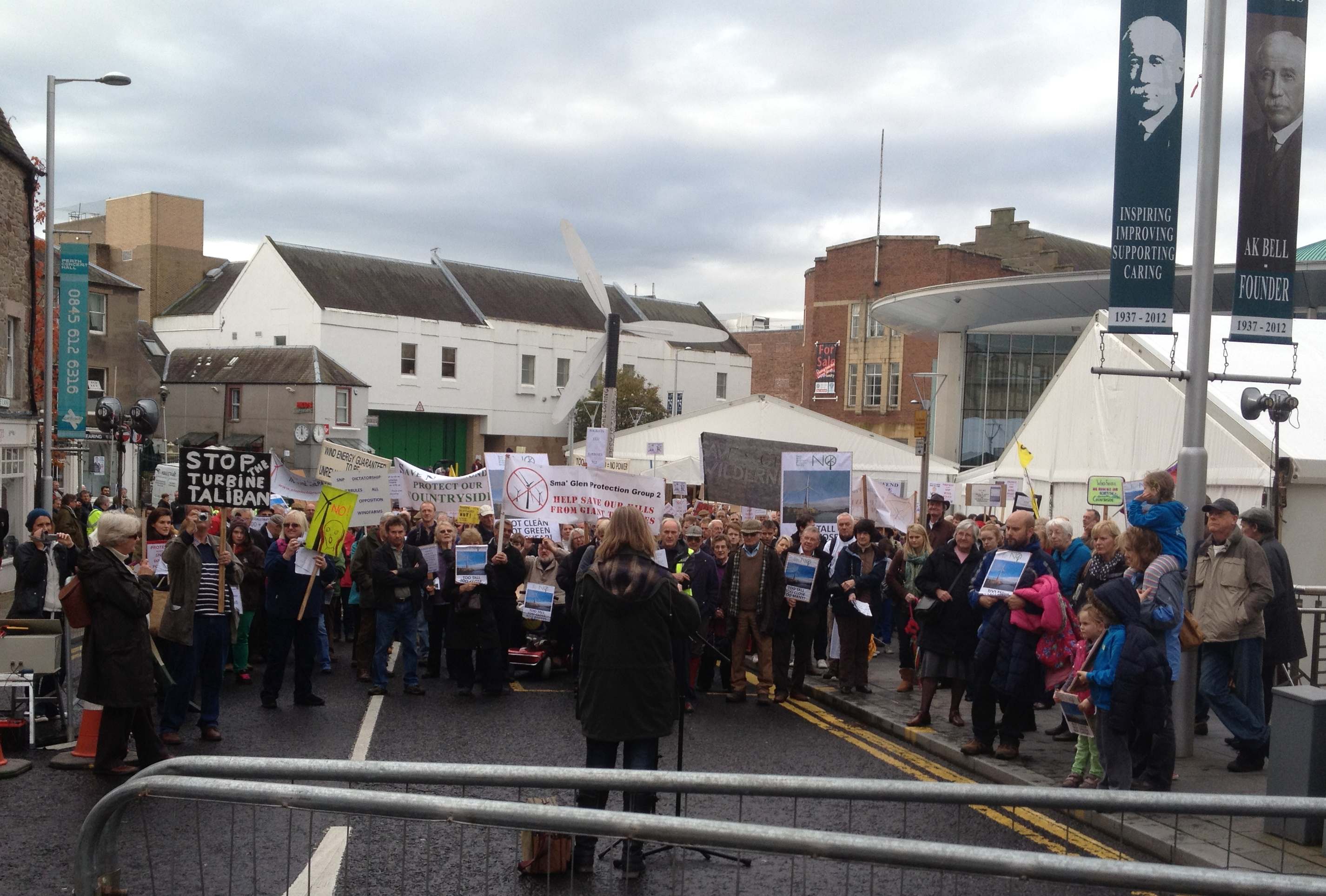
Fiona Hyslop’s Culture Secretary speech having ben bounced from its proper spot by the hectic of yesterday’s NATO debate, I missed much of proceedings having been ambushed by an even stronger demo outside—this time against wind farms, as opposed to against NATO and nukes.

Although officially against all forms of wind power, talking to the demonstrators indicated a broader range of opinions than the protest speakers were implying. Talking to an Aberdeenshire farmer, he was against all structures in or near to settlements but quite happy to upset The Donald with the offshore farm visible from his Balmenie estate.

Another rural resident—originally from Germany—was relaxed even about wind farms on remote and uninhabited moorland but fiercely against the latest government tendency to permit smaller turbines almost anywhere and to provide subsidies to do so. When I cited East Lothian’s attempt to resist this and to win most appeals against our refusal, the demonstrators were surprised that any were being refused anywhere.

After a enlightening fringe meting on FAME (Future of the Atlantic Marine Environment) from Dr Ellie Owen who is discovering prodigious amounts of key environment informaion tracking seabirds and their feeding habits using modern GPS and miniaturised electronics.

Dr Ellie Owen Explaining the FAME Project She Leads with Stewart Stevenson MSP and Lloyd Austin of RSPB

Then it was in to the hall for largely motherhood-and-apple-pie Topical Resolutions that were all passed by acclaim in time for the Main Event of His Eckness’ speech, which started bang on time at 3pm. I could restate much of what has already been said about—and good, pragmatic speech, more full of content than gesture, but a really good piece as already been written by Burdzeyeview, which I throughly recommend.

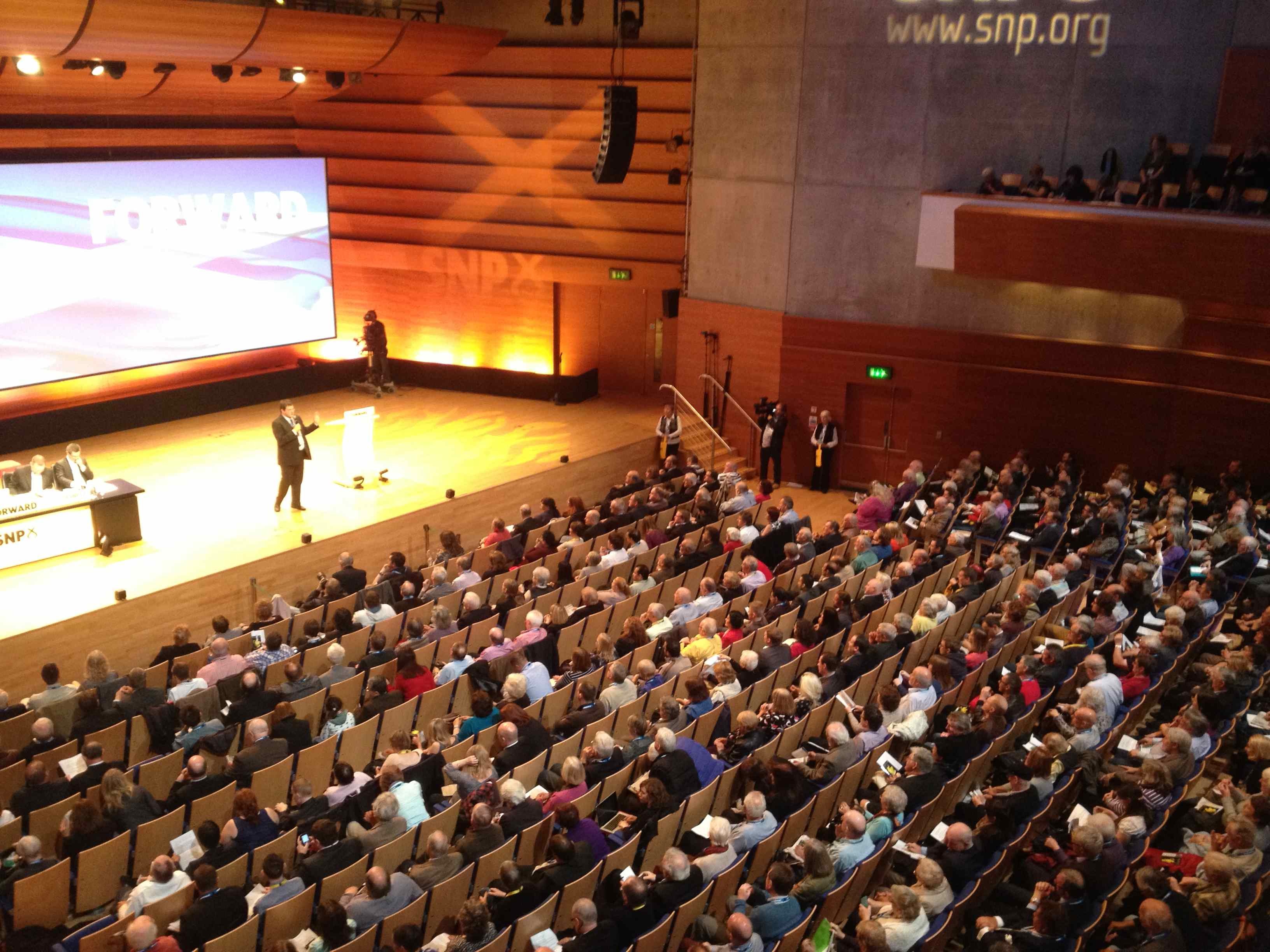
Instead, I give you some visuals to complement the Burd’s excellent reporting.

Ready for the Man—The Financial Appeal Warm-up Act that always Precedes the Leader’s Speech

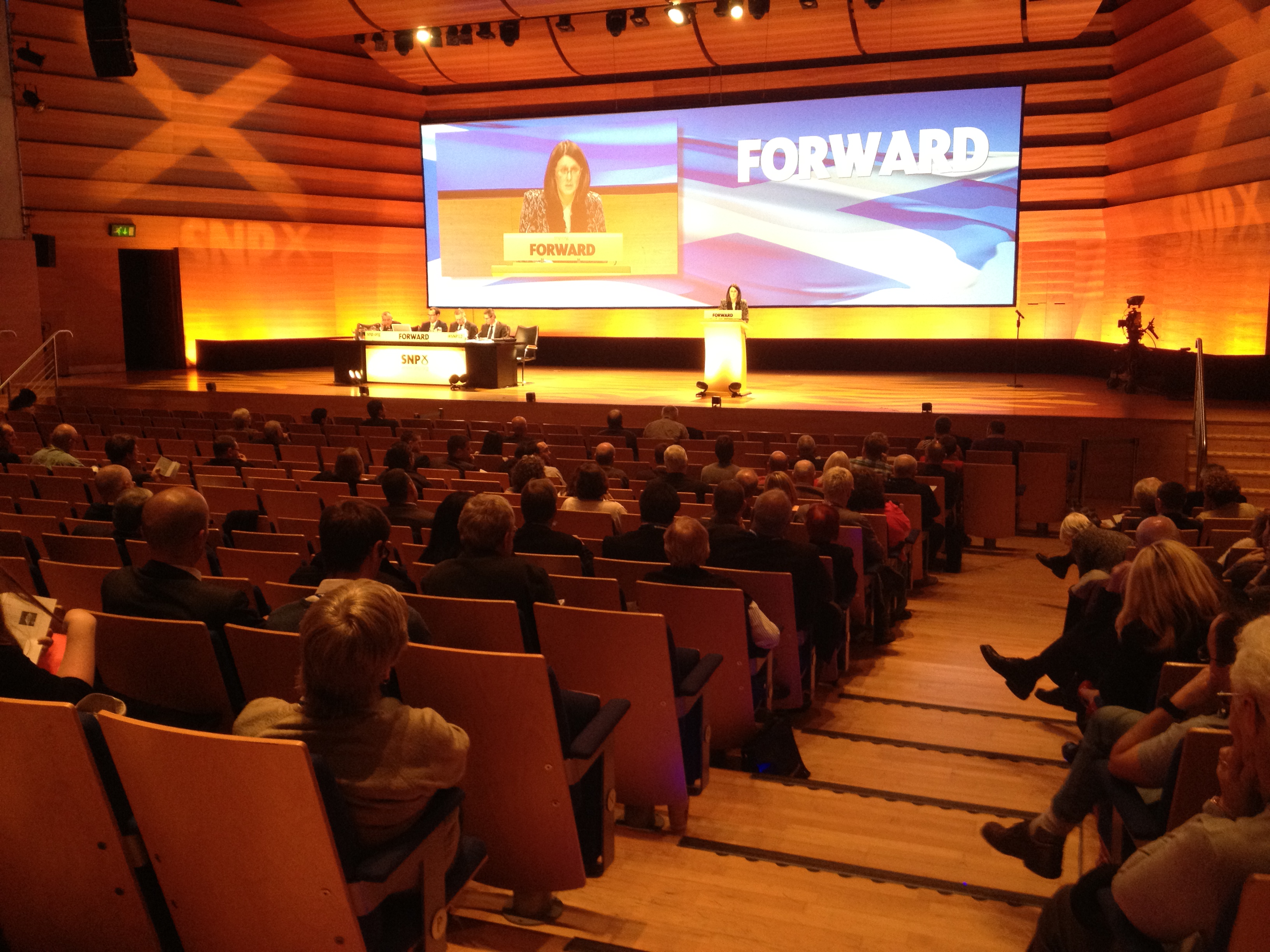
Eck on Form with 800+ Attentive Supporters in the Audience

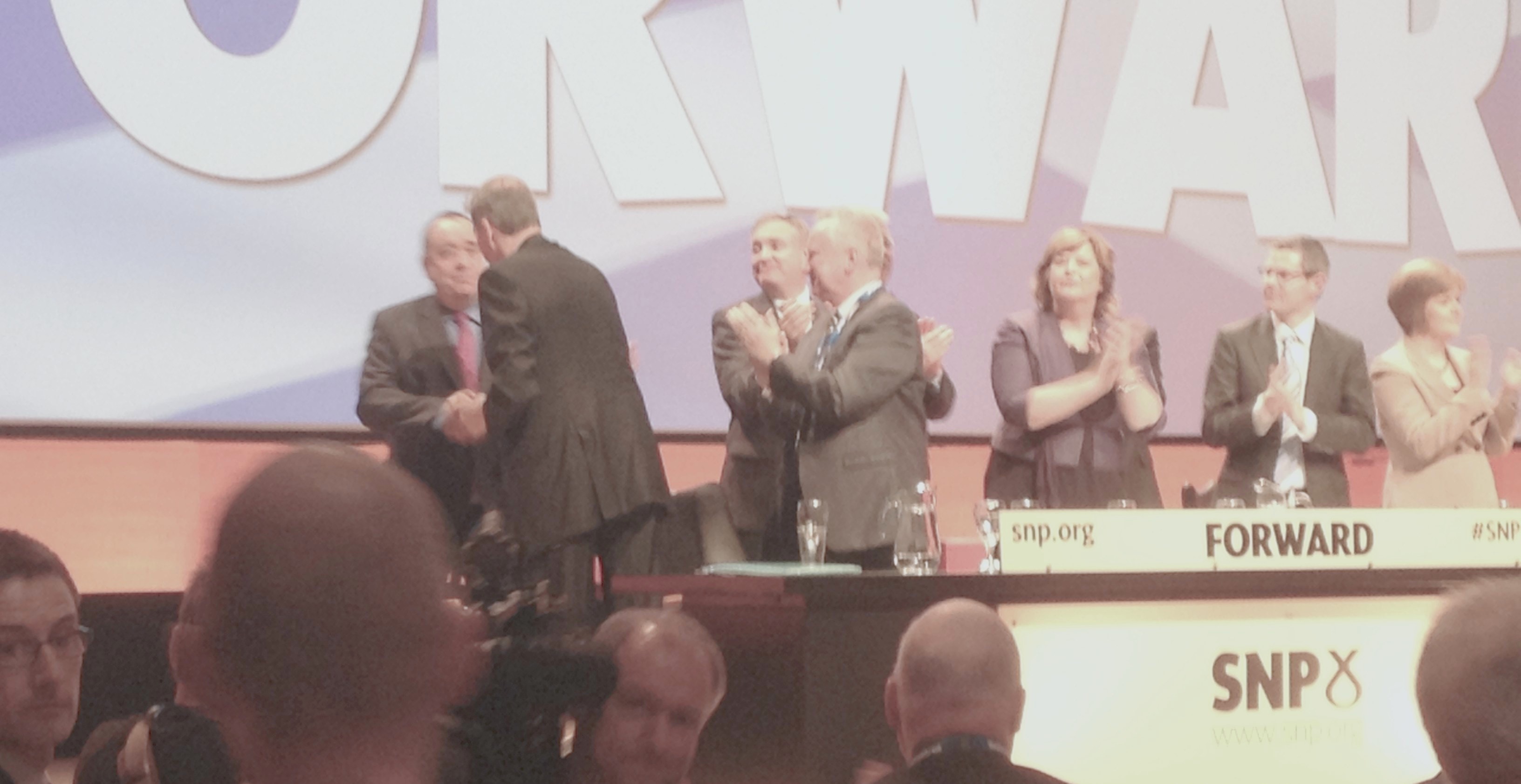
The Congratulatory “Lap of Honour” Starts at the Top Table…

…but Soon Degenerates into a Media Scrum as Everyone Tries for a Definitive Shot

As usual, Salmond was able to both sense and match the mood of the time and added both a call to campaign for 2014 in a way that harmonised well with the passionate but pragmatic debate that has characterised this conference.


Posted in Politics | Tagged | Leave a comment

Perth Conference—Day 2

After the unexpected fireworks of the first day, I was still fully expectant that the debate would heat up on Day 2 but it started earlier than anticipated with the Trade Union Group’s Chris Stevens giving one of the most articulate and impassioned speeches of the day in support of  Marco Biagi’s motion on private renting.

Before even getting into the hall there had been some lively demonstrating outside by the SSP and some friends, including the ever-amiable Colin Fox, which all added to the rather electric atmosphere of the day.

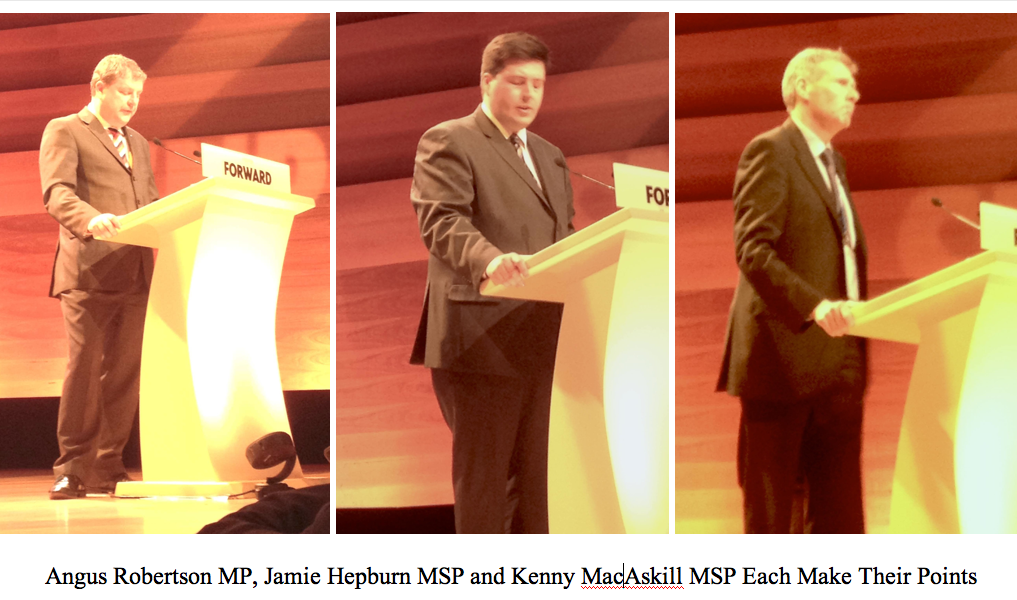
Chris’s contribution was part of the hour-long warm up of debates leading up to the ‘top billing’ motion 17 that was launched bang on time at 3pm to a hall so packed they had combed out visitors, media and any other non-delegates, so keen was everyone to do this right. Moved by Defence Spokesman Angus Robertson MP the Foreign, Security and Defence Policy Update included point 13, which—for the first time since 2002—called for an end to the SNP’s 30-year-long stance against NATO.

Although there were three amendments to the motion, ‘A’ (to remove specific budget for defence) while causing good debate, was handily defeated and ‘B’ simply reinforced the anti-nuclear stance and was accepted as part of the motion without serious debate. But it was amendment ‘C’ which essentially reversed the “pro-NATO membership on condition all nuclear weapons leave Scotland” stance embodied in point 13 that was the nub of the debate.

A Grim-Looking Top Table Still Attentive 1 Hour in to Motion 17

And debate it was. Angus MacNeil MP seconded the motion, Rob Gibson MSP made a strong case that a decision was not urgent and so this should be remitted back for further debate. Jamie Hepburn MSP who has ripened well from a somewhat erratic firebrand to a more subtle and persuasive politicians laid out the case for Amendment ‘C’: where was the need for NATO in our present day when Ireland saw no need for membership? Where was the supposed threat coming from?

What was clear from every speaker was the unity over removing Trident and fighting  ant successor. What the debate revolved around was whether having or declining membership of NATO was the best way to do that. Over two dozen speakers made their contribution on both sides (with dozens more having cards in to speak but not being called).

But Business Convener Derek Mackay handled himself impeccably, following procedure to the letter, clearing the agenda to make room for more debate and never losing control of what were easily the most intense 2 1/2 hours of debate since I first started attending SNP conferences at Dunoon in 1993. There were repetitions, there were weak speeches, there was the occasional dubious assertion that was left unchallenged. But it was as good an example of democracy in action as I have seen.

Which meant that I was at least as worried as the top table appeared. Having been one of those who badgered senior members to have this debate, judging from the applause for speakers who supported Amendment ‘C’ or who trashed NATO in their speech, this was not going to pass unamended. Justice minister Kenny MacAskill MSP pulled a barnstorming speech against ‘C’ out of this air but Jean Urquhart, Lachie McNeil and even first time speaker Natalie McGarry each countered with impassioned deliveries in its support to thunderous acclaim.

When Alyn Smith MEP stood to make a cogent case against the remit back that we were being naive and not understanding what it would take to make friends among the international community, a section of the attendees jeered and , as Angus Roberstson stood summing up for the motion along similar lines was the only other time the debate was marred by any jeers from the other side.

The passion and conviction was palpable and when Norman McLeod stood to sum up for the direct negative, it was to acknowledge a debate without rancour that had so affected him that he was barely able to complete his address without emotion overcoming him. After more than two hours—a record debate in my experience—everyone from both sides felt they’d had a good shake at making their case and were ready for results.

Counting the results were non-trivial as the hall was packed to capacity all the way up to the rear of the balcony. Amendment ‘A’ was clearly defeated, so there was no count and ‘B’ was accepted into the motion. It took five minutes for the stewards to clock all the votes on Amendment ‘C’ and it was a cliffhanger: 365 for, 394 against, so it fell. Then came Rob Gibson’s remit back, which also fell but by a slighter larger margin: 360 for but 425 against. Finally, the motion itself—amended only by ‘B’—passed by a clear but hardly overwhelming 426 for and 332 against.

Votes For the Remit Back Being Counted

As a drama, it could scarcely have been better orchestrated. Although grumblings about leaving any party that could embrace NATO were heard afterwards from some, nobody lost sight that independence is an absolute prerequisite and the general mood was upbeat for as emotive an argument as this was. What illustrated that for me was, as Derek Mackay asked for a further extension of time to permit all the votes to be counted, a voice piped up in the hall “OK—but get 795 pizzas in first, will ye?”

The dozen fringe meetings after seemed like oases of calm by contrast but, since the CSPP Transport meeting with minister Keith Brown MSP was a km away at the Salutation and still well attended, it obviously takes more than a good knock-down drag out debate to take the wind out of the SNP’s sails and/or appetite for politics.

Nigel Wunsch Head of Strategy, Network Rail; Keith Brown MSP; Steve Montgomery, MD ScotRail; Stewart Stevenson MSP

Posted in Politics | Tagged | Leave a comment

Perth Conference—Day 1

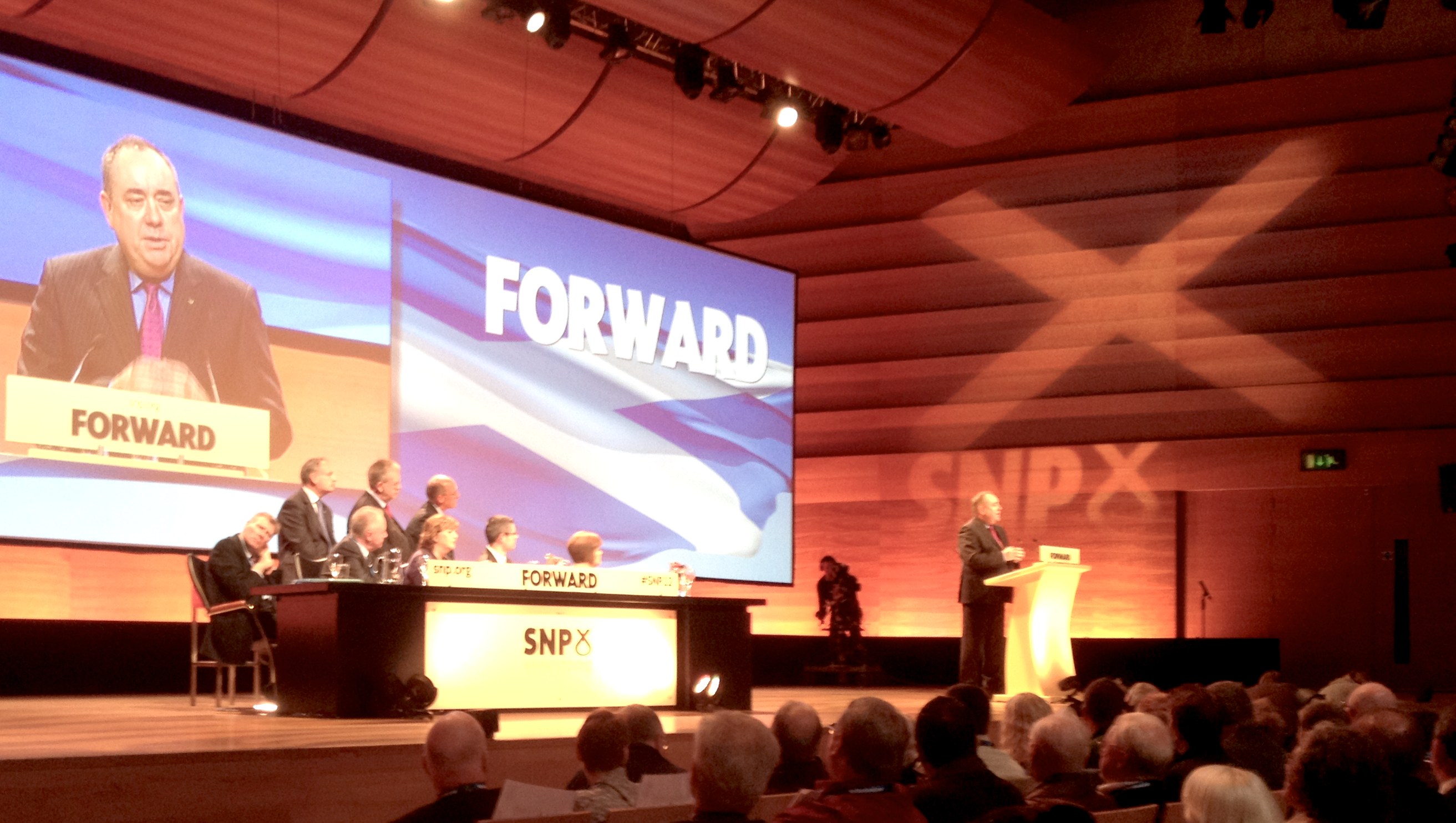
Rescheduled from mid-September to coincide with the school/parliament autumn recess later in the year, I regretted the SNP conference no longer being blessed by indian summer weather as I thrashed north in the rain. Surprised to find we’re now famous enough to get the street outside closed off for security reasons, after negotiating the usual chicane of exhibitor stalls I’m into the magnificent Perth Concert Hall to hear His Eckness launch the event. He did not disappoint.

Alex Salmond Opens the 78th SNP Conference at Perth Concert Hall

“”I trust this conference to operate in the best interests of achieving independence for Scotland. I trust this conference to debate the big issues in a comradely manner. I think it is fantastic, I think it is great that we are the only political party in these islands with the confidence to take substantive issues to our annual conference.” He declared, before going on to quote a poem from George Robertson, brother of Hearts legend John Robertson: ““Eat well my trusty, honest friends, in 2014, the nonsense ends.”

While everyone is geared up for the right old rammy of a debate on NATO today, it came as a surprise to me that the private session on constitutional changes launched as fierce and well argued a debate as it did. At stake were three motions:

  • Appointing a National Women’s Officer
  • Electing one male and one female MSP to NEC under separate ballots
  • Electing three male and three female ordinary members to NEC under separate ballots

The first sailed through nem con, but the latter two were wrapped as a single debate and caused the session to be stretched a half hour beyond its allotted time.

Julie Hepburn, National Vice Convener for Political Education Launches the Debate

As a member of the party’s National Executive Committee, Julie had been tasked with pleading a sub-group to present a report on how a gender balance could best be struck at all levels of the party. This was the result of ten years of ‘wait-and-see’ following the 1999 conference in Aberdeen when earlier attempts at changing the party’s rules to encourage female participation were struck down by members. The motions were a distillation of her report and had NEC support.

Julie’s argument, supported by the now-sole female member of NEC Tasmina Ahmed-Sheik as second, revolved around the statistical evidence that, not only was the SNP not making progress including women at all levels of the party but in some prominent instances, such as the MSP group and NEC, the proportion was actually slipping back.

Elaine Wylie Notes the Lack of Women on the Platform but Makes a Feisty Case Moving the Direct Negative

It was surprising to me both the number and deep passion of those speaking against the change. Elaine asserted that the male dominance of the platform underlined the need for action, but that this was not it. She wanted to be elected on merit, not on the fact that she was a woman and warned against the equal risk of “electing three male numpties” if the candidates on the male side were not the best either.

She was backed by well known Renfrew activist Audrey Doig, who railed against the lack of consideration for women having conference in a school holiday week and for not providing a creche, whereas a much smaller party used to. Up-and-coming tweeter and BBC Question Time veteran Natalie McGarry underscored both Audrey’s and Elaine’s points.

When it came time for Derek Mackay, Business Convener chairing the session but obviously seeing a tight vote ahead, to make articulate please to consider that this may not be the full solution but it was a considerable advance towards where we needed to be after a number of years effective stagnation, the scattered, as opposed to full-throated, applause made you wonder as to the result.

At first, it appeared that things might be still on-track. Voting on the direct negative (by the newly formulated rules of voting) did not find a majority so many—including former National Secretary Alastair Morgan and NEC member Jerry Fisher—thought that decided it and even called for points of order to query this procedure. However, when the convener asserted order, he moved to the vote on each of the two substantive amendments, both of which required a 2/3 majority to pass.

Despite senior member and full NEC backing, neither even achieved a standard majority, let alone the required 2/3rds. With the party in fine debating fettle and the bit apparently between its collective teeth after Angus Robertson MP’s stowed-out Scotland on Sunday lecture last night on “Updating SNP Defence and Security Policy” there should be even bigger bouts of passion in the hall around 3pm today. Then the party is to debate “SNP Foreign, Defence and Security Policy Update” a.k.a. To NATO or not to NATO.

Expect fireworks and probably the best debate any party has had in public in years.

Posted in Politics | Tagged | Leave a comment

A’ the Blue Bonnets

The leading letter in Tuesday’s Hootsmon was signed by ten experienced nationalists and titled SNP Should Stick to Disarmament Policy. The fact that all are women is not particularly relevant because all have extensive background in the party and their view reflects a significant portion of members’ views.

What is clear is that they are people with whom I would think twice about contradicting individually. As a phalanx of ten, I risk being ambushed en masse at the SNP Conference later this week if I dare query their very clear argument. But I believe they’re wrong and they deserve some detailed explication why I would go public to say so. Their thesis is that future membership of NATO for Scotland is untenable if you are anti-nuclear but membership of the related Partnership for Peace provides an acceptable non-nuclear middle ground.

The basis for my argument is partly the most comprehensive proposal for the defence of an independent Scotland, published this week by the Royal United Services Institute. “A’the Blue Bonnets: Defending an Independent Scotland”, by Stuart Crawford and Richard Marsh, claims a Scottish Defence Force would be necessary, feasible and affordable.

Scotland can argue that it has paid its share towards the British armed services’ inventory and therefore should be able to negotiate most of what it needs to an independent Scotland. As for whether an independent Scotland can afford its own armed forces,  the answer seems to be an unequivocal yes. Indeed the cost of proposals in the study is half the cost of what Scotland currently contributes to the MoD.

My basis is a number of articles articles already on this blogspot on both NATO and a Scottish Defence Force but most especially the RUSI paper which answers repeated complaints from unionists as to how an independent Scotland could possibly afford to defend itself.

This interesting analysis demonstrates, not only that an independent Scotland is perfectly able to maintain well-resourced capabilities across the armed forces, but that we can actually reverse the mammoth decline that there has been of the defence footprint in Scotland over the last decade as a result of cuts by successive Westminster Tory and Labour governments. Taxpayers in Scotland contribute more than £3.3bn a year to the MoD. But less than £2bn is spent on defence in Scotland – and we are still bearing the brunt of UK Government cuts.

The Scottish defence and peacekeeping forces will initially be equipped with Scotland’s share of current assets, including ocean going vessels, fast jets for domestic air patrol duties, transport aircraft and helicopters, as well as army vehicles, artillery and air defence systems. A review of requirements will fill in some of the major gaps that the present UK defence posture leaves in its northern extremities—fast patrol boats and long-range maritime reconnaissance aircraft to name but two.

The response from the usual suspects like the Record/Sunday Mail has not been warm but the paper’s main findings are that Scotland could deploy perfectly serviceable armed forces somewhere between Eire and Denmark in size and capability and save over £1.3bn in doing so. The savings come from dispensing with weaponry that is relevant to overseas ventures but not to local defence as part of an alliance.

That means no Challenger or other battle tanks, no submarines, no aircraft carriers, no overseas bases and, what is probably the most clear-cut for Scots but contentious in any negotiations, no nuclear weapons. It would be expected that the Scots Guards would remain in the British Army and the Royal Scots Dragoon Guards would give up heavy tanks and become a mechanised reconnaissance unit.

On the plus side, the defence posture would restore key maritime abilities to defend Britain’s northern flank and the critical oil platforms and two brigades would allow not just re-establishment of present regimental identities wrapped into the single Royal Regiment of Scotland but the resuscitation of some of those lost.

For all of this to make sense, relations with our neighbours must be good to ensure mutual collective defence. For this, there are only two options: NATO or Partnership for Peace. The former is US-dominated, includes the militarily most capable parts of Europe outside of Russia and has nuclear capability. What that last bit means is that the US controls deployment of its own (huge) and the UK’s (small) nuclear arsenal but not the (small) French nuclear capability. PfP is an association of states that decline to be part of NATO because of its nuclear ability and “allows partners to build an individual relationship with Nato, choosing their own priorities for co-operation”.

PfP members include Sweden, Finland, Austria and Ireland, who all provide plausible examples why Scotland should join them. But there are two facts that torpedo the cosy logic behind that: 1) the UK is currently in NATO and; 2) All its nukes are on Scottish soil. What is worse, there is no other plausible place for those nukes to go. The best geographic alternative is Milford Haven but that is both Welsh and a major oil terminal. The south coast of England has neither comparable facilities, nor easy access to deep water—quite apart from outrage to be expected from nearby Home Counties.

One of the more ludicrous postures that my local East Lothian Council made under Labour control was to subscribe to being a nuclear-free authority. The fact that it is home to EDF’s Torness power station did not strike them as contradictory. In the same way, if Scotland becomes independent, joining PfP and keeping the nukes at Faslane would be untenable, a ludicrously contradictory position to put yourself in.

Not being a part of England-plus any more, we would have no direct say in the MoD’s deployment (although we had precious little when it was first put there) and not being a part of NATO, we would have no influence on where its members deployed anything.

If, as I believe is possible, nuclear weapons are to be removed from Scottish waters we first of all have to become an independent nation with every right to require that. But we must be subtle about it. By joining NATO, we get a place at the table and the right to put in our requirements. These should be the removal of Trident and any successors from Scottish waters.

England-plus will be faced with the dilemma of what to do with it. Given the £20bn price tag to continue it into ‘Son-of-Trident’, the lack of alternative bases and the huge distortion running a nuclear sub fleet of four creates in the (reduced by 8.7%) England-plus defence budget and the smaller (reduced by 8.7%) status of England-plus at the top table’ without Scotland, sanity will break out at Westminster and the nukes will be scrapped.

This means not only will we achieve Scotland’s goal of providing an adequate defence at half the current price but we will be part of an alliance that will provide many of the non-nuclear elements (US carrier task forces, for example) that even England-plus is insane to attempt by itself. AND we will not only have satisfied our own but our English cousins long-held CND convictions.

I believe Scotland can improve the world just by being independent in the first place. But by making its membership of NATO conditional on nukes leaving its territory, it can strike a blow for peace that all the well intentioned and principled members of PfP can only dream of.

Posted in Politics | Tagged | Leave a comment

Two Other Views

Yesterday’s blog was one response to “An Historic Day” but I have come across two others from regular cyberauthors whose opinions I generally value. I therefore have no hesitation in recommending the both of them for further reading on the matter:

  1. Lallans Peat Worrier, whose cogitations from a cranachan cairn are always worth a scan and his take on the glacial pace of media attitude change in England is well articulated at: http://lallandspeatworrier.blogspot.co.uk/
  2. A Burdz Eye View, whose pithy take on social issues are value for time spent and whose sharp analysis of why people lost out in the terms of the referendum can be found at http://burdzeyeview.wordpress.com/2012/10/15/parties-1-people-0/

That said, the Burd’s name appeared, along with a veritable who’s who of female nationalists, in today’s letters pages of the Hootsmon beneath a well reasoned argument against NATO membership. Nonetheless, I expect to be taking exception to it in tomorrow’s blog right here. Watch this space.

Posted in Politics | Tagged | Leave a comment

The Start of Ane New Sang

The Edinburgh Agreement, signed today by Alex Salmond and Nicola Sturgeon on the one hand and David Cameron and Michael Moore on the other signals the end of jostling for position of the hows and wheres of process for a referendum on Scottish independence. It’s about time. For, though there are two years to go before any vote is expected, this is such a major decision that considerable debate on the pros and cons is not just welcome but necessary.

For most of us who believe that Scotland would contribute more—not just to Britain but to the world—by running their own affairs, ongoing language about ripping things up and tearing things out and generally wringing hands at the supposed dire consequences of such a major move are unhelpful.

This move is not against anyone; it is about a country that everyone recognises has all the qualifications to be a country in every sense making a choice whether it wishes that future or to remain in political union with England and therefore administered by Westminster for many key issues, including taxation, foreign relations and defence.

What this is most certainly not about is to create social or economic barriers with anyone, especially England. Virtually all Scots acknowledge the stirring history, the wide spectrum of culture and other contributions to civilisation that our two countries have shared down the centuries. But this debate is about our future, about how England and Scotland can provide the best for their respective citizens going forward.

Those who believe the Scots would be better as a normal country in control of its own affairs must render that so evident to a majority voters that they vote accordingly. But those who prefer the status quo must make an equally forward-looking, positive argument that wins by enthusiasm and example. The worst of all worlds is surely one where a vote to stay in the union is won by fomenting fear on baseless uncertainties, leaving the Scots with wounded psyches, such as did so much economic and civic damage from the 1970’s into the 1990’s.

Since then, the transformation of Scotland into a more vibrant, confident, affluent country than England has left many of our English cousins either puzzled or wholly unaware of the transformation here. Whereas the English appear to have moved more reluctantly to accept the end of empire, of world domination, of glorious isolation and of world-beating technology, the Scots, always the junior partner seem to have happily adjusted to a secondary role in the world, particularly when the best quality of life seems to be attainable by more modest-sized countries from Switzerland to Singapore.

If the English wish to rediscover their world-leading role in any field from politics to production, it’s not our job to dissuade them. But where this independence debate will pivot is on the divergence of ambition by the Scots, as an active, developed country with no extra-territorial ambitions beyond trade and tourism.

A major divergence has surfaced just this week with the announcement by Michael Gove that “the Conservative-led government will walk out of the EU unless Westminster is handed back its sovereignty from Europe“. Such an oafish intransigence is anathema to good relations with neighbours and speaks volumes for how little Gove and a significant section of the English public understand its main trading partners.

For centuries, Britain behaved as if it were not part of Europe. Its ‘glorious isolation’ of the 18th and 19th centuries served it well, building world-leading affluence on a huge trading empire made invulnerable by the global policing of the Royal Navy. Yet 100 years on from Sarajevo and the brutal wake-up to reality Britain suffered in WWI, major English parties are acting as if we can dismiss the market 300,000,000 people of which we are a members and try throwing our political toys out the pram to get our way.

And how can unionists keep a straight face and insist on keeping Scotland tightly bound while they reject any external control on themselves?

This is not Scotland’s future. Not having been threatened by neighbours (other than the English) since Haakon got his jotters at Largs in 1260, Scots are actually more curious than hostile towards foreigners—just look how Glasgow’s huge Pakistani community has kept their identity, yet become integral to the landscape. No wonder the Scots look to Ireland or Denmark, Norway or Iceland and see them thriving, even as they make their own mistakes. Consider this:

  • Ireland had a property bubble and is suffering for it. Cranes all over Dublin are still idle. And yet, compared to the dirt-poor backward 3/4 of a country that left Britain in 1922, it is a model of modernisation and relations with Britain are unrecognisably better than they were 100 years ago. Dublin is a vibrant city (with working trams) that attracts boatloads of British tourists. And, meet one of the many Irish immigrants here and they’re more likely to be a doctor than a labourer.  “Irish national debt is down to the same as Germany’s at around €25,000 per head (better than UK’s)” Ask any Irish if they want to return to the UK.
  • Iceland had a long history as a Danish colony before its independence came as one of the few good things to come from German occupation. Visit and you are struck by unending blackened heaths of volcanic debris, constant eruptions, hot springs and a climate worse than Scotland. Add in that their banks overextended themselves prior to the 2008 come-uppance and you should have Zimbabwe on ice. In fact a population 2/3rds the size of Edinburgh has rewritten the constitution to deal with fiscal problems and they are building a fishing industry that Scotland can only envy. “By mid-2012 Iceland is regarded as one of Europe’s recovery success stories. It has had two years of economic growth. Unemployment is down to 6.3% and Iceland is attracting immigrants to fill jobs.” They also have no interest in being taken back under Denmark’s affluent wing.

When people like Jim Murphy deride such countries as ‘The Arc of Insolvency’ they are not only completely underestimating the ability and resolve such countries display in adversity, they are showing dangerous oblivion to the fiscal idiocy with which the UK economy has been steered since Brown borrowed like a drunken sailor to prop up a social programme Britain couldn’t afford that even hard-nosed Tories like Osborne have found impossible to reign in.

Add to the above this ludicrous belief that Britain can still “be at the top table” or the conviction that nuclear weapons have any place in the 21st century UK or that the UK has any business in dubious foreign wars like Afghanistan and you can catalogue the divergence of opinion between the Scottish people and the governments that England keeps choosing for them. This divergence of interests has accelerated since 1999.

Left to themselves, Scots would be part of Europe and NATO; they would develop green energy sources as well as the rest of its hydrocarbon reserves; they would inherit their share of the UK debt but be in a better position to pay that off; they would develop much closer links with other neighbours and join the Nordic Council.

But they would also be part of Britain, with Queen as Head of State and the pound as currency—exactly as Australia did for its first half-century of independence. It would keep building ships for England, allow NATO exercises, keep an open border and make the trains that cross it run on time—that is, unless Westminster makes any more huge messes with the East AND West Coast main line rail franchises: we are not our English brothers’ keepers.

At this time next year a White Paper similar to the process by which devolution was arrived at will be published at Holyrood. This will answer many questions to help those needing detailed data to make a hard-headed, pragmatic decision. We get one shot at this: pro or con, it behooves us all to get it right.

Posted in Politics | Tagged | Leave a comment

Oily Evasion

One of the regrettable developments of the 21st century is that you can’t read any authoritative brief on fiscal matters without stumbling over acronyms for bodies you’ve never even heard of. Two such are the OBR (Office of Budget Responsibility) and the CPPR (Centre for Public Policy for the Regions). Both have recent provenance and are at pains to claim strict political neutrality. They need to: decisions on your future will be argued, based on their figures. To date, their track record’s not good.

OBR was created in 2010 to provide independent and authoritative analysis of the UK’s public finances. It’s £2m budget (mostly wages) is run by Robert Chote who pulls down a cool £142k for that job. They produce forecasts for the economy and public finances, judge progress towards the Government’s fiscal targets, assess the long-term sustainability of the public finances and scrutinise the Treasury’s costing of Budget measures.

It publishes a variety of papers, the one of most interest to us today is their Economic and Fiscal Outlook, last published on 29th November 2011 but updated in March 2012. Underlying that paper were two earlier papers on 24th January 2011 providing Forecast of Oil & Gas Expenditure to 2016/17 and Long-Term Oil & Gas Projection to 2040/41. There is another paper on Scottish Tax Forecast that came out in March and you’d think would be relevant but, as it excludes oil, it’s hardly representative of the real Scottish economy.

CPPR is an academic research centre located in Glasgow University’s College of Social Sciences. The CPPR Director is Professor Richard Harris, a full-time member of staff in the Business School who holds the Cairncross Chair of Economics. Since its inception in 2005, it has published 29 Working Papers and 23 Discussion Papers and undoubtedly contributed to the debate. It published its most recent Pre-Budget Briefing on 12th September.

So far so neutral—but an alert independence cat found a flock of unionist pigeons hiding amongst OBR’s revised estimates for oil and gas published in the March 2012 revision above, processed through the CPPR and finally reported in the Herald on 13th July this year. In this revision, the OBR observe:

“The futures market suggests that oil prices will remain higher throughout the forecast period than we assumed in November, but that they will fall back more quickly than expected previously to $95 per barrel in 2016”.

Now, no-one should dismiss the forecasts implied by the futures market whose traders are ruthless in evaluating likely future pricing; their mortgages depend on them getting it right. But when we look at how well such forecasts have held up in the past and we start to evaluate some motives involved, it is appropriate to put supposed objective analysis under tight scrutiny.

Two years ago the OBR advised the Treasury that its expectations for oil prices in 2012 were around $84 a barrel. That was when WTI (West Texas Intermediate, the US yardstick) and Brent crude (the UK yardstick) were pushing $77 a barrel. This weekend, WTI is at $91.64 and Brent at $114.67. The difference can be explained by oil quality (sweet, as opposed to difficult-to-process high sulphur), more efficient sized wells and closeness to markets, minimising transportation costs. But, in short, OBR miscalculated by a whopping 25%.

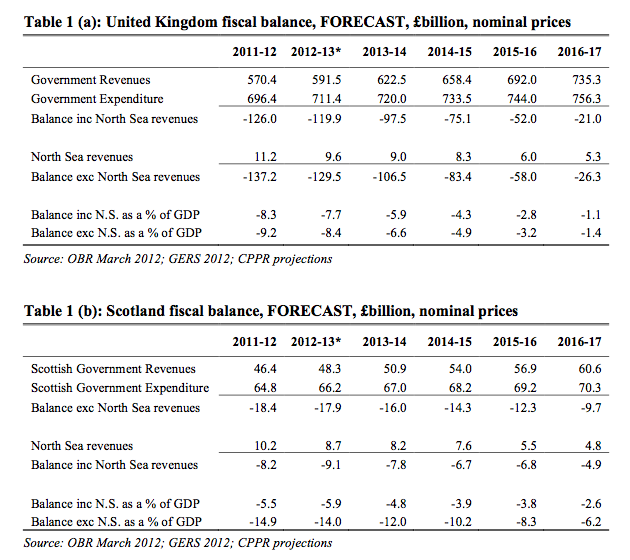
By now, everyone knows that North Sea oil tax revenues—and therefore much of the theoretic initial economic vitality of an independent Scotland—depend on oil prices. Based on OBR numbers, the CPPR originally came up with a table showing short-term results for both the whole UK and for Scotland alone thus:
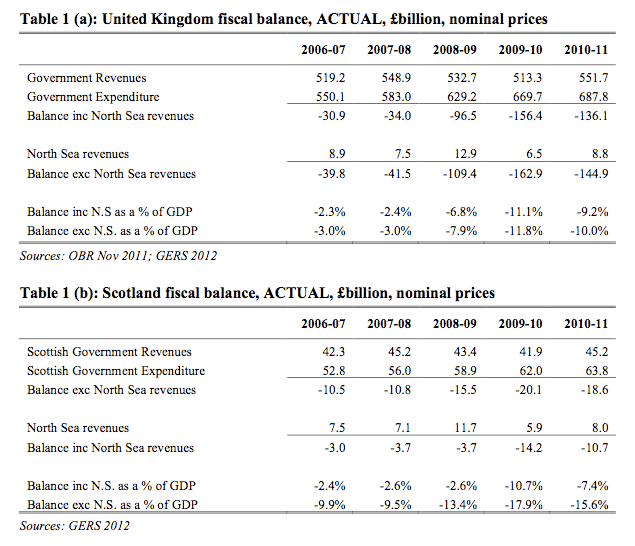
GERS Table (Including Oil) as Originall Published

This shows the UK descending into a negative GERS balance of -£144bn last year, with oil excluded (as 90% of it would be Scottish). This massive -10% balance compares to figures for Scotland that are -£10bn or -7.4%. In other words, a separate Scotland may show a negative balance but it’s only 3/4 of what it would be as part of the UK.

Such a powerful argument was not lost on HM Gubmint. During increasingly heated debates on independence over the last year, the OBR revised its figures. Downward. The CPPR followed suit, making no qualification of the basis upon which such alterations had been made.
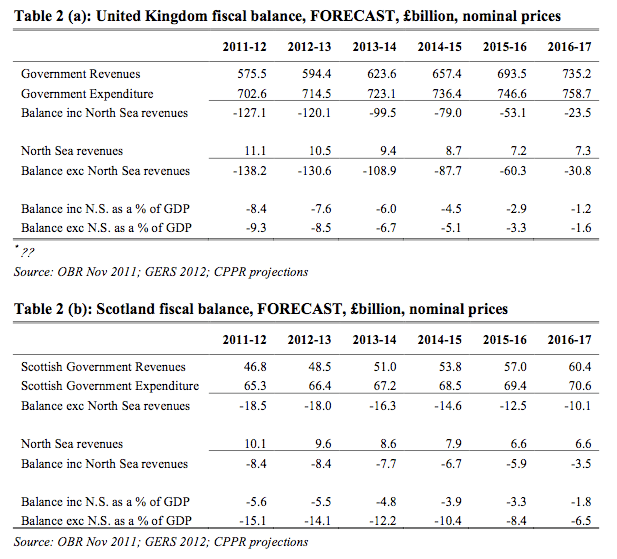
Not only do such tables show what appear to be optimistic forecasts for the UK’s revenues within 5 years (by 73.5% while Scottish revenues rise only 60.4%) but they predict an independent Scotland and a UK both running 1-2% imbalances by 2016/17. In other words, Osbo’s right; hang tough; we’ll come out of this better together.

Aye, right.

There are many arguments as to what most affects future oil prices. Besides production levels and OPEC unity, the demand is usually considered to depend on the world economy. However, given that the stagnation in world GDP since 2008 has seen post-2007-peak oil prices rise steadily from a bare $60 to almost double that, such crude factors clearly don’t tell the whole story.

Not content with the favourable figures show above for the UK for the next five years, the OBR revised oil revenues down and published the following:

Consider these as Tables 3a and 3b—Revised Short-Term CPPR Table, based on FIO

The balance for the UK has improved marginally to -1.4% but for Scotland—even including oil, it has worsened to -2.6%. One reason why such figures as suspect is that, within hours of them being revised in July, UK government and opposition politicians were all over them like a rash.

LibDem Chief Secretary to the Treasury Danny Alexander: “The revised predictions proved Scotland was better off as part of the United Kingdom. There are many reasons for optimism about Scotland’s economic future, and oil and gas remain a big part of that. But a case for separation that relies on a declining source of income is sorely mistaken. Scotland benefits hugely from the income stability being part of the UK provides”.

Labour’s Shadow Scottish Secretary Margaret Curran: “the latest figures show Scotland would be better off rejecting independence in the upcoming referendum, expected in 2014. The oil and gas sector is very important, but production goes up and down, prices go up and down, and so it is foolish to base our whole economy on this alone.”

This reasoning was backed by Robert Rowthorn, Emeritus Professor of Economics at Cambridge University, who warned of problems caused by the volatility of oil revenues: “In the past 25 years oil prices have shown a great deal of volatility. Up to the early 2000s a barrel of oil was $25, then it jumped to $150, dropped to $50, rose back up to $150 and was now around $100.”

What caused these seismic changes in price predictions? OBR reported on July 12th of this year: “Our projections for oil and gas prices are also lower than last year…oil prices rise from $95 a barrel in 2016 to $173 a barrel in 2040. This compares with a projection in last year’s report of a rise from $107 a barrel in 2015, rising to $206 a barrel in 2040.” This is approximately an 11% drop.

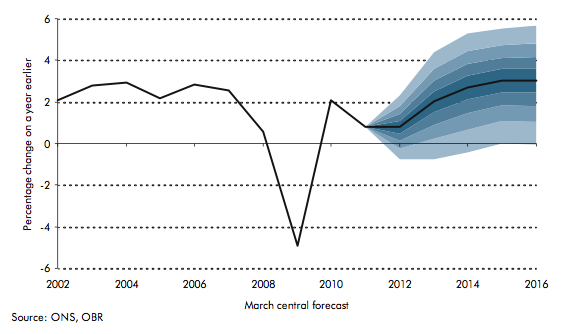
But, as evidenced above, they projected 25% too low for the last five years. As with most economic projections, the professional way to report this is as a fan of possible outcomes spreading from today. Their chart for GDP takes this sensible approach and shows a range from 0% to 6% with the most likely outcome in the middle at 3%.

GDP “fan” Projection for GDP by OBR

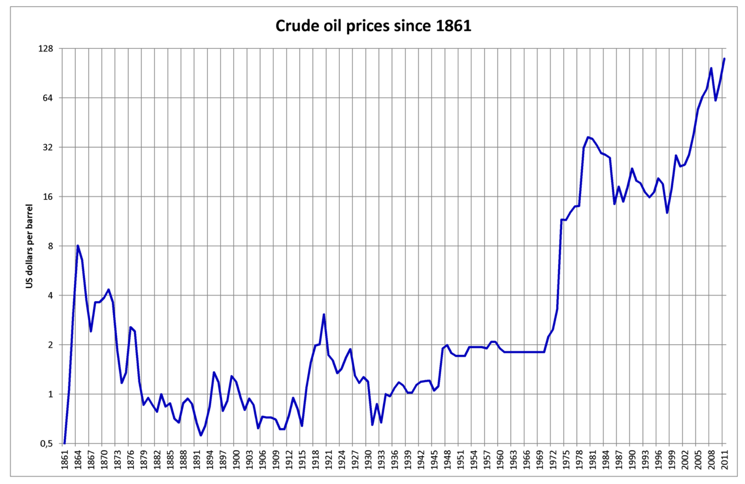
Given that (if you remove the oil shock ‘bumps’) oil prices have climbed pretty steadily for decades, as shown in the logarhythmic chart below. Note the laughable price for most of the 20th century and the effectively steady climb since the 1973 oil shock.
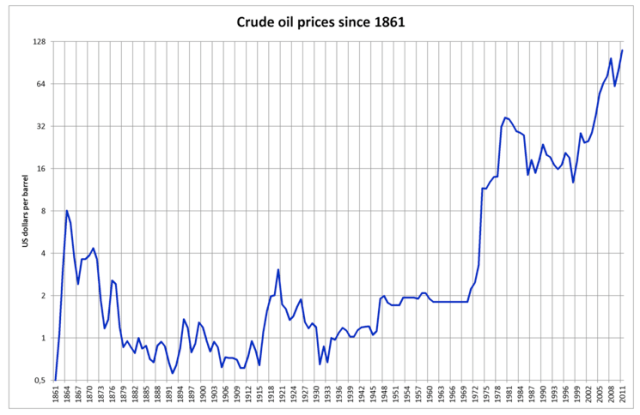
Logarhythmic Chart of Historical Oil Price

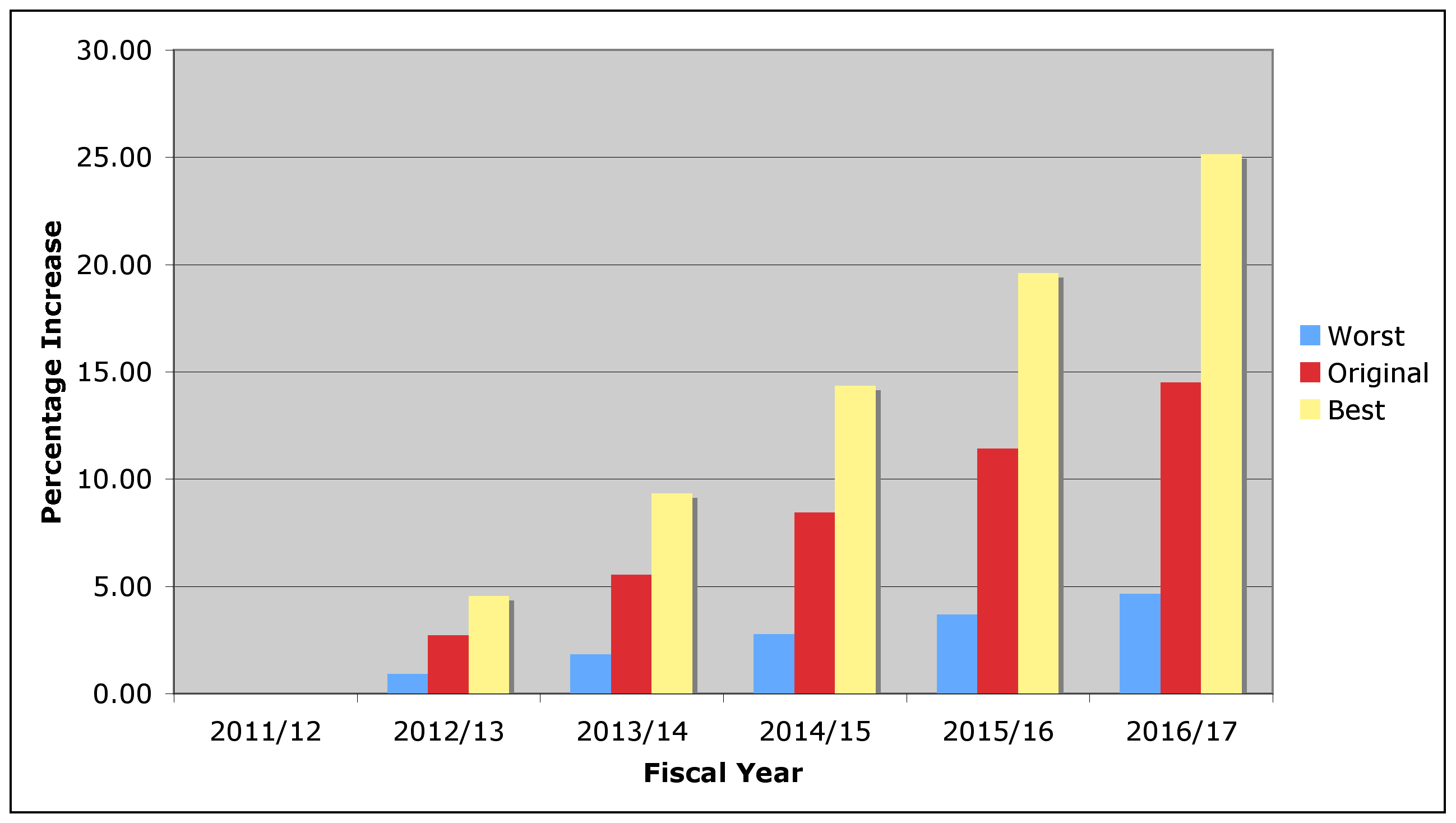
The idea that oil is likely to fall or stay flat in price over the next five years when the entire Western business and social model is 90% dependent on cars seems, if not fanciful, then certainly a worst case scenario. Between 1972 and 2012, the oil price has risen by an average 10% each year from $2.30 to $91. And if we conservatively take just half of this historic average rise as the best case scenario, the new data as the worst and the original as the median, we arrive at a chart like this:
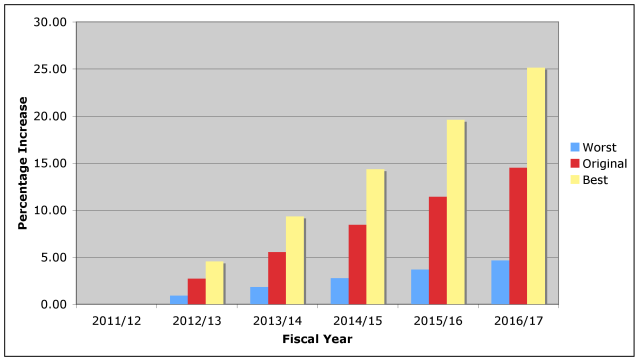
Projection of Oil Price % Increase for Worst (Revised OBR) Original (OBR) and Best (Half of Historic Increase)

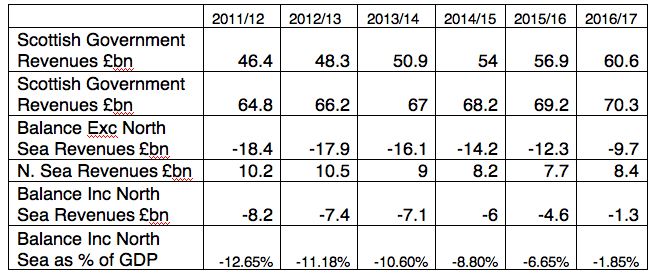
The charts above already show the original and worst-case scenarios. Calculating the best would give a replacement table 4b as follows.
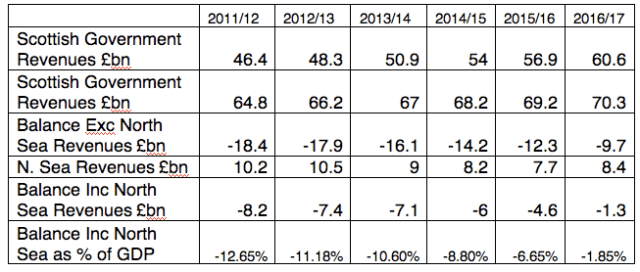
Table 4b—Same as the OBR/CPPR Tables above but using Half Average Oil Price Rise as a Basis

This appears just as plausible as the recent OBR/CPPR downgrading of future oil prices and therefore equally capable of demolishing the quotes above as the latter was in supporting them. This basis shows Scotland doing better than the UK in all of the five years projected. And, rather than downplaying oil’s positive contribution and harping on its volatility, the UK—and especially the OBR and CPPR—ought to be considering the up side potential of oil prices as well as the down.

Not to mention forever looking for bad news stories that might prop up the Union.

Posted in Commerce, Politics | Tagged | Leave a comment

Nightmares Don’t Deserve Commemoration

David Cameron has announced that the UK government is to spend £70m in commemorating (not, you note, ‘celebrating’) the centenary of the outbreak of World War One in less than two year’s time. Meaning no disrespect to any of the millions who died during those four years, still less to the multiples of millions who suffered its legacy of destruction, lost loved ones and its execrable solution that bred both resentment and World War Two, despite extensive competition amongst his utterances, it is easily the stupidest thing I have ever heard Cameron say.

For whatever glory or even good may be said to come of war, it is hard to pick a more vivid global example of the vanity, stupidity and sheer cussedness of mankind at its worst than WWI. All wars have their horrors, victims and, often, post-conflict justifications that stink. Some are arguably necessary. Moreover, the sacrifices made by brave and selfless people in their respective causes can often illustrate mankind at its selfless best.

I attend Armistice Day commemorations partly for that reason and partly because my grandfather managed to bring most of himself back from Ypres (leaving most of his right leg there). My father brought all of himself back from a four-year stint driving between Cairo and Lübeck in a variety of tanks. As a result I exist and am eternally grateful that my existence enjoys freedom from such emotional and physical scars, due to their—and all their comrades—selfless efforts.

But, let’s be honest, WWI is a global canvas of arrogance, brutality and stupidity that puts other wars in the shade by taking all those to depths never exceeded—before or since.

It starts with the cosy self-righteousness of the European ‘powers’ in the century before. By growing ever richer from their burgeoning industry and scant resistance to their global colonial carve-up, it was self-evident (to them) that their culture was superior to all others, justified in its Kipling-esque ‘white man’s burden’ way to sweep aside any culture, tradition or religion encountered. As Major Heyward queried General Webb in Last of the Mohicans: “I thought our purpose was to make the world England, sir!”

Despite fixation with massed colourful, concentrated brutality of the Napoleonic era, the military did learn lessons. But they were all about improving ability to kill. From rifle to machine-gun to breech-loading artillery, lethality grew in leaps and bounds that railways and navies allowed to be deployed over unheard-of distances at unheard-of speeds. But all that new scientific warfare offered little to the defence, whose main leap forward was drab uniforms that no longer made easy targets of brilliantly visible military peacocks.

The 19th & early 20th centuries should have taught military professionals across Europe many salient, fundamental lessons in war during the run-up to August 1914, such as:

  • Massed charges against modern equipment in the hands of those resolute enough to use them caused carnage, such as obliterated Pickett’s charge at Gettysburg or decimated the Irish Brigade as it milled fruitlessly about in the Tugela river bend under Spion Kop or even the Old Contemptibles mowing down von Kluck’s doubl;e-time marching men before Ypres.
  • Courage, resolution, élan, training and even camouflage uniforms count for nothing and are useless as defence if you simply charge a strong enemy. The French in the Vosges, the Japanese at Port Arthur, even the Zulus at Rorke’s Drift bought this lesson with the lives of their men.
  • Relatively easy victories against large, courageous but ill-equipped forces in the colonies were no precedent to learn from (much less an training exercise in appropriate tactics), despite what Omdurman or the Boxer rebellion or Napoleon III’s Mexican adventure might appear to say.
  • Using the First Law of Engineering “When in Doubt, Use a Bigger Hammer” while appealing, is not necessarily effective on the battlefield. Thus trenches largely negate the awful killing power of machine guns and artillery—and if they’re deep enough, even heavy artillery. Also, as Harald Hardrada found at Stamford Bridge and the English found at Bannockburn, having the biggest force is no ace trump if it can’t be deployed effectively.

The domino politics that led all the ‘great powers’ into war deserves entire chapters on its own but it bears a strong resemblance to a ‘my big brother can beat up your big brother’ ego-driven intransigence that characterises puerile playground face-offs.

Also, given that all major powers had put much ego into an arms race that involved dreadnoughts, mass-production-equipped armies and a fiendishly intricate mechanism for calling it up, those few with an objective appreciation of the powder keg that everyone was sitting on while passing round the fags were horrified when the whole Heath-Robinson-esque juggernaut was triggered by Archduke Ferdinand’s demise in Sarajevo, a person/place unknown to 99% of those about to be killed because of it.

That mass armies, in many cases galvanised by an almost insane level of imperial jingoism and deprecation of the enemy (e.g. “Huns Bayonet Babies in Belgian Churches”)  met other mass armies in Flanders, Galicia, East Prussia was perhaps inevitable. But that, once stalled against each other, that the general-ship then applied was of such poor and basic reasoning makes you wonder how they ever got the job:

  • ” They’re building trenches”? We’ll just outflank them.
  • “We’ve run out of space to outflank them”? We’ll throw more men at ‘em
  • “They’re mowing down our men faster than they can climb out of the trenches”? bombard their lines so they can’t fire at us so easily.
  • “They’re still mowing us down”? Then use bigger/heavier/more artillery longer

And, behind the respective fronts, entire corps of cavalry milled about, waiting for their cue: a clean breakthrough that military manuals in every combative’s language dictated would be the way the war would be won. It never happened.

What little lateral thinking was displayed was scuppered by an execution that would be hilarious, had it not cost as many lives as it did. Raring to be at ‘em, Churchill pushed for the RN to invade the Baltic and land troops in Pomerania, failing which a similar move against the Turks by taking Dardanelles and then pushing on the Constantinople and linking up with hard-pressed imperial Russia.

Expecting a pushover against the much-maligned Turks, the ANZACs and British 29th Division stormed ashore at Gallipoli, milled about in confusion caused by an ossified command structure strangulated by superannuated commanders like Stopford, then found themselves mown down by German-trained troops under Kemel Attaturk who sold every inch of their homeland dearly.

Gallipoli turned into a sun-scorched version of the Flanders trench warfare but with desiccation instead of trench foot and omnipresent flies replacing rats. And yet, the attacks of 1915 and 1916 went on as if the Somme or Verdun could be different and had no lessons to learn from Ypres or the Marne, let alone the previous half-century of escalating carnage.

Perhaps Haig and French were prisoners of their own time, just as Foch and Joffre or Ludendorf and Hindenburg. That the German ‘Stosstruppen’ or the British tanks were able to break some of the stalemate is not the point; several million corpses already lay strewn pointlessly across Europe and it can be argued that it was German economic and social collapse that brought the war to an end. “Our soldiers were stabbed in the back” was what Hitler’s NSDAP, the Stahlhelm and other right-wing organisations would claim post-war—and thereby lay the foundations for what some regard as ‘the second half’, a.k.a. WW2.

It was a tragedy for all concerned that would bring Europe down from unprecedented Edwardian achievements and affluence to the shattered collection of bankrupt ruins that stretched from Stoke-on-Trent to Stalingrad in the rationed hand-to-mouth of the late 1940’s. If Western civilisation has a clear and unequivocal low point, it was then, when closed, smug minds in government took their gullible peoples to war in 1914. It should never have happened. It must be held up as a lesson in communal losing of the plot: brutal; costly; unedifying; unforgettable, but not something to commemorate, except as a kind of self-flagellating reminder of our capacity for universal idiocy.

Posted in Community | Tagged | Leave a comment