The Auld Antagonist

Scotland is a funny sort of place. As an independent state throughout the Middle Ages it might have been poor—but then so was most of the planet. And that relative poverty helped to shape the national character of pluck, doggedness, thrift, self-sufficiency and an acceptance that any ambition meant you went out into the rest of the world to find your fortune.

That last part was as true of the mercenaries who fought for Gustavus Adolphus, the Scottish merchant houses scattered along North Sea and Baltic coasts, the Glasgow Tobacco Barons or the prototype Star Trek Scotty who held the ships/trains/pumps etc together all over the Empire that, in turn, held that empire itself together.

But in the demise of that empire, we Scots lost our international dimension. The last spurt of it was £10 Assisted Passages to Oz in the 1950s. Perversely, this demise has happened at a time when more Scots go abroad than ever before. The difference is that two weeks in Ibiza or Sharm el Sheikh may teach you Bacardi’s cheaper to drink than Tennents—but nothing about Spain or Egypt or their peoples.

This cultural isolation can be explained almost entirely by the Union. In the 300 years that we have been part of it, foreign policy has, understandably, been driven by the larger partner, indeed the one in the front line against various invasions from the Continent. Embroiled as the English were originally in the Angevin Empire, once Calais was lost, they pretty much pulled up the drawbridge and sought fortune elsewhere. The present membership of the EU has not fundamentally altered that.

As junior partner, we have been following their lead without thinking much about it. Two world wars did much to reinforce a common interest that empire-building had developed. But now well into the 21st century, it’s well past the time for Scotland to assess to what extent its future interests still coincide with those of our cousins.

Rather than couch the question in pure independence terms, let’s look at it from the perspective of the EU—especially our old Hanseatic neighbours with whom we were once so close. Rather than the rabble of city states with whom we traded, we have a handful of nations, the bulk of which form the Nordic Council, all of whom are doing rather well, maintaining individual identity while leveraging their common clout to finance that prosperity with international successes like SAS or Nokia.

None of those countries fell into the supposedly global recession of 2007 that still plagues us. None of their banks needed baling out. Even ignoring Norway’s huge bankroll, all other Nordic Council members have a debt-to-GDP ratio under 50% (UK is pushing 90% while much-maligned Spain is under 70%). But the one country that is also an old partner but which doesn’t get mentioned much is the engine room of the EU and its biggest member: Germany.

Given our 20th century history (both previous generations of my family went off to get shot at by them), both Scots and English developed a pretty poisoned attitude to Germany rather well lampooned by Basil Fawlty. The fact that, economically, they went by us like we were standing still in the latter half of the century only added to resentment. And, while this attitude may be too ingrained in English psyches, the more pragmatic Scots are missing a trick by not cosying up to our other Teutonic cousins.

Because Germany IS the future; the EU stands or falls on its involvement. And its people are getting pretty fed up with fiscal irresponsibility among PIGS and the taking-my-toys-home stroppy sulkiness of English Tories since Thatcher. Even if Scotland were to line up with the Scandinavians and be accepted into the Nordic Council, though that would indeed make a formidable economic bloc, it’s still only 30m vs Germany’s 81.3m.

So it’s well past time for us Scots to cosy up to the Germans. That means stop ignoring its language in schools and its news in our media. We know more about Berlusconi’s love life than we do about Merkel’s policies. Even our best political reporters can’t tell their SPD from their FPD. Most of the thousands of German visitors embarrass us with their fluent English, palates that can discern single malts and sophistication that takes no guff about haggis-hunting season.

Their politics are no more complex than ours (although both seem to baffle the English see-saw tradition). There are two traditional blocs: CDU/FDP and SPD/Greens. A fifth (The Left) may show up in the next federal election but only in the former Communist eastern part. The recent election in Lower Saxony (the one of the 16 federal states closest to us that includes Hanover and Bremen) the former just lost control to the latter by one vote. Merkel is alarmed at the prospect of a repetition of this at the federal level later this year.

When our media does pay attention, it often focuses on the fact that most Germans agree with Merkel’s course in the Eurozone crisis, the “crisis” itself is not a big topic in Germany at all, as it never manifested there. Issues of social justice, healthcare reform, education and tax reform are all more important in German elections at the moment. Does this not sound familiar? Neither the CDU/FDP nor the SPD/Greens have yet come forward with any convincing strategies on the domestic topics mentioned.

What is interesting to us is that the man who lost—the former Ministärpräsident—is not only a top CDU politician and Merkel confidant but also half Scots. David McAllister was born the son of a Scottish soldier in Berlin, his English is faultless, as he demonstrated as a Hume Institute lecture in Edinburgh last year. Now that he has some time on his (very capable) hands, we ought to be capitalising on this fortuitous (for us) fluke.

Scotland has just celebrated our exports rising £1.6bn to over £23bn and the bulk of which is to the EU. If we want this excellent trend to grow further and help us out of our own recession (never mind the English), the likes of Weir Pumps and other engineering firms need to learn from the spotless factories, obsession with precision and taste for gratification from hard work that has made Germany the non-threatening economic powerhouse of Europe.

We should be inviting Herr McAllister to lead a trade mission over here to sample the food and drink, the tourism sites, the spectacular scenery that so many of his own countrymen already enjoy so that more come and all stay longer. That should be followed by a reciprocal trade mission, led by the First Minister to shown its significance and staffed by our best engineering companies and negotiators for power links across the North Sea.

Bremerhaven is actually closer to Leith or Rosyth than either Rotterdam or Zeebrugge. It’s also closer to Berlin to facilitate using a Lower Saxon bridgehead to take Scots goods and reputation for canny banking and solid engineering to the rest of that huge market. Britain may be in the EU…but thanks to Pavlovian English hostility to its precepts (however justified such hostility may seem by history), we Scots have yet to exploit it properly. This looks like our chance.

Auf geht’s!

Posted in Commerce | Leave a comment

Big Ben

Having spent a third of my adult life in the States and travelled through most of them, it seems I have a higher opinion of Americans and their civic qualities than most Brits, Yet, while they do exhibit qualities that lead to deep incomprehensibles like the NRA and Sandy Hook, some of their milder idiosyncrasies like lionising their national heroes were genuine, even as they left me cold. It may be an example of presuming understanding when the words are understandable—Mark Twain’s penetrating observation of the Americans and the British being “two peoples, separated by a common language“.

When I was over there two months ago, I saw the film Lincoln. Superb though Day Lewis’ performance may be in the title role, I still don’t connect with the adulation of him. Good man though he was, I found the character dry and un-charismatic, verging on a bucolic out of his depth. Washington was no titan of tactics and damn near lost them the war. Though the main author of the Declaration, Jefferson was a poor orator and caused more dissent than harmony before becoming President.

And then there’s Benjamin Franklin. If they think of him at all, Americans think of him as an American patriot and founding father. But his influence extended much further. Believing that people volunteering together in a spirit of cooperation could accomplish great things, he was driven by a strong sense of civic duty to be involved himself in both his community and his nation. Always mindful of the “greater good,” Franklin helped establish or improve institutions such as circulating libraries, public hospitals, mutual insurance companies, volunteer fire departments, agricultural colleges, and intellectual societies. Some of his astute observations have a profundity still useful today—and tomorrow:

  • Creditors have better memories than debtors
  • If you want to be wealthy, think of saving as well as earning
  • A ploughman on his legs is higher than a gentleman on his knees
  • If you want to know the value of money, go try to borrow some
  • Buy what you do not need, and soon you will sell your necessities
  • It’s easier to suppress the first desire than to satisfy all that follow it
  • Experience keeps an expensive school, but fools will learn in no other
  • A life of leisure and a life of laziness are two different things

As a “man of science,” Franklin is best known for his experiments with electricity, but his lifelong curiosity also led him to explore an amazing range of scientific topics. From the common cold to ocean currents, from medicine to music, and from agriculture to the aurora borealis, he believed that human logic could unlock the mysteries of the natural world. More interested in practical applications than in theory, Franklin put his ideas to work through such useful inventions as a smokeless fireplace, bifocal glasses, and the lightning rod.

Of the numerous inventions Franklin created, he did not patent even one, believing that: “As we benefit from the inventions of others, we should be glad to share our own…freely and gladly.” He was the first to observe that storms can move in an opposite direction from the direction of the wind. Franklin accurately theorized about the existence of high and low pressure providing early explanations for storm movement. As an extensive traveler, Franklin made eight transatlantic voyages. By measuring the temperature of the ocean at varying depths, Franklin explained the Gulf Stream as a warm river flowing over the Atlantic Ocean. He suggested how the Gulf Stream could be used to speed of vessels sailing to & from America.

As a skilled diplomat, he negotiated treaties with Great Britain, France, Germany, Sweden, and Spain and helped secure the fledgling country America’s place in the world. As a respected scientist and scholar, he was granted honorary degrees in England, Scotland, and America. And as an Enlightenment thinker, he exchanged letters with some of the greatest minds of the eighteenth century.

Taking nothing away from the American pantheon of 18th © national heroes, most were men of their time that fate called upon to do extraordinary things—just as Bruce was prisoner of equivocal loyalties in the 13th © before destiny picked him up by both lapels. But, towering as Wallace’s patriotism or Hume’s international intellect were, our long history has yet to produce our Ben Franklin who combines both. He was a shining intellect, with equal love of community, country and humanity. He wore his greatness lightly: a Renaissance man who left a complex and inspirational legacy to us all—not just to Americans.

“If you would not be forgotten, as soon as you are dead and rotten, either write things worth reading, or do things worth the writing.” ~ Ben Franklin

Posted in Community, Education | Tagged | 1 Comment

Osbo’s Gilt Complex

STATUTORY WARNING: This blog is calibrated for fiscal anoraks and may cause nausea and/or disorientation among those faint-hearted about figures.

This year has not started well for George Osborne. While some might relish the evil schadenfreude in that, the problem is the corollary means this year has started badly for the British punter, with today’s stark news that GDP fell in the fourth quarter of 2012 (by 0.3%)—making the only quarter for over a year when our finances were not declining was during London’s Olympics.

The bottom line on this, reinforced by some pretty stern comments from the IMF, is that the present financial (and abrasive) Plan ‘A’ for the economy, in place since May 2010, is itself bankrupt. After £385 bn of ‘quantative easing’ where the Treasury simply prints the money it needs and most of those 2 1/2 years with bank interest rates in the tank (0.5% has been typical), all we are getting from our economic engine is the ‘rurr-rurr-rurr’ of the starter motor flattening the battery. But firing is there none.

In comments that will be seen as a strong criticism of the Bank of England’s quantitative easing policy, Lord Turner (currently FSA chair but one of the leading candidates to replace Sir Mervyn King at the Bank of England) said printing more money would have a declining marginal impact and would threaten the stability of the economy. As he elaborated:

“Quantitative easing has left Britain facing a liquidity trap in which replacing private sector holdings of bonds with private sector holdings of money has little impact on behaviour and thus on demand”.

In December, Osborne & his Treasury mandarins hit on the alternative wheeze of so-called ‘perpetual bonds’ to cut the cost of the UK’s borrowing, by increasing the terms of long-dated bonds from the current average of 30 years. The last undated gilt was issued in October 1946, shortly after the end of World War Two. The Chancellor hoped to leverage the Government’s ability to borrow money at the cheapest rate in the 400-year history of the Treasury.

“This reflects the confidence investors have in Britain’s ability to pay its way,” said Mr Osborne during his budget speech in March.

The Debt Management Office (DMO) has now confirmed that this ambitious plan has been dropped. The admission follows an industry consultation during the summer to which investors including Hermes, the Association of British Insurers and Goldman Sachs all responded. An unimpressed DMO said “In the case of perpetual gilts, the Government judges that these would be unlikely to represent a cost effective source of financing at present in the absence of tangible market demand”.

Whereas this time last year, Osborne forecast 2.8% growth for 2012, the real number is 0%. Given that 75% of the UK economy is now services and that has been flat, this is scarcely surprising. But he’s getting ALL his figures wrong. His Plan ‘A’  assumed 6% total growth by now: the real number is 0.6%.

The Office for National Statistics said that public sector net borrowing rose last month to £15.4bn from £14.8bn a year earlier, as spending grew faster than income in a struggling economy, thwarting efforts to erase a large budget deficit. Government borrowing amounted to £106.5bn in the first nine months of financial year 2012/13—7.3% higher than the £99.3bn in the corresponding period in 2011/12. Put another way, we’re in a hole and we’re still digging.

As anyone with personal debt out of control will tell you, it becomes an ever-more frenetic race just to keep financing everyday life. In many ways, Osborne (and, believe it or not, the public) has had it easy up to now. Between QE, low interest rates and a continued AAA rating, the growing UK debt has placed very little burden on the government’s cash flow. Yet. It’s as if you’re badly in debt but mortgage rates are tiny, the bank is charging you insanely low interest on your overdraft and your dad keeps slipping you £100 a week on the side.

It won’t last.

Firstly, Osborne’s toolbox is empty. He went easy on the banks, didn’t force them to lend, nor to clamp down on bonuses. They rewarded him by out-scrooge-ing Scrooge on loans. He eased up taxing the super-rich and multinationals, rationalising that their liquidity would boost the economy. They rewarded him by shoveling as much income offshore as they could and paying minimal, if not negligible, taxes.

Secondly, even the global appetite for UK Treasury bonds (known as ‘Gilts’ because they are—supposedly—a gilt-edge security that cannot lose value) is showing limits. It’s easy to see why so many investors are pouring their money into government bonds. Ever since the credit bubble burst, investors are wary of the risks posed by stocks. Over the past decade, bonds gave the safe return they were looking for.

UKgilts

Demand (not least from the Bank of England mopping things up) has driven Gilt prices up so much that they are at an all-time high, meaning yields are at rock bottom levels. 10 year Gilts, for example, yield just 3%—less than the rate of inflation. Robert Froehlich, senior managing director of the Hartford Financial Services Group says “The bond market is a bubble and it’s getting ready to burst.” Asked whether government bonds currently represent fair value, 72% of CFAs (Chartered Financial Analysts) believe they are somewhat or very overvalued, compared to only 12% who view them as somewhat or very undervalued.

So…what happens if (when?) investors decide the Emperor indeed has no clothes and the market, herd-like as ever, stampedes for the exits from Gilts? Prices drop, yields go up and it becomes ever harder for the Treasury to unload its paper. Such a crisis of confidence would damage the UK as a stable financial centre. The AAA credit rating would be history—even holding on to an AA would be doubtful.

That triggers a vicious spiral as yields rise trying to make Gilts more attractive, but borrowing the same amount of money now costs more and UK ability to repay that onerous debt is thrown into even deeper doubt. At that point, there is a run on the pound as the Masters of the Universe down Canary Wharf way mobilise investment billions to profit from its slide. Eminence grise from the 1992 ERM debacle George Soros may now be in retirement but said recently “investors are now betting against the pound”. The embarassment of a devaluation would be the least of it.

Some people think this would be good because it means our exports look cheaper to others and so we would have a boom as they buy more. In the days of shipbuilding and good ol’ British engineering, that might have been an argument. But with 75% of our economy now services, there are only so many Indian-owned Jaguars we can sell overseas. Meanwhile, every TV, microwave, computer, out-of-season fruit, Cyprus holiday, etc will cost more, gobbling up even more of frozen wage packets.

Only we won’t notice that because the mortgage rates will also have risen, house prices stagnated and credit card debt become unsustainable as interest rates rise. Not everyone will be so badly affected. Ironically, the Scots—beside their robust oil industry—have seen a £1.6bn increase in exports to a record £23.9bn and, at the same time, exporting £45.5bn to the rest of the UK. None of those figures include our £7.6bn oil export overseas (4.5% growth). Since the export figures for the entire UK dropped 4.8% during 2012, that must mean England’s exports dropped even more than that. Certainly, devaluing the pound alone is no ‘silver bullet’ solution.

Rather than stuff it down your throat, gentle reader. I will leave you to draw your own political conclusions from this. But should you want my advice, buy gold (ScotGold shares trade on the AIM market—disclosure: I am long ScotGold) and vote #indy.

Posted in Commerce, Politics | Tagged | Leave a comment

Straight from the Top

Unionists may not agree but I’m not the only one who thinks that the Scottish media—including BBC Scotland, the Hootsmon and, on occasion, The Herald reflect the bias of their unionist ‘owners’. While I have no trouble with those who would keep Scotland in the UK arguing their case (indeed, I wish they would, instead of hankering for lost empires or spreading scare stories how even the women will go bald if we go it alone) there is only so much bias even open-minded people can thole.

Which is why I’m delighted that Deputy First Minister Nicola Sturgeon has started her own blog to try to counter some of this. While I don’t think even she pretends neutrality, at the very least it provides a well argued counter to some of the excesses of supposedly quality media in Scotland that should know better. The rest of today’s entry is an extract from today’s missive—straight from the top.

“Today we welcomed the findings in the Scottish Social Attitudes Survey. Reading the papers you’d think it was bad news. However, the figures tell a different story. The fact is that when people are presented with a range of constitutional choices open to Scotland, independence emerges as the most popular.

Independence is supported by 35%, Devo max 32%, status quo 24% and no devolution 6% – you won’t read that in many papers, but it is what the survey says.

Graph

Here’s some other highlights from the survey, ideal for your conversations with the [as yet] undecided:

  • 63% believe that the Scottish Government should have most influence over how Scotland is run
  • 64% believe that Holyrood should make decisions about welfare benefits
  • 56% believe that Holyrood should make decisions about the level of taxes.

Yesterday, of course, months after criticising the Scottish Government over the timing of the independence referendum, David Cameron tells us he wants his own referendum – on Europe – but not for another 4 years or so!

Alex Salmond summed this up nicely. The fact is that being independent within the EU will allow us to assert and protect our national interests much more effectively than we can as part of the UK.

Following a Yes vote in 2014, and in parallel to negotiations with the UK, there will be a negotiation with the EU on the terms of our continuing membership.  Just like Sweden, we would not join the Euro.  And just like Ireland, we would not enter Schengen but would instead co-operate with Ireland and the rest of the UK in the Common Travel Area.

Tomorrow I’m off to Dublin to give a speech to the British Irish Chamber of Commerce Annual Conference. One of the bonds we share with Ireland is our commitment to Europe and our appreciation of the benefits that the EU brings to our citizens.

The EU is easily our biggest international trading partner accounting for nearly half of Scotland’s exports. And membership of the EU is one of the major factors that make us attractive for inward investment.

Watch Reporting Scotland tomorrow night to see how I get on. But there is one thing I am fairly sure of, even before I go – there are not many people in Ireland who would agree with the view that being independent is the wrong choice in terms of European and international engagement. Not many at all.

Tomorrow also sees Yes Scotland launch the first in a series of major campaigns with a rallying call for Scots to put their hands up for a better Scotland. 2013 will see us move the debate from the how to the why of independence.

We want people to start thinking about what kind of country they want; what kind of country Scotland could be and to think about why being independent could be the best way to achieve our aspirations and goals.”

Posted in Politics | Tagged | Leave a comment

Matthew Ch.10, Verse 26

I’m not given to religious quotes and—lest any reader fall under the delusion that your humble scribe has gone all pious in his dotage, the only reason I know the verse in the title is from as eloquent an anti-war film as you’re likely to see—Breaker Morant, Bruce Beresford’s 1980 gem about Australians in the Boer War.

One extremely effective anti-war policy is to have no army at all—such as Costa Rica pursues and with some success. Outside observers of British military deployment might be deceived into thinking we were pursuing the same policy, now that another round of cuts—this time 5,300 personnel from the Army only—was announced this week from the Commons despatch box. Yet another faceless minister no-one remembers seeing before waded through the thankless task, ostensibly to prove his mettle under adverse circumstances but actually so that Hammond didn’t have to.

Details of the total cuts to the Army by 2020 are available on the Army’s web site. Even if you’re a pacifist, it makes for sad reading if you want your country (however you define that) to play its part in joint security in the world. Stuart Crawford, a retired Lt. Colonel for whose military opinion I have much respect, had a piece in the Hootsmon in which he dispelled any myth that this had to do with a more sensible defence posture (rather than desperately saving money) as claptrap.

Stuart made comparisons with the British Army of yore, observing that the ‘new’ Army of 82,000 would be smaller than pre-Crimea or the ‘Old Contemptibles’ sent to war in 1914 and who so effectively dislocated von Kluck’s pivot through Belgium at the cost of horrendous casualties, among them my grandad. His point is that there would be no ‘depth’ to our forces: one good engagement with substantial casualties and there might be no army at all.

But it is rather worse than that. Comparisons with 1850 or 1914 are barely tenable. In either case, the structure of the army was far simpler. Over 80% of soldiers were infantry, with most of the rest cavalry and artillery. Logistics, signaling, catering and the like were primitive. Armour, transport, air, electronics, etc were non-existent. Prince Harry’s Apache gunship, on which troops on the ground in Afghanistan relied for serious firepower support, was pure science fiction.

“Casualties in the 120,000-strong BEF between 14 October and 30 November were 58,155, the majority of whom were infantry. Of the eighty-four British infantry battalions at Ypres on 1 November, eighteen had fewer than 100 men, thirty-one fewer than 200 men, twenty-six had fewer than 300 men, and only nine exceeded 300 men.”

With extensive overseas expeditions in WW1 and WW2 as precursors to the kind of overseas spats that Britain has engaged in since, the logistical ‘tail’ of any troops on the ground at the ‘sharp end’ has grown until there are now, of necessity, more soldiers operating radars, flying drones, cooking lunches, servicing ‘copters, testing equipment, etc than at the front doing any shooting.

Add in the fact that heavy tanks, SP artillery, heavy lift transports, while all part of British Army inventory, have no role to play in any of the brush wars it has fought since Suez. From Falklands through Yugoslavia to Afghanistan such expensive gear has been no more use than the Trident submarine fleet. What we have always needed (and never had enough of) is trained infantry.

In total, 23 Regiment-sized (in anyone else’s parlance battalion-sized or about 600 troops) units will be disbanded—in Armyspeak ‘removed from ORBAT’. They are spread over all the Corps and include two tank, one artillery, four logistics and four engineer units. But the biggest lump is loss of six infantry units—equivalent in size to the entire Scottish Army (when we go indy and have one).

It also means that the 32 serving active infantry battalions, augmented by three Parachute, two Gurkha and a couple of RM Commando battalions, all trained for special types of warfare but usable as regular infantry at a pinch, will be reduced by a third. Put in other terms, the 24,700 soldiers currently in the infantry arm will reduce by about 4,000.

Planned Infantry Structure of the British Army for 2020

Planned Infantry Structure of the British Army for 2020

Add in the fact that any infantry battalion (nominally ~720 soldiers) has a HQ company full of drivers, clerks and general non-coms, plus three companies each with heavy weapons sections that lug mortars and machine guns around for local fire support and there are fewer than 500 real infantrymen who went in with cold steel on Mount Longdon or are patrolling various village streets in Helmand.

This piece is not meant to disparage British infantry, nor their training or capability. But superb training, kevlar helmet, plentiful support or no, they are each just a man (unlike the Israelis, the British don’t let women serve in the infantry) and, as such, vulnerable. When the Argentine Air Force caught Sir Galahad with its trousers down in Bluff Cove in 1982, over 300 Welsh Guardsmen died, despite superb élan.

It is foolish for the MoD (under prodding from the Tories) to claim that we can thole such reductions and still be a world power with forces to quell global hotspots as the Paras did in Sierra Leone a decade ago. The people on the overstretched front line in Helmand are doing a brave but impossible job. It would not take a serious deterioration in the situation there for casualties to rise to untenable levels. The idea that we can dispose of six front line units that are the ONLY type of units to sensibly deploy in similar terrorist powder kegs and then rattle our sabre about threats from Mali and Algeria verges on the delusional.

Our armed forces should not be forced to make up for politicians’ shortcomings, nor provide the cover for politicians’ chest-butting overambition. But loyalty demands that they obey—but at what cost to their deserved sky-high reputation, not to mention morale?

“And thine enemies shall be those of thine own household.”

Posted in Politics | Tagged | Leave a comment

Cottages: Cosier and Healthier

All across Scotland a debate about the NHS and how its services can be preserved amidst these new financial strictures is bubbling beneath the media surface. Above the surface, what debate there is about health focusses on waiting times and budgets. But what really matters to people is the health service they receive and how effective it is.

In the early noughties, the new Scottish Parliament  sought to persuade councils and the NHS to work more closely together in the area of Adult Social Care by forming Community Health Partnerships. This drifted along for a couple of years without notable success and then the NHS Reform (Scotland) Act of 2004. The development of CHPs in 2004 was intended to build on the success of partnership working up to that point, and included a strong focus on organisational development to support new ways of working across health and social care.

In 2010, the Scottish Government took stock with a paper called Integration across Health and Social Care Services in Scotland. Though it put a brave face on things, it was hard-pressed to find much evidence of any progress on integration that might have been expected after the best part of a decade. This problem was caused by the two would-be partners for similar reasons—basically the “aye been” inertia that comes from organisations that have been left to live within their comfort zones for decades.

Neither councils nor NHS were used to working on projects together—let alone sharing resources and/or budgets. Both were proficient at attending meetings from which minutes gave the impression of progress. But, in truth, nothing much has happened. Like the ‘Shared Services’ agenda whereby Scotland’s 32 councils were expected to merge departments with each other to economise on overheads, CHPs, although formed, have remained a damp squib in terms of real progress.

Both partners are to blame but (with a couple of laudable exceptions like Highland) the NHS has been consistently worse. Their plans for rationalisations or for hospitals have soaked up all their attention and (more importantly) all their capital and the total absense of any democratic control has meant they have stonewalled and dared councils to do anything about it.

The East Lothian picture is pretty representative. The massive PFI project that is Edinburgh Royal Infirmary soaks up huge NHS Lothian revenue without paying a single nurse. The Musselburgh Primary Care Centre opened this year to serve the western half of the county. Its costs are a mystery because 2009’s 50-page Full Business Case may be public but it has had every figure (including risk factors) redacted out of it. It looks like an expensive hospital more than a Health Centre and may be why NHS Lothian has been dragging its feet for over a decade to provide the other key local component‚a ‘Community Hospital’ in Haddington to replace the badly ageing Roodlands.

But this is where the bean counters and people’s priority clash nastily. The obverse of a new CH (although no-one in NHS management will admit it) is to close the remaining small hospitals in Dunbar (Belhaven) and North Berwick (Edington). Any time this has been rumoured, the pitchforks and burning torches have been out in force.

The Edington is a GP-referred cottage hospital (9 beds) in North Berwick of the type that does not lend itself to low cost-per-bed stats. On the other hand it has 220 admissions a year and has an unequalled record of patient care/recovery and minor injury provision, partly because of joint working with the adjacent doctors’ surgery. A review of The Edington operation is underway by NHS Lothian, taking on board the imminent need for joint provision for the elderly with East Lothian Council.

A year of discussion with a forum of people from NHS Lothian, ELC, NBCC, the GP practice and Edington staff resulted in an obfuscation paper from NHS Lothian that was both incomplete and written in bureaucratese. It seems clear that, unless the community and those outside the NHS define their concept of a future and how it might be achieved, the NHS is using a classic inertial strategy to close it.

But though both the Edington and its co-located Health Centre are badly in need of upgrade, they are, in fact, a splendid example of effective community health work. Rolling together the related facilities expected with the NHS/ASC merger into a single campus actually makes both the most financial AND operational service quality sense, provided none of the components are forced to pay for it alone. The related facilities that a town of North Berwick’s size can reasonably expect are:

  • A GP surgery of more doctors provided in business hours with callout 24/7
  • A well used minor injuries clinic (including 20% for tourists/visitors) 24/7
  • Convalescent care for local patients recovering from serious illness/surgery
  • Residential care for elderly still capable of mobility and limited self-reliance
  • Palliative care for end-of-life circumstances
  • Supervisory care for those still physically capable but suffering dementia
  • Respite care for those who normally reside at home with home help

Although NHS claim that the Edington site is not sustainable within budgets that public bodies are able to provide, nor is the site adequate for expansion, this is taking a narrow view. It may also make sense to cast the net wider and include NB Day Centre and Gullane (Health & Day Centres already in train for a joint building) in the discussion so that all local facilities and the strengths they offer are considered.

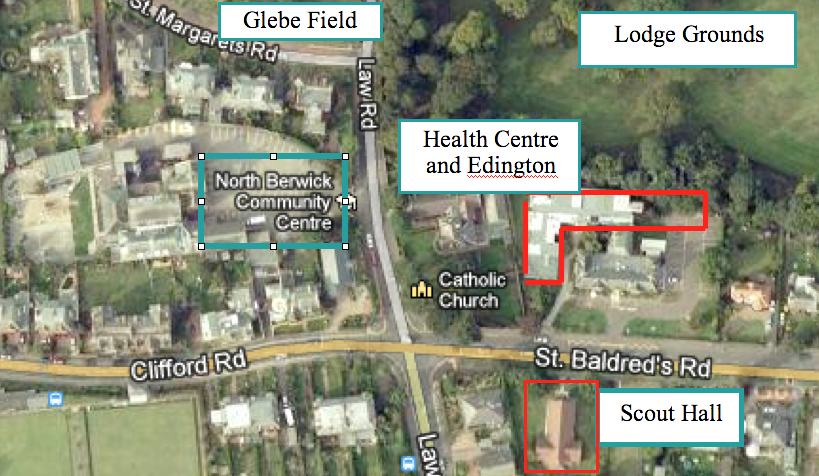
If the Scout Hall (across St Baldred’s Road) were located elsewhere and the site purchased, this could be redeveloped to accommodate a larger GP surgery with nurse station and minor injuries service. The space currently occupied by the surgery could then be redeveloped on more than one floor as an extensive adjunct to the Edington that would have several wings/wards that each specialised in one of the list of services listed above. This would include ELC’s present 28-bed care provision at the Abbey.

Map of Edington Area Showing How a Health Centre (lower red) Could be Replaced by Care Extension (upper red)

Map of Edington Area Showing How a Health Centre (lower red) Could be Replaced by Care Extension (upper red)

The new care extension would intrude on the present car park and, possibly, into the Lodge Grounds. A pedestrian access through the Lodge could access long-stay & staff parking in the upper Glebe. Those with appointments and other short stay would use the remaining car park. The Community Centre car park provides a temporary measure until the Glebe was completed.

Keeping all health and care facilities in the one place still capitalises on the superb personal and responsive service that adjacent doctors surgeries provides and preserves the excellent recovery statistics. Extending the Edington itself to around 30-40 beds, most of which would be non-medical residential/respite/etc retains the high quality care for which the Abbey is known.

But most of all, rather than freight people to/from Edinburgh and/or Haddington (which no-one outside Haddington considers a ‘community’ facility), the benefits to patients of the present arrangement would be preserved and the NHS goal of ameliorating their precious cost-per-bed statistics would be addressed.

What we have here in North Berwick is a gem: the ingredients of a totally new, cross-authority opportunity to address problems that all those involved with health, especially of the elderly, need to address before the demographics overwhelm us. The area around the Edington is ripe for a groundbreaking, highly effective solution that integrates all components cost-effectively in a manner the community would not just support but do so enthusiastically as elements most appreciated would continue. It could be a key model to secure much-loved cottage hospitals elsewhere.

Posted in Community | Tagged | Leave a comment

The Shape of the Future

To quote Holyrood magazine which has proved itself pretty adept at putting its finger on the pulse of the moment:

“Scotland’s population has reached its highest ever level. Official census figures published at the end of last year revealed that the number of people living in the country has climbed to 5,295,000 – up nearly 5 per cent since the previous census in 2001.”

This is revolutionary stuff. I grew up in a Scotland that had almost as many people but it also had 250 operating coal mines employing 80,000 people, 38 shipyards giving work to another 100,000. The great majority of all of them went on holiday to Largs or Dunoon or Arran or Arbroath or North Berwick or—if you were really adventurous and/or on the cutting edge—to Butlin’s camp at Ayr.

As my grannie used to say: “Ah’ve seen the day—but noo it’s nicht!

In the intervening fifty years, we’ve seen major social upheavals and some pretty rough times. Some of them were caused by arthritic attitudes in once-major Scottish companies: the North British Locomotive Company built superb steam locomotives right up into the sixties when there was no more market; Clydeside yards built ships with rivets long after welding became better and cheaper. Others were caused by UK governments also with their heads equally stuck in the past. They gave us Linwood and Ravenscraig and Monktonhall—all doomed dinosaur efforts to pretend we were still a major player in heavy engineering stakes.

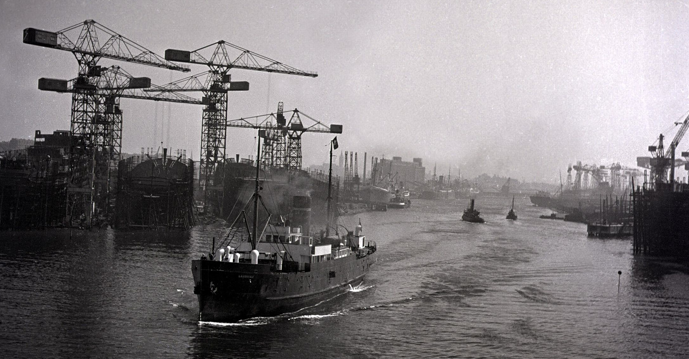
The River Clyde in 1951

The River Clyde in 1951

But in the past decade (present recession excluded) things have gone much better to the point that we’ve seen 250,000 more Scots and found whisky, finance, oil, tourism and renewables to be businesses bringing steady wealth with a good future. In fact, those buoyant industries, while not shielding us from the recession, have made us—perhaps for the first time in a century—appear to be doing better than our English cousins. The result has been barely a pause in the number of immigrants.

Not all developments are good news. For the first time, the number of Scots over 65 exceeds those under 15. In 20 years, there will be 2 1/2 times as many people over 85 and the jury is out whether they will be healthier or need even more medical care than the present generation. But with smoking and alcohol binges declining in most of the population (even if it isn’t among the young), there is hope to be cheerful.

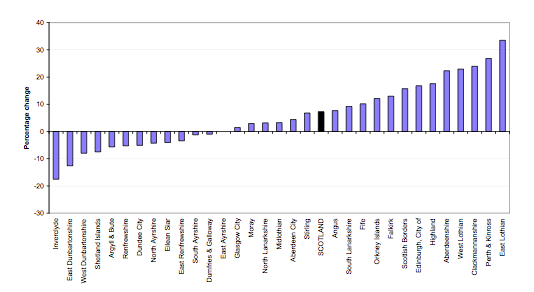
So, what sort of country can we expect Scotland to be in 20 years? Not one that my grandparents would recognise because there is every chance that the pains of de-industrialisation that we suffered in the latter half of the twentieth century may have prepared us for a better future. Let’s consider the General Register Office for Scotland’s population projections. Broken down by council area, these point to a major population shift to the East and North at the expense of the West. This can be seen in the chart ranked by population change 2012-2032.

Change in Population by Scottish Council to 2032

Change in Population by Scottish Council to 2032

While the Scottish population is expected to increase to 5.54m (from present 5.25m) the old Strathclyde area will stagnate at best and lose as much as 17.5% in Inverclyde. The only city expected to beat the average is Edinburgh. Growth will dominate in the rural eastern areas, with East Lothian leading at 33%—equivalent to one new resident for every three already there.

Examining the other above-average growth areas and they are largely rural, with pleasant towns and high quality of life. Those areas on this list that contain major urban areas like Fife will see more growth in the East Neuk than in Kirkcaldy or Dunfermline, with any growth in those towns being dormitory outliers of Edinburgh. Aside from the 70-80,000 growth in the Northeast and Highland, the bulk of Scotland’s growth will be over 200.000 new residents of the Edinburgh City Region. While some will be from elsewhere in Scotland, most will be immigrants.

This is a massive opportunity for Scotland. Whereas its earlier growth periods, whether it was the tobacco barons of the late 18th century or the ship magnates of the late 19th, people were shoehorned into the great Glasgow conurbation with little or no planning. This resulted in severe social deprivation for many and an understandable growth of union and socialist movements to combat it. And when our heavy industry disappeared, a lot of the pride and purpose went with it.

But we know, ahead of time, we need houses and jobs for a quarter of a million people and they need to be provided in the Edinburgh City Region Plan. Given that most jobs will be office or creative as finance recovers, advertising and design flourish and service in restaurants and hotels will boom on the back of tourism and our second-to-none food and drink offerings, there is no reason not to scatter many of those jobs outside already-busy Edinburgh. The Linlithgows and Kelsos, the Dunbars and Dollars, the Peebles and Pittenweems that already attract commuters would benefit from office space and telecommuters that would revitalise their high streets and give them the buzz that tourists like to visit.

If someone in the Scottish Government that has shown such vision with much else would kindly ignite a large rocket up Scottish Enterprise’ somnambulant bum as to the potential here, we’d be on the right road. While they’re at it, they might also firmly bang together the heads of Planning in those councils on the right side of the chart above and we could have ourselves quite a boom. That would put Scotland not just on the map but into the Arc of Prosperity on a basis our Scandinavian neighbours would welcome onto the Nordic Council.

We don’t need another steel plant or Hyundai haven or any other third-world short-term manufacturing soak up of inward investment grants. We should be growing our own businesses building wind, tide and wave turbines, specialising in the canny banking for which we were famous before Canary Wharf’s canary braces Lords of the Universe got their grubby hands on RBS & BoS, exporting salmon, world-class seafood, venison, etc, marketing single malt variants the way the French do wine.

Being independent would surely help. Not only would we not have to depend on hooray henries haw-hawing their way around global trade fairs pretending to represent us but we’d have the money to pay off our share of Broon’s Billions and get back to investing in our own future, trading with our old friends across the North Sea. Having proper Scottish forces based at Leuchars, Rosyth, Glencorse, Redford, Lossie, Fort George and Faslane would be a bonus for local economies. Might even power us past the 300,000 growth projected.

Then, with a model that has been shown to work boosting Edinburgh City Region into the Milan/Munich class of world-leading areas in lifestyle, we reformulate it to work on the Dundee and Glasgow City Regions to restore them to the dynamic they both once shared. Stand on Dundee Law or Lyle Park above Greenock and look at the view. Are you telling me either should be losing population? ALL of Scotland has a future—we just need to get off our caterwauling knees and build it.

Up-market Shopping—Theatinerstraße, Munich

Up-market Shopping—Theatinerstraße, Munich

Posted in Commerce, Community | Tagged | Leave a comment

Neart na Gaoithe

Tuesday’s meeting of the East Lothian Cabinet was pretty light on council business but it carried one paper that will have long and deep repercussions for the whole Firth of Forth. Nine miles off Fife Ness and nineteen from North Berwick is an area of the North Sea outside the three-mile limit of council planning; the Neart na Gaoithe (pron: ‘nersht na goy-eh’—Gaelic for “Power of the Wind”) offshore wind farm is to provide 450 MW of power from around 100 wind turbines, each the height of Berwick Law.

Formerly a submarine exercise area known as “The Wee Bankie“, putting turbines on this scale out so far is an engineering challenge but not as difficult as it might appear. The floor of the Firth of Forth falls away quite rapidly from both coasts but is relatively flat around 40m deep. Out in the North Sea past Isle of May, this flat profile continues, with the Wee Bankie rising up to only 30m depth and never getting below 60m. Wind engineering has developed such that building 200m tall turbines, each capable of generating up to 7 MW is quite feasible in places like that.

The Wee Bankie Area of the North Sea where Neart na Gaoithe Is Located

The Wee Bankie Area of the North Sea where Neart na Gaoithe Is Located

Even though this new field can generate half of the power Torness is capable of when running flat out, that is still only a fraction of an original plan by Scottish & Southern and is now only the closest of four fields being considered in an area that stretches over 50 miles offshore and runs from Berwick up to Montrose. Similar fields have been producing large amounts of power in the shallow waters off Norfolk, Denmark and Holland for the last decade.

The power is to be brought ashore close to Torness at Thorntonloch in two large cables that will connect into the National Grid there. Construction of the turbines is likely to be done at some yard in the Forth, possibly Leven, with most of the economic benefit of some 3,000 jobs over three years going there. However ongoing operational maintenance and repair would involve another 100-140 jobs over the lifetime of the wind farm—expected to be 30 years or more.

The discussion in Scotland over wind farms has grown more intense as the Scottish Government has championed renewables and an increasingly vocal protest against the spread of wind turbines culminated in a noisy demonstration of several hundred at the SNP Conference in Perth in October. To date, this has not diverted the Government from its enthusiasm but there may be areas of compromise.

Wind farms can be broken into three rough categories:

  • large land-based wind farms, typically sited on high moorland
  • large offshore wind farms, typically sited no closer to shore than the horizon
  • small ‘personal’ wind farms, typically 1-5 smaller ones sited on private land

While there are vocal objectors to all three, the bulk of objections relate to the last category. They often occur at farms in scenic areas and they are seldom major contributors to the grid, partly because their location requires them to be small and therefore less efficient—around 100 KW capacity, rather than the 5 MW each in this new proposal. As it is clear their construction is more driven by benefits from feed-in tariffs than the need for electricity, it’s little wonder they garner objections. The local community sees plenty turbines but little benefit.

While the bulk of Scots would rather have plentiful, clean green energy than more beached monsters like Longannet or Torness, they are not for despoiling our wild, beautiful landscape to do so. It seems these small ‘personal/local’ small wind farms should not be given priority unless the local community wants them and if they derive community benefit from them. Though Aikengall in East Lothian is badged as a community wind farm, it is nothing of the sort. A better example is the 2.5 MW, 3-turbine scheme at Melness in Orkney, which is owned by Melness Crofters.

But whoever owns these smaller systems, they will never make Scotland self-sufficient in green energy. The Scottish Government is simply stirring up resistance to wind energy in general by promoting this kind of small project. On the other hand, the large farms on the moors and especially the even larger ones out to sea provide serious alternatives to achieve the 5GW that Scotland needs on a daily basis.

The key issue is not to offend the tourist as well as the local. When questioned, 20% of visitors said they would be put off by intrusive views of wind farms on any scale. Given that this year is being touted as The Year of Wild Scotland with a £3.4m promotion in England, Europe and the States, we need to get this right. Other agencies have voiced concern but none seem to have substance. RSPB thought the gannets would be affected but it;s not clear how. SEPA were concerned about “the introduction of non-native species” but didn’t make clear why or how. SNH has yet to make an observation. One aspect entirely overlooked is that biodiversity has been enhanced in the English Channel by sinking ships as artificial reefs. Seaweed and kelp provide habitats and species proliferate. This should have the same effect.

Whereas the paper for Neart na Gaoithe described its visual impact on East Lothian’s Areas of Great Landscape Value as ‘minor to none’. However he Council’s Principal Landscape and Projects Officer does not agree with this and considers the effect to be at least Medium and possibly High. His view was supported by a number of the Administration members, based in part on a series of mock-up photos of the horizon from several points in the county. If these fears were grounded, it is an excellent reason to refuse such a development.

However last year Statoil (Norwegian) completed the 317MW/88-turbine Sheringham Shoals wind farm 15 miles off the Norfolk coast. I am sure they are visible in very clear weather but the two clear days when I was at both Cromer and Wells-Next-the Sea last month, they were not visible. This is because average visibility in the North Sea is less than 15 miles, largely because of the amount of vapour in the air forming a haze. The nearest turbines in Neart na Gaoithe will be 17 miles from Dunbar and 19 miles from Berwick Law. On those few cracking clear days we sometimes get they are easily tall enough to be visible; on every other day they will be lost in the haze.

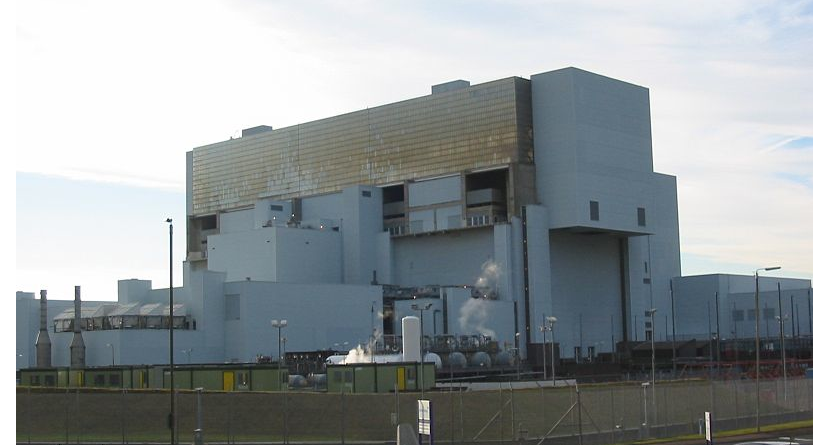
The best view from East Lothian may well be from 60m-high Innerwick Castle, just off the A1—except that you’ll have a dirty great nuclear power station blocking your view.

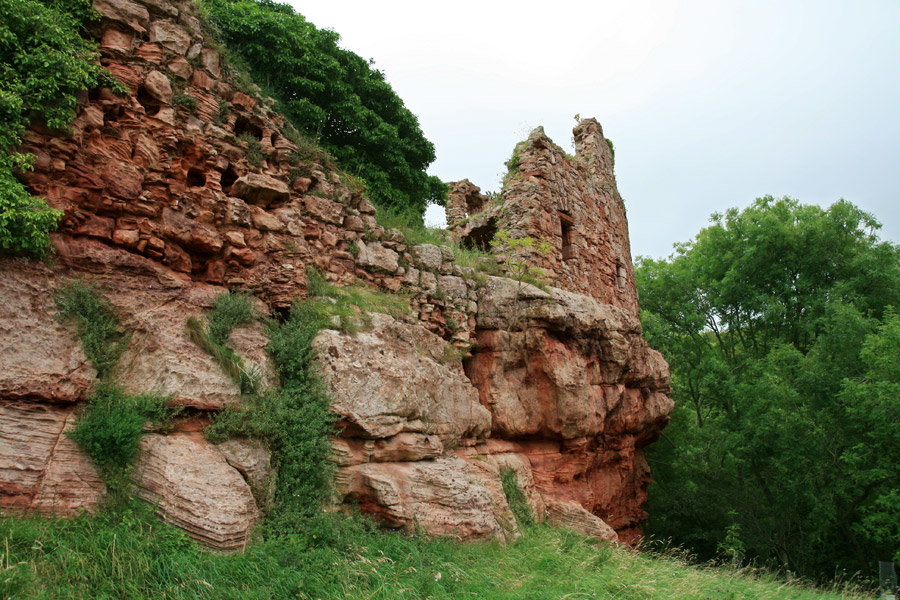
Innerwick Castle, East Lothian—Stronghold of the Hamilton Ancestors of the Earls of Haddington

Innerwick Castle, East Lothian—Stronghold of the Hamilton Ancestors of the Earls of Haddington

View from Innerwick Castle—Torness Nuclear Power Station

View from Innerwick Castle—Torness Nuclear Power Station


Posted in Community, Environment | Tagged | 1 Comment

Saving Us from Ourselves

It is meant as no insult to the Welsh, Cumbria, Peak District or anywhere else to say that Scotland has the most extensive rugged landscape in the British Isles—or, for that matter, Western Europe. There are more mountains to scale, coasts to kayak, wildlife to watch, islands to explore, etc. than almost anyone can cope with in one lifetime.

But this huge variety of inspirational places lie at the heart of Scotland’s attraction as a tourist destination that brings so many people to visit has a darker side. Whereas Mountain Rescue England & Wales do sterling work rescuing over 1,300 people who get into trouble and recover some 30 fatalities each year, Scottish Mountain Rescue, covering only 8.6% of the UK population rescue almost 700 people and recover over 50 fatalities each year. Those figures alone mark Scotland as a dangerous place.

Rather than scare the socks off potential visitors, the consistent message put out by VisitScotland, SMR, RNLI and related organisations is welcoming but firm: do come and visit us; but dress appropriately, bring appropriate equipment, check and be wary of weather/sea conditions—last but not least—let people know where you’re going and when to expect you back.

Most people, when setting off to climb the Buachaille or sail out of Oban or explore the Summer Isles by sea kayak, are too busy with their arrangements to consider who is going to come to their rescue if the mist falls or the mast breaks or a kayaker develops appendicitis. So effective are our rescue services that it is small wonder people give them little thought. But just like checking your pack for map, food compass, foul weather gear, and having some idea where the nearest refuge is, being aware of what rescue services there are and their capabilities is sensible prep work.

The Scots (and their many visitors to its magnificent outdoors) are generally appreciative of the well integrated and equipped rescue services and the professional and resolutely brave people who staff them. Other than the Forces and Coastguard, they are all volunteers who regularly put themselves in harm’s way to save the lives of others.

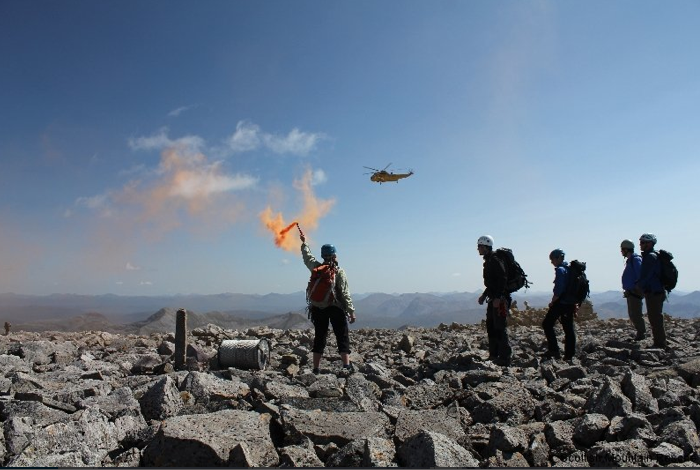
Across Scotland (not just in the Highlands) are the 1,000 volunteer members of the 27 Scottish Mountain Rescue teams (plus 3 police and 2 RAF). Among them, they spent some 24,000 hours deployed in 2011, getting 157 urgent cases off the hills by helicopter, lugging 65 off by stretcher, walking 71 to safety and getting another 24 out by vehicle. Of the rest, 157 were found to not need evacuation and 25 managed to find their way to safety without the team finding them first.

Moutain Rescue Team Guides in a Rescue Helicopter with a Smoke Marker

Moutain Rescue Team Guides in a Rescue Helicopter with a Smoke Marker

The MRTs are backed up by some indefatigable flyers operating out of five ASR helicopter bases around the country, flying the big yellow Sea King helicopters:

  • Rescue 102 & 103 at MCA Coastguard at Lerwick, Shetland
  • Rescue 100 & 101 at MCA Coastguard at Stornoway, Lewis
  • Rescue 137 & 138 at RAF Lossiemouth, Moray (‘D’ Flight, No 202 Sqdn)
  • Rescue 177 & 178 at RN HMS Gannet, Prestwick, Ayrshire
  • Rescue 131 & 132 at RAK Boulmer, Northumberland (‘A’ Flight, No 202 Sqdn)

These assisted in 197 rescues in 2011 and were supplemented in another 9 by Scottish Ambulance Service craft and 19 by police helicopters.

If you have no concept what their job entails, watch the Highland Rescue TV programme to get some idea of the skills they deploy and risks they take to whisk the seriously injured from some inaccessible crag direct to hospital. Frequently the pilot will be holding the craft in winds, sleet or mist with rotor tips just metres from a cliff while the winchman dangles down to administer first aid and ease the casualty onto a stretcher.

The ASR helicopters also assist in many of the sea rescues that occur around Scotland’s 10,000 km of coastline. Here the RNLI are usually involved under direction of the Coastguard. Like the MRT, RNLI crews are all volunteers and, thanks to the generosity of the public, operate a dense network of stations for both inshore RIBs and deep-water displacement lifeboats all around the British Isles.

The RNLI regularly make 8,000 launches (‘shouts’) all around the coast of the UK and Ireland, regularly saving over 300 lives each year, with Scotland contributing 1,000 launches and over 40 lives to those statistics. One reasons Scotland plays a more proportional role in RNLI statistics is that, despite our long coast, the bulk of shipping and recreational boating is elsewhere.

All RNLI stations are proud of their record of almost 90% of ‘shouts’ resulting in a launch within 10 minutes and an enviable reputation for skilled boatwork getting people out of life-threatening situations. They work closely with HM Coastguard who direct them to the scene and co-ordinate any ASR helicopter involvement to take casualties ashore and/or to hospital faster then the lifeboat could achieve. This is one reason why the loss of Fife and Clyde coastguard stations was objected to so strongly—the masterful knowledge of the coast exhibited by coastguards is hard to retain now that the three remaining stations each average 3,500 km of rugged coast to be familiar with.

But the biggest difficulty of all is people and—dare we say it—their stupidity. Despite the warnings, despite their putting members of the rescue services in harm’s way, the general public seems to be getting more cavalier about venturing into mountains or out to sea not properly prepared. Whereas 53% of MRT callouts were from slips or illness or avalanche and could not reasonably have been predicted, 44% came in because people got lost, were overdue, got benighted or some other reason where carelessness and/or bad planning was the cause.

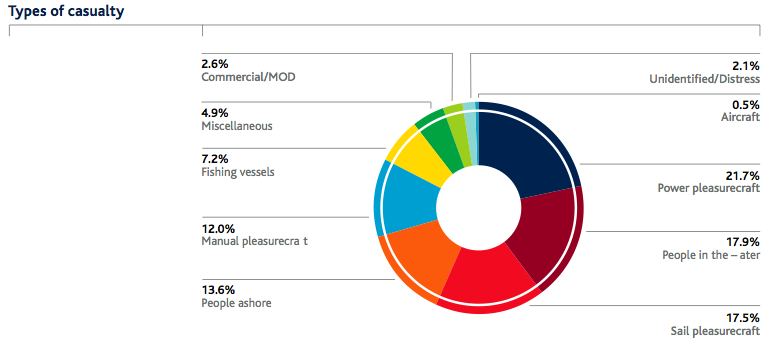
This is also reflected in the RNLI statistics. Whereas barely 10% of their callouts are to professional sailors, 51% are to pleasure craft (mostly powered), 18% to people in the water and another 13% to people stranded. There were 128 incidents from running out of fuel, 185 ‘man overboard’s, 505 stranding/cut off by tide and 622 groundings. While these can theoretically happen to anyone, any sailor worth their salt would be acutely embarrassed if they were responsible.

Proportion of RNLI Rescues in 2011 by Type

Proportion of RNLI Rescues in 2011 by Type

A corollary of our more affluent lifestyle is not just more time off and easier access to more remote places but also ownership of recreational vehicles such as jet skis. Given that rescues on both land and shore have increased some 40% in the last decade, the question whether irresponsible behaviour that causes such rescues should be penalised is being asked.

One ‘yachtsman’ had to be rescued twice in two days; he was using a road map to navigate the North Sea. Another family with no maps torches or proper clothes also got lost a second time in two days (despite a broken ankle from the first incident), causing three MRCs to waste 150 hours in the Lake District. In one out-of-control stag do, several young males in t-shirts had to be stretchered off Snowdon.

Certainly no-one in danger should be left. But if a disdain through lack of respect for nature and the elements is what caused the danger in the first place, why should brave, skilled, selfless people have to put themselves in harm’s way to make up for such irresponsible stupidity without some form of comeback?

Or perhaps such behaviour should just be treated as a category of Darwin Award.

Posted in Community, Environment | Tagged | 1 Comment

Scrooge’s Abacus

It was no surprise that the ConDems won tonight’s vote in Westminster on a Bill to limit annual increases in benefits to 1%, nor was it any surprise that Labour politicians lined up to condemn this development. So far, so predictable. The bill is a testament to Osborne’s ingenuity because it is a piece of legislation that is both apparently popular and opposed by the Labour party. In the Observer, Andrew Rawnsley rather drily commented: “It should be properly described as the Welfare (Make Labour Look Like the Party for Skiving Fat Slobs) Bill.”

But this is mischievous. The TUC has done some useful work on public perception about benefits. Whereas people think over a quarter of benefit recipients are cheating, the real figure is under 1%. Even more relevant, some 60% of the people who will lose out as a result of this bill are in work. In the emotional fracas over social conscience (or lack thereof) the two questions that no-one seems to be asking are:

  1. why do so many in work also receive benefits?
  2. can the UK economy can sustain the level of benefits we now have?

Bill Jamieson, writing in the Hootsmon last week, took politicians in the UK and elsewhere to task for hoofing the debt mountains they are faced with down the road and continuing to behave as if they can continue to outbid one another with bribes to the electorate. It was an eloquent plea for sanity & courage in the face of austerity. After nailing the scale of the US debt mountain he went on:

“Here in the UK targets for debt and deficit reduction have been missed. Even with “austerity”, net debt to GDP is on course to hit 79.9 per cent of GDP in three years, and the coalition government is besieged by bitter opposition to benefit capping. All this is unfolding under the shadow of an imminent loss of the country’s Triple A credit rating”

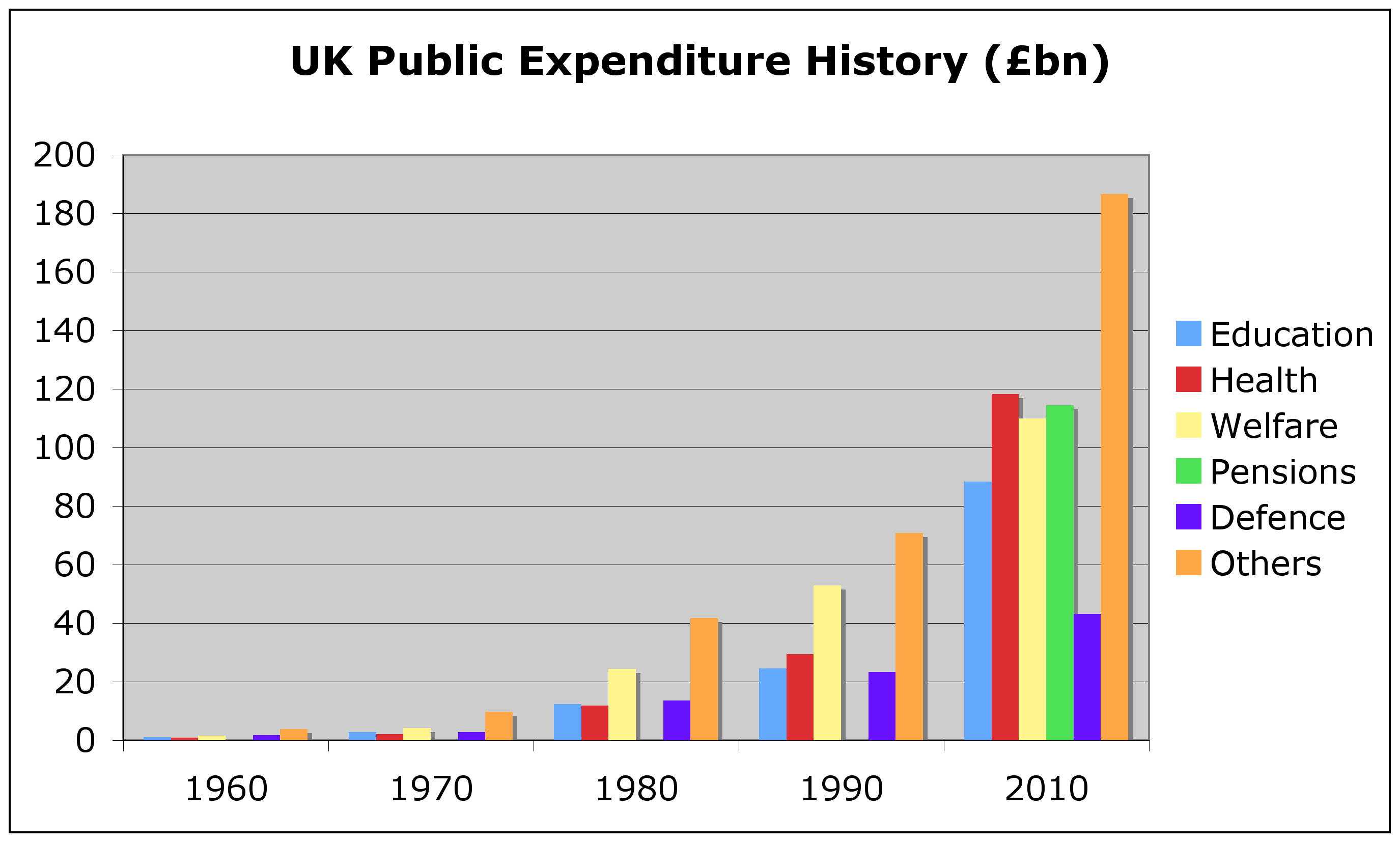
So, is he being a big girl’s blouse or is it time for the hair shirt? Judge for yourself. In the last fifty years—since MacMillan told a booming Britain that they’d “never had it so good” there has been a ballooning of government expenditure. This is shown in Chart 1 below.

Chart 1—UK Public Expenditure per Annum in Selected Years

Chart 1—UK Public Expenditure per Annum in Selected Years

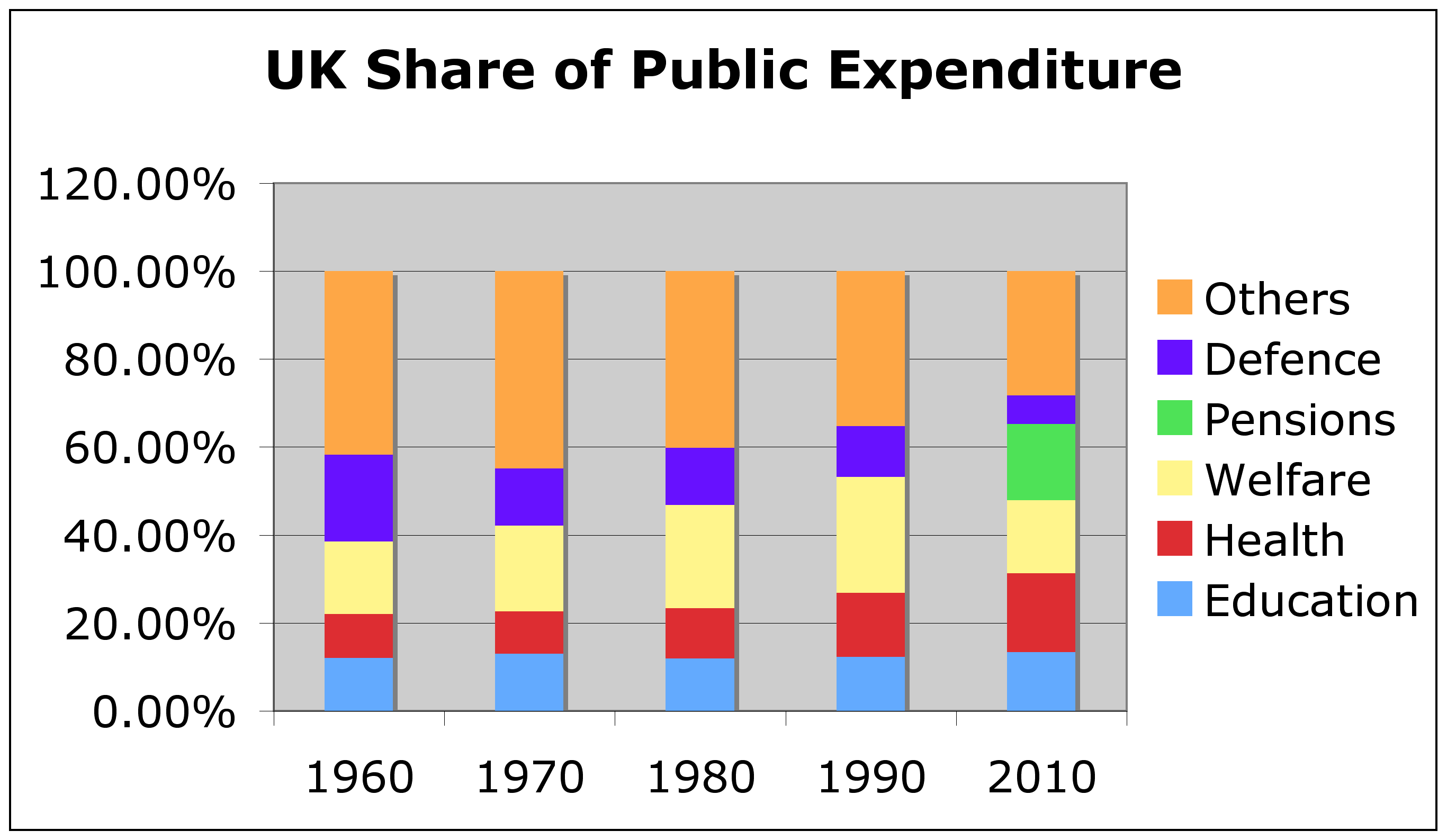
From a total of £9.1bn in 1960, it has mushroomed to £660bn in the first year of the present government. The chart shows the key social provisions broken out (Health, Welfare and Pensions), together with Education (a fundamental requirement) and Defence (a more optional requirement). Note that Pensions were self-funding until the last decade since when they have become 17.3% of expenditure—bigger than Education at 13.7%. In order to better compare things over time, let’s redraw the above in terms of percentages to show which have grown or diminished (Chart 2)

Chart 2—UK Share of Public Expenditure in Selected Years

Chart 2—UK Share of Public Expenditure in Selected Years

This makes it graphically clear that ‘social’ provision has grown in fifty years from one quarter to one half of the budget. Even allowing for inflation since 1960 (1,833%), in real terms, for every £1 we once spent on health, it’s now £7.16; for every £1 on benefits and pensions, it’s £8.04.

This can be seen as laudable—a developed country looking after the welfare of its people and especially the vulnerable but let us return to the questions posed above.

“Why do so many in work also receive benefits?” This question can best be answered by all those party policy wonks who have argued for generosity with certain sections of the public—from cutting the once-punitive 90% supertax at one end to providing a minimum wage at the other. Some of the argument for those in work receiving benefits is to avoid the financial trap of those on low wages who would actually be worse off if all benefits were withdrawn.

By capping the benefit rise at 1%, about seven million working people will be affected. This is about one quarter of the UK working population. Outside of this group are the 13% of the UK population who live on disability benefit (in Japan, it is 3%). Add in the 8% unemployed (and seeking work) and rummage for the others not seeking work who are below the radar and it is perhaps not surprising that YouGov recently found 74% of people believed that the present benefits system was excessive.

“Can the UK economy can sustain the level of benefits we now have?” Because of the emotive nature of the first question, people get stuck on it seldom get around to addressing the second. It is a measure of democracy just how responsive a government is to the needs of the people. But even a democratically elected government must act decisively and can’t consult with the people through a referendum on any but the most important issues. The ConDems clearly think that benefits need to be curtailed; Labour, SNP and the Greens disagree. Who’s right?

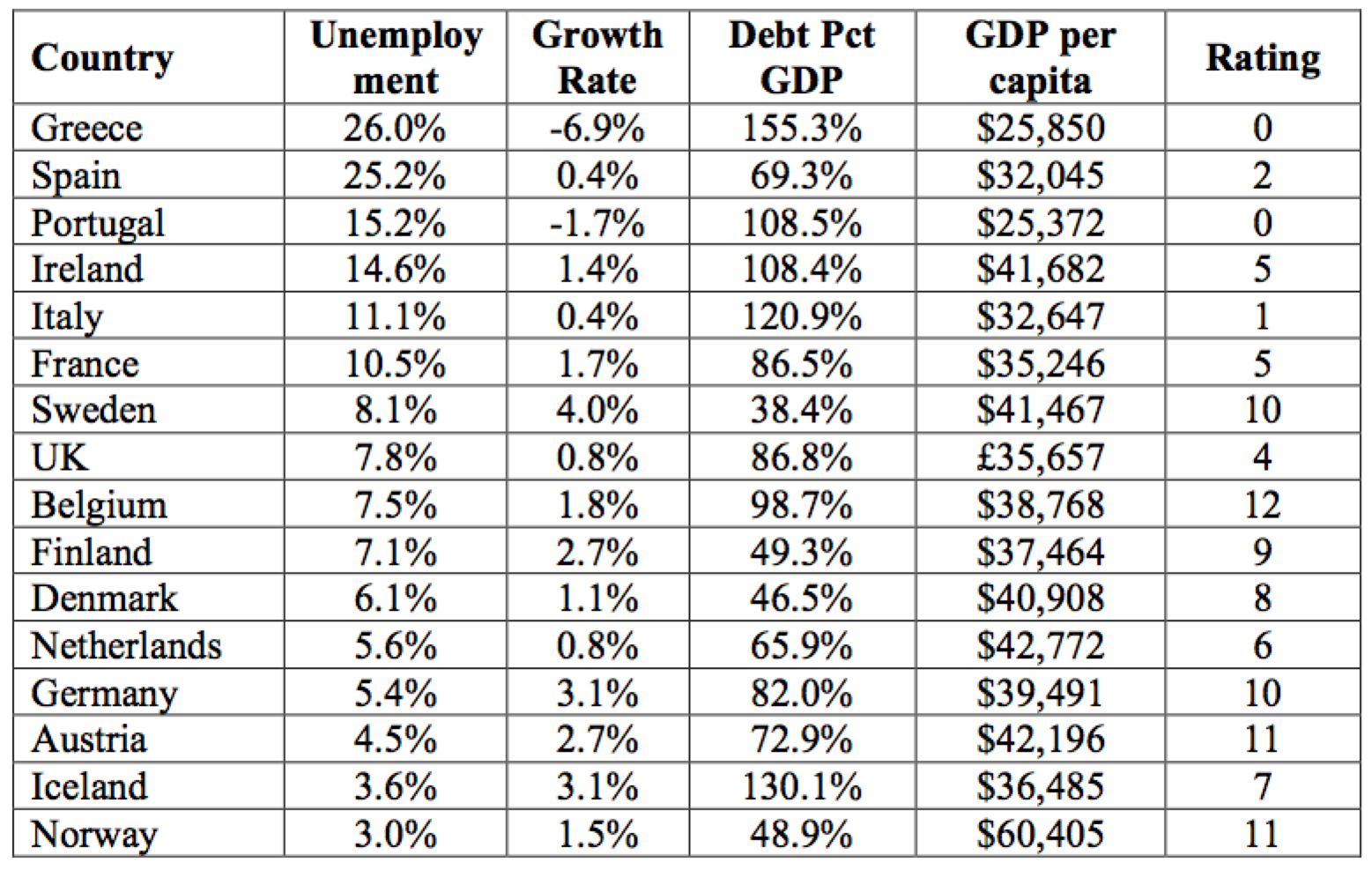
Comparing the UK with other developed countries is one way of creating some kind of objective measure of this. While numbers don’t tell you everything, the level of unemployment, the health of the economy and the degree to which the burden of public debt is manageable are all related indicators to say what a country can afford. Table 1 lists a selection of European countries whose economy is some form of yardstick for the UK’s.

Table 1—'Scrooge Chart' Comparison of European Countries

Table 1—’Scrooge Chart’ Comparison of Economic Parameters among 16 European Countries

All of Britain’s neighbours and several other comparable European countries are rated in the above table by considering which quartile they fall into, measured by each of four economic parameters. Three points are awarded for being in the top quartile (of four), down to zero points in the fourth quartile. Unsurprisingly, Germany does well as Europe’s ‘engine room’; the ‘PIGS’ languish at the bottom.

What is perhaps more surprising is that relatively modest countries like Austria and Norway are in the lead, Scandinavia puts other areas to shame and the supposed “Arc of Insolvency” countries are doing better then Britain. While it would be foolish to use such measures alone to run a country, as a ‘back-of-the-envelope’ snapshot, it’s pretty solid. Little wonder that the UK is on the verge of losing its ‘AAA’ rating when it falls into the third quartile by all four measures.

It is not being a small-minded Scrooge to say that Britain cannot afford to spend money the way it is doing, especially on long-term commitments that show no return on investment—like the scale of welfare in which we now indulge. Were the economic basis on which it was built sound (like most of Scandinavia), it might be a sensible, as well as a humane, choice.

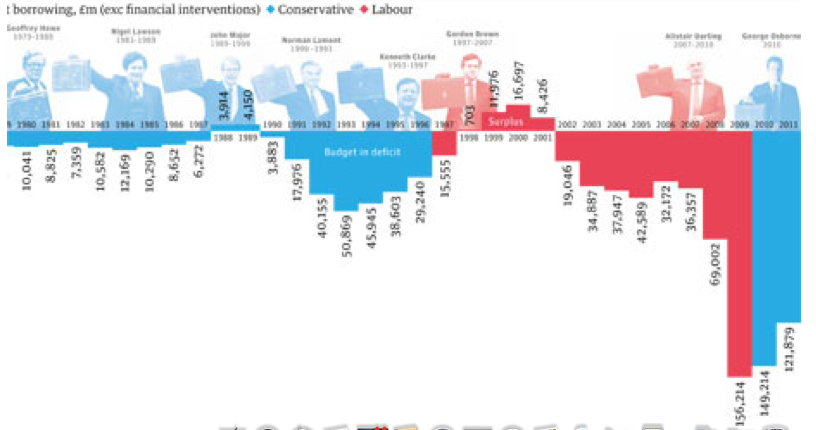
But since British welfare has been funded for decades by exploiting  a variety of sources from North Sea oil profits to Irn Broon’s early raid on the pension funds, we are living beyond our means on a titanic scale. This is illustrated by a chart from the Guardian that illustrates why we are in deeper financial trouble than we have ever been; we simply cannot afford the benefits to which we have grown accustomed.

Chart 3—UK Government Net Cash Flow by Year

Chart 3—UK Government Net Cash Flow by Year

The financial shakiness of Tory tenure under Lawson in the eighties and Clarke’s in the nineties did pay off with eventual surpluses. But what Brown and Darling got us into in the noughties is on a scale that boggles the mind as well as the banks.

It may be against our good nature and humane compassion but the bottom line is: Britain is broke. Borrowing one pound in five cannot be sustained. Education, seen as a vital and basic right, has seen no growth in its share of spending. Defence is seen as less vital but its share has already slumped from 20% to 6.5%. Everyone agrees the NHS is sacrosanct, so, even its doubling from 9% to 18% is seen as acceptable. Everything else the government does (transport, treasury, foreign office, etc) has also been clipped—down from 41% to 28%.

That leaves the £225,000,000,000 we spend on Welfare and Pensions. You can blame Scrooge and his calculations for such a Hobson’s choice if you like but the bottom line is one of:

  • we act decisively to curb this
  • we butcher a different sacred cow (e.g. NHS)
  • we go bust

Scrooge sez: you choose

Posted in Commerce, Community, Politics | Tagged | 1 Comment