As ever, The Burd nails a situation that flaunts the ‘ reasonable person’ standard and, in so doing, questions why we are not yet all working “as if in the early days of a better country”.

burdzeyeview's avatarA Burdz Eye View

Two Scottish broadsheet Sunday papers, two quite different splashes. But they share a theme.

The Sunday Herald’s front page story tells of the Scotland Office sitting on internal government files relating to devolution. Despite the Scottish Government reducing the time at which such documents can be released publicly, the current Scotland Office has decided to sit on these ones, so it can have a wee look for anything in there that might prove embarrassing – or worse – to the Unionist parties. Why a Tory-Lib Dem controlled UK administration might want to spare the blushes of a previous Labour government neatly illustrates the complexity of the constitutional ties that bind. It’s them – all of them, most of the time – against the SNP.

Scotland on Sunday runs with a piece about Holyrood and specifically, about the failure of Cross Party Groups (CPGs) to file annual returns and declare benefits…

View original post 937 more words

Posted in Uncategorized | 1 Comment

Education as Political Football

Currently, politicians are getting stick for appearing to prefer squabbling to getting things done. While this can been seen as simplistic and not showing understanding of how democracy works, there is nonetheless much truth in the accusation. Because what they choose to squabble about is seldom the arcane details of a law or deep-rooted philosophical differences about the ‘big picture’ but issues that are closer to the punter’s heart—and therefore more likely to catch the media and gain publicity.

Whether it’s care homes or schools or road repairs (all devolved matters), there’s always a lively public debate in pubs and letters pages about such things. If you rank these devolved matters by the amount of money we spend on them, the top three—by a country mile—are Health (~£9bn), Education (~£7bn) and Social Work (~£3bn), in that order. Study the media and you will find reports of political spats revolving around one or other of those on a regular basis. But do these spats get to the heart of things?

Although Health is the largest of the ‘big three’ there really isn’t much of a political dimension to its operation. While arguments over waiting times and Clostridium difficile do break out, politicians (sensibly) leave the technical side of running the health service to the professionals.

Not so Education. Not only is it the largest part of any council budget but it hits the headlines more often than any other topic. And, in this case, politicians have not been shy about debating how schools and universities should be funded, run and managed.

This involvement has been heightened by Education being among the most highly unionised sectors of the Scottish economy, boasting a range of unions, among which the Education Institute of Scotland (EIS) is the largest. They were instrumental in the growth of school teacher numbers in the 1970/80’s as new subjects were added to the academic curriculum (e.g. CDT; Computer Science; Music) and of administrative staff as school offices expanded in scope and function. Staff at HE and FE institutions grew even faster as a tertiary qualification was deemed to be for everyone.

By the millennium, pupil numbers had slid from their 1975 peak of 1.05m to around 0.75m. Over the following decade, they continued to slide to around 0.66m but the millennium is regarded as something of a watershed: it was finally recognised that teachers had slipped behind. This was not just in pay terms: children’s rights, complex curricula, inclusion etc had all made a teacher’s job more difficult at a time when the social status of teachers had fallen behind that of doctors and solicitors with whom they had once been seen as equals.

The McCrone Report of 2001 was a milestone that was turned into an agreement with cross-party support. Much of the teacher’s time usage was defined and a considerable pay deal of a 21.5% increase over 3 years granted, followed by 10% over another four years, all of which found broad support. Mostly due to this, council education budgets almost doubled over a decade.

After six years, an ordinary teacher can now earn £32,583. As the Scottish Block Grant doubled (£16bn to £32bn) in the first decade of the 21st century, the sharp hikes in council outlay this involved were covered and otherwise painful adjustments were accommodated without painful trade-offs.

Even so, the unions never slept. Teachers didn’t quibble with their campaigns for improved pension and pay rises on top of all this, despite that fact that no change in productivity, flexibility or the right to fire incompetent teachers was forthcoming as part of the deal. Also, many teachers who formerly had displayed flexibility, such as helping with extra-curricular activities, no longer did so. Although many teachers still see teaching as a vocation and contribute more than their contract requires, the numbers who clock-watch and only do stipulated hours has increased markedly.

Yet their annual number of teaching hours has been reducing—from 950 hours in 2000 to 893 hours in 2005 and to 855 hours in 2010 at the primary level. At the same time, pupil-teacher ratios in public schools have dropped in the decade since the millennium—from 14.9 to 13.5 (i.e. by 10%), with most improvement being in the crucial early years (i.e. infant classes) of primary schools.

The bottom line of all this should be pupils with better skills and abilities to take out into the world when they’re done. And, while there has been a steady improvement in ‘exam league table’ results, there are accusations of grade inflation, as well as educationalists’ understandable skepticism of using this as a sole measure: learning is not just about passing exams.

This ‘careerist’ approach to educating our children places heavy emphasis on tertiary education, and the gaining of a degree. Whereas fifty years ago, all four Scottish universities of the day had fewer than 40,000 students matriculated, fifteen years ago this number had grown to 141,892 (with 191,526 in FE colleges). This number peaked in the last few years at over 287,565. Combined with the present recession, such numbers swamp available jobs and result in a major social waste of large numbers of unemployed graduates.

One reason for the disappearance of the once-guaranteed job for graduates is what youth have chosen to study. Starting in the 1960’s humanities course like Social Anthropology blossomed and sciences were seen as ‘too hard’. This has since become critical. Despite physics graduates being in demand and snagging healthy salaries as a result, their numbers have dropped by well over 20%—from 1,970 15 years ago to 1,545 today. According to an IOP Report:

  • Physics graduates find employment in a wide range of industry sectors, with a significant proportion relocating overseas.
  • Physics graduates earn above the median UK wage and succeed in management positions and consultancy roles.
  • More than half of first-degree physics graduates earn a salary in excess of £40,000 and more than half with a PhD in physics earn over £50,000

The quality of both teaching and research at Scottish universities is world-class. But research hubs are not career factories nor do they function well  as career consultants. Given that our youth aredriven through school with expectations from both parents and teachers that everyone goes university, students wind up with an unbalanced view of what is possible and/or desirable in life.

Scotland’s political parties supported this mushrooming of student numbers as an unalloyed good—and still cling to it as doctrine. They have yet to twig how public money and youth ambition are both being sacrificed on this doctrinaire altar. Fixation with numbers—be it class sizes in primaries, league tables in secondaries or sheer quantity in tertiary—has beguiled them all. They tout quantity as opposed to quality. Our clutch of teaching unions are all part of this, exhibiting little but paranoia when it comes to changing philosophy or methodology.

Few have broken ranks to ask fundamental questions about our education, let alone gone abroad to study if others might do it better. Our youngsters are not best served by conveyer-belting them along a single ‘academic’ track defined by political shibboleths of politicians and vested self-interests of unions. To get out of this self-excavated rut, we need to answer:

  1. How do we best start children in formal education? Before 6 is unusual elsewhere but their kindergartens provide informal education, develop social skills and widen cultural horizons early on. Norway’s policy of year-round outdoor kindergartens is worth a look.
  2. How do we ensure basic literacy and numeracy before they leave infant stage? A major complaint of university lecturers and (worse) employers is how few students can express themselves beyond textspeak or make a decent fist of mental arithmetic
  3. How do we involve ALL parents pro-actively as part of the process? This can be homework or extra-curricular support or simple interest and encouragement. A major factor in social segmentation is that many deprived pupils lack all that.
  4. How best to ensure that GIRFEC wasn’t just a hollow slogan? Class sizes are a factor, but so is the social environment or out-of-hours coaching and (are you listening EIS?) pro-active flexibility on the part of teachers.
  5. How to identify and ‘virtual’ stream (i.e. without physical segregation) the different directions that pupils are headed. Not just academic science vs creative but those with manual, sports, social, music, presentations, language and a host of other inherent skills. Few pupils will have none; all need encouragement; all need equal status—that Latin is ‘better’ than Woodwork is social striver myth.
  6. How, at secondary level especially, to allow for such specialisation as early as possible, without losing the Scottish baccalaureat concept of broad education to end of high school that has served Scots so much better than English A-levels?
  7. How to maintain a parity of esteem among specialisations. Dexterity with tools is as valuable as dexterity with footballs or a keyboard: all have status in the real world and all can earn reward on a par with ‘brainy’ work.
  8. Now that we’ve flooded H&FE with so many (a significant percentage of whom drop out) how do we restore universities to academic skills and research while colleges develop practical skills, supported by a comprehensive hands-on apprentice programme that covers the many key manual skills necessary in 21st century Scotland?

It’s not just a matter of parties and councils running scared of unions—those run by Labour who rely on their donations especially. Nor should we thole  Tory ideaology, importing English policies of ‘free’ schools and academies wholesale, with their inherent social fragmentation founded on Eton, Harrow, Winchester, etc and the virtual promulgation of those into Oxbridge. They may have their place in England; Scotland marches to a different social drum.

Our children should not be ammunition for political trench warfare, nor a vehicle for unions to shield their members from the realities of life. And—who knows—if we were to think the unthinkable and actually adopt educational ideas that clearly already work from places like Scandinavia, we might be on the road to building the kind of prosperous, egalitarian, admirable society here that they already enjoy.

Not just our children but those long out of school would surely welcome that.

Posted in Education | Tagged | Leave a comment

Where Hell Froze Over

The year 2012 will be remembered  for unusual weather. Sunny Dunny was drenched, Stonehaven flooded, Assynt suffered an unheard-of drought and much of England is still so sodden any new rain simply runs off. North of us was unusual too in that the amount of sea ice in the Arctic melted to a record low.

It might have been coincidence but on the heels of news of minimal Arctic ice, just before Christmas, the UK government followed up an equally-belated acknowledgement of Bomber Command’s 55,000 losses in WW2 with the announcement of a medal for the 65,000 men who served on the Arctic Convoys, 3,000 of whom died there; barely 200 of them are alive today.

Seventy years on, it is difficult to imagine how tough people had it. Luxuries we take for granted today—electronic gizmos, exotic foods or even more exotic holidays—were unknown. The Forces suffered hardships, bad food and endless boredom, interrupted by manic periods of people trying to kill them. Airmen tended to have it better when based at home. Yet, nursing 15,000lb of Amatol and incendiaries packed into a freezing Lancaster through pitch dark in a hail of flak at 20,000ft over Essen with radar-equipped Nachtjäger gunning for you requires stiff-upper-lip courage of a special sort.

Taking nothing away from the millions who served in the Forces to give us freedom leading to our seventy years of affluent comfort, they at least signed up for and got paid for it. While civilians from Barking to Belfast suffered waves of losses—from night bombers, followed by V1s you wished you couldn’t hear, followed by V2s you wished you could—there were civilians on the front line who had never signed up to warfare: our merchant seamen.

Most people know about the Battle of the Atlantic during which convoys of ships tried to keep Britain from starving. And while the North Atlantic is no easy place to be in winter, especially rolling around in a 1,000-ton corvette, one of the worst sea boats ever built, it was infinitely preferable to the worst billet in the entire war—the Arctic convoys to Russia.

Compared to the two-week Halifax-to-Liverpool haul, Loch Ewe-to-Murmansk looks a doddle. It’s much shorter, and with no sea ice and 24 hour daylight in summer, what could be simpler? Well, Hitler occupied Norway in 1940. The Luftwaffe  deployed KG26, a crack anti-shipping wing whose He111s could carry two torpedos each. Not to be outdone, the Kriegsmarine stationed two full flotillas of U-boats and most of their heavy surface units there, including Tirpitz (15″-gun battleship), Scharnhorst (11″-gun battlecruiser), Admiral ScheerLützow (11″-gun pocket battleships) and Hipper (8″-gun cruiser).

When, to almost everyone’s surprise, Hitler invaded the Soviet Union in June 1941, it took some time for the capitalist West and communist East to behave like Allies. As Blitzkrieg bagged millions of Russian prisoners and panzers rolled up to the gates of Moscow, Stalin realised he needed all the help he could get. But getting it was not easy. Via the Pacific involved the 4,000-mile single-track Trans-Siberian railway, the Axis controlled the Aegean and therefore all access to Black Sea ports. The only option was the shortest one—to ice-free Murmansk and, in summer when the White Sea melted, Archangelsk.

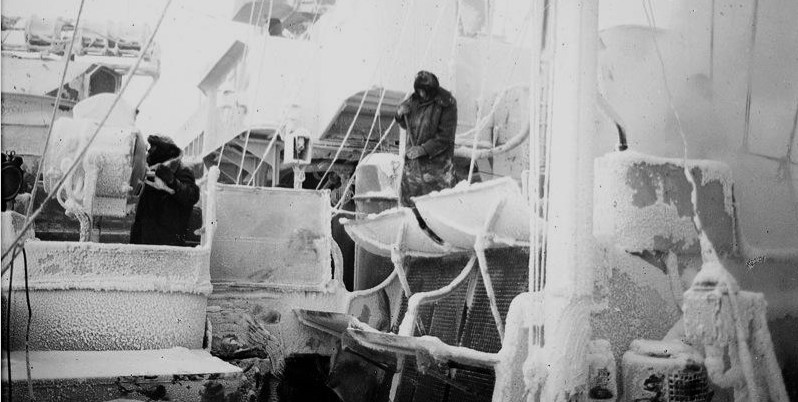
Things got going in October 1941 when PQ1 of 11 ships left Iceland. Initially not much molested, as the season changed to winter, the bitter conditions were bad as any enemy. Sea spray froze into ice on the superstructures; this had to be chipped away or ships would capsize (HMS Shira lost this way—3 survivors). To touch anything with bare skin was to lose it, freezing to metal immediately as if glued. From November on, passage was in 24-hour darkness—a blessing because pack ice forced the convoys south towards the Norwegian coast so the less German patrols could see the better. (See here for details of convoys).

Clearing Ice aboard HMS King George V

Clearing Ice aboard HMS King George V

Lookouts had it worst, squinting into driven sleet for a whole watch. RN escorts could not stay closed up for action as AA gunners and deck parties would freeze. Deck equipment like winches was unusable; Frostbite was commonplace. The cruiser HMS Trinidad was even sunk by her own torpedos when their gyros malfunctioned in the cold and sent them in circles.

Keeping station in dark or foul weather (or both) to avoid collisions required extraordinary seamanship. Even when you got there, neither Murmansk nor Archangelsk offered facilities for visitors, the Russian treated even merchant seamen like spies: they pointed guns at those trying to unload PQ1 in the absence of stevedores because they had no permit to be ashore.

Although losses in the first six months were light, as weather improved into 1942, so did exposure to risk. In March PQ12 narrowly avoided Tirpitz in foul weather. From then on, each convoy was more roughly handled until PQ17 sailed with 33 ships at the end of June. Despite the Home Fleet providing distant cover, the Germans spotted it and sent  Lützow and Scheer to attack, whereupon the convoy was ordered to scatter; U-boats and planes then had a field day picking off stragglers as there was nowhere to hide in 24-hour daylight. Only 11 ships of the 33 made Russian ports; some 1,200 merchant seamen, as well as 430 tanks, 210 aircraft, 3,350 lorries and 100,000 tons of war materials, were lost—the worst convoy disaster of the war.
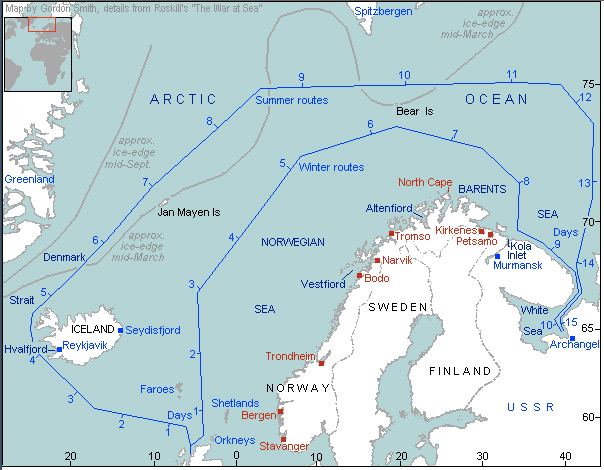
Seasonal Courses of Arctic Convoys to Russia

Seasonal Courses of Arctic Convoys to Russia. Luftwaffe Air Bases in Red

Having had their fingers burned, the Admiralty held off until trying again with PQ18 in September which was roughly handled, losing a dozen ships before the remaining 28 reached Archangelsk. Then in December, a new series of JW convoys started and, taking advantage again of darkness and foul weather, these avoided many casualties, despite attempts to intercept by Lützow and Hipper. But after February 1943, all convoys were suspended until the following November because the odds against convoys in the summer months were suicidal—merchant seamen asked to face odds of dying worse than front-line soldiers or bomber crew.

Convoy JW55B, sailing in December, was used—unbeknownst to its sailors—as bait to lure out Scharnhorst, which was caught and sunk by HMS Duke of York and cruisers. With Tirpitz immobilised by the RAF, convoys in 1944 had an easier time of with no surface threat, running monthly until the final JW67 in May 1945. By ‘easier time of it’ is meant from the Germans: JW56A lost days fighting a huge storm off the Faroes, finally having to take shelter in Iceland.

Just surviving one Arctic Convoy would be a horrendously searing experience. But several ships sailed there more than once. How their crews held it together having already gone through this frozen hell already we may never know. And of the 3,000 that died on the 85 merchant ships and 16 RN warships lying at the bottom of the Barents Sea, we can only imagine what the nightmare of being thrown into stormy, sub-zero seawater after your ship sinks feels like. Survival time is minutes; the very low number hauled alive onto rescuing ships speaks volumes.

But there are two glaring reasons that make the whole sacrifice tragic that would have been known to none on the ships.

One is that all of this really was little more than a gesture. Because Britain was incapable of dealing with the Germans on any front in 1941 (we fielded five divisions then—all in Libya & only one of them all-British), the only way we could help the Russians (fielding 360 divisions and barely holding 208 Axis) was to provide these military supplies as the only direct contribution they could make. The ever-suspicious Russians actually thought Britain was just going through the motions to appear to help them and that the PQ17 losses had never existed.

The second tragedy is the Russians actually despised much of what was shipped. Our 2-pounder anti-tank guns were laughed at—their tanks were already equipped with a 76mm gun. They sidelined our slow, under-armed Valentine infantry tanks to the Caucasus side-show because the Red Army did not rate them beside their fast, powerful T34. What they did appreciate were lorries, which they used in Mechanised Corps to grind the once formidable German panzers to pieces.

Had the Arctic Convoys never happened, the outcome of the war would not have been greatly different—at worst, delayed a few weeks. In Britain, we tend to overplay our role in WW2 and nowhere is that more apparent than in the conceit that the Arctic Convoys brought materiel without which the Soviets would not have prevailed.

No-one should underestimate the courage of our sailors—both Merchant and Royal Navy—braving unspeakable trials of endurance for weeks. An acknowledgement of their sacrifices is both overdue and welcome. But don’t examine the rationale behind sending them too closely. They could ave stayed warm and snug at home for all the difference their sacrifices made to the war.

But give them the medals they have long deserved.

Posted in Education | Tagged | Leave a comment

Credo

We make out of the quarrel with others, politics, but of the quarrel with ourselves, poetry” —W.B. Yeats

The previous post is a re-blog from Mute Swan with which I was particularly impressed because it asked politicians to rethink their verbal mud wrestling and reconsider what the people who gave them their jobs might actually want them to do. I interpret that as:

  • following a set of fundamental principles
  • being clear and consistent in your beliefs
  • being active and articulate in pursuing them
  • treating with respect others who do the same

Principles

While there are neither training sessions nor spot-checks on politicians, they should abide by a set of principles—things that are fundamental to both their own morals and activities. Such principles are applicable to all—it’s in beliefs that we differ.

It is obviously convenient at times to elude or even dispense with these principles. But the measure of integrity is to avoid doing so. For an example of principles in practice, it is hard to surpass Zinneman’s film of Bolt’s A Man for All Seasons.

  1. We live in a democracy; however inspired or daft, the voters’ decision rules
  2. People are fundamentally decent and well intentioned—even those who may disagree with you
  3. Election requires that you actively represent the best interests of ALL those living in the area without fear or favour
  4. Where such interests may clash, you make your best evaluation of the will of the majority and put your head above the parapet to explain to the rest
  5. If promoted to a portfolio position, 4 above now applies for that service across the whole council/country vs the general interests of your ward/constituency
  6. You are not in it for the money, nor to exploit opportunities on the public purse: anyone who thinks they are is in the wrong job
  7. However venal it may seem, everything you do outside private property is public and liable to publicity
  8. Behave as if your parents were watching your every move: make them proud

Beliefs

Although I’m a physics graduate, one of the more interesting classes I took was Moral Philosophy from Professor Acton. Far from the steely certainty of Maxwell’s Equations, Plato, Kant, Spinoza and Mill all vied for my understanding and received shifting interpretations.

It was my introduction to the shifting moral morass of the real world and the need to move beyond W.C. Fields (“Everybody’s got to believe in something. I believe I’ll have another drink.”). You may share some beliefs with others but, generally, this is the meat and drink of political debate.

  1. Scotland is a country because its people say it is.
  2. Democracy is the method by which it should be ruled (Churchill said “democracy is the worst system of government—except for all the other systems“)
  3. The best future for the people of Scotland can be achieved through independence
  4. The best future for the people of England can be achieved through Scottish independence
  5. Nuclear weapons have no place in Scotland and nuclear power should be phased out because of the unsolved problem of waste disposal.
  6. Anyone can choose to be Scot simply by living here permanently; we are a welcoming country that enjoys our diversity and we are not full up
  7. Nobody has a right to anything, other than citizenship, by virtue of their birth
  8. That said, The Queen is the best, hardest working, most indefatigable Head of State you could want, coming close to defeating my republicanism all by herself
  9. Scotland is a small country and needs friends: England, EU, NATO, in that order
  10. You can’t have 2-way communication with 5m people: local contact is the real arena of politics (Tip O’Neill, former House Speaker said “ALL politics is local“)
  11. As regards local, the abolition of burgh councils was a mistake because it severed the roots of local democracy—’our’ council became ‘that’ council.
  12. On the other hand, major public services should be city-region based
  13. No part of public services in Scotland should be privatised, although temporary expedients like ALEOs to take advantage of the law may be implemented
  14. Major decisions on shaping & maintaining our towns (e.g. planning, tourism) should be taken at community level
  15. A community is anywhere that thinks it is but a model size would be a high school catchment area
  16. The rewards for hard work and ability should mainly accrue to the individual
  17. A measure of any civilisation is its commitment and ability to support and protect its vulnerable
  18. With provision of support/protection comes an obligation not to abuse it.
  19. A mixed community is a healthy community—mass estates, especially gated ones, are recipes for social unrest, if not disintegration
  20. Of all the public services we need to get right, Education is prime because it will shape the future
  21. After three centuries of Anglocentric foreign policy, Scotland needs to re-think its international contacts, especially with Scandinavia

Practice

All such principles and beliefs come to naught if you spend your time watching reality TV instead of getting your ass in gear. Quite apart from engaging with friend and foe alike on the above (incomplete) list of beliefs, the bulk of a politician’s day is taken up by committees, meetings, community events, etc. How those are handled will have a major impact on how effective the representation is, principled or no.

  1. Make yourself available: shop local, use the high street, attend events and get yourself known if you aren’t already
  2. Beware of bias; be wary of joining clubs, especially when there are two, to avoid being seen as partisan
  3. Go to the spectrum of local civic meetings, even if only sporadically
  4. Maintain a friendly and regular channel to local press and radio. Even if they’re biased, there is no upside to falling out with them
  5. If in Administration, articulate your achievements outside of the regular PR channels because most will not know about them. Don’t boast—communicate
  6. If in Opposition, select a few key (preferably vulnerable) issues and point out both shortcomings and your own (hopefully superior) alternative(s)
  7. Treat colleagues with respect and avoid public disputes in which all will lose
  8. Treat opponents with respect, especially ‘off-duty’ but avoid craven posturing in the hope of crumbs from the Administration’s table
  9. Avoid unnecessary public expenditure, especially in these straightened times. Sending Christmas cards to all your constituents at public expense may be legal and above board, but it will damage, not enhance, your image
  10. It’s easy to be ‘in the paper’ but if it is not for some serious or social issue relevant to your residents, it may damage, not enhance, your image
  11. Build your contacts throughout officials in your organisation. Favours are far more often granted to those who have built bridges and are not strangers.
  12. Build your network outside your organisation, whether in the party, other councils or, especially, other public bodies & quangos. Speaking at conferences is a particularly effective way to do this. Scotland is a village; conferences are the village pump round which you make friends and get the gossip

OK, so I didn’t make it in 1,000 words (typical bloody wordy politician!). But the above is a distillation of why I am in politics (beliefs), what guides me (principles) and how I go about it (practice) after 20 years as elected something. This is not meant to challenge but to explain. Nonetheless, comments and feedback—especially from Mute Swan—would be welcome.

Posted in Politics | Tagged | Leave a comment

Dear politicians and political types

Dear politicians and political types.

I find myself pretty much in sympathy with the sentiments expressed in this blog and, since I have a public affiliation to the SNP, acknowledge ALL parties have suffered some erosion of moral anchors afflicting them since the rise of the SPADs.

As this can be read as a call to arms, it is a challenge that I accept: within a few days I intend to formulate my own ideals in 1,000 words or less and publish them on this blogsite.

Readers are welcome to critique it within the bounds that Mute Swan proposes. Anyone without a platform to do the same, I offer this one—again provided it does not breach the principles embodied in the original blog.

Posted in Politics | Leave a comment

Two Peoples, Separated by a Common Language

Although a phrase coined by the ever-observant Mark Twain to describe why the Americans and British were forever misunderstanding each other, despite both, in theory, sharing the same English, the phrase jumped to mind as I watched Simon Heffer’s New Year’s Day documentary on BBC1 Fifties British War Films: Days of Glory.

Born in the late forties in the shadow of WW2, In the fifties, I was in awe of a dad who had managed to drive various inferior tank designs against all that the Afrika Korps could throw at him. Living in sleepy North Berwick, where no-one much remarked on a seven-year-old, I spent my pocket money catching many of the three-films-a-week programme at the Playhouse cinema 100 yards down the road.

I was game for most anything and Mrs Scott who sold the tickets none too picky whether someone barely able to see over the counter should be watching Kiss Me Kate, let alone the Hound of the Baskervilles. But, though I didn’t realise it at the time, I was witness to many films from a classic phase of British cinema—the black-and-white semi-documentary war film.

All I knew was they were my favourites. When the Dam Busters finally reached our corner of the world, I saw all five showings, most of which were a sellout. I much preferred the British war films to American. Whereas Audie Murphy seemed all posture in To Hell and Back, the underplayed anguish on Jack Hawkins’ face in Cruel Sea when he depth-charged a U-boat in the middle of swimming sailors had me horrified that such choices were made.

This was before TV stole the cinema audience and closed most small-town cinemas like the Playhouse and many of the films appeared as filler on TV channels in the sixties and seventies, which rather debased their value. The film experience was lost on a 19″ screen with tinny sound and an ad break every 15 minutes.

But, in the fifties, in a ‘proper’ cinema, these films were epic, draining experiences: We Dive at Dawn; Cockleshell Heroes; Sink the Bismarck; A Hill in Korea; Bridge on the River Kwai; Battle of the River Plate. While other films impressed me, few haunted me like these, scenes staying in my memory so firmly that I still have trouble watching the DVD half a century later.

It troubled me for some time that later war films seldom had the same appeal for me. Even Cross of Iron or Das Boot, although streets ahead in budget, realism and sophistication, did not hold the some attraction for me, did not offer the pitiless tension of, say, Ice Cold in Alex. It’s only recently that all this has more to do with identity and psychology than entertainment or even adrenalin rushes.

Because the element of all those films that I schizophrenically both admired and simultaneously thought foreign were all the heroic leads were officers speaking Oxbridge English. I only ever heard such an accent on the BBC and when people brought their pranged cars in to my dad to have the dings hammered out. They represented a culture embedded in a class war—at once familiar and yet not mine.

While John Mills could make a decent fist of playing a regular Joe (e.g. Dunkirk), the rest of the Ealing stable could only do the stiff-upper-lip English officer. When they strayed outside of that (e.g. David Niven hopelessly miscast as dynamite specialist Miller in Guns of Navarone), it was painful to behold. I even disliked Michael Caine when I first saw him in Zulu because he made a very convincing fist of an Eton-then-Sandhurst accent.

And so, although I did not realise it at the time, my political awakenings lay in that very genre of films that taught me culture and history, even as it entertained me. Even as I admired the manly heroics with which these films are replete, I was put off by the type that always seemed to play them.

In his programme, Simon Heffer states  these films “are part of my DNA, displaying what it meant to be British and values such as courage, heroism, patriotism and decency.” While I understand just what he means, there is a quibble that has been with me for the last half-century: the films displayed the culture of the upper class in England. Other than token appearances by John Laurie, the first Scot I saw with any equivalent derring-do was when Shir Shean played Urquhart in Bridge Too Far. But that was two decades later.

Now, given the dominance of England in our little union, plus Ealing Studios being located in, well, Ealing, plus the fact that received pronunciation was the lingua franca of radio and then-nascent TV, the lead’s accent was likely to sound that way. But it was the conflation in the films (and repeated by Simon Heffer) of ‘English’ with ‘British’ that stoked my awareness then and has been with me since.

Because the stoic repression of feelings, the use of stock phrases, the deference to authority, the references to cricket or Piccadilly or pints of bitter that lace all of these films make them far more English than British. For a contemporary film with Scots culture juxtaposed with the English for comparison (and with a bit of American thrown in for good measure), try The Maggie. Or for a film that embodies Scots cultural thinking in a myriad of ways, try Caton-Jones’ Rob Roy.

I take nothing away from the excellent, articulate and historically accurate genre that is the 1950’s era British-made war film: Simon Heffer is quite right to highlight it as part of our heritage. In the 1950’s the shared horrors and relief that it was over released emotions all across Britain in these shared experiences. But this far on, they belong more to the English than to us Scots because it is English cultural icons, behaviours and social mores that inform and populate scripts, directing and acting.

English people having difficulty following this might consider how they feel about American productions. Forget U-556, which was a straight rip-off of one of the Royal Navy’s most audacious operations. But consider Last of the Mohicans—a lyrical, pretty accurate, beautifully shot 1759 slice of the war with the French. The setting is technically ‘British’ (the colonies still had two decades to go before revolution) but neither the English Major Heyward nor the Scots Colonel Munro, though brave, come out of it well because the sensibility of the film is very much American.

One of these days we may have black-and-white films made of Lord Lovat non-standard training of the first commandos up in Glen Roy or of the hazards overcome by the volunteers who manned the Shetland Bus. Either would need to display a Scottish cultural sensibility to be decent portrayals. But, until then, it is no great hardship to get by with the English-dominated (but really none the worse for that) portfolio of 1950s war films that articulated the mood of Scots and English unused after two world wars and a depression to allowing themselves self-expression.

Thankfully, the Scots seem to have made progress overcoming any such inhibitions since. Punk music and reality TV notwithstanding, it must be time for the English to get there too.

Posted in Community | Tagged | Leave a comment

Ten of the Best

For all our readers, whether regular or no, thanks for your interest in this blog over the last twelve months. The hope is that it entertained and stimulated your thinking.

In truly democratic fashion, a ranked list of the top ten blogs from among the 240-odd posted throughout the year, ordered by frequency of hits by which you, the reader, accessed and read them, is given below.

  1. Chris Marr: Obituary (December 11th) For locals in N. Berwick, there may be no surprise in this topping the list. What might stun them—as it did me—was the size of its lead: swamping the next in line over five times and logging more than 2,000 hits in a very short period. As I said in response to a comment, I only hope I did his complex character, unsung abilities and wide popularity justice.
  2. You Can’t Get There from Here (March 14th) A critique of Lothian Buses. Although a well-run operation, they do it in a world seemingly unable to understand public transport as a key part of Edinburgh’s offering.
  3. Along the Highland Line (February 21st) Another transport critique, this time of ScotRail’s apparent inability to see Scotland’s long-haul train journeys as opportunities their minimalist short trains more suited to the Greenock run can’t handle. Class 222 trains like Virgin runs could make them more profit and revolutionise travel to Dundee & Aberdeen especially.
  4. J’Accuse! (February 18th) Often I despair of any voice of reason coming out of a now habitually venomous Scottish Labour party. But this brave letter, reprinted in full, was replete with true party loyalty, mixed with sincere concerns about where that party was going.
  5. An Army Fit for a Better Nation (May 14th) One of several blogs imagining the structure of any Scottish Defence Force and what its roles might be. This blog focussed on a very different deployment posture from the UK, more on the Irish model.
  6. Furth of Forth (July 15th) Bemoaning the UK Government/MCA decision to close Forth Coastguard station on the flawed rationale that fewer stations and reduced intimate knowledge of the ‘patch’ can handle the moody complexity of Scotland’s 6,000-mile coastline.
  7. South Suburban Salvation (July 13th) Another public transport diatribe bemoaning the glaring absence of any real suburban rail in Edinburgh and the lack of will for a very cost-effective way to provide it via an existing South Suburban Rail Loop.
  8. Labour for Independence (July 30th) A brave set of Labour activists who think there’s a debate to be had on independence engage with the rest of the country by putting their head above the parapet and launching a website.
  9. Nemo Me Impune Lacessit (February 7th) The next most popular of several blogs on  a Scottish Defence Force, this one written to rebut a dismissive Op Ed piece from Lord Robertson of Port Ellen. A year later I’m still waiting for his plea to his party to “cut the vitriol; we need a debate” to be heeded.
  10. Britannia Waives the Rules (November 12th) Almost as a complement to No 9 above, this deconstructs the illusion of sensible defence of Scotland, its rigs and other strategic targets from unconventional attack under UK MoD policy.

It’s interesting to take stock. Why half the top ten should come from only two months is not obvious. The above list is far more ‘heavy’ and political than the general run of blogs and are also notable for their almost total lack of humour. While life can be a serious business, it’s too short not to lighten up on a regular basis. This blog may need to consider whether its humorous attempts need to smarten up—or whether it simply attracts an overly serious readership.

Wishing all readers a Guid and Prosperous New Year (unless you belong to the be-bonused wunch of bankers); may you read wide and debate long. And, remember, all comments are free & welcome: all will be accepted, right up to (but not including) the personal and/or insulting. As my dad once put it: “I refuse nothing but blows.

Posted in Uncategorized | Tagged | 1 Comment

Darling is My Charlie

I had every good intention of sitting out the balance of 2012 full of pud and good will and sticking my oar back in the political water once the Hogmanay bubbly was undrinkably flat and more than a few well intentioned resolutions had paved the road to hell for another year. But, thanks to Alastair Darling’s New Year Message for Better Together, my gast is flabbered that someone as senior and with his depth of experience should associate himself with material like that.

Allow me to be clear: I neither discount his right to formulate a case for the unionist campaign—in fact, I welcome that someone is trying to—nor do I expect any case he puts not to outrage me in some form or another, so differing are our viewpoints. But within his 3 1/2 minutes are so many venomous misrepresentations that I question whether he was the author, so far from the integrity I would expect from him do many formulations stray.

The language of “breaking apart”, “splitting up”, “turning against our closest ally” seems prejudiced. But open debate is not genuine if either side dictates how the other must express itself. And it would be unfair not to acknowledge areas of agreement—that the debate demands respect on both sides; that it needs to start now with serious questions that demand considered answers; that it is too important for anyone not to stand up and be counted as part of it.

It would be tedious to contradict each part in turn so two examples should suffice.

  • Several alternatives given between which he believes we must choose includes: “getting our economy back on track or facing years of instability”. Now, not only is his party and their union colleagues relentless in their condemnation of the present UK government’s financial policy but they believe it to be ruinous to our economic prospects. With the UK’s debt passing £1 trillion with no recovery in sight and Scotland in a better position to pay off its £65 billion share, the first half of his alternative seems shaky at best. And what instability is there beyond the UK’s plight? Scots would keep the pound, stay in Europe, minimise any disruption and continue trading under close relations with England (much as Ireland has done for 90 years) because it’s in nobody’s interest to rock the boat any more than necessary.
  • In making what he describes as a ‘positive case’ he leads off with: “On our small island, we have more in common than divides us; more to gain from working together than turning against each other.” Let’s leave aside that our end of the island’s actually quite big in proportion to our population (it’s the English who are crowded) and that we’ve tholed 300 years of English priorities (not least because we got rich on empire-building too). Yet in this—and every other ‘positive statement’ from anyone in Better Together—no pragmatic case is made for Scots remaining in the union. Why would we be richer/happier/safer? Because if you look at Norway/Denmark or even pressures exerted on Catalonia/Flanders, the case for staying is anything but obvious and we’ve yet to see much sign of it being articulated.

Where he does pose a series of questions, most are indeed deserving of an answer. And while this blog cannot claim to speak for the Scottish Government or, indeed, anyone else signed up for the Yes campaign, the degree to which unionists pose a flurry of questions and then proceed to ignore cogent answers is doing their pose of positive messages serious damage. So, allow me to recap the more serious ones.

  1. What would the currency be? The UK Pound until/if the Scottish people chose an alternative, such as joining the Euro. There are plenty of examples already and the argument about not controlling bank rates is facile—we don’t now.
  2.  How do we keep jobs dependent on trade with the UK? The same way we got them in the first place—by being competitive and by trading on a world-wide reputation for reliability, engineering savvy and financial canniness
  3. How would we be represented?  As every other normal country is: our own embassies (share with England?); our own MEPs (14?) & EU commissioner; our own UN seat; our membership of NATO; membership of the Nordic Union? Our most important embassy would be in London.
  4. Would we keep the BBC as is? At first, why not. And if it proves able to break its SE England bias, that could be extended indefinitely as a joint facility, much as the RNLI currently happily includes Eire as well as the UK. The same could apply  to the Post Office, MCA, etc.
  5. (Alasdair never mentioned but should have) How would we divvy up the various UK-level institutions and government departments? Actually many are already split (e.g. Law, Church, SNH, water, NTS, all SG departments). Tax, Benefits, Defence, Foreign Office, etc would need to be set up or negotiate continued use of English facilities for a price.
  6. (Alasdair also never mentioned but should have) How will we restructure the armed forces? Subject of a separate blog, this should not prove insurmountable. The RRS, RSDG and proportionate support units could be expected to transfer to the Scots but with the proviso that no serving soldiers/sailors/airmen be forced either to become part of the SDF nor to be left behind. The more modest SDF would not require nuclear weapons, tanks, global deployment ability nor aircraft carriers—but it would need new long-range maritime patrol craft and fast missile boats to defend the rigs (both neglected by the UK). In this context, “A’the Blue Bonnets: Defending an Independent Scotland”, by Stuart Crawford and Richard Marsh, claims a Scottish Defence Force would be necessary, feasible and affordable.

It would please me no end if Alasdair or (being realistic) someone else at Better Together would put their head above the parapet with details of how post-2014 Scotland would clearly be better staying in the Union. Comparison to the rather bright future for small, developed European countries with a world-class reputation would be a plus.

Actually, that description of Scotland probably puts us ahead of England in the eyes of the world, especially now that troglodyte Tory backwoodsmen drive much of the UK’s foreign policy. With independence, Scotland is likely to find it has a lot more friends in the world—especially in Europe—than the nostalgia-prone, monolingual, cold-fish, endlessly stroppy English seem to manage.

So—while they’re at it—Better Together might explain how Iceland has dragged itself out of a bigger fiscal hole than us and is now powering past our recession-ridden UK economy; or why Scottish membership of the Nordic Union might not transform both our international relations as well as our economy?

Because, unless they start putting their arguments up for debate, it’s not just Darling who is going to look like a right Charlie when the ‘undecideds’ give up on them.

All True: Now Tell Me Why Independence In Incompatible—an amicable divorce is better than a one-sided marriage

BT Poster is All True: But Why Is Independence Incompatible with Any of the Above—we HAVE conflict: is amicable divorce not better than a loveless, one-sided marriage?

Posted in Politics | Tagged | Leave a comment

The Auld Adversary

Much ink has been spilled in the dead tree media over how difficult it would be for Scotland to operate economically as an independent country with England no longer bound to support it. Certainly any hostility on England’s part would make life more difficult for the Scots. Exactly why they would do so, given how well we have worked and traded together so far is unclear. But can we draw on any examples that might give us some guidance?

Although bound by the same ruler, Scotland operated on its own as an economic unit between 1603 and 1707. Not remembered as a time of great prosperity and blossoming, might that period not actually be power to the unionist argument of better together?

Certainly there were some serious low points. The massive failure of the Darien venture, coming on the heels of famines in the 1690s certainly tee’d the country up for union in 1707. But, in the rest of the century, the Scots actually prospered. Not least among the factors were the evaporation of the need to spend so much wealth on defence. The last tower house was built in 1660 and more opulent country houses funded by improved agriculture became the order of the day. Rural markets, longer leases, crop rotation and the use of lime all presaged the systematic improvements that would be made widespread by Cockburn.

Highland lairds were soon exploiting the English market for their timber and black cattle and the great Border landlords did the same with cattle and sheep. Between them and Lowland enterprisers, over 100 burghs of barony were created that century, harbours and ports were created at places like Saltcoats and Bo’ness. These assisted trade in linen, coal and salt, as well as cattle and sheep to ready English markets and accounted for 40% of Scotland’s trade by 1700. Traditional monopoly rights were removed from Royal burghs in 1672; the 18th © fashion for ‘improvements’ actually got its start a hundred years before.

But, primarily because of the constant focus on Anglo-Scots relations in any British history with a subtext of hostility to whichever continental power was currently out of English favour, Scotland’s strong international links and their positive economic influence are often overlooked. But, whereas strong links with Poland, the Hanseatic Ports and Scandinavia fell into disuse and those with France were gradually blocked by the constant wars England waged with France, others were built to replace them.

Experienced Scots traders simply shifted their emphasis West. The 100,000 new Scots emigrants in Ulster needed supplied with goods from home and this provided a stepping stone to exploitation of the booming trade with English colonies along the American seaboard, especially tobacco. East Jersey and Pennsylvania both attracted a share of some 100 investors and several thousand colonists. The Carolinas were planted with Highlanders in the earliest and most willing of the Clearances.

These investors were ploughing new fields of opportunity and not simply following where their English cousins led. Glasgow merchants were fast to exploit larger and faster ships. together with agents in the colonies buying up and gathering harvests at ports ready for loading. As a result, whereas most English ships only managed a single annual trip of around 100 tons of cargo, the Scots would manage two with up to 500 tons on board, resulting in lower costs and great competitive advantage.

It was a combination of misfortune with the famines of the 1690’s and the steeply rising English tariffs to fight off the entrepreneurial Scots that damaged an otherwise healthy economy that laid the Scots low in the early years of the 18th ©. The provisions of the Act of Union, compensating many for their losses, gave the impression of the magnanimous English taking their impoverished  neighbour into the embrace of its trading empire so that it might prosper. History does not bear this out.

Post-1707, prosper the Scots surely did as equal partners in the first country to exploit the heady combination of an industrial revolution at home supplied by a global empire of raw materials and almost limitless markets for their goods in a rapidly industrialising world.

But, true though that might be, let’s not forget the 104 years when the supposedly poor and backward Scots turned a barely self-sufficient rural nation that could barely feed itself into such a feisty competitor for English markets that thier merchants went crying to Westminster for tariffs and duties to deal with the shrewdly competitive Scots.

There’s no law that says the English would not be so thrawn post-independence for them to try to keep the Scots outside of the EU’s single market and then impose punitive tariffs on them, as they did in the 1600’s. But, given their need for our power oil, gas and water and a liking for our whisky, game, fish and tourist offerings, why would they damage their own interests?

And if we build better warships at competitive prices, do you not think an MoD now further cash-strapped by loss of North Sea Oil revenues would keep ordering from the best friend England’s likely to have as they get even more xenophobic from loss of the outward-looking Scots from Westminster? Say what you like about the English—they are practical people; they are not daft.

And if you add in a deal that we might let them base their nukes on the Clyde for a few years to avoid international humiliation—quite apart from military dislocation—do you not think they’d recognise this as a serious bargaining chip for which they’ll need to come up with a pretty nifty quid pro quo?

The post-independence period would see the Scots adjusting to a new relationship with the English, much as we did post-1603. And, if we take that as an example of how ‘wee’ Scotland might cope, a pretty solid case can be made that the English may again be constrained to dance to a Scottish tune, rather than the Anglocentric dirge that most Unionist commentators appear to be singing.

Those commentators should study our joint history closer. Chapter 3 of Tom Devine’s The Scottish Nation would make a fine start.

Posted in Commerce, Politics | Tagged | Leave a comment

‘Tis the Season

If the Three Wise Men had been abroad in England on their mission to follow the star in 2012, they would have a tough time of it. Not only have the skies here been uniformly obscured by rain clouds (except for a welcome break on Sunday) but I hope they brought their wellies and were warned that gold, frankincense and myrrh won”t be welcomed nearly so much as a re-stock of sandbags.

From Helford to Stonehaven and beyond, this has been a terrible time for people with houses near rivers and includes a huge number who—until the present drenching—had thought themselves safe enough. This is a horrible time for families & firms affected by floods—but huge thanks to emergency services and council workers for doing all they can to help. Flooding is devastating at anytime, but especially at Christmas.

For those newly affected seeking to register for Floodline Scotland, call 0845 988 1188 for the latest information or visit SEPA’s Floodline website. If you’re on Twitter, follow @metofficeScot to get Met Offfice (sic) alerts sent automatically.

But for the great majority of you of all political stripes and none who are not so affected, other than being forced to take your working-off-the-calories constitutional walks in wellies; may you enjoy a very Merry Christmas among the people you love.

Over the last year, I have much enjoyed contributions from supporters and opponents of my beliefs and am equally grateful to both for their contributions. I only hope that I was able to consider and develop my views as a result. The New Year will hopefully improve on that.

There will be a festive hiatus in this blog for the next few days but I sincerely hope that regular readers will find they have much more engaging, memorable and enjoyable things to do before service here is resumed shortly.

Peace and good will to all.

Among Friends—My Ersatz Family at Christmas

Among Friends—My Ersatz Family at Christmas

Posted in Uncategorized | Leave a comment