That’s More Like It

I was struck by a post elsewhere this week. Though I disagreed with its conclusions, I was impressed a young and principled unionist could make their case without implying that everyone in Scotland would go bald and slobber uncontrollably post-independence. In the interests of balanced debate, I reprint the article verbatim from the Glasgow Guardian in acknowledgement of its good sense to print opposing views in this vital debate.

“Too often in the debate surrounding independence is the term nationalism used, and no-one seems particularly sure in what context they wish to use it. Many pro-Union supporters pigeonhole Scottish self-determinism as a concept used primarily to stir up emotions of patriotism to encourage a ‘Yes’ vote in 2014. Yet, some pro-Independence supporters would argue that it is sheer hypocrisy to condemn Scottish nationalism on one hand while beating the drum of ‘how great the UK is’ on the other.”

I’m with you so far: actually a pretty solidly objective basis from which to launch an argument.

“Here, I may be guilty of fitting into the Tory stereotype, and find myself drawn towards the question of Europe as an initial point of reference. Whilst I am not a fan of single currency, I do believe in the concept of Europe in the same way I believe in the United Kingdom; we have more that unite us than divides us. But Europe is not fixed – just look how much it has changed in our life time, with the recent decision by the Prime Minister for a referendum being testament to that. Whilst Yes Scotland states that ‘it will be the people who live in Scotland who will be in charge’, it also affirms that ‘an independent Scotland will remain part of the European Union’. Can this balance really be guaranteed? By the time Scotland has applied and been accepted as an EU Accession State, what will the EU look like? Will it really hold Scotland’s interests at heart? Our relationship with the rest of the UK is far more long-standing, with our Sterling Currency far more responsive to financial fluctuations than the Euro currency we would have to join. I believe that greater devolution will allow for Scotland to have the best of both worlds; self-governance with a historic safety net of support in London, rather than in Brussels.”

Here’s where we start to diverge. I do accept there seems a logical inconsistency in independence from the UK but not from Europe—but only if they are effectively equivalent: dominant superior powers that limit (cripple?) any benefits from that independence. Even assuming renegotiating Scotland’s place within Europe takes longer than the independence process itself, there would be so many factors over which Edinburgh would take sovereign control that present subservience to London is far more severe than any subservience to Brussels—present or contemplated. And, instead of the present 7-soon-to-be-6 MEPs, we’d have something like Denmark’s 13 and a seat at the top table to argue our case. And we’re not presently arguing to join the Euro but to stay aloof, as Sweden has done.

“There is also consensus among pro-Independence supporters that an independent Scotland will be a more fair, just, and equal nation. If this argument was correct, then who wouldn’t vote for Independence to rectify the social problems that we face in the United Kingdom? The main reason, I believe, why this argument is ineffective, is because these social problems are shared by citizens throughout our country. Are the social ills we face in Glasgow any different from those faced in Birmingham or Sheffield? Of course not; these are national problems that require a collective national response. Why would you want to push a more progressive policy in Scotland than throughout the rest of the United Kingdom? Do we not feel a moral obligation to help our wider family in the rest of the country? We can achieve so much more together than we can apart, and that to me, is the definition of the Big Society. We are a nation with so much in common, and Scotland is as fundamental to this sense of collective identity as any other part of the UK.”

This is where we really part company. The argument that our sharing similar social ills must mean we belong together is actually looking through the telescope from the wrong end. Equally plausible is it’s precisely because we have shared the same doctrinally capitalist/fiscally spendthrift Tory/Labour governments for centuries that their equally cack-handed social policies have homogenised British society geographically, yet fragmented it socially to the extent cited. That Scotland is more couthy, down-to-earth and egalitarian is underscored by the resurgence of its culture (Kelman or Connolly) and explains the demise of Scottish Tories. This latter because they became (unnecessarily in my view) just a branch of Lord-Snooty’s-chums Tories of Englandshire.

“I think that we are better together because Scotland has an integral role within the UK, contributing positively towards the country as a whole. I believe that Scottish identity is as independent from the UK as it is shared, and as progressive as it is responsive. We have a precious relationship which could achieve so much more through collaboration between devolved and central governments to benefit everyone.

We agree that UK-with-Scotland and England-with-appendages would be very different places. Likewise no-one gainsays all that the countries of the UK achieved together in the glory days now gone. But here is where the glib unionist assumption that what is good for Britain (by which they mean England) is ipse facto good for Scotland. Were Scotland’s identity respected, why would all the oil money go South or Scotland have to tolerate Faslane less than 20 miles from its biggest conurbation? The fiscal outlook for England is poor, with Osborne borrowing way beyond his worst expectations. Scotland shorn of that English millstone would be solvent within two decades through oil, renewables, marine engineering and whisky/tourism. If we have sense, we’d look to Scandinavia whose advances in education, co-operation, global business and social justice put all Brits to shame. And, by learning from them. we’d be better placed to teach our benighted English cousins for whom, despite all this rammy, we do have a fondness.

“Furthermore, when this is combined with our valuable position on the global stage as a United Kingdom, the potential for positive change is even greater, and I don’t think even the most reluctant nationalist could argue with that.”

Carys Hughes, Glasgow University Conservative Association

And here is the main delusion that we Scots do not share. Starting with its Norman origins, tackling Wales, failing in Scotland, the English have two traits that we Scots don’t share: 1) a hankering for empire; 2) a resulting mistrust of foreigners. This claptrap about being a global power is historic and ended with Suez, although the English have yet to accept it. I hate to deploy the “too poor, too wee” argument often leveled at us, but it’s true. Despite a £40bn defence budget, the UK would be unable to re-take the Falklands if the Argentinians were minded to throw the clock back 30 years.

To all those open-minded Conservatives like Carys Hughes, I suggest that a future with hidebound England who thinks foreign policy consists of invading those we don’t like only as an American poodle and waving Trident warheads at the rest is not an enlightened one. Staying in the UK sells an inferior future to Scotland, mainly as a prop for wonky English delusions. But, as a member of the Nordic Union—pretty much paragon of what civilisation can achieve—we might in the long run bring the English back from the brink of that penurious future they are pursuing that sits poorly with their gracious, if now faded, civilisation to see the better future we do.

Posted in Politics | Leave a comment

Fit Like, Eh?

Just back from a couple of days in various parts of Aberdeenshire and am happy to report that, not only is the Doric alive and well but that the area is surviving as robustly as you would expect. It’s not just that the P&J carries headlines as distinct from Scotland’s Central belt as any other ‘foreign national’ newspaper (they it was reputed to have brought the news of the Titanic’s sinking with “Local Man Lost at Sea”) but the whole place has its own feel from landscape to architecture.

I had forgotten what a big place it is—and not just because it takes you hours to get from Peterheid to Fochabers or Turra to Elgin. While there is flat land, its bulk is the rolling farmland that goes up and down a lot more than Ayrshire or the Mearns. They also seem to have gone in for fair sized wind turbines too because these are scattered all amidst the farms and villages and not just the more deserted moors beyond New Pitsligo. And when you come to the coast, even at a major river mouth like the Deveron, you are impressed with beetling headlands that seem to be a local specialty.

The thing that touched me the most was the blizzard of small towns you pass through that seem to be working as such. Much of it must have to do with the sheer distance to get into Inverness or Aberdeen and the antiquated paucity of what passes for a rail service or even a decent trunk road in the A96. But whether Huntly or Banff, there is a High Street with a selection of shops that aren’t just charity remnants and little of the run-down, seen-better-days that characterises much bigger places like Dunfermline or Motherwell.

Places like MacDuff may not be booming but the harbour’s full of working boats (unlike Banff where it’s mostly yachts) and there’s work to be had in the boatyards and chandleries. And, on the outside of town there’s a John Deere dealership with a yardful of green toys to tempt the farmer, whose big fields under broad skies must make for arable farming at least as rich as in my own East Lothian. To be sure there are derelict sites and grim estates, such as you find anywhere in Scotland. But here is wearing better than most.

Climb on any Stagecoach bus that trundle between towns on a spider’s web. Not only is the driver friendly to the point of striking up a conversation with you but buses seem to operate as a kind of mobile coffee morning where half the bus is bantering away with the other half and even the teenagers break their cool to talk with the elderly. And, as in the Borders, don’t dare clump towns together—people are highly aware of which town they are from. A Macduff man living in Banff (on the other bank of the Deveron) 20 years is still not regarded as local. Perhaps that’s what keeps Highland League football so lively.

On the two brilliant sunny days I was there, Aberdeenshire presented itself at its crisp wintry best. I can imagine what clouds of Nor’easter storms might do to damage that ambiance but maybe that also helps the sociability. Because, unlike the more money-grubbing suburbs to which I’m afraid places like North Berwick now belong, however reluctantly, the North East seems to have less of fixation on house prices and career and more of a grasp on what matters in life—family, friends and a bit of fun to break the monotony. The schools are good; there’s good work to be had still; the pubs are friendly.

I’m sure, while they’re growing up there, young people can’t wait to get out of such a quiet and unprepossessing part of the world. But once they’ve seen it and realised how cut-throat and impersonal it can be, especially in the big cities, I imagine there must be a fair number who show up back in Turriff or wherever to bring up their own kids, maybe run the John Deere dealership and remind themselves how to tell a quine from a bitcallant.

Harbour Entrance, Macduff

Harbour Entrance, Macduff

Posted in Community | Tagged | Leave a comment

Not Just the People Must Be Free

Both Anas Sarwar and Johann Lamont stepped off into this week with major speeches about what Scotland can afford. So far, so practical—and so new; it’s not often you catch Scottish Labour arguing for something more subtle than simply throwing money at our problems. Ms Lamont called for voters to engage in “an honest debate about affordability” and pledged Labour will no longer ask “what we can bribe them with by claiming it is free. Scots face a stark choice of increasing taxes, introducing charges or cutting public spending elsewhere if they want to keep the full range of ‘free’ benefits currently available”.

And she indicated support for scrapping some universal benefits, being particularly critical of college budgets being cut “when the children of judges and lawyers get taxpayer-funded degrees at university”. Meanwhile, her deputy was adding an appropriately discordant harmony to her dirge. Mr Sarwar claimed the SNP has abandoned social justice, attacking universal benefits such as free personal care for the elderly, free prescriptions and the removal of university tuition fees. He argued:

“How can you talk about social justice without talking about wealth redistribution? Not only is it that the SNP talk left and act right, although that’s certainly true, but that redistribution is one of the strongest arguments in favour of the United Kingdom.”

Let’s leave aside that Labour has run urban Scotland for the last century and the entire country for most of the last quarter-century and made a total pigs ear of providing either social justice or equality to either. But let’s consider what might be the most effective social engineering programme to achieve the kind of equality and prosperity that, to be fair, most parties and not just Labour aspire to.

Mr Sarwar claims that Scotland staying part of the United Kingdom means a kind of fairness through redistribution and this has always been Labour’s problem—an envy of those who have, a fixation with tapping that wealth but an insouciant cluelessness about how wealth is achieved so that there’s more to go around in the first place. He also does not explain how 13 years under Blair/Brown made Britain MORE unequal.

In their more lucid moments, most parties would also agree on enlightenment and good education for all are key ingredients for an ideal future. But, is the Union going to help or hinder? David Cameron is in India and sounded the internationalist tone that might point positively in that direction. In a round of TV interviews in Mumbai as part of his three-day trade visit, Mr Cameron welcomed Indian university students and said there was no limit on the number that could come to British universities.

Funny that, because just last week the Hootsmon was bemoaning a steep falling off of foreign students from that part of the world, due to new draconian measures being taken by the UK Border Agency towards foreign students. He appears to be welcoming Indian students to come to the UK —yet his government has implemented damaging immigration policy, which is putting Scotland at a disadvantage. International students are attracted to Scotland’s universities due to their world-class reputations and our culture and history.  Their presence on Scottish university campuses not only enriches the student experience for our home students but the wider local community.

They also add value to the Scottish economy – the University of Strathclyde in 2009 estimated that international students contribute £188 million to universities in Scotland directly, with a further £321 million to the wider Scottish economy.  International students were already going to tremendous lengths to comply with UKBA’s immigration rules, and the termination of the UKBA post-study work route – which was part of the visa package and enabled international students to help pay off their fees- has left Scotland disadvantaged with nations who still offer the feature.

So, Scotland finds itself in something of a vice created by the two main Unionist parties. On the one hand, although claiming to be open-door, The Tories’ paranoia on immigration (lest UKIP outflank them) results in severe cuts in income to Scots education. On the other hand, Ms Lamont’s new-found zeal for fiscal rectitude says we can’t afford free university tuition and Labour would start charging for it.

No doubt the two play together rather well but it is overly Machiavellian to accuse them of collusion in attacking our tertiary education system from both flanks. While it is undoubtedly true that there are things we must forego in the current recession, the Scots’ fundamental tradition of free education for all must surely rank highest in our priorities.

Up until now, Sweden has been one of the few countries in Europe that has not charged any types of fees. All students—regardless of nationality—have been funded by Swedish taxpayers. Global competition for talent is increasing sharply and the government wants Swedish universities to compete on equal terms with universities in other countries. In the last decade, the number of foreign students has more than tripled, totaling 36,000 in 2008/2009.

As in Scotland, the rules for Swedes also apply to citizens of other EU or EEA countries, and Switzerland. Exchange students are also exempt from fees, as their studies are regulated by agreements between Swedish and foreign universities. Thus, the new rules apply only to free movers from outside the EU/EEA studying at the bachelor’s or master’s level. PhD programs will continue to be tuition-free.

So the Swedes, with one of the most affluent and egalitarian societies on the planet, have managed fine until now without draconian immigration laws or charging tuition. In a puzzling rant, Mr Sarwar seems to attack our absence of fees as a reason for poverty “Children, through their circumstances at birth, already have their life mapped out – poorer health, poorer education outcomes, reduced social opportunities, higher rates of alcoholism, addiction and mental illness.”

Quite apart from displaying a kind of social hypochondria that pervades Labour, he just does not get it that fees are what distinguish private from state schools—and the kind of poisonous social snobbery that results. Exactly the same phenomenon with the Ivy League universities in the States has resulted in their degrees being more valued. Is that what Mr Sarwar wants? Inequality of value among degrees that can be bought by those very judges and lawyers’ children he disparages as advantaged?

Here in Scotland, we have a proud egalitarian tradition that started with Arbroath. We are all Jock Tamson’s bairns and the dominies of yore pulled many a ploughman’s son out from the mire of his background to be a John Maier or a John Knox or a Rabbie Burns. If the idea of free universal health care at the point of need seems sacrosanct, how much more so the idea of educating our children as far as they can go, with no reference to their parents’ ability to buy their way towards success.

If that’s Sarwar’s Union, I want no part of it.

Posted in Education | Leave a comment

A Right Wunch of Bankers

After enduring relative poverty of a teenager, funding any outlay from paper routes and summer jobs and the absolute poverty of being a student, some forty years ago I finally had a salary fit to open a current account with the RBS here in North Berwick. The bank manager’s name was Griffiths and he lived next door to the branch. When you had a chat with him, it was hard to pay attention because the gorgeous panorama from his office’s bay window, taking in lush putting greens, the blue sweep of the Firth, the sleeping-lion bulk of Craigleith and Fife dancing along the horizon beguiled you.

We never talked much business but he liked to know his customers and I reciprocated the compliment by keeping my balance so that he never needed to read me the riot act. When I went abroad I saw much less of him, but got to know my “customer adviser” at my bank in Munich equally well. Twenty years after I left Germany, I needed some help with fund transfers to a German friend. Not only did he recognise me but he facilitated the transfer, despite Teutonic formalities being bent a little.

In California, I found a small bank in Palo Alto that had similar wisdom about customer service, so they got all my business (by then over six figures annually) because the tellers knew my name and even the bank president and I swapped yarns about the open top sports cars we drove (his an Alfa Spider; mine an MGB).

Those of you who have much to do with your bank probably already know just where this blog is going. In the twenty years since my return in 1993, not only has the branch where my account is still lodged lost Mr Griffiths but his three successors (until there are now no successors) and five business managers (until there are now no business managers). Only two tellers even recognise me as a customer now.

When I was running a database consultancy in the nineties and noughties, this didn’t matter much. Such a business has low capital investment, steady if unspectacular turnover and business advice was ably handled by my accountant. The loss of personal service was regretful but had no ill effect on the business; it could be dismissed as simply a sign of the times and the changing nature of local High Streets.

Because of the time commitment required after I became ELC Leader six years ago, my database business suffered badly; clients were passed to other consultants or drifted away to the point that, when my party passed into opposition last year and I had time to attend to business again, there wasn’t much left to attend to. So I spent the summer bouncing around as a guide on the Seabird Centre boats thinking about what I could do as a new business challenge in my life, wrote up a plan and am now trying to start it up.

As this business needs more capital investment than consulting—the business plan calls for £20,000 to get going—going to the bank that ‘knew’ me for a new business account, a credit card, a card charging system and a business loan seemed logical. Approaching my branch on January 24th, they apologised; they had no business manager any more so suggested I talk to Haddington branch, which still did. Once I ran him to earth, he was most courteous explaining that he didn’t deal with startups—that was now done centrally at “RBS Business Connect” in Edinburgh.

After leaving my contact details there twice, I was phoned back by the manager who said, if I sent in my plan and some details, it would be allocated to one of his staff, who would contact me. An admin assistant contacted me, offering me a telephone appointment five days away. During that 45-minute conversation I explained about myself, my history and my plan in detail. She said she would send me the requisite forms to fill. When they arrived, there were two covering letters which contradicted one another (apparently one for a new account and the other for a credit card), twelve pages of forms, page 5 of which was duplicated and the business name misspelled throughout. There were no covering instructions, nor any mention of a loan.

Filled in as best I could, I sent them and got on with other startup business, including checking my credit rating. This, when I paid my money to receive it, showed that I had dropped from ‘good’ to ‘fair’ since last summer. When enquiring why, I was told that RBS had recently checked it and that action damages the rating. It should not damage the rating if it is done for business purposes but RBS had apparently insisted this was for a personal credit rating.

My female ‘account manager’ came back to me four days after I had sent the forms in. Apparently they went to the ‘wrong address’. The address I had sent them to was on both letters but I ‘should have used the address on the e-mail’. Anyway, because so many corrections of the business name were required, we had to process a new set and these would be put in the post to me ‘immediately’ (Thursday 14th). I was told no account number, credit card or anything like a loan application could be issued until duly completed forms were on file.

Today (Saturday) I received a fat A4 envelope from RBS. Tearing it open, I find three booklets on Business Banking (Charges, Terms & Rates), all of which I have since I have been a business customer since 1993, and a ‘Key Facts’ leaflet and an unsigned complement slip that said “required for new account” but no instructions about what, if any, action was required of me. And of corrected forms to sign, there was no clue.

Now I realise, as a card-carrying, paid up member of the Old Farts, I hanker for a lost era of humanity when bank branches knew their customers and did business with them accordingly. I accept that time has gone. But when their supposedly professional key central business team now handling that operation perform like semi-literates on the morning after a bender, I get angry at paying good money for crap service. And as one of 60m reluctant shareholders recovering from cowboy abuse of a once-great institution, not only do I see little humility after greedy speculation putting Las Vegas to shame but they expect me to thole millions in bonus going to high-heid-yins while their rank amateur minions hack off the very people from whom those millions were fleeced.

They want my business? They can earn it by acting like they live in the same country and play for the same team. And, as for demanding whatever rate-above-inflation they were wanting for their loan on their glib, eternal assumption that I have no choice, they can just feck off.

Posted in Commerce | Tagged | Leave a comment

False Economy

This week, East Lothian Council passed a three-year budget that the Labour-led but Tory-chaired Administration said would “take the county out of fiscal chaos and on a journey towards a more stable financial future” as the new Leader Cllr. Willie Innes put it. Since the amount of funding available for services currently forecast to drop from £195.7m to around £191.4m over the next three years, these are troubled fiscal times. But is this the right budget to cope with that?

The accusations of fiscal chaos are a bit rich. The previous SNP-led administration had invested heavily in new affordable housing (which eventually pays for itself through the rents charged) and necessary public works like Dunbar Primary, the John Gray Centre, Tranent Care Home that had the secondary effect of keeping many residents in work while jobs in private building all but disappeared locally. (see Corned Beef Auditors for a more detailed discussion of this).

They are especially rich because in 2007 Cllr Innes was outgoing Cabinet member for Social Work, a dysfunctional department that, under his tutelage, habitually overspent its budget by £1/2m each year, careening from a £10m to a £40m budget in less than a decade. After firing the Head of Service and focussed work by the SNP administration, not only did the ASC department but the entire council come in on-budget in each of the last four years, including this one that Cllr Innes seems so upset about.

The budget debate was certainly unusual, not least because, at 2 hours, it was twice as long as any of the 13 others I have experienced since election. Almost every one of the 22 councillors present had their say. As might be expected, it split down party lines and partisanship exhibited by both sides. But an objective observer—had any such exotic creature have been present in the chamber—would have been puzzled at conclusions drawn and how the decision taken derived from what the Administration speakers actually said.

Labour, as usual, claimed this to be a budget for the vulnerable and for the future—especially for our children, while correcting the profligacy of the previous administration. And yet, examination of the figures showed that they were planning to reduce Social Work by almost £2m, with £500k coming out of Children’s Services’ £10m budget (a 5% cut). Leaving aside the moral argument, the demand on Children’s Services lies almost totally out-with management control and demand for Social Work from the elderly expected to rise at over 5% each year. Were that enough, hidden in 37 separate places were purchasing savings labelled ‘BuySmart’. While some savings here are indeed possible (SNP suggested a total of £250k in their budget) Labour had tripled  this to a hopelessly optimistic £750k.

Then, despite a manifesto pledge from Labour that promised “an extra £100,000 for each high school”, not only did this sum not materialise but something like half this amount was taken OUT of each DSM (Devolved School Management) monies given to schools to run their affairs semi-independently. This will cut school activities, materials or support staff. Their budget also removed free school meals for P1-P3 classes from the large areas in the West of the county where these had been provided.

The explanation given was that the really needy on benefits qualify for free school meals anyway. But this misses the whole point. Three years ago, on advice from the best practice of early intervention, a whole package was put in place for areas of deprivation. As well as free school meals, this consisted of extra teachers to bring P1-P3 class sizes down to 18, a Place2B programme of support and guidance for pupils and dedicated police teams who have time to get involved with local social issues and work closely with both the ELC ASBO and Warden teams.

The whole effort was regarded as an investment because practice elsewhere has shown that the many problems and intensive social work and police intervention with troubled teenagers can largely be avoided by early intervention: “Give me a child until he is seven and I will show you the man“. While all of this may not be jeopardised by removal of free school meals, it reintroduces social stigma and divisiveness to those who do get them and an extra burden of £500 per child per year on parents earning as little as £16,900 p.a. These are exactly the parents who are struggling to make ends meet and NOT throw themselves on the dubious mercy of state benefits.

In the same class of false economy but with perhaps more import was their decision to remove almost £1/4m funding from volunteer group support. Ranging from First Step in Musselburgh to the Special Needs Playscheme in North Berwick, volunteers play a huge role in providing services that communities need but the public purse can’t afford. When compared to how community volunteers are enabling museums in both those towns to be viable through council seed funding this appears counterproductive : it will wind up costing the council more than it saves, plus widespread disruption to well loved services in the meantime.

And, along those lines, the removal of refurbishment funding for both the Haddington Day Centre and Abbey Care Home from the capital plan to allow a £800k ‘ slush fund’ for Labour pork barrel projects (watch for Ormiston Bowling Club being bought for a 6-figure sum) flies in the face of the high regard and demand both those facilities enjoy. The tragedy of the Abbey is that its original funding was the only hope of triggering a more positive attitude from NHS Lothian over the Edington by providing seed cash to make a joint project viable, as Scottish Government wishes to do by merging ASC and NHS into a more coherent single service.

But most bizarre was the manner in which Labour member after Labour member used their five-minute speech to berate the Opposition’s record and budget for profligacy and damage to council finances and spend little time praising the merits of their own. Perhaps they were confused; perhaps the more perceptive were embarrassed. Because, having spent hours lambasting the previous administration for investing too much with related interest payments and not spending enough on the vulnerable and our children, three things were clear:

  • The SNP budget placed a lower capital burden than the Administration’s did
  • The SNP budget placed a lower interest burden than the Administration’s did
  • The SNP budget provided almost £2m more for ASC, Children’s services and education than the Administration’s

So Administration members would have reached their purported goal of fiscal penance easier by voting for the SNP Opposition budget; why they chose the false economy of their own you must ask them. Having created or contributed to a dozen budgets to date, my prediction is an irrecoverable overspend of £500,000 in Social Work and a six-figure purchase of an unnecessary facility in the West of the county before the year is out. How either helps the vulnerable or the residents of East Lothian in general escapes me.

Posted in Politics | Tagged | Leave a comment

The Cost of Being British

There are many stalwarts among the people working towards Scotland’s rightful future as a proper country. But, until this week, I never included The Economist among them. Don’t get me wrong—right-wing rag for blinkered fat cats though it is often derided—I am a fan of the publication, often subscribe and frequently find their analyses more rooted than other publications I enjoy: more pragmatic than the New Statesman; more global than Time; more objective than Private Eye.

So much for the intro ad. This week, their occasional centrefold Special Report is on the Nordic Countries. In the past, the Economist has certainly not held back from pillorying Sweden 20 years ago for its massive state share of their economy or the entire bloc 10 years ago for the parlous state of its banking system. But this report is glowing. While it makes distinctions among them, all four Nordic countries (Norway; Denmark; Sweden; Finland) gain high marks and high praise as models for 21st century living with a “generous welfare system that does not cost the earth”.

The analysis tries to cover a spectrum of measures and not just raw wealth. Places like the US rank high in per capita GDP and even productivity but their social tensions and their inequalities—not to mention liberties taken with the environment to achieve it all—rather spoil the scale of achievement. Other advanced countries like Italy suffer severe geographic inequalities and even Britain suffers from an unbalanced economic picture between its capital and affluent surroundings, as compared to bleaker, poorer provinces that are treated as such by the establishment.

But the images of Scandinavia described are at once futuristically alien and yet intimate and comfortable. As the report puts it:

“Swedish fathers enjoying a leisurely lunch while their children sleep in prams (Sweden’s paternity leave is among the most generous in the world); Danish mothers cycling, helmet-less, through the early morning mist with their children in sidecars (Copenhagen has more than 350 km of cycle lanes and 1/3 of the population cycles to work); a Finnish physics teacher discussing the nature of elegance with a class of 15-year-olds (Finland regularly comes top of league tables of educational attainment).

That latter point itself is worth considering. Through its 32 councils, Scotland spends around £2.5 bn on educating her children up to 18. This outlay is exceeded only by health but is subject to even more scrutiny and, especially in England, more partisan political interference than in any other public service. Various theories of teaching methods, examination, streaming, etc have dominated at one time or another.

But the bottom line is—exam results or no—Scottish employers claim school leavers are not adequately educated; our colleges & universities must provide remedial courses in basic english and mathematics. This is confirmed by the internationally acknowledged PISA scores which rank Scotland below any of the four Nordic countries on measures of reading, mathematics and science. Finland ranks head and shoulders above on all three measures.

Why is this? Their success does not depend on accountability: they have dispensed with shibboleths like a national curriculum, school inspections or high-stakes exams. Nor does it depend on resources: they spend less of their GDP on education than the USA and Finnish teachers talk enviously how much their British colleagues are paid. The reason they do such a good job for less pay is simple: the high quality people it attracts have stability and respect—they design their own curricula and write their own tests. And this system has been left undisturbed by mandarins or ministers for forty years.

But Finland is not the only one of the four to have cocked a snook at Western orthodoxy and beaten its own path into the future. One news item you never head from the unionist media in Scotland is how little impact the recession (now in its fourth year and third dip of crippling the British economy) had on Scandinavia. Take Sweden as an example why this is the case.

For much of the 20th ©, Sweden steered a course between socialism and capitalism but by 1993 it had drifted left to the point that public spending was 63% of the economy, the budget deficit stood at 11% and public debt was up to 70% of GDP. A banking crisis and a conviction that the welfare state they had created was unaffordable caused radical thinking and decisive action. What helped resolve was that they had drifted from 4th to 14th place among the world’s richest per capita countries, similar to Britain’s recent decline.

It adopted fiscal orthodoxy by pledging to create a fiscal surplus. It scrapped a complex system of taxes on property, gifts, wealth and inheritance and brought the top tax rate slowly down from 84% to 57%. Its public debt is now halved to 37% of GDP and it is running a budget surplus of 0.3%. All this meant that, as a small, open economy, it rode the storm of 2007-8 and recovered quickly. As part of Britain, such a path is not open to Scotland.

But, just as Scots look skeptically at the kind of fiscal cowboy behaviour favoured by the English with Canary Wharf as its epicentre, preferring a more egalitarian society, so the Nordics appear to have found a way to prosper without generating the kind of social tensions and material inequalities that plague both Birminghams in England and Alabama. Their most laudable achievement appears to be that, despite each having a distinct approach to prosperity, all four top the league table of equality with a Gini equivalent of income inequality around 0.25. This compares with an OECD average over 0.3 and with Britain and the USA both pushing o.4.

Had history gone differently and Scotland had become independent in, say, 1979, not only could we have avoided Thatcher but, in order to steer clear of her slash-and-burn crusade, we would have been forced into the arms of the Scandinavians, the only neighbours of comparable size with whom we share comparable social philosophy.

Had we then gone through the same financial epiphany as Sweden, funded by our capital from North Sea oil, thirty years on, we would be a full fifth member of the group, with The Economist praising our fiscal rectitude, our internationally successful companies, our educational effectiveness, our enlightened social programmes and our happy egalitarianism.

But we’re not; we’re part of clueless Britain. So, are we going to wait another thirty years bumping along in the shadow of its past glories before we see the light?

Posted in Commerce, Community, Education, Politics | Tagged | Leave a comment

Don’t Knock It

After a lively Twitter debate with an old buddy that stemmed from Scottish Government proposals that will effectively raise stamp duties by making them more proportionate to house prices, we got on to a discussion about which parts of Scotland this would most affect and the degree of incentive for people to pick less affluent places to live. It turns out that the old East/West split in Central Scotland appears alive and well but now manifesting itself in house price snobbery.

Now, coming from someone living in North Berwick, you might think any observation would be rather rich—quite apart from the house price. But as a NB ‘schemie’ growing up in a prefab whose dad fixed cars for a living and who still lives in a modest flat in the town, I’m taking no lessons in anything as outmoded as class warfare.

Despite the fiscal rigours of the last few years, Edinburgh and its surrounds has done pretty well and, despite falls in house prices from silly levels (a dumpy cottage in NB needing major work once went for over £600k because it was on the beach) people are still trading modest scale family homes for £400k in and around Edinburgh. The new stamp duty proposals would add £7,500 to the sale of such a house.

What bothers me is the now-common fixation that anyone who sees themselves as successful or even just upwardly mobile regards a house purchase as essential. One of my coffee buddies was bemoaning how his 28-year-old son was about to settle down with partner and baby-on-the-way; together they had far too little to think of buying a house in Edinburgh.

While he and they have my sympathies, who said that ‘getting on the property ladder’ was either necessary or a right and how much are we fragmenting society by assuming that it is. When I lived in Germany, house ownership was uncommon. My department head at Siemens pulled down the equivalent of £100k but rented a beautiful flat for his family of four. The whole chain up to him (my project manager & his boss the section head) also rented. And rather than being strapped to pay the mortgage, they all went out socialising regularly, skiing throughout the season and taking 3-week holidays in the Maldives.

Now I don’t want to get racist about this but the get-a-job/get-married/get-a-mortgage culture seems originally a product of London-centric SE England. When I was growing up, renting—even a council house—didn’t have a lot of social stigma in Scotland because  so many did it. When, in my wilder/hairier days, I played the working mens clubs of Sheffield or Doncaster, I had the same feeling about England’s industrial North. While I deny no-one the right to profit from their shrewd investments, why should so many people’s lives now be fixated on house price appreciation as if it were a second career?

When there was a recession in the late 1980’s and London house prices dropped for the first time in decades, from the London-based media, you would have thought the world was coming to an end. On the other hand, the gentrification of Islington is regarded by many as Blair’s greatest achievement—although the retail selection is greatly improved upmarket, the streets and house themselves appear largely unchanged. It’s just the prices have more than doubled so the residents chuckle all the way to the bank.

Having lived in a similar environment, I find it poisonous. Palo Alto in California was always a little precious because of a smattering of professors from nearby Stanford. That made both houses and downtown interesting and desirable so that the wealth explosion from nearby Silicon Valley drove prices up and the more interesting elements out. Today, funky cinemas, diners, bookshops and hardware stores are gone, replaced by $50 lunch venues, aruba coffee, organic specialists and Apple’s newest retail outlet.

Most importantly, not only has a place like Palo Alto lost its soul but it has become a homogenised up-scale ghetto full of venture capitalists, lawyers, surgeons and psychiatrists where all the workers, shop assistants, gardeners, even police and postmen, have to commute in from somewhere more affordable. Although still a town, it is a mockery of community.

Because it is larger, Edinburgh has not done an Islington or Palo Alto, although parts of it are verging on it. I have a divorced friend living on the same street as J.K.Rowling did who has live there modestly since the ’70’s who could be a multi-millionaire overnight just by putting her house on the market. But for the 18% of homebuyers here who are in the market for a £400,000 home, I struggle to find sympathy that they would pay £7,500 as a surcharge for Stamp Duty. In California they would pay £24,000 in realtor fees before any such charges were added.

My twitter companion is outraged by such things and believe it will deter people from coming to Scotland to live. I disagree. What it might do is encourage people to consider the many alternatives on more affordable. Instead of always plumping for Scotland’s Islington here in the capital as a no-brainer investment bound to make them richer as prices soar further, why not consider the considerable charms of Biggar or West Kilbride or Newport or Arbroath?

Because, not only are such places considerably more affordable and therefore provide even more potential on the up side should they ever become as sought-after as Stockbridge but they are real, living communities where people still know and like and help each other—not least because they’re not always moving on every two years to the next house trade-up.

Scotland is full of such places. You fall over the unspoiled rural variant all over Aberdeenshire, the Borders, Galloway and the length of the A9. And even the area most devastated by the loss of its industrial past—Inverclyde—has an amazing number of positive ingredients pointing to the future. Drive the Western end of the M8 and you might ask if I’m crazy.

But explore Langbank or Kilmalcolm; admire the Victorian exuberance of Wemyss Bay pier; go sailing out of Inverkip; wonder at the rich views of Argyll from the various vantage points in Greenock. Basket-case economy it may be for now but this is a place with major potential. It only needs to secure major contracts for West coast offshore wind farms, for tidal schemes, for fleets of wave serpents, for subsea interconnectors and the glory days of Edwardian riches built on quality engineering could soon be back.

So, were I surveying the bleakness of Bury or Stoke-on-Trent (or, for that matter, crowded Slough or Chelmsford) and thinking that my family needs space to grow and a better quality in their life, they could do worse than lay down that £407,500 for a nice place in Trinity. But better yet, for half of that, they could get settled among friends in a nice house in Spey Road, overlooking the Kyles of Bute and wonder why they ever thought of a city or stayed so long in Potteries in the first place.


Posted in Commerce, Community | Tagged | Leave a comment

The Answer Is Blowing In the Wind

Lively as the debate is becoming in rural communities about the evils of wind turbines near them, the ‘big picture’ actuality is that they are something of a sideshow, as compared to the great majority of wind turbine installations. This is not to say that a number of legitimate complaints (see previous blog) have not been handled with either foresight or sensitivity. As a local councillor and member of ELC Planning Committee, I bear my share of responsibility for that.

But, while a local farmer with a couple of 30m turbines may have a disproportionate impact on the local view for the sake of a few tens of kilowatts of green energy, that is a drop in the bucket when it comes to generation on a national scale. Scotland’s ‘base load’ for power (that which needs to run 24/7) is around 5Gw (billion watts or 5 with 9 zeros or 5 million one-bar electric fires). For the last couple of decades, this has largely been furnished by two nuclear stations running round the clock, plus three coal-fired stations and some hydro schemes that are run as required.

Far from us being close to the lights going out, there is a net export of about 20% of our power to Northern Ireland and England through interconnectors and just recently we passed through the point of having 2GW of wind capacity on Eaglesham Morr, the Lammermuirs, etc. But, as with hydro, most of the easier sites have been exploited for onshore wind and its further development is meeting increased resistance—in no small part due to outrage at the small local schemes that benefit landowners but not the communities they are sited next to. The future appears to be in the third and rapidly developing sector for wind—offshore.

This week, attending the Offshore Wind & Supply Chain Conference at Aberdeen’s Exhibition Centre at Bridge of Don, I had a series of rapid lessons in why. Not only were the usual suspects—SE, Marine Scotland, local councils and other such good-to-show-face public bodies there, but a whole slew of people who are developing  (Inchcape; Scottish Renewables) and supporting (Aggreko; Buckie Shipyard) this rapidly area were there to show their wares to 800 attendees. There was a significant Scandinavian presence too.

For once, the Scottish Government appears to have lined up the necessary players to put this whole segment on the fast track. In conjunction with the Crown Estates, development segments right round the Scottish coast have been identified, with several smaller ones closer to the coast (at 20km minimum still barely visible) and some massive one farther out in the relatively shallow North Sea. The Danes and Dutch had been ahead of the Scots in this field and even the English have installed medium-sized fields on Sheringham Shoal (Norfolk) and Thames estuary.

But Scotland is now catching up–with the Beatrice field in the outer Moray Firth and the Inchcape and Neart na Gaoithe fields off the Forth. Even the ‘smaller’ offshore wind farms under consideration will generate around 1GW, which is approximately half the generating capacity of either Torness or Cockenzie. This will be achieved with up to 50 towers whose blade tips will be as much as 200m above sea level. At the planned distance from shore they will be visible on a very clear day. However such days with no haze are rare and even on such days, a 4m wide mast at that distance will be as prominent as a 0.1mm thick line at 1m distance.

Now I now that there is an appreciable number of people out there who are hostile to wind power in all its forms. While I sympathise with those opposed to opportunistic turbines popping up in pristine rural environments and believe the Scottish Government is wrong to give these the same planning urgency as the larger and less visible farms, I simply do not understand how a monstrosity like Cockenzie, sited where it is visible to 1m people, is any less of an outrage–quite apart from its lack of green credentials. That’s without considering what a spectacular shorline development between Musselburgh Lagoons and Seton Sands (bikeways; marina; watersports; revitalised harbours; waterside restaurants; chandleries; ferry port; shopping…) might take its place.

Scotland’s entire present capacity being planned offhore from the Forth alone (and none visible unless you’re up Berwick Law on a rare clear day). The further potential scattered around our long coast in our everpresent wind, added to still-untapped tide and wave power means a lucrative export market. The thousands of jobs would build on our already rich marine engineering capability giving Scotland the kind of leading role in an industry with a global future that others bcan only dream of.

The many construction jobs will continue with installations for others, as will service jobs for ours and theirs in the long term as these many turbines will need maintenance and eventual replacement.

Some public bodies have expressed concern about environmental impact. All of our present means of generation exert a heavier toll than do wind turbines. Some marine agencies are concerned with collisions but sincve they must follow certain channels to avoid oil rigs and the like, this does not complicate matters much. Indeed by being planned for the Wee Bankie & Dogger Bank, they maypersuade larger ships not to risk those waters anyway.

RSPB are concerned about bird strikes and there is little doubt these will occur. But since we continue to fly in ever-increasing numbers and airport bird strikes are common, we should keep things in perspective. Also, short-ranged species like auks will not reach out that far during the breeding season and will be far out to sea the rest of the time. Gannets will be among the casualties; but since they use wave-skimming formations for any distance, they will pass untouched: to avoid storm damage, 200m turbine blades won’t come within 10m of MHWS (the very top of spring tides).

There may, in fact, be considerable benefits to marine wildlife. In the English Channel, several ships have been deiberately sunk as artificial reefs. As seaweed, corals, barnacles, etc attach theselves, habitats for small and then larges sea creatures come into existence where there were none, increasing biodiversity. For those reasons, the Forth Islands off North Berwick provide a particularly rich marine environment. An offshore wind farm can be seen as a gathering of small, steep islands; each turbine tower lush with growth underwater in just a few years and fisheries benefitting accordingly.

Coming back from Aberdeen, which should itself boom from these developments, ports like Montrose, Dundee, Methil and Leith could each play a part in building and installing this lucrative, sustainable part of Scotland’s future. Not only that but even ports like Dunbar or Eyemouth–too small for heavy lift but located perfectly for maintenance and inspection craft–could play a role so that the long-term benefits reached out to the whole coast. And with the connector coming ashore at Torness to mate with an existing underground grid, very little disturbance on land would be visible at all.

It’s all as neat a low-impact answer to our energy problems and financial future as you could wish.

Posted in Commerce, Environment | Tagged | Leave a comment

Ah—That Explains It

This week was a busy one. A few evenings back was the Gullane Community Council meeting in whose area the pretty little village of Dirleton falls, along with its 13th © castle. Bang next to the castle is the local farm, whose farmer took advantage of incentives to apply for a wind turbine for his farmyard.

As luck would have it, notification of the application went out to local councillors in the run-up to last Spring’s council elections and, despite efforts to have the matter brought to the full Planning Committee, it went through on the nod and into a real pitchforks-and-burning-torches public reaction at the construction within 200m of the castle.

Questions were asked why Hysterical Scotland—a statutory consultee in such cases and famous for its adherence to nitpicking detail—made no objection. The upshot was that they were invited to this meeting to explain themselves. To their undying credit, the relevant officials: Andrew Martindale (Head of Heritage Management East) and Rory McDonald (Senior Heritage Management Officer, Ancient Monuments East) duly walked into the lion’s den, armed only with PowerPoint.

For the thirty locals gathered at Aberlady Kirk Stables Hall, their best efforts to explain themselves were clearly unsatisfactory. Despite assiduous attempts to explain the finer points of ‘setting’ through ‘asset identification’ and ‘setting definition’ and ‘impact measurement (they have a whole set of guidance notes) it held all the clarity of Donald Rumsfeld babbling on about knowable unknowables and vice versa.

Bottom line amidst all the no-doubt-well-intentioned bureacratbabble was that the turbine, being sited in an already despoiled farm yard, did not merit their objection. The good citizens of the Gullane area are far too douce for anything as vulgar as a lynch mob. But HS should expect a fair number of subs and memberships coming from those post codes to dry up in the near future. A meeting of minds it was not.

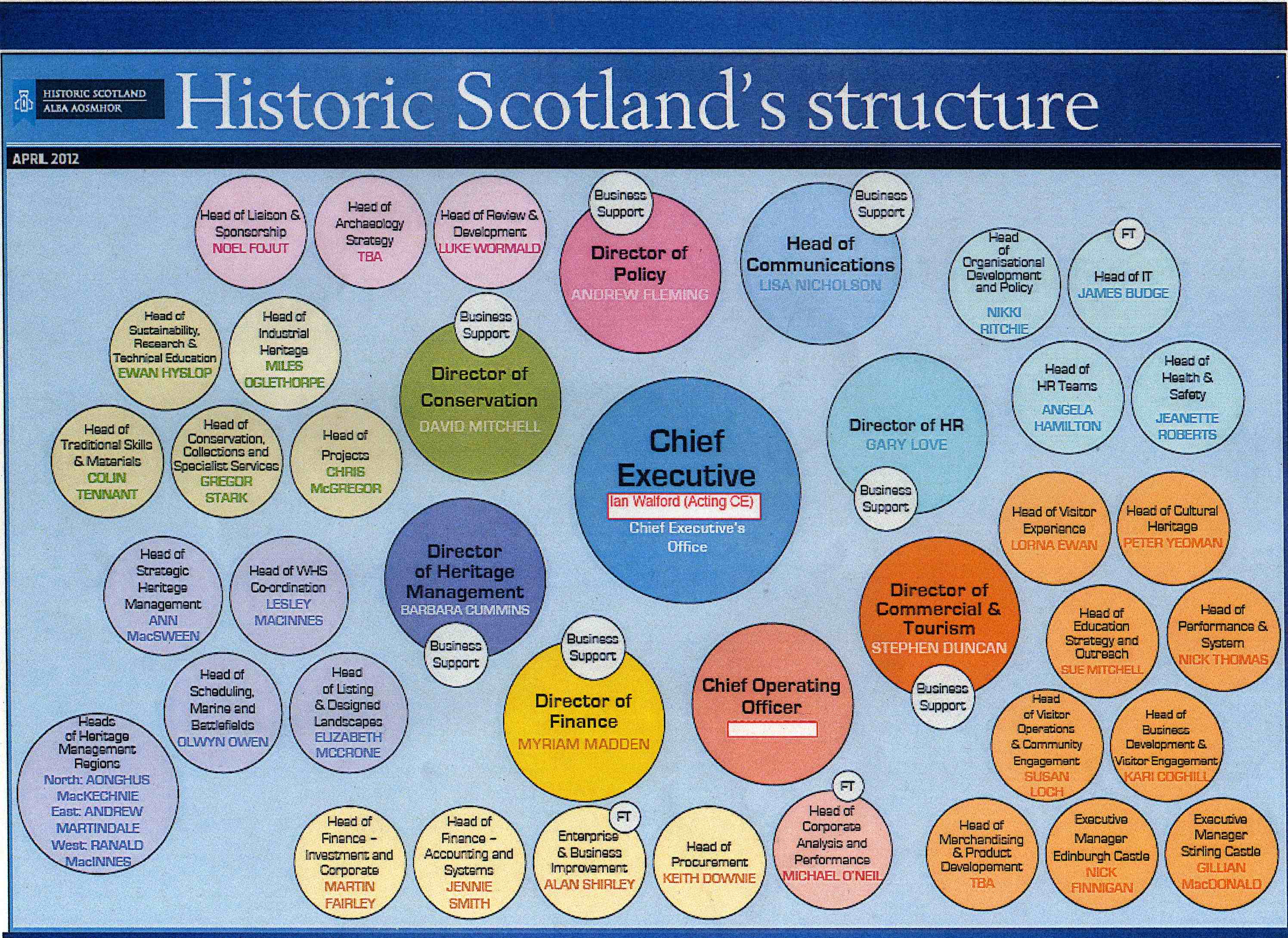
Perhaps the best explanation for why such a well intentioned damage limitation exercise should go so awry is to examine the HS Org Chart that came as part of the presentation. I have seen few better examples of a visual metaphor for an dysfunctional rabble that little understands how to operate in the real world.

HistScotOrg

Posted in Community | Tagged | 1 Comment

Buried but not Forgotten

This evening for the third time in the last few years, I put my head in the lion’s mouth as I dared to venture up to the West end of the county and deliver a talk on Mining in East Lothian. As with the other two times, the St Clement’s Men’s Club in Wallyford heard me out with patience and—as with the other two times—embarrassed me with the riches of recollections that brought a presentation of facts to life with their embellishments.

Despite the fact that the last East Lothian pit closed 47 years ago and last in this area (Monktonhall) over 15 years after a heroic attempt by the miners themselves to give it a future, there were ex-miners still in the audience and most of the others had fathers or uncles who had gone down the pit. This area around Wallyford has been steeped mining for a thousand years—since the monks of Newbattle created the main village street—Salter’s Road—to carry the surface-mined coal down to the salt pans along the coast below their Preston outpost.

Whether my flawed and incomplete history did a thousand years of hard graft, sacrifice of generation upon generation and tradition adequate justice is not for me to judge. Their generosity in listening attentively and then filling in much of the humanity as well as the details missing from my account was an experience for me that compensated me for my own shortcomings—such as how miners had to ride on top of the trams along the Bottom Pans because they had no baths at the pit, or being forced to work 2ft-high seams at Limeylands lying on their sides swinging a pickaxe for a full shift.

What was particularly striking was that any telling of such tales verged on the shy, was matter-of-fact to the point of dismissive, as if everyday facts of life that hardly need be remarked upon. These were not men figuratively chest-butting tales of accomplishments but people no strangers to hard graft in a hard environment simply telling it like it was. That dialogue after the presentation taught me more about mining and miners than several books, multiple visits to the Lady Vic and Prestongrange and extended hours trawling the web for details and pictures of the people who mined coal here for those thousand years.

And it is hard to find much photographic record of the mines themselves, let alone the once-indentured slaves who mined the black gold that drove our industrial revolution and Scotland into becoming the richest country in the world exactly a century ago. There are few snaps of miners above ground and almost none of the circumstances in which they worked—even the more modern conditions of new deep superpits like Monktonhall with its fluorescent lighting, its two-storey express lifts (3,000ft in 3 minutes) or the underground diesel trains to the face.

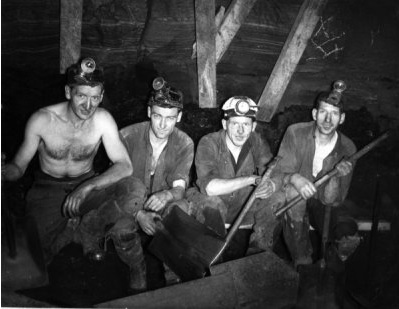
But I had found one picture of four miners at Fleets taken underground. And, as I showed this slide there was a laugh—one of the miners pictured was right there in the audience and I was able to fill in another tiny piece of this huge jugsaw.

MinersUngrnd

John McNeill, Peter Murray, Maxwell Gordon and Bob Thomson on a break at Fleets Colliery, Ormiston circa 1957

John is a lively 87 now but still carries a catheter from the time a charge went off prematurely and half a ton of coal buried him. Like most else about their hard life, as a miner he makes little fuss about it, or about all the other stories now long buried at the bottom of a thousand abandoned mine shafts all across the Central Belt.

Posted in Community | Tagged | Leave a comment