How would you build a nation?

The Burd is no stranger to nailing the Zeitgeist but anyone on the swither about whether Scots should run their own affairs reading this won’t get fiscal stats why we’ll be better off. But they will get lump-in-my-throat-pride at being Scots.
The only obvious omission from her uplifting list is a scribe whose passion lucidly articulates how a nation can better itself. But the Burd is too modest to list herself.

burdzeyeview's avatarA Burdz Eye View

If you had the chance, how would you build a nation? What qualities would you want your people and communities to have?

Courage, certainly. To decide in a split second that the right response, the human response to extreme adversity is to turn and face it, not run from it. Just as Jim Murphy MP did when he found himself passing the Clutha bar in Glasgow just as a terrible incident occurred. He could have stayed in his car, called 999 and waited for help to arrive. Instead, he and others, acted to save others, walking into an unknown situation, compelled to do so by some unbidden sense of duty and willing to set aside notions of risk in order to help people in need.

Also, prescience of mind. The ability to make a judgement call and make the right one. Thus, it was not enough for Edward Waltham to…

View original post 1,168 more words

Posted in Uncategorized | Leave a comment

Per Ardua Ad Asda

It may be flippant to paraphrase the RAF’s motto into a cynical equivalent for the Royal Navy but purchasing chickens now coming home to roost under Admiralty Arch are a product of a whole series of predecessors to the luckless Phillip Hammond as Minister of Defence. All of them have been faced with an impossible task: sustain global commitments on a shoestring budget. His particular crime? To be the mug holding the parcel when the music stopped.

For decades, Britain has deluded itself that it could achieve the twin goals of securing jobs by building huge defense contracts in the UK. Despite some catastrophic outcomes from this—from Blue Streak in the sixties to Nimrod replacement in the noughties—’big-ticket items’ like warships have been built in UK yards, most recently mostly those of BAE.

BAE is a prime illustration of how heavy industry in the West struggles to survive in a world where developing countries are increasingly assuming their own naval shipbuilding. Worse than that, it is now obvious that a private company’s primary focus on profitability cannot be reconciled with a government’s sovereign requirement to build warships in domestic shipyards.

It is now equally clear is that European governments eager to cash in on the post-Cold War peace dividend deluded themselves into believing that costly and unprofitable industrial activities, such as naval shipbuilding, would become sustainable and affordable simply by virtue of being handed over to private industry. This convenient fiction—that privatised shipyards can better compete for commercial ship orders—is now conclusively discredited.

Reality has now prevailed, starting with the RN building its next replenishment ships in South Korea because British shipyards couldn’t compete on price, & the Royal Navy budget balked at paying British prices. So much for Scottish yards being banned from bidding for RN contracts post-independence. Even Hammond has been forced to concede:

“We hear a great deal about how shipbuilding will be sustained through the commercial market and the third-nation market, including the market for warships, but I am afraid I have seen no evidence to suggest that we are able to compete in what is a very aggressive global market for commercial shipping.”

What is that ‘global market’? Well, the situation a century ago was Europe built 80% of the world’s ships and the Clyde was grandaddy of ’em all. That profile has changed massively with Europe down below 20%, South Korea boasting 8 of the 10 biggest yards and even Japan being beaten to those last two spots by an emerging China. As well as dominating the market, these three countries have effectively edged European yard out of most shipbuilding segments.

Share of SHipbuilding Segments by Major Producers

Share of Shipbuilding Segments by Major Producers (CESA = All Europe) (source: Study on Competitiveness of the European Shipbuilding Industry, ENTR/06/054, ECORYS SES Group)

Europeans had already been penned into the most expensive passenger segment (liners, ferries, large yachts, etc), as well as the similarly expensive military (not listed above because relatively small in tonnage). Meanwhile, low labour costs (not necessarily labour efficiency) have secured oriental yards the bulk of world tonnage construction, 99% of it for export.  Despite their technical skills, Europeans gave up competing in the bulk carrier market; even the Danish container giant Maersk couldn’t build its own ships economically.

However, because of jealous protection of home industries endemic in Europe, over 300 yards still exist—most of them hopelessly small and inefficient and just a few (like BAE) more hopefully big. But still inefficient.

Map of European Shipyards Coded by Size

Map of European Shipyards Coded by Size

Whereas European production per enterprise averages €4m, in South Korea it is €22m and €34m in China. Such efficiencies of scale are amplified building a 350,000-ton ULOC or 500,000-ton ULCC. The Portsmouths and Govans—let alone the St Nazaires and La Spezias—have been coddled from this cold reality so long they cannot compete on a level playing field of true competition, This is doubly true as recession still depresses shipping demands, operator incomes and shipping earnings, as measured by the Baltic Index.

So, even if the dozen-or-so Type 26 frigates as desired by the RN (plus proposed yesterday to form the blue water element of any Scottish Navy) are built by what remains of BAE shipbuilding, such has been the isolation of most yards from economic reality by their  governmental protection. Unless BAE makes a step change to its yards’ efficiency, these may be the last bespoke warships the RN has the luxury of commissioning.

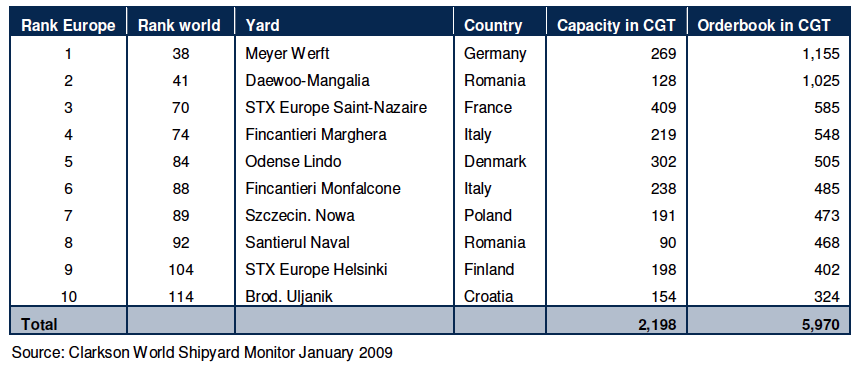
Had the Admiralty been less bloody-minded and followed the RAF’s more pragmatic procurement, the acceptance of ‘foreign’ designs (c.f. American Apaches or Eurofighter Typhoons) might point to more positive options where they retained some control. But shipbuilding in the UK has become a shadow of itself even more than it has in Europe.

Top Ten Shipbuilders in Europe

Top Ten Shipbuilders in Europe (Note: STX indicates a subsidiary of STX in Korea)

Any further large warships for the UK are therefore likely to be limited to non-custom (and non-local) designs with broader appeal and built by yards that can spread costs across many multiple units and customers. That’s how orientals shrewdly came to dominate this business—as the shipyard equivalent of ASDA.

Posted in Commerce, Transport | Tagged | Leave a comment

Britain Is Broke

Making that statement does not fill me with great joy. There may be an entirely different social debate about wealth distribution that could equally have headlined “Britain is Broken” but this blog is about fiscal facts—that Brown’s smug ineptitude and Osborne’s bitter medicine have combined to bring one of the world’s great economies effectively to a level of stagnation that few (no?) analysts predicted seven years ago.

The statement is made with reluctance because this author is British, shares the islands’ culture with the other three nations and is downright proud of how much this medium archipelago influenced the development of civilisation. All great stuff. But all in the past and, rather than wear our stiff upper lips, hoping they’ll provide more than further demonstrations of fortitude, we all need things to change.

We Scots need our chance to find our own fortune. This deal with our English friends has been a good one for both sides. But, ever since the Masters of the Universe took over the asylum (sorry—Canary Wharf), England especially has lost the plot and there is little sign of it re-finding it, even after the most serious fiscal train wreck in living memory.

So the Scots are offski—and here’s why. Whereas, once, big countries were the answer to endless petty wars that plagued civilisation, now we’ve learned to coexist and desist from nuking each other, a similar extinction-level event to that which once wiped out the dinosaurs is underway: it’s the smaller, nimbler, more flexible creatures that will survive. Britainosaurus has gone the way of Monty Python’s parrot—it’s just too ponderous  a beast for news that it’s dead to have reached its tiny brain yet.

And, lest some flag-waver think I’m being flippant and/or biased and/or too lazy to put a substantive case, allow me to post as exhibit ‘A’ the table below, which draws together some salient figures, comparing the economy of Scotland with that of the UK.
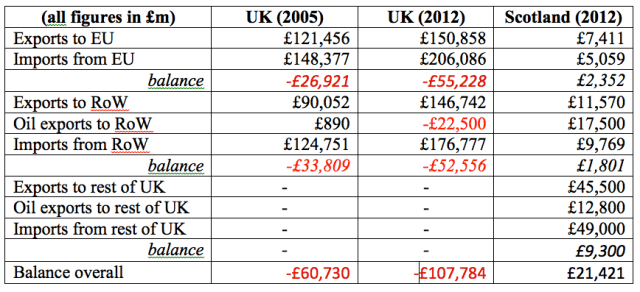
Key Trade Balance Statistics for UK and Scotland

Key Trade Balance Statistics for UK and Scotland

The first thing to notice is how the situation has deteriorated for the UK as a whole. In the seven years to 2012, the trade imbalance worsened with that between UK and EU doubling. Also notice that the UK became a net oil importer, losing a once positive balance to spend 10% on importing what we once sold. The result is that the worrying £60bn trade deficit of 2005 has ballooned to almost double and new represents each person in the UK living £1,710 above their means each year.

Contrast all this with Scottish statistics, which Whitehall has doggedly obfuscated in their eagerness to undermine the idea that Scotland is economically viable without the steadying hand of its bigger brother down south. Note that in all three main categories, the Scottish account is positive, culminating in an estimated £21bn trade surplus, once the largest chunk—trade with England—is taken into account. Small wonder that anyone in Whitehall in the know is desperate for Scotland not to leave.

Even allowing for inaccuracy and the extensive negotiations that would precede any such step, these figures don’t just make a formidable basis for an independent Scotland; they flag a little caution to both our English cousins and to anglophiles in Scotland too (among whom I count myself). Because we all live in an interwoven world. If the fortunes of distant trade partners affect prosperity, how much more true for our close neighbours?

Even if the future were blindingly rosy for the Scots themselves, little would be achieved thereby if England were to continue on its present socially disruptive and fiscally dogmatic path. Look at the numbers above: trade with the rest of the UK (94% of which is England) dwarfs Scottish trade with elsewhere. Though Scots will make their own choices, ignoring what would be good for England (even if England seems oblivious to what that might be) will damage the Scots ability to achieve new aspirations. If the English economy sneezes, we will still risk catching flu.

So what might that entail? Keeping the pound for one. It’s in both our interests because: a) it will cause least disruption to Scots business and keep an economic flywheel working for us and; b) the English will benefit from it remaining an oil currency and Scots exports propping up its exchange rate and bank interest grade.

A second is steadying the English wobble on Europe being fomented by UKIP and benighted Tory backwoodsmen. Clearly the EU needs some straightening out but, in LBJ’s pithy phrase, it’s much better to have ’em in the tent pissing out than to have ’em outside the tent pissing in. Look at the trade both England and Scotland have with Europe; we both need to be at the table (with Eire?) making our case against Spanish fishermen, French farmers and all the other initiative-stifling lobbies.

We could even spare England a wheen of pain on defence. Without the Scots, their £40bn defence budget would be doubly unsustainable. This will force the MoD to take either the decision to axe England’s long-expired global role or to cancel Trident’s replacement for which there is no sane use—or both. Forming a team with Scotland and Eire, English defence could focus on heavy ground forces, long-range naval ASW/strike ability and a beefy air force to combine with Scots and Irish doughty infantry and specialist long-range maritime security into an interlocking North Atlantic component of NATO.

And, if the Scots succeed—as they are lining up to do—in becoming the literal powerhouse of Europe, leading to us breaking down centuries of British isolation by re-forming close ties we once had across the North Sea, this would finally drag the English closer to their natural allies—the Germans. And if they taught all of us a thing or two about supercharging economies, how much different would the EU look? Imagine a productive, socially advanced northern bloc leading the rest out of Mezzogiorno miasma to more enlightened prosperity, setting an example to BRICs, the 3rd world & even the USA itself.

It sounds very high-minded. But so did the Magna Carta, the Declaration of Arbroath and the Declaration of Independence. But in the turgid, post depression atmosphere of today are such inspirational concepts not urgently needed? For it is always some ordinary folk, moved by passion and belie—and never the smug establishment—who achieve mankind’s great advances, especially when confronted by a dim and uncertain future. If Britain is indeed broke, then at what point do we stop trying to fix it, lift our eyes and move on?

For when would be a time of greater need for advancement than now?

And who is in a better position to achieve it than the Scots?

Sources:

  • Scottish Tax Forecasts, March 2013, Office for Budget Responsibility, ISBN 978-1-909096-74-5
  • Scottish Draft Budget 2014-15, September 2013, ISBN: 978-1-78256-844-5
  • UK ENERGY IN BRIEF 2012, July 2012, DECC/1.3k/07/12/NP. URN 12D/220
  • Estimating Oil and Gas Flows for Scotland, November 2013, Scottish National Accounts Project (SNAP)
  • Scottish independence: the fiscal context, November 2012, Institute of Fiscal Studies, ISBN: 978-1-903274-96-5
  • Energy imports and exports, 30th August 2013, House of Commons Library SN/SG/4046
Posted in Commerce, Politics | Tagged | Leave a comment

Enough with Racket Science

Yesterday, my normally chatty barista went all quiet when one of my coffee buddies brought the chat around to independence by speculating on the White Paper due out this coming week. When prodded, she looked awkward, but blurted out “What with all these deadbeats on benefits and students not paying fees, we couldn’t afford it.”

But it set me to thinking: with all this barrage of misinformation across the media, why wouldn’t it look like a bad deal? Back in March, the Daily Record was wringing its hands at a “huge drop” in North Sea oil tax, quoting Michael Moore in furrowed-brow mode:

“There is a gulf between those independent OBR figures and the hugely optimistic numbers published by the Scottish Government last week.”

Last week, the Institute of Fiscal Studies published their Briefing Note 135 “Scottish Independence: the Fiscal Context” As with so many such papers, Better Together fell over themselves using it as evidence that more taxes or less services would be inevitable while Blair Jenkins declined to meet it head-on, saying only:

“Only a yes vote can put in place the economic levers to produce policies best suited to the needs and aspirations of our people.”

Enough with this racket science where one side tries to drown out the other. It’s the reason one in three Scots remain undecided on this vital matter. Most are clamouring for some information they can trust to help them decide under which choice they or their family will prosper better and life will be the rosier.

Let’s de-fang some of the numbers and maybe opposing arguments will make more sense. The Office of Budget Responsibility (OBR) is the UK’s attempt to provide independent commentary on government finance, especially its projections. The 40-year-old IFS is “Britain’s leading independent microeconomic research institute, and as authoritative commentators on the public finances, tax and welfare policy“. As both are London-based, expecting 100% objectivity may be asking a great deal. Nonetheless their analysis is by professionals and pivotal questions thrown up deserve reasoned answers and not just more boo-sucks racket.

OBR projections in March for tax revenues collected within Scotland to drop were described as “disastrous”. But examining the numbers and taking (as OBR does) UK Treasury projections as reliable, this means (for example) UK income tax take will dip below £144bn this year but then rise rapidly to £188bn in 2017-18. Income tax take in Scotland is proportionally far lower—around £4.46bn this year, rising to £5.54bn by 2017-18. This is lagging UK growth in tax take by over 5% and was seen as an example of how staying in the UK would benefit Scotland.

However, what was not said was the comparison with Scotland’s settlement, already projected over a similar period to drop from £30.6bn to £27.2bn—a 10.9% reduction. Put another way, Scotland staying in the Union means that the UK Government will get around £0.28bn less in income tax from Scotland than it might expect from a similar-sized chunk of England—but it will save £3.2bn in the basic devolution grant to the Scots. Sweet.

This newer IFS analysis is full of statistics, most of which seem correct. They (rightly) detail that money spent is £11,801 per head in Scotland but some £1,200 lower in England at £10,630 (2010-11 figures) and point to the following as main differences:

  • enterprise and economic development (£157 per person vs £80 per person);
  • agriculture, fisheries and forestry (£184 vs £84);
  • transport (£521 vs £345);
  • housing and community amenities (£340 vs £206);
  • recreation, culture and religion (£301 vs £209).

The second and third points are easily explained in that each Scot has 30 times as much geography (and most of it rugged) as compared to England. That takes care of 1/4 of the difference right there. But it is when we examine the contribution made that the balance is seen to be fully compensated for. Like the UK government, IFS are coy when it comes to allocating oil tax revenues—arguing they might be allocated on several bases, such per-head—and lump them into a third ‘region’ neither Scotland nor England but ‘offshore’.

But the only legally tenable solution (and that used globally for the allocation of maritime resources) is geographic, with Scotland owning 80.4% of the oil and gas resources in UK waters. On this basis, even the IFS accept that Scotland pays more than its share:

Revenue Income to UK Government

Income to UK Government from Scotland

So, even the IFS (when pushed) accepts that Scotland contributes more than it costs. But, while it may provide accurate figures and manipulate them accurately, the IFS paper makes several major assumptions that seem like suspicious attempts to undermine independence and echo unionist arguments of the fiscal dangers of not being in the UK.

  1. Oil Price. We are forever hearing how volatile the price of oil is. But not one oil economy is poorer than Scotland.  Norway has even managed to amass a £300bn oil fund in the past, so it could not have been all bad. Moreover, examine oil prices and we see spikes in the seventies and in 2007/8 but the other 90% of the time has seen a steady rise from $15 to $110 per barrel, which means what is still to be pumped will be worth a lot more than what has already been extracted. Recent private announcements of £4bn investments in exploration confirm a solid future for decades.
  2. Policy Inertia. Nothing in the IFS paper allows for any change of policy from that laid out by Cameron and Osborne for the UK. Leave aside whether they still call the shots post-2015. Their UK-based vision sidesteps much of the fiscal advantage independence offers. On defence alone, Scotland could save £1.5bn annually—£300 per head. Even policies already devolved offer relatively easy savings (free concessions, eye tests, prescriptions could re-inject £1bn into the coffers if repealed)
  3. Public Debt. From modest levels when Prudence was alive and well, Tories and Labour alike have saddled us with massive public debt—currently £1.2tn and growing at £8bn each month. The Scottish share of that will have grown to £120bn before we can achieve independence. It would take £2.5bn to service that and start paying it back. The good news is that’s achievable by oil revenues and defence savings alone (see above). The UK will not find it so easy repaying £30bn annual interest, especially if they don’t keep the Scots within sterling zone and the UK£ is no longer an oil currency.

So, neither the OBR nor the IFS should be seen as enemies just because they’re used by desperate unionists in their racket science. Once understood, their papers fuel the arguments that independence could provide an enlightened Scotland with fiscal wriggle room to re-think modern tax policies—drop Corporation Tax, get heavy with rich exiles, re-think land ownership and support growing industries for the future like renewables, food and drink (esp whisky), specialist engineering (esp marine and computer games), tourism and even bulk water export.

If a fraction of all that were to succeed, 10,000 jobs with a future are neither pipe-dreams nor insignificant in our much smaller workforce. Quite apart from a positive effect on tax take, this would have significant knock-on in service industries, retail turnover, property values and balance of payments. And if this seems to be fueled by optimism, it needs far less optimism than Osborne’s shaky recovery that seems too dependent on consumer debt and London property values than any significant boom in real industry or export.

Or are we so fixated on the UK’s own admittedly scary numbers that we’ve forgotten how gallus we could be in going out and creating ones that suit us and our ambitions better?

IFS: Scottish independence: the fiscal context (P. Johnson & D. Phillips) Nov 2012 BN135—ISBN: 978-1-903274-96-5
OBR: Economic and fiscal outlook—Scottish tax forecasts March 2013—ISBN 978-1-909096-74-5
Posted in Commerce, Community, Politics | Tagged | Leave a comment

The ‘Lords’ Prayer

—may those who take the Jubilee Line to St John’s Wood meet the Test.

OK, so it’s two months late for National Poetry Day (Oct 4th) whose theme for 2013 was supposed to be ‘water’. But the poem below popped up on Twitter soon after a trip to London, during which I traveled much of the Under- and Over-ground and a subsequent lively discussion with a friend of the relative merits of Boris reneging on a promise to keep Tube ticket offices staffed.

Compared to two Scots’ high-minded debate on efficiencies, workers’ rights and the best way to get about the place, this poem somehow better captured both the ubiquity of the Tube and knowledgeable and irreverent way the real locals ‘dahn saff’ treat any such unavoidable omnipotence that has come to dominate their daily existence.

Lord'sPrayer

Posted in Transport | Tagged | Leave a comment

On Top of the World

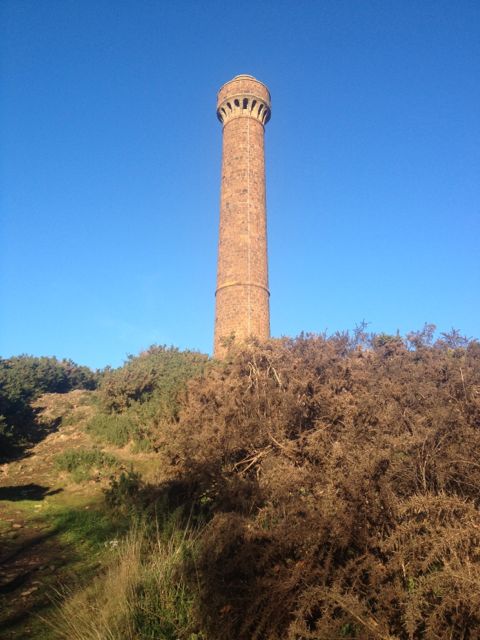
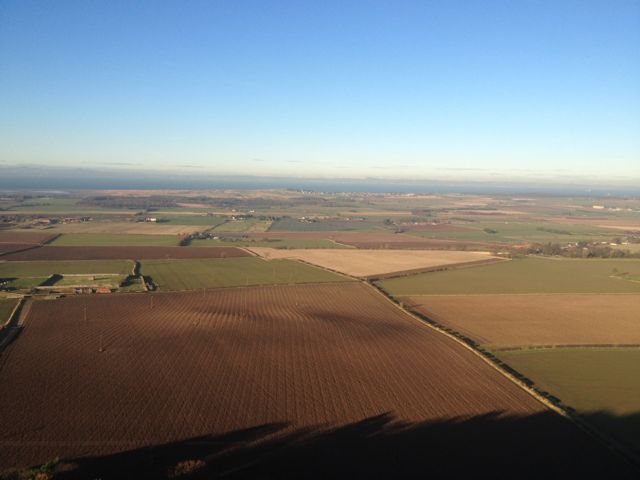
At lunchtime, on my way in to EL Council offices in Haddington the skive inspiration hit me and veered me off the A6137 at West Garleton to puff my way up Byers Hill and the 133 steps to the top of the Hopeton Monument. We don’t normally get such clear, still days here in the depths of normally dreich November; this was a special treat, well worth the skive.

The 20m Hopetoun Monument atop 186m Byers Hill

The 20m Hopetoun Monument atop 186m Byers Hill

The car park is at the base of the hill and a good 50m below the summit itself. Use the kissing gate on the entrance road leading direct to the slope—the easier looking access at the end of the car park does not lead to the summit. The views from the hilltop are good but not a patch from those at the top, so do make the effort to climb all the way.

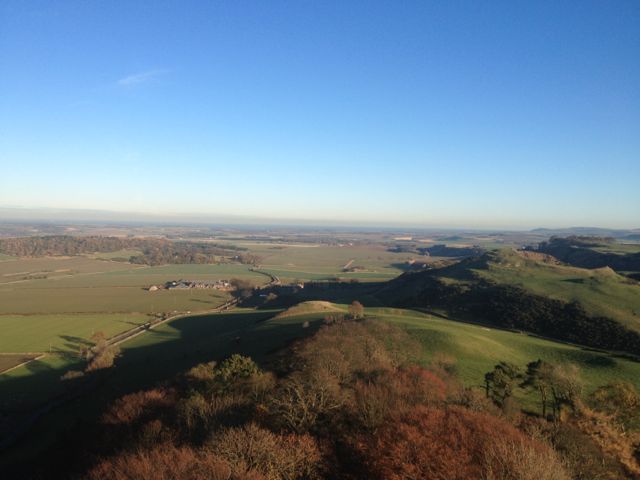
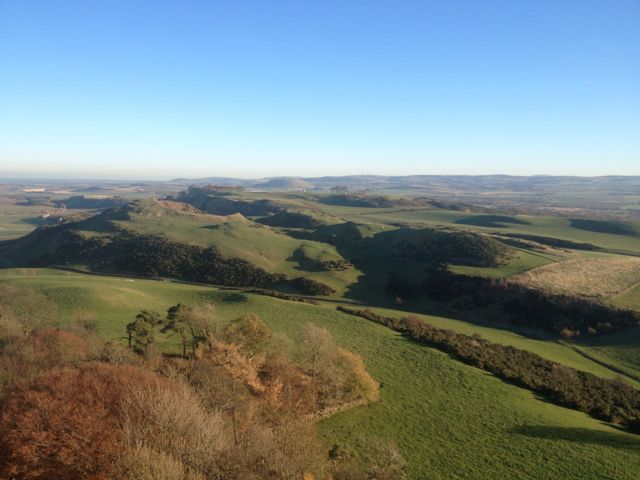
The entry is on the SE side with the size and pitch of the steps visible here so you can judge if you’re up for it. Be aware that the spiral stair is narrow and lit only by the odd slit in the stone walls so bring a torch. However, although the steps don’t get narrower as you go up, beware a crow’s nest in a slit just past halfway up (now apparently deserted). If cardiac arrest doesn’t get you first, the top offers the best 360 degree view in East Lothian (better than Berwick Law) because you can see virtually the whole county—as well as most of Edinburgh and much of Fife.

The the NE—Berwick Law and the Bass Rock

To the Northeast—Kilduff in the middle ground with Berwick Law and the Bass Rock in the distance.

To the East

To the East—Athelstaneford in the middle distance with East Fortune Museum of Flight beyond

To the South-East

To the Southeast—Kae Heughs in the foreground; Traprain Law and Dunbar in the distance

To the South

To the South—Haddington in the middle distance and the Lammermuirs along the Horizon

To the Southwest (and into the sun)

To the Southwest (and into the sun)—Billy Logan’s hugely successful East Lothian Produce and Moorfoots in the distance

To the West

To the West—West Garleton Farm in the foreground, Pentlands, Arthur’s Seat and Edfinburgh in the distance

To the Northwest

To the Northwest—Cockenzie Power Station to the left, Aberlady to the right and Kinghorn beyond Inchkeith & the Forth

To the North

To the North—over Ballencrieff and the railway towards Gullane with Fife’s Largo Law barely visible in the haze

Other than how clear and pretty it all is, what is perhaps reassuring after scanning all round is an unspoiled rural nature of the view: all towns lost in the distance; only fields and far hills dominate the landscape in every direction. Any developer hell-bent on breaking the so-far-intact DC1 policy of East Lothian Council’s Planning Department should perhaps be taken up the monument and shown this view. If they have any soul, they will relent. Otherwise it’s a really good place for justice by defenestration.

Dedication to

Monument Dedication to the 4th Earl of Hopetoun—with Bicentenary fast approaching

Posted in Environment | Tagged | 2 Comments

“Planning Scotland’s Seas” Consultation

(Submitted as a personal response to the consultation: would be interested to hear any other comments that were made in response to http://www.scotland.gov.uk/Topics/marine/marine-consultation)

Background

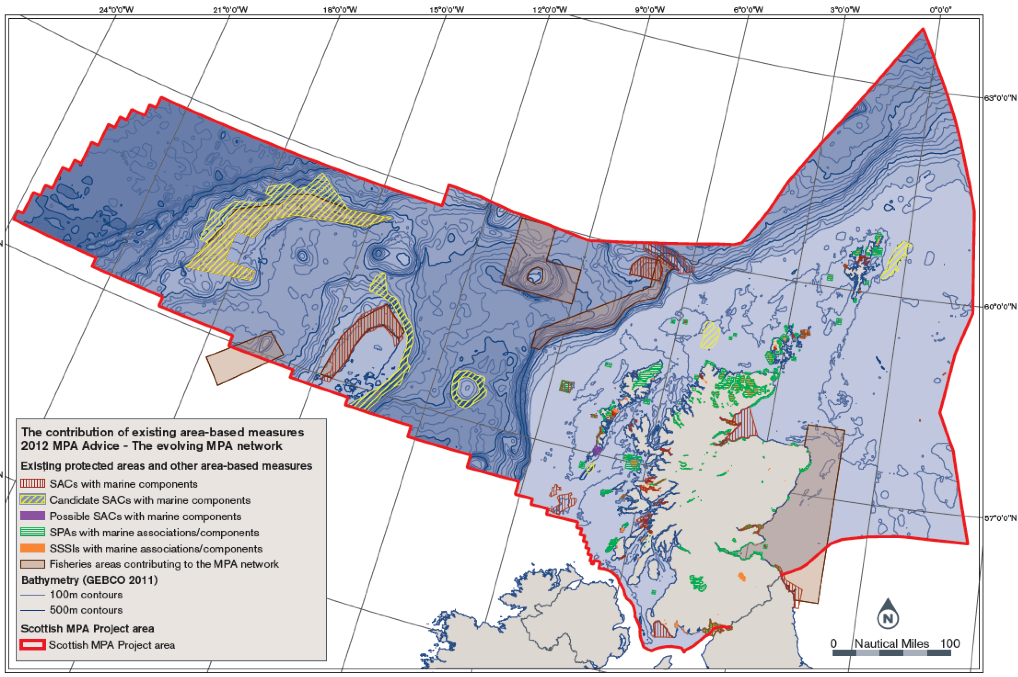
My comments are confined to the territorial waters element Southeast Marine Region (Between Montrose and Berwick and out to the 12-mile limit), as that is where the bulk of my interest and experience lies. Not only does this area see the densest marine traffic (including all Grangemouth refinery traffic) in and out of the Firth of Forth but it also is to be the focus of three major offshore wind farms. With an average depth around 50m, concern about sustainable stewardship of the seabed becomes a concern because of the demands made on it.

Map of Scotland's Seas: (Note how much larger they are than Scotland—or England

Map of Scotland’s Seas: (Note how much larger they are than Scotland—or England

Issues of Concern

Currently there is no proposal for an MPA in the Southeast Marine Region. Because of its proximity to dense population centres and various pressures on it, the provision of an MPA should be considered for five reasons:

  1. Inshore (generally above the 20m depth line), unregulated fishing of crustaceans and removal of shore-bound shellfish (razor clams, whelks, mussels, etc) is damaging stocks and undermining sustainability. This lack of reserved areas (c.f. Maine USA) means conservation is actively discouraged and the free-for-all that devastated fish stocks and led to EU quotas is underway. The concept of Several Orders founders on the lack of local inshore fishermen’s organisations to define, legislate, implement and enforce them.
  2. The shallowness of water in the area allows easy trawl and dredge access to the seabed of the whole area. While prawn/langoustine fishing is generally non-destructive, scallop dredging is damaging to seabed life in general. Both are currently carried out without regulation and the demand from this area, being so close to its markets, is far heavier than, say, in the Western Isles.
  3. Whereas most wildlife is found to the North and West of Scotland—especially seabirds, a huge exception to this are the Forth islands that are home not only to the largest gannetry in the world and major puffin colonies but also to the Scottish Seabird Centre which is an award winning world leader in making Scotland’s maritime wildlife accessible to a wide public in a sustainable way. These populations have been threatened in the past (e.g. overfishing of sand eels by Danish fertiliser processors and invasion of Bass Mallow that decimated puffin colonies by blocking their nest sites). To continue with an open season in their key fishing area (most can fly less than 20km from base to feed in the nesting season) risks decimating their food sources.
  4. Because of its very different geography to the heavily indented West Coast and the absence of any significant sheltered waters protected from Northeasterlies, there are no 24/7 quiet water sites where fish farms or shellfish farms would be viable as an alternative.
  5. From an economic development viewpoint, local fisheries in the Southeast Marine Region are barely exploited. Most of the catch is wholesaled at points like Eyemouth; most of the local catch is consumed by visitors in Spain. With no security of supply, the incentive to invest in keep tanks, hatcheries, shared marketing and distribution to a disorganised spectrum of retail outlets means this situation is likely to continue indefinitely, despite Scotland being a byword in fresh quality foods in which East Lothian is generally a leader.

Possible Actions

If the present situation continues, then all five of the concerns raised above are likely to continue and probably worsen. It appears to make little sense to provide MPAs in remote sites if those accessible by the bulk of the population (especially in the tourist season when they are joined by thousands of English and foreign tourists) are to lack any and suffer the consequences to wildlife and its sustainability. Actions to be considered before significant and irreversible damage occurs would include:

  1. Consider an MPA for the outer Forth and Tay that would permit continued fishing of all species but with effects on feed-stocks for wildlife monitored and capable of triggering restrictions.
  2. Facilitate the establishment of fishermen’s associations empowered to manage inshore stocks and receive financial support in providing infrastructure such as hatcheries and regulating access to areas for specific species to both enhance and protect stocks and businesses in a long-term sustainable manner.
  3. Lobby the appropriate government to avoid intrusion by others into the fisheries, including those that are known to be a key species in sustaining wildlife.
  4. Consider establishing a hands-on enabling agency that combines fisheries research (c.f. the former Seafish research unit at Ardtoe) with guidance in stock conservation and funding for infrastructure through the local fishermen’s associations so that they are seen to be both necessary and useful.

Conclusions

The consultation on Marine Protected Areas is timely but appears to have been poorly conceived when it comes to the special conditions in the Southeast. By being the most accessible and visible and having the most potential to provide economic benefits from marine resources, this should be considered as a prototype how an MPA could be seen as a force for progress and good, instead of the reactive and bureaucratic tangle of the (deep-sea only) CFP that causes such anger among our professional fishermen of the Northeast.

Posted in Environment | Tagged | Leave a comment

It’s Official: I’ve Become My Dad

It may have been a long time coming but what brought me epiphany was 4-5 days of solitude. While I really enjoyed this last summer, it is over and, despite pleasant weather, autumn is clearly hurtling winterwards.

Although it doesn’t qualify as hibernation, I have been ensconced at home with few interruptions and getting on with some of the writing with which I amuse myself on long winter nights. Sometimes when I am deep into it, all else is blanked out—no music or radio, nothing to distract—but more often, I run the television at low volume as a kind of background white noise that smooths out noise interruptions from the outside world.

As often as not, it will be a movie, even one that I know well. But over the last few months I’ve found my tolerance becoming frayed and channel-hopping becoming more frequent. When this transition to grumpy old man, dissatisfied with what the rest of the world seems to enjoy, occurred is not clear. But what is clear is that modern video culture and I have parted company.

For someone who has been a film buff for sixty years, cutting my teeth in the local Playhouse on its three-films-a-week magic, courtesy of a tolerant granny (with whom I was living) and 2/- pocket money that got a six-year-old into the cheap seats up front and change enough for an ice lolly at the interval, this latest development is worse than losing my youth; it’s losing touch with modern culture the way my dad got culturally alienated by the Beatles.

Because there are no heroes any more. Caught between Statham in The Mechanic and Washington in Book of Eli, I could find no alternative and switched off. I have never enjoyed endless soaps, ritual reality humiliation or strobe-lit game shows. But in between superb but sporadic documentaries and the Simpsons, films were why I paid the licence fee. Except, it seems I don’t like film any more.

Now, Denzel Washington is an excellent actor and the whole visual mood of the cinematography in Book of Eli is crisp and innovative. But if the script is monosyllabic, the story is non-existent. It carries the warning “some brutal violence and language” but I channel-hopped after the twentieth corpse and there was no relief in Statham’s permanent scowl and ever-re-occurring ketchup. Were this weekend just a spurious phase in film and Hollywood’s output had been on a higher general plane, I wouldn’t feel this bad.

But, starting in the eighties with Heartbreak Ridge on through to Black Hawk Down, there were a series of Star-Wars-level military hoohah that goes a long way in explaining why the US has such a bully-boy ‘big stick’ approach to foreign difficulties. Forget Ahhrnold’s or Sly’s outings—it spilled over into supposedly close-to-real filmings of Clancy’s incisively researched books…but turning them into Rambo XXIXVI. Once in a while something of the stunning authenticity of Saving Private Ryan comes along but it drowns in the tsunami of sludge.

I do not expect to be wowed by rom-coms—even if I am appalled when greats like de Niro freewheel through The Fokkers nor is Disney ever likely to snare me again the way they did with The Lady Is A Tramp (I was only ten) but I do long for another stunner to match Khouri’s Thelma & Louise when the most we get is made-for-TV bubblegum where some successful-but-single lawyer hits the Pinot Grigio over love/louse/child/career/illness.

But what gars me greet is the genre that once made my young urchin self bounce out of the cinema way past my bedtime, filled with aspiration to be some mighty character as I had just witnessed, is no more, cannot be found. The cinematic world has become populated with characters who are not just flawed—good heroes were always flawed and therefore human (think of Rick in Casablanca or Lean’s El Awrance)—but hard and unsympathetic. Though the Die Hard franchise starts with MacLean vulnerable as well as tough, by 4.0 he’s wooden as Statham…or Will Smith in I Am Legend, or Matt Damon in any of the (interchangeable) Bourne trilogy. Good though Daniel Craig is as Bond, he is too much  the automaton for me to feel for—let alone aspire to be—the character.

So, I have become my dad, a man at odds with the culture in which he finds himself living. There are some signs of progress from my pre-pubescent self. Fine films though they still are, black-and-white stalwarts like Above Us the Waves or In Which We Serve have aged culturally. But this week I came across a forgotten classic that threw all this into focus for me. The Professionals brings together a stellar cast: watching it gave the very rush of inspiration I felt half a century ago and thought I’d lost, especially in the spark between Marvin and Lancaster—both in cracking form at the top of their game.

The formula is one copied by Peckinpah in The Wild Bunch but not so sympathetically: take a bunch of worldly-wise misfits who’ve been through things together on a perilous gun-totin’ mission, throw in feisty eye-candy (Cardinale) and baddie you come to like (Palance) and a goodie you come to hate (Bellamy), lace it with glaringly bright desert backdrops and a pinch of humorous banter and you have a buddy movie to beat the band.

OK, so it is fiction as much as any of the others. Extras tumble off horses until you lose count. But do I care for these characters? Yes. Would I want to share their obvious mutual trust and camaraderie? Yes. Do I feel inspired that grit and fortitude are the only proper companion’s to a man’s beliefs? You betcha. Despite its rather brutal vehicle, The Professionals again made me believe that, not only could the world be a better place but that I still had my own contribution to make towards that. Not bad for a few miles of 50-year-old film stock.

It could be just old age, but I really don’t think they make ’em like that any more.

Posted in Community | Tagged | Leave a comment

Changing of the Parliamentary guard

In contrast to a friend, alienated by what he calls the ‘unedifying rammy’ of FMQs, this looks behind media’s fixation with sensation and points to those who have done real and undervalued work, despite party tribalism.

burdzeyeview's avatarA Burdz Eye View

2013 has, in many ways, been a transition year. It’s not over yet, of course, but November always seems like a good point at which to pause and reflect, before the hurly burly of the festive season takes over and we are then cajoled into looking forward to the year to come.

In many aspects of public life, this year has been a stepping stone, a bridge from the past towards the future. Moving forward requires leaving some stuff behind. Occasionally, we don’t get to do that voluntarily.

It’s been that kind of a year for Holyrood with the passing of three MSPs who were initiates of the Parliament when reconvened in 1999. The deaths of Brian Adam, David McLetchie and most recently, of Helen Eadie remind us that nothing stays the same.

There have been serious illnesses too for others in that original intake this year, with worried whispers…

View original post 549 more words

Posted in Uncategorized | Leave a comment

Big Brother in George Street

The Accounts Commission does a fine job. Given that local councils are run by (no offence intended as I’m one myself) a bunch of amateur councillors, as a result of the way they are selected, it is self-evident that some independent body to check how well they look after around £11bn in public money is needed. So their remit therefore makes perfect sense, viz:

“The Accounts Commission is the public spending watchdog for local government. We hold councils in Scotland to account and help them improve.”

Their publications mostly focus either on individual councils or on a service many councils provide in common. In both cases, they attempt to winkle out what is not being done well and make solid suggestions how improvements might be achieved. When they stick to their last, this is normally incisive stuff that goes unremarked by the press.

But last week, the Accounts Commission published Charging for services: are you getting it right? forty pages largely questioning why there was so much (and implying there should not be any) differences among charges to the public meted out by councils, such as library fines and sports facility access. Being something of a grey area, the status of the Accounts Commission and the criticism implied in its report was picked up by the media and was seen as criticism of council behaviour.

Now, this column is no apologist for Scottish Councils, who still have much to learn about flexibility and how to deal with uncertain income. But, clumsy in scale for giving effective democracy as they are, they are all we have to reflect ‘local’ decisions and the fact that Lerwick and Larbert have very different needs and therefore priorities in local services. The report seemed to take scant notice of this.

Coming on top of a disturbing series of one-sided decisions on councils taken by the Scottish Government—centralising fire and police; jamming huge extra housing demands onto hard-won local plans; strong-arming a council tax freeze long past its sell-by date; running a coach and horses through our justice system—there has been a growing democratic deficit that the toothless and passive CoSLA is unable to counter.

Whether that was the Accounts Commission’s intention of not, the media has taken their report as an indication that differing council charges are bad and that, somehow central regulation would be more ‘fair’. This is a nonsense and flies in the face of the very reasons why local government exists. This is compounded by the scale of local government in Scotland. Look at equivalents across western Europe and North America where councils have under 20,000 inhabitants, our average of 140,000 seems remote and clumsy by comparison—we are already on the way to the homogenisation the report seeks.

But, after decades of faceless bureaucrats in a distant town being resented for their unresponsive service, people even here are waking up to localism, whether it be manning museums with volunteers, dynamic sports clubs seeking partial support from their council or trade association cutting deals that they will water hanging baskets if the council would just provide them. A decade ago councils were awash with dosh. But now we need to find creative ways of engaging with the public to help or lose services is now being forced on us all by shrinking funding for everything, not just local government.

Why should councils not operate more like businesses, raising more revenue from services they deem to be less essential, providing better services to attract people to come to live in their area? People vote with their feet anyway—just ask Inverclyde, despite its stunning views of Cowal and look at house prices in Aberdeen where energy business is prospering. Why should a travel concession card allow travel on express buses to the other end of the country and be valid at rush hour when local bus services are being cut? Why should a sports centre not charge more and provide top-notch equipment to compete with a Bannatyne’s private club round the corner—offering equivalent quality but cheaper?

And if buses rate high in Kinlochbervie while sports centres do in Kinross, isn’t that why we have councils to provide—as far as is possible—what their residents want and not what some pencil-neck on Victoria Quay deems to be the universal goal from Rhinns of Galloway to Muckle Flugga? And, while we’re there, note that both lighthouses are not the same—the Northern Lighthouse Board seems smarter than the Accounts Commission in accepting that one size lighthouse does not fit all.

This logic applies in spades to Council Tax. While freezing it for a few years made eminent sense to help people through the recession, it is now hamstringing the very local democracy  we Scots are so bad at—and driving council charges upward because that is the only lever left to them to derive income. It is long past time to unfreeze it and, because all parties agree it is a regressive tax hitting the poor harder, get shifting on a fairer alternative that is not the now-discredited local income tax.

By allowing a bump in Council Tax, councils then would have the option of direct charging more for services or using the tax to levy funds across the broad population so that some disadvantaged group in real need of funding would not bear the whole financial burden. And if a council ratcheted its rate up by an excessive amount, governments have not been shy in capping in the past. Or they could take a more enlightened view and use Housing legislation to help people move where the rate was less usurious.

However, prior to that, the council tax structure needs adjustment to be less regressive. A local income tax is discredited because people in mansions with little income would pay little. The poll tax remains discredited for similar reasons—the value of the home is not taken into account. But there are other ways to skin this particular cat and one is to split higher bands and add a few more so that the top rate of council tax became a mansion tax. This was posited in an earlier column and bears repeating because it does problems with the above—reducing tax at the low end, boosting it in the middle and charging 1% of the value of mansions worth £1/2m or more, whose owners can afford it.

And if a council was minded to drop its council tax as an incentive to attract high-fliers by its more reasonable charges, this simply reflects the way most of the world—and certainly multinational business—has worked for some time. So, rather than berating councils for not being all the same, the Accounts Commission (and the Scottish Government) needs to wake up to the incentives and efficiencies available by engaging at those local levels, which would, in turn, lessen the current set of cuts and allow us to provide for those in greater need through the funds thus saved.

Posted in Community, Politics | Tagged | Leave a comment