The Real Britain

This is a reblog. I had been getting increasingly steamed up on the theme that this whole independence debate pivots around the wrong topic. At its root, it is NOT about what the Scots think of Scotland: it’s about what Scots and our English cousins think of Britain. On that topic there’s a wheen of difference and an edge to debate that threatens to turn ugly.

But before I could formulate this any more subtly, I came across Derek Bateman’s blog and found he’d already written a more incisive commentary than I could have managed anyway. As the man says himself:

“The British state, no matter which party is in power, (is) self-serving and contemptuous of the people it is supposed to serve.”

In deconstructing the British state and its culture, he asks if we really want this kind of government—an oligarchic monolith that knows every answer without ever having to pose questions—perpetuating a kind of Deus-ex-St-Trinians. This cultural nomenklatura has ruled us all uninterruptedly since “rebellious Scots” were brought to heel (if not crushed) and a Nelsonian blind eye turned to lucrative slave/opium/raw goods exploitation in which Glasgow became as sordidly complicit as Liverpool or Bristol.

And if you think that’s old-hat tobacco baron and/or Jardine-Matheson history, ask yourself what business British gunboats had in Brunei or Persia in the fifties, Oman in the seventies, Iraq in the nineties/noughties, right up to Libya last year. If your answer doesn’t include ‘oil’ then your understanding of what really drives Westminster appears flawed.

The real question: do Scots still want to be any part of a country like that?

Posted in Commerce, Politics | Tagged | Leave a comment

Politician: Heal Thyself

Just now, most people are preoccupied with enjoyed the feasts and bounty of the festive season; many of the rest are simply puzzling how to pay for their end of it. As a result, this may not be the best time of year for anyone to be banging the drum for in-depth reflection. On the other hand, when else does anyone have a whole series of days post-Xmas that can only be partly filled by film re-runs on Channel 5, bracing walks into the teeth of the wind and another turkey sandwich/casserole?

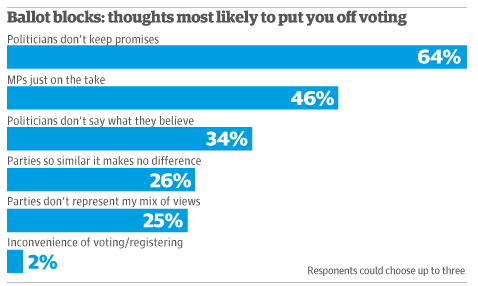
And if these hazy days are not a good time to take stock of the country and its management, when is? Clearly this was on the Grauniad‘s mind when it commissioned ICM Research to survey people’s attitude towards politics, using 2023 adults aged 18+ online on 20-22 December 2013. Although this was UK-wide, it has particular relevance to the referendum on Scottish independence to be held in September.

The results make unsettling reading for professional politicians, their hangers on and any idealists that are counted amidst their ranks. As the article reporting on the survey says:

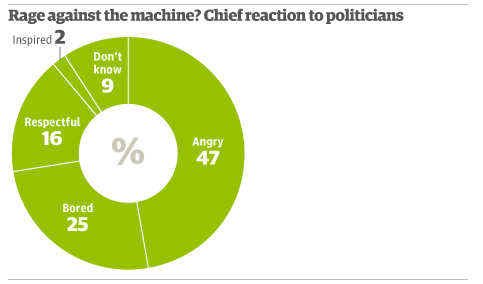
Asked for the single word best describing “how or what you instinctively feel” about politics and politicians in general, 47% of respondents answered “angry”, against 25% who said they were chiefly “bored”.

Negative sentiments vastly outnumber positive, with only 16% reporting feeling “respectful” towards people doing a difficult job, while a vanishingly small proportion of 2% claim to feel “inspired”.

Poll1PutOffsIn the years between elections, most elected representatives ride out unpopularity because the electorate has shown short memories in the past and starting any non-traditional pattern of voting to unseat specific incumbents is notoriously hard to do. What should be unsettling to the Scots is that, despite promises and good intentions to keep Holyrood pure of the braying partisanship on view at PMQ, we now have FMQs that have become indistinguishable in their braying partisanship. Most people are now put off by all of it.

Voter disconnect has become endemic among younger voters to the point where only 46% of sub-30s voted, vs 76% of over-65s did. Tory Chloe Smith has a ministerial brief that includes improving voter engagement. But she thinks:

“there is an existential problem coming for traditional forms of British democracy, which it is in everyone’s interests, all of us as democrats, to respond to. We have to demonstrate what politics is for, why a young person’s individual action in voting matters.”

This is equally true in Scotland, where the figures are even lower for deprived areas, swathes of which feel no incentive to vote because they feel their voice is ignored. Once upon a time, it would have been easy to blame that on Labour, who had represented such areas since Adam was a boy. But now the SNP represent as many such areas as Labour and have been just as monolithically party-loyal so that the voices of their constituents appear muzzled—even in those cases where they actually aren’t.

The result is a strong sense at grass roots that those who are elected ‘go native’ once there by kow-towing to party leaders and their politics and rarely take on the causes voiced by those who elected them: housing priorities in Arbroath or Ayr are driven by those in Airdrie. This sense then drives feelings that are not pretty. Gordon Brown’s former pollster Deborah Mattinson believes politicians have not begun to grasp the scale of the problem.

“Voter disengagement is getting worse and worse. Nobody is really taking it seriously enough.”
Poll2ReactionIf this were a poll on doctors or teachers, there would be politicians jostling to be in front of cameras to deplore such a result and speak emphatically how it should be tackled. But you’ll be hard pressed to find anyone on salary (with honorable exceptions like Margo or Caroline Lucas) between the Thames and the Water of Leith ready to take such appalling statistics on in public, largely because they know them to be true.

Because they are feart for their careers.

Now, it is fair do’s that you can’t represent everyone But you must do your best to judge the majority view among your constituents and either make it your own or explain to your electorate your reasons for not punting their position. Some 86% of people (whether they vote or not) think politicians take decisions that are Very of Fairly important to their lives so we are not dealing with ignorance and misunderstanding here.

Russell Brand expressed the disaffection of many in October when he told Jeremy Paxman on Newsnight that he had never voted because he “can’t be arsed“, adding later: “The only reason to vote is if the vote represents power or change. I don’t think it does.” Even those who dislike Brand and his style admit the accuracy of his comments.\

Which brings us to the Referendum. Though it has allowed itself to be distracted into trying parry the ‘All-Is-Lost-Brigade” clammy negatives emanating from the ‘No’ camp, the Yes campaign has also failed to inspire the 30-40% of Scots voters still sitting on the fence, desperate for understanding why one or the other choice will better the lives of their children, not to mention their own.

Plain though it may be to hardened nationalists that independence ripens fruits of all ilks, that message has yet to arrive among the switherers whose otherwise even-handed objectivity and openness to persuasion has been deformed—not to say poisoned—by the fact that the clearly political campaign being run to persuade them is obviously sired out of the same stable as the four parties of the Apocolypse whose collective gobshite has soured the air of debate for years before next year’s momentous choice was more than a gleam in His Eckness’ eye.

The Yes campaign therefore faces a major dilemma, highlighted by this timely ICM poll: continue with a well funded/focussed myriad-SPAD-driven (and therefore blatantly political) campaign that has run for a year now with no traction and an increasingly steep hill to climb…

…OR…

…dump everything successful politicians and their wolf packs of SPADs have learned in the last two decades—that dissent is poison; that policy is monolithically unquestionable; that, Rule 1, the Leader is always right, that, Rule 2, should he/she ever be wrong, Rule 1 comes into immediate effect. People want bonny fechters for their causes and not career-focussed lackeys. Because their is so much unknown, they want BOTH sides to be able to articulate a credible truth that lies somewhere in the middle between both camps.

The black-and-white-speak that fills each FMQ is now distinguishable from its English equivalent only by accent, not by content. November’s White Paper was beefy on many up-side arguments but piss-poor on facts/figures and dismissive of the (fair) case that there are risks involved taking a nation of 5.25m into uncharted waters. And what if it’s a 52% yes result on a 33% turnout? That’s a win—but how do you justify that morally to (let alone inspire with opportunity) the five in six Scots who didn’t vote for it?

If Fionn MacCumhail were to wake with his thousand Fianna so long asleep on our mountains awaiting our call and they were to scare the bejasus out of ALL our politicians so that they could speak only fairly and that from their hearts or if Wallace were to reappear and bang the modern equivalent of self-interested nobles heads together, would that ignite a real fierce, passionate debate on our futures that we all need?

If not, what would?: this is no rehearsal.

Forget the niceties of jousting within parliamentary rules and scoring political points that have zero value out in the real world. This is not just about next year’s referendum, major thought that is. It’s about the credibility of Holyrood itself. Was Bill Connolly right in this being “a wee pretendy pairliament”? And even if it does remain a devolved legislature of the United Kingdom, who will be inspired by it—let alone towards giving it full powers—if it is a jumped-up council, with council petty interests aping the tedious, self-importance of the Old Boys’ Club on the Thames because it knows no better ambition?

Posted in Politics | Tagged | Leave a comment

No Such Thing as a Free Lunch

As is its repeated wont, the massive EIS union has waded out into deep political waters well over its head by pressuring the Scottish Government to make all school meals free for pupils in the first three years of primary school (today’s Hootsmon). As a principle, it has merit—virtually all sources agree that ensuring all pupils are fed and nourished makes an impact on their ability to concentrate and learn and also removes one possible source of social discrimination among them. Most parties agree with the principle. But is it ipse facto that simple?

School meals have always had some social baggage—the kids whose parents both had to work, as well as those who were not good providers once made up the bulk of those in the school dining hall. Now that pupils typically don’t leave the campus at lunch time, there has been more of a leveling, especially now that swipe cards blur distinctions between those paying for their lunch and those using free meal entitlement.

The reason this policy has become a political football is a consensus that free school meal entitlement (FSME) acts as a measure of social deprivation in a school’s catchment area and (this point being more controversial) acts as an inverse indicator of academic performance. Such performance is itself a political football, with many (including the EIS and other teaching unions) scoffing that exam results are any measure of the quality of teaching received and more a measure of affluence, of engaged parents and their ability to hire tutors. The only scoff we make is that vocational qualifications should be equally venerated—but that’s for another blog another day.

As with any social science involving millions and complex demographics, single parameters are never able to tell the whole story. But the idea that free school meals are in the gift of government and have few opponents is appealing for politicians—including union officials—at a national level. There are few risks being seen advocating it. And it is not just Labour-leaning teaching unions trying to beat up on an SNP government. At their autumn conference in 2009, Jamie Hepburn MSP successfully moved and passed a motion for free school meals to ALL primary classes, not just to P1-P3. Despite  becoming party policy, this has yet to be scheduled as government business and passed into law.

But this leads to the fundamental question: who are the education authorities in Scotland? By law, it is the 32 local authorities, for whom there is very little point if their entire policy package is dictated by central government. That is already the case in class sizes, Curriculum for Education and Gaelic education. What’s the point of an Education Authority that does little more than set term times? Why can they not decide that their local circumstances require free school meals—or indeed a host of other choices like teaching Norwegian in Shetland, farming in the Borders or oil-related engineering in Aberdeen?

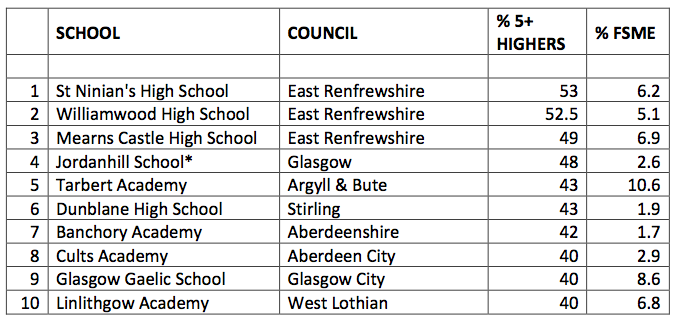
The whole premise that FSME runs inverse to exam results also does not bear much scrutiny. The table below is the top ten high schools by exam results with their FSME shown in percent of the enrollment.

'Top Ten' High Schools by Exam Results

‘Top Ten’ High Schools by Exam Results

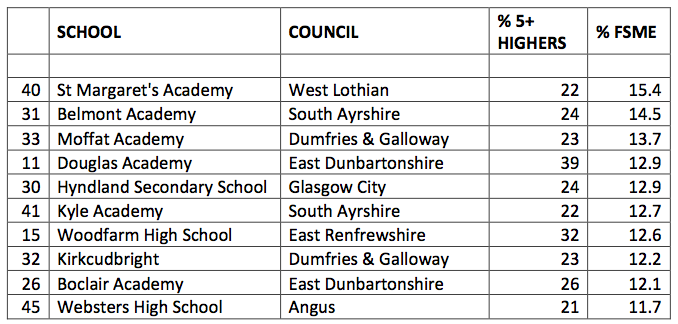
Only two have changed since last year. Impressive results as these are, there is a large variation in their associated FSME stats. If this were so decisive, why would Banchory not beat St Ninians as they have a quarter of their FSME? How do Tarbert or the Gaelic School do so well, despite 1 in 10 pupils entitled to FSM? Ansd what about those with substantial FSME? Take the highest 10 of these within the top 50 in exam achievement gives the following table:

Highest FSME High School within Top 50 in Exam Results

Highest FSME High School within Top 50 in Exam Results

What is striking among these is—despite high FSME stats—these are not all languishing near the bottom. Indeed Douglas and Woodfarm are not far off being in the Top Ten above. So, while a doubling of FSME over a broad range gives a rough halving of exam results, the variation between schools at both ends of the scales are huge.

At the bottom end of the table 14 of the lowest 20 are in one of the four cities; these range from 24% to 54% FSME. The half-dozen non-city schools range from 13% to 33%. Perhaps the most disturbing is the spread of schools within a given city: Glasgow has 2 in the top ten but 7 in the bottom twenty; Edinburgh has 0 and 3, respectively. While FSME provides some guide towards what exam results to expect, clearly there are other major factors at play, not least is that a general hierarchy of: suburban is-better-than rural better-than city applies right across Scotland and requires a less crude analysis than by FSME.

Educators, schools and unions all fall over themselves to dismiss exam tables as a measure of how good any school is. “There are very good schools in deprived areas which look like they are underperforming simply because their results are not so good.” (Dr Mark Priestley, School of Education, Stirling University). Interpreting such results through FSME may be too crude but, as it is based on deprivation, let’s look at its demographics through the Scottish Index of Multiple Deprivation (SIMD), published by the government.

Some 60% of best-performing East Renfrewshire lies in the least deprived quintile while barely 5% lies in the most. For Edinburgh, 45% lies in the least and 10% in the most-deprived quintiles. That again provides some explanation but does not answer why Douglas Academy can be just outside the top decile while Bo’ness Academy lies just above the tenth decile when both share FSME of 13%. What areas of East Dunbartonshire are not in the least deprived group around Kirkintilloch; few are in Douglas’ catchment. Most of the Bo’ness catchment is a mix of 2nd, 3rd & 4th quintiles.

So, SIMD might be one clearer measure. But after a study of such comparisons as the above, it quickly becomes clear that the real underlying factor (from which the more easily quantifiable SIMD and FSME derive) is the coherence of the community and its economic vitality. Visit Milngavie and Bo’ness and contrast the douce middle class suburb with the ex-mining/fishing/shipbreaking town that has yet to discover its 21st century purpose.

Scan down the list of ‘top’ schools above and every one is powered by motivated parents in a hinterland little different to Milngavie. Scan the bottom list and every one lies in areas blighted by economic decline—even Alness, where the smelter closed, rig construction has declined to nothing and tourists are hard to lure off the nearby A9. It is more than affluent areas sending their children to private schools; it is perfectly good state schools starved of motivated pupils because neither they nor their parents (some of whom are poor but many CAN spare lunch money for their children) see the point in bothering.

In an old Mad magazine cartoon, a character asked how many Elastoplasts it takes to cure a brain haemhorrage. Crusading union leaders and MSPs keen to board any passing bandwagon and boost their career might ruminate over Mad’s pallative ideas. Providing free lunches will cost significant money we don’t have to achieve nothing in academic terms and little in terms of nourishing the student body. Worse: it does nothing to address underlying causes—lack of community, of hope, of appreciation just how key education is to build futures, let alone how brutal the world can be, even armed with qualifications.

A more effective approach would be to examine the legion funded causes active in the Bo’ness, Wester Hailes, Castlebrae, Gallowgate, Shettleston, etc, give them targets and deadlines to succeed by putting themselves out of business and treat each area with a purposeful community plan so that residents have reasons to send their kids to school and interest enough to check the homework when they come back. Making excuses like “this school is excellent, given its catchment area” condemns another generation of our young to hopelessness, the buroo and, as the educationalists put it ‘non-positive destinations’.

A free or any other kind of lunch is useless—except as a platform for politicians.

Posted in Education | Tagged | Leave a comment

What’s Right with This Picture?

Cockenny

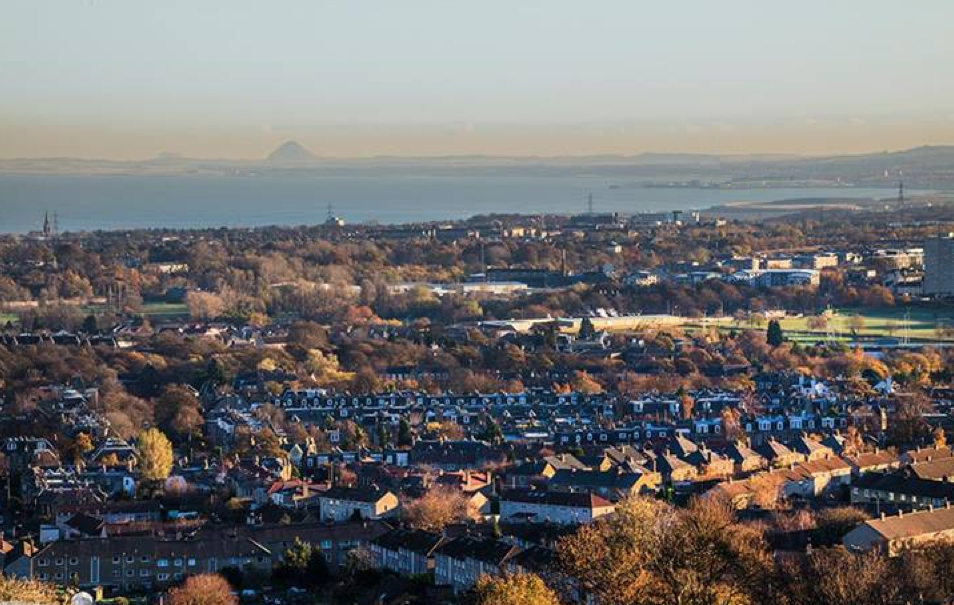
RealEdinburgh’s beautiful winter early morning shot of East Lothian from Blackford Hill is yet another demonstration why so many of us enjoy living in this part of the world.

But…

…this is not the exact original view: this shot has been doctored. Can you spot what is different from the actual shot? Comment if you think you know what the difference is.

Give up?

Check out https://www.facebook.com/photo.php?fbid=556080217811407&l=05d17aa437 for the answer (El poder español esta desaparecido). But if you had your druthers, would you not prefer the view above as so much better?

Posted in Community | Leave a comment

Boosting The Burgh

Ask anyone within a stone’s throw of the River Esk (once its two halves have joined and found their way out of Dalkeith Country Park) and they will be in no doubt about what is meant by “The Burgh”. Most Scots towns have a fair conceit of themselves. But you have to be at the Honest Toon Association’s dinner when the members of that august organisation stand on their chairs and launch into the Town Song (“Musselburgh was a burgh when Edinburgh was nane“). It’s only a shade less bristling than “whau daur meddle wi’ me?” but you get the drift.

But despite such healthy spirit and loyalty to the community, Musselburgh—like many medium towns whose centres are being eroded by changes in retail dynamics—is in need of some attention and revival. The largest town in East Lothian by a factor of two, its catchment includes the two large villages of Wallyford and Whitecraig, neither of which have significant retail and also most of Prestonpans and Tranent, neither of which enjoy full-blown High Streets on the scale of Musselburgh but have frequent bus links there.

The resulting catchment of around a third of East Lothian’s population served it well and ensured healthy retail sales—despite traffic jams—until the turn of the millennium. By then, the recently completed A1/A720 started to draw people to Kinnaird Park and Straiton. This accelerated over the next decade as many households with cars moved into the area and other nearby malls like The Fort drew more people away. When Somerfield’s and other ‘anchor’ shops closed, the retail offering’s draw weakened further.

Some years ago, East Lothian Council decided to create a Town Centre Strategy that would address—and hopefully reverse—this decline. It was finally published for (and approved at) the Dec 10th meeting of the Cabinet with four broad objectives:

  1. To keep Musselburgh town centre busy and vibrant whilst taking actions that promote additional business in Musselburgh town centre.
  2. To encourage improvements to support existing businesses and town centre users and encourage investment into the town centre.
  3. To enhance the setting of the local town centre, which is the unique selling point of the town.
  4. To build on the unique identity of Musselburgh by explaining more of the history and heritage.

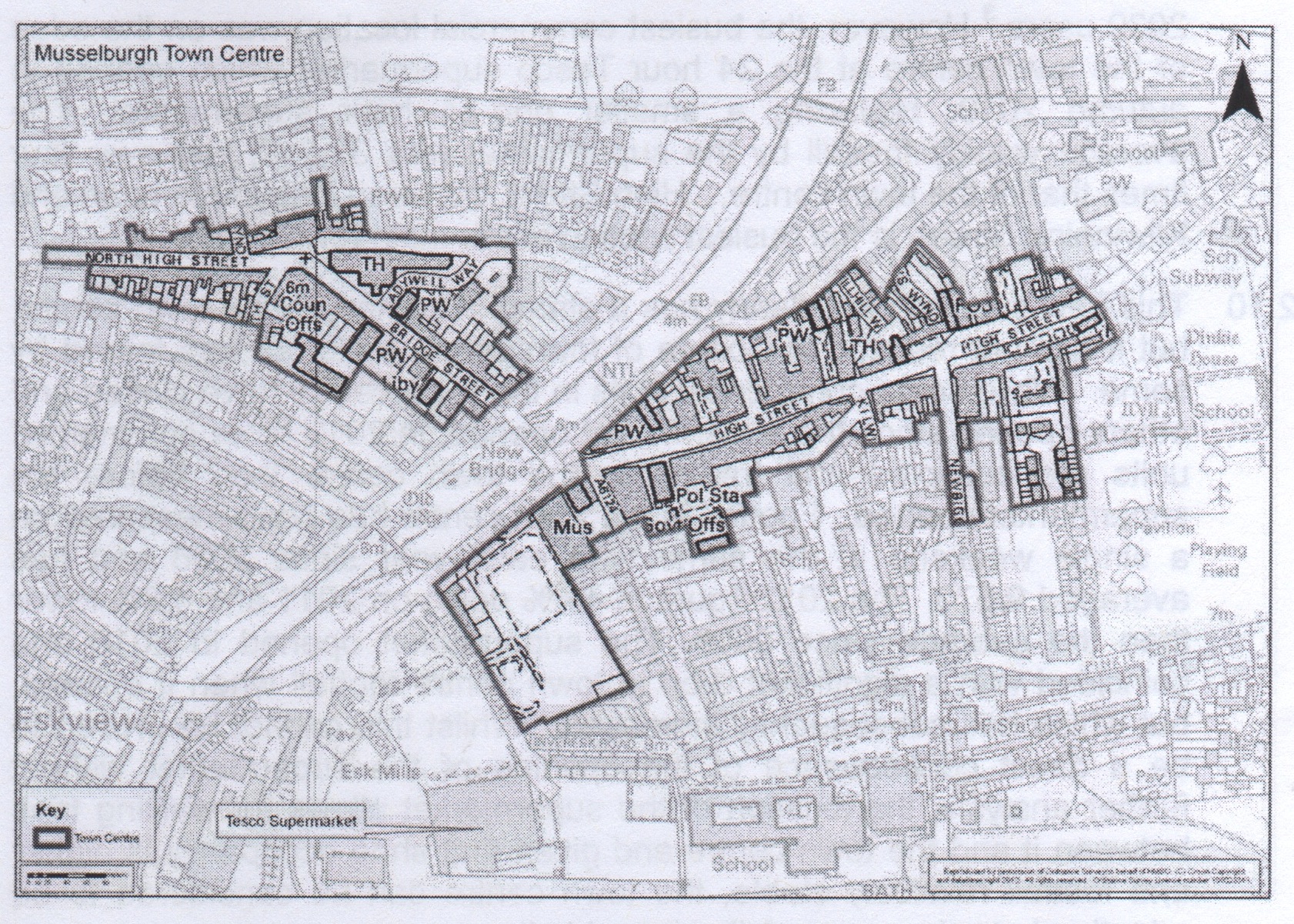
In truth, there is little to argue with in terms of broad aims and the fact that some 2,500 new homes at Goshen and Wallyford (and as many again at Blindwells) are provided for in the Local Plan means that there is some prospect of triggering investment on the back of further housing. One very positive aspect is that the strategy draws on an extensive consultation with local residents as to their views to avoid a common problem of foisting plans on a population that has had little chance to ‘buy in’. The area considered is shown:

Areas Covered by the Town Centre Strategy

Areas Covered by the Town Centre Strategy

Conclusions drawn in the Strategy include:

  • The opening of a 24-hour Tesco had not had major impact and footfall numbers had been roughly static since 2008
  • The challenge was “to make the town centre more appealing to users”.
  • Planned interventions were required to do this although few redevelopment opportunities exist
  • A 24-point Action Plan, phased over short/medium/longer term

All of the above seems worthy and considered. But, digging deeper into the 24-point Action Plan leaves the reader with no clarity as to what strategy (i.e. the overarching plan, as opposed to operational/tactical detail) actually exists. This is compounded by the absence of any recognition—let alone action to address—a number of key factors identified in the document. This forms an unfortunate example of “Ready—Fire—Aim” which typifies a plan of action that has misplaced its strategic direction.

First of all, the map above illustrates the most glaring omission (despite being clearly stated in the third objective above) of the USP of the town centre is the Esk and its setting. Not only is this a most attractive aspect, perfectly sited to link the two components shown on the map, but the opportunity to do so is even more apparent than in the few Scottish towns that enjoy such an opportunity (principally Inverness, Ayr, Dumfries and Perth). The idea that the wide, green banks of this linear park could be woven in to the retail offerings with riverside cafes, restaurants, kiosks and recreational facilities is nowhere mentioned.

Secondly, the most unfavourable factor of heavy traffic all along the High Street and repetitive breaching of SEPA air pollution guidelines is nowhere addressed. Quite apart from the non-green waste of fuel that stagnant traffic symbolises, the constant noise and sight of traffic is unpleasant, quite apart from difficulties created in crossing the road. At present every single vehicle crossing between East and West must pass the single choke point outside the Caprice restaurant (25,000 vehicles each day). At no point has the possibility of re-opening Inveresk Road for access to/from Tesco/Eskmills or of the ‘Electricity’ bridge to link North High Street with Millhill—or any other traffic solution been mentioned, let alone considered.

Thirdly, the attraction of increased footfall is already embedded in the numbers provided but no conclusion drawn. The current footfall per week is barely 9,000, and that, spread over 178 commercial units is barely 10 customers each day. On the other hand, Tesco—not 300m from most of the area designated—enjoys over 37,000 per week. It seems obvious that attracting Tesco customers to spend time elsewhere would, if only 50% successful, result in a tripling of footfall and a revolution in business viability. The manner in which this could be done requires study but redevelopment of the underused council car park near Tesco beside the Roman Bridge into riverside business and the extension of this to the western end of the High Street that already backs on to the river would provide an attractive link to lead people to do just that.

Unfortunately, all three components appear to be outwith even co-ordination—let alone planning and financing—by East Lothian Council. There is a seven-figure provision in their capital budget, and that could provide a multiplicity of things: improved street furniture, spruce up shop-fronts, review heritage and its presentation and even revamp the Town House square to make it more pedestrian and event-friendly. But no concrete reasons are given why such things will alter the basic situation and no examples are cited illustrating where such measures have been effective elsewhere

While all these good intentions and supportive moves may indeed improve business in Musselburgh town centre, the mix so far echoes the effort made almost twenty years ago in Dunbar when several million were spent on a leisure pool and revamp of the High Street. That had no significant effect on improving business and, by altering the parking provision, caused some people to think it had actually damaged retail business. The present Musselburgh strategy (if it can be called that) pretty much fails the same test.

Posted in Commerce, Community | Tagged | 1 Comment

Winding Us All Up

After being trailed over the preceding weeks so much, there was little that was actually new to report when Osborne made his Autumn Statement last week. Most reporting was on the jousting of the Osborne/Balls protagonists in delivering/rubbishing it. (A more measured analysis was in the Financial Times.) But the sad death of “President of the World” Nelson Mandela following hard on it has only served to divert and so further restrict public debate.

Which is not good because the vagaries of this recession force Osborne out of an annual budget cycle into out-of-phase adjustments—this one apparently to proclaim the economy is ‘doing better’ at 1.4% growth. Not to be too much of a balloon-burster but ‘doing better’ and ‘not doing so badly’ are both positive signs that should not be confused with each other.

But the OBR are questioning whether growth is being driven by consumer spending; others question the absence of export-led growth following a period of effective currency devaluation. Some see this as Ed Balls’ focus on the “cost of living” is paying off. But only schadenfreude revellers could derive satisfaction from growth of 1.4% actually consists of 1.2% due to consumer spending and none due to business investment.

The ugly interpretation of this is another housing price bubble amid falling living standards across the UK. So, while Osborne claimed credit for putting his squeeze on welfare spend and the benefit cap centre stage, this also Labour into contortions of their own on state pensions and the so called ‘ triple lock’. Actually neither should be proud how the UK tax system appears to be targeted at the poorest 10%.

Amount of Wages Taken in Taxes by Decile 2011

Amount of Gross Earnings Taken in Taxes by Decile

But energy costs and support for renewables were the real zingers in this statement. Scottish Renewables have said: “the sharper than expected cut to onshore wind (strike price) will present a real challenge to developers, and could well mean that some projects don’t go ahead, slowing down progress towards our 2020 renewables and climate change targets.

Put another way, increasing uncertainty in the offshore sector will not be calmed by an increase of £5 /MWh from £135 to £140/MWh. This also puts any hopes for any renewables revolution out in the Islands at death’s door—already acknowledged by Energy Minister Ewing. They will need substantial financial support to survive.

The Scottish government has set challenging targets for Scottish Renewables and continue to strong-arm a rash of inefficient little turbines that contribute peanuts to self-sufficiency into sensitive rural areas. Onshore wind is still the most competitive source of renewable electricity but we are exhausting suitable sites for wind farms of economic scale and minimal intrusion.

The last of the six big shoes has dropped when E.On announced an average price rise of 3.7% for dual fuel customers, claiming this takes account of the changes to the green and social levies. This will still add £48 to the average bill in the new year, which is bad enough for individual households.

But, more ominously, this all puts the UK government on a collision course with the Scottish Government’s long-stated policy of becoming 100% green in energy generation. That strategy depends not just on existing wind but on massive offshore farms planned like Neart na Gaoithe which are essential to fill in generating segments still provided by nuclear and coal.

The alternative is for rapid development of both wave and tide technology but that, in turn, depends on massive development subsidies from either existing (thin) initiatives from Westminster or an equivalent amount from Holyrood which, given existing constraints under devolution they are simply not permitted to fund.

Is it Machiavellian or just realistic to wonder if Osborne is doing this on the threshold of the year of the Referendum just to wind the Scots up?

Renewable Capacity Built and Projected (source: Audit Scotland Sept 2013)

Renewable Capacity Built and Projected (source: Audit Scotland Sept 2013)

Posted in Environment, Politics | Tagged | Leave a comment

Oh, The Farmer and The Planner Should Be Friends ♫

This blog isn’t about to break out into Oklahoma-inspired song about how “one of ’em milks a cow with ease; the other steals his planning fees” but, as in the original musical, “that’s no reason why they can’t be friends”.

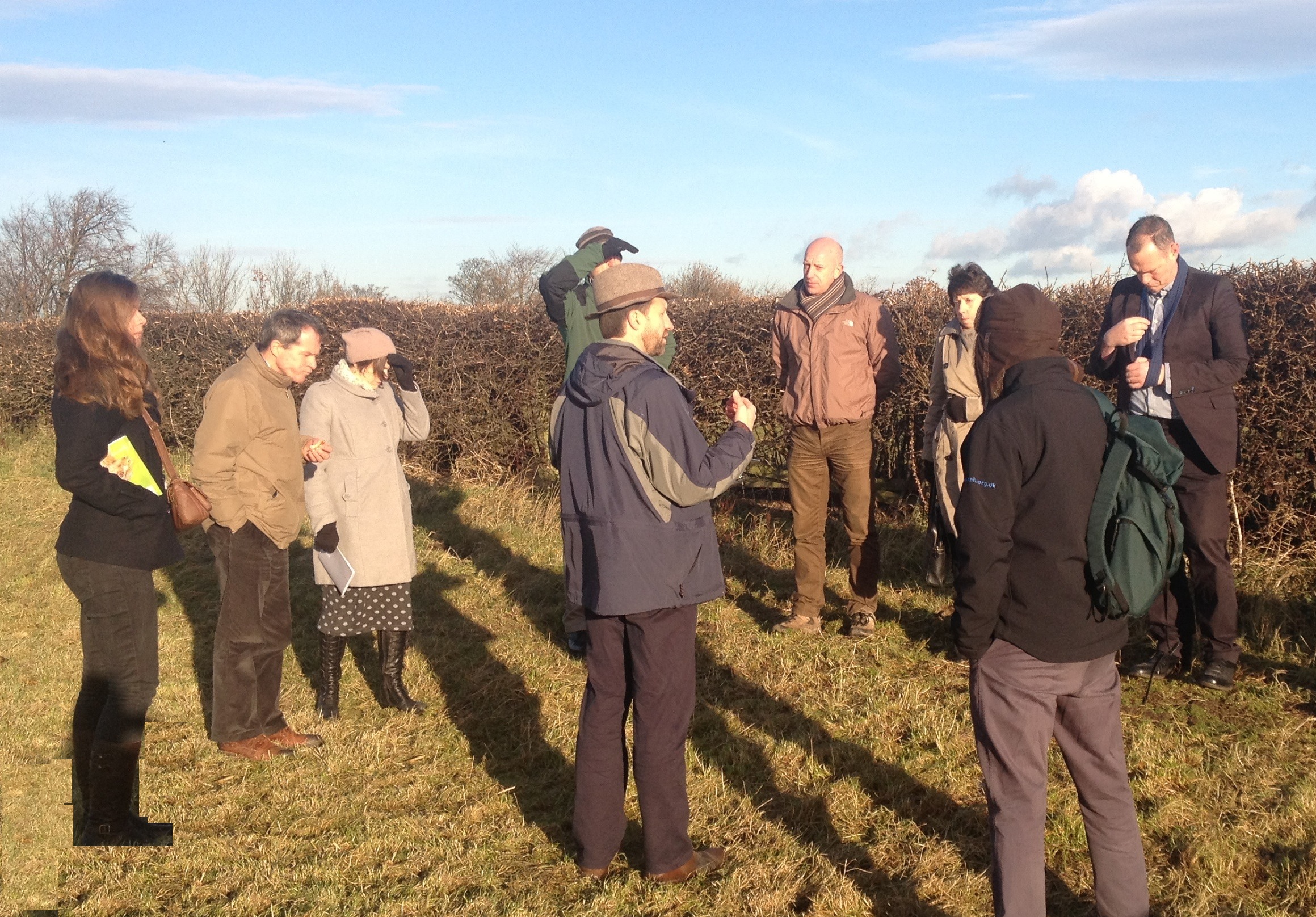
This insight came to me in the midst of a most instructive tour of the Winton Estate, kindly laid on by the estate owner, Francis Ogilvy, in an attempt to set up a dialogue with planning officials and relevant national bodies about the best way to develop business opportunities on the estate. He invited representatives of East Lothian Council, SNH, Scottish Enterprise, etc to spend a morning visiting the estate to see what had already been done and informally discuss what might be done.

In 14 years on ELC, I had never seen such a pro-active approach and it set me thinking. Most of ELC’s involvement with such large-scale, ‘blue sky’ thinking has been extremely limited. Leaving aside the myriad applications for window replacement or conservatory additions, their Planning department has been largely engaged with, on the one hand, receiving strategic allocations from the city region how many houses to provide and, on the other, fitting them into a local plan that wasn’t just a turkey shoot for developers.

A pivotal bulwark of their defence against the latter was a remains Policy DC1, which covers the bulk of the countryside and basically forbids any housing there that is not the conversion of existing buildings with minimal external alterations. In avoiding wholesale urbanisation and strip development, DC1 has been a success. But, as a tool of intelligent development of the countryside (as opposed to spreading houses all over it), it is blunt: “The answer is ‘NO’; now, what was the question?”

Francis was basically challenging the planning system to think more creatively than that about an estate with 1,000 years of history. Phillip de Sayton was granted the lands of Seton, Winton and Winchburgh around 1150 but were caught up in Henry VIII’s ‘rough wooing’ and Winton was burnt by the English Army in 1544. The 6th Lord Seton was made 1st Earl of Winton in 1600 and set about making a home out of the ruin.

Support for the Jacobite uprising of 1715 saw the capture of George 5th Earl of Winton whose land was confiscated by the crown and leased to the York Buildings Company. When they went bankrupt in 1779, the house was sold to Mrs Mary Hamilton Nisbet of Pencaitland. Mary was followed by Constance, her granddaughter who married Henry Ogilvy in 1888. Francis followed his father Sir David to become 14th Baronet. The whole estate was made over into a Trust a century later, with the house as its jewel.

Sir Francis Ogilvy and Family at Home in Winton House

Sir Francis Ogilvy and Family at Home in Winton House

The 1st Earl had engaged William Wallace, the King’s Master Mason as his architect who embodied his skills in the then-new Jacobean style in the restored house. His carved, pale stone twisted-chimney exterior in the style of the Scottish Renaissance still herald the palace within. His ornate plaster ceilings are the most elaborate in Scotland—so much so that casts were made to restore those in Edinburgh Castle to their proper magnificence.

So much for background.

The tour started in the house itself. As Winton House was designed for entertaining, it is a marvellous venue for bespoke dinners, conferences, meetings, activity days, team building events and special private events, such as weddings. Walls crammed with ancestral portraits and roaring log fires provide an atmosphere even 5-star hotels struggle to match. This activity started new business development on the estate, which has been augmented by self-catering and outdoor activities over the last couple of decades.

These have been financed so far by internal resources, which includes consolidating the three active and profitable farms and investing in key infrastructure such as a grain dryer and a district heating system, both run on local wood chips. While draft plans have been made for other activities, the whole purpose of the tour was to gain feedback and start dialogues that could help steer these without too much effort being expended on what would be dead-ends. Among the ideas floated were:

  • Conversion of Wintonhill  Steading into housing (fine views towards the Moorfoots)
  • Sand/Gravel extraction at Loanfoot, providing a large aquatic park and water sports
  • Addition of business (and perhaps some retail) space to New Winton village
  • Possible bakery/shop/restaurant social enterprise at Broomrigg Farm
The Tour at Winton Farm with Francis in Foreground

The Tour at Winton Farm with Francis in Foreground

Despite it being a chill day, there was a good bit of chat in the winter sunshine how business goals might be made compatible with both green and conservation objectives, especially as the economic driver of Edinburgh was so close. What was clear was that, because of a strong desire to resist rural over-development, no adequate forum was available to plan coherently for any development in the East Lothian countryside—desirable or not.

Virtually all agencies represented accepted that the present black/white approach which gave carte blanche to agricultural structures and banned virtually all else might be revisited, provided the defence against widespread tract housing was not weakened. Given that the City Region plan was close to completion and that the next Local Plan would then be formulated, the time seemed right for more in-depth discussion how a place like Winton could explore a profitable future while still preserving the highly valued unspoiled nature of rural East Lothian that makes it so attractive in the first place.

It would appear that a viable operation with deep local and historic roots like Winton offers the opportunity to explore how a such a multi-channel rural business could be sensibly developed in a sustainable manner for the 21st century. Rather than a blanket ban on all but (usually ugly and intrusive) agricultural buildings, this may be the opportunity for council planners to become more sophisticated in ‘enabling development’ so that the partial successes of Archerfield and Whitekirk can be improved on.

Large agricultural estates  were instrumental in leading the revolution in agriculture over 200 years ago. They bequeathed us gems we now treasure including planned villages like Athelstaneford and Tyninghame and the magnificent country houses that now decorate our countryside. Perhaps somewhere like Winton is already part-way down the road to making our countryside an attraction in its own right without despoiling it in the process.

Winton House Main Entrance

Winton House Main Entrance

Posted in Commerce | Tagged | Leave a comment

Fur Coat and Nae Knickers

Seldom can HM Government have been so embarrassed to spend so much and yet be so accurately pilloried for its inefficacy than in Angus Robertson MP, Defence Spokesman and SNP Group Leader at Westminster’s speech on December 3rd. The UK spends £40bn on ‘defence’. But, by trying to project strength globally, the UK Government’s delusional ego has left no credible defence of the UK itself.

The MoD focusses on being a ‘global player’. As a result, the current RN web site says “the core of the fleet” are their 13 frigates which “can typically be found east of Suez, safeguarding Britain’s vital maritime trade routes“. This rather avoids the practical substance of why the MoD even exists in the first place and underscored in detail in Angus’s forensic speech. It is a shame that so few people pay attention to what the government is doing in all our names:

“I think that Members from across the House agree that naval forces are there to protect and patrol, to secure freedom of movement, to enforce the boundaries of territorial waters, to control exclusive economic zones, and to secure the environment—a significant consideration—renewables and critical infrastructure. That is particularly important when one bears in mind what is likely to happen in the decades ahead with offshore wind, tidal and wave power and the development of super-grid systems, which are likely to connect Iceland, the Faroe islands, Scotland, Norway and the rest of Europe.

“There is no better place to start than with an incident that happened two years ago and has close connection to my part of the world. The 65,000-tonne Admiral Kuznetsov anchored on the edge of UK waters off my constituency. Other Russian ships that also sought shelter in the Moray Firth included the anti-submarine warfare ship Admiral Chabanenko, and the escort ship Yaroslav Mudryy.

Russian Carrier "Admiral Kuznetsov" with Escorts

Russian Carrier “Admiral Kuznetsov” with Escorts

“The vessels did not warn domestic authorities that they were going to come so close to the coast, and are believed to have blamed bad weather for making that approach. It was the first time the Kuznetsov, or a vessel of its size, had deployed near UK waters, and it was the closest in 20 years that a Russian naval task group had deployed to Scotland or anywhere else in the UK.

“In previous years, Nimrod maritime patrol aircraft would have been loitering and would have been aware of the presence of a Russian deployment of that size. Of course, by 2011, the UK had no such aircraft; it is the only northern European military without them. Nevertheless, the Russians were there without any UK escort. At that stage, the Ministry of Defence was relying on Scottish fishing vessels to report developments, including fly-tipping by the visitors.

“When the MOD became aware of the Russians’ presence, a 30-year-old Type 42 frigate, the HMS York, was scrambled from Portsmouth, around 1,000 miles away. That distance, at 20 to 24 knots, takes more than 24 hours to travel. The responsibility that the HMS York was fulfilling was that of fleet ready escort, which means being the deployable and capable vessel in UK waters ready to perform emergency response tasks.

“NATO has, as part of its immediate reaction force, standing NATO maritime group 1, which  operates in the eastern Atlantic. Similarly, standing NATO mine countermeasures group 1 operates in northern waters. They are relevant for future and current naval vessel provision, as they are standing operational commitments for allied nations, which provide destroyers, frigates and mine countermeasure vessels. It is notable that the UK has not provided vessels to either of the groups for several years.

“Similarly, on joint training, there is a real issue of properly committing current and, hopefully, future vessels. Last month saw the largest NATO training exercise in northern Europe in nearly a decade. Some 6,000 troops from 20 allied and partner nations took part in Steadfast Jazz, which involved land, air, and sea elements. Of the 6,000 participants in the exercise, the UK contributed precisely 52 personnel aboard a single mine hunter. It followed a large-scale exercise with maritime dimensions in Norway, where the UK provided just one aircraft, which is more than has ever been provided to the NATO air policing commitments in Iceland.

“When it comes to our immediate maritime backyard, the UK is sadly posted missing too often and is not taking its responsibilities seriously. The absence of any mention of the high north and Arctic in the most recent strategic defence and security review eloquently underlines my point.

“This is all especially relevant to Scotland when it comes to current and future conventional vessels. Scotland is a maritime nation with a sea area five times larger than its land area. Our coastline is over 11,000 km long—longer than that of the People’s Republic of China or India. It constitutes 61% of the entire UK coastline, and there are more than 800 islands. Remarkably, however, there is not a single major, ocean-going, UK conventional vessel based in Scotland to perform the key tasks that I have outlined”.

There are some amplifications needed in Angus’ speech, but only in detail, not in its general validity. These are:

  1. HMS York was actually a 5,200-tonne Type 42 destroyer (not 4,900 ton frigate). But, even so, had it been on-station in the Moray Firth, engagement with the Russian task force on its own would have been suicidal. It was paid off in 2012.
  2. Admiral Kuznetsov is only 55,000 tonnes fully loaded (yet still twice the size of any recent RN a/c carrier). Carrying 17 Sukhoi fighter and 24 Kamov helicopter aircraft, its task group was quite capable of also taking on remaining RAF strength in Scotland.
  3. Steadfast Jazz 2013 took place in November and was principally an exercise in ground deployment in Poland involving troops from Sweden and Ukraine. This highlights how the UK’s single-ship contribution was a trivial addition to a side-show.
Posted in Politics | Tagged | 2 Comments

I Was Proceeding in a Festive Direction

Today, I received the following e-mail from the Police Scotland commander of my local council’s patch. While undoubtedly sincere in wishing to help us locals enjoy a mishap-free festive season, in its dogged effort to cover all the bases, it does fail any test of a ‘festive message’—the mysterious “Operation Tinsel” notwithstanding: it fails to wish anybody anything, least of all “Merry Christmas”.

Quite apart from that, some personal element would not have gone astray—something reassuring like a local reference. That might dispel the impression that, under Stephen House’s direction, this same centralised message went out from Hamnavoe to Hawick.

_______________________________________________________

Festive Safety Message For East Lothian Public

“Police in East Lothian are issuing a safety message to ensure the public enjoy a safe and crime-free festive season. The Christmas and New Year period is a busy time for emergency services and local authorities with many people enjoying nights out across the county. During this time, a number of alcohol-related incidents are reported including disturbances, assaults and antisocial behaviour. Local officers will now begin engaging with their communities to promote responsible behaviour for those enjoying the festivities.

“To enhance our commitment to Keeping people safe, Police in East Lothian have progressed Operation Tinsel that will run between 4th December and 6th January.

“Licensing Officers will visit the various pubs and clubs within the region to speak with staff and remind them of their responsibilities when serving alcohol to patrons. Over the festive weekends, high-visibility patrols will be out during the evenings and will carry out inspections of licensed premises during this time. Any criminal activity witnessed will be appropriately dealt with.

“Police are also keen to ensure those enjoying the night-time economy are able to get to and from their destinations safely. Revellers are urged to plan their nights in advance and make sure they know where they are going; how they are getting there and back and whom they are going with. While within a pub, club or restaurant and when returning home, people are advised to always be aware of their surroundings and never leave items such as jackets and handbags unattended or unsupervised.

“Anyone wishing more advice on keeping themselves and their belongings safe can contact their local policing team or visit the Police Scotland website.

“With increased numbers of shoppers expected on the High Streets, the public are reminded to be vigilant for pickpockets and other criminals looking to obtain your money and possessions. Be wary of anyone acting suspiciously around you in crowded areas and always protect your pin number when withdrawing money or paying for gifts.

“The holiday season can also result in increased reports of housebreakings and thefts with criminals targeting the homes of those who have left to visit family and friends. When leaving your home unattended, ensure all windows and doors are locked securely and keys are not left in the keyhole. Where possible store items of value out of sight and report any suspicious activity around your property or neighbouring addresses to police immediately.

“Throughout December and January, increased police patrols will be deployed across East Lothian to identify potentially vulnerable properties and deter crime. Chief Inspector Colin Brown Local Commander for East Lothian said:

“The festive period is a time of celebration and relaxation for our communities, many of whom will head out and about enjoying a night out with family, friends or workmates. It is therefore essential that the public are equipped with all the necessary advice and guidance on staying safe. Simple steps such as drinking responsibly, planning evenings in advance and always being aware of your surroundings will help make sure your evening is an enjoyable and safe one.

“As part of our commitment to keeping people safe, we will be engaging with licensed premises across East Lothian and urging staff to use their best judgement and refrain from selling alcohol to anyone who appears to have consumed too much. Licensees will also be asked to report any criminal activity on their premises to police immediately.

“Higher levels of acquisitive crime are also reported during the holiday season and our communities should help safeguard themselves against thieves – both at home and while out.

“Keeping hold of your belongings when on a night out or when shopping will help deter would-be thieves, while appropriately securing your home when leaving it unoccupied make it far more difficult for criminals to strike.”

Ends

_________________________________________________

Posted in Community | Tagged | Leave a comment

Garbage In—Garbage Out

It’s not often that techies invent a buzzword but when ‘FIFO’ (the technical term for a serial data buffering device in a computer—first in, first out) was bent into GIGO, a new OED term was born to mean the quality of output for any system is entirely dependent on the quality of what you put into it. As with many cool phrases that come into public use, GIGO has so many varied uses that it has become everyday.

Unfortunately, this applies to some areas where we all wish it was not so, This includes hospital catering. The NHS across the UK has a sterling reputation for dedication by staff and their universal commitment to health for all. That does not, however, extend to hospital food, which has suffered an evil reputation for decades. And now that NHS needs to cut costs in areas other than clinical services, catering has been in the firing line. So parsimonious have some administrators become that patients are being fed for less than £3 per day. (Western Sussex Hospitals NHS Trust = £2.57; Harrow Primary Care Trust £2.75; North Somerset PCT £2.76), to name but three.

On the other hand, Kirklees PCT spends £19.81, University Hospitals Bristol NHS Foundation Trust (£17.46) and Cumbria Teaching PCT (£17.85) but that has done nothing to give hospital food a decent name because they don’t taste six time better. Palatability aside, there are serious questions as to the nutritional value of what is being served. Sandwell and West Birmingham catering output has no proper dietary control because the kitchens don’t operate with menus; dieticians involved therefore must guess whether sufficient nutrients in the right balance are being delivered to patients.

And that delivery itself ought to be under better scrutiny. In the current system, caterers load up trolleys with similar-sized portions to be taken into wards, regardless of whether patients are hungry. Many kitchens have been centralised: meals are delivered from a large facility either in urns (for medium-sized facilities) or ‘plated’ (stacked on trays) for distribution to smaller sites and within the main hospital supplying it.

Catering administrators are supposed to regularly monitor both consumption and quality. Many seem to regard and element of the meal touched (e.g. a spoonful from a pudding) is a meal consumed; outlying facilities simply empty their urns and provide no feedback.

The resulting statistics are meaningless: many trusts report food wastage below 20%, which is bad enough. But more accurate surveys that actually follow the food to the patient and record what they do not eat come up with figures between 40 and 50% wastage. It is not for want of funding. In England, the Department of Health claims:

“The amount of money hospitals spend on food has gone up over the past five years, with the average at £6.53 per patient per day in 2005-06, rising to £8.58 in 2010-11.”

But, looking closer at actual catering, very often, contracts for bulk food prepared outside have been let to industrial caterers like Brakes, Bunzl, 3663, etc attracted by huge amounts of money paid to outside caterers who win the contracts and who are tempted to inflate their costs and use cheaper ingredients to maximise profits. This results in little by way of creative planning by catering managers, a production line for industrial glop in the kitchens and little to motivate—let alone inspire—chefs and staff.

The Campaign for Better Hospital Food claims that between 1992 and 2013 there were 21 failed voluntary initiatives to improve hospital food, costing more than £54m. Journalist and broadcaster Loyd Grossman and celebrity chefs by the cauldronful—Albert Roux, John Benson-Smith, Mark Hix, Anton Edelmann and Heston Blumenthal—have all been drafted in to help improve standards. Things have yet to improve.

But, rather than a few TV shows of terrified toques with bleeped-out swearing, surely the hale clamjamfrie could be fixed by management with a grasp of both spreadsheets and people motivation who set up a catering system with restorative nutrition at its heart, viz:

  1. Set a clear budget per patient that is reasonable and consistent—something like £5
  2. Investigate local produce availability and develop draft menus with dieticians based on sourcing fresh, healthy supplies wherever possible.
  3. Supply menus to the patients who can then order ahead of time = minimise waste
  4. Properly track consumption of meals, using feedback to adjust menu = minimise waste
  5. Allow chefs and other kitchen staff to contribute to new recipes.
  6. Extend this to staff canteens & consider opening them to the public. “Pat’s” at Scarborough hospital not only runs at a profit but has brought food waste rates in the whole hospital down below 10%.
  7. Train staff to serve food properly; medical staff who have other priorities will sling it about like in an Army barracks
  8. Though this may be the bleeding obvious, inappropriate food should not be served to people who have specific medical and healthcare needs.
  9. Establish a “protected meal times” policy on wards so that people can enjoy food without interruption

A culture far too prevalent among ‘administrators’, hired in the nineties to make the NHS more ‘professional’, is knowing the price of everything and the value of nothing. They will argue suppliers down 1p on a box of sauce sachets but ignore when local soft fruit growers have strawberries coming out their ears. Rather than dictating top chefs, they should be following chefs’ directions, all within a clear budget per head.

It requires thinking. But anyone on their salary should be doing that as a matter of course and not foisting some formulaic glop onto patients whose recovery is not helped thereby—just because it’s easier to let the Bunzl rep handle everything. The real scandal is that many patients are prescribed diet supplements just because of the poor nutritional value of much NHS food—and they have a wastage rate (by not being taken) the same as any other prescriptions of around 40%.

Posted in Community | Tagged | Leave a comment