Redefining Security and Intelligence in an independent Scotland

The debate on defence has gone all quiet, perhaps because anyone comparing the costs to Scots of expensive ego-toys (like nukes, global bases, aircraft carriers, etc,) to the threadbare defence we actually get sees the fiscal ineptitude behind the MoD’s present posture.
But the unionist case about security and counter-terrorism is made just as seldom—and is equally in need of debunking, as here.

Admin's avatarA Thousand Flowers

A Guest Post by Cosmopolitan Scum
sadfacesub

Military and intelligence stories have been all over the news recently. Be it indiscriminate eavesdropping programs, WMD infrastructure, or our impending doom at the hands of terrorists if we vote “yes”, there is a common denominator in the statements of the high heid yins: these are issue for the big boys, the role set out for the rest of us is to cower in fear and not to hurt our wee brains trying to understand. In the independence debate, we are warned that an independent Scotland is going to be overrun by terrorists, disastrously cyber-attacked, or run out of money trying to prevent these disasters from happening. The catalyst of the recent wave of scare stories is a report by a bunch of military and intelligence insiders,  the crowd treated in the mainstream media as holding an exclusive grasp of the serious issue…

View original post 5,149 more words

Posted in Uncategorized | Leave a comment

Is This an Economic Argument or the Full Half-Hour?

Now that the indy debate has devolved from professionals to real people it has become muddier. All sorts of voices are chiming in with their two cents’ worth—as it should be. But over the last month as the babble has intensified, Clarity has been the first casualty. Folk—rightly—have a broad range of opinion; falling into the lock-step of a single voice is not human nature.

Unfortunately, truth has not been far behind in getting wheeled into A&E. While the vast bulk of these new voices are undoubtedly sincere, there are more than a few on the payroll vote stirring it and some amazingly gallus slants put on various news items by a media that will be pilloried at sopme point in the future for falling down on their prime duty: objectivity.

But, as hardened observers of the Fifth Estate will long have practiced, a strong filter of their own research, familiarity with the pundit in question and a healthy dash of skepticism does much to focus the truth, much as a projector lens throws a clear image on a screen—if properly set up.

This week, the turd in question arriving at the fan blades were the GERS figures for last year. Although they didn’t make front page in the Cornish Guardian, from the Rhinns Reader to the Yell Yeller, it became the talk of the steamie that oil tax revenues for HM Treasury fell from £10bn to £5.6bn from the previous year and that ~Scotland’s fiscal public deficit shifted thereby from being better than the UK average of 7.3% to a rather worse 8.3%.

Let’s leave to one side whether any treasury mandarin cooked these books. Tax revenue does fluctuate and such numbers are plausible and would have to be dealt with by an independent Scottish Treasury. But is it, as Labour Finance Spokesman Iain Gray almost had a heart attack running between channels to tell us, proof that Scotland should stay in the UK? Are oil revenues in ten, as opposed to eleven digits, bad news?

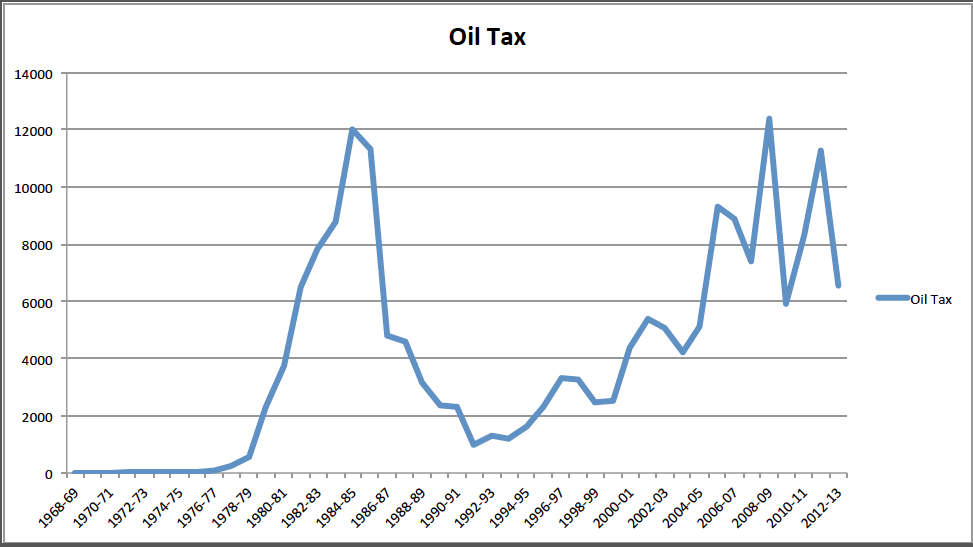
Iain, for one, needs to have a word with himself. Serious financial trends are never predicted from one set of figures—certainly not without reading the small print. Some £2bn of the drop this year were due to a larger figure being invested in the North and Celtic Seas and the justifiable tax incentives for our future kicking in. Then there is the fact that last year was a rather good year and bucked the general trend of gentle decline in the figures. In fact, looking back a decade or two, it’s easy to see why even sober, neutral commentators caution against over-dependency on such a volatile revenue source.

Total Treasury Revenues from Oil & Gas by Year in £m. (Source: HM Treasury)

Total Treasury Revenues from Oil & Gas by Year in £m. (Source: HM Treasury)

So, not only are fluctuations pretty much the norm but the UK Treasury has suffered considerably lower annual incomes 1990-95 without their fiscal world coming to an end. Ah, retort the unionist apologist rentaquotes like Iain; that’s because the UK economy is so much bigger and provides exactly the ‘flywheel’ effect we need. He rather ignores that Norway, rather than squandering £165bn so far as the UK has done, built up a quarter trillion ‘oil fund’ to act as their flywheel—and to gain a quarter of their income from interest from it as a side effect. Some ‘side effect’.

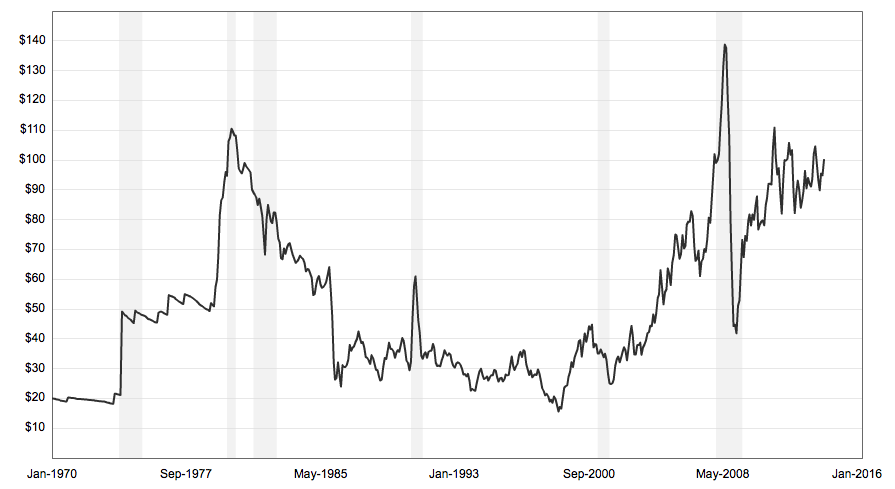
The other point that Iain gamely makes is that it now costs twice as much to extract each barrel than it once did. Quite true and—as we drill deeper and further out—likely to get worse. What Iain’s highly selective grasp of figures fails to mention is that firms are falling over themselves to spend that extra money because the higher price of oil makes it very much worth their while—indeed many overheads become proportionately less of a burden.

Historic Global Crude Oil Prices by Year in $US/barrel (Source: Macrotrends)

Historic Global Crude Oil Prices by Year in $US/barrel (Source: Macrotrends)

This shows price history back to the two dramatic leaps in the 1970’s. The average price over these 45 years has been $40. The current price of $100 (with an obvious steady upward trend if the 2008 ‘blip’ is removed) means that, despite a doubling in cost, there is now a 50% extra profit margin available to companies, as compared to historic average—and that seems likely to increase. Fold into the equation the fact that half the oil remains to be extracted (at these or higher prices) and it may be time for Iain to upgrade his crystal ball and/or trade in his slide rule if he is to be current.

It’s probably unfair to pick on the unfortunate Mr Gray who is strapped into the job of mouthpiece for a party that embodies the scene from Life of Brian in which a streetful of people all chant “Yes, we must all learn to think for ourselves“. Much more relevant are comments from business leaders who have less of a posturing and more of a pragmatic role they are following—as often as not with the interests of their business to the fore.

This week at their annual conference Stephen Leckie, chair of the Scottish Tourism Alliance, said there was huge uncertainty for what independence would mean for his £11bn industry that employs over 200,000 people. In particular:

“The discussions and debates and arguments that are going on at the moment are, I think, not representing Scotland and the parliament well. All it is is everyone just arguing with each other.”

He has a fair point. The problem with providing figures he (and many others) say are missing from the White Paper is  no party has ever provided detailed financials prior to any election. With the UK digging heels in over whether the £UK could be shared, so many imponderables are created that even making a stab at Scotland’s would be a fool’s errand.

On the other hand, world-leading maker of portable power supplies Aggreko’s CEO Rupert Soames waded into the debate claiming that his business was being damaged by uncertainty from debate over independence. Sounds plausible—until you realise that this is Winston (Empire-is-my-Life) Churchill’s grandson and brother of Tory Minister Nicholas Soames. Having lobbed his grenade, he promptly resigned to run Serco “The Company that Runs Britain” since accused of so fraudulently over-charging on contracts to tag criminals such that the UK government has banned them getting any new work. Meanwhile, Aggreko share price dropped by 9%. Nice.

Probably most significant are the rumblings from Scotland’s £17bn/150,000-worker finance sector that they may have to consider their staff and HQ deployments in the even of independence. Scottish Widows, RBS, Standard Life and BoS wing have all been quoted in this context. These seem to be both genuine and sensible for such firms. Nobody—least of all the Scots—want to see any of them go. But, before unionists expect us all to head screaming for the hills at the prospect, we should bear in mind what is meant by ‘go’.

Both Standard Life and BoS are already part of the Lloyd’s group, which has the bulk of its staff and business outside of Scotland. Important though their operations are here, it is hard to see either being disrupted by major moves of staff south—especially when office space in Canary Wharf (at £55/sq.ft.) is more than three times that of the Gyle (£16/sq.ft.). Standard Life, being listed on the London stock exchange, is less of a Scottish company than it used to be. As for the Royal Bank of Scotland, it is these days largely a Scottish company in name only.

Standard Life has previous form in these matters. As long ago as 1992 it warned that devolution – never mind independence – might cause it to relocate south of the border. Well, devolution happened and Standard Life is still here. As for RBS, Mark Carney told the Treasury select committee that an independent Scotland would have to guarantee deposits held in England by Scottish-domiciled banks under EU law and so could lead to RBS HQ moving to England. But three facts modulate the impact of any such move:

  1. Just where the company displays its brass plate involves a hundred or so staff at most; BoS HQ remains a spectacular but nonetheless small building on the Mound
  2. The bulk of operations and therefore staff and therefore economic advantage would remain wherever they are now.
  3. Removing the HQ of such global giants removes the main argument against currency union as the bank of last resort connection would move with the HQ, unburdening the new Scottish Treasury.

Nobody sensible objects to all companies making contingency plans—which explains 90% of the fluff spun by the press over the last month. What has received rather less coverage and speculation is the possible good news story from independence if:

  • Oil tax revenues average over £8bn—as they have for the last decade?
  • Scotland puts its £2bn annual saving from defence (alone) into its own oil fund?
  • Oil continues to rise at ~$5 each year, boosting tax revenue to £12bn by 2025?
  • Whisky exports continue to grow past the £4bn p.a. already achieved?
  • Renewables employment exceeds last year’s 5% growth (to 11,365 people)?
  • Tourist expenditures grows better than the 15% achieved in recent years?

Funny, but unionists and their media never seem to think of bringing up such possibilities.

Posted in Commerce, Politics | Tagged | Leave a comment

Better Together? Aye, Right

Now that the independence debate has broken out of the ghetto of late-night-current-affairs  programmes and heated up and with the UK Cabinet and Shadow Cabinet weighing in—along with CEO’s of major Scottish companies—it’s a good time to look at the case being presented why Scotland would benefit from the rather unusual position of being run by another country, rather than joining the 200+ countries of the world who define their own destiny.

There is a whole page on the Better Together website labelled “The Positive Case”. We will assume it is not just a front for HM Treasury, keen to suck another £165,000,000,000 out of us to avoid more taxes. The “Case” is repeated here in full below (whether it is indeed positive we leave the reader to judge)—but adding a commentary of balancing statements. Better Together is hereby enjoined to disprove these disprovals.

“We love Scotland. We are ambitious for Scotland’s people and Scotland’s possibilities. Our case is not that Scotland could not survive as a separate country – it is that there’s a better choice for our future.

“A strong Scottish Parliament within the United Kingdom gives us the best of both worlds: real decision making power here in Scotland, as well as a key role in a strong and secure UK. Now and in the future Scotland is stronger as part of the United Kingdom and the United Kingdom is stronger with Scotland as a partner.”

Billy Connolly called Holyrood “A pretendy parliament”. That is being a little harsh as it does control half of public disbursement in Scotland—but NONE of the revenue income. This is a weak setup if you want either efficiency or responsible accountability.

“In the UK the BBC and the Bank of England were founded by Scotsmen. The NHS was founded by a Welshman. The State Pension system was founded by an Englishman. Partners in these islands. Working together, better together.

“We are proud that we fought together to defeat fascism, and worked together to build a welfare state. But the case we make is about what’s best for Scotland’s future.

The same Scotsman who founded the Bank of England also led us into the Darien Disaster but no-one disputes the glorious history we have shared over hundreds of years. Canada, Australia and New Zealand fought fascism just as hard as we did but were independent. Where we do agree is that this is all “about what’s best for Scotland’s future“.

Prosperity

“Times are really tough at home and really turbulent internationally. In the future Scotland’s prosperity will be strengthened by keeping the British connection. We need more growth, more jobs, and more prosperity in Scotland. We don’t need uncertainty, instability, and barriers for our businesses.

Someone should tell that to UKIP and the Eurosceptic wing of the Tories, whose “Little-Englander” myopia that alienates European friends could be got shot of with independence.

“In these tough and turbulent times, the size, strength and stability of the UK economy is a huge advantage for Scotland’s businesses. Scotland’s largest market is the rest of the UK. The UK is the world’s oldest and most successful single market and the UK has the oldest and most successful currency – the pound.

“Scottish businesses are increasingly having to win orders against smart, efficient and productive firms in foreign markets. These competitive challenges will only get tougher in the years ahead. The UK is better placed than a separate Scotland or England to help our businesses find and win new orders across the world.

That business is tough is a surprise to no-one. £24.3bn in Scotland’s exports go to rUK while £32.4bn are imported. Of the £23.1bn exported outside UK, only £10.5bn go to Europe so far. Scotland balance of £47.4bn exports vs imports of £53.7bn give a trade balance of -£6.3bn. Growing exports and lowering trade imbalance is a desirable goal.

The equivalent figure for the UK is -£119bn (-£77bn with EU & -£42bn with RoW). Scotland’s per head imbalance is 2/3rds of England’s (£1,200 vs £1,889) and therefore more sustainable. Having direct influence on EU trade talks would offer a market of 500m people with 10 times the opportunity from staying in the UK. If being with ‘big Britain’ makes sense then being with bigger EU with our own voice makes ten times more sense.

Security

“In an uncertain world Scotland’s security will be strengthened as part of the United Kingdom. The British Armed Forces that protect us are the best in the world. In Scotland we are proud of the Forces and proud of the vital contribution that Scotland makes to them. As part of the UK we have real clout in the UN Security Council, NATO, the EU, and we have Embassies around the world.

Such ‘clout’ is delusional and displays a strange understanding of ‘protection’. The UK’s residual colonial tendencies have interfered in too many other countries from Senegal to Iraq to Afghanistan. Claiming a too-horrendous-to-be-used nuclear arsenal as a force for peace flies in the face of peaceful intent. The only part of Ireland to have been a blood bath since 1922 is the part the UK hung on to. In fact, Irish, Danish and Norwegian soldiers have won praise and friends around the globe by being peacekeepers—a force for good on request. None of those countries have suffered terrorist attacks.

More to the point, Scottish armed forces would resurrect Scottish regiments, giving them more appropriate support forces under a £2bn defence budget than the present depleted off-balance travesty (nearest ocean-going ship in Portsmouth), for which the MoD charges us twice as much: £4bn.

Interdependence

“As Scots we believe there’s nowhere better, but we understand there’s something bigger. By contributing to and benefiting from the multi-national, multi-ethnic and multi-cultural United Kingdom of the years ahead, Scotland’s society and culture will be enriched.

If the UK government were not slapping on immigration restraints to placate UKIP and their own small-minded backwoodsmen, Scotland might receive more of the infusion of new people it needs from England, Poland, etc that has boosted its economy. We are not full up; England sees the Channel as a moat. Scots are already a model of multiculturalism but London is ignoring our experience and fixating on pulling up drawbridges.

“Hundreds of thousands of Scots and English have made their homes in each other’s nation. Half of us have English neighbours.  Hundreds of thousands of Scots were born in England. This interdependence – the coming together of family, friends, ideas, institutions and identities – is a strength not a weakness, and is an ideal worth celebrating. The truth is we’re better together.”

We lose none of that with independence. We already share an open border with independent Eire—and have done for 92 years. There are 2 million Brits living happily all over Europe but outside of Britain. And if Better Together truly “are ambitious for Scotland’s people and Scotland’s possibilities” they might consider rewriting the whole piece looking to a future towards which we are all headed and not mired in nostalgia for our shared past.

We all prosper from friendly relations with neighbours; it is desperate stuff to scaremonger about barriers at Berwick when there are none at Dundalk or, for that matter, none at Baarle-Hertog.

Belgian/Dutch border at Baarle-Hertog bisects a café.

Belgian/Dutch border at Baarle-Hertog bisects a café.

“Our case is that Scotland is stronger now and will be stronger in the future – economically, politically, and socially – as a partner in the United Kingdom.”

Scots do want to be England’s partner and close friend. But, for that to work in the way Better Together claims, London needs to get out of the habit of light-fingering our resources and running Scotland as if it were just another one of its provinces.

Posted in Politics | Tagged | Leave a comment

Kissinger on Ukraine

Published in the Washington Post on March 5th 2014, the attached article was written by Henry A. Kissinger under the title How the Ukraine crisis ends. He was US Secretary of State from 1973 to 1977 and, as such, received heavy criticism as ‘Doktor Death’ by dissidents opposed to US involvement in the Vietnam War, despite bitter lessons the French learned, culminating in Dien Bien Phu. That included myself. But his grasp of geopolitics’ subtler needs here is more astute than the gesture politics in which the UK and EU are indulging on this matter.

WPopinionsPublic discussion on Ukraine is all about confrontation. But do we know where we are going? In my life, I have seen four wars begun with great enthusiasm and public support, all of which we did not know how to end and from three of which we withdrew unilaterally. The test of policy is how it ends, not how it begins.

Far too often the Ukrainian issue is posed as a showdown: whether Ukraine joins the East or the West. But if Ukraine is to survive and thrive, it must not be either side’s outpost against the other — it should function as a bridge between them.

Russia must accept that to try to force Ukraine into a satellite status, and thereby move Russia’s borders again, would doom Moscow to repeat its history of self-fulfilling cycles of reciprocal pressures with Europe and the United States.

The West must understand that, to Russia, Ukraine can never be just a foreign country. Russian history began in what was called Kievan-Rus. The Russian religion spread from there. Ukraine has been part of Russia for centuries, and their histories were intertwined before then. Some of the most important battles for Russian freedom, starting with the Battle of Poltava in 1709 , were fought on Ukrainian soil. The Black Sea Fleet — Russia’s means of projecting power in the Mediterranean — is based by long-term lease in Sevastopol, in Crimea. Even such famed dissidents as Aleksandr Solzhenitsyn and Joseph Brodsky insisted that Ukraine was an integral part of Russian history and, indeed, of Russia.

The European Union must recognize that its bureaucratic dilatoriness and subordination of the strategic element to domestic politics in negotiating Ukraine’s relationship to Europe contributed to turning a negotiation into a crisis. Foreign policy is the art of establishing priorities.

The Ukrainians are the decisive element. They live in a country with a complex history and a polyglot composition. The Western part was incorporated into the Soviet Union in 1939, when Stalin and Hitler divided up the spoils. Crimea, 60 percent of whose population is Russian, became part of Ukraine only in 1954 , when Nikita Khrushchev, a Ukrainian by birth, awarded it as part of the 300th-year celebration of a Russian agreement with the Cossacks. The west is largely Catholic; the east largely Russian Orthodox. The west speaks Ukrainian; the east speaks mostly Russian. Any attempt by one wing of Ukraine to dominate the other — as has been the pattern — would lead eventually to civil war or breakup. To treat Ukraine as part of an East-West confrontation would scuttle for decades any prospect to bring Russia and the West — especially Russia and Europe — into a cooperative international system.

Ukraine has been independent for only 23 years; it had previously been under some kind of foreign rule since the 14th century. Not surprisingly, its leaders have not learned the art of compromise, even less of historical perspective. The politics of post-independence Ukraine clearly demonstrate that the root of the problem lies in efforts by Ukrainian politicians to impose their will on recalcitrant parts of the country, first by one faction, then by the other. That is the essence of the conflict between Viktor Yanu­kovych and his principal political rival, Yulia Tymo­shenko. They represent the two wings of Ukraine and have not been willing to share power. A wise U.S. policy toward Ukraine would seek a way for the two parts of the country to cooperate with each other. We should seek reconciliation, not the domination of a faction.

Russia and the West, and least of all the various factions in Ukraine, have not acted on this principle. Each has made the situation worse. Russia would not be able to impose a military solution without isolating itself at a time when many of its borders are already precarious. For the West, the demonization of Vladimir Putin is not a policy; it is an alibi for the absence of one.

Putin should come to realize that, whatever his grievances, a policy of military impositions would produce another Cold War. For its part, the United States needs to avoid treating Russia as an aberrant to be patiently taught rules of conduct established by Washington. Putin is a serious strategist — on the premises of Russian history. Understanding U.S. values and psychology are not his strong suits. Nor has understanding Russian history and psychology been a strong point of U.S. policymakers.

Leaders of all sides should return to examining outcomes, not compete in posturing. Here is my notion of an outcome compatible with the values and security interests of all sides:

  1. Ukraine should have the right to choose freely its economic and political associations, including with Europe.
  2. Ukraine should not join NATO, a position I took seven years ago, when it last came up.
  3. Ukraine should be free to create any government compatible with the expressed will of its people. Wise Ukrainian leaders would then opt for a policy of reconciliation between the various parts of their country. Internationally, they should pursue a posture comparable to that of Finland. That nation leaves no doubt about its fierce independence and cooperates with the West in most fields but carefully avoids institutional hostility toward Russia.
  4. It is incompatible with the rules of the existing world order for Russia to annex Crimea. But it should be possible to put Crimea’s relationship to Ukraine on a less fraught basis. To that end, Russia would recognize Ukraine’s sovereignty over Crimea. Ukraine should reinforce Crimea’s autonomy in elections held in the presence of international observers. The process would include removing any ambiguities about the status of the Black Sea Fleet at Sevastopol.

These are principles, not prescriptions. People familiar with the region will know that not all of them will be palatable to all parties. The test is not absolute satisfaction but balanced dissatisfaction. If some solution based on these or comparable elements is not achieved, the drift toward confrontation will accelerate. The time for that will come soon enough.

Posted in Politics | Tagged | 1 Comment

Mebbies Aye; Mebbies Naw

Knox Academy is the high school serving East Lothian’s county town of Haddington and named after its pulpit-thundering son John Knox, would-be nemesis of Mary Queen of Scots and her “monstrous regiment of women”. Well to the fore again today he might have swelled with pride rather than brimstone when three ELC councillors joined a fund-raising debate organised by Knox seniors to benefit the local Bridges Project.

Organised by Yve and others* (most from the Monstrous Regiment), with light-touch support from Head Teacher Ms Ingham, the lunch hour was spent in a debate that ‘professional’ politicians engaged in similar but less edifying activity in Westminster, Holyrood and sundry TV studios could well have learned from—not least in the use of factual support, articulation and lack of acrimony. The panel was set up in the library in from of 120 seniors between two teams to debate the question: “Should Scotland be an independent country?” chaired by Ludovic Broun-Lindsay, Provost of East Lothian. The ‘No’ team consisted of Amy, Lev and Cllr John McMillan who, like the Provost, represents Haddington. The ‘Yes’ team was Finn, Euan and should have included the third councillor for Haddington, Tom Trotter. As Tom was unavailable, your humble scribe was pulled in to make up the numbers.

Finn opened the batting for  Yes with a straightforward series of arguments how there was a general need for change and the only way for that to happen in Scotland was through a break with Westminster and run our own affairs. In fact, he asserted that the present UK government was dysfunctional and unable to meet Scots aspirations. A better society was attainable by using neighbours like Denmark and Iceland as examples. It was time, he argued, to bring power into our own hands.

Amy’s riposte for No was powerful, claiming independence would lead to weakness and isolation, threatening the Barnett handouts and the fact that HM Treasury supported Scotland to the tune of £8,300 per head, whereas only £7,100 was spent in England. We would be too reliant on a single volatile commodity—oil—and even short-term surplus would be spent and not saved. And taking the 2008 financial crisis as an example of tough times, she maintained an independent Scotland would not be able to weather such a storm, especially as the clear steer from the Chancellor was that we could not use the stability of the pound sterling.

Coming back for Yes, Euan challenged Barrosa’s claim that EU membership would be “difficult if not impossible” by citing other EU officials saying the opposite, including Spanish nationals. And, far from depleting, the oil reserves were being added to such that some £200bn remained to be exploited. Moreover, properly managed, oil could start to build a fund like Norway’s (now £300bn) and other industries such as textiles, whisky, salmon and renewable energy were major earners and growing. He also pointed out that the UK could not prevent Scots from using the pound as there were plenty of examples of sovereign states using someone else’s currency while being independent—including the Isle of Man and the Channel Islands.

Lev weighed in for ‘No’ by stating flatly that independence would obliterate Scotland’s voice in the world it has through the ‘weight’ of the Union. No more would we have a seat on the UN Security Council, have any control within the EU or NATO and—most serious of all—give up both the “iron protection” of 225 nuclear warheads and that of the special relationship with the United States. Independence would be a weak, disjointed strategy that would steer us onto the rocks.

The two councillors then made their own contributions, none of the speakers being allowed past the 3-minute limit set by the Provost, who then threw the debate open to the floor and a series of questions mostly directed at the ‘No’ team but both sides handled it well, especially given that nobody had ‘prepped’ them for what those questions were likely to be.

As my own views as part of the ‘Yes’ team are pretty clear, I would not wish to critique the other side too much, other than to say their arguments were just a catalogue of losses they believe we would suffer with independence. But, other than that, I thought both Amy and Lev marshaled their arguments and articulated them well and, if I am honest, made a better, slicker case than Finn and Euan managed. But when the Provost called for a show of hands in the vote, there were roughly 50 each for ‘Yes’ and ‘No’, with a dozen or so undecided— a classic Scots “mebbies aye; mebbies naw” result.

So, in declaring such a draw, he was being both fair and accurate. That rather delights me because, if these young voters are at all representative how this douce backyard of former Labour leader Iain Gray will vote, then the Better Together campaign is in deep trouble in what should be its heartland.

*Thanks for helping make this all possible go to: Emma Scott, Bethan McGregor, Nicole Alexander, Danielle Forsyth, Caitlin Brock, Gemma Sandie, Kirsty Steven, Holly Taylor, Connor Tinch, Lyndsey Herkes, Kieran Haldane and Calumn Wilson.

KnoxBadge

Posted in Community, Politics | Leave a comment

Carlekemp

Apologies

This blog and its embedded photographs were removed at the request of residents as details on the interior of the building might have compromised resident security.

December 2nd 2014

Posted in Community, Environment | Tagged | Leave a comment

Lord of the Gnomes

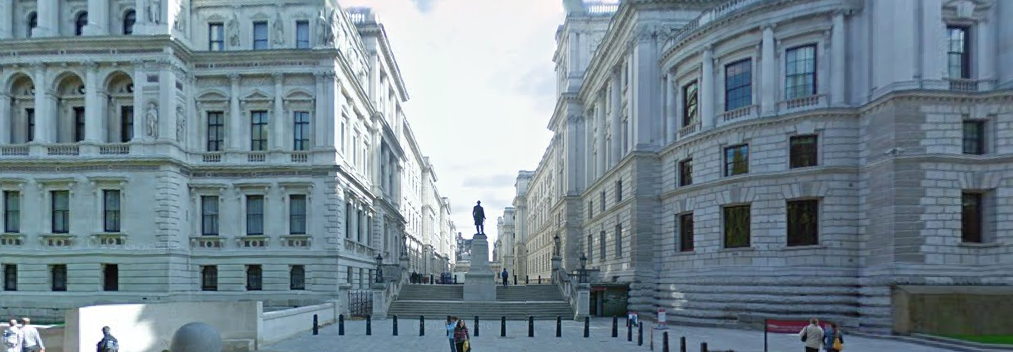
King Charles Street should be famous, but isn’t—perhaps by being named for the only British head of state to lose their head to democracy just up the road in front of Banqueting Hall. This narrow street is permanently sunless and gloomy, with little traffic running E-W between massive buildings—the Foreign & Commonwelth Office to the North and a monolith known as GOGGS (Government Offices Great George Street) to the South. It should be famous because that’s where HM Treasury lives.

You might think that Number 10 in the far better known Downing Street just to the North or the Cabinet Office, a little further up Whitehall yet, would represent the seat of real power for this United Kingdom. The media certainly thinks so. But major decisions in matters of state—whether to raise taxes, go to war or enhance welfare—are always rooted in what the gnomic mandarins of GOGGS permit.
The Heart of Imperial Britain: Clive of India dominates St Charles St with the Churchill War Rooms entrance on the right

The Heart of Imperial Britain: Clive of India dominates St Charles St with the Churchill War Rooms entrance on the right

Filling the splendid Edwardian edifice to the right (built 1908-17) is a formidable collection of fiscal minds who actually run this country. As of September 2013, Sir Nicholas Macpherson KCB, Permanent Secretary to HM Treasury since 2005 (and currently the longest-serving PS in all Whitehall), disposed of the following top staff.
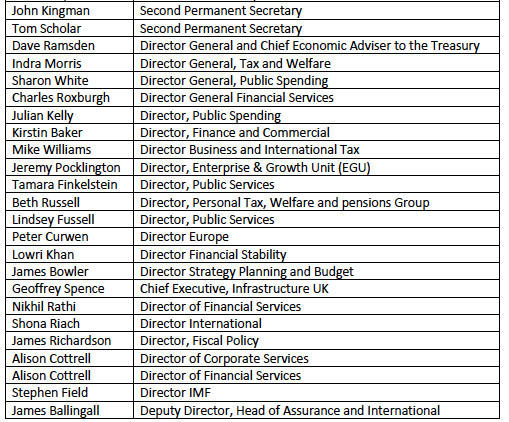
HMTsnrmgmtOstensibly reporting to The Chancellor, George Osborne MP, through Nick (as he is known) this high-powered lot—plus 66 Deputy Director minions—cost us all a cool £3.682m in salaries. As they are all sworn to work for the good of the country, irrespective of party in power (Nick has seen off two chancellors already) this should seem like a snip if it makes the other 63m rich. Except, for some time now a major question has been going unanswered: which country?

On 13 February HM Treasury published a letter from Nick to the Chancellor, advising him against entering into a currency union with an independent Scotland. The publication of personal advice from a Permanent Secretary to a Minister is highly unusual and calls into question just who they are working for.

In the 1970’s HM Treasury was in the thick of a strategy to downplay the importance of North Sea oil so that short-term gain could be made at the expense of SNP attempts to portray it as a vital strategic resource. In the 1980’s HMT was instrumental in selling off UK oil assets and settling for a steady stream of oil tax revenues, rather than be an active participant or to divert earnings into an oil fund, both of which Norway chose to pursue. In the 1990’s, they were up to their starched evening collars in the UK’s disastrous flirtation with the ERM and their scheming abetted Irn Broon’s notorious “pension stealth tax” that reduced the value of retirement funds by at least £100 billion.

So when we roll up to the present day and find Osborne dismissing any currency union and Cameron pitching that the UK is far better placed to develop North Sea oil further—both on the backs of HM Treasury advice, it is time to ask for whose benefit those 90 fiscal super-gnomes are beavering away and look this fiscal gift horse in the mouth. It would be unfair to accuse them of serving the payroll vote like Scots Labour MP always do—habitually rubbishing independence because it threatens both their ego and their job. But it must be hard to see 10% of their domain and most of the oil disappear from their clutches and not be tempted to do what you can to prevent it.

That said, the HMT cohort listed above are products of the formidable British Civil Service; they’re not daft. So let’ds see just how well they have done in general down the years before anyone dismisses the clear recommendations they are giving to keep Scotland in the Union as just self-serving gobshite. First, we’ll examine the outline of the UK economy in the 30 years since Thatcher came to power and oil became a factor in the economy. Then, we’ll compare that performance with a couple of neighbouring countries with and without oil of their own.

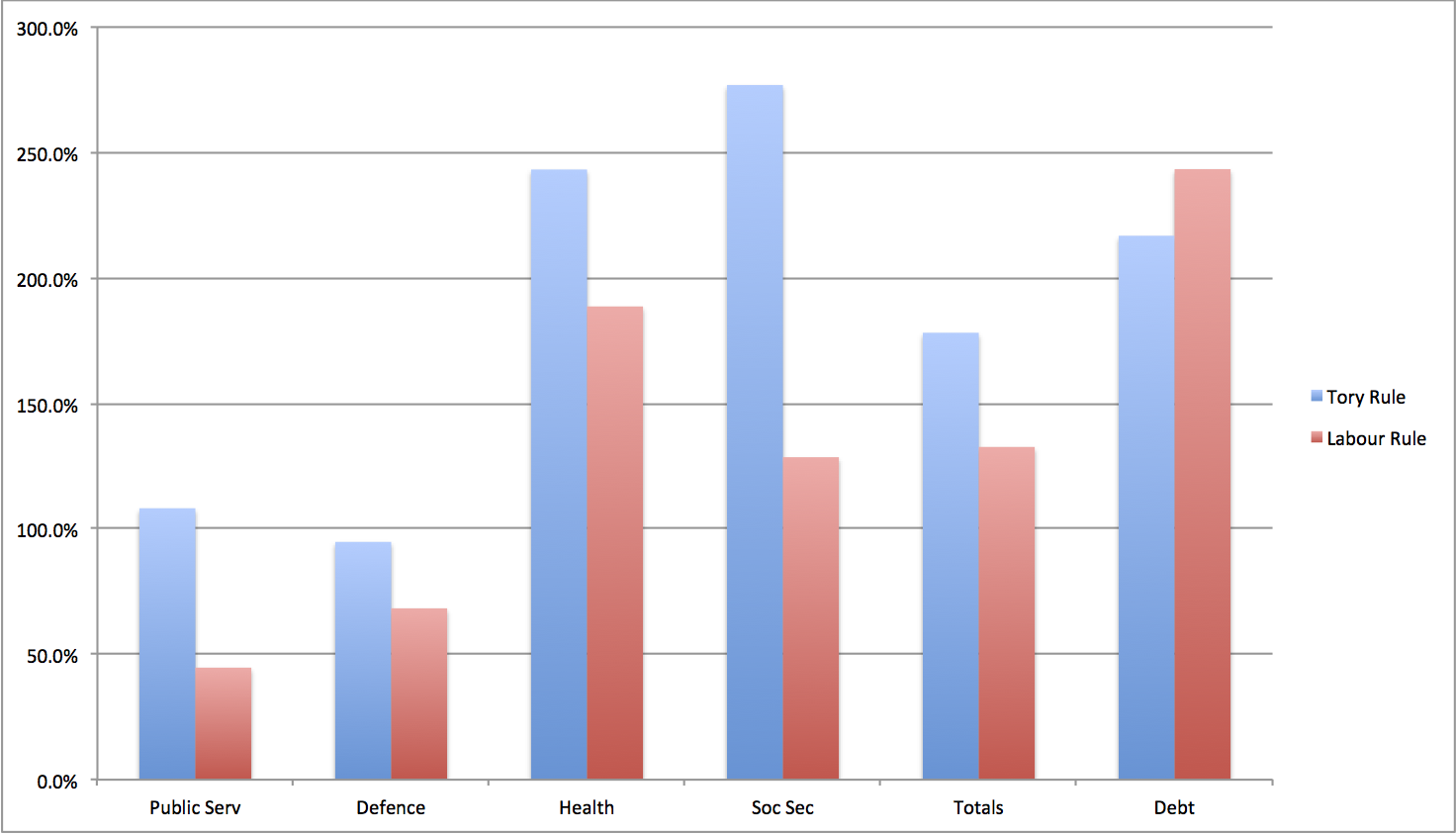
Those 30 years were split between 18 years of Tory rule, dominated by Thatcher, followed by 13 years of Labour rule dominated by Blair. Key elements of government spending from each period are compared in the graph below.

Change in UK Government Expenditure & Debt 1980-2010

Graph 1—Change in UK Government Expenditure & Debt 1980-2010 (Source HM Treasury)

This chart is something of an eye-opener because it shows that ‘small government’ Tories actually increased spending more in every department on their watch, as compared to supposedly ‘tax and spend’ Labour—even  into debt in an attempt to sustain it. Supposedly HM Treasury was providing both governments with their shrewdest advice how best to exploit Britain’s resources (including oil) and standing in the world to maximise the benefits for its citizens. If we compare with nearby small countries, we should be able to see the formidable exercise of shrewdness backed by clout exemplified.

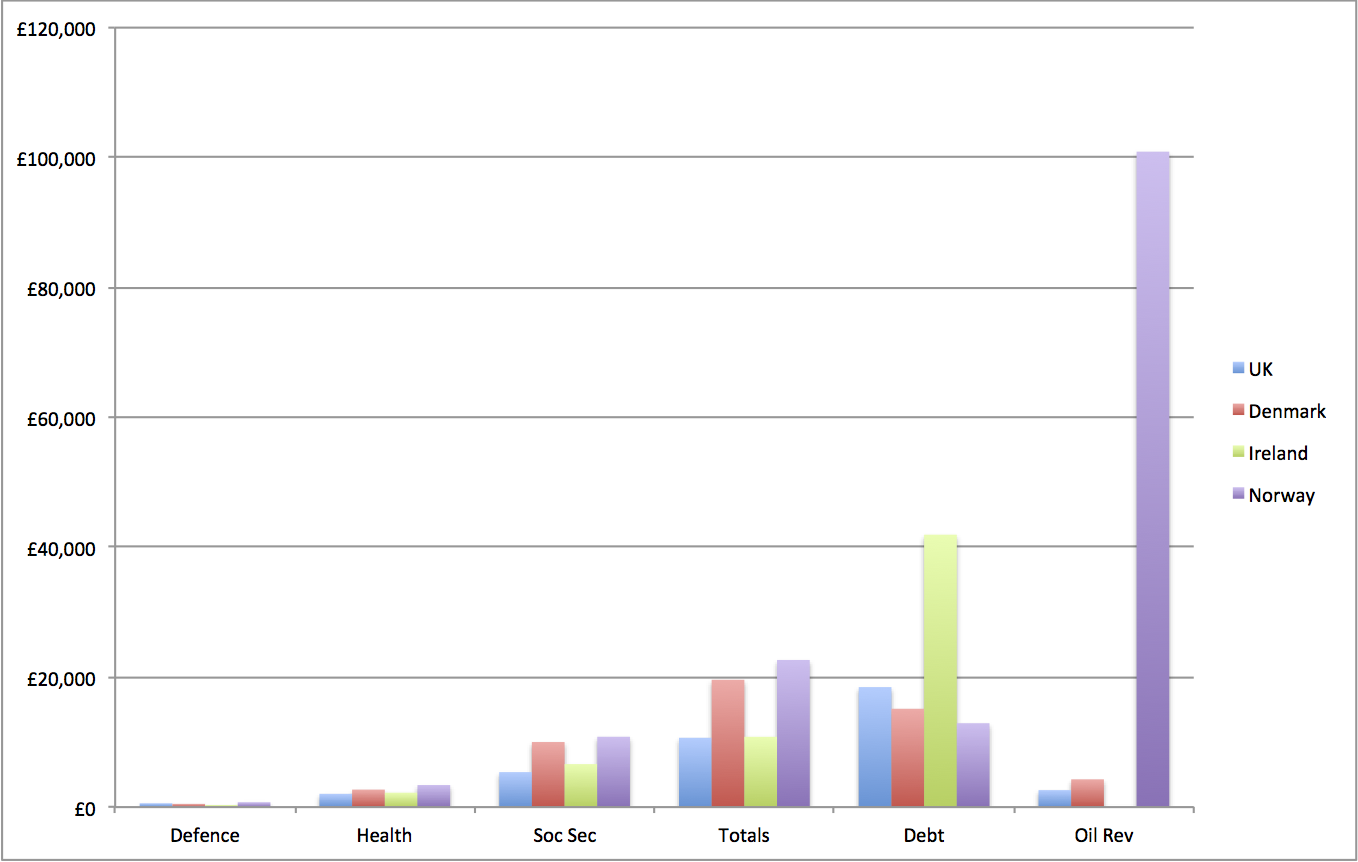
Graph 2—Comparison of Three Small Neighbours to UK 1980-2010

Graph 2—Comparison of Three Small Neighbours to UK, 1980-2010 (Source OECD)

So comparing how expenditure in neighbours increased over the 30-year period under discussion, it can be seen that the UK increased its health spending greater than the others but in every other case (except vs Irish defence spending) lagged behind, even though debt accrued during the period outstripped all three countries. This looks like poor performance, with smaller countries—even those like Ireland, often derided as in an ‘arc of insolvency’ still outstrip the UK is providing for their citizens without mortgaging their future through debt.

However, it could be that small countries suffer, as strange bedfellows like Lamont and Cameron both maintain, from dis-economies of scale, so let’s revisit this from the point of view of spend per capita.

Chart 3—Government Spend and Total Oil Receipts per Capita 2010

Chart 3—Government Spend and Total Oil Receipts per Capita 2010

The salient points from Chart 3 can be summed up as:

  • Norway, Denmark & UK spend comparable sums on defence; Ireland spends barely 25% as much
  • Health spend per head each year is comparable, ranging from UK ‘s £2,042 to Norway’s £3,401.
  • Despite its huge outlays on Social programmes, UK still only spends half the amount Norway or Denmark do to provide theirs
  • Total spending on its citizens in Norway or Denmark is twice that in UK or Ireland
  • Ireland may have eye-watering debt but it has no oil; UK debt is highest of the others.
  • Despite having the largest share, UK taxpayers have benefited least from North Sea oil

Put bluntly, not only does the relative size of the UK seem to have provided its citizens with no advantage over countries one tenth its size but two of the three cases cited beat it on every count and supposed ‘basket case’ Ireland does just as well. There seem to be three plausible explanations for this:

  1. Despite their size, resources and ‘clout’, large countries operate at a disadvantage.
  2. HM Treasury is fiscally incompetent
  3. HM Treasury does not work to benefit all citizens but a subset of them

The sheer economic beefcake that is the USA soon disproves 1. The reputation of the UK Civil service in general and the fiscal wheezes dreamed up by the gnomes of the Treasury to lightfinger ever more money out of unsuspecting punters rather gives the lie to 2.

The most stunning statistic in all the charts and figures is that, while even the Danes have each benefited by twice as much oil revenue as the UK, the Norwegians have fifty-fold; in Norwegian Krone (NKK), they are each millionaires. If you want some detail why that should be, try Dude, Where’s My Oil Money? in the Guardian on January 14th. To quote in part:

“For a few years, the UK enjoyed a once-in-a-lifetime windfall – only, unlike the Norwegians, we’ve got almost nothing to show for it.

“All this was kick-started by Margaret Thatcher, the woman who David Cameron claims saved the country. The party she led still touts itself as the bunch you can trust with the nation’s money. But that isn’t the evidence from the North Sea. That debacle shows the Conservatives as being as profligate as sailors on shore leave.”

Don’t like the Grauniad’s take on the affair—how about the New Statesman?

“…nothing better illustrates her failure to invest in Britain’s long term future than her mishandling of the giant windfall she was gifted on entering Number 10 from booming North Sea oil revenues.

“Tony Blair said in 1987 that North Sea oil was “utterly essential to Mrs Thatcher’s electoral success”. But history should also record that Thatcher missed a trick in not diverting some of the proceeds of oil revenue into an oil fund, like Norway and others did.”

To be un-Britishly blunt: HM Treasury was complicit with Thatcher in making the worst economic decision ever made in the UK. For all their Oxbridge/Civil Service training, the gnomes of King Charles Street blithely frittered away £165bn on “current spending, including covering the costs of large-scale industrial restructuring and funding expensive tax cuts to woo middle England.” Given all that, Chief Gnome Sir Nicholas Macpherson wading in to prop up the Union, though deeply unprofessional and blatantly self-serving, is hardly surprising.

But what is surprising is that Scots are not livid with righteous anger they are not yet sitting on a nice £90,000 nest egg in their own rich, progressive country and are still being lectured by economic pygmies how to squander the other half of their own North Sea oil riches left. Our 90 top fiscal gnomes on their £3.682m in salaries seem dedicated to shafting Scotland in the process. They have form.

The real mystery of the whole sorry story is why we let them.

Posted in Commerce, Community, Politics | Tagged | Leave a comment

Buddy, Can You Spare a Dome?

You have to hand it to Tony Blair. Not only did he shrewdly sidestep the coming fiscal storm in 2007 but then dropped from public scrutiny straight on to the six-figure speaker circuit and hasn’t looked back since.  Sweet. What has helped is his deeply pragmatic view of politics. Though he does not have his public enemies to seek, they are fewer and less vitriolic, compared to the only other 20th century politico hate figure—Margaret Thatcher.

That Thatcher-bashing remains a favoured sport can be explained by her steely vision and inability to compromise,. Whereas Blair, in many ways, went further—reinventing Labour as friend to patrician and proletariat alike, once you bury your principles, it’s much harder for media and/or enemies to pin you to a given point. Thatcher’s mistake was to settle for recruiting the middle class to her standard, leaving most workers thirled to Labour. Blair, on the other hand saw he could take their loyalty for granted while he wooed both the middle class and arriviste rich created by Maggie’s City ‘Big Bang’ and housing bubble.

Even though the hapless Irn Broon reaped Blair’s whirlwind head-on, even he got away with his rape of prudence as chancellor—raiding pension funds; letting the FSA doze at the wheel; inventing social benefits without worrying about long-term financing; pushing PFI (onto councils especially) to keep borrowing off the books and pork-barrel flowing.

In office, Blair was happy to bask in the glow of popular developments, London infrastructure and socially progressive schemes funded by government spending doubling from £250bn to £500bn on his watch. Brown sang descant, milking money left, right and centre. Because everyone’s house prices/salaries were rising, nobody questioned bonanzas. Blair may have stolen much Tory policy thunder but business beamed; ‘Ethical Foreign Policy’ was simply a cover for selling anything to anyone, provided all kept quiet and didn’t rile the Americans.

In those days almost everyone felt they were getting richer and Blair deserves acknowledgement for creating such feelings. He appeared to do this by speaking to voters over the heads of parliament and party with a presidential omniscience that lasted over a decade. It was still intact when he body-swerved out of the limelight. Once the lugubrious Brown was in charge, the Bambi shine went all dull. Yet, despite borrowing to sustain it all when the infinite-money-illusion collapsed, Brown slid off to Kircaldy-les-deux-Églises un-pilloried, if not unsullied.

Blair was not just gifted, his timing was flawless. Brown may claim to have produced over a decade of affluence and growth but mostly he just indulged himself on the proceeds and milked the image of a dour, bankerly Scot as the right man for the economy. People only dimly perceived the extent to which the (then-new) army of spin doctors manipulated  news. Alastair Campbell, Charlie Whelan, John McTernan had a field day selling devolution, peace in Ulster, national minimum wage, saving the NHS and local council education, bringing unemployment down, introducing tax credits, etc, etc.

While some of his team like Mandelson and Irving lost touch, Blair never fell into the trap of hubris, never made McMillan’s mistake of telling people they’ve “never had it so good”. He even managed to deflect criticism by putting Mandelson in charge of the ill-fated Dome as a kind of lightning-conductor, deflecting criticism away from his boss by getting guacamole on his face. Just as well; the NAO slammed the project as a £1bn disaster.

This may have been the highest profile of many profligacies in which Blair indulged. But the one that did  most damage—especially in Scotland—was to revamp the Tory dosh-for the-boys PPP scheme and relaunch it as PFI. Worse value than normal public procedure of borrowing off the PWLB at rates below anything a private company could, it did not show  as government debt. Public bodies like councils doing the borrowing were bluntly told it was “the only game in town” and to find extra money required by themselves.

So detached was this wheeze from socialist principles and damaging to the public sector that its biggest union came out against it and in 2007 published “At What Cost” a report on the aggregate costs of PFI/PPP projects in Scotland. As these contracts last 30 years and take precedence over any other fiscal priorities, such contracts are now playing havoc with  councils’ ability to deal with any fiscal belt-tightening in a balanced manner. In the Executive Summary, Unison points out:

  • Total PFI contracts active in Scotland total £20bn, mostly in councils and NHS
  • Scottish PFI/PPP contracts could be costing around £2.1bn more than conventional funding. That’s twice the spend on the Dome with nowt to show for it.
  • Analysis of official figures from 35 schemes found that estimated public sector
    comparators (PSCs) were 6.4% cheaper than the contractors’ bids.
  • An incredible £3.5 billion ‘insurance’ policy is effectively paid to the private sector to cover risks of things going wrong with the contracts, despite risk being effectively retained by the public sector.
  • None of the above figures take account of higher financing costs in the private sector; Audit Scotland says this could be as much as 10% of total costs in early PFI schools.

It is notoriously difficult to get detailed financial figures for many PFI/PPP schemes due to claims of ‘commercial confidentiality’. Despite approving funding for these schemes, the Labour Scottish Executive of the day claimed it did not actually hold many of the key documents. Details of many of those it did hold are redacted due to commercial confidentiality; other public bodies withhold financial information on similar grounds.

In order to prove that PFI/PPP supposedly provides good value for money a notional risk adjustment is added to the PSC. This usually takes the estimate higher than the PFI/PPP contract. This like an ‘insurance’ policy against problems such as time and cost overruns.
Yet any Minister worth their salary would be able to negotiate a far cheaper policy than
the total estimated £3.5 bn in risk adjustments.

“Unison Scotland estimates the total sum wasted on PFI in Scotland at £5.8 billion, taking into account the whole range of factors listed above.”

So, while many of the New Labour persuasion still think fondly of Blair as the man who won three elections on the trot for the first time in their party’s history and as many of his detractors vilify him for finessing UK into the Iraq War with scant moral justification, his true legacy in Scotland is that he robbed at least two generations of adequate public capital investment just to buy himself glory in those three election wins. I doubt he loses sleep over thinking about what that £5.8bn would buy for Scotland. The answer?:

  • 29 hospitals the size of ERI
  • 244 inner-city high schools of 1,300 pupils (including full S6)
  • 3 new Forth Crossings
  • 2 Denver International Airports (newest in US & 5th-busiest airport in the world)
  • Build Phase I and II of EGIP and upgrade Aberdeen line to express standard—then have the same amount again to revolutionise Scotland railways
  • Dual A9 Perth-Inverness & A1 Dunbar-Berwick, upgrade A96 Inverness-Aberdeen
  • Pay independent Scotland’s share of UK’s £1.5tn debt for first ten years

Or if you prefer to think the way Blair, Mandelson et al thought: 6 Millennium Domes.

Posted in Commerce, Politics | Leave a comment

Learning from History

It was eerie. I had a Friday evening free, fired up a casserole and channel surfed for something better than another yuppie house makeover to watch. And there it was—forty years almost to the day the cusp of change in the British two-party state. Anorak as I am for being able to watch BBC Parliament for more than five minutes without throwing something (including up), here was politics (and broadcasting) in aspic—a whole era of accents, suits and attitudes that looked outdated and seemed as remote as Peel or Disraeli or even Arthur’s Camelot.

Though nobody knew it at the time, the February 1974 UK General Election was the last of a long line of binary tussles between Tweedledum and Tweedledee (not to be confused with Christine Grahame’s Borders constituency) that had driven British politics since the post WW1 self immolation of the Liberal Party. Graphics were hilarious by today’s standards, links were clumsy, with Alastair Burnett and Robin Day desperately picking up pieces and patching in gaps as they anchored a period piece of reporting with ugly cracks and stuffing leaking out the back like an old sofa.

To appreciate its full glory, you had to re-imagine life in the seventies—interrupted by repetitive strikes, living standards wobbling as once-muscular industries were debilitated by the devilish cleverness of Johnny Foreigner. Cities were echoing to glam rock and random explosions as provos and proddies had eternal goes at one another and most of the British Army then deployed to Ulster—to the despair of most of the rest of us. It was not anyone’s finest hour.

So it was weird, if understandable, that half the commentary was about or came from Ulster and the results in its dozen seats. Paisley’s unionists disparaged Fitt’s unionists and both had a go at the struggling SDLP when their real problem came from Sinn Fein. Ian Paisley’s resounding victory was celebrating not with a victory speech but with a psalm. The main story of the election was expected to be the resounding endorsement of Ted Heath’s Tory government who, after suffering years of fractious behaviour from various unions, had called their bluff with an election on the basis of “who rules?”

“Well, not you”, came the people’s response. Yet they also could not raise enthusiasm for the alternative: Harold-Wilson-led Labour who struggled to overturn many Tory-held seats and barely scraped past them with 305 seats to 299. As with every election in modern times until then, the pendulum between the two was all that counted and they totalled 95% of all seats even that time. So, much of the long night and well into the following afternoon was taken up by speculation of coalitions and repeated strutting by Ulster Unionists anticipating the power of being kingmakers.

But there were two spectres at their collective feast. One was the Liberals who, although having a hugely successful election, garnering 6m votes. By spread evenly across Britain as a solid 25% share, they could not translate those votes into seats, winding up with barely a dozen—it was taking over 800,000 votes to elect a Liberal MP. This was discussed across the BBC studio with much wringing of hands and anticipation of voting reform. Aye, right. Bottom line was the Liberals were too weak to be power brokers and the two big party’s stiff indifference still lasts to today.

The other was ignored until well into the following day when the catch-all group of MP’s lumped together as ‘others’ grew too big to be ignored. In this were Selwyn Lloyd the Speaker (whose contest drew much sucking of teeth because both Labour & Liberals had had the temerity to break convention and oppose him) an Independent Labour win at Blyth as a poke in the eye to machine Labour who deselected him for exposing cronyism in the CLP and the usual (at the time) Irish unionist suspects.

This still left an unexpected squad of nationalists—two from Plaid and seven from the SNP—who had gone through rural Tories like a dose of salts, presaging their eventual 1997 wipe-out by 23 years. The import of this was lost on the entire BBC studio crew, who yammered on about LAB/CON swings: none seemed able to escape such binary politics and could only treat Northern Ireland as if it were a separate planet.

So, we had a toothsomely young Esther Rantzen interviewing vowel-mangling Tory toff St John Stevens for holding off his Liberal challenger in Chelmsford, various Tory nabobs dissing the Liberals’ complaint for fairer representation and some frightening union dinosaurs of the era like Jack Jones and Frank Cousins clearly chuffed to see themselves as power brokers now that Heath had thrown down the electoral gauntlet at them.

But there was no outside broadcast interview North of Newcastle, Worse was the level of ignorance displayed, labeling George Reid as ‘David’ and Gordon Wilson as ‘Grahame’. As a piece of metropolitan reporting it is a history lesson both in how simplistically British politics was treated (with the massive, almost kow-towing exception of Ulster) and in how the SNP could build up a significant head of political steam simply by highlighting the complete lack of understanding/sensitivity where Scots were concerned.

Even when the SNP ‘football team’ of 11 was sent to Westminster in the second election in October (that still failed to form a real majority but did unseat Ted Heath and launched Thatcher), Wilson and then Callaghan’s fixation was the cat fight into which British industrial relations had fallen—and that they felt elected to resolve. The naescent surge for independence on the back of North Sea oil was cleverly run into the sand by a scheming Willie Ross as Scottish Secretary and the connivance of the Westminster establishment, culminating in the odious ‘40% rule’ that lost the 1979 Referendum, despite a clear majority.

Watching the whole election unfold explained why so many other things were anguished over but the SNP’s surge was not. As my granny would say: “Aye, they ken noo!”

Posted in Politics | Tagged | Leave a comment

The Devil Is in the Doodle

I have been a fan of the Scottish Parliament since before we failed to get ourselves one in 1979. And, however sanctimoniously two-faced some parties my have been in opposing it and then using it to rescue themselves from well earned oblivion, that all political stripes of Scottish life are in there and arguing their corner speaks for democracy and to Scotland being mature enough to handle such diversity.

That said diversity does not currently stretch to the socialists can be blamed on their fractious nature (so ably lampooned in Life of Brian) or offer much hope to the BNP/UKIP right explained by the less xenophobic nature of the Scots. And the definition of ‘Scots’ can be as loose as you like. In the decade since 1999, 800,000 English came to settle in Scotland. Yet UKIP polled a miserable 0.7% in the 2010 election here vs the 25% they polled in England last month. Maybe it’s our water.

With good nationalist friends, I stood on the steps of the (as it still was) Bank of Scotland HQ steps that summer’s day in 1999, clutching my saltire and lump rising in my throat at the history being made before me. Winnie spoke powerfully of the Parliament being ‘reconvened’ after three centuries in oblivion and Sheena Wellington nailed the mood with a rendition of “A Man’s A Man, For A’ That” that didn’t leave a dry eye in the house.

I won’t rehearse the many unrealistic expectations of this reconvened ‘Pairlimunt’ because that which dissolved in 1707 was no model of representation, biased as it was towards a nobility of questionable nobility (they were still flogging Nova Scotia baronetcies to arrivistes if they could pony up the money) and still more questionable morals. The bulk of those there were more concerned with recovering what they had lost in the ‘gaun wursels’ colonial disaster at Darien the decade before than representing the Scottish people in any broad sense.

But nobody seems to have bothered wondering just what sort of Parliament we do have and—especially as it may wind up running the other 2/3rds of the Scots economy not under its control—it would seem a good time for a little stock-taking. The difficulty seems to be that everyone has already filed into their partisan trenches and got busy lobbing mud at Holyrood or Westminster, depending on which jersey you’re already wearing.

There is no doubt that there has been legislation that meets the elusive simultaneous goals of popular, effective and successful. Land reform; free personal care; smoking ban; rewriting teachers’ contracts come under those heads albeit—as with so much—not with everyone. That said, looking to the areas most affected (1/3rd of budget goes on the NHS and another 1/3rd on local government) precious little hard-headed analysis is done.

Both main parties are to blame for this. Labour managed to fluff the massive opportunity offered by a doubling of budget 1999-2007 to provide anything memorable. The 2001 McCrone agreement with teachers doubled their pay/pension per chalk-face hour, yet has yet to achieve improvement in pupil education. Even larger percentage increases in the social work budgets were swallowed up by ever-wider casting of the social care net so that free provisions—free bus passes; free prescriptions; free personal care—as well as new services—kinship care; compliance with DDA; equalities issues; etc. The system swallowed it all to the point that carers still complain they are under-compensated. They have a point.

But let’s be hard-nosed about some real luxuries. Why should travel concessions apply during rush hours? Or allow travel from Stranraer to Thurso for nothing? Why is there no means test of the annual heating allowance? Those are some simple ones. But if we truly are in a fiscal bind and local authorities are cutting services people value why don’t most charge for parking or special uplifts or park/ranger services? Why does property banding stop at an average-home price? Why do people get discounts on 2nd/3rd/etc homes when they usually rent them out for profit? Even if you’re an NHS fan, why should prescriptions be free and why should those who abuse its laudable impartiality (e.g. using ambulances as taxis) not get charged for their unreasonableness?

Billy Connolly derided Holyrood as a ‘pretendy parliament’. Most of us don’t share that view but, as long as they have no direct responsibility for raising their finances, there is a case to answer how they would do in the ‘real’ world. Full fiscal autonomy would sweep away much gesture politics and get whoever runs the show focused on balancing the books. It might launch civil debate over fundamental changes now being visited on the police/justice systems to prioritise cost-savings there so NHS monies are maintained (even as overheated wards open windows and thousands of meals are binned daily).

It should not take a fiscal crisis to make any government behave responsibly as it discharges its duties of health, welfare and prosperity for all of its citizens. They should be lean, mean and fit for purpose at all times: Olympic athletes do not start training three weeks before the games. But watching FMQs over the last couple of years should make even Labour politicos wonder if the present opposition is in any state to oppose, let alone run a country. The lack of lead in their pencil has let the present government run rings around them and so allow backbenchers the luxury of posing as much as pushing.

If only to release all 129 of ’em from self-importance (despite their doodling) in the chamber, the argument for independence is overwhelming. Not only is it a big, cold world out there but when the going gets tough, the tough get going. In its its formative decade and a half, the Scottish Parliament achieved much. But to overcome radical challenges from this century—and for as long as Westminster fixates on problems of a colonial past—the Scottish Parliament needs to streamline the jalopy—make it faster, leaner, meaner. And when independence does come, know how to drive clever and not make an arse of it.

Posted in Commerce, Community, Environment | Tagged | Leave a comment