Why Yes Is the Answer III—It’s the Economy, Stupid!

There is a clear case for an independent Scotland to prosper more than it has to date within the UK. I confess that I have not examined all the contrary evidence put out by HM Gubmint on its website at public expense but any open-minded Martian would find it a) turgid; b) light on facts and c) questionable in its conclusions. You need only hold your nose and point your browser at:

https://www.gov.uk/government/publications/scottish-independence-referendum-money-and-the-economy/scottish-independence-referendum-money-and-the-economy

for the sheer self-serving vacuousness of the arguments to assault your senses. For example:

  • Scotland is a successful, growing economy, as part of the UK Scotland has the highest economic output per person behind London and the South East.
  • The UK’s economy grew by 1.7% in 2013 – and the recovery is forecast to continue – with growth of 2.7% in 2014.
  • There are more people in work across the UK – more than 30 million – than ever before. The UK’s overall employment rate is higher than the USA for the first time since 1978 and, as part of the UK, Scotland’s employment rate is greater still.
  • Nations within the UK have strong, important and beneficial trade links – In 2013, Scotland sold £50 billion worth of goods and services to the rest of the UK and bought £63 billion worth of goods from the rest of the UK.

All of which is fascinating. But it makes no case whatsoever why Scotland needs to remain part of the UK. Indeed, the reverse could be argued, since Scotland appears to be doing so well within the UK and all of us are part of the EU open market. The Westminster beancounters then go on to say that Scots already control 60% of expenditure and receive 10% per capita more than England (conveniently ignoring oil revenues). So??

The entire 2000-word document is in the same vein, verging on the naff. There are four such ‘Factsheets’, plus a dozen ‘Scotland Analysis’ papers totally well over 1,000 pages in all. The one on Currency and Monetary Policy is typical of them all, seeking to rubbish all options for use of sterling by both countries, as if it were not in England’s interest to see an independent Scotland succeed. This self-destructive myopia is a leitmotif of the entire UK government approach to Scotland. Given the strength that Scotland brings to the UK economy, such self-interest is understandable. But to present the debate as if Scotland were a basket case while citing umpteen positive parameters as if they could only ever be realised under Westminster’s sage tuition takes rare cheek.

But let’s leave aside those Tories who have made themselves foreign to Scotland and their city chums whose wizard wheezes need the biggest fiscal stage on which to play. Let’s also leave aside a ‘feeble fifty’ Labour MPs—in 35 years after scuppering our ’79 referendum they have grown fat from the imperial trough but done diddly-squat on behalf of their Scottish constituents (honourable exceptions: Donny Dewar and John Smith who had both ideas and principles, working themselves into early graves trying to stick to them).

Let’s look at this ‘recovery’ of which Lord Snooty & Chums are so proud. “The economy” says the Treasury “grew by 1.3% in 2013“. Let’s see what the Evening Standard—as big a booster for London as you can get—says about that:

The UK’s economic recovery is dangerously unbalanced, with almost 10 times more jobs being created in London than in the next best city, according to a new report. Research by the Centre for Cities think tank revealed that London accounted for 80% of private sector employment growth between 2010 and 2012.

The kind of jobs created were mostly service sector jobs—little surprise given London’s relative paucity of manufacturing. So, comparing Scotland’s recovery with England’s can we distinguish differences? Since 1996, in Scotland, manufacturing has dropped from 19% to 12% of GVA while finance and insurance has risen from 12% to 16%, despite financial crashes. England still retains a significant manufacturing element (e.g. Rolls Royce and foreign car plants) but Scotland’s is larger per capita, specialising in oilfield engineering, whisky and renewables.

In fact, throwing in the financial and tourism sectors, plus growing food and drink exports, Scotland can be said to have a robust economy, closer to London’s than to still-to-recover northern and Midland areas of England. This is borne out by comparing GVA statistics since before the recession, shown in Figure 1.
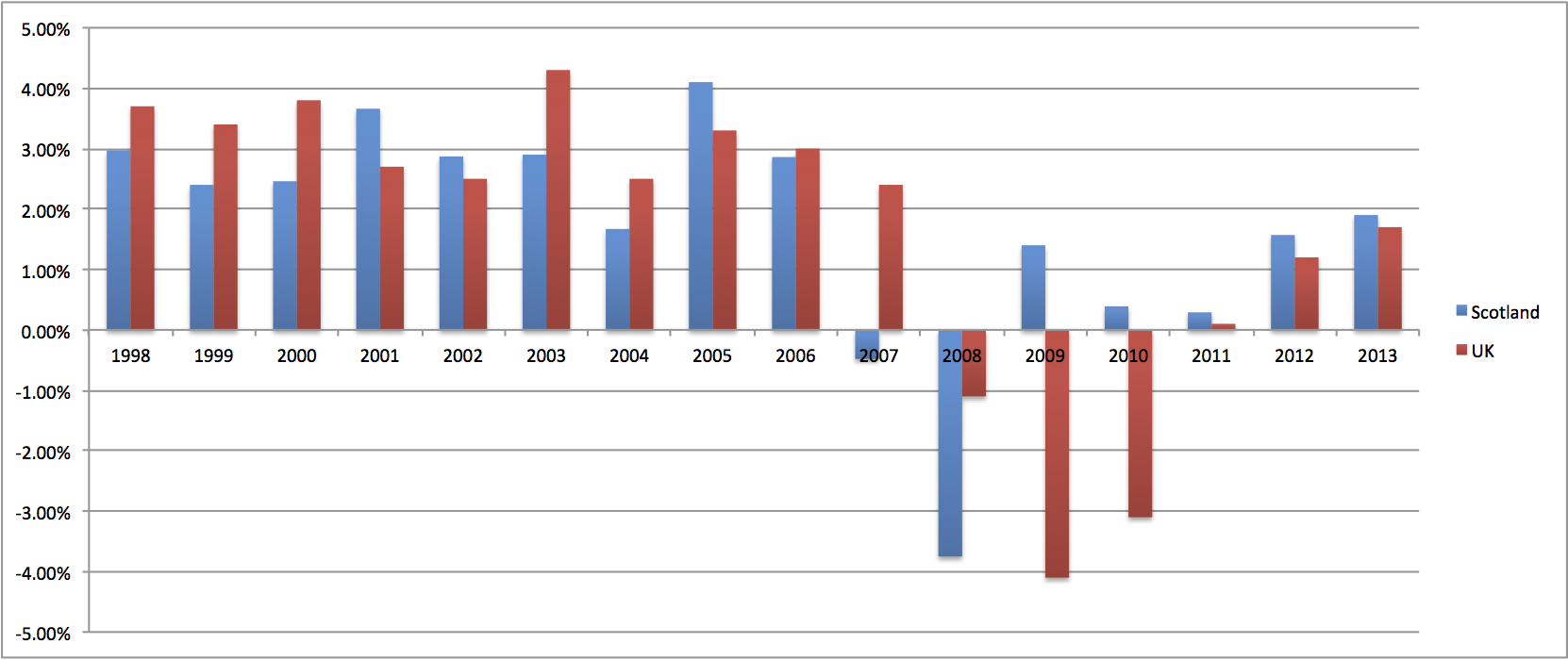
Figure 1—GVA Change Comparisons (Sourgce ONS & SG)

Figure 1—GVA Change Comparisons (Source ONS & SG)

Clearly, Scotland grew at a rate comparable to the UK until the recession in 2007. At that point, we were initially hit far harder but recovered faster and continue to do so. Indeed, Scotland’s economy appears more robust than the UK (i.e. England’s) and a strong case can be made that they need Scotland to keep them afloat.

It’s about this point when unionists wade in with their hoary warnings how RBS would have gone bust, had Big Bruvver Britain not been there to grease the skids. As they put it:

“The UK Government supported the injection of over £45 billion into the Royal Bank of Scotland in 2008 and offered the bank a further £275 billion of guarantees and state support to protect our financial systems. The total level of this support would have been more than double the total size of Scotland’s economy in that year.”

All factually correct—except that subsidiaries NatWest and Ulsterbank operate solely elsewhere in the UK and are worth £380bn and £48bn respectively—out of total group assets of £1,470bn, 30% of which (£421bn) are held overseas (including £70bn in the  disastrous Dutch foray of ABN-Amro). Ignoring other English RBS subsidiaries, at least 60% of RBS operations were furth of Scotland and—unlike Icelandic banks who had no ‘Big Bruvver’ to rescue them—the Bank of England would have been foolish not to intervene, even had the bloated RBS been based in an independent Scotland at that time.

The alternative would have been to see NatWest and Ulsterbank close their doors and freeze depositors out, as Northern Rock had just done. Hard fiscal realities dictate that banks with heavy presences in other countries can rely on adopted countries to help in times of fiscal trouble. That’s why Icelandic banks went to the wall (because they had none) but the heavy presence RBS/HBOS furth of Scotland gave the Bank of England no choice. (The whole question might not even have arisen, had Scotland been independent, with a real Financial Services Authority—not a toothless gaggle of City chums asleep at the wheel in London. Scandinavia—with robust FSAs—survived without a banking blemish).

Which brings us to the use of the £UK. High-placed unionist payroll members like the Alexander brothers (Danny and Douglas) are falling over themselves to explain why this is an impossibility. Let’s leave aside that the Aberdeen agreement was supposed to lead to constructive dialogue to achieve the best for both countries in the event of a ‘No’ vote and consider several pragmatic points:

  • It’s not England’s £. Shared jointly since 1707, so Scots have a solid claim it’s theirs too
  • Sterling with Scotland outside would stop being a petrocurrency and drop in value
  • Although not independent, sharing the £UK officially means having a Scots member of the BofE board to argue our particular needs—more influence than Scots have now.
  • Any barrier to the 80% of Scots trade that is with England hurts them as much as us.
  • In 1922, independent Eire used the punt—pegged to the £UK—for 80 years before adopting the Euro in 2002. It was done with an amicable agreement which worked well
  • If Scots chose to use the £UK unofficially, there’s nothing England could do about it.
  • Having Scots use £UK unofficially as England gets ever more Euro-hostile could give Scotland a huge boost as Europe used it as a bridgehead in the sterling zone

There’s a strong case that the UK is being petulantly thrawn over this. But let’s assume that Scotland chose not to use sterling, thereby creating a barrier to trade to that £2tn market. When life gives you lemons, you make lemonade; huge markets exist to our East:

  • Germany—£2.500bn economy
  • Low Countries—£830bn total economies
  • Scandinavia—£1,050bn total economies

It would be naive to pretend that this market—twice the size of the present UK—would be immediately accessible. But centuries of London fixation by those who have steered our economy have lost us historic links with our other neighbours obvious from one glance at a map. Aberdeen is closer to Oslo, Copenhagen, Hamburg and Amsterdam than to London.

It’s high time Scotland stood up for ourselves in Europe and not thole this self-serving guff from Westminster and (especially) the new herd of myopic UKIP MEPs. Europe has faults that need fixed but Scotland has many friends (Iceland today became the latest to go public) who will delight at Scots distancing themselves from English xenophobia and wistful hankerings for a lost empire. Scots were England’s hard-headed partner in building, policing and administering that empire; but 21st century trade opportunities are global and not just in pink-painted bits.

Seen objectively, the idea that the EU would not fall over themselves to admit a dynamic, viable, energy-rich, export-rich Scotland as soon as they detach from England is really laughable. And that’s in the event that the Commission were not to interpret an existing member splitting into two would not entitle both to automatic membership. The EU is as creative at political fudge as any organisation. Scotland would, like Sweden, have to sign up to eventual adoption of the Euro. But, like Sweden, it only need finesse its finances to that they fail convergence criteria indefinitely and the kroner/£Scots could last forever.

Look at it the other way. If Scotland were already independent, with a stronger economy than England, better trade balance, more friends, no fiscal drag of Trident & ‘global police’ delusion, no europhobic faction, less haves/have-not inequality and a reputation for good education, resourceful engineers and generous hospitality, why on God’s green earth would they choose to partner up with a greedy, inward-looking, nostalgia-fixated has-been like London-dominated England?

Posted in Commerce, Politics | Tagged | Leave a comment

Why ‘Yes’ Is the Answer I—Personal

Growing up in a small town made for a restricted education as regards other cultures and alternative modes of living. But university threw me into the melting pot that was Edinburgh with its 10,000 students, many from England and abroad and the political activism that electrified student life in the late sixties.

That, in turn, led me to spend much time travelling in England and the Continent to iron out cultural deficiencies by time spent living in Surrey, Cornwall and Portugal. Then a couple of years in London as a mainframe maintenance engineer exposed me to the detailed geography and nocturnal life of the capital’s heart.

It did not remind me of Edinburgh, still less of small-town Scotland. Although the Big Bang and Canary Wharf were decades in the future, the ‘up-and-abaht’ Londoner was already impressive in confidence, in initiative and in shrewdness.

As a counterbalance to the wonderful life lessons available, there was an unbridled hectic that I would come to recognise in Rome, New York and Hong Kong—a city with confidence, intoxicated by its own success and ignorant, rather than intolerant, of others, encapsulated rather well in Johnson’s “When a man is tired of London, he is tired of life.”

While each city has its own culture and conceit of itself—an early girlfriend soon brought differences between Glasgow and Edinburgh into sharp contrast for me—London brings it (with some justification) to a whole new level of self-reference. Adding in the bloc that is the supporting Home Counties, there is an effortless arrogance from Peterborough to Portsmouth that puts medieval city states to shame.

After London, not counting the odd few weeks, I lived in a half-dozen cities on four continents and, barring the social extremes of Bogotà that were morally uncomfortable for me, never felt so culturally adrift in terms of both scale and alien-ness that was London, despite language barriers. Having been born in Central Middlesex Hospital and therefore a Londoner myself, I found this disconcerting.

I put this down to London’s endemic unshakeable superiority, combined with an unthinking conviction that no viable alternative can exist. Germans suffer this in things technical but are easy and class-free elsewhere, such as socialising; Americans suffer it from lack of exposure to alternatives but this is greatly softened by their curiously wide-eyed deference to European culture(s).

It may be unfair to allow London to speak for all of England but that rather underscores the emotional point: Culturally, politically and financially, London & SE dominates England. It may follow from that that Scotland is indistinguishable from another English region. Being convinced that this is both wired into their DNA and demonstrably incurable., then the only rational antidote that permits Scotland the voice to which I believe it is entitled is to bypass such effortless hubris through independence.

Posted in Politics | Leave a comment

Basildon Revisited. How Ukip is remaking UK in Thatcher’s image.

Iain managed to be insightful about the euro-elections and the underlying how/why of establishment parties’ disconnection even before the MEP results were known

@iainmacwhirter's avatarIain Macwhirter

“The suburbs are being painted red” tweeted Labour’s John McTernan at the height of post poll spin frenzy on Friday. He meant that Labour was holding off Ukip and the Tories in the metropolis – gaining Hammersmith and Fulham and various other stops on the suburban tube routes. Mind you Ukip had taken the precaution of not standing in most of these suburbs. As one of their number, Suzanne Evans said, with disarming honesty, “media-savvy, well-educated people” don’t vote Ukip.

The Kippers are still largely an out-of-London phenomenon. But that doesn’t make them any less dangerous to the political establishment. Nigel Farage’s people were taking 47% of the vote in solid Labour areas like Rotherham. They swept the board in Essex, taking Basildon the home of Essex man – the aspiring working class voter who turned Tory in the 80s in admiration of Margaret Thatcher.

Nigel Farage is the direct…

View original post 1,074 more words

Posted in Politics | Tagged | 1 Comment

Basildon Man Rides Again

With only the European vote to turn out for, Scotland will have recorded one of its lowest voter turnouts on Thursday May 22nd—probably somewhere in the high 30’s percent. The turnout in England was hardly much better but they did have roughly 1/3rd of council seats up for election. And, though those English local results may seem irrelevant to most Scots, they should be considered highly relevant as a factor in anyone’s choice between Yes and No in September.

Other than to party apparatchiks and the candidates involved, local elections anywhere rarely stir the blood or set anyone’s heather alight. In England, over the last 14 years the Tories have drifted down from 38% to 29% in share of local vote while Labour has barely moved from 29% to 31% (despite a bad dip to 20% under Irn Broon in 2009). But dig deeper and over the same time, Labour has slipped from 10,608 councillors to 7,109 while Tories have almost doubled from 4,449 to 8,400, despite losing vote share.

All this augers ill for Labour hopes of attaining UK power in 2015. But what augers worse is the Lib-Dem tale of vertiginous cratering, moving from a 28% share and 4,754 seats to just 2,318 seats from a 13% vote share. This can’t be just the unpopularity of being in government or the Tories would be hit just as hard. What’s going on? Well, it seems that the voting public, ever more cynical towards those who rule, has seized an even more radical stick with which to beat incumbents as a protest vote: UKIP.

Just as the Lib-Dems once filled the vacuum in Northern England cities by taking up the opposition cudgels that decimated Tories dropped from Accrington to York, so this election saw a phenomenon new to English politics but now familiar to Scots—a complex pattern of confusion and No-Overall-Control spawned by four-party politics. Where once basic city = red/country = blue assumptions would apply to 90% of results, the council map of England is now much more of a dull desert of grey.

For UKIP has arrived—157 seats at the last count and, while there are no councils in their control, several clear patterns emerge from their location, all of which pose dangers to the three UK parties and none of which seem to be taken seriously by any of their commentators on the aftermath. While Farage was chuckling into his pint in an Essex pub, a succession of party talking heads on BBC2’s election coverage spouted a predictable mélange of minder-dictated messages that added little to the sum of political knowledge:

  • “Labour has made significant gains with 290 more councillors and seizing key councils in London such as Croydon, Haringey and David Cameron’s favourite Hammersmith & Fulham” (Mary Creagh MP, Shadow Transport Minister)
  • While I’m sorry to lose hard-working Conservative councillors, we have been able to win the first new council in London since 1982—Kingston-on-Thames.” (Boris Johnson, Mayor of London)
  • “Yes we have had losses. But where Lib-Dems are strong, holding parliamentary seats and councils, we are more resilient because of the ground work we do.” (Malcolm Bruce MP, Deputy L-Dem Leader)

It may be unfair to pick on them but they are representative. Since great affairs of state were not drivers in these elections, the banality of policy content highlighted the sheer gallus nature of what every guest on the programme said. Despite the fact that 155 new UKIP councillors had been elected in the teeth of established heartlands of all three parties, they were dismissed as protest only, just assorted flashes in the pan. This was not only naive but underscores what the average voter detests about politicians: their apparent inability to give a straight answer or (often) even to address the question.

The sudden, often unexpected appearance of UKIP council groups inflicted pain across the political spectrum that does not necessarily bode well even for those who seem to have benefited. In the Labour target of Portsmouth, the Lib-Dems lost control by losing five of their seats—but to UKIP who took a sixth off Labour who thereby went backwards. In wall-to-wall Labour homeland, UKIP wooed what Rotherham Labour MP John Healy called the “disillusioned former Labour working-class vote” and won 10 seats in his Rotherham back yard, making inroads as far apart as Hull, Sunderland and Birmingham. Though Labour gained in total seats, it was nothing like what they hoped for.

And while Tories did lose seats to Labour, the bulk of UKIP’s 155 additions were at their expense and their diversion of core Tory support cost many others. But in Essex, home to ‘Basildon Man’, those aspirational working class voters who flocked to support Thatcher and found a home with Blair’s New Labour, seem to have been especially impressed by UKIP. Several former Tory councils went to NOC as almost half of the UKIP seats were won across East Anglia. From Castle Point to Great Yarmouth there are now new UKIP groups of 5 – 10 on local councils.

In Basildon itself, UKIP are suddenly the main opposition, having taken seven seats from the Tories, three from Labour and one from the Lib-Dems, almost as if to show their even-handed lethality to established parties. This seems much more than symbolic or coincidental. With the advent of on-message elected members, SPADs, expenses scandals and relentless media, the entire body politic in the UK has become the focus for people’s growing, if unrealistic, expectations.

Politicians, who increasingly inhabit a world with little external experience and who have adopted much of the career-building techniques that business developed in the 1980s, may have moved beyond mullet hairstyles and power shoulder pads. But slick media handling by groomed ‘safe pairs of hands’ has jaundiced our view of such spokespeople—and by extension parties. High profile characters who still evade party whips’ best efforts—Dennis “Beast of Bolsover” Skinner or Boris “Bendy-Bus” Johnson—are exceptions, evincing an affection but that does not extend to their parties.  ‘Old school’ parliamentary elders like Austin Mitchell come across as anachronisms: when told UKIP had the biggest vote in Grimsby, had taken seats off everyone and could take his seat next year, he dismissed that tetchily—as only an 80-year-old no longer moving with the times can.

There have been times in the past when Social Democrats or Greens were seen as the coming wave of politics and thereby made themselves into conduits of protest. But the dissatisfaction with ‘business-as-usual’ politics back then never reached levels it has attained now. Watching a day of David Dimbleby quizzing a series of MPs spinning their respective UK parties, they were relentless in agreeing UKIP’s surge was powered by a need for change in the present system and yet loyally spouting their party mantra variants.

Was there no exception? Well, yes: a brief interview with Nigel Farage outside an Essex pub showed him to be astute in articulating UKIP achievements as if they were victories when, in fact, not one council came under their control. But, more importantly, he was disarmingly normal: hesitating before answering, as if thinking about it; accepting that London results were disappointing; giving an object lesson how to be the kind of bloke that Basildon Man might not just vote for but like and trust.

Whether that image was genuine or generated almost doesn’t matter. It signals that the English middle has found the kind of person whose politics makes sense to them again. The ‘main’ UK parties must soon learn that lesson or suffer rigor mortis from their own over-managed anal retention and cringeworthy adherence to a political system nobody in the real world admires. Because Basildon Man, having lost and found first Thatcherism and then Blairism, has found a new credo, one that makes equivalent sense to him.

But, while he relishes those new politics of England, the UKIP philosophy of mistrust of those across the channel and defence of all things English makes less sense to the other countries of the British Isles; UKIP is effectively EIP—the English Independence Party. As such, they will reap MEPs on Sunday, yet elect none in Wales, Scotland or Ireland. Equally, they will do well in next year’s UK election—but again just in England. If we Scots have any sense, we will sidestep all this by serving notice in September that we prefer active participation in the world and deprecate England’s increasing isolation and the small-minded UKIP politics now driving it.

Posted in Politics | Tagged | 1 Comment

Heart of Scotland

There has been a lot of media flannel about St John’s Town in the wake of their peppy team bringing home the Scottish Cup. But some is overdue praise for a little-recognised Scottish success story and one both the Central Belt and civic planners would do well to learn from. Perth and Perthshire may be considered the “Heart of Scotland”, as their local tourist industry would have it. But it links in to other parts of Scotland in a whole series of ways such that there are few other representative touchstones that could mirror the complex country we live in.

The bulk of the county is Highlands, reaching far into the glens towards Dalwhinnie, Glen Lyon and Killin. Acres of tartan are shifted out of the House of Bruar on a daily basis; far fewer pounds of salmon are lifted from nonetheless fiercely delineated beats along the Tay; Glenshee is still celebrating a bumper ski season; on the Atholl and Chesthill and Glenfernate estates they are gearing up to cater for well heeled shooting parties.

But another swathe across the South is as fertile a swathe of beautiful rolling countryside as you find anywhere in Berwickshire or Fife or the Mearns. It turns gold and green in the summer and slides into russet, offering some of the most scenic bike or open-top car runs down its sleepy lanes. Yet come into Perth itself and you find a bustling place that wholly merits the title of ‘city’.

Not only does a tastefully pedestrianised area around the High Street provide a pleasant outdoor shopping environment but the hypermarkets along the nearby Dunblane Road offers a selection of bulk buy opportunities where it’s easy to load up the car. The retail offering has a huge catchment from Crianlarich to Cupar: people even travel from Dundee, it’s that attractive.

And its economy holds its own with any similar-sized town, having survived a local decline in the whisky industry for more romantic settings deeper in the Highlands and the merger of General Accident (headquartered in Perth) with Norwich Union, it is still the home to leading UK firms like Scottish & Southern and Stagecoach. Heavy engineering has declined here, as in much of Scotland. What remains survives around the little-known port where ships can still navigate the Firth of Tay.

As a result, the city has a richer political mix than its hinterland, with Labour & Lib-Dem councillors representing many city wards while the rural ones tend to be SNP where they have replaced (but not entirely displaced) the Tories as the locally dominant force. In fact, the SNP has quietly run Perth & Kinross (P&KC) for the last two decades with little fuss and quiet efficiency, overseeing major local investment like Perth Concert Hall and the Tay Flood Defences. Some city centre housing does compare poorly with douce villas off the Glasgow Road but the difference is less than in Scotland’s larger cities.

People who are partisan about their own home town may disagree but many objective observers acknowledge Perth as Scotland’s most successful and liveable city, with outliers like Dunkeld, Crieff and Blairgowrie. Not suburbs but towns in their own right they offer, if anything, even better quality of life. So it is perhaps long overdue that their local football team should plant the ‘Fair City’ solidly on the map at last. At 45,000 people, it is urban enough to offer cinema, theatre, restaurant and other cultural offerings people now demand, while not losing a green ambience that the river and the two massive Inches lend it. It even rates No.10 as tourist destination with Insider Scotland.

With Scotland’s future demographics no longer tied to where coal can be mined or ships can be launched, we need not be thirled to the 19th/20th century dictum that the big city is the place to be: modern communications and a higher value put on quality of life demand a more flexible and livable approach. Far too much time is wasted on the M8 than is good for people of the economy.

Perth actually offers an excellent model for the future: a modest city serving its citizens better than sprawling monoliths spawned by the industrial age. Just as small countries like Denmark or Singapore have shown how modest size can offer nimble economic advantages to prosper in the 21st century, is it not logical that places like Perth—and by extension, Stirling, Dumfries or Inverness (No 2 in Rightmove’s Happy At Home Index for 2014)—will be the places to invest and that those places will become a magnet for quiet affluence that all can enjoy?

Posted in Commerce, Community | Leave a comment

Thinking Big

Jimmy Reid was not a man to think small. A product of the tough Clyde shipyards in its heyday, he saw a future for shipbuilding when the yard bosses and their clumsy attitudes had alienated a proud workforce into union nitpickery as a defence. When the Heath government pulled all support from Upper Clyde Shipbuilders, instead of a strike, Jimmy organised a work-in to complete orders. After two years, the government capitulated. Jimmy’s speech that galvanised workers to take this visionary step is legendary:

“We are not going to strike. We are not even having a sit-in strike. Nobody and nothing will come in and nothing will go out without our permission. And there will be no hooliganism, there will be no vandalism, there will be no bevvying because the world is watching us, and it is our responsibility to conduct ourselves with responsibility, and with dignity, and with maturity.”

Jimmy died four years ago but a Foundation set up in his name has kept his gallus visionary spirit alive, never more so than with their publication of “Atlas of Productivity” which seeks nothing less than to literally change people’s perception of Scotland’s place in the world. The authors describe it as:

“The first dedicated atlas of Scotland since the 19th century and perhaps the first ‘atlas of productivity’ anywhere in the world. The atlas maps not just Scotland’s landscape and towns and cities but seeks to map as many of the aspects of national productivity as possible.”

This, in itself, would make it groundbreaking. But what it also seeks to do is see Scotland’s—as opposed to Britain’s—potential place in the world. The aim of the atlas is to get Scots to look afresh at the potential of their nation based on its position and its natural resources. It considers issues like:

  • 83.1% of land in Scotland is owned by private landowners – and of the private land 50% is owned by 432 people
  • Scotland has 25% of Europe’s offshore wind resources
  • Scotland has 25% of Europe’s tidal potential and 10% of its wave potential
  • Scotland’s peak energy requirement is 10.5GW. The full wind energy capacity of Scotland is 159GW.
  • In 2013 Orkney generated 103% of its renewable capacity, but a lack of connection with the mainland meant a £3m loss in energy
  • There are 7,000 possible 5MW hydro schemes available in Scotland
  • Scotland lacks ferry connections with the Nordic countries, despite European ferries already passing between Orkney and Shetland
  • How Scotland would and should contribute to the Arctic region
  • How Scotland could become the “gateway to northern Europe”

Perhaps most intriguing of all are these last two points. For the last 300 years, all strategic UK thinking has been, understandably, been done for Britain as a whole. For most of that time, Empire meant that two major axes of thought dominated: across the Channel to Europe and; towards global trade via the Western Approaches. Even though Britain’s role in the world has diminished, these two axes still dominate London’s thinking and consign Scotland to the resulting fate of a province on the periphery.

But, apart from political upheavals and an overdue modernisation of Scottish thinking towards near neighbours in Scandinavia and the North, geography is colluding to open up whole new possibilities for that orientation. The steady reduction in summer ice in the Arctic means that, instead of being on the periphery of Europe, Scotland can be re-thought as Europe’s launch pad for the Arctic.

Projected extent of Arctic Sea Ice over the Next Century

Projected Extent of Arctic Sea Ice over the Next Century

Initially, the season of open water connecting the Barents Sea with the Bering Strait will be too short for commercial exploitation. But demands for raw materials for China and the rest of developing Asia will mean coal, minerals and timber, currently locked in the Russian and Canadian Arctic will drive a commerically viable shipping option. But the secondary effect, more crucial for Scotland is that our rail links to the South mean that we could develop the new Rotterdam—transhipment point where huge, efficient ocean-going carriers have their goods transferred to smaller lighters for local distribution and exports from all over Europe are combined for shipment to Asia.

Currently, Rotterdam to Shanghai is 12,000 nautical miles (even using the Suez Canal, which ‘cape size’ ships can’t) and the voyage involves 50 days at sea. A Cape-Size ship would face 13,800 nautical miles and a 59-day voyage. It is not far off that distance and time if a Westward course via the Panama Canal were used instead.

But, given the option of the marine equivalent of a polar route, already flown by airlines heading for the Far East, distances suddenly shrink. From the Firth of Clyde’s deep water, massive anchorage and excellent transport links, a Cape-Size ship with an ice-free passage across the Arctic would mean after only 7,200 nm and 32 days it could reach Shanghai, (6,250nm/29 days, Yokohama)—at savings of over 40% in shipping costs. Norwegian and Russian ports may be closer yet but they don’t have our links to the South; US & Canadian East Coast ports would also benefit but would navigate West of Greenland. The resulting passage of the Canadian Arctic archipelago of 37,000 islands would be a nightmare and probably be ice-free for less time each summer.

Jimmy Reid’s questing spirit is well remembered in such provocatively forward thinking. Whether or not you want to plunk £40 for this quality book, it underscores that, if Scotland is already capable of making its own way in the world—as balanced, objective financials indicate—how much better would the Scots do if new futures such as this were seized by a people freshly invigorated to plant their country firmly on the 21st century map?

Posted in Commerce, Transport | Tagged | Leave a comment

Ten Wakeup Calls for Scottish Labour

In an attempt to bolster the Labour vote for the European Elections, the Labour List web site attempts a morale-boosting list of

10 reasons for Labour activists to be cheerful

And so they might be—in Englandshire. But seen from a Scots perspective, even dyed-in-the-wool, aye-been Glasgow Labour hardliners may have to scramble a bit to find much succour in the chippy young researcher’s (for who else but an apparatchik-zealot who’s not been out much could conjour up such blinding optimism?) ten upbeat points.

Yes, Labour may do well in England; they could hardly do worse than 2009 when UKIP swept up seats the Labour thought were destined for them. Below are the his points with some more realistic observations about how the point is likely to play in Scotland. Like we’ve been saying all along; it’s a different country.

  1. You can win round UKIP voters. Yes, we’re having a judder. But I’ve not talked to a single Labour voter considering UKIP who knew about their views on the NHS and the flat tax. As soon as they learn that Nigel Farage wants a cleaner to pay the same percentage of tax as a banker, the dalliance with UKIP ends. UKIP is a non-starter in Scotland where there are few Tory votes for them to pillage and therefore even fewer to be won back: Farage in Scotland is a fish out of water.
  2. To repeat: every single wavering Labour- to-UKIP switcher I have talked to comes back to the fold when they know UKIP’s policy on the NHS. When faced with policy facts, their appeal as the anti-establishment party fades. In Scotland, Labour is still seen as the Establishment and their credibility as guardian of the NHS is weakened as the SNP are seen as doing a better job of protecting it.
  3. Labour’s on-the-ground operation is the best of all the political parties. This will only improve over the next year. The Arnie Graf and Movement for Change model of community organising is making a difference. Our members and organisers are working flat out in the run up to Thursday 22nd. He clearly hasn’t been to Scotland where the demise of Labour clubs and colliery brass bands has decimated the number of footsoldiers; those that are left are mostly aging rapidly or inexperienced students.
  4. Lib Dem activists – the bedrock of their campaign base – will erode yet further next Thursday. How can I predict this? Well, remarkably for a so-called national party of government, a third of the wards being contested next week do not have Lib Dem candidates standing. This speaks to a continuing long-term decline. At least we can agree on this one—but it’s already happened; Lib-Dems are endangered species in all but the North Isles.
  5. Hate it or love it, the Labour Party Political Broadcast that makes the point about Nick Clegg being a small and insignificant figure has at least got people talking. And a third of 2010 Lib Dem voters are still in the ‘undecided’ column on your canvass sheets. Nick who? Even Cameron’s visit to Scotland this week highlighted not the power but the rarity of Westminster ‘big guns’ registering up here. And because of this, the ‘B’ team currently running Scottish Labour are exposed weekly to not being up to the job.
  6. Sion Simon will be an MEP next week. Why is this good? Because when he wins, Labour in the West Midlands will have doubled our representation in the European Parliament. And we’re making progress in every region, not just the West Midlands. Nice spin—doubling from 1 in Birmingham shows how rocky Labour ‘heartlands’ have become for them—like Coatbridge & half of Glasgow falling to the SNP in 2011. They will still have a single MEP in Scotland after May 22nd.
  7. At last we’re taking the independence referendum seriously. Douglas Alexander, Jim Murphy and Frank Roy all are committing their time and political reputations to work for Alistair Darling in the Better Together campaign. And even better, they’re bringing back Gordon to provide substantial weight to the final push. Oh, puh-lease! That may fly ‘dahn saff’ but they have no votes. Only Alexander seems to have any traction with switherers in his own backyard and Labour inner circles need to wake up to Irn ‘Pension Raider’ Broon being a liability.
  8. The polls show that 65% of people under 25 support Labour. The future is ours to win. Even if that were true in Scotland, 58% of under-25’s support independence and some (large?) percentage may decline to support Labour any more.
  9. We have 2218 new councillors since Ed became leader. That’s a battalion of Miliband’s marchers. In Scotland, the number is 62, still much lower than their 2003 heyday. And, with rare exceptions, Labour has not dealt well with losing power across Central Belt councils and with loss of patronage has comes erosion of activists.
  10. The weather forecast says it’s sunny for the weekend – perfect for that last minute push on the doorsteps. Good luck to all Labour candidates next Thursday. Win or lose, your personal commitment to a greater cause will make a difference. That may apply in Hull or Halifax but even in Hamilton, Labour is outgunned. If they get round half the doors the SNP can (10% outside the Central Belt), they’ll be doing well.
Posted in Politics | Tagged | Leave a comment

How Not to Run a Railway

Anoraks are dusting off their bobble hats and sharpening their tram-spotting pencils in anticipation of Embra trams soon making a reappearance after an absence of half a century. I’m not sure who deserves more opprobrium—the city fathers who first junked the comprehensive network of the 1950s or the ones who managed to bastardise a reasonable concept for revival into the worst transport white elephant that Scotland has seen. Yet.

Had they gone with original circle/Line 1 concept, linking city centre with rail-starved waterfront and junked the ‘prestige’ (aka ego-driven) addition of an airport/Line 2 element (that wound up being the ONLY element), they might have been on a winner and shifted the revival of Granton/Newhaven/Leith into top gear. As it is, it’s faster to get to Fife or Dunbar from the city centre than to Ocean Terminal. But I digress: they didn’t.

What they did was something that serious transport experts across Europe are stunned into incredulity over—breaking what ought to be a cardinal rule stapled to the forehead of every TIE executive who waltzed into (and out of) their £1/4m post:

Never build a tram line that duplicates an existing serviceable heavy rail line because capital investment alone—quite apart from competition—make it impossible to be cost-effective.

As soon as line 1 was ditched in favour of line 2, this rule was broken and Edinburgh trams transmogrified into the white elephant before you next month, The scale of this FUBAR will only become evident when the Airlink bus comes under threat because it will easily out-compete the insanely indirect line the tram takes to the airport.

But, you say, that’s a bus. I thought we were talking about the trains competing. True: we are. Because the other half of the ill-fated (and very expensive) TIE disaster was a white elephant that was thankfully assassinated in the womb in summer of 2007 by the then-new SNP government: the Edinburgh Air Rail Link (EARL).

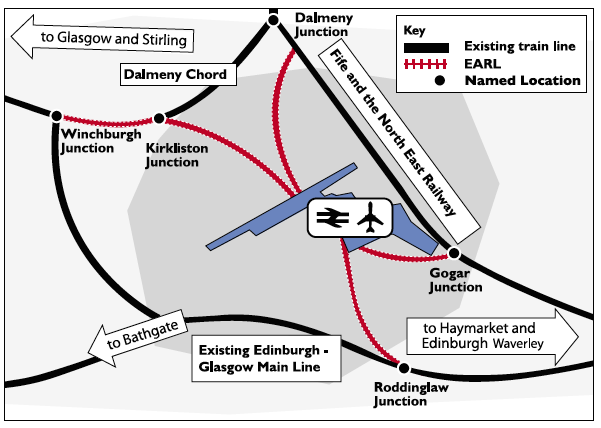
Providing Edinburgh Airport with a station with direct links to Scottish cities is no bad idea. Scotland has among the worst public transport service to/from its airports in Europe. EARL would have dragged Edinburgh’s out of oblivion and into the 21st century. But, given a budget of £650m, had TIE managed EARL the way it managed the trams, they could have muddled that up to £2 billion, no sweat.  And, like the trams, the implementation concept was flawed from the start. Check out this map & spot the error.

Edinburgh Airport Rail Link (original TIE plan)

Edinburgh Airport Rail Link (original TIE plan)

Did you spot it? The four tracks coming west from Haymarket split before reaching the area of the map. Therefore there is NO NEED for duplicate tunnels from both Gogar and Roddinglaw junctions to meet again under the airport: i.e. at least 20% of the cost was unnecessary idiocy.

But even more relevant is this concept was hugely and unnecessarily pricey in the first place. It is well for all concerned that Swinney recognised a turkey when he saw one. But, unfortunately, because every other party ganged up to force him to fund the trams, any reasonable alternative for EARL was never considered. This is unfortunate because a far cheaper alternative that Orcadians might call PEARL (Peedie EARL) was available.

The EARL layout was intended to allow services on both Edinburgh-Linlithgow (to Glasgow & Stirling) and Edinburgh-Forth Bridge (to Fife, Perth, Dundee and the North) to call en route to/from Edinburgh. The same could be achieved by combining four relatively cheap components:

  1. Re-open Turnhouse station with road access to/from Gogar roundabout (& tram stop)
  2. Provide a frequent shuttle bus between the station & airport terminal
  3. Build a chord (above ground) to connect the station directly to Kirkliston Junction.
  4. Re-route all Linlithgow & beyond trains via the airport & this chord

This achieves all the aims of EARL without a single (expensive) tunnel. It would work better if the revived station could be provided with four tracks to ease congestion. In terms of capital required, £10m for the station, £5m for related infrastructure, £15m for the Kirkliston chord and £10m for quad tracks at the station comes in at £40m. Call it £50m total, with contingencies.

This is 8% of the original EARL budget—or a mere 2.5% of what TIE,  from past form, would have run up as a bill. All services posited for EARL would be equally possible with PEARL. The trams could even be used to transfer passengers to the station, getting them into town faster than suffering the 11 stops (and 200m walk) into Waverley by tram.

Better yet: the entire Almond Valley viaduct and Winchburgh tunnel—both high cost-per-mile structures to maintain—with no passenger trains would be surplus to requirement and be abandoned. The only disadvantage (which applied equally to EARL) is that Stirling/Glasgow trains could no longer serve Edinburgh Park; on the current ScotRail timetable, most don’t anyway.

Almond Valley Rail Viaduct.: Symbol of West Lothian

Almond Valley Rail Viaduct.: Symbol of West Lothian

Interior of Winchburgh Tunnel or Brightness of TIE Executives—whichever makes sense.

Interior of Winchburgh Tunnel…or Brightness of TIE Executives…whichever

The principle on which TIE was founded–a unifying single transport authority for Scotland’s capital that could co-ordinate large, expensive projects such that they worked together—was not flawed. Indeed, since its demise, the absence of a TIE, or an equivalent that is any good, is glaring.

From a country seriously under-investing in the eighties to a modest programme of new stations in the nineties, Scotland naively let the pork-barrel numpties loose in the noughties with pots of money. As a result Airdrie, Alloa and Galashiels services all sucked in burgeoning sums with scant real network improvement to show for it. Major projects to improve Waverley and realign the ECML at Prestonpans did little for passengers but cost £60m each. Throughout it all, private companies did only what short franchises required but took several £billion in profits each year while doubling rail fares.

To whale on TIE’s shortcoming when our whole transport philosophy was torn between a private-no-matter-what diktat from London (which continued under Labour 1997-2010), combined with an endemic civic jobs-for-the-boys mantra across Scotland’s Central Belt is probably unfair. But fresh-faced MSPs fell over themselves post-1999 to justify their own existence and what better than a sparkly new train/tram for their punters? TIE actually suffered by having its SMT’s rank incompetence shielded by new ministers and self-interested city fathers (& now mothers) who didn’t know enough to challenge it.

When the real history of early 21st-century civic Scotland is written, it will point the finger firmly at the absence of adequate scrutiny to combat the professional incompetence of those who have all now taken their comfortable £1m severances, shrugged and moved on.

Posted in Transport | Tagged , | Leave a comment

Capital Offence

At the end of last week, the Grauniad shored up a decades-old reputation for clod-hopping sub-editing by crediting Glasgow with being the capital of Scotland. Given that 115% of weegies might agree with such an assertion, this is not all bad, even if such Southern ignorance/laziness did nudge a few hundred more switherers into the ‘Yes’ camp.

But the unfortunate thing is that the article itself (Don’t call Glasgow’s Contemporary Art Scene a Miracle from Maureen Jaffrey) did have merit, pointing out that three of this year’s four nominees for the Turner Prize are graduates of some form from the Glasgow School of Art and seeking to explain why that might be. Indeed, the article implies that this is no longer surprising; indeed it is now considered the norm:

“In recent years the city has come to dominate Turner prize lists. Glasgow winners include Douglas Gordon (1996), Simon Starling (2005), Richard Wright (2009) and Martin Boyce (2011). Martin Creed (2001) and Susan Philipsz (2010) both studied and made their careers elsewhere, but grew up in the city. I could go on: nominees Christine Borland, Jim Lambie, Nathan Coley, Cathy Wilkes, Lucy Skaer, Karla Black, Luke Fowler and David Shrigley have all lived and worked in Glasgow.”

While the original article made no attempt to politicise such eminence, I found it stood in sharp contrast to a Simon Shama’s piece in the FT on May 9th, which is being seized upon by unionists as a shining rationale to retain the status quo. Whereas Shama waxes lyrical about all the quirky contributions the Scots have made to the union, he cannot seem to grasp that the present argument is not about the splendidness or otherwise of what the nations on this island (what he calls “a splendid mess of a union (that) should not be torn asunder“) have achieved but what each perceive as a best option for their future going forward from this point.

For his sole forward-looking argument, Shama cites Adam Smith “the capacity to enter into the experience of someone not necessarily like you was the fundamental principle around which just societies, as well as rich ones, evolved.” On this basis, he argues that both Smith and Hume would have been ‘No’ voters, which rather presumes impervious national boundaries of that era still apply, rather than the present actuality of global mobility and economy dominating our lives today. Smith and Hume would worry little about borders today.

In contrast, Jaffrey’s article is suffused with the gallus, mobile creativity that was always part of Glasgow but now manifests itself in multiple channels well beyond any Clydeside garret, making nonsense of geographic or political barriers. As she says:

The novelist Nicola White cites “the collective, egalitarian feel of Glasgow, the multitude of practices and groupings, the respect for hard work, the ‘now’“.  All of them agree that the do-it-yourself culture of the city’s artists, who built their own institutions rather than rely on established ones, has been crucial.”

Even Edinburgh would concede Glasgow as the Art Capital of the country, just as Aberdeen is the Oil and Dundee the Game Capital. All of this is indicative of a new Scottish cultural vibrancy radiating from Glasgow, despite (as many artists would avow) the clammy hand of Creative Scotland slowing things down. These artists are interacting with a market outside the UK via the mobile telephone, cheap air travel and the internet. And since they are working a deep cultural source that has been opened recently, their art will be no more impeded by borders than French impressionists were over a century ago.

Glasgow has always been outward looking: a mighty river runs through it. Its built fabric is Victorian and very grand. Rents are considerably cheaper than in many major UK cities and the city council, which once appeared wrong-footed by the riches on its own doorstep, has now invested hugely in studio complexes. Glasgow is home to impressive architecture (the Glasgow tenement is crucial, offering large rooms, high ceilings and huge windows), a strong cultural sector (music & film as well as art) and reasonable rents. It is also a smallish city—the M8 cutting right through it means most people live 20 minutes from the airport; cheap flights do the rest.

There is a critical mass of  creativity that no earnest bureaucrats can create. Artists are gregarious, routinely alerting each other to their colleagues’ progress: one studio visit leads to another. Artists learn from, share with, and are challenged by their peers.

Given such circumstances, it’s little wonder that Glasgow has become such a force in contemporary art. That, in turn, is a springboard that will showcase Scottish culture far beyond the limits of a small country—whether that country is Scotland or the UK. Small wonder then the little-Englander mentality that drives most of the unionist campaign has little traction in Glasgow in general and its artists in particular. The corollary is that the vibrant Glasgow art scene is one of the many forward-looking drivers that point towards independence being the better choice for a Scotland with a future other than as an appendage.

Ben Luke of the London Evening Standard said: “The shortlist confirms the supremacy of Glasgow as the UK centre for new art”. Now, if we could only get the weegies to recover engineering skills that made miracles a century ago, it could reassert itself as the finance capital too and re-establish itself as what it once was in 1910—the richest city in the world.

Posted in Commerce, Community, Politics | Leave a comment

Home Thoughts from Abroad

Jake Briggs and I have been friends since I showed up in his P1 class and we ‘chummed’ one another to school. In our late teens, he went off to a financial career in credit cards, retired to Catalonia and has recently been driven back to the UK by repercussions of the 2007 downturn. We clash amicably on Facebook, so his opinions and mine do differ. But, since he recently took the trouble to lay out his position on Indy as both expat Scot and expat Brit, his opinions seem representative of many and merit wider coverage.

_________________________________________________________

First, let me state that I am a floating non voter.

This is my first grizzle, I am Scottish and although I have not lived in Scotland for 40 years, this does not make me any less Scottish. Our local Tesco manager is a genuine bites-yer-bum Glaswegian, promoted to “dahn saff”. No vote for him either. There must be hundreds of thousands of us throughout the world, and we care. By contrast, some eligible voters will not be Scottish, merely working/resident there, possibly with no long term commitment to the country. This cannot be right. When you lived and worked in California, did you consider yourself American ? Unlikely.

Local/General elections come and go. If you don’t like the result, you have the chance to change it in a few years . Not so here—this is a one-off. And how do 16-year-olds get the opportunity to vote, how did this happen? This looks like an equation for a “my game, times my rules, equals my result”. Also there are issues that are not just Scottish matters, but affect the whole of the UK. In fact, the whole Independence issue relates not only to Scotland, but to all of the UK. A ‘Yes’ vote would see 50-odd fewer Labour MP’s in Westminster—a major long term change to the political landscape. As someone said “If the Scots vote to stay, can we have a vote on whether we want to keep them?”

On to the campaigns, starting with the No/Better Together.

This has really been a non-campaign, but in how many different ways can you say ‘No’? Change, keep things as they are, straight ahead. What has worked (or not worked) in the past will work (or not work) in the future. Living standards have generally improved, our health care, education, law and order are fine (this is arguable), so why change? Issues such as currency or EU Membership will be resolved. But, at the moment, the threatening statements from the No campaigners has only served to fuel the perverse ‘see-you-Jimmy’ attitude in the Scottish character, and has possibly worked against its objectives, rather than in favour of them.

Now the Yes/#Indy.

Where to start? I can understand the desire of a country to have control of its destiny and much is made of decisions being taken in London. However, London and Edinburgh are only 400 miles apart, and Scotland sends 59 MP’s to Westminster. Will these MP’s vote differently if they are based in Edinburgh? Even Alex Salmond agrees the first Scottish government could be a Labour Government.

My impression is that some people see this not so much as a pro-Scotland move, but an anti-England move (don’t deny those people exist) and that Independence is an end in itself, the Holy Grail has been achieved, game over. They will find that, after any euphoria, a reality check may well kick in. However, I think there are more pro-Scotland voters with good intentions. There does seem to be a bit of cherry-picking over which bits of the existing situation will not be affected by Independence, topics such as currency, retention of the B of E as lender of last resort. Had Independence happened 10 years ago, could the Scottish economy, on it’s own, have bailed out RBS/BoS?

The yes argument seems to be primarily based round two principal agendas: Norway and Oil. If Norway can do it so can we, possibly, maybe even probably, but not definitely. I can see the similarities, but a lot depends on the political direction the country takes.

As you’ve said, oil prices have stabilised around $110, but this is no indication of future trends, and it is a diminishing resource. Future forecasting is something best avoided, and perhaps not dependent on.

As always, the prime concern will be the economy. Can an Independent Scotland maintain the same spending that it currently enjoys? I have reservations on health (free prescriptions) and education, (free university education). Bearing in mind that the first Independent Scotland government is likely to be Labour-led, and that these governments tend to be tax/borrow/spend, there may be a few gaps somewhere which will need to be plugged.

So, if the magic wand could be waved, and I could be allowed to vote, where would I put my X? I think that, if there is a ‘Yes’ vote, then those not in favour will accept it and get on with it. If there is a ‘No’ vote, then the pro-Indy lobby will still be there, and won’t go away. The preferred option of “let’s give it twenty years and see how we get on” is not available. This may surprise you, but I think I might (and it’s a big might) vote Yes, backed up by my “what if” theory. This states that if you don’t do it, you will always wonder “what if”.

So, go for it, remembering, there are lots of ifs, it’s a big cliff, there’s no parachute, and no-one else to blame if the land of milk and honey fails to materialise.

Posted in Politics | Leave a comment