Quis Custodiet Legis Latori?

If another smug unionist argument repeats the claim that bigger is automatically better and that we can all relax in the arms of Big British Brother, I may have to reach for the boke bag. Let’s leave aside unanswered questions why inhabitants of Switzerland or Singapore can be so much better off than ‘global power UK’ or why Eire shows no desire to re-enfold itself in Britannia’s protective skirts and focus on just one item that is an insult to Scottish autonomy on even the devolved scale.

Pardon me if this gets anorak and esoteric in its detail. Scottish Ministers are responsible for policing and justice. A Regulation of Investigatory Powers Act was signed into law by Westminster in 2000. It was already the case that Scottish Ministers signed off any request for intercept on serious crime grounds but being in its infancy, the Scottish Parliament accepted the legislation in full. It permits five types of surveillance:

  • Interception of Communications—this involves listening to the calls made on a telephone or opening and reading the contents of a target’s letters or e-mails. This is only allowed under the authority of a warrant signed by a Secretary of State
  • Intrusive Surveillance – covert surveillance in residential premises or in private vehicles – so covertly filming a person’s house, bugging a house or car.
  • Directed Surveillance – covert surveillance mainly in a public place – so covertly monitoring the movements and actions of specific targets, following them around, listening in or filming in mainly public spaces.
  • Covert Human Intelligence Sources A CHIS is a person who, under direction from a public authority, establishes a personal or other relationship in order to (covertly) use the relationship to obtain information or disclose information gained from the relationship.
  • Communications Data – this contains the record of a communication, such as a telephone call, email or website visited – it does not contain the content of the communication.

It appears that the European Court of Justice deemed the original Bill contradicted the rights of its citizens, so there was an indecent rush at Westminster to patch the legislation so it did not. Some haste is understandable but it seems Theresa May sat on the revision since April and left minimal time for public debate—always a bad sign when Tories are dealing with security.

Many opposition MPs, including Pete Wishart (Perth and North Perthshire, SNP) objected to the resulting wholly unnecessary ‘bum’s rush’:

“I have massive concerns about this Bill. I do not like the way in which it has been brought to the House. I do not like the way in which we have to rush through this process at breakneck speed, even though this is an issue that was flagged up to the Government some three months ago. I am suspicious about the reasons why we are doing all of this now. I do not like the fact that it seems little more than a half-hearted attempt to get around a European Court of Justice ruling that declared the European directive invalid and thereafter practically everything that the Government are doing on data retention probably illegal.”

In the background, all UK parties and leaders were brought into line around “unspecified threats”, reminiscent of the dark days of the creation of New Labour’s anti-libertarian state. Despite having responsibility for the judiciary, policing and even delivering parts of RIPA in Scotland, the Scottish Government were never consulted. Theresa May’s department pretend this legislation is business as usual. But it is clearly an extension of what the Government can do in the collection and retention of an individual’s personal data.

The Prime Minister said that the Government were not introducing “new powers or capabilities”, but clauses 3 to 5 make significant amendments to the range of powers included in RIPA. The Bill extends the Government’s surveillance powers in two very important ways. Clause 4 clearly extends the territorial scope of RIPA, and the Government can now issue interception warrants for communications data to companies outside the UK. It also extends the definition of what “telecommunications services” means within RIPA to include webmail services such as Gmail—the most fundamental change in the relationship between ISPs and the state.

The Government have had three months to address the Court’s findings. It is not the threat of terrorism or of criminal activity that has forced the Government’s hand in bringing this forward today. It is the threat of legal action by organisations such as the Open Rights Group and others that has prompted this emergency legislation. The Government should not mislead us about the urgency of the Bill. Given its significance and the issues it raises about our civil liberties, it should not have been passed without proper parliamentary scrutiny.

In the interests of legality—not to mention people’s rights against unwarranted surveillance, the Government must come clean that this is not business as usual. These are significant and substantial new powers. What the European Court of Justice said was that we have a very low threshold for the retention of data, and it made it clear that the retention of data of every single person strikes the wrong balance between the need to tackle serious crime and our right to privacy and a private family life.

The Bill is more than the sum of its parts. It is a statement of intent. The Home Secretary’s real intention is, of course, to reintroduce her much-coveted snoopers’ charter in this Bill. The way in which the Bill brings on board the overseas ISPs is little more than a paving Bill for the reintroduction of that most unwanted anti-civil libertarian measure.

Posted in Politics | Tagged | Leave a comment

Marking-Time Season

Never having been one to body-swerve touchy issues, it is nonetheless with some trepidation that this blog is dedicated to questioning the usefulness to anyone of high-profile public display of whatever your religious beliefs happens to be. While they are hardly a model of enlightened restraint when it comes to religion, I have always believed that the clear separation of church and state that the Americans wrote into their Constitution is something the Old World would do well to consider emulating.

Let me be clear that I single out no religion for criticism and certainly in no way question anyone’s religious beliefs insofar as they do not dictate how others who don’t share those beliefs must live. And while there are many examples in the past of religions causing wars and havoc, I also believe that those who follow almost any religion believe in peace, co-existence, the sanctity of life and the rights of their fellows.

Religion requires much faith and cannot be judged on scientific substantiation. Whether the wine becomes the blood of Christ or the Queen is the supreme spiritual head of a church because of Henry VIII’s combination of human frailties, greed and ego is not for outsiders like myself to quibble with, not least because there is no perceptible harm to others from either.

But in today’s news (July 12th), both Israeli strikes on Gaza and the limits imposed on an Orange Order march in North Belfast are items that I, for one, am thoroughly sick of hearing. I have watched such depressingly repetitive items all my adult life with no sign of humanity—let alone sheepish acceptance of how daft it appears to those outside—breaking out. I have now come to regard those and similar such entrenched bigotry (Sunni/Shia, Serb/Moslem, Dinka/Nuer, India/Pakistan, etc) as net detractors from human progress.

Such distinctiveness not all bad;  personal identity, community spirit and national awareness derive from similar distinctions and, indeed, sometimes from those traits against which this blog is otherwise railing. As with individuals, we should celebrate our differences but that does not mean absence of spirited differences. This year’s World Cup in Brazil was perhaps the most splendid example to date of the world having a go at one another in an atmosphere of frantic but friendly competition, just as Brazil itself provides a vibrant example of how races and origins can get so mixed up that their international reputation beyond football is of a place to party and make friends.

Not to imply that the Irish are unique in unproductive self-harm, nor am I without sympathy for both the sash and the shamrock, given they’ve been living with dissent ever since Richard II overreached himself beyond the pale and brought the War of the Roses down on himself as a result. Half a millennium of undeclared civil war cannot but leave scars and Britain’s imperial/colonial approach to what it tried to pretend was part of the homeland 1801 to 1922 will take more than a royal visit and apology (however sincere) to consign to history.

But, just as Lt Hiroo Onoda finally accepted WW2 was over and emerged from the Phillipine jungle, so at some point one of the factions involved in Ireland will win and the other will need to get used to that fact. Now, while it is possible that Ulster unionists and their supporters may broaden their appeal and convince the rest of humanity that sashes, bowler hats and fife bands are somehow symbolic of the future, they will also have to deal with the statistical fact that catholics generally have more children and that some day within the next century, that will mean a unionist voting minority.

However distasteful and however much that flies in the face of tradition and victories won three hundred years in the past, there is scant hope for the world’s other trouble spots, some on their second millennia of strife if an island with so much culture in common and a racially indistinguishable 5m inhabitants can’t find some way of burying the memories of Black & Tans and IRA hit squads equally deep to find an emotional, as well as political accommodation of one another’s existence on the same piece of real estate.

Israel’s unilateral decisions as to where boundaries lie and then delineating them with community-fragmenting walls are operations worthy of Canute. A much mightier empire than theirs once divided what is now Germany’s capital with a similar idea; it is now dust and souvenir fragments. Just as the 12th and 13th © Crusades ended in failure when the Turks took Constantinople in 1453, so the Turkish-Greek animosity that erupted in war in 1920 is cooling to quasi-normal relations.

Forbidding Ulster unionists their provocative-in-all-but-name marches is no more sensible then the old Ulster Constabulary’s foot-on-the-neck approach to policing catholic communities. But with the passage of time and some easing of tensions already, both communities now include a majority of pragmatic and reasonable people who, in their heart, want the best for their community. When pressed, they accept such will require an accommodation with the ‘other side’.

Every marching season pushes actualisation of that accommodation into the future and adds a little more despair and frustration to fans of the Irish people in general like this writer with no axe to grind for either faction. Because, ready though Britain may be to have royal visits and make apologies for errors in the past, that will cut little ice as long as two factions of Irish stand like petulant children, glaring and poking each other in the ribs to elicit any response but with the tacit understanding that anger will do.

Posted in Community, Politics | Tagged | Leave a comment

Century-Old Lesson Still Unlearned

Since posting The Bitter Legacy of Sykes-Picot a couple of weeks back, I have run across a couple of points substantiating the thesis therein, namely that two untraveled mandarins were ill-qualified to carve up one of the world’s great powder kegs along lines that suited their respective empires. Quite apart from leading the Arab Revolt of that time against the Turks, T.E. Lawrence used his experience to argue a different approach.

Apart from listening to men from across the Middle East who were serving in the army of Britain’s Arab allies against Turkey, he was also in contact with other British experts on the region, such as DG Hogarth and Gilbert Clayton. Lawrence’s suggestions however fell foul of the British administration in Mesopotamia.

Jeremy Wilson, Lawrence biographer recently discovered a map that was particularly interesting because “it suggests that Lawrence’s proposals were taken fairly seriously, at least in London and would have provided the region with a far better starting point than the crude imperial carve-up agreed by Sykes and Georges-Picot”. Hania Farhan, regional director of the Middle East and North Africa, Economist Intelligence Unit, said: “The map shows that the opinions of those who knew the region well were often ignored, as the colonial powers in London and Paris had their own agendas and did not appear to care about the facts on the ground or the people of those areas.

Lawrence's 'Peace Map' for the Middle East

Lawrence’s ‘Peace Map’ for the Middle East

Note how provision for a Kurdish homeland (still unrealised) and an Arab unity outside of Palestine. Had such a proposal for sovereign countries (not just protectorates to be subsumed into existing empires) been followed, much of the mayhem that has plagued the region in the century since might have been avoided.

Fears are growing of a widening war across the Middle East, fed by reports that the Islamic State of Iraq and Syria (ISIS) envisions a region-wide, all controlling theocracy. At the same time the centenary of  The Great War and its 37 million casualties is focusing on the battlefields and trenches of the Western Front to the exclusion of the Ottoman Empire of the Turks that dominated the Middle East. T.E. Lawrence became a hero in the Arab world when he led nomadic Bedouin tribes in battle against Turkish rule. Peter O’Toole immortalized him in the epic movie, “Lawrence of Arabia.”

In that film, after dynamiting the Hijaz railway and looting a Turkish supply train, Lawrence is asked by an American reporter, “What, in your opinion, do these people hope to gain from this war?” “They hope to gain their freedom,” Lawrence replies, and when the journalist scoffs, insists, “They’re going to get it. I’m going to give it to them.”

At war’s end, Lawrence’s vision of Arab independence was shattered when the Versailles peace conference confirmed the carving of Iraq, Syria, Lebanon and Palestine into British and French spheres of influence; arbitrary boundaries drawn in the sand to satisfy the appetites of empire. The F.O. even called the former Ottoman lands “The Great Loot.”

Using Lawrence’s map could have provided us “with a far better starting point than the crude imperial carve up.” Lawrence wrote to a British major in Cairo: “I’m afraid you will be delayed a long time, cleaning up all the messes and oddments we have left behind us.

After the invasion of Iraq in 2003, demand for Lawrence’s book, “Seven Pillars of Wisdom” increased eightfold. It was taught at the Pentagon and Sandhurst  for its insights into fighting war in the Middle East. In 2010, Major Niel Smith, who had served as operations officer for the US Army and Marine Corps Counterinsurgency Center, told The Christian Science Monitor, “T.E. Lawrence has in some ways become the patron saint of the US Army advisory effort in Afghanistan and Iraq.”

Lawrence’s understanding of the ancient and potent jealousies of the people among whom he had lived and fought generally was ignored. In 1920, he wrote for the Times an a prophetic article about Iraq. He decried the money spent, the number of troops and loss of life, and warned that his countrymen had been led “into a trap from which it will be hard to escape with dignity and honor. They have been tricked into it by a steady withholding of information…. Things have been far worse than we have been told, our administration more bloody and inefficient than the public knows. It… may soon be too inflamed for any ordinary cure. We are today not far from a disaster.

Not for the last time in the Middle East would disaster come from the blundering ignorance and blinding arrogance of foreign intruders convinced by magical thinking of their own omnipotence and righteousness. If ever George Santayana’s pithy aphorism applies it must surely be here:

Those who do not learn from history are condemned to repeat it.”

Posted in Politics | Tagged | Leave a comment

Why Yes is the Answer III: It’s the Economy, Stupid

There is a clear case for an independent Scotland to prosper more than it has to date within the UK. I confess that I have not examined all the contrary evidence put out by HM Gubmint on its website at public expense but any open-minded Martian would find it a) turgid; b) light on facts and c) questionable in its conclusions. You need only hold your nose and point your browser at:

https://www.gov.uk/government/publications/scottish-independence-referendum-money-and-the-economy/scottish-independence-referendum-money-and-the-economy

for the sheer self-serving vacuousness of the arguments to assault your senses. For example:

  • Scotland is a successful, growing economy, as part of the UK Scotland has the highest economic output per person behind London and the South East.
  • The UK’s economy grew by 1.7% in 2013 – and the recovery is forecast to continue – with growth of 2.7% in 2014.
  • There are more people in work across the UK – more than 30 million – than ever before. The UK’s overall employment rate is higher than the USA for the first time since 1978 and, as part of the UK, Scotland’s employment rate is greater still.
  • Nations within the UK have strong, important and beneficial trade links – In 2013, Scotland sold £50 billion worth of goods and services to the rest of the UK and bought £63 billion worth of goods from the rest of the UK.

All of which is fascinating. But it makes no case whatsoever why Scotland needs to remain part of the UK. Indeed, the reverse could be argued, since Scotland appears to be doing so well within the UK and all of us are part of the EU open market. The Westminster beancounters then go on to say that Scots already control 60% of expenditure and receive 10% per capita more than England (conveniently ignoring oil revenues). So??

The entire 2000-word document is in the same vein, verging on the naff. There are four such ‘Factsheets’, plus a dozen ‘Scotland Analysis’ papers totally well over 1,000 pages in all. The one on Currency and Monetary Policy is typical of them all, seeking to rubbish all options for use of sterling by both countries, as if it were not in England’s interest to see an independent Scotland succeed. This self-destructive myopia is a leitmotif of the entire UK government approach to Scotland. Given the strength that Scotland brings to the UK economy, such self-interest is understandable. But to present the debate as if Scotland were a basket case while citing umpteen positive parameters as if they could only ever be realised under Westminster’s sage tuition takes rare cheek.

But let’s leave aside those Tories who have made themselves foreign to Scotland and their city chums whose wizard wheezes need the biggest fiscal stage on which to play. Let’s also leave aside a ‘feeble fifty’ Labour MPs—in 35 years after scuppering our ’79 referendum they have grown fat from the imperial trough but done diddly-squat on behalf of their Scottish constituents (honourable exceptions: Donny Dewar and John Smith who had both ideas and principles, working themselves into early graves trying to stick to them).

Let’s look at this ‘recovery’ of which Lord Snooty & Chums are so proud. “The economy” says the Treasury “grew by 1.3% in 2013“. Let’s see what the Evening Standard—as big a booster for London as you can get—says about that:

The UK’s economic recovery is dangerously unbalanced, with almost 10 times more jobs being created in London than in the next best city, according to a new report. Research by the Centre for Cities think tank revealed that London accounted for 80% of private sector employment growth between 2010 and 2012.

The kind of jobs created were mostly service sector jobs—little surprise given London’s relative paucity of manufacturing. So, comparing Scotland’s recovery with England’s can we distinguish differences? Since 1996, in Scotland, manufacturing has dropped from 19% to 12% of GVA while finance and insurance has risen from 12% to 16%, despite financial crashes. England still retains a significant manufacturing element (e.g. Rolls Royce and foreign car plants) but Scotland’s is larger per capita, specialising in oilfield engineering, whisky and renewables.

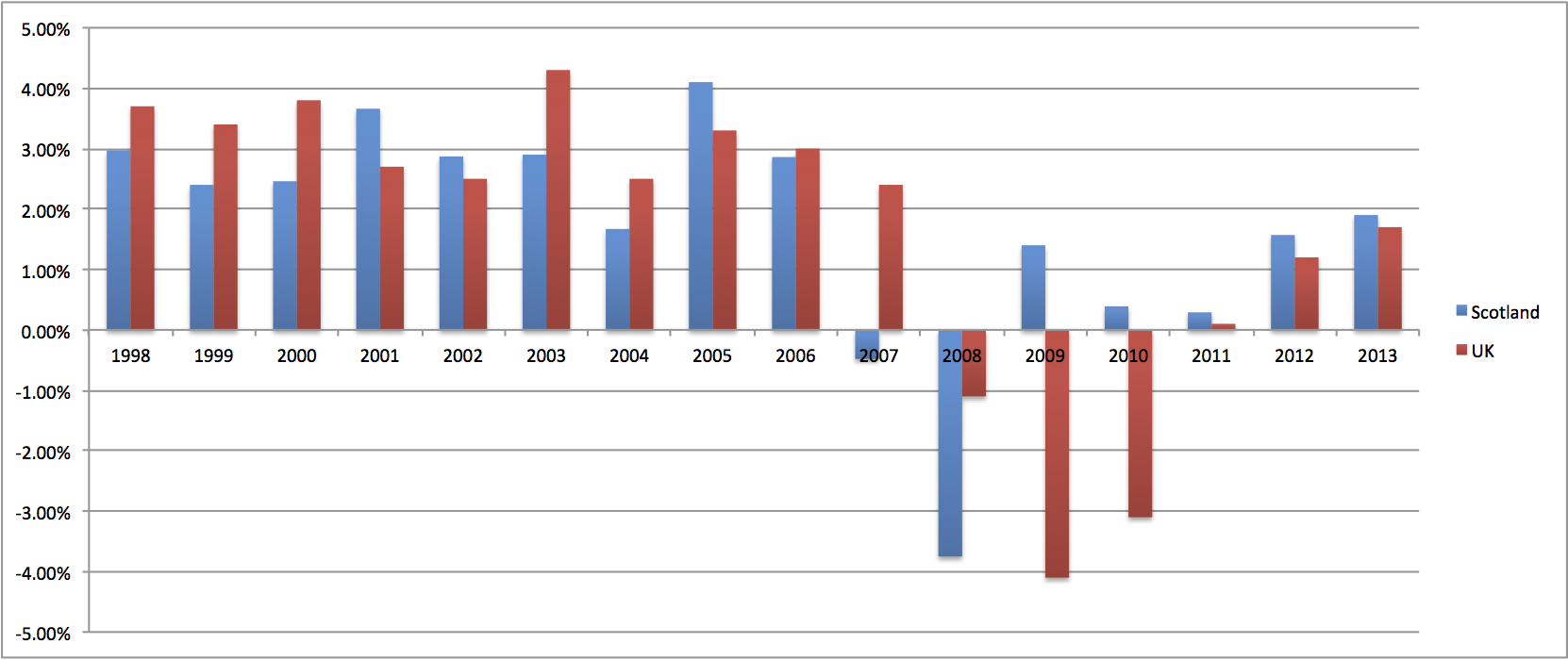
In fact, throwing in the financial and tourism sectors, plus growing food and drink exports, Scotland can be said to have a robust economy, closer to London’s than to still-to-recover northern and Midland areas of England. This is borne out by comparing GVA statistics since before the recession, shown in Figure 1.

Figure 1—GVA Change Comparisons (Sourgce ONS & SG)

Figure 1—GVA Change Comparisons (Sourgce ONS & SG)

Clearly, Scotland grew at a rate comparable to the UK until the recession in 2007. At that point, we were initially hit far harder but recovered faster and continue to do so. Indeed, Scotland’s economy appears more robust than the UK (i.e. England’s) and a strong case can be made that they need Scotland to keep them afloat.

It’s about this point when unionists wade in with their hoary warnings how RBS would have gone bust, had Big Bruvver Britain not been there to grease the skids. As they put it:

“The UK Government supported the injection of over £45 billion into the Royal Bank of Scotland in 2008 and offered the bank a further £275 billion of guarantees and state support to protect our financial systems. The total level of this support would have been more than double the total size of Scotland’s economy in that year.”

All factually correct—except that subsidiaries NatWest and Ulsterbank operate solely elsewhere in the UK and are worth £380bn and £48bn respectively—out of total group assets of £1,470bn, 30% of which (£421bn) are held overseas (including £70bn in the  disastrous Dutch foray of ABN-Amro). Ignoring other English RBS subsidiaries, at least 60% of RBS operations were furth of Scotland and—unlike Icelandic banks who had no ‘Big Bruvver’ to rescue them—the Bank of England would have been foolish not to intervene, even had the bloated RBS been based in an independent Scotland at that time.

The alternative would have been to see NatWest and Ulsterbank close their doors and freeze depositors out, as Northern Rock had just done. Hard fiscal realities dictate that banks with heavy presences in other countries can rely on adopted countries to help in times of fiscal trouble. That’s why Icelandic banks went to the wall (because they had none) but the heavy presence RBS/HBOS furth of Scotland gave the Bank of England no choice. (The whole question might not even have arisen, had Scotland been independent, with a real Financial Services Authority—not a toothless gaggle of City chums asleep at the wheel in London. Scandinavia—with robust FSAs—survived without a banking blemish).

Which brings us to the use of the £UK. High-placed unionist payroll members like the Alexander brothers (Danny and Douglas) are falling over themselves to explain why this is an impossibility. Let’s leave aside that the Aberdeen agreement was supposed to lead to constructive dialogue to achieve the best for both countries in the event of a ‘No’ vote and consider several pragmatic points:

  • It’s not England’s £. Shared jointly since 1707, so Scots have a solid claim it’s theirs too
  • Sterling with Scotland outside would stop being a petrocurrency and drop in value
  • Although not independent, sharing the £UK officially means having a Scots member of the BofE board to argue our particular needs—more influence than Scots have now.
  • Any barrier to the 80% of Scots trade that is with England hurts them as much as us.
  • In 1922, independent Eire used the punt—pegged to the £UK—for 80 years before adopting the Euro in 2002. It was done with an amicable agreement which worked well
  • If Scots chose to use the £UK unofficially, there’s nothing England could do about it.
  • Having Scots use £UK unofficially as England gets ever more Euro-hostile could give Scotland a huge boost as Europe used it as a bridgehead in the sterling zone

There’s a strong case that the UK is being petulantly thrawn over this. But let’s assume that Scotland chose not to use sterling, thereby creating a barrier to trade to that £2tn market. When life gives you lemons, you make lemonade; huge markets exist to our East:

  • Germany—£2.500bn economy
  • Low Countries—£830bn total economies
  • Scandinavia—£1,050bn total economies

It would be naive to pretend that this market—twice the size of the present UK—would be immediately accessible. But centuries of London fixation by those who have steered our economy have lost us historic links with our other neighbours obvious from one glance at a map. Aberdeen is closer to Oslo, Copenhagen, Hamburg and Amsterdam than to London.

It’s high time Scotland stood up for ourselves in Europe and not thole this self-serving guff from Westminster and (especially) the new herd of myopic UKIP MEPs. Europe has faults that need fixed but Scotland has many friends (Iceland today became the latest to go public) who will delight at Scots distancing themselves from English xenophobia and wistful hankerings for a lost empire. Scots were England’s hard-headed partner in building, policing and administering that empire; but 21st century trade opportunities are global and not just in pink-painted bits.

Seen objectively, the idea that the EU would not fall over themselves to admit a dynamic, viable, energy-rich, export-rich Scotland as soon as they detach from England is really laughable. And that’s in the event that the Commission were not to interpret an existing member splitting into two would not entitle both to automatic membership. The EU is as creative at political fudge as any organisation. Scotland would, like Sweden, have to sign up to eventual adoption of the Euro. But, like Sweden, it only need finesse its finances to that they fail convergence criteria indefinitely and the kroner/£Scots could last forever.

Look at it the other way. If Scotland were already independent, with a stronger economy than England, better trade balance, more friends, no fiscal drag of Trident & ‘global police’ delusion, no europhobic faction, less haves/have-not inequality and a reputation for good education, resourceful engineers and generous hospitality, why on God’s green earth would they choose to partner up with a greedy, inward-looking, nostalgia-fixated has-been like London-dominated England?


Posted in Commerce, Education | Tagged | Leave a comment

Armed Farces Day

Lest hostile readers think the title too flippant, let me start by assuring any reader of my respect and gratitude for all those who put themselves in harm’s way on behalf of the rest of us. Previous generations of my family have done their bit—my grandad was separated from half a leg while contesting Ypres with 2nd Bn Scots Guards and my dad toured North Africa and Northwest Europe as a driver with 44th RTR in 4th Armd Bde. I am especially grateful that this European corner of the world has become a saner place and to be the first generation not called on to serve my country.

For, necessary as armed forces may be, they represent an instrument of exercising what von Clausewitz described as “diplomacy by other means“. I admire but do not subscribe to either Iceland’s or Costa Rica’s approach, which is to eschew armed forces at all. Harry Truman’s dictum: “Walk softly…and carry a big stick” appears to me the more sensible approach.

Every since the English Navy played merry hell with the Spanish Armada, this island of Britain has been a force to be reckoned with on the world stage. That has been effected by a skilled Royal Navy that protected British maritime trade, that in turn dominated global commerce from then until a century ago. This allowed a smallish but highly professional Army to conquer the famous ‘pink’ fifth of the globe and police a population far more numerous than Britain itself. The resulting apogee was prosperous Edwardian Britain.

The Armed Forces and those who served in them do deserve recognition and respect but the modern egalitarian, meritocratic Forces contrast with those that built the empire. For much of the time, officer commissions were awarded on the basis of class, bribery or both. This made the lives of squaddies and tars dependent on the whim of whoever they were landed with as commanders.

Some like Wolfe and Nelson learned their trade and valued their men but this is the origin of the British Army’s reputation elsewhere of ‘lions led by donkeys‘. Loss of half the 700 men of the Light Brigade at Balaklava in 1854 or the 4,500 troops wiped out in 1842’s retreat from Kabul or 1,300 men overwhelmed by Zulus at Isandlwana in 1879 can all be attributed to command incompetence. Thankfully, the Royal Navy was smart enough to realise that the admiral on the spot needed to form accurate opinions and choose well among options with advice days or weeks away and trained accordingly.

But well led or no, empire-building came at a cost. Until the mid-19th century, men were press-ganged into the navy and flogging was common discipline. This blog earlier published a map showing how bullying Britain became, invading most of the current 200 countries at one time or another and putting down local resistance to the Raj with brutality—as in Amritsar in 1919, when troops under Brig. Gen. Dyer opened fire on 10,000 unarmed protesters hemmed into Jallianwallah Bagh, killing 379 and wounding over 1,200. The House of Lords praised his action, and a fund was raised in his honour.

However, the worst aspect of military operations down the ages has been the relative incompetence with which British forces have been equipped and led. Cheapskate politicians are not a new phenomenon: hapless Government troops at Killiecrankie in 1689 could not remove the plug bayonet in time to fire their weapons before a horde of screaming Highlanders were cutting them down. It took a century to adopt the slotted bayonet that allowed the musket to be fired with the bayonet still attached.

Whether in tactics of weapons, Britain has relied on the sheer doggedness of its trained men to overcome opposition. In the American Revolution, nicely lined-up redcoats were shot down by skilled hunters; 120 years later the same happened at Spion Kop, Modder River, Magersfontein. At Coronel in 1914, Craddock’s ancient armoured cruisers (and 1,570 men) were faced by Spee’s modern ones—and sunk; 27 years later the much-vaunted but under-armoured HMS Hood faced the modern Bismarck—and blew up with the loss of all but three of her 1,433 crew.

Unfortunately, as Britain’s power waned, this effect intensified during the ‘good’ wars of the 20th century. The first (of our four to date) invasions of Iraq in 1914/16 was mishandled with losses over 4,000. The Admiralty took its sweet time to organise convoys against the U-boat menace in 1916, causing much unnecessary loss of merchant navy life—and entered WW2 making the same mistake due to having almost no escort vessels. They tried to compensate by sending carriers on a fool’s errand of ‘hunting’ U-boats; they gave up when HMS Courageous was sunk by the sub she was ‘hunting’ (U-29) with the loss of 519 lives.

Such mismanagement was not confined to the Admiralty. In 1939, the RAF’s light bomber force was equipped with the Fairey Battle. Ten squadrons were sent to France in time for the German invasion; they lost 99 (~70%) of the slow and under-armed aircraft in the first week. At the same time, the British Army’s cavalry tradition demanded light, fast ‘cruiser’ tanks. When these came up against the Afrika Korps panzers in 1941, they were regularly and roundly trounced—not just because they were outgunned and under-armoured but because they were employed in wild cavalry-style charges. The Germans dug-in AT guns included the venomous ’88’ AA gun that could destroy such tanks at five times the range at which any British tank gun was effective. The British did have a 3.7″ AA gun but doctrine forbade it being used in the AT role. The ever-efficient Wehrmacht had no such scruples.

Despite having invented the tank throughout WW2, British tank and anti-tank equipment was consistently second-rate and set a precedence for post-war equipment. Fighting Kenyan Mau-Mau or Malayan communists in the 1950s caused casualties for the lack of armour on patrol vehicles. This was STILL the case in the last decade in Afghanistan with vulnerable Land Rovers replaced by overweight Mastiff until the Foxhound patrol vehicle came into service late on. And it’s not just the Army—the Navy has no patrol boats with the clout and speed of the Finnish Hamina class; the RAF has no long-range maritime patrol craft at all (pretty dumb for an island with supposed global pretensions).

Despite the third-biggest defence budget on the planet, for the last century, Britain has kept up the pretence of being a global power, of ‘punching above its weight’ of being able to rough it in the playground with the big boys. By insisting on a global role that requires nuclear submarines (probably the most useless weapon we have ever deployed) and full-scale aircraft carriers, one glance at the Chinese or Russian armed forces—let alone the sole superpower with its dozen carrier task forces—tells anyone we are no longer big league; not only do we have no business throwing our weight about but we can’t afford it.

So, by all means honour all those who serve or who have served in our Armed Forces, especially those who made the ultimate sacrifice. Whether you include the desk-jockeys of the MoD is another matter. But the present collection of odd ships, merged regiments and misfit aircraft is a shilpit remnant of once-glorious tradition that is long overdue for reduction to a regional power. Far from securing peace around the world, our intruding into other people’s time zones with a shadow of the authority that the Victorians once wielded, incomplete, unbalanced Armed Farces as we have today actually lose Britain friends and provoke setbacks like 7/7 or British recruits for Isis or the Taliban.

Posted in Politics | Tagged | Leave a comment

The Bitter Legacy of Sykes-Picot

We Scots are currently under heavy bombardment from the London payroll and anyone they can strap a kilt on how the UK is better as the entity with which our patriotism is to identify. We can be Scots—but only as much as we can be parochial Glaswegians or Aberdonians: on the world stage, UK rools, ya bass.

Arguments to take this view appear to be based on nostalgia for ‘good’ wars won together and arguments for the future that seem to along the lines of schoolyard politics: status; ‘punching above our weight’ and whether my dad can beat up yours. Now sensible Scots accept that no-one should forget our joint history, nor malign the pride felt for helping rid the world of global fascism, still less the honour due to those who risked and lost their lives for such liberty.

But the UK of which we are currently a part is having major difficulty moving on from the 19th century and recent events have highlighted this yet again. Not only are our English cousins again foaming with recurrent xenophobia as millions vote for UKIP, rail against Euro-domination and railing at immigrants as if we were reliving War of the Worlds, but here in Scotland we have the temerity to suggest that the UK as the littlest bully on the UN Security (= World’s Policeman) gang is a repugnant role Scots no longer want to share.

If Britain had a decent record of engagement with the rest of the planet, there might be much more of which Scots could be proud and thereby reason to stay in partnership to extend it. But from tobacco and sugar, through slaves and cotton to opium and oil, the engine that drove the British Empire was ever-more lucrative commerce—in whose exploitation the Scots joined in with an enthusiasm that belied our dour reputation.

Once the First War had hollowed out the UK’s commercial wealth and the Second punctured our imperial myths, there followed an unseemly haste in dismantling of the pink parts of the globe. It was unseemly because it was done fast under financial duress. Contemporary horrors like Mau Mau, Eoka and the brutal partition of India showed the UK up as weak, inflexible and poor at diplomacy with former ghat wallahs when it came to peaceful parting. The parade of tin-pot horrors —Nkruma, Nasser, Amin, Kenyatta and (later) Hussein—can be directly traced to the abysmal British record of ill preparing natives to rule themselves—mostly from a bigoted belief that they couldn’t.

Expediency may have moved the UK on from pure gunboat diplomacy but from the Falklands to Bosnia to Iraq showed the UK had retained a very American disposition to shoot first and ask questions later. Unsurprisingly, this has not won many friends. Indeed it appears a very reasonable explanation why thousands of young British muslims are both active and hostile, with many serving in forces Britain condemns as ‘terrorists’.

“My country, right or wrong” is no bad credo for serving soldiers who aren’t allowed the luxury of debate on their own deployment. But there is an unspoken obligation of the government exploiting such single-mindedness to choose their wars very carefully so as not to abuse such unswerving loyalty. While human frailty implies we won’t always get it right and WW2 is generally held up as a ‘good’ war because of Nazi atrocities it struck down, there are few places on the planet that Britain has not sent troops and even fewer where they got it as wrong and as often as the Middle East.

Dominated by Turks before the UK existed, let alone had colonies, the Fertile Crescent from Beersheba to Basra was long terra incognita to Britain. But the discovery of oil and its fueling of the RN battlefleet brought the region into sharp focus so that the UK’s first real foray into the region was invasion #1 of Iraq in 1916. Rather a debacle, it nonetheless put the whole region into a joint UK/France sphere of influence. And in true empire style, both powers assigned it to senior diplomats who’d never been near the place: Sir Tatton Benvenuto Mark Sykes and François Marie Denis Georges-Picot.

Their negotiations carved what we now know as Israel, Jordan, Iraq, Saudi Arabia, Yemen, Oman, Kuwait, Qatar, Lebanon and Syria out of the disintegrating provinces of the Ottoman Empire. (First three became British protectorates, the last two French). The priority given to imperial interests (oil, trade, bases, ports, railways) was paramount. The regard for native interest was minimal and their understanding of the area’s enthnicity (seen as irrelevant) even less.

The result was a powder keg that has exploded more than once and, given that the bulk of the world’s proven oil reserves lie under the shifting sands (double-entendre intentional) of the region, it is an area of perpetual world focus. Unrest in the thirties exploded into revolt in Iraq under Rashid-Ali in 1940, which was put down by Britain’s invasion #2.

After WW2, the French departed to deal with hairier problems of their own in Vietnam. But the Brits hung in there. Such was the quantity and lucrativeness of the Gulf’s oil that the UK meddled endlessly not only in Iraq and the Gulf States but in Iran’s internal affairs until BP’s forerunner’s assets were seized and the 1963 revolution threw the British out. Such was Britain’s post-Suez weakness that nothing effective could be done to counter this, any more than when an embryonic Hussein regime repeated the eviction in Iraq. Britain was able to live with both because Saudi/Gulf State rulers were accommodating and North Sea oil offered a safer, if more expensive, source within a decade.

So, having removed the Ottoman Empire as a stabilising influence of 500 years and creating a myriad of new states tailored to global empires but not locals, both ‘powers’ disappeared from the scene, leaving an unholy melange of Jewish, Sunni, Shia, Kurdish, Baathist, Persian, Christian (from bloody Crusades even predating the Turks), Ismalis, Turkomans, etc., all in no way contiguous with the Sykes-Picot borders. Despite some involvement by the USA as a global power, the last half-century has seen ever-more wars of various sorts break out in the region with neither resolution nor end is in sight.

From three Arab-Israeli wars, through incursion into Lebanon, to the decade-long Iran/Iraq war, to the fierce anti-US position in Teheran post-1979, to the forced merger of Yemen and the present Syrian Civil War, mayhem has been the order of the day before we even start in on the Gulf War parts I and II (Invasion #3 and #4). In other words, the greatest imperial power of its day and its main ally had a chance to rewrite the future for the entire cradle of civilisation and got it so wrong that fifty years of on-off warfare in and around the world’s fuel tanks show no sign of ending.

So, now that Isis has exploded out of a disintegrating Syria and starts rolling up the parts of Iraq dominated by their ethnic kin, is anyone surprised? And when William Hague touts re-opening of diplomatic links with Iran to help defuse/deflect such developments when the UK and US are a decade into fiercely eyeballing Iran for a nuclear programme they don’t like, we half-expect the dramatis personae to start quoting Lewis Caroll. Touting Iran as best new buddy when it was a global nuclear pariah last week shows breathtaking cynicism. That the UK is refuting ‘boots on the ground’ is fig-leaf comfort since we’ve invaded the same place four times already in the last century.

If there is a lesson anywhere why the UK should stop pretending to be a global power, slink off to the European margin and zip its lip for once, it is surely here. (Whether the UK can afford to exert any global power is a good but separate question). The bottom line is: Britain’s record as a force for good in the world is stained with selfish bad judgement—and nowhere more so than in the serial flash point that is the Middle East. This is where we once had the clout and chance to fix things on a comprehensive scale, yet played to our self-interests of oil, trade and the securing a safe passage to India, the ‘Jewel in the Crown’..

Whatever the glories of our past together, the most irrefutable reason for Scotland leaving the United Kingdom is that English diplomacy, although much-vaunted, is delusion. It has always focused on exploiting local resources to manufacture goods to then sell back to the natives. With self-interest and money as the real motivators, the UK gets it spectacularly wrong on a regular basis. And, in doing so, copious seeds of dissent are sown and armies of enemies recruited. If 7/11 can be attributed to US strong-arm behaviour around the Gulf, then 7/7 was the child of an even longer bull-in-a-china-shop British record there.

And, in case anyone thinks such insensitivity can be explained by vast cultural divides that are difficult to bridge, go the post office on O’Connell Street in Dublin and read the history emblazoned on the walls. Whether a British Imperium capable of such brutal repression of its own kith and kin should ever have had its day seems debatable but that Empire—and any status it brought—is all done now. If the English want to pretend it still exists, they are welcome to their warped delusions, as formulated by Sykes-Picot.

But let the Scots go; it’s time for us to make more friends, not more enemies.

Posted in Politics | Tagged | 1 Comment

Why ‘Yes’ Is the Answer II—As Ithers See Us

This week there were a whole gamut of responses ranging from dismay to outrage when Scotland’s independence debate went global. While I understand why fellow supporters of us becoming a normal country might feel like Custer when the entire Sioux nation piled into his little fracas at Little Big Horn, it was only a matter of time before the world paid attention to our indy issue.

Some may claim there are more weighty voices in global affairs then the US President, his Secretary of State and Il Papa but I’d be hard pressed to name them. This blog interpreted what the Pope said in a blog earlier this week. But UK shadow foreign secretary Douglas Alexander said Ms Clinton had brought a global perspective to the debate when she commented:

“I hope Scotland does not become independent from the rest of the UK; a “Yes” vote would be a loss for both sides.”

In this, she was simply backing up her boss, Barack Obama who, after months of steering clear of voicing an opinion broke cover during his recent meeting with David Cameron to opine that “America’s interest lies in ensuring it retains a strong, robust, united and effective partner“in the UK.

So 300 million Americans, plus one-and-a-quarter billion catholics are lined up with the UK parties to lock Scotland into the UK forever? Before fellow yessers fall prey to despair and starting queuing to fling themselves off the new Forth Road Bridge, once it’s built, they should first see all this from both global and relative perspectives. As I spent 22 years furth of Scotland, 15 of which were in the States, I have some background in supplying this.

What outsiders (even our English cousins) don’t know or understand about Scotland may be seen as outrageous, were it not for the fact that most Scots are no better at following the geography—let alone the current affairs—of most of the rest of the planet. Leaving aside a well travelled/educated and cosmopolitan minority that exists in almost every country, we are dealing with a degree of benign ignorance among punters, which is compounded by a natural short-sighted self-interest and all this seen through a prism of the local culture.

The first rule of a Scot abroad is not to assume people know anything. I once hitchhiked around Western Europe with a saltire on my pack: nobody recognised it. It’s not just Europe but most of the planet that talks about England/Angleterre/Inghlaterra/etc when they mean ‘Britain’ or ‘UK’. When culture is discussed, afternoon tea, bobbies, stiff upper lips and a warm pint in the pub watching cricket on the village green predominates from California to Kowloon. Many think we’re independent already (confusing us with Eire) or don’t include us under the rubric ‘British’.

All that said, the profile of this small country of 5.25m is astounding. I have been in some odd places: poppy harvest near Chiang Mai; Fiesta de Mayo in Popoyan; fishing junk off Macau; pseudo-Cetnik meeting in Belgrade when it was still Yugoslavia. Everybody knew about Scotland and—whether it stretched no further than ‘whisky’ or ‘kilt’ or ‘bagpipe’—it produced a smiling positive reaction. It got me through an army anti-drug road block outside Baranquilla in tropical Colombia where any ‘mora’ (white guy) must be a dealer. “Yo no soy ingles: soy escoces” brought smiles and a chat (halting from my side) about single malts over a couple of ice-cold Aguilas while helmets idly spun on rifle muzzles.

It may be because we have a diaspora that surpasses even the Irish. It may be that for 200 years, there were no more enthusiastic standard bearers of the British Empire than the Scots. From Himalayan hill stations to Hudson’s Bay trappers, we administered and we traded, built ships and railways, explored, fought, settled. Right up until Suez burst the illusion that Britain was still a global power, as evidenced by pink-dominated maps in every school classroom, the Scots showed up everywhere.

As a result, an amazing number of people and cultures have some sense of Scotland and the Scots. However partial, however kailyard those views, most countries would give their eye teeth for the positive profile we Scots enjoy. And, despite our centuries of participation in empire-building, a kind of cognitive dissonance seems to separate the dour competent Scot from the undiluted resentment felt for pith-helmeted English and their effortless act of superiority.

So when Obama or Hilary or various EU nabobs wade into this debate, they do it for pragmatic reasons—fewer countries take less effort when they are as neatly bundled and externally indistinguishable as the US of A. But talk to the general population on any continent and most are surprised to learn that Scotland isn’t already independent and don’t get why we would voluntarily still hang out with those lisping Old Etonians (or whatever caricature is local shorthand for feelthy Eengleesh).

It starts right across the Channel. Flemish Belgians identify immediately with Scots because their culture is under constant Francophone assault. Catalans, who have suffered far more cultural abuse than we have, love us to the point of seeing us as a kind of political battering ram against those lisping Castilians dominating Madrid. Bavarians see Scots as kindred spirits, afflicted by the kind of ‘Saupreuß’ cultural colonialism they deal with daily. The Dutch remember our trading residents (the museum in Veere is ‘De Shotse Huizen’), villages across Poland have Scottish names because they were founded by mercenaries  and informed Russians will admit not just to the (reversed) saltire as their flag but to 15 of their imperial navy admirals hailing from Scotland.

That’s to not even start on Gaelic in Nova Scotia, Saskatchewan indians showing up in Orkney looking for their great grandad, the Carolina coast, the Blue Ridge mountains, Patagonia, the Transvaal Scottish, most of Oz, the City of Wellington (NZ) Pipe Band, Aberdeen Harbour (Hong Kong), Jardine Matheson and hugely influential oddballs like Lachlan MacQuarrie the “Father of Australia” or Thomas Blake Glover “the Scot Who Shaped Japan”. The huge majority of that huge diversity not only know about Scotland but see us as couthy, capable folk who have already made major contributions to civilisation.

So, when unionists are droning on about three hundred years of successful togetherness, they are technically correct. But how we managed both to profit from the British Empire as its very enthusiastic partner and yet escape most of the opprobrium as evil repressers of freedoms and dismantlers of cultures (from which England continues to suffer), remains a puzzle. The UK lost global clout post-WW1 but it took the Suez debacle to underscore the fact. Yet, 60 years on, Whitehall still acts as if a gunboat backed up by a subaltern and a thin red line is all it takes to sustain their natural role top dog.

But one thing is clear: if the English were also given a vote, they would likely vote ‘no’ and outnumber the Scots’ own ‘yes’. But, if the English could vote, why not the rest of the world? The ‘no’ campaign seems ignorant of the degree of global resentment against Britain/England (90% of foreigners make no distinction), whether due to slavery, colonial repression, EU stroppiness, the Iraq invasion or any number of ‘global policeman’ roles that Westminster took upon itself (perhaps to justify a seat on the UN Security Council).

Because, if the whole world were to vote on Scottish independence, it would be a huge embarrassment for our southern cousins—an overwhelming landslide for ‘Yes’.

Posted in Politics | Leave a comment

What the Pope REALLY Said

There has been some sloppy reporting which has been seized on by unionists a little too desperate to make their case that Pope Francis is hostile to Scottish Independence because he is ‘against divisions’. What was published in the Catalan newspaper La Vangardia does not say that. As you might expect, the Pontiff was rather more subtle; his words are translated below, with a link to the original article.

A great deal of damage can be done to public figures—as well as the referendum debate—by both sides getting overly partisan and forgetting that objectivity is far more convincing to the undecided than hysteria. I would argue that Scotland is seeking independence by emancipation, about which the Pontiff makes positive distinction.

Q: Does the conflict between Catalonia and Spain worry you?

A: “All divisions worry me. There is independence by emancipation and there is independence by secession. Independence by emancipation, for example, are the Americans, that emancipated themselves from the European states. The independence of people by secession is a dismemberment, sometimes it’s very obvious. We’re thinking of the old Yugoslavia. Obviously, there are people, with cultures so diverse that not even glue could stick them together. The Yugoslavian case is very clear, but I wonder if other cases are so clear, with other people that have been together up to now. We have to study them case by case. Scotland, Padania (Po Valley, Northern Italy), Catalonia. There will be cases that are just and cases that are not just, but the secession of a nation without a precedent of forced unity, you have to be very careful and analyse each case separately.”

http://www.lavanguardia.com/internacional/20140612/54408951579/entrevista-papa-francisco.html

Posted in Politics | Tagged | 2 Comments

The Country Now Standing on Platform 9 3/4

Along with many others, I have long been an admirer of J.K. Rowling, not because we once shared the same taste in coffee shops but because belief in her own creativity made her a ‘lass o’ pairts’. The fact that she has come out on the ‘NO’ side of the debate and put her money where her mouth has spoiled my admiration less than I would have expected.

Indeed, I have no time for small-minded criticism of her for joining the debate—so much so that I devote the bulk of this blog to her views. I find her thoughts reasoned, sincere and articulate. The set of largely B-team politicians currently making such a girning fist of Better Together would do well to read and absorb their spirit.

What follows is her full text, as published in the Telegraph. which appears identical to her own web site. It is amended in three places where, my own view being so at odds with hers and despite humble deference to her as a writer, I simply could not let the position go unchallenged.

My own position, as regular readers of the blog should know, is that our country stands poised before a future that could overshadow all our long history has achieved and make Ms Rowling’s superbly fertile imaginings seem almost dreich by comparison.

JK Rowling’s Statement on why She Disagrees with an Independent Scotland

I came to the question of independence with an open mind and an awareness of the seriousness of what we are being asked to decide. This is not a general election, after which we can curse the result, bide our time and hope to get a better result in four years. Whatever Scotland decides, we will probably find ourselves justifying our choice to our grandchildren. I wanted to write this because I always prefer to explain in my own words why I am supporting a cause and it will be made public shortly that I’ve made a substantial donation to the Better Together Campaign, which advocates keeping Scotland part of the United Kingdom.

As everyone living in Scotland will know, we are currently being bombarded with contradictory figures and forecasts/warnings of catastrophe/promises of Utopia as the referendum approaches and I expect we will shortly be enjoying (for want of a better word) wall-to-wall coverage.

In the interests of full disclosure, I should say that I am friendly with individuals involved with both the Better Together Campaign and the Yes Campaign, so I know that there are intelligent, thoughtful people on both sides of this question. Indeed, I believe that intelligent, thoughtful people predominate.

However, I also know that there is a fringe of nationalists who like to demonise anyone who is not blindly and unquestionably pro-independence and I suspect, notwithstanding the fact that I’ve lived in Scotland for twenty-one years and plan to remain here for the rest of my life, that they might judge me ‘insufficiently Scottish’ to have a valid view. It is true that I was born in the West Country and grew up on the Welsh border and while I have Scottish blood on my mother’s side, I also have English, French and Flemish ancestry. However, when people try to make this debate about the purity of your lineage, things start getting a little Death Eaterish for my taste. By residence, marriage, and out of gratitude for what this country has given me, my allegiance is wholly to Scotland and it is in that spirit that I have been listening to the months of arguments and counter-arguments.

On the one hand, the Yes campaign promises a fairer, greener, richer and more equal society if Scotland leaves the UK, and that sounds highly appealing. I’m no fan of the current Westminster government and I couldn’t be happier that devolution has protected us from what is being done to health and education south of the border. I’m also frequently irritated by a London-centric media that can be careless and dismissive in its treatment of Scotland. On the other hand, I’m mindful of the fact that when RBS needed to be bailed out, membership of the union saved us from economic catastrophe and I worry about whether North Sea oil can, as we are told by the ‘Yes’ campaign, sustain and even improve Scotland’s standard of living.

Some of the most pro-independence people I know think that Scotland need not be afraid of going it alone, because it will excel no matter what. This romantic outlook strikes a chord with me, because I happen to think that this country is exceptional, too. Scotland has punched above its weight in just about every field of endeavour you care to mention, pouring out world-class scientists, statesmen, economists, philanthropists, sportsmen, writers, musicians and indeed Westminster Prime Ministers in quantities you would expect from a far larger country.

My hesitance at embracing independence has nothing to do with lack of belief in Scotland’s remarkable people or its achievements. The simple truth is that Scotland is subject to the same twenty-first century pressures as the rest of the world. It must compete in the same global markets, defend itself from the same threats and navigate what still feels like a fragile economic recovery. The more I listen to the Yes campaign, the more I worry about its minimisation and even denial of risks. Whenever the big issues are raised – our heavy reliance on oil revenue if we become independent, what currency we’ll use, whether we’ll get back into the EU – reasonable questions are drowned out by accusations of ‘scaremongering.’ Meanwhile, dramatically differing figures and predictions are being slapped in front of us by both campaigns, so that it becomes difficult to know what to believe.

(The minimisation of risks is a concern that I share. The White Paper dismisses the issue of university tuition fees in a glib sentence. But reliance on oil derives from Thatcher’s use of that bonus to fund a welfare state beyond her means; Denmark and Ireland have no such crutch, yet prosper more than UK. With major presence in engineering, whisky, renewables, tourism, etc Scotland enjoys a robust, viable economy for its size)

I doubt I’m alone in trying to find as much impartial and non-partisan information as I can, especially regarding the economy. Of course, some will say that worrying about our economic prospects is poor-spirited, because those people take the view ‘I’ll be skint if I want to and Westminster can’t tell me otherwise’. I’m afraid that’s a form of ‘patriotism’ that I will never understand. It places higher importance on ‘sticking it’ to David Cameron, who will be long gone before the full consequences of independence are felt, than to looking after your own. It prefers the grand ‘up yours’ gesture to considering what you might be doing to the prospects of future generations.

The more I have read from a variety of independent and unbiased sources, the more I have come to the conclusion that while independence might give us opportunities – any change brings opportunities – it also carries serious risks. The Institute for Fiscal Studies concludes that Alex Salmond has underestimated the long-term impact of our ageing population and the fact that oil and gas reserves are being depleted. This view is also taken by the independent study ‘Scotland’s Choices: The Referendum and What Happens Afterwards’ by Iain McLean, Jim Gallagher and Guy Lodge, which says that ‘it would be a foolish Scottish government that planned future public expenditure on the basis of current tax receipts from North Sea oil and gas’.

My fears about the economy extend into an area in which I have a very personal interest: Scottish medical research. Having put a large amount of money into Multiple Sclerosis research here, I was worried to see an open letter from all five of Scotland’s medical schools expressing ‘grave concerns’ that independence could jeopardise what is currently Scotland’s world-class performance in this area. Fourteen professors put their names to this letter, which says that Alex Salmond’s plans for a common research funding area are ‘fraught with difficulty’ and ‘unlikely to come to fruition’. According to the professors who signed the letter, ‘it is highly unlikely that the remaining UK would tolerate a situation in which an independent “competitor” country won more money than it contributed.’ In this area, as in many others, I worry that Alex Salmond’s ambition is outstripping his reach.

I’ve heard it said that ‘we’ve got to leave, because they’ll punish us if we don’t’, but my guess is that if we vote to stay, we will be in the heady position of the spouse who looked like walking out, but decided to give things one last go. All the major political parties are currently wooing us with offers of extra powers, keen to keep Scotland happy so that it does not hold an independence referendum every ten years and cause uncertainty and turmoil all over again. I doubt whether we will ever have been more popular, or in a better position to dictate terms, than if we vote to stay.

(Can’t agree with that: Westminster politicians and mandarins are a pragmatic lot who make Russians look generous across a bargaining table. All three UK parties can’t agree now what our deal would be, post-‘NO’. Promises made in 1914 and 1979 went out the window as soon as the ‘danger’ passed.)

If we leave, though, there will be no going back. This separation will not be quick and clean: it will take microsurgery to disentangle three centuries of close interdependence, after which we will have to deal with three bitter neighbours. I doubt that an independent Scotland will be able to bank on its ex-partners’ fond memories of the old relationship once we’ve left. The rest of the UK will have had no say in the biggest change to the Union in centuries, but will suffer the economic consequences. When Alex Salmond tells us that we can keep whatever we’re particularly attached to – be it EU membership, the pound or the Queen, or insists that his preferred arrangements for monetary union or defence will be rubber-stamped by our ex-partners – he is talking about issues that Scotland will need, in every case, to negotiate. In the words of ‘Scotland’s Choices’ ‘Scotland will be very much the smaller partner seeking arrangements from the UK to meet its own needs, and may not be in a very powerful negotiating position.’

(Even if you don’t buy the Aberdeen Agreement of accepting any decision and negotiating as friends, the English are not stupid. Keeping the pound would support its present value; being in the EU means a net contributor not an outsider; Faslane is a huge bargaining chip if England is thirled to global swagger, despite crippling its conventional defence with weapons it can’t afford.)

If the majority of people in Scotland want independence I truly hope that it is a resounding success. While a few of our fiercer nationalists might like to drive me forcibly over the border after reading this, I’d prefer to stay and contribute to a country that has given me more than I can easily express. It is because I love this country that I want it to thrive. Whatever the outcome of the referendum on 18th September, it will be a historic moment for Scotland. I just hope with all my heart that we never have cause to look back and feel that we made a historically bad mistake.

Posted in Politics | Tagged | Leave a comment

Independence of Education

Time was a Scottish education was regarded as thorough, useful and a positive mark for the person who had passed through it. But, like those glory days when Scotland had the highest GDP per capita in the world and that world stood in awe of our ships, our engineering and our canniness with money, that all belongs to 100 years ago. As my granny would say “Ah’ve seen the day—but noo it’s nicht!

Politicians and pedagogue of every stripe agree that education is the future and therefore a high priority. So how is it that Scotland is so come down in the world that we have many more late teens out of work and generally unemployable than our continental neighbours? If the Eurozone is such a basket case and the UK such a dynamic place for business, why would Scandinavia, Holland, Austria and—most importantly—Germany be streets ahead in bringing their young into the heart of their economy, thereby building their future?

It is significant that last year was the first EIS conference to be addressed by an Education Secretary when Mike Russell responded to general secretary, Larry Flanagan’s accusation that the minister was “hiding behind the coat-tails of some Eton toffs” by failing to find a Scottish solution to Westminster’s proposed changes to teachers’ pensions. It is equally significant that the issue in question had diddly squat to do with education. But visit any Scottish teaching union website and the fixation with belligerent action to gain benefits to teachers (over any campaign to benefit young people in their care) is embarrassing.

So, with unions, ministers, parents and pupils all colluding of praise of the steady increase in SQA results over the last decade, all is well at the chalk-face?

This week the Final Report from the Commission for Developing Young People, chaired by Sir Ian Wood, published a number of salient stats that should make Mike Russell, EIS and pedagogues the length of the country pause and reflect just what we Scots are doing with our £12bn education budget.

  • Today, in Scotland we have 53,000 young people, not in work and not in education, waking up each morning wondering if their community has any need for them.
  • This unemployment rate at 18.8 per cent is almost three times the all-age unemployment rate of 6.4 per cent and double that of the best performing European countries.
  • More than 50 per cent of school leavers don’t go to university. Very few gain industry relevant vocational qualifications while still at school.
  • Less than 30 per cent of Scottish businesses have any contact of any kind with education.
  • Only 27 per cent of employers offer work experience opportunities.
  • Only 29 per cent of employers recruit directly from education.
  • Only 13 per cent of employers have Modern Apprentices.

Such stats are appalling but the report sank without media trace and the net “steady-as-she-goes” result is not what Scotland needs to fuel any post-independence economic boom. As the report itself pithily puts it: “one in five young people in Scotland wake up in the morning wondering if their country needs them.

The tragic bottom line is that Scotland shares a miserable statistic of double-digit figures for youth who are ‘NEET’ (not in employment, education or training with Europe’s weakest economies: Cyprus, Romania, Ireland, Spain, Greece, Italy, Bulgaria. Not only is this shameful but, since youth NEET stats have been a focus in Scotland since before the 2007 recession, somebody needs to be asking some pointed questions.

The problem in Scottish education is not teachers’ conditions: they were sorted by McCrone agreement a decade ago that went entirely in the teachers’ favour and, since it asked for no productivity and time commitment improvement that is precisely what we have wound up with. Nor is it the implementation of Curriculum for Excellence—although it has increased workload marginally—nor GIRFEC, which aimed to better tailor teaching to individual needs seems that nobody is taking a fundamental flaw serious, nor even the school estate, now greatly improved by putting billions in private companies and council debt through Tory/Labour-wheeze PFI/PPF schemes.

So, basically, we have thrown money at education for a decade. Why is it STILL letting our youth down? It seems to be a cultural thing. The Scots have long been good at developing a ‘lad o’ pairts’ through its original network of parish schools led by fearsome dominies and that has been overlaid by the English (and now US) ‘meritocratic’ approach that favours those who can afford either to send their kids to private schools or to move to an area where the state ones have a good reputation.

This system was rather buried for a decade or two in the ’60s/’70s when Labour held sway and emphasised egalitarianism. This impeded school performance, especially in large ‘secondary modern’s. but did open university—once the preserve of ‘toffs’—to a much broader intake. The ’80s/’90s domination by Tories had much less effect on secondaries in Scotland but did continue the push to widen access to universities, such that we now suffer degree inflation where nobody without a degree can hope for a serious salaried job and those with can still wind up slinging hamburgers.

Culturally, this has meant parents becoming more involved to ensure ‘a good start in life’ for their kids and a fixation with exam results by all concerned so that places at ‘good’ (i.e. not ex-polytechnic) universities are secured and the next generation of surgeons/QCs/politicos safely launched on their billiard-ball-in-a-gutter way. Everyone is complicit in this. From parent to pupil to teacher to SQA to government, the single aspiration is clear.

But it is wrong. If the UK weren’t so appalling ignorant about what transpires among our neighbours (beyond the view from a sun-lounger in Torremolinos) they would wonder why the French have ‘Le Bac’ or the Germans bother with ‘Die Abitur’. Both provide a broad education pre-university so that they produce few ‘Fachidioten’ (specialised idiots), such as the English produce—with two A-levels in science and pig-ignorant since age 15 about all else focussing to secure those.

While a third of German students attend a Gymnasium to gain the requisite Abitur to enter universsity, the quarter heading for clerical or administation work Realschule, which leads to Fachschule and employment. Somewhat less than half continue in Hauptschule until about age 15 or 16. Afterward students are assigned to Berufsschule that they attend part-time in conjunction with an apprenticeship or other on-the-job training. This program makes it possible for virtually every young person in the vocational track to learn a useful skill or trade, constantly adapted to the actual demands of the employment market.

Bottom line is that, whichever channel is used, it is very professional training, appropriate to the career and with minimal social stigma attached. In Germany, an engineer or a carpenter both earn good money with much pride from their parents. The undertone of class system that still rears its ugly head in Scottish education is undetectable there. Sir Ian Wood’s report is an articulate plea for Scotland to learn such lessons. But as long as our educational establishment fixates on degrees (however spurious) and parents see white collar ‘prestige’ jobs as the sine qua non, we will continue to build someone else’s cars and delude ourselves we have a car industry—let alone the reputation for engineering the Clyde once enjoyed.

As a parting thought that the fix is not entirely related to dirty fingernails, our own Nicola Benedetti’s achievements stem from a deep-rooted belief in the powers of a creative element to education. As she herself puts it:

“Music is one of the most potent ways to tap into someone’s innate confidence. Singing in a choir, you’re having to express yourself but also take into consideration a whole group. Think of just how many little life skills you’re learning. No matter how hard you look, you cannot find evidence against that.”

Posted in Education | Tagged | Leave a comment