Ken Yaur Neuk

Friday’s FT carries an amusing tirade from John Lewis’ boss Andy Street in the Retail & Consumer section that denigrates France as “sclerotic, hopeless and downbeat”. It seems, en route from Paris to make this speech, “He was delayed by a rather poor experience coming back through Gare du Nord”—a place he described as “the squalor pit of Europe”.

Having spent time there, I grant his point, although most main termini (and indeed many airports) could contest the title. More relevant, though, is his dismissal of one of the three main pillars of the EU as “finished“. Leave aside the material such outbursts may provide UKIP and the troglodyte wing of Tory backwoodsmen, this sent me back to the archives where this blog parried such xenophobic mutterings on other occasions such as this.

There are many variants on the ‘Frogs Begin at Calais’ theme but if there is one thing that does continue to unite this Kingdom it is an endemic, perhaps genetic, inability to couch anything in terms of other cultures, even cultures no more than a coastal artillery shot distant. There is little to choose among all four nations in this regard—all are equally inept at languages and (more importantly) the cultural differences they conceal. We get annoyed by Japanese saying “hai“, thinking it means “yes” when what is meant is a far more subtle “I understand you and respond as if agreeing, so as to save you face“.

Since languages simply reflect the cultures that developed them, we need to appreciate subtlety to a depth a dictionary cannot begin to fathom. The German equivalent of “hai” is “jein“. Technically it doesn’t exist but translates more as “Your point seems a good one but incomplete/in error”. The culture of precision vs the culture of face. The British ‘happens’ is neutral, without overtone; the Portuguese equivalent “acontece” is laden with acute understanding for woe or misfortune—much closer to the American “shit happens”.

Andy Street is almost certainly one of our more traveled and cosmopolitan Brits. If he’s alienated by our Eurocousins, what of the 90+% whose Spanish experience is poolside waiters in Lanzarote and Italian is Spag Bol down Streatham High Street? Most schools offer French to under half their pupils; a fraction of those could survive in France—even with a decent A-level in the subject.

In Scotland, 191,850 pupils sat Highers last year: French was down from 4,688 to 4,236—a miserable 2.2%. German (spoken by 1/3rd of the EU) was 0.5%, with no other language significant. The rest of the UK is no better. The argument that “the world speaks English” is a fallacy, especially in business where negotiations are personal and cultural subtleties often form winning strategies. German precision is not enforced; it is a cultural necessity. Anyone aspiring to trade with them need to ‘get into their heads’, much as style is a part of Italian psyche and any product for the Italian market needs passion as an ingredient.

So, even if we spoke the language beyond ‘A’-level, we’re still miles from thinking as they do. Andy’s nemesis the French do have their idiosyncracies; they are proud, volatile, voluble, communautaire and generally socialist. The French believe implicitly in the superiority of their culture, at whose peak lie language, cuisine, couture, art, wine and architecture. They are dismissive of British culture, although do appear as wedded to their cars. This is in contrast to the Dutch, who do use cars and build motorways but give comparable space and priority in their crowded country to bicycles and pedestrians.

Another contrast for the Dutch is that nobody bothers learning their language—despite 28 million people speaking it in half-a-dozen countries, as well as remnants in South Africa and Indonesia. This appears to bother them not one whit; in fact it appears that anyone you meet in the country speaks English and this may help explain why they effortlessly run major global operations, including Shell beer, electronics, financial services and long-distance tugs.

Whereas the British and French have both, for their own reasons, accepted the need for an EU with their own versions of bad grace, the Dutch (and most others, including Germany) have embraced the concept of opportunity. With ongoing delusions of global grandeur, the Entente Cordial of 100 years ago share a hankering for their glory days and ambition to ‘punch above their weight’. But, whereas France—after a couple of sharp lessons from the Wehrmacht—have accepted a humbler, less global role, the UK has not; some 50 years on it still hasn’t learned lessons from the Suez débâcle and is still first to rattle its sabre (that is, once Uncle Sam has sanctioned it by furrowing his brow).

The pathologically incorrigible ego of the French is, unfortunately, what most Brits know of Europe and much of our unsatisfying experience in the EU can be diagnosed as a form of macho chest-butting between those two ex-empires. But while British cuisine has moved on from the disaster area it once was and squadrons of pieds-á-terre Anglais colonise the Dordogne, real mutual understanding remains in short supply.

How much worse then with the rest of the Continent? There may never be much meeting of minds with the Mediterranean profligates (although Portugal is an old, old friend with much in common and would repay any subtlety and discrimination in British attitudes.

The tragedy of all this is that the greatest misunderstanding—deriving from almost total ignorance and willful isolation—is with the Middle European and Scandinavian blocs with whom the British ought to find the most in common. Plenty of Brits have had a stag or hen in Amsterdam but find me any who have visited the Rembrandt Museum in Antwerp. The glories of Vienna and Prague are only now being discovered, thanks to Easyjet—and the fact that the locals speak English.

But the bulk of the area is unknown and opinions formed on the basis that they lost the war and have been in penance ever since. This is absurd. Germany dwarfs all others in the EU in both size and economy. But a Rhine boat trip from Bingen to Bonn floated on a couple of glasses of Piesporter is like elastoplast to cure a brain haemorrhage. That we Brits can’t manage alstublieft in Amsterdam is poor but understandable. That we don’t understand Wirtschaftswunder on any level shows our cultural credentials as threadbare.

A century ago, Britain was a manufacturing colossus. WWI tested the best the British could do against the best the Germans could do and we were found wanting. At Jutland, three RN battlecruisers blew up, whereas a German equivalent (Derfflinger) took huge punishment yet made it back to port. A century later, we are still puzzling why the ghost of British Leyland haunts our exports and why German engineering is legendary and leads their exports.

It is senseless to withdraw from the EU like some petulant child who can’t get his way. Our cultural, linguistic and Victorian-era attitudes that drive that are a ball and chain that will hobble ambition for any economic virility until we realise we need the world more than they need us. We speak English; that gives us an ‘in’ to all of prosperous Scandinavia and the Low Countries, not to mention Germany. But we must train engineers the way they do: in schools and technical colleges that have as much status as our much-favoured doctors and lawyers. Fastidious accuracy is not a joke but a credo that builds products and markets. Investment in infrastructure like transport systems follows boundary-crossing plans that work and are not just an opportunity for large contractors to get their snouts in.

Britain may not be as sick as the cardiac arrest that was the 1970’s. But its low-wage, services-driven, unequal society is no way to compete in a 21st century world, still less to address and defeat a £1.5tn debt hole dug from a decade of living beyond our means.

Posted in Uncategorized | Tagged | Leave a comment

Ma Faither’s Howff (Revisited)

With the council budget planning season now upon us and the pips starting to squeak badly as Osbo’s Os-terity bites ever deeper into their allocation, it’s time to rethink the ~20% that comes from Council Tax. Labour has revived the idea of a ‘mansion tax’ but that needs to be applied fairly as part of a rebanding, such as was proposed in this blog from exactly two years ago.

davidsberry's avatardavidsberry

This morning on BBC Scotland’s GMS, there was an unedifying interview with James Kelly MSP, Labour’s whip at Holyrood. In five minutes, James managed to display every bad trait for which his party has become notorious: evasiveness, posturing concern for the vulnerable, lack of ideas and a dogged debate style like he was reading off a script consisting of six words at most.

But, to be fair to him, one point he stuck to but which became lost in his partisan posture was that Holyrood will suffer cuts at least until 2016 and we need a debate how we are going to face them. His party’s contribution, trailed by Johan Lamont earlier in the week, is we need to revisit a range of free services currently provided, mostly to the elderly because “why should people with six-figure incomes receive them?”

A curious point as it was Labour who set them…

View original post 986 more words

Posted in Uncategorized | Leave a comment

Go Back to Your Constituencies…

…and Prepare for a Gubbing.

The first day of Labour’s conference in Manchester was a standard affair and made even more standard by a rather plodding “don’t-frighten-the-horses” speech from an Ed Balls who normally likes to position himself as a bit of a radical. Although he said some un-Labour-like things like squeezing Child Benefit, that’s not how commentators saw it. BBC economics editor Robert Peston asked:

“Can Ed Balls be austere enough? The shadow chancellor has a difficult trick to pull off: to be seen to be austere and fiscally righteous but not as austere as George Osborne, because then there would be little reason to vote Labour”.

Today, Ed Milliband is to lay out his 10-point plan for a better Britain but the tone has already been set: Labour continues on its Blairite path of wooing the better-off South East England where it is chronically weak and trusting the unions and the poor will keep buying their hollow socialist rhetoric because they have nowhere else to go. But—given an Eton-mafia-run Tory government in a dire economic situation where £128bn more than an already-disastrous plan has been borrowed—shouldn’t Labour be doing rather better in the polls than a wobbly 5% lead?

The most excitement came from Unite’s Len McClusky. The head of Labour’s biggest union donor today called on Ed Miliband to stop wooing middle class voters and increase the minimum wage to £8 an hour immediately. He dismissed Labour’s pledge to increase the minimum wage by £1.50 over the next five years and attacked Ed Balls’s plan to make real terms cuts to child benefit.

“The Scottish referendum had exposed the anger of working class voters ignored by the main political parties. It’s time for Labour to stop tailoring policies to ‘a few marginal voters in southern England’ and to focus on ‘working people’. We’ve been calling for a £1.50 increase in the minimum wage with immediate effect, not over a five-year period.”

When the most radical and thought-provoking ideas come from the unions and not the leadership—as happened in the disastrous Labour governments of the 1970s—then you know the party is in trouble. That it is complacent about its great tracts of English Midland & Northern urban heartlands is bad enough; their imploding Lib-Dem opponents there do give them plausible hope that inertia may not be too damaging.

But the most deckchair-rearrangement moment came when those stalwarts of the Scottish Referendum ‘victory’ were invited up to crowd the stage to receive applause and acclaim from assembled delegates. Looking along the faces you did recognise Darling, Murphy and Alexander—all of whom undoubtedly contributed to the result and deserve recognition for effective (if not indelible) contributions. But those are all Westminster; lost among the crowd, although properly placed centre stage were Lamont, Boyack and a sprinkle of faces from Scottish Labour. Like their contributions up to September 18th, not one of them stood out.

There were fulsome congratulations for “the team that saved the union” and, indeed if anyone on the union side chapped significant numbers of doors or manned ubiquitous street stalls, it was Labour. Airdie’s MP Pamela Nash paid tribute to “the role of the solidarity of the Labour Party in securing the UK’s future last week“. In the corridor outside was a 3m tall map of the UK showing target constituencies. This included Argyll and Bute. To be fair, there was no triumphalism but any onlooker could be forgiven in thinking all was well.

Whether Labour manage to out-poll UKIP in target constituencies south of the border or the traditional back-and-forth sees them inherit enough Tory votes to unseat Cameron remains to be seen. However, this UKIP novelty isn’t really that novel (think of the Alliance in the 1980s) and so Labour psephologists and tacticians ought to be able to cope. No-one can deny they’re in with a shout ‘dahn saff’.

But what is different and appears little understood by either Scottish Labour or their unionist masters on the bridge of the Titanic yesterday was what has been going on in Scotland both before and after the referendum. Where the NO camp managed to get fellow unionists working together it was usually with some distaste on both sides—a revelation for Labour that Tories still existed in numbers as a bolshy lot of genteel individuals; a revelation for Tories just how tribal and Stalinist any operation run by Labour was.

But the net result was not any meeting of minds likely to affect the rapidly looming May 2015 General Election. Labour seems not to have noticed that NO won by cosy middle class and cosy elderly combining to vote against any change that cosiness much. This is not Labour heartland. However, the massive 45% YES came largely from the less well off and the young (71%) who normally do comprise Labour heartland. Actually, as many as 40% of Labour voters broke ranks and voted YES.

Now that the ranks of the Labour Clubs—not to mention activists who are not on the payroll vote as MP/MSP assistants/researchers—have dwindled, Labour finds it increasingly hard to talk to people. This is because of an increasing awareness of policy betrayal, of talking socialist and acting Tory makes more and more ‘supporters’ hostile. Vox pops outside the conference found uniform hostility to Milliband as leader. Typical is a letter in today’s Scotsman from an ex-Labour member who finds Milliband indistinguishable from Cameron in presentation and policy.

But their real problem lies north of the border where a viable political alternativr has been running the show for the last seven years and undermining the patronage that used to be a pillar of ensuring local support for Labour. And if the machine is falling apart, its leadership has been execrable.

Iain Gray piloted it to a disaster on a scale previously unimaginable in 2011. Half the Glasgow constituencies and many in the Lanarkshire and Fife heartlands fell to the SNP. SInce then, Johann Lamont has bettered (worsered?) that dismal record by losing every single one of the eight Glasgow constituencies (plus N. Lanarkshire and Dundee) to YES. It is arguable that the voters will come back but the simplistic rhteoric at Manchester about having beaten ‘narrow nationalism’ entirely misses the point.

The letter in the Scotsman represents thousands of other Scots who no longer support Labour because they no longer recognise the party, especially in its leadership and especially because that leadership is so obviously ‘B’ team when compared to the John Smiths and Donnie Dewars that preceded it. But they are not nationalists (and probably resent the imprecation) and, though they may not be 40% of Labour, they’re not in single digits either.

Compounding Labour’s problems are the 16,000 new SNP and 3,000 new Green party members who have signed up in the last week. While some will be ex-Labour and the vast bulk are from (ex-?) Labour heartlands, most come from the disenfranchised who see the YES campaign and the parties behind it as the only ones holding out a positive beacon of hope—very like the one Labour used to hold out—for the future; that life could be better and that a politics other than nihilistic buggins’ turn adherents is the only realistic way to achieve that. In Dewar’s day, 90% of such people would have voted Labour. Not now.

So the febrile forty-one Scottish Labour MPs basking in their unionist glow in Manchester should enjoy the acclaim while they can. Not only are no new constituencies likely to fall to Labour but from Greenock to Glenrothes there large holes will be torn in a once-red map and a number of the loyal-but-invisible MPs Labour is so adept at producing will find themselves suddenly staring at their jotters.

Posted in Politics | Tagged | Leave a comment

The Best Means of Defence…

…is to go on the attack. Positive Yes advocates all scunnered by result? Unionists looking like they may waver of last-minute promises? Ordinary folk appalled by right-wing hoodlums making a battlefield out of peaceful George Square? Don’t get mad; get even.

Scots hold Geordies in high regard—not least as they suffer the same neglect and cultural misunderstanding as the Scots? The feeling is mostly reciprocated— there are strong currents of dissent; rejection of the the milky-weak devolution warmed up by John Prescott a decade ago is not a fair measure of their dissatisfaction. This attitude can be found as far south as Yorkshire, although it does not penetrate far on the west side of the Pennines—Carlisle seems to feel as loyal and English as Tunbridge Wells.

But cosy up to the eastern border and you find citizens in the former District of Berwick (now subsumed into a distant, much-resented monolith of Northumberland County Council) to be less than happy about their fate. They have a hinterland that is 75% Scots but don’t get their free prescriptions, tuition fees, bus passes, personal care, etc.

General Map of Berwick and its Context

General Map of Berwick and its Context

So, after two years in which English high panjandrums from Cameron down rolled north to preach against the blasphemy of kilted heathens who don’t see warm beer and Pimms while watching the cricket as the pinnacle of civilisation, it’s time for payback. It’s time for something to rattle their “plucky union jack overcomes odds yet again” triumph, set their teeth on edge and rekindle the alarm and despondency (especially among Tories) that plagued them in the run-up to Thursday? Let’s do something radical.

Let’s invite Berwick back into Scotland.

It’s not like there’s no precedent. After Edward II lost at Bannockburn what his Longshanks dad had won, not only did Scots retrieve Berwick but something close to peace reigned into the 1400s while our English cousins staged the English Civil War, Part I (also known as the War of the Roses). Four cities in Scotland flourished, including Berwick and Roxburgh, mostly from trade with the Continent that was much easier to conduct by sea in those days. Far from being on the edge of the world, Scotland was a major supplier of raw materials to the Hanseatic League and the Low Countries. Berwick was focal in all that.

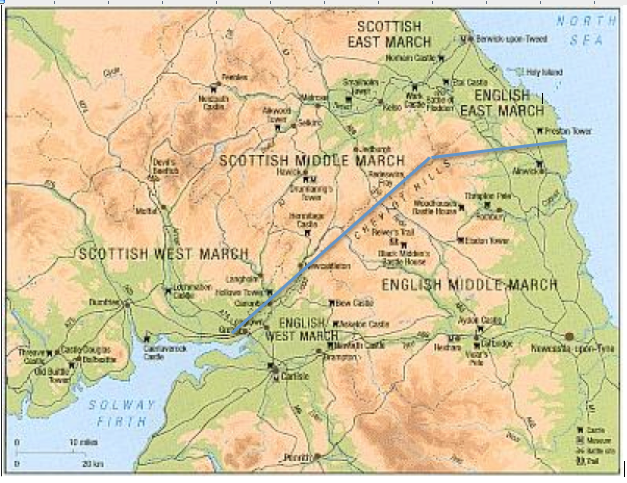
But its name was South Berwick—to distinguish it from its smaller ferry port namesake up on the Forth. Back then, the Border was an elastic concept, running from the end of the Cheviots to roughly Holy Island; Alnwick and Rothbury were definitely English; Norham and Spittal were not; in between was anyone’s guess. Repeated wars switched Berwick itself between the two countries 13 times, becoming English when Elizabeth I built its still-extant magnificent town fortifications to replace the castle (eventually demolished to make way for the station in 1850). It’s long overdue to switch back.

Berwick is closer to the Scottish capital of Edinburgh, than to the North East’s regional centre of Newcastle upon Tyne. That Berwick is Scottish is  reinforced by the fact that most commercial banks in the town are Scottish and Berwick Rangers plays in the Scottish league. Dialect also leads to the belief that Berwick is Scottish as, to most Englishmen, the local `Tweedside’ accent spoken sounds Scottish

Local residents today regard themselves as independent `Tweedsiders’ or `Berwickers’, rather than English or Scottish. In fact until the Reform Act of 1885 Berwick did have a considerable degree of independence with the status of a `Free Burgh’ meaning that it had to be mentioned separately in Acts of Parliament. But the abolition of Berwick District recommended by the Boundary Commission in 2004 and executed in 2009 have left them feeling run by outsiders with scant sympathy for their unique position.

Assuming the local population like the idea, what would a redrawn boundary mean? The whole of the old Berwick District would have the border run from The Cheviot roughly East, passing 5-6 miles North of Alnwick to hit the sea between Seahouses and Dunstanburgh Castle (it would not include the RAF ASR base at Boulmer). An alternative is that the border instead of heading East should follow the line of the Cheviot border slanting NE past Wooler and Belford to reach the sea near Budle Bay.

In either case, some 25,000 people would become Scottish citizens, enjoying advantages  the other 5.25m already do. It would lend itself to solving a longstanding problem of civic incoherence in Scottish Borders. Spinning Berwickshire out of Scottish Borders to join with Berwick and its formerly English hinterland could form a 33rd Scottish local authority, one that had a major town at its focus, excellent rail connections N & S and a far better chance of encouraging coherent development and growth of the lower Tweed valley.

Quite apart from the sheer logic of having a town and its hinterland be in the same country, it would eliminate cross-border nonsense, such as English involvement in Tweed water quality because they control 10 miles of its bank or futile arguments about which roads authority repairs the Coldstream/Cornhill bridge. All this is conceivable without independence and would still be a shot in the arm to Scots at this emotional time.

Oh—and bringing the old English East March north of the border would also move the maritime border between Scotland & England in the North Sea south by about 50 miles—giving the Scots 95% instead of 90% of the oil. Don’t tell the English but if we bribe the Berwickers with some of that increment this could all be self-financing.

Ssshhh!

A New Border? The English East March Turns Scottish

A New Border? The English East March Turns Scottish

Posted in Community, Politics | 7 Comments

That Motion In Full

Without much apparent consultation with colleagues in his own party, let alone across all three unionist ones, Gordon Brown announced a timetable of UK parliamentary measures to address the inadequacies of the present devolution settlement to Scotland. According to papers today, as the first step of that, the following motion is to be laid before the UK Parliament next week:

“That this House welcomes the result of the Scottish independence referendum and the decision of the people of Scotland to remain part of the United Kingdom; recognises that people across Scotland voted‎ for a Union based on the pooling and sharing of resources and for the‎ continuation of devolution inside the United Kingdom; notes the statement by the Prime Minister, Deputy Prime Minister and Leader of the Opposition regarding the guarantee of and timetable for further devolution to Scotland; calls on the Government to lay before Parliament a Command Paper including the proposals of all three UK political parties by 30th October and to consult widely with the Scottish people, civic Scotland and the Scottish Parliament on these proposals; further calls on the Government to publish heads of agreement by the end of November and draft clauses for the new Scotland Bill by the end of January 2015.”

Given that a clear option to achieve just that was excluded from the referendum question on David Cameron’s insistence, the undignified scramble of the last week and the above motion taken at face value could be seen to have reversed that stance. As a result, Scotland may still gain something substantial for the 45% of its people who voted YES, even if it is not the sovereignty they hoped for.

Not wishing to rain on anyone’s parade and dampen such prospects, the whole thing seems cobbled together in a panic. There is evidence of UKIP-paranoid Tory backwoodsmen gathering pitchforks and torches against any more ‘concessions’ to Scotland and—of pivotal importance—any agreement has to survive ritual abuse of party machines girding their loins for a General Election now less than 8 months away.

The cynical negativity and nastiness that typified senior politicians speaking out against independence may have simply been a campaign tactic and they do indeed wish Scotland well and bury their collective hatchets to permit her to prosper by their alternate method.

But, as gran said: “Ah hae ma doots”

Posted in Politics | Tagged | Leave a comment

Grey Light of Dawn

It’s 8am and the last result from Highland comes in with a 47% Yes/53% in Danny Alexander’s back yard, making a grand final total of 1,617,989 Yes votes against 2,001,926 No votes. Despite the consistent polls during the run-up pointing to a knife-edge result, that 45%-to-55% difference is decisive and the Yes campaign in the shape of Nicola Sturgeon conceded defeat before the last half-dozen results were in.

Yes supporters like myself have been reported variously as disappointed, gutted, stunned, etc and I’m sure that is true. But the ad hoc Yes party outside Dynamic Earth kept spirits until the dawn and dispersed without any incidents—as seems to have happened across the country. As could be expected, the No party in Glasgow was ebullient.

In the grey light of dawn (the haar is in here in East Lothian and the roofs are wet without it actually raining) the result seems to have surprised both sides. While I’m sure there is much ongoing anguish and even resentment from crestfallen Yes supporters, many of us are actually proud and relieved that Scotland came out and voted in such numbers to give an unheard-of 85% turnout.

The last time Scotland voted so completely was the 1945 General Election that came in the dying days of WW2 and swept wartime leader Winston Churchill out of office and the reforming Labour administration of Clement Attlee in. Ordinarily, elections in Scotland these days are lucky to achieve a 60% turnout—with some socially derived city constituencies even falling below 50%.

What campaigners and poll-gate-checkers of both persuasions shared throughout yesterday was a reward for all their work by turnout that was an exemplary display of democracy in action. The mood at the polling stations sometimes verged on the carnival, with groups showing up singing here and bagpipes skirling there. Despite some minor blips earlier in the summer, the intense campaign of the last few weeks was fought very hard but very fairly. Some 20% of the votes were postal and represented a return rate around 95% of those sent out returning—again an unheard-of figure.

With such a definitive result on the back of effectively total participation, there is little by way of doubt for Yes supporters like me to grumble about—“if only the ‘X’ vote had turned out” is a non-starter of an excuse. Which should make it rather easier to wake up today, unpin the Yes and No lapel badges from the jackets and all be friends and Scots together—although resentment at the bias of almost all major media is remains unfinished business if democracy is to be truly fair and open.

Because the story doesn’t end here any more than if there had been a ‘Yes’ landslide, debate about what these vague ‘additional powers’ promised by all three unionist parties in the dying days must be addressed, especially as any unity will do a ‘snaw-aff-a-dyke’ job as the 2015 UK General Election looms. And, given the humphing and grumbling from many parts of England that they were excluded from yesterday’s vote, the democratic deficit of the non-existent English Parliament and a re-thinking of this UK Heath-Robinson constitution is immediately front and centre.

Proper analysis of why the vote was so decisive may need to wait until data from across the country can be better correlated but, having been a counting agent in East Lothian and watched votes tumble out of our 96 ballot boxes (as I have done for the last two decades) some factors seem fairly clear.

  • A surprising uniformity across Scotland with the main differences between city, suburban and rural areas rather than geographic location
  • That said, faith in the Union seemed strongest along our southern border: Scottish Borders (33%/67%) and Dumfries & Galloway  (34%/66%)
  • “Tory” areas (known down our way known as ‘The Stone Houses”) overwhelmingly voted No. This came as no shock but the anguish displayed by residents there over the prospect of independence and loss of British identity was surprisingly intense.
  • SNP areas did more poorly than expected—Aberdeenshire, Moray, Clacks, Perth, West Lothian, East Ayrshire all have strong SNP presence but none lay much outside the general trend and none managed a Yes majority. The exception was Dundee which had been predicted to be “Yes City”
  • If the Lib-Dems had an influence in all this, I failed to see it (there were no Lib-Dem activists present at any polling station I visited—and they once had 6 councillors here)
  • Most interesting were the Labour ‘strongholds’ where there seems to have been considerable erosion of party loyalty and a significant number of the 35% predicted to vote Yes doing so. This meant Glasgow, the Lanarkshires and Fife came in far closer to the knife edge the pollsters had been predicting overall and it remains to be seen how much damage Labour’s No stance has done to their support
  • Affluent suburban areas generally seem to have voted No by 2 to 1. This can be seen in the three ‘Easts’ (Renfrewshire, Dumbartonshire and my own Lothian) are within a whisker of each other around 38% Yes to 62% No.
  • The Islands—as always and as in 1979—have minds of their own (Orkney 33/67; Shetland 36/64; Argyll 42/58 but Western Isles a more balanced 47/53)

Overall in a contest this huge, there will be no glib single explanation of the result. But for my money what we saw was a variant of the surprise result in 1992 when Kinnock’s Labour were widely predicted to win and yet Major’s Tories scraped in with a majority and ruled another five years. The explanation given was that it had become embarrassing to admit to being a Tory so the polls deeply underestimated their real strength

In this campaign, I believe pollsters asking Scots how they would vote were getting many answers from people who did not wish to be thought unpatriotic by voting No so they responded as Undecided or even Yes. But on the day, they were fully in the mood of their fellow independence skeptics and cast their ballots firmly for NO.

Posted in Community, Politics | Tagged | 2 Comments

Poll Position

Today finally came and, with it, a climax of energy that has been building across Scotland over the last two years. I can’t claim to have much of a clue of what’s going on elsewhere (I’ve heard that a phalanx of women marched into a Glasgow polling station singing ‘Flower of Scotland’) but I have been round all six polling stations in my North Berwick Coastal ward and am mightily impressed with what I found.

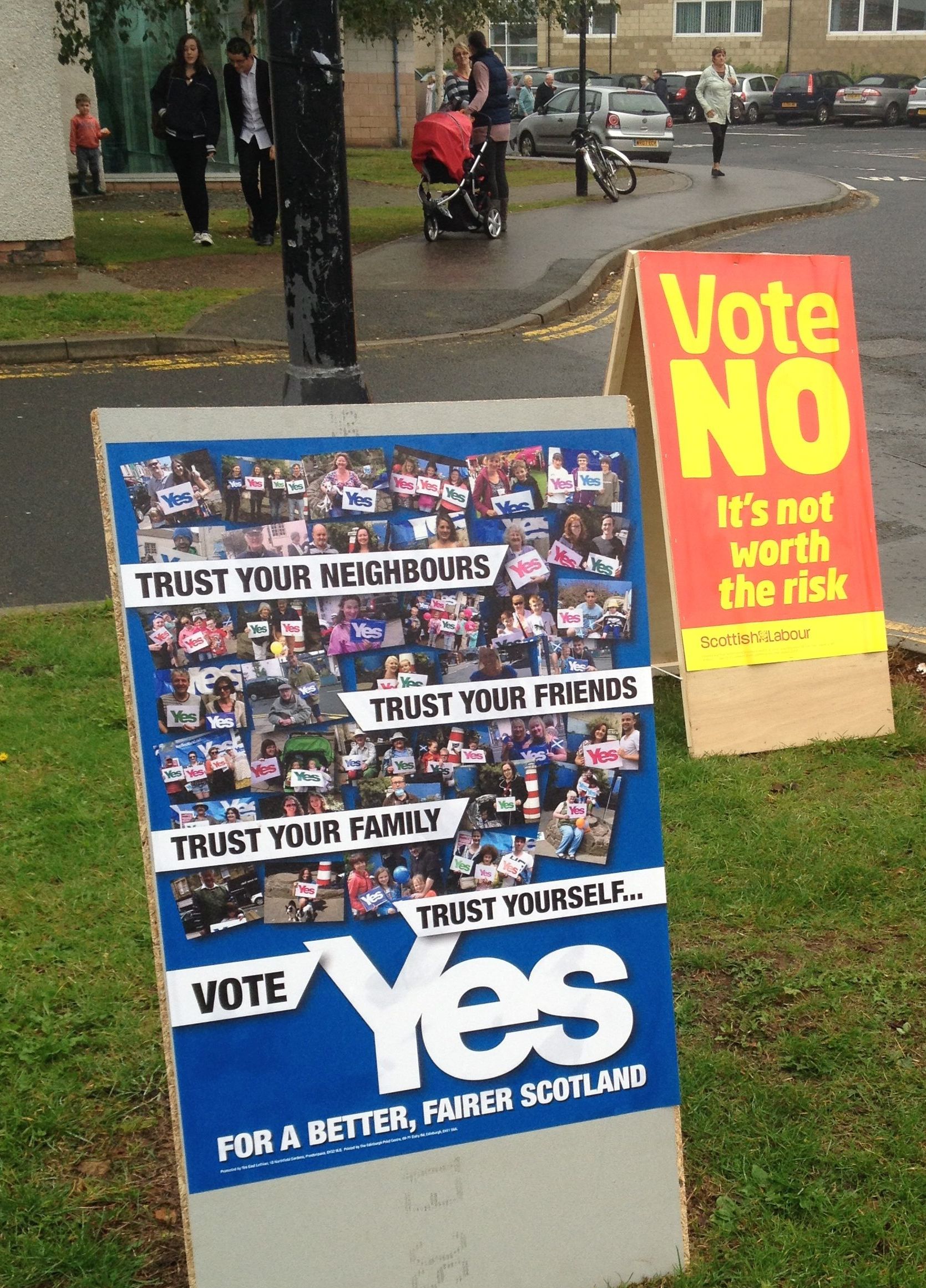
First of all, the customary boards were there in greater numbers and, in the absence of candidates and parties to promote, are actually carrying messages. These two at North Berwick seemed to sum up the differences between the campaigns.

YES and NO Campaign Boards, North Berwick Polling Station

YES and NO Campaign Boards, North Berwick Polling Station

I have stood at polling stations for every election in this area since 1994 and have never seen what I saw today. Turnout is immense; normally sleepy Gullane had a queue out the door, across the car park and part-way up the street when it opened at 7am. The 20% of all voters have sent 95% of their ballots in and still they were pouring through the doors.

But much more than at party elections, people were bringing their kids, stopping to chat, making the whole event more carnival-like. This feeling was heightened at North Berwick in the early evening when three rather fine young pipers showed up and started entertaining both the poll gate checkers and the flood of people going in to vote. Only the wee dug seemed perplexed by the noise.

Three Pipers play. NO on the left of the door YES on the right

Three Pipers play. NO on the left of the door YES on the right

At Whikeirk, a resolute YES supporter staked out the place where no party has ever thought it worthwhile to do so before (barely 300 voters) but there she was with her camper chair, brolly and flask of coffee. At Aberlady, the same Presiding Officer of two decades of elections there was saying he’d seen many people he knew who had never been to vote before—some had to be guided in as it’s the most difficult polling station to find.

In Gullane, the douce ladies with the blue NO rosettes seemed particularly discomfited by having non-local NO ‘colleagues’ in red NO rosettes so close for so long. In fact that was a theme common around them all—NO presence far higher than any single party manages at a normal election. But, more than that, a high level of anxiety, if not actual stress among NO workers that seemed entirely absent from the YES side. Some worked it out of themselves with intense conversations, largely with YES workers who, in turn, seemed relaxed…but were having trouble coming to terms with no longer being the underdog.

Two hours to go on a two year campaign and the word from East Lothian is that everyone deserves credit for engaging with the public and galvanising them to participate on a scale that may be unprecedented. Since it is such an important vote, it’s a real victory for democracy. Incidents of egging, shoving and heckling did occur—but what other country has come this close to independence with no deaths and no injuries stemming from it?

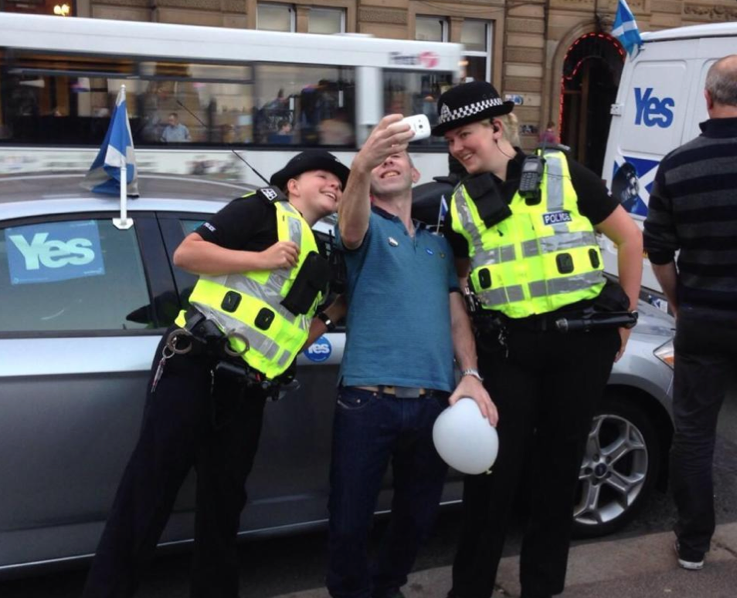
And, if the turnout does exceed 80%—as it well might—that will make any relatively close result (e.g. 52% to 48%) still be conclusive so we can all wake up on Friday as friends and get on with the next phase of Scotland’s future. But, down our way, despite emotions running high, this election went off splendidly—so splendidly that the local polis had a chance to take their eye off roit control and get themselves a decent selfie.

SOme of Lothian's Finest Allow Themselves to Get into the Indyref Mood.

Some of Lothian’s Finest Allow Themselves to Be Distracted into the Indyref Mood.

Posted in Community, Politics | Tagged | Leave a comment

Chiels That Winna Ding

This last week of the referendum debate has grown ever more heated. Despite 99% of those engaged in campaigning keeping the heid, there have been some idiots on either side. Even some intending no malice have had their exhuberence seen as intimidation by  opponents. But, given what’s at stake and the sheer scale of activity, we should perhaps be grateful that the worst violations of good grace have been limited to robust heckling and at least one egging.

There has never in history been an independence movement like this—come so close to succeeding without serious personal injury, let alone any loss of life. Whichever side wins, once emotions cool both sides will look back on this with pride, irrespective of outcome.

But part of the problem has been debates too light on facts. Both sides have been guilty of this—the Yes campaign declining to answer gaps in the White Paper and the No campaign projecting doomsday scenarios for which it failed to provide much evidence.

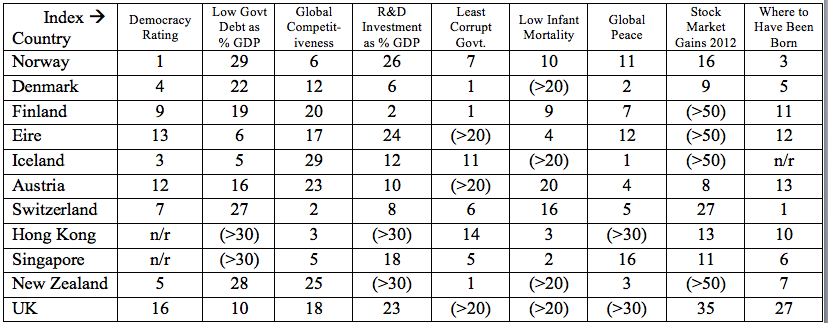
So, before the polls open and the hour grows too late, allow me to distill a series of hard facts, as gleaned by the respected Economist Intelligence Unit, comparing countries on a number of key parameters of success for its citizens. Most are extracted from their World in Numbers 2012 booklet. Together, these rankings summarise which countries are successful in bringing a rich, safe, comfortable and fulfilling life to its citizens.

Brought together in the table below are ten countries roughly comparable to what Scotland might become as an independent nation and the UK as a whole. While there is no clear winner, these cold numbers make it abundantly clear how much more successful these Scotland-sized nations are in every category. Any conclusion drawn on Scotland’s future must include consideration of these facts that are, in Burns phrase, chiels that winna ding.

Comparison of UK vs Scotland-Sized Countries (Source: Economist

Comparison of UK vs Scotland-Sized Countries (Source: The Economist)

While it may be difficult to see which country does come out on top, it is most certainly not the UK. But the whole point of independence is for a country to choose its own destiny and not live by someone else’s priorities. Socially-conscious Scandinavia to bustling Singapore is all possible but we’re bonkers together.

Posted in Politics | Tagged | Leave a comment

Wee Blue Book: Currency/Pensions

In this third installment from the Wee Blue Book, the two main targets of Project Fear are debunked. Clearly the use of a stable currency is vital to any country’s prosperity but it is equally clear that Westminster has created this straw man for their own purpose. As the security of pensions is a vital issue to people as they age, sowing uncertainty about their future is a similar bid for the normally reliable pensioner vote.

Currency

The No campaign’s most repeated scare story is that an independent Scotland wouldn’t be able to keep the UK pound. This is a categorical lie. Sterling is what’s known as a “fully-tradeable” international currency, which means that any country can use it if it wants to, without requiring the UK government’s permission.

So even if the threats made by George Osborne (and backed by Ed Balls and Danny Alexander) that Westminster would refuse a formal currency union were to turn out to be true, nothing could stop Scotland from continuing to use the pound.

Many economic experts actually believe that using Sterling “unofficially” would be a BETTER plan for Scotland. In February this year Sam Bowman, research director of the world-renowned Adam Smith Institute, said:

“An independent Scotland would not need England’s permission to continue using the pound sterling, and in fact would be better off using the pound without such permission. An independent Scotland that used the pound as its base currency without the English government’s permission would probably have a more stable financial system and economy than England itself.”

Professor Lawrence White of the Institute of Economic Affairs agreed, noting that while informal use would leave Scotland without a national central bank, such an arrangement can actually be a positive:

“The possibility of banking panic justifies having a central bank only if it can be shown that panics are more frequent and severe in countries without central banking than in countries with central banking.”

The evidence actually points the other way.

An official lender of last resort can unintentionally worsen the problem of banking panics if it makes explicit or implicit bailout guarantees that encourage banks to take undue risks”

In any event, most experts agree that the Unionist parties’ position is a bluff. In March 2014 Janan Ganesh of the Financial Times (and formerly of The Economist), who also wrote a biography of George Osborne in 2012, told the BBC’s Sunday Politics that:

“If the Scots vote for independence, of course a deal will be done on the currency, because it’s not in London’s interests to have a rancorous relationship with Edinburgh.”

He was commenting after an unnamed UK government minister told the Guardian:

“Of course there would be a currency union”

A few days later the University of Glasgow’s professor of economics Anton Muscatelli – a former consultant to the World Bank and the European Commission, a current adviser to the House of Commons Treasury Select Committee on monetary policy, and former chair of an independent expert group for the Calman Commission on devolution – also said the UK government was bluffing, in a piece for the Financial Times explaining why refusing a currency union would be a reckless and irresponsible move:

“A successful currency union would actually be in the interest of both sides – and especially the rest of the UK. The most damaging prospect to the rest of the UK from rejecting a sterling currency union is what it will do to its own trade and business activity. Whatever the political tactics involved, it would be tantamount to economic vandalism.”

No matter what happens after a Yes vote, whether the UK government agrees to a currency union or not (although the overwhelming likelihood is that it will), Scotland WILL keep the pound. Because of the nature of Sterling, this is one of the few aspects of the debate which can be absolutely, unequivocally guaranteed.

Pensions

Pensions are a matter of great concern to many Scots, and as a result the No campaign spends a considerable amount of its time trying to frighten people into believing independence represents a threat to their pension. Yet as with currency, pensions are one of the few aspects of the independence debate about which it IS possible to state the position with certainty.

For example, Labour MP Ian Davidson, chair of the Scottish Affairs Select Committee, made these comments in the House Of Commons in May 2014:

“The state pension of any individual in Scotland, in the event of separation, would not be adversely affected […] they would continue to get the level of state pension, the same as everyone else in the UK… people themselves can be assured that their pensions are secure.”

Mr Davidson was reflecting a statement to the committee by UK government pensions minister Steve Webb, which was reported in the Scotsman the same day:

“State pensions would still be paid after independence, a UK minister has told MPs, despite concerns raised by the Better Together campaign.”

Giving evidence to the Scottish Affairs Select Committee, Lib Dem pensions minister Steve Webb said that anybody who had paid UK national insurance would be entitled to their state pension whatever the outcome of the referendum.

The intervention contradicts concerns raised by former Labour Chancellor Alistair Darling, the leader of the Better Together campaign.”

And in any event the facts had been well established long before then, with the Department for Work and Pensions having made a similar statement in January 2013:

“If Scotland does become independent this will have no effect on your State Pension, you will continue to receive it just as you do at present. Anyone who is in receipt or entitled to claim State Pension can still receive this when they live abroad. If this is a European country or a country where Britain has a reciprocal agreement they will continue to receive annual increases as if they stayed in Britain.”

Public sector pensions will be equally safe. In May this year Neil Walsh, the Irish-born pensions officer for the Prospect trade union (which is neutral on independence), conducted a conference call for union members to explain the ramifications of a Yes vote to the union’s members, and others in a similar position.

“If you [are] a member of a public service pension scheme that’s already delivered by a Scottish administration – and that includes the NHS, teachers’ pension scheme, fire authority, local government pensions – then literally I can’t imagine what would be very different under independence because you’re already having your occupational pension delivered by a Scottish administrator.

“The responsibility for each and every one of those schemes, NHS, teachers, police, fire and local government, would be taken over by an independent Scotland and continue to be delivered in precisely the same way that you’ve always been used to.”

On the subject of UK-wide public sector pensions, such as those applying to the armed forces and civil service, Walsh noted that negotiation would be required between governments, but that nobody should worry and members wouldn’t notice any change:

“The Scottish Government says the most appropriate way to divide up responsibility is for them on independence to take responsibility for the state and public service pension of anybody who lives in an independent Scotland at that time, the UK Government says that that might not be the most appropriate way.”

But I don’t think anybody says no-one will become responsible for your public sector pension after independence. It would be a matter for negotiation behind the scenes, and actually you as a member should just continue on paying your contributions seamlessly if you are an active member or receiving your benefits seamlessly if you’re a pensioner member.”

Private workplace pensions are the only area of uncertainty. EU rules impose funding requirements on pensions operating across national borders, which would apply to any UK-wide scheme.

However, there are numerous options available to circumvent this problem, the simplest of which is for the firms operating the scheme to set up a Scottish office and handle the Scottish and rUK sides separately. The decision as to which solution to adopt will be one for each company to make individually. Unfortunately it’s simply not possible to answer generically or in advance.

(In previous cases affected by these rules, such as between the UK and Ireland, the governments concerned have been able to make transitional arrangements while matters were sorted out. Unfortunately, the Westminster government refuses to discuss such arrangements before the referendum.)

But perhaps more to the point, staying in the UK doesn’t guarantee anything about pensions.

  • Gordon Brown’s infamous “pension raid” shortly after he became Chancellor in 1997 has so far cost UK pensioners £118 billion, or about £12,000 each, and will continue to cost them money every year until the day they die.
  • the UK plans to increase the state pension age to 70 for both men and women. Some people, particularly women, have already seen the age they expected to start receiving their pension increase by five years under changes by both Labour and Tory governments.
  • in June 2013, a report from the National Pensioners’ Convention revealed just how badly-served the UK’s pensioners have been by Westminster:“According to the latest figures from the Office for National Statistics, British pensioners are among Europe’s poorest, with more than two million older people at risk of poverty.

    The UK was ranked fourth from bottom out of 27 European countries, with more than one in five (21.4 %) of older British people classed as being at risk of poverty in 2010; significantly higher than the EU average of 15.9%.

    The main reason for this situation stems from the UK’s inadequate state pension system. According to the latest EU comparisons, the adequacy of the UK state pension in relation to the country’s average wage ranks it at the bottom in a list of 25 European countries.

    For the average earner, the UK replacement rate of 17% is far below the EU average of 57%.”

The idea that a No vote provides either security or certainty over pensions is simply a myth. Nobody can say what the next government England elects will do.

Posted in Politics | Tagged | Leave a comment

Wee Blue Book: Economy

This second installment from the Wee Blue Book addresses an area over which considerable debate has raged. The economy underpins every aspect of Scotland’s future. In the interests of objectivity on so crucial a matter, this section has received a fiercely partisan—but nonetheless considered and articulate—critique from Kevin Hague’s Chokkablog.


The choices that any independent Scottish Government makes, and whether those choices will be easier or harder than those faced by a devolved Scottish Government, will be dictated by how much money is available. For that reason, the UK government and the No campaign desperately want you to believe that Scotland would be poorer as an independent country, and that it would therefore have to raise taxes and/or cut public spending to protect services.

But that simply isn’t true. In fact, it’s not even close – the Financial Times stated unequivocally in February 2014:

“An independent Scotland could expect to start with healthier state finances than the rest of the UK.” Scotland subsidises the UK by billions of pounds every year, and has done for many decades. On the rare occasions when it’s forced by Parliamentary rules to tell the truth, the UK government admits that fact plainly.

On 27 March 1997, the Herald newspaper reported:

“Mr William Waldegrave, Chief Secretary to the Treasury, has been forced to concede figures in Commons questioning in recent months, which show that if Scotland’s share of North Sea revenues had been allocated since 1979, then the net flow in favour of the Treasury from north of the Border ran to £27bn.”

The Herald went on in the same article to note that Mr Waldegrave (the 1997 ministerial equivalent of Danny Alexander) later admitted to the House that the real figure was even higher, at £31 billion over the 18-year period.

The extent of Scotland’s wealth after the discovery of North Sea oil in the 1970s was so great that successive Labour and Conservative governments hid it from the Scottish people for three decades. When a 1975 analysis for the UK government by economist Professor Gavin McCrone was finally made public in 2005 after a Freedom Of Information request, The Independent newspaper reported:

“An independent Scotland’s budget surpluses as a result of the oil boom, wrote Professor McCrone, would be so large as to be ‘embarrassing’.
Scotland’s currency ‘would become the hardest in Europe, with the exception perhaps of the Norwegian Kronor.’ From being poorer than their southern neighbours, Scots would quite possibly become richer. Scotland would be in a position to lend heavily to England and ‘this situation could last for a very long time into the future.”
In short, the oil would put the British boot, after centuries of resentment, firmly on the foot standing north of the border.
Within days of its receipt at Westminster in 1974, Professor McCrone’s document was judged as incendiary and classified as secret. It would be sat upon for the next thirty years.”

The pro-Union economist Professor Brian Ashcroft (husband of former Scottish Labour leader Wendy Alexander) calculated in July 2013 that had Scotland been independent since 1981, it would by now have an accumulated basic budget surplus of at least £68 billion. The real figure, including interest and other benefits, would likely be an “oil fund” of well over £100 billion.

But instead of that huge surplus, Scotland is part of a UK with a massive £1.4 trillion debt – our population share of the debt is approximately £118 billion.

In short, membership of the UK for the last 32 years has left Scotland anywhere from £180 billion to £250 billion worse off than it would have been as an independent country. Thanks to Westminster we’re massively in debt, where we should have had money in the bank.

There’s no point crying over spilt milk – that’s all in the past. (Although the vast subsidy Scots have paid to the UK could still play a big part in reducing how much of the UK’s debt Scotland takes on in independence negotiations – see Chapter 5) But the fundamental economic facts making Scotland stronger than the UK are the same now as they’ve been for the last 40 years, as the Financial Times observed.

Unionists don’t care about that. In February 2014 the Labour MP for Lanark and Hamilton East, Jim Hood, stood up in the House Of Commons and said:

“If the Scottish people are going to be better off economically etc, I would still be against breaking away from the Union.” (and video)

But Scottish Labour MPs can afford not to care. They’ve got safe jobs for life (Jim Hood has a 13,000 majority and has been in place for 27 years) and they get to decide their own salaries. If you’re living in Scotland and you DON’T have an MP’s lavish expense account and gold-plated pension to fall back on, you probably do care whether you and your family would be better off or not.

Scotland can’t afford to keep paying tens of billions of pounds over and above its fair share. The simple fact is that by any reasonable calculation, and even BEFORE the effect of different policies (such as scrapping Trident) is taken into account, Scotland will have more money as an independent country than it does as part of the UK.

Questions

Q: “But isn’t UK government spending higher per person in Scotland?”

A: Yes, it is. But Scotland pays for every penny of that spending and more besides. As the Financial Times article from February points out:

“Although Scotland enjoys public spending well above the UK average – a source of resentment among some in England, Wales and Northern Ireland – the cost to the Treasury is more than outweighed by oil and gas revenues from Scottish waters.”

On average, UK spending is around £1,200 higher per person in Scotland than in the UK as a whole. But on average Scotland sends £1,700 more per person to the UK in taxes. We only get back around 70% of the extra money we send to London. The other 30% is kept by Westminster and spent in England, Wales and Northern Ireland.

Q: “But doesn’t Scotland get more money spent on it than it generates in tax?”

A: Sort of. In 2011-12, for example, Scotland generated roughly £57bn in tax and had £64.5bn spent on it. But that extra spending isn’t a generous gift from the UK – it’s borrowing, taken out by the UK government in Scotland’s name. It’s not money from the rest of the UK, it’s money from international banks – it becomes part of the massive debt referred to above, and Scotland has to pay it back.

(And we have to pay it even if we didn’t need or want the things it was spent on – like nuclear weapons, the London Olympics and the HS2 railway from London to Birmingham, all of which Scotland pays billions of pounds towards because Westminster claims they’re for the benefit of the whole country.)

The gap between what a government gets from tax receipts and what it spends is called a deficit, and almost every country on Earth (except Norway and Switzerland) has one. It’s a normal state of affairs – it’s just how modern governments work, though the No campaign likes to make out that Scotland would be the only country in the world with a deficit.

Scotland’s deficit is in fact considerably smaller than the UK’s – in 2011/12 the UK’s deficit was £126bn, making Scotland’s population share of it £10.6bn. Yet Scotland’s own deficit that year, according to Alistair Darling, was only £7.6bn.

In other words, in just one year Scotland had to take on an extra £3bn of the rest of the UK’s debt, as well as all of its own.
For perspective, £3bn is roughly three times the cost of free university tuition (£590m), free prescriptions (£60m), free bus passes for pensioners (£180m) and free personal care for the elderly (£200m) combined.

Most of Scotland’s deficit (roughly £5bn a year, or two-thirds of it) is in fact made up of UK debt repayments. We only have to pay that because we’re in the UK and the UK keeps loading extra debt onto Scotland, even though Scotland already pays far more than its share.

The facts are clear – the longer we stay in the UK, the worse Scotland’s deficit and debt will get.

Q: “But what if there was another banking crisis? Scotland couldn’t afford to bail out the banks.”

A: That’s simply not how bank bailouts work. There have been numerous bailouts of banks across Europe and the USA in the last few years, and they’ve all operated under the same principle – governments fund the bailout proportionate to the business the bank does IN THAT COUNTRY.

So if a bank is based in Scotland but does 90% of its business elsewhere, the Scottish Government would only be liable (if it chose to bail out the bank at all) for 10% of the bailout. That’s why, for example, the US Federal Reserve contributed an eye-watering £640 billion to save Barclays in 2008, despite Barclays being a UK bank registered in London.

Q: “But won’t independence create barriers to trade with the rest of the UK, which will damage the economy?”

A: No. Scotland and the rUK will both remain inside the European Economic Area (EEA), a free-trade zone which incorporates both EU and non-EU states.

Q: “But aren’t those figures about a wealthy Scotland mostly from the boom years of North Sea oil? Isn’t the oil running out and getting harder to extract and less profitable now?”

A: For most of the 1990s the price of oil was around $20 a barrel, but it’s been consistently over $100 for the last two years. The price of increasingly-rare commodities on which the world depends tends to go up, not down. But don’t listen to us – how about the Investors Chronicle (part of the Financial Times group), which in July 2014 told its readers to buy shares in oil company EnQuest, saying:

“We think that Westminster has been deliberately downplaying the potential of the UK Continental Shelf (UKCS) ahead of September’s referendum on Scottish independence.”

Unionist politicians are desperate to talk down Scotland’s oil wealth, for obvious reasons. As we’ll find out later in this book, they’ve been doing that for most of the last 40 years. If you want an honest, impartial assessment, ask the people whose living depends on making money out of it. Because unlike the government, they can’t afford to lie to you.

Posted in Commerce, Politics | Tagged | Leave a comment