Calling All Pedants

John Cleese has been able to make me laugh in a huge variety of circumstances ever since my uni studies were regularly interrupted to join a flatful of mates to fall about to Monty Python. Ever wry, if not acid, he has since commented on 2015’s ongoing security crisis by dipping his pen into his customary fluent vitriol and lampooning the bureaucrat’s cheerless ideas of how to deal with it. However, in contrast to his normally flawless flow, in this case, he has made a (not?) deliberate mistake; see if you can spot it.

“The English are feeling the pinch in relation to recent events in Syria and have therefore raised their security level from “Miffed” to “Peeved.” Soon, though, security levels may be raised yet again to “Irritated” or even “A Bit Cross.” The English have not been “A Bit Cross” since the blitz in 1940 when tea supplies nearly ran out. Terrorists have been re-categorised from “Tiresome” to “A Bloody Nuisance.” The last time the British issued a “Bloody Nuisance” warning level was in 1588, when threatened by the Spanish Armada.

“The Scots have raised their threat level from “Pissed Off” to “Let’s get the Bastards.” They don’t have any other levels. This is the reason they have been used on the front line of the British army for the last 300 years.

“The French government announced yesterday that it has raised its terror alert level from “Run” to “Hide.” The only two higher levels in France are “Collaborate” and “Surrender.” The rise was precipitated by a recent fire that destroyed France ‘s white flag factory, effectively paralysing the country’s military capability.”

Posted in Community | Leave a comment

Twa Corbyns

It’s a humble man who makes a speech using the word ‘thank’ 27 times. Such is not the mark of a man of overweening ambition, nor one who aspires to high office. Yet that speech was made as the landslide victor of the Labour leadership contest, Jeremy Corbyn. “J.C. (of non-biblical)“, as some have long called him, took Westminster’s political pundits by surprise and the Labour party by storm. And, though the man himself has been a model of unshakable conviction throughout his 32-year career representing Islington North, the next year or so will be marked by incompatibly schizophrenic views about him.

To adherents of ‘Old Labour’ on the one hand—especially those in Scotland—it had been a desperate two decades. Dominant throughout the eighties as the standard-bearers against Thatcher, Scottish Labour boasted fifty MPs, every council of note and a stranglehold on civic and quango appointments. They were embedded in the social fabric of clubs and miners’ welfares across the country, the unswerving representatives of ‘the working man’ and who, in turn, received their unswerving vote. “Ah’ve aye votit Labour” was a doorstep response from Mauchline to Mastrick.

Two decades ago, this monolith was faced with a dilemma; dig in with what they knew or adopt what Blair was doing to achieve power again. With few exceptions, they hung tough, were ever-vigilant on party loyalty and accommodated the Blair years and their victories by staying out of sight and “ca’in a well worn haun’le.” In this, they were joined by Jeremy Corbyn building his maverick reputation by being full-bore Foot’s socialism and dealing with untouchables like Jerry Adams long before any NI peace deal seemed plausible.

This put those here who embraced Blair—Brown, Cook, Darling, Alexander, etc—at odds with their CLPs. But the idea that New Labour had moved so far from its own roots spread like crabgrass. Corbyn would have had a great night out with Keir Hardy; he would have provided the missing seconder to his 1894 counter-motion rejecting the house’s congratulations at the birth of Edward (later VIII) Saxe-Coburg-Gotha and substituting condolences to the families of 280 dead in that year’s Albion Colliery disaster.

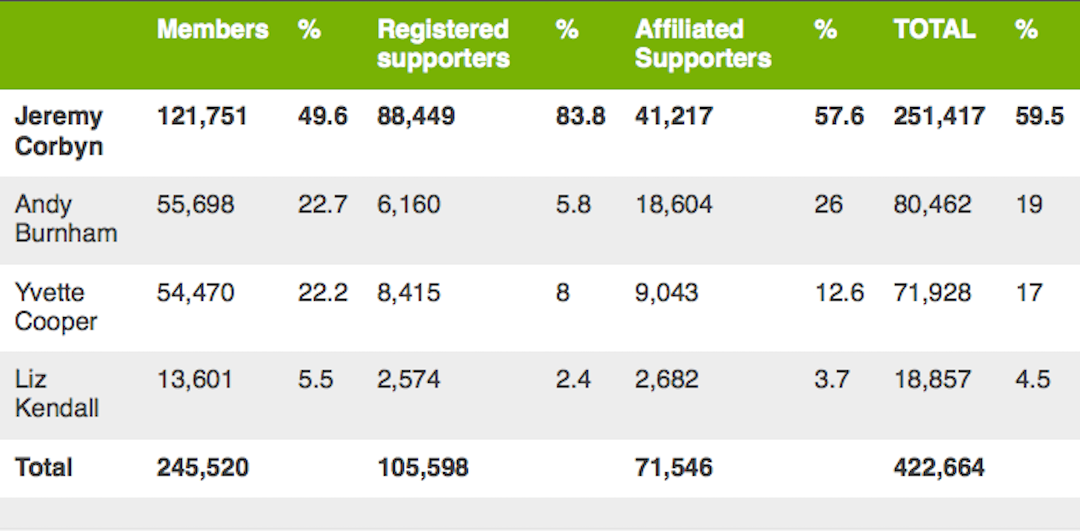
For much of Labour Corbyn represents a return to values they understand, for which they have spent years in the party fighting. That the result was so conclusive in all three categories of voters—members, supporters and affiliates—underscores both how deep socialist principles still run within Labour and how rudderless New Labour has become without the evangelical leadership of someone like Blair.

Labour Leadership Results

Labour Leadership Results

With this broad level of support Corbyn cannot be simply dismissed as some old marginal leftie. Consider several of his policies:

  • Scrap Trident and not replace it
  • National Education Service, modeled on the NHS
  • Cease military action in Syria & Iraq
  • Re-introduce rent controls, linking private rents to local earnings
  • Take in refugees desperate to get somewhere safe to live
  • Recreate a regulated, publicly run service delivering energy

Not all will agree with these or his more radical, positions. But a significant number outside Labour embrace many of those, none achievable under the Tories. He may not be the Messiah, but he represents people who have long felt no major UK party reflected their social conscience; in Scotland, they defected to the SNP in droves. Some see him, rather than Kezia, as the antidote and therefore the salvation of Scottish Labour from oblivion. He presents hope for revival here that none of the other three Blair-lite candidates could.

Then there is the other Corbyn, the one the Tories and a great swathe of the media see: Michael Foot without the donkey jacket; irresponsible disarmer; tax-and-spend fanatic; Joshua to Canary Wharf’s Jericho; veggie-munching cycling nut; Lenin with hair…they go on. And so The Torygraph trumpets: “Death of New Labour as Jeremy Corbyn’s socialist party begins a period of civil war” or the Daily Mail thunders: “Corbyn called Colombian terror group ‘comrades’: Labour leader faces fresh fury over militant beliefs” or UK Defence Secretary, Michael Fallon, bleats: “Jeremy Corbyn presents a big “risk” to Britain’s national and economic security.

Once this sort of ritual bad-mouthing gets into its stride, it will make the ritual abuse that the Yes campaign had to endure last year seem as harmless as an episode of SpongeBob SquarePants. It is not just the Tories who will have a go. After two decades of New Labour, there are many in the party who believe in its evolution to this point and are loath to take regressive, if comforting, steps into the past. The resignation of seven front bench members (including all three opponents) signals a strong internal resistance. To call it a split is premature but certainly there have been tensions among factions for some time. Yet, every party is a broad church; Derry Irvine and Dennis Skinner were never even on speaking terms, but most (except, apparently, Scotland’s far left) rub along for the sake of effectiveness through cohesion.

But the key point of attack will be electability. Many comparisons have already been made between Corbyn’s stance and the 1983 Labour manifesto—in Kaufman‘s pithy put-down “The longest suicide note in political history”. Significant numbers within Labour longed for a return to historic ‘Labour values’ from spin-heavy fare peddled by the Shadow Cabinet up to now. But how does that chime with the great apolitical public?

Certainly politics is tainted; principle and backbone are seen as rarities. But old-style socialism proved unelectable in the 1980’s and was ditched as such in the 1990’s with considerable success. The English public since m0ved considerably to the right. The Scots less so but SNP success came from embracing a more centrist position than before. And, despite legendary resolve and principle, they made little headway until voters perceived personal advantage over any risk in voting for them. Corbyn deserves plaudits for being one of the few to keep the red flag flying But will such principle cut any ice with a more fickle, self-interested electorate in the teeth of Tory scaremongering, resentful Blairites and a media fixated on bogey-men?

But nane sall ken whaur he is gane;
O’er his white banes, whan they are bare,
The wind sall blaw fir evermair.

Posted in Politics | Tagged | Leave a comment

Changing the Old Guard

It’s a tough old world in politics. When you’re in political limbo, nobody cares much what you do. However, the scope for character, opinions and even eccentricity is large. On the other hand, when you run a one-party state you can afford a few loose cannons because they make you look more human: think how Sir Nicky Fairbairn was once as much a scourge of the Tories as Dennis ‘Beast of Bolsover’ Skinner has been to New Labour. The trouble comes when you are neither off the radar, nor complacently secure. This is the state in which the SNP currently finds itself. And it shows.

Since the SNP got their act together for the 2007 elections, the party has gone from strength to strength and has managed to put a long overdue wind up the unionists and the little-Englanders who dominate Westminster (not all of them Tories). Consolidation of their grip on the Scottish Parliament in 2011 and a right trouncing of all other parties this year has put real power in the SNP’s hands, especially as they managed to turn a supposed defeat in September’s referendum into a recruiting bonanza, giving them stature in the eyes of the Scottish public that a complacent Labour had long abdicated.

This success has been attributed (rightly) to excellent party discipline through loyalty to a common purpose and willingness to suppress personal ambition ‘for the cause.’ Compared to recent Labour shenanigans in Scotland or Tory 1922 Committee posturings in Westminster, the SNP has been a model of united purpose. There have been no defections and the few resignations have been on demonstrable principle—as when MSPs John Finnie and Jean Urquhart resigned over policy realignment on  NATO.

That honeymoon appears to be ending. Apart from the swollen ranks of over 100 parliamentarians when there weren’t even three dozen a decade ago, the strain of eight years of unrelenting centralisation of local government tries the loyalty of 400+ SNP councillors. However much the fiscal squeeze can be blamed on London, councils are in the front line of cuts they have little latitude to ameliorate.

Eight years of the ‘parity of esteem’ in John Swinney’s Concordat have been a sham; councillors have been treated as inferiors and ignored. Yet they have demonstrated the same unswerving loyalty as virtually every parliamentarian and their growing army of assistants, researchers and SPADs. Why is this?

Partly it’s because disloyalty can cost your job; no-one is indispensible—unless they can achieve the kind of profile Margo did. There are now over 1,000 people who derive an income from politics due to their membership of (and loyalty to) the SNP. Few risk rocking their lucrative boat. But that is only part of the story. Examine the front ranks of SNP MSPs and MPs and there is a wealth of experience and a dedication forged in the dark days prior to 1999 when very few were elected and the party was run by a colourful array of long-time volunteer members who knew each other well.

Examine the pre-2011 ranks and almost all had served time motivating local branches, canvassing the streets and swallowing defeat until they were inured to it: party position was won by hard graft and gritty determination. Then came the 2007 and 2011 breakthroughs when a large number found themselves elected into positions of power. Organising and co-ordinating that explosion of numbers was made possible because most were loyal veterans of that long march to power.

Then came the referendum ‘defeat’. Suddenly, party ranks swelled eight-fold. The watershed also catalysed like-minded organisations outside the party, such as the popular “Women for Independence”. Unlike the many passive members of previous generations, many of these new members wanted to be involved and showed up at meetings and conferences, seeking to participate.

As the May General Election demonstrated, the days of defeat were past; getting nominated as an SNP candidate was no longer a hiding to nothing. And, because a good number of the Old Guard were already MSPs or councillors or disinterested in becoming either, a phalanx of new blood swept in to swell the group to 56 SNP MPs.

With nearly a year’s participation under their belt, the new, already politicised generation of members realised the world had changed, that glory, fame and fortune was available for those nominated. So, whereas the jostling for nominations had formerly been largely for List position, this summer was open season on the constituencies. It is only now becoming apparent that the process is in turmoil.

Those with national profile are unaffected; nobody is going to challenge Cabinet secretaries because that would be too blatantly disloyal. Otherwise, it is open season. With tangible prizes now at stake, several contests have turned bitter:

  • North East List MSP Christian Allard (he succeeded Mark MacDonald who won the Aberdeen Donside by-election in 2013) is challenging junior Health Minister (and long-time activist) Maureen Watt for Aberdeen South.
  • Veteran and South of Scotland list MSP Chic Brodie has been unexpectedly pipped for the nomination in Ayr (which he has worked diligently) by Glasgow councillor Jennifer Dunn. Jennifer cast the net wide, including East Lothian and Carrick before being se;ected for Ayr. She may prove a strong candidate but it may be significant that all her endorsements are from the new generation elected since 2011.
  • Colin Keir, elected in 2011 for Edinburgh Western, lost the 2016 nomination to Toni Giugliano who had been a Yes campaign official and is  a protegé of Alex Salmond.
  • Veteran and Angus & Mearns MSP Nigel Don who has been a diligent and articulate voice for the area (unless you swallow the calculated sour grapes of his Lib-Dem opponents) has similarly been ousted by a councillor-since-2011, Mairi Evans. He had put up a stiff opposition to court closures until part whips frog-marched him into voting for the legislation.
  • Fur has been flying in North Lanarkshire where Richard Lyle (a stalwart since the seventies) has come under serious fire for supporting the Mossend freight terminal extension and his candidacy for Uddingston and Bellshill appears to be in the balance.
  • In Paisley, Andy Doig, a regular activist and councillor who had been selected to fight the Renfrewshire South seat, is under fire from claims that he jumpd the gun and had used party information to campaign for his selection.
  • Rumours abound that European minister Humza Yousaf may be challenged in his Glasgow Pollok seat and there are currently no fewer than nine jostling for the Glasgow Provan nomination so the story is not yet at an end.

It would be foolish of any party not to bring on fresh talent (a lesson Kezia has supposedly now learned). But, though there is no evidence for anything underhand in the democratic process, is it not curious that all rammies so far have involved unseating a long-term activist? This appears to signify a sea change where, besides fealty to the whips’ command, those elected will also need to start diligently courting their local members.

It remains to be seen whether this ‘new blood’ infuses character or, like the SPADs some of them are, they remain Pavlovian in their loyalty. Certainly the refreshing surge of political interest over the last year bodes well and, to avoid universal frustration of the Covenant in the 1950s, getting elected is the only way to change things. Once there, it is always possible to ‘go native’ in what you believe, as Margo did.

Women for Independence is one of the more impressive products of this year and several SNP candidates are from that vibrant organisation. Candidates replacing Kenny MacAskill and Margaret Burgess (both stepping down) are WFI, as is the Skye, Lochaber & Badenoch candidate. Nothing against WFI but, if elected, they may well run into the same wall that Salmond did 30 years ago when his membership of the 79 Group caused ructions.

Any transition is difficult but the larger any organisation and the more in the public eye, the more painful the process. It remains to be seen whether these spats clouding the SNP selection process (and there may be more to come) cause party prospects any damage or are just transient symptoms of the party having grown so fast.

But one thing is clear: the come-rule-with-me cabal of Sturgeon, Murrell, Robison and Hosie—effectively the politburo of the party since Salmond stepped aside—are Old Guard and need to either broaden their church to recognise these developments…or get themselves an industrial-grade crystal ball to keep their swollen party on track for success. Because the instinctive loyalty of those who brought the SNP through its dark days is being undermined, if not usurped, by a Young Guard whose ambition is personal and who no longer share their folk memory.

Posted in Politics | Tagged | Leave a comment

Put Power Where People Live

Starting with its inception, the Scottish Parliament has played double standards, especially since the SNP came to power. Whereas the first eight years marked time with an unambitious Labour-led Scottish Executive sitting on their well paid behinds, the SNP have at least taken the jalopy out on the road to see what it could do.

But there is one glaring exception covering a third of their entire budget that stilll has cobwebs all over it. Starting well with John Swinney’s great-sounding Concordat with its ‘Parity of Esteem’, local government has been run into the long grass as an issue and democracy in Scotland suffers as a result. Our present Scottish Government shows double standards: it scoffs at what Westminster regards generous devolution of powers under Smith, yet it has increased their stranglehold over councils.

It dates from the ill-considered Tory reforms of 1976 that abolished burghs and any real local responsibility, creating eight behemoths of regional councils. By Tory lights, these went badly awry, largely falling under Labour control. So they had another go in 1996, gerrymandering them small enough for Tories to have a chance to control at least some of them (the real reason why Glasgow was stripped of its less-Labour leafy suburbs).

While Tories were content that even Parish Councils in England had fiscal powers, their more colonial approach in Scotland emasculated those very burghs with which most people identified as ‘their’ community. The way the Scottish Local Government Boundary Commission has operated since in drawing wards, fixating on voter numbers and shibboleths like deprivation while driving a coach and horses through preservation of such community identity has only made things worse.

So after forty years of flawed one-size-fits-all diktat from both Westminster and Holyrood,  Reform Scotland has done what CoSLA failed to do: make a case for local government to be just that and not just a supine instrument of central government policy. Whether on PPI or Council Tax freeze councils have had their arms up their backs the whole time. Reform Scotland’s briefing argues:

  • Local authorities in Scotland are not fully in control of any of their own tax income.
  • Local autonomy is undermined when councillors have no real control over taxation.
  • By at least devolving council tax and non-domestic rates in full, councils would have greater room for manoeuvre to take local priorities/circumstances into account.

So, not devolution in full, nor any attempt to address the currently skewed scale of what constitutes local democracy, but at least the same argument of being responsible fully for what they spend that the present Scottish Government argues should apply to Holyrood.

Consider what happens now and the case is overwhelming. Say a council wants to provide early years support in its education and that would cost the equivalent of a 1% rise in its total budget. If this is not government policy there is little chance that their component of funding would increase to cover that. But since 80% of funding comes from them and only 20% from council tax, it would take a 5% rise in council tax to fund the initiative. Ergo, nobody sticks their head above the parapet.

Meantime government policy continues to be doled out in terms of specific grants, such as the Safer Streets initiative. The result is that, while potholes go unfilled and road markings are left to fade, safety signs, traffic calming and traffic studies keep rolling to ensure that year’s grant is fully spent as they are legally unavailable for anything else.

Devolution was never supposed to stop at Holyrood. As well as council tax, business rates are collected by local authorities. But they are set and controlled by Holyrood. This means that not only the rate, but to whom it applies and discount schemes are controlled centrally and cannot reflect local requirements adequately. Even though the level of grants to local authorities ring-fenced for specific purposes was cut significantly under the 2007 Concordat, neither of Swinney’s successors in charge of local government has since moved an inch to reinforce its supposed ‘parity of equals’.

The respected Chartered Institute of Public Finance and Accountancy’s (CIPFA) 2014 submission to the Scottish Parliament’s Local Government and Regeneration Committee highlighted the problem of a lack of local control over, and accountability for, local taxation:

“We recommend: That as part of a revised system of funding, there should also be a review of the proportion of resources which can be raised locally; as part of this:
• Responsibility for, and control of local taxation should sit clearly at the local level; and
• The level of resources raised from local taxation should promote accountability to local citizens for local choices and incentivise growth of the local economy, attract investment and deliver positive outcomes for the local area.”

It appears a no-brainer to those outside the bubble of political self-interest that this is both in the spirit of devolution that created the Scottish Parliament in the first place and that this would go far in reasserting the lively link that once existed between voters and those responsible for most of the services on which they depend in their daily lives—schools, roads, planning, recreation, culture, social support, cleansing, etc, etc.

Reform Scotland’s proposals deserve serious consideration and require implementation if the slide in voter interest is to be halted and—equally important the unsung work of local volunteers in building nd sustaining their communities is not to be undermined. Those proposals should be seized as an opportunity and implemented in full, viz:

  • Devolve Council Tax in full; this means complete control over local tax, including rates and bands. This would even allow individual councils to retain, reform or replace Council Tax with another form of local taxation.
  • Devolve Business Rates in full. Councils would then have an incentive to provide an attractive economic environment, but the decision how best to achieve that would be up to them. Given big-is-beautiful myopia displayed by both Scottish Enterprise and VisitScotland in recent years, an antidote to their baleful influence is needed.
  • Once further powers are devolved from Westminster, there is a strong case for devolving further taxes, and perhaps welfare powers, to councils.
  • Give Councils the ability to innovate. Whether on a bed tax or parking charges, let local councillors try new ideas and face the voters with results achieved.
  • Publish local authority information within GERS: future editions of Government Expenditure and Revenue Scotland should separate Scottish Government income/expenditure from those of councils to allow figures to be compared.

So the ball is in the SNP government’s court. But will the affable, capable but largely unknown Marco Biagi have the clout/support to make a move? Given party discipline displayed to date and the SNP’s aversion to unnecessary controversy, the runes do not look good. But they are savvy politicos who know that discretion breeds over-caution which breeds inertia which breeds ossification which leads to the political wilderness.

Just look at Scottish Labour as an object lesson.

Posted in Politics | Tagged | Leave a comment

The Price of Everything and The Value of Nothing

“The follies of our youth are, in retrospect, glorious compared to the follies of our old age.” (G.K.Chesterton)

The real question for the Scottish Labout party is: which of these follies is it presently engaged in? Forget the barking mad purge currently going on across the UK in a ludicrous attempt to derail the Corbyn bandwagon.As UK Democratic Audit puts it:

“Ed Milliband’s leadership was characterised by a series of catastrophic mistakes, and the registered supporter model may prove to be the one with the most lasting consequences.”

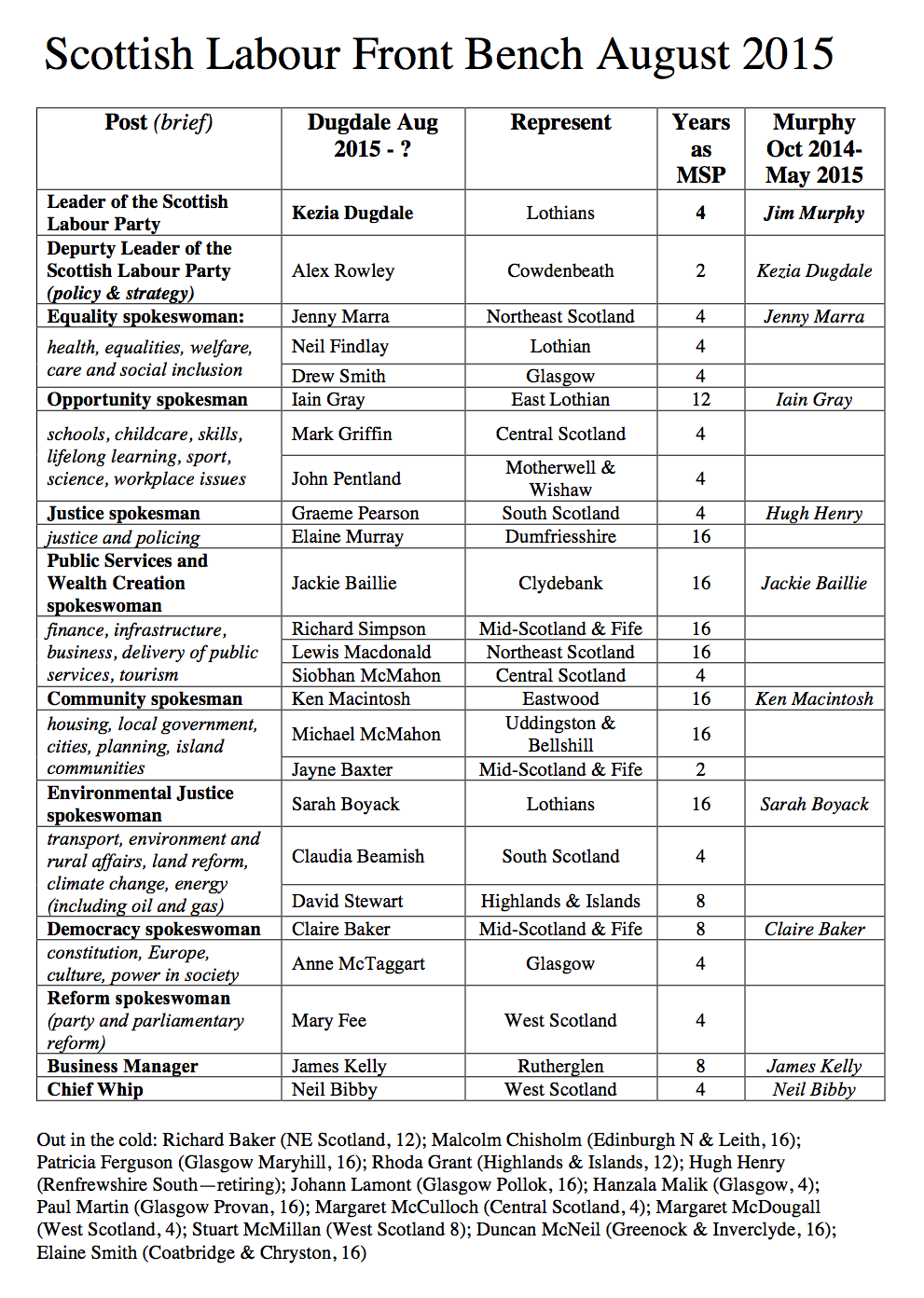
By contrast, in a well mannered and decisive contest, Kezia Dugdale won the Scottish leadership. She was quick out of the gates with her ‘Front Bench Team’, promising change and that “her front bench would be charged with communicating Labour values, rather than shadowing SNP ministers so their portfolios do not necessarily match opposite numbers in government“.

Not necessarily a bad idea, provided those values connect with the voting public. But Euan McColm had a recent column in the Hootsmon that questions whether people might identify with ‘Equality’ and ‘Opportunity’ as political briefs. McColm was also less than kind in his evaluation of the options she faced, concluding:

“There is a dearth of talent in Labour’s Holyrood ranks. Dugdale had to make do with what she had.”

A second issue that will surely bewilder punters is that she seems to have fallen into the same trap as the UK Tories of appointing a myriad of colleagues to front bench positions—resulting in scrambles for air time and precious little chance of the disinterested public remembering any of them. Whereas the SNP Government’s tally of ministers has swollen to 23, Labour has gone two better and appointed 25 to their front bench.

LabShadPicHow that makes the remaining 13 backbenchers feel can only be guessed at. But if that number appears cumbersome, consider the potential for turf wars over the myriad briefs, especially given relative lack of ‘bottom’ or experience in those who are exalted. In her quest to move younger/newer blood into the limelight, Ms Dugdale has built an unwieldy structure that also seems dangerously unbalanced. Several of her key spokespeople have only 4 years experience in parliament— and the whole shooting match barely averages 8. Why Mary Fee’s 4 years as a councillor and twenty-plus as a shop steward qualifies her to steer both party and parliament reform is entirely unclear.

On the other hand, those left out average 12 years experience and include many former ministers, never mind shadow frontbenchers. The absence of the well liked, experienced and capable Malcolm ‘Jessie’ Chisholm is a puzzle all by itself. Certainly, half of them can be seen as ‘The Old Guard’ and excluded from any bid for a fresh start. But we may be in ‘Ready—Shoot—Aim’ territory here. The whole shebang smacks of symbolism.

Building on McColm’c criticism of fuzziness in the briefs, it is hard to see where the ideas and new policies that will restore Labour as a credible government in Scotland. Even the long-experienced members of her shadow cabinet have weak track records of making much of their briefs to date and appear to be in post for the sake of continuity. As an example, Iain Gray had the Education/Opportunity brief under Lamond. Yet he never laid a finger on the urbane Mike Russell, has failed to land any blow—far less unsettle—the less sophisticated Angela Constance and yet this summer had not two ideas to rub together in a speech supposedly lauding the opportunities of new powers being given to Scotland.

And it may be unfair to pick on Iain; his colleagues have been equally duff in coming up with anything new, besides moans about what the SNP has or has not done in eight years of office. Jackie Baillie managed to criticise Vale of Leven hospital in her own constituency for something she inaugurated while she was Health Minister. Sarah Boyack has had Transport since Adam was a boy but, while the SNP moved from EGIP to Borders Rail to A9 improvements to the Forth Crossing, never made a mark of her own and indeed came close to losing a vote of confidence in her work.

All in all, it seems a rum do when Kezia’s promised team of fresh horses turn out to be the same old nags who were still finishing the course when everyone had gone home. It’s a variant on the old seventies TV comedy Never Mind the Quality, Feel the Width. If she thinks by flooding the media with ministers comments she can hoodwink the punters into thinking something new and exciting is happening, her own 4 years of experience outside the student/party bubble have yet to teach her how the >95% non-politicians out there think—and vote.

Posted in Politics | Tagged | 1 Comment

Kan Kezia Kope?

Despite party rules that forbid badmouthing other candidates, the UK Labour leadership contest is descending into mud wrestling. Although it’s hard for outsiders to distinguish many differences among these clone children of New Labour, they themselves insist that distinction exists, if only as negatives. According to the New Statesman, Yvette Cooper’s camp recently spattered their rival for second place with:

“Andy needs to show some leadership and be clear whether he opposes Jeremy or not. Our figures show he will drop out in the second round because his campaign is failing to provide an effective alternative to Jeremy.”

“Old-style bullying by the boys”

To which the Burnham camp accused Cooper of:

“A desperate, panicked stunt since it was completely untrue that she was in second place.”

“Yvette has no chance of winning and is continuing only because of her pride; she should stand down”

Contrast such unedifying rammies with the relative dignity of the Labour leadership contest in Scotland. Congratulations are due Kezia Dugdale, the clear favourite who romped home handsomely with a 72% share on a 60% turnout. Other than promising change and wider internal democracy, she did not offer much new on the policy front. Nonetheless, recognition is due for chutzpah and courage to stand for the leadership of a party that just suffered a worse drubbing on its supposed home turf than even its more fanatical opponents had projected.

Though Scottish Labour is more resilient than recent voting results might indicate, it still takes guts to take the helm when even sympathetic observers see only rough waters ahead.

Although young by any party leadership standards, she has already demonstrated nous in awareness of the scale of the task the job entails and surprised many who had not seen her in action by handling the stand-in-leader position at FMQs with a competence that ranked well, especially when compared with her predecessors: none made any lasting impact. Kezia may be different.

It may seem strange for an unabashedly independence-supporting commentary such as this to speak in positive terms of the one person in any position to rally the somewhat disorganised forces of unionism, but these are strange times. The supposed defeat of the cause of independence a year ago has had exactly the opposite effect. It appears to have opened up the ranks of the SNP to a flood of new recruits, politicised a whole slew of people previously deaf to politics and damaged, possibly irreparably, the hegemony that Labour once enjoyed in most Scottish cities and large towns.

But—referendum aside—this wave of support and positive results for the SNP brings with its power a minefield of dangers; disconnection from its roots; beginnings of hubris; over-tight restriction on policy speculation and debate. Should any of these come to pass, Kezia may find a fair wind with which her predecessors were not blessed.

So far, she has conducted herself well—having a good campaign, being magnanimous in victory and making credible noises about bringing change to an ossified party—a party still full of jobsworths, policy stuck in ‘aye been’ dogma and ranks depleted as those with vision or talent or principle who moved on. For all the media slurs about unelectability, Jeremy Corbin has galvanised the UK party talking tough on clear ideas. Can Kezia do the same?

She has some tough alligators to whack on the snout if she is to clear this particular swamp. Her team reckon up to half of the party’s 39 MSPs are of poor quality and need to be culled at a time when every one of 14 remaining first-past-the-post seats is under threat. One proposal is to re-interview potential List candidates, including incumbents, with a view to weeding out the deadwood. Kezia is quoted as saying:

“I’ve been very clear I want to bring in new talent, new people to the Scottish party, and I’ll be encouraging them to stand next year. I will say more about that in the weeks ahead.”

All very laudable. But in the Miners’ Welfare and CLP rooms of darkest Lanarkshire they have a way of doing things that has changed little down the aeons that involves closed door debate, blind loyalty and Buggins’ Turn. It will take serious political dynamite, together with acceptance that things need to change, to make real progress.

And for someone who wants change, she is not off to a flying start with her cabinet reshuffle. Hugh Henry has been singularly ineffectual in neutralising the Kenny MacAskill bulldozer taken to Procurator Fiscals, the Scottish Court Service, the Scottish Fire Service and local policing, and is stepping down. But the Old Guard of Baillie, Boyack, Gray, Macintosh, Marra etc all stay in post after years marked by endless anti-SNP moaning and little by way of either innovation or inspiration.

It is significant that her ‘biggest’ change has been to appoint Marra as spokesperson for Equalities—something symbolically significant to politicians and their SPADs but without much traction in Carntyne or Lochee. Nothing against Marra who, like Dugdale, carries no baggage from the do-nothing days of 1999-2007 and also shows promise.

But though she may not be able to squeeze ideas—the lifeblood of politics—from these stones with which she has burdened herself, perhaps her promise to infuse the party with new, younger candidates to be elected next May will allow her to cobble together a more dynamic crew further down the line. Meantime, this stinks of don’t-rock-the-boat ossification that has characterised CLPs right across the Central Belt since Tories became irrelevant in the seventies and Labour lapsed into their cosy fantasy that they alone had a right to represent Scotland, especially working-class Scotland.

So, if Kezia is to gee it all up, she must do better then this. Brutal as it may be, she faces the same dilemma that faced the much shrewder, more experienced Jim Murphy: a party grown smug and losing touch with once-loyal base voters. Even if next May is not the gubbing of last May, there is still a long, hard road back to challenge the SNP, let alone Westminster and ‘real’ power. Once turned, voters are not inclined to admit they were wrong and meekly return to the fold; defeat costs leaders their jobs.

Because it would be a shame to lose her. Indeed, Scottish Labour needs more like her as it is not (yet?) blessed with a wealth of upcoming talent. Indeed Scotland needs more like her because the SNP running rings round the opposition (as they are doing) does not make for healthy politics in the long term. And it would be unfortunate if someone showing her signs of future leadership should be thrown into this unforgiving maelstrom of politics a decade early—before she could develop the nous to survive, and maybe even harness, it.

Posted in Politics | Tagged | Leave a comment

Yes, We Must All Think for Ourselves

Monty Python’s Life of Brian is over thirty years old now and therefore probably unknown to younger generations. Pilloried in its day as sacrilegious, its humour has aged far better than its Carry On… predecessors, especially its shrewd observations on political movements and the tides driving them.

Because, like humour, politics is seldom about being sensible. Indeed irrational emotion and gut feelings continue—despite Iain Macwhirter’s best efforts to introduce logic and the ever-present lure of personal gain—to drive the bulk of political activity in Scotland. Seems to apply elsewhere too.

I was reminded of the sheer irrational gusto of the epinonimous Brian’s unwitting elevation to cult messiah when I caught Derek Bateman’s latest piece encouraging robust debate in the wake of the SNP government’s teflon poll performance, despite some recent wobbles. Derek recently sold his soul to become a columnist at the odious Daily Mail, yet his pithy blogs are required reading for us independistas who don’t swallow every ray of sunshine issued by the SNP Jackson’s Close press eyrie.

Derek’s piece makes the case that open debate is healthy, ergo, it’s time we had some around the SNP government. He also—in my opinion wisely—cautions against the prospects of any premature “Indyref2” and predicts that the influx of new members to the SNP will inject an even more radical, more progressive, tone into internal party debates that may not chime so well with the wider public.

He argues, rightly, that the Scottish public has made unprecedented strides in altering its basic political posture within a handful of years and is in no mood to move much further before this new status quo is better digested. As he puts it: “Gie’s a brekk should be the (SNP) conference slogan for Aberdeen.” Be that as it may, that is not what the SNP nomenklatura need to be considering, even if not yet in public.

As a political force, the SNP has had a wild ride. After a false dawn in the 1970’s, the political purgatory they suffered for two dark decades tested every loyalty and shred of thrawn determination among those members who stayed. Joining the SNP pre-1999 was the choice of the idealist. No-one with either nous or political ambition thought the party offered any route towards success, let alone to the top.

There then followed a rise that was both unpredicted and historic. A prostate out-of-touch Tory party and a smug, ossified Labour Party were both bypassed as if they were standing still. Latterly May’s utter rout of the remnants of both continued this unpredicted, stratospheric pattern of SNP progress.

But, while it may be argued that the unionist parties gifted them the opportunity, the SNP did also earn it. Not only did they have the backbone of indefatigable veterans from the dark years but their constant note of hope and progress inspired younger, imaginative, more ambitious phalanxes, culminating in the party growing from 15,000 to over 100,000 members within a year.

To say this was all planned would say too much. But a tight Praetorian group around Salmond held their nerve and, as far as resources would allow, used technology and marketing to exploit an emotional appeal to Scots that we weren’t too wee, too poor, too incompetent to look after ourselves. Even those to whom the SNP and independence were anathema mostly agreed with such tenets, even if they preferred devolution as the answer.

Once the supposed-impossible happened and the SNP ran the country from 2007, many such skeptics were impressed how the new government displayed a vigour that made previous Labour administrations seem listless and cautious. The apolitical majority found the barbarians ran Rome better than the ossified Senate had. In opposing only by criticism with no coherent set of alternative policies, both Labour and Tories set themselves up for succesive trouncings, culminating in this year’s wipeout.

The key to all of this was SNP internal discipline. Unlike other parties where personal ambition jousted with party loyalty, SNP members and ministers alike had come through  hard times together. Like Mao’s colleagues at the end of the Long March, their unity had overcome hardship; they saw cohesion was vital to sustain success.

This was reinforced by budding politicos seeing the SNP for the first time as a plausible vehicle for a successful career. Dozens of new MSPs hired young staff which included many such; this phenomenon grew with the recent equally-large batch of MPs. Few staff, researchers, SPADs, etc have yet made the transition to election (c.f. Ed Balls and his like in Labour) but that’s only a matter of time. Unlike some stroppy old guard, such people are fully aware dissent is not career-enhancing. They shrewdly eschew following either the Dennis Skinners or Dennis Canavans of this world and keep their heads down.

Since the electorate is notoriously brutal about punishing apparently disunited parties, the now legendary discipline of the SNP remains an understandable prority. Former rebels like MacAskill, Blackford and even Salmond himself (albeit long ago) are firmly back in the fold. But the SNP’s problem has evolved. The self-discipline that got them into power is now wavering as they transition from being the rebels to being the Establishment. Personal ambition and natural strains from collective responsibility put pressure on old loyalties. But most still think it better to conform and thus survive, not to innovate.

What has saved the SNP so far has been an effective small cabal who run the show, plus the self-interest of many now in paid positions under their tutelage. This balance has been at the expense of having other power centres; in contrast, Lanarkshire Labour was a law unto itself in its neanderthal attitudes and buggins-turn hierarchies,. The SNP has left their 400+ councillors largely ignored and still without a serious power base.

Such a balance of focussed core vs relatively docile hinterland works well so far. A number of centrist initiatives (MacAskill in the Justice brief, for example) have gone badly off the rails in execution, in part because of clogged or even non-existent feedback channels from the real world. But, because of  obvious electoral success and ever-higher rating in the polls, such peace-through-hegemony looks likely to work at least past next May’s elections to the Scottish Parliament. Most observers expect a result then as decisive for the SNP and humiliating for Labour as that in May.

But rigid passivity for the sake of peace and power is not the SNP’s natural home. The original party was full of iconoclasts and the 80% of the membership that is new in the past year are heavily laced with idealists who saw Tories are right-wing colonials and Labour as Blairite betrayers of the party’s founding principles. They will respect the 20% old guard who preceded them as long as the future appears to lead upwards.

Despite being a broad church from its inception, the bigger variety of opinions about to bubble out of rejuvenated branches is unlikely to reach the agenda at SNP conference. Unionist parties have always stage-managed theirs into harmlessness. as the establishment, the SNP will join them. This may even work for a year or two.

Then, either the SNP leadership must relax discipline and find a way to allow, yet contain, genuine debate or they will confront internal rammies between the People’s Front of Scotland and the Scottish People’s Front as newbies, still full of piss, principle and vinegar, start to make their mark as a fractious idealist majority, if only to dislodge the old guard who will try hanging on to all the decent jobs.

Posted in Uncategorized | Leave a comment

Who’s Kidding Whom?

The fiscal train wreck that is Kids Company has been explained away in the English media as one of a kind, much as its founder and leading light—the larger-than-life Camila Batmanghelidgh—belies any standard concept of a CEO. When the Cabinet Office convened in Downing Street to consider the wreckage, The Guardian reported:

“She appeared out of nowhere, said a few words that no one could hear and then slowly made her way through the photographers to a cab and vanished: a great, big, fruitily dressed fairy godmother who, when you come to think of it, bears not the slightest resemblance to any of the other seven million people on the planet.”

This sense of unreality pervades much of the story. Many people have come forward to praise what Kids Company has done and the Chairman—BBC’s Alan Yentob—is not running for cover. But, whatever good the charity did in fact do, wholesale abandonment of traditional public sector duties to the untried/unexplored world of social enterprise as is now policy both sides of the border has yet to come under adequate scrutiny.

In the case of Kids Company, despite receiving millions of pounds in government funding, it lived hand to mouth, spending almost all its income each year, meaning to never built  any reserves. HM government knew they didn’t have any reserves and so bailed them out when there was grass in the undercarriage. As a result, the trustees got complacent, knowing they would always get bailed out. It received constant injections of funding, including government grants running into millions.

Between 2009 and 2013, its income increased by 77% from £13m to £23m, but in the same period, its outgoings increased by 72%. Meantime, senior management were awarding themselves pay increases. In 2009 the highest salary was under £70,000. By 2013, the top-paid was nudging £100,000, and the next close to £80,000.

This echoes arguments over appropriate executive pay in the public sector where the old saw that “you pay nuts, you get monkeys” has been used repeatedy to ratchet directors and CEOs toward what they might earn in the private sector. This whole area is murkily seedy. High streets are full of charity shops manned by volunteers that compete—often with new goods—with small retailers who have a tough enough time as it is. People are making good careers on the back of it.

No-one objects to paying for a result they value. But last year, 32 charity executives topped £200,000 in earnings. Most people think this outrageous. And who scrutinises such things? Well, in England, it’s the Cabinet Office, who seem overwhelmed by the complexity of this task, dispensing myriad grants in complexities they barely appear to comprehend. There may be a case for combining the Office for Civil Society with the universities and science functions of the business department (DBIS)—and even the Department of Culture, Media and Sport (DCMS) to form a critical mass with a dedicated Secretary of State.

Though the problem may be smaller in Scotland, because of our more ‘progressive’ politics, there is even more enthusiasm both for social conscience and social enterprise as a way to execute it. The Scottish Government supports several umbrella organisations and provides some £8m in direct funding through their Scottish Investment, Enterprise Growth and Social Entrepreneurs Funds. But that’s the tip of the iceberg. Another £200m+ is dispensed over seven years by the European ERDF and ESF. These funds are ostensibly overseen by a committee of fifteen sundry worthies. But they meet only four times a year and that to rubberstamp what Sir Humphrey places before them. Chip in lottery funding and elements of SE, Sports Scotland, HS, NTS, etc and numbers are big and growing, despite recession/recovery.

All this is not to imply that Scottish social enterprise is rife with snouts in the public trough. But, given the wide public’s good natured support here for good causes—whether it be the homeless, the vulnerable, the poor, children, pets, wildlife, nature—the social enterprise sector providing more and more of such services does demand a scrutiny beyond benight neglect that assumes everyone is doing their best and demanding least in each of the undoubtedly good causes.

But the road to hell is paved with good intentions. As much as the private or public sectors, so the social sector needs hard-nosed management if funds are to be used effectively. In 2009 Kids Company cared for 14,000 children but this rose to 36,000 in four years, which required weekly full-time employees to increase from 231 to 495. But, since costs for youth workers, therapists, practice teachers and special project workers only increased 26% over the same period. Ergo, most of the 77% increase in income did not reach where the work was done.

This is not a prediction that Scotland (or another 36,000 kids) will experience such disruption to vital services. But, unless someone with clout wakes up and gets a handle on this sector, a combination of gravy train greed and well meaning incompetence, a similar derailment may not be avoidable. OSCR now oversees (but does not scrutinise) something like £20bn in third sector business across Scotland. That’s 2/3rds of Scottish Government’s entire budget.

Who’s watching how well it is spent?

Posted in Commerce | Leave a comment

Eastern Promise

The character of many small fishing ports around the Forth is stopped from falling into the soporific boredom of marinas like Port Edgar by the remaining fishing boats that still ply their trade. Though oysters may be a thing of the past and deep sea fishing goes on only from Pittenweem and Eyemouth, the backbone of the remaining ports—especially those in East Lothian, is landing lobsters.

But, unlike other major producers like Maine in the States, the business here is pretty ramshackle. Until recently, virtually all East Lothian lobsters were sold wholesale to Eyemouth dealers who would ship them to Spain for consumption by the tourists—many of them Scottish. Prices were low, crabs had no market and, with weather unpredictable and overheads  growing, it was becoming a marginal way of making a living. Several old hands passed away, some younger ones found better money on a steady wage and few school leavers saw the fishing as any kind of future.

All this may have the sound of fatalistic finality for the lifeblood of small ports around the Forth but it need not be so. Maine lobstermen had already shown how a good business can be made by controlling both who can fish where and the distribution channel. Their Homarus americanus is very similar to our Homarus gammarus, but with larger claws. But their real secret is to make them available: a half kilo live lobster in carry-on container is available at Boston’s Logan airport for $60 (£40).

So, though the life may be equally hardy, lobstermen make a far better living in Maine than they do around the Forth, where most are hostile to their fellow fishermen and much ill-will comes from fleets of creels being shot indiscriminately in waters other think are theirs. It’s a little like a farmer driving a combine down a country road and harvesting whichever field takes his fancy.

The people who have improved the local lobstermen’s lot have not been fishermen themselves. From a small start with the Lobster Shack on the harbour-side in North Berwick, this has expanded to include the nearby Rocketeer and a branch on George Street, as well as other restaurants starting to offer lobster on their menu. Moving their fresh catch this way means they effectively earn double for the same amount of work.

The other boost is a long-term one where the Lobster Hatchery takes berried hens (female lobsters with fertilised eggs serried under their tail) which normally must be thrown back, removes the eggs for hatching and returns the now salable lobster to the fisherman. The eggs are hatched, developed as larvae and then released onto local lobster grounds as 1″-size mini-lobsters which have 1,000%+ greater chance of surviving to maturity than an egg. In 6-8 years they will mature to boost yield from the areas where they were released.

But all of this still doesn’t keep pace with what the Maine lobstermen are up to now. Back in 2009, they tried exporting to the growing Chinese middle class, to whom a steamed, whole crustacean — flown in live from the United States — is not just a festive delicacy and a good-luck symbol but also a mark of prosperity. They managed to add $2m to their business. While that is impressive, last year they had boosted it to $90m and their lobsters were retailing for $50-$100, still expensive, but more affordable than the previously dominant Australian rock lobster (Panulirus cygnus), which can cost hundreds of dollars and doesn’t have the big meaty claws of the American variety.

China took about 12% of U.S. lobster exports in 2014, up from 0.6 percent in 2009. Lobsters and other foods seen as luxuries are popular at Lunar New Year and other festive occasions. The bright red of a cooked lobster is considered lucky, as is its resemblance to a dragon. The boom has put more money in the pockets of lobstermen and kept shippers and processors busy during the usually slack midwinter months. China also imports lobsters from Canada, Australia, South Africa, the Caribbean and elsewhere, but the market for the U.S. variety is exploding, with the demand strong year-round, not just at New Year’s. There are now 144 boats operating in Maine. Why are we Scots not in on this booming business?

There are a variety of reasons. First of all, the Scottish Government’s so-called business arm Scottish Enterprise are a chocolate teapot when it comes to sticking their neck out to exploit opportunity with their £400m annual budget. Despite Scotland £1.1bn food and drink export business, lobsters get no mention on their website. Secondly, the Scottish Fishermen’s Federation spends most of its time fighting for the deep-sea fishermen that dominate it and their Inshore Committee seems happy just to haud the jaikets in the occasional dispute. Thirdly, smaller organisations like the Forth Estuary Forum could be called ineffectual toothless talking shops—if that were not an insult to ineffectual toothless talking shops around the world.

But, mostly, the reason lies with the absence of any organisation prepared to define what is needed and then campaign to assemble the coherent lobby and marketing support that Maine lobstermen enjoy. Individual ports and even councils are too small and preoccupied with other things. The most experienced fishermen are comfortable in their ways and not enough newbies are coming in with an eye on a more profitable future.

But, if someone were to pull together effective local fishermens’ associations, allocate them so-called ‘Several Orders’ to take certain species from certain areas and cobble together a marketing channel to compete with Maine (coastline = 3,478 miles) in the still-booming Chinese market, Scotland (coastline 10,250 miles) could become a world-class player in lobsters and our young people would flood back into a lucrative business (tough though it is) that might pay well over £250 a day for hauling a fleet of 50 creels.

Posted in Uncategorized | Leave a comment

Local Tax Overhaul Overdue

After some serious consideration almost eight years ago, the Scottish Government has swept the whole concept of handing democratic control to localities through local taxation (as opposed to the regressive Council Tax) onto the back burner indefinitely. While a minority government has the plausible excuse that it has to pick its fights carefully and not court controversy, that has not applied since May 2012 and is unlikely to alter come May 2016 (any more than the flavour of government).

So, presuming the probability of SNP rule until at least 2020, the next five years offer a real opportunity to revamp the effectiveness of local government from the halfway-house carved up by the Tories in a failed gerrymander 20 years ago to try to prop up some Tory councils somewhere. But before the huge task of rethinking councils appropriate for the democracy of the 21st century, much could be done to fix the clumsy unfair regressive manner in which Council Tax is levied, especially as the Scottish Government has increased its leverage and control over this area by freezing it for the last eight years.

As a first step, the Scottish Government has collaborated with CoSLA to create the Commission on Local Tax Reform (CLTR), although one main party has chosen to absent itself from the debate. A submission to this has been made on behalf of the Centre for Scottish Public Policy (CSPP) by Professor Richard Kerley, Chair of the Centre. We think it makes eminent sense and reproduce it below in full, encouraging readers to both consider it and any amendments they might make as their own submissions.

(CSPP Submission follows)

We are covering a range of matters here, and have not confined our comments to just a consideration of the approximately 18-20% of council income that is covered by the council tax, i.e. in gross terms only a little under £2bn last year compared to a total local government revenue spend much greater than that.

A major theme of the work of the CSPP, and a statement we often use, is to stress the importance of ‘people and place ‘. There are clearly many ways of interpreting this phrase, but central to this theme is that for us great emphasis should be given to people determining what is, in their views, appropriate for their place—whether that place is the UK, Scotland, a given council area, or a community within that council area. Of course all of that has to be set in the context of shared rights, and the responsibilities we believe we all share to ensure equitable treatment of all peoples regardless of where they live.

  • For us, this is an argument for a default assumption that specific competences and decisions – e.g. on local tax levels, should be made as locally as possible. Local government data already shows that assessment of Scotland-wide per capita spend [excluding the Islands] ranges between a little over £2000 to a little over £3000. Such a variation on spend should logically be matched by a variation on local tax raising.This is why we consider the current system of council tax, particularly with the current ‘freeze’ that will have been in place for 8 years by the next election, to be a flawed system.
    The standstill on council tax levels is regressive, not providing material advantage to the lowest income households, and also infantilises local authorities and those who elect them by denying them options of specifically increasing local taxes to support proposed initiatives and expenditure.
  • It seems very limiting for the review to confine itself only to Council Tax, particularly when the Chancellor in England has initiated a review of Non Domestic Rates (NDR). Previous Scottish governments have followed NDR policies from England closely, and there are clear reference points here for the many multi-site businesses that operate across the UK; if this is not reviewed in Scotland there is a clear risk of the government being caught on the hop by an announcement in England.We would urge the government to review NDR reach by, for example, ending agricultural and rural estate de-rating along with the de-rating for various other subjects that are category exempt from NDR.

    We would also urge the government to re-localise NDR and enable councils to make choices on NDR that they consider appropriate to their areas, with a legislative requirement to consult with all representative business of organisations on proposed budget changes that impact on NDR.
    If this were to happen then both CT and NDR, along with local fees and charges would approximate to some 60 % of local council spend and eco the kind of revenue raising financial balance likely to emerge  from the current Scotland Bill .

  • Aspects of the Council Tax itself are flawed: this partly arises from the artificially created multipliers built into the original scheme; the failure to revalue since 1991, and the constrained banding. It also arises from the hybrid nature of the tax: it is partially a charge for services (hence the discount for 2nd homes and the reduction for solo occupancy); partially a property tax; and partially income contingent (the rebate scheme).We do favour a form of tax that relates to property. Property is the most substantial real asset most people own or enjoy and it would seem odd to have tax on it at all.
    In the longer term we think there is a lot to be said for discussion about land value taxation, or a form of domestic property taxation based on capital values and annual percentage levies (a la Burt Report).

    That may be too ambitious for agreement now, so  in the meantime various changes could  be made to the CT. For instance:

  • Revaluation in the near future – and the creation of a formalised mandatory quinquennial review of domestic subject values to prevent future governments avoiding this sensible necessity.
  • The extension of bands above H, and the precise number of bands, would depend upon the nature of the revaluation.  One more band is not enough; while there may be little sympathy or people owning properties valued in excess of, say £1M, it would be equally as inequitable to lump them in with £5M + properties.
  • The removal of the single person discount.
  • The removal of discount for 2nd homes.

Revaluation and therefore possible re-banding of improved or extended properties should be triggered on the issue of a completion certificate for building works, not – as at present – on future resale. Particularly in the period since 2008—according to press reports and trade reports—there is a large backlog of extended properties that may not yet have been re-sold and hence revalued.

4] We also recommend a programme of public education and reference to experience in, say Wales, in relation to any suggested changes in banding and valuation. There appears to be a broadly held view that both equate to a massive increase in local taxation and the Welsh experience has shown that this is not the case.

Posted in Community | Tagged | 2 Comments