Open Letter to Fergus Ewing

Dear Fergus:

my congratulations for having held the Tourism portfolio for the last four years. That is quite a record in terms of stability in the slippery world of politics. However, I have to ask what you believe you have actually achieved in that time that would not have happened entirely by itself.

This week’s choice of meeting venue for the annual Scottish Tourism Alliance (STA) midsummer conference of Cumbernauld—the ‘Carbuncle of Scotland’ and symbol of how wrong town planning can get—might be seen as a metaphor for the ill-conceived nature of current tourism planning in Scotland. I recognise that the STA is not under your control but such cack-handed thinking is representative of the parts that are.

It starts with VisitScotland, your main quango and executive arm. VS appears more keen on behaving like a corporate cash cow than a promotion and support operation. From a symbolically remote eyrie down in the docks, it presides over a wheen of meetings, strategies and bumf production but seems to have scant understanding of the experience of the average tourist and, more especially, their needs. They have distanced themselves further from their ‘customers’ by closing many TICs because of ‘falling footfall’.

It is obvious that VS never stopped to analyse why that footfall declined when visitor numbers were rising. Apart from selling kitsch like Loch Ness Monster soft toys from Kirkcudbight to Kirkwall and plugging only those B&B signed up to pay VS fees, they became staffed with warm bodies with scant knowledge of the areas served. Their usage fell because of an obvious programme to kill them off, ostensibly because “everyone uses the internet nowadays”. Simplistic and flat wrong—as wrong as last decade’s push to have all B&B’s en suite, which has ruined many a quaint cottage bedroom to satisfy VS’ box-ticking fetish.

The second problem is that VS has body-swerved local tourism to make it a council problem. Even if councils had the necessary business attitudes, VS has abdicated all responsibility in co-ordinating key tools and templates so that each of the 32 councils reinvents their own tourism wheel with mixed results (CoSLA being no more than a talking shop). But they do so on declining budgets as their secure education and social budgets that are 3/4 of their outlay. But no councillor gets elected on his/her vision of tourism.

As a result, council Economic Development budgets are often under £1m and so struggle to print local leaflets, let alone co-ordinate/exploit and distribute benefits from major tourism markets such as Edinburgh. A Golf Officer here and a User Group there result in small-scale projects but nothing lasting, still less strategic.

More importantly, councils have yet to understand ‘customers’ or break out of departmental ‘silo’ mentality. For example, Planning treats all applications with the same ‘objectivity’. This means running scared of developers and indifference to future tourism needs. Hotels and B&Bs are lost as profitable housing—even if it is never the affordable housing that the country needs. Per-day spend by tourists plummets as a result.

Transportation in councils is another case. They remain in the dark ages when it comes to through-ticketing and organise supported bus networks as if it were still the 1980s when ploughmen’s wives had to get into town to do the shopping. Not only are there no tourist-oriented services linking with trains (even seasonal) but any information provided is patchy. If there are any timetables at a stop, they are by different companies and show timing points that are seldom tourist destinations like castles or museums. Local buses often run school services through school holidays when they could run a tourist service. The concept of a day ticket for use on all transport (as most of our European visitors expect) is still alien.

At the STA meeting, tourism chiefs complained of “problems with tax levied on tourism experiences, air passenger duty, high fuel prices, poor digital connectivity and difficulties recruiting skilled workers.” I’m sure all that is true. But, at a more basic level, nobody is addressing the need for a professionalism in hospitality as a cultural issue. The number of cafes, restaurants, bars, etc staffed by young girls with no training, yet who provide a major interaction experience with visitors is appalling. Even in the States, service is rewarded and waiters/bartenders/etc have an enlightened attitude to pleasing the customer. We still suffer from the clock-watching teen who’d rather yak with her friend in public view. Some of the worst examples vampire on key destinations, living by inertia: try getting a decent lunch in the three hotels at Dunvegan, Skye. Yet the (un-signposted) Three Chimneys is just down the road.

Marc Crothall, STA Chief Executive said “Scotland faces barriers to ensure that visitors  see it as first choice for a high-quality, value for money and memorable customer experience”. We have had eight years of such high-minded guff and it has largely been down to innovative chefs and pioneering hosts to provide progress to overcome those barriers. My own North Berwick now has a flourishing local restaurant market for locally-landed lobster and crab. It was generated by local businesses prepared to take risks; both VS and the local council were useless in either developing or supporting the idea. Indeed, Planning did their best to obstruct using a derelict historic building as a site.

We are all still living on the fact that Scotland has a global profile that any other nation (not just a small one) would give its eye teeth to have. The experience that will bring visitors back is not what draws people to Lanzarote or Phuket. We are not about sun-drenched packages where geography is almost immaterial. Scotland must be as modern and welcoming in its hospitality as anywhere else—global standards now demand it. But charging cruise ship visitors who’ve just been schlepped to the shoddy Hawes Pier $1,000 for a day tour of Edinburgh is not the way to demonstrate that.

Our appeal is based on evocative scenery and ancient stonework but this must be presented with style and warmth. The real attraction of our golf courses—shabby by comparison with Atlanta or Dubai—is the gritty challenge of authentic links courses that you can’t fabricate elsewhere. Access to the character of the Scots, the sense that we welcome them, talk to them in a language most understand, make personal contact is something Lanzarote or Phuket can’t offer. Providing a modern service against a backdrop of historic beauty will bring them and their cousins back again and again.

VS is a chocolate teapot. If you think that’s overly harsh, consider some facts:

  1. VS gross spend has gone from £58.1m to £63.6m in the last two years. That’s a 10% boost when everyone else’s budget is being cut.
  2. Last year Grant in Aid (i.e. SG funding from public money) to VS increased from £45.3m to £47.7m, an increase of over 5% in just a year.
  3. The £4.7bn increase in tourist spend in 2014 celebrated by VS and STA was entirely driven by one-off events such as the Commonwealth Games and the Ryder Cup.
  4. On VS’s (and your own ministerial) watch, overnight tourism stays in Scotland—a clear measure of serious tourism expenditure—have declined steadily from 17m to under 15m. That is a drop on 13% on VS’s own figures.
  5. VS paid over £1m in ‘severance packages’ last year, half of which went to 6 senior staff.

This is YOUR baby, Fergus; the buck has stopped at your door for 50 months now—and counting. Is your VS really fit for purpose? Do you expect Scotland to coast past  another decade of opportunity with a money-grubbing VS and councils’ internecine pen-pushers as our tourism ‘spearhead’ when they are as sharp as stale porage?

Or is it not high time this costly, ossified, self-serving quangocracy got its jotters and you earned your £86,300 paycheck in sorting this out?
Posted in Commerce | Tagged | Leave a comment

Dominorum

Schools don’t teach much Latin these days. Despite The Iris Project – Literacy Through Latin, launched two years ago its teaching is pretty much confined to independent (i.e. private, or in England, public) schools. This makes them appear archaic. State schools meanwhile are launching our kids into the future by teaching ‘modern’ subjects, right?

Not quite. Although proportionally significant only in Edinburgh, private schools in Scotland are pretty smug about their ability to educate ‘leaders of the future’. And basic SQA exam statistics would appear to bear them out. Of the 660,000 pupils in Scottish schools, only 31,000 (under 5%) attend private schools. Yet, according to Ms Dorothy MacGinty, Headmistress of Kilgraston School:

“Students in independent schools are three times more likely to gain A and A* grades at A-level than their state-educated peers. In girls’ education, the figures are even more stark: only one in 20 girls taking A-levels study at independent schools; yet one in four of the A* grades awarded in STEM subjects goes to them.”

Ms McGinty is fulsome in her praise of the advantages of independent schools; the Friends of the Scotsman have given her a half-page platform in today’s Scotsman to expand on the above, which she does with great enthusiasm. Recently returned from England where the ‘public’ school is alive and well, she attributes a recent 4.3% rise in pupil numbers to Michael Gove’s policies. as he puts it: “With Academy Schools and Free Schools springing up to blaze a trail in uncharted territory, parents are not willing to leave their child’s education to chance.

Though many may share her antipathy towards Gove, she just said a mouthful. The implication is that, unless you can fork out double minimum wage per sprog, your children’s education is likely to suffer. That’s bad enough in England but, in Scotland which has long had pride in its education, that cannot go unchallenged.

Certainly, regular readers of this blog will know that it has little time for the EIS and the manner in which all education unions constantly harps on teacher pay and conditions but appears to care little for the fate of children that should be their focus. As a result, state schools remain afflicted by a minority of clock watchers, sea lawyers, time servers and dead wood whose days might be more fruitfully spent on their vegetable patch and not in the classroom. Private schools tolerate few such passengers.

But that ignores the bulk of motivated professional teachers who seek to inspire their charges and are constantly finding ways to engage with young minds to inspire them with worlds they can inhabit beyond Hollyoaks, Farmville or Game of Thrones. Private schools ensure they don’t always get to teach the best pupils. The flaw in McGinty’s thinking is to think that, by throwing money at education, you can guarantee a good one. There are many reasons she—and those parents who think they can buy their kid a successful career—are wrong. Here are six of the best

  1. It’s been tried before. The USA is rife with a class system in a culture that claims to be classless. ‘Prep Schools’ are no longer confined to the East Coast. Attendance at them and the odd endowment from parents guarantees places at Ivy League universities, which in turn pretty much guarantee good jobs in law firms and large corporations. But the massive waste of talent for 9 in 10 families unable to afford horrendous fees involved means the US still relies on trained immigrants for much of its science and engineering prowess. Silicon Valley is half-staffed by Asians.
  2. Almost all private schools in Scotland ape public schools in England in training for the professions. By that, they mean lawyers, doctors, diplomats, financiers, high-ranking civil servants. They do NOT mean engineers, scientists, craftsmen, creatives and certainly not anything smacking of sweaty toil like joiners or masons. Although once the privately educated might have dedicated their lives to selfless work in the colonies, today, it’s about getting into a highest-paying professions.
  3. This, in turn, skews the whole attitude in Scottish education to think that the academic is the only field that really matters in education. There is no such thing as a private school for mechanics. Yet Germans value skilled workers on a par with professionals and there is no implied social inferiority. As a result, British engineering has retreated to a few specialties while Germans export their handiwork throughout the world.
  4. Private schools believe the Curriculum for Excellence is catching up with what has always been ‘their’ philosophy: “commitment to developing successful learners, confident individuals, responsible citizens and effective contributors.” But there is much more to it than that. Even if Scotland does not fly the Old School Tie quite as blatantly as England, the small size of the Scottish ‘village’ means it is no co-incidence that a similar proportion of QCs, board members, CEOs, mandarins, etc here went to private schools as happens in darkest Home Counties.
  5. The sheer inequality of levying fees and the paucity of bursaries means a rich elite have an inside track to semi-exclusive training grounds for ‘movers and shakers’ and all that state education has tried, private schools’ small classes, incentivised teachers, ambitious parents and brutally competitive culture continue to make them a bastion of privilege. Bursaries are rarely given at primary school level so the privileged few have all the advantages before the less well off have a chance of attending.
  6. For that reason, how private schools have charitable status under OSCR is a mystery. Their fees verge on the outrageous. Starting with Fettes at £30k, the rest of the ‘top ten’ are all over £20k and even day pupils save barely £6k on such sums. Were that all, most families would be struggling. But add in uniform, sports kit, activities, trips, clubs, etc and the bills are more than most earn, let alone can afford.

It is clear that the Scottish elite look after their own. Private education is so integral to their identity that all threats have been quietly seen off. But the average state school pupil suffers as a result. If the best and brightest are constantly creamed off into the 21st century answer to a Spartan Military College, they are not there to inspire and compete with their peers. Instead, they become inculcated in the same culture that did so much to ossify and damage Scottish manufacturing after the war, leading to rust-belt disasters from which we are still recovering like UCS or Linwood or Kinlochleven or Ravenscraig.

It’s time Scots bit the bullet and treated private schools like the businesses they are and exposed the sham of their perceived advantage by taking education in a direction in which most advanced North European nations have already gone: treating academia as just one of many career paths, not all of which are defined by exams and league tables. Engaging parents in their share of bringing up their own kids as assiduously as private school parents treat their own ‘investments’ would give most—not 5% of—pupils the ‘private boost’.

Posted in Education | Leave a comment

More Than a Dormitory

Life is good in East Lothian. It rightly prides itself on its attractive towns, pristine countryside, glorious coast and golf galore, Together with good schools and easy access to Edinburgh, that makes it a magnet for commuters and retirees. Unfortunately, that does little for the local economy and jobs. To date, the county has been smart enough to avoid spoiling its splendour with factory development but has so far failed to exploit an opportunity to prosper that relies on keeping things pristine and presentable: tourism

It already boasts a national name in golf and in day trips from across Central Scotland. And, as home to the award-winning Scottish Seabird Centre world-famous Bass Rock and Scottish Ornithologists’ Club, has a growing profile as a wildlife destination, especially for ‘twitchers’. But the bulk of high earners still do their earnings elsewhere—county GDP per head is no better than Turkey. Add in a myopic VisitScotland closing all three of our Tourist Information Centres and tourism growth is sluggish.

The most obvious next step would be for East Lothian to work closer with Edinburgh—the biggest tourist destination in Britain outside London—by broadening Edinburgh’s portfolio of appeal. But there is one barnstorming opportunity to put the county on the global tourist map they simply won’t support because they already make a killing from it; cruise liners.

In the last decade, despite recession, the global cruise business has gone through the roof. Forget your experience on the cross-Channel ferry, these ships represent the future. Kirkwall in Orkney was one of the first Scottish towns to exploit this business. A recent survey there showed, of the two dozen ships calling, 94% of passengers went ashore, each spending an average of £100 while there.

A typical modern liner (Royal Princess which moored off Queensferry on May 18th) has 3,500 passengers on board. That gives a one-day boost of more than £1/3m to the local economy. These ships are now so big Leith cannot accommodate them. Yet there will be no fewer than 36 such behemoths calling this summer. This represents a £12m boost to local revenues from passengers alone.

So far, Forth Ports has been adept at making money but not in sticking its fiscal neck out to invest in the future. Landing in the rain from bouncy little boats at Hawes Pier is not the five-star experience to which cruise passengers are accustomed. The only serious marine study was the £3/4m project in 2008 for ferry services across to Fife and that came to nothing.

But Napier University has put its thinking cap on and has an unpublished proposal for the already derelict Cockenzie pwer station site. where a deepwater pier out into the Forth could transform the only ugly part of the East Lothian coast using the existing rail branch that served the coal yards. Add a proper passenger terminal able to handle ferry as well as cruise passengers and you would have a dynamic business core to which Ocean Terminal style facilities, yacht marina, boardwalk and restaurants could be added.

With a weather-secure rail link into Waverley, cruise passengers could be whisked into town in 15 minutes (and ferry passengers out)—rather than endure the inadequate 90-minute-long lighter-plus-bus solution via Queensferry.

The knock-on boost to the local economy could be massive, with chandlery, catering, engineering, and other high-value facilities required. And with stylish redevelopment of not just the Cockenzie industrial dinosaur but both Prestonpans and Cockenzie waterfronts, all could prosper with copious jobs and revenues by bodily shifting the start of East Lothian’s attractive recreational coast seven miles closer to Edinburgh to start at Musselburgh Racetrack instead of Seton Sands.

It is exactly the engine needed to restore pride, purpose and prosperity to the county’s ex-mining region and contribute its proportionate share of the dynamic economy of Edinburgh’s city region without spoiling what makes it unique in the first place. But is anyone thinking big enough to realise it?

Posted in Commerce | Tagged | 5 Comments

Jockalypse Now

Two weeks ago a tsunami of revolt against London unionist parties felled the two remaining in Scotland bringing them down to the same risible level of 1 solitary MP at which the Tories have been languishing since devolution was introduced 16 years ago. The phalanx of 56 SNP MPs have been making waves by not meekly following ancient Westminster conventions like where to sit in the chamber or in the Commons dining room. The Establishment is quite put out about it.

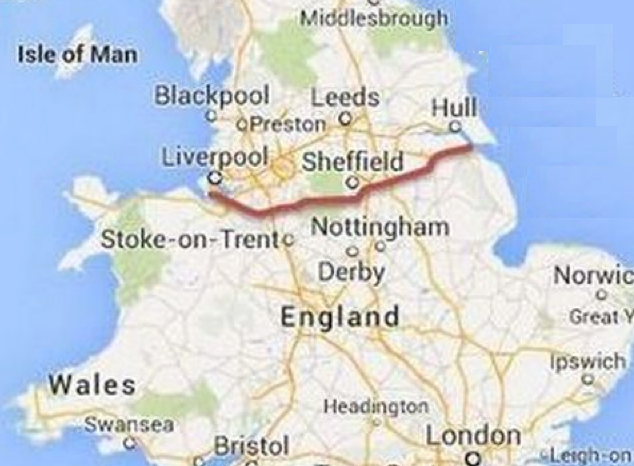
But, as if that weren’t enough, last week the Manchester Evening News revealed that a petition was going the rounds to take the North out of England and attach it to Scotland, with which it appears to have much more in common, socially and culturally than the London-dominated Home Counties. The scheme proposed is shown below.

Proposed New England/Scotland Border

Proposed New England/Scotland Border

Far more radical than a return of Berwick to Scotland—or even a restoration of Malcolm’s border on the Eden and Tyne—if this happened it would bifurcate Britain; England would no longer dominate. It would involve all the big cities of the North and the counties of Cumbria, Northumberland, Tyne & Wear, Durham, Cleveland, all four Yorkshires, Manchester, Lancashire, Merseyside and Chester—half the ten biggest English counties, even giving Scotland a border with Wales.

Using the hashtag #TakeUsWithYouScotland, the call appears to have originated in Sheffield. The petition says:

“The deliberations in Westminster are becoming increasingly irrelevant to the north of England. The northern cities feel far greater affinity with their Scottish counterparts such as Glasgow and Edinburgh than with the ideologies of the London-centric south. The needs and challenges of the north cannot be understood by the endless parade of old Etonions lining the frontbenches of the House of Commons.”

If this ever happened, it would shift over 12m people into another country. Scotland would then cover half the island with a population of 17.5m, putting it eighth in size in the EU—behind Romania but ahead of the Netherlands. It would have around 30 MEPs and  command a whopping 200 seats at Westminster, very few of whom would be Tory. The entire dynamic how British governments are currently formed would be overthrown.

Either the Tory party would have to accommodate Northern thinking or this such a bloc would soon seek independence, as spurious arguments about size deployed against Scotland during their Independence Referendum clearly no longer apply. Then a rump English economy would be left with London’s finance and residual industry in Derby, Bristol and Birmingham.

Apoplectic retired colonels in Tunbridge Wells may splutter cornflakes all over their Times at the very idea. But those same colonels’ fathers spent a career in India only to witness it slip from the fingers of the colonial office as local democracy asserted itself in the teeth of colonial efforts. Traditionalists may scoff at the concept but Manchester is already well down the road to forming a city-region alliance of surrounding councils to take not just education and social work under their wing but the gamut of transport, strategic planning and health too. It’s even physically closer to Edinburgh than to London.

The cultural bonds of industrial heritage and post-industrial recovery bind the North with Scotland more strongly than either politicians or journalists of the South’s self-referential culture appreciate. But those who scoff at such a revolutionary concept should consider the pressures within Belgium as Flemish of the North increasingly resent cultural differences with the Walloons of the South or similar centrifugal pressure in Lombardy vs the Mezzagiorno.

And the more the unionist right dominates the British political agenda with Europhobe if not xenophobe sentiments and seek to continue the illusion of  Britain as a ‘global power capable of punching above its weight‘ the more progressive sentiments of Scots will find resonance and common cause with the similarly minded Northern English. Then the concept of an enlarged Scotland not be so far-fetched is it might now appear.

Posted in Politics | Tagged | Leave a comment

They Also Serve

Unless there’s a scandal involved, like yesterday’s Hootsmon front page story of Edinburgh officials on the take, you don’t hear much about councils. There were council elections all over England on the same Thursday as the General Election  but they might have been in Patagonia for all the coverage in the media. As provider of most local services and the closest democracy gets to Mr & Mrs Punter, you’d think they deserved better.

But do they?

From once being mostly low-paid administrators and manual workers, council employees have come up in the world. Public service unions made sure their members didn’t lose out in rampant wage inflation that once characterised the 1970’s. But, after the handbagging of private sector unions that subsequently took place, those same unions survived to transform their members’ jobs from being low on wage to compensate for being high in job security into ones that were both.

Council chief executives now earn over half what the Prime Minister does; South Lanarkshire Council executive director Linda Hardie  came second on a UK-wide rich list. being paid £543,538. In adjacent N. Lanarkshire Council, 29 senior staff scooped approximately £184,000 in extra payments – chief executive Gavin Whitefield being the biggest winner with an extra £12,050 on top of his £136,848 salary. All of this has the approval of the local Labour administrations.

Meantime, council meetings echo to the management-school-speak of team building and mission statement and key performance indicators; council papers are now peppered with financial impact and code of conduct and equalities impact and human resources policies.

As they say in the States: “They can talk the talk—but can they walk the walk?”

After sixteen years as a councillor, I have developed a high regard for the professionalism, dedication and general hard work of most of the officials with whom I have come in contact. There are those who have had some acknowledgement for this but it is generally internal, such as ELC’s Star Awards which are presented at a gathering of employees. Generally, the public they serve are unaware.

This is all the more unjust because those who do go the extra mile stand out from the facelessness that is how most public view their council because almost none of them work local so you can chat in the post office queue. That means their phone number/e-mail gets passed about as ‘someone who gets things done’ and their work load is ever-increasing while their pay stays the same as their colleague whose phone never gets answered.

When dealing with this latter type, my advice to customers frustrated by their passivity has always been: “Never ascribe to malice what you can explain by incompetence“.

Poor service isn’t always a function of poor pay but it is a reasonable explanation why—30 years ago when their pay was poor—council employee dealings with the public were poor, if only in the familiar bureaucratic “but you should have filled out the seven-page Form 79B, not 79A” way.

They delighted in setting rules; their own perceived lowly status was compensated by being able to order others about; all seemed paid-up members of the Amalgamated Union of Pencil-necks. Fast-forward thirty years and the only thing to have changed significantly are pay grades and their compensation. Teachers—rightly outraged at having been left behind in professional salary—received the generous McCrone settlement in 2001. Since when they have worked to rule as if they hadn’t been professionals in the first place.

It’s unfair to pick on teachers. Pretty much across the spectrum, any increased rewards are linked to service not to quality and the original mind-set of keeping the public in check and at arm’s length has not been leached out of the system. Examples:

  • A new call centre is installed—but taking half a minute to answer an incoming call is regarded as acceptable; private companies want phones answered by the third ring.
  • Planning officials make definitive decisions following the letter of the law, ignoring aesthetics, context, architecture or community needs—but thereby avoid making any waves in the shape of appeals or even litigation by rich developers.
  • Supported bus services are dictated by what the council is required to do (e.g. school transport) with no initiative to research new travel patterns or develop integration
  • Major local events like the Open are planned behind closed doors with the police and then ‘consultation’ involves telling communities affected how things will be run
  • Licensing consists of ensuring fees are paid for everything under the sun allowed by law but no effort is put into promoting the businesses being licensed
  • Formal correspondence, be it Council Tax demands, Road Traffic Notices or Planning Notifications consist of minimal blocks of legalese and so wind up largely incomprehensible gibberish, with no effort explain or expand
  • A drive for community involvement became ‘Area Partnerships’ with a cast of thousands and little responsibility or budget beyond duplicating community councils

Some attempts at genuinely tying council services into local initiatives (like Landscape does so well with In Bloom or Culture does with Community Museums) or putting them on a professional customer-oriented setting (like Enjoy) have not broached the silos in which most council departments continue to operate.

While not as keen on empire building as brash new private companies, most directors are shrewd at empire-defending: each fiefdom is jealous of both its budget and its size of staff. And, while many are adept at ‘downsizing’ and using special funds for early retirements and the like, strange things happen. For example, the car park at ELC’s John Muir House HQ is now harder to get into at 8:30am that it used to be at 9am—and this after ‘loss’ of 400 posts and the closure of Haddington Sheriff Court. Strange.

The explanation is mostly to be found in agency staff—and in early retirees who are suddenly back at their desks as ‘consultants’ They earn more money And they collect pension. Sweet. The richest scam of all was when an ELC Chief Executive tried to have his post declared redundant (actually against the law) and collect a £149,000 extra pot on top of his normal retirement package.

But the greatest fallacy going the rounds is that of interchangeable management. Managers and directors usually start off as junior officers and work their way up. Until recently, that invariably meant within their own discipline. The latest fad is to define directors or heads of service as ‘generic’ managers, able to bring widely applicable skills to different disciplines.

In theory great, in practice it means directors with scant understanding of the intricacies of a broad range of services under their control. In private business that would be handled by a management team, many of whom had MBAs or at least experience with management consultants—which meant they were trained to be generalists. Such people are rare in public service and those who join seldom stay because the culture is so passive and therefore incompatible to what they were trained for.

Despite all the moaning from various council leaders about belts being tightened, that has only been true of lower level management and those that left were often the experienced ones who seized a chance at early retirement or a move to the private sector. What is left in Scotland is a hollowed-out set of 32 councils not fit for purpose. They small ones are too small to be efficient; the large ones too bureaucratic to be efficient. All are to large to enjoy much local connection and are not at the heart of most communities.

Continued austerity will bring them to the brink. That will mean serious amounts of shared services that all have body-swerved to date. And if the Scottish Government is worth its salt, it will replace the hale clamjamfrey with a half-dozen regional authorities based on cities (with all strategic and most operational responsibility) and revive the old burgh councils (or equivalent) at community level with small budgets, tiny staff and the clout to shape the communities they serve.

This is not new: see earlier blogs on the Christie Commission, overpaying council management, and possible council structures for the future.

Posted in Community | Leave a comment

“Not Enough Votes, Mainly”

Tom Harris, whose dry comment on Scottish Labour’s election debacle this is, is only one of a posse of capable and experienced politicians whose next stop is the burroo. Aside from those who jumped ship, Douglas Alexander, Anne Begg and even Jim Murphy elicited respect from their opponents as well as their constituents. That they should be swept away reversing 5-figure majorities on swings never before seen in modern politics deserves far more than customary simplistic explanation of left-right swings beloved by the media.

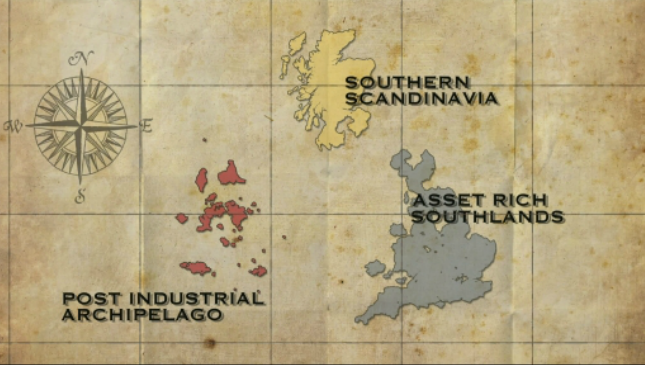
What was interesting about the BBC coverage in particular was not so much that they reported on the stunning changes in Scotland but that they did so from a traditional ‘British’ (i.e. London-centred English) perspective. The coverage of the stalled Labour revival across England (with London a notable exception) was astute in many cases. Paul Mason of Channel 4’s analysis of the UK’s new political geography was succinct:

The Fragmented Political Geography of Britain 2015

The Fragmented Political Geography of Britain 2015

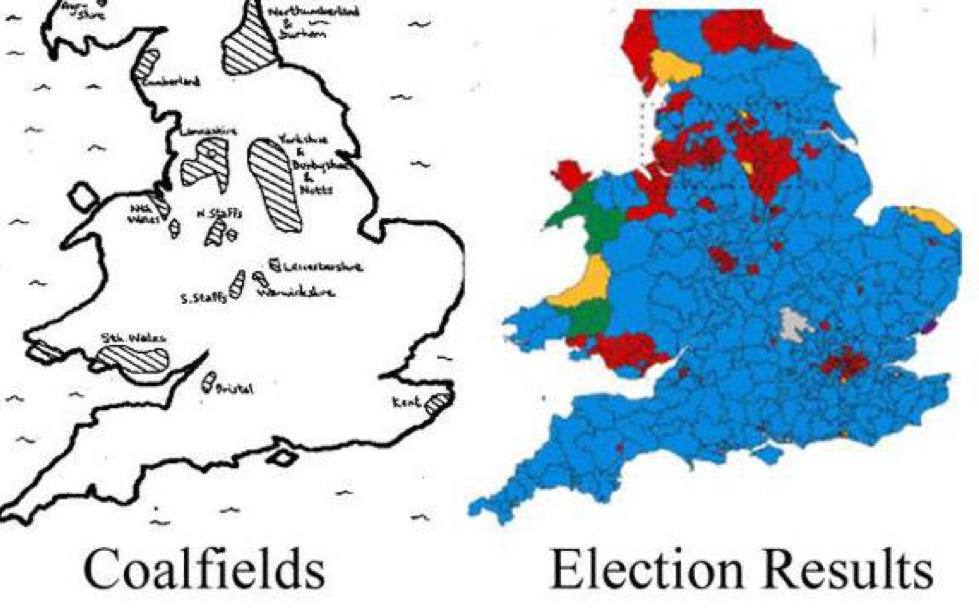
This underscores the degree to which Labour in England was unable to break out of what has been its traditional heartlands where heavy industry and mining once dominated. Pat Kane tweeted an even more graphic map of this phenomenon by comparing the areas of Labour support in England with the distribution of former coalfields, as shown.

Comparison of Coalfield Distribution with Labour MP

Comparison of Coalfield Distribution with Labour MP

There are exceptions to this uniform coincidence (London & Kent) but the point remains—Labour could not break out of its post-industrial ghetto into the more aspirational rural idylls. It was the failure to make progress here—more than any other factor—that scuppered any Labour government and caused Milliband to fall on his sword. Labour will now descend into internecine conflict whether the party was not left enough or not right enough; whether it was too Blairite or too much in the pockets of the unions. But that would be repeating the mistakes of the past and remaining blind to a new era, heralded as graphically as it could be by its obliteration in Scotland.

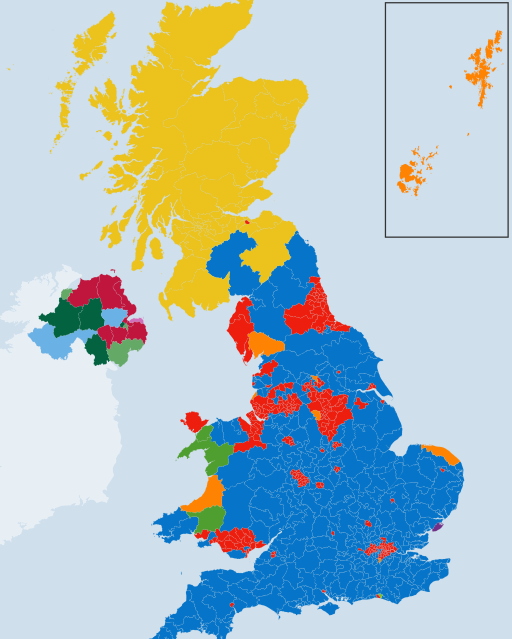
Labour are not alone in seeing tomorrows politics in terms of the past—the whole night’s coverage by the BBC was entirely by London-anchored reporting with outposts in the far-flung colonies like Manchester. But the hexagonal colour tile map taking shape outside BBC’s Broadcasting House showed a startling variety among the four countries of the UK.

Reporters made much of the divergent colours between England and Scotland as virtually all the 59 tiles representing Scottish constituencies turned SNP yellow. But the 18 tiles for Northern Ireland were coloured a mix of ‘Other’ parties, as they have for a century—which was reported as normal. Wales was the only one of the four looking vaguely like England, made the more so by three more Tory seats—and 27% representation there.

Political Map of UK after the 2015 General Election

Political Map of UK after the 2015 General Election

Given that England covers 533 of the 650 seats being elected (82%), it is hardly surprising that the bulk of coverage focused on those. But while much was made of the voting revolution in Scotland, the attempts to explain it were couched very much in English terms and the underlying drivers barely understood.

Some factors were universal across most of the UK. That the Liberal-Democrats were going to suffer as a punishment for their coalition with the Tories was widely predicted. But its sheer scale was underestimated—a loss of 49 of their 57 seats not only decimated their experienced MP cohort but sent them back into a minority wilderness out of which they had inched over half a century. Why the punishment was so severe remains unclear, given their centrist policies and the general drift of parties in that direction.

“The Lib Dems are not just empty. They are a void within a vacuum surrounded by a vast inanition.” (Boris Johnson)

Understandably,  the main story of the night was the Tories’ ability to form a majority government, despite having been in power and administering swingeing austerity measures for the last five years. Virtually no pundit or poll had foreseen this.

The second story was Labour’s modest progress in England and Wales—14 more seats almost entirely at the expense of the L-Ds, with the exception of some impressive victories in London. Even had their normal Scottish contingent of 40 MPs been returned as before, this was far too weak a performance to get anywhere near government.

The third story was the Labour wipe-out in Scotland at the hands of the SNP. But this was reported entirely in terms of the English CON/LAB/LD ‘main parties’ when such a framework clearly no longer applies—even Paul Mason and Pat Kane’s keen observations seem to miss the probably permanent dislocation of Scotland from the British political mainstream, much as happened with Ireland in the run-up to WWI.

“The sweetest victory of all…we confounded the pollsters…We held on in Scotland.” (David Cameron)

Cameron’s quote is shorthand for the myopia that exists in the unionist parties even after the rise of the SNP and the political awakening of the referendum last September should have opened their eyes. For the Prime Minister to see the UK governing party holding a single seat in Scotland with a thin majority of 798 (1.5%) as anything other than tragic says much for their focus.

From once being as typical in party balance as England, since the seventies, Scotland has drifted in its own direction. At this election, it left the reservation altogether. A chart of its history of representation at Westminster illustrates this well.

Westminster Party Representation from Scotland since WW2

History of Westminster Party Representation from Scotland

For unionist parties to have countenanced this decline and seen it in terms of Westminster (and therefore English) terms seems foolhardy and counter-productive. First the Tories, who once held a voting majority, lost that edge through a series of thrawn decisions that decimated Scottish heavy industry, culminating in the disaster (for Scottish Tories) of Thatcherism.

“There is no such thing as Society” (Margaret Thatcher)

Labour gladly stepped into the vacuum without needing to actually do anything. They spent the next quarter-century sending mostly buggins-turn voting fodder down to Westminster where Scottish interests like oil funds or fishing rights or opposition to Trident were subsumed into their battle with the now-totally-English-focused Tories. Even capable Labour MPs like Smith, Cook, Darling, Brown, Alexander, etc ‘went native’, seeing themselves more as London’s men in Scotland, rather than the reverse. Only Dewar had the vision to join the Scottish Parliament but had died within the year.

Labour could have learned from the Tories whose ‘hollowing out’ in Scotland under Thatcher reduced them on a feeble footing from which they have never recovered. Despite the Goldies and Monteiths, they are still seen—however unfairly—as an English party of ‘Hooray Henries’ confined to comfy Borders or Perthshire estates or the rarified world of Edinburgh QCs and the Honourable Company of Archers.

Either unionist party could have smelled the coffee, absorbed the bolshy zeitgeist abroad since the nineties and developed Scottish policies in tune with the people they claimed to represent. But after two decades of ineffectual opposition (kept in local power mostly by not being Tories), Labour in Scotland caught its terminal disease—Blairism. This did not sit well down the Miners’ Welfare in Auchenshoogle but it offered success and power—whether in Edinburgh or London—both irresistible to candidate and branch organiser alike. It was tholed philosophically as a means to an end.

But it also meant a hollowing-out of the Scottish party. On top of the political nursery of council sinecures, Labour now had over a hundred MPs and MSPs, all of whom needed office managers, press officers, SPADs, etc. The payroll vote swelled to over a thousand. But self-motivated, principled activists, who once formed the backbone of the party and rooted it in the communities it served, shrank to a core of idealists. Worst of all, the ‘B’ team from whom the MSPs had been recruited sought promotion to the London gravy train, where they took up jobs with no notable impact back home—certainly not when it came to benefiting Scotland.

The bottom line: despite mouthing a mantra of ‘ordinary working class’ or ‘looking after the vulnerable’ or ‘traditional values’, it doubtful that John Maclean or Keir Hardie would have given the time of day to wasp-chewers like Curran or bar-room brawlers like Joyce, let alone Derry Irvine’s taste in wallpaper or Peter Mandelson’s penchant for guacamole over mushy peas. The Westminster elite became alien to the remaining social fabric that held Scottish Labour together as a civic force at grass roots level.

All of this could be seen as progress and a modern party would have adjusted and moved on. But the dogged loyalty and local rewards created a system that threw up too few able politicians at any level. For every Wendy Alexander there were a dozen Karen Whitefields and nobody had the ability or stature of Wilson’s Willie Ross to take advantage of the power they deployed as Scottish Secretary.

It is no coincidence that the earlier fall of the Scottish Tories or the rather more rapid disintegration of Scottish Labour can be discussed with barely a reference to the SNP. Because both parties brought their demise on themselves. Despite the euphoria of Blair’s sweeping victory in 1997 (enhanced by Scottish Tories shooting themselves in the foot opposing any Scottish Parliament) the strong contingent of SNP MSPs elected in 1999 was their first warning.

But it didn’t warn. Organisation continued to drift; policy was set by London; decent performers headed South. Then came the louder fire alarm of 2007. Proportional representation winnowed the ranks of numpty West Central councillors like machine gun fire while SNP councillors doubled and half Scotland’s council fell out of Labour control. More stunning was enough SNP MSPs to form a minority administration under Alex Salmond and its competent operation. Suddenly, even Labour’s payroll vote was shrinking.

Radical action might have saved things—but Scottish Labour seemed incapable of ‘action’, let alone anything ‘radical’. Their group psyche of being the only ones capable of representing working and downtrodden people became outraged that the SNP had muscled in on ‘their’ patch. Members developed a venal hatred of all things SNP, surpassing even their long-held venal hatred of Tories.

The result was not pretty. They chose leaders like Gray and Lamont who were grey and lamentable—light on leadership and idea-free zones. Their opposition was interminable girning and nothing else. Sympathetic media did Labour no favours by beaming FMQs into ordinary homes, showing Salmond running rings round their supposed champions.

The final straw was the 2010 general election when Brown was clearly a wounded animal and, after 13 years of Blairism, a Tory victory was likely. Labour voters trotted out for the last loyal time to be rewarded in a lesson in London Labour impotence. ‘Osterity’ should have been an open goal but they picked the wrong brother as Leader ant PMQs became not much better than FMQs. Worse—almost every Labour talking head on Marr or Newsnight was some button-down slick ‘soothmoother’ or excruciatingly earnest ‘Blair Babe’, many of them (e.g. Balls) with the oily facelessness of ex-SPADs. Not one Willie Ross or John Reid with whom the once-Labour-to-a-man denizens of Carntyne or Cardenden could identify.

At the 2011 Scottish elections ‘third warning’ another slew of mediocre Labour MSPs went down like ninepins across once-hallowed home turf of Lanarkshire. The SNP achieved the supposedly impossible outright majority in the Scottish Parliament. Outraged resentment oozed from every Labour statement. They resembled a small child refused an ice cream who hopes that by squatting down, closing their eyes and holding their breath their just entitlement would be restored. To the apolitical bulk of Scots, it was their undoing.

Perhaps a better metaphor than a spoiled child would be a rabbit in the headlights. For the last four years, little changed: policy was dire; spokespeople were dire; joint work with on Better Together was negative caterwauling of the ‘Scots are too poor, too wee…’ sort. Had they claimed that, with independence Irn Bru would become poisonous and our first-born would arrive with two left feet and thus be hopeless at football, they could hardly have insulted supporters more.

The ‘victory’ of the NO campaign last September was nothing of the sort. Given the fanfare of media arrayed against them, the canny Scots should never have got near voting YES in the first place. But hurried intervention of promises just prior the shuffling of feet at Westminster since outraged many by its cynical deviousness. From then on, a serious gubbing for Scottish Labour was inevitable.

But what made this election the perfect storm for Labour was the loneliness of Jim Murphy’s one-man band underscored by Kezia’s overpromotion. Once-traditional Labour heartlands were loyally fed a Milksop-Millibland message…and jumped ship. All the SNP had to do was avoid making any mistakes. Having come of age, they made none.

Up by 933%—Six Old MPs with 50 New Ones + NIcola

Up by 933%—Six Old MPs with 50 New Ones—with a Triumphant Nicola

Tom Harris’ wry explanation of “not enough votes, mainly” while true, provides no clue how Labour moves on from this. Fortunately, one glaring lesson of what NOT to do is clear—don’t be a branch office. The Tories have done that and have been mired in the wilderness for 18 years so far.

If the three unionist party rumps are too thrawn to learn from the SNP, they need to look at Ulster, where parties start from the premiss that they represent  locals in the imperial capital and not the other way round. Because recent 55% NO vote or not, Scotland is off the reservation and ain’t coming back.

If the unionists are serious about being our friends, they must stop saying ‘British’ when they mean ‘English’, they must stop throwing their 533 English votes around when it suits them and start handling Scotland AS IF it were a sovereign nation because that’s where it’s headed if they don’t.

Posted in Uncategorized | Leave a comment

The Other Borders Railway

Most people around Edinburgh know that there will be big fanfares this September when the long-awaited Borders Railway re-opens as far as Tweedbank, linking the Central Borders, Galasheils, Gorebridge and Dalkeith back into the ScotRail network at Waverley. It’s not quite the Waverley route that once went on through Hawick to Carlisle but it’s a start.

But there is a second such key link in the works that is likely to provide just as big a boost to Borders business and quality of life—but at far less cost than £294m the Institute of Economic Affairs called ‘insane’ because of its cost-benefit ratio of only 0.5 (50p return for every £ spent).

For ten years, the local Rail Action Group East of Scotland (RAGES), backed by East Lothian Council has been lobbying for a return of a local service from Edinburgh to Dunbar and beyond. Until recently, all such services were provided by long-distance trains from East Coast or Cross Country and had led to the ridiculous situation of Dunbar station being run by East Coast and their train service being driven by East Coast Main Line (ECML) planning based in London.

A Scottish Transport Appraisal Guidance 1 (STAG 1) was undertaken and released in October 2005. It identified various points as worthy of further examination. When the SNP administration took over ELC in 2007, they put the project into high gear, asked for the more detailed STAG 2 analysis (completed in 2013), lobbied Keith Brown MSP as Transport Minister and persuaded ScotRail to experiment with an interim local service to Dunbar (stopping only at Musselburgh for QMU) in 2010.

A full service with new train stations for East Linton and Reston came a step closer after services for the stops were written into the new ScotRail franchise. This involved a two-hourly service between Edinburgh and Berwick, with timing for stops at East Linton and Reston as part of the new planned timetable. Recently this local service to Berwick was priced by Abellio and accepted by Transport Scotland.

Although originally planned to be introduced as early as December 2016, operational requirements meant that even the newest  class 380 trains used on the North Berwick service did not have adequate acceleration to adhere to the proposed timetable stopping at all stations in the busy ECML schedule. This means that service introduction is delayed until the new Hitachi-built trains are available, which means December 2018.

By then, considerable progress will have been made in providing a new station at East Linton some 300m to the West of the old one with vehicle access from the North (Brown’s Place) and pedestrian from the South (Orchardfield). Such a station will provide an easier access for people in Spott/Stenton and relieve congestion at Drem. Work should also have begun on a station at Reston, accessible from Eyemouth, St Abbs, Ayton and much of Eastern Berwickshire.

And because it is included in the ECML timetable, we know when the trains will run. Apart from an 07:00 train to Waverley starting at Dunbar, the 2-hourly service is as follows:

  • Weekdays leave Edinburgh at 06:31, 08:36, 10:33, 12:33, 14:35, 16:34, 18:34, 20:22 and 22:33
  • Sundays leave Edinburgh at 08:36,11:36, 14:36, 17:36 and 20:36
  • leave Berwick at 07:41, 09:47, 11:50, 13:47, 15:47, 17:48, 19:47, 21:47 and 23:44
  • Sundays leave Berwick at at 09:47, 12:47, 15:47, 18:47 and 21:51

Journey times will be at least as fast to existing stops (Edinburgh-Drem in 23 minutes) with the following journey times on the extended service:

  • Edinburgh-Dunbar in 35 minutes
  • Edinburgh-Berwick in 58 minutes

While not quite as fast on either stretch as the Cross-country trains, this will beat any driving time to Central Edinburgh and may prove serious competition to Perryman’s excellent bus service on both ( currently 1hr from Dunbar and 2hrs 10 mins from Berwick), as well as linking Berwick with Dunbar by rail for the first time in decades.

Besides convenient access into Edinburgh, this also opens up a number of options for East Lothian and Berwickshire residents. Access to/from QMU will now be easy for students in Eastern Berwickshire and better for those around Dunbar, avoiding any need to go into Waverley then back out on a North Berwick train.

But this also opens up options for residents along the line to pick up both East Coast or Cross Country trains at whichever between Dunbar and Berwick they stop, again avoiding the need to travel all the way in to Waverley. Even North Berwick residents can change at Drem for a 15-minute wait to head South but coming North you’ll need to dash over the bridge because the two trains will arrive around the same time.

Including Dunbar and its hinterland, the population opened up by the other Borders service is as large and economically important as the main Borders Railway. And, at under 10% the cost (with most of that going to provide two brand new stations). With a BCR of over 2 already calculated for this service, positive lessons from electrification of the North Berwick service and huge unexpected ridership on new services like the Alloa line means this may be some of the money best spent on Transport anywhere in Scotland—with a bonus for our Northumbrian friends.

Posted in Commerce | Leave a comment

Labour is already in mourning.

MacWhirter has proved to be among the most astute political observers in Scotland. But in the blog below he has managed to cut through party spin to articulate the real currents driving Scottish politics in a way that unionist parties and the media have failed to grasp, let alone deal with.

@iainmacwhirter's avatarIain Macwhirter

Spare a thought this weekend for the Labour MP for Glasgow North East, Willie Bain. Opinion polls had suggested that he might be the only Labour MP left in Scotland. It could have made him a shoe-in for Scottish Secretary.

Then on Wednesday, disaster struck. A poll from Ipsos Mori suggested that the SNP would take every seat in Scotland. Poor Willie Bain’s brilliant career was cut tragically short.

Of course, no one believes these polls. I can’t see the SNP winning every seat in Scotland. Even after landslides on Everest some people are left standing and I fully expect that on Friday morning there will still be a number of Labour MPs boasting that they survived the Nat-quake.

But no one can be in any doubt that a fundamental change has taken place in the fabric of Scottish politics. It seems almost unbelievable that only five years ago, Labour…

View original post 2,054 more words

Posted in Uncategorized | Leave a comment

The Kids Aren’t All Right

What follows is my column to this week’s East Lothian Courier, which tries to address a pressing issue for our local school pupils and their education.

Last week East Lothian Education Committee met for the first time this academic year since September. After two recent efforts had failed as inquorate, it met last week. The reason given for this huge 7-month gap? “No business to consider”.

Errr..not true.

Last June Audit Scotland published its School Education report. Its Exhibit 10 shows East Lothian to be the 2nd-worst (of 32) councils in improvement over 2004-15; its Exhibit 9 highlights EL with the 2nd-worst (of 32) disparity between best- and worst-performing schools in its care.

Also last June, the Wood Commission published its Education Working for All report. It is laced with insight and ideas how education might better prepare our young people for the real world. Its Summary says: “(throughout secondary), young people should be exposed to a wide range of career options. This can only be achieved by schools and employers systematically working together in meaningful partnership”. East Lothian has achieved no such thing.

Fire alarms on this scale should demand reports and decisive action. A year on, the chair (Cllr Shamin Akhtar) has yet to do either. The two policy papers that were considered on April 21st didn’t mention—let alone address—either report, despite having had a year to do so. The decision taken? That members note “attainment in East Lothian has improved 2009-2014”.

Cobblers.

By SQA yardsticks, East Lothian has fallen (by 1.5%)—behind comparable authorities like East Dumbartonshire (up by 15%) Disparity within the county has actually grown but Labour shies from publishing data for individual schools and, by aggregating, can boast we’re around national average.

Comparing 2004 SQA statistics with 2014 is very revealing: NBHS results +15%; Knox +9%; Dunbar +3%. Good so far, but: PL -6%; Ross -7%; Musselburgh Grammar -9%. These latter are poor figures, suggesting our three largest high schools have lost ghround: they are WORSE than a decade ago.

And looking at where school leavers wind up shows similar disparities. So-called “positive destinations” averages 89% of EL’s 1,043 leavers, compared to 91% nationally. Our poor average conceals over half ‘non-positive’ results leave from just two schools (43 out of 82).

Yet Audit Scotland and Wood are ignored. This Labour administration declines to hear any alarm bell ringing, let alone the need to discuss solutions—so smugly comfortable with inaction are they that deaf must mean there IS no alarm.

Meanwhile, pupils in half EL’s high schools are offered raw deals instead of careers.

Posted in Education | Leave a comment

Tiptoe Through the TTIP

Hands up all those who know what TTIP stands for? You don’t? Well it was the topic of a major debate in the Scottish Parliament yesterday. However it received scant coverage. The only news about the SP seemed to be that we should expect a rammy there today because it’s the last FMQ before next week’s General Election.

It’s the same with most obscure acronyms referring to organisations not instantly recognisable as sports (FIFA), political hot potato (NATO), celebrity (BAFTA) or telly (BBC) oriented. Business—especially international business—is a wilderness of ignorance. ITU-T(CCITT)? CFCA? ERDF/ESF? The first regulates telecomms worldwide—the basis for both internet and mobile phones, the second runs EU fishing (in which Scotland gets no say) and the third distributes more EU sunsidies across Scotland (£600m) than CAP (£580m).

The Transatlantic Trade and Investment Partnership (TTIP)—along with the TPP sister operation for Asia—is Uncle Sam waking up and trying to smell the coffee after five decades of protectionism during which they missed several rounds of trade agreements with their best customers. While Europe was post-war devastated and fragmented and the Chinese dragon had not yet grown up to be capable of global flame-throwing, US firms from Ford to Boeing to Intel to McDonalds to Microsoft could rule the roost.

The global reach of Google, Starbucks et al shows they are still very much a player. But the way Japan challenged and won electronics and small car skirmishes, the way Airbus stole much of Boeing’s market, the way Union Carbide’s Bhopal disaster put a stop to most shoddy industrial practice exploitation of the Third World all knocked the US off its once-dominant perch.

The struggle to mitigate the impact of recession post-2007 has been hampered by the habitual civil war that goes on between President and Congress but minds have slowly turned from their usual autocratic Deus-ex-Mackinaw position to a genuine attempt to go out into the world and negotiate treaties different from one-sided United Fruit deals with small banana republics—largely responsible for the US being tarred with a colonial brush throughout Latin America.

And so to TTIP. TTIP is about reducing the regulatory barriers to trade for big business, things like food safety law, environmental legislation, banking regulations and the sovereign powers of individual nations. The good news is that the Americans are genuinely after a deal with Europe.

The bad news is that (as usual) they want the rules written their way AND the whole thing has been going on behind the closed doors of commercial confidentiality since February of last year. As a result, few people are informed about the likely consequences of this being approved. John Hilary, Executive Director of campaign group War on Want, calls it “An assault on European and US societies by transnational corporations.”

Is that not hyperbole or, at least, anti-American overstatement? Well consider some of the probable impacts:

  1. Public services, especially the NHS, are in the firing line. One of the main aims of TTIP is to open up Europe’s public health, education and water services to US companies. This could essentially mean the privatisation of the NHS. The European Commission has claimed that public services will be kept out of TTIP. However, Lord Livingston (Tory Trade Minister) has admitted that talks about the NHS were still on the table.
  2. On the touchy subject of Food Safety, TTIP’s ‘regulatory convergence’ tries to move EU standards on food safety towards the US. But US regulations are not as strict: 70% of US supermarket processed food has genetically modified ingredients while the EU allows none; US restrictions on the use of pesticides are more lax and growth hormones in its beef are banned by EU due to links to cancer.
  3. Similarly in environmental issues, the EU’s REACH regulations on potentially toxic substances are strict—a company has to prove a substance safe before use is permitted; in the US any substance can be used until it is proved to be unsafe.
  4. The all-powerful City of London wants America’s financial rules (much tougher than the UK’s). They were put into place post-2007 to curb the powers of bankers and avoid a repetition of that fiscal crisis. TTIP could remove those restrictions, effectively handing the City’s powers back to bankers on both sides of the pond.
  5. On privacy, an easing of data privacy laws and a restriction of public access to pharmaceutical companies’ clinical trials are both being discussed. There is also a concern that the Anti-Counterfeiting Trade Agreement (thrown out by the EU parliament) is being reintroduced undemocratically as part of TTIP discussions.
  6. Jobs are also at stake: The EU has aldready admitted TTIP will switch jobs to the US, where labour standards and trade union rights are lower. The 30-year-old North American Free Trade Agreement (NAFTA) between the US, Canada and Mexico actually cost 1m US jobs over 12 years, instead of hundreds of thousands promised.
  7. There is no evidence to support TTIP’s claim that it will benefit small businesses. Large corporations will benefit from opening up of local procurement but small businesses will be disadvantaged in competition with transnationals.”
  8. But TTIP’s biggest threat is its inherent assault on democracy. One of TTIP main aims is Investor-State Dispute Settlements (ISDS) These allow companies to sue governments if their policies cause a loss of profits. This means unelected global corporations could dictate policy to democratically elected governments.

Many of these points came out in Wednesday’s Holyrood debate S4M-13007—Implications of the TTIP for Scotland. While Jamie McGrigor  (Tory Spokesperson on the Environment, Fishing and External Affairs) was pretty gung-ho about the whole thing, a great deal of sense was spoken by the two Independent Highland MSPs, Jean Urquhart and John Finney who touched on most of the points listed above and made a strong case that, although Scotland was (again) not at the top table negotiating this, that we would be best to sup wi’ a lang spoon from this particular brew.

On a February visit to London to ‘promote’ TTIP, EU Trade Commissioner Cecilia Malmstrom got several fleas in her ear: MPs said more transparency was needed to address public concern; Business Secretary Vince Cable accepted there were benefits, but only if MPs were given access to the treaty to ask searching questions; StopTTIP UK claimed it could jeopardize governments’ legal freedom and lower trade standards. “What part of ‘NO’ does she not understand?” is how they put it.

International trade agreements are necessary for world economies to flourish. But a good start to defusing a raft of valid concerns about TTIP would be to drag its negotiations out of the closet and into democratic view.

Posted in Commerce | Leave a comment