45: None So Blind

Not content with vampire tapping into Scotland’s oil revenues since the mid 1970’s, a little-known grab by the UK government of 6,ooo square miles of Scotland’s North Sea in 1999 added insult to injury and ensured that several key oilfields would always stay within English jurisdiction and pump money into the UK treasury (see map).

To revisit this is not just picking at old sores. The area in question hems in an active Scottish & Southern’s plan to build a huge offshore wind farm that would stretch from off St Abbs to off Arbroath and range between 20 and 40km offshore. Invisible from land, over a hundred massive turbines out there could generate the equivalent of Torness. But wind rarely develops it rated output: it’s unpredictable and sometimes fails entirely.

But with the first serious (1 Mwatt) test turbines for tidal soon to be laid in the Sound of Islay and followed by full-scale (100 Mwatt) in the Pentland, we should be looking even closer to home to provide us with clean power. Tidal runs four times each day, is therefore predictable and suitable for providing the base load that nuclear currently does. And before someone lodges a comment about slack at high and low water, high tide at Leith is 8 hours behind Oban; tide is always running somewhere on our 6,000km coast.

Which brings us to our very doorstep. What if we looked at the tides that churn in and out of the Forth twice daily? With an average 5m rise per tide and 3kt current on a good day, that means the 11 billion tons of water passing between Fidra and Elie Ness could, potentially, provide 40 gigawatts of energy if it were all tapped. Clearly it’s not possible but just harnessing 3% would again be equivalent to replacing Torness.

Why, with its insistence on nuclear, is each UK government so eternally greedy for our oil yet so blind to our renewables? Could it be their interests are not the same as ours?


Posted in Environment | Tagged | Leave a comment

46: Full Moon Equinox

Funny how things do seem to come together naturally—like the Labour conference and Magners Comedy Festival being together in Glasgow this weekend. It was a fabulous full moon tonight, right on the gateway to Spring. Clear sky, still sea and the moon bigger and brighter than ever, it’s not hard to feel that we’re on the cusp of something new.

As Labour activists wend their way home from Glasgow (or perhaps stay for the Comedy Festival to cheer themselves up) what is ringing in their ears is the standard carp from their leader that famine and pestilence will engulf Scotland if it rejects their dismal cant. But, as Newsnet Scotland said “one key problem for Labour is the bulk of their time has been spent undermining the SNP Government’s credibility. In so doing, the party has not associated key positive issues with their leader in the minds of the electorate.”

East Lothian is such a varied mix of people that you might take it as a microcosm of Scotland, a 5% corner that represents the whole. On balance, it is aspirational. In its thousands of new homes, people may be tightening belts to deal with runaway banks but they hope tomorrow will bring a better story so their children will grow up in better times, just as they did themselves.

The keynote speech in Glasgow may have moved the faithful in the hall. But its bitter, accusatory tone finds little resonance out in Appin Drive or Aberlady, Windygoul or Whitekirk. Just as the faithful blue rinses who sustained the Tories passed on in the nineties, so too the grizzled miners of Ormiston and Elphinston and their half-century-old memories of working pits have passed on. Their sons and daughters, rather than following their blind loyalty, now choose something better: it is all coming together.

Posted in Politics | Tagged | Leave a comment

47: Getting It Together

Dealing with rubbish was the most popular blog for the last month (see below) so this week I visited ELC’s Kinwegar waste facility. Primarily this was to say ‘thanks’ to the eighty-odd members of the lorry crews for a winter we survived with distinction. When the snow was at its worst, these crews were out there, handling bins under conditions to give H&S inspectors heart attacks.

The much improved facilities the crews now enjoy have been open for a year now. After being cramped in draughty portakabins at Macmerry, they now have their own lockers, showers and heated drying areas so they no longer need go out into February dark in boots still clammy and damp from the day before.

But most impressive were the waste handling facilities themselves. Apart from a modern public recycling centre, the massive sheds allow both waste and recycling to be stored and sorted before almost half goes off to be used again while the rest is shipped in bulk to landfill at Dunbar. The managers were especially proud of the detailed separation they did and the top dollar income negotiable for quality bulk recyclate to off-set costs.

Even the design of the site is green, making good use of what would otherwise be waste land between a busy railway and road, sloping to allow rainwater runoff from both roofs and concrete aprons. This is then stored and used for the heavy amount of vehicle washing involved running the fleet. The two dozen bin lorries in the fleet enjoy semi-covered parking, protecting bin loading mechanisms from weather.

Bottom line is that the crews feel valued and motivated to continue dealing with the almost 100,000 tons a year that we discard. And with 40,000 tons no longer going to landfill, that’s a saving of £2.4m in landfill tax that itself gets recycled into better service.

Posted in Uncategorized | Leave a comment

The blog articles receiving the greatest number of hits since mid-February were:


Posted on by davidsberry | Leave a comment

48: Cause or Effect?

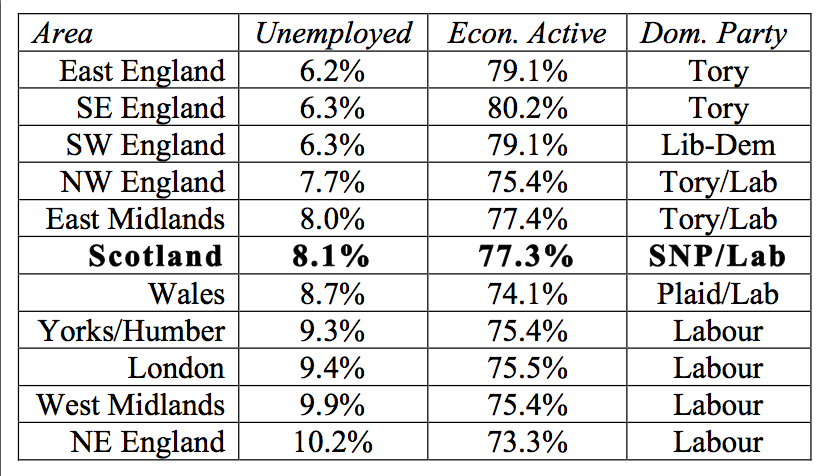
An interesting set of statistics surfaced yesterday. Amidst a great deal of BBC and UK-level handwringing over worsening employment statistics, (England’s rising to 2.53m people out of work) Scotland bucked the trend, dropping 16,000 to 218,000 or 8.1%. And that was achieved while shedding 18,000 public sector workers and helped by 14.3% growth in construction employment.

This could be transient, or luck…or it could be the result of a savvy SNP government working with responsive SNP councils to slim Scotland’s bureaucracy while pumping investment into infrastructure and housing. Why else should Scotland buck a UK trend?

Looking more closely at statistics for the economic regions—as the Scotsman did—highlights a more subtle pattern. Labour rushed in to rubbish any positive reading of the favourable Scottish statistics but they would be better occupied considering why it is that, after over half a century of their dominance across much of the UK, poverty and economic blight should, from Dagenham to Dennistoun, remain the embarrassing hallmark of their dismal dominance. The table ranks UK ‘regions’ by unemployment.

What is striking from the table is that Labour is inextricably linked with areas of high unemployment or low economic activity. To hear the Labour party, this is because it is the champion of the poor, the oppressed and the vulnerable. It is this loyalty to their champion that makes these areas such heartlands. However true this might have been back in Edwardian times, a century on is this still valid?

Or is it that those areas are condemned to economic hardship by Labour ‘leadership’ that is institutionalised nepotism that holds entire communities in social dependency and ‘jobs-for-the-boys’ paternalism? If Labour showed any ability to—let alone interest in—really helping those people on whose votes its existence depends they might grow out of dependency and actually gain the better life to which we all aspire.

Unemployment/Activity by UK region (from The Scotsman, Mar 17th 2011)

Posted in Community, Politics | Leave a comment

A Happy St Patrick's Day to All Our Readers

Posted on by davidsberry | 1 Comment

49: Parliamo Politico VI

Let’s Talk Pencil-Pusher: Lesson VI—Scrutiny (Sixth of a series, translating bureaucrat-speak into what it means for folk in East Lothian on St Paddy’s Day)

Our council operates what is called a ‘scrutiny’ or self-evaluation mechanism. This consists of a Customer Relationship Management (CRM) system that tracks service of its 100,000 customers, a series of statistics tracked by officials called ‘Statutory Performance Indicators’ (SPIs) and two committees (Audit & Governance and Policy & Performance Review) that meet regularly to track performance. For fairness, both committees are chaired by members of the opposition and meet in public.

The CRM now includes a feedback mechanism that tracks stage 1 complaints (dealt with immediately), stage 2 complaints (formal complaint investigated by an officer) and stage 3 complaints (handled by the Chief Executive). Anything beyond that goes to the Scottish Public Services Ombudsman. ELC is receiving around 1,000 complaints each year, about 42% involving property maintenance, 21% transportation and just under 10% housing management. Of these only 8 went to the third stage and two to the SPSO (both partly upheld and ELC complied).

That may seem a lot but this period covers the atrocious weather. Against that, 96% of complaints were acknowledged within five days and 83% resolved within 20 days and compliments have been running at 300 per year, actually increasing during the bad weather. Social Work received over 25% of them, possibly because home helps were trudging through snow to make sure that no-one was missed. Bottom line is that it is definitely worth complaining about poor service.

However, on SPIs, the jury is still out. Most of these were determined years ago and not all make sense. For example, one SPI is the number of children in council care. No-one knows whether a higher count is good (we’re finding more children needing care) or bad (more and more children need care). ELC is good at collecting refuse (£74 per house vs £92 for Scotland) but bad at repairing our houses promptly (84% vs 91% for Scotland).

Bottom line: ELC has no illusions about its imperfections and is genuinely trying to use management systems to iron them out while keeping its customers informed

Posted in Politics | Tagged | 1 Comment

50 Days to Go

At the halfway point to May’s election, ELC’s Education Committee has tabled a paper on destinations for its school leavers. It highlighted a 2% year-on-year improvement in positive destinations (F.E. colleges, universities, training and jobs), despite a huge 40% ‘bulge’ in numbers leaving last year (2009/10). That said, too many leavers still find themselves unemployed and variations among the six high schools are still too great.

Variations in the share going to university (between 28% and 55%) is not necessarily bad if an uptake in vocational makes up the difference. But that’s not the case. Although more Ross High leavers went for training and jobs, those added up to only half the shortfall of academic leavers. Also, Musselburgh Grammar and Ross High had both been poor at steering leavers into training prior to this year’s improvement from 1% to over 5%.

Confusing the issue is the number of leavers taking  ‘gap year’, especially prevalent at NBHS, which skews the East Lothian figures to look worse than national statistics when they are, in fact, rather better. Perhaps most frustrating of all is that academic standards are rising faster in lower-performing schools (a hard thing to achieve) while training and job destinations stay stubbornly low. Is this due to education or the sheer paucity of business in East Lothian to offer such destinations—including the council?

Dave discussing youth destinations with Alex Salmond

Posted in Commerce, Community, Education | Tagged | Leave a comment

51: Tornado…Tsunami…Tomorrow?

It was pure coincidence but perhaps symbolic. The day I was invited to visit EDF’s Torness power station was when the 8.9 magnitude earthquake struck Japan. Since we had no news of its impact, the only discussion at the time was to express sympathy.

But safety was high on our agenda. Plant manager Paul Winkel was at pains to explain their long run of incident-free days from safety processes as rigorous as holding handrails while on the stairs. We discussed closure, scheduled for 2023, but with extensions of five or ten years possible. Although new high-pressure water reactors are planned in England, no replacements for AGRs at Hunterston or Torness are under consideration.

Having been round Torness several times, its impressive operation and engineering were not new to me. And, knowing plenty of workers, I need no reassurance of the professional pride all 500 of them take in running the place. In fact, having been the mover of the motion that changed SNP policy to run nuclear stations to the end of their useful lives, I remain among the least sceptical of SNP members on nuclear energy.

That said, even before events at Fukushima Dai-ichi, I voiced concern how the unforeseen can evade the best safety plan, as when an RAF Tornado crashed close to Torness. The third explosion at Fukushima may not have caused a catastrophic core breach, as happened at Chernobyl. But the increased radiation leak has caused both the Swiss and the Germans to suspend all new nuclear build.

Tsunamis my be rarer than Tornados in the North Sea. But, why should we risk nuclear catastrophe at all? With alternatives as alluring as Scotland’s renewable riches to tempt scientists and engineers into building our green future, why tinker with second-best?

Plant manager Paul Winkel with Dave Berry at Torness

Posted in Commerce, Politics | Tagged | 2 Comments

52: Coast to Coast

Going through to Glasgow for the SNP Conference let me sample another SNP Government achievement—the Airdire-Bathgate line. In theory opened in December, it’s only been running to timetable the last week or so—quarter-hourly to Bathgate, with half then running on through Airdrie and Glasgow to Helensburgh.

Though it worked fine, I must admit to disappointments. For a start, they’re using SPT stock, whose livery was designed by the colour-deaf and which offer nothing by way of tables, space or trolley service. Add in that it takes almost an hour and a half to get to Queen St (low level) as it stops at every lamppost between Blairhill and Belgrove.

But the major disappointment is that the journey refuses to be scenic—the stubby bings of West Lothian give way to the stubby hills of Lanarkshire and then suburbs of eastern Glasgow begging to be adverts for B&Q or weed-whackers. Along most of the track the bare embankments, praries of empty car parks and miles of galvanised fencing look neat but add zip to the experience. That West Lothian neds have already discovered this short-cut to the good criac and bevvy of Glasgow didn’t help either.

The arrival of the new Class 334 trains might boost the experience. I had argued that ScotRail should extend this line into the North Berwick service as these same trains are planned for here. That would have meant a true coast-to-coast from NB to Helensburgh.

As it was, I had to change at Partick to get to the SECC and so a 2-hour journey took me 3 hours. Next time, I’m afraid I’ll be back on the 45-minute Queen Street service and leave the views of the snow-flecked bings of Blackridge to the neds and their Buckie.

Glasgow-Edinburgh via Airdrie & Bathgate

Posted in Transport | Tagged | 1 Comment