Hall of Shame: Update I

On July 19th, we published our consolidated Hall of Shame list of those councillors in Scotland we felt had brought real shame to their public calling by improper, ignoble or otherwise reprehensible actions—whether they had admitted it or whether this had resulted in their losing their jobs or not. In order to grade the seriousness of the offense we had awarded between one and four blots (with no-one blatantly crass and amoral enough to deserve the most serious ‘5-blot’ category).

But solidly in the ☁☁☁☁ category “Substantial or systemic abuse of position or dishonesty conviction” was John Holden, until this week Labour councillor for the Inverness South ward of Highland Council.

John Holden's entry in our Hall of Shame on July 19th of this year

This week John got his comeuppance when he was given the maximum sentence possible of a year in jail at Inverness Sheriff Court. This means that he will be disqualified automatically from continuing as a councillor. A former labourer and union official, he was suspended by the Labour Party when the case came to light.  He was found guilty of falsely claiming £34,000 income support, council tax benefit of £6,925.24 and single occupancy of more than £2,309.73.

But he had lived for long periods with Mary Ewan, who later became his wife, and had amassed savings of about £250,000 during the period in question, between 2002 and 2008. Some of the most damning evidence about his living arrangements came from his own son.

In pronouncing sentence, Sheriff Ian Abercrombie said: “You are a liar and a cheat. You have deliberately and repeatedly lied to protect your undisclosed income over a number of years, the scale of which is simply breathtaking.”

Posted in Politics | Tagged | Leave a comment

Inglorious Twelfth

Covering most of Scotland north of the Highland Line (other than East Aberdeenshire), heather moors cover 67% of our country. According to the Moorland Association: “grouse shooting is now the only significant income earner there which is not heavily subsidised by the taxpayer. It provides the ‘economic engine’ to pay for conservation management and to maintain employment in remote rural areas.” Oh, aye.

Grouse shooting in England & Wales bags about £70m a year for the local economy, based on £150 a brace of birds shot. Data for Scotland is much harder to come by, in part because the Moorland Forum is much more a conservation operation than the openly hunter-oriented Moorland Association and Moorland Scotland has no website at present.

According to Robert Rattray, partner at sporting agency CKD Galbraith the take-up for grouse shooting this season had been “particularly strong” despite the poor weather hitting bird numbers. “We expect an influx of visitors to Scotland with teams of grouse shooters looking to spend on average £10,000 to £15,000 for a day’s shooting. Grouse shooting is a vital part of our fragile rural economy, with the grouse industry as a whole in Scotland valued at £30m and supporting some 950 full time jobs.”

Over 2/3rds of Scotland’s 78,000 sq. km. are classed as the “grasses and rough grazing” of these moorlands. Let’s leave aside the whole overhanging question of the Clearances that created these great empty estates in the first place, what is the actual opportunity cost of dedicating most of the country to grouse, deer and pheasant hunting? We will also leave aside the ongoing carnage among predators, even though the scale of shooting, poisoning or otherwise eradicating sea eagles, red kites, kestrels, etc. from estates verges on the criminal and just consider the environmental and economic impact.

The great. bleak glens of Cairngorm or Morvern are not natural. The original inhabitants did for the original Caledonian forest but three hundred years of deer over-stocking and stalking have ensured that it can’t regenerate. Add in that grouse need open heather to nest and the treeless, windswept character of most estates is a logical outcome. Now, whether Assynt or Lewis could ever be more than a wilderness of peat hags is not the point. Great swathes of the Highlands (not to mention the Southern Uplands) have been planted with equally bleak and uniform blankets of conifers.

However misguided, this proves that the land is nowhere near worthless for other uses, something the eyeless skeletons of villages from Mull to Bettyhill provide eloquent, if mute, testament. And with bracken spreading its poisonous presence across the more fertile open areas, all evidence is that this is an ecology out of balance, geared to private estates benefitting from a couple of overstocked species while taking up most of the country. And that for some £30m in income in a country with a GDP of £124bn. Think about the sheer waste in those numbers: 67% of the country provides 0.02% of the GDP.

Now, I make no claim to be an ecologist but, is it not conceivable that regeneration of the Caledonian forest across huge tracts and reintroduction of lost species like beaver and wolf might not, in itself, provide more jobs and tourism per sq. km., even if some estates were left to cater for those who insist blasting hapless local fauna constitutes civilised recreation? This would also reintroduce the biodiversity we claim to want and, at the same time, provide an organic blanket to buffer this wetter climate so large rainstorms no longer cause so many flood alerts in Perth, Elgin and the like.

Instead of our archaic land laws allowing absentee landlords and our own exclusion from great swathes of our country ‘in season’, we need some draconian measures, incentivising creative and historic restoration to redress the present ludicrous imbalance between Central Belt and deserted glen populations. This, in turn would be an economic shot in the arm to Highland & Island businesses, bringing with it transport improvements and more competitive pricing so that Mullachs, etc. need not pay £1,50 per litre for fuel.

Unlike most other attractions that bring many people to visit Scotland, over 95% of native Scots will never get near a grouse moor—with those that do likely to be chased off. There is a reek of class and unearned privilege about the whole business. Why it should dominate our country for a measly £30m in forelock-tugging income straight out of another era eludes me entirely.

£30m is what people in Highlands & Islands pay EXTRA in petrol costs (over & above elsewhere) just to live where they do amidst this massive waste of national resources.
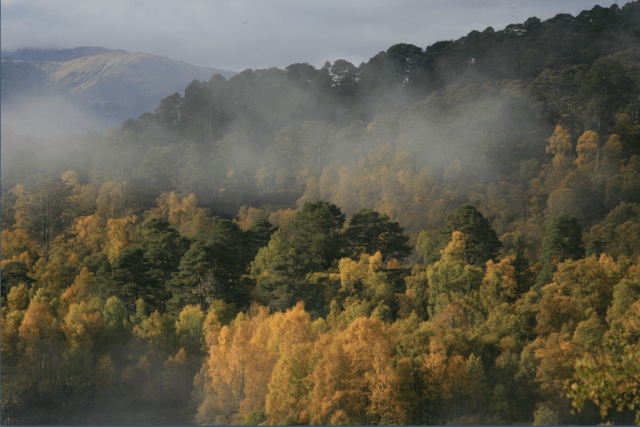
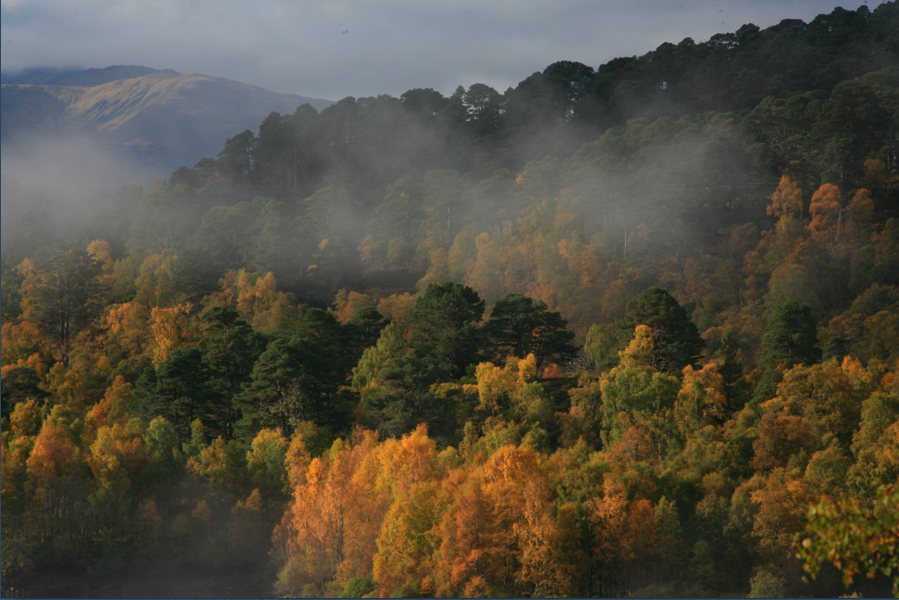
Regenerated Caledonian Forest: Image courtesy of Trees for Life


Posted in Commerce, Environment | Tagged | Leave a comment

Recipe for Lemonade

Just got off the phone with an old friend in the States who is anguishing about the decline in his pension investments, which he makes himself in the US stock market. After several weeks of jittery action and vertiginous movements in the Dow, I can understand the anguish but I did what I could to persuade him that Armageddon had not yet arrived.

Some may consider this just foolish optimism on my part. After all, the world is still struggling to recover from the 2008 financial implosion, profligate PIGS countries are teetering under mounds of debt, threatening the Euro’s very existence, most major English cities are picking up the pieces from the worst riots since the anti-Thatcher wave in the mid-eighties and Scotland is drowning under a St Swithen’s curse of biblical proportions. What’s to be cheerful about?

My first response would be to agree—in the last two weeks the boat trips I’ve been crewing have been cancelled in good weather because of heavy seas and running only in deluges the other 80% of the time. And yet…

…on the two boat trips that I did crew yesterday through the stair rods churning up the sea, passengers had a great time, half even spurning the cabin cowling providing some shelter to sit out on the seats on deck. They were rewarded by spotting a couple of the few remaining puffins, a glimpse of a whale and a pair of guillemots paddling along in the middle of the parental fishing lesson to this year’s chick. The gannets were, as usual, entirely unfazed by the weather, forming a huge ‘flying circus’ spiral Northwest of the Bass and floating along the East cliff edge in unbelievably dense gliding practice. This year’s gugas are now big as their parents, some already dark with adolescent feathers and only a Mohawk of down signaling they’re not quite ready to leave.

Even a Chinese family, unfamiliar with our birds and struggling with our language came back bubbling with enthusiasm. So, when I trudged through the rain to the Spiegeltent for last night’s concert, I was in a better mood than three weeks of poor weather should have allowed. Then Eddi Reader hit the stage. To say that the 600 of us packed in there enjoyed it is gross understatement. For almost two hours the rapport was intense. Her four-piece band were understated accompaniment to her rich variety of music from rocking, clap-along Perfect to a heartbreaking, definitive rendition of Burns Ae Fond Kiss.

At one point she broke into a long Connolly-esque rambling description of her family singalong, based on memories when she was five. Only if The Broons ever gets made into a musical will you witness such well-observed vignettes of savage Glasgow humour, laced with unbridled passion and expressed in song as Eddi mimicked her aunts varied voices and musical tastes—complete with sharp interruptions and even sharper ripostes. A high-energy criac buzzed around the Spiegeltent long after Eddi and the band had left.

Which left me in a good mood today, despite more relentless rain and cancelled boat trips. I was determined not to be put off doing the first of my Walk the Toun history tour contributions to Fringe by the Sea. But when I arrived early, the few people there were sheltering in the food tent next door and the only tickets arriving were for Maggie O’Farrel’s author chat in the Spiegeltent. I had visions of calling off or having to do the walk for the benefit of one or two: O me of little faith!

By showtime, two dozen people were there and ready. Off we went for our 90-minute jaunt through a thousand years and six reinventions of the town, undaunted by weather, by high tide or by traffic at the many street crossings. Perhaps a quarter of the group were local but everybody kept up, asked searching questions and generally joined in so that it felt more like an outdoor seminar with motivated students than anything else. Such was the engagement that we took a half-hour longer than scheduled and I truly hope they enjoyed the mobile talk as much as I enjoyed giving it.

When you have as fascinating material to work with as North Berwick gives you, it’s hard not to get wrapped up in enthusiasm. But when a whole bunch of people—even if they are largely strangers—get wrapped up with you, then you start to understand how a strong sense of place (and identity with it) goes a long way to combat evils far worse than persistently bad weather that life can throw at you.

When life gives you lemons, such things give you the sweetness to make lemonade.

Posted in Uncategorized | Leave a comment

Correction: Sirius

In the Parliamo Politico III blog of February 26th, I cited an example of “Enabling Development”, referring to the incomplete greyhound stadium at Wallyford and citing Sirius as the Developer that had “pocketed the dosh” in connection with the original 100 houses built. I also stated that Sirius had defaulted on their obligation to finish the stadium and provide services to the adjacent business park.

Since then, a major shareholder in the closely held Sirius company has been good enough to take time to explain their side of the matter to me. I now accept that Sirius was not the developer of the homes that were built. The Section 75 planning obligations which Sirius signed up to included completion of the stadium steelwork and provision of utilities for the proposed business park. These obligations were fulfilled, with the understandable exception of running gas services to an empty business park, for health and safety reasons.

I also made comment on Sirius’ attempt to gain consent for a further 94 homes with no “binding commitment” to finish the stadium. I now accept that Sirius was prepared to enter into such a binding commitment to ensure that the funds realised from the sale of this extra land for housing provided for completion of the stadium. I had not appreciated that council policy prohibits legal officials from spending time drafting such commitment if the Planning Department already intends recommending refusal of the application. Since the application had no provision for the business park, as the Local Plan requires, this was the case here. That a binding commitment was unavailable cannot therefore be blamed on Sirius.

I have always believed that building this stadium is desirable and still hope for an acceptable proposal that will allow that. But, because this later application would have eliminated the business park, I remain convinced that the Planning Committee’s refusal, which I supported, was correct. Nonetheless, I regret any implication that Sirius acted with anything less than integrity or with any intent to deceive. I offer my apologies for any distress inaccuracies in my original blog might have caused, especially to those involved with Sirius directly.

Posted in Community, Environment | Tagged | Leave a comment

Being Blacked Out

Regular readers will be used to controversy here—and I hope they believe it’s never just for the sake of it. But even those should hold on to their hats as we’re about to test tolerances in 21st century Britain.

Only those holidaying on Mars will have missed riots erupting in various parts of London and the puzzlement of police spokespeople as to how such dark forces of public disorder could hit out of a clear blue sky. The torching of cars and houses and the looting of shops was no isolated anger at the death of Mark Duggan in Tottenham. Several other London boroughs have further suffered anarchic behaviour, including today’s aerial footage in broad daylight of looting, gratuitous wrecking of businesses and a sporadic running battle with mainly passive police around Hackney station.

On behalf of his community, Tottenham’s MP David Lammy denounced a minority causing the riot; local civic leaders were quick to distance themselves and call for more help taking young people off the streets for a more productive future. All, especially the police, were at pains to dismiss comparisons with 1985. But the footage around Hackney clearly shows four out of five of those hurling bricks, breaking windows, looting shops and surging about as a mob have three things in common: they are young; they are male; they are black. None of the three has been reported.

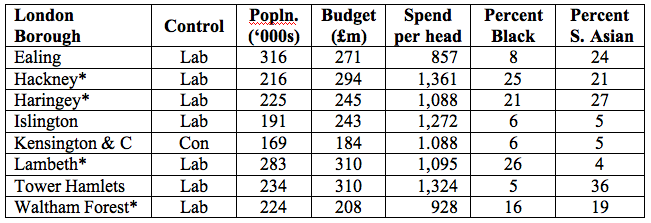
Now, before anyone draws any wrong conclusions, I have lived in Stoke Newington and do not judge people by culture/origin, nor the colour of their skin. But in these events there is a social disaster here everyone is pussy-footing around. And lest anyone think this a white-versus-minority issue, allow me to refer you to the table below.

Demographic Statistics of Selected London Boroughs

The eight boroughs include the four in which recent rioting took place (marked with *) and four others with differing ethnic statistics as contrast. Several factors that might have been linked to the rioting can be discounted by referring to this table:

  1. Political control of the council area is not necessarily associated with rioting
  2. Large percentages of ethnic minority are not necessarily associated with rioting
  3. Relatively less spend per head is not necessarily associated with rioting

But, however unpalatable or un-PC as it may be to highlight it, what stands out is that the four boroughs in which rioting flared are the four with the largest percentage black populations. Note that others with huge ethnic populations (but of South Asians and where most muslims are found) torched no police cars. Whatever genuine grievances there may be among blacks in those four boroughs, they cannot include money when the biggest black populations receive more spend per head than even pukka Kensington & Chelsea residents.

Even allowing for sensitivity to avoid ethnicity when reporting crime, it is still inexcusable that TV/press/politicians/etc have made no mention of this key dimension, one that we must both face up to and deal with. As well as Stoke Newington, I have hung wid da homies in East Oakland, parts of which make Mogadishu look like a model home estate. Their disenfranchisement from the American Dream is so acute that few homies ever make it out of the ghetto (rent Boyz ‘n’ da Hood for a graphic lesson in the reasons).

In London, as in California, South Asians and Chinese found themselves some niche to make a living and then dinned ambition and a hope for a better future into their kids’ heads. But—in Hackney or in Oakland—black kids have the hostility of cultural lepers, the resentment of witnessing someone else’s dream in a country they don’t see as theirs.

It is not just a matter of sensitive policing. Either those hoodies cudgelling Ladbroke’s windows in on Mare Street today start feeling ownership of their patch or it won’t be another 25 years before the next police car gets torched.

Posted in Community, Politics | Tagged | Leave a comment

It Must Be Summer: the Rain’s Less Cold

After July’s doubled rainfall and 1 deg lower temperature, the continuation of unusually dreich summer weather into August was hardly a surprise. But I felt sorry for the Topper championship attendees this week. Coming to North Berwick from all round the UK for their national championship, 272 single-handed yachts brought close to 1,000 people here for the first week of August.

And it wasn’t that they got rained on heavily three of the days in the week they were here: rain matters little to enthusiastic teenage participants in wetsuits who get dunked in the water regularly. It was the lack of wind on those days it rained. To watch the entire fleet straggle in Tuesday last under lowering skies, with the last couple of dozen towed behind rescue RIBS like so many ducklings was to share their frustration.

Toppers straggle home under dark skies in less-than-demanding wind conditions

Thankfully, there were several bright days with plenty of wind so the contest was completed. But the participants’ temporary social centres at ELYC and the Hope Rooms were mobbed with a polyglot of young accents that seemed to be succeeding in keeping their spirits up in what must have been trying circumstances that includedtrying to launch into the lowest tide of the summer.

Toppers trying to launch down a shrunken Fairway: note how low the tide is on Point Garry & the Lamb behind them

As the West Links drained of departing Toppers today, the other end of the town was filling up with three dozen pipe bands and thousands of different visitors as our Highland Games kicked off in cloudy but encouragingly dry weather. Although not as mobbed as I have seen it, the whole proceedings seemed even better organised with a single, larger ring to include the heavies as well as the bands and this gave more space for parking.

The whole thing was in full swing around lunch time, with the dancers huddled in their usual corner, kids in face paint slurping ice cream and the skirl of pipes wafting over the town with the aroma of burgers and the screams of girls on the rides when the forecast heavy clouds rolled up from the Southeast and the heavens opened. Thankfully, they took and hour or two to get the taps fully unscrewed so that proceedings could be completed. But by late afternoon, despite heroic cheerfulness by Chieftain Sir David Tweedie, even the fellow selling twollies (double-shafted umbrellas for two) was for packing up and going home and the parade into town verged on a wash-out.

Clouds lower over the main arena at NBHG. Photo by Derek Braid

The simple law of averages (as well as the long-range forecast) predicts a drier, sunnier August which, with the sellout Fringe by the Sea approaching next week, would be just the ticket. But, if it is wet, the advantage of it being summer is that it’s easier to dry off your legs when you’re wearing shorts and deck shoes.

Posted in Commerce, Community | Tagged | Leave a comment

Standard & Poor Says: Standards Are Poor

As a amateur observer of things economic, it’s hard to feel bad when you’re proved right but I derive no pleasure in having predicted the present fiscal tumble in which stock markets have lost 10% in value and the mighty US of A sees its debt rating drop from top rank AAA to (beginnings-of-a-slippery-slope?) AA+. That this size-nineteen-clodhopper of another shoe dropped surprised few in the business but it is totally unprecedented. It is a maxim in US fiscal circles that the government does not default. Standard & Poor has broken ranks to say “they might”

This shoe dropping will raise pain on everybody’s corns because it pushes up interest rates (mortgages, credit cards, etc) even as the value of investments and pensions erodes. The Republican US Majority Leader might have taken off his Dick Turpin mask at the last minute but those in the know seem unconvinced that enough political resolve to cut spending and limit the US debt exists. That, in turn, takes the wind out of the economy’s sails so that the present weak recovery becomes threatened.

All this would be bad enough were it not for the simultaneous fiscal war going on around the Euro in which poor generalship is leading the Eurozone towards defeat. We banged on about this last month but, with the PIGS (Portugal, Italy, Greece & Spain) all looking ropier in their ability to repay the debt they’ve each taken on, the sheer size of the total makes any bale-out like last month’s extension of Greek debt impossibly large.

Britain—and, by extension, Scotland—may not be directly involved in ether. But such is the global scale of both problems that either deteriorating from here would mean recession; both together would amount to another depression. To give you some idea of the scale of all this, MPs of all parties have been handwringing about the £160bn of debt we landed ourselves (talk of our grandchildren paying it off is no exaggeration: the National Debt from WWI took until the nineties to pay off).

Once, in the heady days of the Clinton administration, talk was of a US budget surplus. But, check out how puny Britain’s debt is in comparison with what Bush doctrines and tax cuts for the rich have done to the US:

Posted in Commerce, Politics | Tagged | Leave a comment

Are We Nuts Overpaying Monkeys?

There has been considerable agitation by public service unions on both sides of the border that workers are being hit severely by Westminster’s austerity programme, whether by pay freeze/cut or benefit loss (especially pension) or even loss of their job entirely. In Scotland, tightened budgets have mostly led to natural job losses as people move on or retire. But that won’t last. And, given that worse is to come, the real question is how best to cope rather than shutting eyes tight in the face of reality.

But one area where tightening remains a foreign concept is in executive pay. The senior management teams (SMT) of councils (Heads of Service, Directors and Chief Executives) have had it pretty good. In 1976, the first pass of local government reorganisation had district councils led by Chief Executives earning 2-3 multiples of the median wage of £4,420 (even trained professionals earned under £8,000). Twenty years later, the present structure of single-tier councils saw SMT pay scales appropriate to regions retained when the median wage had risen over £15,000 and SMTs were led by CEOs with salaries 4-5 times that. (Actual and historical details are fiercely protected by SOLACE).

Recently, median level earnings in the public sector (£28,808 per per annum) has pulled ahead of the private sector (£24,596 per annum), following steady annual increases that the private sector has not seen since pre-2008. But, in the decade and a half since the present 32 councils were set up, it is SMT members who have done extraordinarily well. In steady boosts—such as Glasgow’s 9.2% jump in 2002—every council Chief Executive is now on at least £100,000, with Edinburgh’s new CEO landing £158,000 and Glasgow’s pushing £200k. Current strictures that apply to council staff, the private sector (or, indeed, the real world) don’t seem to apply here. And when you chip in that a council SMT consists of upwards of 15 senior staff on over £75k each, costing each council £1.5m or more, questions need to be asked.

Back in 2002, Sir Neil Macintosh’s review of senior salaries claimed  ”This review is necessary if councils are to continue to attract and retain the best calibre of chief officers by offering competitive salaries in comparison with other authorities and public sector bodies.” Since public sector bodies like SPT are paying £150k to their CEO, this seems like a rather self-serving, circular argument. And none can be claimed as performance-related. The local government bill to the Scottish public a decade ago was half what it is now. Can anyone highlight a council service that’s twice as good as it was ten years ago?

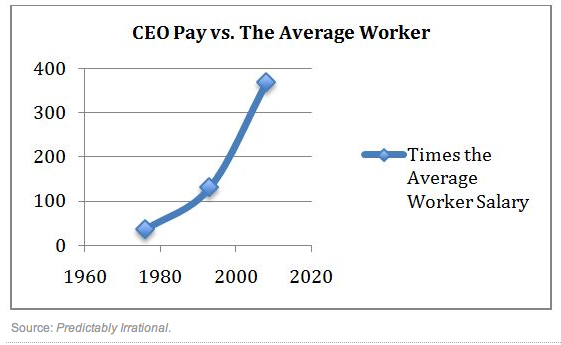
This fraught situation has its parallel in the private sector. Once, CEO’s there were paid a modest multiple of the workers’ wage, much as in the public sector. But look what happened once business growth and ambition combined into a heady mix:

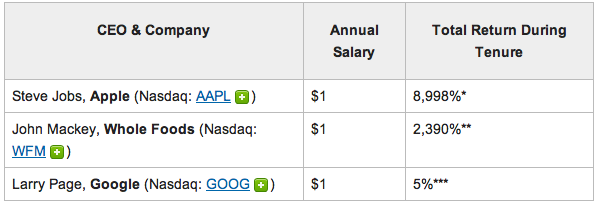
These are astronomical figures, made worse by the fact that, since 1993 salaries were supposed to be geared to efficiency and/or sales growth. So, are our public servants modest by comparison? Do the public actually get a good deal? The answer has to be a firm ‘no’. Not only are councils famously top-heavy as operations but they have proved themselves unable to rationally streamline their operations, let alone exploit business opportunities and build customer loyalty through excellent service. What we need in our public sector apparently exists in the private, namely chief officers prepared to put their money where their mouth is and take performance-related rewards and only token base pay:

So, step up the first council CEO prepared to work for a £1 salary, plus some fraction of the efficiency savings and/or people motivation that they create personally. Their current annual haul is, surely, justified by that, isn’t it? …Hello?…

…Is anyone there?…


Posted in Commerce, Politics | Tagged | 1 Comment

The Lion in Us All

After the eternal navel-gazing of Hackgate, I was delighted to find a real discussion kicked off by Pete Wishart’s article on Britishness in Newsnet Scotland. His open queries came immediately under sustained attack from people whose position seems more like Irish nationalists a century ago than modern Scots. However, over the weekend Newsnet Scotland saw fit to publish a further article on the matter by Paul Kavanaugh that broadens discussion to cultural groups around Europe and how they do not carry the same baggage that “British” still seems to. And, simply because such a range of opinions exists, isn’t it time we Scots sorted ourselves out on this?

I am with Pete and Paul. Despite great respect for Wallace, England is not foreign to me, any more than Ireland or Wales or, for that matter, Orkney, despite each having a culture distinct from my own lowland Scots. I’m delighted to surprise Welsh friends with tales of their ‘Old North’. After the Welsh Gododdin succumbed, this area was English until Malcolm II knocked heads at Carham in 1058, whereupon our Southern cousins soon got too distracted by French-speaking Vikings to ever get it back. Add in a half millennium of our close ties with Flanders, the Hanseatic ports and much of Scandinavia and you start to put our culture on a much broader basis than a London-dominated state that painted a fifth of the world map pink. Yet the word to describe it is ‘British’.

We Scots never really embraced English jingoism. But then, post-Carham, we were never threatened by ‘real’ foreigners, the way the English were by the Armada or Napoleon. And, once the bad taste of Darien was washed away, first, by post-1707 prosperity, then the agricultural and industrial revolutions in which all four ‘British’ nations joined with enthusiasm, the idea of anything other than ‘British’ to describe the team that went on to build the world’s most successful empire would be ludicrous.

If colonial ventures are not to your taste, the manner in which the British stood their ground in two world wars—even when the sacrifice was huge and the post-Dunkirk future hopeless—gives us shared heritage and pride it would be churlish to ignore. Had we nothing else, that we never gave in and faced down Fascism should give us common pride and bonds lasting generations.

I am proud to be an internationalist, with longstanding German, Belgian, American and even Macaoese friends. But, fond of them as I am, none are brothers or sisters in the way those who inhabit these islands are. In Galway and Cork I feel more at home than in the middle of a Gaelic conversation in Stornoway; Cardigan Bay delights me as much as views of Fidra or the Bass; the sleepy lanes of rural Norfolk are even cosier than the back roads of Lothian that I love. Our common culture, as mundane as a good cup of tea or Monty Python humour or the great pop culture Pete refers to, seems obvious to me. If there are barriers to appreciating Yeats or Dylan Thomas, I fail to see them. If I like Vaughan Williams over MacMillan, does that make me English? Or if Capercaillie opens my country’s culture to me while Irish folk leaves me cold, does that make me a xenophobe?

The richness that all of us bring to these islands is surely a matter of celebration and pride. Sweden once dominated Scandinavia as Spain once occupied all of Portugal. but Greig and Sibelius, Munch and Nokia, not to mention Telemark skiing and saunas are just some of the contributions their neighbours have made to not just Scandinavian culture but to the world. With its centuries of broad links with the wider world and its history of amicable, active ties with Celtic brethren, Scotland, which has contributed so much to ‘British’ culture to date, has a pivotal role to play in its future—once we sort out this ‘last colony’ anachronism among some of our more benighted English cousins.

Posted in Community, Politics | 1 Comment

Crime and Punishment

Posted in Uncategorized | Leave a comment