Changing Course or Deckchairs?

It seems that my ex-opponent is as good as his word. Within 24 hours of standing tight-lipped across from me as the ERO confirmed his 151 majority and having heard the scale of the SNP victory elsewhere, he declared:

“There are many hard lessons we must take forward from this election, not least my own responsibility and role as the Scottish Labour Leader. After consulting with colleagues I have decided to stay on until the autumn as we conduct a fundamental and radical reappraisal of the structure and direction of Scottish Labour.”

This weekend saw the first step. Labour’s “biggest shake-up in 90 years” considers radical proposals for constitution and leader. These are to be debated at UK party conference in September. Then, at a special Scottish Labour Party conference on 29 October, the leadership process will begin. Highlights of the proposals are:

  • devolution for the party “on Scottish matters”
  • all party members (not just MSPs) eligible to stand as leader
  • leader to be for the whole Scottish Party, not just MSP group
  • redrawing CLP boundaries on Holyrood, not Westminster constituencies

Labour’s performance over the summer has not been impressive. Given the scale of their gubbing, their diminished ranks and loss of access to advice from Holyrood mandarins after 2007, this may be understandable. Iain Gray’s performance on his feet has actually got better. But the substance of Labour opposition, as when his response to Salmond failed to posit any alternative, or when Patricia Ferguson accused Fiona Hyslop of a ‘blunder’ in the EU debate is still substandard. 

But—so far—I congratulate them; no ancient organisation changes itself easily and one in the public spotlight is especially hard to shift off-course. It was not with malice that I suggested as much in April’s article in Newsnet Scotland. And, for all the sincerity about reform from Gray, Murphy, et al, what chance do they have of succeeding?

Ninety years ago, the party sang The Red Flag with authority, speaking up for the industrial workers of Britain against exploitation. They expanded into the party of aspiration for workers and protectors of the weak. Even under Wilson or Callaghan, this heritage was plain and worn on its sleeve. Unfortunately, Britain de-industrialised and, pre-Blair, Thatcher lured many aspirationals into the Tory camp.

After decades of class warfare in Scotland and entrenched municipalism in its cities and across its own ex-industrial belt, Scottish Labour lost sight of what it was for and exerted all its energy defending what it had. If Labour had a heyday in Scotland, it was embodied in Strathclyde Region. Although SRC begat SPT, the water referendum and anti-Thatcher actions, it also invented glacial self-interest common to Labour councils across Scotland. Three decades later, what structure props up Scottish Labour now?

  • CLPs now virtually non-existent outside of cities & ex-industrial areas
  • membership halved to 15,000 since the run-up to 1997 peak of 30,000
  • councillor numbers have halved from over 600 to barely 300
  • only 3 councils (out of 32) are under Labour’s full control now
  • any reputation for competence damaged by Holyrood performances
While the last of these five points has encouraged a drift of voters to other parties, it is the other four that are hampering Labour’s effectiveness in any fight-back. “For too long Labour has undervalued the vital work that councillors do in the party and in their local communities.” (David Martin MEP in Scotland on Sunday).And here’s the rub: the whole shebang was driven by local clubs (Labour or Miners’) and a career path from member to activist to councillor to convener to MP/MSP/MEP. In my own East Lothian, three of four Labour Clubs have closed and the couple of Miners’ Clubs still on their feet are wobbly. But they and the councillors were contact points that kept party and people in touch.

But post-Blair activists are now close to extinct. Members in the clubs like the criac and the cheap beer; they don’t even mind getting herded into vans to stuff leaflets through doors. But the clubs’ days of fervent debate and dedicated work are history. With STV in councils and Salmond’s Holyrood sweep, the career path has also been scuppered. And compensating effort that could once be called in from parliamentarian staffs has now been more than halved.

So the real question for Labour’s apparent good intentions is: Is it all too late? Apart from the high heid yins and the largely apolitical social membership, just who is there left to have their debate, let alone man the fight-back? Or is the whole process flawed and, in Brian Donohoe MP’s dismissive words “crass stupidity”?

Posted in Politics | Tagged | Leave a comment

Calling All Unionists

 “Unfortunately, it is true that only one side is even on the park playing in this match.” Lord McConnell of Glenscorrodale, Scotland’s first minister from 2001 to 2007, on the proposed Independence Referendum. The Scotsman, Sep. 7th 2011.

“We need someone people will listen to; this should not be restricted to the 36-or-so MSPs” former Chancellor Alastair Darling MP, speaking on Labour’s leadership contest, Good Morning Scotland BBC, Sep 7th 2011.

As has been said in the last blog, we live in strange times. After over 100 days for the political chatteratti and nomenklatura of all stripes who run Scotland to come to terms with the unprecedented result of May’s election, the silence from Unionists lambs verges on the deafening. The SNP called the event ‘historic’ and have busied themselves over the summer with building on the political momentum it generated. The only efforts to derail that momentum are a few apopleptic splutterings from the CBI and a border raid by Danny Alexander who galloped north to fling down his half-dozen questions before galloping off without waiting to see if anyone answered.

This was, according to Joan McAlpine, part of a co-ordinated plan to resist the SNP and all its works. The problem seems to be that nobody north of the border either knows about it or has the stomach to do more than stare at their feet when elbowed to get with this programme. Let’s be clear about this; the next five years will be as pivotal for Scotland’s future as the decade that followed Scotland’s near-bankruptcy in the odious Darien disaster and the scramble of self-interest that led to the 1707 union.

Love or loathe the SNP, they now have both the will and the means to take Scotland to independence. Whether they do requires some intense debate over many details, and not just a simple ‘yes’ or ‘no’. To hear the pro side of the argument, grab your local SNP member over a coffee a pint or lunch and get talking. Finding one isn’t hard these days—there are over 15,000 members and 902,915 people who voted for them. By all means ask hard questions but listen to the answers too—the SNP has been thinking about independence for decades and has its own proposals for which currency, whether the Queen should stay, what sort of armed forces, etc.

MORI Poll of Sep. 3rd 2011. Note the SNP Lead Has Grown since May's Election

But finding someone to make the opposing case is nigh-impossible. The papers are full of dinosaurs like Michael Forsyth mumbling the same unsubstantiated predictions of disaster they did decades ago. Where is the opposition? Well, the Lib-Dems—whether from entering UK coalition or not—have managed to machine-gun their feet so they’re barely standing. The Tories are locked in internecine rammies along “to be or not to be” lines. And Labour? Well, Jack’s observation of there not being another team on the park reflects more on his old colleagues than on anyone else.

Scotland deserves better.

For the main (only?) opposition party to faff about leaderless for months, doing little but spitting venom and looking surly when the country it claims to love stands on the brink, is reprehensible. There surely must be unionist arguments to make and Labour should lead in making them. I therefore offer articulate unionists (not an oxymoron but I sometimes wonder) this blog as a platform to make their case. This will not be a comment but a full blog with title. As long as it is not libellous, I will print it. And if the arguments are good, I will try to parry them.

Scotland needs this debate; let’s get it going.

Posted in Politics | Tagged | Leave a comment

“Murdo!” He Wrote

We live in strange times. Wind the clock back a quarter century and Scotland was an unsightly pimple on the alabaster edifice of Thatcherism and about to get handbagged by the Sermon on the Mound.  To suggest then that the Tory party would voluntarily disintegrate to placate the Scots would have got you certified. Yet that is exactly what Murdo Fraser, leading contender for the poisoned chalice of Tory leadership in Scotland, is advocating.

Now, Murdo is neither daft nor inexperienced—although he may be a little punchy, having, like most of his colleagues, been comprehensively gubbed in every constituency election since the early nineties. But he believes ‘Tory’ “has become a toxic brand” in Scotland, so his solution is “to wind up the Conservative party in Scotland and re-establish it as a new centre-right Scottish party.”

There are two major problems with this logical—and possibly even sensible—proposal:

  1. It is actually called “The Conservative and Unionist Party”. Ignoring for a moment that the ‘unionist’ bit refers to union with Ireland, there is a real cognitive dissonance about a unionist party splitting to preserve a union.
  2. Despite the obvious advantage to English Tories in offloading Scotland with its stubborn insistence on sending anyone but Tory MPs to Westminster, there is almost no support, either in Cameron’s cabinet or in the twinset-and-pearls party backbone for ditching us Scots, however intransigent.

This makes the job to which he aspires almost impossibly hard: he either fights his party, dominated as it still is by the harumphing backwoodsmen of the English shires; or he faces a Scotland resurgent with prickliness towards being told what to do or being treated as another region of England—both longstanding Tory habits. When elections were a straight fight between Tory & Labour, the battle was a familiar one to Tories—fought on the same left vs right lines, whether in Bishopbriggs or Bishop Stortford.

But Scottish politics has changed significantly. Voters of all stripes are now happily following Aladair Gray’s dictum: “work as if you live in the early days of a better nation”. For all Tories claim to be the party of business and progress, that mantle sits comfortably on a dominant SNP; Tories are scrambling to find relevance. Their clear ‘right-of centre’ rôle in England finds little relevance in Scotland any more.

It is not simply enough to trace the almost total extinction of Tory MPs in Scotland, from a majority in 1955 to a persistently risible 1 since devolution. The rot is also deep at local level. Trailing as the fifth party in councils (dropping 30 councillors to 143 in 2007—fewer even than independents), Tories verge on irrelevant, with partial control in only three administrations (out of 32). In my own East Lothian, their vote has slipped from a 15,500/28% second place to a 5,300/16% poor third. More telling is that their in-with-the-bricks local radar of councillors had dropped from seven to two.

And it is here, in growing, dynamic areas like East Lothian that Tory shortcomings hit home. Not only are they perceived as an alien party right across the county but they have lost ground in their ‘natural’ support—the 10,000 aspirational residents in new estates across the county; those have gone solidly for the SNP. More than anything, this explains why Murdo’s party keeps on flatlining.

This weekend’s Mori Poll puts the SNP on 49% and the Tories on 12%, which implies that, whatever the course taken, they must do something to escape electoral oblivion.

“I think that what Murdo Fraser is saying is very refreshing.  In broad terms, I welcome it.”—Sir Malcolm Rifkind MP, once of East Lothian, whose faith in a Scots Tory future might be deduced from his now representing Kensington & Chelsea.

After over a decade in this state, it takes a brave soul to predict a recovery and an even braver soul to prescribe the radical medicine that will pour life into as stiff a cadaver as the Scottish Tories have become. Murdo Fraser may be just that radical soul. But, while some may wait with bated breath for Murdo on the Ormiston Express, my (and, I suspect the smart) money will be going on And Then There Were None.

Posted in Politics | Tagged | Leave a comment

Hats Off to Pat

This blog has never been shy when it came to criticism. Given my SNP background, it may be expected that it would be particularly harsh with perceived faults in other parties. And, given decades of dominance of my beloved East Lothian by them, its criticism of Labour has been especially crisp.

But, last night, at the conference dinner of the Association of Nationalist Councillors (ANC) at Airth, a Labour man through and through won the hearts—if not the loyalty—of those present with an after-dinner speech that demonstrated in spades why the looming retirement of Cllr. Pat Watters as President of CoSLA will be a loss to local government in Scotland—and to politicians of all stripes.

It wasn’t just that Pat had walked cheerfully into our lions’ den or that he took and returned Derek Mackay’s barbed banter, or that he gave as flowing and amusing an after-dinner speech as I’ve heard. It was how he took the measure of his audience and seemed to speak to each, as only someone with years of skill at the top of their game could.

With almost thirty years of success in Lanarkshire politics and three terms as CoSLA President behind him, Pat certainly has experience in depth. Also, his CBE and last year’s Herald Local Politician of the Year Award are signs that I’m far from alone in seeing this rising above party politics. In my first two terms as a backbench councillor, CoSLA delegates were overwhelmingly Labour. I came to see the organisation as a tool of that party. But post-May 2007 opened my eyes.

Because in summer 2007, I began attending CoSLA Leaders’ Meetings and worked with  Pat for the first time. The huge changes in council composition, with no party dominant were reflected in CoSLA and Pat was faced with what must have been one of the toughest periods in his career, requiring resolute efforts to steer CoSLA through many choppy meetings so that it was respected—by all parties—as diligently following its core brief: to speak objectively for all Scotland’s 32 councils.

Achieving this did unlock major progress over the last four years, including Single Outcome Agreements including all public services (not just councils), council tax freeze, progress on Single Status with staff and a removal of ring-fencing of funds that allowed councils freedom to set their own priorities. “Parity of Esteem” became a reality. Many others were involved in all this but Pat steered CoSLA (and, by extension, councils) towards the possible and stood his ground when necessary to make it happen. But where he deserves huge kudos was in retaining his Labour credentials unsullied while championing the best interests of Scottish local government.

Even seasoned political observers like Brian Taylor have written pieces betraying their surprise that Pat handled things as astutely as he did. And this, I think, is the measure of the man—hard to find someone in the business who does not respect his ability and integrity, but harder to find someone who will be able to discern that quite unexpected direction that a sharp political mind will discern as the next step required.

Scottish local politics (and the good people of East Kilbride he has represented so well for so long) still have until next May to appreciate him. Working with him has been, for me, an education in how politics is indeed the art of the possible. I mean no disrespect to fellow councillors of any party in Scotland if I say Pat’s will be a tough act to follow.

Pat Watters in Typical Negotiating Mode

Posted in Politics | Tagged | Leave a comment

Gimme a Break

For those of you rushing here to catch the latest spiky iconoclasm, sorry to disappoint. It strikes me that this blog is taking itself entirely too seriously and that you, gentle reader, would be appreciative if I were to climb down off the soapbox for once. With a good summer crewing the boats out to the islands behind me and an even better final week of August in Portugal just beginning to lose its sun-bright immediacy, why not?

Despite intense traffic and soaring cranes, Portugal was as I remembered it. The bica coffee was just as pungent, the Porco Alentejo  (pork with clam sauce) just as tasty and the warren of alleys of Lisbon’s Alfama just as indecipherable. Where else can you get several dozen snappily dressed students surfing the web amidst ancient tomes stuffed into teetering 18th © shelves and wallfulls of classic azulejo tiles than in the Central Library?

Reception in Central Library, Campo Pequeno, Lisbon

The Portuguese are very proud of their long history (independent since 1160; the main square of Restauradores celebrates their liberation in June 1660 from domination by the then all-powerful Spanish crown). They had a magnificent renaissance city in Lisbon, built on the riches shipped from the Indies on trade routes they had pioneered before its almost total destruction in an earthquake and tsunami in 1755.

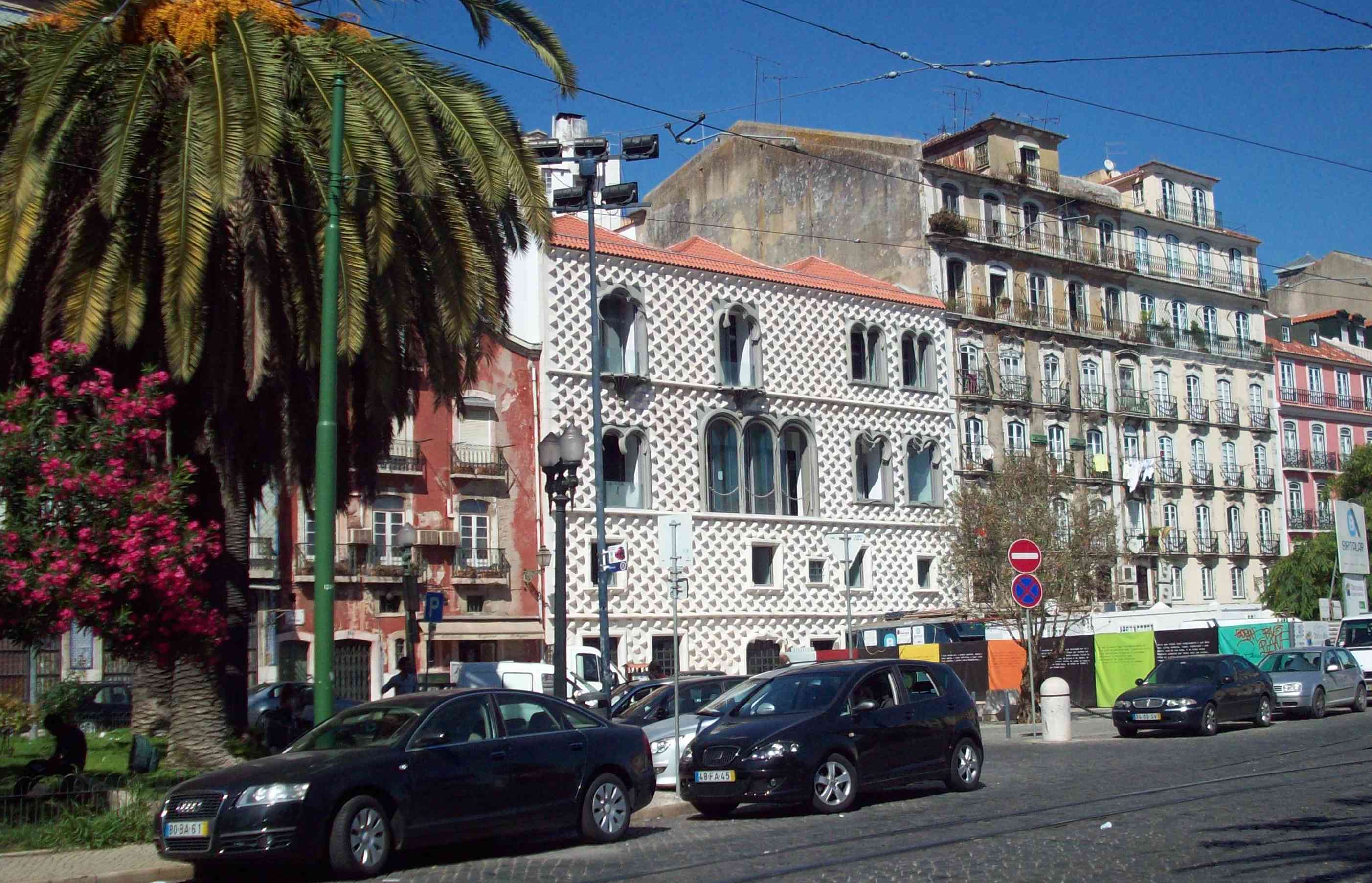
The Sole Residence to Survive the 1755 Earthquake (centre picture)

They rebuilt the centre of the city adjacent to the Tagus and called Baixo (“Low Part”) in an orderly grid that, gridlocked with traffic forty years ago, has served them well as a pedestrian shopping district more recently.

Looking Across the Baixo to the Century-old Lift that Serves the Barrio Alto

On either side of the Baixo are two rabbit warrens of streets that have never seen much redevelopment and are therefore a joy to explore; the Alfama encircles the Moorish Castelo Sāo Jorge that dominates the city; the Bairro Alto is home to that most deeply Portuguese of entertainments—two dark-clad, serious guitar players accompanying an even more serious woman singing fado.

Tagus River Seen over the Rooftops of the Alfama

Lisbon is one of my three top cities—livable, human-scale and crammed with characterful inhabitants. Plus, on 25 April 1974, they had a revolution to throw out a fascist dictator and no-one got killed. The proud symbol of the revolution was a FN rifle with a carnation in the barrel; my kind of revolution; my kind of people

Posted in Uncategorized | Tagged | Leave a comment

Let’s Kill All the Councils, Let’s Kill ‘Em Tonight!

The Welsh Government seems to have got itself in hot water for treading where no other devolved administration has dared to tread—into the morass of local government reform. Given that England has been in a constant low-level turmoil for decades (Berwick-on-Tweed’s District Council is still grumping about being folded into a unitary Northumberland three years ago), the peace and quiet on this front in Scotland since 1996 has suited most of us associated with local government.

But that was before the recent savage reductions in monies going to councils set sundry spokespersons dutifully nodding that something radical was going to be necessary to make shrinking funds stretch to cover all the services the public required. After one year of austerity, pips aren’t squeaking yet—but, as there are at least four more years to go, they will soon.

The problem seems to be that, for fear of taking the kind of radical plunge Wales is considering (six to replace the present 22) Scotland is, at best, dabbling. This whole furore about a single police force is deckchair-rearrangment thinking if we don’t have a local structure into which it would sensibly fit. The recent Christie Commission pretty much tip-toed around the elephant in the room too and Ministers of all stripes have steered well clear of even broaching the possibility of change.

This would be tolerable if the present efforts at shared services either between councils or with other public bodies were developing robust alternatives. But with West Dunbartonshire baling from the Clyde Valley pilot and only a couple of tentative education projects (Stirling/Clacks; East/Mid-lothian) still in play, no serious dent in the projected £3.7bn council shortfall has yet been identified. The multiplicity of little bureaucratic worlds that passes for public services in Scotland: 32 councils, 8 police or fire boards, over a dozen health boards, a jumble of city region planning areas, transport authorities of uneven powers, etc. constitute a dog’s breakfast—whether created by a Tory gerrymander or not. The point is this: it ain’t fit for 21st © purpose.

So, do we take out all the councils and shoot ‘em? Well, yeah. Because what we really need is four city regions, plus two rural areas (N and S) to handle all the ‘big stuff’. Take every public service in those six areas—including health, police, fire, strategic planning, water and transport—and put them under a single, major elected body. Sole exceptions should be very local services like planning, business and civic cleansing/maintenance. These would come under reconstituted burghs in those communities that wanted local accountability. But these would be tiny councils (5 people) steering a town manager and handful of employees—all else would be contracted out.

Half the unaccountable nomenklatura of boards across Scotland would get their jotters at that same time that efficiencies of scale would be available in each region. Squeals that this would be disaster will come from SOLACE, CoSLA, Unison, EIS and the usual ‘aye been’ suspects. They’ve had 15 years to improve what’s in place now—yet did little but grow work forces and salaries. It’s time to meet their complacency head-on if we want all the services we now enjoy to still be delivered with £3.7bn less finance.

Both the Eagles and Shakespeare’s Henry VI were right in their homicidal urges; they just got their target wrong.

Posted in Community, Politics | Tagged | 2 Comments

This Month’s Oxter Award

It’s the traditional political Silly Season when major politicians and those that hound them are generally off on some sun-baked beach, August is a month we have to cast about to find a decent candidate deserving opprobrium. Yet, there in Hootsmon on Sunday was Cllr. Andrew Burns doing a head-and-shoulders-above act, crowned by leading Labour’s Orwellian volte-face and gang-up-with-Tories opportunism at ECC’s most recent bout of self-immolation on the Trams.

To be fair to Andrew, he does call his blog “Andrew Burns Really Bad Blog” and tried to package his pitch by starting with unaccustomed apology:

“They (the public] are absolutely due an apology. I am personally extremely sorry for the way that it has unraveled in the last four or five years. Quite clearly it has had a very, very sorry history, particularly since the middle of 2007 when there has been no clear leadership or vision. It has completely unraveled in that time and people are absolutely right to be angry and annoyed about it. I am pretty dismayed myself.”

But soon his two real purposes became apparent: 1) to distance Labour (and himself) from the present good-option-free tram shambles and; 2) to blame the ‘unraveling’ on the 2007-2012 Lib-Dem/SNP administration of ECC. While such tactics verge on the astute, any long-term observer of the tram saga is immediately faced with a barrage of questions that leaves Emperor Burns with nary a stitch of credible clothing.

For it was he, as disciple paddling into the shoes of now-Professor David Begg who, together with Leader Donald Anderson and Transport Minister Iain Gray, cooked up the whole tram scheme in 2002-3. Questions that should have graced Cllr. Burns In-Tray as Executive Member for Transport and Public Realm and received considered answer at that time were:

  1. Could justification for Line 1 be sustained in the event of a property collapse in the ‘Edinburgh Waterfront’ (as actually happened in 2008)?
  2. Was any full business plan for Line 2 to the airport prepared that compared alternatives, like reopening Turnhouse station, ever produced?
  3. Could a £375m budget for Line 1 suddenly, and without fully revisiting the business plan, be deemed adequate to finance Line 2 as well?
  4. Were preparatory works and TIE/consultants properly supervised, especially regarding revenue loss to local business, including Lothian Buses?
  5. Could Line 1’s mostly on-street route be justified when a plethora of disused rail lines across North Edinburgh offered faster, cheaper options?
  6. Why build another system independent of both train or bus when all modern cities operate start-to-end tickets that encourage transfers and speed loading?

(Hint: the answer to each of the six questions posed is a variant of ‘No’.) Had most of those questions been addressed on Burns’ watch, the whole Line 2 to the airport might never have started and a Line 1 ‘North Loop’ might have been built within the $375m budget, giving Edinburgh an overdue start on a city-wide transport scheme.

It’s not easy to become a senior councillor like Andrew Burns without deploying guile. But his position on last week’s Haymarket choice went well beyond to bare-faced shameless. It must have been hard for him to keep a straight face. As someone responsible for:

  • the wrong original choice of tram scheme and implementation
  • spineless acquiescence to flawed major modifications
  • seven years of head-in-the-sand refusal to admit his own original mistakes
  • four years of thwarting an administration trying to rid the city of his mess

Cllr. Burns makes clear he is no ordinary politician; he is a careerist who will say anything to please his party and further his career (often hard to perceive the difference). To call him ‘sleekit’ is an insult to tim’rous beasties everywhere.

If the Scottish—and especially the Edinburgh—public are scunnered with two-faced politicos who would not know a principle—let alone a good idea—if they found one in their soup, then it’s thanks to the likes of Mrs Burns’ laddie. Unlike the faceless voting fodder who typically fill the elected ranks of his party, he was given talent that could have been applied to wider public benefit.

Instead, he chose rent-a-mob posturing that secures party advancement. And, since yesterday’s article made plain he won’t (can’t?) deviate from that (where else could he get a job on a par with Opposition Leader now that Labour’s patronage is oot the windae?) we have no hesitation in fingering him for the Oxter Award this month.

Posted in Politics, Transport | Tagged | Leave a comment

One He Made Earlier?

So Cllr Burns blames the Lib-Dems and SNP for the trams debacle. Inevitable as such self-serving guff may be, I still smacked my forehead in disgust—perhaps too hard…

…bzzztschhkkooee…

…With hindsight, it seems fortunate that Cllr Andrew Burns fell on his head that night in 2003, For, how else would he have had those inspired brainwaves that helped him persuade the then Scottish Transport Minister, Iain Gray, to divert £350m from an ill-conceived tram project into a transport suite of genius, a beacon for creative city transport around the world? Had the original airport tram gone ahead, it might have cost £1bn or might, despite all disruptions, have never been completed. How unthinkable!

But, luckily, Messrs Burns and Gray were clear-sighted men, seeing a tram to serve an airport that already had a major train line at the end of the runway for what it was: a white elephant ‘prestige’ project, short-sighted as London tying Heathrow to its sluggish Tube. As a result, the £17m spent on reopening Turnhouse station in 2009 and linking it to the air terminal with back-to-back shuttles gave a faster, more cost-effective solution than a tram via Sighthill. The passenger surge made Network Rail bump electrification of the Forth Bridge/Fife line above its EGIP priority agenda.

Another £110m was used to link the Brunstane spur round the South Suburban line, including reopened stations at Craigmillar, Cameron Toll, Newington, Morningside, Merchiston and Gorgie. As infrastructure and rolling stock were mostly in place, it was a big bang for our buck. But the stroke of genius was running trains into the under-used Platform 0 at Haymarket to provide easy interchange with the planned trams while avoiding adding to bottlenecks in the Princes Street tunnels.

Then, when an improved ‘circular’ tram plan was introduced in 2012, Haymarket flowered as the major interchange for suburban, tram and airport with western distance routes. And by using the still-extant track beds around northern Edinburgh, this whole area was linked up with no major road or business disruption.

Starting at Haymarket, Line 1 linked Haymarket with Murrayfield, Craigleith, Crewe Toll and Granton. The line then looped through Trinity to Broughton Road before using the old Scotland Street tunnel to give express access to Waverley station where the rebuilt platforms 20 and 1 stood. This fast, direct access to the city centre gave a shot in the arm to moribund Edinburgh waterfront developments.

By 2014, a new Line 4 ran on from here, using Carlton North and Abbeyhill loop to provide good access to Holyrood before using the old Leith Central line to reach Leith and Pacific Quay. Since the South Suburban now ran from bays on the East side of Waverley, this provided easy N/E/S link interchange, similar to Haymarket’s.

A Transport Map for Edinburgh. Since It Includes No Hoverferry to Fife, Can It Be a Wet Dream?

As the suburban rail improvements included running half East Lothian trains through the South Suburban and on to the airport, plans for Lines 2 & 3 were scrapped as unnecessary. Total tram costs were then held at £220m, much of which was heavy rail re-routing at Waverley/Carlton. This left £3m of the original £350m surplus to look at system improvement, with introducing a long overdue ‘Oyster’ card high on the list.

It was surprise enough that Labour held Edinburgh against the flow in 2007, but when Cllr Burns’ was carried shoulder-high to the City Chambers by businessmen delighted at the growth of trade across the newly-accessible city, accolades were widespread: Eight new stations; two new tram lines; a city-wide fast backbone for its excellent buses—all within original budget; all working like an integrated transport system. Asked if he planned to put his name forward to replace his old colleague Gray as Labour Leader, Burns said: “this all sounds like a dream…”

…bzzztschhkkooee…

…or did I just hit my head?

Posted in Transport | Tagged | Leave a comment

All Roads Lead to Lisbon

Since spending probably my best summer ever as a 23-year-old waiter in the Algarve, I have had a soft spot for Portugal, its people and especially its fading-grande-dame-but-still-a-babe capital, Lisbon. Down for just a week for my first visit in years to catch an old friend in town from Macao, I see it for the first time from a political perspective—and it is an eye-opener.

Portuguese debt and imminent default not withstanding, the place is buzzing. New malls have appeared in the Bairro Alto and even under the bullring at Campo Pequeno; new Metro stops; new trams vie with ancient ones to snake round the Baixo; the airport has a new wing longer even than Schipol’s. Once the province of British exports, the double-decker buses are gone and an integrated system has arrival indicators at all but the smallest stops.

Old Tram in the Baixo—Unlike Edinburgh, Lisbon never Tore up its Tram System

If this is a place tightening its belt, there is little sign of it: building sites are many; cafes and shops are full; the raparigas in the Rossio are lithe and glamourously dressed. Only on the financial pages of Diario de Noticias (local ‘quality’ paper) is anything approaching an alarm bell ringing. They are on about the scale of debt building infrastructure. With generous EU support, over the last decade Portugal has embarked on a roads-building programme that makes ours look look like a Green wet dream.

Portugal is roughly the area of Scotland (31,000 sq. miles) but with twice the population (10.5m). What they have going for them is a latin culture of family and enterprise but without the frenetic edge their Iberian neighbours the Spanish seem to put on life.

The result is a wonderful combination of the laid-back with the opportunistic. They have sold the EU on the need for serious infrastructure development. Twenty-one separate road projects interlace the country for a dizzy total of €9.57bn in major road projects. How the PPP piper is to be paid for this veritable orchestral suite is for the next generation to worry about.

Best of all, much generous finance comes direct from the EU. As examples, the single-line railway that winds through the hilly countryside of Beja to the Algarve has been electrified, although carrying only five return trains daily between Lisbon and Faro. Despite fully functioning bridges across the Tagus to Santarem and Setubal, “The Lusaponte” has now been built in between across the widest extent of the bay at a cost of €898m.

If Scotland were Portugal, not only would the A9 be dualled and another Forth crossing completed but the A77, A1, A76 and A96 would all be dualled too and rail lines to Aberdeen, Inverness and Stranraer electrified—all at a cost of only 20% to the Scottish taxpayer.

And it’s not just in big stuff that Portugal seems to have an advantage: a large beer is €2 even in the tourist areas and an expresso anywhere costs half what it does in Scotland. Considering they have no oil, the fact that petrol’s cheaper than in Scotland verges on being an insult. If this is a country in fiscal trouble, maybe it’s time Scotland thought about courting bankruptcy itself.

Sign on the Lisbon-Algarve Railway

Posted in Commerce, Politics, Transport | Tagged | Leave a comment

Don’t Outlaw What Matters

A leader in Scotland on Sunday, remarkable both in its six-line brevity and in its esoteric subject, caught the eye yesterday. Glasdelphia was agog with Pittmania and Tripoli was slipping from Ghaddafi’s feverish grip. But this leader was about a topic so obscure that few Scots can know the story—whether an unassuming man from Port of Ness and nine chosen others can continue do what his Nessmen forebears have done since they were subjects of a Viking Earl of Orkney.

For the last two decades, Dods McFarlane has led the annual guga hunt to ‘The Rock’ in late August. Gugas are this year’s gannet chicks ready to fledge. Fed, to a bouncing 3kg or more, they make a meal rich in fat and protein. After the 1869 Preservation of Seabirds Act, 1930’s evacuation of St Kilda left Ness as the last place to harvest birds. Even the new 1954 Act preserved their right to take 2,000 guga.

As you can imagine, such practice sits ill with crusaders of RSPB and SNH. They see this as wanton destruction of the natural habitat by cruel methods. I may be wrong in this but I imagine that the 99% of Scots who have either never seen the business end of a gannet or who class any hunting with Scotland’s exclusive shooting estates would side with such well intentioned environmentalists. But they shouldn’t.

Before explaining why, let me say that gannets are magnificent—the largest seabird in the North Atlantic, a graceful, two-metre wingspan carrying a teardrop-streamlined body, tipped with penetrating golden eyes and a wicked 10cm beak. As embodiment of natural elegance or an exercise in distance flying aerodynamics, they are hard to beat. They are also fearless and devoted parents, migrating to Africa only after their one chick has fledged and left. No one who knows gannets would go near without expecting fierce attacks from those beaks. Other birds may fly off but gannets will fiercely defend nest and chick against all comers—including other gannets.

The combination of fierceness with protection means that gannets are not a threatened species. Bass Rock went from 10,000 to almost 140,000 in fifty years. What IS a threatened species is the group of men that Dods leads forty miles out from the Butt of Lewis to spend a week on Sulasgeir (‘Gannet Rock’ in Norse) collecting the haul. It is an epic of fortitude, skill, teamwork and understanding that is—quite rightly—seen as a rite of passage by the young men of Ness. Nothing expands understanding like exposure to nature in the raw; nothing binds people together like shared danger. Both are now rare in our over-cultured Western lifestyle.

The trip to Sulasgeir is full of both.

Leaving in the dark in a local trawler, they land at dawn on the bare rock and offload water, peat, supplies and precious few personal items in Geodha a Phuill Bhain, the most sheltered corner that passes for a harbour. Landed and alone with themselves, they drag everything 50m up to the waist of the bare island to where the shells of beehive bothies stand. Using tarpaulins, fishing net and stones to weigh the roofs down, they make them watertight. All this is done in the middle of 30,000 gannets pecking at them and 20,000 fulmars who spit a pungent, clinging oil at anyone who comes near them.

For the next week, teams of surefooted hunters scramble the cliffs of Sulasgeir—one roped for safety uses a fowling pole to snare a mature guga by the neck, lift and swing it to the other team member on steadier ground who kills and releases its limp body. These men are not free climbing in bare feet at 2,000ft above the sea, as St Kildans once did. But it takes guts and skill that few would find in themselves.

As the gugas are brought to the ‘village’ another team plucks the feathers and still another passes the plucked bird through the flames of a peat fire to singe off any remaining down. Then each guga is spilt open, gutted and placed neatly in a circular pile resembling a broch, a special pickling liquid poured in the middle to preserve them and left to percolate for the balance of the trip. After a week, everything is dismantled and lugged back down to the returned trawler.

One or other passage, whether to or from, is always rough, the seas being those of the wide Atlantic. Yet the ten return home, not as heroes but simply as men of integrity, contributors, proud of what they have done with little fuss, bonded together through their ordeal on unforgiving rock under fierce weathers and the interdependence they share. There are no fanfares; there are no media. On the pier at Ness the gugas are apportioned evenly and made ready for sale, along with crabs, lobsters and what long lines have caught.

It matters little whether you share their taste for this delicacy (“somewhere between chicken and kippers” is the description). Unless we all go vegan, factory farming will fill our supermarket shelves with meats and meat products. We define that as ‘humane’ because it conveniently supplies us with cheap food. Does that make us so civilised that there’s no place for modest ritual of man against nature, that allows successive generations to relive their common history. As well as gugas, each Nessman fills his store of tales to relate as a source of pride in who he is and where he is from. By what right should pencil-pushers in Inverness or Edinburgh be able to take all that away?

Posted in Community, Environment | Tagged | Leave a comment