Macho White Heffalumps

Ever since The Defence Minister Philip Hammond started backpedalling last week, there has been more than a whiff of panic in the air over the two monster aircraft carriers so beloved by the Lords at the Admirality (as CPO Pertwee once dubbed them on the Navy Lark). Apart from that comment showing my age, it also makes me old enough to remember the last time the UK deployed ‘real’ carriers in the 1950’s—and to question why we need any new ones at all.

Back then, there was some military rationale for carriers. WW2 taught the lesson that air supremacy is vital to any operation and the most flexible way to apply it, especially to a far-flung maritime empire such as Britain still had then. With all the pre-war fleet carriers, plus various classes of light and escort carriers all decommissioned before the Korean War, the remaining two Audacious (Fleet) four Centaur (Fleet) and four Colossus (despite the name, Light) class carriers did sterling service both there and the later Suez debacle.

But planes grew ever faster and heavier and no UK carrier (except HMS Hermes) was provided with a proper angled flight deck that allowed simultaneous aircraft take-off and recovery operations, nor were they big enough for the size of air group that became the norm. Global experts and the only ‘blue-water’ navy with real credibility was the USN, who developed 98,000-ton monsters capable of carrying and deploying 70+ aircraft on board. By 1960 all light carriers were scrapped (Bulwark converting to a helicopter carrier) and soon, with Britain’s withdrawal ‘East of Suez’ the Fleet Air Arm and remaining fleet carriers were scrapped (Eagle in 1972; Ark Royal in 1979; Hermes in 1984).

Three smaller carriers (20,000 ton Invincible class, originally ‘through-deck cruisers’ vs the 28,000-ton Centaurs) saved Britain’s bacon in the Falklands conflict by allowing air cover by Harrier ‘jump-jets’ as no other heavy fixed-wing aircraft could operate from such small ships. But, valuable as they were, even the original fleet carriers were no match for the USN. With a current total of fifteen operational carrier ‘battle groups’ the USN rules the waves in a manner the Royal Navy never did in its heyday. The idea that the UK can again stand tall with the Americans by building these large carriers is delusional.

HMS Ark Royal (left, with 'painted-on' angled deck) berthed with USS Nimitz (right, with the real deal)

As the picture underscores, the UK has never been able to play in the carrier big league. Quite apart from the carrier itself at the core of things, EACH US carrier battle group consists of:

  • 2,000 highly trained personnel on each carrier
  • Air wing: 12 x F14s; 36 F/A18s; 4 x E2Cs (AWACS); 5 EA6s (ECM); 8 x S-3s (Tankers)
  • At least one CG Aegis cruiser (10,000 ton, $1bn cost command & control unit)
  • Two DDG (9,000 ton, Guided missile destroyers for anti-air/missile work)
  • Two FFG (4,000 ton Guided missile frigates for anti-submarine work)
  • One of more oilers and supply ships

So, don’t just count the ballooning cost of £5.5bn for two ships—the RN would wind up spending 4 TIMES that amount if it ever wanted to deploy them in anger. Call it £20bn. That’s HALF the entire UK defense budget. The real issue is the UK doesn’t really have the £5.5bn, let alone any multiple.

And what, exactly are they to be used for? Afghanistan is landlocked—even the American’s can’t use naval air there. Have we any more colonies we are likely to go to war over, a la Falklands? Are the Chinese, busily building business links all across the planet, suddenly going to invade Oz (for whatever Lebensraum is in Mandarin) and we will rush to their aid?

It now appears that the UK’s original plan to delay equipping the carriers with JSF fighter aircraft until the VTOL version (can take off/land like Harriers) has run into further cost escalation. The necessary catapults to launch and arrestor gear to land aircraft add (according to Babcock) another £800m per ship, bringing the total bill to £7bn for just the ships.

Mr Hammond is to make a statement in the Commons tomorrow (March 27th). His and his government’s back may not collectively be quite back against the wall on this matter. So these white carrier heffalumps (they’re too ridiculous to be called ‘elephants’), born of Labour macho hubris but embraced by equally macho Tory hubris, may not face the axe. Yet. There will be some mumbling compromise that appears to pare their ludicrous costs.

But the more the UK gets irradiated by poisonous Osbornium—borrowing at a furious rate, not cutting public spending, stealing the odd tax where he can—at its fiscal heart, the more certain it is that these monsters will never launch, let alone carry aircraft in anger. It took the Admirality 15 years to build HMS Hermes: with these two, it looks like Their Lardships are going for the record.
Posted in Uncategorized | 1 Comment

In Darkest Englandshire

We Scots poke fun at our neighbours quite a bit. And, truth be known, they do deserve it sometimes. One such occasion was the polTroon fest underway this weekend, during which various ‘heavyweight’ spokespersons (applies in particular to Lord Strathclyde but I’ll try not to make this too personal) have been freighted up to the woolly North to shore up the Union before Babe Ruth gives it all away.

Others have better dissected the largely ill-informed speeches made in Troon. Suffice to say that the premise on which they all depended (‘better off together’) made them all seem to look back to the days of Empire, the enlightenment of dark corners and the ol’ Dunkirk spirit. I wish to disparage none of those, as Scotland was very much a partner in all. But we also shared mining, heavy engineering and shipbuilding. As none are any basis for a prosperous future now, why ipse facto is the Union? That question remained unanswered at Troon.

Co-incidentally (and not, in any way, to avoid the Cameron, May, et al cavalcade heading north) I have headed south this weekend. Spending time in England is always revealing and helps my perspective. This time I was in the non-Home Counties South, traveling from Somerset, through Wiltshire and on through Oxford to Leicester.

The first thing that strikes you is the diversity—the almost bucolic feeling of villages around the Somerset levels, with their narrow streets and crowding-in tall hedgerows giving it a cosiness that is uncommon elsewhere. Then a sheer bustle of places like Trowbridge or Devizes contrasts with the timeless serenity of the Avebury megaliths only a few miles away. Down there, with the sky-splitting early Spring sun bringing them on, the daffodils are fading, buds bursting and the grass glowing green with growth. All rather beautiful, especially approaching some dreaming pile of warm Cotswold stone like Norton Philip.

Also, the level of civilisation is palpable—lunching in the Summertown part of Oxford on a sun-drenched verandah just off the Banbury Road compares with anything on the Rive Gauche or Rodeo Drive. Even stopping off at the Dog and Gun in Chipping Warden, that effortless calm of rural England pervades the soul amidst oak beams, horse brasses and comfortable chairs. Great stuff, which I don’t always get to enjoy on a visit.

But you are also struck by the hectic of most towns and roads; there’s traffic everywhere road signs are appalling and everyone’s in a hurry. Some places like Tamworth are almost choked by cars piling in and out of hypermarkets, sprawling malls and DIY centres, even as pedestrianised streets of the old town centre are thronged too. More than anything, I am struck both by the sheer density of people—whether housing everywhere, town centres choked or roads nose-to-tail. Even far from London—which you expect to be crowded—there is an urban and/or higher-paced feel all over.

This intensifies when you enter quite secondary cities like Swindon or Leicester. Though football crowds make moving about impossible, even on a Sunday roads are thronged with cars and sirens punctuate the air more often than I recall even in Glasgow or Edinburgh. But most striking in virtually ever such city are the rows upon rows of Victorian brick-built terraces where the corner shops are long gone and cultural mixtures abound. Wandering such streets feels like another country, largely because such sprawling suburbs are less common to me but partly because the degree of cultural mixing is limited only to some parts of Scottish cities.

While cultural diversity is relatively unknown in Tamworth or Swindon, in cities of the Midlands and North like Leicester or Oldham, it is the norm. Having little experience of it, I have few insights to give. But such areas do have a very different feel and I start to get some sense why the English seem to be so much keener on border controls than the relatively open-minded Scots. If we had the scale of population mixing, we might share their attitudes. But we don’t.

But, when Theresa ‘Shoes’ May comes North to rouse the polTroons and dares to lecture the Scots how border controls would need to be introduced in the event of Scottish Independence and our signing up to Schengen, despite recent insights, I am still ashamed of such jingoistic paranoia about immigration. From my own experience, immigrants have drive and ambition and are generally not burdens on but benefactors to the state. How immigrants are supposed to reach England via Scotland when we have no direct ferries to the Continent any more on which they might stow away remains a mystery.

And, with the Scots natural curiousity about the world that made us equal partners with the English out of all proportion to our population, it’s time we started to reassert that willingness to engage with others and distance ourselves from an inward-looking, defensive attitude that now dominates English dealings with their neighbours, especially under the congenitally hostile-to-furriners Tory governments, as typified by La May. It wins few friends and impresses no-one.

So, pleased though I am to rediscover the culture of darkest Englandshire and that it, despite overcrowding issues, remains vibrant, until they get themselves a more tolerant, outward-looking government that the rather petty minds we have now, the sooner we Scots should celebrate our distinct culture of inclusiveness by asserting our right to it. And if southern paranoia insists border posts, they can put them up on their side

Posted in Politics | 1 Comment

A-Bashing We Will Go

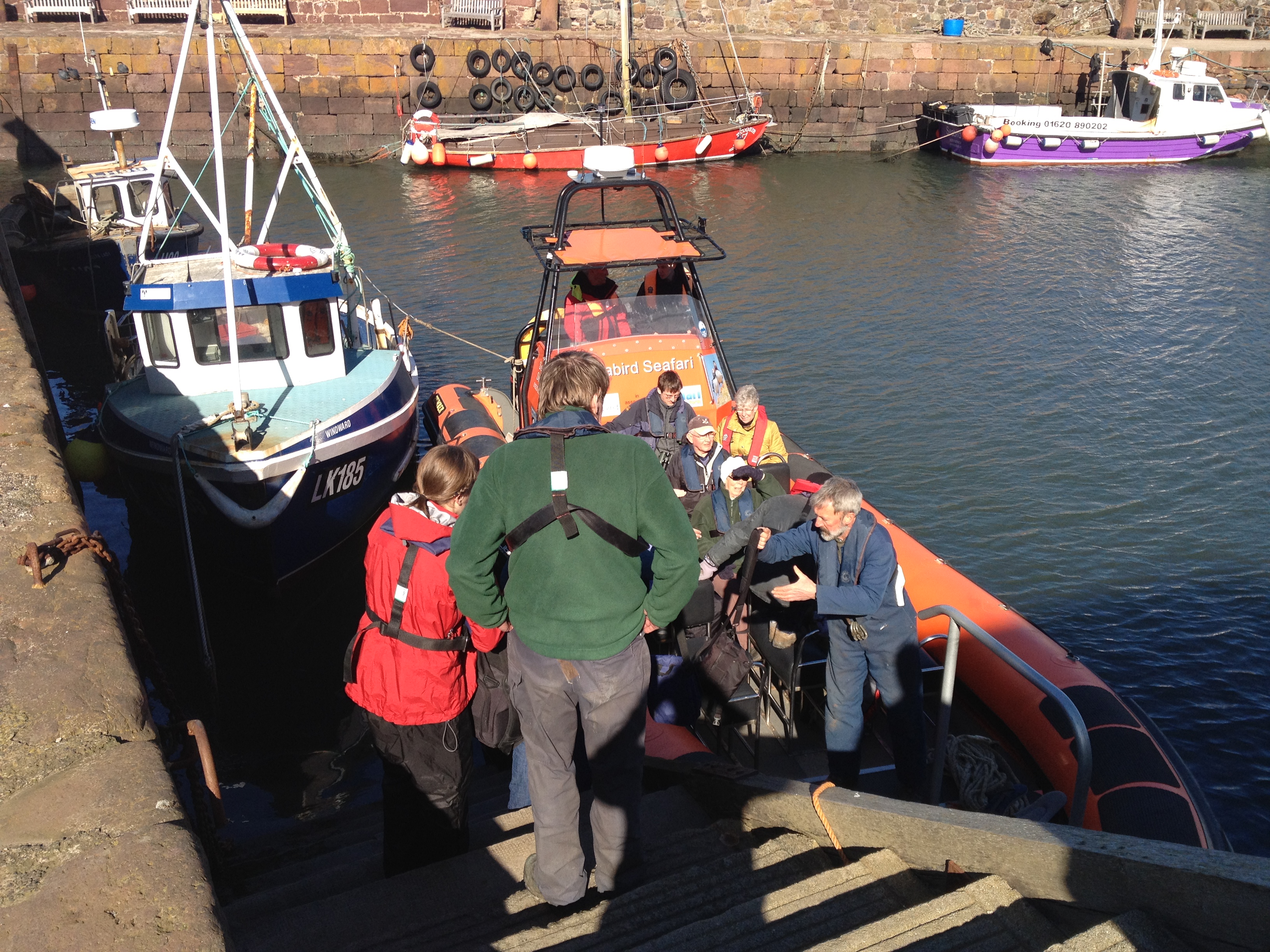
Down at North Berwick Harbour this morning, I was delighted to find yet another full crew of volunteers preparing to board one the the Seabird Centre RIBs and head out to Craigleith, one kilometer off shore and blighted until recently with ‘Bass Mallow’.

Loading the RIB at the Fish Stairs. The Two Colins at the helm and John Hunt (Operation Puffin's Organiser) nearest camera

Craigleith was originally the town’s rabbit warren. When they were wiped out by myxomatosis in the fifties, puffins that had shared the island by living in abandoned burrows became spoiled for choice and numbers burgeoned from a few thousand to over 20,000 by the noughties. But then, observers noted a steep decline in numbers and traced it to an invasive plant that was blocking the burrows.

Known locally as “Bass Mallow” because it grew around the lighthouse on Bass Rock, it is tree mallow, a monster relative of the geranium originally from the Mediterranean. The theory why it’s here is that an ex-sailor lighthouse keeper planted some on the Bass because of its large soft leaves for the occasions when storms isolated the keepers and fresh supplies of toilet paper could not get through. Kept in check on the Bass by the trampling of 150,000 gannets, seeds were carried to nearby islands where they easily established themselves in the soft soil around each burrow entrance.

Under the auspices of the Scottish Seabird Centre, over 140 work parties have made regular trips out to Craigleith and neighbouring Fidra island to cut down the tree mallow, with the project being run and supported entirely by more than 700 volunteers, know colloquially as the ‘mallow bashers’. Thanks to their tremendous support, excellent progress has been made. Monitoring is shows puffins are returning to the islands to re-use old burrows where mallow has been removed. The ‘season’ is when the puffins are at sea, which is August until around now, so today was one of the last parties to land.

How successful it has been can be measured but the larger numbers of puffins recorded last year and the fact that all of the mature mallow (grows up to 3m tall— a daunting size for a 15cm bird) has been cut down and the parties are now dealing with the myriad seedlings still springing up. Response from volunteers to work these trips has been magnificent, with John Hunt stellar as the organiser and usually the leader of each 12-strong squad. On a day like today—dazzlingly spring-like—the 5 hours spent on the island will have been an otherworldly and inspirational experience for all involved.

If you’re keen on some mallow-bashing yourself, there’s a page on the SSC website where you can sign up. You need reasonable mobility, some warm and waterproof clothes (Forth weather is not always as idyllic as today) a packed lunch and a sense of adventure. You won’t get any ‘thank-you’ from the puffins but a boat trip out to see them in a couple of months—as they bob around in sociable rafts or gather in kaffeklatch groups on the grassy slopes or whir overhead like clockwork toys with sand eels in their colourful beaks—should be reward enough for the much good you’ve done.

Kaffeklatsch of Puffins: You Decide if they Look Grateful

Posted in Environment | 1 Comment

The Man Who Would Be King

Tony Blair has a lot to answer for. Taking nothing away from the vision with which he shook the Labour Party out of its post-Foot slumber and made it electable, there are unsavourary aspects of his legacy with which many are still having to cope. The least savoury of those is the bottomless pit known as Afghanistan.

Meaning no disrespect to the bravery and dedication of all British forces who have served or are serving in that far-flung, foreign and mountainous region, the question that is still asked all too seldom is: What the Hell do we think we’re doing there? Long before Camp Bastion was even a glimmer in Blair’s eye, that place had been a graveyard for foreign intervention. The mighty Soviet Army found that out when they piled in there thirty years ago, only to slink out of Kabul a decade later much, much the wiser.

What is especially galling is the the British—of all the global forces on this planet—ought to have known better than to stick their fingers back into that particular fire. For, long before the Russians, ‘way back when the Great White Queen (Victoria, not Elizabeth) had barely ascended the throne, the Afghans taught the Raj a lesson that the MoD at least seems to have forgotten.

Once India was conquered and settling into its role as “The Jewel in the Crown”, the ‘wider still and wider’ edict of empire drove the then-Governor-General of India Lord Auckland to take down the troublesome Amir of Kabul by force. The occupation was relatively easy at first (sound familiar) and left 10,000 British troops split into two main garrisons at Kabul and Kandahar. So easy was it that the Kabul cantonment was built with so little consideration for defence that the commissariat stores were placed some 400m away outside its perimeter.

To command this most far-flung, split-new conquest, Auckland sent the 60-year-old, gout-ridden, flatulent and incontinent Lord Elphinstone, who arrived to be told by the outgoing General Cotton that “You will have nothing to do here: all is peace”. No sooner had he left the country then communication with India was severed by Afghans in the hills, a relieving force chased into Kandahar and “Elphy Bey” found himself besieged in Kabul.

Almost immediately, his health broke down. But since he could not abide his abrasive second-in-command Brigadier Shelton he would not relinquish command to him. Nor would he make up his mind what action to take as the Afghans looted the stores and gave the clumsy, overdressed British infantry reacting to their raids a series of sharp lessons in both skirmishing and accurate musket fire. When the British formed squares to repel Afghan light cavalry, the accompanying sharpshooters found the obligingly large, bright red, mass targets impossible to miss, even at a distance.

With supplies gone, casualties mounting and the appallingly poor standard of British musketry (some officers took to throwing stones at the Afghans, so poor were their men at picking them off, the 44th Regiment of Foot being especially bad), Elphinstone waited until mid-winter before deciding on evacuation. “Everything is reverting to the old state of things” he said his last dispatch.

With snow a foot thick all the 100+km to Jalalabad and the safety of the Khyber Pass beyond, the 16,000 headed East, harassed all the way by tribesmen and even children who picked off exhausted soldiers and stragglers. Although of smaller scale, because of the totality of the result it rivaled Napoleon’s humiliating retreat from Moscow just 30 years before in the annals of military disasters.

The only European to reach Jalalabad and safety was Surgeon-Major William Brydon. Once the news reached Auckland, a punitive expedition was launched and the great bazaar at Kabul was burnt, which the bulk of Afghans cooly observed from the safety of surrounding hills. For the next 150 years, the perils of trying to occupy, pacify or even interfere with the internal affairs of Afghanistan were passed around the Army and the Foreign Office as career-ending gospel if they were to be ignored.

Unfortunately, those who feel the hand of destiny upon them rarely pay much heed to dusty lessons from a distant past. Any Man who would be King makes his own fate and, like Peachy Carnaghan and Daniel Dravitt of Kipling’s tale before him, drive on through the perils beyond the Khyber to make their mark on the world. Peachy and Daniel both paid dear for such temerity—as, more recently, have 400 British servicemen.

Meanwhile, the Man Who Would Be (and was) King now gets six-figure speaking fees and sleeps sound at night, untroubled by any nightmares of Elphinstone’s terrible legacy in its current incarnation.

Posted in Politics | 1 Comment

We Want to Get BACK On

Today’s issue of the Hootsmon has an interesting article from a Devo-Plus advocate Malcolm Fraser who argues Scotland does not need independence to take on more responsibility for its own future. Plausible though many of his arguments are, it is when we get to Scotland’s historic role in the world that we part company. “The union has been good for us as a nation, in helping us out of a Celtic miasma and on to an international stage” he argues. Bollocks! I retort.

The Western world of today had its origins in the 15th-to-17th century expansion of European trade. The English, having fallen out with everyone, glared across the Channel through its finger-hold of Calais and built a ‘blue-water’ maritime future elsewhere on piracy and colonisation. But, in ever-egalitarian Scotland, not just the royal court and clergy, but the enterprise and labour of ordinary Scots got us into trading. For the most part those people have left little trace in the historical records but their legacy lies all around us.

Scotland lay at the edge of a developing European economy; life on the edge made many Scots enthusiastic traders and travellers in search of the opportunities for a better life. Scots merchant communities were established across Northern Europe—in Bordeaux and Dieppe in France, Bergen in Norway, Mälmo in Sweden, Elsinore and Copenhagen in Denmark, the Hanseatic Ports of Hamburg, Luebeck and Danzig and as far afield as Russia. Where ever they went the Scots stuck together and established their own trading networks, as well as their own Kirks, often with altars dedicated to St Ninian.

The main focus was a ‘staple port’ in Flanders, with permanent Scots merchant houses established in Bruges then, as that silted up, in Veere (where the town museum is the ‘Schottise Huis’). From there Scots flowed across the continent to trade goods, find  jobs or take up the opportunities of warfare and university education. The Scots exported their wool, hides, coal or timber and imported a myriad of both luxury and manufactured goods (sometimes the same thing).

The major beneficiaries in Scotland were Leith, Aberdeen and Berwick, with smaller ports in Fife’s East Neuk and the Lothian coast joining in. My own home town of North Berwick had 11 trade ships registered there in the 15th century. Lost between all the squabbles over independence in the 1200s/1300s and over religion in the 1500s/1600s, the 1400s were actually a time of growth and prosperity in Scotland. While England was engrossed in its Wars of the Roses, Scotland became relatively affluent on its trade.

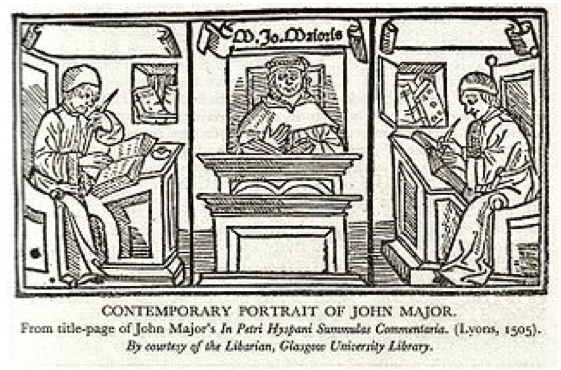
It also became cosmopolitan, with Highland chieftains sending their sons to Paris for their education, those of lowland lairds to university at places like Utrecht and Liege. From Gelghornie, a small farm outside North Berwick, John Major left to be educated in Paris in 1592, becoming renowned scholar in theology and philosophy at the University. Peter the Great’s principal advisor, General Patrick Gordon of Auchleucheries hailed from Aberdeen; in fact, 15 admirals of the Imperial Navy were Scots.

In the 17th century, up to 40,000 Scots were settled in Poland mainly as merchants, peddlers and craftsmen. Scots immigrant names can still to be found in Polish phone books and Danzig (now Gdansk) has many Scottish street names. Even village names remember the Scots  who built them: Dzkocja, Skotna Góra, Szotniki or Szoty. When Gustavus Adolphus launched the Thirty Years War at Breitenfeld, an entire Brigade of Scots were the solid centre on which he pivoted his line.

But, after the Darien Disaster of 1698 drained a quarter of the country’s capital and the Treaty of Union in 1707 opened new doors, impoverished Scots turned to opportunities in the new British Empire and the once-strong links with neighbours across the North Sea faded to the point that we were seen as reluctant Europeans in the mould of our new English partners. The Napoleonic and two World Wars did not help. But all that is now as much history as the Thirty Years War; time for another re-think.

To paraphrase the redoubtable Winnie Ewing: “Stop the World: Scotland wants to get BACK on”.

Posted in Commerce | Leave a comment

England’s Green & Pleasant Land

A recent book by Prof Higgs of Essex University is entitled Identifying the English but it will be of little help in the independence debate as it is all about identity theft since 1500. But one of the major components absent from the debate is exactly that: who are the English? Most unionists seem to assume that there is an identity called ‘the UK’ and that, should we Scots go our own way, this would become ‘the rest of the UK’ or ‘rUK’ for short.

This is flawed thinking. The current treaty binding the UK (of 1801, modified in 1922 when Eire went its own way) is based entirely on the grubby 1707 document that is more concerned with protecting merchants and banning Catholics then anything as noble as nation-building. But, nonetheless, the present state of Britain rests on its equal partnership between England and Scotland. Should Scotland end that partnership, there is no such state of Britain or UK, any more than Canada or Jamaica are part of the UK.

And here’s where out English friends get confused. After 300 years of using ‘British’ and ‘English’ as interchangeable adjectives (who can blame them: most foreign countries make the same mistake), they are now forced to work out what distinguishes their own identity. Our Irish cousins have been dealing with this for the last 90 years. Given the harrowing circumstances that led to Eire, their acceptance of being ‘British’ has been reluctant, to say the least. But they—and in good time Scots—will learn to embrace the cultural, linguistic and geographic truths about all that we share on these islands.

But what about the English? Who are they, as distinct from just being the most numerous of the British peoples? Some years back, John Major—quite sincerely and without irony—tried to punt ‘British’ values that sounded very English to Celtic ears: cricket games on village greens and warm beer in the local pub. That makes sense coming from someone in Huntingdon—or the Cotswolds, or anywhere in the snugger Home Counties. But what about Cleveland or Clitheroe; what about Cornwall or Cromer?

As with any agglomeration of 50-odd million people, there is a huge diversity. London alone speaks a myriad of languages; Pimlico and Brixton are three tube stops apart but barely on the same planet. How relevant are thatched cottage idylls to most English, when cities are multi-ethnic and Salford or Bradford residents may never have seen a thatched cottage?

A pure North/South divide is too simplistic but the Wash-to-Bristol line does delineate a huge northern segment that is still struggling to find its common purpose in a post-industrial world. This has close parallels with our own Glasgow/Clyde valley. Whereas city centres like Leeds and Manchester have largely recovered, great swathes of suburbs and smaller towns have little economic vitality and therefore societal ties are looser and opportunities thinner on the ground.

This is not to write off the entire area—visit the Lakes, the Dales, the Peak District, the North York Moors, swathes of Northumberland and you’ll be charmed by England’s many hidden gems. But the cities and towns—where the majority live—are generally struggling to find either identity or affluence. For every Cockermouth or Grassington or Whitby, there’s a Salford or a Rotherham.

For them—as much as for us Scots—it is futile and stupid to talk in terms of what the empire achieved or of the Dunkirk spirit that saw off the Nazis. Proud though we all ought to be of such things, you can’t see the future if you’re looking backwards. I can see a Scotland using wealth from its bountiful oil and renewables to give new purpose to our greatest city, to turn a dependency culture into generations who invent what will make Scotland famous into the 22nd century. What is the English equivalent?

Whatever it is, I hope they don’t see it in terms of any more Falklands or Afghanistans; those days are done. By why can’t they use their copious muslim citizens as a force for good? What European country has so many people better qualified to form bonds with the Middle East and South Asia? Where are the tidal projects in their 14m-rise-and-fall Bristol Channel? Why are they letting us nail the renewables market?

‘Britain’ may be something we can all be proud of but, because of its imperial and imperious overtones, is it not time for a brand name change? Just as the Scots are seen as  full of quirky and endearing character across the world, maybe it’s time for the English to mimic us and go for a spruced-up image. James Bond and Harrod’s; Rolls Royce and Beatles; Cotswolds to Chelsea; Man U. to Wimbledon; cut glass accents in Pall Mall clubs; West End farce or village brass band; punting on the Cam or strolling Blackpool pier; BBC costume drama or Fawlty Towers—they’re all quintessentially English. Don’t tell me there’s not enough material to work with!

And then, it will be so much easier for all of us on these islands to be British.

Posted in Uncategorized | 2 Comments

Scotland by Hugh MacDiarmid

As an enjoyable weekend break, I’m at the StAnza festival’s 15th outing and was enjoying St Andrews’ lively atmosphere in term time, delving into various entertainments and thinking I was well clear of politics and motivations to blog. Then I came across (and I say—to my shame—for the first time) Hugh MacDiarmid’s concise, graceful and (for him at least) understated poem, Scotland:

It requires great love of it deeply to read
The configuration of a land,
Gradually grow conscious of fine shadings,
Of great meanings in slight symbols,
Hear at last the great voice that speaks softly,
See the swell and fall upon the flank
Of a statue carved out in a whole country’s marble,
Be like Spring, like a hand in a window
Moving New and Old things carefully to and fro,
Moving a fraction of flower here,
Placing an inch of air there,
And without breaking anything.
So I have gathered unto myself
All the loose ends of Scotland,
And by naming them and accepting them,
Loving them and identifying myself with them,
Attempt to express the whole.

For those interested, this is available on an A3 poster from the Scottish Poetry Library which makes a fine decoration for any underpopulated pinboard or wall. I am moved by the above because—unlike some other works and even some contemporary nationalists—it does not beat me over the head with its message.

Born in Langholm as Christopher Grieve in 1892, he was a postman’s son. He trained to be a teacher in Edinburgh, then worked on local newspapers before enlisting in the Royal Army Medical Corps in 1915. War service took him to the Balkans and France and during this period he formulated his ambitious literary and cultural plans (as well as his pen name).

These centred on an attempt to revive the Scottish language in poetry as a means of asserting Scotland’s artistic independence from England and re-invigorating a literature suffering from sentimentality. His radical advocacy of Scots won support for and provided a major impetus to what became known as ‘The Scottish Renaissance’ which involved fellow poets like Robert Garioch and Norman MacCaig and included designers like Charles Rennie Macintosh and the Scottish Colourist painters.

In his early collections this championing of Scots took the form of short lyrics which synthesised diction from the dialects of different areas of Lowland Scotland to create his own version of the Scots literary language otherwise known as Lallans. Though this has been hailed as a modernist technique, the effect on the page is less academic than this sounds—there is a fresh energy to these poems.

MacDiarmid described Scots as “an inexhaustible quarry of subtle and significant sound” and believed only Scots was capable of capturing a distinctive Scottish sensibility. This had political as well as linguistic implications and MacDiarmid engaged passionately with the politics of the time—he was a member of both the SNP and the Communist Party, a divided loyalty that got him into trouble with both.

For all his faults, it was he who proved great literature could still be crafted from the Scots dialect; he catalysed pride in a distinctively Scots culture that was in danger of being swamped. Poets like Morgan, Lochhead and Burnside owe him a debt and, without him,  it is debatable whether plays like The Cheviot & the Stag or Black Watch, or even films like Local Hero and Trainspotting would even exist.

Posted in Education | 1 Comment

You Choose—

Two very different quotes regarding Scottish independence from viewpoints furth of Scotland came to light this week.

One, from a Tory grandee—whose party prides itself as emblematic of tea with crumpets, cricket on village greens and jolly good shows; that has consistently expressed views we have interwoven history and culture; that Scotland benefits greatly from being part of the UK; that we’re “stronger together” and “punch above our weight” so we can jointly “be a force in the world” as “the most successful partnership the world has seen”.

The other, a representative of the Russian bear—whose country brought the world autocratic Csars, communist revolution, gulags. Josef Dughailovitch Stalin, the Katyn massacre, human wave attacks, the Cold War/Iron Curtain, institutionalised nomenklatura cronyism, mutually assured destruction, Afghan invasions, Ilyushin “Bear” bomber intrusions into our airspace and broke Italy’s monopoly on mafioso behaviour.

Which do you think would be the more understanding and naturally make the better friend to Scotland? You may choose, based on quotes this week from two senior representatives of their respective organisations:

“If Scotland were left undefended as a result of acquiring independence, the enemies of England could use it as a base from which to launch air raids over the border. If that were to happen, England would have no choice but to bomb Scottish Glasgow and Edinburgh airports in order to defend itself.”

–former Solicitor-General for Scotland Lord Fraser of Carmyle

“Russia has a consulate-general in Edinburgh which organises a large number of cultural events. Russian ships call at Scottish ports and Moscow will maintain ties with Edinburgh in the future. As regards the referendum, it’s a domestic affair. In accordance with the Helsinki Agreement, European frontiers are inviolable unless the parties concerned rule otherwise. The British government has given its consent to hold a referendum on the independence of Scotland.”

–Foreign Minister Sergei Lavrov, speaking to the lower house of the Russian parliament.

Time, perhaps, to reconsider who we Scots regard as friends more in the light of how much they are behaving as such.

Posted in Politics | Leave a comment

You Can’t Get There from Here

A recent tweet complained that a passenger boarding a Lothian bus did not have his (valid) Ridacard accepted, was thrown off and had to taxi in to work. I’m sure this was a rare exception but it highlights a certain autocratic confusion at Lothian Buses as to why they are there. They trumpet their citations—Bus Company of the Year in 2002; Top City Bus Operator in 2011 and their website duly pays requisite homage to the customer:

“At Lothian Buses, our customers are at the heart of everything we do. From continual investment in our modern, comfortable fleet to using the latest technology to deliver up-to-date and accurate information about our services, we are committed to providing our customers with the very best in comfortable, easily accessible and affordable public transport.”

Shimply shplendid shtuff; but what is the reality? To be fair, for the last five years, they have not had their operational troubles to seek, with sundry primary arteries repeatedly torn up for the infamous tram works. And, having spoken with senior officials at Lothian, none are too chuffed with having tram operations hung round their neck. That said, how good are they at running public transport?

As a company running buses, they are indeed very good. First provides a splendid foil for them. After years in the nineties when the two companies fought bus wars all across Edinburgh, it has died down to the ongoing skirmish that is the 44 Wallyford/Balerno route, with Lothian the unquestioned victor. First is a much more low-budget operation that now confines itself to predatory pricing, mostly with clapped-out buses largely outside Edinburgh.

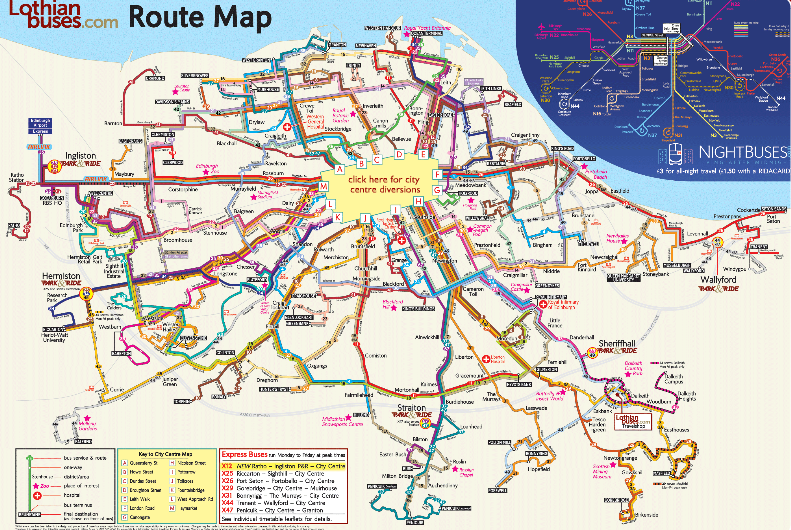
Within the city, Lothian runs the show, with over 90% of intra-city passengers and First slavishly copying its pricing just to stay in business. Looking at their route map, Lothian do provide a pretty comprehensive service that encompasses most urban outliers like Penicuik or Tranent, as well as all areas of the city.

So that’s it then, Edinburgh’s award-winning bus company takes you anywhere you’d want making the city a paragon of public transport? Bzzzzt: wrong! It’s a actually a dinosaur.

Born out of Edinburgh Corporation Transport’s monopoly pre-bus deregulation, Lothian remains publicly owned, shared by the former authorities that comprised Lothian Region (Edinburgh has 91% and the three Lothians 3% each). Which means it’s a quango, so loved by Labour and therefore stuffed with its acolytes from inception. No other European city of Edinburgh’s size and economic vibrancy is either so poorly served by bus alternatives or so car-hostile (let alone both), which gives Lothian’s virtual monopoly a thick edge over comparable bus operators elsewhere.

Let’s leave aside the money that the Blue Meanies make for themselves and for ECC and focus on three classes of non-car = bus customers: 1) the Edinburgh local; 2) the visiting Scot and; 3) the visiting ‘foreigner’ (in which group I include the English, not through any value judgement but for the sake of simplicity).

  1. Edinburgh locals. Most of those who ride regularly buy a Ridacard (weekly @ £17, monthly @ £51 or annual @ £612). Slapping that on the reader beside the driver gets them on quickly. Their main gripe is that buses don’t take them in one trip and they must wait in the rain and cold for transfers. A secondary gripe is that these are not much of a deal—ten single trips to/from work (if that’s all you do) is only £14 p.w.
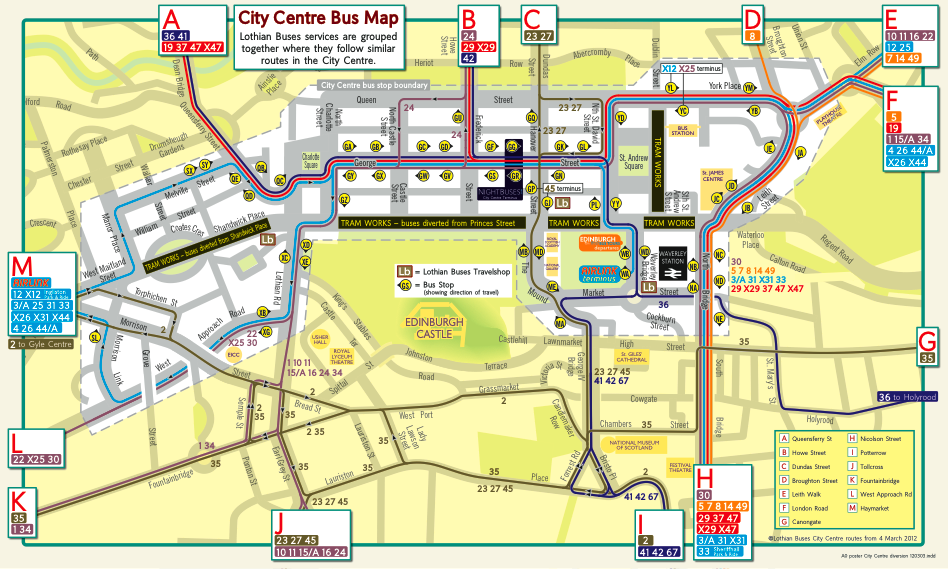
  2. Visiting Scots. If you’re a pensioner with a Scottish Concession Card, it’s as easy as the native, with the same transfer drawbacks. However, the system presumes you already know how to use it. Route maps are rare even in bus shelters so you need to know which bus goes where. Then the centre of Edinburgh is a maze of bus stops (even before any tram works—see below). Finding the right stop is hard because (unlike London) there are no helpful maps of surrounding bus stop locations. This is made worse by a propensity to scatter them. Getting off a train in Waverley, it’s half a kilometre walk to catch a 10/11/16 past Tollcross because the stop is at the Mound. Those with no card have to fork out £1.40 to go any distance and do that again if they transfer. A Day Ticket is available, but at £3.50, it’s no bargain until you make a total of four journeys or more that day.
  3. Visiting foreigners should simply not bother. Over 90% of them arrive at Waverley where you’d be forgiven for thinking that both Visitor Information Centre and local transport were state secrets for all the information available. Network Rail spent millions refurbishing the station but shitepence on telling passengers how to continue their journey or where to visit/stay. Cabbies love it because most give up baffled or balk at the uphill slog to find an exit. (the helpful new Waverley Steps escalators are long overdue but good luck finding them) Even if visitors do make it out into daylight, the maze of bus stops and queues of buses dissuade most. And when the most determined/resourceful do find the right stop and bus, they must find exactly £1.40 in coins or get “ah’m sorry, pal, we dinnae tak’ ony notes” from the driver.

Seen as a self-serving monopoly where locals have no choice, Lothian is brilliant. And, to be fair to them, they do invest in their buses, which are consistently new, clean, well maintained and punctual (tram works permitting). Seen from a bus anorak’s perspective, it’s a faultless operation with well equipped depots at Seafield, Shrub Hill, Longstone, etc.

But, because they refuse to use conductors, they are often held up at stops while someone struggles for change; because they favour double-deckers, they refuse to run lighter load routes, which means almost all lines converge on the city centre to sit in endless queues; because rail provision in the city is so poor, the idea of joined-up transport with rail is entirely alien to them.

Apparently, they’ve never been to the Continent to see how public transport should work. Given the lack of competition, you could say that the world is their oyster but apparently they’ve never been to London to see how that works there either.

Lothian's Idea of a "Customer-Friendly' Inner City Map for their Blizzard of Bus Stops

Posted in Transport | 5 Comments

Not the Best of Health

Today’s Hootsmon prints an op ed piece by local MSP Iain Gray entitled “Smiling and Nodding Will not Create Change”. In it, Iain, a former  Minister for Social Justice, fulminates about the lack of progress in harmonising (if not actually integrating) the NHS with social work across the country. Now, I believe Iain may be sincere in his wish to see this but his track record while he was capable of influencing this gives these recent comments more than a whiff of sanctimony.

He is correct in his assertion that the two services ought to work together far more closely and he is also correct that officials on both sides of the divide have not fallen over themselves to make that happen. But if he indeed started this process in 2001, how come, when I became East Lothian Council leader in 2007 and started down the road he advocates, was it as if this idea of joint working had never occurred to anyone before?

There are definitely culpable officials on both sides of the divide. But in East Lothian Council, we rid ourselves of both the relevant director and head of service and set to making joint working the order of the day for the best reason in the world—because it made sense. What we had not bargained for was the degree of entrenched self-interest of senior staff within NHS Lothian.

That first summer, we came up with three major projects that we thought exemplified the  joined-up thinking required that would provide better service at less cost to the public purse. The first was a joint surgery and day centre for Gullane. The current NHS Cusworth surgery there is bursting at the seams and the present ELC-run Day Centre requires a substantial re-build.

Looking around for alternatives, we hit on the local tennis courts. They were bang in the centre of the village and in desperate need of a refurb themselves (the chain-link fence round the courts fell over in high winds). By shifting the three courts bodily westward and buying an adjacent house that was on the market, we could plunk a joint building with more than enough car parking on Hamilton Road. Meetings with the surgery doctors, the tennis club, day centre attendees and the public secured local agreement.

NHS Officials attended the same meetings and pledged to co-operate. Four and a half years later, the council has bought the relevant house and shifted/refurbed the tennis courts. But we waited so long for the NHS to commit any capital that it’s been turned over to the Scottish Government to finish. So much for what had been agreed to be a pilot of co-operation. Similar intransigence put two other crucial projects on ice.

They were for a revolutionary concept in local hospital and elderly care. Instead of the NHS ‘rationalising’ its hospitals further away from the patients and the council providing ‘pure’ care homes, why not combine the two? Building 60-bed joint units could allow elderly in care who needed medical assistance to stay in the same room but switch to medical staff—and then back to the care staff when treatment succeeded. There would be no barriers between the two levels of care, the patient would suffer no disruption and the economies of scale would benefit all.

Tranent and Musselburgh were earmarked as likely projects. For four years, ELC tried to get NHS Lothian to commit to this even bigger ‘everyone wins’ concept. We have now given up and gone back to planning for separate care homes while the NHS touts a ‘community’ hospital in Haddington for all East Lothian—as if the other five towns think of Haddington as any part of their community when it’s a 45-minute bus ride away.

Is there a villain to this piece? Why, yes—and it’s not Iain Gray, who may well have tried to shift the NHS off its complacent arse. But he is complicit, because it was on his watch that Professor James Barbour OBE was appointed chair of the board of NHS Lothian in 2001 . Having seen how senior officials operate around Prof. Barbour and having had the depressing experience of sitting across the table from him in negotiations, I would say, simplistic as it is to blame any individual, that here lay the root of willful, pathological obfuscation from the NHS.

What his real motivations for this were remains unclear. Perhaps he, like many other senior Humphreys of officialdom, was angling for a knighthood. But it was clear that nobody in NHS Lothian went to the toilet without his permission, far less work on a project costing millions where anyone else had a say. The only time I recall ELC getting any concession out of him during negotiations, I watched him, as he was leaving, kick a stone clear across the Deaconess House car park in frustration.

But he is not alone. Where Iain and his colleagues must bear much blame was the series of apparatchik appointments they made to the many quangos under their control over their eight years of tenure. While the NHS Boards may not provide the worst examples of cronyism indulged in, it would be hard to find a more egregious example of my-trainset-and-I’ll-play-with-it-as-I-like than Lothian NHS under Professor Barbour.

Iain may be sincere in wishing it were not so but he’s also being very disingenuous.

Posted in Uncategorized | Leave a comment