Savaged by a Wolf in Dead Sheep’s Clothing

Amidst the settling dust from last week’s local elections, a number of things are becoming clear. YouGov have conducted their usual regional poll around the UK and, while it shows little that is surprising, it does continue to show some trends.

First, the popularity of the UK Government continues to decline and the rot seems to be spreading South. Whereas Scotland had consistently shown the worst disapproval rating (generally hovering around -50) that dubious honour now goes to the North of England where 70% of voters now disapprove of the UK Government.

Secondly, the disintegration of the Lib-Dem vote continues apace, with only 25% of those who voted Lib-Dem in 2010 still intending to vote that way at this point and the rate in Scotland half of that in the rest of the UK. But, thirdly, the most interesting statistic appears to be that, of the 75% of lost Lib-Dem votes, 44% have drifted to Labour—almost twice those remaining loyal to the Lib-Dems.

That certainly seems to bear out what appears to have happened in the Scottish local elections. Whereas, in last year’s Holyrood election, the disintegrating Lib-Dem vote went largely to benefit the SNP, this year those same voters appear to have voted Labour instead.

While it is probably foolish to speak of any group of voters as if they were solid and homogeneous, there appears to have been a historic development of floating voters since the 1970’s. Prior to that, the UK had an almost US-style two-party polarity. Governments were formed and lost on the pendulum left-right swing between Labour and Tories; third parties were rare and frequently crushed between the two giants.

Labour’s industrial nightmare of the seventies laid the foundations for Thatcher and the muscular Toryism in the 1980’s that cleared the centre for the rise of the Lib-Dems and SNP. Voters deserted Foot’s principled but unelectable Labour in droves. But as the Tories ran out of ideas, they were seen as more extreme and Blair’s obvious reforms beguiled millions of newly propertied consumerist Tories into supporting his social democratic spin.

But not in Scotland. Scots had never given up on Old Labour. So, when the great Blairite phase came down around Irn Broon’s ears, the main beneficiaries of these floating voters were the SNP. Thousands of them—accompanied by many Labour voters fed up with little sign of life in moribund Labour heartlands—overturned decades of voting-for-donkeys-with-rosettes Labour across Scotland.

The clear beneficiary was the SNP, who swept into majority power in Holyrood against all statistical likelihood and—truth be told—their own forecasts. They became the current roost of this growing flock of floating voters, whose numbers have been growing for four decades.

But these voters, impressed as most were by the SNP’s deft underdog performance in its first term, did not thereby become nationalists, nor were they solidly behind independence. In fact, the whole idea of independence made a third of them at least nervous and another third residually hostile to the very thought. Most savvy SNP activists realised this. Whereas their original core vote was solid, this rapid rise of support over the last couple of years came from a different stock altogether.

In 2011, Labour was caught with its political pants down by believing polls three months out that said they were in the lead. That all changed in the last eight weeks so that the now-marginal Tory and Lib-Dem votes highlighted the shape of the election as purely a Labour-vs-SNP contest. Given that Scottish Labour had avoided much of the modernisation that Blair’s reforms had wrought elsewhere (and actually prided itself in this fact) their business-as-usual grump that passed for opposition played poorly against an SNP with its tail up and a dynamic message to convey. They were duly gubbed.

Spending longer than either of the other opposition parties to sort out a new leader, Labour seemed to have been stuffed. External observers seemed agreed on that—few campaign initiatives, problems with heartland councils, especially Glasgow, ill-tempered handling of those tools available like the Scottish Affairs Committee, right up to and including Johann Lamont’s doughty but hardly virtuoso handling of FMQs.

Whether it was deliberate or not, it wasn’t a bad impersonation of a predator who feigns injury to lure their prey closer. Because people in Labour like Douglas Alexander, Margaret Curran and her son Stephen were not only alive to the danger but quite prepared to step on toes to do something about it. For once, London Labour and their dour Scots colleagues appear to have agreed on joint action, staff were sent North and something approaching a real plan was hatched.

That did not include much by way of new ideas, change of direction or even of tactics. This suited Scottish Labour’s somewhat creaky structure. But there was both a readiness to start listening to punters and much more of a backbone organisation that put candidates back on doorsteps talking to people and harnessed new and enthusiastic activists to support that by leafleting, etc. It was no rocket science but it was work that Labour had become careless about doing.

Other than the walking-dead Lib-Dems, this campaign saw more active candidates, including Tories where they thought they had a chance, following this old-time religion than ever before.

Granted, it was a pure local election so national media coverage was dimmed in comparison with either 2010 or 2011 because they saw little outside of Glasgow that was at stake. Savvy local organisers knew that, as well as not turning people off with saturated coverage, this was an opportunity to fly under the media radar.

Buoyed up with momentum from the 2011 result enhancing the 2007 sense of solid progress, the SNP saw no reason to alter its tactical campaign. Indeed, being confident that positive advance would be maintained so soon after last year they effectively launched the referendum campaign in the form of public consultation, heightened discord with Westminster and an internal roadshow to prep the troops.

Had Labour stayed moribund, this might have worked. As it was, the SNP, despite now being a national party, with coast-to-coast representation at all levels, is still a bunch of enthusiastic amateurs. And those amateurs have had many of the best and brightest either creamed off to serve as MPs/MSPs and their staff. It takes time for the flood of new members to turn into activists, especially experienced ones.

With a small (as compared to UK parties) staff, SNP HQ has little ability to reach out into the field with support. Professional organisers out there who could take local charge (which the Tories have always had and Labour woke up to this time) stayed off the priority list. Theoretically key posts like Local Government Convener, National Organiser and Association of Nationalist Councillors officials were all unpaid and each of them engaged in being re-elected as a councillor themselves.

What seems to have remained unappreciated in the SNP was the continued disparity between their formidable heartland campaign organisations all across the North East and well intentioned ad hoc ones staffed with newbies that characterises the Central Belt. This latter have still to learn much about effective campaigning.

In 2007 and 2011 they worked hard and won. But the win was as much due to a national tide raising all boats; that tide did not run in 2010 and no-one seems to have asked why. The reason seems to have been that the former two elections were purely about Scotland and the SNP have made huge strides in convincing people that they, more than any other party, stand up for Scotland.

In 2010, it was not about Scotland—it was about recession, international affairs and how badly both would affect people’s pockets. While no disaster, it was a disappointment for the SNP. And, while it is foolish to read too much into comparing elections at different levels, it appears that this 2012 election had something of the same disappointment for the SNP. Why? What happened seems to have been:

  1. Expectations were poorly managed. Talking up the chance of Labour losing Glasgow made the actual solid advance made there seem a disappointment.
  2. Focus was diffuse. While the local troops were out doing their best, the phalanx of former activists now in and associated with Parliament were preoccupied, understandably, with other things
  3. Media was not managed. Whereas parliamentary members have media support, local campaigners and councillors have none; when exposed to TV especially they came across as a series of shots from the hip
  4. Intelligence was used poorly. Early canvass results indicated voters getting markedly nervous about independence now that the prospect had come closer. Nothing was done to counter a ‘this is a stepping stone to indy’ perception.
  5. SNP is now the Establishment. Whereas even parliamentarians have played the underdog and evoked support for taking on an uncaring colossus, that ploy has less traction when SNP can and do make laws with no cross-party support.
  6. Unreasonable expectations from the public. All parties in power run into this as the media hunts for the least flaws. Disagreement with The Donald or association with the discredited Murdoch affair do unavoidable damage. For the SNP, this is new.
  7. Labour got its act together. After several elections of poor campaigning, they made the breakthrough of stopping sulking, admitting to people that they needed to listen and translated this into the first campaign with real traction on the doorsteps.

Since the next—and biggest—political step is the referendum, how that is launched from this point will be crucial. A smashing and decisive romp in 2012 that carried on the momentum of 2011 would have been perfect. But to grimly hang on to this result as if it were that would be a mistake by looking like numbers mattered more than people.

Yes, by all measures, it was a win. But politics is three parts perception; go to the 80% of voters who are not wedded to any party and they are unlikely to agree it was a win. They may see a referendum in 2014 as given. But most have misgivings what independence might mean and are staring sullenly at the ground just now. As usual, they are looking for a voice they can trust in uncertain times.

Labour pulled off this sleight of hand simply by telling people it had changed and was listening; they still had no message of substance beyond “mea culpa” and “don’t listen to the nasty nats”. Until they concoct their own vision for Scotland, they’re ambitious political wolves, whether they wear sheep’s clothing drag or not.

The SNP’s success to date has been built on positive vision, a prosperous, egalitarian Scotland that takes it place in the world among the exemplarly small countries that have led the way. Appearing to cling to statistical victories, historic irrelevances or scoring tactical points in politics is what led all three opposition parties to the sorry pass in which they find themselves. Honesty, courage and selflessness are not what Scottish voters are used to in their politicians.

To win, all the SNP has to do is prove them wrong.

Posted in Uncategorized | 1 Comment

All In It Together?

You don’t hear that phrase much these days (especially from ConDem spokespersons). Perhaps it’s because the stats for this last year—the year that Osbo forecast we’d start to see the positive effect of a paper money mountain for his banker chums to sit on—don’t look good for the peasants who aren’t among the twenty Cabinet millionaires.

While those of us whose closest approach to Eton was a walking tour of Windsor, wages last year rose by 1%. And, while FTSE100 companies (& your pension pot) lost over 7% in value, compensation for their Chief Execs for climbing in and out of limos went up 11% to £3.65m. At the same time, the Second Baron Lord Strathclyde was protesting that the Conservatives “are not the rich and posh party“.

Aye, right.

But as a Belgravia mafia supplants the Islington mafia in fleecing the rest of us, a much more subtle, widespread and damaging fragmentation of our society is occurring at the other end of the social spectrum. Whereas the UK Government has always been the playground of the establishment, augmented by a small waves of arrivistes (c.f. Derry Irvine), a disconnect with the poor & excluded is no post-2010 phenomenon but something for which Blair and Brown carry as much blame as any Lord Snooty & chums.

Because of frozen wages, social strains are starting to show in union belligerence and consumer spending. But that is, in turn, concealing some serious fractures between society and those who no longer feel a part of it at all. Once this was a phenomenon of American cities which the social justice agenda over here did much to prevent. But, after 13 years of Labour social programmes, the disenfranchised are now a significant chunk of society—mainly, but not exclusively, in our cities.

Consider the news today that 495 properties across Scotland are now blacklisted by the Scottish Ambulance Service because paramedics and ambulance crews have been assaulted or otherwise abused when attending incidents there. Greater Glasgow and Clyde hold the dubious record of most “red-flagged” addresses in Scotland (125) but Lothian is close at 86; Forth Valley and Fife both have 53.

It’s not just ambulances; over the last five years, almost 1,300 firefighters—an average of five each week—have been attacked when attending 999 calls and the trend is upwards. Add in incidents like the trainee social worker attacked by three teenagers while doing a home visit or that the number of deliberate wheelie bin fires has become close to an epidemic and alarm bells of social disintegration become deafening.

Evening Times (Glasgow) Front Page Weds May 9th 2012

Society is not rigid, nor should it be. There are misbehaviours that can be discounted, such as when students get uppity with eggs around Halloween. But at what point does the unthinking, gratuitous, menacing behaviour of a growing number become critical?

A councillor for 13 years, it takes quite a bit to shock me. But recently, a couple with a young child came to see me to complain. They claimed to have been homeless and impoverished and our council’s homeless team managed not just to house them but to do it in the town centre of the place they most wanted to stay as the child’s nan was there. Their complaint? Not about the flat, nor the time taken to house them. It was that they didn’t have a parking space for their car and would I please fix that?

Whereas my mother would have to have been at death’s door before asking for a doctor’s appointment, much less a home visit, we have a local who phones an ambulance to take him home when he gets too drunk to walk because he gets so abusive regular taxis decline to handle him. It’s not about teenage skaters who wreck wooden benches by using them as grind bars—they’re just daft and will learn, possibly even under their own steam. It’s about society’s switch to fixation on entitlement and dissociation with even some ownership—let alone responsibility—of using public services with care and consideration.

No enlightened society neglects its elderly or its vulnerable. But in their attempt to outbid one another, major UK parties have trumpeted their social programmes without paying much attention to their effectiveness. In times of plenty, this may have been foolish but was still feasible. In times of indefinite fiscal constriction, such as we are now facing, that no longer applies.

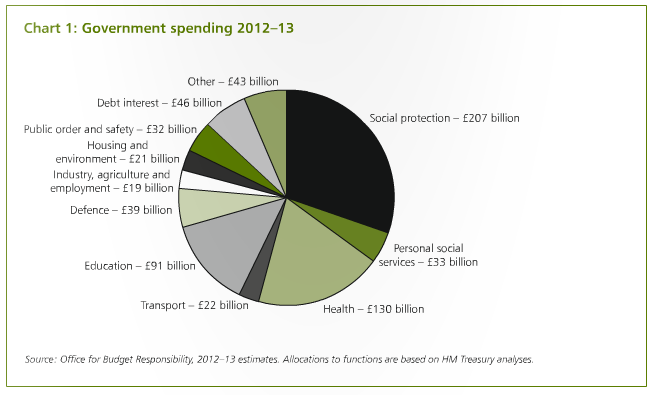
Whereas the number of social workers and those pulling down a decent professional salary while running charities or ‘third-sector’ operations has rocketed from virtually nil half a century ago, social funding now dwarfs every other area of government expenditure. The UK numbers (taken from the Treasury’s 2012 Budget Report in March 2012) are shown in the chart below.

The £207bn on Social Services (which includes all benefits, pensions, etc) represents 30% of all UK government expenditure but, because we’re running a whopping £91bn budget overspend, it’s a rather larger 36% of income. That represents £3,460 each year for every man, woman and child in the UK. Adding in the £2.7bn that Scottish councils pay out for Social Care, which is another £540 per skull and you’re talking a cool £4k per person.

Now, given that three-quarters of the population are net donors—not (in theory) vulnerable, nor too old/infirm, not to mention in jail or on drug recovery programmes, you’re talking about over 1m people in Scotland each receiving an average £12,000 in state help. Leave aside whether such help is adequate or that thousands of carers deserve financial help and/or respite, with the economy on a steady downward track and the UK government paying some £600,000,000 each DAY in interest on what it has borrowed already, this is all careening towards a very big fiscal brick wall.

So, while it is perfectly fair to demand that Chief Execs get their collective snouts out of the trough, it is equally fair to ask why people who attack ambulances or firemen or cause £130m in damage to wheelie bins are still entitled to any benefits. Of Scotland’s 49,618 criminal offenders last year, 27,813 (over 57%) were re-offending and this after decades of ‘enlightened’ attitudes among police, social work, municipal organisations and sundry charities.

When careers advisors say “There are thousands of charities in the UK, employing well over half a million people full-time” this is not to say that they may not be a cost-effective way of providing essential services, often to those most in need. But they also become a self-interested party. While the ideal of such charities and, indeed, of social work in general, ought to be to put themselves out of business by succeeding, so far, this has not happened.

And, while it would be unjust to blindly equate benefits recipients with wanton damage and unnecessary cost to society, it is not fat bankers who are setting fire to wheelie bins and stoning the firemen who show up to put them out. Both extremes of society need to make themselves included and respected within the whole; both must take responsibility to do that. There are plenty of third-world communities working miracles with the paucity of aid that actually reaches them that could teach us what can be done.

But, if the middle keeps getting squeezed between greedy rich and ma-giro’ll-do-me-jist-fine types, then the present fiscal squeeze will fragment society further, undermining any sense that “we’re all in it together“. After a further couple of years, look for something very like revolts that will, by comparison, make community charge riots seem like bliss.

Posted in Commerce, Community | 1 Comment

If our democracy is so exemplary, how come Malawi puts it to shame?

burdzeyeview's avatarA Burdz Eye View

This week, the blog will be focusing on some of the wider issues raised by last week’s local elections – the voting system, the impact of apparent Alphabetis, the low representation of women (and others).  To kick us off, a fantastic guest post on low turnout and compulsory voting from Susan Dalgety.  

Susan is an independent communications adviser, focusing on public policy campaigns, gender and international development. She was a Labour councillor in Edinburgh (1992 – 99) and Jack McConnell’s chief press officer during much of his time as First Minister. 

I was following the 2012 council election results on Twitter last Friday as I simultaneously proofed a project proposal for training women candidates for Malawi’s 2014 local elections.

I don’t need my crystal ball to predict that the turnout in Malawi in two years time will be much higher than Scotland’s was on 3 May, with less…

View original post 677 more words

Posted in Uncategorized | 1 Comment

Local & Party Politics: Symbiotic or Strangers?

Three days after the first standalone local elections for over a decade and while most of Scotland still does not know who is going to be running their schools and libraries, the two biggest parties in Scotland are lobbing claim and counter-claim at each other to prove who won.

Call me naïve but, unless the people themselves feel that they won, the whole exercise has been a huge waste of time and likely to push party politics ever further into posturing irrelevance. Outside of the political and media hot house, few conversations in pubs or aerobics class hinge on who runs Glasgow or council group sizes. Plenty revolve around local services from bins to buses—but if politicians get mentioned, it is likely accompanied by expletives.

Leave aside whether parties get their national policies and pitches right. Is part of the reason why the turnout for last Thursday’s election was so embarrassingly low because none of the parties in Scotland ‘gets’ council-level politics? In cahoots with all manner of media, parties all seem to make the same mistakes, finding themselves still distant at the level of politics closest to the people. This is for several reasons:

1)    Inability to handle diversity Because national politics is eternally in the media’s eye, diversity is anathema to party handlers. They are convinced (with some justification) that the voters punish internal rifts which diversity resembles. So, despite huge disparities in appropriate local service priority in Stenhousemuir is locked with Stornoway and national party manifestos for local government become the song sheet from which all local candidates must sing—whether in their language or not.

2)    Inflexible Internal Communication. National leaders are invariably found in parliament because that is the seat of power and vice-versa. As a result, this ‘parity of esteem’ touted over the last four years is a convenient fig-leaf concealing an inner coterie around each party leader. It is actually a one-way-street: that coterie posits, formulates and embeds policy with scant consultation of those in local government tasked with implementing such policy. It is only party discipline that keeps the illusion of co-operation functional.

3)    Organisational Incompatability Whereas national campaigns, based on constituencies as units, are organised uniformly, managed centrally and look coherent to an outsider, local council campaigns can be untidy, eccentric and amateur to the point of embarrassment—even as they are effective. Often that effectiveness relies on understanding nuances of individuals, 95% of whom do not fit the neat database boxes into which national canvass would fit them. Despite parties’ best efforts to harmonise, some 400+ wards are beyond enforced uniformity: canvass is sporadic; records are parital/mislaid; analysis of or research into opposition activities is rare. A political equivalent of ill-disciplined militia to the military, local campaigns present an insoluble headache to national organisers in the on-message world of SPADs

4)    Fuzziness in Election Focus Although lip service is paid to local elections and HQ staff sometimes deployed to support it, true national effort, such as happens in general elections, is rare. The ineffectiveness of party internal local government organisations stems from their being staffed by unpaid councillor volunteers too pre-occupied with their own election to provide strategy, overview or support to others. And, steered by parliament priorities, national staff provides little proper scrutiny.

5)    Confusion of National Message Whereas a government minister controls the officials of the department and need only worry about the media and connecting with the Leader and Cabinet, by contrast, few council cabinet members know who their opposite numbers are, still less what their policy direction might be. Due to paranoia at the centre about policy leakage, there is seldom consultation with those tasked with implementation prior to commitment to a policy. The result is either a local policy initiative vacuum or, at best, a fragmented, contradictory set of messages—again anathema to the bright young suits at headquarters.

6)    Interference by National Image The highest profile in each party is held by their leaders, upon whose public image so much political success depends. That requires constant public confidence and aura of infallibility. But to be seen either as soulless power addicts or be classed with the current damaging ‘in-it-for-themselves’ public image of politicians in general is especially damaging for councillors who depend far more on personal contact and trust. The best councillors are those who neither behave like, nor are seen as ‘politicians’ in any recognisable sense.

7)    No Room for the Radical One of the reasons for the continued popularity of Independents in many parts of Scotland is their reputation of speaking their mind and damn the consequences distinguishes them in the public eye. National politics demands that parties close to power march their members in lock-step unity. ‘Awkward squad’ types like Malcolm Chisholm, Nicky Fairbairn, Tam Dalyell or Dennis Canavan are the bane of whips. Yet the best councillors are such individuals. Without them, public disillusionment with politics would be even worse than it is.

In this age of the professional, it is understandable that voters make ever more unreasonable demands of their elected representatives. The resulting inevitable falls from grace tend to be at a national level simply because that’s where the media focuses. By not allowing a much more generous latitude in both behaviour and support to their councillors and insisting on parliamentary levels of discipline and conformity, not only are parties choking off a prolific source of ideas and energy but they are constricting the fruitful source of public trust and credibility that they so desperately seek.

Posted in Politics | Leave a comment

The Other Auld Alliance

Down our way, Labour candidates for Thursday are banging on about jobs and buses, as if their political lives dependent on it. Which they do. That is unfortunate for them; the SNP has already sorted the local problem with buses, but they keep banging on about them because they have no idea how to replace that ploy with anything relevant.

But their point about jobs has some validity in the present UK recession. Trouble is that their proposals how to provide any jobs are seriously light on detail. They promise to end youth unemployment by creating a place for every school leaver. This echoes Irn Broon’s wheezes of camouflaging dole queues by giving them pretendy work. But they’re rather more coy to identify either useful jobs to employ them or public money to fund those jobs. Hardly the clear forward thinking of a party expecting to deliver on their promises.

But, with England wallowing even deeper in recession than Scotland, the initiatives that might provide those well paid, business-boosting, economy-booming jobs are unlikely to come from ‘dahn saff’. So, if not there, where?

Today’s Hootsmon carries an intriguing op ed piece by Wolfgang Michalski entitled Hamburg is a Model Worth Emulating. This probably comes as a surprise to most Scots. For all that modern life has made travel abroad commonplace, it’s unlikely that 1 in 100 Scots have ever been there—despite the fact that, of major European cities, only those in the Low Countries are actually closer to us. More than anything, this underscores the historical down side of our 300-year union with England, after which our attention went global as our new partnership engaged in empire-building.

Seven hundred years ago, the world was very different—and not just because so much of the world remained unknown, not to mention unexploited. Because overland trade was made nigh impossible by poor roads, the Scots were very active in seaborne trade and travel: it was easier and faster to get to Danzig than to Doncaster, especially with a load of hides. Lads o’ pairts like own John Maior of Gleghornie (just outside North Berwick) studied in Paris and became a high official at the Vatican. Highland chieftains would send their sons to France for schooling. From our East coast ports, major trade with the Baltic and Low Countries in hides, wool, cattle, etc, met finished goods coming the other way.

Originally, most of the trade was with the Hanseatic Ports. The long east coastline of Scotland gave Scottish merchants a much shorter sea crossing to Scandinavia and the Baltic ports.  Until 1296 Berwick was the leading Scottish port when it was then taken by Edward I. By the late 1300s there were in excess of 70 ports, harbours and havens in Scotland. Leith had the greatest trade, followed by Aberdeen, Dundee, Perth and the many harbours around the Firth of Forth.

It was from this trade that so many Scots made major contributions across Northern Europe: ‘Scottish’ towns in Poland; generals and entire regiments in the Swedish armies of Gustavus Adolphus; fifteen admirals in the Russian Navy. It was a heritage that once helped Scotland blossom into a place in the world but one we have long forgotten. Though never formulated as such, it was an ‘Auld Alliance’ that actually brought us far more good than the better-known one with France that only ever took us to war.

Decline began with the virtually terminal decline of the Hanseatic League in the late 15th century and remaining focus lost with the Union as trade turned towards the New World and colonies. But what once made trade easy—close proximity, a common egalitarian culture, Protestant ethics and doughty determination in adversity—is still there.

So when Herr Michaelski refers to the Scottish Government’s 2006 paper  “Business Growth – the next 10 years“, it seems puzzling that more has not been made of such dormant links to provide that growth, especially in light of the subsequent recession. Because, of all developed countries, it is exactly those old friends from half a millennium ago who are weathering these present economic difficulties best. Scandinavia, Germany and Benelux have seen none of the GIPS (Greece, Italy, Portugal, Spain) financial stress; none of their banks needed bailing out; none of them have seen recession, let alone a double-dip one.

So, rather than waiting for a further turn of Osbo’s quantitive easing and financial screws an analysis of the Hamburg district and its (booming) local economy, as Herr Michaelski suggests, might offer a more productive approach. Key to this is the fact that Hamburg is neither the capital (Berlin), nor the industrial focus of its country (Ruhr). But what it has is a flexible economy that has reinvented itself down the years, adapting its focus to what provided prosperity to its citizens at any given time.

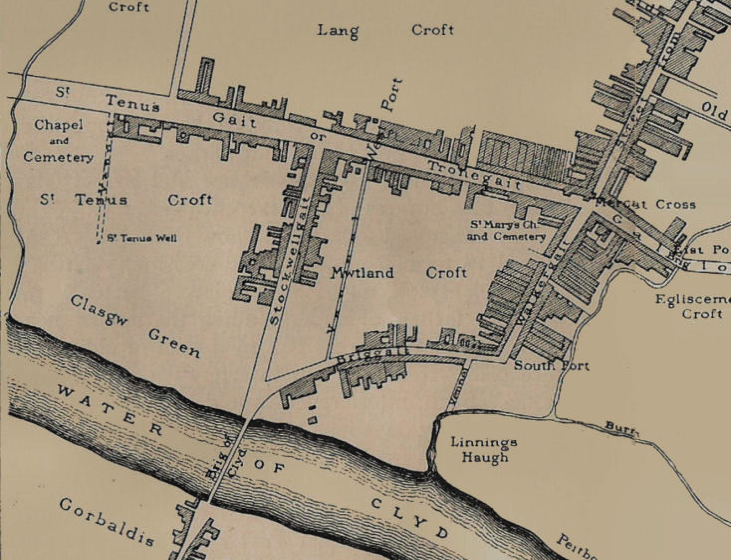
Other places have risen and fallen on the success of one industry. Glasgow is such an example. From little more than a village at the time of Culloden, it grew into the ‘Second City of the Empire’ on the back of shipbuilding and the heavy industry derived from it. But the shipyards were late in adopting welded hulls; the North British Locomotive Co was still building steam engines in 1960. Glasgow is still recovering from the resulting decline.

Map of Glasgow in the Early 1700's

But Hamburg has reinvented itself several times since its Hanseatic heyday. To quote Michaelski’s article:

Today, Hamburg is, in terms of both population and GDP, the most important non-capital city in the European Union. And although shipbuilding and the oil industry, two of the growth sectors of the city’s economy during the 20th century are no longer there, it is still the number one industrial city and trading centre in Northern Europe. It is now the world’s third most important location for the civil aircraft industry, operates one of the two leading European container ports, is home to Europe’s biggest copper smelter and a leader in new energy technologies. And despite all this industrial activity, the city remains a pleasant place to live, winning high scores in lifestyle rankings.”

It is all very well for us Scots to wax lyrical about how much more prosperous we would be with independence—and I, for one, believe that to be true. However, that does not mean that we should sit around waiting for that to be our salvation. If Hamburg (and other places) can prosper and offer a high quality of life to their citizens, while still being treated as a distant province their own country, the dismissive way that Scotland is treated by London is no excuse for us to sulk about it.

Our own Scottish Government’s Culture Committee laid the groundwork in a paper six years ago; that was when Labour ruled the roost, so instead of partisan obstruction that sometimes clogs up our national strategy, this ought to be the chance for cross-party consensus to dig Scotland out of this fiscal mire and leave our English cousins wondering how a country they see as “too poor and too wee” managed it.

Posted in Commerce, Politics | Tagged | Leave a comment

Target Practice

In cutting my teeth on active politics twenty years ago, my unwitting mentor was John Macnair, a crusty, iconic businessman-cum-farmer, whom I had known for a long time because I had gone to school with his two sons. John stepped down as a Tory district councillor but kept an eye on his many local interests by remaining active on the community council, environment trust, etc, etc.

Having survived a stint on destroyers in WW2 and endless insults from Labour council administration over decades, he could be tough when he needed to. But he was neither narrow in nor stingy with the wisdom it had brought him. I was lucky enough to benefit from its depth. “If they’re shooting at you, you know you’re doing something right” was one of John’s sage phrases that has stuck with me.

It sprang to mind again when I was handed the latest leaflet from my Labour opponent in Thursday’s election. Devoting the entire side of the leaflet to one of my blogs from last year, they pay me the great compliment of attacking what I wrote.

The Welsh Labour Administration had dared to break an unspoken political pact among parties not to discuss local government reorganisation. On the back of that, I had posited how that might be approached in Scotland. Labour here clearly doesn’t talk to its Welsh cousins but the leaflet ploughs ahead with: “This is typical of the crazy ideas that David Berry puts forward without thinking through the implications for local communities.

Horseshit. My ideas are both thought-through and based on 13 years serving on single-tier councils. The Tories introduced them over vehement Labour protest in 1996. But Labour now seems to treasure them. Why? Beats me: no-one else does.

I won’t rehearse the arguments from last year’s blog but ask yourself: if you’re abroad in some exotic location far from home and are asked where you’re from, what do you say? If even one in twenty say “East Lothian” or whatever council area they live in, I would be stunned. A Belter will say “Tranent” or maybe “just outside Edinburgh”; most people will cite either their town/village or the nearest city.

No matter how well run and efficient, councils are unloved. This is because they are all too big for people to identify with. And, because they are run from faceless offices and depots miles away, they are foreign to whatever town/village each of us identifies with.

On the other hand, councils are too small for efficiency of scale. With 32 different roads depots or payroll departments and chief executives, jobsworths jealously guard their own patch/job/pension. Each new development in equipment or policy requires that wheel to be reinvented 32 times. After four years of effort, Scotland Excel (common purchasing agency) still handles only a fraction of council buying. You’d think the council umbrella organisation CoSLA might co-ordinate such things, but they are too passive for that.

Dividing Scotland into six city regions to manage the big public services would still allow for regional distinctiveness but with major economies of scale. A city region would have 50 or so councillors, each paid professional salary, and perhaps a provost comparable to the London Mayor. That’s 1/4 the number of salaried councillors we have now. Each would represent a quarter as many people as present MSPs do (around 16,000, vs 70,000) at a saving of around £20m.

Those six ‘big’ city-region councils would administer around half the current Scottish Government budget and would therefore be more readily seen as SG partners, having under their management:

  • Health—all present NHS facilities, replacing inefficient/unaccountable health boards
  • Police and Fire—a reasonable compromise rather than single national forces
  • Water—Scottish Water has far too little public accountability as a public body
  • Education—schools would remain devolved and unaffected but services centralised
  • Social Work—would be refocussed on working with Health, private and third sector
  • Transportation—not only economy of scale for roads but integrated public transport
  • Environmental, Building, Cleansing, Recreation, Parks & Wildlife services, as required

The final ‘as required’ is important and the key balancing element in my argument that Labour’s leaflet ignored. If main public services were managed at city region level, a local element is essential. That element is the level of council universally missed since their abolition in 1976—burghs. They were at a scale people identified with (and still do); their councillors got nabbed in the street; the burgh surveyor got things done to avoid being nabbed himself.

But the structure of a 21st century burgh would be a different. Beyond a burgh manager, there would be few staff; some professionals and an office staff. Most services (e.g. bin collection) would be contracted with the city region (but free to be contracted elsewhere). Main burgh functions would be planning, housing and economic development.

The burgh council would be small (e.g five councillors) and unpaid. Apart from acting as a board for the burgh manager, their role would be to steer the future direction of their community. Where the burgh was large (as in a city) it could be divided into burghs, like London. Where the burgh is small, as in villages, they may wish to coalesce or be managed by a neighbouring burgh.

So, in this instance when the aim is so bad and the attack misses out the half of my thesis how people can best identify with their local government, being shot at by Labour is a compliment. They draw attention to the democratic deficit; they remind us that vibrant community spirit reduces demand on the ‘big’ services, making them less necessary.

But, rather than calling me crazy, I challenge East Lothian Labour to stop mumphing and contribute some real vision for our area: the poor one on their leaflet is either ‘me too’ or pretty lame. I quote:

  1. Safeguard local health facilities—high-priority but not a council function = no control
  2. Maintain local bus services—already done by the SNP but we’ll also integrate them
  3. Fairer local housing applications—Labour started the non-local policy; SNP fixed it
  4. More local job opportunities—SNP’s doing this with apprentices & tourism promos
  5. Devolved funds for local schools—Already done and funding maintained in recession

For decades Labour have recycled ideas from others but don’t seem to read them all the way through, let alone give proper credit. But, I have faith: they should keep shooting; someday they’ll eventually hit something other than their foot.

Posted in Politics | Tagged | 3 Comments

Gathering Nuts in May

So, it’s the final stretch. I have avoided blogging about the upcoming local election partly because I have an interest in it and partly because the great majority of normal people don’t. It doesn’t matter that they should; it doesn’t matter that over £2,000 per head is spent locally of behalf of each and every one of you, nor that holes in the street, dog fouling and scaffy service are on far more minds than nuclear submarines, refining laws or endless enquiries in London about who tweeted whom when about what.

The result in my own East Lothian will not be spectacular; Labour took its unexpected thrashing five years ago but, other than local Lib-Dems following a nationally expected trend of doing a snaw-aff-a-dyke act, the dust will settle on the local SNP running the council in some form. If there is any focus, it will be on the contest in Glasgow where, through their own silly internal wrangling, Labour have lost overall control and don’t look likely to get it back. But smart money—including the SNP’s—is that nobody will be able to secure an overall majority there.

And that is likely to be the main outcome—Labour losing its remaining strangle-/strong-holds in Midlothian, Glasgow and the two Lanarkshires. Rather than anything radical, this is simply a kind of political hysteresis—a natural delay of cause and effect in any monolithic organisation, as when a brontosaurus has a heart attack, everything functions normally for a while before the scattered physiology realises that it’s dead.

Though it will not be a good outcome for Labour, it will be no wipeout. Despite the fact that La Lamont and others on the bridge have proved themselves incapable of adjusting to reality and have logged five years of ill-tempered reactionary opposition with hardly two ideas to rub together, that’s not true everywhere. West Central Scotland may still see many tear-stained red rosettes because they still don’t ‘get it’.

But read Edinburgh Labour’s manifesto and here is a group who have taken recent electoral drubbings to heart and have a set of policies as close to visionary as anyone has managed in their party since Blair. The only question is, if all these shiny ideas are so good, why they had done nothing about them pre-2007 when they ran the place? But the voter is a fickle creature and such history counts for little. Labour won’t surge back into control of the capital but nor will they suffer much further loss.

And that is more likely to be the story where the local party has been dragged into the 21st century and no longer quote Thatcher and the miners’ strike as their main rationale. They will wallow directionless in Dundee, Fife, Ayrshire and the like for a while longer but they may start to come back elsewhere—non-traditional areas where they have good local candidates, instead of the traditional party-loyal-numpty-with-red-rosette.

Wee Ruthie Davidson has made a weak fist so far of here tenure as Tory leader. National appearances have simply echoed the miseryguts attacks on the Scottish government but locally, they claim to want devolution from the centre. Not a bad idea, except that the SNP was already parading that idea. In stark contrast to the pre-2007 bickering within Labour, Swinney and the councils have been a revelation in co-operation and those who claim this is from supine passivity of SNP councils awed by His Eckness have clearly never met many SNP Council Leaders.

So the Tories might be talking sense but then—to one section of the population—they always did. However, their appeal elsewhere remains risible and, as long as they make the mistake of conflating the independence debate with the SNP’s competence in running councils and country, there will remain marking time in the wilderness. As for the Lib-Dems, this will be their worst election to date, comparable to the great collapse of the Liberals in Scotland almost a century ago. They won’t disappear but they’ll be decimated, with Tories overtaking them in votes and councillor numbers.

And, while there are plucky Green, UKIP, BNP and Independent candidates all over the country, those elected are likely to be sitting councillors or in the cities where they had colleagues. That means UKIP/BNP get none, the Greens a handful in Edinburgh and Glasgow and the independents will retain their Borders/DG/Highlands-and-Islands dominance, albeit with a few losses.

Which leaves the SNP. They are considered to be riding high, have firm control of the government and varied levels of control in a dozen councils. This could be the time when they sweep all before it, much, as they did last May. That is possible, and, speaking as a party member of 35 years, desirable. But it’s not going to happen.

First of all, apart from well oiled machines like Perth & Kinross that never make the news, the SNP has been thrust into power in a swathe of places new to them. That meant relative inexperience, not least because Labour was venal in its refusal to share power with anyone unless forced. This has resulted in some understandable mistakes; Edinburgh’s clumsy handling of the trams hot potato is perhaps the best known.

Secondly, the mess that Brown’s administration left in Whitehall (“all the money’s gone” read the note on the Treasury desk) had its parallel in Scottish councils. Aberdeen was left with a financial bombshell; Renfrewshire was little better; my own East Lothian had to deal with a £149,000 payoff to its Chief Executive that the Accounts Commission and CiPFA reversed in embarrassment. Many SNP councils have struggled to right the ship.

Thirdly, although the now-double-dip recession has been well advertised, people still were used to the decade of Labour control when council spending almost doubled from £6bn in 1999 to £11bn last year. Although expectations, children, social care and elderly are all rising in demand, the money to do it is now going the other way. Objective understanding is one thing but when the local school closes or bins get lifted only every other week, people focus on that and forget why.

So, the reality of being in the line of fire at a difficult time will bring disadvantages that have not been experienced before. But the fourth and final thing that will hold the SNP back in this election will be the insistence of a Scottish Government with its tail up of getting started on the independence debate when the decision is still two years off. While a long and decisive debate is in everyone’s interest, for every voter out there who already supports a ‘yes’ vote, there is one still undecided and one dead against.

Since elections are mainly fought (and won) in the media, unless strong local candidates make their mark, the debate as seen by the public has been about the referendum and not about the frequency of bin collection. Because people are not yet ready for the referendum, this will deflate a fair bit of the momentum the party built last year. That does not mean there will be unexpected losses but nor does it mean there will be sweeping gains (i.e. Glasgow) to parallel last May.

As Angus McLead of the Times put it “Many tabloid readers don’t read the politics but goes straight to the back pages.” The level of political debate may seem complex to the press offices and SpAds. But out in the real world, this local election is not causing much of a stir; the low (circa 37%?) turnout will favour the Tories and, despite being decoupled for the very purpose of not being overshadowed, won’t attain the prominence in history that the ‘overshadowed’ 2007 local result did.

Posted in Uncategorized | Leave a comment

The sheer hypocrisy of opposition leaders falling over themselves to find some mud to sling at Salmond when their own party High Heid Yins schmoozed Murdoch for years verges on the breathtaking. #cheekan’impitence!

auldacquaintance's avatarAuld Acquaintance

I commented yesterday about the lack of any evidence of Alex Salmond behaving inappropriately or corresponding improperly with Murdoch.
Assumption and allegation of impropriety based on nothing but speculation are worthless, particularly when there is concrete evidence of endeavors to promote Scotland and Scottish jobs in hte form of the letter written by Alex Salmond to James Murdoch on the 25th of January 2011, two weeks prior to the internal emails of News International advisor revealed yesterday.

Today, for anyone who cared to watch, Johann Lamont made a total mess of her accusations against the First Minister, and she was seen off accordingly. Ruth Davidson chose Trump rather than Murdoch for her subject, and we are still trying to work out what was the purpose of her question?

BBC News tonight, again went completely over the top in reporting events in a manner which bore no semblance of truth to…

View original post 1,090 more words

Posted in Uncategorized | Leave a comment

Lions Led by Donkeys

Now that the Scotland Bill has passed its final hurdle today and will become law within a matter of weeks, we Scots can expect to be enjoined by a kaleidoscope of unionists to appreciate the multifarious benefits of that union. These will revolve around our common history and in that there are indeed things to celebrate. But let’s not kid ourselves that being integral to all that was British and its Empire was pure beneficial glory.

For today is also ANZAC day. For you non-Antipodeans, this is a special kind of Remembrance for Australians and New Zealanders for what became the first action of their recently-independent armed forces in the Allied cause during WWI. It was an example of unequalled bravery on the part of the soldiers and an example of appalling stupidity on the part of the British, who dreamed up and executed one of the least celebrated disasters that pock-mark the story of the ‘Great War’.

WWI was launched on waves of patriotic fervour on both sides. But by 1915, trench warfare had stultified progress on the Western Front. As First Sea Lord, the congenitally impatient Winston Churchill was in charge of the Royal Navy. Turkey had entered the war, blocking access to our Russian allies. Churchill glimpsed glory in forcing the Dardanelles, capturing Istanbul and knocking Turkey out of the war. Re-opening supply routes to support a hard-pressed Russia were an added bonus.

Starting on February 19th, Admiral Carden expected the breakthrough to capture Istanbul to take no more than two weeks. But the first attempt to suppress Turkish forts protecting the Dardanelles was a disaster: a combined French and British fleet of second-rate battleships traded shells with shore batteries, while dodging torpedoes and minefields. 100 years before, Nelson had said  “any captain who engages a fort worthy of the name deserves to be shot” but that lesson had been forgotten.

Instead, the French Bouvet was sunk, with Suffren and Gaulois heavily damaged. The RN lost Irresistible, Inflexible and Ocean, all in the first five miles. Sent homeward to think again, Kitchener appointed Sir Ian Hamilton to lead a Mediterranean Expeditionary Force. It was to land on the Gallipoli peninsula, clear it of Turks and their artillery, so allowing the fleet to proceed. Turkish soldiers were discounted as obstacles.

As the British Army was stretched to fill the ranks in France, Hamilton augmented his 29th Division with the Australia and New Zealand Corps (ANZAC). These had answered the empire’s call for men and were completing their training in Egypt. Aside from lacking experience, these were superb troops—fit, young, healthy, built like brick shithouses and—what is key in war—organised in cohesive units and raring to make their mark.

Being new to amphibious assault, the British Army was short on both equipment and experience. Luckily, the Turks had not expected the makeshift landing by the 29th division near Hellas at the tip of Gallipoli, while the ANZACs came ashore at Gaba Tepe, in what became known as Anzac Cove. While elements of the 29th took hundreds of casualties on defended beaches, others landed without opposition and then, against orders, drifted back and re-embarked. Although the ANZACs got ashore, they ran into stiff opposition. Within hours, all landings had been sealed off and movement reduced to the equivalent of the trench warfare then ongoing the length of France.

The Turks, far from being pushovers, had been taken in hand by a German General von Sanders and reinforced by two divisions, the one facing the ANZACs being commanded by  a Col. Mustapha Kemel, later Kemel Attaturk, regarded as saviour of his country from disintegration in the aftermath of WWI. Able to land as planned on April 25th, the ANZACs were immediately counter-attacked by Kemel’s 57th Regiment and experienced days of tough fighting where the outcome hung in the balance. Almost out of ammunition, Kemel issued a brutal order “I do not order you to fight; I order you to die. In the time which passes until we die, other troops and commanders can come forward and take our places.” Of the 3,000-man regiment, none survived. As a mark of respect, there has been no 57th regiment in the Turkish Army since.

Despite desperate fighting and heroic deeds, the ANZACs bled for no good reason. All of the beachheads into which the troops had been led blind with no reconnaissance and no artillery bombardment were going nowhere. Yet General Hamilton persisted. By the summer, the heat was atrocious. Corpses in the open were bloated and putrid and, with bad sanitation, led to so many flies that eating was misery. Dysentery spread through the beachheads.

Hamilton’s solution  to the stalemate was another landing further at Suvla Bay where 22,000 men of IX Corps (British 53rd and 54th divisions) would sweep ashore against 1,500 militia holding the area and—this was key—move swiftly inland to capture a commanding chain of hills. The ANZACs were to provide a diversion by capturing Chunuk Bair. This was assigned to the New Zealand Brigade and the Australian 3rd Light Horse Brigade (dismounted at this point). The exploits of the latter became the subject of Peter Weir’s fine 1981 film, the eponymous Gallipoli.

So fierce was the fighting around Chunuk Bair that, of the 760 men of NZ’s Wellington Battalion, 711 of became casualties. Meantime under General Stopford, the IX Corps landed and proceeded to just dig in. For over two days, the wide open Turkish flank was left untroubled by soldiers milling about on the beaches of Suvla “like an enormous anthill”. Stopford stayed aboard ship, satisfied to have got his command ashore safely.

When he eventually moved forward nine days later, the chain of hills were full of dug-in Turks under the formidable Kemel and 8,000 of his men died in futile attempts to secure them.

While there is no gainsaying the utter bravery and self-sacrifice of ANZACs from half a world away fighting for a country that was no longer theirs in a war that was not theirs, the sheer professional incompetence of the British commanders from Churchill down through Kitchener, Hamilton and Stopford was shameful. It was, if anything, worse at Gallipoli than in the unimaginative charnel house that Haig created in France.

A bon mot usually attributed to the very capable German General Ludendorff, famous for bamboozling the 1914 Russian offensive in Masuria, was that British soldiers were “Lions led by Donkeys”. But how much more difficult for Australians and New Zealanders—both fighting in the forces and anxiously awaiting news from half a world away—to thole that their lives, sold dearly with such bravery, should be wasted by incompetence rife in the mother country’s supposed professionals who’d yet to learn their butcher’s trade of war.

Posted in Uncategorized | 4 Comments

Camlachie Lassie

As a politician of 13 years experience in both parliaments and having demonstrated in that time that she is no numpty, the current Shadow Secretary of State for Scotland Margaret Curran MP should be able to hold her own. That she can mix it with the best of them was demonstrated in the feisty campaign she ran in the Glasgow East by-election in 2008—losing narrowly to John Mason before digging in and achieving a thumping turnaround in the subsequent 2010 general election.

A disappointment, then, when interviewed in London today along with Stewart Hosie MP on the matter of the now-double-dip recession that, instead of finding common cause with the SNP to declaim Osbo’s flawed economics that have led us into a £1 trillion deficit and no recovery in sight, Ms Curran chose tangential-attack-dog mode instead. Far from finding common cause, she fixated on an irrelevant question whether MSPs can insist on the First Minister being specially carpeted prior to FMQs due tomorrow (Thursday) to explain any discussions with Rupert Murdoch.

It was an unwitting re-enactment of the hilarious Monty Python snippet: “and here is a recording of Alastair Cooke being attacked by a duck—(cue nasal Ivy League accent) ‘I can never visit Philadelphia without’...” the rest of the monologue is drowned out in quacks. Poor Stewart; despite a sincere attempt to support Labour’s thesis that the present ConDem fiscal strategy is bankrupt, he was dragged into pained silence by Curran’s puerile repetition of exactly the same question.

To some extent, repeating the question and not being stonewalled by non-answers is a legitimate political tactic. Paxo has used it to devastating effect in his time and any question of substance does deserve an answer. But in a proper context.

To be legitimate and effective requires that the question pass two key tests: 1) the question must have direct bearing on the discussion; 2) the one questioned must be competent to answer it. On the first, the FM’s relationship with Murdoch is irrelevant to our recovery from recession and, on the second, querying an MP for procedure in the Scottish Parliament (where he has never served) reeks of seizing any opportunity to justify a pre-judged position.

It wasn’t a pretty sight. Ms Curran did her credibility no good in quacking as raucously as she did. This is especially so when her own and her party’s performance is considered when the questioning boot is on the other foot.

Just as Labour’s recent pious demands for education budgets to be preserved, whatever Westminster cuts may come (conveniently ignoring an 8%-and-rising drain on that budget funding 30 fat years of profit for PFI companies set up by Ms Curran & her former MSP colleagues), so this pious insistence on utter, instant openness sits awkwardly with Labour’s own FOI record.

In the period 1999 to 2007, the three Labour-led Administrations declined to answer 547 questions put to it, mostly under the FOI Act requests. Of these 18 were questions made directly to FM Jack McConnell, which included:

  • discussions with the Catholic Church (Refused: deemed exempt under Section 12—excessive cost of compliance)
  • the Section 28/2A furore of 2000 (Refused: deemed exempt under section 29—Formulation of Scottish Administration policy)
  • the Beattie Media furore of 2001 (Refused: deemed exempt under s12—excessive cost of compliance and s33(1)(b)—Commercial interests and the economy)

Some of the reasons given are pretty odious, as when “Request for copies of the advice given from Dundas & Wilson, Ernst & Young, Scottish Airports Ltd., Thomas  & Adamson, SO, HM Treasury and its PFI Unit on the PFI project.”is met with: “Refusal: exempt under sections 29 (Formulation of Scottish Administration policy), 30 (Prejudice to effective conduct of public affairs), 36 (Confidentiality)

Baron McConnell of Glenscorrodale needed no lessons in evading questions he preferred not to answer; Ms Curran had a front bench role throughout his tenure and learned well from the master, steeped, as she was, in his ritual obfuscation for at least the last decade. It may not be her fault that her facial expression falls naturally into a body language that radiates distrust and displeasure. But it seems a fair expression of what’s going on inside.

Nonetheless, it’s a shame she focusses her energy into trying to trip up opponents so deeply that she’s convinced others deploy the same obfuscation. Because there is a dwindling pool of people who can pull Scottish Labour back from the brink of oblivion into which it seems hell-bent on driving itself. The combination of thrawn sullenness at not being in charge and addiction to decrying the works of others as flawed by definition will be its downfall unless someone of the stature of Curran or Darling calls ‘enough’.

Credibility is a precious commodity in politics; parties or people play with it at their peril. If people believe you’re as two-faced as Camlachie clock (and that’s got four), it might be time for someone with ambition for office to consider whether incessant quacking has any place in a strategy towards such a future.

Posted in Politics | 2 Comments