Living Next Door to the Blenheim

Regular visitors to this blog may have noticed a certain hiatus in its usual crisp sequence of posts every other day. Normal service may resume but I’m not sure I can promise it. The reason is a particularly hectic weekend when I caught up with friends on contiguous nights, guided out to Bass Rock on the last Saturday of the SSC trips out there and was confronted with a piece of history in which I had not choice but to participate.

Now that I no longer chair East Lothian’s Licensing Board (nor am I even a member) I can come clean about a dirty little secret that friends have been good enough not to shop me for. The story starts ‘way back in the innocent days of the early sixties. Are you sitting comfortably? Then I’ll begin.

Like most small-town adolescent males, I spent 1963 desperately trying to impress girls but failing miserably. At the time, I blamed the fact that 5th year rugby gorillas drove cars and therefore could sweep the babes in my year off their feet. I now see that hormone-induced acne and raging mood swings and the thinness of wallet and/or cool sustainable by a paper round might have played their respective parts.

The answer, with rock belting out the radio and girls swooning before the stage at the local dance hall, was obvious: get in a band. The first iteration didn’t work too well. All of our mothers turned us out scrubbed and we were about as earthily proficient in the Gene Simmons school of profanity and tongue leers as the Vienna Boys’ Choir. Plenty rock, plenty gigs, even some money; but no babes.

Before leaving school, I’d worked out that the formula was wrong. The acne was gone but the mood swings were still there and rock cool now had to be Stones-like or Who-esque, although my freckles were never going to let me aspire to be Hendrix-some. So, when the rival local band who had a raunchy lead singer, wildly plugging bass, more feedback-screaming lead guitar than the wimpy amps of my old band could dream of asked if I’d join them for a tour, I said ‘yes’ before I thought about it.

Because the ‘tour’ was all in Milton’s head. He’d bamboozled three of the band (Spike, Mick & Bert) to join him in traveling to Majorca to make a bundle playing for sun-and-sangria-loving tourists. But Walter the drummer had a good gig as a housepainter and wanted none of it. So, early July 1967, a red Thames van with all our gear and the five of us headed down the A1 towards fame & fortune.

Before we’d even got to London, Milton broke it to us that we didn’t have any gigs in Majorca yet. But he’d been at Farnham College of Art that year and knew a pad near there we could crash at while we went up to London, saw some agents and sorted all that out. After being laughed out of several agencies, it wasn’t even Shaftesbury Avenue but Turnham Green where we finally capitulated to one who suggested we just play some gigs around London.

So we did. And though we played the Angel, it was in Edmunton, not Islington and that summer we never even got a sniff of the Marquee, Bag of Nails—let alone the Crawdaddy Club where the Beatles met the Stones. Still, it was a summer I’ll never forget—working out how to live like a hippy, sleeping till noon, playing a crude squash variant in the garden, seducing the dollybird daughters of Farnham stockbrokers—all (unknown to us) in parallel with the Haight-Ashbury summer of love going on at the same time.

Milton and Mick composed songs on an old pedal organ one of the art-student roomies had; we got better as musicians; made demo records to peddle round other agencies; gigs got further afield—from family caravan sites in Pembroke to gloomy working men’s clubs in Sheffield to camp psychedelic clubs ahead of their time in Colchester. But that was about as close to the Continent as we ever got.

By the end of the summer, both repertoire and playing were much tighter but I had a dilemma. Second year at uni started in mid-October. Despite the bird-pulling power of a tight band in tight flares, I hitchhiked back north to reality.

They did fine without me—got a better drummer who was really into the lifestyle and not just dabbling like me. They were good enough to turn professional, get better equipment and the sine qua non of professionals: a Ford Transit van with aircraft seats. A couple of summers I visited, sat in, was mildly jealous, especially when they had tours to Denmark and Germany. What I didn’t know is they starved and froze much as the Beatles had done in Hamburg seven years earlier.

Eventually it dawned that they were good and could get good gigs—but always as warmup; none of the songs they wrote interested recording studios; although they had offers as individual session musicians that wasn’t why they were there. So after three years—right around the time the Beatles split in 1970—they called it a day and went their separate ways.

Milton went back to Scotland, taking over his dad’s hotel business; Mick went to California, still with some dreams; Bert wound up in Tromso(?!); Spike settled down and used his patter to get into advertising in Fleet Street in the days that was the centre of the print universe. And that, as the storyteller has it, was that.

Except it wasn’t. After a few years, Mick, now trained as a nurse, came back home. Within a year, another band is touring Fife and the Lothians, featuring him and Milton. But now they’re both married with jobs and so obligations soon ratchet it back to just playing in Milton’s pub each weekend with a succession of young local guitarists and drum machines filling in for the absent members.

By the nineties, Milton had moved back into hotels, buying the Blenheim House Hotel in North Berwick’s Westgate, which is where I found him on my own return from the States. Soon there were a series of New Years Day parties, 40th/50th birthdays, receptions, wakes, anything was an excuse for a gig, fill the lounge with a heady mix of friends and rock’n’roll. This went on for years, with Bert arriving back a decade ago and Spike often making the trip up to sit in. But it couldn’t last.

With all of us pushing retirement age, Milton decided to hang up both his bar peeny and his guitars after one last summer season. And so it was that, 45 years on from our first (and some claim only) rehearsal, his Westgate neighbours were deafened for the last time by a six-hour stint of various guest performances, as well as of the old band. High point for me was when Milton (as is his wont) ad libbed new words to a song—in this case “Living Next Door to Alice” in which he sang apologies to his long-suffering neighbours who for twenty-four years have been living next door to the Blenheim.

Though I’m sad it has all now ended, I’m also relieved: I always had visions of us being in the middle of tearing the place down with “I Saw Her Standing There” or “All Right Now” when the polis arrive to complain—and there’s me, Convener of the Licensing Board giein’ it laldy at the epicentre of it all.

Blenheim Final Gig, October 7th 2012: Spike (lead); usurper (my drums); Bert (bass); Mick (vocals); Milton (rhythm)
Posted in Community | Tagged | 2 Comments

Corned Beef Auditors

Since taking over control of East Lothian Council five months ago, the new Labour/Tory administration has not exactly hit the ground running. But what they have been busy doing is sowing alarm and despondency about the “parlous state” of council finances and using every opportunity to declaim “last year’s record 26% increase in capital spend to a total of £71m“.

To a large extent, this is predictable politics. They made a number of election promises like restoring free heavy kerb-side uplifts and building house extensions. These need to be funded at a time when incomes are dropping, so something will need to be cut to allow for them; finding fault with the previous budget is good cover to blame someone else.

Except that both Labour and Tory budgets last February committed even more capital spend and Labour, in particular, had been vocal in criticising the scale of reserves, claiming that the council could therefore afford to give everyone a pay rise. However, at the Audit Committee meeting of September 18th, an audit report from KPMG sided with the new administration, criticising both over-commitment of reserves and a debt-to- revenue ratio at 1.62 that they presented as the worst in Scotland.

Auditors—especially ones of the stature and charging the fees of KPMG—are expected to get things like this right by listening to the details. This lot may have looked for the beef in the figures but they wound up corned beef. Here’s why.

Firstly, not only was the present recession was anticipated and built into ELC budgets as early as 2010/11 but ELC was praised for its handing of it. The Report on the 2010/11 Audit by Audit Scotland of October 2011: “The General Fund recorded a net surplus of £5.9 million, attributable mainly to savings across service budgets” and “an additional £7.4 million statutory surplus was added to reserves” and most importantly “most of the council’s recent borrowing is to finance the building of social housing and debt charges can be met from housing revenues.” All this was achieved while securing local jobs by sticking to plan giving people affordable homes and key facilities like schools.

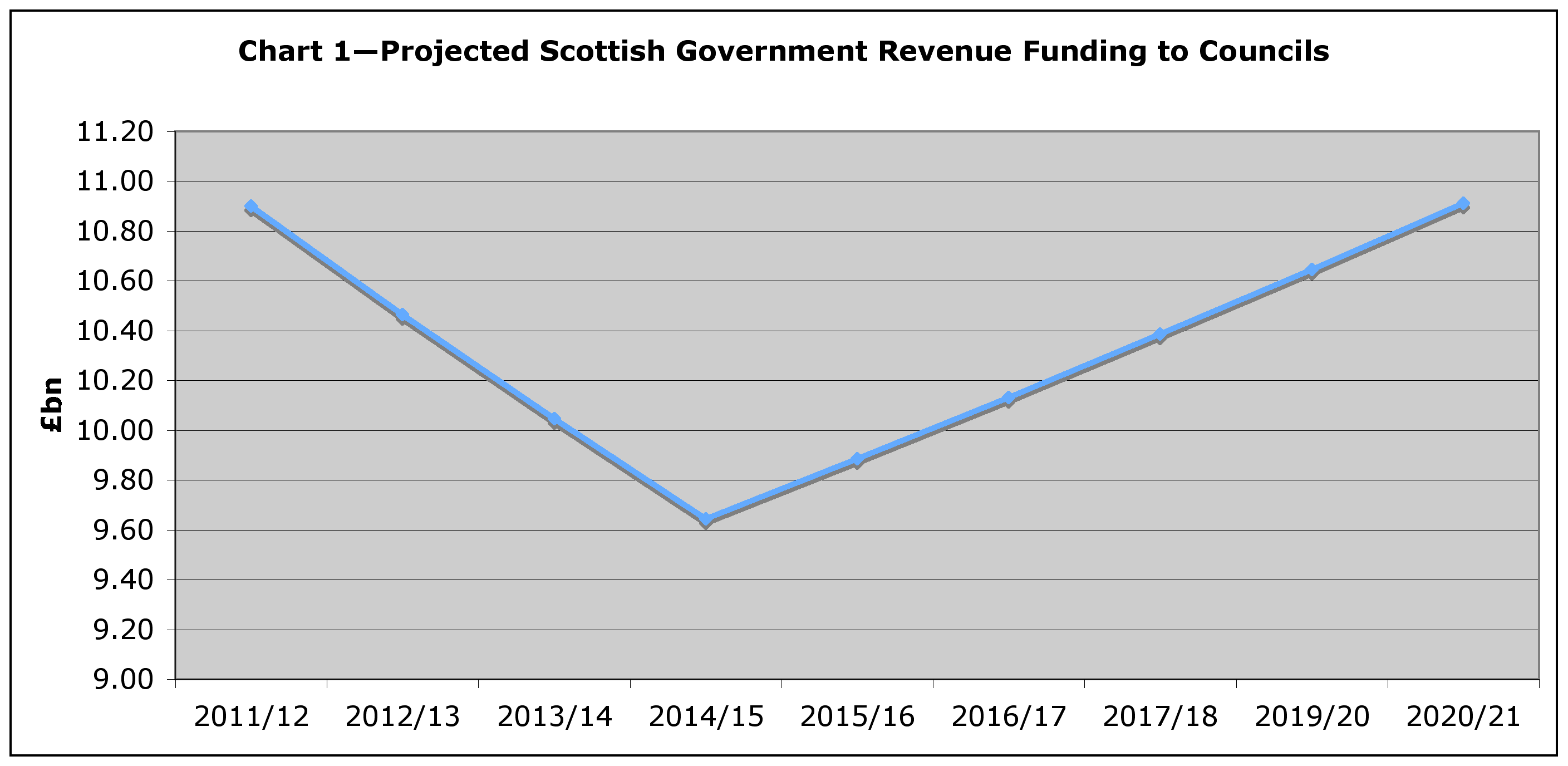
Secondly, until this spring, the UK Governments was driving Scotland towards a reduction in finance of 4% over each of three years to 2013/14, followed by a slow recovery to original levels by 2020. Faced with an option between shedding 12% of staff or building a “bridge” across the dip, ELC chose temporary use reserves to keep services stable and staff secure. The dip in revenue and ‘bridge’ across its low point is illustrated in Chart 1.

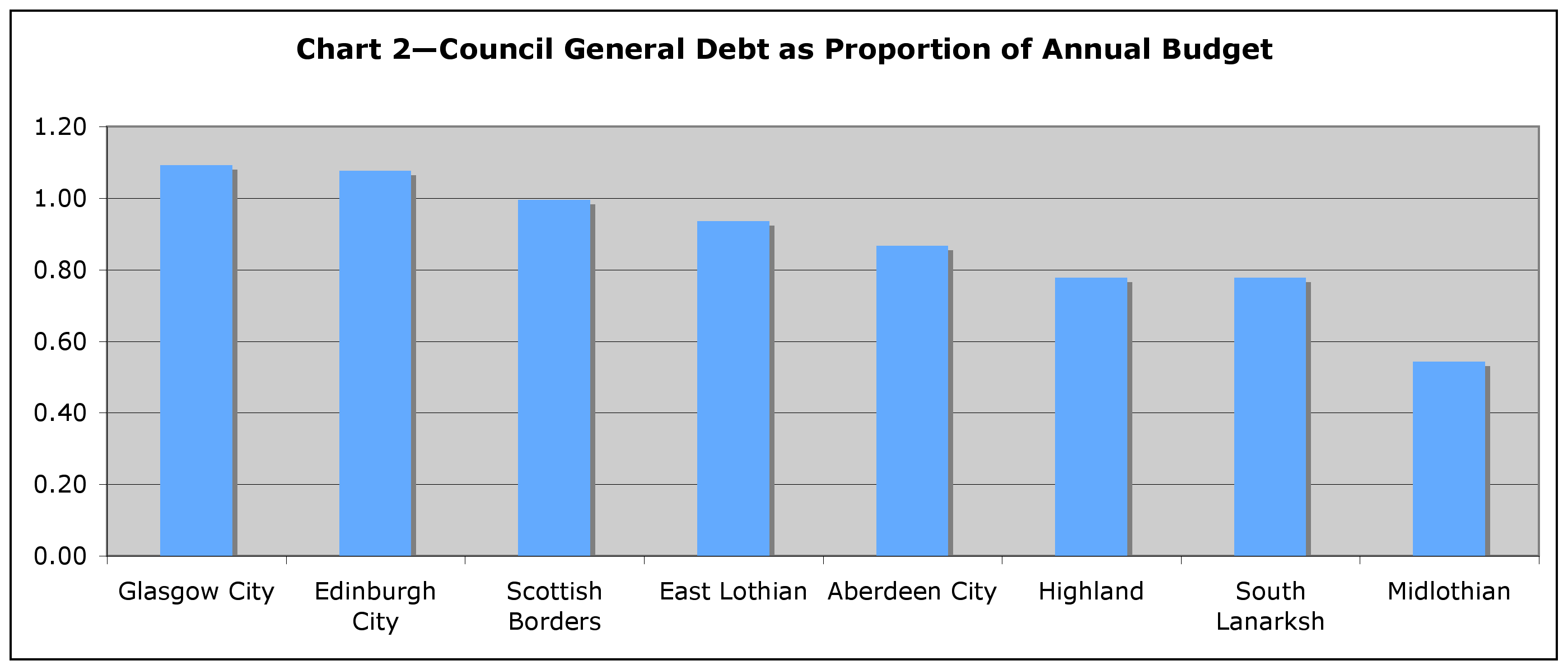
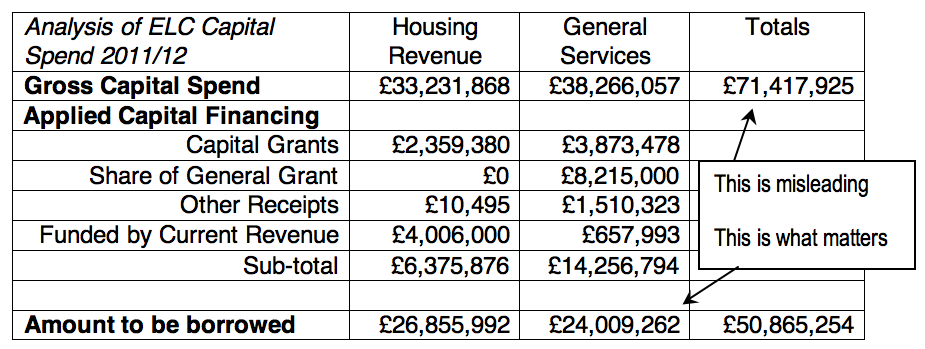
Thirdly, the new KPMG report to ELC’s Audit Committee last month appeared to be written wearing a set of blinkers. By claiming “all reserves committed” and a “record rise in capital spend by £71m” and “largest debt by revenue of all 32 councils” they interpreted numbers narrowly. The use of reserves had been planned that way (see 2 above). The key figure for debt was £24m, rather than £71m (see table below) and; c) non-housing debt by revenue—the one that matters because it’s repaid from revenue was 0.95, not KPMG’s 1.62.

Table 1—Breakdown of ELC Capital Investment for 2011/12

The reason net non-housing debt should be used is twofold: several councils (e.g. Glasgow & Borders) have no housing debt at all and; housing debt is no real burden as rents not only cover borrowing costs but can even supply financial support elsewhere. Therefore only the non-housing part need be funded from general revenue budget. Redrawing KPMG’s chart gives Chart 2.

This shows three councils deeper in debt than East Lothian, none of whose housing, education or general infrastructure (i.e. buildings) are in as excellent a shape as East Lothian. Indeed, one reason for East Lothian’s debt has been making its estate sound in anticipation of money being tight in the near future. This secured many jobs in the county while allowing the council to shed 400 jobs naturally, thus far avoiding any mass compulsory redundancies.

Fourthly, putting that another way, some £106m (over £1,000 per resident) has been pumped into local jobs in providing 1,000 affordable homes over the last five years. Crucially, all resulting debt can be carried within the self-sustaining Housing Revenue account (HRA). Over the same time, the General Services account borrowed an additional £43m that will cost just over £1m in additional interest. An equivalent sum was taken every year from the HRA by the earlier Labour administration—clearly such numbers can be sustained.

All that said, no-one questions difficult times ahead. A double-recession has delayed when the corner in Chart 1 will be turned. Any 3-year budget set last February does now need revision to allow for new circumstances. But whether ELC’s new administration can absorb the rigorous budgeting necessary—or KPMG twigs how local government capital finance works—is entirely another matter.

Posted in Community, Politics | Tagged | 1 Comment

Buck-Buck, Bu-aaaaack!

Ten days ago, in a blog entitled Ten of the Best, I threw the gauntlet down to the assorted rammy of unionists who claim that Scotland would be better off in the UK in any and all situations. OK, I said: convince me.

They have been much better at claiming the superiority of the union than giving me anything I could recognise as sober and cold-reasoned arguments. I was looking to them to lock their case down tight and deafen us all with the sound of nat foreheads being slapped as they forsake their misguided ways and return to the paths of the righteous.

To make it easy for them, I couched the debate in terms of ten ‘daft laddie’ questions that most ten-year-olds could take a stab at answering without having to flip to the calculator app on their iPhone. That was ten days ago; so far, nothing; zip; nada; nada goddam thing.

Come now, Jackson Carlaw or Ruth Davidson; Willie Rennie or Tavish Scott; Jackie Baillie or Michael McMahon. You’ve all trashed nats with glee in the past. But what I’m looking for is your positive half of the argument; what the Scottish people will enjoy into their future that they would/could not have more of or better or easier by having their own country back. If the case is so self-evident, why are you spending your lives nitpicking the political equivalent of dandruff?

I am especially disappointed in the Tom Harris/Murdo Fraser/Jo Swinson factions who have shown themselves to be articulate, objective when required with commitment to the causes they espouse that go far beyond arsecrawling conformity in their chosen party. It’s hard for me to believe they have nothing to say. But that is the conclusion that, inevitably, must be drawn—that, daft laddie or no—independence is as hard to refute as a solid case for the union is to make.

The credible critics of independence, such as Alan Cochrane, can be relied on to make a decent fist of their argument, as can the literate venom of Brian Wilson, even as bluster epitomised by Lord Foulkes undermines their cause. But they’re on less sure ground as union-boosters. I’ll grant this summer was a good patch for those who regard the UK as sacrosanct—the enjoyment of millions in a well run extravaganza crowned by a serious medal haul was plain to see. Yet the Ryder Cup, where the UK has no identity and which is coming to Scotland in 2014, drew amazing TV crowds into the wee hours.

It’s possible no-one reads these blogs and that the 20,000+ hits so far were all mistakes. Judge for yourself. More likely is that a variety of people come for some info, some opinion and some titilation, We don’t want them to stop so the best story yet why we should stay in the union should make for a good  read.

Or, in truth, do such arguments—like answers to my daft laddie questions—not exist and such unionists as make up the Better Together campaign already dwindling to the payroll vote?

Posted in Politics | Tagged | 1 Comment

Embra-rassing: A Public Transport Pygmy


The recent criticism of restructuring the EGIP railway electrification project to bring Scotland’s key intercity track out of the 19th century rather misses the point. As with the rest of Britain, we think that throwing money at individual lines in the worst pork-barrel tradition will someone leave Scotland with a modern transport system. Almost every new rail investment has underestimated the demand. But that’s not necessarily a sign that we’re getting it right. It could be that demand is so huge, almost any new line will succeed.

Today sees the publication of a paper by Transport Scotland on a Smart and Integrated Ticketing Strategy. Sounds good—great in fact: it’s not just God who loves a sinner come to his understanding. Given the scale of the issue, its 18 pages are light on substance and reading them poses more questions than they answer until you realise that we’re only discussing smart—not integrated—ticketing, which is a shame. What we seem to be aiming for is McOyster and little else.

It’s a bit like laying 150mph track but then running 60mph trains down it: yes, it’s a railway, Jim—but not as we would like to know it. However many anoraks we have staffing Transport Scotland, SPT, Network Rail, SESTrans, ScotRail et al, nobody seems capable of thinking like passengers, addressing their problems holistically and finally getting ridership to compare with what European countries achieved decades ago. Let me state this in simple terms:

  1. People want to get from home to/from work or shops or friends as direct as possible.
  2. They will do that by the easiest means (and in the least time if it is repeated often).
  3. Price is a factor but convenience/speed much more so.

Universal direct public transport links are, by definition, impossible. But any transport system worth its salt will minimise interchanges required and the distance/time needed at each. Currently there are no systems in Scotland worth the name—trains and buses operate on different planets, let alone ticket systems or timetables. The result is a mess—and an expensive mess at that—which results in people piling into their cars in droves.

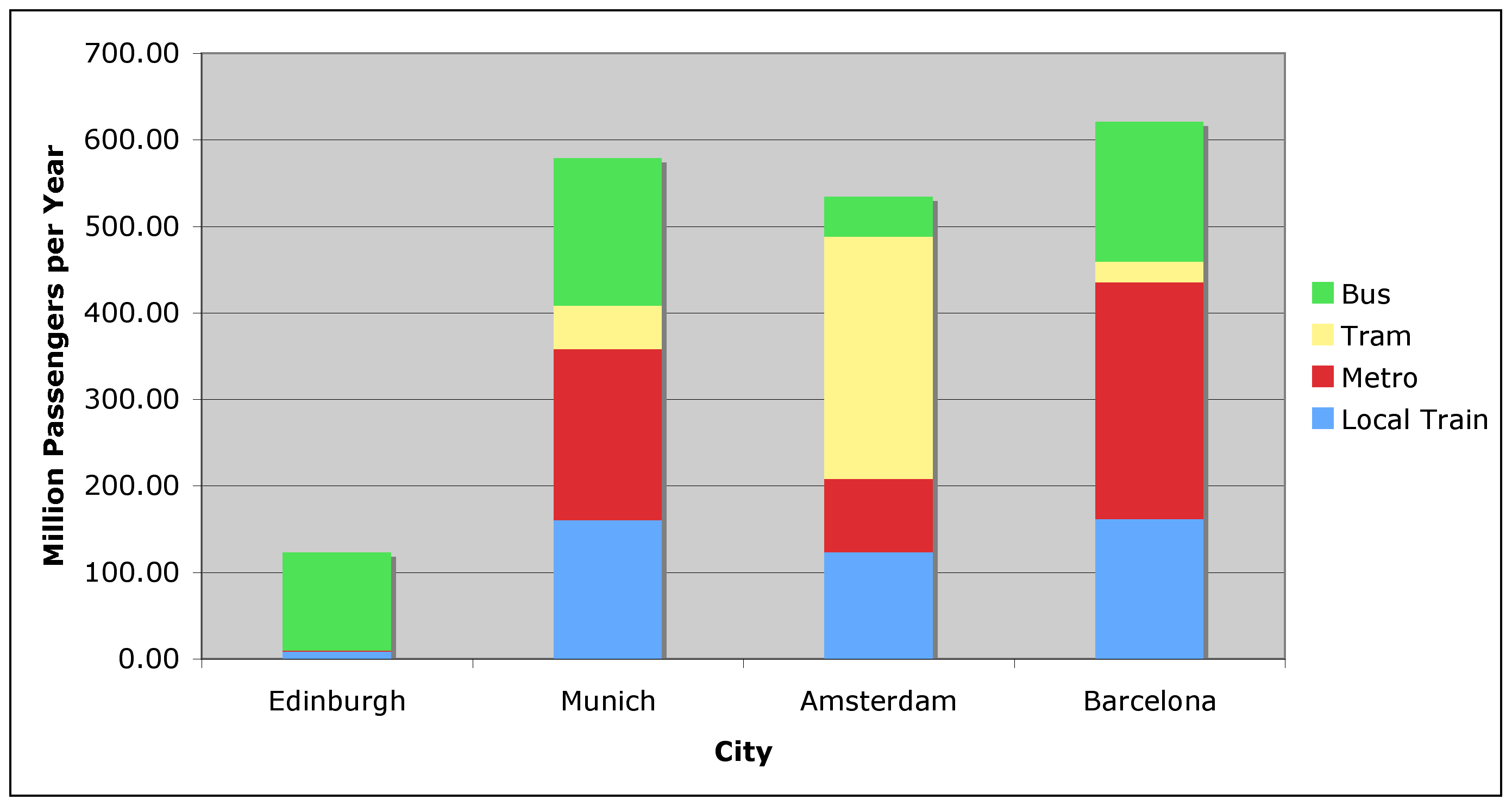
Look at any decent-sized city in Europe and its public transport will put Edinburgh to shame. From Amsterdam to Zurich one ticket gets you around a logical, integrated web of trains, metro, tram and bus, cascading from one to the other in a linked plan.

Munich’s Public Transport—a Real Network

By contrast, in Edinburgh, almost 90% of its 123,000,000 annual passengers rely on the slowest, least efficient form of public transport—bus. Good though Lothian buses may be, they have no real competition, with neither metro, nor suburban trains worth the name within the city. The other 10% use ScotRail & First services from the Lothians and Fife. But comparing Edinburgh with European cities is an exercise inviting serious ridicule.

Embra-rassing: Public Transport Statistics for Comparable European Cities

Reliant almost entirely on buses which are then choked by the cars people use in frustration, Edinburgh is a pygmy in transport and decades behind comparable cities. Even allowing for its population (500,000) being the smallest of the four, its still grossly outclassed per head.

But what is worse, the reason the Europeans are so far ahead is that all three other cities ditched the competitive private profit shibboleth vampiring on investment and hobbling growth here by picking transport organisations up by the lapels and making them work seamlessly together. as a result, the MVV in Munich has run a slick single-ticket system for the last 40 years. Together with linked services, it’s what lures people from their cars.

Yet we (and the Transport Scotland paper published today) act as if such a thing had yet to be invented. No wonder Bavarian or Catalan visitors milling around Waverley looking for a bus—or even any information about buses—look on us as transport neanderthals. This Gordian knot needs to be cut by

  • rethinking the ScotRail franchise to encourage single-ticketed integrated services
  • threatening bus companies with loss of all subsidy unless they jointly agree a single ticket system in short order
  • insisting toothless SESTrans/SPTs earn their pay or get their jotters.

And, in case you think this is being unduly harsh, insisting on transport value for public money, the future ridership stats for Edinburgh’s £1bn tram system are included in the graph above. It’s just they’re so small you can’t see them. Embra-rassing stuff!

Posted in Transport | Tagged | 3 Comments

Private Finance Insanity

So the debate on how Scotland’s public sector should face another four or more years of growing fiscal drought that will take 12% out of the £33bn devolved budget has been blown open by Labour’s unexpected conversion to revisiting universal care. Leaving aside the relative merits of that and the proposal made in this blog yesterday of adjusting (but not raising) Council Tax so that the rich pay proportionately more and the poor and middle pay the same, what other major factors are in play?

Together with the roughly £11bn of GAE (Grant-Aided Expenditure) from the Scottish Government, councils rely on around £3bn in council tax to balance their books after all fees and charges they levy are taken into account. A 12% rises in that tax take would certainly cover a multitude of fiscal problems—£360m is a wheen o’ siller. But that is not likely in the next year or two, so what else need we focus on?

Wages are a huge element of council expense and, despite a wage freeze, there is still an upward creep in this of around 1% because of promotions and grade advancements. That means that, if the 12% drop hits councils, we are really looking at a 16% squeeze by 2016. Any prognosis that all services are not in for some form of paring is unrealistic and it will take a level of clever management and shared service delivery that, to date, both CoSLA and council senior management have both shown themselves incapable of addressing, to avoid customers complaining about cuts and staff going out the door.

One of the culprits that gets away with no adverse publicity is the Irn Broon wheeze-of-the-noughties of PPP-redux, aka Private Finance Initiative (PFI). Labour-run councils in particular fell over themselves to use this because it was so tempting: get millions invested now and let children as yet unborn worry about how to pay for it once you were long retired. Great wheeze!

Had the halcyon pre-2008 days continued, PFI might not have been such a burden. When council tax and GAE were both rising at an average 5% each year, there was always more in the pot to spread around and cover such growing expenses.

Now, we’re in a totally different situation the income growth isn’t there but PFI demand is. As an example, East Lothian’s PFI for six high schools was valued at £56m and started in 2002 with payments of £5.5m. Ten years later, that annual payment has risen inexorably and now stands at £7.7m. Put another way, ELC is now paying a 13.75% rate on a £56m loan (when PWLB borrowing is around 2.8%) and it’s only going to go up.

Although it affects almost all areas of public finance, little has been written about PFI in Scotland and especially its growing vampire drain of public finance at a time when that finance is shrinking. There are 85 PFI projects running across Scotland that have produced a total capital investment of some £5.67bn. In return for that, by 2040, these projects will have cost the taxpayer £30.77bn in payments. Borrowing from the PWLB would have cost around £4.67bn over the 30 years. You judge which is the better deal.

But, now that the pips are squeaking and we are supposedly “all in this together” are any of the PFI contracts being renegotiated? Are any of the PFI consortia meeting with councils and the Scottish Government see see what they can do to ease distress? Not a bit of it; in fact Westminster insists that all PFI payments come ‘off the top’ before and other liabilities are considered for payment.

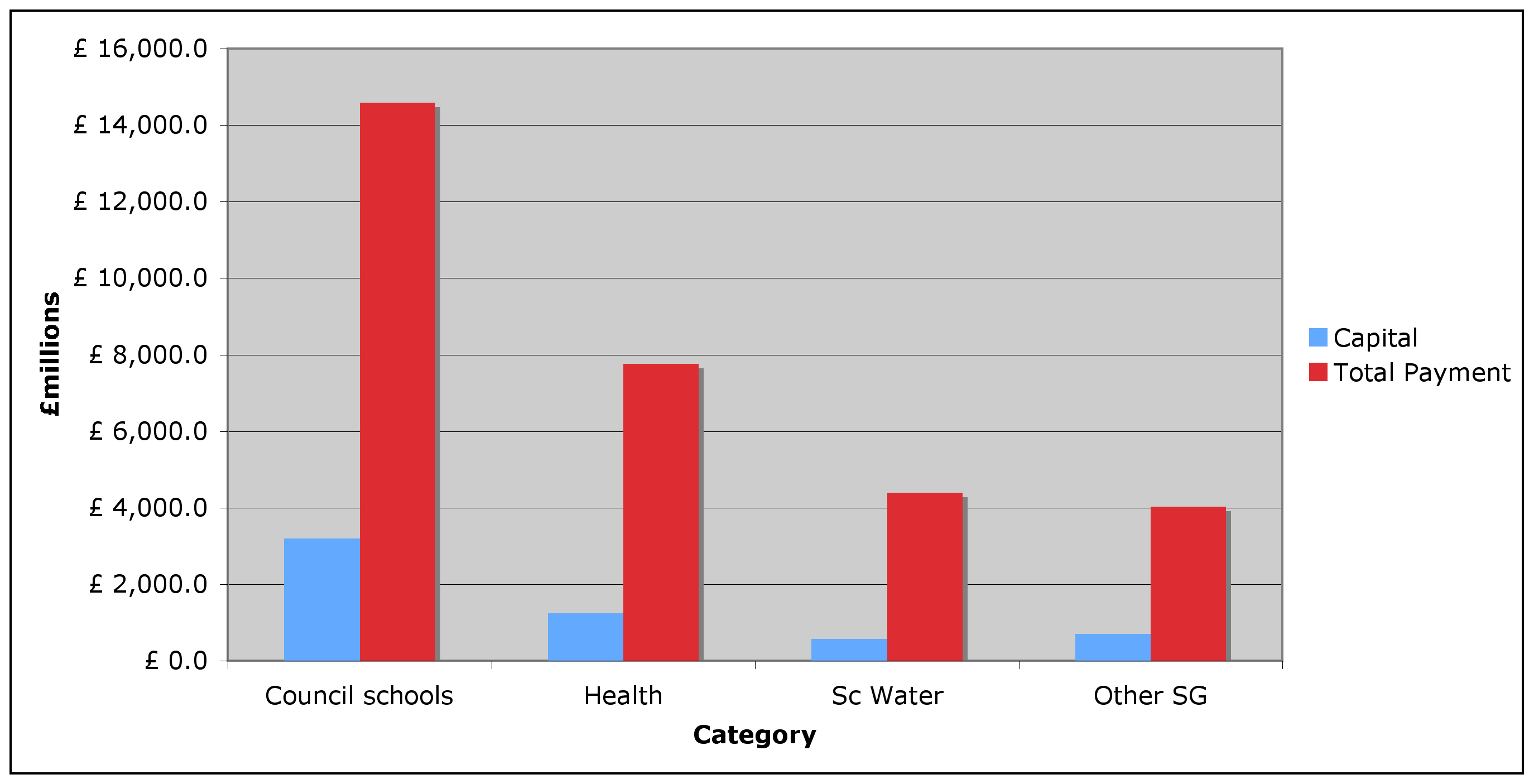
Because the Scottish Government gets all its funding directly from Westminster, it is not in a position to adjust its income at all. Councils are slightly better off in that they get ~20% of income from council tax. But, since that has been frozen, both are in the same cash-strapped boat—the question is more which category of government is more affected by the financial imposition of PFI. Chart 1 shows the main divisions:

Chart 1—PFI Capital Investments and Total Repayments by Category

While the other categories clearly made major use of PFI to fund projects—60% of total projects and just under 50% of repayments are council schools projects. One of the largest is Glasgow’s £225m of investment. It is also one of the worst deals going—currently costing £46m this year and rising inexorably to £68m each year before it finally ends in 2030.

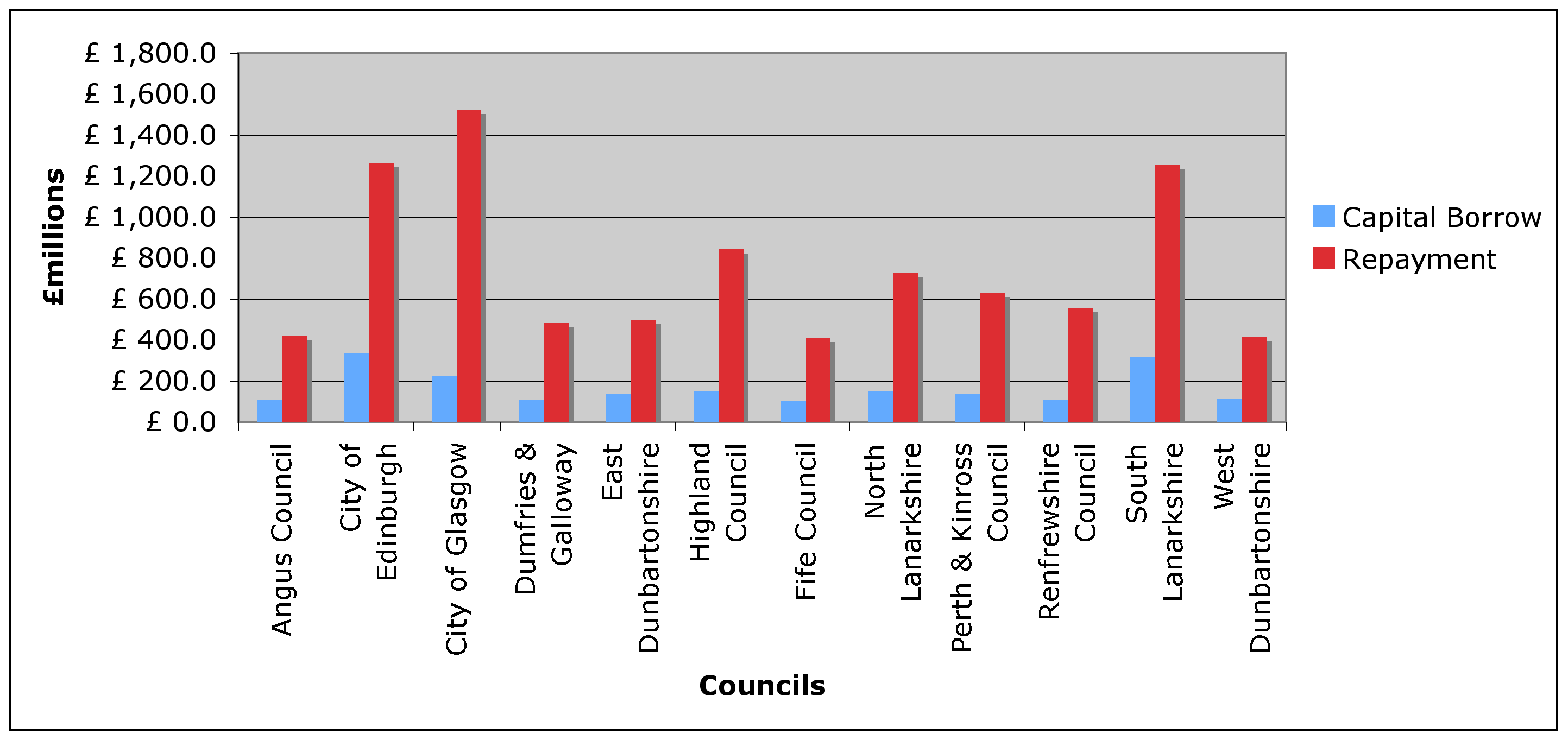
If it were just Glasgow, the case against PFI would be bad enough. But because Finance-Minister-at-the-time Andy Kerr pushed PFI as “the only game in town” and many loyal Labour councils followed his instructions, councils put over 40 PFI schemes in place, almost all to do with building schools. Those involving over £100m in capital investment are shown on Chart 2, along with the total repayments involved:

Chart 2—Twelve of the Best? Council Schools PFI Projects over £100m

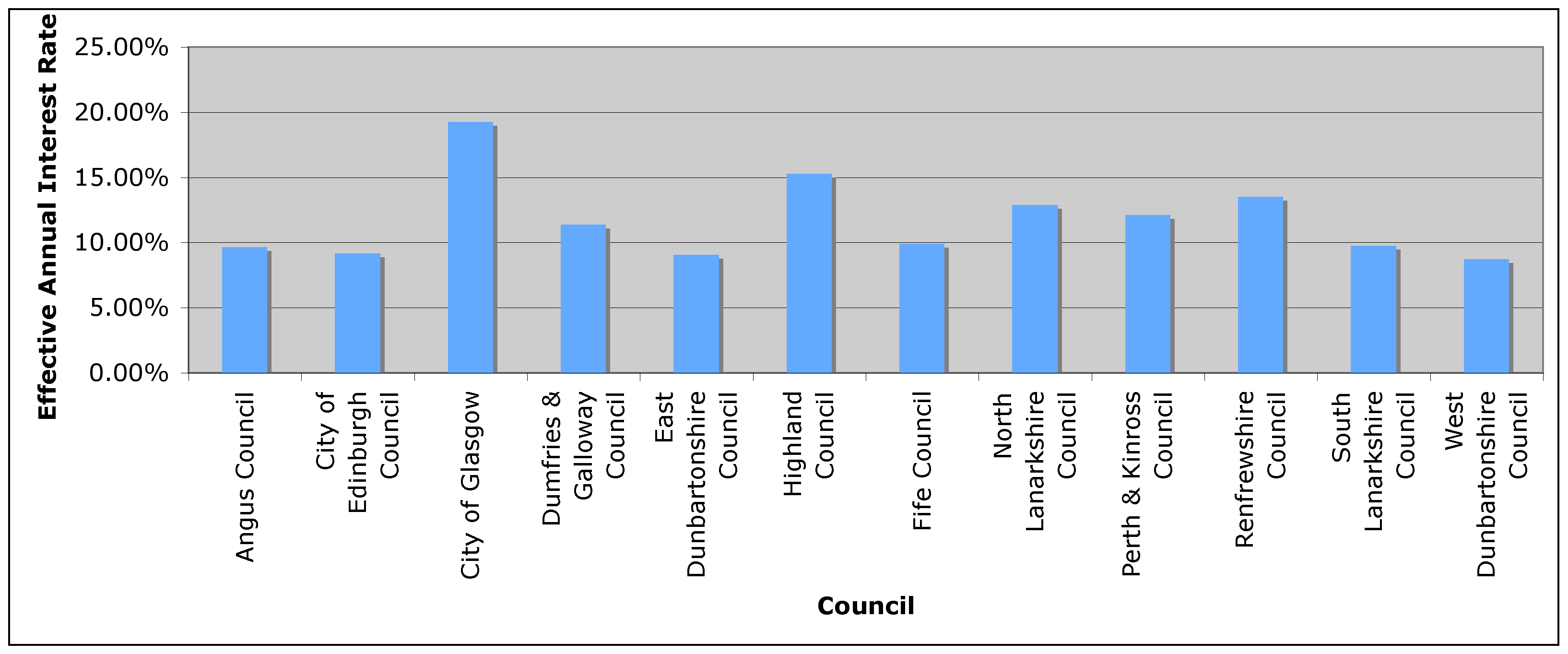
Obvious from this is that not all PFIs were created equal. The ‘Total Payment” is how much will be spent by the end of the full PFI period (usually 30 years). Part of that payment is repayment of the capital involved and, because management and maintenance are part of it too, not all can be described as interest/profit. However, subtracting the capital to be repaid and restating the total payment numbers as if they were interest over those 30 years yields Chart 3 below:

Chart 3—Effective Interest Rates for the 12 Biggest Schools PFI Projects

Even allowing for half of the annual costs to be management, an average interest rate around 6% is being charged when this scale of borrowing is available at 2.8% from the PWLB. But what Chart 3 underlines is the differing range of deals struck under PFI. While some are grossing under 10% for the PFI contractors, those dealing with Glasgow, Highland and Renfrewshire appear to have driven particularly sweet deals for themselves.

Let’s leave aside that UK and Holyrood governments, plus CoSLA left councils to strike the best deals themselves—and this was lambs-to-slaughter stuff considering council finance and law officials were totally outgunned by slick operators & QCs in the private sector. Leave aside the massive (for councils) start-up costs—East Lothian’s being especially heavy as their PFI contractor went bust during the process. Leave aside the much tougher cost structure for local groups to use PFI schools or the inability of school management to control snagging and maintenance over the PFI period.

The bottom line is that, each year, almost £500m of 32 councils’ £5bn total education budget—almost 10%—is skimmed right off the top and this proportion will only get larger as we approach 2030. That means that any reduction in Education budgets will be amplified by a further factor of 0.1 because each PFI can legally insist on its pound of flesh, no matter what trouble councils, schools or the whole of Scottish education gets into as a result.

When East Lothian Council proposed to buy out its £56m-capital PFI for £80m cash on the barrel (which would be financed by an equivalent loan but at 2.8%, instead of the effective 9% rate). With 20 years to run, that would have saved the public almost £120m.

Annoyingly, all those who foisted this on us didn’t even wait ten years to scarper before these ugly chickens came home to roost: Gordon Brown, Andy Kerr, Pat Lally, Norman Murray, et al have all fled the scene; they no longer need to stand up and defend this fiscal straightjacket they have consigned us to.

Given that local finances are entering ever choppier waters and PFI conglomerates are not going to volunteer to relinquish their cosy cash cows, it will take a bold move from Westminster to provide councils with teeth to renegotiate those contracts (see above) that are clearly not in the long-term public interest.

Posted in Commerce, Politics | Tagged | Leave a comment

Ma Faither’s Howff (Revisited)

This morning on BBC Scotland’s GMS, there was an unedifying interview with James Kelly MSP, Labour’s whip at Holyrood. In five minutes, James managed to display every bad trait for which his party has become notorious: evasiveness, posturing concern for the vulnerable, lack of ideas and a dogged debate style like he was reading off a script consisting of six words at most.

But, to be fair to him, one point he stuck to but which became lost in his partisan posture was that Holyrood will suffer cuts at least until 2016 and we need a debate how we are going to face them. His party’s contribution, trailed by Johan Lamont earlier in the week, is we need to revisit a range of free services currently provided, mostly to the elderly because “why should people with six-figure incomes receive them?”

A curious point as it was Labour who set them all up in the first place—Jackie Baillie, for example, welcomed free prescriptions as it would save money not having to administer the programme. Why Labour are focussing on just this area is a puzzle: if you want to sort Scotland’s finances in these tight fiscal times and genuinely want to trigger debate, why not put options on the table and not just pick one section?

Six months ago, as part of the debate in the run-up to May’s council elections, one of my contributions to that was to highlight the regressive nature of Council Tax in a blog titled “My Faither’s Howff has Many Mansions” and to propose major adjustments to its structure. The ideas how this might work have been updated below.

All councils will be strapped to cushion the dire financial effect of the next few years on staff and residents alike. But, following John 14:2, there is an option to supplement local funding, though it does require legislation. If freezing Council tax because it hits the poor hardest (and Local Income Tax is beyond Holyrood’s competence), why not adjust it so it leaves the poor alone and lays a proportional burden on the rich?

The LabourHame web site has some good ideas worth stealing. John Ruddy has cooked up a more progressive system with the dual virtues of raising tax receipts without touching council tax rates that have been frozen over five years. Taking my own East Lothian Council as an example, some 55% of its 35,500 taxable properties are rated as Council Tax Bands A-C. Another 24% are in the ‘yardstick’ Band D, while 19% are in bands E-H. These last properties can reasonably be considered the more affluent, while bands A-C are typically occupied by those with modest incomes. Yardstick Band D properties pay 9/9ths of the tax rate set, with lower bands paying proportionately less and those above more. The current situation in East Lothian is shown in Table 1.

Table 1—Council Tax Bands in East Lothian with Approximate Revenues

This raises around £39m in Council Tax. John’s ploy to increase this is to split each upper band (E-H) in two so as to give bands E-L but to continue the proportionate ratcheting up of the ratio (3rd column) so that band L would be paying 36/9ths or 4 times as much as Band D. This does accrue appreciably more tax, with all of the increase coming from above Band D. But this hits the middle class (houses in the £58,000 to £212,000 valuation range) hard, compared to now. But it still doesn’t nail the many houses valued well over £212k.

A better compromise would be to adapt John’s scheme so that we have the additional bands and increments he suggests, but that we assign houses into upper bands with less steep gradations than his proposals and then add a proper ‘Mansion Tax’ on houses valued over £1/2m. This would give a scheme more like that in Table 2.

In the case of Table 2, no-one in Bands A-F pay any more. Those in old Band G would find themselves paying between £0 and £800 more each year, depending on which new band they fell into. Those in the old ‘over £212k’ Band H would pay at least £745 more. The middle upper reaches of house prices would therefore be more fairly segmented; those approaching £1/2m in value would see their tax exactly double from £2,235 to £4,470. There would be no theoretical upper limit for properties valued over £500,000.

As a final element of this, second homes would be treated differently. Until recently, they actually received a tax break by paying at only a 50% rate. But most second homes are actually holiday homes, run as businesses and property speculation schemes. That, in itself, is not reprehensible but the cumulative effect on our remote and picturesque communities is a glut of empty houses and an abandoned feel off-season, and locals—especially young locals—being driven away by being priced out of the market.

Anyone with a second home cannot be poor. If they were rated at 150%, this would effectively be a tax on holiday homes that leave the locals payment unaffected. The definition of local would be registered voters resident, which would have the added bonus of catching the rich who maintain a home in Scotland yet claim reduced council tax as non-residents. Estimating the number of local second homes (mostly above band D) at 1,000 in East Lothian, such a scheme should add another £1.5m; urban councils would see less benefit.

Bottom line of this scheme is that it would boost Council Tax income in the East Lothian example from £39m to £46m without any increment for people living in modest houses valued up to £100,000. The Mansion Tax sting would be concentrated on less than 10% of all houses but those are best placed to stomach such increments. Given increases in East Lothian house prices for decades now (average 5% per annum) that alone pays for any council tax five times over in the long term.

Would there be people unfairly hit (e.g. widows with little income still in a large family home)? Yes, it might and some thought needs given to such cases. And, lest you think that this would fall unfairly on certain parts of East Lothian, even the Fa’side ward has 16% of its houses in current Bands F-H.

While this would be unpopular with those affected, affluent areas like East Lothian must keep essential services running for those vulnerable for whom (additional) free services under discussion were originally designed. Whether any of those services needs to be means tested—as Labour implies—should be part of the debate. But first there is other, low-hanging fruit in the council tax system alone to adjust its unfair burden from the less well to the better off and boost council income by the same as an (unacceptable) 12-13% rise in council tax.

Posted in Community, Politics | Tagged | 5 Comments

Come All Ye Jolly Mallowbashers

Poor though this summer has been, the restart of our local mallow bashing season has seen a couple of fine weekend days to get the season off to a good start, For those of you puzzled what I’m on about, I refer you to John Hunt’s SOS Puffin Report and an earlier blog.

A week ago, the plan had been to land on Craigleith with a squad to clear this year’s growth of tree mallow (Lavatera arborea) that still infests the island because of its prolific seeds still dormant in the soil. See Scottish Natural Heritage’s 2005 Report for details but basically this non-native plant was throttling the local puffin population. Despite it being a brilliant day, a Westering breeze and sea chop exposed the ad hoc landing and we diverted to Fidra, whose small harbour is sheltered from the West.

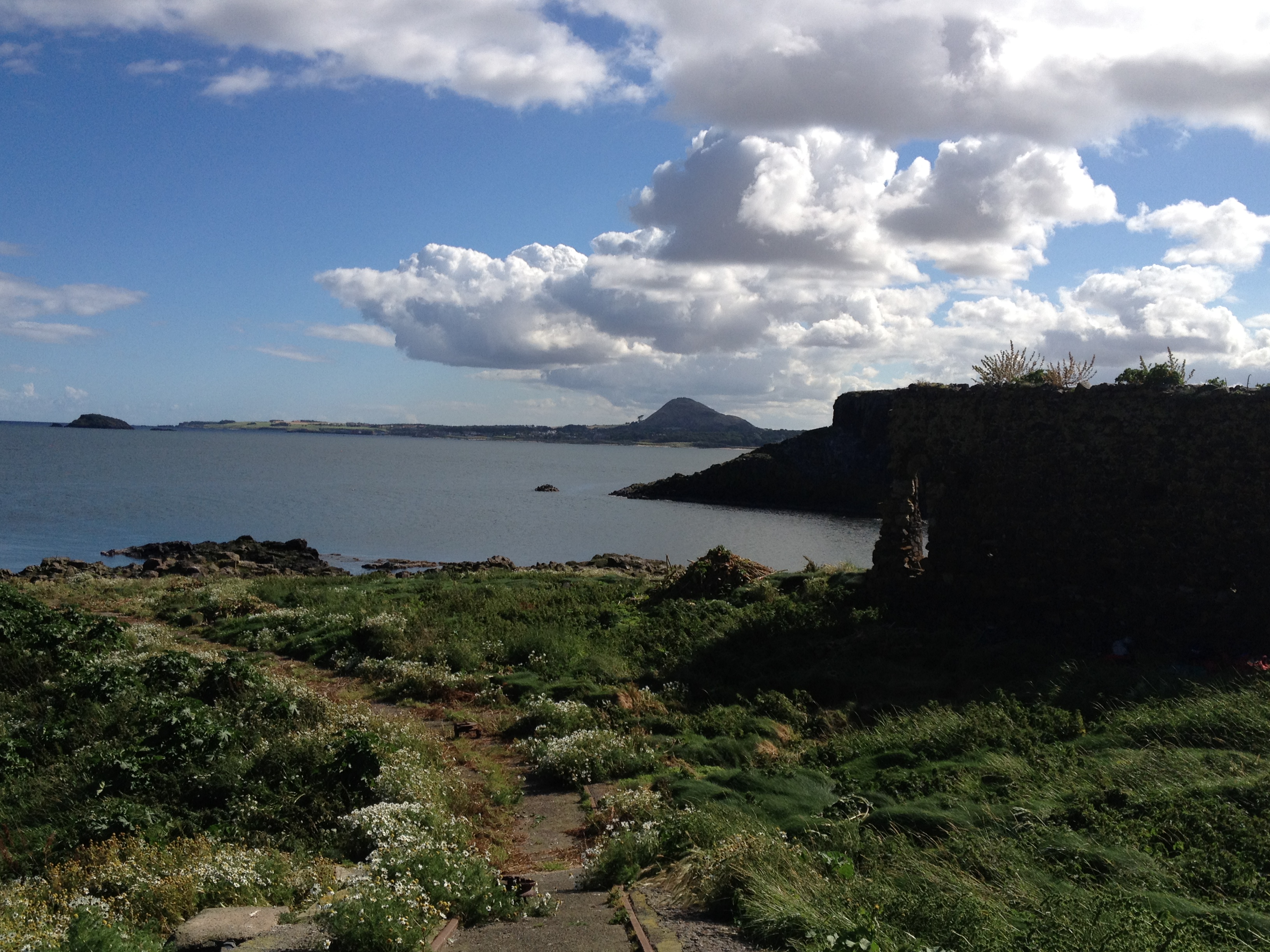
View from railway path past Castle Tarbet towards Berwick Law and the town with Uri Geller’s Lamb on Left

As days go, we couldn’t have asked for a better one in September. As the breeding season was over, the gulls usually nesting around the ruins of St Nicholas chapel were gone and all Fidra eerily silent. There are only a few hundred puffins nest on Fidra, as opposed to the 7-8,000 on Craigleith and we were not working the area around the lighthouse where their burrows are. Nonetheless, we need to clear as much of the mallow as possible as its seeds carry easily from island to island, being eaten by non-seabirds then defecated.

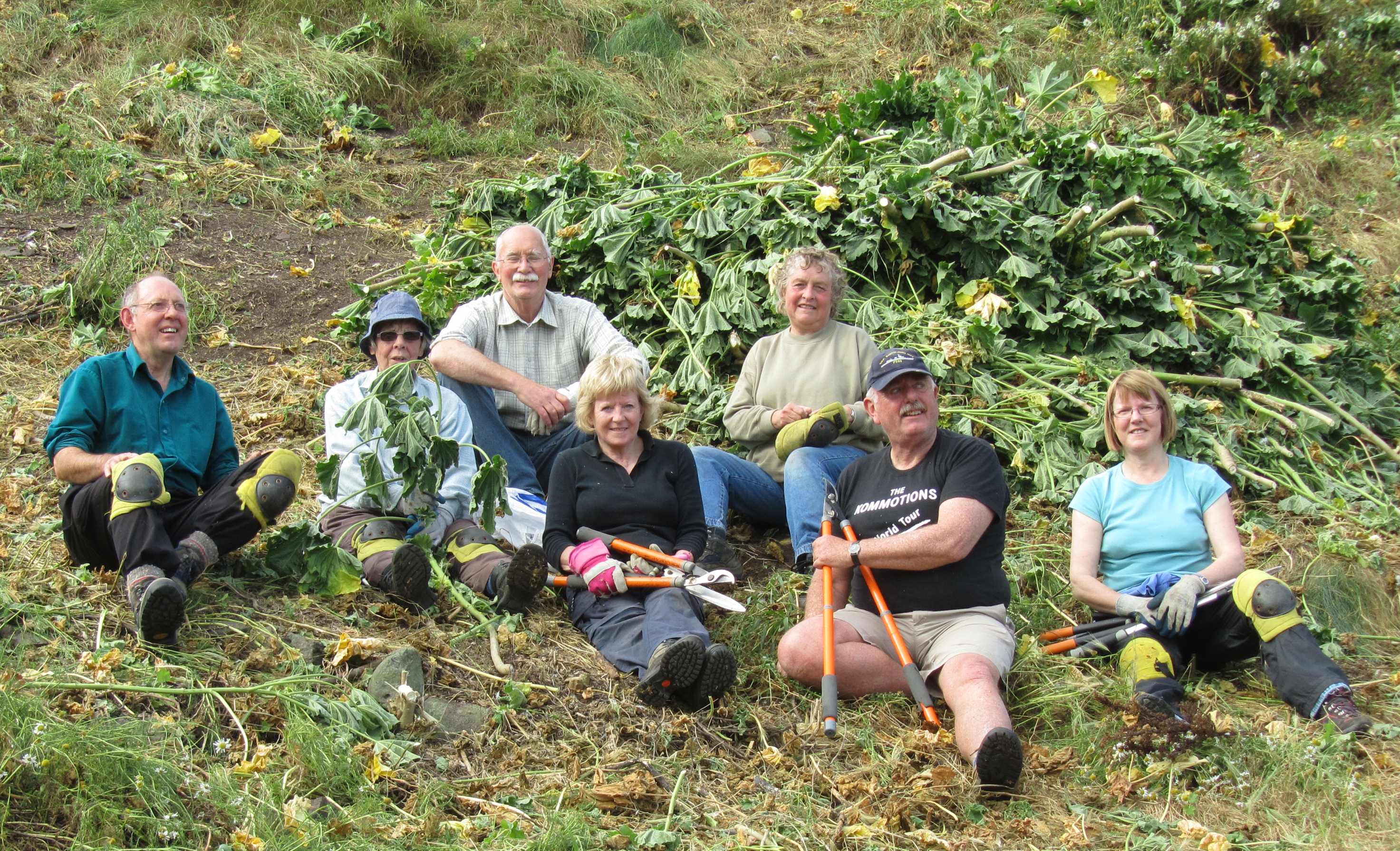
A break for the Mallowbashers—recently cut mallow behind them

In the full day you spend on the islands you don’t get much time for socialising: you see a lot of hard work from all the volunteers and there’s never a shirker amongst ’em. John is a gentle taskmaster, so lunch is leisurely and gives you a chance to chat or explore.

We use different techniques to eliminate the plant: strimmers will deal with seedlings early in the year, simple hand weeding on larger plants but for those really established (the larger stems can be thick as your arm—it’s not called ‘tree mallow’ for nothing) you need loppers or even a saw, cutting it close to the ground or the root will regenerate.

Your humble narrator doing his bit

Fidra is full of history, although you have trouble finding it while you’re there. The local Congal tribe, who appear to have been a remnant of the once-powerful Goddodin, lost badly here to a band of Vikings under Arnulf the Dane in the 9th © and may explain the Norse name (“feather island”). By the 10th © it was an Anglian outpost on Northumbria which passed to Scotland after Malcolm won at Carham in 1057.

It then seems to have been a retreat for the first settlements under control of the Earls of Fife and the original pilgrim ferry may have gone from here before boats became too big to haul up on the beach and they moved to the nearest haven, thereby founding North Berwick. A stave fort similar to Traprain existed on Castle Tarbet and even a wooden bridge to shore over the shallow Brigs of Fidra. The single ruined wall on the island dates from around that time and was a chapel dedicated to St Nicholas. This was gifted to Dryburgh in 1165 but terminated by Alexander de Vaux in 1240 when that Norman family had built their castle 2km away at Dirleton.

The lighthouse is a latecomer, another Stevenson effort built in 1878 and uniquely having a cable-drawn wagon railway to haul supplies and paraffin up from the landing, thereby saving the three keepers considerable work. When keepers were withdrawn in the 1980s and Bass Rock was downgraded, Fidra became the main light on the south side of the now-busy Forth, flashing its powerful 24-mile range beam four times each ten seconds.

Looking North through the ‘White Lady’ beneath the Lighthouse (plants visible are mallow)

Work though it may be, just having the privilege to wander these islands is a magical experience that makes it worth the effort and brings you back tired and pleased and filled with images. If you’d like to participate, the squads go (weather permitting) most weekends and sometimes mid-week. Contact John, if indefatigable leader of hundreds of trips on johnf_hunt@yahoo.co.uk.

And to see why we’re bothering, sneak a look at Tammie Norrie, clown of the sea and tell me if you don’t want to help out a fellow creature who—despite being among the world’s toughest and resilient seafarers—may be the living embodiment of the word ‘cute’.

Posted in Community, Environment | Tagged | Leave a comment

No More Branch Office

One of the good thing about unionists  is that they’re committed. And when the more thoughtful ones—of which I cheerfully admit there are many—pester you with questions, they are often questions deserving of not just an answer but a fair bit of pondering and self-examination in order to supply that answer.

One such epiphany happened this week on Twitter, when a particularly terrier-like series of questions revolved around the presumption that Scotland would do better on its own just ipse facto, quite apart from any other factor. That wasn’t quite what I had asserted. I had been claiming that Scotland was, on balance, prospering even now:

“Taken as a unit, all of it is: Tower Hamlets is a basket case but next-door Canary Wharf & the like make London boom.”

But this wasn’t good enough for my correspondent:

“The parts not engaged in successful industry are not doing so well. Edinburgh & Aberdeen prosper. I’m more of a Michael Porter / John Kay kind of guy. The focus should be on industries & regions rather than national borders.”

This is a thought-provoking point. Do we, in our political fixation with where laws and cultures run, get fixated on boundaries that make little sense in a global economy where raw materials, factories and customers are scattered across the globe. The Nation State is dead: long live the Multinational?

Back in the Seventies, I read The Sovereign State of ITT, a non-fiction portrait of how Harold Geneen created a continent-spanning monster out of the non-American segment of AT&T. Back then, it appeared only a matter of time before GM, IBM, Macdonald’s, Disney and other darlings of Wall Street took over the Third, as well as First, World. Now I don’t believe my correspondent was necessarily a fan of such philosophy but he did dismiss the relevance, if not the importance, of sovereign states.

But I would contest that. While there are certainly enough cases of states running their own affairs running them into a wall, this is not the norm. Certainly Africa offers a rich suite of examples how not to run a country and other parts of the world are no better. Mighty and elusive though multinationals may appear, there are sharp limits to what they can achieve without the active co-operation of the countries in whom they do business. Entire sectors get nationalised, tax regimes are adjusted and it’s not at all clear that multinationals do have the whip hand.

But let’s look at how well sovereign states do as units to better the lot of their inhabitants. You might think that most countries in a demographic grouping, such as Europe would do pretty much the same, with the ‘big’ countries dominating, the odd specialist like Switzerland alone being able to break the mould of ‘big is better’. You’d be wrong.

Taking a long view to iron out the vagaries of war, recession, oil shocks, etc, let’s look at European countries from a GDP purchasing power parity perspective (PPP—an accepted way of comparing economic apples with apples). The chart below is pretty self-explanatory.

Source: Contours of the World Economy, 1–2030 AD and Index Mundi http://www.indexmundi.com/g/

This provides an interesting picture. Major European countries have done well for their citizens, providing GDP growth of 1000% and more over the century. The UK is actually the worst at 879%, this can be explained by the UK being the world’s largest economy at the time and therefore other countries’ later growth would be likely to exceed it.

Most interesting of all are the countries that barely existed 100 years ago. Norway had just recently asserted its independence from Sweden in 1905; since then it has come on a whopping 4,409%. Finland would break from being a province of Imperial Russia during the mayhem of their revolution in 1917, after which it has managed 3,030% growth.

But the star performer is Ireland. After being a surly and fractious component of the United Kingdom for 121 years, it was granted independence in 1922 by an ill-tempered still-imperial/imperious Britain that sought to retain Ulster and thereby kept the most surly and fractious component.

Ireland did not prosper in its early years. Having little industry and few obvious natural resources, it suffered endemic migration of its best and brightest for over a generation until they joined the EU and played a shrewd hand of being an English-speaking manufacturing and distribution hub within the EU boundaries that played to those same multinationals we discussed above.

The rest, as they say, is history. Since the 1980’s when Ireland wrong-footed a slew of British development agencies at this game, in the 30 years since they have caught up with and surpassed anything other countries have achieved in a century with an out-of-the-park score of 10,100%.

While none of the three top countries and necessarily templates for what Scotland could achieve post-2014, it is up to the unionists to explain how staying a part of Britain slices  to 1/10th the growth in wealth that the people of Ireland experienced by leaving—not staying—in this Union.

Posted in Commerce, Politics | Tagged | 4 Comments

Ten of the Best

Now that Nicola Sturgeon has been assigned to the Yes campaign, expect to see some fireworks from that quarter. I have watched Nicola mature from a passionate YSI member that I first saw in action at the SNP Conference in Dunoon in 1993 and watched her develop through what some saw as a ‘nippy sweetie’ phase that saw her chosen as Deputy Leader and since which she has matured into a formidable politician with a depth and personable side that does not necessarily come with that accolade.

But taking prisoners is not what Nicola is about; expect some strong arguments and searching questions to soon be discomfiting the unionists’ shaky alliance of strange bedfellows and the pace along the road to 2014 to move up a gear. To do my humble bit, I spent part of this morning on Twitter, posing ten “daft laddie” questions that I believe any unionist worth their salt should be able to answer if the case for remaining as part of the United Kingdom makes as much ‘no-brainer’ sense for Scotland as they claim.

I therefore challenge anyone who has taken the principled stance that Scotland will benefit more from remaining in a union with England than it would resuming its former role as an independent country, to answer the following ten questions honestly. In particular I challenge organisations keen to tout the UK’s advantages to Scotland, such as British Unity or Better Together to answer as many of the ‘reasons’ they give seem to be historic and about ‘preserving’ things. No disrespect to 300 years of glorious joint history, but answers should look forward to Scotland’s future.

Daftladdie Question 1: If UK is world’s 7th richest country, how come it’s >£1tn in debt, with a more unequal society than a decade ago?

Daftladdie Question 2: If Scotland’s manufacture and exports and GDP are all more per head than the UK’s, and with 80% of oil & renewables in Scotland, why wouldn’t it be better off alone than in the current UK?

Daftladdie Question 3: If UK £40bn defence spend allows Scotland to ‘punch above its weight’, how come we now have defenceless oil rigs?

Daftladdie Question 4: If the UK is so ‘great’, how come most EU members dislike its stroppy attitude, the US treats it as a poodle, and yet Scotland has friends around the globe?

Daftladdie Question 5: If an independent Scotland would not be allowed to stay in the EU and this Union is equal partnership, there can be no ‘rest of’ (rUK)—so how could England stay either if Scotland left?

Daftladdie Question 6: If the UK is such a beacon for the future, how come females provide only 144 MPs (28%) and yet 44 MSPs (34%) in Scotland?

Daftladdie Question 7: If the UK is such a sweet deal for all, why is supposedly basket-case Eire not clamouring to enjoy the benefits of being back in the fold?

Daftladdie Question 8:  If England is such a rich, vibrant place we should stay thirled to, why are more English moving here than Scots moving there?

Daftladdie Question 9: If the MoD thinks a Scottish Defence Force is daft why are Norwegian/Danish/etc units in such demand as UN peacekeepers?

Daftladdie Question 10: If big is better, why has the world grown to over 200 countries, the most prosperous & stable of which are all small?

Answers on the back of a signed copy of the Declaration of Arbroath please (need not be an original & the Declaration of Independence will be accepted but at only 1/1.56 value) before October 24th 2014. Those postmarked “Saorsa Alba” will be disqualified for being premature (this contest is not open to members of the Scottish Government, nor to anyone currently employed by that organisation).

For so long as a hundred of us remain on-line, we shall not submit to the domination of the unionists…

Posted in Politics | Tagged | 2 Comments

How to Run a Railroad

We apologise to readers here in search of soaring rhetoric on broadminded topics; today you have come to the wrong place. This blog is not just about things local to East Lothian but written wearing the tasteless anorak of a train spotter.

The recent stramash about Virgin vs First on the WCML franchise is actually about First’s penchant for capturing markets, then milking the hell out of them—as with First Edinburgh’s buses. This is equally apparent than in their tenure of ScotRail, in which they expand only when someone else tells them and pays for it (e.g. Airdrie/Bathgate, Alloa). Otherwise, they’ve shown no vision to invest in growing rail services for the long haul.

The recent Scottish Parliament rammy over whether the £1bn EGIP (see our earlier blog) was phased or gutted was notable in that ScotRail—who should have been raising merry hell that its premier line was still not electrified—said nary a public peep on the matter. Other than simply cashing in on passenger numbers that are rising anyway, they show little interest in growing their future. They should.

Let’s take an example of a 40-year-story of a rail service (once pronounced dead and now among the most profitable) as how business can be made in the least likely circumstances and almost despite the company that benefits from it. The North Berwick-Edinburgh service dates from 1850, seeing such dizzy luxuries as the Lothian Coast Express in its Edwardian heyday. By the 1960’s new diesel multiple units, frequent services through Edinburgh to Corstorphine and closing half the intermediate stations didn’t halt decline in passengers. In 1968, the dreaded closure order came down from British Rail.

As with dozens of casualties of the Beeching axe, that should have been it. But EL County Council, supported by N. Berwick and Prestonpans Town Councils (an unholy alliance if there ever was one) commissioned a study that showed only £36k would be saved, rubbishing BR’s financial analysis that they would save £66k—almost twice that. John P. Macintosh MP marched this study into Barbara Castle’s office, with the result that she was persuaded to give a reprieve and a £13k subsidy. Locals 1; BR 0.

The downside was a skeletal service; two commuter trains each way on weekdays and three shopping trains each way on Saturdays. But the punters used them—so much so that they were overcrowded and a lobby of BR to double the commuter trains from 3-car to 6-car units succeeded. Locals 2; BR 0. Then Macintosh got behind a lobby by schoolkids for an earlier train to return from Edinburgh and a new 4:30pm brought the score to Locals 3; BR 0.

Not all was success. A very reasonable campaign to do away with platform staff and have train staff collect tickets (as they do now) was turned down because BR thought “not all fares could be collected on such a short journey.” Efforts to have extra excursion trains were stymied by all track and signaling, bar a single “6-mile siding” having been removed made such working impossible. Hmmm Locals 3; BR 2.

The local North Berwick Negotiating Committee continued to badger BR for various improvements: peak through running to Haymarket restarted in 1979 (4:2) and a daily midday train was introduced in 1984 (5:2). This resulted in BR admitting that the line was on the verge of profitability and that, after 15 years of doubt, its future had become so secure that they were using it as an experiment in local accountability. This was just as well as the old station buildings at NB were succumbing to decades of neglect and were demolished to leave a single short platform. Final score: Locals 5; BR 3.

However, this greatly improved available parking and a growth in residents meant more commuters than ever were piling on the trains and the introduction of the first pay-trains in Scotland made the line even more viable. By this time, traffic congestion in Edinburgh drove ever more people onto the trains. Sunday trains were introduced, then evening trains on a seasonal and then year-round basis. By 1988, introduction of the class 150 “Sprinters” restored a full 7-day service, hourly between 7am and midnight.

Real growth came after 1991 when, similar to the provision of electric overhead catenaries on the Lanark line spur off the WCML, the NB branch was electrified along with the Berwick-to-Edinburgh ECML after some strenuous lobbying by locals and Lothian Regional Council (who met half the £1.3m cost), as well as supplying new stations at Musselburgh and Wallyford. The ‘new’ trains were refurbished class 305 ‘slam-door’ 4-car trains from Essex. But they were fast, quiet and, despite initial teething troubles, grew the service by offering larger capacity and easy entry/exit.

After the class 305’s soldiered on well past their sell-by date, a recent upgrade has finally given the line modern class 180 new trains fit for the frequent and popular service it now provides. Not only does the 6-day (Su – Fr) hourly service run 22 trains between 6am and midnight but a Saturday 30-minute frequency is now well used, as are extra late trains run during the Festival and Fringe by the Sea.

Whereas the original 70’s service focussed on the commuter and didn’t break 50,000 fares annually, shoppers and casual business, as well a a heavy counter-flow of students to the new QMU and visitors to the seaside and MoF at East Fortune took it past 1,000,000 by 2005. As a rail revival story, it could hardly be bettered, showing business growth around 10% each year at all stations.

Since 2000, ScotRail has enjoyed a 157% growth in their revenue on the line.

The obvious next step would be to reopen East Linton station and go through an equivalent exercise to grow a Dunbar-Edinburgh local service. But although ScotRail have been persuaded to run four trains a day to Dunbar (compared to the previous none) and the logic of running  30-min service out to Drem and then alternating between Dunbar and North Berwick as destinations seems irrefutable, there is, as yet, no sign they’ve learned lesson one from the story laid out above.

Shame there isn’t a Dunbar Negotiating Committee. Maybe there should be.

Posted in Transport | Tagged | Leave a comment