Stemming the Mormon Conquest

Yesterday was historic for a number of reasons: Obama secured a solid win that gives him a second term that many had written off; his ‘coat tails’ and Republican intransigence combined to sweep a number of senate seats into the Democrat camp, thwarting Republican hopes of control and; other than minor advances, the Republicans failed at just about anything they tried.

While theoretical equivalences exist between Labour/Democrat and Tory/Republican, they don’t carry too far. The Democrats do get support from organised labour and the bulk of America’s many minorities. But over the last couple of decades, the Republicans have moved into what strikes outsiders as a kind of fervent religious jihad for the soul of America. Looked at from their hallowed perspective of individual liberties, small government, inalienble rights and irrepressible business initiative, their posture does make some kind of sense…

…until you look at the people who are promoting this. There are poor and there are non-white Republicans; but you see few. When their Founding Fathers set up their hallowed Constitution, the country was a blank slate scattered with farms and plantations. It took a people of guts and determination to build this 21st century superpower of 300m people; they needed the moral and legal encouragement to do that. But once you’ve paved over a good chunk of it with tract homes and shopping malls and strung them all together with eight-lane highways that never sleep, maybe its time to rethink your basic philosophy.

Many Americans are prepared to do that. And while not all of them are Democrats. there are precious few Republicans who seem to inhabit the changed world of 21st century America and staunchly justify an apparent extremism purely through copious quotes from the Constitution and the Bible in equal measures. While church and state are legally separate in the US, religion plays a big role in many people’s lives—and especially in Republicans. No church plays a bigger role than the Church of Jesus Christ of Latter Day Saints, also known as the Mormons.

A short blog cannot do justice to their complex extension of the Protestant faith. They have grown in strength in the almost-two-centuries since they were led to found a new promised land that is now the state of Utah. And, while it would be a gross error to claim all Republicans to be Mormon, the reverse is broadly true and a strong thread of Christian belief runs through many other party members. It was strongly religious Republicans who forced teaching creationism alongside Darwinian evolution in schools across the South—also commonly known in much of the US as “the Bible Belt”.

For the last few decades, religion has grown in popularity among the wealthy and middle class from Orange County to New Hampshire. Separation or no, it has become common for the wealthy to tithe their church, send their children to private school & university and for a self-sustaining upper class to become more embedded in US society than the nobility can claim in Britain any more.

This, in turn, is leaving indelible marks on US society. Whereas fifty years ago in the simpler times of Eisenhower’s ‘Mad Men’ era America—an era Republicans look back on as a paradise lost—businessmen made bundles, farmers fed the world and Joe Sixpack still pulled a good wage down at the car plant, poverty was banished to an aberration—only small minorities, new immigrants and hillbillies suffered it. A sense of ever-growing wealth and comfort prevailed. The Republicans—especially their Mormon shock troops—hanker for those days. “We want our country back” is their common cry.

This is no place to argue the pros and cons of social programmes but it boils down to the Republicans wanting virtually none and the Democrats proposing ones that even Tories would find shame at their inadequacy. Add in deep Republican hostility to abortion, gay marriage and other matters considered elsewhere to issues of personal choice and you have what should a lively debate. Except this entire election was swamped with viciously personal TV ‘attack ads’ on a scale dwarfing any previous contest, leaving a bitter taste and a level of disinterest in the public directly blamed on the ads’ ferocity.

As money goes these days, $6bn may not seem like much but it’s $20 per head and 650 times the UK’s legal limit on election expenses. It’s also more than the GDP of a third of the world’s 200 countries. And what people got for it was an unedifying series of reasons why their opponent was pond scum.

When the dust settled yesterday, the surprise was that the Republican money machine had not made more inroads than it had. As expected, the South and MidWest went for Romney; the coasts and industrial North went for Obama. But, what was surprising is that, of the nine ‘swing states’—the marginal ones everybody agreed were ‘in play’ and would decide the election—the Republicans failed in all of them:

  • Colorado (9 votes) 1,199,142 for Obama; 1,100,186 for Romney
  • Florida (29 votes) 4,129,502 for Obama; 4,083,441 for Romney
  • Iowa (6 votes) 816,174 for Obama; 462,422 for Romney
  • Nevada (6 votes) 528,801 for Obama; 462,422 for Romney
  • New Hampshire (4 votes) 335,004 for Obama; 300,241 for Romney
  • Ohio (18 votes) 2,672,302 for Obama; 2,571,539 for Romney
  • Pennsylvania (20 votes) 2,894,079 for Obama; 2,610,385 for Romney
  • Virginia (9 votes) 1,852,123 for Obama; 1,745,397 for Romney
  • Wisconsin (10 votes) 1,597,201 for Obama; 1,395,499 for Romney

None of the nine was a walkover for Obama and the most cliffhanger of all was the one with most votes at stake: Florida. But Romney HAD to win most of these to win the presidency. He threw everything he had at them—and failed. The Americans have their own cruel way of saying this: “close only counts in horseshoes and hand grenades”.

Looking beyond the presidential contest, half the Senate were up for election and a couple of hundred House members. Given the leap forward they made in the mid-terms in 2010 when Republicans took control of the House, much was expected here too, with a Senate majority clearly in their sights. But it was not to be. Of the half-dozen pivotal campaigns two self-destructed on egregious (some say stupid) comments about abortion by the Republican candidate (Akin & Murdoch), Tommy Thompson’s well financed mud-slinging failed to prevent first openly lesbian Senator Tammy Baldwin in Wisconsin and Elizabeth Warren, blindingly best-qualified to become Massachusetts’ first woman Senator, stormed home.

Although not a massive defeat, it was such a comprehensively poor showing for the wide open intensity of right-wing politics backed by effectively limitless money that the more moderate voter can sleep a little more soundly. In the wake of the Citizens United ruling at the Supreme Court (who got into anthropology by claiming “corporations are people”), many moderates worried that the election would be “bought” by billionaire donors. But the savvy micro-targeting (and sheer gusto) of Obama’s money-raising machine proved them wrong.

Though not a massive defeat, it was decisive. In 2008, the Republicans stormed off to try a new tack, which meant a shift to the right, a home for no-compromise types in the Tea Party extreme and a thrawn determination to frustrate everything the Democrats and especially Obama tried to do. They succeeded in all three.

But, given the clarity of defeat at all levels, the more thoughtful Republicans (of whom many still exist) who have been holed up in fallout shelters across the country waiting for Sarah Palin and her fans to go away, just might now have a chance to reclaim their party and  provide the thoughtful opposition America has lacked for the last four years. They do have such people—New Jersey Governor Chris Christie, who led a brilliant bipartisan recovery effort in the wake of Hurricane Sandy is one.

The alternative—and this is where understanding American politics requires more than its usual leap of faith/understanding, the Democrats elected will know the Republicans are still loaded for bear and will use that lever to attach their own narrow requests to legislation or threaten to vote with the opposition. Such is the logic in this, the self-styled greatest democracy in the world.

I wish.
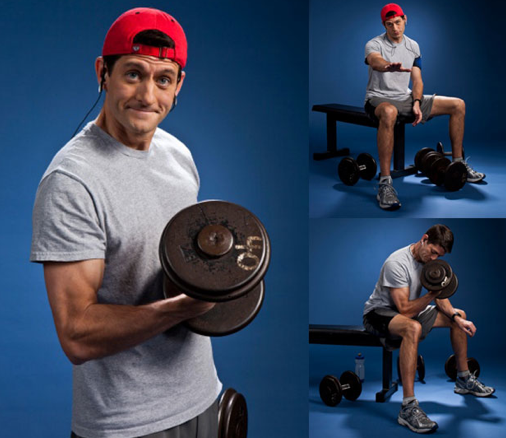
Would You Vote for This Man? Vice-Presidential Candidate & Romney Running Mate Paul Ryan Flexes His (Right-Wing) Muscles for the Voters

Posted in Politics | Tagged | Leave a comment

Reinventing Downtown

One of the main malaise affecting towns across Scotland is the decline of the High Street and erosion of social cohesion that goes with it as the more affluent use their Chelsea Tractors to shop out of town while the less fortunate count their pennies and stay at home. First to go were furniture, white goods and clothing stores, followed by fruiterers, ironmongers and now music/DVD, offies and even post offices.

What’s left is either upmarket specialists, such as delicatessens, cafes and upmarket butchers or a wasteland of charity shops, bookies and the occasional poundstretcher. Where demographics and investment have worked in their favour, some still do well. But for every Stirling or Inverness, there’s a Motherwell or Dunfermline; for every Peebles or North Berwick, there are a dozen Saltcoats or Arbroaths or Dalkeiths. Well intentioned town planning of the sixties that gave us Cumbernauld is long bankrupt when it comes to any retail revival.

To our American cousins, none of this is new. Their society embraces almost a slash-and-burn, then move on metality. In the twenties & thirties downtown Los Angeles or San Jose boomed with new money. Then, in WW2 and after millions settled, building new suburbs and shopping malls. Downtowns slid into the place you went for civic business like the DMV but you din’t hang about, certainly not at night. Now those same sleazy downtowns of dark bars and bail bonds are reviving with cultural centres, city tram systems and upscale restuarants.

Some cities like New York and San Francisco were such magnets that they never really suffered urban decline. Others like Baltimore and Boston reinvented themselves from metal bashing & shipyards into chic waterfront cities with great quality of life. Still others—like Pittsburgh or Cleveland, struggle on in ‘Rust Belt’ post-industrial strictures. But when it comes to the more modest scale of town below what we would regard as cities, despite both a will and a means to invest, they just don’t seem to ‘get it’.

Silicon Valley has classic examples. Of the ‘anchors’ at either end of it, San Francisco has never seen serious decline and San Jose has revitalised its once-seedy downtown. But in a strip of 100.000 population towns between, something has gone wrong, despite ongoing affluence through Google & Facebook overhauling Cisco & Sun, who overhauled Intel and AMD, who overhauled HP and Xerox PARC as main drivers of local affluence. But consider three ‘cities’ in turn who are mimicking what the big cities have done and you wonder if they’re on the right track.

The whole area was once fruit orchards—The Valley of the Heart’s Delight. Those first disappeared around Palo Alto because of the founding of top university Stanford there over a century ago. This spawned modest tract homes, a research park and a modest  downtown area that, by the 1960’s was in need of investment and new thinking. Being a university town, it became rich in cinemas and bookshops and a fair smattering of cheap,  funky restaurants— a mini-Berkeley.

Because it was such a magnet for professionals, the school district was top-notch, attracting even more high earners in the post-war boom.  Clearing many side streets of buildings to provide car parking spaces brought more people to downtown to spend their money. But the new businesses drove up prices, the funky bookstores closed up, the students moved on and the entire square km is now so dense with yuppies that, while you can buy a wedge salad for $30, you can’t buy a light bulb.

Pleasant though it is, it has become homogeneous the way that Islington or the Upper West Side has. The main giveaway is that the ethnic mix depends entirely on the staff; otherwise it verges on the 100% white bread.

Having Palo Alto set the trend in catching custom caught the attention of the next two ‘cities’ down Highways 82 and 101 (the entire peninsula’s flat land is built up, so the idea of any space between is illusory). Mountain View had a downtown originally geared to fruit growers, with work boot stores and lumber yards supplying tall ladders. Coming later to the boom than Palo Alto, they first herded lots of minority restaurants into the downtown area and did reasonably well from a lunch trade, less well from dinners.

Without the magnet of Stanford, Mountain View went with an even bigger scale of investment that revamped Castro (its main street) with trees, planters and bowers and poured millions into multi-storey car parks one block behind the main street. This, in turn, created a de facto food mall where it was easy to park so that now the length of Castro is a parade of restaurants of bewildering ethnicity and has a reputation for that.

But it’s not a downtown. It may be a place people come to eat but a fraction of those people live in Mountain View and use any other facility of the town. At first glance, it also appears well served by public transport, having a CalTrain station with an adjacent SCCT tram terminus. But neither serve any other part of Mountain View: CalTrain goes North to Palo Alto & SF or South to Sunnyvale & San Jose, while the tram heads East into a wilderness of business parks and Great America. The bulk of buses travel along El Camino (Hwy 82) almost a mile away and connections are an infrequent nightmare.

Finally, there is Sunnyvale. Once its station was called Murphy handled more cherries than any other, grown on the huge adjacent Murphy Ranch. The main streets of the town are still named for Murphy’s daughters—Evelyn, Mary, Maude and Mathilde. As tract homes and business parks swept over the area in the latter 20th century, the downtown—smaller than Mountain View or Palo Alto—pretty much shrivelled up and blew away, lost as it was among the abandoned fruit loading sheds by the railroad.

At first, this seemed OK by the city fathers. El Camino was a strip development of just about every business you could name from Macdonalds, through Jiffylube, Mancini’s waterbeds and Ham Radio World. Part of it was an auto row where men ritually kicked tyres and there was one throwback of 100 yards of frontage with an old shack where you could buy some of the biggest and best cherries you ever tasted.

Problem was the online shopping and aspiring tastes meant people—especially women—weren’t prepared to go bumping along an ugly six-lane highway, parking in dusty lots and presented with little but hamburgers for lunch. So Sunnyvale’s civic leaders revamped an old neglected street called Murphy right in the heart by the CalTrain station. What they made was a mini-version of Mountain View’s Castro. But to shore it up they lured two major ‘anchor’ stores (Target and Macy’s) to apply the same critical mass philosophy as makes malls work from the Gyle to the Ginja.

But it doesn’t work. With the rest of downtown boasting new multi-storey glass-and-concrete office complexes, it feels like walking around New York or Philly, but without the people and the buzz. But what is really interesting is the racial mix. Whereas my first contact with the area in 1978 showed a considerable black and latino presence everywhere and you could not find a curry for love nor money, at least half the people enjoying Murphy Street’s bars and restaurants are Asian. Whites are still there but few blacks or latinos. The huge exception is the spanish-speaking mass who comprise the restaurant staff—whether Thai, Korean, Japanese, Italian—even in Lily Mac’s Irish bar.

Whatever the answer is for reviving Scottish town centres, what California cities have done with millions of investment here is not it. They have improved on strip-development El Camino to make somewhere pleasant, but soulless as a motorway rest stop. There must be a better way to give a town back its heart.

Posted in Commerce, Community | Tagged | 1 Comment

Tip for Today

Posted in Uncategorized | Leave a comment

Mitt Must Learn from His Daddy

Almost half a century ago, in 1964, Republican presidential nominee Barry Goldwater spoke candidly about the possibility of nuclear warfare in Vietnam and of mining the harbors in Hanoi. The uproar was instantaneous, and the conservative Arizona senator struggled to overcome an image of bellicosity that frightened away voters by the droves. He never recovered and lost in a landslide to Lyndon Johnson.

Because this marked one of the earliest examples of bellicose Republican extremism, you would think that Mitt Romney’s team would have this lesson taped up around their campaign headquarters. In fact, Mitt has a personal reason to be aware of all this, not least because it launched the Free Speech movement, whose activities cause heart attacks among his colleagues and the reason it was launched was because of his dad.

George Romney has not registered much in this election (neither has another George—Dubya—but that another story). Although a Mormon like his son, George passed for a moderate and engineered an impressive career that encompassed being CEO of American Motors (AMC) when the ‘big four’ of Detroit still wrote the book on car development. He parlayed this into the Governorship of the state (Michigan) and left behind a record of which most businessmen or politicians should be justly proud.

What is less well know is that George went on to contest the Republican candidacy in 1964 and the world might have wound up a different place had he succeeded. Being a moderate, he gained wide support, especially among students and UC Berkeley Republican Club availed themselves of a 75-year-old tradition on campus that allowed students to set out stalls advocating various political causes. In the Fall semester of 1964, this is exactly what they did, distributing material in support of Mitt’s dad.

In the 1960’s, first on the Berkeley campus and spreading until it was international, students tested the limits of permissible dissent, challenged the conventional wisdom in unprecedented ways and insisted on participating as active agents in the shaping of history. With the intensity of the 1964 campaign, a tension arose between students who wished to express their various views and UC Berkeley officials who, to be fair, were being prodded by outside forces.

In this era of crew-cuts, fraternity jackets and fresh-faced students who would graduate and work for IBM and the other huge American corporations, President Kerr and his Board of Regents were none too happy that a ragged, ill-disciplined minority had assortments of hand-drawn placards and card tables vocally manned by young advocates of sundry clauses. But, while they were shifted around the campus to be less visible, toleration prevailed on both sides.

Matters came to a head however when staunch Goldwater supporter William Knowland, publisher of the (at the time) right-wing Tribune paper in nearby Oakland, prodded UC Berkeley officials to suppress the student Republicans who, to his taste, were doing entirely too good a job of promoting George Romney. The action of removing them was carried out by the campus police without much difficulty, such was the respect for authority prevalent at the time, even among students.

Before the next day, a disquieted group of remaining activists gathered and decided that, though they were no Republicans, this curtailment of speech affected them all. As a result, not only did the Republicans set up their tables the next day outside Sproul Hall but others did too and a crowd gathered in support. Back came the police to remove the Republicans and bundle them into their squad car. But, before they could leave, the car was surrounded by angry students and one of them Mario Savio who would go on to found the Free Speech Movement climbed onto the police car to speak to the crowd.

But before he did so, he took off his shoes so as not to damage its paintwork. That was still the fifties (a plaque nearby marking “Mario Savio’s Steps” and the occasion was erected nearby in 1997).

On the third day, pretty much the same scenario was acted out—but this time the police car was so covered with students that the police retreated on foot…and none of the students bothered removing their shoes before they climbed all over it. That, people who were there agree, marked the launch of the sixties: the rest is history.

Romney the elder (and more moderate) lost to Goldwater (who wasn’t) by a landslide, opening the way for the first ever attack ad, run by LBJ against Goldwater. His ‘Daisy’ commercial showed only once on TV: a small girl counting petals as she picked them off a flower, with ’10’ obliterated by a nuclear blast and a voice intones: “These are the stakes—to make a world in which all of God’s children can live, or to go into the dark…Vote for President Johnson on November 3. The stakes are too high for you to stay home.”

For Goldwater, given to apocalyptic banter about “lobbing missiles into the men’s room of the Kremlin“, this was fatal to his campaign. Before he panders further to the hawks that dominate the Republican party, Mitt Romney might reflect on how a similar attitude lost the 1964 election—and started the whole commie/pinko/stroppy/free-thinking apocalypse that was the sixties and that he and colleagues still have trouble coming to terms with half a century later.

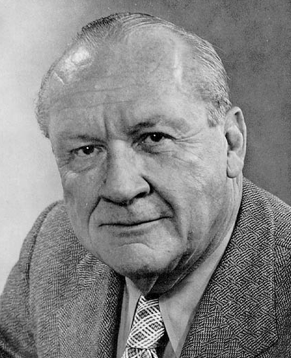
William K. Knowland, REP: State Representative in the 1930s, Candidate for Governor of California in 1946, Unwitting Inventor of the Sixties in 1964


Posted in Politics | Tagged | Leave a comment

Letter to the Editor

At last enjoying the sweet city living of San Francisco’s Noe Valley, I sauntered over to Martha’s Coffee Shop this afternoon to enjoy a leisurely latte in the sunshine outdoors but spluttered half of it all over the Washington Post when I read its editorial. Not only was it about a topic close to my heart—independence for Scotland—but it dropped several elementary factual clangers, as well as thinking this a bad idea.

Jetlag and vacation or no, my dander was up, my metaphorical pen dipped into the vitriol and I let ’em have it with both barrels:

  • Letters to the Editor,
  • The Washington Post,
  • 1150 15th Street NW,
  • Washington DC 20071

November 1st 2012

Sir:

it was with something between astonishment and anger that I read your editorial expressing concern about the future impact of Scotland restoring itself to being an independent country. Specifically, you assert:

“the more fragmented Europe becomes, the less it will be able to use its collective strength on the global stage, both in military and diplomatic terms.”

Taken by itself, the basis for such an assertion is unclear and smacks of the kind of empire retention Americans have always found distasteful. The independence of Norway in 1906, of Eire in 1922 or of the Baltic republics in the 1990s can only be considered positive steps towards world peace and international co-operation. Indeed, it is the frustration of a people’s aspirations to conduct their own affairs—consider Northern Ireland or the Basque country—that lead to ongoing intolerable outcomes.

It is vital that your paper—the flagship publication in the ‘Capital of the Free World’—gets things right. However, your piece has more than one flaw: it is in error on the SNP policy towards NATO, in error on Scotland’s ability to retain the pound and in error in the proportion of North Sea oil remaining to England (barely 10%).

Few citizens of as large and isolated a country as the US may be fluent in the complex politics of Europe. It may not be obvious to them that, rid of England and its feeble global aspirations, Scotland would become as effective a component of Europe’s defence matrix as Norway or Denmark, or that, by rebalancing its conventional forces, it could supply long-range maritime reconnaissance, tactical oilfield defence and rapid response forces such as the present overstretched UK is unable to do.

But, to enlighten those citizens, as prestigious a publication as your own has a duty to accurately inform them of the real effects of an independent Scotland. Anything less is irresponsible. May I recommend the RUSI study “A’ the Blue Bonnets” to help set minds at rest how much more effective Scotland could be if allowed to forge relations with England, Europe and the US on its own terms—as all normal countries do and as your own Declaration of Independence takes to be self-evident?

yours sincerely

Posted in Politics | Tagged | 1 Comment

The Gloves Are Off

It’s not yet six but I’m wide awake from the early J-Church street cars rumbling by outside. Yesterday went better than it might. Though it involved three flights, four time zones and eighteen hours of travel, on the plus side, every flight arrived early, my bag managed to make the hops with me.

More importantly, it was a chance to mix—with three redneck truckers at a Quality Inn…with unfortunate people forced to sit next to me for an hour or three…with others munching their $8.50 sandwiches while cooling their heels at Chicago’s O’Hare and Phoenix’s Sky Harbour hubs. No-one abroad on America’s broad airways was safe from incisive interviewing—usually launched by a ‘daft laddie’ question like “So, what do you think of this election?

The answer—no surprise to anyone trying the same exercise in Scotland six days out from an election—was: “Not much”. But parallels with Scotland are thin. Whereas the political fault lines between Milngavie and the Raploch still run deep, what seems to be happening here is the opening of social fault lines that would make your hair stand on end. This is a society on the verge of war with itself.

Seen from outside, the two party monoliths that embody all entire political power here have long been seen as two variants on the right wing. That’s now too simplistic. Whereas the Democrat/donkey/blue faction was always a party of the factory worker and their unions, both elements have faded in the US as they have in the UK, to be replaced/supported by an armlock on minority votes, esepcially black and latino. And the Republican/elephant/red faction, always seen as the advocates of ‘small government’ and the choice of the well off as that implies less tax have become unrepresentatively white. But don’t be fooled by too many parallels with Labour and Tory.

The three redneck truckers I met were Republican. They all own guns, carry NRA membership, hate the government for the taxes they levy and think Obama is a communist because he initiated programmes to support the poor and provide them with basic medical cover (‘Obamacare’). The agency exec flying to marshal a fashion show in upmarket Palo Alto was busy prepping on the plane but did admit to being staunchly Republican as she felt business shouldered too much of the burden of carrying the country and the world needed a militarily strong America to keep world markets open and terrorism at bay.

There were equally vocal Democrats: the aircraft mechanic who saw unions as the shield to stop workers being screwed by M&A hyenas and their senior management friends. Partisan though he might have been, the American airline industry is unrecognisable from 25 years ago and, whoever benefitted from such dynamic churn, it wasn’t airline employees. A 30-something minority immigrant was a reluctant Democrat because, although she shared their values, Obama’s reluctance to sign into law an amnesty giving legal residence to those born or serving in the Armed Forces sat badly with what she felt he was obliged to do.

But, most striking (as compared to 2004 or 2008) is the intensity with which each side is holding partisan beliefs. This rather came to the surface during the second presidential debate in which both Romney and Obama verged on aggression and rudenes the way they got in each other’s face. It is evident in the senatorial and house campaigns that are going on in parallel to the presidential one—TV ads from both candidates essentially rubbishing the other’s record and casting aspertions on their opponent’s abilities, morals and private life. It ain’t pretty.

What seems to have happened is the major defeat the Republicans suffered in 2008 drove them to re-think their strategy. They have come back with legal levers that work in their favour. By disparaging Obama, capitalising on the post 2008 depression and making significant Senate and House gains in 2010 mid-terms, they have pushed through legislation that permits ‘super-PACs’ which essentially means that all limits to campaign spending are revoked. As they are the party of the rich, that means the campaign budgets are in the billions and fund the ubiquitous ‘attack ads’.

By raising the (largely illusory) spectre of voter fraud, they have also introduced legislation requiring complex voter registration hurdles. These are combined with a series of billboards and ads that claim those registering will be found and deported for having broken the law by not registering (untrue). The bottom line? This is as major a blow to the solidly Democrat latino vote as could be conceived.

While such tactics are deployed by national and state Republicans, local tactics are impressive too. Employees at Menard’s (the B&Q of the Midwest) are being given ‘training’ in which Obama is being portrayed as a danger to the welfare of the company and, as a consequence, their jobs. In Washington State, voters are receiving phone calls from a ‘Washington State Democratic Voter Identification Committee” which doesn’t exist discouraging them to vote until they get a new ballot.

So vicious has the scale of animosity between Republicans and Democrats become that dating agencies are reporting political affiliations as the biggest factor being cited in reasons why matches don’t work.

While it would be unfair to blame the Republicans entirely, their Tea Party splinter group has set new standards for bias in debate and pejorative implications about their opponents, such as “we want our country back”. It is too early to form a coherent rationale why things should be so nasty this time—what is at stake is what has always been at stake: the most powerful job in the world.

But the superficial take is that the 2007 recession has America rattled because it is like no other. Whereas earlier ones hit the auto or steel industry worse than most and a recovery was soon underway, this is structural across the entire economy, with the halcyon days when blue-collar shift workers pulled down $28.50 an hour long gone. As with everywhere, the rich are still rich. But there’s an undercurrent of fear, amplified by the number of good jobs like engineering and programming that have been outsourced to India, China, Brasil, Indonesia. The business catch phrase for any project or idea these days is “what’s the China price?’

So, while it would be excessive to compare this to Weimar or other once-great powers on the skids, there is an element of that which seems to feed a desperation among Republicans especially that a return to the lost good ol’ days is urgent and overdue. While it is chilling to think what President Romney—a man after Dubya’s own heart—might do with foreign policy, it might at least teach his more extreme supporters that blaming everyone else and getting angry about it does not create propserity; it creates enemies.

Posted in Politics | Tagged | 1 Comment

Terminal Condition

Many are the praises that have been sung about traveling in America. Whether it’s the complex network of airlines that fly you hither and yon across that vast country or the Tera-acres of tarmac laid out in three-and four-lane ribboned homage to that great god Detroit that tie the country together from sea to shining sea, it’s hard to find a people as mobile—or as joyous in that mobility.

Leaving aside that their public transport is execrable—even in the densest metropolis—that bikes and lanes for them rare (although Philly does rate an honourable mention in this department) and that suburban sprawl is their unifying lifestyle, travel in the States is still an exciting experience even if not suffering James Dean delusions in a top down Mustang on a stretch of blacktop that could be a still for Thelma & Louise.

And then there’s Philadelphia International Airport.

Having driven across the States from Point Reyes CA to Bar Harbor ME, from Port Townsend WA to the Rosarita Beach Inn in Baja and paid dues along most of US93 the Backbone of America that puts Route 66 to shame, I’ve clocked a quarter million miles on their roads.

Over the last few days, I’ve even made sense of navigating the hopelessly entangled largely signpost-free mess that passes for a road network in South Jersey where a blizzard of intersecting state ‘highways’ blast sometimes two sometimes eight lanes straight through otherwise sleepy wooded neighbourhoods. You will find a bewildering variety of junctions—some with turns, some with lights, some with neither—linked by roads that grow and lose lanes at a frenetic pace and the occasional right-angle junction where you must brake/accelerate between 0 and 55 in about 10 yards. Or die.

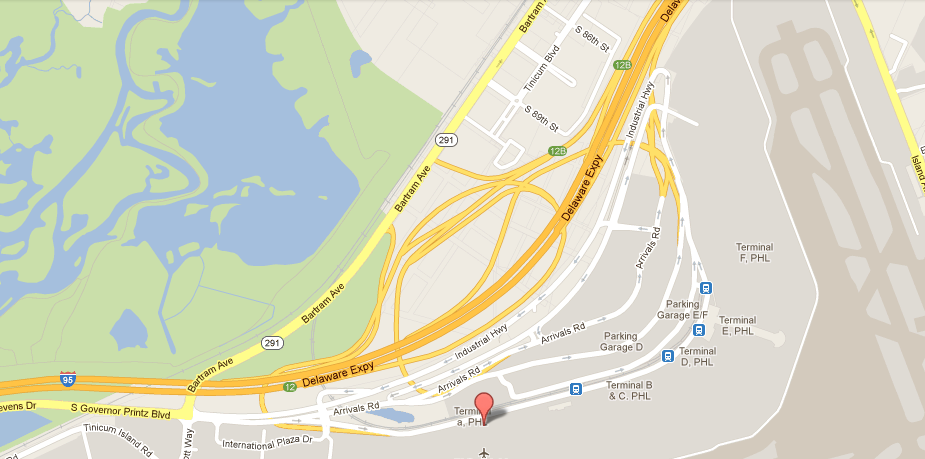
But when you come to PHL, you find a driver’s Bermuda Triangle, a Gordian Knot of swirling lanes that sweep you past just about everywhere but where you want to go. Try LAX and broad Century Boulevard leads you from I405 past three terminals, then back past three terminals onto the boulevard. Couldn’t be simpler. SFO and you have a similar loop but this time circular on two levels from 101. But PHL? YOU try to describe it:

The PHL Gospel According to Google: Note ‘Rat’s Nest’ of Access Roads above & below I95

Starting at the red marker shown and going right, there is the usual sequence of terminals A through E but there the logic ends. Approaching on the Delaware Expressway (Interstate 95) from North or South, there are signs for Arrivals and Departures but heaven help you if you choose the wrong one or if you are looking for, say, a specific car rental or a specific hotel. Mulitstorey car parks obscure all information about terminals and so, often as not, you find yourself at the end of options faced with I95 N or S and precious little else.

Choose N and you get entangled in Philadelphia Naval Yard when trying to find a return route; choose S and it’s much simpler—other than a 6-mile round trip to the next exit. It makes you think of the Sopranos—someone with the concrete contract for this airport would not be satisfied with less than 10 unnecessary miles of lanes and flyovers included in the over-engineered design. But if Fat Tony padded the concrete contract, whichever Don subcontracted for signage showed no respect and was sleeping with the fishes before he could deliver: if there’s a minimalist style of signs for airports, PHL is the model.

Approach from the S and you actually cross four bridges, two of which take you over I95 and back for no obvious purpose. Approach from the N and the separate ‘exit’ ramp is actually a three-lane motorway that parallels I95 for over a mile for no obvious reason before sweeping into a single lane on a bridge over—you guessed it—I95.

Car rental return is grouped, logically enough, with Departures. But it doesn’t say that at first. Then, in the middle of impatient two-lane traffic doing 50 you have to keep an eye out for the right entry gate as they flash by on the left, with no indication which is coming up next. Oh, and where it says “Enterprise” on a sharp and unexpected left turn, it should also say ‘Alamo’ and ‘National’. But doesn’t.

But, at least there are signs for returns. Pity the poor sod just rented their car and found the exit gate where some polyglot-but-none-of-them-English mumbles something from the depth of his kiosk and raises the barrier. You turn left because there is no option and then spend the first peg of you gas tank exploring the sweeping Soprano bridges of the area, crossing and recrossing I95 with no clue as to how to join it. Occasionally you will see a filter lane that seems to go the way you want but it is protected by stern signs that say it is “For Commercial Vehicles ONLY”. And so you orbit on.

You may only be going to an airport hotel. The Marriott is cheek by jowl with the high-rise parking. But the rest hunker along S Governor Prinz Blvd or Bartram Ave. Indeed, you can see some of the higher ones as you cross I95 for the seventeenth time. But signs there are none and I have a crisp $10 bill that says you will be on I95 N or S at least once before you get within spitting distance of your hotel.

For my money, unless you were born here, by far the most relaxing way to fly to Philadelphia is to skip it and go to New York instead.

Posted in Community, Transport | Tagged | Leave a comment

Stormbound

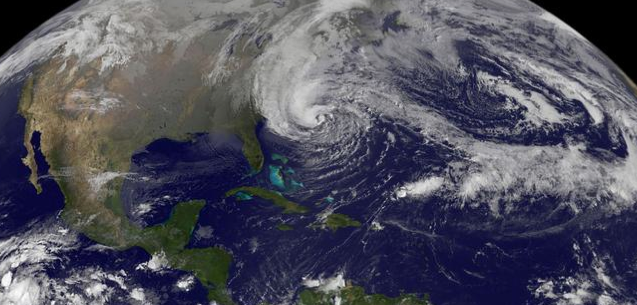
I should have taken the hint from the sprinkling of rain that accompanied yesterday’s trip back to Philly from the golden fall colours of the upper Delaware. The rain has intensified on the back of a fierce Southeasterly that is systematically ripping those leaves off all the trees and sweeping them drainwards along the street as Hurricane Sandy swerves left off Cape Hatteras and comes to pay us a visit.

Hurricanes are not to be taken lightly at the best of times but the stretch of US coast between Virginia and Massachusetts has spring tides and are now expecting a storm surge between 5 and 8 feet on top of that. Any coastline would be threatened by that but this entire stretch consists of low-lying islands (geologically terminal moraine from glaciers) with lagoons inland and much of Delaware, South Jersey and Long Island are Lincolnshire-flat and not much above sea level.

NASA View of Hurricane Sandy from Space

So far, disruption has been serious but not severe. Because much of the Eastern seaboard of the US is covered with trees—including most suburban streets—and the standard means of local power distribution is along cables hung on telephone-poles-on-steroids down each street, it only takes one serious branch blown down for an entire series of city blocks to be without power. We still have power here in Audubon but the blackout is expected momentarily.

The storm was well predicted but local media have been in overdrive about its seriousness, labelling it ‘frankenstorm’, calling it “massive and life-threatening” and  “worst case scenario for the New Jersey shore”. As a result, local stores are being reduced to empty shelves as emergency supplies are being snapped up at the last minute. Ours here is completely out of bottled water, D batteries and flashlights (i.e. torches) and running low on things like crackers (i.e. biscuits), peanut butter and candles.

Worse than that, a whole series of airports between Washington DC and Boston’s Logan are closed to traffic, all flights in and out cancelled and virtually all flights to the eastern seaboard from Europe cancelled too. Many businesses are closed, not least because workers declined to undertake the long daily drive that most do. The most serious among these is that the NY Stock Exchange did not open for business today and even the 24-hr circus of entertainment at Atlantic City closed as of noon.

Unusual Scene of Desertion at Caesar’s in Atlantic City

Of most concern are those living along the low-lying Jersey shore. All of the various settlements and holiday cottages have been under evacuation orders since yesterday but coastal flooding is expected to be severe and to affect communities not normally at risk, such as in the lagoons themselves, up the Delaware River beyond Philly, all along the tortuous shoreline of all five boros of New York City and even the normally sheltered Long Island Sound.

No Time to Be beside the Seaside—Today at Ocean Grove, New Jersey

At the time of writing, the eye of the storm was expected to hit the coast at Atlantic City by this evening. Winds of 50 mph will be common, with gusts to 75 mph as far inland as Audubon and of 90 mph at the coast itself. For the Philadelphia/South Jersey area 4 inches of rain are expected to fall in the next 24 hours. Whether the zillions of leaves washed into street drains will allow all of this to quietly flow away remains to be seen.

Because weather in much of the States tends to be calm and wind-free, they are more sensitive than most Brits to the effects of a stiff breeze. And, having seen some filthy North Sea weather myself, I am not too nervous about life and limb. But the next 24 hours may change that insouciance as, with around 45m Americans who live in this most populous part of their country face what may be the storm of the century.

NOT a Still from Ghostbusters: Clouds Gather over Manhattan Earlier Today

Posted in Environment | Tagged | Leave a comment

Ivy League Visit

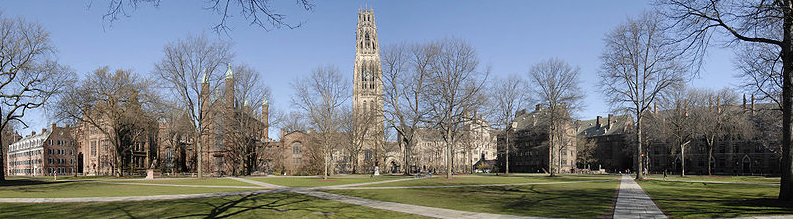
After the bustle of Philly and the freeway traffic piling onto two-lane country ‘pikes’ in South Jersey, I have escaped for the weekend to the fall-colour-blessed bliss of Princeton, barely an hour north on I-295. Still in New Jersey, this is one of the Ivy League universities that could give any European campus a run for its money in its stately demeanour, its fulsomely ripening architecture and its fearsome reputation in law and the liberal arts.

Even more than the dreaming spires of Oxbridge or St Andrews the place is shot through with greenery and a rather sensibly laid out combination of ancient quads with the necessities of a town. Unlike much of America, this place has history, with its main building—Nassau Hall—having housed a detachment of redcoats during the wars of independence who were dislodged by a well aimed cannonball that came in through the window hurt no-one but took out the portrait of George III on the wall

Nassau Hall: with Princeton’s Massive Endowments, its Broken Window is Long Since Repaired

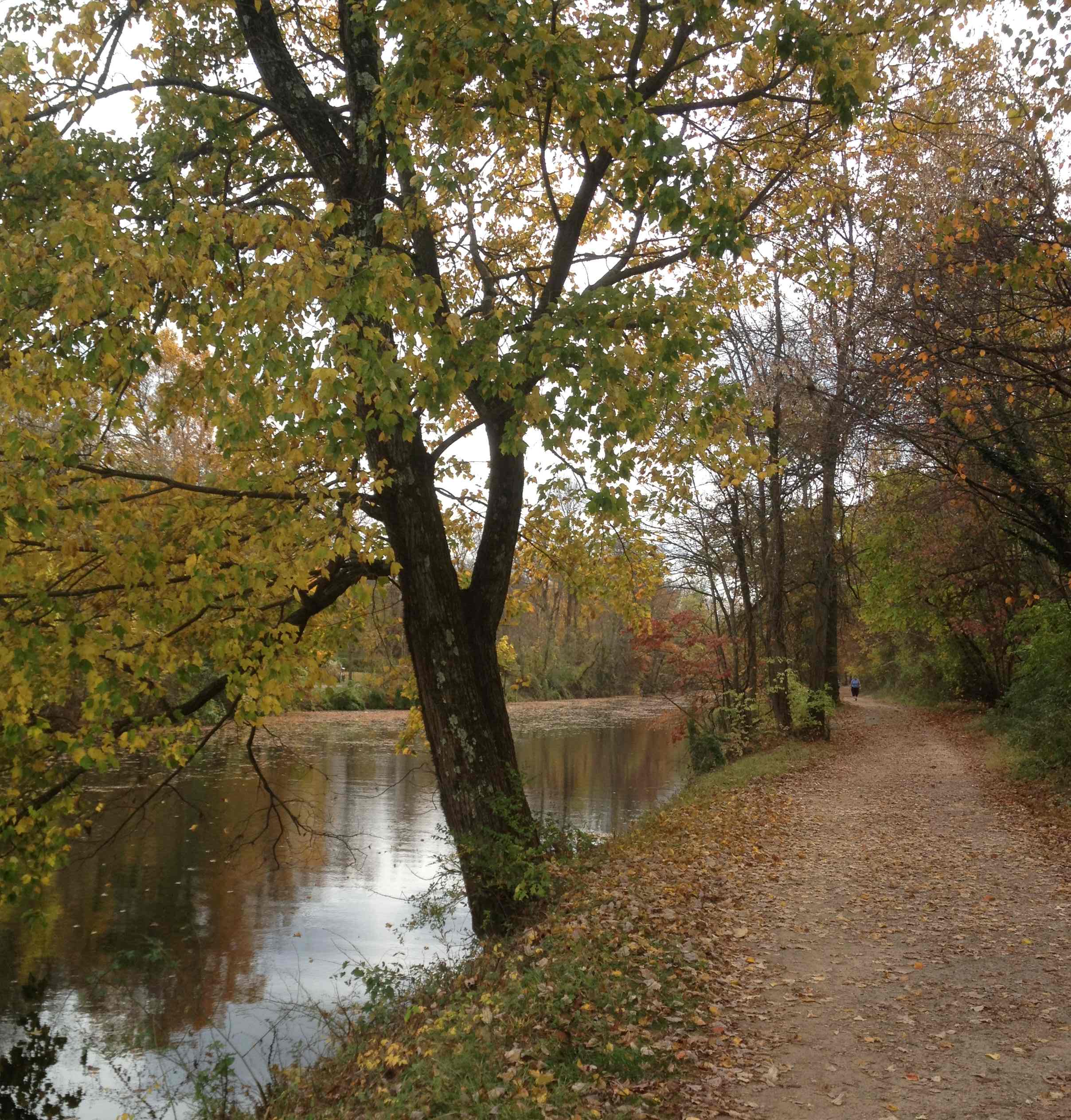
A long walk along the Delaware & Raritan Canal was a pleasant way to work off a very decent lunch on the patio of Sharon & Bill’s new home nearby to make space for one of the best seafood meals I’ve had in a long time at the Blue Point Grill which seems to specialise in fresh-caught catch from Barnegat, which is a fishing port on the Jersey shore as close as you can get to Princeton without dragging the boats overland. I hadn’t had swordfish in two decades and this was a reminder what I had been missing—a huge steak, grilled fresh, flavourful and textured almost like chicken. They put ketchup and tabasco on the table but that would be sacrilege.

Hiking/Biking Trail Along the Delaware and Ruritan Canal

After an obligatory stop at the local Bent Spoon Ice Cream Parlour with the obligatory myriad choice and superbly creamy product, it was time for a little culture. At the McCarter Theatre, the Elevator Repair Service was completing its trilogy of transferring classic American works to the stage with The Select (The Sun Also Rises) staging of Ernest Hemingway’s masterpiece novel. Their reviews gushed about “cutting wit, doomed romance, and a live bullfight that has to be seen to be believed“, claiming this to be “an exquisite, wine-soaked homage to one of the finest novels ever written“. It seemed like a worthwhile experience for the $38 price tag.

But, while it had its moments, with a creative staging, lively music and dance interludes and some real creative theatre, it completely lost track of itself and especially the era of Americans in Europe entre les guerres with its trademark flat, staccato pace of Hemingway dialogue. The costume department needs to be sat through the Powers/Flynn 1957 take.

Probably the most damning of all was to examine the other theatre-goers at the interval in the three-hour (and 1 1/2 hour too long) peeformance. They seemed, almost to a couple, to be the very same penguin-suit-&-tiara mafia against whom I railed in the previous blog, only this time in dress-down mode. Maybe all these Ivy League universities maintain a theatre as they maintain a football team—to be seen to participate. But the impression left is that they pour far more money and prestige into the players of the latter.

Passageway to Holder Hall, Princeton

Posted in Education | Tagged | 1 Comment

Philadelphia Freedom

After just two days in Philly, I have rediscovered that joy of exploring a new city with the open-mouthed naivety of a stranger. Fifth in size among US cities, it is a place I had managed never to visit in my 15 years living among our US cousins. It has much in common with its sister cities—from the multi-terminal sprawling airport to the lacework of freeways framing the rectangular grid of streets, it boasts the usual soaring bridges (this time across the broad Delaware River) named for their heroes: politician and scientist Ben Franklin, flag-sewer Betsy Ross and poet of tributes to a great land in the throes of seeking its destiny, Walt Whitman.

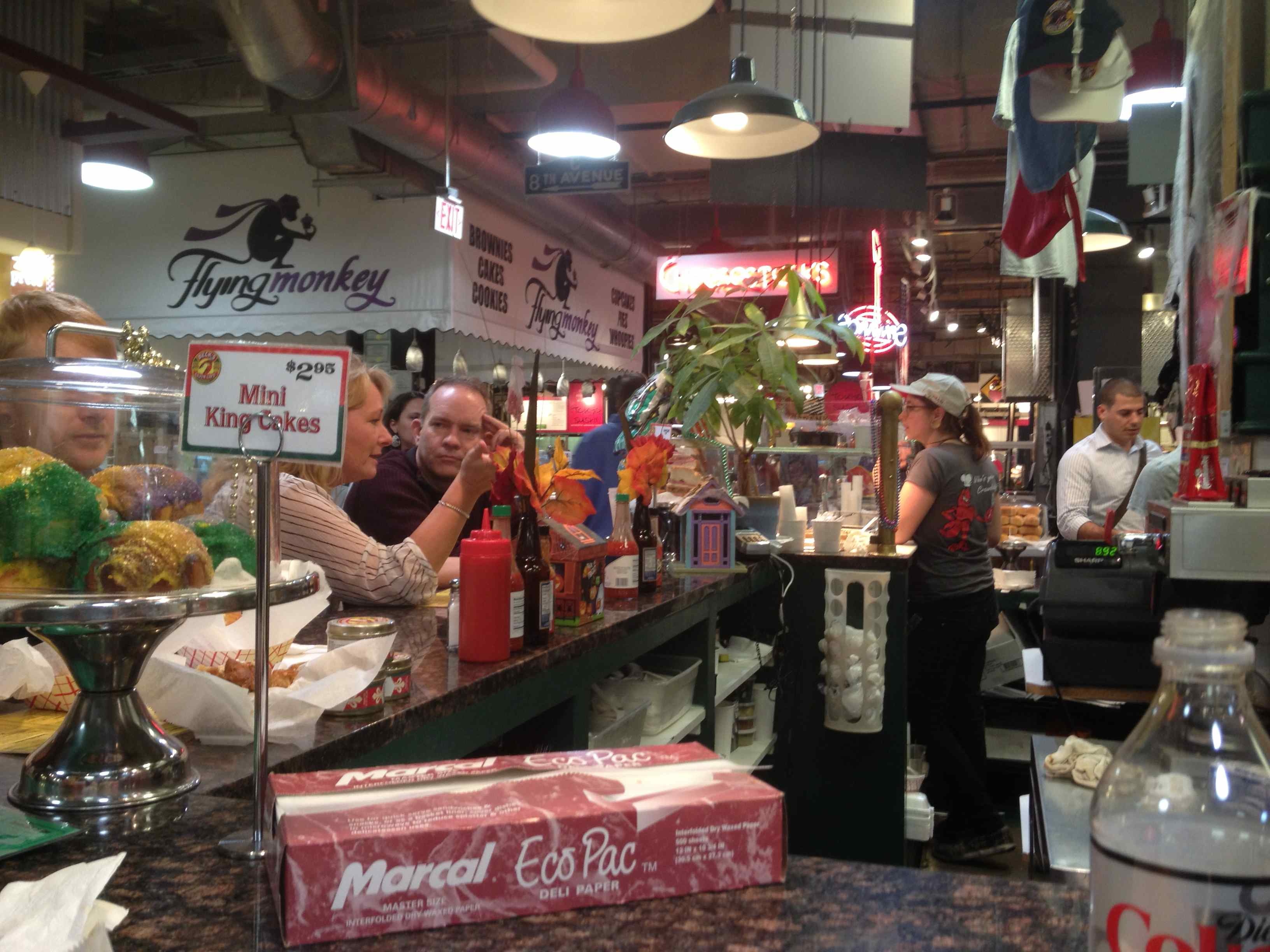
My first great discovery was the Reading Terminal. Originally a train station, the basement has become one the best market and exotic food emporia I have seen. It compares to Faneuil Hall in Boston but it’s less tasteful, more lively and easily more exotic. We plumped for Beck’s Cajun Cafe and tried to deal with a Train Wreck sandwich that had andouille sausage, carmelised onions, peppers and could have choked a horse. Billed as “what a Philly Steak sandwich wants to be when it grows up”, it defeated me after a half hour of plucky effort.

Beck’s Cajun Cafe in the Chaotic Bustle of Reading Terminal

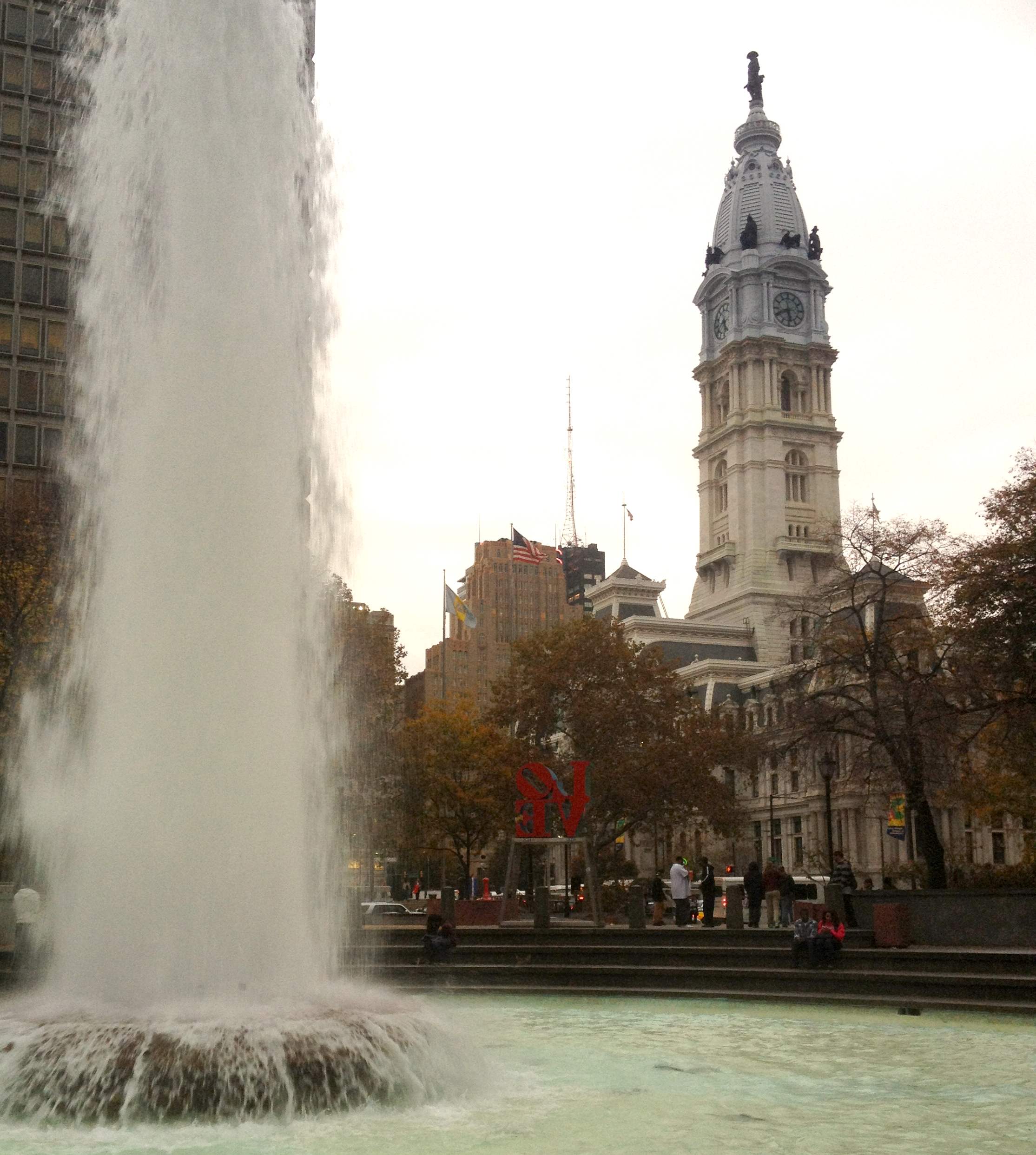
All of the multiracial bustle you expect in the States surges through the narrow streets around City Hall, whose pinnacle statue of William Penn has long been dwarfed by huge skyscrapers nearby and making mockery of a city ordinance against any such thing ever happening. As magnificent a building as it is, City Hall seems to be under unending construction and yet the corridors are dingy, poorly lit and completely free of any helpful signs to tell you what’s where.

Philadephia City Hall from Love Square

Nearby, the Love sculpture has a group of  blacks offering to take pictures of couples beside it but, from their touchy response to a ‘no’ and the fisticuffs between a Buick driver and the taxi he cut off on Arch Street below shows the ‘City of Brotherly Love’ to be a little short on supplies just now. Downtown streets show signs of the recession—several major department stores closed and too many loan stores and other down-market signs. But cars are new, traffic heavy and, if horn-honks were dollars, a lucrative source of income.

From the city centre, the spacious Ben Franklin Boulevard stretches Northwest through top-notch hotels and a cathedral into a cultural district that would grace any European capital. The Philadelphia Museum, Academy of Natural Sciences and several major libraries all clustered around Logan Square (which is actually a circle). Top for me was the Rodin Museum which has displays a fine representation of his sculpture in a tasteful garden and gallery set back from the noisy traffic of the boulevard.

You are greeted by one of his versions of the Gates of Hell and the Burghers of Calais were missing from their plinth in the garden but The Kiss has pride of place, although I found either of their versions of The Embrace in marble and bronze to be at least as good and even more racy.

Biggest disappointment came from the museum that should have knocked my socks off. Never particularly highbrow and always preferring the representational in my art, I have been a fan of the colours and subtleties of the Impressionists since an early girlfriend dragged me out of my comfort zone to see an exhibit. The Barnes collection is generally accepted as the most comprehensive in the world and has recently moved from the mansion where the philanthropist displayed them to this heartland site.

Unfortunately, the great and the good have got their pretentious hands on them. By becoming an annual member at $250 you may enter when you like. Otherwise, the plebs must book ahead to be drip-fed in at $18 per ticket, bookable only days in advance. I don’t know the stipulations of Barnes’ original bequest but I believe it was for the public to have free access to good art. My impression is that his philanthropy fell on hard times and a similar penguin-suit-and-tiara mafia to that which fund-raised  themselves into the nomenklatura of the San Jose Symphony have done the same thing here—but with even less grace towards those outside their socially-circled wagons.

But past there and over the Shuykill River, things get funky again as you come into the university district. Not just one but the University of Pennsylvania, Drexel University and several colleges, strung along Walnut and Chestnut streets. The usual mix of jumbled tower architecture mixed in with wooded squares and eclectic food outlets make for a kind of universal atmosphere of college culture. What was noticeable, though was that, whereas in downtown you could see the racial mix of this city on display (38% white; 38% black; 24% mixed, mostly latino and chinese), over here you see mostly white and many asian students. But the blacks seem almost all to be both in menial jobs (e.g. porters) and badly overweight, especially the women. That and they don’t seem to frequent the stores or food outlets.

You can’t get a proper feel for a city the size of Philly after only a couple of days—and I apologise to anyone who knows it well if the sketch above doesn’t seem to do it justice. But I also saw, however briefly, an Aegis cruiser under maintenance in the huge sprawling US Navy Yard in South Philly, the disconnected half-attempt at public transport between SEPTA, PATCO and Metrobus that didn’t seem to make sense, the bizarre costume party underway at Finnegan’s Wake on Spring Garden Street and the European scale of too-much-traffic for the width of street.

But it’s a city I’m glad I got to know, however minimally and however belatedly. There is a similar endearingly OTT boisterousness in Philly that you might associate with New York. It’s a city with chutzpah, a sense of itself and, sitting outside at Mace Landing over a cool one (it may be late October but it’s still short-sleeve weather), you can watch a world go by that behaves like it knows where its going.


Posted in Education | Tagged | Leave a comment