Why Aren’t We All Just People?

Just back from a month in the States (well, OK—in five of ‘em), I am overwhelmed by a blizzard of impressions that makes nonsense of my having spent a couple of decades of my life there. This time, despite my friends’ best efforts, I most definitely felt like a ‘furriner’.

After two decades of living in a small town, I have been spoiled—able to walk in less than a minute to the High Street, the beach, the butcher and (most important) the tender ministrations of my favourite barista. It’s hard to summarise America but an unending sprawl of suburbs surrounded by an bigger unending sprawl of massive fields, surrounded by even bigger scenery is a start.

In Philadelphia/Chicago/San Francisco, I thoroughly enjoyed how the Americans do their vibrant downtown culture. But why the bulk would choose to live in South Jersey or Silicon Valley remains as much a mystery to me. When I first encountered their large front lawns widely separating ranch=style homes and getting a pint of milk involves jumping in the car, I could not get my head round why this was desirable. Because it seems like a recipe to kill community, I still can’t

Not having visited Philadelphia before, it was all new—the usual grid of streets chess-boarding out from City Hall, a huge ethnic and cultural variety rubbing shoulders from the tuxedo-and-tiara mafia in charge of the Barnes Museum (best Impressionist collection outside of Paris) to the cacophonic multicultural gastronomic mayhem of the Reading Station. But I had no basis to compare change.

After longer in a San Francisco I know well, I was struck by the ethnic basis for the seismic shift in US population that Romney wilfully ignored and that brought his presidential effort down with a crash. Because, cosmopolitan and multicultural as San Francisco might have been when I lived there in the early nineties, it now bids fair to be a prototype of how cultures will mix across the USA, if not the world.

Ignoring the more uniform white suburbs of the East Bay, SF used to be white with heavy latino and black elements, plus a good dose of Chinese who had been there almost as long as the whites. By my unscientific observations, whites are now in a clear minority, with a heady mix of Mexican, Guatemalan, Costa Rican, (i.e. primarily Central America) latinos who are now almost as populous. Virtually every restaurant, irrespective of genre, has completely latino kitchen staff.

Meantime, the Chinese element has been tripled, which together with major Vietnamese, Filipino, Korean and Indian elements is coming up fast in third place. The only element not growing (in fact declining as manufacturing jobs close down) is the black, which is dropping towards single digits.

Some explanation for this can be found on the college campuses. Whether at UC Berkeley or SF City College, the sheer number of Asian, followed by latino students dwarfs the white faces and makes a black face unusual. With the job market just as tight in the US as Scotland for young people, degree inflation means that almost any salaried job demands a degree and those that always have (e.g. in engineering) are now looking for a PhD or at least a Masters.

White kids are doing all right in all this. Not only have they always had the inside track in the culture but, until recently, their never-had-it-so-good parents could dip into the savings/401k/2ndMortgage to fund the $10k+ necessary for Junior to get a degree. Asian parents have always been astute in egging their kids on to study hard and do well, even if only to be able to look after them well in their dotage.

Over the last couple of decades, latinos have also caught on and, although their home culture is not quite as performance-oriented as the Asians (most gardeners, construction workers, plumbers’ assistants, etc are latino) they do have the work ethic and many of their kids are grabbing what opportunity comes their way.

But the real tragedy seems to be the blacks. Those outside of the South drifted there after the Civil War and got menial jobs in factories. Though there are many black professionals, they remain the exception and the black districts of Hunter’s Point and Oakland, though shrinking in extent (East Palo Alto’s black neighbourhood seems to have been entirely Yuppified) have become even more hopeless swathes of civic wasteland than two decades ago.

This gives real food for thought. For a century after the Civil War, blacks remained second-class citizens in their own country. As late as WW2, black regiments would not be mixed with whites. The Civil Rights Movement swept away much of the bigotry that did stand in their way, especially across the old Confederacy. But in the half-century since all official barriers were torn down, their lot as a whole has barely improved.

This could be ascribed to racial prejudice—except that the Asians and latinos have used that time to not just explode in numbers but to drag the standard of living for those numbers well up past anything blacks have achieved to within contention of the white elements of the population.

Comparing these aspirational and social problems with ours in Glasgow and/or Dundee, where it is less clearly racial, is it possible that social fragmentation and the hopelessness hung round the neck of one generation after another has far more to do with family life and local culture than any racial or visual characteristics upon which many well intentioned social programmes are focussed?

Whether blacks started off as slaves may now be irrelevant but their dearth of positive examples within their neighbourhoods is not. In other words, are our equalities efforts barking up the wrong, racial tree?

Posted in Community | Tagged | Leave a comment

Listless People in a Land Full of Energy

Over the last forty years, one truth almost done to death but still deserving of repetition is the fact that Scotland is the only country in the world to have discovered oil and not grown rich by it.

If that, in itself, isn’t enough to get Scots upset, then the manner in which £283bn (to date) provided by that oil was squandered ought to. And, if all that is water under the bridge to you, what about the scale of renewables opportunities that dwarfs those of oil that the UK government have hamstrung through lack of investment?

For the political debate in Scotland to focus on details like exact college funding and whether NHS bursitis treatment is a postcode lottery is evidence—if ever it were needed—that elected politicians fixate on sound bites or points scoring, showing little clue about the big picture or why people elected them in the first place. No-one expects Scottish Tories to agree with Scottish Labour on much. But why they are not all on the barricades with the rest of us to stop their country being ripped off has been the great unanswered question of the Scottish Parliament?

As a result of their nit-picking, yah-boo-sucks posturing, the great bulk of Scots, so hopeful as they crowded the Royal Mile that summer’s day in 1999, are not watching their antics at Holyrood any more than they are glued to BBC Westminster for the latest droning from three MPs and a junior minister over how Sunday opening might affect morris dance festivals in Kidderminster. It was supposed to be better; it was supposed to be less schoolyard confrontational.

But it isn’t. And the punters have had just about enough of being turned off in droves. So, this is an effort to focus readers on one thing: the biggest political outrage in Scotland for the last half century—our valuable windfall of energy and its purloining to benefit others.

Let’s set the context with a few relevant facts about our past and present energy bonanza—oil and gas:

  • The North Sea contains Western Europe’s largest oil and natural gas reserves. The largest share of that is in Scotland with Norway owning the next largest.
  • Since 1970, approximately 39.5 billion barrels of oil equivalent (boe) have been extracted from the UK Continental Shelf. Most of that was extracted below $50 a barrel.
  • Further overall recovery is forecast to be in the range of 15-24 billion boe – although the exact amount of reserves remaining will depend on a range of factors including investment, technology and oil price, which has not fallen below $80 since the 2009 dip.
  • Total production of oil and gas was 2.5 million barrels of oil equivalent per day (boepd) in 2011 (roughly the 2.5 m in 2009).
  • Since 1964/65, the UK Government has raised approximately £283 billion in direct tax revenue from oil and gas production in the North Sea after adjusting for inflation (2010/11 prices).
  • The Office for Budgetary Responsibility forecasts suggests that the North Sea will generate £50.8 billion in tax revenue between 2010/11 and 2014/15.
  • Research by the University of Aberdeen shows that Scotland’s share of North Sea tax revenue will exceed 90% over the next five years.
  • Aberdeen is the world’s second largest energy hub, behind only Houston. The representative body, Oil and Gas UK, estimate that in 2010 the industry provides 196,000 jobs in Scotland. Of these the UKCS is estimated to account for 110,000 with a further 45,000 supported in the export of goods and services and 41,000 supported in the wider economy.

Where has our money from all this gone? Taxation in the last 40 years rose under Thatcher/Major from £58 bn to £296 bn while Blair/Brown raised it to £529 bn. Even allowing that inflation has almost tripled prices over the same time, the government’s take is 3.25 times what it was.

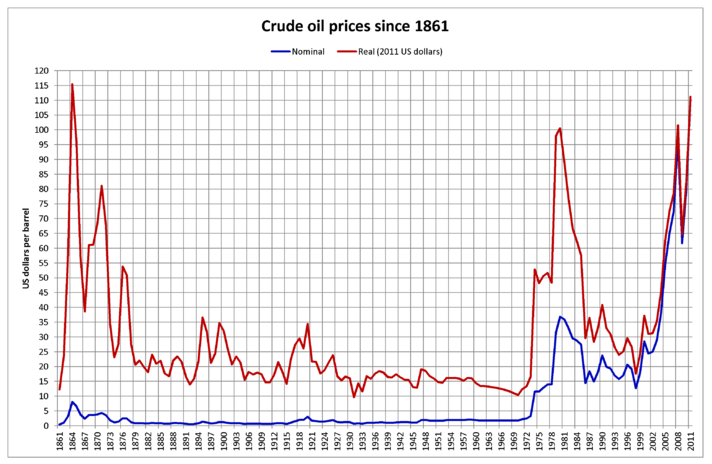
But the really sweet deal has been the oil taxes, linked to oil price—$16 a barrel in 1979 while Brent Crude today fetches $111.38. So, for all the unionist moaning about volatile oil prices and supply running out, even though volume has fallen almost 50% since its peak, the government take is still 3.5 times what it was.

In other words the UK Government is getting the largest share of its revenues from our oil that it ever has. And what munificence and gratitude has it shown us? Has it squirreled at least a part of it away like Norway’s Oil Fund ($660 bn, with $29 bn added last quarter as stocks rose)? Has it poured investment north to exploit the joint benefits that would accrue from Scotland’s dominant position as a potential source of green energy? Has it hell.

Starting with the Thatcher but exploited like there was no tomorrow by Blair and Brown, all the money went to offset other taxes while increasing benefits and the health budget. In the 17 years since 1994, personal social service costs have risen from £5.5 bn to £17.2 bn, NHS from £36.6 bn to £118.7 bn while benefits rose from £88.4 bn to £168.6 bn and are expected to top £200 bn by the end of the decade. Oh, and have I mentioned our public pension liability grew from £41.3 bn to £119.2 bn?

In 1994, oil was less than $20 a barrel—not much more than in 1979—but since then the booming oil taxes slurped like a godsend into Irn “call me Prudence” Broon’s coffers so that £13 bn of the above generosity could be funded as oil revenues quintupled. It paid for 8% of all the increases listed above or, looked at another way (i.e. 10% of ALL income tax receipts) was equivalent to body-swerving a 10p-in-the-£ rise in basic tax rates. Nice trick.

In short, we wuz robbed—and we still are being, only more so.

The bigger tragedy is that the sprawling house-of-cards benefits system by which Blair & Brown bought successive elections was based on borrowing, pension raids and taxing both North Sea oil and the now-notoriously cowboy junk-mortgage-etc boom times of Canary Wharf et al. The UK lived well above its collective means and all of Osbo’s smoke-and-mirrors efforts to prune the behemoth have produced little. That’s because, of all Irn Broon’s fiscal tricks, the only one still producing—and that right well—are the oil revenues.

So every unionist who can add is falling over themselves to keep Scotland’s oil revenue flowing into their Treasury. Without Scotland, the present bloated UK expenditure commitments point to a bankrupt England. Little wonder there’s a panic in John Bull’s breastie.

But the wonder to me is that the Scots—ever canny with other people’s money, let alone their own, should not be in angry pitchforks-and-torches mode over this. Having each lost £56,000 to date, they appear to be tholing another cool £2,200 sneaking south each year. And, as oil prices rise (and they will over time) that number will just get bigger.

I don’t want to believe this, but, with an indifference uninspired by all the petty squabbling at Holyrood, has a once-proud nation been bought off by Irn Broon’s handouts—the modern equivalent of 1707’s English gold? We could make such a better fist than the UK Treasury of investing our own money in our own future.

Posted in Commerce, Politics | Tagged | Leave a comment

Giving Thanks

Regular readers of this blog will know that I’m a fan of the Americans. Not because all they do is spiffy but because they have forged a great nation out of the hopes and guts of a pile of penniless immigrants. And, if you go there—bearing in mind Mark Twain’s superb observation that we are “two peoples separated by a common language”—you’ll find them generous, sociable and optimistic in a way that sundry Europeans could learn from.

The other cultural high point of their year besides 4th of July is a mystery to most Brits. Today is Thanksgiving. Always on the 4th Thursday in November, Americans try to get home to be with family celebrating the survival of early Pilgrim settlers, thanks to the generosity of their Indian neighbours. The ritual meal served (turkey, stuffing, cranberry sauce, yams, pumpkin pie, etc) surpasses English Sunday roast and Christmas dinner all rolled into one.

The four day weekend is spent stuffing yourself with food, catching up with family and getting started on the Christmas shopping. The Friday after (always a holiday too) is usually the peak retail turnover day of the year. Since I have no American family, I have left them to it and returned to Scotland after four weeks over there. My own Thanksgiving is to all the people who still made what was a difficult trip into another series of memories and experiences that I will treasure.

What follows are some snaps that try to capture some of the warmth shown me during the trip (including breakfasting in shorts outdoors in the middle of November)

Sharon & Bill—my Hosts at Princeton—outside their House

Exotic Food and Entertaining Chaos at Reading Market, Philadelphia

Idyllic Miles of Bike/Walking Path along the Delaware & Ruritan Canal, New Jersey

The Brand New Apple Store on University Avenue, Palo Alto, CA

“Dr R. Boles”—Tree Surgeon and Poet Extraordinaire Bob Evans (with Truck), Palo Alto CA

Martha’s Coffee Shop, Noe Valley, San Francisco—Java Joint/Meeting Place/Civic Hub

American Excess: Mobile Home on Highway 1, Half Moon Bay, CA

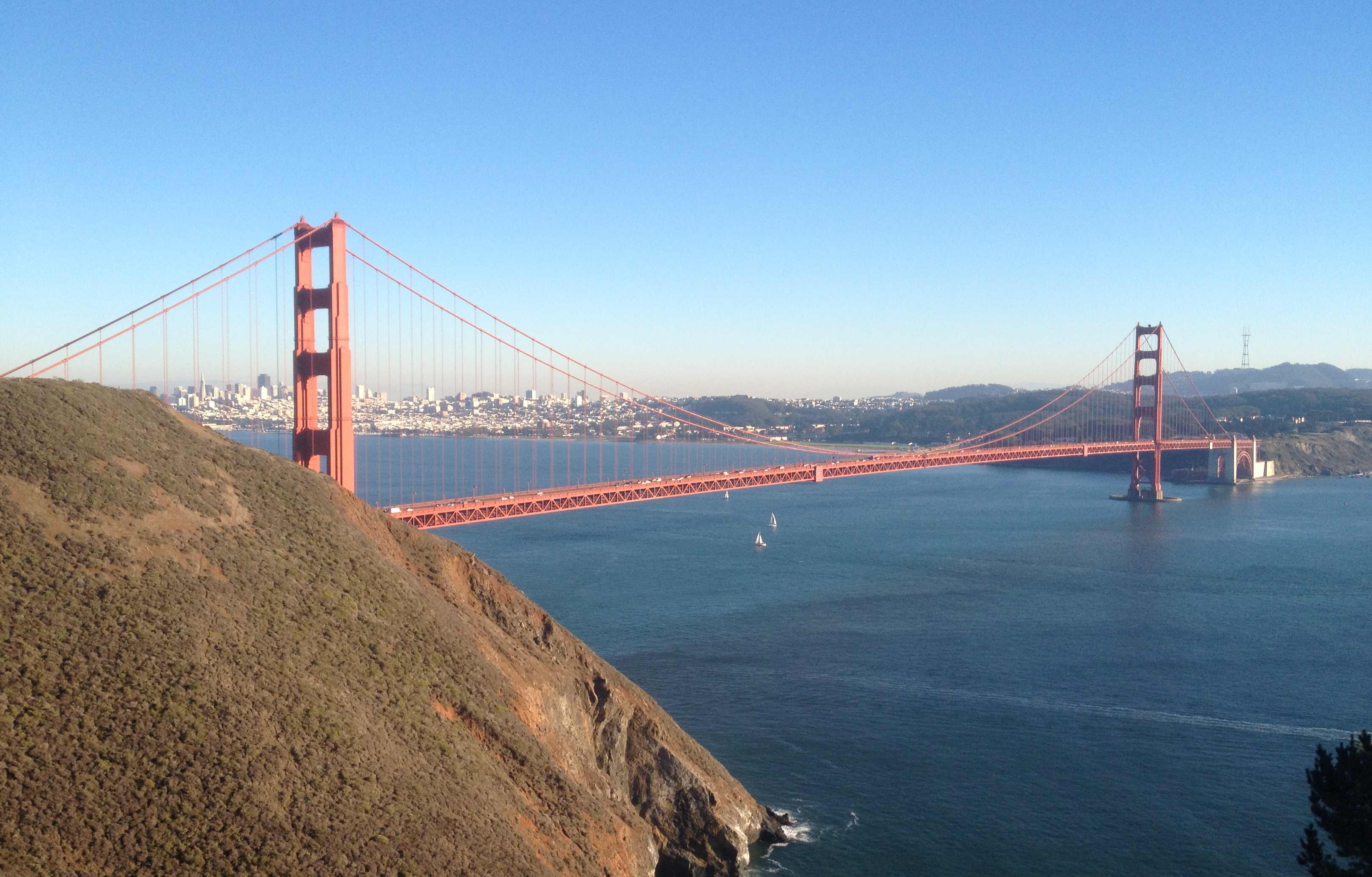
The Classic View—San Francisco beyond the Golden Gate Bridge from Marin Headlands

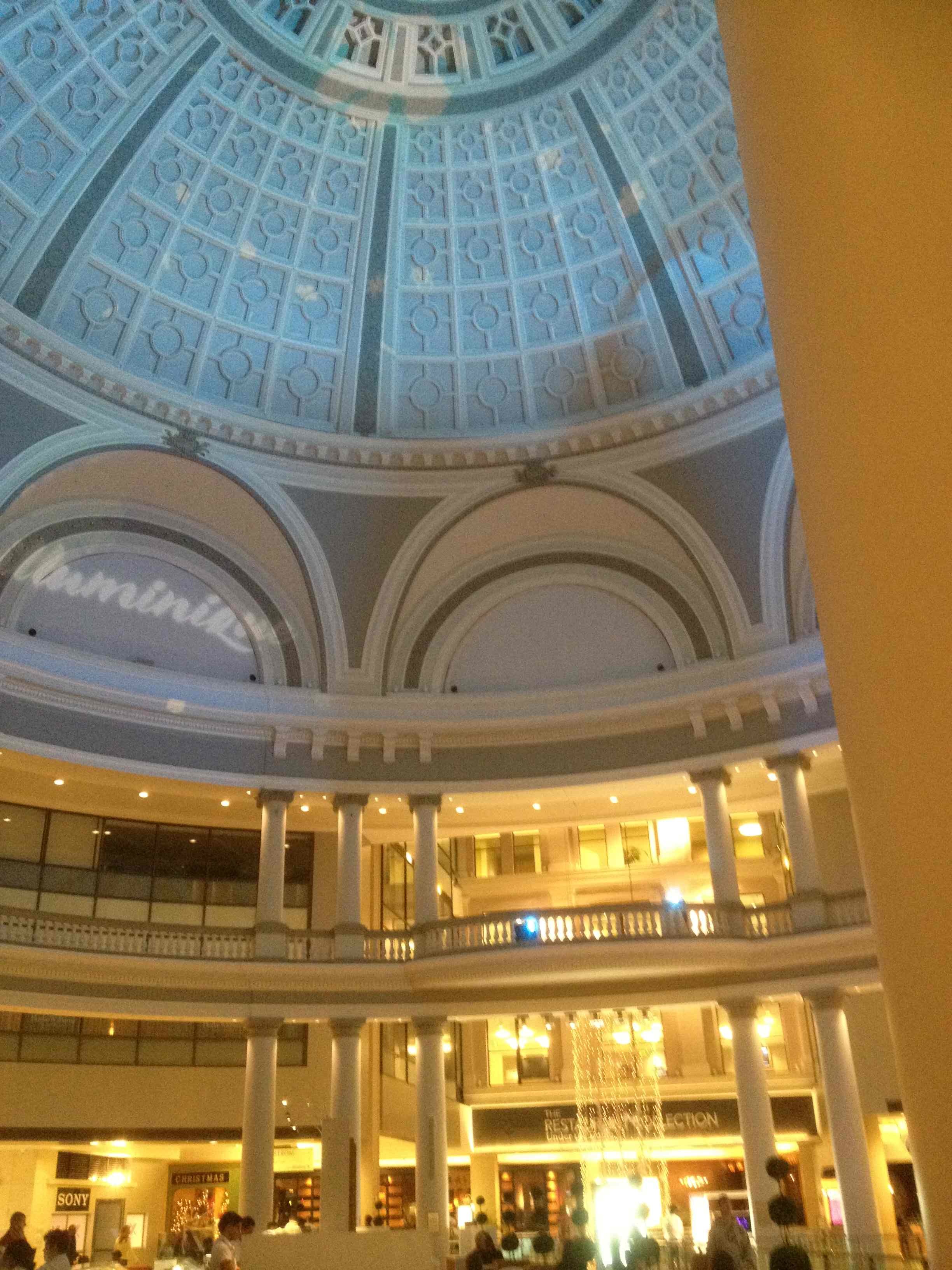
Bloomingdales Department Store, SOMA, San Francisco

The Kelp Forest Tank, Monterey Bay Aquarium, CA

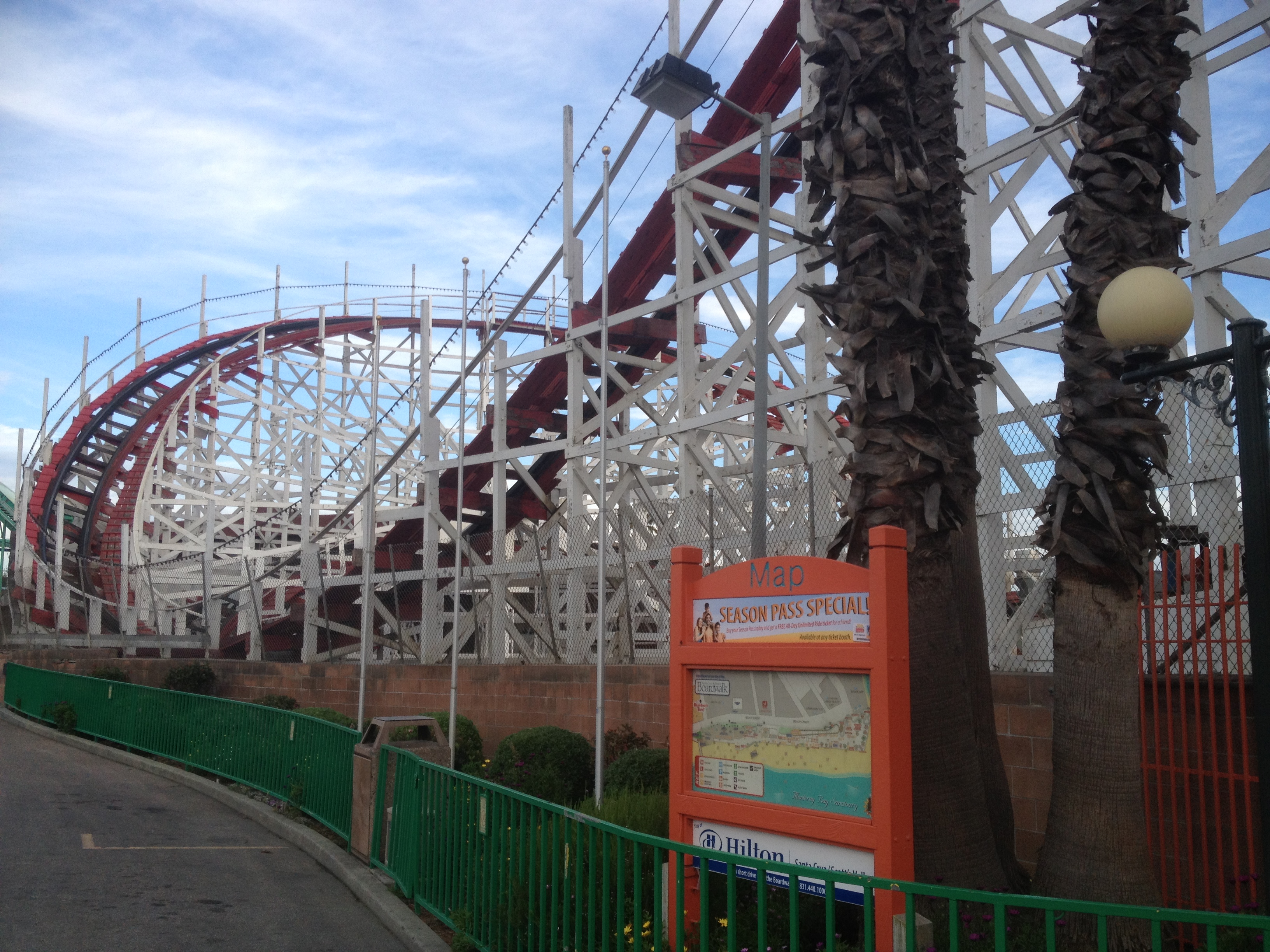
Original 100-Year-Old Wooden Rollercoaster, The Boardwalk, Santa Cruz, CA

Duarte’s Tavern, Pescadero, CA—Best Artichoke Soup & Ollallieberry Pie Anywhere

Winetasting, Nicholson Winery, Santa Cruz, CA

Silicon Valley Escapees and Mine Santa Cruz Hosts—Susan and Stephan in Henry Cowell Redwoods

Posted in Community | Tagged | Leave a comment

The Partisan Needs Perspective

Most observers of Scottish politics would concede that the last few weeks have proved to be rockier for the SNP Government than they have been used to. Mistakes have been made in more than one statement, resulting in a level of baying from the opposition that would do credit to any passing wolf pack. Hugh Henry accusing the FM of lying and “deliberately fiddling the figures” or Johann Lamont asserting that no-one “can believe anything the first minister says ever again” is strong and rather intemperate stuff from their heaviest hitters.

Opposition requires a measure of judgement as to the seriousness and the intent of any errors uncovered and no administration—whether in Holyrood or Westminster—has brought perfection to the art of governing, let alone of keeping the people informed in a manner that keeps the Opposition happy.

Whether Parliament was or was not misled—on legal advice on the EU or on funding for tertiary education or whatever— is for others to decide. But even an openly partisan blog like this is prepared to concede there appears to be evidence for questioning both. Whether either will justify the level of venom currently being pumped into posing those questions is entirely another matter.

Should Jackie Baillie be disciplined for attacking SNP custody of the NHS with figures that date from her own stint as Health Minister? Should Margaret Curran get her jotters for pillorying SNP use of 4G phone license allocation monies when, in fact, Scotland gets none because they lie out-with the Barnett Formula? Probably not, even if both were deliberate (unlikely). In politics, some rough-and-tumble comes with the territory; those posing as holier-than-thou are often early casualties.

Partisanship is fine, provided it has a healthy degree of perspective attached. Which is why we should all be grateful to the Scottish political press who, despite the best efforts of their editors, often achieve that rare creature: a partisan piece that ought to be recommended reading for all politicos. In this context, I cite Alan Cochrane’s frequently mordant but thoughtful broadsides in the Torygraph (try http://www.telegraph.co.uk/news/uknews/scotland/9687005/Scottish-Labour-hot-under-collar-over-Salmonds-figures.html.)

But an even rarer gem is an informed and incisive observation that surpasses any partisan intent and simply puts a complex and thorny issue (over which elected high heid yins are squabbling to their mutual detriment) into a lucid context that the 90+% of Scots (whose healthy cynicism about the hale jing-bang grows by the day) can not only understand but believe it to be as good a formulation of the truth as they are likely to see.

For that in this context, try Iain Macwhirter’s latest blog at: http://iainmacwhirter2.blogspot.no/2012/11/facts-are-chiels-that-winna-ding-is-one.html

Posted in Politics | Tagged | Leave a comment

Why No Searchlights On Titanic?

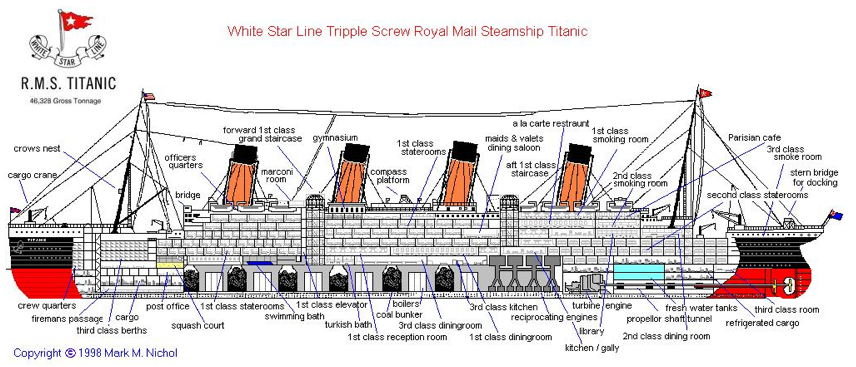
Easily the greatest maritime tragedy that can be regarded as avoidable was the 1912 sinking of the brand new White Star liner RMS Titanic on its maiden voyage. Fitted to the most opulent standards of the time, no cost was spared to make her the safest and most luxurious ship afloat.

So, apart from the unheard-of luxury of the first class accommodation (it was a rather different affair in steerage), the whole structure of the ship was divided into 16 watertight compartments that could be sealed of by electrically actuated doors. Anyone who has seen the film or read the story needs no reminding of the somewhat insouciant attitude of Captain Miller, senior captain of the White Star Line and, as such, privileged to always take a new liner out on it first cruise.

He was provided with ice warnings, although in insufficient detail for him to appreciate that meteorological circumstances had combined to push a number of icebergs further south of the Grand Banks than they typically managed before melting into harmless slush. As with any such voyage, subtle pressure was exerted on him to not just make but better the scheduled crossing time.

With that to the fore in his mind, all 29 boilers were lit and Titanic’s three massive screws were churning its 46,000 tons through a glass calm, icy sea at her 23 knot best speed under clear and starry skies of a night with no moon.

Much has been made of how difficult it is to spot icebergs in a calm sea when there is so little light and no wave-break at their waterline. It has also been noted that Lookouts Frederick Fleet and Reginald Lee had only their eyes to watch for hazards as the officer with the key to the binocular locker had gone ashore at Southampton. Given the speed of the ship, both these factors undoubtedly contributed to the best reaction the crew could achieve not being enough to avoid the iceberg when it was spotted at 23:39 on April 14th.

But, given the speed and relative blindness, why had the crew not used searchlights to illuminate the sea ahead? The easy answer is that they had none. Hard to believe, given that all navies had seen the advantage of developing strong, directed lights for night fighting and Norris, A. “Alternating Current on Shipboard.” in the Journal of the American Society of Naval Engineers. Vol. 24, (1912) detailed a practical 7.5Kw searchlight and observed “All searchlights of the (US) Navy are operated on a power circuit requiring about 125 ampères at 60 volts.”

Given that no expense was spared on the Titanic, why were no searchlights shipped? Captain E.J. Smith and White Star Line’s Vice President Sanderson in charge of ship’s equipment would both have agreed that such new-fangled ideas interfered with the night vision of lookouts. Such skepticism had its basis. Human eyes have an ability to see peripherally in very low light but this requires up to 30 minutes to adjust and is ruined instantly by any bright light.

This meant that use of searchlights to navigate would have rendered not only all lookouts blind at night, except where the light was shining but also any lookout on a passing ship. It was considered essential to keep a 360 degree watch and, although naval units could be trusted to administer searchlight assistance only when required and under strict regulations, civilian mariners could not be so trusted and so the idea of any ship navigating by searchlight was considered hazardous to all.

Second Officer Charles Herbert Lightoller told the Senate subcommittee, “I think [a searchlight] would have assisted us, under those peculiar conditions, very probably. The light would have been reflected off the berg, probably.” Third Officer Herbert John Pitman added that, though he had seen them used by naval vessels, he had never seen a merchantman vessel with a searchlight. An experienced seaman, he believed that a light might have revealed the iceberg.

A prominent British scientist blamed the Royal Navy for the disaster. Henry Wilde, an English electrical engineer and Fellow of the British Royal Society, charged that the ultimate responsibility “rests upon the naval authorities at Whitehall through their blind policy of excluding searchlights from the mercantile marine.”

The Admiralty objected to widespread use of searchlights, arguing that they interfered with the navigation of other ships. While it is true that bright lights can complicate navigation, and an unshielded light at night in the pilothouse can ruin a watchkeeper’s night vision, this is a short term effect. In reality, the Admiralty’s position was more complex and based more on military than on navigational considerations.

The Admiralty’s effort was doomed to failure in the end. Applying the prohibition to British shipping did nothing to slow other nations use of arc lights. Worse, as Titanic showed, denying passenger ships the tools they needed for safe navigation put innocent civilians at risk, and today every ship that goes to sea carries several strong lights to illuminate the hazards of the deep.

If two searchlights had been fitted either to the for’ard mast where the lookout crow’s nest was located or an some other superstructure immediately above the bridge, the technology of the time would have allowed a path ahead and some 30° to either side to be illuminated, with a good chance of identifying icebergs of the scale that did for the Titanic around 5 miles away on a night like April 14th 1912.

Granted, the lookout’s night vision would have been impaired, as would any other ship in the vicinity. But there was no other ships in the vicinity, other than the Carpathia which took four hours to cover the sixty miles and the nearby California which was hove to because of the ice field and therefore not in need of lookouts (or, unfortunately radio telegraph operator who had gone to bed 15 minutes before Titanic hit).

But imagine the headlines that might have been: April 17, 1912, edition of the New York Herald:

(New York) “We learned today from passengers on her maiden voyage that the White Star liner, Titanic, nearly collided with an iceberg in the early morning of April 15th. Titanic, pinnacle of the modern shipbuilder’s art, was saved from damage by an electrical arc searchlight. The guardian beacon of light alerted the officers of Titanic in time to steer away from danger. The captain noted that a collision, though unlikely to have been serious, might have inconvenienced the great ship.”

Posted in Commerce, Transport | Tagged , , | 2 Comments

The Burd may be injured—but she still knows how to fly straight when it matters.

burdzeyeview's avatarA Burdz Eye View

But first, a word about my own.  Blogging silence has been enforced by a mystery shoulder affliction, which might be connected.  Or not.  Suffice to say, it is agony, I am a whimpering wreck when the painkillers threaten to wear off.  And cannae do normal things which require the use of two hands.  This post marks an occasional return which took two hours to type one-handed.

Bad as my week was, it could have been worse.  I could have been the Education Secretary, Michael Russell.  Suffice to say that he will have been dispatched by the Boss to his constituency this weekend to reflect on just how shoogly the peg on which his coat rests, is. Fortunately for the Education Secretary, there has just been a re-shuffle and the FM, as ever, is not one who acts under an admission of adversity.  People come and go at his behest, not…

View original post 966 more words

Posted in Education | Tagged , , | Leave a comment

Why Arkansas Is Not Argyll

Despite whatever peccadillos my have transpired during his White House tenure, Bill Clinton survived the worst that his Republican opponents could throw at him (and pretty odious some of it was too) to preside for two terms over a steady boom in US affluence, lasting accommodation for the fragments of the Soviet empire and a period of relative international peace.

So when he appeared on-stage at the Democratic Convention on September 5th to nominate the Obama/Biden ticket for a second term in the White House, the thousands of delegates thundered their welcome for him, as well as their approval of his message. And his speech did not disappoint. Much more than a paean of praise for Obama, it was a lucid and well laid out policy document that presented the complexity of the tasks ahead without the usual rabble-rousing shorthand that comes so easy when the popular talk to the faithful.

It was another reminder of Clinton’s skills and capabilities and why he rightly commands eye-watering speaker fees at events around the globe. One other such event at which he featured was Entrepreneurs 2012 in London this weekend at which he asserted:

“The issue of independence is a “classic case” of identity politics which, would dominate 21st century...Can you be Scottish and British? How are the Egyptians going to deal with their various identities and still be Egyptian? Can we find a way to appreciate what is separate and unique about us and still think that what we have in common with others still matters more?”

These are fair questions. What is disappointing is that, unlike in his rousing speech in Charlotte, he appears to have made little effort to answer them, other than by implication that what we have in common should dominate. From an American perspective, they believe that they have the balance right. Their great country is built of 50 distinct federated states, each with its own constitution, laws and other forms of identity in which the citizens set great store.

But, from a European perspective, these identities appear almost artificial and more on the scale of English counties or French départments. Certainly travel from New Jersey to Massachusetts gives little indication you’ve passed through five states any more than a journey from Atlanta to Bill’s own Little Rock another five—although the contrast between the two trips are Yankee urban night vs Confederate rural day.

When Clinton made his Charlotte speech, he was not just among friends, he was on sure ground. His explanation of how Obama filled the $716 bn ‘donut hole’ in Medicare or how the Recovery Act provided 450,000 more jobs was lucidity itself, the mark of a speaker on top of his game. And after eight years in the White House and a dozen more making high-powered speeches to high-powered people, it is little wonder. So why would his London foray not carry the same weight and authority?

He need look no further that Article 1 of the Constitution of the State of Arkansas 1874, which declares:

“All political power is inherent in the people and government is instituted for their protection, security and benefit; and they have the right to alter, reform or abolish the same, in such manner as they may think proper.”

Sound familiar? It should, because it derives, as most states’ constitutions do, from the 1776 Declaration of Independence which, in its turn, derives from the 1314 Declaration of Arbroath that said more or less the same thing. And, if you should examine Bill’s no doubt random reference to the Egyptians, you would realise that they have a history longer than almost any other country of being unified as Egyptians; during those many millennia they have never sought to be anything else.

Scotland (or Ireland, Denmark, Finland, etc, etc) is different. Not only has there been a Scottish border about ten times longer than there has been a Constitution of the State of Arkansas, it has kept unique laws, religion, culture  and identity that only the State of Texas seeks to approach in its distinctiveness. Steeped as he is in US state civics, their minor differences don’t begin to approach the distinctiveness that most Scots feel from the other peoples of Britain.

So when Bill makes his sincere pleas to bury differences and work towards a common goal, he is presuming that we, like a US state, are already comfortable with the status quo. As Bill phrased it:

“Political debate framed about identity issues hampers efforts to forge stronger bonds. “You can’t have 51/49, 52/48 debate about that every single year. This is the triumph of identity politics that is zero sum and its negative reference instead of a common vision.”

But what when that identity needs its proper expression in order to make the full participation in a common vision? The Scots are British and Europeans, just as their English and Welsh cousins are. But they need the latitude to be Scots without forever having a London-based set of presumptions hung around our neck—whether it be that nukes based on the Clyde, beating up total strangers in Afghanistan or giving away our fishing rights are all justified by a Westminster majority and a non-existent constitution.

Would Bill argue the Canadians ought to house America’s nuclear sub fleet? What if that situation were reversed and there were Canadian nukes on the Mississippi? Before any such unlikely scenario, you would swiftly see another draft “We the People of the United States, in Order to form a more perfect Union, establish Justice, insure domestic Tranquility…”

Because it’s the people, stupid (I mean, Bill). Just as your forebears worked out that British imperial peasantship was not what they were about, so have we. Once the English get it through their miasmic heads that the Empire has gone and the last colony is about to jump ship, that’s when we Scots will “find a way to appreciate what is separate and unique about us and still think that what we have in common with others“.

Including Arkansas.

Posted in Politics | Tagged | Leave a comment

Protecting Our Nation’s Interests

The title of this blog is lifted from the header of Royal Navy’s website and before we get our sleeves rolled up and into the subject, I wish to make clear that there is no stronger admirer of the Senior Service and its achievements down the centuries than your humble blogger. But, being as we are in the 21st century, the principles upon which Britain’s exercise of sea power and the political masters that determine its strategy ought to be the topic of a more serious review than the penny-pinching exercises that Messrs Hoon, Hammond et al have indulged in over the last decade.

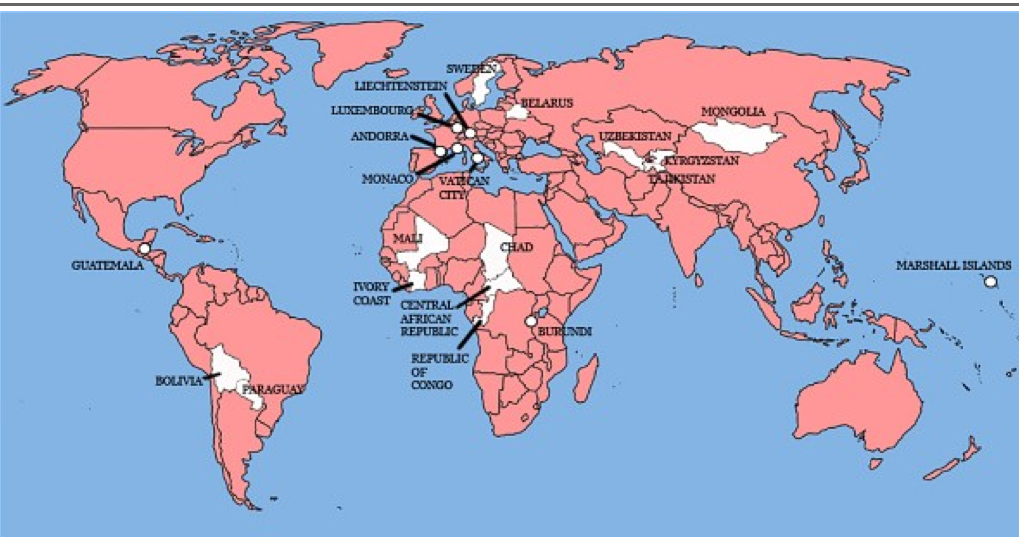
The British like to think of themselves as peaceloving—slow to anger but fierce in their retribution. Unfortunately, such a self-image sits ill with reality. Let’s leave aside who was at fault in the major conflagrations that were WW1 and WW2, few of the countries of the world can boast as aggressive a history as Imperial Britain. Consider a world map in terms of that history:

Countries Shown in White Have NOT Been Invaded by Britain; All Others (Shown in Pink) Have

Fewer than thirty of the world’s two hundred countries have never stared down the barrel of a figurative British gunboat. And before you start pointing out that neither Mongolia nor Mali have a coastline and are therefore inaccessible, note that Upper Volta and Uzbekistan both have; also, as recently as 1998, the Royal Navy paid a visit to Switzerland by sailing a patrol boat up the Rhine to Basel. There is however no truth to the rumour that Russia drained the Aral Sea just in case perfidious Albion found some way of wangling a gunboat onto it.

Admittedly the world map is a simplistic rendition of four hundred years of complex history and geopolitics. But the point of it all is that attitudes toward Britain have been formed at least in part by such a perspective. And, given incursions into both Iraq and Afghanistan in the last decade, it could be argued that we are still playing the gunboat diplomacy role of a world power and that terrible events like 7/7 or the Glasgow airport car bomb are direct, if unjustifiable, consequences of that.

Given the scale of British interests, it has always fallen to the RN to police those interests across the globe. A century ago, we dominated both trade and naval power and that effort was both sensible and feasible. However, British share of both has now shrunk to risible levels compared to global competitors. Yet the RN continues to be tasked with its old role. Thirty years ago, the fallacy that this could be done was almost exposed in the waters off the Falklands. Although a brave victory against steep odds, a few more Exocets and/or fewer dud Argentinian bombs could have made it a disaster.

A quarter century later, the Royal Navy still had its global tasking but Geoff Hoon’s Strategic Defence Review of 2005 pared all three small carriers and 3 of the 35 ‘blue water’ escorts (frigates and destroyers). By comparison, the USN operates 11 major carrier task groups (each with almost 100 aircraft and a half dozen escorts, including Aegis cruisers), plus 9 similar-sized amphibious assault groups, each capable of landing a brigade of 2,200 US Marines against opposition.

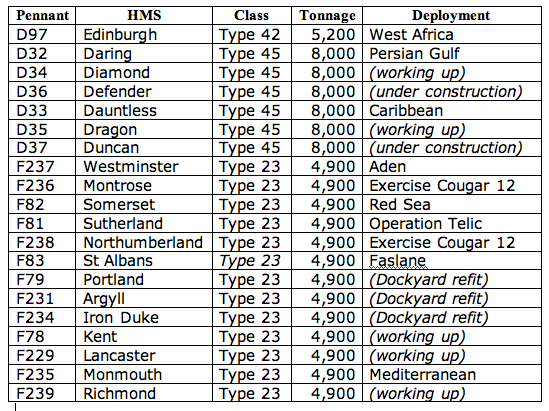
Not only is Britain incapable of deploying even one such task group (at least until 2018) but the existing main units are stretched halfway round the globe and, despite their web site slogan, no longer capable of discharging all that is asked of them. But, worse than that, the beancounting firm of Hoon, Fox & Hammond have all but gutted what capability is left. From the SDR’s 32 FF/DD fleet of only seven years ago, the RN is effectively down to 5 DDs and 13 FFs—and not all of those operational

Royal Navy Fleet Escort Deployment, November 2012

For anyone with a naval background, this does not make comforting reading. The RN still deploys four amphibious warfare and helicopter assault ships plus six survey ships, but those are not naval combat units in the usual sense. They also have a couple of dozen patrol ships and minesweepers but none of those are really ocean-going, nor armed, nor capable of the 30+ knot speeds of the destroyers and frigates.

So the table above scatters nine of the ten operational units halfway round the globe (including two supporting HMS Bulwark on Exercise Cougar 12 with the French and Albanians in the Mediterranean). The only ship in home waters not either undergoing refit or working up (in theory operational but crew is still training on new equipment) is the Type 23 Frigate HMS St Albans, based at Faslane.

Now the defence of the nuclear sub base at Faslane is obviously a priority which is why the St Albans is there (along with two 50-ton Archer class patrol boats). And chasing drug-runners in the Caribbean or Somali pirates could be justified if they caught more of them. But if I were the Taliban looking to smack Britain in the chops for daring to invade my country, a couple of fast cigarette boats packed with amatol could do damage to North Sea rigs that would dwarf Piper Alpha.

Even if the Admiralty were to get wind of such a strike, attack submarines would be useless to counter it, minesweepers and patrol boats would be too slow, even sailing from the Forth or Hull, and HMS St Albans would take a day to get there, even if immediately ready to put to sea from Faslane. And the RAF would be hard put to hit such small, fast targets, even if they were not clever enough to hide out next to the rigs that ASMs or cannon would be as likely to damage as their intended target.

Or what about an LNG tanker with 200,000 cubic metres of liquid gas aboard is similarly attacked as it come in to tie up at South Hook? The resulting fire and explosion would not only wreck Britain’s main LNG import facility but take out much of the Milford Haven oil facility with it, causing an environmental as well as economic disaster.

That the RN is ludicrously overstretched cannot be blamed on the sailors. Both Labour and Tory governments have insisted on a global role for Britain, whether it be a global military reach the whole UK can no longer afford or the nuclear deterrent that it can’t afford either. As a result, the RN is kidding itself that it is capable of protecting Britain’s conventional maritime interests any more.

But what is worse, seen from a purely Scottish perspective, the key oilfields, most especially the newer ones out in the deeper waters of the Celtic Sea, are wide open. With no long-range maritime patrol capability, we no longer even know what’s out there, whether some rusty Liberia freighter off the Faroes is even now removing its deck hatches and using its derricks to launch fast attack boats amidst the rigs.

To protect our nation (that is Scotland’s) interests, we need 2-3 FF’s deployed around our coast, backed up by a half-dozen fast attack boats (c.f. Finland’s Hamina class), a squadron of long-range maritime patrol aircraft and an SBS squadron specially trained to deal with terrorists, especially aboard oil rigs. The UK has none of that.

No disrespect to the RN personnel doing their best in impossible circumstance but the only way we Scots can protect our nation’s interests is to have our own nation and then choose defence forces that don’t involve poking 90% of the world in the eye with a gunboat at some point in our history.

Posted in Politics | Tagged | Leave a comment

The Economics of BASE Jumping

With the dust settling on a US election result that just about everyone who is not Republican (and a good few who are) is relieved by, it is back to financial business as usual—and not before time. Europe has just moved back into recession with French unemployment at 10% and one Spanish youth in four out of work.

Even though the Greeks approved (another) sweeping set of €17bn in austerity measures cutting pensions, salaries and social services, their €31bn in credit remains firmly locked and most workers remain convinced that strikes can magic good times out of thin air. The UK is in the throes of a double-dip recession and a reinvigorated Obama is immediately faced with what is being touted as a ‘fiscal cliff’ for the US economy.

The origin of all this is the series of tax cuts and unemployment benefits linked to reductions in military and domestic programmes, agreed six years ago under Dubya and designed to stimulate a faltering economy. But that had caveats of time limits attached. That flight of chickens is already in the landing path and set to come home to roost on January 1st 2013. Both sides of the House are agreed that this sudden $700m change could scupper recovery. But whether Obama can break the Washington gridlock of DEM initiatives being stalled by resolute REP opposition remains to be seen.

Much of the current energy around establishing sound fiscal conditions is focused on plans that theoretically would both contribute revenue to deficit reduction and significantly reduce individual income tax rates. But two things combine to make that desirable outcome unlikely:

  1. Some politicians see the scape-goat-free enforcement of tax increases and spending cuts that would result if no action is taken prior to Jan 1st as one way of increasing tax revenue in the teeth of Republican opposition and for which they cannot personally be blamed
  2. Despite the supposed unity within parties, some politicians from both sides (but especially Democrats) see such logjams as pork barrel opportunities, where they can insist on irrelevant attachments to bills that nonetheless suit some narrow interest for theit own local constituents (especially generous campaign donors)

While it may sound strange to European ears, where party discipline is a given, such horse trading is common in Washington. Plans to reduce many tax deductions, exclusions, etc (i.e. tax expenditures) to pay for both lower personal income tax rates and deficit reduction may seem like a politically attractive alternative to raising tax rates or cutting entitlements or other spending.

But huge swathes of people now rely on tax expenditures, such as the deductibility of mortgage interest, charitable contributions and the exclusion from income of employer-provided health insurance. Even when the substantive effects and political realities of large-scale reductions are examined, it’s obviously not possible to both reduce tax rates and also cut the deficit on this basis.

Raising tax rates for those with the highest incomes challenges the proposition that even moderately higher rates hurt growth. Clinton’s 1993 deficit reduction plan increased income tax rates for the top 1%. Republicans fell over themselves to claim this would lead to recession. Instead, the job creation powered over a decade of economic expansion that fell over only once Dubya had brought in his tax reliefs for the rich that are among those about to roll over the cliff.

Perhaps because we don’t face the same urgency of an approaching cliff, none of this seems to have percolated into the economic thinking of either Osborne or Balls. It certainly has elicited no contrition from their predecessor Alastair Darling, on whose watch the wild excesses of junk ‘financial instruments’ imploded, taking most of our economic growth with them. His new book Back from the Brink implies that politics is merely a competition in managerial competence: his stance is unchanged in a defiant macho chest-butting austerity that gets short shrift from colleagues:

“I will admit from the outset that I am not a big fan of the former Chancellor. In particular his, our cuts will be “tougher and bigger” than Thatcher’s, almost led me to giving up on the 2010 election campaign. That one stupid phrase illustrated just how managerial Labour had become in government”. —Dave Watson, Head of Bargaining and Campaigns, UNISON Scotland.

Now that Britain is four years into Osborne’s eye-watering austerity, made liquid only by extravagantly irresponsible amounts of ‘quantitive easing’ (i.e. printing money you don’t have), you wonder if the US’ dilemma of an impending fiscal cliff might not be just the thing to focus our own minds for fresh, decisive action, rather than simply applying more leeches to an already debilitated economy à la Osborne.

BASE jumpers know how to deal with a cliff: indeed they welcome such opportunity to launch themselves into the unknown. But (and this is a big ‘but’), in order to survive, they have trained, equipped and psychologically prepared themselves for something so radical as a leap into the unknown, with every intention of landing hale and hearty. It will take much hard work, good will and inspired insight for Obama and both sides of the House to design, pack and agree a fiscal chute in the short time available. But it’s still feasible.

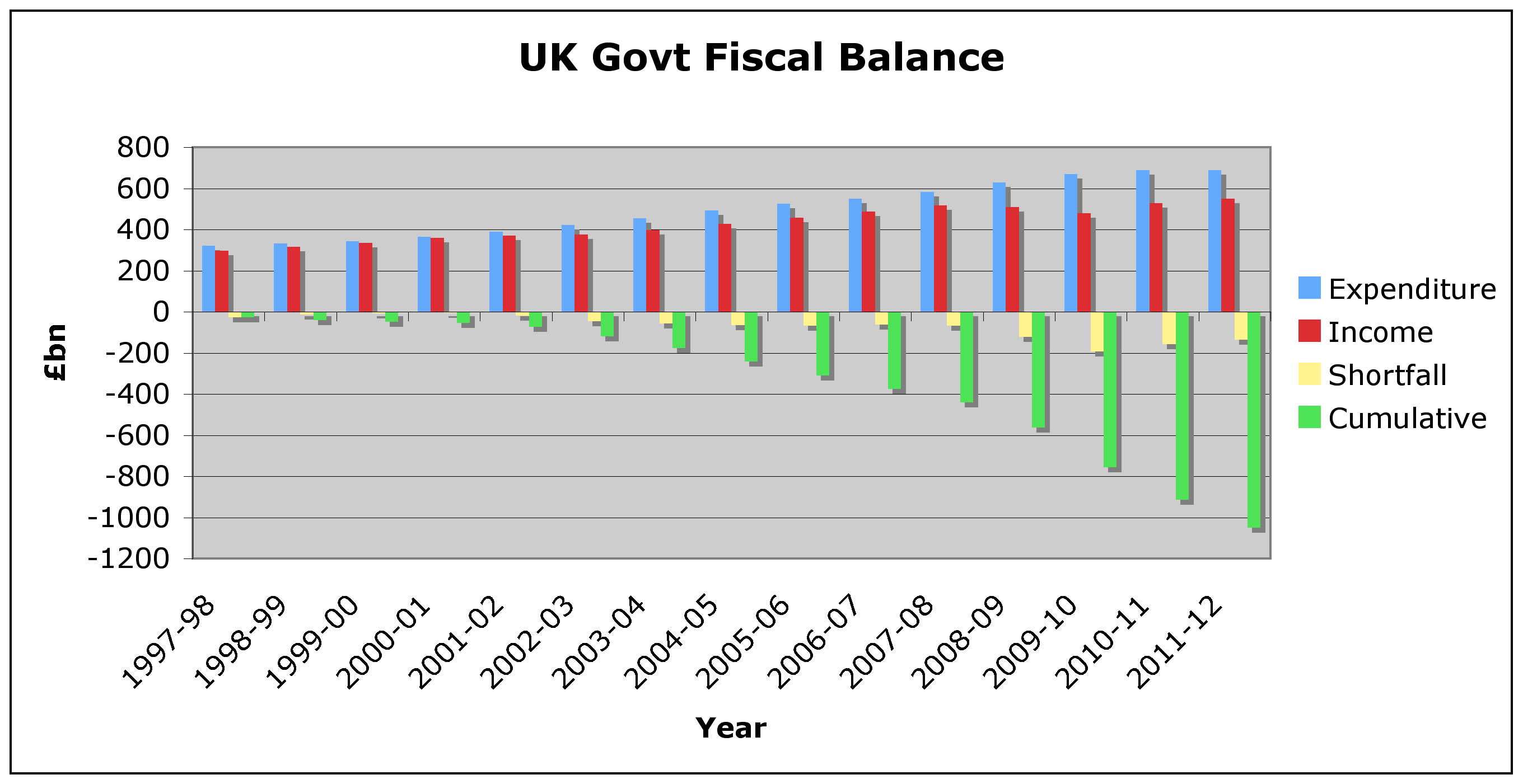
Assuming Clean Slate in 1997, Cumulative UK Debt from Brown + Darling + Osborne

Despite Labour having raised debt per head fourteen-fold on their watch (£432 to £6,237) and he has taken it to forty-fold (£17,523), Osborne sees no cliff—indeed maintains that the ground recently covered that has perversely sloped down and down each year, despite all his best reassurances, will soon lift us back towards the sunlit uplands that lie just ahead. The chart above shows scant evidence for this.

Right about now, you may wish to consider strapping on a parachute.

Posted in Commerce, Politics | Tagged | Leave a comment

Making the World England

So far, most of the arguments coming from unionist mouthpieces in the independence like Better Together have revolved around perceived advantages that accrue to Scotland from being a part of the Union. In terms of economies of scale—such as running embassies around the globe or having critical mass enough to retain our own global currency—they may have a point. But a many more points deriving from the UK’s scale and historical ambition actually work in the opposite direction.

Despite early obstacles, like Jacobites and Americans, the Union thrived from inception. Its modern proponents claim it will do so in the future too. But let’s take a closer look at that thriving. While the Scots became willing partners in the enterprise, they were never equal. It was rather like a boys gang where the bigger of two brothers dominates and the smaller/younger goes along part in awe and part in the knowledge that he could achieve none of this by himself.

That Britain was a leading nation in Western civilisation for a quarter millennium is a given. That it contributed to exploration, technology, humanities and a host of other key developments for mankind is unquestioned. But it was not all sunlit uplands. From the early slave trade, through imperial excesses like Amritsar, to axiomatic racist attitudes in non-white colonies, imperial enlightenment came at a price of hard menial work and the insult of being a second-class citizen in your own land.

There is no intent to demean what was achieved but, given that 50m Brits dominated ten times that number of citizens of empire, it was always going to be a con job.Perceived superiority was essential if the young agent-sahib, outnumbered 1,000 to 1 at some Assam hill station was not going to have his throat slit. This was especially true when the natives realised that the prime British motive to come among them with rituals that sat awkwardly in the local culture like afternoon tea was not to enlighten but to exploit.

Unprofitable British colonies got short shrift. Other than coaling stations, no-one ever worked out what Belize or St Helena was for. But Canadian fur or South African gold or Malayan rubber got the ships or the redcoats or new laws they needed before you could blink. As a trading nation, there was none nimbler; as a manufacturing power, there was none more innovative. Scotland played at least its share in achieving this.

Much though the story of empire has been couched as heroism and altruism, that does not bear close examination. To say the British Empire was the most efficient pillaging machine ever invented until our US cousins came up with the multinational corporation is equally superficial. What is true is that British troops and gunboats were used shamelessly to break open closed countries (e.g. China), subvert exotic empires (e.g. India) or simply strongarm ancient civilisations out of resources (e..g. Iran/Iraq).

Once the raw materials were identified, secured and exploited, they were shipped home to fuel Britain’s burgeoning factories and population’s needs and out again into the world as finished goods. In our Victorian heyday, this worked like a dream. No other country had the combination of global reach and factory muscle to compete or the combination of gritty infantry and jolly tars strategically positioned around the globe.

It was a sweet deal. Not only did the City ensure the establishment grew rich but clacking mills and roaring furnaces from Clydebank to Chatham put everyone in work, although not yet either secure or well paid. The only British people not swept along were the Irish, whose resentment grew with  indifference to the potato famine, mass emigration and being seen as cheap labour and/or cannon fodder.

It was a plausible system, not least because it was successful and almost everyone felt they had a stake in it. Closer examination reveals that virtually all of the sacrosanct pillars that held up the whole edifice—whether Monarchy, Parliament, City commerce, naval tradition, unflappable sang froid, home-as-castle, roast-beef-n-yorkshire-pud—were English. Welsh cakes and choirs went with other regional idiosyncracies like Morris dancing or scrumpy as colourful descants to the main theme.

As a result, it is little wonder that the names of Britain and England become conflated to the point that few foreign languages bother—Inglaterra; Angleterre; etc. While we’re all signed up to a global programme that’s still achieving, why quibble? But, since the British Empire ignored the close-to-bankruptcy shot across its bows from WWI and was caught embarrassingly short in the aftermath of WWII, when the US had money and everyone else was broke or devastated or both, Britain has been struggling for a new role in the world.

And what is it exactly? Seen from a European perspective, we are just another mid-sized country but with an ego problem and stroppier than most. Seen from a US perspective, we are one of many developed markets and a sidekick that’s good to have along when a swift global action needs to look consensual and not too unilateral. From an Asian perspective, we are Turkey or France—a once global empire reduced to modest means but a decent market for finished goods.

The point is that all our joint culture of judicious exploitation of the world’s resources with a minimal amount of slapping anyone around does not play in the 21st century the way it did in the 19th. Ninety years ago, the Irish decided they didn’t want to be a part of it any more and left. There are few studies of this but most would accept that to have been a good choice. There is certainly no voice raised in Dublin to rejoin the UK because it offers a better deal than what they have.

Which leaves the Welsh, the English (still happily pretending the whole culture theirs) and us. Were the Scots in some doubt about themselves— as in the great self-examination of the 1970’s, when industry went to hell in a handcart and the cultural revival consisted to the Cheviot the Stag and the Black Black Oil, there’s an issue. But 40 years ago was the last time that happened. Building momentum since the early nineties, Scotland’s awareness of itself, its culture and—most importantly—its potential, has changed the debate. Rather than why we should go, the argument Better Together is scrambling to make now is why we should stay.

The argument that Scotland is economically viable takes five seconds to make: the arc of whatever (the countries that are our neighbours) all seem to do fine. But they don’t have our oil, our renewables, our tourism or £4bn annual exports of whisky. The fatuous argument about splitting up social bonds are nonsense—the Irish are closer friends than they have ever been and we even have a law defining them as ‘not foreign’. And, as the bulk of Scots want nothing to do with Trident on the Clyde, the fastest way to get rid of it is to become independent and tell the English to put it closer to the Home Counties.

There are strong economic as well as emotional arguments why England would want to stay in a union with Scotland. And, if they want to be nostalgic for the days of Empire, then that is their privilege. But more and more Scots are wondering why everyone is so keen to keep this union intact when every opportunity open to Scotland for a more vibrant and culturally coherent future lies outside with the Nordic Union, exploiting the Celtic Sea with Ireland and the Faroes, managing our fish as cleverly as the Icelanders, developing a new non-nuclear relationship in NATO, developing a less stroppy approach to the EU if we get something for it.

England does a superb job of making England England. But the world isn’t buying it any more and it’s time for this first and last colony to stop the world and get on.

Posted in Community, Politics | Tagged | Leave a comment