The Gross Is Greener

As it has been doing for a number of years, BOS has published its “Quality of Life” List just before Christmas. This rates council areas in Scotland by seventeen parameters, grouped in a half-dozen classes that they believe relate to measuring the quality of life in a given area. We’ll consider the validity of that later but first let’s examine what they came up with. As BoS themselves put it:

“The Quality of Life index aims to quantify where living standards are highest in Scotland by ranking local performance across a range of indicators, including the labour market, the housing market, the environment, education and health.”

There are minor changes in position in those in the ‘top ten’ but no major surprises, as compared to last year; indeed the bulk of the councils in the top ten are pretty much the same over the last few years, with Scottish Borders and Moray drifting out (the latter hit by RAF base closures) to be replaced  by West Lothian and Fife. The top ten for the last three years are shown in Table 1 below.
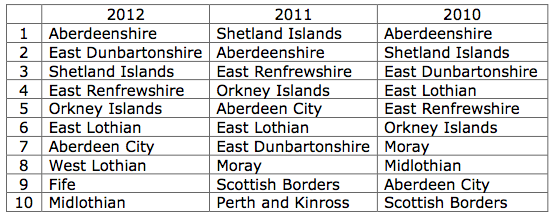
Table 1—Top Ten in Scotland for Quality of Life (source: Lloyds Banking Group)

Table 1—Top Ten in Scotland for Quality of Life (source: Lloyds Banking Group)

But those wishing to use this as an guide where to live should consider both major omissions and unstated selfish interest that cast some doubt on both BoS’s arithmetic and its quantisation.

A similar study done over the UK by Lloyds (BoS now being part of Lloyds Banking Group) ranks ‘desirable areas’ across the UK by pretty much the same criteria. In this case, Hart (near Fleet in Hampshire) tops the poll—indeed the only areas outside the Home Counties were Wychavon, Worcestershire; Rushcliffe, Nottinghamshire; Rutland; and North Kesteven in Lincolnshire. Nowhere in the north of England, NI, Scotland or Wales managed to make this exclusive top-50 list.

Hold on—does that mean SE England enjoys a higher quality of life than anywhere else? I’ve been there. Pretty and cultured as parts are, it’s something of a zoo from which many people have escaped to places like Scotland. It might pay to examine this story and its conclusions in more detail.

Because we’re not comparing apples to apples. Hampshire is the biggest English non-metropolitan county, boasting a population around 1.7m in an area of 3,700 sq. km. But it is barely half the size of Aberdeenshire’s 6,313 sq. km. whose 232,000 people are clearly not nearly as crowded  (by a factor of ten). This also means that the larger area clearly will contain a broader mix, with Hart’s 213 sq. km. holding just one strata of society and a station car park “that looks like a BMW dealership“.

Indeed, all of the top-rated English districts are small, comparable in size to Hart, and home to under 100,000 people. The BoS evaluation ignores the density and hectic associated with even supposedly rural areas of England’s Home Counties. Most of the demographic maps of traffic congestion are based on journeys per resident and so Perth comes out as bad as Petersfield because it has the A9 running through. But sheer traffic volumes and associated congestion are the bane of England’s South-East. Why were these not considered in the study? The top ten places in England are components of traffic statistics given in Table 2.

Table 2—Traffic Statistics for English Counties Covering QoL Top-Rated Places

Table 2—Traffic Statistics for English Counties Home to QoL Top-Rated Places (Source: Dept for Transport)

The figures (in thousand vehicle-miles) show pretty consistent heavy traffic, still  growing at over 6% in ten years and accidents that, while improving, add up to some pretty serious carnage. The equivalent statistics for the top ten for Scotland are shown in Table 3 below.
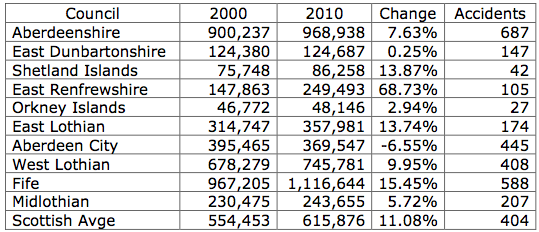
Table 3—Traffic and Accident Statistics for Scotland's Top QoL Places

Table 3—Traffic and Accident Statistics for Scotland’s Top QoL Places

While geographic areas covered differ some between Tables 2 & 3, it’s not a major factor. And though Scotland’s traffic may be growing at almost twice the rate of England, it is from such a small base that it’s still barely a tenth the size, with comparable differences in accidents. You are left with stark statistics implying that the ‘top’ quality of life locations in England are far more congested and dangerous, a key issue that shows up nowhere in BoS’s ratings.

Things get worse when we broaden our view beyond the UK into Europe (I know this brings on a barf reflex in most Tory readers, but bear with me). The EU makes a point on surveying its own take on quality of life across the continent and comparing results among member countries. This again makes for interesting reading. It is not possible to reproduce all 125 questions but the trend where the UK did poorly in comparison to other members—especially Denmark and Finland—was stark.
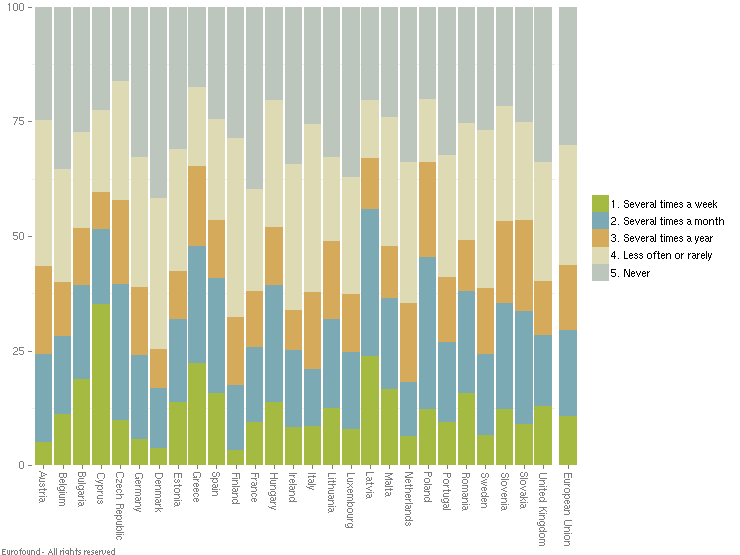
Chart 1—Frequency That Family Responsibilities Intrude to the Detriment of Career

Chart 1—Frequency That Family Responsibilities Intrude to the Detriment of Career

While UK residents are not as torn as others, they still come in over 40% with this problem, while Danes and Finns are more tranquil—closer to 25%.

Chart 2—Number of Times Respondents Felt Stress from Conflicting Priorities

Chart 2—Number of Times Respondents Felt Stress from Conflicting Priorities

Again Danes and Finns come out well with over 50% feeling no stress, while the Brits can’t manage a 40% level. There is clearly a pinch of salt to be taken with any conclusion drawn over multiple cultures like this. But the qualitative feel: that the British are over-worked, suffer more stress and have a poorer overall quality of life compared to their neighbours is inescapable.

Which brings us back to the questionable nature of BoS’s results. Rather than measure genuine quality of life, the parameters they measure have an agenda. While some of them (weather, crime, health, life expectancy) are entirely valid, the rest (weekly earnings, house prices, number of rooms in house) are a yuppy wet dream. They expose BoS’s real motivation—shifting expensive houses to the highest bidder, which is rather shabby. It is, effectively, ammunition for an estate agent’s pitch.

While this is neither illegal nor unexpected, it rather undercuts their high-minded statement printed at the top of this blog. Had they titled this “How the already Rich and Lucky can get even Richer and Luckier”, it would at least have been honest. They want you to trade up: to see the gross is always greener elsewhere.

Because you will indeed make more money buying a house in Hart or Elmbridge (only if you’re already rich enough to afford it). But, as you struggle with traffic on the B3016, inching your Beemer towards Winchfield station or the M3, think about tranquil Turriff or laid-back Lerwick in a Zen attempt to bring its genuine quality of life into the hectic of your own.
Posted in Commerce, Community, Environment | Tagged | Leave a comment

Grey Sea of Grey Seals

Half of the world’s population of the grey seal is found on or around the British coast and it has doubled in number since 1960. Grey seals mainly feed on fish, but will also rarely take squid, octopus and crustaceans. While they are found in colonies all round Britain, they are predominately in Scotland, with the one on the Marr Rocks at the North end of the Isle of May the one with which I am familiar.

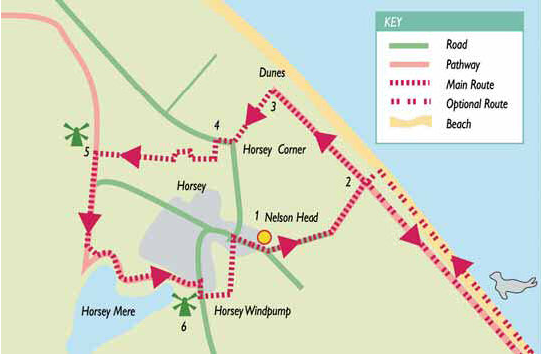
Suggested Walk Round Horsey Taking in Seals, Windmill & Pub

Suggested Walk Round Horsey Taking in Seals, Windmill & Pub

A rare southern Grey Seal colony has been growing at Horsey (on the Norfolk coast between Waxham and Winterton) for the past 10 years. It started with only a handful of seals (a break away group from Blakeney Point?) and now there’s believed to be more than 1,000. The seals come onto the beach to breed between early December and early February. Access to the seals has been causing issues over visitors going too close to the seals, worries about the sea defences being eroded and the car havoc at Horsey Gap. With most cameras having good zoom options, you really don’t need to get too close.

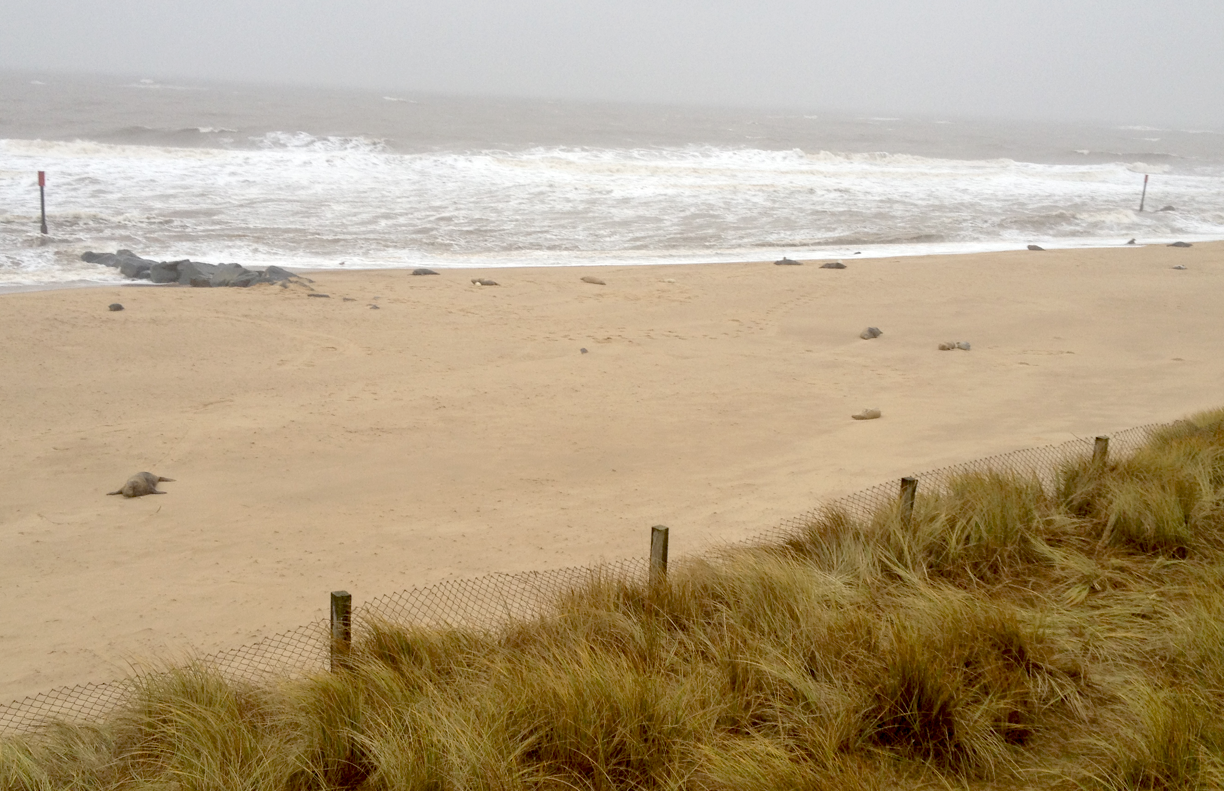
Our visit was on one of the worst days of the year with rain slashing in from the Southeast—directly into your face as you stumble down the rutted mile or so from the car park. The beach itself is off-limits, for obvious reasons. Use the first access to the left near the WW2 bunker to get a glimpse without walking too far. But at this time (Dec 2012) the roped off path along the top of the dunes where people can observe the seals without disturbing them was closed from that point South.

The Beach at Horsey Gap: the 'Boulders' ARe Grey Seals

The Beach at Horsey Gap: the ‘Boulders’ between the Groynes Are Grey Seals

Continue along the track behind the dunes, ignoring the concrete gap in the dunes and sea defences which was closed up with Herris fencing and finally you come to an area where you’re allowed on top of the dunes overlooking the main colony. Although visitors were once allowed on to the beach among the seals, this caused so many pups to become detached from their mothers and lost that everyone should stay off the beach and on the dunes behind the blue rope.

Grey seals seem so awkward on land, lolloping forward with waves of blubber showing along their bodies. But, underwater, they are immensely graceful and streamlined, capable of lithe, effortless turns and speed to catch most fish. Those here at Horsey probably broke off from the older colony at Blakeney Point or Donne Nook in Lincolnshire. All three are unusual, being beach colonies; most of the others are on remote rocky points far less accessible for us to appreciate them.

Bull Seal Well Up the Beach at Horsey

Bull Seal Hauled Well up the Beach among Dunes at Horsey

After commercial hunting in our history, it’s good to see these fascinating sea mammals making a recovery—although inshore fishermen complain they lose too much of their catch to their ravages. This colony is an excellent opportunity for much of East Anglia to catch a glimpse of them, especially in winter when larger numbers are ashore to pup and it’s not hard to find a white-coloured one suckling from its mother.

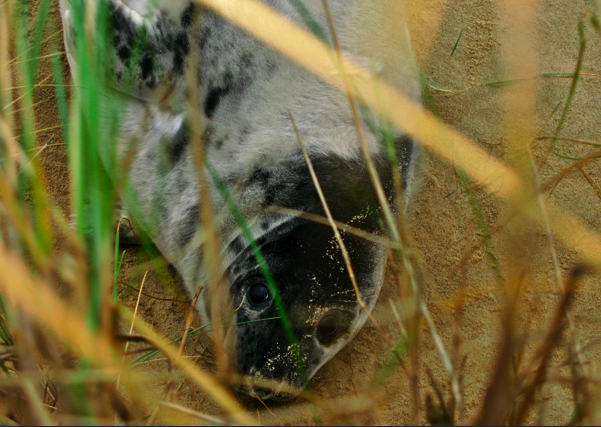
Gey Seal Pup Trying to Stay Hidden in the Marram

Gey Seal Pup Trying to Stay Hidden in the Marram

After braving the elements for the best part of an hour (the seals appeared supremely indifferent to what the weather was throwing at them) we retreated to Horsey’s conveniently located only pub, the Nelson Head, where some fine parsnip soup did much to restore circulation and restore us to a more human state of mind.

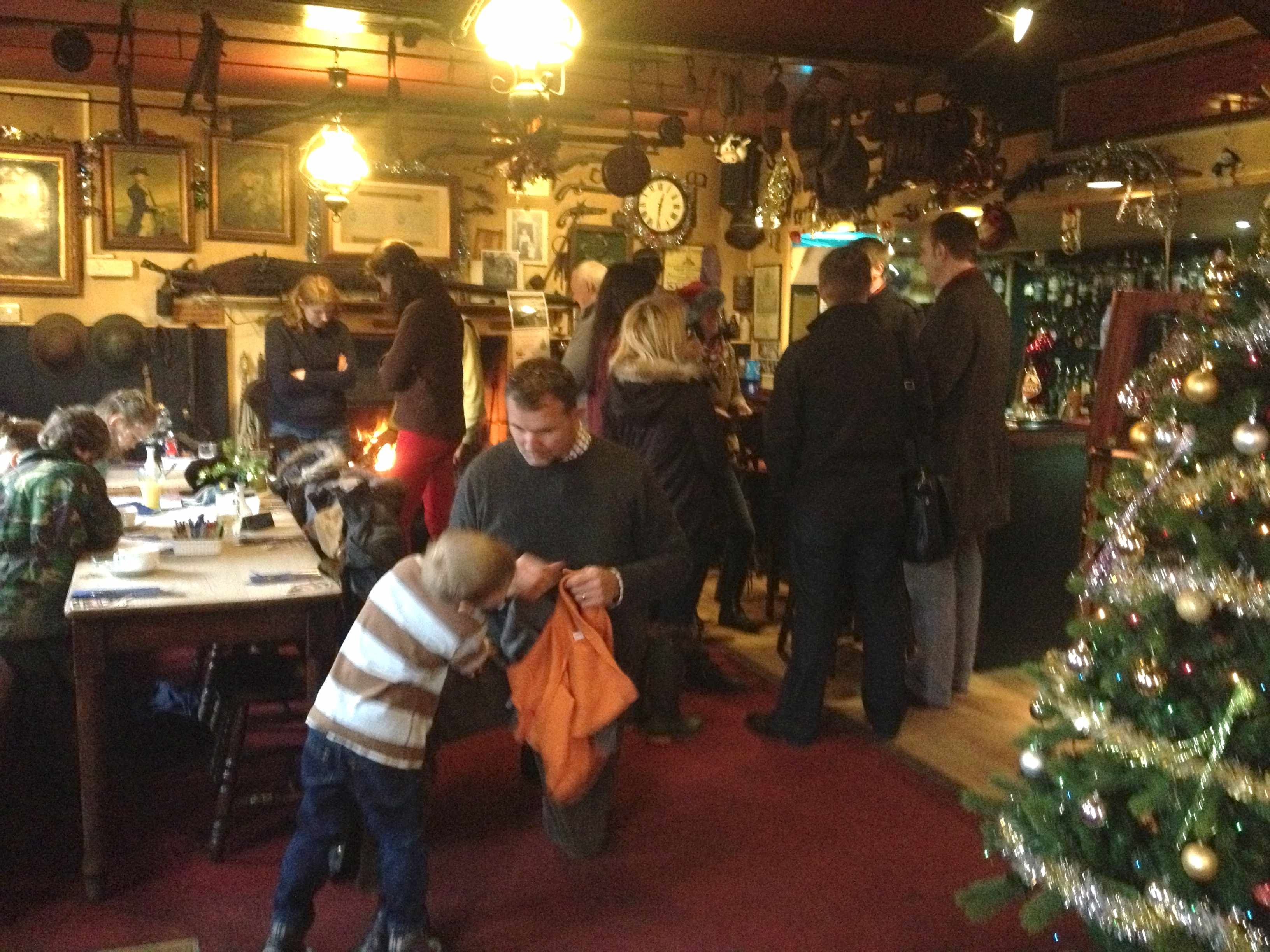
Snug Interior of the Lord Nelson at Horsey

Snug Interior of the Nelson Head at Horsey


Posted in Environment | Tagged | Leave a comment

All Struggling Together

One of the joys of spending Christmas with good friends in England is to be immersed in a generous hospitality and a flair for celebrating Christmas that the Scots could well learn from. But it is also an opportunity to experience a rather different culture than I’m used to. It’s not just differences with things Scots but it’s a rural culture (1.6 people/hectare) of huntin’/fishin’/shootin’, despite the presence of the Fine City of Norwich (pop: 190,000). And it forms something we see little of in Scotland these days: Conservative heartland.

In some ways, it does resemble other Tory heartlands like Surrey, where only the odd Lib-Dem orange blob disturbs a tranquil sea of blue and upstarts like Greens or Labour may occur on town councils, but never at MP level. However, where Norfolk seems to part company with its Home County Tory chums is that it’s a bit more turbulent than the seamlessly douce quiet of Haselmere or Farnham.

First of all, they seem quite open to change. Breckland District’s former Chief Executive is returning to take on the job of joint Chief Executive with Holland District Council—the kind of radical innovation that Scots have shied away from. The voters also seem capable of discounting party loyalties and voting for the person. In yesterday’s by-election for two seats on Norwich City Council, Labour’s Marion Maxwell romped home in the Crome ward while Andrew Boswell retained the Green’s numbers at 15 by holding Nelson ward. Though the city’s two MPs are split between Tory and Lib-Dem, they elected only 5 and 6 councillors (out of 39) and both received a good drubbing at this poll.

Although the half-dozen surrounding district councils are solidly Tory, they are not the sleepy shires normally associated with that party. Jon Herbert, a Conservative member of South Norfolk District Council has resigned from the party to stand as an independent against Derrick Murphy, the Tory Leader of Norfolk County Council. The spat appears to stem from a combination of approval for 180 houses near his home in Mulbarton and an ongoing QC investigation into taxpayer-funded catfight internal to Norfolk Tories in which Mr Murphy seems implicated.

More disturbing to comprehend than that was the death of Keith Johnson, Leader of Tory-controlled North Norfolk Council. The police investigation into this is still ongoing but it appears Mr Johnson shot his wife of 18 years dead with one of her four shotguns in a neighbour’s garden in Cromer, returned home then shot himself in his own garden.

He had become Leader only in May with the “shock resignation” of Helen Eales who had led the Tories to victory in ousting the Lib-Dems from control of the council for the first time in its history. A new civic leader (= Provost) was chosen at the same time. Tom Fitzpatrick took over as Leader at this week’s council meeting at which a new civic leader Peter Moore was elected to replace John Perry-Warnes who resigned unexpectedly.

In case you think they might run out of councillors at this rate, there are 43 on North Norfolk Council serving a population of barely 80,000—smaller than East Lothian. And, in case you think this month is an unusual flurry of activity, on Nov 17th of this year, Dr Jenny Harries, joint director of public health at NHS Norfolk and Norfolk County Council resigned, saying she “could no longer sustain the toll being placed on her by living away from her family, who are based in Wales”.

Back on the County Council, Cllr Paul Rice defected from the Lib Dems to the Conservatives in July 2011, to be followed in November of that year by Cllr David Callaby, of Fakenham Ward. Cllr Phil Hardy who had been leader of the Green Party group on NCC defected to the Conservatives and one of the by-elections mentioned above was caused by Green Cllr David Rogers resigning, claiming the Green Party “attracts the gullible and the authoritarian”.

This scale of kerfuffle is not limited to the County. Having 47 Conservative, 3 Labour and 3 independents, Breckland District Council is almost the political mirror image of the old Glasgow City (74 Labour out of 77 total). But, like Glasgow, that did not lead to serenity. They have seen no fewer than five resignations since the last local election—one where a Labour member left to form a group with the independents, three Conservative resignations gave by-elections that they easily won back and the most recent was by Cllr Pauline Quadling who resigned as a Tory so that she can fight the current Tory leader (of Breckland, not Norfolk—don’t get confused with the above).

Given that the population of Norfolk is barely 0.75m (a fifth our 5.25m, even though it has almost half the number of councillors as Scotland), this level of political ‘churn’ seems amazing, most especially in a heartland of douce—and supposedly stable—Conservatism. Yet so frequent and incessant are such political spats that they seldom rate more than a side column in the Eastern Daily Press.

If this happened in Scotland, such council bun fights would never be off the front page.

Posted in Politics | Tagged | Leave a comment

Native Arts; International Direction

I had been hoping to back off on the politics for the festive season, get out the mulled wine, wish everyone whether nationalist or unionist, flat-earther or chelsea tractor pilot alike good cheer for the festive season, and revel in the warmth and humanity of the season. I had even decamped to England where they ‘do’ Christmas rather better than we Scots in terms of both public and private festive warmth. But ’twas not to be.

Because, the Torygraph has a piece from Jenny Hjul that rubbed me up the wrong way because it rolls out some hoary old chestnuts around the discussion triggered by Alasdair Gray. Now Jenny—or anyone else—is entitled to their opinions. And, as someone who lives in the capital and earlier used to contribute regularly to the Hootsmon, hers is an articulate voice worth considering, despite the fact that most of what she wrote had me spluttering cornflakes before para 3.

Alasdair Gray is, as Jenny observes, a member of “the cantankerous old guard” and, in my opinion, long may he remain so. He has earned his place in that Scottish firmament just as Ken Clarke, Dennis Skinner, Margaret Thatcher and Alf Garnet qualif for the English equivalent. Actually, what he is saying, IS pretty cantankerous—but also drags points into the limelight that deserve debate.

To categorise English people who take up senior arts posts in Scotland as either ‘settlers’ or ‘colonials’ does approach the boundary of racism. Professor Tom Devine, a cultural heavyweight with whom I do not lightly cross swords, thunders in the Herald“I think Mr Gray shows a disgraceful attitude. We have got to remember that the current Scottish population is so vibrant because of the English factor.” Ian Dean Burns and Hannah McGill both appeared on Scotland Tonight ill at ease taking an icon like Gray to task but nonetheless agreeing he’d gone too far.

But what is his reprehensible act? Gray, making the comments in an essay in a book called Unstated: Writers on Scottish Independence, has said this row leaves him mystified. He distinguishes the settler from the colonial by describing the former as those who come here, absorb Scottish culture and go on to make a life here, whereas the latter simply use whatever stint they serve as a stepping stone on their career and soon move back to England.

Unfortunately for Alasdair, that latter pattern is common among more than just senior art administrators and futile to avoid, except at job interview stage. He singles out Vicky Featherstone as being guilty of that after eight years here—a judgement I find severe, given what she did with Black Watch, a seminal Scottish play. In international terms, the Traverse carries more creative cachet than Dublin’s Abbey, so we are not in agreement on that either.

But the furore about provincialism and racism thus created has obscured some significant points, most especially the ‘nasty nat’ overtone so rampant in Jenny Hjul’s piece. There are estimated to be over 400,000 first-generation English ‘settlers’ now domiciled in Scotland and I have yet to meet someone who doesn’t regard them as generally welcome.

As with most people who move seeking the prospect of a better life, ‘settlers’ tend to exhibit gumption, which does not always go down well with all locals. I witnessed this with Gastarbeiter in Germany and immigrants in the States; a small section of the population—usually the less successful—resents outsiders ‘taking their jobs’. But most people in Scotland are simply curious about outsiders and open to new ideas that they bring. I certainly believe that to have been the case in the arts.

What I think Gray was raising as a question was twofold: how many ‘colonials’ are simply job-bagging for their CV and to what extent are such people excluding local talent from jobs they could have filled. The number of senior posts in the arts filled by non-Scots in Scotland certainly validates such a question being asked, even if it in no way justifies any kind of witch-hunt of non-natives.

Gray’s ‘colonial’ phenomenon is palpable in many aspects of Scottish life outside of the arts. Whereas the relatively canny banking culture displayed formerly by RBS and BoS brought an almost Swiss reputation for reliability to Scottish bankers, the piratical irresponsibility of Fred the Shred and fellow Halifax colonials who exploited and then trashed that hard-won reputation has caused immense damage.

Look at any up-market housing development across our Central Belt. For the many families making friends to share the excellent quality of life here in Scotland and whose children will be indistinguishable from any old guard’s sprogs, there are always a few up here promoted to some corporate stepping stone who shield their children in private school, rail against the weather and the distance to London and are relieved to move back south on a further promotion within a matter of months.

We must see past the poorly phrased argument that Gray made to understand any terms of debate how we develop our own arts management talent to compete on the world stage for posts anywhere—not just in Scotland. We must also examine the extent to which we tolerate the kind of carpetbagger to whom a posting to Scotland is seen as exile—to be tolerated and in no way a positive cultural opportunity.

So when Jenny Hjul and Tom Devine—both, I am sure, convinced of their objectivity in this debate—see “disgraceful anti-Englishness” or echoes of repressive apartheid in this, hauling out the old chestnuts of ‘nasty nats’ and quoting racist incidents against the English, it cannot go unchallenged. Though much was made of supposed statistics showing increased racism this flies in the face of recent experience and was debunked by the Scottish Government.

More important is to deflate this straw man of an entire phalanx of ‘nasty nats’ out there. Eejits exist in all camps; few are under control. In my challenge to the many negative and simplistic arguments put forward by unionists, I may qualify as a ‘nasty nat’ myself—I have been blocked on Twitter by Tom Harris MP, whom I hold in high regard. But, along with the great bulk of fellow nationalists on social media, I have been as courteous as I have been robust, swallowed a couple of deserved portions of humble pie and treated arguments with which I had little sympathy as much with good humour as with scorn.

Many of us grow tired of NOT being racist—of presenting what we believe to be solid arguments why Scotland as an independent country is both a normal and a desirable state of affairs—and being pilloried as one anyway. But we want an open discussion—with all scots, regardless of origin. The sole qualification is residence here. And, though there is clearly no way to enforce such a thing, a committed permanence to that residency would seem a stronger endorsement of right to participate. For the avoidance of doubt, all those mentioned above qualify.

But Alasdair Gray’s key point—that there are career carpetbaggers among us and we might wish to consider what effect that is having on the development of native talent—is worthy of discussion without descending into anglophobia or scaremongering about any renewed Settler Watch. The Scottish culture scene is indeed robust, in a manner not seen in centuries; the English among us are making key contributions to that.

But one thing is clear to me: if London’s arts establishment were as dominated by Americans as ours is by the English, questions very like that raised by Gray would have long since raised heated debate. It is not racist to query people’s commitment to this country’s arts. And, since no Poles, Pakistanis or Italians head our arts establishments, it would be disingenuous not to couch the question in terms of the English, who do.

But if, instead of presuming divisive intention, we could now move on to discussing just how different our arts management is here (c.f. the Abbey in Eire), then we might bring something both useful and positive to this debate.


Posted in Community, Politics | Tagged | Leave a comment

More Isaiah 9:19 Than Proverbs 22:9

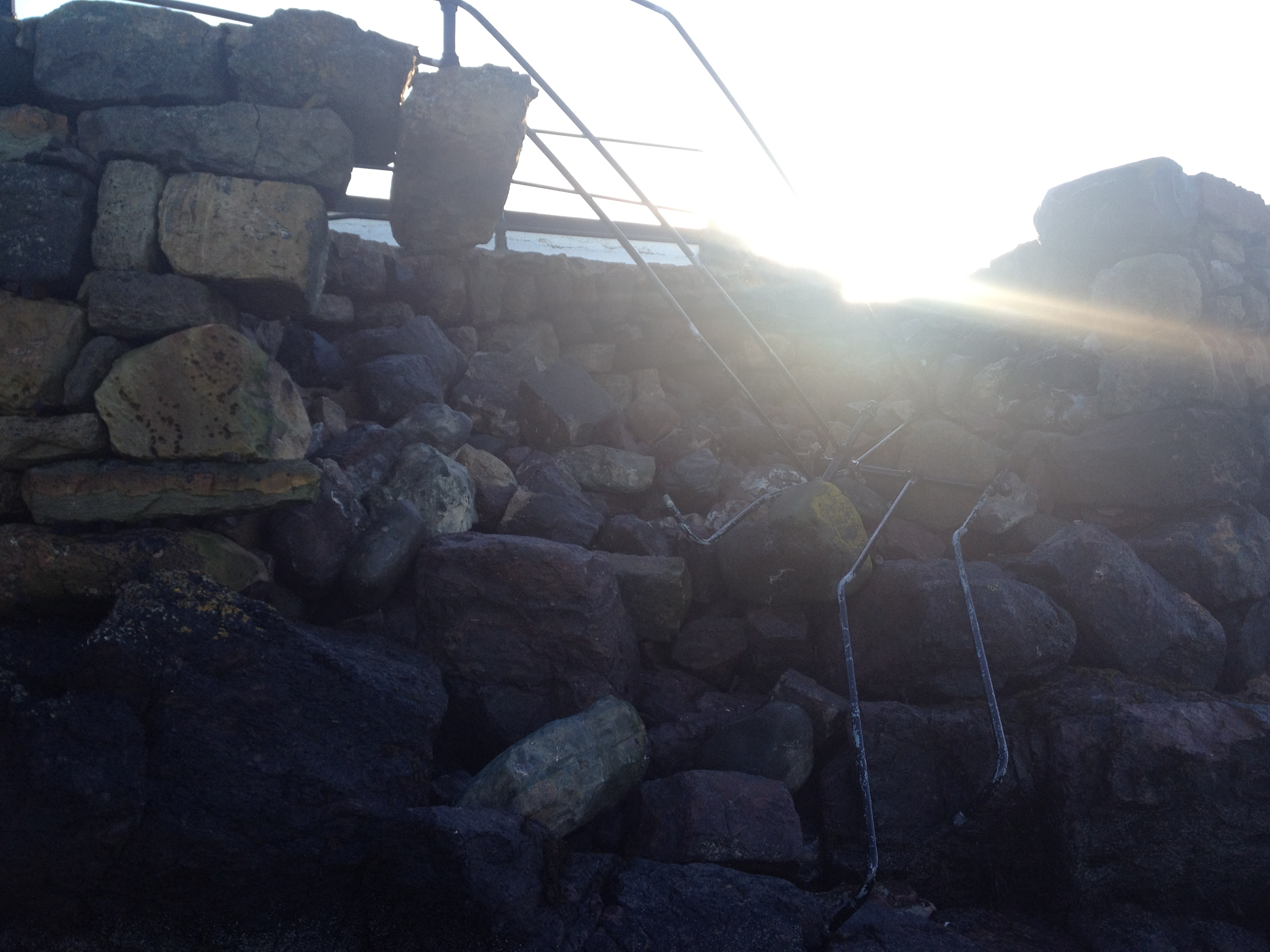
It’s the Sabbath and in bright sunshine beside an unbelievably calm sea (given what transpired on Friday night over into Saturday) I’m assessing the damage to North Berwick’s infrastructure from 24 hours of fury that did more damage than the storm of March 31st 2010. Disbelievers in any Wrath of God who witnessed it might well have had their scepticism shaken, if not stirred.

It was, as then, a Hell’s Kitchen combination of unfortunate circumstances that drove major waves ashore on the crest of an unusually high water level. Spring tides were forecast for Saturday 16th—a 5.9m peak at 3:30am and a similar peak at 3:45pm. This was well known to all involved at the harbour, along with the forecast of SE winds out in the Dogger area of the North Sea, building large waves out of the South East. These are always a threat on top of big tides but the wind was forecast to back to the West late on Thursday, which was expected to calm waves down.

Three yachties were distrustful of this reassurance and pulled their dinghies out of the Esplanade dinghy park late on Friday. Long-time civic figure in NB, Norman Hall, shared their misgivings. He contacted ELC’s emergency planning (01620 827779;  emergencyplanning@eastlothian.gov.uk) to request sandbags and precautionary stationing of JCBs and lorries. ELC checked with SEPA, whose job it is to predict and prevent flooding. They reassured ELC that their model of the event showed Fife and further North bearing the brunt of it and East Lothian need not worry.

Three things combined to make a bad situation worse. Firstly, the winds in the North Sea produced bigger waves than expected; secondly, the centre of the low causing the storm parked itself right over NB, dropping the barometer by 50mbars and adding another half-metre to the tide height; thirdly, the wind did back to the West but blew gently, which was not strong enough to dissipate the waves, in fact it steepened them.

Although fishermen, lifeboat and yachtsmen all spent a sleepless night with one eye and one ear out for the weather, no-one could have done much to prevent the major damage, even had everyone been on full alert. Around 3am the worst of the storm came ashore at the peak of the tide. For more than an hour beforehand, the sea defences of the Esplanade wall had been overtopped and the Esplanade itself filling with seawater to a depth over 2m.

All of the 50+ dinghies tied down on the Esplanade were flooded and buffeted by large waves  sweeping over the top of the sea wall without much hindrance. In the previous storm, most had broken loose and piled on top of each other in the west corner where a barred gate acted as a drain. This time they held firm, although some were damaged at their tie-downs by the force of the waves.

Those waves broke loose a 40ft container that had arrived only that day and was tied down adjacent to the Lobstery Hatchery at the east end. One of the fishermen intended using it as a keep tank storage of his catch. Once free, because its doors let in water only slowly, the container floated. Pushed by waves, it acted as a battering ram against the moored dinghies until it was swept along to the harbour quay underneath the Seabird Centre offices.

Here it fetched up against the yacht Borecay, standing on its cradle on the quayside. The metre-deep water pushed Borecay off its cradle and against the harbour railings so hard that they gave way and everything piled into the harbour on top of the boats moored in the SE corner. Meanwhile, the Girl Pat, sitting at the west end had been floated off its blocks and was driven against the old pool cubicle block so high and so hard that it bent the railings along the top, which stove in much of her starboard side. Local people have taken this particularly hard: this was Chris Marr’s boat.

Before dawn, as the tide dropped and the waves relented, the harbour was a hive of activity as ELYC members rescued as many dinghies as possible from the esplanade, fishermen were winching the harbour booms into place, Harbour Trust Association were trying to assess the damage and police, fire and ELC Transportation all showed up in strength to sort things out before the next, equally-high tide made it worse.

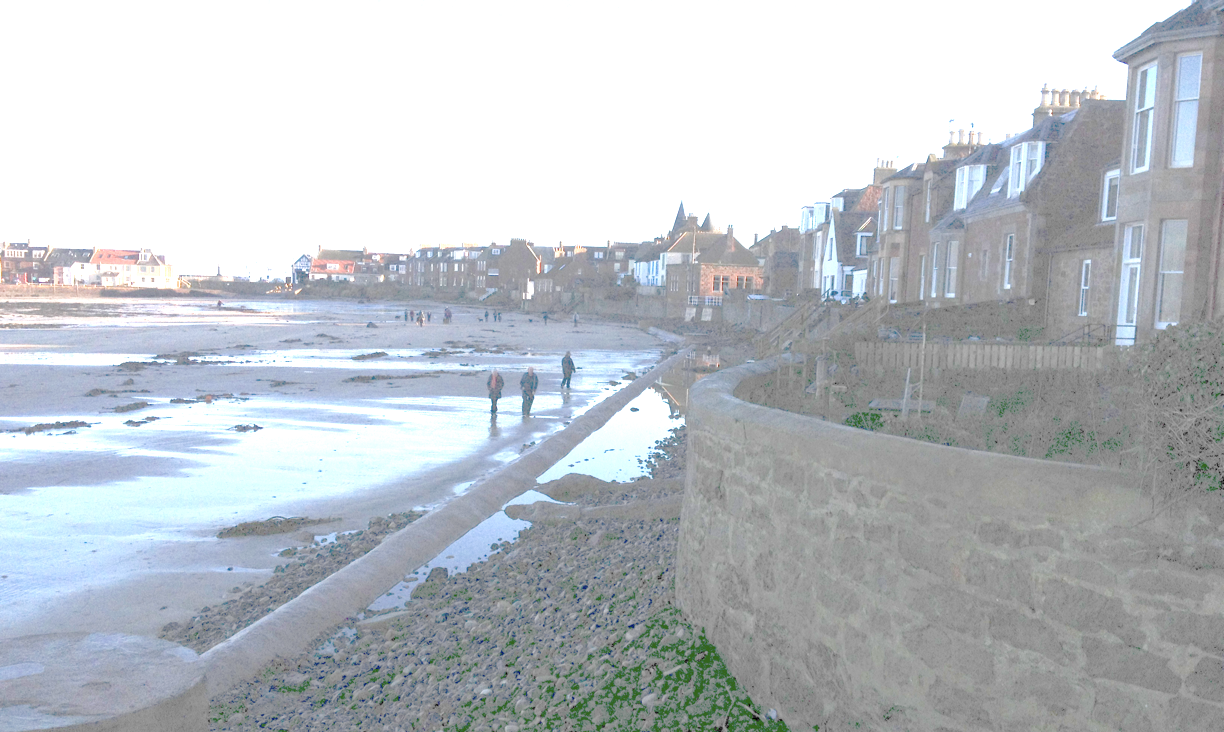
West Beach: This Is the Same View as Shown in the Header of This Page

West Beach: Low Tide and the Same View as Shown in the Header of This Page. A 2m Sand Cover Has Disappeared

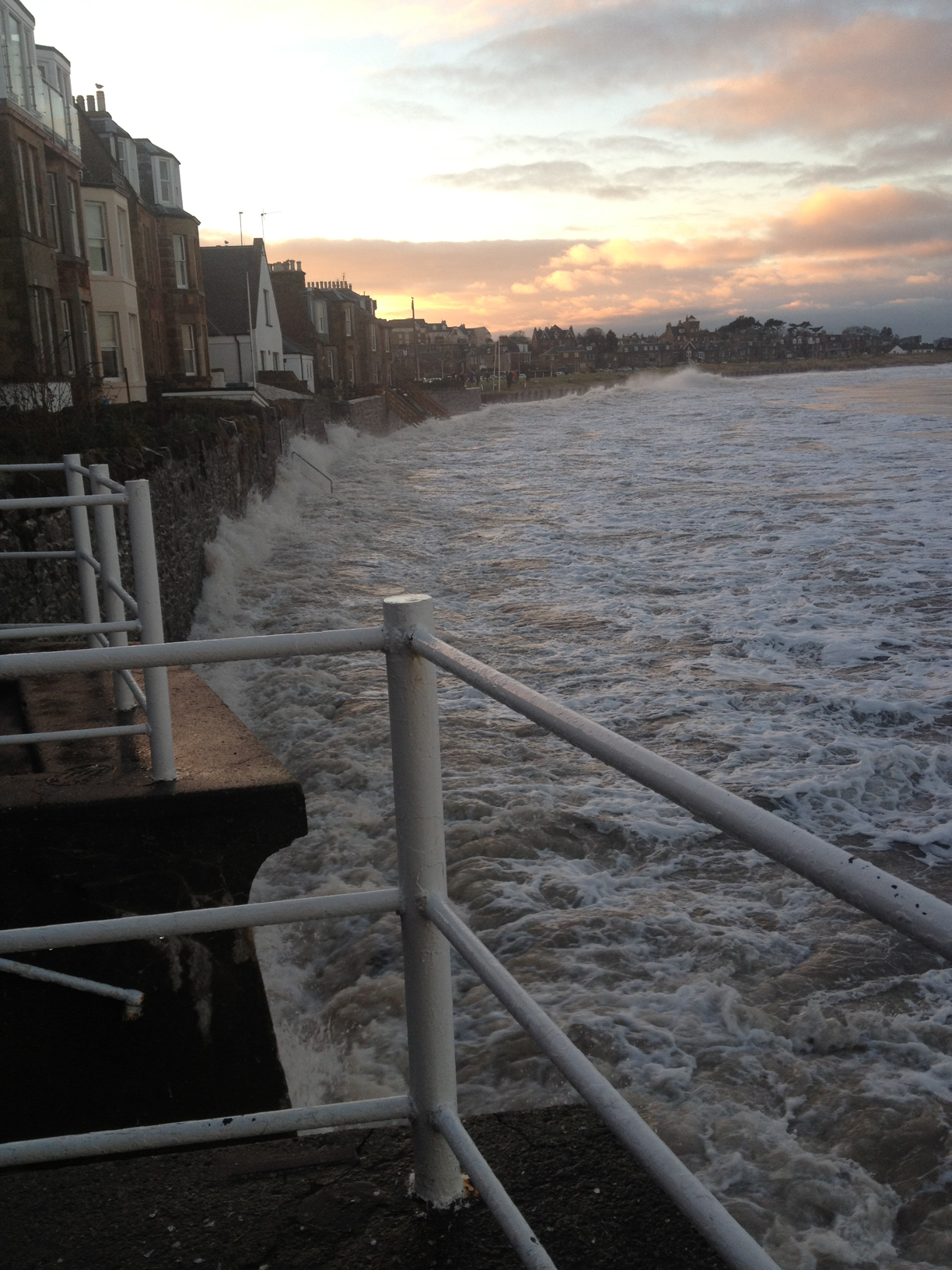
West Beach at 2pm—2 hours Before High Tide

West Beach at 2pm—2 hours Before High Tide. This View is in the Opposite Direction to the Above

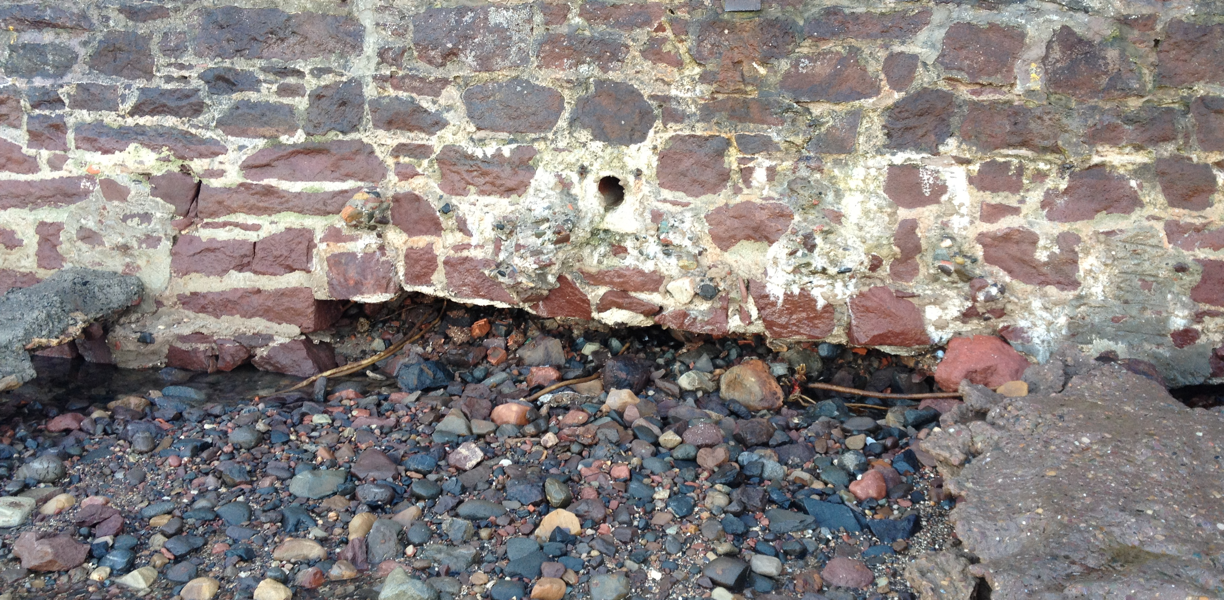
Detail to Show Undermining of Sea Wall, Forth St., NB

Detail to Show Undermining of Sea Wall, Forth St., NB

Although no significant damage occurred on either of the main  beaches, huge amounts of sand were eroded and marram grass areas all along the East Beach were halved in extent as the sea clawed 4-6m towards the road. Back at the Seabird Centre, the sea had entered by an emergency exit and partly flooded the exhibit area and cinema. But the main loss there appears to have been water damage to the shop store which is located under the cafe deck. Nonetheless, they were open for business again on Sunday.

Before the afternoon tide could return, all of the dinghies, most of the debris and all of the damaged boats had been recovered and removed. But nothing could be done to prevent more damage to the oldest part of the harbour wall at its NE corner. Here the rough stones had been held in place for half a millennium by wooden chocks through all kinds of weather. This time, it gave and a 5m section of the outer wall collapsed into the gully below. This exposed the rubble core which the afternoon tide washed out. By evening, only the pump hut on the N pier was holding up the inner wall and stopping the waves from gushing straight into the harbour.

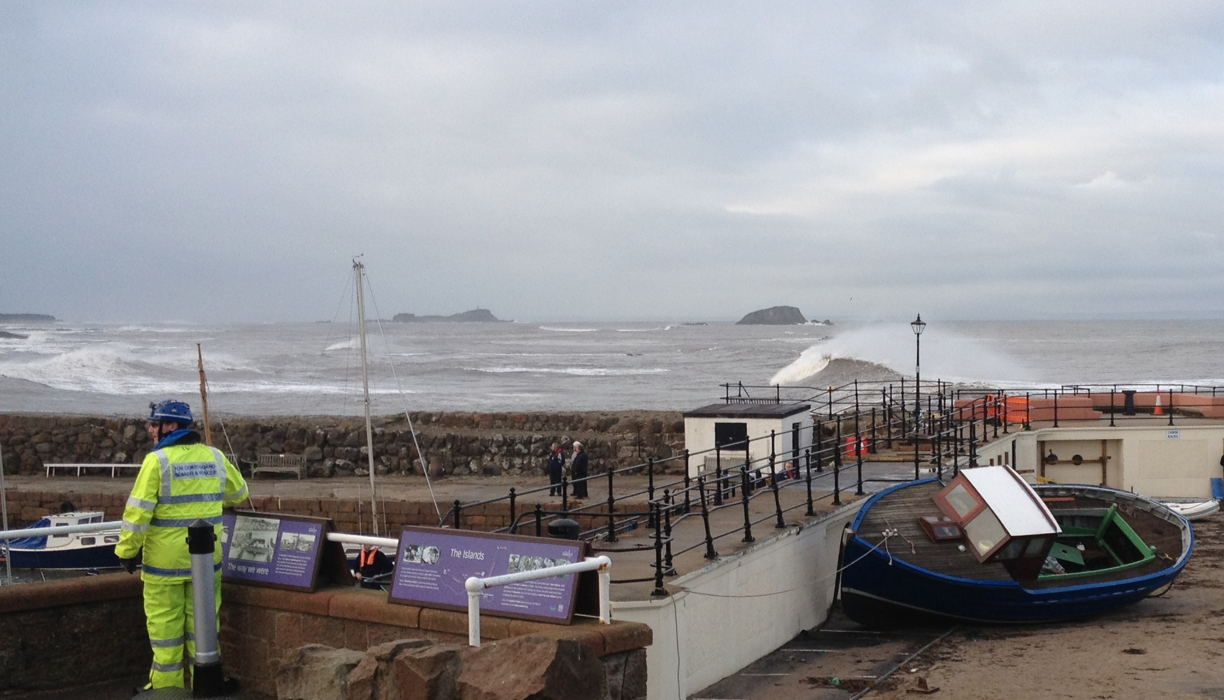
The waves were observed to be an unusual format. The sea would be rough with normal waves for 2-4 minutes. Then a set of a half-dozen monster waves, most estimated to be over 4m would appear and, as quickly, disappear. More than anything, those super sets caused the bulk of the damage, coming as they did on top of a record sea levels around 6.4m above chart datum.

Girl Pat Against Cubicle Block Damaged Harbour Wall Between Breaking Wave and Pump House

Girl Pat Against Cubicle Block—Damaged Harbour Wall Between Breaking Wave and Pump House

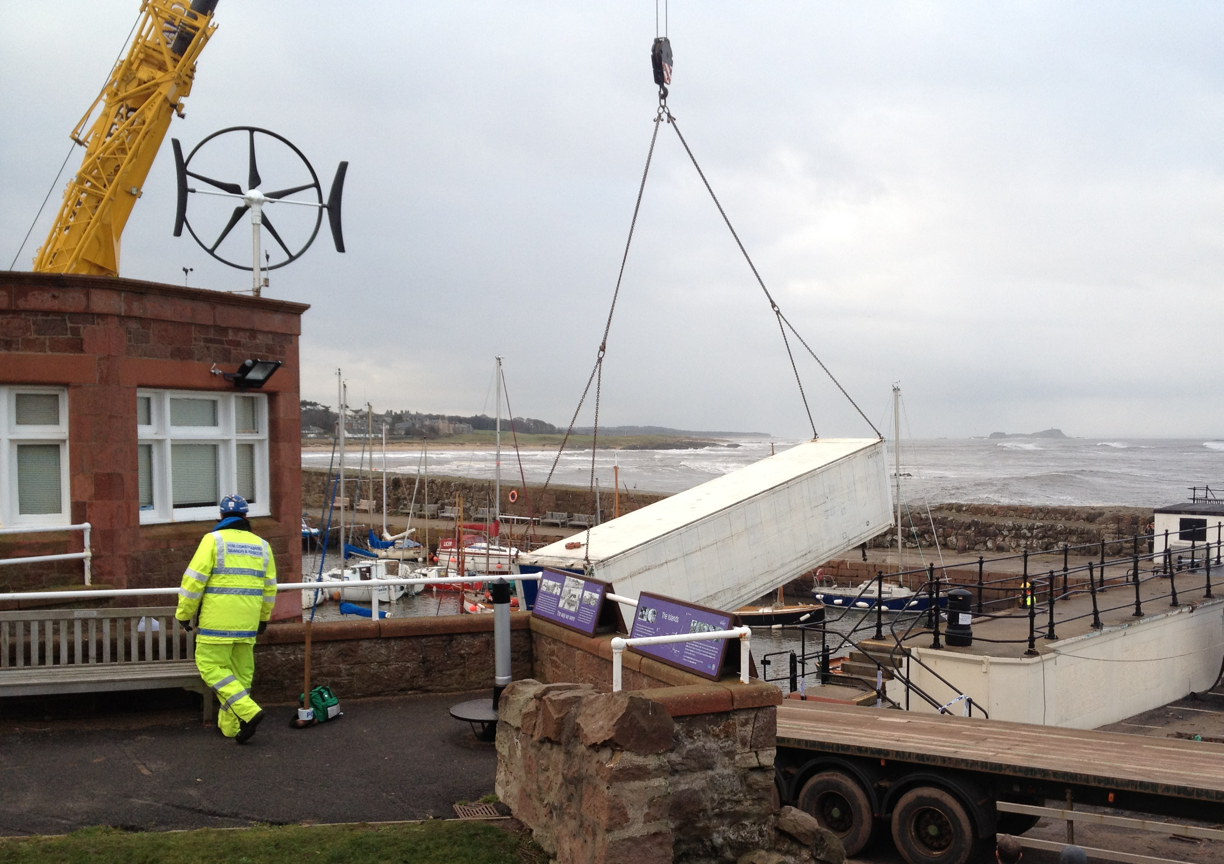
Recovery of the Container from the Harbour

Recovery of the Container from the Harbour

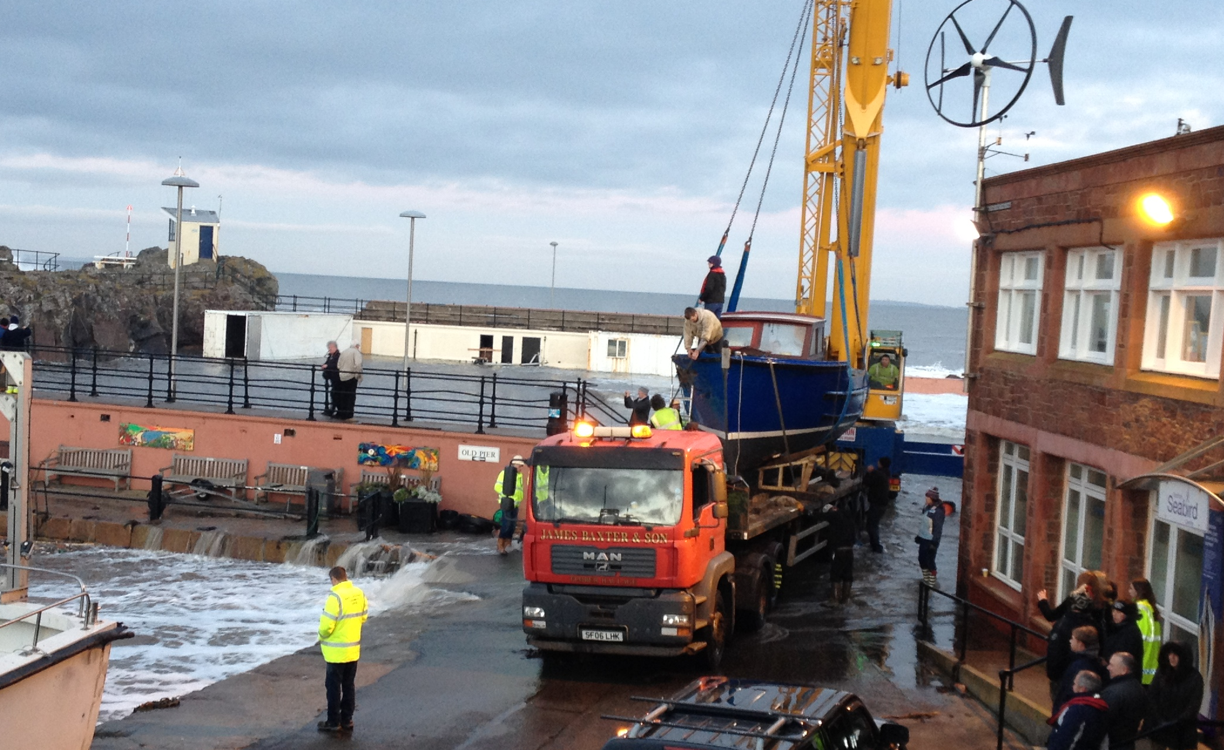
Girl Pat Is Strapped Down for Removal—Note Water from Afternoon Tide on Esplanade & Flowing into Harbour

Removing Girl Pat—Note Water from Afternoon Tide already on Esplanade & Flowing into Harbour

Wreck of Steps to Galloway's Pier

Wreck of Steps to Galloway’s Pier

Hole in the Harbour Wall

Hole in the Harbour Wall East View Point—’Pipes” Are Wreck of Railings; Bench Was Found in Harbour

As fast as it had come up, the sea state dropped. Another 5.7m tide at 5am Sunday caused no damage and by daybreak, the sea was almost flat calm. The sun made it look glassy and it was hard to remember its stormy nature just one day earlier. It will take a few days to catalogue all the damage and a couple of weeks to come up with a plan for restoration. A figure of £500,000 was quoted in the press but that must be a guess at this stage

The hardest to solve but most urgent issue is how to deal with the harbour wall. It will need to be restored so that it does not look out of place, which will take both time and craft. Meantime, some temporary patch must be found because leaving it in its vulnerable, torn open state only invites another storm to break through to the harbour and wreak even more damage than we’ve had already. Adding the loss to boat owners to the major infrastructure problems, this is already a more costly storm than 2010.

While North Berwick usually likes publicity, the last three weeks have brought it too much of the kind it prefers not to have.It makes locals wonder what they have done to provoke something verging on the Wrath of God. Following our Fire Station burning down, we lost an iconic figure in Chris Marr within a week and, within a second week. have had the focus of the town wrecked in a night. Not the sort of run-up anyone wants to have towards Christmas.

Posted in Community, Environment | Tagged | Leave a comment

Responsibility Must Trump Rights

It may be 16 years ago but the inexplicable barbarity with which Thomas Hamilton shot 16 innocent primary school children in Dunblane sprang first to mind when the news broke of the equally horrific shooting of 20 innocent small children at Sandy Hook Elementary School in suburban Newtown, Connecticut.

Newtown is not one of the US’s many social disaster areas. It is a postcard-perfect New England town where everyone seems to know everyone else. In many ways it resembles Dunblane—an affluent outlying green belt town with many commuters, in this case using Metro North to travel the 70 miles into Grand Central Station in Manhattan. Its tree-lined streets are home to 27,000 and lie near Danbury CT in Fairfield County, just over the border from New York state.

The gunman was Adam Lanza, the 20-year-old son of a teacher at the school. It all apparently started when he killed his mother Nancy at her home nearby before taking guns she kept there and using her car to drive to the school with them. All US schools have security access but Dawn Hochsprung, the school Principal, recognised Adam as the son of a colleague when he rang for access and buzzed him in. She was one of the six adults who died when she went to investigate the sound of shots.

This early on, there is only speculation what the motive could have been. But whatever gripe Lanza may have had against his mother or the school management, how this translated onto 6-year-old children is difficult to fathom. He is reported by former classmates to have been a quiet, self-effacing, intelligent and nervous type. Because it is so typical, little can be read into the fact that his father Peter had divorced Nancy or that his 24-year-old elder brother Ryan had moved away and was living in New Jersey. Since Adam showed up wearing all-black combat gear and a bulletproof vest, this can hardly have been a spontaneous event. He made no attempt to escape and shot himself as police responded.

As we Scots have learned ourselves, even one such tragedy is too many. Though the United States is not as dangerous a place as those who have never visited might believe, this scale of willful carnage is entirely too commonplace there. This year alone, 12 people had already died at a Batman movie opening, six at a Sikh temple and, just this week, two more at a shopping mall. And the horrific scale of this rampage at Newton still does not top the 32 casualties Virginia Tech in 2007. It is a tragedy that the world even needs to have such a league table of carnage.

While some blame violent films, TV, games and other hostility-inducing elements of our culture, that does not explain why—Dunblane and Utoya being glaring exceptions—the bulk of such events occur in the States. Even the Canadians, who share a long open border and a very similar culture, do not indulge themselves in inhumanity on anything like the scale.

Some insight can be gleaned from more thoughtful films like Peter Bogdanovitch’s Targets (1968) or Michael Moore’s Bowling for Columbine (2002). The former explores what motivates a slightly unhinged young man to drag his gun collection out on a shooting spree, while the latter is a tongue-in-cheek documentary about American gun culture, the title deriving from the 1999 rampage in Colorado when 12 died.

The common denominator appears to be the US’s prevalent gun culture. While it was still a frontier country, carrying weapons there was an understandable way of life. But justification this Western mentality has long been history. A secondary reason is the also-understandable perception that Americans live in a violent society and each should be capable of defending themselves and their homes. This accounts for the bulk of the 250,000,000 guns in the States. Many people own two. The only other country to come close to the raw 0.88 guns per head statistic is terrorist-infested Yemen at 0.5 per head.

Whether because of the foregoing or the simple macho power it confers, supporters of gun ownership have always been a significant political force, spearheaded by the National Rifle Association (NRA), whose uncompromising slogan was coined by Charlton Heston while he was their president; “You can have my gun only when you pry it from my cold, dead hand.” Not the most flexible stance and made all the more resolute by support for gun ownership outvoting those who would curtail it over the last few years—recent massacres notwithstanding. “Guns don’t kill people; criminals kill people” is one of their more sensible mantras.

The defence pivots around the Second Amendment to the US Constitution—a hallowed document that is revered to an extent a constitution-less Brit has trouble comprehending. The NRA and its supporters often quote this in their arguments:

“the right of the people to keep and bear arms shall not be infringed”

Which sounds pretty definitive; like it or loathe it, this seems to make a conclusive case that guns can be owned and carried by those who wish to do so. But the above is only a partial quote. The full text of the Second Amendment reads:

“A well regulated militia being necessary to the security of a free state, the right of the people to keep and bear arms shall not be infringed”

When this was adopted (in 1791), it made perfect sense. America had just emerged as the first colony to set itself free after a long and bloody war. It would soon be plunged into the war of 1812 and so the idea that its citizens could transform into well armed militia volunteers was a vital one and deserved enshrining. But that was 200 years ago. Europeans have far more recent arguments why they should go about armed to the teeth. But they don’t.

Whether Obama can take this anachronism and its powerful lobby on remains to be seen. But, in the meantime, it is providing cover for an arsenal to be available in almost all US homes. And, despite statistics showing that the great majority of the times they are used it is on members of the same household, opinion in support of that ‘right’ has remained firm.

Which means that the naturally occurring tiny psychotic minority (especially among teens and young men struggling with identity, hormones and drugs) have access to the personal equivalent of nuclear armageddon. That some use it is hardly surprising: to a 20-year-old (to quote Spike Milligan) ‘patience’ is a word invented by old farts who couldn’t think fast enough. Such behaviour is also hardly surprising in a culture where community generally tends to be thin as people move often and wall themselves off from each other in ranch-style homes.

But that last point does not appear to apply to idyllic Newtown, which could be the model for every fresh-faced, uplifting film about cosy community from “It’s a Wonderful Life” to “Home Alone”. So, even though all of the facts are not yet in, we are left with guns plentifully available to pyschotic youngsters as the only coherent explanation for what just happened there. Their ‘right’ to bear arms was not balanced by any functioning sense of responsibility towards the community of fellow humans.

And the only way for government to make a direct contribution to avoid more of this is for it to face down the NRA for once and knock away its main justification by a long-overdue repeal of the Second Amendment. Otherwise, Obama’s legacy is toast and America will fully earn Oscar Wilde’s scathing observation of being: “the only country to have gone from barbarism to decadence without any intervening civilisation“.

Newtown's Grace Christian Fellowship Holds a Candlelit Vigil

Newtown’s Grace Christian Fellowship Holds a Candlelight Vigil

Posted in Community | Tagged | Leave a comment

Part of the Job

At this week’s meeting of East Lothian Council’s Cabinet, a draft paper on the Council’s Health & Safety policy was discussed. Not, you would think, the most exciting of topics, especially as H&S has become something of a joke these days, requiring behaviour that some would regard as excessively cautious: kids are banned from playing conkers or riding to high on swings.

But, as it is nonetheless necessary to set rules for worker safety, I posed a couple of questions, chief among which was how we would ensure that staff would not use this policy as an opt-out from doing their job. I cited the 2008 case of Allison Hume who fell down a disused mine shaft in Galston, Ayrshire. Strathclyde F&R crews were soon on-site with the necessary ropes and harnesses. But managers deemed the rescue too dangerous and it was seven hours until a mountain rescue team arrived, by which time, Allison had died of her injuries.

ELC staff encounter equivalent cases—whether it’s the bin men who pirouette wheelie bins safely through traffic or social workers who trudged through snow storms two years ago to ensure all their clients were warm and safe or the grit lorry drivers who, by definition, are out on empty roads in the worst weather we get. To date all have been both dedicated and heroic. But, what if they got precious and ‘did a Galston’, declining to take any risks and citing H&S policy?

I was reassured that such would not be the case and that, while risk analysis has been done for all ELC jobs, appreciation was always shown staff who went that extra mile. What I found much more reassuring was a reality check on Lothian’s Number 26 bus related in the Tim’s Tales column in this weeks East Lothian Courier. I thoroughly recommend buying the issue just for this tale but, since the Courier’s scant website only publishes a fraction of the print, I paraphrase it here for those too far from civilisation to get “dead-tree media” yourself.

A Tranent woman was returning home on the lower deck of a Lothian 26 bus on a dark, cold evening witnessed an example of someone doing more than just their job. As the bus approached Musselburgh, a group of five young lads got on, all of whom went upstairs.

At the police station,  a young couple around 16 got on with a babe in arms and sat opposite the woman in the pushchair space. When two more lads got on at Newbigging, one recognised the young father and made a threatening gesture to him before both climbed to the top deck to meet the other lads already there. Both he and the mother turned pale and looked distressed.

A tense situation got worse when the two lads returned with three of the others who had boarded earlier and crowded into the seats around the couple, who said nothing. Then the father touched his partner’s hand and stood up as if to get off at the next stop and, presumably, run for it.

As the bus slowed to the next stop, all five lads stood up and waited behind him near the door. Meanwhile, the mother had been frantically trying to phone someone and, because she could raise no answer, had started to cry. It was an ominous situation and the woman witnessing it had no doubt that trouble was about to erupt.

But, just as the bus halted, a clear voice rang out “You lot stay there—you’re no’ leavin’ the bus here.” It was the bus driver, a woman. She looked back up the bus at the mother and asked “You want to get of here too, hen?” Through the tears, the mother shook her head, sobbing “It’s no’ oor stop.”

“Fine” said the driver, turning to the five lads “youse can get off now” and, turning to the father, “and you go sit wi’ yer bairn”. The father slipped unmolested past the five to sit back down beside his young partner. The five lads remained standing by the now-open doors. “Well, go on” the driver said.

“This isnae oor stop either” said one of the lads. “It is now”  the driver shot back, with such authority that the lads called the remaining two down from the top deck who remonstrated why they were being ‘pit aff’ into the cold and dark.

” We’re gettin’ a row fae the driver: we’ve tae get aff the bus; she’s telt us tae.” explained one of the five. The driver backed that up “Come on lads, hurry up—there’s another Tranent 26 in five minutes. I’ll let the driver know.” And all seven exited quietly.

The doors closed after them and, as the bus pulled away from the group, the young father gave a triumphal laugh. But the driver snapped at him “That’s enough. You hae a bairn and yer a dad, so act like one.” He nodded in silence, hugged his partner and, for the first time, looked directly at his baby and smiled.

As they got off a few stops later, he said “thanks” to the driver. “Nae bother” she replied “just mind ye hae a bairn now”. As the woman witness got off a few stops after that, she stopped at the driver’s cab and said “Well done for that”. The driver just smiled.

The incident wasn’t major—it might even be commonplace. But you can bet your life that this brave and shrewd intervention by the driver appears in no Lothian training manual, let alone any Health & Safety policy. What the woman witnessed is exactly the kind of thing that makes community more than a random collection of houses populated by individual selfishness.

The driver didn’t need to do what she did and, if identified, would probably get a row from her boss or Lothian’s legal department. But both the young couple and the seven lads shivering five minutes for the next 26 learned something about respect and boundaries and strangers who aren’t really strangers that made them better citizens.

We need people like that driver on our buses, on our grit lorries, in our social work—regular folk who can handle themselves, who would modestly say they’re only doing their jobs but are, in fact, the sensible glue that holds all of us together. Long may we have such people quietly doing their job with such engagement and understanding: we are all the better for it.

Posted in Community | Tagged | Leave a comment

Chris Marr: Obituary

Early in the morning of Sunday December 9th, Chris Marr was found with serious head injuries in Bank Street, North Berwick. Though rushed to Edinburgh’s Royal Infirmary, he died soon after. The police, so far, are treating the death as ‘unexplained’ and have no firm evidence to substantiate any of the rumours of foul play now buzzing round the town. An explanation will be established, probably soon. But that doesn’t help those of us who knew him come to terms with our loss.

My first contact with Chris was literal—at NB Primary when it was still in what is now the Community Centre. It was a robust contact, he was two years older and we were playing football on the tarmac at the back of the school when he shoulder-charged me out of the way. He was a robust, crusty character even then—quiet-spoken, direct but a hair-trigger temper that suffered no fools. But when there were apples to be scrumped or snowfall offered sledging down the Greenheads, Chris was to the fore.

Which is as it should have been. Coming from a long line of North Berwick fisher folk, the Marrs had provided their share of local harbourmasters and seasoned sailors for the Royal Navy when the colours called. His family lived first at 34 then 43 Melbourne Place, within spitting distance of the sea. In the fifties father Fred brought a modern boat in among the small zulus and one seine netter in the harbour—a trig wooden motor boat with a high fo’cstle and wheelhouse for’ard and work space aft he called the Girl Pat after his only daughter and younger sister to Chris.

Though bright enough, Chris was no academic. By the time he was fifteen, he was already helping Fred at the creels over his summer holidays. Soon after, he left school to make it permanent. But, like Chris, Fred wasn’t content with just lifting crabs and lobsters for its seasonal living. He secured the NLB contract to ferry lighthouse keeprs and their supplies out to Fidra and Bass Rock. In this role, the two of them featured in a scene from a promotional colour film made in the 1960’s by the town council, called “A View from the Bass“.

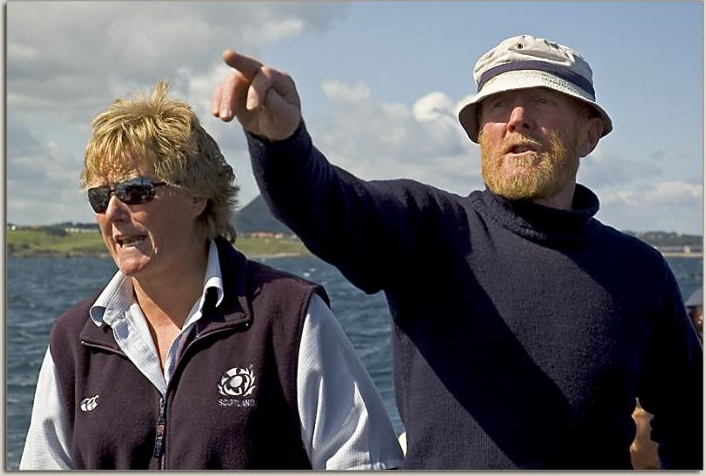
Still this wasn’t enough for them, so in 1970, remembering David Tweedie’s success with pleasure launches in the 1950’s, they invested in the original Sula to take people on summer cruises round Bass Rock. This was soon replaced by Sula II in 1972, a clinker-built open 76-seater brought all the way up from Norfolk for the purpose. Soon this became the highlight of any summer visit to the town, with Fred and Chris growing their carrot blonde hair and beards in the flowing fashion of the time, they looked like a crew more appropriate to a longship of the Viking era.

Gannets over the Castle & Lighthouse on Bass Rock

Gannets over the Castle & Lighthouse on Bass Rock

Business grew so that they could both afford impressive neighbouring houses at the harbour end of Victoria Road. Chris married Meg and three daughters followed in the six years to 1982. As well as ferrying visitors and lighthouse loads, academic interest in seabirds was growing and so boatloads of ornithologists and artists were added to the summer traffic. At the time, the gannet population on Bass Rock only covered the cliffs and a fraction of its top and Fidra had not been overrun by gulls so landing trips with time on either island were commonplace.

Taking over from Fred’s short, gruff trip commentary, Chris added more extensive data on the fauna and, developing his interest in local history and scuba diving, peppered each trip with more historical snippets and details of wrecks. The more he learned and explored, the more his enthusiasm grew until he was spending days in the winter off-season researching details in the local History Centre in Haddington and becoming something of an expert in 100+year-old back issues of the Courier.

Business during the summer months became so intense that sister Pat and even her husband Ken Macaulay were recruited as crew. And, though none of his own daughters took to the sea like their dad and grandad, his nephew would get hauled in on occasion. By the millennium, Fred, along with ‘Craw’ Pearson, was regarded as the the last of real characters, the fisher folk ‘old guard’ who had dominated the local harbour for so long until yachts and dinghies displaced the few working boats.

Fred’s career high point may have been piloting Prince Charles round the Bass as part of the Scottish Seabird Centre opening in 2000. But, as Fred aged and participated less, Chris became the more recognisable figure with local and visitor alike. His greying red hair, erect military bearing and purposeful stride were unmistakable from a mile off. To say he was loved (other than by family) might stretch a point. His bearing was stiff—a body language some found off-putting; if you were incompetent or forgetful around him, his impatient anger could be merciless.

But, catch him in the corner of the Auld Hoose bar of an evening and ply him with a pint and informed questions about the wreck of the Fusilier or the U-Boat off Dunbar and, if your knowledge could keep your end of the conversation up, you’d learn more detailed local history in an hour than any other way. The man had passion, a great love for his home town and a mind broad enough to absorb and integrate its myriad stories.

After the daughters had left home, he and Meg split up, eventually selling the home, with Chris landing back in Melbourne Place a stone’s throw from the sea and literally across the road from where he’d grown up. But he still ran Sula II with a level of boatmanship that 40+ years of guiding some three million people out to the amazing sight of Bass Rock had made exemplary. To see him pirouette the 12m boat with 70 people aboard inside the crowded confines of NB Harbour was to see a master at work. A quiet man who kept things personal, few guessed he was losing his enthusiasm after doing that same trip over and over again over all that time.

And so, in agreement with Pat, 2010 was the last season of trips on Sula II with Chris at the helm. The business and boat were sold and another operator, who has struggled to approach the 8,000+ passengers each season that Chris had attracted. For the last two years, he had more time for his local history and wreck charts, keeping himself to himself, as he had always done.

Sula II with Chris at the Wheel and Pat Preparing Fenders Approaches the East Landing of Bass Rock

Chris Takes Sula II Astern to Clear the East Landing at Bass Rock, © John Richardson

Quite apart from the shock for those who knew him, for those who could recognise his erect stride a mile off, he is a loss to the whole community. With Chris, the family name of Marr, so prominent in and around North Berwick harbour for eleven generations, dies out. And we’ve lost an individual who navigated life by his own compass, melding a family tradition with his own talents to be different, unique, a man of deeds, more at home beside/on/in/under the fickle waters of the Forth than in any desk-bound office or elegant dinner party.

Chris will be mourned by his family. My deep sympathy goes out to them for their great and untimely loss. But I expect that so many more—even those who crossed swords with him—will, like me, also mourn him, remembering him as his own man, a man of unique character who both loved and enriched this place he had always called home so that we came to a deeper appreciation of it ourselves.

Chris Marr (1946-2012) Last of a Long Line of North Berwick Boatmen R.I.P.

Chris Marr (1946-2012) Last of a Long Line of North Berwick Boatmen R.I.P. © John Richardson

Posted in Community | Tagged | 22 Comments

On the First Dodge of Crimbo…


12DodgersFound this on Facebook and thought it too good not to rip off from:

http://www.facebook.com/peoplepowerchange

Posted in Commerce | Tagged , | Leave a comment

‘Tory Evolution’: an Oxymoron?

There appears to be a concerted programme of disinformation being followed by unionist parties. The latest is how Scotland would need to reapply to be an EU member in its own right, complete with letter to the House of Lords stating this. At least, that’s what the Hootsmon claimed this week.

Except, there wasn’t any letter and the Hootsmon was forced to print an apology to that effect. Yet that didn’t stop the Tories fulminating that the SNP had changed its mind on EU membership by shifting from a position that membership would be automatic. For the objective third of Scots yet to jump into one trench or the other on this, allow me to recap the story so far:

  1. Originally, the SNP opposed EU membership as it would mean some loss of sovereignty and, having none at the time, they were impatient for all 100%.
  2. As the party matured in the 1980’s wilderness, it realised how Scotland might benefit from good friends outside the British Isles too and became pro-EU.
  3. The EU has no official process for ejecting a member or for dealing with an existing member wishing to become two. Barossa’s comments this week reflect the closest thing to that: anyone not a member must follow the accession process to become one. This is the answer he gave David Martin MEP in 2004.
  4. The SNP’s position is Scots are already members, complying with membership requirements, so there should be no obstacles to Scotland remaining a member.
  5. Furthermore, in the event that the Commission decided that any renegotiation were necessary, the two years or so between 2014 and 2016 could resolve that while Scotland was still a UK component. We could slide seamlessly from membership as a part of the UK to membership in its own right.
  6. Scotland is NOT comparable to ‘new’ members seeking accession: it does not have Turkey’s human rights issues, Serbia’s racist history. Iceland’s belligerent fisheries or Croatia’s dubious finances. It is the only oil-rich state the EU, would make positive net contributions; therefore most members don’t want to lose us.
  7. Those few states who have an issue are restricted to Spain (not wanting to encourage the Catalans) or Belgium (not wanting to encourage the Flamands). But the idea of Flemish provinces that border Brussels being thrown out of the EU is so ludicrously self-evidently stupid that it’s hard to see the Commission ruling that way for Scotland in case it would set a precedence for Belgium.
  8. Before and after 1707, Scotland was and is a country, with its own laws, church, culture and identity. It STILL ranks 15th among recognised states in the world. The United Kingdom is just that—a union of two countries and, like a marriage, the creation of a joint identity does not erase either original identity.

Though some are undoubtedly playing the daft laddie on the above, the worst is the Scottish Conservative & Unionist Party. Though there are honourable exceptions—members who are genuine Scots and shred their lip staying loyal to what their southern cousins get up to—the bulk behave much like an English National Party. From the leafy shires of the Home Counties come a phalanx of Tory MPs for whom culture ceases beyond Watford; they just don’t ‘get’ the diversity of Britain. Whether backbench Jeremy Hunt & Spock (John Redwood) or front-bench Michael Gove & Philip Hammond, the Surrey mafia rools (ya bass).

A measure of Tory lack of modernity is that the ‘unionist’ part of their title has nothing to do with Scotland; it refers to Ireland. Hundreds died in the last century for that supposedly unifying sentiment. If it made any sense today, why would Eire not reject any ‘Arc of Insolvency’ and be clamouring to get back into the UK? This week’s riots over flying the flag over Belfast City Hall underscores how unresolved feelings remain there ninety years on from sneaky retention of the six counties as part of the UK. This was done to give fig-leaf cover to the ‘union’ part of their title.

As they dig their heels in about Scotland too, despite their having been reduced to a rump here for doing so, you wonder if they’re secretly plotting to hold on to Shetland or Faslane à la Ulster. While appalling personal attacks on the First Minister may well be all that Scottish Labour in their reduced straits are capable of, our Tories had at least once shown both guts and ideas—until Murdo Fraser’s radicalism lost out to Babe Ruth’s pitch to the blue-rinses.

Since then, Ruth has shown herself every bit as dire as Johann, dabbling any mud handy and flinging it across the chamber. This is a pity. With the virtual annihilation of the Lib-Dems as a force at Holyrood, the Tories are our one hope to keep pace with the SNP and hold them to account: ‘Bella’ Goldie achieved quite a lot doing just that 2007-11—but her matronly low-key lessons seem to have been ditched.

This week, things deteriorated further with Jackson Carlaw carping about perceived SNP inconsistencies about Europe. Granted, the UK Tory record of dire hostility to Europe from Thatcher to May is forced on them by a significant Eurosceptic wing of the party who behave as if the next Napoleon were about to muster another invasion force on the Pas de Calais. But the more reasonably balanced Scottish Tories have no room to talk, bound as they are to xenophobic English colleagues who run the show.

Perhaps its because the English have such influence with them but Scottish Tories seem oblivious to the Scots’ relative warmth towards Europe and immigration and their total rejection of UKIP and BNP. They are not embarrassed as the rest of us are by a grumpy UK approach to our best market and nearest friends. They are not annoyed as the rest of us are that they sell our major fisheries and spirits duty interests down the river, that they keep air passenger duty high so we have few direct links into those markets, that the real advantage of HS2 is over the long distance to Scotland and that is kicked into the long grass.

But, most of all, they betray their own principles of self-sufficiency by pooh-poohing that Scotland has enough oil left worth exporting, that we could become THE leading source of renewable energy, that we could make things business-friendly so that BAE would keep building ships and we might stretch our existing lead in quality research and manufacturing over our English cousins as they struggle to overcome the Osbo/Irn Broon debt mountain while we pay off our share in short order.

Which is a shame. We need a decent opposition, especially when we get independence. If our Tories were to climb out of the swamp they’re wallowing in with Labour, we could see Keith Brown being challenged on transport ideas, Swinney’s mettle tested with alternatives for business growth and Lochhead not monopolising farming’s enthusiasm—an area Tories once called their own.

If they want to get a clue, they could start by shutting up and watching one of their own. Liz Smith sets no heather alight. But she knows her education brief, has carried it with distinction for years and is pragmatic enough to work with others to achieve her goals. She is one of the few reasons I do not look forward to more Tory wipeouts in Scotland. And, dire as any other opposition is, that’s their future if their collective heads stay stuck in history’s sand while their country moves far beyond them.


Posted in Politics | Tagged | Leave a comment