Matthew Ch.10, Verse 26

I’m not given to religious quotes and—lest any reader fall under the delusion that your humble scribe has gone all pious in his dotage, the only reason I know the verse in the title is from as eloquent an anti-war film as you’re likely to see—Breaker Morant, Bruce Beresford’s 1980 gem about Australians in the Boer War.

One extremely effective anti-war policy is to have no army at all—such as Costa Rica pursues and with some success. Outside observers of British military deployment might be deceived into thinking we were pursuing the same policy, now that another round of cuts—this time 5,300 personnel from the Army only—was announced this week from the Commons despatch box. Yet another faceless minister no-one remembers seeing before waded through the thankless task, ostensibly to prove his mettle under adverse circumstances but actually so that Hammond didn’t have to.

Details of the total cuts to the Army by 2020 are available on the Army’s web site. Even if you’re a pacifist, it makes for sad reading if you want your country (however you define that) to play its part in joint security in the world. Stuart Crawford, a retired Lt. Colonel for whose military opinion I have much respect, had a piece in the Hootsmon in which he dispelled any myth that this had to do with a more sensible defence posture (rather than desperately saving money) as claptrap.

Stuart made comparisons with the British Army of yore, observing that the ‘new’ Army of 82,000 would be smaller than pre-Crimea or the ‘Old Contemptibles’ sent to war in 1914 and who so effectively dislocated von Kluck’s pivot through Belgium at the cost of horrendous casualties, among them my grandad. His point is that there would be no ‘depth’ to our forces: one good engagement with substantial casualties and there might be no army at all.

But it is rather worse than that. Comparisons with 1850 or 1914 are barely tenable. In either case, the structure of the army was far simpler. Over 80% of soldiers were infantry, with most of the rest cavalry and artillery. Logistics, signaling, catering and the like were primitive. Armour, transport, air, electronics, etc were non-existent. Prince Harry’s Apache gunship, on which troops on the ground in Afghanistan relied for serious firepower support, was pure science fiction.

“Casualties in the 120,000-strong BEF between 14 October and 30 November were 58,155, the majority of whom were infantry. Of the eighty-four British infantry battalions at Ypres on 1 November, eighteen had fewer than 100 men, thirty-one fewer than 200 men, twenty-six had fewer than 300 men, and only nine exceeded 300 men.”

With extensive overseas expeditions in WW1 and WW2 as precursors to the kind of overseas spats that Britain has engaged in since, the logistical ‘tail’ of any troops on the ground at the ‘sharp end’ has grown until there are now, of necessity, more soldiers operating radars, flying drones, cooking lunches, servicing ‘copters, testing equipment, etc than at the front doing any shooting.

Add in the fact that heavy tanks, SP artillery, heavy lift transports, while all part of British Army inventory, have no role to play in any of the brush wars it has fought since Suez. From Falklands through Yugoslavia to Afghanistan such expensive gear has been no more use than the Trident submarine fleet. What we have always needed (and never had enough of) is trained infantry.

In total, 23 Regiment-sized (in anyone else’s parlance battalion-sized or about 600 troops) units will be disbanded—in Armyspeak ‘removed from ORBAT’. They are spread over all the Corps and include two tank, one artillery, four logistics and four engineer units. But the biggest lump is loss of six infantry units—equivalent in size to the entire Scottish Army (when we go indy and have one).

It also means that the 32 serving active infantry battalions, augmented by three Parachute, two Gurkha and a couple of RM Commando battalions, all trained for special types of warfare but usable as regular infantry at a pinch, will be reduced by a third. Put in other terms, the 24,700 soldiers currently in the infantry arm will reduce by about 4,000.

Planned Infantry Structure of the British Army for 2020

Planned Infantry Structure of the British Army for 2020

Add in the fact that any infantry battalion (nominally ~720 soldiers) has a HQ company full of drivers, clerks and general non-coms, plus three companies each with heavy weapons sections that lug mortars and machine guns around for local fire support and there are fewer than 500 real infantrymen who went in with cold steel on Mount Longdon or are patrolling various village streets in Helmand.

This piece is not meant to disparage British infantry, nor their training or capability. But superb training, kevlar helmet, plentiful support or no, they are each just a man (unlike the Israelis, the British don’t let women serve in the infantry) and, as such, vulnerable. When the Argentine Air Force caught Sir Galahad with its trousers down in Bluff Cove in 1982, over 300 Welsh Guardsmen died, despite superb élan.

It is foolish for the MoD (under prodding from the Tories) to claim that we can thole such reductions and still be a world power with forces to quell global hotspots as the Paras did in Sierra Leone a decade ago. The people on the overstretched front line in Helmand are doing a brave but impossible job. It would not take a serious deterioration in the situation there for casualties to rise to untenable levels. The idea that we can dispose of six front line units that are the ONLY type of units to sensibly deploy in similar terrorist powder kegs and then rattle our sabre about threats from Mali and Algeria verges on the delusional.

Our armed forces should not be forced to make up for politicians’ shortcomings, nor provide the cover for politicians’ chest-butting overambition. But loyalty demands that they obey—but at what cost to their deserved sky-high reputation, not to mention morale?

“And thine enemies shall be those of thine own household.”
Posted in Politics | Tagged | Leave a comment

Cottages: Cosier and Healthier

All across Scotland a debate about the NHS and how its services can be preserved amidst these new financial strictures is bubbling beneath the media surface. Above the surface, what debate there is about health focusses on waiting times and budgets. But what really matters to people is the health service they receive and how effective it is.

In the early noughties, the new Scottish Parliament  sought to persuade councils and the NHS to work more closely together in the area of Adult Social Care by forming Community Health Partnerships. This drifted along for a couple of years without notable success and then the NHS Reform (Scotland) Act of 2004. The development of CHPs in 2004 was intended to build on the success of partnership working up to that point, and included a strong focus on organisational development to support new ways of working across health and social care.

In 2010, the Scottish Government took stock with a paper called Integration across Health and Social Care Services in Scotland. Though it put a brave face on things, it was hard-pressed to find much evidence of any progress on integration that might have been expected after the best part of a decade. This problem was caused by the two would-be partners for similar reasons—basically the “aye been” inertia that comes from organisations that have been left to live within their comfort zones for decades.

Neither councils nor NHS were used to working on projects together—let alone sharing resources and/or budgets. Both were proficient at attending meetings from which minutes gave the impression of progress. But, in truth, nothing much has happened. Like the ‘Shared Services’ agenda whereby Scotland’s 32 councils were expected to merge departments with each other to economise on overheads, CHPs, although formed, have remained a damp squib in terms of real progress.

Both partners are to blame but (with a couple of laudable exceptions like Highland) the NHS has been consistently worse. Their plans for rationalisations or for hospitals have soaked up all their attention and (more importantly) all their capital and the total absense of any democratic control has meant they have stonewalled and dared councils to do anything about it.

The East Lothian picture is pretty representative. The massive PFI project that is Edinburgh Royal Infirmary soaks up huge NHS Lothian revenue without paying a single nurse. The Musselburgh Primary Care Centre opened this year to serve the western half of the county. Its costs are a mystery because 2009’s 50-page Full Business Case may be public but it has had every figure (including risk factors) redacted out of it. It looks like an expensive hospital more than a Health Centre and may be why NHS Lothian has been dragging its feet for over a decade to provide the other key local component‚a ‘Community Hospital’ in Haddington to replace the badly ageing Roodlands.

But this is where the bean counters and people’s priority clash nastily. The obverse of a new CH (although no-one in NHS management will admit it) is to close the remaining small hospitals in Dunbar (Belhaven) and North Berwick (Edington). Any time this has been rumoured, the pitchforks and burning torches have been out in force.

The Edington is a GP-referred cottage hospital (9 beds) in North Berwick of the type that does not lend itself to low cost-per-bed stats. On the other hand it has 220 admissions a year and has an unequalled record of patient care/recovery and minor injury provision, partly because of joint working with the adjacent doctors’ surgery. A review of The Edington operation is underway by NHS Lothian, taking on board the imminent need for joint provision for the elderly with East Lothian Council.

A year of discussion with a forum of people from NHS Lothian, ELC, NBCC, the GP practice and Edington staff resulted in an obfuscation paper from NHS Lothian that was both incomplete and written in bureaucratese. It seems clear that, unless the community and those outside the NHS define their concept of a future and how it might be achieved, the NHS is using a classic inertial strategy to close it.

But though both the Edington and its co-located Health Centre are badly in need of upgrade, they are, in fact, a splendid example of effective community health work. Rolling together the related facilities expected with the NHS/ASC merger into a single campus actually makes both the most financial AND operational service quality sense, provided none of the components are forced to pay for it alone. The related facilities that a town of North Berwick’s size can reasonably expect are:

  • A GP surgery of more doctors provided in business hours with callout 24/7
  • A well used minor injuries clinic (including 20% for tourists/visitors) 24/7
  • Convalescent care for local patients recovering from serious illness/surgery
  • Residential care for elderly still capable of mobility and limited self-reliance
  • Palliative care for end-of-life circumstances
  • Supervisory care for those still physically capable but suffering dementia
  • Respite care for those who normally reside at home with home help

Although NHS claim that the Edington site is not sustainable within budgets that public bodies are able to provide, nor is the site adequate for expansion, this is taking a narrow view. It may also make sense to cast the net wider and include NB Day Centre and Gullane (Health & Day Centres already in train for a joint building) in the discussion so that all local facilities and the strengths they offer are considered.

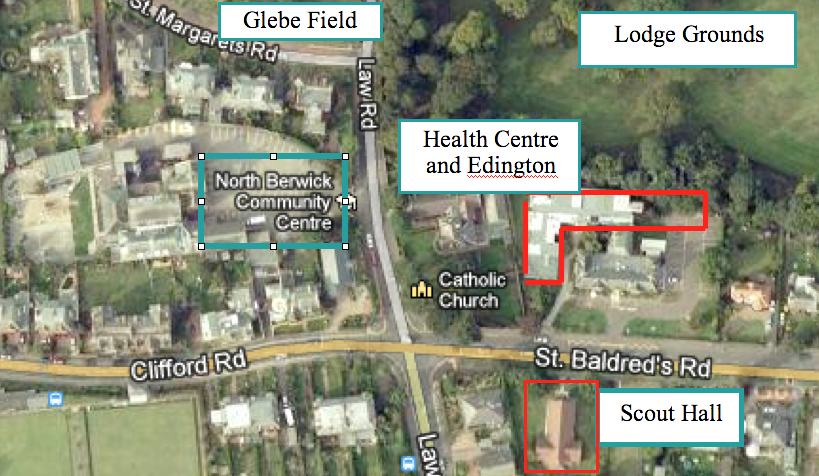
If the Scout Hall (across St Baldred’s Road) were located elsewhere and the site purchased, this could be redeveloped to accommodate a larger GP surgery with nurse station and minor injuries service. The space currently occupied by the surgery could then be redeveloped on more than one floor as an extensive adjunct to the Edington that would have several wings/wards that each specialised in one of the list of services listed above. This would include ELC’s present 28-bed care provision at the Abbey.

Map of Edington Area Showing How a Health Centre (lower red) Could be Replaced by Care Extension (upper red)

Map of Edington Area Showing How a Health Centre (lower red) Could be Replaced by Care Extension (upper red)

The new care extension would intrude on the present car park and, possibly, into the Lodge Grounds. A pedestrian access through the Lodge could access long-stay & staff parking in the upper Glebe. Those with appointments and other short stay would use the remaining car park. The Community Centre car park provides a temporary measure until the Glebe was completed.

Keeping all health and care facilities in the one place still capitalises on the superb personal and responsive service that adjacent doctors surgeries provides and preserves the excellent recovery statistics. Extending the Edington itself to around 30-40 beds, most of which would be non-medical residential/respite/etc retains the high quality care for which the Abbey is known.

But most of all, rather than freight people to/from Edinburgh and/or Haddington (which no-one outside Haddington considers a ‘community’ facility), the benefits to patients of the present arrangement would be preserved and the NHS goal of ameliorating their precious cost-per-bed statistics would be addressed.

What we have here in North Berwick is a gem: the ingredients of a totally new, cross-authority opportunity to address problems that all those involved with health, especially of the elderly, need to address before the demographics overwhelm us. The area around the Edington is ripe for a groundbreaking, highly effective solution that integrates all components cost-effectively in a manner the community would not just support but do so enthusiastically as elements most appreciated would continue. It could be a key model to secure much-loved cottage hospitals elsewhere.

Posted in Community | Tagged | Leave a comment

The Shape of the Future

To quote Holyrood magazine which has proved itself pretty adept at putting its finger on the pulse of the moment:

“Scotland’s population has reached its highest ever level. Official census figures published at the end of last year revealed that the number of people living in the country has climbed to 5,295,000 – up nearly 5 per cent since the previous census in 2001.”

This is revolutionary stuff. I grew up in a Scotland that had almost as many people but it also had 250 operating coal mines employing 80,000 people, 38 shipyards giving work to another 100,000. The great majority of all of them went on holiday to Largs or Dunoon or Arran or Arbroath or North Berwick or—if you were really adventurous and/or on the cutting edge—to Butlin’s camp at Ayr.

As my grannie used to say: “Ah’ve seen the day—but noo it’s nicht!

In the intervening fifty years, we’ve seen major social upheavals and some pretty rough times. Some of them were caused by arthritic attitudes in once-major Scottish companies: the North British Locomotive Company built superb steam locomotives right up into the sixties when there was no more market; Clydeside yards built ships with rivets long after welding became better and cheaper. Others were caused by UK governments also with their heads equally stuck in the past. They gave us Linwood and Ravenscraig and Monktonhall—all doomed dinosaur efforts to pretend we were still a major player in heavy engineering stakes.

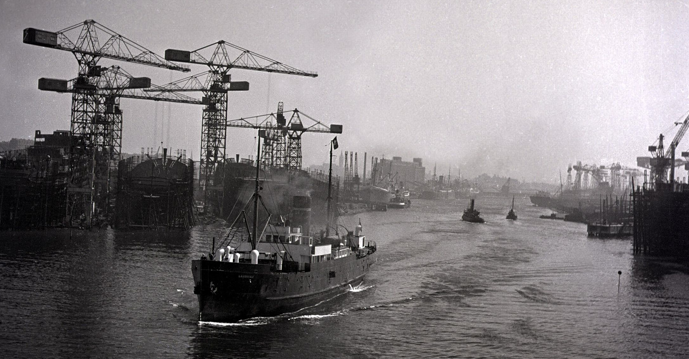
The River Clyde in 1951

The River Clyde in 1951

But in the past decade (present recession excluded) things have gone much better to the point that we’ve seen 250,000 more Scots and found whisky, finance, oil, tourism and renewables to be businesses bringing steady wealth with a good future. In fact, those buoyant industries, while not shielding us from the recession, have made us—perhaps for the first time in a century—appear to be doing better than our English cousins. The result has been barely a pause in the number of immigrants.

Not all developments are good news. For the first time, the number of Scots over 65 exceeds those under 15. In 20 years, there will be 2 1/2 times as many people over 85 and the jury is out whether they will be healthier or need even more medical care than the present generation. But with smoking and alcohol binges declining in most of the population (even if it isn’t among the young), there is hope to be cheerful.

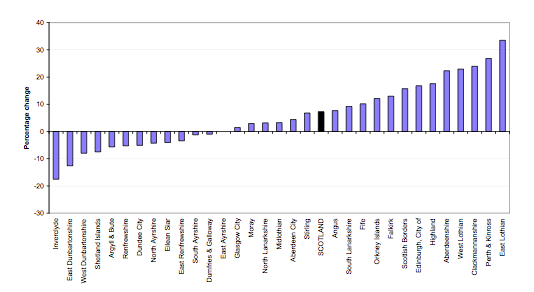
So, what sort of country can we expect Scotland to be in 20 years? Not one that my grandparents would recognise because there is every chance that the pains of de-industrialisation that we suffered in the latter half of the twentieth century may have prepared us for a better future. Let’s consider the General Register Office for Scotland’s population projections. Broken down by council area, these point to a major population shift to the East and North at the expense of the West. This can be seen in the chart ranked by population change 2012-2032.

Change in Population by Scottish Council to 2032

Change in Population by Scottish Council to 2032

While the Scottish population is expected to increase to 5.54m (from present 5.25m) the old Strathclyde area will stagnate at best and lose as much as 17.5% in Inverclyde. The only city expected to beat the average is Edinburgh. Growth will dominate in the rural eastern areas, with East Lothian leading at 33%—equivalent to one new resident for every three already there.

Examining the other above-average growth areas and they are largely rural, with pleasant towns and high quality of life. Those areas on this list that contain major urban areas like Fife will see more growth in the East Neuk than in Kirkcaldy or Dunfermline, with any growth in those towns being dormitory outliers of Edinburgh. Aside from the 70-80,000 growth in the Northeast and Highland, the bulk of Scotland’s growth will be over 200.000 new residents of the Edinburgh City Region. While some will be from elsewhere in Scotland, most will be immigrants.

This is a massive opportunity for Scotland. Whereas its earlier growth periods, whether it was the tobacco barons of the late 18th century or the ship magnates of the late 19th, people were shoehorned into the great Glasgow conurbation with little or no planning. This resulted in severe social deprivation for many and an understandable growth of union and socialist movements to combat it. And when our heavy industry disappeared, a lot of the pride and purpose went with it.

But we know, ahead of time, we need houses and jobs for a quarter of a million people and they need to be provided in the Edinburgh City Region Plan. Given that most jobs will be office or creative as finance recovers, advertising and design flourish and service in restaurants and hotels will boom on the back of tourism and our second-to-none food and drink offerings, there is no reason not to scatter many of those jobs outside already-busy Edinburgh. The Linlithgows and Kelsos, the Dunbars and Dollars, the Peebles and Pittenweems that already attract commuters would benefit from office space and telecommuters that would revitalise their high streets and give them the buzz that tourists like to visit.

If someone in the Scottish Government that has shown such vision with much else would kindly ignite a large rocket up Scottish Enterprise’ somnambulant bum as to the potential here, we’d be on the right road. While they’re at it, they might also firmly bang together the heads of Planning in those councils on the right side of the chart above and we could have ourselves quite a boom. That would put Scotland not just on the map but into the Arc of Prosperity on a basis our Scandinavian neighbours would welcome onto the Nordic Council.

We don’t need another steel plant or Hyundai haven or any other third-world short-term manufacturing soak up of inward investment grants. We should be growing our own businesses building wind, tide and wave turbines, specialising in the canny banking for which we were famous before Canary Wharf’s canary braces Lords of the Universe got their grubby hands on RBS & BoS, exporting salmon, world-class seafood, venison, etc, marketing single malt variants the way the French do wine.

Being independent would surely help. Not only would we not have to depend on hooray henries haw-hawing their way around global trade fairs pretending to represent us but we’d have the money to pay off our share of Broon’s Billions and get back to investing in our own future, trading with our old friends across the North Sea. Having proper Scottish forces based at Leuchars, Rosyth, Glencorse, Redford, Lossie, Fort George and Faslane would be a bonus for local economies. Might even power us past the 300,000 growth projected.

Then, with a model that has been shown to work boosting Edinburgh City Region into the Milan/Munich class of world-leading areas in lifestyle, we reformulate it to work on the Dundee and Glasgow City Regions to restore them to the dynamic they both once shared. Stand on Dundee Law or Lyle Park above Greenock and look at the view. Are you telling me either should be losing population? ALL of Scotland has a future—we just need to get off our caterwauling knees and build it.

Up-market Shopping—Theatinerstraße, Munich

Up-market Shopping—Theatinerstraße, Munich

Posted in Commerce, Community | Tagged | Leave a comment

Neart na Gaoithe

Tuesday’s meeting of the East Lothian Cabinet was pretty light on council business but it carried one paper that will have long and deep repercussions for the whole Firth of Forth. Nine miles off Fife Ness and nineteen from North Berwick is an area of the North Sea outside the three-mile limit of council planning; the Neart na Gaoithe (pron: ‘nersht na goy-eh’—Gaelic for “Power of the Wind”) offshore wind farm is to provide 450 MW of power from around 100 wind turbines, each the height of Berwick Law.

Formerly a submarine exercise area known as “The Wee Bankie“, putting turbines on this scale out so far is an engineering challenge but not as difficult as it might appear. The floor of the Firth of Forth falls away quite rapidly from both coasts but is relatively flat around 40m deep. Out in the North Sea past Isle of May, this flat profile continues, with the Wee Bankie rising up to only 30m depth and never getting below 60m. Wind engineering has developed such that building 200m tall turbines, each capable of generating up to 7 MW is quite feasible in places like that.

The Wee Bankie Area of the North Sea where Neart na Gaoithe Is Located

The Wee Bankie Area of the North Sea where Neart na Gaoithe Is Located

Even though this new field can generate half of the power Torness is capable of when running flat out, that is still only a fraction of an original plan by Scottish & Southern and is now only the closest of four fields being considered in an area that stretches over 50 miles offshore and runs from Berwick up to Montrose. Similar fields have been producing large amounts of power in the shallow waters off Norfolk, Denmark and Holland for the last decade.

The power is to be brought ashore close to Torness at Thorntonloch in two large cables that will connect into the National Grid there. Construction of the turbines is likely to be done at some yard in the Forth, possibly Leven, with most of the economic benefit of some 3,000 jobs over three years going there. However ongoing operational maintenance and repair would involve another 100-140 jobs over the lifetime of the wind farm—expected to be 30 years or more.

The discussion in Scotland over wind farms has grown more intense as the Scottish Government has championed renewables and an increasingly vocal protest against the spread of wind turbines culminated in a noisy demonstration of several hundred at the SNP Conference in Perth in October. To date, this has not diverted the Government from its enthusiasm but there may be areas of compromise.

Wind farms can be broken into three rough categories:

  • large land-based wind farms, typically sited on high moorland
  • large offshore wind farms, typically sited no closer to shore than the horizon
  • small ‘personal’ wind farms, typically 1-5 smaller ones sited on private land

While there are vocal objectors to all three, the bulk of objections relate to the last category. They often occur at farms in scenic areas and they are seldom major contributors to the grid, partly because their location requires them to be small and therefore less efficient—around 100 KW capacity, rather than the 5 MW each in this new proposal. As it is clear their construction is more driven by benefits from feed-in tariffs than the need for electricity, it’s little wonder they garner objections. The local community sees plenty turbines but little benefit.

While the bulk of Scots would rather have plentiful, clean green energy than more beached monsters like Longannet or Torness, they are not for despoiling our wild, beautiful landscape to do so. It seems these small ‘personal/local’ small wind farms should not be given priority unless the local community wants them and if they derive community benefit from them. Though Aikengall in East Lothian is badged as a community wind farm, it is nothing of the sort. A better example is the 2.5 MW, 3-turbine scheme at Melness in Orkney, which is owned by Melness Crofters.

But whoever owns these smaller systems, they will never make Scotland self-sufficient in green energy. The Scottish Government is simply stirring up resistance to wind energy in general by promoting this kind of small project. On the other hand, the large farms on the moors and especially the even larger ones out to sea provide serious alternatives to achieve the 5GW that Scotland needs on a daily basis.

The key issue is not to offend the tourist as well as the local. When questioned, 20% of visitors said they would be put off by intrusive views of wind farms on any scale. Given that this year is being touted as The Year of Wild Scotland with a £3.4m promotion in England, Europe and the States, we need to get this right. Other agencies have voiced concern but none seem to have substance. RSPB thought the gannets would be affected but it;s not clear how. SEPA were concerned about “the introduction of non-native species” but didn’t make clear why or how. SNH has yet to make an observation. One aspect entirely overlooked is that biodiversity has been enhanced in the English Channel by sinking ships as artificial reefs. Seaweed and kelp provide habitats and species proliferate. This should have the same effect.

Whereas the paper for Neart na Gaoithe described its visual impact on East Lothian’s Areas of Great Landscape Value as ‘minor to none’. However he Council’s Principal Landscape and Projects Officer does not agree with this and considers the effect to be at least Medium and possibly High. His view was supported by a number of the Administration members, based in part on a series of mock-up photos of the horizon from several points in the county. If these fears were grounded, it is an excellent reason to refuse such a development.

However last year Statoil (Norwegian) completed the 317MW/88-turbine Sheringham Shoals wind farm 15 miles off the Norfolk coast. I am sure they are visible in very clear weather but the two clear days when I was at both Cromer and Wells-Next-the Sea last month, they were not visible. This is because average visibility in the North Sea is less than 15 miles, largely because of the amount of vapour in the air forming a haze. The nearest turbines in Neart na Gaoithe will be 17 miles from Dunbar and 19 miles from Berwick Law. On those few cracking clear days we sometimes get they are easily tall enough to be visible; on every other day they will be lost in the haze.

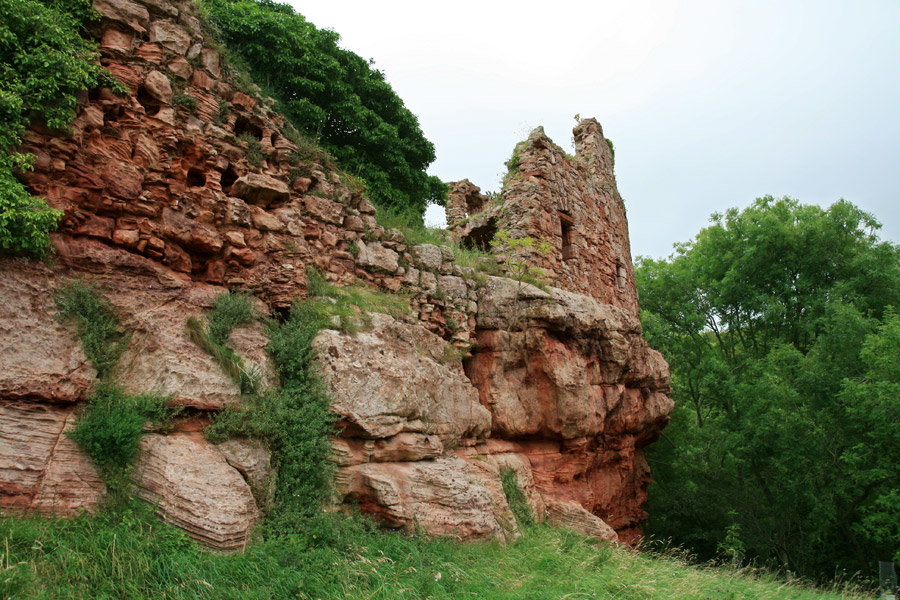
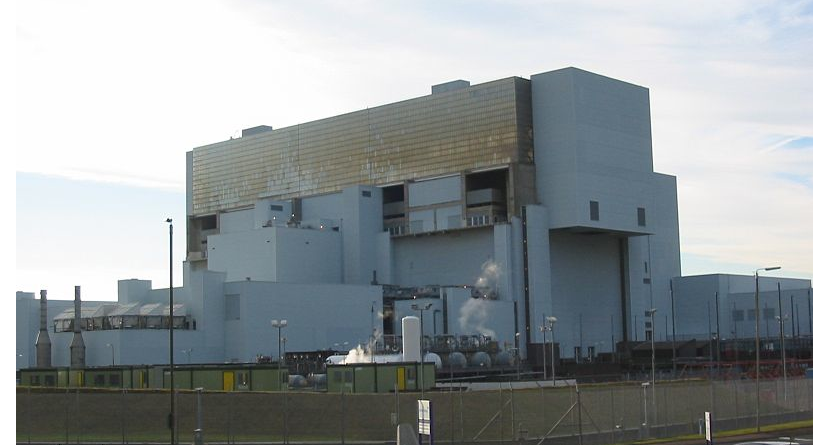
The best view from East Lothian may well be from 60m-high Innerwick Castle, just off the A1—except that you’ll have a dirty great nuclear power station blocking your view.

Innerwick Castle, East Lothian—Stronghold of the Hamilton Ancestors of the Earls of Haddington

Innerwick Castle, East Lothian—Stronghold of the Hamilton Ancestors of the Earls of Haddington

View from Innerwick Castle—Torness Nuclear Power Station

View from Innerwick Castle—Torness Nuclear Power Station


Posted in Community, Environment | Tagged | 1 Comment

Saving Us from Ourselves

It is meant as no insult to the Welsh, Cumbria, Peak District or anywhere else to say that Scotland has the most extensive rugged landscape in the British Isles—or, for that matter, Western Europe. There are more mountains to scale, coasts to kayak, wildlife to watch, islands to explore, etc. than almost anyone can cope with in one lifetime.

But this huge variety of inspirational places lie at the heart of Scotland’s attraction as a tourist destination that brings so many people to visit has a darker side. Whereas Mountain Rescue England & Wales do sterling work rescuing over 1,300 people who get into trouble and recover some 30 fatalities each year, Scottish Mountain Rescue, covering only 8.6% of the UK population rescue almost 700 people and recover over 50 fatalities each year. Those figures alone mark Scotland as a dangerous place.

Rather than scare the socks off potential visitors, the consistent message put out by VisitScotland, SMR, RNLI and related organisations is welcoming but firm: do come and visit us; but dress appropriately, bring appropriate equipment, check and be wary of weather/sea conditions—last but not least—let people know where you’re going and when to expect you back.

Most people, when setting off to climb the Buachaille or sail out of Oban or explore the Summer Isles by sea kayak, are too busy with their arrangements to consider who is going to come to their rescue if the mist falls or the mast breaks or a kayaker develops appendicitis. So effective are our rescue services that it is small wonder people give them little thought. But just like checking your pack for map, food compass, foul weather gear, and having some idea where the nearest refuge is, being aware of what rescue services there are and their capabilities is sensible prep work.

The Scots (and their many visitors to its magnificent outdoors) are generally appreciative of the well integrated and equipped rescue services and the professional and resolutely brave people who staff them. Other than the Forces and Coastguard, they are all volunteers who regularly put themselves in harm’s way to save the lives of others.

Across Scotland (not just in the Highlands) are the 1,000 volunteer members of the 27 Scottish Mountain Rescue teams (plus 3 police and 2 RAF). Among them, they spent some 24,000 hours deployed in 2011, getting 157 urgent cases off the hills by helicopter, lugging 65 off by stretcher, walking 71 to safety and getting another 24 out by vehicle. Of the rest, 157 were found to not need evacuation and 25 managed to find their way to safety without the team finding them first.

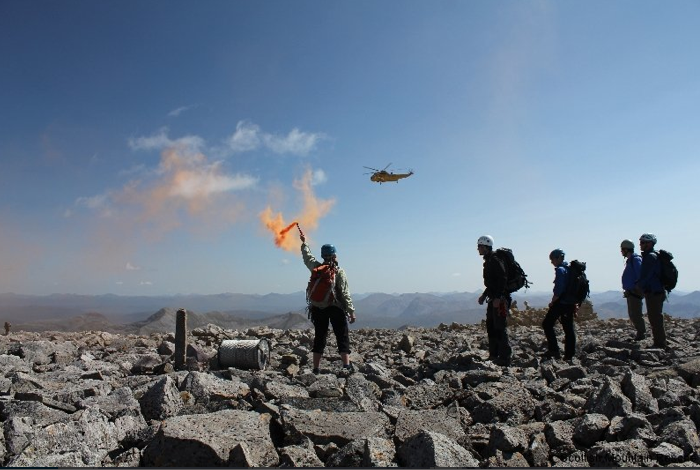
Moutain Rescue Team Guides in a Rescue Helicopter with a Smoke Marker

Moutain Rescue Team Guides in a Rescue Helicopter with a Smoke Marker

The MRTs are backed up by some indefatigable flyers operating out of five ASR helicopter bases around the country, flying the big yellow Sea King helicopters:

  • Rescue 102 & 103 at MCA Coastguard at Lerwick, Shetland
  • Rescue 100 & 101 at MCA Coastguard at Stornoway, Lewis
  • Rescue 137 & 138 at RAF Lossiemouth, Moray (‘D’ Flight, No 202 Sqdn)
  • Rescue 177 & 178 at RN HMS Gannet, Prestwick, Ayrshire
  • Rescue 131 & 132 at RAK Boulmer, Northumberland (‘A’ Flight, No 202 Sqdn)

These assisted in 197 rescues in 2011 and were supplemented in another 9 by Scottish Ambulance Service craft and 19 by police helicopters.

If you have no concept what their job entails, watch the Highland Rescue TV programme to get some idea of the skills they deploy and risks they take to whisk the seriously injured from some inaccessible crag direct to hospital. Frequently the pilot will be holding the craft in winds, sleet or mist with rotor tips just metres from a cliff while the winchman dangles down to administer first aid and ease the casualty onto a stretcher.

The ASR helicopters also assist in many of the sea rescues that occur around Scotland’s 10,000 km of coastline. Here the RNLI are usually involved under direction of the Coastguard. Like the MRT, RNLI crews are all volunteers and, thanks to the generosity of the public, operate a dense network of stations for both inshore RIBs and deep-water displacement lifeboats all around the British Isles.

The RNLI regularly make 8,000 launches (‘shouts’) all around the coast of the UK and Ireland, regularly saving over 300 lives each year, with Scotland contributing 1,000 launches and over 40 lives to those statistics. One reasons Scotland plays a more proportional role in RNLI statistics is that, despite our long coast, the bulk of shipping and recreational boating is elsewhere.

All RNLI stations are proud of their record of almost 90% of ‘shouts’ resulting in a launch within 10 minutes and an enviable reputation for skilled boatwork getting people out of life-threatening situations. They work closely with HM Coastguard who direct them to the scene and co-ordinate any ASR helicopter involvement to take casualties ashore and/or to hospital faster then the lifeboat could achieve. This is one reason why the loss of Fife and Clyde coastguard stations was objected to so strongly—the masterful knowledge of the coast exhibited by coastguards is hard to retain now that the three remaining stations each average 3,500 km of rugged coast to be familiar with.

But the biggest difficulty of all is people and—dare we say it—their stupidity. Despite the warnings, despite their putting members of the rescue services in harm’s way, the general public seems to be getting more cavalier about venturing into mountains or out to sea not properly prepared. Whereas 53% of MRT callouts were from slips or illness or avalanche and could not reasonably have been predicted, 44% came in because people got lost, were overdue, got benighted or some other reason where carelessness and/or bad planning was the cause.

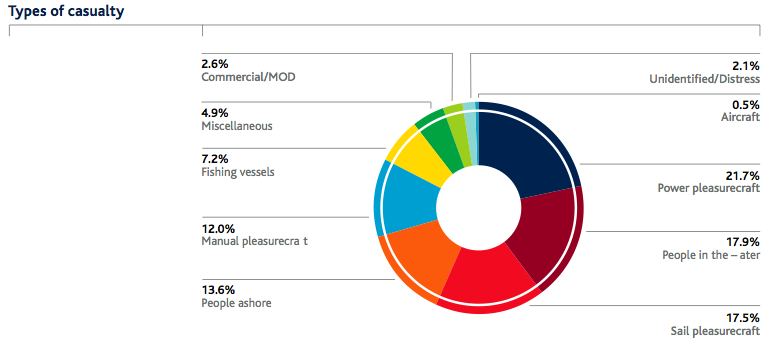
This is also reflected in the RNLI statistics. Whereas barely 10% of their callouts are to professional sailors, 51% are to pleasure craft (mostly powered), 18% to people in the water and another 13% to people stranded. There were 128 incidents from running out of fuel, 185 ‘man overboard’s, 505 stranding/cut off by tide and 622 groundings. While these can theoretically happen to anyone, any sailor worth their salt would be acutely embarrassed if they were responsible.

Proportion of RNLI Rescues in 2011 by Type

Proportion of RNLI Rescues in 2011 by Type

A corollary of our more affluent lifestyle is not just more time off and easier access to more remote places but also ownership of recreational vehicles such as jet skis. Given that rescues on both land and shore have increased some 40% in the last decade, the question whether irresponsible behaviour that causes such rescues should be penalised is being asked.

One ‘yachtsman’ had to be rescued twice in two days; he was using a road map to navigate the North Sea. Another family with no maps torches or proper clothes also got lost a second time in two days (despite a broken ankle from the first incident), causing three MRCs to waste 150 hours in the Lake District. In one out-of-control stag do, several young males in t-shirts had to be stretchered off Snowdon.

Certainly no-one in danger should be left. But if a disdain through lack of respect for nature and the elements is what caused the danger in the first place, why should brave, skilled, selfless people have to put themselves in harm’s way to make up for such irresponsible stupidity without some form of comeback?

Or perhaps such behaviour should just be treated as a category of Darwin Award.

Posted in Community, Environment | Tagged | 1 Comment

Scrooge’s Abacus

It was no surprise that the ConDems won tonight’s vote in Westminster on a Bill to limit annual increases in benefits to 1%, nor was it any surprise that Labour politicians lined up to condemn this development. So far, so predictable. The bill is a testament to Osborne’s ingenuity because it is a piece of legislation that is both apparently popular and opposed by the Labour party. In the Observer, Andrew Rawnsley rather drily commented: “It should be properly described as the Welfare (Make Labour Look Like the Party for Skiving Fat Slobs) Bill.”

But this is mischievous. The TUC has done some useful work on public perception about benefits. Whereas people think over a quarter of benefit recipients are cheating, the real figure is under 1%. Even more relevant, some 60% of the people who will lose out as a result of this bill are in work. In the emotional fracas over social conscience (or lack thereof) the two questions that no-one seems to be asking are:

  1. why do so many in work also receive benefits?
  2. can the UK economy can sustain the level of benefits we now have?

Bill Jamieson, writing in the Hootsmon last week, took politicians in the UK and elsewhere to task for hoofing the debt mountains they are faced with down the road and continuing to behave as if they can continue to outbid one another with bribes to the electorate. It was an eloquent plea for sanity & courage in the face of austerity. After nailing the scale of the US debt mountain he went on:

“Here in the UK targets for debt and deficit reduction have been missed. Even with “austerity”, net debt to GDP is on course to hit 79.9 per cent of GDP in three years, and the coalition government is besieged by bitter opposition to benefit capping. All this is unfolding under the shadow of an imminent loss of the country’s Triple A credit rating”

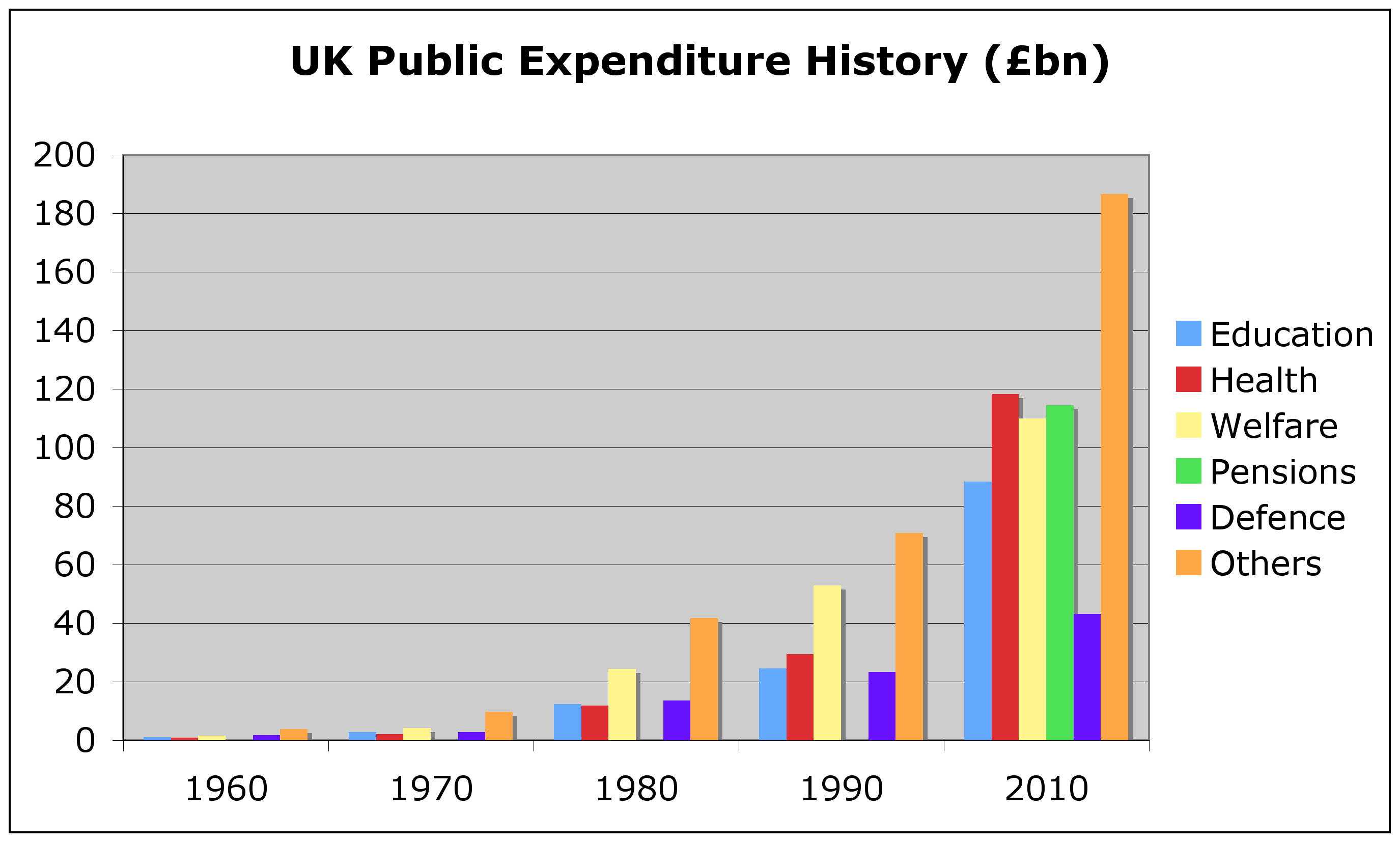
So, is he being a big girl’s blouse or is it time for the hair shirt? Judge for yourself. In the last fifty years—since MacMillan told a booming Britain that they’d “never had it so good” there has been a ballooning of government expenditure. This is shown in Chart 1 below.

Chart 1—UK Public Expenditure per Annum in Selected Years

Chart 1—UK Public Expenditure per Annum in Selected Years

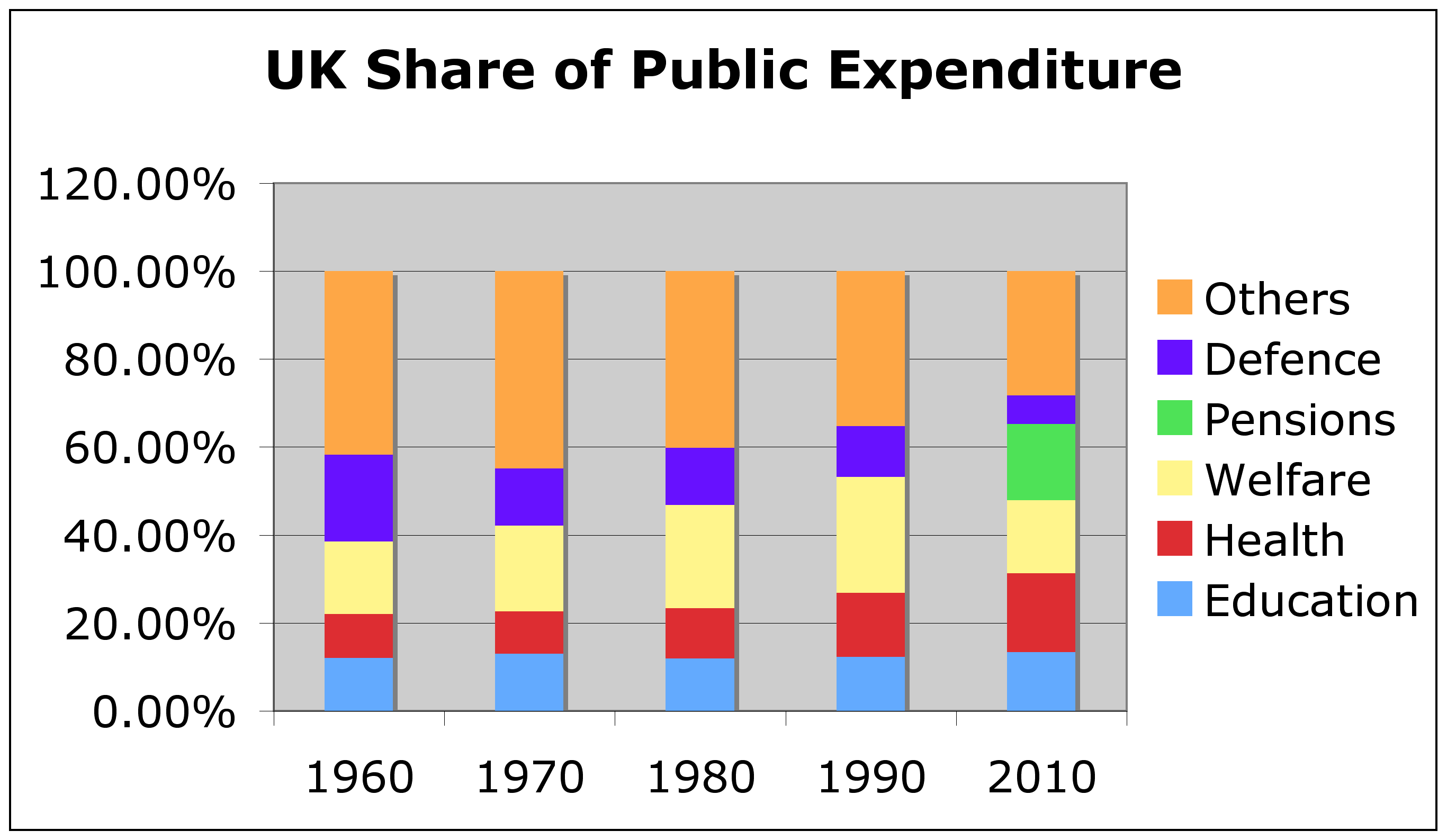
From a total of £9.1bn in 1960, it has mushroomed to £660bn in the first year of the present government. The chart shows the key social provisions broken out (Health, Welfare and Pensions), together with Education (a fundamental requirement) and Defence (a more optional requirement). Note that Pensions were self-funding until the last decade since when they have become 17.3% of expenditure—bigger than Education at 13.7%. In order to better compare things over time, let’s redraw the above in terms of percentages to show which have grown or diminished (Chart 2)

Chart 2—UK Share of Public Expenditure in Selected Years

Chart 2—UK Share of Public Expenditure in Selected Years

This makes it graphically clear that ‘social’ provision has grown in fifty years from one quarter to one half of the budget. Even allowing for inflation since 1960 (1,833%), in real terms, for every £1 we once spent on health, it’s now £7.16; for every £1 on benefits and pensions, it’s £8.04.

This can be seen as laudable—a developed country looking after the welfare of its people and especially the vulnerable but let us return to the questions posed above.

“Why do so many in work also receive benefits?” This question can best be answered by all those party policy wonks who have argued for generosity with certain sections of the public—from cutting the once-punitive 90% supertax at one end to providing a minimum wage at the other. Some of the argument for those in work receiving benefits is to avoid the financial trap of those on low wages who would actually be worse off if all benefits were withdrawn.

By capping the benefit rise at 1%, about seven million working people will be affected. This is about one quarter of the UK working population. Outside of this group are the 13% of the UK population who live on disability benefit (in Japan, it is 3%). Add in the 8% unemployed (and seeking work) and rummage for the others not seeking work who are below the radar and it is perhaps not surprising that YouGov recently found 74% of people believed that the present benefits system was excessive.

“Can the UK economy can sustain the level of benefits we now have?” Because of the emotive nature of the first question, people get stuck on it seldom get around to addressing the second. It is a measure of democracy just how responsive a government is to the needs of the people. But even a democratically elected government must act decisively and can’t consult with the people through a referendum on any but the most important issues. The ConDems clearly think that benefits need to be curtailed; Labour, SNP and the Greens disagree. Who’s right?

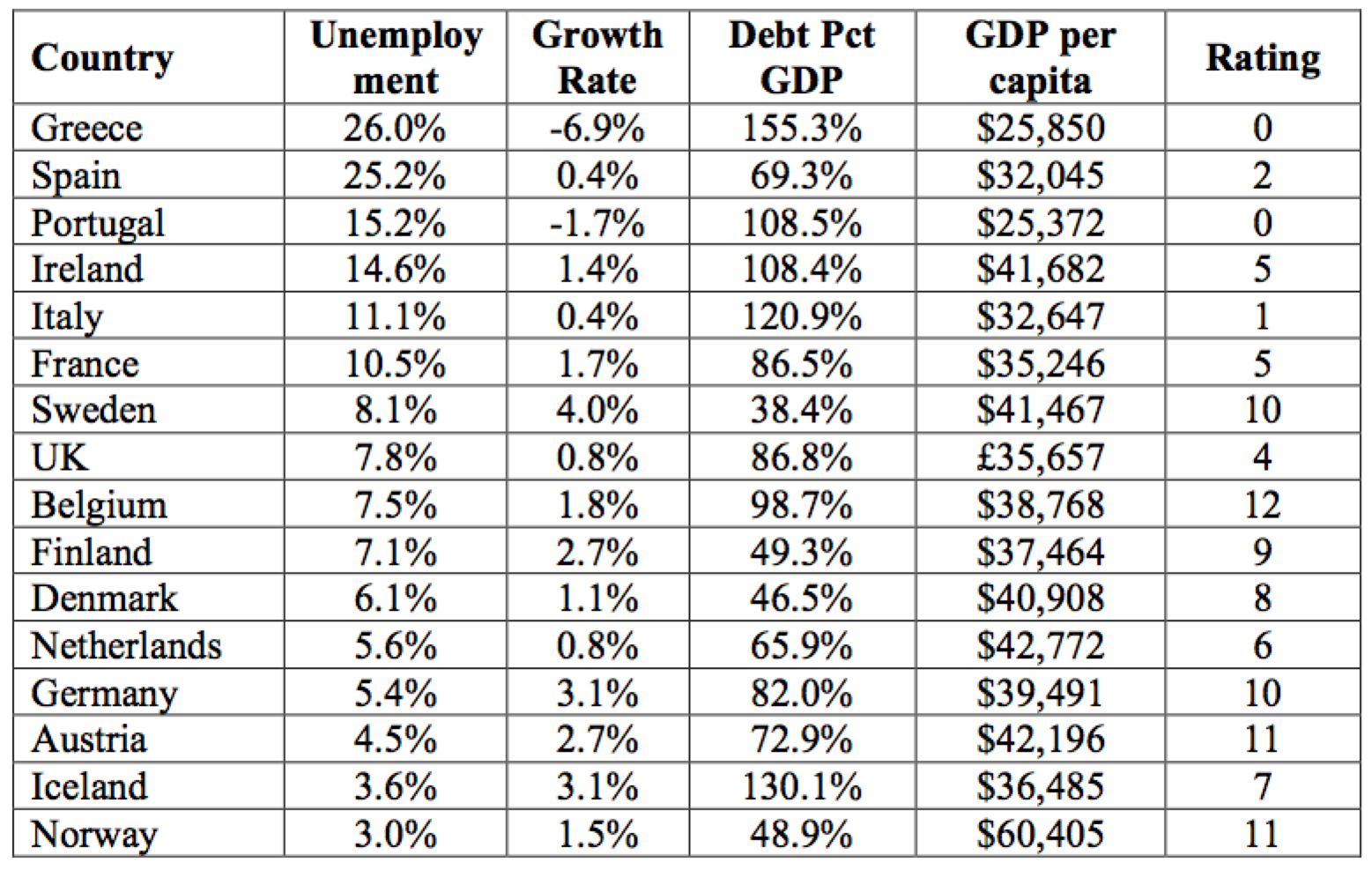
Comparing the UK with other developed countries is one way of creating some kind of objective measure of this. While numbers don’t tell you everything, the level of unemployment, the health of the economy and the degree to which the burden of public debt is manageable are all related indicators to say what a country can afford. Table 1 lists a selection of European countries whose economy is some form of yardstick for the UK’s.

Table 1—'Scrooge Chart' Comparison of European Countries

Table 1—’Scrooge Chart’ Comparison of Economic Parameters among 16 European Countries

All of Britain’s neighbours and several other comparable European countries are rated in the above table by considering which quartile they fall into, measured by each of four economic parameters. Three points are awarded for being in the top quartile (of four), down to zero points in the fourth quartile. Unsurprisingly, Germany does well as Europe’s ‘engine room’; the ‘PIGS’ languish at the bottom.

What is perhaps more surprising is that relatively modest countries like Austria and Norway are in the lead, Scandinavia puts other areas to shame and the supposed “Arc of Insolvency” countries are doing better then Britain. While it would be foolish to use such measures alone to run a country, as a ‘back-of-the-envelope’ snapshot, it’s pretty solid. Little wonder that the UK is on the verge of losing its ‘AAA’ rating when it falls into the third quartile by all four measures.

It is not being a small-minded Scrooge to say that Britain cannot afford to spend money the way it is doing, especially on long-term commitments that show no return on investment—like the scale of welfare in which we now indulge. Were the economic basis on which it was built sound (like most of Scandinavia), it might be a sensible, as well as a humane, choice.

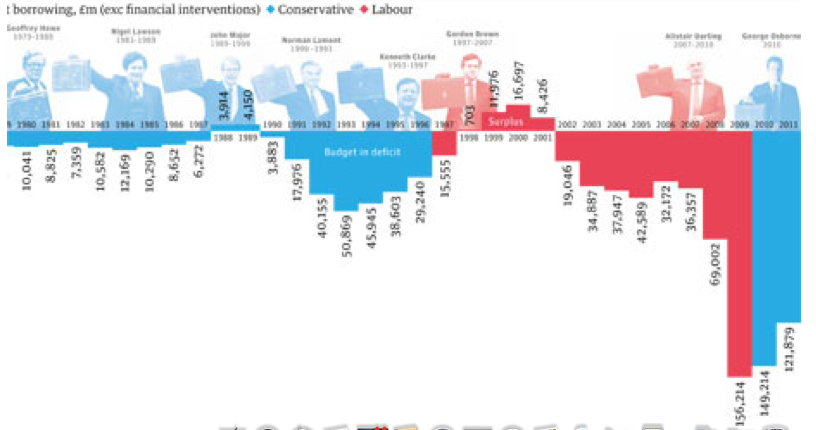
But since British welfare has been funded for decades by exploiting  a variety of sources from North Sea oil profits to Irn Broon’s early raid on the pension funds, we are living beyond our means on a titanic scale. This is illustrated by a chart from the Guardian that illustrates why we are in deeper financial trouble than we have ever been; we simply cannot afford the benefits to which we have grown accustomed.

Chart 3—UK Government Net Cash Flow by Year

Chart 3—UK Government Net Cash Flow by Year

The financial shakiness of Tory tenure under Lawson in the eighties and Clarke’s in the nineties did pay off with eventual surpluses. But what Brown and Darling got us into in the noughties is on a scale that boggles the mind as well as the banks.

It may be against our good nature and humane compassion but the bottom line is: Britain is broke. Borrowing one pound in five cannot be sustained. Education, seen as a vital and basic right, has seen no growth in its share of spending. Defence is seen as less vital but its share has already slumped from 20% to 6.5%. Everyone agrees the NHS is sacrosanct, so, even its doubling from 9% to 18% is seen as acceptable. Everything else the government does (transport, treasury, foreign office, etc) has also been clipped—down from 41% to 28%.

That leaves the £225,000,000,000 we spend on Welfare and Pensions. You can blame Scrooge and his calculations for such a Hobson’s choice if you like but the bottom line is one of:

  • we act decisively to curb this
  • we butcher a different sacred cow (e.g. NHS)
  • we go bust

Scrooge sez: you choose

Posted in Commerce, Community, Politics | Tagged | 1 Comment

As ever, The Burd nails a situation that flaunts the ‘ reasonable person’ standard and, in so doing, questions why we are not yet all working “as if in the early days of a better country”.

burdzeyeview's avatarA Burdz Eye View

Two Scottish broadsheet Sunday papers, two quite different splashes. But they share a theme.

The Sunday Herald’s front page story tells of the Scotland Office sitting on internal government files relating to devolution. Despite the Scottish Government reducing the time at which such documents can be released publicly, the current Scotland Office has decided to sit on these ones, so it can have a wee look for anything in there that might prove embarrassing – or worse – to the Unionist parties. Why a Tory-Lib Dem controlled UK administration might want to spare the blushes of a previous Labour government neatly illustrates the complexity of the constitutional ties that bind. It’s them – all of them, most of the time – against the SNP.

Scotland on Sunday runs with a piece about Holyrood and specifically, about the failure of Cross Party Groups (CPGs) to file annual returns and declare benefits…

View original post 937 more words

Posted in Uncategorized | 1 Comment

Education as Political Football

Currently, politicians are getting stick for appearing to prefer squabbling to getting things done. While this can been seen as simplistic and not showing understanding of how democracy works, there is nonetheless much truth in the accusation. Because what they choose to squabble about is seldom the arcane details of a law or deep-rooted philosophical differences about the ‘big picture’ but issues that are closer to the punter’s heart—and therefore more likely to catch the media and gain publicity.

Whether it’s care homes or schools or road repairs (all devolved matters), there’s always a lively public debate in pubs and letters pages about such things. If you rank these devolved matters by the amount of money we spend on them, the top three—by a country mile—are Health (~£9bn), Education (~£7bn) and Social Work (~£3bn), in that order. Study the media and you will find reports of political spats revolving around one or other of those on a regular basis. But do these spats get to the heart of things?

Although Health is the largest of the ‘big three’ there really isn’t much of a political dimension to its operation. While arguments over waiting times and Clostridium difficile do break out, politicians (sensibly) leave the technical side of running the health service to the professionals.

Not so Education. Not only is it the largest part of any council budget but it hits the headlines more often than any other topic. And, in this case, politicians have not been shy about debating how schools and universities should be funded, run and managed.

This involvement has been heightened by Education being among the most highly unionised sectors of the Scottish economy, boasting a range of unions, among which the Education Institute of Scotland (EIS) is the largest. They were instrumental in the growth of school teacher numbers in the 1970/80’s as new subjects were added to the academic curriculum (e.g. CDT; Computer Science; Music) and of administrative staff as school offices expanded in scope and function. Staff at HE and FE institutions grew even faster as a tertiary qualification was deemed to be for everyone.

By the millennium, pupil numbers had slid from their 1975 peak of 1.05m to around 0.75m. Over the following decade, they continued to slide to around 0.66m but the millennium is regarded as something of a watershed: it was finally recognised that teachers had slipped behind. This was not just in pay terms: children’s rights, complex curricula, inclusion etc had all made a teacher’s job more difficult at a time when the social status of teachers had fallen behind that of doctors and solicitors with whom they had once been seen as equals.

The McCrone Report of 2001 was a milestone that was turned into an agreement with cross-party support. Much of the teacher’s time usage was defined and a considerable pay deal of a 21.5% increase over 3 years granted, followed by 10% over another four years, all of which found broad support. Mostly due to this, council education budgets almost doubled over a decade.

After six years, an ordinary teacher can now earn £32,583. As the Scottish Block Grant doubled (£16bn to £32bn) in the first decade of the 21st century, the sharp hikes in council outlay this involved were covered and otherwise painful adjustments were accommodated without painful trade-offs.

Even so, the unions never slept. Teachers didn’t quibble with their campaigns for improved pension and pay rises on top of all this, despite that fact that no change in productivity, flexibility or the right to fire incompetent teachers was forthcoming as part of the deal. Also, many teachers who formerly had displayed flexibility, such as helping with extra-curricular activities, no longer did so. Although many teachers still see teaching as a vocation and contribute more than their contract requires, the numbers who clock-watch and only do stipulated hours has increased markedly.

Yet their annual number of teaching hours has been reducing—from 950 hours in 2000 to 893 hours in 2005 and to 855 hours in 2010 at the primary level. At the same time, pupil-teacher ratios in public schools have dropped in the decade since the millennium—from 14.9 to 13.5 (i.e. by 10%), with most improvement being in the crucial early years (i.e. infant classes) of primary schools.

The bottom line of all this should be pupils with better skills and abilities to take out into the world when they’re done. And, while there has been a steady improvement in ‘exam league table’ results, there are accusations of grade inflation, as well as educationalists’ understandable skepticism of using this as a sole measure: learning is not just about passing exams.

This ‘careerist’ approach to educating our children places heavy emphasis on tertiary education, and the gaining of a degree. Whereas fifty years ago, all four Scottish universities of the day had fewer than 40,000 students matriculated, fifteen years ago this number had grown to 141,892 (with 191,526 in FE colleges). This number peaked in the last few years at over 287,565. Combined with the present recession, such numbers swamp available jobs and result in a major social waste of large numbers of unemployed graduates.

One reason for the disappearance of the once-guaranteed job for graduates is what youth have chosen to study. Starting in the 1960’s humanities course like Social Anthropology blossomed and sciences were seen as ‘too hard’. This has since become critical. Despite physics graduates being in demand and snagging healthy salaries as a result, their numbers have dropped by well over 20%—from 1,970 15 years ago to 1,545 today. According to an IOP Report:

  • Physics graduates find employment in a wide range of industry sectors, with a significant proportion relocating overseas.
  • Physics graduates earn above the median UK wage and succeed in management positions and consultancy roles.
  • More than half of first-degree physics graduates earn a salary in excess of £40,000 and more than half with a PhD in physics earn over £50,000

The quality of both teaching and research at Scottish universities is world-class. But research hubs are not career factories nor do they function well  as career consultants. Given that our youth aredriven through school with expectations from both parents and teachers that everyone goes university, students wind up with an unbalanced view of what is possible and/or desirable in life.

Scotland’s political parties supported this mushrooming of student numbers as an unalloyed good—and still cling to it as doctrine. They have yet to twig how public money and youth ambition are both being sacrificed on this doctrinaire altar. Fixation with numbers—be it class sizes in primaries, league tables in secondaries or sheer quantity in tertiary—has beguiled them all. They tout quantity as opposed to quality. Our clutch of teaching unions are all part of this, exhibiting little but paranoia when it comes to changing philosophy or methodology.

Few have broken ranks to ask fundamental questions about our education, let alone gone abroad to study if others might do it better. Our youngsters are not best served by conveyer-belting them along a single ‘academic’ track defined by political shibboleths of politicians and vested self-interests of unions. To get out of this self-excavated rut, we need to answer:

  1. How do we best start children in formal education? Before 6 is unusual elsewhere but their kindergartens provide informal education, develop social skills and widen cultural horizons early on. Norway’s policy of year-round outdoor kindergartens is worth a look.
  2. How do we ensure basic literacy and numeracy before they leave infant stage? A major complaint of university lecturers and (worse) employers is how few students can express themselves beyond textspeak or make a decent fist of mental arithmetic
  3. How do we involve ALL parents pro-actively as part of the process? This can be homework or extra-curricular support or simple interest and encouragement. A major factor in social segmentation is that many deprived pupils lack all that.
  4. How best to ensure that GIRFEC wasn’t just a hollow slogan? Class sizes are a factor, but so is the social environment or out-of-hours coaching and (are you listening EIS?) pro-active flexibility on the part of teachers.
  5. How to identify and ‘virtual’ stream (i.e. without physical segregation) the different directions that pupils are headed. Not just academic science vs creative but those with manual, sports, social, music, presentations, language and a host of other inherent skills. Few pupils will have none; all need encouragement; all need equal status—that Latin is ‘better’ than Woodwork is social striver myth.
  6. How, at secondary level especially, to allow for such specialisation as early as possible, without losing the Scottish baccalaureat concept of broad education to end of high school that has served Scots so much better than English A-levels?
  7. How to maintain a parity of esteem among specialisations. Dexterity with tools is as valuable as dexterity with footballs or a keyboard: all have status in the real world and all can earn reward on a par with ‘brainy’ work.
  8. Now that we’ve flooded H&FE with so many (a significant percentage of whom drop out) how do we restore universities to academic skills and research while colleges develop practical skills, supported by a comprehensive hands-on apprentice programme that covers the many key manual skills necessary in 21st century Scotland?

It’s not just a matter of parties and councils running scared of unions—those run by Labour who rely on their donations especially. Nor should we thole  Tory ideaology, importing English policies of ‘free’ schools and academies wholesale, with their inherent social fragmentation founded on Eton, Harrow, Winchester, etc and the virtual promulgation of those into Oxbridge. They may have their place in England; Scotland marches to a different social drum.

Our children should not be ammunition for political trench warfare, nor a vehicle for unions to shield their members from the realities of life. And—who knows—if we were to think the unthinkable and actually adopt educational ideas that clearly already work from places like Scandinavia, we might be on the road to building the kind of prosperous, egalitarian, admirable society here that they already enjoy.

Not just our children but those long out of school would surely welcome that.

Posted in Education | Tagged | Leave a comment

Where Hell Froze Over

The year 2012 will be remembered  for unusual weather. Sunny Dunny was drenched, Stonehaven flooded, Assynt suffered an unheard-of drought and much of England is still so sodden any new rain simply runs off. North of us was unusual too in that the amount of sea ice in the Arctic melted to a record low.

It might have been coincidence but on the heels of news of minimal Arctic ice, just before Christmas, the UK government followed up an equally-belated acknowledgement of Bomber Command’s 55,000 losses in WW2 with the announcement of a medal for the 65,000 men who served on the Arctic Convoys, 3,000 of whom died there; barely 200 of them are alive today.

Seventy years on, it is difficult to imagine how tough people had it. Luxuries we take for granted today—electronic gizmos, exotic foods or even more exotic holidays—were unknown. The Forces suffered hardships, bad food and endless boredom, interrupted by manic periods of people trying to kill them. Airmen tended to have it better when based at home. Yet, nursing 15,000lb of Amatol and incendiaries packed into a freezing Lancaster through pitch dark in a hail of flak at 20,000ft over Essen with radar-equipped Nachtjäger gunning for you requires stiff-upper-lip courage of a special sort.

Taking nothing away from the millions who served in the Forces to give us freedom leading to our seventy years of affluent comfort, they at least signed up for and got paid for it. While civilians from Barking to Belfast suffered waves of losses—from night bombers, followed by V1s you wished you couldn’t hear, followed by V2s you wished you could—there were civilians on the front line who had never signed up to warfare: our merchant seamen.

Most people know about the Battle of the Atlantic during which convoys of ships tried to keep Britain from starving. And while the North Atlantic is no easy place to be in winter, especially rolling around in a 1,000-ton corvette, one of the worst sea boats ever built, it was infinitely preferable to the worst billet in the entire war—the Arctic convoys to Russia.

Compared to the two-week Halifax-to-Liverpool haul, Loch Ewe-to-Murmansk looks a doddle. It’s much shorter, and with no sea ice and 24 hour daylight in summer, what could be simpler? Well, Hitler occupied Norway in 1940. The Luftwaffe  deployed KG26, a crack anti-shipping wing whose He111s could carry two torpedos each. Not to be outdone, the Kriegsmarine stationed two full flotillas of U-boats and most of their heavy surface units there, including Tirpitz (15″-gun battleship), Scharnhorst (11″-gun battlecruiser), Admiral ScheerLützow (11″-gun pocket battleships) and Hipper (8″-gun cruiser).

When, to almost everyone’s surprise, Hitler invaded the Soviet Union in June 1941, it took some time for the capitalist West and communist East to behave like Allies. As Blitzkrieg bagged millions of Russian prisoners and panzers rolled up to the gates of Moscow, Stalin realised he needed all the help he could get. But getting it was not easy. Via the Pacific involved the 4,000-mile single-track Trans-Siberian railway, the Axis controlled the Aegean and therefore all access to Black Sea ports. The only option was the shortest one—to ice-free Murmansk and, in summer when the White Sea melted, Archangelsk.

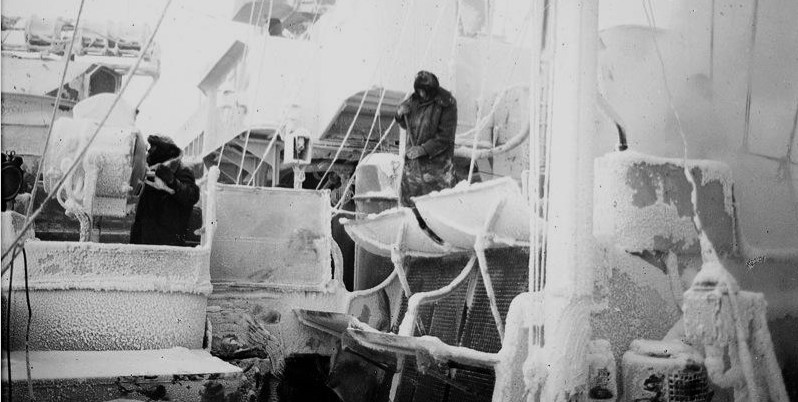
Things got going in October 1941 when PQ1 of 11 ships left Iceland. Initially not much molested, as the season changed to winter, the bitter conditions were bad as any enemy. Sea spray froze into ice on the superstructures; this had to be chipped away or ships would capsize (HMS Shira lost this way—3 survivors). To touch anything with bare skin was to lose it, freezing to metal immediately as if glued. From November on, passage was in 24-hour darkness—a blessing because pack ice forced the convoys south towards the Norwegian coast so the less German patrols could see the better. (See here for details of convoys).

Clearing Ice aboard HMS King George V

Clearing Ice aboard HMS King George V

Lookouts had it worst, squinting into driven sleet for a whole watch. RN escorts could not stay closed up for action as AA gunners and deck parties would freeze. Deck equipment like winches was unusable; Frostbite was commonplace. The cruiser HMS Trinidad was even sunk by her own torpedos when their gyros malfunctioned in the cold and sent them in circles.

Keeping station in dark or foul weather (or both) to avoid collisions required extraordinary seamanship. Even when you got there, neither Murmansk nor Archangelsk offered facilities for visitors, the Russian treated even merchant seamen like spies: they pointed guns at those trying to unload PQ1 in the absence of stevedores because they had no permit to be ashore.

Although losses in the first six months were light, as weather improved into 1942, so did exposure to risk. In March PQ12 narrowly avoided Tirpitz in foul weather. From then on, each convoy was more roughly handled until PQ17 sailed with 33 ships at the end of June. Despite the Home Fleet providing distant cover, the Germans spotted it and sent  Lützow and Scheer to attack, whereupon the convoy was ordered to scatter; U-boats and planes then had a field day picking off stragglers as there was nowhere to hide in 24-hour daylight. Only 11 ships of the 33 made Russian ports; some 1,200 merchant seamen, as well as 430 tanks, 210 aircraft, 3,350 lorries and 100,000 tons of war materials, were lost—the worst convoy disaster of the war.

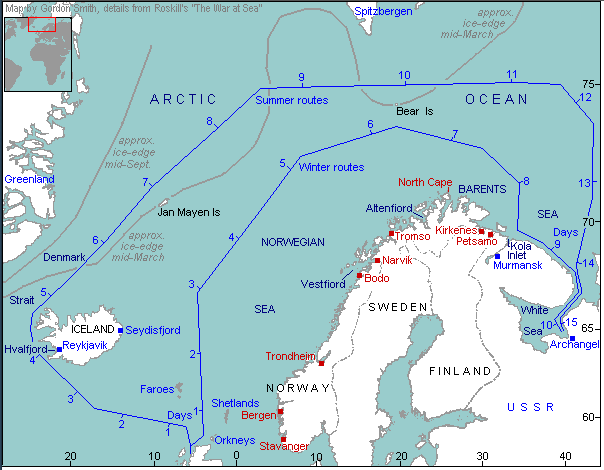
Seasonal Courses of Arctic Convoys to Russia

Seasonal Courses of Arctic Convoys to Russia. Luftwaffe Air Bases in Red

Having had their fingers burned, the Admiralty held off until trying again with PQ18 in September which was roughly handled, losing a dozen ships before the remaining 28 reached Archangelsk. Then in December, a new series of JW convoys started and, taking advantage again of darkness and foul weather, these avoided many casualties, despite attempts to intercept by Lützow and Hipper. But after February 1943, all convoys were suspended until the following November because the odds against convoys in the summer months were suicidal—merchant seamen asked to face odds of dying worse than front-line soldiers or bomber crew.

Convoy JW55B, sailing in December, was used—unbeknownst to its sailors—as bait to lure out Scharnhorst, which was caught and sunk by HMS Duke of York and cruisers. With Tirpitz immobilised by the RAF, convoys in 1944 had an easier time of with no surface threat, running monthly until the final JW67 in May 1945. By ‘easier time of it’ is meant from the Germans: JW56A lost days fighting a huge storm off the Faroes, finally having to take shelter in Iceland.

Just surviving one Arctic Convoy would be a horrendously searing experience. But several ships sailed there more than once. How their crews held it together having already gone through this frozen hell already we may never know. And of the 3,000 that died on the 85 merchant ships and 16 RN warships lying at the bottom of the Barents Sea, we can only imagine what the nightmare of being thrown into stormy, sub-zero seawater after your ship sinks feels like. Survival time is minutes; the very low number hauled alive onto rescuing ships speaks volumes.

But there are two glaring reasons that make the whole sacrifice tragic that would have been known to none on the ships.

One is that all of this really was little more than a gesture. Because Britain was incapable of dealing with the Germans on any front in 1941 (we fielded five divisions then—all in Libya & only one of them all-British), the only way we could help the Russians (fielding 360 divisions and barely holding 208 Axis) was to provide these military supplies as the only direct contribution they could make. The ever-suspicious Russians actually thought Britain was just going through the motions to appear to help them and that the PQ17 losses had never existed.

The second tragedy is the Russians actually despised much of what was shipped. Our 2-pounder anti-tank guns were laughed at—their tanks were already equipped with a 76mm gun. They sidelined our slow, under-armed Valentine infantry tanks to the Caucasus side-show because the Red Army did not rate them beside their fast, powerful T34. What they did appreciate were lorries, which they used in Mechanised Corps to grind the once formidable German panzers to pieces.

Had the Arctic Convoys never happened, the outcome of the war would not have been greatly different—at worst, delayed a few weeks. In Britain, we tend to overplay our role in WW2 and nowhere is that more apparent than in the conceit that the Arctic Convoys brought materiel without which the Soviets would not have prevailed.

No-one should underestimate the courage of our sailors—both Merchant and Royal Navy—braving unspeakable trials of endurance for weeks. An acknowledgement of their sacrifices is both overdue and welcome. But don’t examine the rationale behind sending them too closely. They could ave stayed warm and snug at home for all the difference their sacrifices made to the war.

But give them the medals they have long deserved.

Posted in Education | Tagged | Leave a comment

Credo

We make out of the quarrel with others, politics, but of the quarrel with ourselves, poetry” —W.B. Yeats

The previous post is a re-blog from Mute Swan with which I was particularly impressed because it asked politicians to rethink their verbal mud wrestling and reconsider what the people who gave them their jobs might actually want them to do. I interpret that as:

  • following a set of fundamental principles
  • being clear and consistent in your beliefs
  • being active and articulate in pursuing them
  • treating with respect others who do the same

Principles

While there are neither training sessions nor spot-checks on politicians, they should abide by a set of principles—things that are fundamental to both their own morals and activities. Such principles are applicable to all—it’s in beliefs that we differ.

It is obviously convenient at times to elude or even dispense with these principles. But the measure of integrity is to avoid doing so. For an example of principles in practice, it is hard to surpass Zinneman’s film of Bolt’s A Man for All Seasons.

  1. We live in a democracy; however inspired or daft, the voters’ decision rules
  2. People are fundamentally decent and well intentioned—even those who may disagree with you
  3. Election requires that you actively represent the best interests of ALL those living in the area without fear or favour
  4. Where such interests may clash, you make your best evaluation of the will of the majority and put your head above the parapet to explain to the rest
  5. If promoted to a portfolio position, 4 above now applies for that service across the whole council/country vs the general interests of your ward/constituency
  6. You are not in it for the money, nor to exploit opportunities on the public purse: anyone who thinks they are is in the wrong job
  7. However venal it may seem, everything you do outside private property is public and liable to publicity
  8. Behave as if your parents were watching your every move: make them proud

Beliefs

Although I’m a physics graduate, one of the more interesting classes I took was Moral Philosophy from Professor Acton. Far from the steely certainty of Maxwell’s Equations, Plato, Kant, Spinoza and Mill all vied for my understanding and received shifting interpretations.

It was my introduction to the shifting moral morass of the real world and the need to move beyond W.C. Fields (“Everybody’s got to believe in something. I believe I’ll have another drink.”). You may share some beliefs with others but, generally, this is the meat and drink of political debate.

  1. Scotland is a country because its people say it is.
  2. Democracy is the method by which it should be ruled (Churchill said “democracy is the worst system of government—except for all the other systems“)
  3. The best future for the people of Scotland can be achieved through independence
  4. The best future for the people of England can be achieved through Scottish independence
  5. Nuclear weapons have no place in Scotland and nuclear power should be phased out because of the unsolved problem of waste disposal.
  6. Anyone can choose to be Scot simply by living here permanently; we are a welcoming country that enjoys our diversity and we are not full up
  7. Nobody has a right to anything, other than citizenship, by virtue of their birth
  8. That said, The Queen is the best, hardest working, most indefatigable Head of State you could want, coming close to defeating my republicanism all by herself
  9. Scotland is a small country and needs friends: England, EU, NATO, in that order
  10. You can’t have 2-way communication with 5m people: local contact is the real arena of politics (Tip O’Neill, former House Speaker said “ALL politics is local“)
  11. As regards local, the abolition of burgh councils was a mistake because it severed the roots of local democracy—’our’ council became ‘that’ council.
  12. On the other hand, major public services should be city-region based
  13. No part of public services in Scotland should be privatised, although temporary expedients like ALEOs to take advantage of the law may be implemented
  14. Major decisions on shaping & maintaining our towns (e.g. planning, tourism) should be taken at community level
  15. A community is anywhere that thinks it is but a model size would be a high school catchment area
  16. The rewards for hard work and ability should mainly accrue to the individual
  17. A measure of any civilisation is its commitment and ability to support and protect its vulnerable
  18. With provision of support/protection comes an obligation not to abuse it.
  19. A mixed community is a healthy community—mass estates, especially gated ones, are recipes for social unrest, if not disintegration
  20. Of all the public services we need to get right, Education is prime because it will shape the future
  21. After three centuries of Anglocentric foreign policy, Scotland needs to re-think its international contacts, especially with Scandinavia

Practice

All such principles and beliefs come to naught if you spend your time watching reality TV instead of getting your ass in gear. Quite apart from engaging with friend and foe alike on the above (incomplete) list of beliefs, the bulk of a politician’s day is taken up by committees, meetings, community events, etc. How those are handled will have a major impact on how effective the representation is, principled or no.

  1. Make yourself available: shop local, use the high street, attend events and get yourself known if you aren’t already
  2. Beware of bias; be wary of joining clubs, especially when there are two, to avoid being seen as partisan
  3. Go to the spectrum of local civic meetings, even if only sporadically
  4. Maintain a friendly and regular channel to local press and radio. Even if they’re biased, there is no upside to falling out with them
  5. If in Administration, articulate your achievements outside of the regular PR channels because most will not know about them. Don’t boast—communicate
  6. If in Opposition, select a few key (preferably vulnerable) issues and point out both shortcomings and your own (hopefully superior) alternative(s)
  7. Treat colleagues with respect and avoid public disputes in which all will lose
  8. Treat opponents with respect, especially ‘off-duty’ but avoid craven posturing in the hope of crumbs from the Administration’s table
  9. Avoid unnecessary public expenditure, especially in these straightened times. Sending Christmas cards to all your constituents at public expense may be legal and above board, but it will damage, not enhance, your image
  10. It’s easy to be ‘in the paper’ but if it is not for some serious or social issue relevant to your residents, it may damage, not enhance, your image
  11. Build your contacts throughout officials in your organisation. Favours are far more often granted to those who have built bridges and are not strangers.
  12. Build your network outside your organisation, whether in the party, other councils or, especially, other public bodies & quangos. Speaking at conferences is a particularly effective way to do this. Scotland is a village; conferences are the village pump round which you make friends and get the gossip

OK, so I didn’t make it in 1,000 words (typical bloody wordy politician!). But the above is a distillation of why I am in politics (beliefs), what guides me (principles) and how I go about it (practice) after 20 years as elected something. This is not meant to challenge but to explain. Nonetheless, comments and feedback—especially from Mute Swan—would be welcome.

Posted in Politics | Tagged | Leave a comment