Poseidon Drowning

When Yeats first mused his maxim “out of the quarrel with others we make rhetoric and out of the quarrel with ourselves we make poetry“, it was half a century before the quarrel with others could lead to a nuclear holocaust. As someone who has spent his entire 65 years under the prospect of just that, I used to hold in high regard those who argued forcibly against such a demise for humankind and against the insistence of the MoD that the UK must have such weapons to retain military credibility in the world and “a seat at the top table”, as embodied in membership of the UN’s security council.

Given British history in the first half of the 20th century, there is definitely an argument for staying alert militarily and avoiding the old soldier mistake of forever preparing for the last war so you always start the next one off-balance. Victorian Britain thought only in terms of small colonial wars, supported by global hegemony at sea. Its tiny Edwardian army was all but wiped out in Flanders by the massive German mobilisation of 1914. Its acceptance of the French fixation with Maginot defences almost led to a similar wipeout over the same ground in 1940; only both sides’ imperfect grasp of air power and much courage among sailors rescued most of the BEF from Dunkirk.

Having been caught twice in 25 years with their military trousers round their ankles, it is understandable that the MoD pushed for nuclear deterrence post WW2, especially as the Russian threat appeared palpable and imminent with the advent of the Iron Curtain. But with British global abilities questioned by communists from Cyprus to Malaya, insurgent efforts like the Kenyan Mau Mau springing up all over the globe and the absolute public humiliation of Suez underscoring a new impotence on the world stage, the writing should have been on the wall from 1956 onward. Both India and the vital Gulf oil reserves—the only economic rationale left for a global military reach—was already long out of British direct control.

Yet, not only were the V-bombers developed to thunder off into the skies in pairs with nuclear warheads as a puny Strangelove-esqe attempt to ape the USAF’s SAC ever-ready strike ability but millions were squandered on our own Blue Steel and Blue Streak ICBMs until they were scrapped and a virtue made of necessity by buying in first the US Polaris and then the Trident nuclear missiles to fit on a new submarine fleet. During the Cold War, too few people were asking questions—not about their efficacy, but about the entire rationale of their existence. The doubters were dismissed as mostly long-haired CND and hippy types, laced with intellectuals but including—to its credit—the Labour party.

The UK Nuclear ‘deterrent’ about which so much fuss has been made might still be fully capable of Armageddon all by itself but its rationale is a sickly thing. At the height of the Cold War, the US/Soviet race might also have been madness but superpowers of hundreds of millions of people deploying economies of trillions of dollars can indulge in such exercises in futility and still prosper. Britain, on the other hand, was trudging to the IMF by 1975, cap in hand. Had WW3 ever started, the US & Soviets would have reduced the entire planet to uninhabitable slag. What role the UK nukes could play in that, other than make the rubble dance higher was never made clear.

Worse than that, the chances of the UK ever deploying its nukes unilaterally is something the US has made sure cannot happen without their say-so. And, even were that not the case, at what point in the half-century of their existence could they have been deployed? Global hotspots like Hungary (1956) or Israel (1967/1973) or Vietnam (1966-73) were all American-dominated, as were Kosovo, Iraq and Afghanistan where the UK was involved. Even in the latter cases, had we wanted to use nukes against a tangible enemy, they made no tactical sense, quite apart from the moral opprobrium that would have swiftly followed any such use.

Even in purely British operations like Aden/Yemen in the sixties, nukes were useless against a guerilla force and although the Falklands was a ‘proper’ war against a ‘real’ country, nobody on either side considered for a minute that the Rio Gallagos air base was going to be nuked, let alone Buenos Aires. If nukes are a deterrent, then the question that has yet to be answered is ‘against what?’ The terrorist bombs of 7/7? Just as useless as the US arsenal, including SAC, ICBMs AND fifteen carrier groups were against 9/11.

All this makes argument for any nuclear devices by a civilised society militarily bankrupt. But, more importantly, the argument against nuclear weapons in a civilised society is so incontrovertible that it is a flat choice: nuke-armed or civilised—you can’t be both. It is the much more serious global equivalent of the argument against guns in the light of Sandy Hook or Dunblane or any of the other atrocities committed by gun owners who all claimed a need for ownership of equipment whose only practical use is to kill.

But even if the ‘self-defence against criminals’ justification for guns so often deployed in the States were not scuppered by the fact that far more family members and friends wind up being shot than any evil burglar, at least there is a limit to the damage. Were any nuclear warhead fired anywhere near either the US or Russia, they would shoot first and any questions asked later would be lost in the radioactive dust clouds that would circle the entire planet for 24,000 years (the half-life of Pu-239).

What triggered this outburst is an article in the Grauniad from two MPs who should know better and who underscore how far the Labour party has drifted from its moral roots. Angela Smith and John Woodcock argue for the retention of Trident and its replacement for what can only be described as economic grounds. Other than being PPS to Yvette Cooper and having questionable expenses, there seems no reason for Ms Smith’s contribution, other than from conviction (and jobs at Sheffield Forgemasters). Mr Woodcock, on the other hand, represents Barrow-in-Furness where the subs are built and so can be said to have an interest. Their argument?

“Those who understandably question this spending when money is tight should keep in mind that the cost of building the new submarines would give a near-unique bang for buck in boosting advanced UK manufacturing and creating highly skilled hi-tech jobs here in Britain.”

Ah, so Rolls Royce don’t create highly skilled high-tech jobs building half the world’s jet engines and Weir Pumps don’t do the same supplying the world with high-pressure systems? Smith & Woodcock (NOT Wesson!) demonstrate all the foresight of a learning-impaired dodo. Had this been 1913, they would have argued for investment in buggy-whips so that the Empire’s horse carriages would not fall behind; in 1963, they would have argued for massive investment in the North British Locomotive Company, whose steam engines were second to none. Now, in 2013, they argue the close-to-bankrupt UK “should focus on the £12bn to £17bn still to pay in the 20 years after the next election”.

And, lest we think these are two renegade thinkers—such as the old Labour party once produced in quantity, the article itself declares total orthodoxy of policy credentials:

“Labour under Ed’s leadership would never hand a gift to opponents by opting for a plan that might look fine in a Liberal Democrat election leaflet.”

It is simultaneously alarming and depressing for thinking people to live in a country whose government believes a chest-butting, my-nuclear-arsenal-can-beat-up-your-nuclear-arsenal diplomacy has any place in the 21st century. It is worse that a once-morally sentient opposition has sunk to similar sabre-rattling stupidity. But, most appalling of all, the best argument the dodos can deploy for squandering £17bn on such total uselessness (rather than, say, running ALL of Scotland’s 150 hospitals for FIVE YEARS) is it would support good jobs in their constituencies.

Call me old-fashioned but, having spent the last 20 years of my life hoping people would swallow their cynicism and trust politicians to have both a vision and the best interests of their constituents at heart, the noise you hear is humble pie merging with my cake-hole: in this case, I hope the people in Sheffield and Barrow throw these two clowns out for the short-sighted dodos that they are.

Either that, or that sound is poor Poseidon, drowning under the unwieldy weight of his new budget-busting trident,

Posted in Politics | Tagged | Leave a comment

Border Going South?

Excavation of a previously unknown vault beneath the Douglas Tower of Tantallon Castle has revealed a lead-lined casket with several well preserved medieval parchments that seem to have been part of the family papers of the Red Douglas Earls whose stronghold it was until the 17th century.

The earliest, dating from the 1380s, is a faded cloth Pennon emblazoned with what appears to be the heraldry of Henry Percy, 1st Earl of Northumberland, wrapped inside a contemporary document, apparently signed by him and James, 2nd Earl Douglas. This must have been sometime in August 1388 when both were in the vicinity of Otterburn, the former being killed there and the latter captured in the battle of that name and also explains why the Bishop of Durham, who later advanced at the head of 10,000 men to chase the Scots back over the border, signed and kept this only copy.

HotsPennon

What the document reveals is that Douglas and Percy had actually negotiated a peace of sorts, in which Douglas received deeds (apparently transferred at the time, but since lost) to “Ye baronie of Eyelandshyre et parrishes appertayning hereto” in exchange for agreement “cesse & deysiste from warlyke congresse upon lands laying sutherlie thereto, naymlie ye estaytes of the sayd Earl Percé“. How the two subsequently fell out and met their fates at Otterburn, as history records, is not known.

Parchment

Other documents found sealed in the hoard are fascinating as records from the era, such as a public notice from James II with the signature authority of Archibald, 4th Earl of Douglas prohibiting the “gowff” at “oor ferme toune o Nowrt Bayrwicke” but the Eyelandshyre (i.e. Islandshire) Grant is significant right to the present day because it was the contemporary name for Lindesfarne, the Farnes and local parishes that included Ancroft, Norham, BelfordElwickKyloe and Tweedmouth.

Berwick had already changed hands a number of times before the hostile retaking it by the English after Halidon Hill in 1333 so that, when the Treaty ransoming David II back to Scotland for 100,000 merks was signed there in 1357 there followed a long period of technical English rule but actual joint administration while the English embroiled themselves in the Wars of the Roses and the trade with Europe via Berwick blossomed.

This culminated in Berwick being officially ceded back to Scotland in 1461 by Henry VI, in exchange for help against the Yorkists. Effectively, that meant that the English/Scots border, far from heading N from Great Cheviot, then running along the Tweed would have kept heading NE and included the the present towns of Wooler and Belford as the southernmost towns where the Scottish King’s writ ran on the East coast.

Of course, there was no such clear line as a border, nor niceties like border posts and passports in medieval times; kingdoms were delineated by the loyalty of local nobles and what they regarded as their domains. But the general area would have been administered as Berwickshire under military control from the castle at Berwick. The key role of Keeper of Berwick Castle was only given to trusted Scots nobles, the most prominent among whom was Robert Lauder of the Bass, a close friend and neighbour to the Red Douglases in Tantallon just across the water.

This state of affairs must have existed until the future and tragic Richard III came north to storm Berwick’s defences in 1483. Thereafter, the situation becomes muddy. Though the Tudors ploughed considerable money into modern defences (reportedly “£128,648, the most expensive undertaking of the Elizabethan period”) and made Berwick a ‘County Corporate’ changing its name from the now illogical “South Berwick” to “Berwick-Upon-Tweed, no mention is made of Islandshire.

The 1707 Treaty of Union defined Berwick as being under English Law but neither that, nor the 1885 Act that removed Berwick as a separate entity and joined it with Northumberland for election purposes, dealt with the islands and parishes further south. Because of the religious connections dating back to the days of St Cuthbert, these had been administered as an enclave of the County Palatinate of Durham. Why there is no record of Red Douglas protest or attempt to reassert their Islandshire domain post-1483 is not clear,  although they were struggling with the King at the time who saw them as too powerful (the 8th Earl Douglas had been murdered by James II at Stirling Castle in 1452).

But if this document were to prove still valid, it sets a variety of cats among the present oil-rich pigeons roosting in the North Sea. Instead of the present equidistant boundary drawn by Tony Blair to swallow up 6,000 square miles of previously Scots ownership into English territorial waters, this would more than reverse that and mean that virtually all oil rigs and over half the more southern gas rigs are in Scottish waters. It would also isolate Berwick in an artificial English enclave, totally surrounded by Scotland, much as the supposedly Russian Kaliningrad (ex-Königsberg) is two hundred miles from the rest of Russia and in limbo as a result.

But I’m sure we Scots can be nice about it, dig up the necessary benefits 25,000 Geordies (whom we see as honorary Scots) don’t get at present in England and welcome the reincorporation of the northern quarter of now-not-quite-so-North-umberland Heim ins Reich.

Posted in Politics | Tagged | 1 Comment

Dominie Dominoes

War may not have broken out in Scottish schools quite yet but Michael Gove’s caricature of the annoying swot who used to get beat up behind the bike shed is pushing things that way South of the Border. As the Beeb puts it:

“Teachers in major unions are expected to debate no confidence votes on the Education Secretary Michael Gove and the head of England’s schools’ inspectorate, Ofsted.

“Members of the NASUWT and National Union of Teachers are holding their annual conferences this weekend. The NUT, meeting in Liverpool, is expected to hold votes on Mr Gove and Ofsted chief Sir Michael Wilshaw.

“The NASUWT will hear calls for an overhaul or abolition of inspections. It claims the government’s education policies are “destructive” and that Ofsted inspections are undermining confidence in England’s education system.”

Back in Sconnie Botland, consensus is closer: no less figures than Unison’s Dave Watson and Education Secretary Mike Russell are in agreement that English-style league tables should not be published as measures of school performance. As Mr Russell puts it:

“At its worst, the league table mentality insists that measurement can only be meaningful if it is used in judgemental comparisons, although it does not understand that such comparisons are nearly impossible given diversity of cohorts, communities and cultures.”

This position is endorsed by all of Scotland’s teaching unions. As Larry Flanagan, general secretary of the Educational Institute of Scotland (EIS), sees it:

“It’s important parents know how a school is doing, but it’s much more about the narrative, rather than just the raw data. A few years ago Castlemilk High achieved one of the best inspection reports ever and its head teacher was lauded for his efforts, yet at the time it had the worst qualification results in the Glasgow area. Had it been in a league table, it would have been bottom.”

There is much to be said, morally, for this view. After all, it’s not a child’s fault where it was born of which parents who have whatever level of social status. And no-one these days denies that social deprivation is a major statistic for any Scots child under-performing in education, which in turn prolongs that area’s deprivation.

There’s just one problem: the world doesn’t give a monkey’s toss for such niceties. No-one gets on the Scottish Commonwealth Games team because they went to Castlemilk High and therefore deserve a bye to compensate. The same applies to jobs and life, let alone careers. Moral arguments are fine if they produce results but Scottish education consistently fails too many of its kids: our youth unemployment stats are a consequence. It need not be about brainy bastards; it simply has to be about preparing pupils to fulfill as happy, prosperous and successful a life as adults as possible.

Larry Flanagan and his well meaning ilk perpetuate the exact opposite.

Because, however much they bang on about it, the welfare of union membership—whether it be in pay and conditions or in warm & fuzzy praise for doing a good job in difficult (code for socially deprived) circumstances—is not what education is about. And, as their unions have lost sight of this, so have a large section of teachers, some of whom even see stroppy opposition as a weapon in whatever party political fight they feel they—and by extension their brethren—are engaged in. If pupils need to lose a few days’ schooling in the cause, so be it. For all there are many conscientious, dedicated teachers who go that extra mile, between ill-disciplined stroppy sorts and unpruned dead wood, teaching gives poor value and worse attitude.

While the right to strike is one deserving of protection, few grant it to soldiers, police, nurses, etc. An argument that blameless children are those most hurt by teachers withholding their labour puts them at least in a grey area whether such measures are justified. Were the teachers striking over shortage of computers or derelict schools or education policies they believed in, like PE methods that tackle childhood obesity, it would be difficult to fault their motivation.

But they’re not. Every industrial action threatened has been over teachers’ pay and conditions. What’s more, it has been done with an ill-mannered belligerence, reminiscent of the strike-prone decline of old industrial Britain in the ’60s/’70s that culminated in Thatcher. Because, as then, no reference is allowed for other segments of industry suffering lost wages and benefits, nor to their own pay and conditions having been massively improved.

It’s very like negotiating with Russians: each concession made is accepted without any reciprocal obligation of quid pro quo. They have generous, cast-iron final-salary pensions? They want more. They received a pay rise in 2010 when other public sector workers (and most private sector workers) got none? Entirely deserved and should have been bigger. Devolved school budget is overspent? Must be the council’s fault for not giving us enough.

They call themselves professionals, yet behave like petulant teenagers and shame other ‘real’ professionals who consider their salary as an obligation to get a job done, not  measured as a clock-watching pay-per-hour. Since it’s the mostly secondary-based unions who are the most belligerent, perhaps teaching teenagers does infect behaviour. This is perhaps the one area where teachers do deserve support and sympathy: dealing with sullen, pubescent 14-year-olds day-in, day-out is not an easy job and not made easier when parents can behave as if they have outsourced family obligations to schools.

But let’s not lose sight of why they and the sullen 14-year-olds are there. It’s not day care for brawny minors so mum can earn a second salary. Yet, despite collusion among teachers, education authorities, HM Inspectors and the kids themselves that exam results have improved over the last decade or so, disappointed employers and appalling levels of illiteracy and innumeracy among school leavers tell a very different story. While we are fannying about soft-soaping teaching union egos, our PISA ratings are dropping and comparison with others becomes ever less flattering—especially when you consider Finland has the top EU performance, yet pays its teachers 2/3rds of Scots colleagues.

PISA places UK education in a mediocre 25th place—behind the US, Poland and Ireland and above average only in science. For Scots who have always prided themselves in the strength of their education since dominie days, it is a bitter blow and should provide a wake-up call, especially when all involved tacitly connive to accept social context as an excuse for poor school performance that deprives successive generation of a proper start. PISA is quite clear and unforgiving on this:

“The best performing school systems manage to provide high-quality education to all students. Canada, Finland, Japan, Korea and the partner economies Hong Kong-China and Shanghai-China all perform well above the OECD mean performance and students tend to perform well regardless of their own background or the school they attend. they not only have large proportions of students performing at the highest levels of reading proficiency, but also relatively few students at the lower proficiency levels.

Thus (the UK) is in the difficult position of having an education system that is defined by socio-economic factors rather than one which overcomes them.”

In other words, good schools defeat social problems. So this apologetic and ineffectual Scots roundelay, in which teaching unions claim throwing more money at them is worthwhile and once any money is thrown, play this ‘get-out-of-jail-free card’ for any school with significant social deprivation in its catchment, must stop. Otherwise this cyclical failure of  large slice of our young becomes inevitable as successive dominoes falling.

If teachers believe they are excused for failure, so do pupils—who then wander out into the world ill-prepared for an icy and very judgmental reality of the job market. Many will then follow the marble-in-a-rhone-pipe benefits-based career, with many getting their real education studying at one or other of our great traditional institutions of the University of Life: the buroo, daytime TV and Saughton.

Posted in Education | Tagged | Leave a comment

The Helo Now Standing…

…on Platform 6 3/4 is the 20:15 gravy train for Bristow. Not content with ‘outsourcing’ the UK’s impeccable air/sea rescue services to the private sector, the Condem government, with almost endearingly flatfoot timing, chooses to do so on the 50th anniversary of Baron Beeching wielding his socially callous report: The Reshaping of British Railways. on behalf of Ernest Marples, perhaps the most biased and self-serving minister even the Tories have ever come up with.

Given that most successful and popular train company in the present rail set-up is East Coast and that’s the ONLY part of the whole network NOT being run by the private sector, this should give even Lord Snooty’s chums pause about bunging anything else to their buddies in the City for them to loot and pillage three ways from Sunday. But no. The chance of another slice of key public interest being exposed to the market was another dogma to be run over at speed by their karma.

Granted, our SAR services needed a boost. Their veteran Sea King workhorses have been on station since the 1970s and there is a nominally confusing overlapping among RAF, Royal Navy and HM Coastguard stations and units tasked with operating them in this role, But the bottom line is that their operations have been the stuff of legends—repeated tales of skilled bravery in plucking lives out of hair-raising predicaments. If things ain’t broke, why fix ’em?

What is especially perverse is that the SAR services invariably operate in a seamless unit under co-ordination by HM Coastguard and its mostly part-time teams with the entirely voluntary and self-funding RNLI and the (mostly Scottish) Mountain Rescue teams, all of which are also entirely voluntary and self-funding. No other country relies on its citizens for most of their rescue services. No other country can boast such a dedicated and effective force for good. Imagine if most of our frontline police or NHS were enthusiastic and dedicated (albeit fully and professionally trained) amateurs.

Yet, not content with having scrambled the main Coastguard stations last year in a ‘rationalisation’ that now has Stornoway handling recent wintry emergencies in Kintyre and on Arran, a £1.6bn contract has now been signed with the Aberdeen-based subsidiary of the Texan Bristow Helicopters. No quibbles with this choice of contractor—they’ve been handling helicopters out to the North Sea rigs for forty years, among them the same Sikorsky S92s that HM Coastguard already operates out of Stornoway and Lerwick. And this is not about nostalgia for the Sea King. Splendid and noble though that old warhorse’s service record has been, it’s well past any sell-by date.

In 2006, the Blair government announced controversial plans to effectively privatise provision of search and rescue helicopters, though the intention was that crews might transfer to the new service. In February 2010, Soteria became the programme’s preferred bidder but a year later, the UK Government froze their bid process when Soteria admitted to unauthorised access to commercially sensitive information regarding the programme. While this contract is being renegotiated, a gap contract was tendered for the existing MCA bases and in February 2012 it was announced that Bristow Helicopters would take over the running of Stornoway and Sumburgh using Sikorsky S-92s.

Future SAR Bases (blue = 2 x AW189; red = 2 x S92)

The Eight SAR Bases of the Future (blue = 2 x AW189; red = 2 x S92; ‘Maston’ s/b ‘Manston’)

The proposed coverage shown on the map above has a couple of striking features. One is the lack of cover for the Northumbrian coast, due to a demise of RAF Boulmer and the other is that, like the earlier Coastguard cuts, Scotland’s three to England’s four and Wales two may be in rough proportion to the land mass but not to length of coastline or of sea area to cover, especially considering the UK scrapped its long-range maritime patrol ability in an earlier ‘rationalisation’.

Certainly, a heavier grouping near the Channel is justified by its huge sea traffic. But the worst maritime disasters from Torrey Canyon to Braer have taken place at the periphery. Also, although much revered for their sterling service, no-one would quibble that the Sea Kings needed to be replaced by faster, more modern helos and the AW189 and S92 are capable aircraft. But some penny-pinching advantage has been taken of their greater speed to give them greater radius of coverage and close bases like Boulmer.

A Sea King’s 3,200 hp engines can shift its 10 tonnes at up to 120 mph, which means if you allow a 5-minute scramble time it can be overhead 30 miles away within 15 minutes of the shout coming in. The smaller AW189’s 4,000 hp can cruise its 8 tonnes at 170 mph, which gets it out to almost 45 miles away in the same time whereas the larger S92 uses 5,000 hp to shift its 12 tonnes at a slightly higher cruising speed. Both can take up to 18 passengers—quite a few more than the Sea King but that will come down once all needed equipment is installed. It means that a disaster off the Farnes will take an hour to reach.

But the issue is not really about equipment or even rebasing; that’s been a given for well over a decade. It’s about the crews who will fly them. There are many skilled helo pilots who have honed their skills ferrying men to and from the rigs in tricky conditions. But the men (there are no women) who fly the SAR helos are magnificent, a breed apart. Watch any episode of Highland Rescue on the higher-numbered channels to see there magicians ease their rescuing winchman into impossible corners under impossible conditions.

Taking nothing away from the professionalism of ‘regular’ helo pilots, the breed of men who fly SAR missions for a living—and their crew whose necks depend on their skill and judgement—live on the edge for the sake of others in a way few can imagine. These are not standard day jobs; they are not even standard military jobs because seldom does anyone get put in harm’s way and in the teeth of all that the elements and landscape can throw against you on a daily basis. Handling fickle North Sea visibility is one thing; holding the helo rotors within inches of cliffs in blustery downdrafts while an injured kayaker is winched away from the incoming tide on the rocks below is entirely another.

There is talk of the RAF & RN crews transferring over to the new service and some hope that their pay might become more commensurate with their achievements. But, just as tinkering with HM Coastguard verged on folly when years of experience was ‘rationalised’ out of existence, so any losses among SAR crew will be a huge gap, not just in capability, but in the smooth working with RNLI and Mountain Rescue so that both the seas around us and the hills above will become more dangerous places and all the more deadly.

It is apparent that the UK government is pretty ignorant of conditions as they pertain in Scotland and the fundamental impact such relatively trivial ‘savings’ have on the superb rescue services that have over decades snatched thousands from the jaws of death. They are also pretty ungrateful for the first-class services of the RNLI/Mountain Rescue volunteers that would otherwise cost them a huge amount (RNLI alone: £147m each year).

No doubt whoever crews the new SAR fleet will be professional and do their best. But at £1.6bn, somebody has feathered another nice privatisiation billet for their friends that is comparable to the ludicrously expensive railway privatisation and PFI wheezes of yore. At that rate, 20 new helos pay for themselves inside three months. When it’s good times, the government is well advised not to screw the public—especially over well loved services, but in bad times like these, it is bad politics, as well as bad policy.

Posted in Commerce | Leave a comment

Indienomics for the Feart—I

Much huffing and puffing surrounded last week’s budget with this blog’s prize for bare-faced effrontery going to Alasdair Darling for his cool rendition of the ever-popular “it-wisnae-me:—a-big-boy-did-it-and-ran-away” classic. Rather than rehearse the subtleties (or lack thereof) whether Ed has more Balls than Osbo when it comes to fiscal butchness, let’s discuss the much-quoted but seldom seen ‘bottom line’.

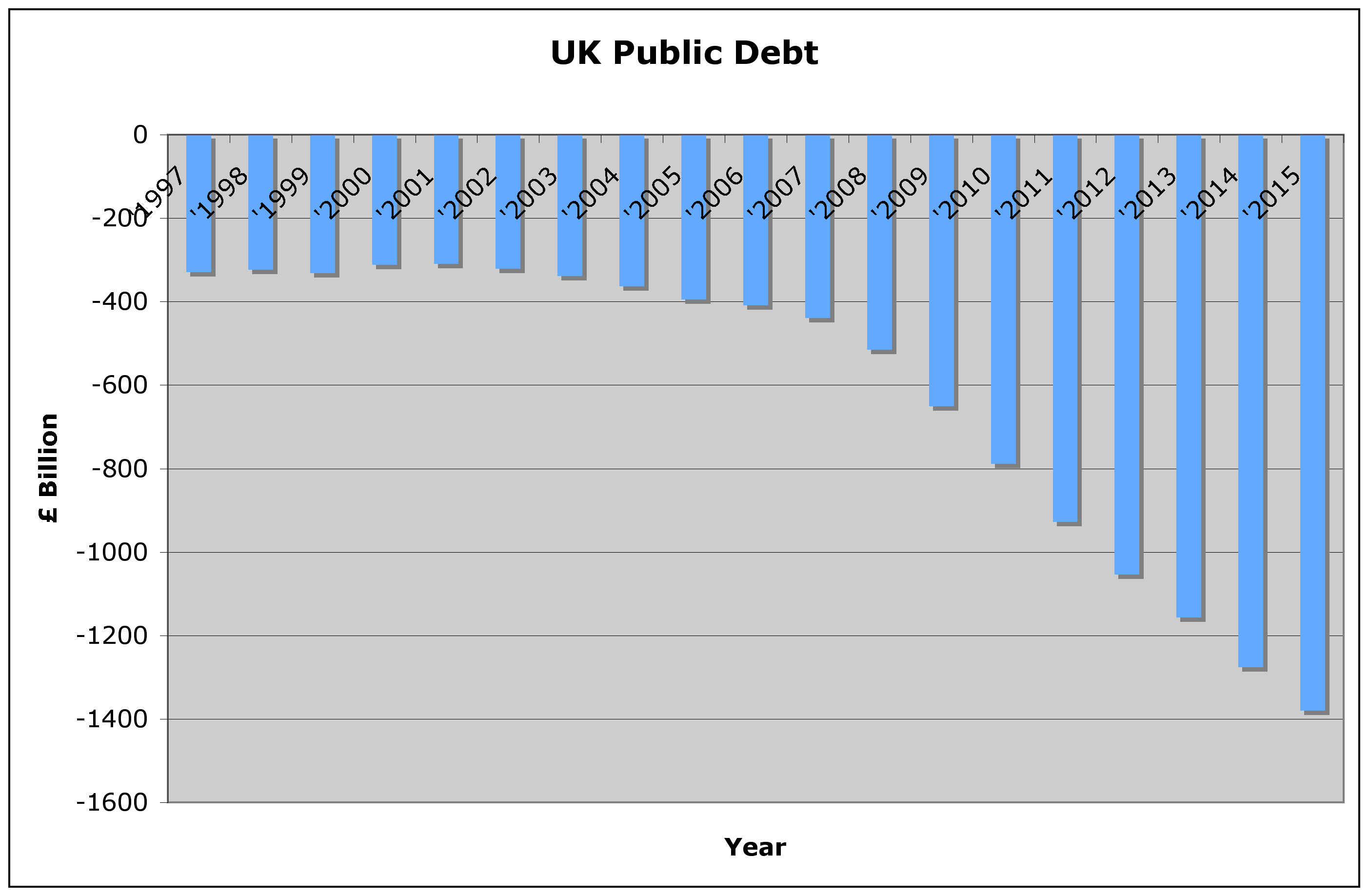
Political squabbling aside, objective observers frame this bottom line in purely fiscal terms: is UK plc broke? Loss of AAA rating suggests it might be but what do the numbers say? As companies are regarded as solvent not whether they have money but whether their credit is good enough to borrow more and hope times improve, let’s take the UK on that more elastic basis. A simple chart of public debt over a couple of decades is shown:

The years 1997 to 2005 were the first two sessions of Blair’s New Labour in which they seemed to hold the boat steady with around £350 bn in debt. But from then on—well before the banking fiasco hit—they seemed to lose the plot, such that by the time Labour had to hand the fiscal reins over to the Condem Coalition, debt had doubled to £650 bn and after three years, Osbo has demonstrated he’s powerless to stop it doubling again.

Nobody comes out of this well. Brown was still canoodling prudence when things started to drift; he and Darling were entirely too cosy with the FSA to clamp down on Canary Wharf’s junk financial wet dreams; neither Darling nor Osbo had the chutzpa to ream those bankers when their odious fiscal concoctions blew up in everyone’s face and nobody—including Balls— is copping to long-term inflationary poison a.k.a. ‘quantative easing’.

Worst of all, no-one has a solution. Both Darling and Balls are claiming they would have borrowed MORE (for feck’s sake) to pump into capital projects. Yet they insist their runaway welfare state is sacrosanct. But look at where all the money in that drunken-sailor free-fall shown above is going.

Share of UK Government Expenditure 1997-2015

Share of UK Government Expenditure 1997-2015

Most people think that Defence or Education are the big-spending departments of the UK government. That may once have been true. But while defence has fallen as a share (from 12% to 8%), look at how the great social programmes have mushroomed to take up close to 3/4 of all government spending. Top of all expenditure is public sector pensions costs that, by 2015, will have tripled in less than 20 years.

However hard-earned or desirable an index-linked public pension may be, the hard truth is that every person in the UK contributing £2,500 each year on top of similar amounts for health and welfare is a heavy burden for any economy. But when £126bn debt accumulates each year to sustain it and any prospect of that changing substantially in the future appears weak, then it is the economics of the madhouse.

The principal unionist argument appears to be that in these troubled times, Scotland should stick with big Britain to help it through. The simple truth, shown above, is that Britain is broke, living hopelessly beyond its means and desperate to keep Scotland as its oil and exports are two of the few good news stories. You want a generous welfare state? Six million Scots are few enough could build one on remaining North Sea oil, whereas sixty million British have most obviously failed to do so with the forty years so far.

Posted in Politics | Tagged | 1 Comment

An Apple a Day

Guest Blog from Christina Bonnington of Wired Magazine (Twitter @redgirlsays)

Can the iPad Rescue a Struggling American Education System?

Matthew Stoltzfus could never get his students to see chemistry like he sees chemistry until he added a digital component to his lesson plan.

Stoltzfus, a chemistry lecturer at Ohio State University, struggled for years to bring complex chemical equations to life on the blackboard, but always saw students’ eyes glaze over. Then he added animations and interactive media to his general chemistry curriculum. Suddenly, he saw students’ faces light up in understanding.

When I see a chemical reaction on a piece of paper, I don’t see coefficients and symbols, I see a bucket of molecules reacting,” Stoltzfus said. “But I don’t think our students see that big bucket of molecules. We can give students a better idea of what’s happening at a molecular level with animations and interactive elements.

And many such students are getting this multi-faceted education on tablets. Tablets are reinventing how students access and interact with educational material, and how teachers assess and monitor students’ performance at a time when many schools are understaffed and many classrooms overcrowded. Millions of grade school and university students worldwide are using iPads to visualize difficult concepts, revisit lectures on their own time and augment lessons with videos, interactive widgets and animations.

In the shift to digital, it’s not just about replacing textbooks but inventing new ways of learning,” Forrester analyst Sarah Rotman Epps said. “Some of the education apps being developed for iPad are approaching learning in an entirely new way, and that’s exciting.

Sallie Severns, founder and CEO of iOS app Answer Underground, told Wired that tablets’ simplicity, ease of use and the massive range of academically minded applications available are drawing teachers and educational technologists to the platform in droves.

Tablet-based learning is no longer the niche it was a year or two ago when we saw a handful of early adopters jump on board with iPad pilot studies in selected grades and classrooms. Schools and teachers are embracing the technology in a big way. A Pew study of 2,462 Advanced Placement and National Writing Project teachers nationwide found that 43 percent have students complete assignments using tablets in the classroom. A PBS LearningMedia study found 35 percent of K-12 teachers surveyed nationwide have a tablet or e-reader in their classroom, up from 20 percent a year ago.

The iPad is the most popular tablet option among educators. Apple sold 4.5 million of them to schools and other educational institutions nationwide last year (it sold 8 million internationally), up from 1.5 million in 2011.

Tablets have proven especially popular in elementary education, and they’ve been a “revolution” for kids younger than 8 because they’re fun and intuitive, said Sara DeWitt, Vice President at PBS KIDS Digital. The taps and swipes are easy to learn, so kids spend more time learning their lessons, not their hardware.

The iPad has given us an opportunity to make technology transparent,” she said. “The touchscreen interface is so much more natural than a mouse and keyboard, kids can jump right in.

That said, there’s more to using a tablet in the classroom than handing them out at the door. Teachers and school district administrators must decide how to best integrate them into the curriculum, considering things like the number of tablets per classroom, which grades receive them first, what content is accessed, and when.

How tablets are integrated into classrooms is key to success,” Severns said. “Planning, preparation, implementation and evaluating apps are key to using this new technology.” While adoption is broad, the ways educators are using them varies from class to class, school to district.

Apple’s iTunes U is one tool making iPad-based course integration easier by helping teachers create and curate a wholly digital curriculum. Teachers can pack iBooks textbooks (including titles from major publishers like McGraw-Hill, Pearson Education, and Houghton Mifflin Harcourt), audio and video, documents, and even iOS apps into a single package that students navigate as they progress through the course.

When it launched in 2007, iTunes U was a source for audio and video lectures students could use on their iPods, but Apple introduced a new app in January 2012 that leveraged the capabilities of the iPhone and iPad, adding in iOS apps, iBooks, and video to the mix. Downloads have topped 1 billion, and iTunes U is used by more than 1,200 colleges and universities and more than 1,200 K-12 schools and districts.

Severns said iTunes U is “paving the way for how educators teach and students learn” because it allows for unprecedented ease in distributing and accessing academic content. Simply log on and it’s there.

Still, it can be easier or more beneficial, particularly in K-12 classrooms, for teachers to just round up a collection of dedicated apps (there are more than 75,000 education related apps in the App Store) for students to use. There, tablets are often supplementary rather than being used for the bulk of coursework, so a full blown iPad-based course (like with iTunes U) isn’t necessary. Tablet time is often a reward, where students will get to play a game that isn’t just fun, it’s building on skills and concepts they’re focusing on in class. iOS has built-in controls that can let teachers lock an iPad into a single app and place restrictions on functions like browser access to ensure kids are learning, and not goofing off.

Third party apps also can take advantage of the social networking opportunity inherent to mobile devices. Students can ask questions of each other and the teacher, something Severns said is absolutely necessary to ensure everyone understand the information.

Stoltzfus, the chemistry lecturer in Ohio, said the social networking aspect allows him to poll students mid-lecture to determine how well they’re understanding the topic. He can adjust his lesson on the fly, which he said is “where tablets can really really help us in terms of progressing in pedagogy.

We are approaching the day when tablets won’t be an option, but a requirement.
Arkansas State University, for example, requires all incoming freshman to have their own iPad. But as tablet adoption proliferates amongst those students and schools with the money to buy the devices, low income students and cash-strapped schools may be left behind. That could deepen the divide between those with access to the latest learning tools and those with traditional technology and limited Internet access.

We’re seeing this kind of segregation already, but some of it is self-imposed. Many college freshmen, for example, are using iPads in class while many upperclassmen prefer their laptops or even pen and paper for coursework.

Five years from now when young students come into college, the expectation is going to be a lot different than it is now. They’ll be used to using tablets in middle and high school,” Stoltzfus said. “We have to be the ones that are pushing the limits.

Posted in Education | Tagged | Leave a comment

It’s the Economy, Stupid!

Some eight month ago, a blog called “Like Wolves at Lambing” cited a number of diverse sources all, at the time, agreeing that it wasn’t just an economic but a moral malaise that had gripped the country. While yesterday’s budget might have shown leadership in fixing both, the only comment that signposts the dark road that now lies ahead is the one used by Clinton when locked in a ritual spat with a hostile Congress. Any hope for insightful alternatives to Osbo’s ‘Osterity’ evaporated yesterday in a tired and spitefully personal riposte from Ed MIlliband, who offered little beyond recycled jibes from last year.

This is serious stuff: recessions come and recessions go but the last one this deep and long gave us the Winter of Discontent, the lowest fiscal ebb since WW2. Dig into that era of ridicule for the UK on a global scale and you almost immediately find an economy that had lost its way. Still full of bomb sites and out-produced by the US, the UK rediscovered a non-superpower role in the fifties and sixties that boomed, filling latent domestic demand, the echoes of global dominance in the colonies and old Allies like Portugal. But while buses in 1970 Lisbon may still have been from Leyland, all the taxis were Mercedes.

This and similar points like the obsolescence of Clydeside riveting technology in a world of welding was lost on the TUC. The growth of union power—an absolute godsend against appalling conditions in Victorian times—was boosted by humming factories, railways, mines, etc in the ‘You’ve-Never-Had-It-So-Good” sixties. But while Wedgewood-Benn waxed eloquent on the “white-hot heat of technology”, it was all delusion. Outmoded working practices, insisted on by unions, meant most UK industry could offer nothing of the sort. The US developed airliners and computers, Japan mass-produced chips and consumer electronics, Germany made cars and precision machinery, Korea made steel and built ships. The emblems of the era were the Rolls washing machine and the Austin Allegro: both British-made; both crap; both firms went to the wall.

By 1978, although there were good British designs and conscientious workers, strikes were endemic, inflation out of control and faith in the ‘establishment’ of most generations—including the elderly—thoroughly undermined. It took the brutality of Thatcherism to slap Britain out of its self-inflicted stupidity of class warfare and see that profits could make prosperity for all. But, just as untrammeled sixties wage demands scuppered the seventies, so untrammeled nineties financial greed did for the noughties: Blair was a willing bearer of the new on-yer-bike standards and Irn Broon’s much-cited Prudence was a whore to any industrialist with a bulge in his trousers.

It is a fault of most people that they will forgive and forget much as long as the dosh rolls in. Mobster molls worry more about splitting their prestige nails than who hubby iced to buy them. Every wheeze Canary Wharf dreamed up or pinched from the Caymans was good to go. It’s surprising that more blatant rip-offs like unnecessary loan insurance didn’t occur. Whatever the FSA was doing, it wasn’t its job. Junk mortgages may not have been invented in London but they wrapped ’em in ‘securities’ and traded the sanitised result with gusto anyway—with the ludicrously styled ‘investment banks’ to the fore.

In 2007 when the whole Potemkin village of global equities that were actually worthless came unglued, the hale clamjamfrey should have gone down the toilet because anything else offends logic, morals and common sense. Dragging bankers through the streets to be pelted with ordure might be extreme but NONE  were summarily fired and ridiculed for gross misconduct; most are still in the jobs and pulling down bonuses.

There is a kind of silent conspriracy among the press, politicians and the public just now to roll about in anguish at the present pain of austerity. But the previous quarter-century of increasing prosperity has made us forget what austerity really is. It is not holidaying in Mallorca instead of the Seychelles; it is not postponing replacing the Chelsea tractor for another year; it is not settling for a cheaper 42″ telly. We are not in austerity if we spend  £40bn on war we don’t need to wage or £169bn on pensions and benefits (£3,000 for every person) when much of that goes to people who don’t really need it. The UK now has 306,655 millionaire households—more than 1 in 100—but, worse than that, most of the other 99 envy that one above all else.

It’s typical of an old fart to bemoan sliding standards and muse wistfully how it once was so much better. But that’s not the point I’m making. The fifties were a time of scrabble and hardships that makes today’s circumstances of care for the vulnerable and elderly seem luxury by comparison. But the mentality has changed. Whereas then, people would look after those in their family in need, it’s now seen as the state’s problem. As few now know their neighbours as they once did, they’re quick to sue them or plant leylandias. If the size and opulence of your house is not now the main measure of your worth then your car or job is. This rather poisonous inheritance from Thatcher grew rather than diminished under Blair.

So, whereas in the fifties, remnants of the ‘Dunkirk spirit’ got people to work together to generate a mini-boom and in the eighties, the constricting dead hand of the work-to-rule was swept away by right-wing radicalism to give the most prosperity any of us have seen, we now have neither to fall back on. The cohesion of society through contentment with their lot has long since given way to ambition clueless about how that could be achieved, other than through the lottery and similar opportunism. If bankers get £1m+ bonuses for demonstrably being incompetent clots, why shouldn’t I?

And so the hope of diminishing the benefits bill is illusory if everyone has now lost their fifties ethics and will claim every bean they can—whether entitled to or not. The only hope is a real stimulus to the economy by the incredibly simple concept of making stuff that people want to buy, of adding value. Danny Alexander just boasted of over 1m new jobs in the private sector, as if that were the philosopher’s stone. But how many of those are stacking shelfs at Poundland or sweeping up at a hairdresser’s?

It may be we need even more years of this stagnation before enough of us admit that we have grown fat and greedy, that we wouldn’t last five minutes doing the jobs our grandfathers did, still less survive on their wages—even their inflation-adjusted wages. What we need, since the public now owns them, is for the government to have the guts to take out the senior bankers of RBS and Lloyds/BoS and shoot them—even if only figuratively. They might consider shooting the business and investment elements too.

They will then take over the banks and start providing serious loans to small businesses at ludicrously small rates (because that’s where the much-tarnished LIBOR has been for years) and they will keep doing that even after the economy picks up. It will send a shock through the financial establishment that, for once, the country means business and that no cow is sacred. There are a few ideas in this budget that complement that, such as the 20% help with deposit for first-time buyers and there will be need for many building services companies to reverse the stagnation in construction in order to build those houses. But farting around with 1p off beer is Nero fiddling while Rome burns.

For Cameron, Osborne and either side in Westminster are all clearly in thrall to the City. So the bad boys will continue to pull down fat seven-figure pay cheques, innovation will stall on the bureaucratic incompetent caution of their so-called ‘business’ managers and we will see real austerity when yuppies find themselves rummaging in the out-of-date bin at Tesco. Or you can take a look at a man like John Swinney, the banker-that-never-was, and ask yourself if you would not prefer a man like that—clear competence and bankerly judgement—to be in charge of the much easier financial recovery of an oil-rich state whose people are famed for their canniness wi’ the bawbees.

Posted in Commerce | Tagged | Leave a comment

Pushing the Patch

Though we’ve reached the Equinox, it surely feels like a long road to the end of winter. Normally dry East Lothian is underwater with its roads and fields flooded after a week of intermittent rain, capped by two days of Easterlies constantly lashing the place with sleety snow. This has driven anyone with sense indoors and farmers scrambling into difficult corners to help their sheltering ewes with lambing.

But I’m already thinking of summer.

With barely a week to Easter and the dawn breaking ever earlier, optimistic hearts are convinced this can’t last—the signs are all there: snowdrops in Binning Wood are almost past; crocus are nodding to each other in colourful crowds; winter wheat greening the otherwise mud-and-puddle fields; the first scouts of Spring’s great battalions of daffodils is already nodding to you. I gave a lift in from Tantallon Castle to a Malaysian and a Turkish German, so the visitors are already among us.

So, I’ve been thinking of the coming season and hoping against hope this summer is more than the miserable effort of the last couple of years. Because the North Berwick area really is getting its tourist act together. Quite apart from its year-round appeal to golfers and casual shoppers to its diverse and flourishing High Street, we’re getting to a nice critical mass of different reasons that bring people here. So it’s time to do a sales job on why the North Berwick area is a great place to visit—and not just because I’m setting up a business that hopes to capitalise on that.

Top attraction is the hugely successful Scottish Seabird Centre. Its remote cameras, displays/events and its boat trips out to the islands have brought over a million visitors and spread their visits through the year. Less popular but only because it is less easily accessible is the Museum of Flight, with its Concorde and the best aircraft collection North of Doncaster. Moving up in the popularity stakes are our two magnificent but very different medieval castles: beetling cliff-top Tantallon and stately, civilised Dirleton, both less than 5 km away. And if you like your vintage cars and thirties roadside memorabilia, it’s hard to whack the Myreton Motor Museum (if you can find it!). Not far away is the backdrop for your upstairs/downstairs fantasy to showcase them is Gosford House, the magnificent Palladian pile of the Earl of March & Wemyss.

All those are good value for the entry charge but a slew of other attractions in the area are free, like the garden centres at Merryhatton (bright & new, with a very popular cafe) or Smeaton (in old-fashioned greenhouses and walled garden, with a vegetarian cafe that is a delight for twitchers). Another Walled Garden is opening at Archerfield on Friday 22nd touting excellent food and a microbrewery to go with views of deer grazing by the lake. Archerfield itself, along with the Renaissance have been doing a splendid job of puncturing the fuddy-duddy image of golf, so loved at Muirfield, and bringing top-notch golf into the county year-round. But we’re all looking forward to both the US Kids Golf coming again in May and the Open itself in July. And if you don’t aspire to such championship courses, there are 16 others in the area to choose from.

But also hidden away around the area are a number of other destinations that, just because they don’t charge admission, don’t get the same degree of promotion or, as a result, the same number of visitors. The Flag Heritage Centre is tastefully housed in a classic old doocot behind Athelstaneford church. Tantallon Studios at Halflandbarns is always alive with classes, the stunningly creative pottery of David Cohen or the brilliantly atmospheric oils of his daughter, Kirsty. You can see some of their work in the local galleries, such as Westgate or Greens and Blues in North Berwick as well as lively ones in the neighbouring Gullane and Dirleton villages.

John Muir Country Park offers a variety of draws from family-oriented East Links Family Park,  through a fun-to-get-wet time at Fox Lake Wakeboarding on the south side of the Tyne estuary to the peace of Fir Links Woods and the endless beach at Ravensheugh. There is similar scope for exploration at Yellowcraig on the Nature Trail there and if you don’t want to laze on the beach gazing at Fidra, try Broadsands to the East or Stevenson’s ‘Hidden Coast’ to the West. In the middle of nowhere the former RAF buildings of Drem airfield are home to a wonderful collection of unique outlets, including solid furniture, an archery range, a model shop, carpet outlet and so on at Fenton Barns.

Want something more adventurous? Go watch for deer in Binning Wood or spot waders like grey heron in Balgone Loch or take a good pair of binoculars to Gin Head to watch 150,000 gannets have a good time careening around Bass Rock (best seen from one of the boats out of NB Harbour). In between there are plenty of spectacular houses to goggle at, including Tyninghame, with its immaculate and quaint planned village, restored Fenton Tower or Ballencrieff and the eerier ruins of Hailes or Redhouse.

In between, you’re bound to get peckish or need a cuppa. While North Berwick itself has a real range of cafes and restaurants, you won’t go hungry out in the country. The larger attractions have their own cafes (although castles don’t). That leaves you stuck at Tantallon or Hailes but Dirleton’s cafe is in its gallery (see above) and is popular with locals. There’s great food for such a small village at both the Castle Inn and the Open Arms literally a stone’s throw distant and both also do comfortable accommodation.

Aberlady boasts a good restaurant in Ducks at the Kilspindie but, apart from a couple of pubs, there is no cafe in the village. In Gullane, on the other hand, the choice is broad and evenly good. From the cosy Village Tearoom through the cheery good food of the Old Clubhouse, through the Golf Inn‘s fine hospitality offerings and Falko’s magnificently authentic German Konditorei to Greywalls with its superb Chez Roux dining. Its main culinary rival is the tiny La Potiniere, opposite the Golf Inn.

And, if you’re caught short out amidst the rolling greenery of our countryside, don’t panic: we have outposts of good food in the most unlikely places at least providing afternoon tea and hot soup. Whitekirk Golf Club does such a good lunch that the non-golfers outnumber the original purpose. Or try the Tyninghame Smithy (especially on a sunny day when you can sit outside) or the Fenton Barns Farm Shop (potato skins with salad is superb) and try not to buy too much of the wonderful fare in the shop itself. And for an especially healthy repast, try the cafe in the new Core Health facility just east of Drem. Once you get as far as East Linton or Haddington you are again spoiled for choice.

Because of the high desirability of living in the ‘North Neuk’, house prices haven’t suffered from the recession as much as elsewhere and this has meant we’ve lost a number of hotels and B&Bs because it’s hard to make a business case if you can sell for the thick end of £1m. North Berwick itself has lost the Blenheim House, Beach Lodge, Point Garry, Belhaven and Golf Hotels in the last decade. Other than what’s mentioned above in the villages, what’s still on offer (in rough order of price) are:

For a website that focuses on North Berwick, rather than the general surrounding area of the North Neuk, try the town website. And anyone reading this far who wants to get to know the area better might try the new area specialist tours being offered by my new business venture GoForth Tours.

Posted in Commerce, Environment | Tagged | Leave a comment

Not always easy to distill such heady and touchy concepts into digestible phrases but the Burd shows how it’s done.

burdzeyeview's avatarA Burdz Eye View

I read Alistair Darling’s essay for Scotland on Sunday on the benefits of the Union early yesterday morning and key passages gnawed away at me all day.

The final part of a very good series of essays, three for independence and three against, it gave a wearily familiar view of why Scotland should stay in the UK, one we’ve heard quite a lot of from Labour protagonists.  And no matter how well they turn a phrase, their argument amounts to little more than Scotland being too wee and too poor to go it alone.

But worst of all, it is an argument predicated on the past which offers nothing but warm words and vacuous reassurances for the future.

Darling argues that the financial crisis that faced the UK in 2008 was only resolved because we were all in the UK.  And he claims that this crisis – or at least…

View original post 1,276 more words

Posted in Uncategorized | Leave a comment

King Coal Grinds to a Halt?

Friday wasn’t just the Ides of March; it was also the last day of operation for Scottish Power’s Cockenzie power station, seen variously as the last holdout of Scotland’s age of mighty manufacturing, or as a horribly visible eyesore, or as the single most polluting chunk of industrial gear in Western Europe, depending on your view.

What is clear is that it belonged to another age, when the Clyde still rang with rivets, virtually all power stations—not to mention railways, ships and half the economy—ran on coal and still days in cities produced pea-souper fog that made your eyes smart and you couldn’t see five yards—caused by soot particles from a million coal fires belching smoke from a million chimneys.

Despite this seeming ancient history, ‘Cockenny’ wasn’t that old. In 1961 when Preston Links (one of Prestonpans two big deep mines) closed in response to a steady drop in demand for coal, the site was earmarked for a new power station. It replaced several smaller, ageing coal stations, such as the one on the shore at Portobello (where the five-a-side pitches now are).

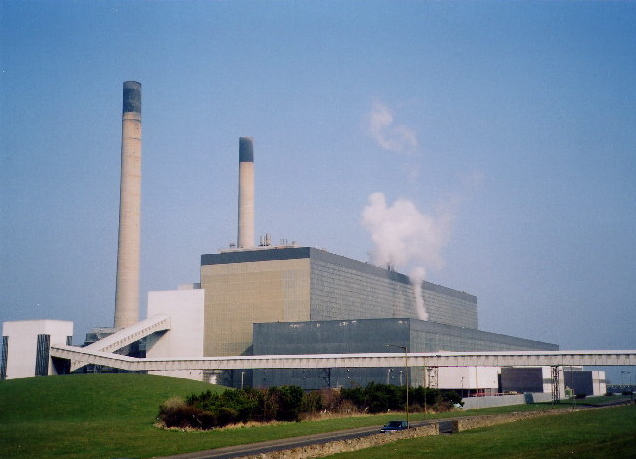
Deigned by the architect Sir Robert Matthew, the 24-acre site is dominated by its 50m-high rectangular main building, housing four identical 300 MW generating units, giving a peak supply capacity of 1200 MW. Each unit consists of a steam boiler driving a large generating turbine and the boiler exhausts paired into two 100m-tall chimneys. The key heavy electrical equipment for the station was manufactured by Bruce Peebles & Co. in Granton (put out of business by a major fire in 1999). Ash left after burning was piped along the shore as slurry to reclaim land in four lagoons on the east side of the Esk estuary. As a result of this, large numbers of waders, gulls and duck now use these lagoons as a high tide roost site, particularly the lagoon nearest to the river mouth.

It was located there originally to be supplied to the station directly from the deep mines of the nearby coalfields, especially the Monktonhall and Bilston ‘superpits’. Both were closed by the mid-’90s and subsequent coal supplies came mostly from open cast mines, including the local Blindwells and as far away as Australia. The power station was the first to use the “merry-go-round” system of coal deliveries by trains of hopper wagons carrying 914 tonnes of coal each train.

Cockenzie Power Station with its Coal Feed Conveyer and twin 100m-tall Chimneys

A Youthful Cockenzie Power Station with its Coal Feed Conveyer and twin 100m-tall Chimneys

Initially operated by the nationalised South of Scotland Electricity Board, it was taken over by Scottish Power in the 1991 privatisation of the industry, then bought for £12 bn by Spain’s 2nd-largest power company Iberdrola in 2006. In 2005 a WWF report had named Cockenzie as the UK’s least carbon-efficient power station, in terms of carbon dioxide released per unit of energy generated.

For almost half a century, it was a pivotal part of Scotland’s energy but, with Torness coming on-stream in 1987, the two nuclear plants generating a steady 2.6GW between them provided the 24/7 base load needed. This meant Cockenzie became more of an auxiliary generator, to be switched on and off as demand required. In its peak year it burnt 1.5m tons of coal but, after the damning 2006 WWF report, its life was proscribed at a certain number of operating hours, to be completed before 2014.

On Friday, the clock ran out.

Many people in the West of East Lothian, will mourn its passing. To them it was a symbol of mighty engineering and ‘man’s work’—a last link to the mining tradition of the area. But, like Ravenscraig, Linwood or Kinlochleven, the era of heavy engineering as a major component of the Scottish economy are long past. And though Iberdrola has plans to put a gas-fired station on the same site, that looks doubtful: the financial situation in Spain is worse than here and people question why a rich chemical feedstock like natural gas should be simply burned.

More important is the opportunity cost of allowing it to continue as a power station. When built, it was surrounded by the industrial landscape of the oldest worked coalfield in Scotland. Now it is surrounded by houses and is a huge blot on the otherwise scenic and tourist-attracting Lothian coastline of the Forth. An idea being punted for a cruise ship and ferry port to replace it could be a far bigger—not to say more attractive—money-spinner.

If that were augmented by a yachting marina and redevelopment of the neglected Presonpans shoreline, a linear park linking Musselburgh lagoons with Longniddry Bents could become a recreational attraction. Visitors and Edinburgh residents would put Prestonpans back on the map and put North Berwick current modest success of  into the shade.

The Last Coal Trains at Cockenzie Coal-Handling Plant (© Phil Rider)

The Last Coal Trains at Cockenzie Coal-Handling Plant (© Phil Rider)

Posted in Commerce, Environment | Tagged | 1 Comment