How to Recruit a Twitterati Lynch Mob

It had been a good couple of days away from it all. Being out of 3G and WiFi has its blessings and spurred a couple of thoughts. So, just to get myself back in the swing of things, for around 24 hours I tried tweeting/retweeting on a dozen or so of—to me at least—pithy issues in the hope of generating some debate and alternate insights.

I needn’t have bothered. As with similar forays I had tried in the past, there seem to be few out there with much insight, most of whom appear to tweet cautiously (pictures of the Rest-and-be-Thankful or pious comments on party conferences). I ran the idea of setting a cat among these Twitterati pigeons by a friend who acted as if I had just suggested trailing muddy boots across his wife’s new carpet: ‘cautioned against it’ would be heavily understating the vigour of his opposition.

But…being who I am (for readers unfamiliar with detail, I am not much of a respecter of unearned authority, or anal health & safety sticklers or those who believe political correctness and the moral high ground go ipse facto hand-in-hand) I persisted in testing the waters. There was an innocuous tweet with a picture of Ruth Davidson doing her bit for Better Together at the Tory Conference, holding one of their posters, which urged us all to keep the British family together. That would do nicely. My tweet said:

@RuthDavidsonMSP sez: “Good to see @UK_Together spread the word” Is there no contradiction in her promoting ‘family’ pic.twitter.com/gqvveVw9bv

No question that was provocative: indeed, that was rather the point. But the following few hours were the same as if you had gone fishing for a few mackerel and landed a shoal of sharks. There were people early on who challenged the undoubted implications in the above, but did so in a firm and even-handed way—i.e. they gave me the benefit of the doubt but asked what I specifically meant. I want to thank the dozen or so of them for their forebearance to which I extended the following amplification:

“For the record, (recipients) I think those w/no family should keep opinions private.”

Which, though still out on a limb and deserving of challenge, ought to have knocked suspicion of homophobia on the the head. Or so I thought. But that was just the beginning. While the usual suspects among those hostile to whatever I say (even if I just quote the phone book) were to the fore, a whole new congregation of hostility joined them and, perhaps most disappointing to me, a number of people familiar with me and my against-the-flow utterances over the years put as venal an interpretation on my original tweet as any of the signed-up hate squad. It was quite an eye-opener.

But my original theory—that real debate is hard to find but you only have to stick a toe into un-PC waters and the moral pirhanas have half your leg before you feel the first bite—seems to stand. There has been debate previously—egged on some by their opponents—that Twitter was awash with Nasty Nats. Brian Wilson, Jim Murphy, David Mundell et al disparaged their harsh, condemnatory hostility as unworthy of the debate. Well, I’m a nat and (the foregoing notwithstanding) not nasty (if you’ve read this far, you may as well find out why by continuing), yet you could have cut the venom with a knife.

First off, my one and only fulsome apology goes to Ms Davidson. I used her and her sexuality (though never specifically mentioned) as bait for the morally oversensitive. The fact that no-one gets to be Tory Leader in Scotland without being able to shrug off such minor jibes as mine is not the point. Her personal life should not be fair game and I made it so to make my point. I have apologised to her for doing that.

And to the (so far) ~57 other tweets that range from unsubstantiated prejudgement to insults, I would ask them to cite—even if I were a homophobic bigot, which I emphatically deny—more than a flimsy hook baited like this one before they go overboard in venting  spleen online. Ask yourself if communication on Twitter, let alone the debate on Scotland’s future and the sum of human knowledge, is advanced by your contribution. And, though my second, amplifying statement (above) is flawed in its attempt to project my opinion on that of another person, I would argue that decent debate should allow such flaws without a black sentencing wig being donned with each transgression.

I cheerfully confess to being a flawed debater. But no statement I have ever made was intentionally homophobic, racist, anti-feminist or any other form of disrespect for other human beings, no matter their provenance or preference. I have disparaged some that I felt were being overly hostile to me but it takes some to rile me and—in being flawed myself—I do almost always see and appreciate the humanity in others. In short, I respect all and seek common ground.

So if any responsible for the 57 ‘hostile’ comments still feel aggrieved, comment here and I will respond to all that are not simply egregiously hostile/insulting. I want a Scotland where people talk to each other (hence my original frustration) and do so in a way that does not resemble lobbing grenades between trenches (see Tweets of Shame below). Nobody remembered that I have praised, quoted and retweeted Ruth Davidson in the past, despite my own hostility to Conservatives and much of what they stand for. We need to understand one another if we are going to have a prayer of discussing options for what matters to us all. Simply jumping all over what others seem to say will not lead to that.

Perhaps I don’t have as broad a mind as I think I have, but I’m trying to improve it.

Are you?

Appendices

The Only One to ‘Get’ It: @Mr_Mark_Brown Ahhh, so this is a parody account after all. Stand at ease folks…

Best Response goes to: @Taffoma Mother Theresa never had kids, but I always respected her opinion!

Second Place goes to: @GeoLaird No is the short answer, but Ruth Davidson needs to learn to hold the sign level

Third Place goes to: @euanmccolm and people without trident missiles in the shed shouldn’t talk nukes.

Tweets of Shame

@greiglam Thank god you only came “ve-e-ery” close to becoming an MSP in 2011. Desperate stuff. With views like those, I feel sorry for your family.

@JamieJamjrw Another ridiculous tweet from @DavidSBerry. Contributes nothing to the debate. Will you ever learn?

@ochayethenews Dickensian! No child or partner but still my community

@Anniewells12 what a complete Pratt

@Jamie4Labour Do your views extend to the Catholic Church or just gay people?

@GeoLaird best quit, you are only digging a deeper hole, real lack of talent in SNP

@endless_psych Glad to see @DavidSBerry was only very close to being one of our MSPs with ill considered tweets like that! FFS. It’s the 21st century mate

@dagwells for the record I think those with opinions like yours should keep quiet.

@colmhowardlloyd  @DavidSBerry asks what @RuthDavidsonMSP would know about families? Because LGBT don’t have families? Idiot..

@RossMcCaff everyone has a family you Fucking moron

@Lrhewat I’m sure you do (have a wonderful supportive family). Don’t let this ignorant mug dampen that.

@biscuit_ersed well aren’t *you* a nasty little man.

@DoctorWallis For the record, you should probably consider keeping your opinions private.

@Lrhewat I’m sure you do. Don’t let this ignorant mug dampen that.

@TheBellesPal Deary me Dave, big foot in big gub again. Dignified response Ruth, he is not worthy.

@MajorDMalpas *Ignorant peasant alert* you must feel so proud David.

@LawryONeill There really is no excuse in this day and age for this sort of nonsensical input

@andyneil_After reading this, I have to say that I’m pleased that you’re no longer in the SNP.

@sonnim8 a bit like heir apparent Osborne talkin about working class. Not a clue!

@indigohumbly plonkers is the only word to describe you

@GarethJAnderson You’re a sad individual, aren’t you? Do you even know what family means?

@greiglam As you can tell from his professional-looking website graphics!

@Fireflysghost &you should be thePosterBoy for #AbortionAsAChoice

@AndrewSouthside Thanks for the info. He’s not fit to hold public office. For the record nothing. It was a homophobic attack & @theSNP should kick u out. Perhaps someone should say the same to @DavidSBerry about his homophobic attack on @RuthDavidsonMSP #shameful

@mrjamesmack My guess is that the SNP leadership will hope @DavidSBerry follows his own Twitter biog and spends more time under the sea after today

@Squidge142 for the record Mr Berry, stupid, illogical, offensive tweet. Say sorry move on

@FraserForsyth Last R/T shows the SNP are still Scotland’s Nasty Party thanks to @DavidSBerry

@tommy_ball that is possibly the most bizarre sentence I’ve ever seen in Scottish politics. Thank God Iain Gray beat you in East Lothian.

@libertycaledoni your point was lost in your moronic ramblings! Distasteful and sublimely ignorant!

@alandssmith It’s a case being nowhere near as bright as he likes to think he is. I found it interesting that in your “apology” you use the word “fulsome” which usually means insincere.

@jasoneccles bigoted tweet alert

@haitch7 elected officials??? Heaven help us.

@euanmccolm this stuff about you “using” ruth to make a twitter point is pitiful. you’re making a bigger fool of yourself.

@daftquine He’s a very silly man. Type that always seeks a platform. & worse…they don’t know that they don’t know!

@UnionistRichard Unfortunately this sort of attitude sums up the separatists; they foment division and discord wherever they can.

@euanmccolm I don’t need to do that (describe why it was seen as homophobic), you idiot. It was a repulsive thing to write.

Posted in Politics | Tagged | 3 Comments

Head Examination

This weekend, a minor fracas broke out in Scottish education circles that barely broke the surface of the media. Professor Andy Hargreaves, an educationalist based at Boston College in the United States, was reported as saying that “England’s education system was obsessed with testing children almost to destruction” and that Scotland’s “will become better than its English counterpart if its fledgling school curriculum is implemented effectively.”

Education secretary Mike Russell found that understandably encouraging, commenting “Such a strong international endorsement of Curriculum for Excellence shows we are moving in the right direction”. And yet, Carole Ford, retired head of Kilmarnock Academy and former president of School Leaders Scotland retorted “the main problem is that there’s no external assessment whatsoever in the pri­mary sector. Teachers know their kids, and don’t like marking them down.”

Clearly there is no meeting of minds between the minister and the chalk face—but then there seldom is. Education has to be one of the worst areas of endeavour in Scotland where those who practice it are most at loggerheads with those who govern it. However, this should not be seen as round umpteen of that bout—and still less another jingoistic ‘yah-boo-sucks’ one-up-man-ship on England—but time for some serious anaysis.

Everybody liked this year’s school exam results which were (again) better than last year’s. But, as this blog has pointed out, there is a natural collusion of teachers, pupils and government in making it so because no-one gains if they get worse. Good results are the key to a university education, which everyone from government to employers are claiming is an unalloyed good. But, with the proportion going to university rising from 19% in 1989 to over 40% now, the mismatch of school focus with graduate reality has become damaging both to students and the economy.

A 2008 study by Francis Green and Yu Zhu at the University of Kent found that a third of graduates were “overqualified”, doing work that wouldn’t usually require a university degree. One out of every 10 graduates was “really overqualified” – doing a job that didn’t use any of their costly university training. Spicerhaart, the lettings agent, has its own graduate-training scheme. Only firsts and 2:1s need apply; stick it out for two years, and you can manage a local lettings agency. What’s getting lost in all this is the original virtue of a Scottish education—breadth and flexibility—as opposed to a focus of training for professional careers via narrowing ‘A’ level subjects and ‘The Greats’ that has so long dominated English education.

Examining Scottish school results shows how far this has already gone with league tables that focus on university-qualifying Highers achieved. This applies in spades to the private schools but they pride themselves as hothouses for future high-flying careers so you get what it says on the very expensive tin. But the rest of the 384 high schools in Scotland exhibit a huge variety of results and, unfortunately, an even wider swathe of NEET (not in employment, education or training) among its former pupils.

STV has published its own league table of state schools, but this is ranked purely on the percentage of the S4 cohort in each school that achieves 5 of more higher passes in later years. On that measure, East Renfrewshire and East Dumbartonshire pack heavily into the top decile, along with Aberdeen’s Cults, Edinburgh’s Boroughmuir and Glasgow’s Jordanhill. Trailing in the lowest decile are Dundee’s Craigie, Edinburgh’s Wester Hailes and Glasgow’s Castlemilk. East Lothian comes in averaging in the middle, with three schools well above and three others well below that average.

All of this is fairly unsurprising. Such league tables are criticised by many for not taking many key factors into account, not least the strong correlation that exists between socially deprived areas and poor academic performance. It is understandably difficult to perform well at school in a substandard, perhaps noisy or disruptive household, with neither support nor example from them to achieve among peer pressure that is all too often the exact opposite. But what if allowance is made for this by multiplying higher results by a factor that can be over two, using the free school meal entitlement as a measure of the depredation in the school catchment?

The results are surprising in that, despite new entries in the top decile (like Notre Dame in both Glasgow and Inverclyde—61st to 2nd & 93rd to 5th respectively) the clutch of East Renfrewshire & East Dunbartonshire schools, plus most of the usual suspects remain. At the other end, while Wester Hailes still languishes in the bottom decile, Craigie moves up into the ninth decile (367th to 323rd) and Castlemilk into the eighth (371st to 306th). That may be a better estimate of their actual performance but it is hard to argue that pupils are leaving with adequate qualifications, even for the social circumstances.

In fact, most disappointing is the case of East Lothian, whose six high schools fall into two distinct groups of three. Evaluated under the STV approach, some disparity might be expected because of a variety of social backgrounds of the six main towns in the county. However, applying the social modifier described above, almost all of their ratings deteriorate—and in a uniform manner across all six, dropping two deciles in five out of six cases, as shown in Table 1.

Comparison of STV School Result Ratings with Modified Ratings

Table 1—Comparison of STV School Result Ratings with Modified Ratings

This seems entirely unexpected. That the three better performing schools should be lower rated when social factors are added would seem logical. But those schools with the more deprived population do equally as badly with the modification and the EL Average drops two deciles in sympathy with that. Examining the modifier for the bottom three, it seems their free school meal entitlement (9.8 – 12.0) is only just above those of the better performing trio (4.4 – 7.7).

So, in East Lothian’s case, any adjustment for social deprivation to explain disparities appears misplaced—1,000’s of new homes in all three western school catchment areas has brought the social mix of the county nearly into balance, with none near the 54 rating of Edinburgh’s Castlebrae or the 43 at Glasgow’s Lochend. (In fact the worst 20 are all in Edinburgh or Glasgow). So what’s the explanation for such disparity? Perhaps it’s a symptom of community dissolution amidst relative affluence?

Examination of school sport in East Lothian soon disproves that. Rugby is the game of choice in all East Lothian High Schools and the Scottish Rugby Union maintains a score card on all Scottish schools, most of whom play rugby as the main sport. They also compile a table for rating teams across the local authorities, shown in Table 2.

Table 2—SRU Rating of Top Performing School Rugby Teams by Council

Table 2—SRU Rating of Top Performing School Rugby Teams by Council

Here we see that the top half of all councils by SRU’s measure are almost exclusively rural councils, many of which inhabit the middle deciles of academic performance. There are few industrial heritage sites or relatively minor levels of social deprivation to be found in any of the above. So why is it that the hard work and dedication (not to mention social support) necessary for success on the rugby field appears strongly present across all East Lothian when the academic equivalent seems present only weakly present in some?
Nobody’s going to tell you that an evening rugby training in December is easier than the same evening spent cribbing Women in Love for an English exam.

Those rugby players fight hard for a place on the 1st XV. And nobody gets a careers guidance officer pushing them into any XV over taking Higher French. Aren’t we now at that foolish point, begun sometime in the 1980’s (when only 1 in 5 went on to Uni) when far too many inadequate pupils get shovelled into academic careers that make little sense to them (or to logic)? They are drafted into the 40+% we now expect to wander the dreaming spires for 3-4 of the most momentous years of anyone’s life.

East Lothian Rugby is just one measure of what can happen when staff, pupils and parents agree on a goal. But, worse than underselling sports like rugby, why do schools persist in placing academic exam results ahead of turning out creative carpenters, subtle cooks and electronic gizmo wizards? By disrespecting vocational training, all of us willfully ignore properly educating a good third of human endeavour on the useful—and lucrative—paths available to them.There are millionaire farmers and plumbers, most of whom enjoy getting their fingernails dirty to see a job well done.

Andy Hargreaves only said the half of it when he claimed “English schools are testing children almost to destruction”. In fact, Scottish schools and their CfE may indeed be avoiding that during a school career, but then they insist on it being the only measure that matters, come the real decision point of that career—school leaving.

The present parent/teacher/pupil self-interest conspiracy that worships written exams (as a route to natty careers) needs to have a word with itself. The careers guidance ‘experts’ who recommend media studies or social anthropology as well paying career paths need to get out more. Both need to lobby HMI and the minister for a sea change in priorities to drop student numbers and boost quality vocational training (and its status) by harnessing the competitive enthusiasm seen in rugby. That might actually see exam results improve as only those who need to take them do so. Or have they all been playing rugby without head protection too long?

Posted in Education | Leave a comment

Why Labour wants us to vote no

Johann Lamont’s Brighton speech welcomes the ‘defeat of independence’ next year so that ‘the Labour Party will not be broken up’. But The Burd goes behind that grandstanding to get at the truth.

burdzeyeview's avatarA Burdz Eye View

I am puzzled by the virulence with which Labour folk have thirled themselves to the Union. 

To put it another way, I am bemused by their inherent opposition to independence.  Oh, there are a few hardy souls who still hold to the notion of an international struggle to create a socialist utopia where the workers have united to defeat the dead hand of capitalism.  But even that doesn’t explain it.  For one, you wonder what they are doing in the modern Labour party at all and for another, why does a union which was formed 300 years ago for politically and economically expedient reasons, represent the most effective vehicle in the 21st Century for achieving such a goal? 

But for the rest of them, those who got with the new Labour project either willingly or with reluctance, why does it matter so much? 

In trying to fathom out what’s going…

View original post 1,140 more words

Posted in Uncategorized | Leave a comment

‘Murdoch’ She Wrote

I am not Cllr. Lesley Hinds’ greatest fan. Much of her work—up to and including the ill-fated Trams—has come in for some stick in this blog. But she is to be commended for highlighting a key issue in our communities as she takes an axe to the £2.7m that Edinburgh City spends on what is called ‘additional officer funding’. Ordinarily, I would take an opposite stance and keep funding but Cllr Hinds has sussed that the rules have changed since our local polis all got herded into one big Police Scotland.

It is generally agreed by most observers (not on the SNP payroll) that Kenny Macaskill got that one wrong. Whatever was flawed in the eight police forces we had across Scotland, rolling them all together and then trying to run the result as if Scotland were Strathclyde writ large was not the way to fix it. Personally, I concede some rationalisation was needed (e.g. four city regions, plus two large rural areas). But the differences in policing Wester Hailes vs the Western Isles puts any one-size-fits-all solution in the dock accused of smash-and-grab management.

When local government was shaken up in 1996, water, police and fire were removed from direct council control. Water eventually became the Scottish Water quango and the other two run by boards of local councillors—until this year. The result was neither democratic nor accountable but it sort of worked because many councils struck up good working relations with their local divisional commander and especially the inspectors who ran local stations. This resulted in the police taking community policing more seriously, being a community officer was seen as a rewarding post and not some career backwater and the value of an officer being in post for years gave them massive visibility into and from their community.

An outcome of this is generally agreed to be the huge drop in crime statistics over the last decade and an engagement by councils to encourage this virtuous cycle. As a result 2 in 3 councils diverted part of their budget above and beyond the obligatory Police Requisition and negotiated with their local force to support additional officers to be deployed where the council felt they would have the most positive social impact. In East Lothian, this meant a serious six-figure sum went to support eight officers in the two wards with the highest social deprivation measures with the understanding that they would be employed in positive intervention, support for an early years scheme and complement the good work done by community officers and the council’s own squad of seven community wardens.

While everyone recognised that there could be no return to the rich, daily ‘Dixon-of-Dock-Green’ knowledge of each citizen, nonetheless PC Murdoch’s ability to distinguish Oor Wullie and his pals’ japes from real crime was fundamental to keeping information flowing from the community so that the bad lads got shopped as often as not. What nobody wanted was to recreate the 1970’s situation in much of Ulster where the RUC might as well have been an occupying army for all the information it got from certain communities.

But that’s just what seems to be happening.

Sir Stephen House (formerly of Strathclyde Police and now Scotland’s Chief Constable) seems to be applying Strathclyde methods across the country. This includes zero-tolerance crackdowns on Edinburgh saunas when they were formerly left largely in peace by Lothian & Borders finest. The Glasgow practice of stop-and-search, used to crack down on armed gangs, has now appeared in other cities where knife and other serious crimes were much less prevalent. The manpower to do this appears to have come from council-funded additional officers who were recently praised for having brought calls to ASBO hot lines donw from hundreds to tens a month.

Were some long-term strategy in place to do this temporarily with the agreement of local councils, this might not be so serious. As chair of the local Community and Police Partnership, I can vouch there has been no such consultation. Worse than that, my home town of North Berwick was almost wholly without traffic wardens all summer—its busiest season—as they were deployed elsewhere (apparently in preparation for police getting out of the traffic warden business altogether). Again, this was done with no consultation and it is only because 99% of mobs of visitors actually adhered to traffic/parking regulations that we did not have jams and avoidable accidents.

And it is this unilateralism and lack of PR awareness that makes all this so tragic. No-one but bad lads wish the police ill. But, after over a decade of assiduous (re-)building of relations between communities and their police to repair damage from closing stations, indifference to minor crime, disappearing beat bobbies and over-reliance on panda cars, what Stephen House is up to smacks of indifference, if not ignorance.

As well as community officers, CAPP meetings include councillors, community groups, wardens, Tenant & Resident panels so when residents with a gripe they want help solving show up, it is dealt with swiftly because all the right people are working together. Everyone knew it was working because not only was crime falling but complaints about possible crime were falling too.

The £10.7m extra councils were willing to share may not look big compared to the police budget of £1.2bn. But it represents incremental spend right at the coal face direct in officers and not equipment, buildings or support staff. It also represents thousands of hours in time by council staff and ordinary citizens on police business that feeds them a stream of invaluable local data that makes solving crimes much easier.

If Stephen House is unappreciative that, then Cllr Hinds is doing us all a favour by firing her £2m shot across his bows to remind him of the essential job that all our splendid PC Murdochs still out there do for our quality of life. But if he proves unaware and/or thrawn about it (and his career largely in English metropolitan areas suggests he could well be) then we have the wrong man and, despite his early Glesca roots, he should piss off back to England.

Posted in Community | Tagged | Leave a comment

Coffee-Coloured Punters

Being old enough to remember main cultural moves in Western society for the latter half of the 20th century, one element that keeps returning to me as various unionists meld the peoples of Britain into one prosperous happy family is a song from the seventies—Blue Mink’s Melting Pot. At the time, it encapsulated rather well the enlightened aspirations of Americans who questioned racialism and xenophobia.

It kept playing in my head as I read the speech by the Deputy Leader of the Scottish Labour Party, Anas Sarwar to the Road Haulage Association Conference, Hampden Park, Glasgow on 10th September 2013. In stark contrast to Ms Lamont at this week’s PMQs, he offers what he regards as a positive vision of Britain as a Union and I commend him for laying off the ritual nat-bashing in doing so. The speech catalogues a series of his reasons and I mean no disrespect if I attempt to paraphrase his main argument into “bigger is better” because—together with a shared island and 300 years of history, that is what most boils down to.

There is much to commend a shared vision across as many people as possible as a force for good and his thesis that the world is simpler and more efficient bundled into larger units has plenty of examples in business, if not in nations. While individual states of the US have pride in their identity (and some dwarf many countries) no-one there or elsewhere is seriously proposing 50 seats at the UN instead of one. The EU is a laudable attempt to ensure once-warring countries jaw-jaw instead of woah-woah and the UN, while having its ineffectual moments, is clearly a force for good in a way that the League of Nations never managed to achieve.

Mr Sarwar waxes quite lyrical as he lists what he perceives as the advantages; “I passionately believe we are stronger politically, economically, socially and emotionally as part of the UK.

  • Politically;
  • our voice is stronger when we speak with one voice,
  • the influence we have through a seat at the top table,
  • which demonstrates the positive influence for change we can be.
  • Stronger in the UN,
  • Stronger in the EU,
  • Stronger in the G8
  • and stronger in the G20.”

True to the original principles of socialism, the sweeping away of national barriers and uniting all in an egalitarian workers’ paradise has a noble history. Seen, as it originally was, against a backdrop of narrow nationalism and even fascism, its appeal to lofty and humanitarian minds was strong. Mr Sarwar’s speech echoes that and therefore deserves some answer.

The short catalogue above does make a powerful argument but contains the seeds of its own disproving. The phrase “demonstrates the positive influence for change we can be” presupposes that effect is always positive. In the last 10 years, the Scots have been taken to war (and dutifully served) in Iraq and Afghanistan, neither of which a majority supported. How are we stronger if our own aspirations—positive relations with the EU; opposition to nuclear weapons; conviction about a better social programme—are consistently swept aside? Ask our fishermen watching Spaniards reel in their catch if this ‘stronger’ voice has helped them. Ask an objective observer which country—Norway or Scotland—benefited most from exploitation of roughly equal discoveries of oil in their home waters.

Then there is the logical development of what Mr Sarwar argues. If big is axiomatically good, why should the UK not become the 51st through 54th states of that other 200+year-old union—the USA? They’re the heavyweight of the planet; they speak (pace Mark Twain) the same language; they share a common culture (at least on TV) and we never hear the end of the ‘special relationship’ we enjoy with Washington. Who says that his argument vis-a-vis size has a scale that stops at Calais? Why isn’t he sticking it right up Tory noses by arguing for a United States of Europe that would surely prove his arguments in spades?

An anciliary question that neither Mr Sarwar nor any of his unionist colleagues seem keen to address is this: if the UK is such a successful union that offers its constituent parts such wonderful advantages, why would Eire not want to rejoin? After all, they shared the same political and cultural unity as the rest of the UK up until 1922. Many Irish helped build the British Empire and numbers comparable to other regions died fighting for its continued prosperity right up until the First World War. Ireland has few resources other than its people; it has no oil, coal, gas, minerals, little that supports a modern industrial nation. Yet even when their banks came close to bust and their property bubble burst harder than the UK’s not one Irish voice suggested scuttling in under the UK’s skirts again. Funny, eh?

Because one thing that Mr Sarwar and his pan-British unionists seem to miss is that people feel and behave best when they are comfortable in the knowledge of who they are. In its most fruitful form, this has little to do with knowing who you are against but a sense of common culture, common purpose and common community. This is something that—for reasons that are not entirely clear to me—at which the Scots have proved to be rather adept.

With curry bidding fair to unseat the haggis as our national dish Scots appear adept at making immigrants all Jock Tamson’s Bairns—of which, Mr Sarwar can rightly claim to be a fine example. This is consistent with the historical fact that the millions of Scots who emigrated elsewhere seldom formed ghettos but assimilated early into the mainstream. Whether as soldiers of Gustavus Aldolphus, Admirals of the Czars, merchants scattered across the Low Countries or signatures on the US Declaration of Independence, the Scots diaspora became a strong integral root of the culture where they landed.

And none of this smacked of the ‘narrow nationalism’ of which Mr Sarwar and his supposed broad-minded colleagues habitually and wrongly accuse those who want Scotland to be a normal country. If England were less paranoid about what lies across the Channel, if the New English were half as well culturally integrated as the New Scots, if the hankering for the dead days of Empire and influence were not such a driver for UK foreign policy, then his thesis that we Scots would be better off thinking of ourselves as British and remaining bound to them might have more persuasive traction. But we don’t.

Especially since the symbolic establishment of the Parliament, Scotland has amply demonstrated its unique culture and aspirations. With no disrespect intended to our English friends, Scots are more societal and less competitive than they; we are more egalitarian and less deferential; we are more emotional and less reserved, more philosophical and less ceremonious. In the last decade or so, these differences have become more marked, with the general English benign ignorance about their northern neighbours increasingly underscoring their differences to Scots themselves.

If this were not so, why would Mr Sarwar himself have to declare an end to factionalism in his party, by which he means Scots Old Labour and its MSPs being at loggerheads with New Labour and their MPs? Good luck to him in this. He is, in fact, thereby tackling the very distinctions that he pretends do not (or should not?) exist in his pan-British ideal.

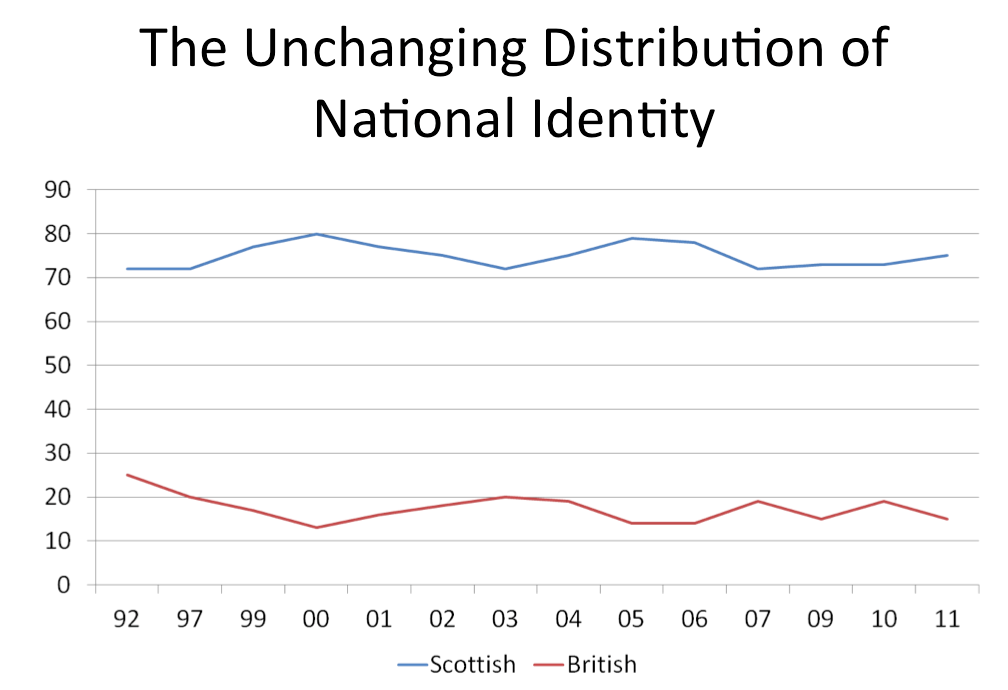
National Identity in Scotland (source: Curtice Social Attitudes Survey)

National Identity in Scotland (source: Curtice Social Attitudes Survey)

Although they have been eloquent in toeing the party line on independence, a number of Mr Sarwar’s colleagues—Douglas Alexander, Jim Murphy and Tom Harris to name a few—have demonstrated a far better understanding of the hill they have to climb in convincing Scots that their better future lies with the Union. He would do well to study their more subtle understanding of what they’re dealing with. But he seems determined to stick with the uninspired moanfest droning from Holyrood’s Labour benches as Lalamont bids fair to be remembered as the leader who out-bored the hapless Iain Gray.

Though he does make a better fist of positive argument than the super-centrist Brian Wilson or the bludgeoning Ian Davidson, Mr Sarwar nonetheless ignores the cultural fact that most (and ever more) Scots identify themselves as just that (see above), even as they become more relaxed about being described as British or European. The once more homogeneous country of Britain fades into history in proportion to the coffee-coloured Scots rediscovering their mongrel roots, their own voice on social integration and the leading role they once played (from Enlightenment to universal schooling to engineering excellence) for the benefit of all.

That ‘all’ includes our good friends in England, who seem to have rather lost their once-impressive way. But only after they stop mistakenly shackling us together mainly on their terms.

Posted in Commerce, Community, Politics | Tagged | Leave a comment

A Geographic Concept

It seems Viking is doing a special on bulk-buy venom this week as ex-MP & Highland Free Press veteran Brian Wilson is using a vat-load in his busy  quill. His article in the Hootsmon today (Weds 11th) is well worth a read, if only to understand the mind of an entrenched commentator for whom the Union is—by definition—as good as things can ever get for Scotland. This time, he focused on what possible currency an independent Scotland could use—“Should we float our groat, stick with somebody else’s sterling or take a punt on the euro?” as Brian puts it—deriding the intermediate use of the pound sterling.

His lodestar in all of this is a paper published by the David Hume Institute Regulation, Supervision, Lender of Last Resort and Crisis Management by Dr Brian Quinn (former Deputy Head of the Bank of England). There may be few points on which Brian and I agree but his assertion that this paper is required reading for any who would debate Scotland’s future is one of them—even if our reasons for that differ.

Because Dr Quinn’s paper is another shell lobbed in a directed barrage of papers that are drip-feeding poison into Scottish ears through a willing media that this whole indy thing is madness. It needs to be taken in context with Danny Alexander’s Scottish Office Scotland Analysis publication series, including  Macroeconomic and Fiscal Performance  and Currency and Monetary Policy. Written by those in the know, such arguments deserve to be met by lucid counter-arguments. They are not merely political posturing—although they do qualify in that department too: independistas (and especially the somnambulent Yes campaign) need to deal with the fact that there are people on the union side of the argument who are just as passionate, articulate and committed as they are.

Now, my training is this fiscal field goes little further than being numerate, paying attention to events and decades of reading the Economist. Nonetheless, the partisanship in the Scotland Analysis series is not hard to expose. On the choice of Sterling as currency that Brian derides, the Scottish Office opines:

“This unilateral adoption of sterling (or “sterlingisation”) would avoid the transition and transaction costs of a change in currency but at the expense of leaving an independent Scottish state with no control over its monetary policy.

“With no ability to print money, a Scottish monetary authority could have at best only a limited function as a lender of last resort to commercial banks. The sterlingisation option would therefore impose severe constraints on monetary and fiscal policy and financial stability.”

Para 1 is fair enough—a country the size of Scotland may need to accept it does not have the clout to adopt its own viable currency—at least not until it is recognised as a hard, oil-backed denomination less volatile than gold. But this ‘lender of last resort’ fiction in para 2 has been peddled by Darling since he was Chancellor. Rather than Scotland going to the wall because of foolish HBOS/RBS profligacy in 2007/8, had it been independent, the 80% of the banks’ business being in England would have forced HM Treasury into an action similar to what happened—and perhaps not so precipitate in giving away so much to the banks as he did.

A secondary argument they make—that the proportion of a Scottish economy dependent on oil would force us into instability with volatile oil prices—ignores two facts: 1) other than the year of global insanity of 2007/8, oil has risen steadily in price from $60 to over $100 a barrel in the last ten years and its viability going forward can be validated by the £2bn+ investment already committed to the North Sea; 2) The Norwegian Krone, far from being volatile with oil prices, over the last decade has strengthened steadily in value—from 7.5 to 6 against the US$ and from 12 to 9.5 against the UK£.

But to Dr Quinn and his weighty paper, which is less obvious to expose. As a Scot, he should have appreciation of the rather differing culture that obtains here and, as a senior servant to the Old Lady of Threadneedle Street, his central banking perspective should be gospel. However, he retired in 1996, long before Irn Broon and his slippery ways infested UK central banking and, perhaps more relevant, spent three decades in the financial heart of London prior to that. Dr Quinn’s principal theses are that:—

“—a shared system of supervision would encounter difficulties, with serious weakness in governance and accountability. As a Scottish Government adopted policies which differed from those at Westminster, these flaws would increase in severity.”

“—the concept of a shared system of supervision and crisis management is seriously flawed and that its weaknesses would increase during the period of transition following independence.”

“—the clarity of responsibilities and procedures which were central objectives of the Financial Services Act 2012 would be reversed…Scottish financial institutions might face a substantial increase in their contributions to a financial compensation fund.”

“—it is important to set out the risks and challenges entailed in moving away from a system built on long experience and the practical lessons of the immediate past, to a system the nature and implications of which are at this point unexplored.”

All weighty points that do not pull punches in implied unknowns. But Dr Quinn really should get out more. The very concept of independence is fraught with uncertainties for a country—more than with any teenager leaving home and moving away, which is scary enough. But, if his “system built on long experience” provides such a desirable model for stability and foresight, what price the 2007/8 fiscal fiasco that made his much-vaunted Financial Services Act 2012 so urgently necessary?

This is the worm at the heart of his argument. He remembers good old days at the Bank—stable, omniscient—before the bright braces of Canary Wharf finished exploring the limits of the 1986 ‘Big Bang’ of financial deregulation and got themselves (and then the rest of us) into ever-deeper trouble creating ‘financial instruments’ built of papier mache, hedge funds of insubstantial twigs and ‘mortgage packages’ from bundles of unsaleable properties—all under the watchful (blind) eye of Irn Broon.

Dr Quinn is writing of another era, when words were bonds; before the similarities between Canary Wharf and Las Vegas became more that just architectural. But his assumption that ‘Scottish financial institutions’ are purely that also derives from an era when they were. But since Sir Peter Burt sold BoS down the Halifax river and RBS jumped on the same empire-building bandwagon, we no longer have the luxury of such clinical distinctions as to which country a bank belongs. The lie to the fiction that England would not have helped bale out an independent Scotland’s banks is given by the fact that:

“Barclays was bailed out to the tune of £552.32bn (at backdated exchange rates) by the US Federal Reserve and £6bn by the Qatari Government.” (Business for Scotland)

This dwarfs the £45bn that Darling squandered on RBS. None of this de facto integration of the financial world—let alone two countries with a joint interest in remaining firm friends—creeps into Dr Quinn’s work, perhaps because it was written for another era to which his own experience applies. The fact that an accommodation, such as he decries would be both necessary and desirable as an arrangement between Scotland and England, eludes him. The fact that without Scotland there IS no UK and that Scots part own all that currently belongs to the UK, including the Bank of England, also passes him by.

But to return to the other Brian and his quill-o’-the-wisp venom that claims “civil servants are being forced to waste their time on composing a white paper on independence while the legs are being kicked away from its central tenets before the tome even sees the light of day”. Let’s assume that prejudging a democratic vote is poor planning and accept that someone should be looking into repercussions of the ‘yes’ option and consider—as he seems unable to—an arrangement for independence in which:

  • England and Scotland both behave like the reasonable long-time friends they are
  • Scotland keeps the £ and places members on the Bank of England committee while
  • Considering other long-term options, such as the €, $ or even Brian’s ₲roat
  • The Scots and English FSAs work closely together to prevent any risk of repeating the cowboy days of 2007/8 (as the Scandinavians did at the time & had no such problems)
  • Just as the Scots recovered from debilitating wars and loyalties in the late 17th © to create the Enlightenment partnerip of Empire and the booming trade of the late 18th © so Scotland could be the best partner England could want—especially if England keeps antagonising Europe and fighting wars it can ill afford.

Just as Dr Quinn seems mired in pre-New Labour assumptions on monetary practice and that fiscal dictatorship by the Bank of England is an a priori good—as well as tenable—in the 21st ©, so the Mr Wilson needs to get off his preoccupation with Great Britain being the only viable country—and by extension political entity—in these islands.

If both Brians and a shed-load of Alastairs/Dannys/Gordons/etc are all so sure of the inherent inviolability of the unity of Britain, answer this question: why did the Irish leave in 1922 and why have they had no desire to return, even their recent darkest fiscal days? To shamefully misquote the great Austrian statesman Metternich (who knew a thing or two about the integrity or otherwise of countries):

“Großbritannien ist nur ein geographisches Begriff”

(Great Britain is merely a geographic concept)

Posted in Commerce, Politics | Tagged | Leave a comment

Disproving the First Law

After a career spent largely pushing paper around in pursuit of ever more complex computer electronics, I returned to Scotland twenty years ago, bringing back an MGB already twenty years old and engaged mechanic buddy Colin to help restore it. For the next year or so, we lay over and under the beast, seeing to various ailments, many of which were age-related and involved removing seized nuts & bolts. Colin’s approach to such problems was a brisk application of WD40 and his First Law of Engineering—When in Doubt, Use a Larger Hammer.

I was reminded First Law by Jim Murphy in the defence debate at the Festival of Politics (see previous blog). He echoed what I have heard from Alastair Darling, Brian Wilson and most other unionist spokespeople when it comes to discussing defence—that Scotland walks taller and ‘punches above its weight’ by being part of the UK. That’s because the UK has a seat on the UN security council, nuclear weapons and the third biggest defence budget on the planet. It strikes me that this is Colin’s First Law writ large on a global scale. And it has all the subtlety of an air raid.

There is, in my opinion, an entire debate to be had whether the UK is in a position to be (or even pretend to be) a global power. The absence of the British emperor’s clothes on the global stage started half a century ago with Suez, became apparent in the Falklands and is the subtext of each American-poodle role UK forces have played since Operation Desert Storm. For me, the jig is up as far as modern global gunboat diplomacy is concerned; the only reason the UK can pretend any global role is as sidekick validator that the US isn’t just a self-interested bully acting alone.

To shore up this role, the UK is spending £7bn to build two aircraft carriers, for which £5.5bn for F35B fighter aircraft cannot be provided at first (and hares have been set running that the UK can’t even afford to finish both ships). Put together with a support & escort force (but no Aegis cruiser because the RN has none), a finished carrier is indeed a potent global weapon—one standing off the Syrian coast (as France’s Charles de Gaulle is currently) may give Assad food for thought. But, given that each US aircraft carrier has three times the planes and three times the clout of any European carrier AND that the USN deploys a dozen of them, both France and the UK are global tiddlers.

And yet, the UK persists in this global role. The workhorse of the RN—the Type 23 frigate is to be replaced by the Global Combat Ship (aka GCS). Because the six larger Type 45 destroyers are costing a cool £500m+ each, at £350m each, the GCS is seen as the escort workhorse well into the 21st century. Indeed it will be a capable vessel, with flexible armament for anti-air, anti-submarine and GP roles. And, at 5,400 tons (25% larger than a frigate), it should have the seaworthiness and habitability for global deployment far from bases.

But, so what? Although both French and American air strikes have been launched into Afghanistan from off the Pakistani coast, it has had trivial effects on the main conflict and done more as an exercise and show of solidarity with the hard-pressed ground troops. To replace all 13 Type 23 frigates will cost £4.5bn and at least two will be committed as escorts for each carrier (along with a Type 45 destroyer), leaving a dozen major surface units for all other tasks. The upside of a ship like the GCS is discussed in a paper from RUSI. But, given Scotland’s geographic position and the rundown of the RAF in the country, what kind of defence are we going to have?

Because what Scotland needs is a regional defence. Leave aside that not being part of the UK would probably reduce any terrorist threat close to zero. In order of probability and priority, Scotland must be provided with defence against:

  1. Terrorist attack on North Sea facilities, especially oil platforms.
  2. Fisheries protection and sovereignty enforcement (incl. drug & contraband traffic)
  3. Long-range intrusion by global powers, whether on, over or under the sea
  4. Major disasters, whether major shipwreck, storm damage or humanitarian aid
  5. Local intrusion by hostile neighbours

The GCS is the optimal platform only for the latter two. Threat No 3 can best be dealt with by long-range maritime reconnaissance aircraft (of which the UK now has none) and land-based air strikes. To best deal with Threats 1 & 2, many more smaller, faster ships would be far preferable to a half-dozen GCS (even if they were deployed in home waters).

Other countries have done the same analysis and come up with better solutions to this set of problems, especially those happy with a simply regional defence and no pretence at global deployment ability. These include:

  • USN Independence class Littoral Combat Ship —2,300 tons, 44 kts, $700m (£470m)—innovative, v. fast trimaran but expensive for what you get
  • German Braunschweig class Corvette—1,840 tons, 26 kts, $309m (£102m)—powerful for its size but teething problems with turbines
  • Spanish BAM (Buque de Acción Marítima) Offshore Patrol Vessel—2,500 tons, 20+kts $110m (£75m)—cheaper but with a high standard of automation and habitability
  • Finnish Hamina class Fast Attack Boat—250 tons, 30 kts, $100m (£68m)—innovative ‘stealth’ boat of shallow draft using water jet propulsion
  • RN River class Offshore Patrol Vessel—1,680 tons, 20 kts, $47m (£32m)—cheapest, with impressive endurance but lightly armed; until recently, leased from the builders

Given that any of the 19 RN ‘major’ ships have been notable by their absence from Scottish waters (there is usually a maximum of one anywhere in UK waters, based at Portsmouth), there is little likelihood that the UK ‘global’ posture will permit that to change. Were Scotland to acquire its ‘share’ of the RN, that would start with two frigates and one of the ‘River’ class patrol boats that are based on the Clyde. That, in itself would provide  better protection for Scottish waters, especially if a squadron of LRMR aircraft were added.

But an optimal protection would be to trade in the two 4,400-ton frigates for something more flexible. assuming that, in the RN each would be replaced by a GCS, the £700m involved could be far better spent. Such a sum (other than one US LCS) would get you:

  • a flotilla of four BAMs for sustained patrol requirements (see above)
  • a flotilla of four Hamina for rapid intercession action (e.g. guerrilla attack on a rig or chasing contraband)
  • two CN-235 turboprop LRMR aircraft to start providing recon support for such a naval

So, trading the single River for something more useful and having eight ships fit for purpose instead of three that are straight out of Engineering’s First Law seems like a deal.

Where such ships would be built is open to debate and there is some risk that they would not be built in Scottish yards. However, given the paucity of ship orders now coming from the MoD, any long term hope for those yards for a future from building RN warships is in jeopardy—whether the UK holds together or not.

Posted in Politics | Tagged | Leave a comment

2013 Festival of Politics V—Defence

This was, for me, the highlight of the whole weekend. Unlike the other panels, which consisted largely of academics and commentators—albeit very capable ones—this featured two heavyweight politicians at the top of their game. They did not disappoint.

  • Professor Louise Richardson, Principal and Vice-Chancellor, St Andrews (Chair)
  • Angus Robertson MP for Moray, Shadow Minister for Defence & Foreign Affairs
  • Professor Hew Strachan, University of Oxford, ex-Director of Scottish School of War Studies
  • Jim Murphy MP for Eastwood, Shadow Secretary of State for Defence

It says much for the capabilities of the Chair and Hew Strachan that they managed to get their views in between the other two. And this is not to say that it denigrated into the usual political yah-boo-sucks typical of Westminster PMQ. Though they hold violently opposing views and articulate them fluently and coherently, lacing them with irony and humour to the point of entertainment, this was a real debate and one it was a privilege to witness.

Angus is as cosmopolitan a man as you can find, having worked extensively in and around Vienna and is fluent in both German and things European. His constituency was the most defence-oriented in Scotland but is now being ravaged by the 2-of-3 air bases cut meted out by the MoD. Elected in 2001 to replace the late Margaret Ewing, as Leader of the SNP group at Westminster he has galvanised his group of six to be an articulate and effective voice on behalf of Scotland putting a much larger group of Scottish Labour MPs to shame.

Jim Murphy is thoroughly deserving of the high status he has achieved. Starting with what should have been the impossible of capturing the safest Tory seat in Scotland in 1997, he showed himself adept at making it his own and now has a bigger majority than the 10,240 he overcame. Starting in 2005, he has held successively higher posts within Labour, including Secretary of State for Scotland, and was regarded as a ‘safe pair of hands’ in all. A vegetarian marathon runner, Jim has an actor’s ability to tailor his body language and delivery to the debate at hand.

After agreeing that defence was unlikely to be decisive in the independence debate, the panel nonetheless also agreed that it was one of the few vital areas of state over which the Scottish Parliament did not have control. Further harmony ensued over the idea that there was little immediate threat to scotland but that, were it to come, it was likely to be in the North Sea and from the Arctic. With themeling of the polar ise cap, the latter was likely to assume more importance than heretofore.

Hew Strachan expanded on Scotland being blessed with a relatively secure position. The biggest threat he saw was the transfer of US (and therefore NATO) focus to Asia/Pacific. This would mean Europe becoming more self-sufficient within NATO and, as co-operation on air/maritime defence is crucial, allies will be an essential element of any credible defence for Scotland. However, he was not sure that a nuclear-free Scotland with only a conventional Coulport/HMNB Clyde would be acceptable to them.

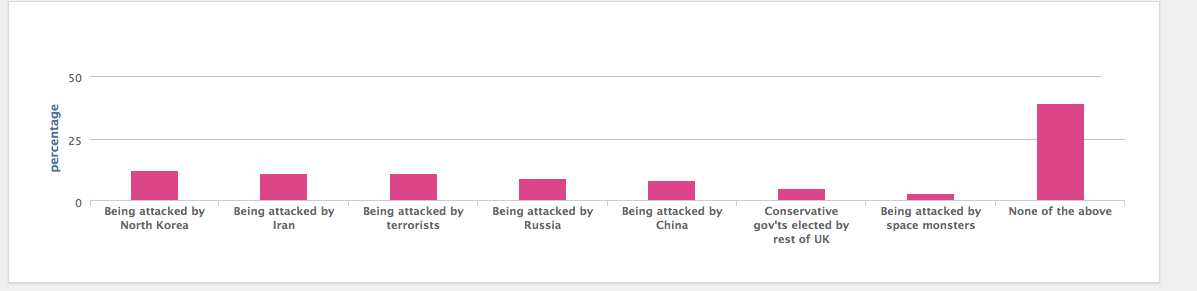
Angus’ main thesis was that the present UK military posture was not appropriate for Scotland. The more obvious elements were the complete absence of long-range maritime patrol capability since the scrapping of Nimrods and their replacement and of any major surface vessels in the critical North Sea arena. Denmark currently spends 1.7% of national wealth on defence, (UK is at 2.5%, which translates to Scotland’s share being over £3.6bn). He argued a much more appropriate defence was available for between £1.6bn (weaker & comparable to Eire) and £2.5bn (comparable capability to Denmark). The key point he made was that everyone—with the possible exception of the USA—could not afford a full-spectrum defence. Interesting data on the perceived usefulness of our £3bn-and-about-to-cost-more nuclear ‘capability’ was gathered by whatscotlandthinks.org

Those Who Think UK Nuclear Deterrence s Effective vs Various Threats (Source: whatscotlandthinks.org)

Those Who Think UK Nuclear Deterrence s Effective vs Various Threats (Source: whatscotlandthinks.org)

Jim focussed on the inability of a country the size of Scotland to maintain the level of ‘clout’ that the UK enjoys. This involves many advantages, including a seat on the UN Security Council, global deployment ability and a credible 24/7 nuclear retaliation. He did not mention any ‘special relationship’ with the US (although Cameron does and Blair did). Only the UK could afford GHQ, which is key in the fight against terrorism, especially cyber-terrorism. We can never be sure of the focus of threats as they change: in 1997, the focus was Northern Ireland and little thought was given to Afghanistan, Libya or Syria; the number of unstable states in the world continues to be double that of stable states.

Hew broadly supported this and argued the 1.7% benchmark was approaching the problem from the wrong end. He was particularly concerned with what he called “infrastructure enablers’ like training and intelligence (again referring to GHQ) and he did emphasise that Scotland’s position required that, rather than arguments about revival of Scots regiments, serious investment in air and maritime which required, as he put it, ‘expensive kit’. Where he did agree with Angus was in the need to any Scottish force to specialise, possibly in an armed policing role which other countries do poorly. Angus agreed, suggesting this was one of the key contributions that Scotland might make. He cited Scandinavia as a model; they provide 25% of all UN peacekeepers, not least because of their reputation for both competence and recognised neutrality and fairness.

As the (lively) debate progressed, it became clear that the two main protagonists were making distinct assumptions about the defence posture to be adopted. Jim clearly saw the global strategic role that the UK played for the last two centuries continuing into the 21st century and argued—quite plausibly—that only larger countries would be able to fund and deploy all the resources necessary to do that. He also argued that Scotland would lose 12,000 MoD workers contributing £1.8bn to the Scottish economy, largely in shipbuilding and the Global Combat Ship would not be built in a ‘foreign’ country. Left to itself, even if it spent £2.5bn, such funds would not go far in defence. He seemed to be recycling the gist of a negative article that appeared the same day in the Sunday Post

In riposte, Angus pointed out that the 5,000 shipyard workers would soon reduce to 1,500 as the QE class carriers neared completion and that, while less than our share of MoD money was spent in Scotland, it still paid £13.4bn of the £160bn MoD procurement budget. But, to him, the key issue was the role envisioned. Scotland had no pretensions at being a world power, especially not on the Security Council or in the nuclear club. To him, it was self-evident that Scots & English should work together, whether in re-introducing real LRMR capability towards the North, working with the Irish, developing the next generation of frigates and co-operating within NATO.

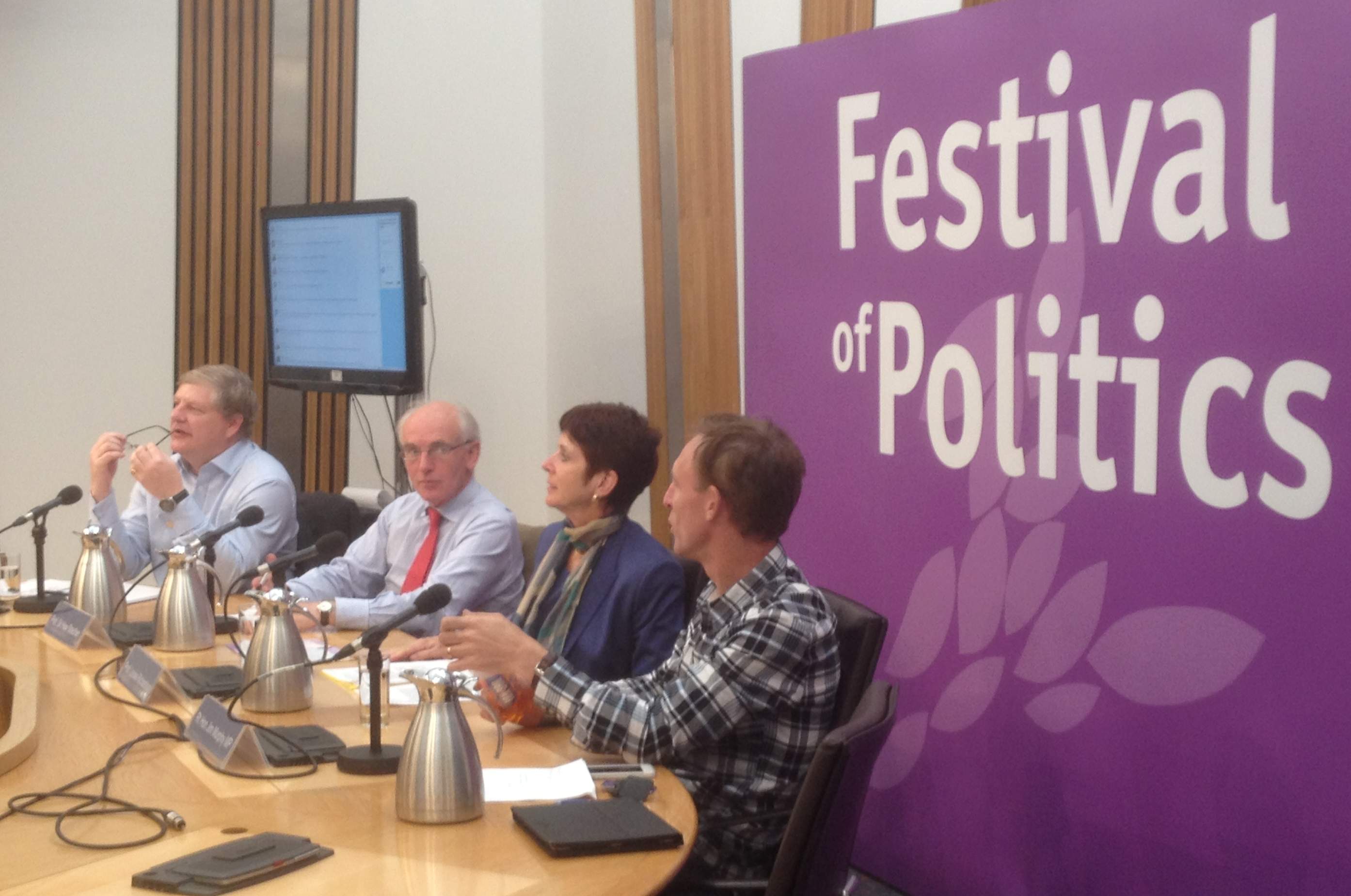
The Defence Panel (l to r) Angus Robertson; Hew Strachan; Louise Richardson; Jim Murphy

The Defence Panel (l to r) Angus Robertson; Hew Strachan; Louise Richardson; Jim Murphy

But it was left to Hew, on the back of a question from the audience, to ask if the real debate was not whether the whole UK—with or without Scotland—was of sufficient size and financial heft to support the kind of global posture that it had to date. He felt that the debate on pros and cons on Scotland’s defence might be distracting from the far more urgent question just what the UK could afford and what other elements of a broad defence spectrum besides LRMR and Harriers must be considered unaffordable.

Posted in Politics | Tagged | Leave a comment

2013 Festival of Politics IV—Public Attitudes

Chaired by the respected Ian Macwhirter, this FoP session launched right into the psephology of the upcoming referendum vote, powered by a deluge of data and graphs from John Curtice and his usual enthusiasm for the subject. In illustrating the debate, I am indebted to the web site whatscotlandthinks.org (“Non-partisan information on attitudes to how Scotland should be governed“). The panel consisted of:

  • Ian Macwhirter, journalist & commentator (Chair)
  • Professor John Curtice, University of Strathclyde
  • Mandy Rhodes, Editor, Holyrood Magazine
  • David Walker, writer & journalist
  • Professor Richard Wyn Jones, Director of Wales Governance Centre, Cardiff Uni.
  • Dr Nicola McEwen, snr. lecturer in Politics, University of Edinburgh

In terms of support for independence, recent polls don’t, in fact, differ much from earlier ones—in fact as long ago as the 1970 Kilbrandon Commission. However, if the ‘don’t knows’ and those unlikely to vote are removed, the committed ‘Yes’ faction sits closer to 40% than the 23% currently published. I t is also interesting that the SNP strategy of the noughties (get power -> demonstrate they can govern -> support for independence will rise—a strategy to which I enthusiastically subscribed) does not seem to have worked. They have governed well since 2007 but their support base has not budged.


IndyIntent2

Poll Responses to “If Held Tomorrow, How Would I Vote on an Independence Referendum?” (source: Curtice/whatscotlandthinks.org)

In analysing polling intentions regarding a vote in favour of independence in more depth, a number of clear trends emerge that are hidden in the overall data. These include:

  • men are more likely to be in favour
  • working class are more likely to be in favour
  • those aged 55 to over 60 are least likely to be in favour, although…
  • in extending the franchise to 16, more voters 16-18 are not in favour than are
  • the range of feeling of “Scottishness” has little effect but “Britishness” has more
  • expectations of the economic impact of independence has a major influence

These last two are interesting discoveries. Two thirds of Scots feel strongly Scottish but are no more likely to vote ‘Yes’ than the other third. But the strength of ‘Yes’ commitment  is in almost exact inverse proportion to the strength of feeling of ‘Britishness’. Since older people tend to hold stronger feelings of British identity, this does some way to explaining the third bullet above. On the economic aspect, there is a strong correlation between optimism regarding Scotland’s economic future under independence and a desire for it.

"How do you perceive the state of the UK economy at the moment?" (source: Curtice/whatscotlandthinks.org

“How do you perceive the state of the UK economy at the moment?” (source: Curtice/whatscotlandthinks.org


This goes far in explaining people’s reluctance to vote ‘Yes’ in the current economy. When the public is asked its opinion in a manner that avoids facing the economic consequences, a far more positive picture emerges. David Walker posed the question: “to what extent do Scots trust the British state” this brought pretty clear answers.  Not only would people prefer the Scottish Parliament to have a dominant, if not total, control over all Scottish Affairs but the degree to which people would choose to have involvement from Westminster is minimal.

Polling results for "Who should make decisions for Scotland?" (source: Curtice/whatscotlandthinks.com

Polling results for “Who should make decisions for Scotland?” (source: Curtice/whatscotlandthinks.com

The bad news for ‘Yes’ is that so many people are still negatively influenced by the UK’s recession of the last five years and a sense that we are not yet out of it. This does, however, offer a chance for positive movement. The most positive things that ‘Yes’ has going for them is their leaders, with Salmond/Sturgeon still rated high in credibility and Cameron/Moore in negative figures (and Moore essentially unknown). Some supposedly pivotal factors do not seem to register as major with the general public—including membership of NATO or the EU; horror at the prospect of more Tory rule if Scotland remains in the Union and the sheer intertia caused by familiarity with the status quo.

Richard Wyn Jones observed that, despite 3/4 of Scots seeming to prefer ‘Devo Plus’ to either of the extreme solutions on offer (Indy/status quo), there is no sense of outrage or unfair play at this ‘third way’ not being available as an option on the September 2014 ballot. Politicians on both sides of the debate were ignoring a pretty clear requirement which, in Wales has been reflected in parties there—including Labour—accepting the wind has changed. But in England, as well as Scotland, there is an existential angst for which few politicians appear able to rise to adequate answer.

What is confusing the issue in Scotland for Mandy Rhodes was that Scottish media had lost impartiality and that this was being aggravated by institutional bias, even within scotland itself. Even when making its best effects, the Scottish media always seemed to posit a ‘glass half-empty’ scenario and never rise to a positive alternative. As an example, the same time as The Scotsman was reporting that the ‘Yes’ camp needed to capture 75% of all undecideds to have a hope of winning, Mori was observing that there was ‘all to play for’.

Perhaps the most insightful observation came from Nicola McEwen—that we are getting into a lather far too early with the vote over a year away. By any standard, the White Paper due in two months will still allow 10 months for debate and a volatility in opinion until closer to the time is to be expected. People (especially undecideds) mainly come to a conclusion only when faced with the decision. After the Crest survey in 1997, many people changed their minds positively before the actual vote on devolution.

The ‘Bottom Line’ appears to be that the ‘Yes’ campaign may be losing the argument but not nearly as badly as the ‘No’ campaign is succeeding in portraying the situation as a ‘done deal’ when polling statistics imply that it is not.

Posted in Politics | 1 Comment

2013 Festival of Politics III—Economics

Rushing from the Europe session to this one with no time allowed in the schedule was another gripe I had for the organisers but, as with the earlier session, it was worth it. Chaired ably by Sir Jeremy Peat of the David Hume Institute where he has a long record of competence staying on top of debate, his panel appeared equally qualified and competent:

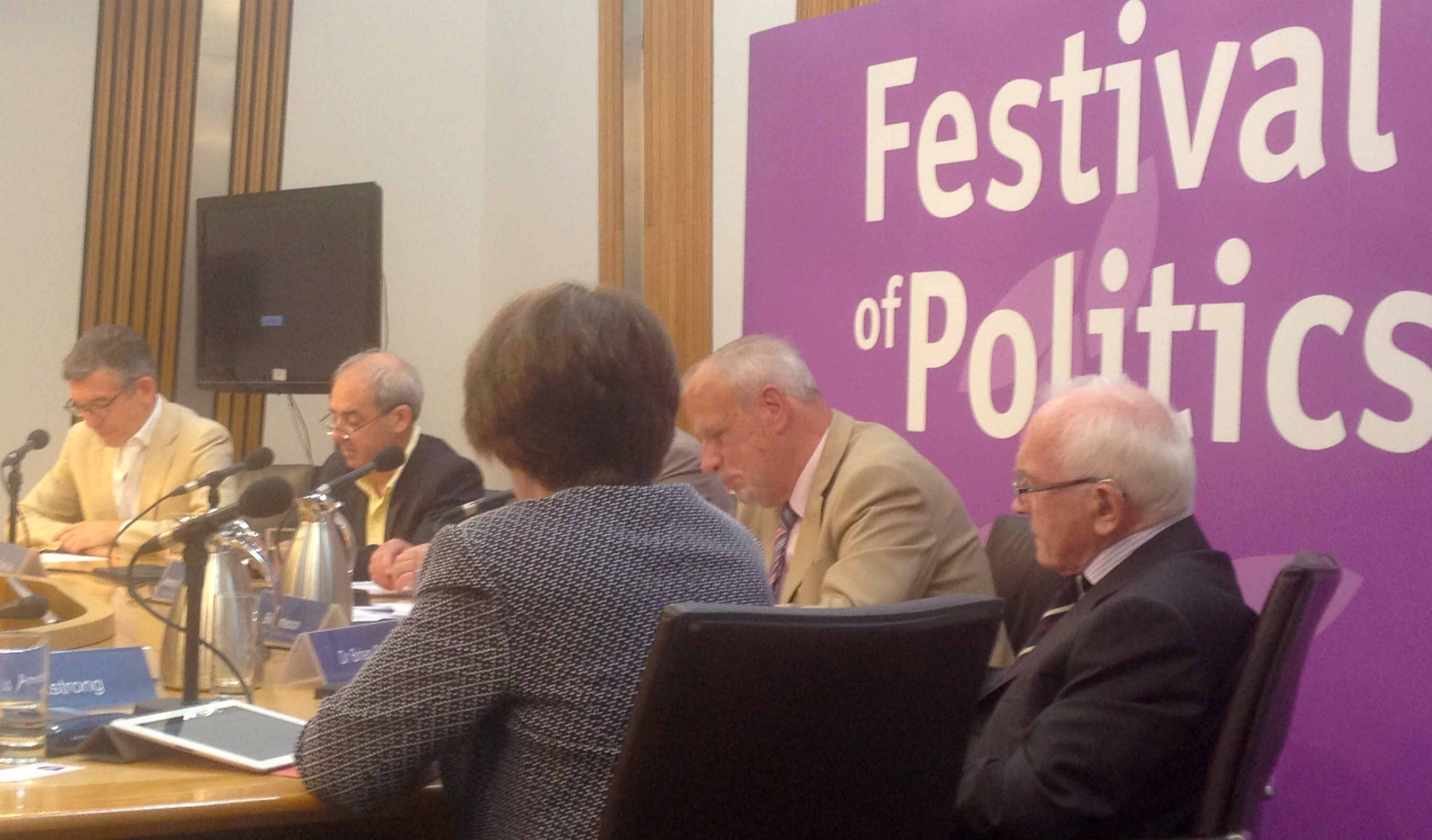
Economics Session: (l-r): Angus Anderson; David Bell; Jo Armstrong (Jeremy Peat behind); Bill Jamieson; Brian Quinn

Economics Session: (l-r): Angus Anderson; David Bell; Jo Armstrong (Jeremy Peat behind); Bill Jamieson; Brian Quinn

Angus Anderson made most of the running, kicking the debate off by arguing that any independence process be regarded as a divorce and that the focus should be on the economic viability of the two units that would be created. He argued that, since Scots started in the Union at 75% of English per capita GDP and now had parity, the Union had been no bad thing. This was underscored by the fact that, if Scotland took its population share of the UK debt of £1tn, that would mean a debt of around £100bn. At some 80% of GDP, this is well outside the EU requirement of 40% and, as a small country, it would be impossible to sell T-bonds to finance it the way the UK currently can.

David Bell, Brian Quinn and Jo Armstrong all weighed in along similar lines until Bill Jamieson and Jeremy Peat became the saving graces of what would otherwise have turned into a textbook Dismal Science Fest among economists—disagreeing only on the source and scale of disaster, but not on its certainty. They did also agree that there were four options to use as a currency:

  • a currency union involving the present pound
  • an informal currency union, such as some countries use the $US
  • adoption of the Euro—generally seen as inevitable if Scotland stayed in the EU
  • a revival of the pound Scots (or its equivalent)
  • (nobody mentioned using the $US and becoming their investment hub in Europe)

However, there was less clarity as which was the preferable option, mainly because the debate seemed to keep circling around to the ill-advised nature of any Yes vote in 2014. It was not that their joint argument was that the UK was doing particularly well and that, if it ain’t broke, we shouldn’t fix it. But the leitmotif from all—despite manful attempts from Jeremy Peat to keep things balanced was that, since the UK is in a tight fiscal spot, then Scotland, with 9% of its resources would ipse facto be worse off.

Of the panel, Brian Quinn seemed the least able to deal with even the concept of an Scotland outside of the UK. Perhaps his decades at the Bank of England instilled a kind of mechanistic thinking but he clearly was unable to foresee any country being run on principles differing from the B of E. In this, he reminded me of Andrew Neil, a bright Scot whose undoubted intellect and keenness on current affairs is ill-informed when it comes to opinions that need understanding of the zeitgeist now abroad in Scotland and from which their decades of residence in London seems to have disconnected them. He agreed with Jo Armstrong that Scotland was ‘overbanked’, as if—properly run—two of the world’s major banks were a burden.

When pressed by the audience, even Angus Anderson accepted that there was no definitive international law that said the remainder of the UK would necessarily become the successor state, nor that England would therefore retain full control of assets and parcel them out (or not) as they saw fit. None of the panel managed to posit any economic future scenario for Scotland that did not involve an austerity that would worsen, the looser our purse strings to London became. Questions they posed—but made little attempt to answer—included:

  • Where is it that Scotland wishes to go?
  • Who would be the winners & losers if we get there?
  • Would we continue to receive a Barnet Settlement?
  • Which currency would it be best to use?

Delving a little into the panel’s background went a long way toward explaining the consistently glum but inconsistently confusing attitudes. In his Report on the Draft Scottish Budget, David Bell sets the tone here with:

“The 2012-13 Scottish Budget is set against a world of increasing economic uncertainty. There are significant risks of further financial collapse along the lines of 2008. This would inevitably impact significantly on the Scottish economy, increasing the likelihood of a further recession. The performance of the Scottish economy since 2008 has been weak.”

But the most suspect of all must be Jo Anderson who peppered her contributions with what seemed like attempts to out-gloom even her colleagues. But then, she has ‘form’ which was exposed in detail in a nifty blog from Joan MacAlpine of two years ago in which her objectivity (if not that of the whole CPPR) was called into question:

“Ms Armstrong was an adviser to another Labour First Minister, Jack McConnell. She is also a controversial figure with what many believe are strong ideological views in favour of liberalising public services. She has advocated the privatisation of Scottish Water. She has associations with those who have most to gain from a return to PFI/PPP – the cost of which has multiplied and delivered huge profits to banks and business consultants. She was involved in the establishment of the Glasgow Housing Association, an  organisation backed by the banks, who were given the city’s entire housing stock but had the debt for that stock completely written off.”

In the 90 minutes, only the audience made any positive contribution. No speculative or positive option appeared. The glib presumption was that Scotland would appear on the world’s stage, naked and friendless, saddled with 80% debt and unable to raise capital. Nobody pointed out that ‘overbanked’ Switzerland or Liechtenstein are economic marvels. Nobody suggested that Scotland could trade the ~£50bn in future oil tax revenues to come against its debt to drop below the 40% debt level required (UK will remain above 90% indefinitely with or without us). Nobody suggested the £1.5bn released from defence and the £5bn-and-rising from energy exports to rUK could themselves pay the interest on even £80bn. The future was seen entirely in terms of a fragment of the UK behaving as a mini-UK—which is pretty much why the Scots are fed up and want to leave in the first place.

This is not to accuse the organisers of the Festival of Politics of bias—and certainly not to demean Jeremy Peat’s efforts to keep things balanced. But imagine Jeremy Clarkson chairing the film personae of Vin Diesel, Craig Statham and Gerard Butler, gathered in all seriousness to discuss gender balance, and you get some sense of the way this session went.

Posted in Commerce, Politics | Tagged | Leave a comment